Amity School of Business BBA V Semester Sales and Distribution Management Module-1 INTRODUCTION
OBJECTIVE ( Gen ) Introduction to Sales Management Evolution, objective, functions and importance of sales management Nature and role of sales manager’s job. Sales management as a career.  Emerging trends in sales management
SALES MANAGEMENT What is Sales Management? “ The planning, direction and control of personal selling, including recruiting, selecting, equipping, assigning, routing, supervising, paying and motivating as these tasks apply to the personal sales force.” -American Marketing Association 1960 “  The management of sales force”
Evolution of Sales Management Situation before industrial revolution (1760AD) Pre industrial revolution ( Before 1760) Dominating small scale manufacturers Manufacturing was the major objective Selling was easy Situation after industrial revolutions Post liberalization revolution Large scale manufacturing organizations Separate departments for manufacturing, finance and sales Selling was not easy Need to identify new markets  Marketing function splits into sales and other functions like market research, advertising, physical distribution
Objectives of sales management Three general objectives: Sales volume Contribution to profits Continuing growth
Nature and Importance  of Sales Management Integration with marketing  management  Relationship selling  Varying sales responsibilities
Importance of Sales Management The only function / department in a company that generates revenue / income The financial results of a firm depend on the performance of the sales department / management Many salespeople are among the best paid people in business It is one of the fastest and surest routes to the top management
Roles and Skills of a Modern Sales Manager Some of the important roles of the modern sales manager are: A member of the strategic management team A member of the corporate team to achieve objectives A team leader, working with salespeople Managing multiple sales / marketing channels Using latest technologies (like CRM) to build superior buyer-seller relationships Continually updating information on changes in marketing environment
Skills of a Successful Sales Manager People skills  include abilities to motivate, lead, communicate, coordinate, team-oriented relationship, and mentoring Managing skills  consist of planning, organizing, controlling and decision making. Technical skills  include training, selling, negotiating, problem-solving, and use of computers
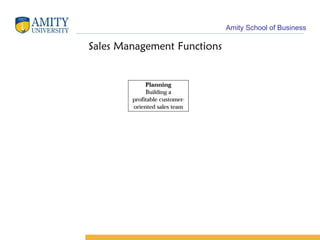
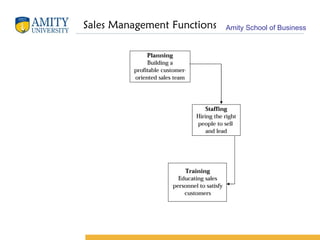
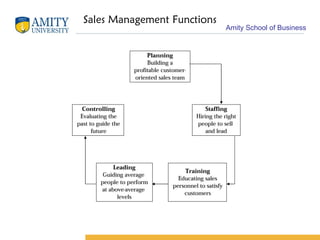
Sales Management Functions
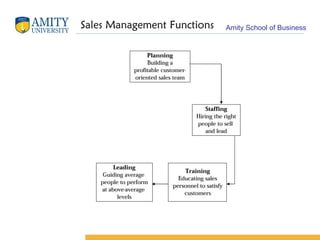
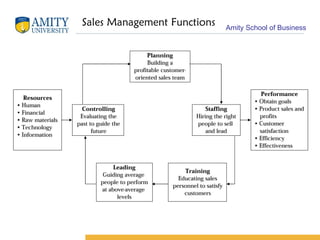
PLANNING The conscious, systemic process of making decisions about goals and activities that an individual, group, work unit, or organization will pursue in the future and the use of resources needed to attain them .
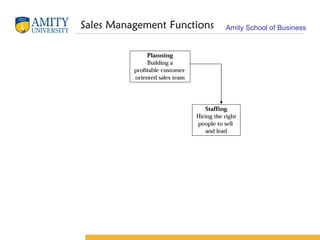
Sales Management Functions
STAFFING Activities undertaken to attract, develop, and maintain effective sales personnel within an organization.
Sales Management Functions
SALES TRAINING The effort put forth by an employer to provide the salesperson job-related culture, skills, knowledge, and attitudes that result in improved performance in the selling environment .
Sales Management Functions
LEADING The ability to influence other people toward the attainment of objectives.
Sales Management Functions
CONTROLLING Monitoring sales personnel’s activities, determining whether the organization is on target toward its goals, and making corrections as necessary.
Sales Management Functions
Sales management as a career. According to US News and World Report, Sales Manager is one of the 50 Best Jobs of 2011 with a predicted increase of 51,800 job openings in the field by 2015 - a 15% growth rate. Skills required for Success in Sales :- Excellent communications skills Strong planning and organization skills Excellent people management skills Good team worker Openness and cooperation Self-motivated, self-disciplined and having the ability to work to tight deadlines Excellent written and verbal English skills Computer literate Academically sound.
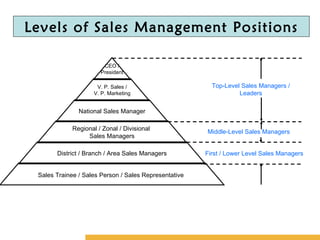
Levels of Sales Management Positions First / Lower Level Sales Managers Middle-Level Sales Managers Top-Level Sales Managers / Leaders CEO / President V. P. Sales / V. P. Marketing National Sales Manager Regional / Zonal / Divisional  Sales Managers District / Branch / Area Sales Managers Sales Trainee / Sales Person / Sales Representative
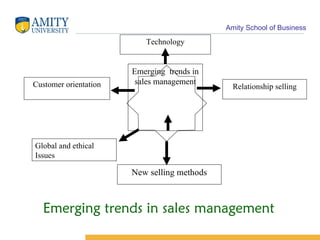
Relationship selling Customer orientation Global and ethical Issues New selling methods Emerging  trends in sales management Emerging trends in sales management Technology
Vendor Management “ A vendor can be any person or a company that is providing services or products on behalf of a covered entity.” Vendor Management is the management and control, by an entity, of those third parties that supply goods and/ or services to that entity. A  Vendor Management System (VMS)  is an Internet-enabled, often Web-based application that acts as a mechanism for business to manage and procure staffing services - temporary, and, in some cases, permanent placement services - as well as outside contract or contingent labor. Typical features of a VMS application include order distribution, consolidated billing and significant enhancements in reporting capability that outperforms manual systems and processes.
Enterprise resource planning (ERP)  "Software solution that addresses the enterprise needs taking the process view of an organization to meet the organizational goals tightly integrating all functions of an enterprise."   Enterprise resource planning  ( ERP ) integrates internal and external management information across an entire organization, embracing finance/accounting, manufacturing, sales and service, customer relationship management, etc.  ERP systems automate this activity with an integrated software application. Its purpose is to facilitate the flow of information between all business functions inside the boundaries of the organization and manage the connections to outside stakeholders.
ERP systems can run on a variety of hardware and network configurations, typically employing a database as a repository for information. ERP systems typically include the following characteristics: An integrated system that operates in real time (or next to real time), without relying on periodic updates.  A common database, which supports all applications.  A consistent look and feel throughout each module.  Installation of the system without elaborate application/data integration by the Information Technology (IT) department
Sales Force Automation (SFA) Abbreviated  SFA , sales force automation is a technique of using software to automate the business tasks of sales, including order processing, contact management, information sharing, inventory monitoring and control, order tracking, customer management, sales forecast analysis and employee performance evaluation. SFA is often used interchangeably with CRM; however, CRM does not necessarily imply automation of sales tasks. SFA tool is often an integral part of an Enterprise Resources Planning (ERP) system
Sales automation systems provide several key functions, plus a wide variety of extra features that are used by a small portion of a sales force.  The main functions of a sales automation system include:  Contact management  Opportunity management  Action Items  Appointment Scheduling  Messaging (e-mail, letter, & fax)  One important side benefit of providing a sales force with a sales automation system is that sales management is able to generate reports, such as:  Sales activity reports  Sales forecasts

SDM Md 1

  • 1.
    Amity School ofBusiness BBA V Semester Sales and Distribution Management Module-1 INTRODUCTION
  • 2.
    OBJECTIVE ( Gen) Introduction to Sales Management Evolution, objective, functions and importance of sales management Nature and role of sales manager’s job. Sales management as a career. Emerging trends in sales management
  • 3.
    SALES MANAGEMENT Whatis Sales Management? “ The planning, direction and control of personal selling, including recruiting, selecting, equipping, assigning, routing, supervising, paying and motivating as these tasks apply to the personal sales force.” -American Marketing Association 1960 “ The management of sales force”
  • 4.
    Evolution of SalesManagement Situation before industrial revolution (1760AD) Pre industrial revolution ( Before 1760) Dominating small scale manufacturers Manufacturing was the major objective Selling was easy Situation after industrial revolutions Post liberalization revolution Large scale manufacturing organizations Separate departments for manufacturing, finance and sales Selling was not easy Need to identify new markets Marketing function splits into sales and other functions like market research, advertising, physical distribution
  • 5.
    Objectives of salesmanagement Three general objectives: Sales volume Contribution to profits Continuing growth
  • 6.
    Nature and Importance of Sales Management Integration with marketing management Relationship selling Varying sales responsibilities
  • 7.
    Importance of SalesManagement The only function / department in a company that generates revenue / income The financial results of a firm depend on the performance of the sales department / management Many salespeople are among the best paid people in business It is one of the fastest and surest routes to the top management
  • 8.
    Roles and Skillsof a Modern Sales Manager Some of the important roles of the modern sales manager are: A member of the strategic management team A member of the corporate team to achieve objectives A team leader, working with salespeople Managing multiple sales / marketing channels Using latest technologies (like CRM) to build superior buyer-seller relationships Continually updating information on changes in marketing environment
  • 9.
    Skills of aSuccessful Sales Manager People skills include abilities to motivate, lead, communicate, coordinate, team-oriented relationship, and mentoring Managing skills consist of planning, organizing, controlling and decision making. Technical skills include training, selling, negotiating, problem-solving, and use of computers
  • 10.
  • 11.
    PLANNING The conscious,systemic process of making decisions about goals and activities that an individual, group, work unit, or organization will pursue in the future and the use of resources needed to attain them .
  • 12.
  • 13.
    STAFFING Activities undertakento attract, develop, and maintain effective sales personnel within an organization.
  • 14.
  • 15.
    SALES TRAINING Theeffort put forth by an employer to provide the salesperson job-related culture, skills, knowledge, and attitudes that result in improved performance in the selling environment .
  • 16.
  • 17.
    LEADING The abilityto influence other people toward the attainment of objectives.
  • 18.
  • 19.
    CONTROLLING Monitoring salespersonnel’s activities, determining whether the organization is on target toward its goals, and making corrections as necessary.
  • 20.
  • 21.
    Sales management asa career. According to US News and World Report, Sales Manager is one of the 50 Best Jobs of 2011 with a predicted increase of 51,800 job openings in the field by 2015 - a 15% growth rate. Skills required for Success in Sales :- Excellent communications skills Strong planning and organization skills Excellent people management skills Good team worker Openness and cooperation Self-motivated, self-disciplined and having the ability to work to tight deadlines Excellent written and verbal English skills Computer literate Academically sound.
  • 22.
    Levels of SalesManagement Positions First / Lower Level Sales Managers Middle-Level Sales Managers Top-Level Sales Managers / Leaders CEO / President V. P. Sales / V. P. Marketing National Sales Manager Regional / Zonal / Divisional Sales Managers District / Branch / Area Sales Managers Sales Trainee / Sales Person / Sales Representative
  • 23.
    Relationship selling Customerorientation Global and ethical Issues New selling methods Emerging trends in sales management Emerging trends in sales management Technology
  • 24.
    Vendor Management “A vendor can be any person or a company that is providing services or products on behalf of a covered entity.” Vendor Management is the management and control, by an entity, of those third parties that supply goods and/ or services to that entity. A Vendor Management System (VMS) is an Internet-enabled, often Web-based application that acts as a mechanism for business to manage and procure staffing services - temporary, and, in some cases, permanent placement services - as well as outside contract or contingent labor. Typical features of a VMS application include order distribution, consolidated billing and significant enhancements in reporting capability that outperforms manual systems and processes.
  • 25.
    Enterprise resource planning(ERP) "Software solution that addresses the enterprise needs taking the process view of an organization to meet the organizational goals tightly integrating all functions of an enterprise." Enterprise resource planning ( ERP ) integrates internal and external management information across an entire organization, embracing finance/accounting, manufacturing, sales and service, customer relationship management, etc. ERP systems automate this activity with an integrated software application. Its purpose is to facilitate the flow of information between all business functions inside the boundaries of the organization and manage the connections to outside stakeholders.
  • 26.
    ERP systems canrun on a variety of hardware and network configurations, typically employing a database as a repository for information. ERP systems typically include the following characteristics: An integrated system that operates in real time (or next to real time), without relying on periodic updates. A common database, which supports all applications. A consistent look and feel throughout each module. Installation of the system without elaborate application/data integration by the Information Technology (IT) department
  • 27.
    Sales Force Automation(SFA) Abbreviated SFA , sales force automation is a technique of using software to automate the business tasks of sales, including order processing, contact management, information sharing, inventory monitoring and control, order tracking, customer management, sales forecast analysis and employee performance evaluation. SFA is often used interchangeably with CRM; however, CRM does not necessarily imply automation of sales tasks. SFA tool is often an integral part of an Enterprise Resources Planning (ERP) system
  • 28.
    Sales automation systemsprovide several key functions, plus a wide variety of extra features that are used by a small portion of a sales force. The main functions of a sales automation system include: Contact management Opportunity management Action Items Appointment Scheduling Messaging (e-mail, letter, & fax) One important side benefit of providing a sales force with a sales automation system is that sales management is able to generate reports, such as: Sales activity reports Sales forecasts