RubyConf China
Why Ruby?
Yukihiro "Matz" Matsumoto
まつもと ゆきひろ
matz@ruby-lang.org
Copyright (c) 2008 Yukihiro "Matz" Matsumoto, No rights reserved
thou
Moore’s Law
The number of Transistors
in LSI Doubles Every
18 Months
Moore’s Law Means:
Computer Grows Exponentially
Faster
Cheaper
More Common
Faster Computer
PCs are Faster than Super
Computers of 20 Years Ago
Cheaper Computers
We can Buy a PC for $400 Now
Common Computers
Now Everyone Owns Computers
Personal Computers
Cell Phones
Cell Phone as a Computer
Everyone is Connected
Broadband
WiFi
Mobile Networks
Influence in Programming
Moore’s Law Changes
Software Complexity
Programming Languages
Software Complexity
No Business Can Be Run
without Software
We Need More Software
Quicker
Cheaper
Humans Don’t Improve
Moore’s Law Does Not Apply to
Humans
Productivity
We Need More Software with
Limited Resources
Productivity
We Have Faster Computers
Development Efficiency At the
Cost of Runtime Efficiency
Productivity
The Most Important Factor of
Language Evolution
Languages are One of the Tools
for Productivity
How Languages Help
Productivity
Sapir-Whorf hypothesis
Language determines the way
we think.
Theorem #1
Languages influence
human thought,
more than you think
Programming Languages
Do programming
languages
influence human
thoughts?
Thinking in Programming
Language
Natural languages are too
ambiguous.
Or, too verbose.
Or, too indirect.
Thinking in Programming
Language.
If programmers think in
programming languages,
They must influence thoughts
as much as
natural languages do.
Theorem #2
"languages" in
Theorem #1 includes
programming
languages.
Why don’t you choose a good
language?
Programming
langugages are so
easy to learn.
What is a good language?
The language that helps thinking
Recursion
BASIC did not allow recursion
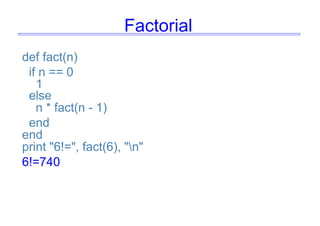
Factorial
def fact(n)
if n == 0
1
else
n * fact(n - 1)
end
end
print "6!=", fact(6), "n"
6!=740
A good Language
does not restrict our thought
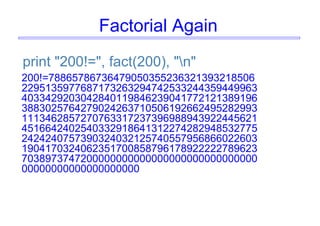
Factorial Again
print "200!=", fact(200), "n"
200!=78865786736479050355236321393218506
2295135977687173263294742533244359449963
4033429203042840119846239041772121389196
3883025764279024263710506192662495282993
1113462857270763317237396988943922445621
4516642402540332918641312274282948532775
2424240757390324032125740557956866022603
1904170324062351700858796178922222789623
7038973747200000000000000000000000000000
00000000000000000000
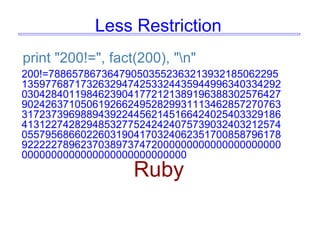
Less Restriction
print "200!=", fact(200), "n"
200!=788657867364790503552363213932185062295
13597768717326329474253324435944996340334292
03042840119846239041772121389196388302576427
90242637105061926624952829931113462857270763
31723739698894392244562145166424025403329186
41312274282948532775242424075739032403212574
05579568660226031904170324062351700858796178
92222278962370389737472000000000000000000000
0000000000000000000000000000
Ruby
A good language
Consise
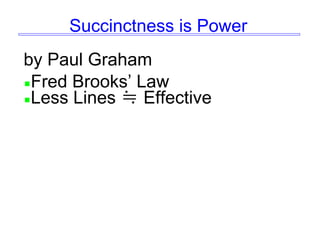
Succinctness is Power
by Paul Graham
Fred Brooks’ Law
Less Lines ≒ Effective
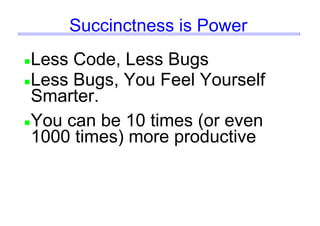
Succinctness is Power
Less Code, Less Bugs
Less Bugs, You Feel Yourself
Smarter.
You can be 10 times (or even
1000 times) more productive
More Factorial
class Factorial {
private static int fact(int n) {
if (n == 1) return 1;
return n * fact(n - 1);
}
public static void main(String[] argv) {
System.out.println("6!="+fact(6));
}
}
6!=740
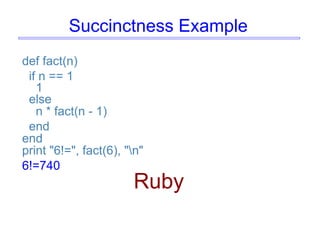
Succinctness Example
def fact(n)
if n == 1
1
else
n * fact(n - 1)
end
end
print "6!=", fact(6), "n"
6!=740
Ruby
A good language
Inspiring
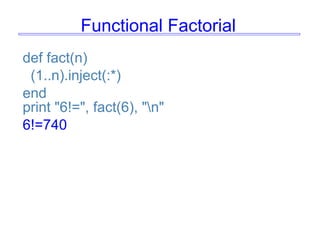
Functional Factorial
def fact(n)
(1..n).inject(:*)
end
print "6!=", fact(6), "n"
6!=740
A good language
makes better programming
experience
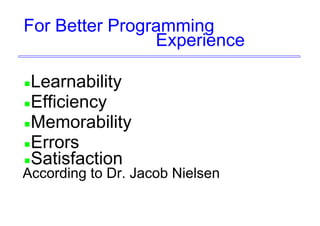
For Better Programming
Experience
Learnability
Efficiency
Memorability
Errors
Satisfaction
According to Dr. Jacob Nielsen
Learnability
How easy is it for users to
accomplish basic tasks the first
time they encounter the design?
Learnability
Usability for Beginners
Important to Acquire New Users
"Common Sense" is the Key
Efficiency
Once users have learned the
design, how quickly can they
perform tasks?
Efficiency
More important than learnability
Efficiency is the top purpose of
languages
Memorability
When users return to the design
after a period of not using it, how
easily can they reestablish
proficiency?
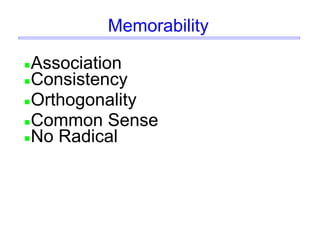
Memorability
Association
Consistency
Orthogonality
Common Sense
No Radical
Errors
How many errors do users make,
how severe are these errors, and
how easily can they recover from
these errors?
Errors
When you see repeated errors,
you have to do something.
Errors are the source of design
inspiration.
Satisfaction
How pleasant is it to use the
design?
Satisfaction
We program to have fun.
Even when we program for
money, we want to have fun as
well.
How Ruby Serves
Learnability
Efficiency
Memorability
Errors
Satisfaction
How Ruby Serves
Learnability
Efficiency
Memorability
Errors
Satisfaction
Learnability
Ruby is very conservative except
for a few places
Quick to learn
Quick to try
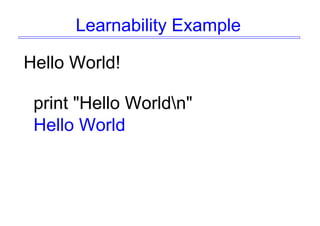
Learnability Example
Hello World!
print "Hello Worldn"
Hello World
How Ruby Serves
Learnability
Efficiency
Memorability
Errors
Satisfaction
Efficiency
No Run-Time Efficiency
Ruby focuses on the cost
of programming.
Devlopment Efficiency
Ruby focuses on the cost of
programming by
Simplicity
Consistency
Smartness
Simplicity
Do you like programming
language to be simple?
Probably you do.
Simplicity
Does language simplicity really
help you?
not always.
need more complex tool
sometimes
Need More Complex Tool
Knife vs Chain Saw
Bicycle vs Airplane
Human Heart: No Simple
We love simplicity
We love complexity
We love easy problems
We hate easy problems
Pseudo-Simplicity
Ruby is NOT a simple
language.
Simplicity Example
Rakefile
Rake = Ruby Make
task :default => [:test]
task :test do
ruby "test/unittest.rb"
end
Simplicity Example
In Simpler Syntax
task({:default => [:test]})
task(:test, lambda(){
ruby "test/unittest.rb"
})
Solution-Simplicity
Tool Complexity is OK
if it makes the Solution Simple
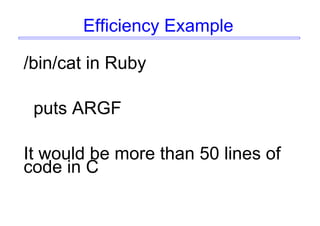
Efficiency Example
/bin/cat in Ruby
puts ARGF
It would be more than 50 lines of
code in C
How Ruby Serves
Learnability
Efficiency
Memorability
Errors
Satisfaction
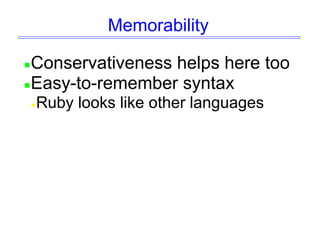
Memorability
Conservativeness helps here too
Easy-to-remember syntax
Ruby looks like other languages
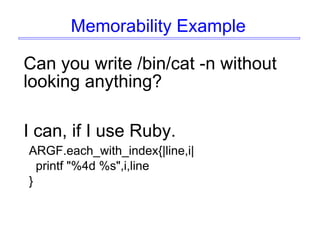
Memorability Example
Can you write /bin/cat -n without
looking anything?
I can, if I use Ruby.
ARGF.each_with_index{|line,i|
printf "%4d %s",i,line
}
How Ruby Serves
Learnability
Efficiency
Memorability
Errors
Satisfaction
Errors
You will see less errors due to
Consistent Syntax Rules
Succinct Code
Less code, Less bug.
How Ruby Serves
Learnability
Efficiency
Memorability
Errors
Satisfaction
Satisfaction
As a result, Ruby is fun to use.
It makes you feel smarter.
Ruby the Language
Ruby is Good for
Text Processing
Web Programming
XML Programming
GUI Applications
Ruby is Good for
Bioinformatics
eXtreme Programming
"I love it. Conceptually it is really clean and sweet."
-- Kent Beck
Why I created Ruby
Just for Fun
Tool for me myself
Ideal tool for Everyday Task
How I created Ruby
Combine Good Things from the
Past
Design Conservative
Design a Tool I Want to Use
To Have Fun
The History of
the Ruby Language
Pre-History
OO Fanboy
Language Geek
In 1993
Project Started
Mere Hobby
Goals
Scripting
a la Perl
Nice Clean Syntax
With OO
Real Goal
To Enjoy
Making Language
Implementation
Programming
Process
Lisp Semantics
Smalltalk OO
Conservative Syntax
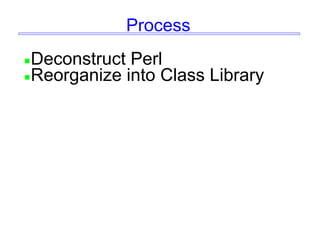
Process
Deconstruct Perl
Reorganize into Class Library
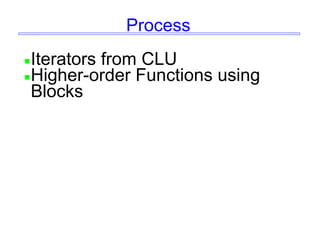
Process
Iterators from CLU
Higher-order Functions using
Blocks
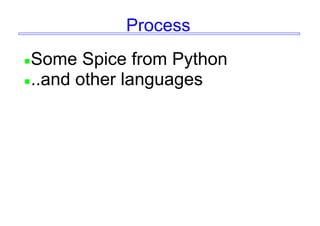
Process
Some Spice from Python
..and other languages
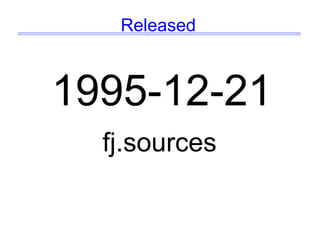
Released
1995-12-21
fj.sources
In 1997
Hired by NaCl
Became Full-time OSS
Developer
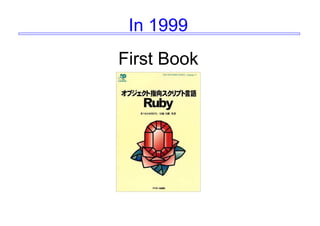
In 1999
First Book
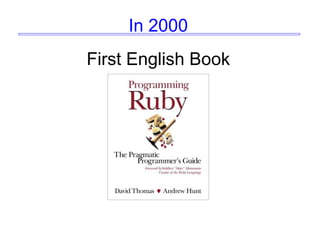
In 2000
First English Book
Ruby in early 2000s
Became a Language
for Geeks
In 2004
Ruby on Rails
Ruby on Rails
Web Application
Framework
Web development that doesn’t hurt
Ruby on Rails
10x Productive than Java
15 Minutes to code Blog
Enterprise Ruby
Ruby started to be used in the
Enterprise Environment
Enterprise Ruby
Concerns
Fast Enough?
Scales?
Enterprise Ruby
Issues are Matters of
Resource/Money We Put in.
Ruby’s Mindshare
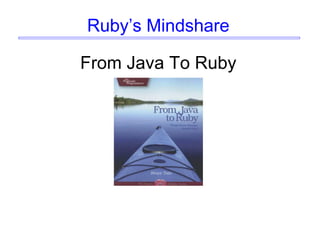
From Java To Ruby
What’s "Enterprise"?
What Major Players
Recommend:
Sun Microsystems
Microsoft
Apple
Etc.
Why Ruby?
Ruby is Productive
Ruby is Motivating
Ruby is Fun
A Message from Ruby
Enjoy Programming!

Why Ruby