INTRODUCTION TO RETAIL BUSINESS
 Definition
 Functions of Retailing
 Types of Retailing
 Forms of retail Business
 Retail Theories
 Retail Life Cycle
 Retail Business in India
 International Perspective in retail business
MARKET
 Market is any system or place where parties are
engaged in exchange of goods or services.
 The two parties involved are called as buyers and
sellers.
 The seller offers goods or services to the buyer who
in return purchases it in exchange of money.
RETAIL
 Retail is the sale of goods to the public in relatively
small quantities for use or consumption rather than
for resale.
 It involves the sale of goods from a single point
(malls, market,dept stores etc.) directly to the
consumers in small quantities for their end use.
 It is the transaction of goods between the seller and
customer in small quantities to satisfy the needs
and wants.
RETAILING
 Retailing consists of those business activities
involved in the sale of goods and services to
consumers for their personal, family or household
use. It is the final stage in a channel of distribution,
which comprises all of the businesses and people
involved in the physical movement and transfer of
ownership of goods and services from producer to
consumer. It involves:
 Interpreting needs of the consumers.
 Developing good assortments of merchandise.
 Presenting them in an effective manner to
consumers
DEFINITION
 According to Kotler, retailing includes all the
activities involved in selling goods or services
directly to final customers for their personal , non
business use.
 According to Kotler , a retailer is any business
enterprise whose sales volume comes primarily
from retailing.
STRUCTURE OF INDIAN RETAIL INDUSTRY
 The retail industry in India is largely unorganized
and predominantly consists of small ,independent,
owner managed shops consisting of the local
kiranashops , owner-mannedgeneral stores ,
chemists , footwear shops , apparel shops, paan
and beedishops , hand –cart hawkers , pavement
vendors etc. which together make up the so- called
‘unorganized’ retail or traditional retail. It can be
classified as :
 Traditional Retail Format
 Modern Retail Format
RETAIL MANAGEMENT
 Retail management is a process of promoting
greater sales and customer satisfaction by gaining
a better understanding of the consumers of goods
and services produced by a company.
FEATURES OF RETAIL MANAGEMENT
 It helps the customers to procure the desired
merchandise from the retail stores for their end use.
 It helps the customers into the store and fulfills their
buying needs
 It makes shopping a pleasurable experience
 It ensures the customers satisfaction
 It helps customers shop without any difficulty
 Facilitate items in large quantities to customers
 Provide products at lower costs
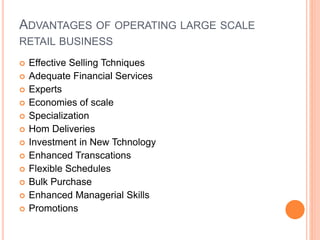
ADVANTAGES OF OPERATING LARGE SCALE
RETAIL BUSINESS
 Effective Selling Tchniques
 Adequate Financial Services
 Experts
 Economies of scale
 Specialization
 Hom Deliveries
 Investment in New Tchnology
 Enhanced Transcations
 Flexible Schedules
 Bulk Purchase
 Enhanced Managerial Skills
 Promotions
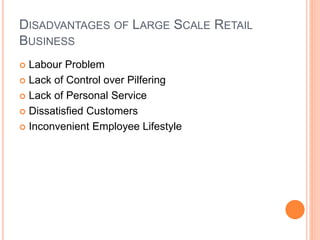
DISADVANTAGES OF LARGE SCALE RETAIL
BUSINESS
 Labour Problem
 Lack of Control over Pilfering
 Lack of Personal Service
 Dissatisfied Customers
 Inconvenient Employee Lifestyle
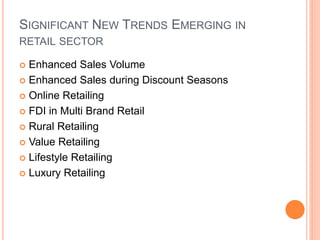
SIGNIFICANT NEW TRENDS EMERGING IN
RETAIL SECTOR
 Enhanced Sales Volume
 Enhanced Sales during Discount Seasons
 Online Retailing
 FDI in Multi Brand Retail
 Rural Retailing
 Value Retailing
 Lifestyle Retailing
 Luxury Retailing
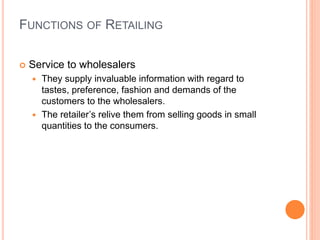
FUNCTIONS OF RETAILING
 Service to wholesalers
 They supply invaluable information with regard to
tastes, preference, fashion and demands of the
customers to the wholesalers.
 The retailer’s relive them from selling goods in small
quantities to the consumers.

Introduction to Retail Business.pptx

  • 2.
    INTRODUCTION TO RETAILBUSINESS  Definition  Functions of Retailing  Types of Retailing  Forms of retail Business  Retail Theories  Retail Life Cycle  Retail Business in India  International Perspective in retail business
  • 3.
    MARKET  Market isany system or place where parties are engaged in exchange of goods or services.  The two parties involved are called as buyers and sellers.  The seller offers goods or services to the buyer who in return purchases it in exchange of money.
  • 4.
    RETAIL  Retail isthe sale of goods to the public in relatively small quantities for use or consumption rather than for resale.  It involves the sale of goods from a single point (malls, market,dept stores etc.) directly to the consumers in small quantities for their end use.  It is the transaction of goods between the seller and customer in small quantities to satisfy the needs and wants.
  • 5.
    RETAILING  Retailing consistsof those business activities involved in the sale of goods and services to consumers for their personal, family or household use. It is the final stage in a channel of distribution, which comprises all of the businesses and people involved in the physical movement and transfer of ownership of goods and services from producer to consumer. It involves:  Interpreting needs of the consumers.  Developing good assortments of merchandise.  Presenting them in an effective manner to consumers
  • 6.
    DEFINITION  According toKotler, retailing includes all the activities involved in selling goods or services directly to final customers for their personal , non business use.  According to Kotler , a retailer is any business enterprise whose sales volume comes primarily from retailing.
  • 7.
    STRUCTURE OF INDIANRETAIL INDUSTRY  The retail industry in India is largely unorganized and predominantly consists of small ,independent, owner managed shops consisting of the local kiranashops , owner-mannedgeneral stores , chemists , footwear shops , apparel shops, paan and beedishops , hand –cart hawkers , pavement vendors etc. which together make up the so- called ‘unorganized’ retail or traditional retail. It can be classified as :  Traditional Retail Format  Modern Retail Format
  • 8.
    RETAIL MANAGEMENT  Retailmanagement is a process of promoting greater sales and customer satisfaction by gaining a better understanding of the consumers of goods and services produced by a company.
  • 9.
    FEATURES OF RETAILMANAGEMENT  It helps the customers to procure the desired merchandise from the retail stores for their end use.  It helps the customers into the store and fulfills their buying needs  It makes shopping a pleasurable experience  It ensures the customers satisfaction  It helps customers shop without any difficulty  Facilitate items in large quantities to customers  Provide products at lower costs
  • 10.
    ADVANTAGES OF OPERATINGLARGE SCALE RETAIL BUSINESS  Effective Selling Tchniques  Adequate Financial Services  Experts  Economies of scale  Specialization  Hom Deliveries  Investment in New Tchnology  Enhanced Transcations  Flexible Schedules  Bulk Purchase  Enhanced Managerial Skills  Promotions
  • 11.
    DISADVANTAGES OF LARGESCALE RETAIL BUSINESS  Labour Problem  Lack of Control over Pilfering  Lack of Personal Service  Dissatisfied Customers  Inconvenient Employee Lifestyle
  • 12.
    SIGNIFICANT NEW TRENDSEMERGING IN RETAIL SECTOR  Enhanced Sales Volume  Enhanced Sales during Discount Seasons  Online Retailing  FDI in Multi Brand Retail  Rural Retailing  Value Retailing  Lifestyle Retailing  Luxury Retailing
  • 13.
    FUNCTIONS OF RETAILING Service to wholesalers  They supply invaluable information with regard to tastes, preference, fashion and demands of the customers to the wholesalers.  The retailer’s relive them from selling goods in small quantities to the consumers.