Introduction to Research Methodology
SVREC,NANDYAL
Dr.M. Bala Theja,M.Tech,Ph.D
Associate Professor
Department Of Mechanical
Engineering
Research & Development
• Research is a process that acquires new knowledge
• Development is a process that applies knowledge to
create new devices or effects
• Research and experimental development (R&D)
Creative work undertaken on a systematic basis in order to increase the
stock of knowledge, including knowledge of man, culture and society, and
the use of this stock of knowledge to devise new applications.
What is Research?
“Research is the systematic approach to obtaining and confirming new
and reliable knowledge”
– Systematic and orderly (following a series of steps).
– Purpose is new knowledge, which must be reliable.
Research is not….
Accidental discovery :
1. Accidental discovery may occur in structured
research process.
2. Usually takes the form of a phenomenon not
previously noticed.
3. May lead to a structured research process to
verify or understand the observation.
Research is not …
Data Collection
• an intermediate step to gain reliable
knowledge.
• collecting reliable data is part of the
research process.
Research is not …
Searching out published research results in
libraries (or the internet)
• This is an important early step of research.
• The research process always includes
synthesis and analysis.
• But, just reviewing of literature is not
research.
Research is…
1. Searching for explanation of events,
phenomena, relationships and causes
– What, how and why things occur
– Are there interactions?
2. A process
– Planned and managed – to make the
information generated credible.
– The process is creative.
– It is circular – always leads to more questions.
• All well designed and conducted research has
potential application.
• Failure to see applications can be due to:
– Users not trained or experienced in the specialized
methods of economic research and reasoning.
– Researchers often do not provide adequate
interpretations and guidance on applications of the
research.
• Researchers are responsible to help users
understand research implications
(How?)
Research is…
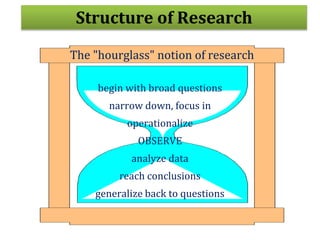
Structure of Research
begin with broad questions
narrow down, focus in
operationalize
OBSERVE
analyze data
reach conclusions
generalize back to questions
The "hourglass" notion of research
What is Methodology
▪ A science of studying how research is done scientifically.
▪ A way to systematically solve the research problem by logically
adopting various steps.
▪ Methodology helps to understand not only the products of
scientific inquiry but the process itself.
▪ Aims to describe and analyze methods, throw light on their
limitations and resources, clarify their presuppositions and
consequences, relating their potentialities to the twilight zone at
the ‘frontiers of knowledge’.
Why should we follow a methodology?
• Research does not begin with the results!!!
• Identification of needs
• Creation of ideas
• Formalization of ideas
• Testing
• Dissemination
• Refinement
Methodology Defined & Described
Methodology and Method are often (incorrectly)
used interchangeable
• Methodology – the study of the general
approach to inquiry in a given field
• Method – the specific techniques, tools or
procedures applied to achieve a given objective
– Research methods in economics include regression
analysis, mathematical analysis, operations research,
surveys, data gathering, etc.
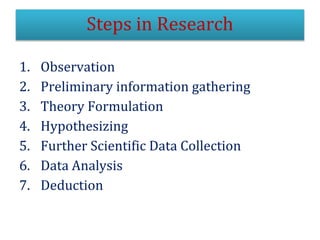
Steps in Research
1. Observation
2. Preliminary information gathering
3. Theory Formulation
4. Hypothesizing
5. Further Scientific Data Collection
6. Data Analysis
7. Deduction
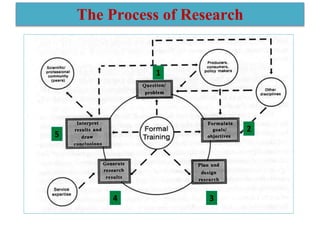
1
2
3
4
5
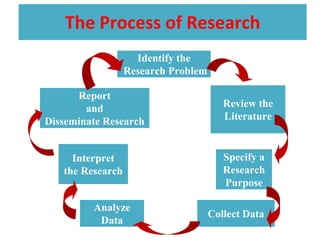
The Process of Research
Identify the
Research Problem
Review the
Literature
Report
and
Disseminate Research
Specify a
Research
Purpose
Collect Data
Interpret
the Research
Analyze
Data
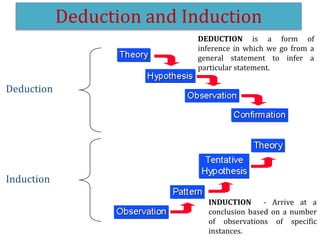
Deduction and Induction
Deduction
Induction
DEDUCTION is a form of
inference in which we go from a
general statement to infer a
particular statement.
INDUCTION - Arrive at a
conclusion based on a number
of observations of specific
instances.
• Applied Research – If the purpose is to solve specific problem currently
faced by the Organization
• Basic or Fundamental Research – To understand various issues in an
organization that are likely to crop up. Aim is not to solve the current
problem but to generate more understanding about the various areas of
interest in an organization.
• Scientific Method – pursues a step-by-step, logical, organized method to
identify problems, gather and analyze data and draw valid conclusions.
TYPES OF RESEARCH
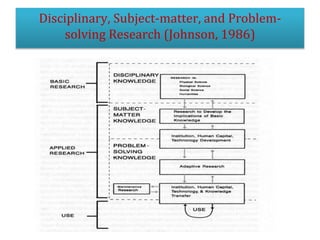
Disciplinary, Subject-matter, and Problem-
solving Research (Johnson, 1986)
• Designed to improve a discipline
• Dwells on theories, fundamental relationships
and analytical procedures and techniques
• In economics, the intended users are other
economists
• Provides the conceptual and analytical base for
other economic research
• It is synergistic and complementary with subject
matter and problem-solving research
19
Disciplinary
• Provides the foundations for applied
research
• Circular as applied research reveals the
shortcomings of disciplinary research
• Examples of some economic theories?
(supply & demand, price elasticity,
consumer utility …)
Disciplinary… Cont..
Subject-matter research
• Provides policy makers with general
knowledge to make decisions about various
problems.
• A primary source of policy applications for
economics
• Subject-matter research is a cornerstone in
economics – it involves direct application of
economics to contemporary issues.
Problem-solving research
• Designed to solve a specific problem for a specific
decision maker
• Often results in recommendations on decisions or
actions
• Problem-solving research is holistic – uses all
information relevant to the specific problem
(while disciplinary research tends to be reductionist)
• Disciplinary research is generally the most “durable”
(long lasting); problem-solving research the least
durable
22
Analytic Vs Descriptive Research
• Descriptive – the attempt to determine, describe, or
identify something
– The intent is often synthesis, which pulls knowledge
or information together
• Analytic – the attempt to establish why something
occurs or how it came to be
─ All disciplines generally engage in both
23
✔ One time/ Cross sectional Vs Longitudinal/Developmental & Trend or
prediction studies (the time domain)
✔ Field setting Vs Lab / Simulation research
✔ Clinical Vs diagnostic studies
✔ Exploratory Vs Formulated (the degree of formulation of the problem)
studies
✔ Historical studies (Greater part of it is quantitative)
✔ Content Analysis is one such quantitative method –a multipurpose
method developed specifically for investigating a broad spectrum of
problems in which the contents of communication serve as a basis of
inference. Example: word usage rates, word counts, etc.
✔ Correlational research
✔ Conclusion oriented or decision oriented research
6/12/2015 Research Methodology 24
Other types of Research
Conclusions
– A thorough literature survey and problem identification
is important before performing research.
– The research area of the student should be chosen as per
the interest over subject.
– A good team with various subject expertise is required to
solve various interdisciplinary problems.
– The research outcome should reach to common people
through industrial, rural and societal development.
Introduction to Research Methodology.pptx

Introduction to Research Methodology.pptx

  • 1.
    Introduction to ResearchMethodology SVREC,NANDYAL Dr.M. Bala Theja,M.Tech,Ph.D Associate Professor Department Of Mechanical Engineering
  • 2.
    Research & Development •Research is a process that acquires new knowledge • Development is a process that applies knowledge to create new devices or effects • Research and experimental development (R&D) Creative work undertaken on a systematic basis in order to increase the stock of knowledge, including knowledge of man, culture and society, and the use of this stock of knowledge to devise new applications.
  • 3.
    What is Research? “Researchis the systematic approach to obtaining and confirming new and reliable knowledge” – Systematic and orderly (following a series of steps). – Purpose is new knowledge, which must be reliable.
  • 4.
    Research is not…. Accidentaldiscovery : 1. Accidental discovery may occur in structured research process. 2. Usually takes the form of a phenomenon not previously noticed. 3. May lead to a structured research process to verify or understand the observation.
  • 5.
    Research is not… Data Collection • an intermediate step to gain reliable knowledge. • collecting reliable data is part of the research process.
  • 6.
    Research is not… Searching out published research results in libraries (or the internet) • This is an important early step of research. • The research process always includes synthesis and analysis. • But, just reviewing of literature is not research.
  • 7.
    Research is… 1. Searchingfor explanation of events, phenomena, relationships and causes – What, how and why things occur – Are there interactions? 2. A process – Planned and managed – to make the information generated credible. – The process is creative. – It is circular – always leads to more questions.
  • 8.
    • All welldesigned and conducted research has potential application. • Failure to see applications can be due to: – Users not trained or experienced in the specialized methods of economic research and reasoning. – Researchers often do not provide adequate interpretations and guidance on applications of the research. • Researchers are responsible to help users understand research implications (How?) Research is…
  • 9.
    Structure of Research beginwith broad questions narrow down, focus in operationalize OBSERVE analyze data reach conclusions generalize back to questions The "hourglass" notion of research
  • 10.
    What is Methodology ▪A science of studying how research is done scientifically. ▪ A way to systematically solve the research problem by logically adopting various steps. ▪ Methodology helps to understand not only the products of scientific inquiry but the process itself. ▪ Aims to describe and analyze methods, throw light on their limitations and resources, clarify their presuppositions and consequences, relating their potentialities to the twilight zone at the ‘frontiers of knowledge’.
  • 11.
    Why should wefollow a methodology? • Research does not begin with the results!!! • Identification of needs • Creation of ideas • Formalization of ideas • Testing • Dissemination • Refinement
  • 12.
    Methodology Defined &Described Methodology and Method are often (incorrectly) used interchangeable • Methodology – the study of the general approach to inquiry in a given field • Method – the specific techniques, tools or procedures applied to achieve a given objective – Research methods in economics include regression analysis, mathematical analysis, operations research, surveys, data gathering, etc.
  • 13.
    Steps in Research 1.Observation 2. Preliminary information gathering 3. Theory Formulation 4. Hypothesizing 5. Further Scientific Data Collection 6. Data Analysis 7. Deduction
  • 14.
  • 15.
    The Process ofResearch Identify the Research Problem Review the Literature Report and Disseminate Research Specify a Research Purpose Collect Data Interpret the Research Analyze Data
  • 16.
    Deduction and Induction Deduction Induction DEDUCTIONis a form of inference in which we go from a general statement to infer a particular statement. INDUCTION - Arrive at a conclusion based on a number of observations of specific instances.
  • 17.
    • Applied Research– If the purpose is to solve specific problem currently faced by the Organization • Basic or Fundamental Research – To understand various issues in an organization that are likely to crop up. Aim is not to solve the current problem but to generate more understanding about the various areas of interest in an organization. • Scientific Method – pursues a step-by-step, logical, organized method to identify problems, gather and analyze data and draw valid conclusions. TYPES OF RESEARCH
  • 18.
    Disciplinary, Subject-matter, andProblem- solving Research (Johnson, 1986)
  • 19.
    • Designed toimprove a discipline • Dwells on theories, fundamental relationships and analytical procedures and techniques • In economics, the intended users are other economists • Provides the conceptual and analytical base for other economic research • It is synergistic and complementary with subject matter and problem-solving research 19 Disciplinary
  • 20.
    • Provides thefoundations for applied research • Circular as applied research reveals the shortcomings of disciplinary research • Examples of some economic theories? (supply & demand, price elasticity, consumer utility …) Disciplinary… Cont..
  • 21.
    Subject-matter research • Providespolicy makers with general knowledge to make decisions about various problems. • A primary source of policy applications for economics • Subject-matter research is a cornerstone in economics – it involves direct application of economics to contemporary issues.
  • 22.
    Problem-solving research • Designedto solve a specific problem for a specific decision maker • Often results in recommendations on decisions or actions • Problem-solving research is holistic – uses all information relevant to the specific problem (while disciplinary research tends to be reductionist) • Disciplinary research is generally the most “durable” (long lasting); problem-solving research the least durable 22
  • 23.
    Analytic Vs DescriptiveResearch • Descriptive – the attempt to determine, describe, or identify something – The intent is often synthesis, which pulls knowledge or information together • Analytic – the attempt to establish why something occurs or how it came to be ─ All disciplines generally engage in both 23
  • 24.
    ✔ One time/Cross sectional Vs Longitudinal/Developmental & Trend or prediction studies (the time domain) ✔ Field setting Vs Lab / Simulation research ✔ Clinical Vs diagnostic studies ✔ Exploratory Vs Formulated (the degree of formulation of the problem) studies ✔ Historical studies (Greater part of it is quantitative) ✔ Content Analysis is one such quantitative method –a multipurpose method developed specifically for investigating a broad spectrum of problems in which the contents of communication serve as a basis of inference. Example: word usage rates, word counts, etc. ✔ Correlational research ✔ Conclusion oriented or decision oriented research 6/12/2015 Research Methodology 24 Other types of Research
  • 25.
    Conclusions – A thoroughliterature survey and problem identification is important before performing research. – The research area of the student should be chosen as per the interest over subject. – A good team with various subject expertise is required to solve various interdisciplinary problems. – The research outcome should reach to common people through industrial, rural and societal development.