The Four Step Process: Research, Planning, Implementation, Evaluation Jackie O'Neal Independent Practitioner's Alliance (IPA member) O'Neal Media Group
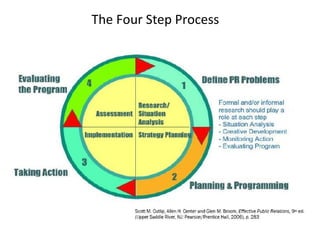
The Four Step Process
Research Create a Problem Statement to ascertain "What is happening now"?  A problem statement consists of a description of the problem encapsulated in a brief paragraph. Written in present tense Describe the situation in specific and measurable terms.
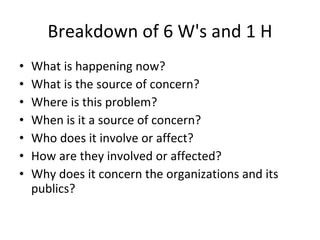
Breakdown of 6 W's and 1 H What is happening now? What is the source of concern? Where is this problem? When is it a source of concern? Who does it involve or affect? How are they involved or affected? Why does it concern the organizations and its publics?
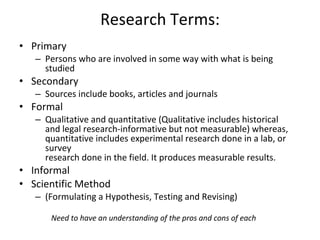
Research Terms: Primary Persons who are involved in some way with what is being studied Secondary Sources include books, articles and journals Formal Qualitative and quantitative (Qualitative includes historical and legal research-informative but not measurable) whereas, quantitative includes experimental research done in a lab, or survey research done in the field. It produces measurable results. Informal Scientific Method  (Formulating a Hypothesis, Testing and Revising) Need to have an understanding of the pros and cons of each
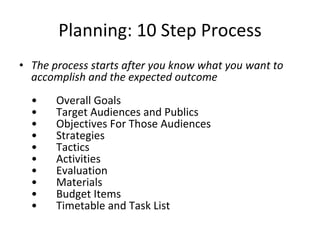
Planning: 10 Step Process The process starts after you know what you want to accomplish and the expected outcome •       Overall Goals •       Target Audiences and Publics •       Objectives For Those Audiences •       Strategies •       Tactics •       Activities •       Evaluation •       Materials •       Budget Items •       Timetable and Task List
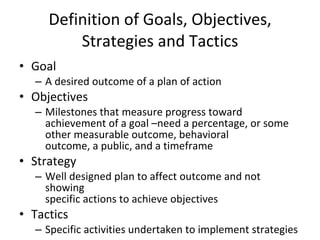
Definition of Goals, Objectives, Strategies and Tactics Goal A desired outcome of a plan of action Objectives Milestones that measure progress toward achievement of a goal –need a percentage, or some other measurable outcome, behavioral outcome, a public, and a timeframe Strategy Well designed plan to affect outcome and not showing specific actions to achieve objectives Tactics Specific activities undertaken to implement strategies
Surveys and Polls: You don't have to spend a fortune or go broke when designing and carrying out public relations research and measurement projects. To save money, consider piggyback studies, secondary analysis, quick-tab polls, internet surveys, or intercept interviews. Mail, fax and e-mail studies are good  for some purposes. Or, do your own field research.                               -Walter K. Lindenmann, Ph.D.
Informal methods: Focus groups Interviews with editors and key opinion leaders Phone or e-mail surveys Internet surveys Representative samples may entail contracting an outside firm in order to get reliable judgments and results.
Determining Sample Size: Bigger is better and consulting with persons who conduct research on a regular basis is advised. Survey Construction: Work closely with a survey firm Attempt triangulation Use several methods that concentrate on answering the same questions Avoid seeking information unless it is relevant to the study Pre-test surveys before launching
Excerpt from  the Summer 2008 issue of The Public Relations Strategist: " Along with planning, execution and evaluation, research is a required campaign component for all Silver Anvil entries. While web-based searches and media analyses remain among the most prevalent research techniques, about 60% of Silver Anvil campaigns also gathered input directly from target audiences.  The research was both formal and informal-proving it doesn't always require significant resources to get valuable information to effectively shape a campaign's goals, strategies and messages."                                  -Kelly Womer, APR, ABC                                   Secrets of Their Success                                   The Public Relations Strategist

Research Methods In Public Relations Practice

  • 1.
    The Four StepProcess: Research, Planning, Implementation, Evaluation Jackie O'Neal Independent Practitioner's Alliance (IPA member) O'Neal Media Group
  • 2.
  • 3.
    Research Create aProblem Statement to ascertain "What is happening now"? A problem statement consists of a description of the problem encapsulated in a brief paragraph. Written in present tense Describe the situation in specific and measurable terms.
  • 4.
    Breakdown of 6W's and 1 H What is happening now? What is the source of concern? Where is this problem? When is it a source of concern? Who does it involve or affect? How are they involved or affected? Why does it concern the organizations and its publics?
  • 5.
    Research Terms: PrimaryPersons who are involved in some way with what is being studied Secondary Sources include books, articles and journals Formal Qualitative and quantitative (Qualitative includes historical and legal research-informative but not measurable) whereas, quantitative includes experimental research done in a lab, or survey research done in the field. It produces measurable results. Informal Scientific Method (Formulating a Hypothesis, Testing and Revising) Need to have an understanding of the pros and cons of each
  • 6.
    Planning: 10 StepProcess The process starts after you know what you want to accomplish and the expected outcome •       Overall Goals •       Target Audiences and Publics •       Objectives For Those Audiences •       Strategies •       Tactics •       Activities •       Evaluation •       Materials •       Budget Items •       Timetable and Task List
  • 7.
    Definition of Goals,Objectives, Strategies and Tactics Goal A desired outcome of a plan of action Objectives Milestones that measure progress toward achievement of a goal –need a percentage, or some other measurable outcome, behavioral outcome, a public, and a timeframe Strategy Well designed plan to affect outcome and not showing specific actions to achieve objectives Tactics Specific activities undertaken to implement strategies
  • 8.
    Surveys and Polls:You don't have to spend a fortune or go broke when designing and carrying out public relations research and measurement projects. To save money, consider piggyback studies, secondary analysis, quick-tab polls, internet surveys, or intercept interviews. Mail, fax and e-mail studies are good for some purposes. Or, do your own field research.                               -Walter K. Lindenmann, Ph.D.
  • 9.
    Informal methods: Focusgroups Interviews with editors and key opinion leaders Phone or e-mail surveys Internet surveys Representative samples may entail contracting an outside firm in order to get reliable judgments and results.
  • 10.
    Determining Sample Size:Bigger is better and consulting with persons who conduct research on a regular basis is advised. Survey Construction: Work closely with a survey firm Attempt triangulation Use several methods that concentrate on answering the same questions Avoid seeking information unless it is relevant to the study Pre-test surveys before launching
  • 11.
    Excerpt from  theSummer 2008 issue of The Public Relations Strategist: " Along with planning, execution and evaluation, research is a required campaign component for all Silver Anvil entries. While web-based searches and media analyses remain among the most prevalent research techniques, about 60% of Silver Anvil campaigns also gathered input directly from target audiences.  The research was both formal and informal-proving it doesn't always require significant resources to get valuable information to effectively shape a campaign's goals, strategies and messages."                                  -Kelly Womer, APR, ABC                                   Secrets of Their Success                                   The Public Relations Strategist