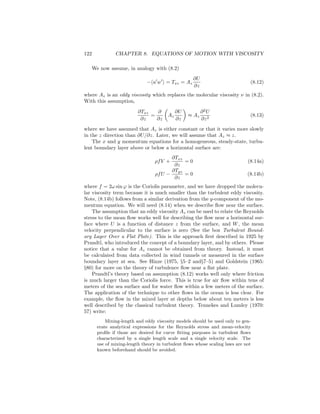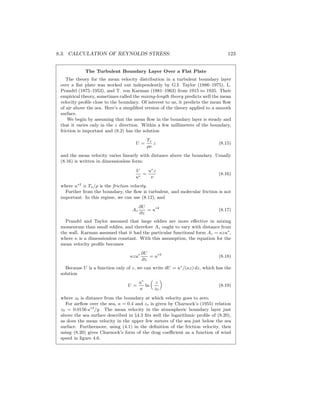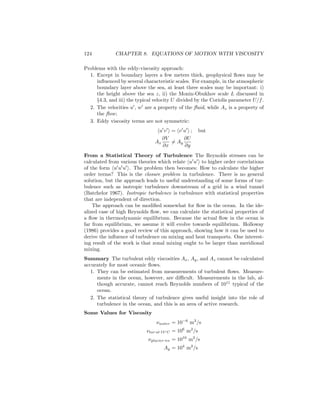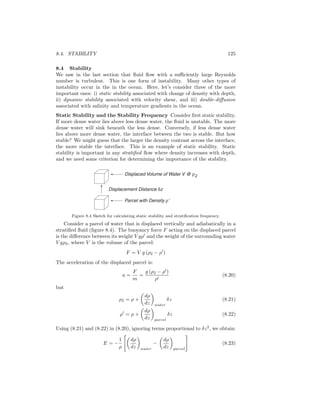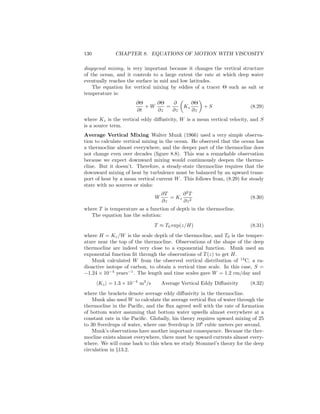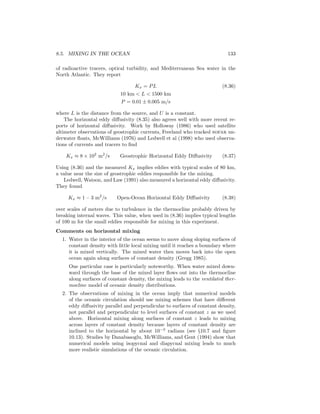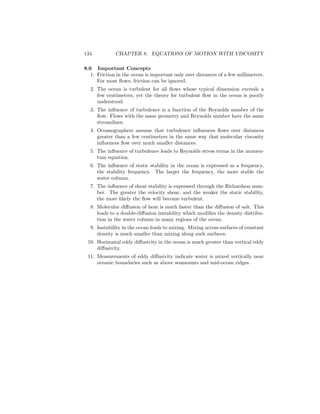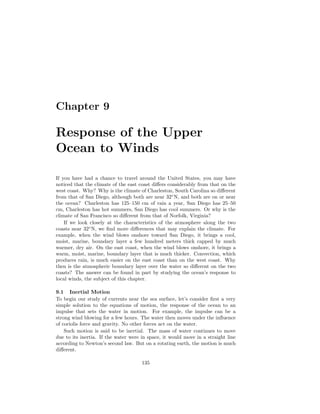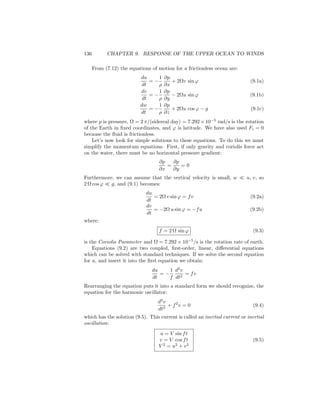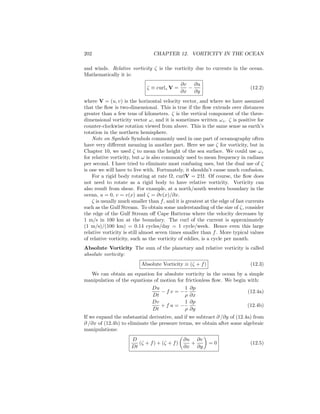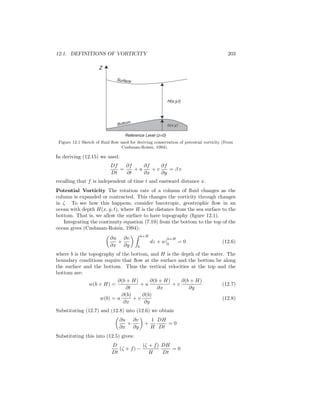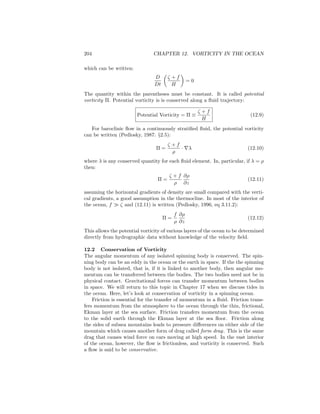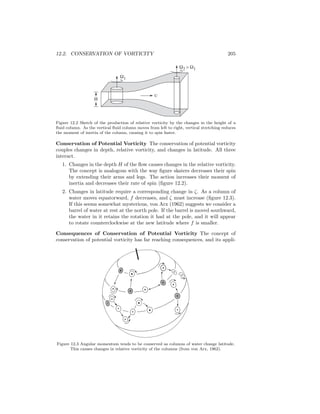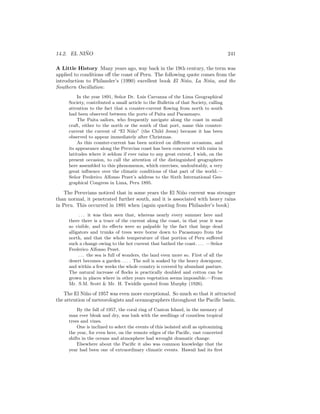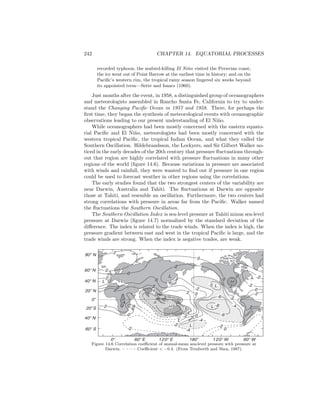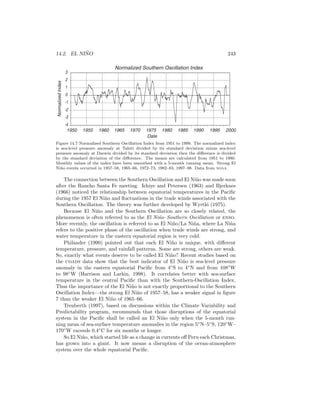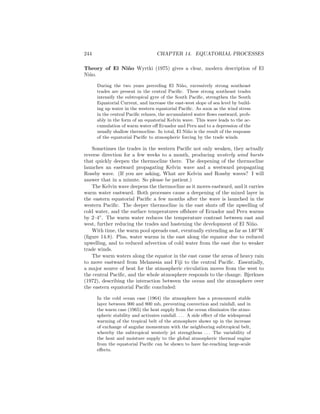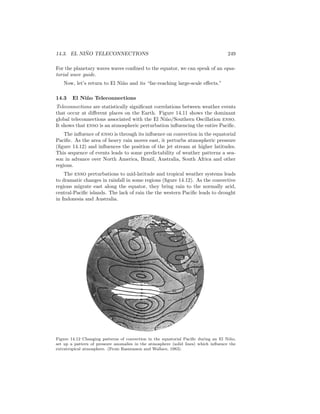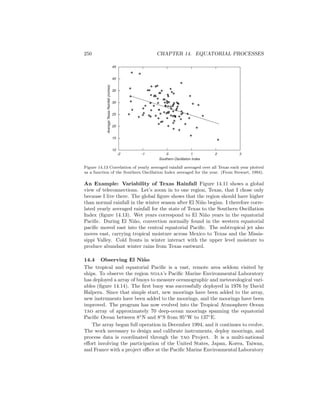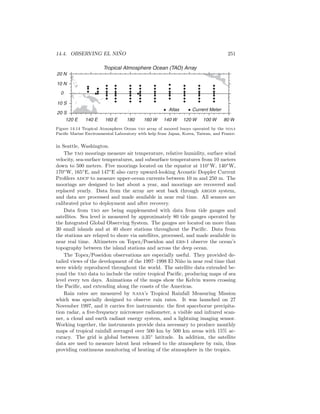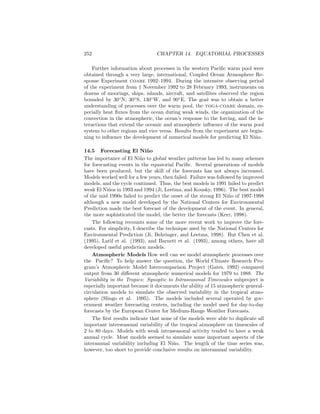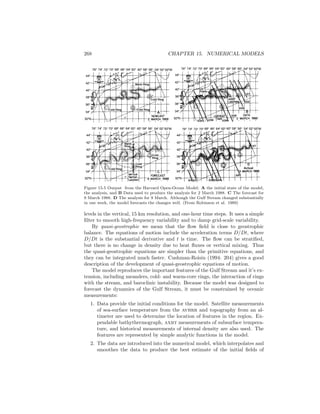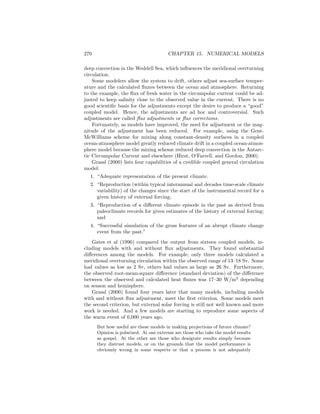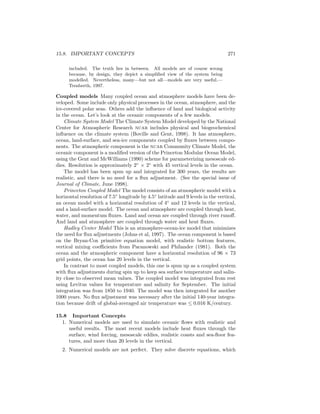





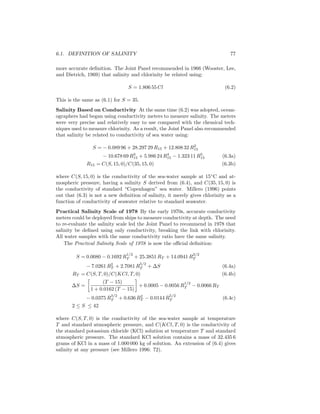
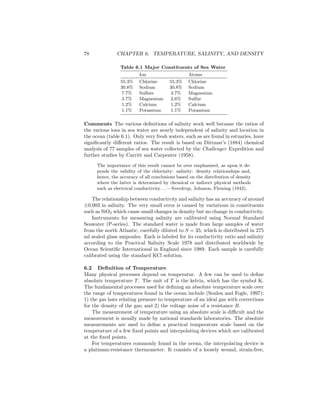
Introduction To
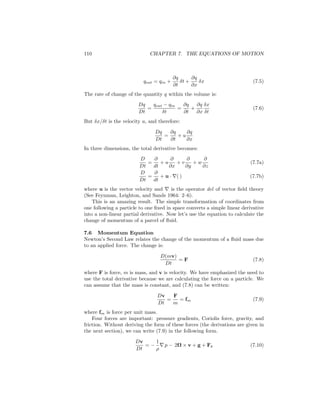
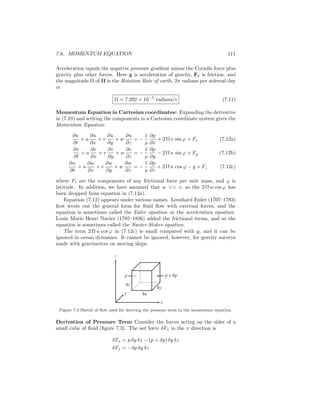
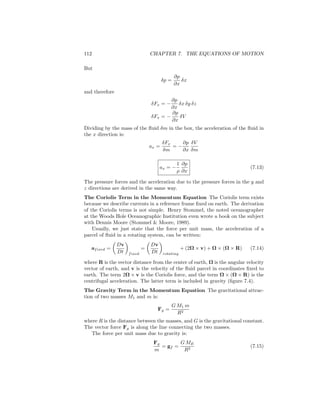
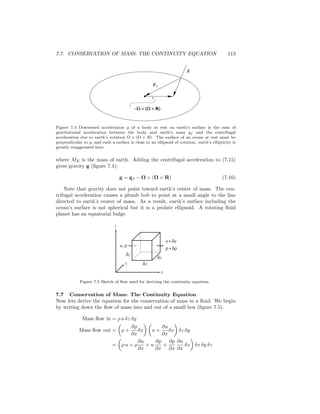
Physical Oceanography
Robert H. Stewart
Department of Oceanography
Texas A & M University
Copyright 2002
Fall 2002 Edition
ii
Contents
Preface vii
1 A Voyage of Discovery 1
1.1 Physics of the ocean . . . . . . . . . . . . . . . . . . . . . . . . . 1
1.2 Goals . . . . . . . . . . . . . . . . . . . . . . . . . . . . . . . . . 2
1.3 Organization . . . . . . . . . . . . . . . . . . . . . . . . . . . . . 3
1.4 The Big Picture . . . . . . . . . . . . . . . . . . . . . . . . . . . . 3
1.5 Further Reading . . . . . . . . . . . . . . . . . . . . . . . . . . . 4
2 The Historical Setting 7
2.1 Definitions . . . . . . . . . . . . . . . . . . . . . . . . . . . . . . . 8
2.2 Eras of Oceanographic Exploration . . . . . . . . . . . . . . . . . 8
2.3 Milestones in the Understanding of the Ocean . . . . . . . . . . . 11
2.4 Evolution of some Theoretical Ideas . . . . . . . . . . . . . . . . 15
2.5 The Role of Observations in Oceanography . . . . . . . . . . . . 16
2.6 Important Concepts . . . . . . . . . . . . . . . . . . . . . . . . . 19
3 The Physical Setting 21
3.1 Oceans and Seas . . . . . . . . . . . . . . . . . . . . . . . . . . . 22
3.2 Dimensions of the Oceans . . . . . . . . . . . . . . . . . . . . . . 24
3.3 Sea-Floor Features . . . . . . . . . . . . . . . . . . . . . . . . . . 25
3.4 Measuring the Depth of the Ocean . . . . . . . . . . . . . . . . . 27
3.5 Sea Floor Charts and Data Sets . . . . . . . . . . . . . . . . . . . 34
3.6 Sound in the Ocean . . . . . . . . . . . . . . . . . . . . . . . . . 35
3.7 Important Concepts . . . . . . . . . . . . . . . . . . . . . . . . . 37
4 Atmospheric Influences 39
4.1 The Earth in Space . . . . . . . . . . . . . . . . . . . . . . . . . . 39
4.2 Atmospheric Wind Systems . . . . . . . . . . . . . . . . . . . . . 41
4.3 The Planetary Boundary Layer . . . . . . . . . . . . . . . . . . . 43
4.4 Measurement of Wind . . . . . . . . . . . . . . . . . . . . . . . . 43
4.5 Wind Stress . . . . . . . . . . . . . . . . . . . . . . . . . . . . . . 48
4.6 Important Concepts . . . . . . . . . . . . . . . . . . . . . . . . . 49
iii
iv CONTENTS
5 The Oceanic Heat Budget 51
5.1 The Oceanic Heat Budget . . . . . . . . . . . . . . . . . . . . . . 51
5.2 Heat-Budget Terms . . . . . . . . . . . . . . . . . . . . . . . . . . 53
5.3 Direct Calculation of Fluxes . . . . . . . . . . . . . . . . . . . . . 57
5.4 Indirect Calculation of Fluxes: Bulk Formulas . . . . . . . . . . . 58
5.5 Global Data Sets for Fluxes . . . . . . . . . . . . . . . . . . . . . 61
5.6 Geographic Distribution of Terms . . . . . . . . . . . . . . . . . . 65
5.7 Meridional Heat Transport . . . . . . . . . . . . . . . . . . . . . 68
5.8 Meridional Fresh Water Transport . . . . . . . . . . . . . . . . . 70
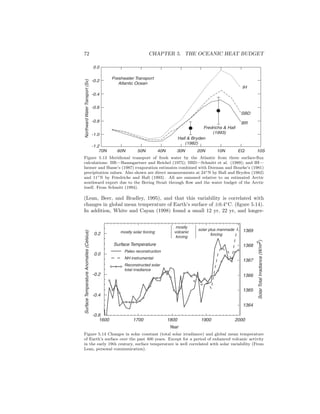
5.9 Variations in Solar Constant . . . . . . . . . . . . . . . . . . . . . 70
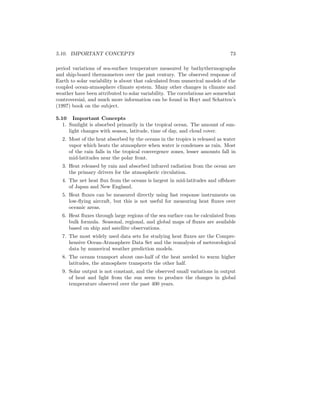
5.10 Important Concepts . . . . . . . . . . . . . . . . . . . . . . . . . 73
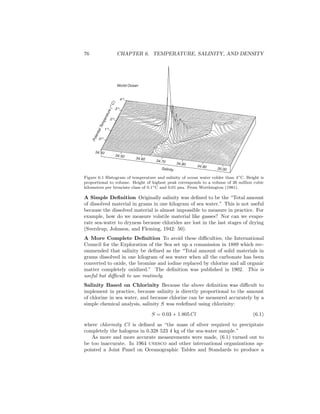
6 Temperature, Salinity, and Density 75
6.1 Definition of Salinity . . . . . . . . . . . . . . . . . . . . . . . . . 75
6.2 Definition of Temperature . . . . . . . . . . . . . . . . . . . . . . 78
6.3 Geographical Distribution . . . . . . . . . . . . . . . . . . . . . . 79
6.4 The Oceanic Mixed Layer and Thermocline . . . . . . . . . . . . 81
6.5 Density . . . . . . . . . . . . . . . . . . . . . . . . . . . . . . . . 85
6.6 Measurement of Temperature . . . . . . . . . . . . . . . . . . . . 89
6.7 Measurement of Conductivity . . . . . . . . . . . . . . . . . . . . 94
6.8 Measurement of Pressure . . . . . . . . . . . . . . . . . . . . . . 95
6.9 Temperature and Salinity With Depth . . . . . . . . . . . . . . . 96
6.10 Light in the Ocean and Absorption of Light . . . . . . . . . . . . 98
6.11 Important Concepts . . . . . . . . . . . . . . . . . . . . . . . . . 102
7 The Equations of Motion 105
7.1 Dominant Forces for Ocean Dynamics . . . . . . . . . . . . . . . 105
7.2 Coordinate System . . . . . . . . . . . . . . . . . . . . . . . . . . 106
7.3 Types of Flow in the ocean . . . . . . . . . . . . . . . . . . . . . 107
7.4 Conservation of Mass and Salt . . . . . . . . . . . . . . . . . . . 108
7.5 The Total Derivative (D/Dt) . . . . . . . . . . . . . . . . . . . . 109
7.6 Momentum Equation . . . . . . . . . . . . . . . . . . . . . . . . . 110
7.7 Conservation of Mass: The Continuity Equation . . . . . . . . . 113
7.8 Solutions to the Equations of Motion . . . . . . . . . . . . . . . . 115
7.9 Important Concepts . . . . . . . . . . . . . . . . . . . . . . . . . 116
8 Equations of Motion With Viscosity 117
8.1 The Influence of Viscosity . . . . . . . . . . . . . . . . . . . . . . 117
8.2 Turbulence . . . . . . . . . . . . . . . . . . . . . . . . . . . . . . 118
8.3 Calculation of Reynolds Stress: . . . . . . . . . . . . . . . . . . . 121
8.4 Stability . . . . . . . . . . . . . . . . . . . . . . . . . . . . . . . . 125
8.5 Mixing in the Ocean . . . . . . . . . . . . . . . . . . . . . . . . . 129
8.6 Important Concepts . . . . . . . . . . . . . . . . . . . . . . . . . 134
CONTENTS v
9 Response of the Upper Ocean to Winds 135
9.1 Inertial Motion . . . . . . . . . . . . . . . . . . . . . . . . . . . . 135
9.2 Ekman Layer at the Sea Surface . . . . . . . . . . . . . . . . . . 137
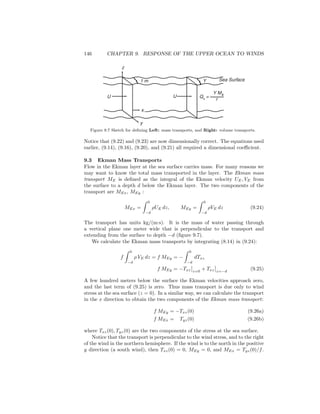
9.3 Ekman Mass Transports . . . . . . . . . . . . . . . . . . . . . . . 146
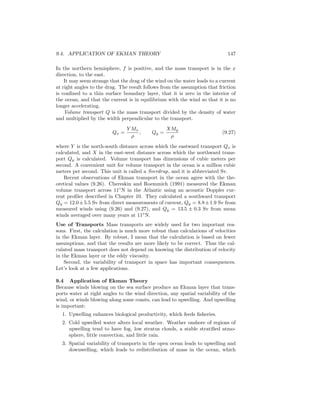
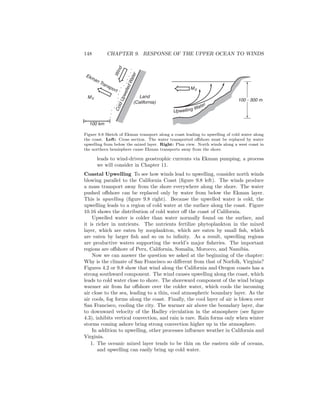
9.4 Application of Ekman Theory . . . . . . . . . . . . . . . . . . . . 147
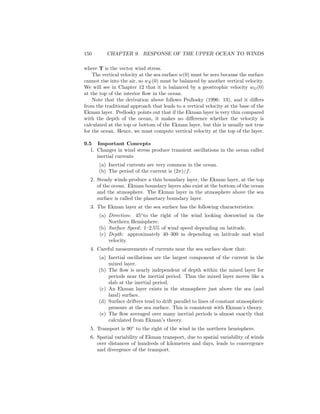
9.5 Important Concepts . . . . . . . . . . . . . . . . . . . . . . . . . 150
10 Geostrophic Currents 153
10.1 Hydrostatic Equilibrium . . . . . . . . . . . . . . . . . . . . . . . 153
10.2 Geostrophic Equations . . . . . . . . . . . . . . . . . . . . . . . . 155
10.3 Surface Geostrophic Currents From Altimetry . . . . . . . . . . . 157
10.4 Geostrophic Currents From Hydrography . . . . . . . . . . . . . 160
10.5 An Example Using Hydrographic Data . . . . . . . . . . . . . . . 165
10.6 Comments on Geostrophic Currents . . . . . . . . . . . . . . . . 166
10.7 Currents From Hydrographic Sections . . . . . . . . . . . . . . . 172
10.8 Lagrangean Measurements of Currents . . . . . . . . . . . . . . . 174
10.9 Eulerian Measurements . . . . . . . . . . . . . . . . . . . . . . . 181
10.10Important Concepts . . . . . . . . . . . . . . . . . . . . . . . . . 183
11 Wind Driven Ocean Circulation 185
11.1 Sverdrup’s Theory of the Oceanic Circulation . . . . . . . . . . . 185
11.2 Western Boundary Currents . . . . . . . . . . . . . . . . . . . . . 191
11.3 Munk’s Solution . . . . . . . . . . . . . . . . . . . . . . . . . . . 192
11.4 Observed Circulation in the Atlantic . . . . . . . . . . . . . . . . 194
11.5 Important Concepts . . . . . . . . . . . . . . . . . . . . . . . . . 200
12 Vorticity in the Ocean 201
12.1 Definitions of Vorticity . . . . . . . . . . . . . . . . . . . . . . . . 201
12.2 Conservation of Vorticity . . . . . . . . . . . . . . . . . . . . . . 204
12.3 Vorticity and Ekman Pumping . . . . . . . . . . . . . . . . . . . 207
12.4 Important Concepts . . . . . . . . . . . . . . . . . . . . . . . . . 212
13 Deep Circulation in the Ocean 213
13.1 Importance of the Thermohaline Circulation . . . . . . . . . . . . 214
13.2 Theory for the Thermohaline Circulation . . . . . . . . . . . . . 218
13.3 Observations of the Deep Circulation . . . . . . . . . . . . . . . . 223
13.4 Antarctic Circumpolar Current . . . . . . . . . . . . . . . . . . . 230
13.5 Important Concepts . . . . . . . . . . . . . . . . . . . . . . . . . 232
14 Equatorial Processes 235
14.1 Equatorial Processes . . . . . . . . . . . . . . . . . . . . . . . . . 236
14.2 El Ni˜no . . . . . . . . . . . . . . . . . . . . . . . . . . . . . . . . 240
14.3 El Ni˜no Teleconnections . . . . . . . . . . . . . . . . . . . . . . . 249
14.4 Observing El Ni˜no . . . . . . . . . . . . . . . . . . . . . . . . . . 250
14.5 Forecasting El Ni˜no . . . . . . . . . . . . . . . . . . . . . . . . . 252
14.6 Important Concepts . . . . . . . . . . . . . . . . . . . . . . . . . 254
vi CONTENTS
15 Numerical Models 255
15.1 Introduction–Some Words of Caution . . . . . . . . . . . . . . . . 255
15.2 Numerical Models in Oceanography . . . . . . . . . . . . . . . . 257
15.3 Simulation Models . . . . . . . . . . . . . . . . . . . . . . . . . . 257
15.4 Primitive-Equation Models . . . . . . . . . . . . . . . . . . . . . 258
15.5 Coastal Models . . . . . . . . . . . . . . . . . . . . . . . . . . . . 262
15.6 Assimilation Models . . . . . . . . . . . . . . . . . . . . . . . . . 266
15.7 Coupled Ocean and Atmosphere Models . . . . . . . . . . . . . . 269
15.8 Important Concepts . . . . . . . . . . . . . . . . . . . . . . . . . 271
16 Ocean Waves 273
16.1 Linear Theory of Ocean Surface Waves . . . . . . . . . . . . . . . 273
16.2 Nonlinear waves . . . . . . . . . . . . . . . . . . . . . . . . . . . 278
16.3 Waves and the Concept of a Wave Spectrum . . . . . . . . . . . 279
16.4 Ocean-Wave Spectra . . . . . . . . . . . . . . . . . . . . . . . . . 285
16.5 Wave Forecasting . . . . . . . . . . . . . . . . . . . . . . . . . . . 290
16.6 Measurement of Waves . . . . . . . . . . . . . . . . . . . . . . . . 291
16.7 Important Concepts . . . . . . . . . . . . . . . . . . . . . . . . . 293
17 Coastal Processes and Tides 295
17.1 Shoaling Waves and Coastal Processes . . . . . . . . . . . . . . . 295
17.2 Tsunamis . . . . . . . . . . . . . . . . . . . . . . . . . . . . . . . 299
17.3 Storm Surges . . . . . . . . . . . . . . . . . . . . . . . . . . . . . 301
17.4 Theory of Ocean Tides . . . . . . . . . . . . . . . . . . . . . . . . 302
17.5 Tidal Prediction . . . . . . . . . . . . . . . . . . . . . . . . . . . 310
17.6 Important Concepts . . . . . . . . . . . . . . . . . . . . . . . . . 314
References 317
Preface
This book is written for upper-division undergraduates and new graduate stu-
dents in meteorology, ocean engineering, and oceanography. Because these stu-
dents have a diverse background, I have emphasized ideas and concepts with a
minimum of mathematical material.
Acknowledgements
I have taught from the book for several years, and I thank the many students
who have pointed out poorly written sections, conflicting notation, and other
errors. I also thank Professor Fred Schlemmer at Texas A&M Galveston who,
after using the book for his classes, has provided extensive comments about the
material.
Of course, I accept responsibility for all mistakes in the book. Please send
me your comments and suggestions for improvement.
Figures in the book came from many sources. I particularly wish to thank
Link Ji for many global maps, and colleagues at the University of Texas Center
for Space Research. Don Johnson redrew many figures and turned sketches into
figures. Trey Morris tagged the words used in the index.
I especially thank nasa’s Jet Propulsion Laboratory and the Topex/Poseidon
Project for their support of the book through contract 960887 and 1205046.
Cover photograph of an island in the Maldives was taken by Jagdish Agara
(copyright Corbis). Cover design is by Don Johnson.
The book was produced in LaTeX 2e using Textures on a Macintosh com-
puter. Figures were drawn in Adobe Illustrator.
vii
viii PREFACE
Chapter 1
A Voyage of Discovery
The role of the ocean on weather and climate is often discussed in the news.
Who has not heard of El Ni˜no and changing weather patterns, the Atlantic
hurricane season and storm surges. Yet, what exactly is the role of the ocean?
And, why do we care?
1.1 Why study the Physics of the ocean?
The answer depends on our interests, which devolves from our use of the oceans.
Three broad themes are important:
1. The oceans are a source of food. Hence we may be interested in processes
which influence the sea just as farmers are interested in the weather and
climate. The ocean not only has weather such as temperature changes
and currents, but the oceanic weather fertilizes the sea. The atmospheric
weather seldom fertilizes fields except for the small amount of nitrogen
fixed by lightning.
2. The oceans are used by man. We build structures on the shore or just
offshore. We use the oceans for transport. We obtain oil and gas below the
ocean, And, we use the oceans for recreation, swimming, boating, fishing,
surfing, and diving. Hence we are interested in processes that influence
these activities, especially waves, winds, currents, and temperature.
3. The oceans influence the atmospheric weather and climate. The oceans in-
fluence the distribution of rainfall, droughts, floods, regional climate, and
the development of storms, hurricanes, and typhoons. Hence we are inter-
ested in air-sea interactions, especially the fluxes of heat and water across
the sea surface, the transport of heat by the oceans, and the influence of
the ocean on climate and weather patterns.
These themes influence our selection of topics to study. The topics then deter-
mine what we measure, how the measurements are made, and the geographic
areas of interest. Some processes are local, such as the breaking of waves on a
beach, some are regional, such as the influence of the North Pacific on Alaskan
weather, and some are global, such as the influence of the oceans on changing
1
2 CHAPTER 1. A VOYAGE OF DISCOVERY
climate and global warming. If indeed, these reasons for the study of the ocean
are important, lets begin a voyage of discovery. Any voyage needs a destination.
What is ours?
1.2 Goals
At the most basic level, I hope you, the students who are reading this text, will
become aware of some of the major conceptual schemes (or theories) that form
the foundation of physical oceanography, how they were arrived at, and why
they are widely accepted, how oceanographers achieve order out of a random
ocean, and the role of experiment in oceanography (to paraphrase Shamos, 1995:
p. 89).
More particularly, I expect you will be able to describe physical processes
influencing the oceans and coastal regions: the interaction of the ocean with the
atmosphere, and the distribution of oceanic winds, currents, heat fluxes, and
water masses. The text emphasizes ideas rather than mathematical techniques.
We will try to answer such questions as:
1. What is the basis of our understanding of physics of the ocean?
(a) What are the physical properties of sea water?
(b) What are the important thermodynamic and dynamic processes in-
fluencing the ocean?
(c) What equations describe the processes and how were they derived?
(d) What approximations were used in the derivation?
(e) Do the equations have useful solutions?
(f) How well do the solutions describe the process? That is, what is the
experimental basis for the theories?
(g) Which processes are poorly understood? Which are well understood?
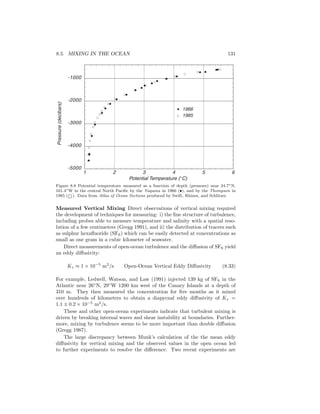
2. What are the sources of information about physical variables?
(a) What instruments are used for measuring each variable?
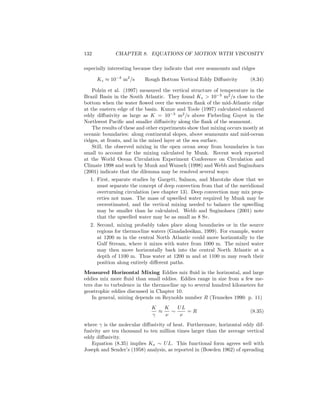
(b) What are their accuracy and limitations?
(c) What historic data exist?
(d) What platforms are used? Satellites, ships, drifters, moorings?
3. What processes are important? Some important process we will study
include:
(a) Heat storage and transport in the oceans.
(b) The exchange of heat with the atmosphere and the role of the ocean
in climate.
(c) Wind and thermal forcing of the surface mixed layer.
(d) The wind-driven circulation including the Ekman circulation, Ekman
pumping of the deeper circulation, and upwelling.
(e) The dynamics of ocean currents, including geostrophic currents and
the role of vorticity.
1.3. ORGANIZATION 3
(f) The formation of water types and masses.
(g) The thermohaline circulation of the ocean.
(h) Equatorial dynamics and El Ni˜no.
(i) The observed circulation of the ocean plus the Gulf of Mexico.
(j) Numerical models of the circulation.
(k) Waves in the ocean including surface waves, inertial oscillations,
tides, and tsunamis.
(l) Waves in shallow water, coastal processes, and tide predictions.
4. What are the major currents and water masses in the ocean, what governs
their distribution, and how does the ocean interact with the atmosphere?
1.3 Organization
Before beginning a voyage, we usually try to learn about the places we will visit.
We look at maps and we consult travel guides. In this book, our guide will be the
papers and books published by oceanographers. We begin with a brief overview
of what is known about the oceans. We then proceed to a description of the
ocean basins, for the shape of the seas influences the physical processes in the
water. Next, we study the external forces, wind and heat, acting on the ocean,
and the ocean’s response. As we proceed, I bring in theory and observations as
necessary.
By the time we reach chapter 7, we will need to understand the equations
describing dynamic response of the oceans. So we consider the equations of
motion, the influence of Earth’s rotation, and viscosity. This leads to a study of
wind-driven ocean currents, the geostrophic approximation, and the usefulness
of conservation of vorticity.
Toward the end, we consider some particular examples: the deep circulation,
the equatorial ocean and El Ni˜no, and the circulation of particular areas of the
oceans. Next we look at the role of numerical models in describing the ocean.
At the end, we study coastal processes, waves, tides, wave and tidal forecasting,
tsunamis, and storm surges.
1.4 The Big Picture
As we study the ocean, I hope you will notice that we use theory, observations,
and numerical models to describe ocean dynamics. Neither is sufficient by itself.
1. Ocean processes are nonlinear and turbulent. Yet we don’t really under-
stand the theory of non-linear, turbulent flow in complex basins. Theories
used to describe the ocean are much simplified approximations to reality.
2. Observations are sparse in time and space. They provide a rough descrip-
tion of the time-averaged flow, but many processes in many regions are
poorly observed.
3. Numerical models include much-more-realistic theoretical ideas, they can
help interpolate oceanic observations in time and space, and they are used
to forecast climate change, currents, and waves. Nonetheless, the numer-
ical equations are approximations to the continuous analytic equations
4 CHAPTER 1. A VOYAGE OF DISCOVERY
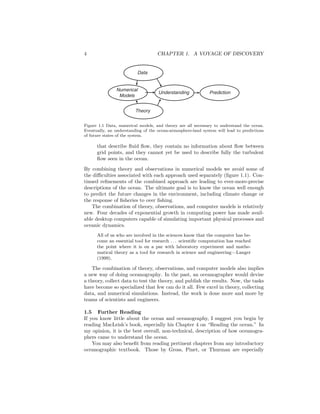
Numerical
Models
Data
Understanding Prediction
Theory
Figure 1.1 Data, numerical models, and theory are all necessary to understand the ocean.
Eventually, an understanding of the ocean-atmosphere-land system will lead to predictions
of future states of the system.
that describe fluid flow, they contain no information about flow between
grid points, and they cannot yet be used to describe fully the turbulent
flow seen in the ocean.
By combining theory and observations in numerical models we avoid some of
the difficulties associated with each approach used separately (figure 1.1). Con-
tinued refinements of the combined approach are leading to ever-more-precise
descriptions of the ocean. The ultimate goal is to know the ocean well enough
to predict the future changes in the environment, including climate change or
the response of fisheries to over fishing.
The combination of theory, observations, and computer models is relatively
new. Four decades of exponential growth in computing power has made avail-
able desktop computers capable of simulating important physical processes and
oceanic dynamics.
All of us who are involved in the sciences know that the computer has be-
come an essential tool for research . . . scientific computation has reached
the point where it is on a par with laboratory experiment and mathe-
matical theory as a tool for research in science and engineering—Langer
(1999).
The combination of theory, observations, and computer models also implies
a new way of doing oceanography. In the past, an oceanographer would devise
a theory, collect data to test the theory, and publish the results. Now, the tasks
have become so specialized that few can do it all. Few excel in theory, collecting
data, and numerical simulations. Instead, the work is done more and more by
teams of scientists and engineers.
1.5 Further Reading
If you know little about the ocean and oceanography, I suggest you begin by
reading MacLeish’s book, especially his Chapter 4 on “Reading the ocean.” In
my opinion, it is the best overall, non-technical, description of how oceanogra-
phers came to understand the ocean.
You may also benefit from reading pertinent chapters from any introductory
oceanographic textbook. Those by Gross, Pinet, or Thurman are especially
1.5. FURTHER READING 5
useful. The three texts produced by the Open University provide a slightly
more advanced treatment.
Gross, M. Grant and Elizabeth Gross (1996) oceanography—A View of Earth.
7th Edition. Upper Saddle River, New Jersey: Prentice Hall.
MacLeish, William (1989) The Gulf Stream: Encounters With the Blue God.
Boston: Houghton Mifflin Company.
Pinet, Paul R. (2000) Invitation to oceanography. 2nd Edition. Sudbury, Mas-
sachusetts: Jones and Bartlett Publishers.
Open University (1989) ocean Circulation. Oxford: Pergamon Press.
Open University (1989) Seawater: Its Composition, Properties and Behavior.
Oxford: Pergamon Press.
Open University (1989) Waves, Tides and Shallow-Water Processes. Oxford:
Pergamon Press.
Thurman, Harold V. and Elizabeth A. Burton (2001) Introductory oceanogra-
phy. 9th Edition. Upper Saddle River, New Jersey: Prentice Hall.
6 CHAPTER 1. A VOYAGE OF DISCOVERY
Chapter 2
The Historical Setting
Our knowledge of oceanic currents, winds, waves, and tides goes back thousands
of years. Polynesian navigators traded over long distances in the Pacific as early
as 4000 bc (Service, 1996). Pytheas explored the Atlantic from Italy to Norway
in 325 bc. Arabic traders used their knowledge of the reversing winds and
currents in the Indian Ocean to establish trade routes to China in the Middle
Ages and later to Zanzibar on the African coast. And, the connection between
tides and the sun and moon was described in the Samaveda of the Indian Vedic
period extending from 2000 to 1400 bc (Pugh, 1987). Those oceanographers
who tend to accept as true only that which has been measured by instruments,
have much to learn from those who earned their living on the ocean.
Modern European knowledge of the ocean began with voyages of discovery by
Bartholomew Dias (1487–1488), Christopher Columbus (1492–1494), Vasco da
Gama (1497–1499), Ferdinand Magellan (1519–1522), and many others. They
laid the foundation for global trade routes stretching from Spain to the Philip-
pines in the early 16th century. The routes were based on a good working
knowledge of trade winds, the westerlies, and western boundary currents in the
Atlantic and Pacific (Couper, 1983: 192–193).
The early European explorers were soon followed by scientific voyages of
discovery led by (among many others) James Cook (1728–1779) on the Endeav-
our, Resolution, and Adventure, Charles Darwin (1809–1882) on the Beagle,
Sir James Clark Ross and Sir John Ross who surveyed the Arctic and Antarc-
tic regions from the Victory, the Isabella, and the Erebus, and Edward Forbes
(1815–1854) who studied the vertical distribution of life in the oceans. Others
collected oceanic observations and produced useful charts, including Edmond
Halley who charted the trade winds and monsoons and Benjamin Franklin who
charted the Gulf Stream.
Slow ships of the 19th and 20th centuries gave way to satellites toward the
end of the 20th century. Satellites now observe the oceans, air, and land. Their
data, when fed into numerical models allowes the study of earth as a system.
For the first time, we can study how biological, chemical, and physical systems
interact to influence our environment.
7
8 CHAPTER 2. THE HISTORICAL SETTING
60
40
20
0
20
40
60
N
S
60
40
20
0
20
40
60
N
S
18060 E60 W 0 120 E 120 W
Figure 2.1 Example from the era of deep-sea exploration: Track of H.M.S. Challenger
during the British Challenger Expedition 1872–1876 (From Wust, 1964).
2.1 Definitions
The long history of the study of the ocean has led to the development of various,
specialized disciplines each with its own interests and vocabulary. The more
important disciplines include:
Oceanography is the study of the ocean, with emphasis on its character as
an environment. The goal is to obtain a description sufficiently quantitative to
be used for predicting the future with some certainty.
Geophysics is the study of the physics of the Earth.
Physical Oceanography is the study of physical properties and dynamics of
the oceans. The primary interests are the interaction of the ocean with the at-
mosphere, the oceanic heat budget, water mass formation, currents, and coastal
dynamics. Physical Oceanography is considered by many to be a subdiscipline
of geophysics.
Geophysical Fluid Dynamics is the study of the dynamics of fluid motion on
scales influenced by the rotation of the Earth. Meteorology and oceanography
use geophysical fluid dynamics to calculate planetary flow fields.
Hydrography is the preparation of nautical charts, including charts of ocean
depths, currents, internal density field of the ocean, and tides.
2.2 Eras of Oceanographic Exploration
The exploration of the sea can be divided, somewhat arbitrarily, into various
eras (Wust, 1964). I have extended his divisions through the end of the 20th
century.
1. Era of Surface Oceanography: Earliest times to 1873. The era is character-
ized by systematic collection of mariners’ observations of winds, currents,
waves, temperature, and other phenomena observable from the deck of
sailing ships. Notable examples include Halley’s charts of the trade winds,
Franklin’s map of the Gulf Stream, and Matthew Fontaine Maury’s Phys-
ical Geography for the Sea.
2.2. ERAS OF OCEANOGRAPHIC EXPLORATION 9
40 W 20 W60 W80 W 0 20 E 40 E
0
20 N
40 N
60 N
20 S
40 S
60 S
0
20 N
40 N
60 N
20 S
40 S
60 S
Stations
Anchored
Stations
Meteor
1925–1927
Figure 2.2 Example of a survey from the era of national systematic surveys. Track of the
R/V Meteor during the German Meteor Expedition (Redrawn from Wust, 1964).
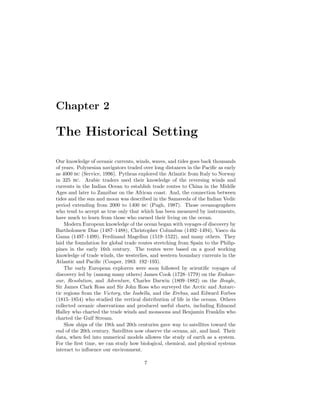
2. Era of Deep-Sea Exploration: 1873–1914. Characterized by wide ranging
oceanographic expeditions to survey surface and subsurface conditions
near colonial claims. The major example is the Challenger Expedition
(figure 2.1), but also the Gazelle and Fram Expeditions.
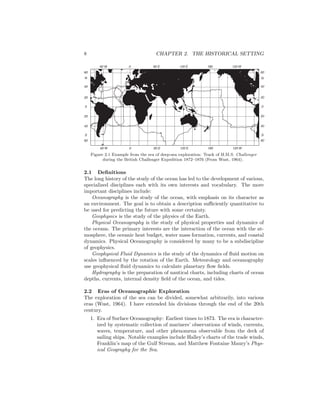
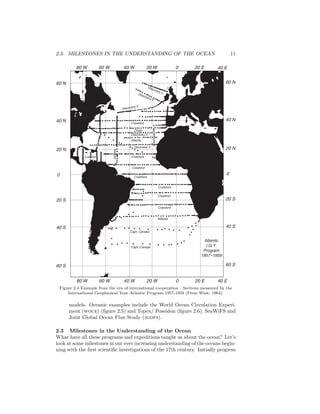
3. Era of National Systematic and National Surveys: 1925–1940. Charac-
terized by detailed surveys of colonial areas. Examples include Meteor
surveys of Atlantic (figure 2.2), and and the Discovery Expeditions.
10 CHAPTER 2. THE HISTORICAL SETTING
60 N
40 N
20 N
0
20 S
40 S
60 N
40 N
20 N
0
20 S
40 S
20 E020 W40 W60 W80 W100 W
Figure 2.3 Example from the era of new methods. The cruises of the R/V Atlantis out of
Woods Hole Oceanographic Institution (From Wust, 1964).
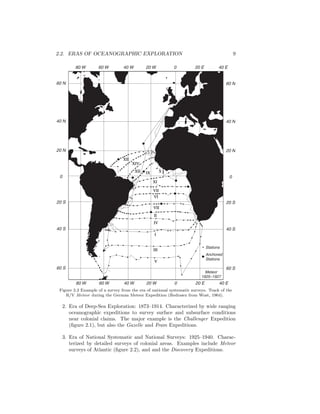
4. Era of New Methods: 1947–1956. Characterized by long surveys using
new instruments (figure 2.3). Examples include seismic surveys of the
Atlantic by Vema leading to Heezen’s maps of the sea floor.
5. Era of International Cooperation: 1957–1978. Characterized by multi-
national surveys of oceans and studies of oceanic processes. Examples
include the Atlantic Polar Front Program, the norpac cruises, the Inter-
national Geophysical Year cruises, and the International Decade of Ocean
Exploration (figure 2.4). Multiship studies of oceanic processes include
mode, polymode, norpax, and jasin experiments.
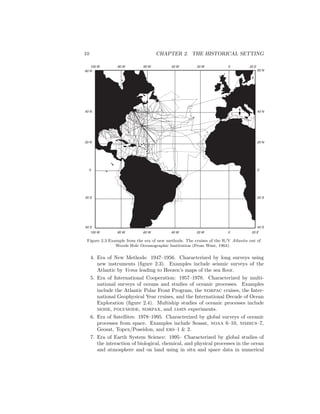
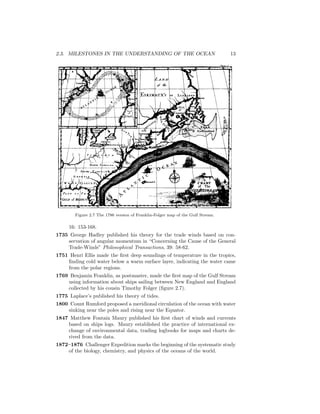
6. Era of Satellites: 1978–1995. Characterized by global surveys of oceanic
processes from space. Examples include Seasat, noaa 6–10, nimbus–7,
Geosat, Topex/Poseidon, and ers–1 & 2.
7. Era of Earth System Science: 1995– Characterized by global studies of
the interaction of biological, chemical, and physical processes in the ocean
and atmosphere and on land using in situ and space data in numerical
2.3. MILESTONES IN THE UNDERSTANDING OF THE OCEAN 11
Crawford
Crawford
Crawford
Crawford
Crawford
Crawford
Crawford
Crawford
Chain
Discovery II
Discovery II
Discovery II
Discovery II
Atlantis
Atlantis
Discovery II
Atlantis
Capt. Canepa
Capt. Canepa
20 E020 W40 W60 W80 W
60 S
40 S
20 S
0
20 N
40 N
60 N
20 E 40 E
40 E
020 W40 W60 W80 W
60 S
40 S
20 S
0
20 N
40 N
60 N
Atlantic
I.G.Y.
Program
1957–1959
Figure 2.4 Example from the era of international cooperation . Sections measured by the
International Geophysical Year Atlantic Program 1957-1959 (From Wust, 1964).
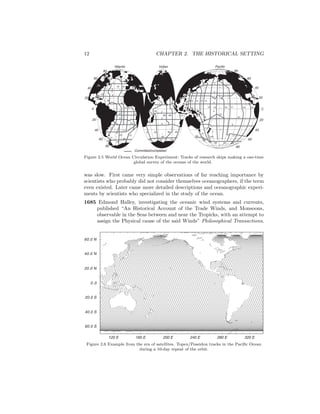
models. Oceanic examples include the World Ocean Circulation Experi-
ment (woce) (figure 2.5) and Topex/ Poseidon (figure 2.6), SeaWiFS and
Joint Global Ocean Flux Study (jgofs).
2.3 Milestones in the Understanding of the Ocean
What have all these programs and expeditions taught us about the ocean? Let’s
look at some milestones in our ever increasing understanding of the oceans begin-
ning with the first scientific investigations of the 17th century. Initially progress
12 CHAPTER 2. THE HISTORICAL SETTING
60
80
40
20
0
20
40
60
80
80
60
40
20
0
20
40
60
80
04080
20 60 100 140
180 140 100
Committed/completed
S4
15
S4
23
16
1
3
5
6
7
9
10
11
12
21
1
18
2
20
4
22
8 13
1415
17
1
3
4
19171614
13
S4
10
5
6
4
1
2
3
7S 8S 9S
9N8N
7N
10
2
5
21
7
12
11S
14S 17
31
20
18
118 9
30
25
28
26
27
29
6
Atlantic Indian Pacific
Figure 2.5 World Ocean Circulation Experiment: Tracks of research ships making a one-time
global survey of the oceans of the world.
was slow. First came very simple observations of far reaching importance by
scientists who probably did not consider themselves oceanographers, if the term
even existed. Later came more detailed descriptions and oceanographic experi-
ments by scientists who specialized in the study of the ocean.
1685 Edmond Halley, investigating the oceanic wind systems and currents,
published “An Historical Account of the Trade Winds, and Monsoons,
observable in the Seas between and near the Tropicks, with an attempt to
assign the Physical cause of the said Winds” Philosophical Transactions,
60.0 S
40.0 S
20.0 S
0.0
20.0 N
40.0 N
60.0 N
120 E 160 E 200 E 240 E 280 E 320 E
Figure 2.6 Example from the era of satellites. Topex/Poseidon tracks in the Pacific Ocean
during a 10-day repeat of the orbit.
2.3. MILESTONES IN THE UNDERSTANDING OF THE OCEAN 13
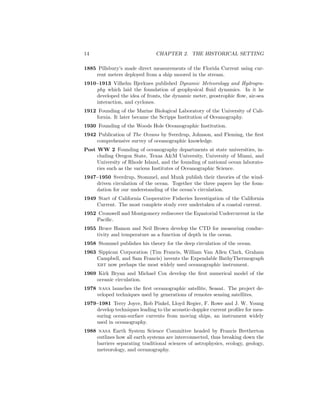
Figure 2.7 The 1786 version of Franklin-Folger map of the Gulf Stream.
16: 153-168.
1735 George Hadley published his theory for the trade winds based on con-
servation of angular momentum in “Concerning the Cause of the General
Trade-Winds” Philosophical Transactions, 39: 58-62.
1751 Henri Ellis made the first deep soundings of temperature in the tropics,
finding cold water below a warm surface layer, indicating the water came
from the polar regions.
1769 Benjamin Franklin, as postmaster, made the first map of the Gulf Stream
using information about ships sailing between New England and England
collected by his cousin Timothy Folger (figure 2.7).
1775 Laplace’s published his theory of tides.
1800 Count Rumford proposed a meridional circulation of the ocean with water
sinking near the poles and rising near the Equator.
1847 Matthew Fontain Maury published his first chart of winds and currents
based on ships logs. Maury established the practice of international ex-
change of environmental data, trading logbooks for maps and charts de-
rived from the data.
1872–1876 Challenger Expedition marks the beginning of the systematic study
of the biology, chemistry, and physics of the oceans of the world.
14 CHAPTER 2. THE HISTORICAL SETTING
1885 Pillsbury’s made direct measurements of the Florida Current using cur-
rent meters deployed from a ship moored in the stream.
1910–1913 Vilhelm Bjerknes published Dynamic Meteorology and Hydrogra-
phy which laid the foundation of geophysical fluid dynamics. In it he
developed the idea of fronts, the dynamic meter, geostrophic flow, air-sea
interaction, and cyclones.
1912 Founding of the Marine Biological Laboratory of the University of Cali-
fornia. It later became the Scripps Institution of Oceanography.
1930 Founding of the Woods Hole Oceanographic Institution.
1942 Publication of The Oceans by Sverdrup, Johnson, and Fleming, the first
comprehensive survey of oceanographic knowledge.
Post WW 2 Founding of oceanography departments at state universities, in-
cluding Oregon State, Texas A&M University, University of Miami, and
University of Rhode Island, and the founding of national ocean laborato-
ries such as the various Institutes of Oceanographic Science.
1947–1950 Sverdrup, Stommel, and Munk publish their theories of the wind-
driven circulation of the ocean. Together the three papers lay the foun-
dation for our understanding of the ocean’s circulation.
1949 Start of California Cooperative Fisheries Investigation of the California
Current. The most complete study ever undertaken of a coastal current.
1952 Cromwell and Montgomery rediscover the Equatorial Undercurrent in the
Pacific.
1955 Bruce Hamon and Neil Brown develop the CTD for measuring conduc-
tivity and temperature as a function of depth in the ocean.
1958 Stommel publishes his theory for the deep circulation of the ocean.
1963 Sippican Corporation (Tim Francis, William Van Allen Clark, Graham
Campbell, and Sam Francis) invents the Expendable BathyThermograph
xbt now perhaps the most widely used oceanographic instrument.
1969 Kirk Bryan and Michael Cox develop the first numerical model of the
oceanic circulation.
1978 nasa launches the first oceanographic satellite, Seasat. The project de-
veloped techniques used by generations of remotes sensing satellites.
1979–1981 Terry Joyce, Rob Pinkel, Lloyd Regier, F. Rowe and J. W. Young
develop techniques leading to the acoustic-doppler current profiler for mea-
suring ocean-surface currents from moving ships, an instrument widely
used in oceanography.
1988 nasa Earth System Science Committee headed by Francis Bretherton
outlines how all earth systems are interconnected, thus breaking down the
barriers separating traditional sciences of astrophysics, ecology, geology,
meteorology, and oceanography.
2.4. EVOLUTION OF SOME THEORETICAL IDEAS 15
Arctic Circle
East
Australia
Alaska
California
Gulf
Stream
Labrador
Florida
Equator
Brazil
Peru
or
Humboldt
Greenland
Guinea
Somali
Benguala
Agulhas
Canaries
Norway
Oyeshio
North Pacific
Kuroshio
North Equatorial
Equatorial Countercurrent
South Equatorial
West wind drift
or
Antarctic Circumpolar
West wind drift
or
Antarctic Circumpolar
Falkland
S. Eq. C. Eq.C.C.
N. Eq. C.
S. Eq. C.
West Australia
Murman
Irminger
North
Atlantic
drift
N. Eq. C.
60
o
N
45
o
N
30
o
N
15
o
N
15
o
S
30
o
S
45
o
N
60
o
N
0
o C.C.
warm currents N. north S. south Eq. equatorial
cool currents C. current C.C. counter current
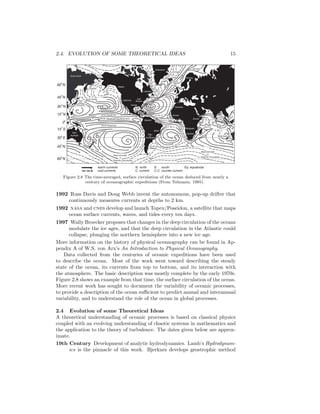
Figure 2.8 The time-averaged, surface circulation of the ocean deduced from nearly a
century of oceanographic expeditions (From Tolmazin, 1985).
1992 Russ Davis and Doug Webb invent the autonomous, pop-up drifter that
continuously measures currents at depths to 2 km.
1992 nasa and cnes develop and launch Topex/Poseidon, a satellite that maps
ocean surface currents, waves, and tides every ten days.
1997 Wally Broecker proposes that changes in the deep circulation of the oceans
modulate the ice ages, and that the deep circulation in the Atlantic could
collapse, plunging the northern hemisphere into a new ice age.
More information on the history of physical oceanography can be found in Ap-
pendix A of W.S. von Arx’s An Introduction to Physical Oceanography.
Data collected from the centuries of oceanic expeditions have been used
to describe the ocean. Most of the work went toward describing the steady
state of the ocean, its currents from top to bottom, and its interaction with
the atmosphere. The basic description was mostly complete by the early 1970s.
Figure 2.8 shows an example from that time, the surface circulation of the ocean.
More recent work has sought to document the variability of oceanic processes,
to provide a description of the ocean sufficient to predict annual and interannual
variability, and to understand the role of the ocean in global processes.
2.4 Evolution of some Theoretical Ideas
A theoretical understanding of oceanic processes is based on classical physics
coupled with an evolving understanding of chaotic systems in mathematics and
the application to the theory of turbulence. The dates given below are approx-
imate.
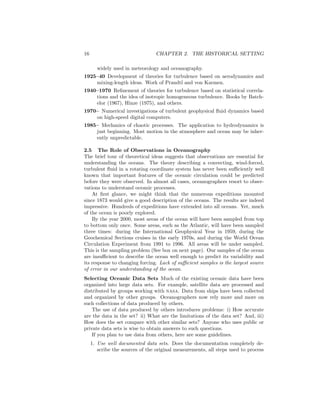
19th Century Development of analytic hydrodynamics. Lamb’s Hydrodynam-
ics is the pinnacle of this work. Bjerknes develops geostrophic method
16 CHAPTER 2. THE HISTORICAL SETTING
widely used in meteorology and oceanography.
1925–40 Development of theories for turbulence based on aerodynamics and
mixing-length ideas. Work of Prandtl and von Karmen.
1940–1970 Refinement of theories for turbulence based on statistical correla-
tions and the idea of isotropic homogeneous turbulence. Books by Batch-
elor (1967), Hinze (1975), and others.
1970– Numerical investigations of turbulent geophysical fluid dynamics based
on high-speed digital computers.
1985– Mechanics of chaotic processes. The application to hydrodynamics is
just beginning. Most motion in the atmosphere and ocean may be inher-
ently unpredictable.
2.5 The Role of Observations in Oceanography
The brief tour of theoretical ideas suggests that observations are essential for
understanding the oceans. The theory describing a convecting, wind-forced,
turbulent fluid in a rotating coordinate system has never been sufficiently well
known that important features of the oceanic circulation could be predicted
before they were observed. In almost all cases, oceanographers resort to obser-
vations to understand oceanic processes.
At first glance, we might think that the numerous expeditions mounted
since 1873 would give a good description of the oceans. The results are indeed
impressive. Hundreds of expeditions have extended into all oceans. Yet, much
of the ocean is poorly explored.
By the year 2000, most areas of the ocean will have been sampled from top
to bottom only once. Some areas, such as the Atlantic, will have been sampled
three times: during the International Geophysical Year in 1959, during the
Geochemical Sections cruises in the early 1970s, and during the World Ocean
Circulation Experiment from 1991 to 1996. All areas will be under sampled.
This is the sampling problem (See box on next page). Our samples of the ocean
are insufficient to describe the ocean well enough to predict its variability and
its response to changing forcing. Lack of sufficient samples is the largest source
of error in our understanding of the ocean.
Selecting Oceanic Data Sets Much of the existing oceanic data have been
organized into large data sets. For example, satellite data are processed and
distributed by groups working with nasa. Data from ships have been collected
and organized by other groups. Oceanographers now rely more and more on
such collections of data produced by others.
The use of data produced by others introduces problems: i) How accurate
are the data in the set? ii) What are the limitations of the data set? And, iii)
How does the set compare with other similar sets? Anyone who uses public or
private data sets is wise to obtain answers to such questions.
If you plan to use data from others, here are some guidelines.
1. Use well documented data sets. Does the documentation completely de-
scribe the sources of the original measurements, all steps used to process
2.5. THE ROLE OF OBSERVATIONS IN OCEANOGRAPHY 17
Sampling Error
Sampling error is caused by a set of samples not representing the popula-
tion of the variable being measured. A population is the set of all possible
measurements, and a sample is the sampled subset of the population. We
assume each measurement is perfectly accurate.
To determine if your measurement has a sampling error, you must first
completely specify the problem you wish to study. This defines the popu-
lation. Then, you must determine if the samples represent the population.
All steps are necessary.
Suppose your problem is to measure the annual-mean sea-surface tem-
perature of the ocean to determine if global warming is occurring. For this
problem, the population is the set of all possible measurements of surface
temperature, in all regions in all months. If the sample mean is to equal
the true mean, the samples must be uniformly distributed throughout the
year and over all the area of the ocean, and sufficiently dense to include all
important variability in time and space. This is impossible. Ships avoid
stormy regions such as high latitudes in winter, so ship sample tend not to
represent the population of surface temperatures. Satellites may not sample
uniformly throughout the daily cycle, and they may not observe tempera-
ture at high latitudes in winter because of persistent clouds, although they
tend to sample uniformly in space and throughout the year in most regions.
If daily variability is small, the satellite samples will be more representative
of the population than the ship samples.
From the above, it should be clear that oceanic samples rarely represent
the population we wish to study. We always have sampling errors.
In defining sampling error, we must clearly distinguish between instru-
ment errors and sampling errors. Instrument errors are due to the inac-
curacy of the instrument. Sampling errors are due to a failure to make
a measurement. Consider the example above: the determination of mean
sea-surface temperature. If the measurements are made by thermometers
on ships, each measurement has a small error because thermometers are not
perfect. This is an instrument error. If the ships avoids high latitudes in
winter, the absence of measurements at high latitude in winter is a sampling
error.
Meteorologists designing the Tropical Rainfall Mapping Mission have
been investigating the sampling error in measurements of rain. Their results
are general and may be applied to other variables. For a general description
of the problem see North & Nakamoto (1989).
the data, and all criteria used to exclude data? Does the data set include
version numbers to identify changes to the set?
2. Use validated data. Has accuracy of data been well documented? Was
accuracy determined by comparing with different measurements of the
same variable? Was validation global or regional?
18 CHAPTER 2. THE HISTORICAL SETTING
3. Use sets that have been used by others and referenced in scientific papers.
Some data sets are widely used for good reason. Those who produced the
sets used them in their own published work and others trust the data.
4. Conversely, don’t use a data set just because it is handy. Can you doc-
ument the source of the set? For example, many versions of the digital,
5-minute maps of the sea floor are widely available. Some date back to
the first sets produced by the U.S. Defense Mapping Agency, others are
from the etopo-5 set. Don’t rely on a colleague’s statement about the
source. Find the documentation. If it is missing, find another data set.
Designing Oceanic Experiments Observations are exceedingly important
for oceanography, yet observations are expensive because ship time and satel-
lites are expensive. As a result, oceanographic experiments must be carefully
planned. While the design of experiments may not fit well within an historical
chapter, perhaps the topic merits a few brief comments because it is seldom
mentioned in oceanographic textbooks, although it is prominently described in
texts for other scientific fields. The design of experiments is particularly impor-
tant because poorly planned experiments lead to ambiguous results, they may
measure the wrong variables, or they may produce completely useless data.
The first and most important aspect of the design of any experiment is to
determine why you wish to make a measurement before deciding how you will
make the measurement or what you will measure.
1. What is the purpose of the observations? Do you wish to test hypotheses
or describe processes?
2. What accuracy is required of the observation?
3. What temporal and spatial resolution is required? What is the duration
of measurements?
Consider, for example, how the purpose of the measurement changes how you
might measure salinity or temperature as a function of depth:
1. If the purpose is to describe water masses in an ocean basin, then measure-
ments with 20–50 m vertical spacing and 50–300 km horizontal spacing,
repeated once per 20–50 years in deep water are required.
2. If the purpose is to describe vertical mixing in the ocean, then 0.5–1.0 mm
vertical spacing and 50–1000 km spacing between locations repeated once
per hour for many days may be required.
Accuracy, Precision, and Linearity While we are on the topic of experi-
ments, now is a good time to introduce three concepts needed throughout the
book when we discuss experiments: precision, accuracy, and linearity of a mea-
surement.
Accuracy is the difference between the measured value and the true value.
Precision is the difference among repeated measurements.
The distinction between accuracy and precision is usually illustrated by the
simple example of firing a rifle at a target. Accuracy is the average distance
2.6. IMPORTANT CONCEPTS 19
from the center of the target to the hits on the target. Precision is the average
distance between the hits. Thus, ten rifle shots could be clustered within a circle
10 cm in diameter with the center of the cluster located 20 cm from the center
of the target. The accuracy is then 20 cm, and the precision is roughly 5 cm.
Linearity requires that the output of an instrument be a linear function of
the input. Nonlinear devices rectify variability to a constant value. So a non-
linear response leads to wrong mean values. Non-linearity can be as important
as accuracy. For example, let
Output = Input + 0.1(Input)2
Input = a sin ωt
then
Output = a sin ωt + 0.1 (a sin ωt)2
Output = Input +
0.1
2
a2
−
0.1
2
a2
cos 2ωt
Note that the mean value of the input is zero, yet the output of this non-
linear instrument has a mean value of 0.05a2
plus an equally large term at
twice the input frequency. In general, if input has frequencies ω1 and ω2, then
output of a non-linear instrument has frequencies ω1 ± ω2. Linearity of an
instrument is especially important when the instrument must measure the mean
value of a turbulent variable. For example, we require linear current meters when
measuring currents near the sea surface where wind and waves produce a large
variability in the current.
Sensitivity to other variables of interest. Errors may be correlated with
other variables of the problem. For example, measurements of conductivity
are sensitive to temperature. So, errors in the measurement of temperature in
salinometers leads to errors in the measured values of conductivity or salinity.
2.6 Important Concepts
From the above, I hope you have learned:
1. The ocean is not well known. What we know is based on data collected
from only a little more than a century of oceanographic expeditions sup-
plemented with satellite data collected since 1978.
2. The basic description of the ocean is sufficient for describing the time-
averaged mean circulation of the ocean, and recent work is beginning to
describe the variability.
3. Observations are essential for understanding the ocean. Few processes
have been predicted from theory before they were observed.
4. Oceanographers rely more and more on large data sets produced by others.
The sets have errors and limitations which you must understand before
using them.
20 CHAPTER 2. THE HISTORICAL SETTING
5. The planning of experiments is at least as important as conducting the
experiment.
6. Sampling errors arise when the observations, the samples, are not repre-
sentative of the process being studied. Sampling errors are the largest
source of error in oceanography.
Chapter 3
The Physical Setting
Earth is a prolate ellipsoid, an ellipse of rotation, with an equatorial radius of
Re = 6, 378.1349 km (West, 1982) which is slightly greater than the polar radius
of Rp = 6, 356.7497 km. The small equatorial bulge is due to Earth’s rotation.
Distances on Earth are measured in many different units, the most common
are degrees of latitude or longitude, meters, miles, and nautical miles. Latitudeis
the angle between the local vertical and the equatorial plane. A meridian is the
intersection at Earth’s surface of a plane perpendicular to the equatorial plane
and passing through Earth’s axis of rotation. Longitude is the angle between
the standard meridian and any other meridian, where the standard meridian
is that which passes through a point at the Royal Observatory at Greenwich,
England. Thus longitude is measured east or west of Greenwich.
A degree of latitude is not the same length as a degree of longitude except
at the equator. Latitude is measured along great circles with radius R, where
R is the mean radius of Earth. Longitude is measured along circles with radius
R cos ϕ, where ϕ is latitude. Thus 1◦
latitude = 111 km, and 1◦
longitude
= 111 cos ϕ km. For careful work, remember that Earth is not a sphere, and
latitude varies slightly with distance from the equator. The values listed here
are close enough for our discussions of the oceans.
Because distance in degrees of longitude is not constant, oceanographers
measure distance on maps using degrees of latitude.
Nautical miles and meters are connected historically to the size of Earth.
Gabriel Mouton, who was vicar of St. Paul’s Church in Lyons, France, proposed
in 1670 a decimal system of measurement based on the length of an arc that
is one minute of a great circle of Earth. This eventually became the nautical
mile. Mouton’s decimal system eventually became the metric system based on a
different unit of length, the meter, which was originally intended to be one ten-
millionth the distance from the Equator to the pole along the Paris meridian.
Although the tie between nautical miles, meters, and Earth’s radius was soon
abandoned because it was not practical, the approximations are still useful. For
example, the polar circumference of Earth is approximately 2πRe = 40, 075 km.
Therefore one ten-millionth of a quadrant is 1.0019 m. Similarly, a nautical
21
22 CHAPTER 3. THE PHYSICAL SETTING
280˚ 320˚ 0˚ 40˚
-90˚
-60˚
-30˚
0˚
30˚
60˚
90˚
-4000 -3000 -1000 -200 0
Figure 3.1 The Atlantic Ocean viewed with an Eckert VI equal-area projection. Depths, in
meters, are from the etopo 30 data set. The 200 m contour outlines continental shelves.
mile should be 2πRe/(360 × 60) = 1.855 km, which is very close to the official
definition of the international nautical mile: 1 nm ≡ 1.852 km.
3.1 Oceans and Seas
There are only three oceans by international definition: the Atlantic, Pacific,
and Indian Oceans (International Hydrographic Bureau, 1953). The seas, which
are part of the ocean, are defined in several ways, and we will consider two.
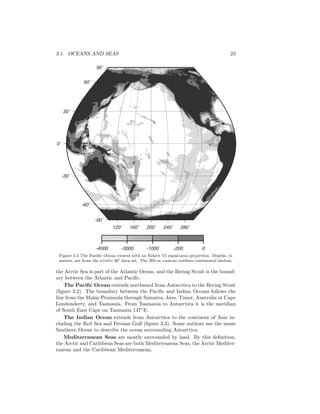
The Atlantic Ocean extends northward from Antarctica and includes all of
the Arctic Sea, the European Mediterranean, and the American Mediterranean
more commonly known as the Caribbean sea (figure 3.1). The boundary be-
tween the Atlantic and Indian Oceans is the meridian of Cape Agulhas (20◦
E).
The boundary between the Atlantic and Pacific Oceans is the line forming the
shortest distance from Cape Horn to the South Shetland Islands. In the north,
3.1. OCEANS AND SEAS 23
120˚ 160˚ 200˚ 240˚ 280˚
-90˚
-60˚
-30˚
0˚
30˚
60˚
90˚
-4000 -3000 -1000 -200 0
Figure 3.2 The Pacific Ocean viewed with an Eckert VI equal-area projection. Depths, in
meters, are from the etopo 30 data set. The 200 m contour outlines continental shelves.
the Arctic Sea is part of the Atlantic Ocean, and the Bering Strait is the bound-
ary between the Atlantic and Pacific.
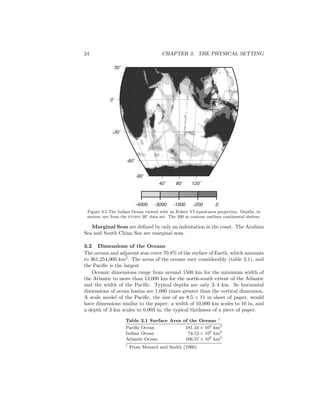
The Pacific Ocean extends northward from Antarctica to the Bering Strait
(figure 3.2). The boundary between the Pacific and Indian Oceans follows the
line from the Malay Peninsula through Sumatra, Java, Timor, Australia at Cape
Londonderry, and Tasmania. From Tasmania to Antarctica it is the meridian
of South East Cape on Tasmania 147◦
E.
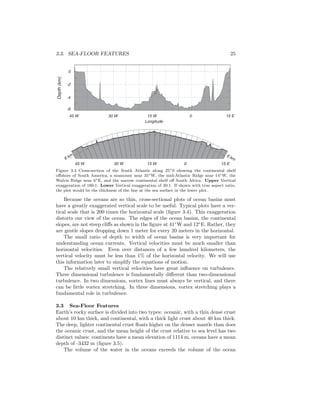
The Indian Ocean extends from Antarctica to the continent of Asia in-
cluding the Red Sea and Persian Gulf (figure 3.3). Some authors use the name
Southern Ocean to describe the ocean surrounding Antarctica.
Mediterranean Seas are mostly surrounded by land. By this definition,
the Arctic and Caribbean Seas are both Mediterranean Seas, the Arctic Mediter-
ranean and the Caribbean Mediterranean.
24 CHAPTER 3. THE PHYSICAL SETTING
40˚ 80˚ 120˚
-90˚
-60˚
-30˚
0˚
30˚
-4000 -3000 -1000 -200 0
Figure 3.3 The Indian Ocean viewed with an Eckert VI equal-area projection. Depths, in
meters, are from the etopo 30 data set. The 200 m contour outlines continental shelves.
Marginal Seas are defined by only an indentation in the coast. The Arabian
Sea and South China Sea are marginal seas.
3.2 Dimensions of the Oceans
The oceans and adjacent seas cover 70.8% of the surface of Earth, which amounts
to 361,254,000 km2
. The areas of the oceans vary considerably (table 3.1), and
the Pacific is the largest.
Oceanic dimensions range from around 1500 km for the minimum width of
the Atlantic to more than 13,000 km for the north-south extent of the Atlantic
and the width of the Pacific. Typical depths are only 3–4 km. So horizontal
dimensions of ocean basins are 1,000 times greater than the vertical dimension.
A scale model of the Pacific, the size of an 8.5 × 11 in sheet of paper, would
have dimensions similar to the paper: a width of 10,000 km scales to 10 in, and
a depth of 3 km scales to 0.003 in, the typical thickness of a piece of paper.
Table 3.1 Surface Area of the Oceans †
Pacific Ocean 181.34 × 10⁶
km2
Indian Ocean 74.12 × 10⁶
km2
Atlantic Ocean 106.57 × 10⁶
km2
†
From Menard and Smith (1966)
3.3. SEA-FLOOR FEATURES 25
Depth(km)
45 W 30 W 15 W 0 15 E
-6
-4
-2
0
Longitude
45 W 30 W 15 W 0 15 E
6 km6 km
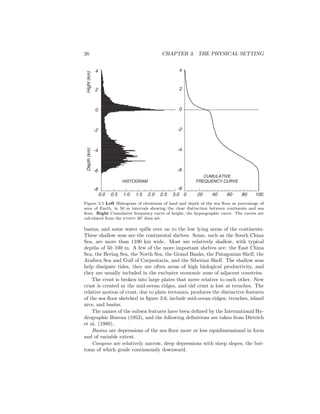
Figure 3.4 Cross-section of the South Atlantic along 25◦S showing the continental shelf
offshore of South America, a seamount near 35◦W, the mid-Atlantic Ridge near 14◦W, the
Walvis Ridge near 6◦E, and the narrow continental shelf off South Africa. Upper Vertical
exaggeration of 180:1. Lower Vertical exaggeration of 30:1. If shown with true aspect ratio,
the plot would be the thickness of the line at the sea surface in the lower plot.
Because the oceans are so thin, cross-sectional plots of ocean basins must
have a greatly exaggerated vertical scale to be useful. Typical plots have a ver-
tical scale that is 200 times the horizontal scale (figure 3.4). This exaggeration
distorts our view of the ocean. The edges of the ocean basins, the continental
slopes, are not steep cliffs as shown in the figure at 41◦
W and 12◦
E. Rather, they
are gentle slopes dropping down 1 meter for every 20 meters in the horizontal.
The small ratio of depth to width of ocean basins is very important for
understanding ocean currents. Vertical velocities must be much smaller than
horizontal velocities. Even over distances of a few hundred kilometers, the
vertical velocity must be less than 1% of the horizontal velocity. We will use
this information later to simplify the equations of motion.
The relatively small vertical velocities have great influence on turbulence.
Three dimensional turbulence is fundamentally different than two-dimensional
turbulence. In two dimensions, vortex lines must always be vertical, and there
can be little vortex stretching. In three dimensions, vortex stretching plays a
fundamental role in turbulence.
3.3 Sea-Floor Features
Earth’s rocky surface is divided into two types: oceanic, with a thin dense crust
about 10 km thick, and continental, with a thick light crust about 40 km thick.
The deep, lighter continental crust floats higher on the denser mantle than does
the oceanic crust, and the mean height of the crust relative to sea level has two
distinct values: continents have a mean elevation of 1114 m, oceans have a mean
depth of -3432 m (figure 3.5).
The volume of the water in the oceans exceeds the volume of the ocean
26 CHAPTER 3. THE PHYSICAL SETTING
0.0 0.5 1.0 1.5 2.0 2.5 3.0
-8
-6
-4
-2
0
2
4
Depth(km)Hight(km)
0 20 40 60 80 100
-8
-6
-4
-2
0
2
4
HISTOGRAM
CUMULATIVE
FREQUENCY CURVE
Figure 3.5 Left Histogram of elevations of land and depth of the sea floor as percentage of
area of Earth, in 50 m intervals showing the clear distinction between continents and sea
floor. Right Cumulative frequency curve of height, the hypsographic curve. The curves are
calculated from the etopo 30 data set.
basins, and some water spills over on to the low lying areas of the continents.
These shallow seas are the continental shelves. Some, such as the South China
Sea, are more than 1100 km wide. Most are relatively shallow, with typical
depths of 50–100 m. A few of the more important shelves are: the East China
Sea, the Bering Sea, the North Sea, the Grand Banks, the Patagonian Shelf, the
Arafura Sea and Gulf of Carpentaria, and the Siberian Shelf. The shallow seas
help dissipate tides, they are often areas of high biological productivity, and
they are usually included in the exclusive economic zone of adjacent countries.
The crust is broken into large plates that move relative to each other. New
crust is created at the mid-ocean ridges, and old crust is lost at trenches. The
relative motion of crust, due to plate tectonics, produces the distinctive features
of the sea floor sketched in figure 3.6, include mid-ocean ridges, trenches, island
arcs, and basins.
The names of the subsea features have been defined by the International Hy-
drographic Bureau (1953), and the following definitions are taken from Dietrich
et al. (1980).
Basins are depressions of the sea floor more or less equidimensional in form
and of variable extent.
Canyons are relatively narrow, deep depressions with steep slopes, the bot-
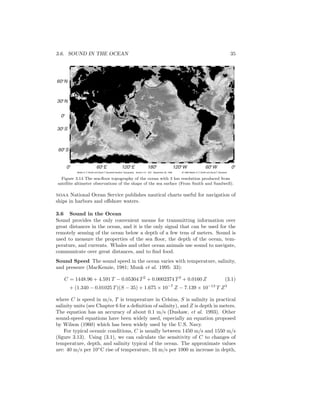
toms of which grade continuously downward.
3.4. MEASURING THE DEPTH OF THE OCEAN 27
Shore
High Water
Low Water
Sea Level
OCEAN
SHELF
(Gravel,
Sand
Av slope
1 in 500)
SLOPE
(Mud
av slope
1 in 20)
CONTINENT
RISE
BASIN
MID-OCEAN
RIDGE
DEEP SEA
(Clay & Oozes)
Mineral Organic
SEAMOUNT
TRENCH
ISLANDARC
Figure 3.6 Schematic section through the ocean showing principal features of the sea floor.
Note that the slope of the sea floor is greatly exaggerated in the figure.
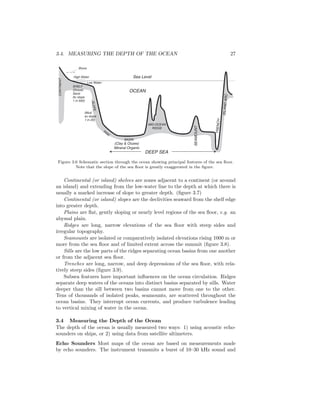
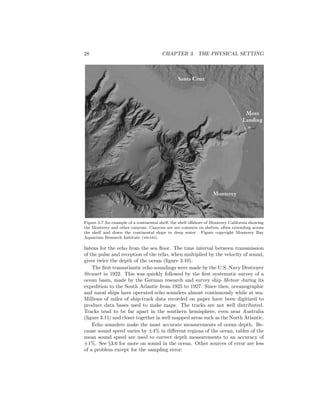
Continental (or island) shelves are zones adjacent to a continent (or around
an island) and extending from the low-water line to the depth at which there is
usually a marked increase of slope to greater depth. (figure 3.7)
Continental (or island) slopes are the declivities seaward from the shelf edge
into greater depth.
Plains are flat, gently sloping or nearly level regions of the sea floor, e.g. an
abyssal plain.
Ridges are long, narrow elevations of the sea floor with steep sides and
irregular topography.
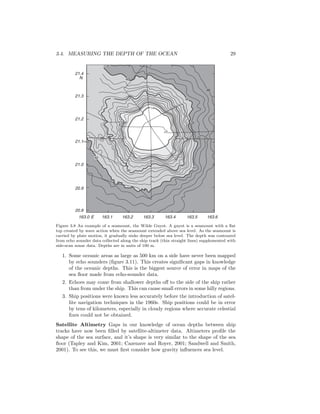
Seamounts are isolated or comparatively isolated elevations rising 1000 m or
more from the sea floor and of limited extent across the summit (figure 3.8).
Sills are the low parts of the ridges separating ocean basins from one another
or from the adjacent sea floor.
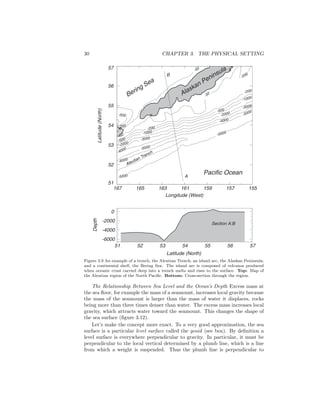
Trenches are long, narrow, and deep depressions of the sea floor, with rela-
tively steep sides (figure 3.9).
Subsea features have important influences on the ocean circulation. Ridges
separate deep waters of the oceans into distinct basins separated by sills. Water
deeper than the sill between two basins cannot move from one to the other.
Tens of thousands of isolated peaks, seamounts, are scattered throughout the
ocean basins. They interrupt ocean currents, and produce turbulence leading
to vertical mixing of water in the ocean.
3.4 Measuring the Depth of the Ocean
The depth of the ocean is usually measured two ways: 1) using acoustic echo-
sounders on ships, or 2) using data from satellite altimeters.
Echo Sounders Most maps of the ocean are based on measurements made
by echo sounders. The instrument transmits a burst of 10–30 kHz sound and
28 CHAPTER 3. THE PHYSICAL SETTING
Figure 3.7 An example of a continental shelf, the shelf offshore of Monterey California showing
the Monterey and other canyons. Canyons are are common on shelves, often extending across
the shelf and down the continental slope to deep water. Figure copyright Monterey Bay
Aquarium Research Institute (mbari).
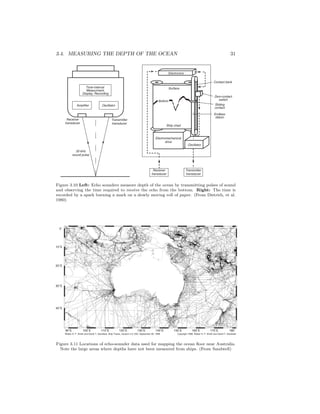
listens for the echo from the sea floor. The time interval between transmission
of the pulse and reception of the echo, when multiplied by the velocity of sound,
gives twice the depth of the ocean (figure 3.10).
The first transatlantic echo soundings were made by the U.S. Navy Destroyer
Stewart in 1922. This was quickly followed by the first systematic survey of a
ocean basin, made by the German research and survey ship Meteor during its
expedition to the South Atlantic from 1925 to 1927. Since then, oceanographic
and naval ships have operated echo sounders almost continuously while at sea.
Millions of miles of ship-track data recorded on paper have been digitized to
produce data bases used to make maps. The tracks are not well distributed.
Tracks tend to be far apart in the southern hemisphere, even near Australia
(figure 3.11) and closer together in well mapped areas such as the North Atlantic.
Echo sounders make the most accurate measurements of ocean depth. Be-
cause sound speed varies by ±4% in different regions of the ocean, tables of the
mean sound speed are used to correct depth measurements to an accuracy of
±1%. See §3.6 for more on sound in the ocean. Other sources of error are less
of a problem except for the sampling error:
3.4. MEASURING THE DEPTH OF THE OCEAN 29
21.4
21.3
21.2
21.1•
21.0
20.9
20.8
N
163.0 E 163.1 163.2 163.3 163.4 163.5 163.6
40
30
20
14
40
40
2040
48
30
Figure 3.8 An example of a seamount, the Wilde Guyot. A guyot is a seamount with a flat
top created by wave action when the seamount extended above sea level. As the seamount is
carried by plate motion, it gradually sinks deeper below sea level. The depth was contoured
from echo sounder data collected along the ship track (thin straight lines) supplemented with
side-scan sonar data. Depths are in units of 100 m.
1. Some oceanic areas as large as 500 km on a side have never been mapped
by echo sounders (figure 3.11). This creates significant gaps in knowledge
of the oceanic depths. This is the biggest source of error in maps of the
sea floor made from echo-sounder data.
2. Echoes may come from shallower depths off to the side of the ship rather
than from under the ship. This can cause small errors in some hilly regions.
3. Ship positions were known less accurately before the introduction of satel-
lite navigation techniques in the 1960s. Ship positions could be in error
by tens of kilometers, especially in cloudy regions where accurate celestial
fixes could not be obtained.
Satellite Altimetry Gaps in our knowledge of ocean depths between ship
tracks have now been filled by satellite-altimeter data. Altimeters profile the
shape of the sea surface, and it’s shape is very similar to the shape of the sea
floor (Tapley and Kim, 2001; Cazenave and Royer, 2001; Sandwell and Smith,
2001). To see this, we must first consider how gravity influences sea level.
30 CHAPTER 3. THE PHYSICAL SETTING
Longitude (West)
Latitude(North)
-5000
-5000
-5000
-5000
-4000
-4000
-3000
-3000
-2000
-2000
-1000
-1000
-500
-500
-200
-200
-50
-50
-200
0
0
-50
-200
-500
0
-6000
167 165 163 161 159 157 155
51
52
53
54
55
56
57
51 52 53 54 55 56 57
Latitude (North)
-6000
-4000
-2000
0
Depth
Section A:B
A
B
Alaskan Peninsula
Bering Sea
Aleutian Trench
Pacific Ocean
Figure 3.9 An example of a trench, the Aleutian Trench; an island arc, the Alaskan Peninsula;
and a continental shelf, the Bering Sea. The island arc is composed of volcanos produced
when oceanic crust carried deep into a trench melts and rises to the surface. Top: Map of
the Aleutian region of the North Pacific. Bottom: Cross-section through the region.
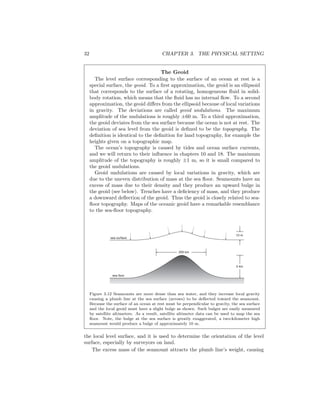
The Relationship Between Sea Level and the Ocean’s Depth Excess mass at
the sea floor, for example the mass of a seamount, increases local gravity because
the mass of the seamount is larger than the mass of water it displaces, rocks
being more than three times denser than water. The excess mass increases local
gravity, which attracts water toward the seamount. This changes the shape of
the sea surface (figure 3.12).
Let’s make the concept more exact. To a very good approximation, the sea
surface is a particular level surface called the geoid (see box). By definition a
level surface is everywhere perpendicular to gravity. In particular, it must be
perpendicular to the local vertical determined by a plumb line, which is a line
from which a weight is suspended. Thus the plumb line is perpendicular to
3.4. MEASURING THE DEPTH OF THE OCEAN 31
Transmitter
transducer
Receiver
transducer
Oscillator
Electromechanical
drive
Electronics
Bottom
Transmitter
transducer
Receiver
transducer
Amplifier Oscillator
Time-interval
Measurment,
Display, Recording
Strip chart
Surface
Contact bank
Zero-contact
switch
Sliding
contact
Endless
ribbon
33 kHz
sound pulse
Figure 3.10 Left: Echo sounders measure depth of the ocean by transmitting pulses of sound
and observing the time required to receive the echo from the bottom. Right: The time is
recorded by a spark burning a mark on a slowly moving roll of paper. (From Dietrich, et al.
1980)
90˚E 100˚E 110˚E 120˚E 130˚E 140˚E 150˚E 160˚E 170˚E 180˚
40˚S
30˚S
20˚S
10˚S
0˚
Walter H. F. Smith and David T. Sandwell, Ship Tracks, Version 4.0, SIO, September 26, 1996 Copyright 1996, Walter H. F. Smith and David T. Sandwell
Figure 3.11 Locations of echo-sounder data used for mapping the ocean floor near Australia.
Note the large areas where depths have not been measured from ships. (From Sandwell)
32 CHAPTER 3. THE PHYSICAL SETTING
The Geoid
The level surface corresponding to the surface of an ocean at rest is a
special surface, the geoid. To a first approximation, the geoid is an ellipsoid
that corresponds to the surface of a rotating, homogeneous fluid in solid-
body rotation, which means that the fluid has no internal flow. To a second
approximation, the geoid differs from the ellipsoid because of local variations
in gravity. The deviations are called geoid undulations. The maximum
amplitude of the undulations is roughly ±60 m. To a third approximation,
the geoid deviates from the sea surface because the ocean is not at rest. The
deviation of sea level from the geoid is defined to be the topography. The
definition is identical to the definition for land topography, for example the
heights given on a topographic map.
The ocean’s topography is caused by tides and ocean surface currents,
and we will return to their influence in chapters 10 and 18. The maximum
amplitude of the topography is roughly ±1 m, so it is small compared to
the geoid undulations.
Geoid undulations are caused by local variations in gravity, which are
due to the uneven distribution of mass at the sea floor. Seamounts have an
excess of mass due to their density and they produce an upward bulge in
the geoid (see below). Trenches have a deficiency of mass, and they produce
a downward deflection of the geoid. Thus the geoid is closely related to sea-
floor topography. Maps of the oceanic geoid have a remarkable resemblance
to the sea-floor topography.
sea surface
sea floor
10 m
2 km
200 km
Figure 3.12 Seamounts are more dense than sea water, and they increase local gravity
causing a plumb line at the sea surface (arrows) to be deflected toward the seamount.
Because the surface of an ocean at rest must be perpendicular to gravity, the sea surface
and the local geoid must have a slight bulge as shown. Such bulges are easily measured
by satellite altimeters. As a result, satellite altimeter data can be used to map the sea
floor. Note, the bulge at the sea surface is greatly exaggerated, a two-kilometer high
seamount would produce a bulge of approximately 10 m.
the local level surface, and it is used to determine the orientation of the level
surface, especially by surveyors on land.
The excess mass of the seamount attracts the plumb line’s weight, causing
3.4. MEASURING THE DEPTH OF THE OCEAN 33
Satelite's Orbit
Geoid
Geoid Undulation
Sea
Surface
Topography
Reference
Ellipsoid
Center of
Mass
{
}
r
h
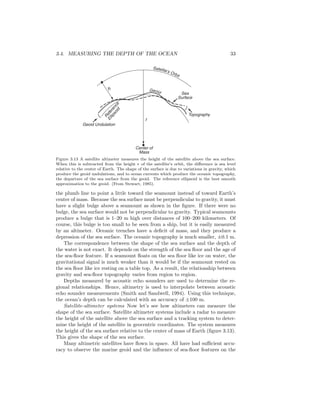
Figure 3.13 A satellite altimeter measures the height of the satellite above the sea surface.
When this is subtracted from the height r of the satellite’s orbit, the difference is sea level
relative to the center of Earth. The shape of the surface is due to variations in gravity, which
produce the geoid undulations, and to ocean currents which produce the oceanic topography,
the departure of the sea surface from the geoid. The reference ellipsoid is the best smooth
approximation to the geoid. (From Stewart, 1985).
the plumb line to point a little toward the seamount instead of toward Earth’s
center of mass. Because the sea surface must be perpendicular to gravity, it must
have a slight bulge above a seamount as shown in the figure. If there were no
bulge, the sea surface would not be perpendicular to gravity. Typical seamounts
produce a bulge that is 1–20 m high over distances of 100–200 kilometers. Of
course, this bulge is too small to be seen from a ship, but it is easily measured
by an altimeter. Oceanic trenches have a deficit of mass, and they produce a
depression of the sea surface. The oceanic topography is much smaller, ±0.1 m.
The correspondence between the shape of the sea surface and the depth of
the water is not exact. It depends on the strength of the sea floor and the age of
the sea-floor feature. If a seamount floats on the sea floor like ice on water, the
gravitational signal is much weaker than it would be if the seamount rested on
the sea floor like ice resting on a table top. As a result, the relationship between
gravity and sea-floor topography varies from region to region.
Depths measured by acoustic echo sounders are used to determine the re-
gional relationships. Hence, altimetry is used to interpolate between acoustic
echo sounder measurements (Smith and Sandwell, 1994). Using this technique,
the ocean’s depth can be calculated with an accuracy of ±100 m.
Satellite-altimeter systems Now let’s see how altimeters can measure the
shape of the sea surface. Satellite altimeter systems include a radar to measure
the height of the satellite above the sea surface and a tracking system to deter-
mine the height of the satellite in geocentric coordinates. The system measures
the height of the sea surface relative to the center of mass of Earth (figure 3.13).
This gives the shape of the sea surface.
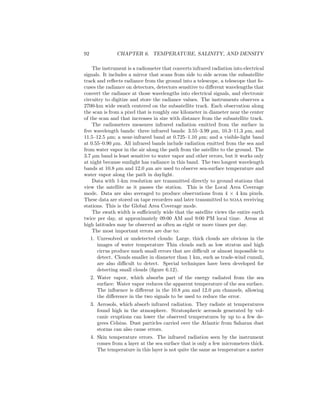
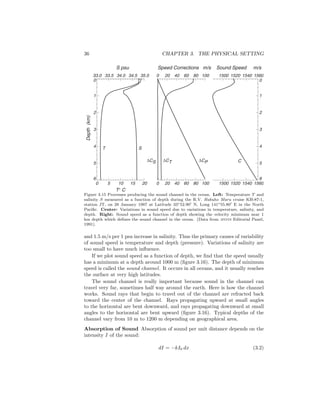
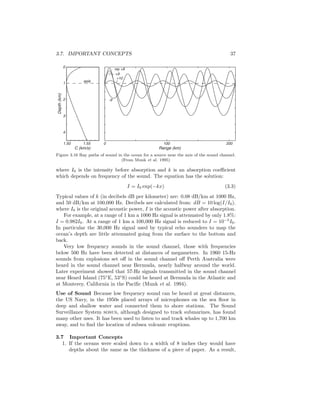
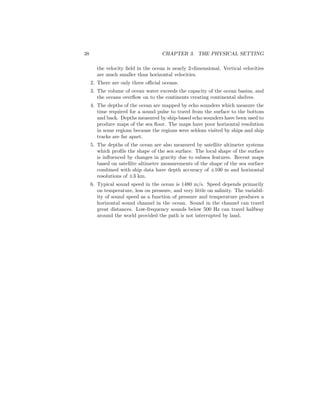
Many altimetric satellites have flown in space. All have had sufficient accu-
racy to observe the marine geoid and the influence of sea-floor features on the
34 CHAPTER 3. THE PHYSICAL SETTING
geoid. Typical accuracy for the very accurate Topex/Poseidon and Jason satel-
lites is ±0.05 m. The most useful satellites include geosat (1985–1988), ers–1
(1991–1996), ers–2 (1995– ), Topex/Poseidon (1992–) and Jason (2002–).
Satellite Altimeter Maps of the Sea-floor Topography Seasat, geosat, ers–
1, and ers–2 were operated in orbits with ground tracks spaced 3–10 km apart,
which was sufficient to map the geoid. The first measurements, which were
made by geosat, were classified by the US Navy, and they were not released
to scientists outside the Navy. By 1996 however, the geoid had been mapped
by the Europeans and the Navy released all the geosat data. By combining
data from all altimetric satellites, Smith ans Sandwell reduced the small errors
due to ocean currents and tides, and then produced maps of the geoid and sea
floor with ±3 km horizontal resolution.
3.5 Sea Floor Charts and Data Sets
Most available echo-sounder data have been digitized and plotted to make sea-
floor charts. Data have been further processed and edited to produce digital
data sets which are widely distributed in cd-rom format. These data have been
supplemented with data from altimetric satellites to produce maps of the sea
floor with horizontal resolution approaching 3 km.
The British Oceanographic Data Centre publishes the General Bathymetric
Chart of the Oceans (gebco) Digital Atlas on behalf of the Intergovernmen-
tal Oceanographic Commission of unesco and the International Hydrographic
Organization. The atlas consists primarily of the location of depth contours,
coastlines, and tracklines from the gebco 5th Edition published at a scale of
1:10 million. The original contours were drawn by hand based on digitized
echo-sounder data plotted on base maps.
The U.S. National Geophysical Data Center publishes the etopo-5 cd-rom
containing values of digital oceanic depths from echo sounders and land heights
from surveys interpolated to a 5-minute (5 nautical mile) grid. Much of the
data were originally compiled by the U.S. Defense Mapping Agency, the U.S.
Navy Oceanographic Office, and the U.S. National Ocean Service. Although
the map has values on a 5-minute grid, data used to make the map are much
more sparse, especially in the southern ocean, where distances between ship
tracks can exceed 500 km in some regions (figure 3.11). The same data set and
cd-rom is contains values smoothed and interpolated to a 30-minute grid.
Sandwell and Smith of the Scripps Institution of Oceanography distribute a
digital sea-floor atlas of the oceans based on measurements of the height of the
sea surface made from geosat and ers–1 altimeters and echo-sounder data.
This map has a horizontal resolution of 3–4 km and a vertical accuracy of ±100
m (Smith and Sandwell, 1997). The US National Geophysical Data Center
combined the Sandwell and Smith data with land elevations to produce a global
map with 2-minute horizontal resolution. These maps shows much more detail
than the etopo-5 map because the satellite data fill in the regions between ship
tracks (figure 3.14).
National governments publish coastal and harbor maps. In the USA, the
3.6. SOUND IN THE OCEAN 35
60∞N
0∞
30∞N
30∞S
60∞S
180∞120∞E0∞ 60∞E 120∞W 60∞W 0∞
Walter H. F. Smith and David T. Sandwell Seafloor Topography Version 4.0 SIO September 26, 1996 © 1996 Walter H. F. Smith and David T. Sandwell
Figure 3.14 The sea-floor topography of the ocean with 3 km resolution produced from
satellite altimeter observations of the shape of the sea surface (From Smith and Sandwell).
noaa National Ocean Service publishes nautical charts useful for navigation of
ships in harbors and offshore waters.
3.6 Sound in the Ocean
Sound provides the only convenient means for transmitting information over
great distances in the ocean, and it is the only signal that can be used for the
remotely sensing of the ocean below a depth of a few tens of meters. Sound is
used to measure the properties of the sea floor, the depth of the ocean, tem-
perature, and currents. Whales and other ocean animals use sound to navigate,
communicate over great distances, and to find food.
Sound Speed The sound speed in the ocean varies with temperature, salinity,
and pressure (MacKenzie, 1981; Munk et al. 1995: 33):
C = 1448.96 + 4.591 T − 0.05304 T2
+ 0.0002374 T3
+ 0.0160 Z (3.1)
+ (1.340 − 0.01025 T)(S − 35) + 1.675 × 10⁻⁷
Z − 7.139 × 10⁻¹³
T Z3
where C is speed in m/s, T is temperature in Celsius, S is salinity in practical
salinity units (see Chapter 6 for a definition of salinity), and Z is depth in meters.
The equation has an accuracy of about 0.1 m/s (Dushaw, et al. 1993). Other
sound-speed equations have been widely used, especially an equation proposed
by Wilson (1960) which has been widely used by the U.S. Navy.
For typical oceanic conditions, C is usually between 1450 m/s and 1550 m/s
(figure 3.13). Using (3.1), we can calculate the sensitivity of C to changes of
temperature, depth, and salinity typical of the ocean. The approximate values
are: 40 m/s per 10◦
C rise of temperature, 16 m/s per 1000 m increase in depth,
36 CHAPTER 3. THE PHYSICAL SETTING
S psu
0 5 10 15 20
6
5
4
3
2
1
0
Depth(km)
33.0 33.5 34.0 34.5 35.0
Speed Corrections m/s
0 20 40 60 80 100
0 20 40 60 80 100
Sound Speed m/s
1500 1520 1540 1560
1500 1520 1540 1560
6
5
4
3
2
1
0
T S
C
T∞ C
DCT DCPDCS
Figure 3.15 Processes producing the sound channel in the ocean. Left: Temperature T and
salinity S measured as a function of depth during the R.V. Hakuho Maru cruise KH-87-1,
station JT, on 28 January 1987 at Latitude 33◦52.90 N, Long 141◦55.80 E in the North
Pacific. Center: Variations in sound speed due to variations in temperature, salinity, and
depth. Right: Sound speed as a function of depth showing the velocity minimum near 1
km depth which defines the sound channel in the ocean. (Data from jpots Editorial Panel,
1991).
and 1.5 m/s per 1 psu increase in salinity. Thus the primary causes of variability
of sound speed is temperature and depth (pressure). Variations of salinity are
too small to have much influence.
If we plot sound speed as a function of depth, we find that the speed usually
has a minimum at a depth around 1000 m (figure 3.16). The depth of minimum
speed is called the sound channel. It occurs in all oceans, and it usually reaches
the surface at very high latitudes.
The sound channel is really important because sound in the channel can
travel very far, sometimes half way around the earth. Here is how the channel
works. Sound rays that begin to travel out of the channel are refracted back
toward the center of the channel. Rays propagating upward at small angles
to the horizontal are bent downward, and rays propagating downward at small
angles to the horizontal are bent upward (figure 3.16). Typical depths of the
channel vary from 10 m to 1200 m depending on geographical area.
Absorption of Sound Absorption of sound per unit distance depends on the
intensity I of the sound:
dI = −kI0 dx (3.2)
3.7. IMPORTANT CONCEPTS 37
+9
+10
-9
ray +8
Range (km)
0 100 2001.50 1.55
0
1
2
3
4
Depth(km)
C (km/s)
axis
Figure 3.16 Ray paths of sound in the ocean for a source near the axis of the sound channel.
(From Munk et al. 1995)
where I0 is the intensity before absorption and k is an absorption coefficient
which depends on frequency of the sound. The equation has the solution:
I = I0 exp(−kx) (3.3)
Typical values of k (in decibels dB per kilometer) are: 0.08 dB/km at 1000 Hz,
and 50 dB/km at 100,000 Hz. Decibels are calculated from: dB = 10 log(I/I0).
where I0 is the original acoustic power, I is the acoustic power after absorption.
For example, at a range of 1 km a 1000 Hz signal is attenuated by only 1.8%:
I = 0.982I0. At a range of 1 km a 100,000 Hz signal is reduced to I = 10−5
I0.
In particular the 30,000 Hz signal used by typical echo sounders to map the
ocean’s depth are little attenuated going from the surface to the bottom and
back.
Very low frequency sounds in the sound channel, those with frequencies
below 500 Hz have been detected at distances of megameters. In 1960 15-Hz
sounds from explosions set off in the sound channel off Perth Australia were
heard in the sound channel near Bermuda, nearly halfway around the world.
Later experiment showed that 57-Hz signals transmitted in the sound channel
near Heard Island (75◦
E, 53◦
S) could be heard at Bermuda in the Atlantic and
at Monterey, California in the Pacific (Munk et al. 1994).
Use of Sound Because low frequency sound can be heard at great distances,
the US Navy, in the 1950s placed arrays of microphones on the sea floor in
deep and shallow water and connected them to shore stations. The Sound
Surveillance System sosus, although designed to track submarines, has found
many other uses. It has been used to listen to and track whales up to 1,700 km
away, and to find the location of subsea volcanic eruptions.
3.7 Important Concepts
1. If the oceans were scaled down to a width of 8 inches they would have
depths about the same as the thickness of a piece of paper. As a result,
38 CHAPTER 3. THE PHYSICAL SETTING
the velocity field in the ocean is nearly 2-dimensional. Vertical velocities
are much smaller than horizontal velocities.
2. There are only three official oceans.
3. The volume of ocean water exceeds the capacity of the ocean basins, and
the oceans overflow on to the continents creating continental shelves.
4. The depths of the ocean are mapped by echo sounders which measure the
time required for a sound pulse to travel from the surface to the bottom
and back. Depths measured by ship-based echo sounders have been used to
produce maps of the sea floor. The maps have poor horizontal resolution
in some regions because the regions were seldom visited by ships and ship
tracks are far apart.
5. The depths of the ocean are also measured by satellite altimeter systems
which profile the shape of the sea surface. The local shape of the surface
is influenced by changes in gravity due to subsea features. Recent maps
based on satellite altimeter measurements of the shape of the sea surface
combined with ship data have depth accuracy of ±100 m and horizontal
resolutions of ±3 km.
6. Typical sound speed in the ocean is 1480 m/s. Speed depends primarily
on temperature, less on pressure, and very little on salinity. The variabil-
ity of sound speed as a function of pressure and temperature produces a
horizontal sound channel in the ocean. Sound in the channel can travel
great distances. Low-frequency sounds below 500 Hz can travel halfway
around the world provided the path is not interrupted by land.
Chapter 4
Atmospheric Influences
The sun and the atmosphere drive directly or indirectly almost all dynamical
processes in the ocean. The dominant external sources and sinks of energy
are sunlight, evaporation, infrared emissions from the sea surface, and sensible
heating of the sea by warm or cold winds. Winds drive the ocean’s surface
circulation down to depths of around a kilometer. Deep mixing drives to some
extent the deeper currents in the ocean.
The oceans, in turn, help drive the atmospheric circulation. The uneven
distribution of heat loss and gain by the ocean leads to winds in the atmosphere.
Sunlight warms the tropical oceans, which evaporate, transferring heat in the
form of moisture to the atmosphere. Winds and ocean currents carry heat
poleward, where it is lost to space.
Because the atmosphere helps drive the ocean, and the ocean helps drive
the atmosphere, we must consider the ocean and the atmosphere as a coupled
dynamic system. In this chapter we will look at the exchange of heat and water
between the atmosphere and the ocean. Later, we will explore the influence of
the wind on the ocean and the exchange of momentum leading to wind-driven
ocean currents. Then we will look at how the ocean and the atmosphere interact
in the Pacific to produce El Ni˜no.
4.1 The Earth in Space
The Earth’s orbit about the sun is nearly circular at a mean distance of 1.5×10⁸
km. The eccentricity of the orbit is small, 0.0168. Thus Earth is 103.4% further
from the Sun at aphelion than at perihelion, the time of closest approach to the
sun. Perihelion occurs every year in January, and the exact time changes by
about 20 minutes per year. In 1995, it occured on 3 January. Earth’s axis of
rotation is inclined 23.45◦
to the plane of earth’s orbit around the sun (figure
4.1). The orientation is such that the sun is directly overhead at the Equator
on the vernal and autumnal equinoxes, which occur on or about 21 March and
21 September each year.
The latitudes of 23.45◦
North and South are the Tropics of Cancer and
Capricorn respectively. The tropics lie equatorward of these latitudes. As a
39
40 CHAPTER 4. ATMOSPHERIC INFLUENCES
Sun
Tropic of
Capricorn
Winter
solstice
Arctic Circle
Autumnal
equinox
Antarctic Circle
Vernal
equinox
Tropic of
Cancer
Summer
solstice
23 1
2
Figure 4.1 The Earth in space. The ellipticity of Earth’s orbit around the sun and the tilt of
Earth’s axis of rotation relative to the plane of Earth orbit leads to an unequal distribution
of heating and to the seasons.
result of the eccentricity of earth’s orbit, maximum solar insolation averaged
over the surface of the earth occurs in early January each year. As a result
of the inclination of earth’s axis of rotation, the maximum insolation at any
location outside the tropics occurs around 21 June in the northern hemisphere,
and around 21 December in the southern hemisphere.
If the insolation were rapidly and efficiently redistributed over Earth, max-
imum temperature would occur in January. Conversely, if heat were poorly
Annual Wind Speed and Sea Level Pressure (hPa) For 1989
20E 60E 100E 140E 180E 140W 100W 60W 20W 20E
90S
60S
30S
EQ
30N
60N
90N
1012 1012 10141014
1014
1014
1014
1012
1014
1014
1014
1014
1014
1014
1014
1014
1012
1012
1012
1012
1012
1012
1018
1018
1018
1012
1018
1012
1018
1018
1012
1014
1018
1018
1000
1000
990
990
990
990
990
1000
1000
1010
1010
1010
1010
1010
1010
1010
1020
980
1010
1010
1020
1010
1020
980
1010
1020
1020
1010
Figure 4.2 Map of mean annual wind velocity calculated from Trenberth (1990) and sea-level
pressure for 1989 from the nasa Goddard Space Flight Center’s Data Assimilation Office
(Schubert et al. 1995).
4.2. ATMOSPHERIC WIND SYSTEMS 41
Equatorial Low or Doldrums
Subtropical High or Horse latitudes
Subpolar Low
Polar High
Subpolar Low
Subtropical High or Horse latitudes
Polar High
easterlies
westerlies
North-East Trades
South-East Trades
westerlies
easterlies
60˚60˚
60˚ 60˚
30˚30˚
30˚30˚
0˚0˚
90˚ S
90˚ N
heavy precipitation
variable winds
and calms
large evaporation
variable winds
and calms
heavy precipitation
variable winds
and calms
large evaporation
sinking air
rising
air
upper westerlies
sinking air
rising air
Hadleycells
upper westerlies
sinking air
rising
air
sinking air
heavy precipitation
moist air
10
20
0
Pole easterlies 60
o
westerlies 30
o
Trade Winds
Polar
High
Subpolar
Low
Subpolar
High
Intertropical
Convergence Zone
Equatorial
Low
troposphere
polar
front
tropopause
temperature inversion
cumulonimbus
activity
P O L A RP O L A R
S U BS U B
T R O P I C A LT R O P I C A L
Height(km)
Figure 4.3 Simplified schematic of Earth’s atmospheric circulation driven by solar heating in
the tropics and cooling at high latitudes. Upper: The meridional cells in the atmosphere
and the influence of Earth’s rotation on the winds. Bottom: Cross-section through the
atmosphere showing the two major cells of meridional circulation. From The Open University
(1989a).
redistributed, maximum temperature in the northern hemisphere would occur
in summer. So it is clear that heat is not rapidly redistributed by winds and
currents.
4.2 Atmospheric Wind Systems
Figure 4.2 shows the distribution of sea-level winds and pressure averaged over
the year 1989. The map shows strong winds from the west between 40◦
to 60◦
latitude, the roaring forties, weak winds in the subtropics near 30◦
latitude,
trade winds from the east in the tropics, and weaker winds from the east along
the Equator. The strength and direction of winds in the atmosphere is the
result of uneven distribution of solar heating and continental land masses and
the circulation of winds in a vertical plane in the atmosphere.
A simple cartoon of the distribution of winds in the atmosphere(figure 4.3)
shows that the surface winds are influenced by equatorial convection and other
processes higher in the atmosphere.
42 CHAPTER 4. ATMOSPHERIC INFLUENCES
July Wind Speed
20E 60E 100E 140E 180E 140W 100W 60W 20W 20E
90S
60S
30S
EQ
30N
60N
90N
January Wind Speed
20E 60E 100E 140E 180E 140W 100W 60W 20W 20E
90S
60S
30S
EQ
30N
60N
90N
Figure 4.4 Mean, sea-surface winds for July and January calculated by Trenberth’s (1990)
data set calculated from the ecmwf reanalyses of weather data from 1980 to 1989.
The mean value of winds over the ocean is (Wentz et al. 1984):
U10 = 7.4 m/s (4.1)
Maps of surface winds change somewhat with the seasons. The largest
changes are in the Indian Ocean and the western Pacific Ocean (figure 4.4).
Both regions are strongly influenced by the Asian monsoon. In winter, the cold
air mass over Siberia creates a region of high pressure at the surface, and cold
air blows southeastward across Japan and on across the hot Kuroshio, extract-
ing heat from the ocean. In summer, the thermal low over Tibet draws warm,
moist air from the Indian Ocean leading to the rainy season over India.
4.3. THE PLANETARY BOUNDARY LAYER 43
4.3 The Planetary Boundary Layer
The atmosphere within 100 m of the sea surface is influenced by the turbulent
drag of the wind on the sea and the fluxes of heat through the surface. This
is the atmospheric boundary layer. It’s thickness Zi varies from a few tens
of meters for weak winds blowing over water colder than the air to around a
kilometer for stronger winds blowing over water warmer than the air.
The lowest part of the atmospheric boundary layer is the surface layer.
Within this layer, which has thickness of ≈ 0.1Zi, vertical fluxes of heat and
momentum are nearly constant.
Wind speed varies as the logarithm of height within the surface layer for
neutral stability. See ”The Turbulent Boundary Layer Over a Flat Plate” in
Chapter 8. Hence, the height of a wind measurement is important. Usually,
winds are reported as the value of wind at a height 10 m above the sea U10.
4.4 Measurement of Wind
Wind at sea has been measured for centuries. Maury (1855) was the first to
systematically collect and map wind reports. Recently, the US National Atmo-
spheric and Oceanic Administration noaa has collected, edited, and digitized
millions of observations going back over a century. The resulting Comprehen-
sive Ocean, Atmosphere Data Set coads discussed in §5.5 is widely used for
studying atmospheric forcing of the ocean.
Our knowledge of winds at the sea surface come from many sources. Here
are the more important, listed in a crude order of relative importance:
Beaufort Scale By far the most common source of wind data have been reports
of speed based on the Beaufort scale. Even in 1990, 60% of winds reported from
the North Atlantic used the Beaufort scale. The scale is based on features, such
as foam coverage and wave shape, seen by an observer on a ship (table 4.1).
The scale was originally proposed by Admiral Sir F. Beaufort in 1806 to give
the force of the wind on a ship’s sails. It was adopted by the British Admiralty
in 1838 and it soon came into general use.
The International Meteorological Committee adopted the force scale for in-
ternational use in 1874. In 1926 they adopted a revised scale giving the wind
speed at a height of 6 meters corresponding to the Beaufort Number. The scale
was revised again in 1946 to extend the scale to higher wind speeds and to give
the equivalent wind speed at a height of 10 meters. The 1946 scale was based
on the empirical U10 = 0.836B3/2
, where B = Beaufort Number and U10 is the
wind speed in meters per second at a height of 10 meters (List, 1966). More
recently, various groups have revised the Beaufort scale by comparing Beaufort
force with ship measurements of winds. Kent and Taylor (1997) compared the
various revisions of the scale with winds measured by ships having anemometers
at known heights. Their recommended values are given in table 4.1.
Observers on ships usually report weather observations, including Beaufort
force, four times per day, at midnight, 6:00 AM, noon, and 6:00 PM Green-
wich Mean Time. The reports are coded and reported by radio to national
meteorological agencies. The reports have important errors:
44 CHAPTER 4. ATMOSPHERIC INFLUENCES
Table 4.1 Beaufort Wind Scale and State of the Sea
Beaufort Descriptive m/s Appearance of the Sea
Number term
0 Calm 0 Sea like a mirror.
1 Light Air 1.2 Ripples with appearance of scales; no foam crests.
2 Light Breeze 2.8 Small wavelets; crests of glassy appearance,
not breaking.
3 Gentle breeze 4.9 Large wavelets; crests begin to break; scattered
whitecaps.
4 Moderate breeze 7.7 Small waves, becoming longer; numerous whitecaps.
5 Fresh breeze 10.5 Moderate waves, taking longer to form; many
whitecaps; some spray.
6 Strong breeze 13.1 Large waves forming; whitecaps everywhere;
more spray.
7 Near gale 15.8 Sea heaps up; white foam from breaking waves begins
to be blown into streaks.
8 Gale 18.8 Moderately high waves of greater length; edges of
crests begin to break into spindrift; foam is blown
in well-marked streaks.
9 Strong gale 22.1 High waves; sea begins to roll; dense streaks of foam;
spray may reduce visibility.
10 Storm 25.9 Very high waves with overhanging crests; sea takes
white appearance as foam is blown in very dense
streaks; rolling is heavy and visibility reduced.
11 Violent storm 30.2 Exceptionally high waves; sea covered with white
foam patches; visibility still more reduced.
12 Hurricane 35.2 Air is filled with foam; sea completely white
with driving spray; visibility greatly reduced.
From Kent and Taylor (1997)
1. Ships are unevenly distributed over the ocean. Ships tend to avoid high
latitudes in winter and hurricanes in summer, and few ships cross the
southern hemisphere (figure 4.5).
2. Observers may fail to take care in observing oceanic conditions on which
the Beaufort scale is based.
3. The coding of the data may have errors, which can result in the reports
having the wrong location.
4. Overall, the accuracy is probably no better than around 10%.
Scatterometers Observations of winds at sea are coming more and more from
instruments on satellites, and scatterometers are the most common source of
the observations. The scatterometer is a instrument very much like a radar
that measures the scatter of centimeter-wavelength radio waves from small,
centimeter-wavelength waves on the sea surface. The area of the sea covered by
small waves, and their amplitude depends on wind speed and direction. The
scatterometer measures scatter from 2–4 directions, from which wind speed and
direction are calculated.
The scatterometers on ers-1 and ers-2 have made global measurements
of winds from space since 1991. The nasa scatterometer on adeos measured
winds for a six-month period beginning November 1996 and ending with the
4.4. MEASUREMENT OF WIND 45
VOLUNTEER OBSERVING SHIP DATA SEPTEMBER 1997
90E 130E 170E 150W 110W 70W 30W 10E 50E
10N
10S
30S
50S
70S
30N
50N
70N
Figure 4.5 Location of surface observations made from volunteer observing ships and
reported to national meteorological agencies. (From noaa, National Ocean Service)
premature failure of the satellite. It was replaced by Quicksat launched in 1999.
The instrument on Quicksat views 90% of the ocean every 24 hr.
Freilich and Dunbar (1999) report that, overall, the nasa scatterometer on
adeos measured wind speed with an accuracy of ±1.3 m/s. The error in wind
direction was ±17◦
. Spatial resolution was 25 km. The errors in calculated
velocity are due to lack of knowledge of scatter vs wind speed, the unknown
influence of surface films, and sampling error (figure 4.6). Calibrated data from
Quicksat has an accuracy of ± 1 m/s.
Because scatterometers view a specific oceanic area only once a day, or once
every two days, the data must be used with numerical weather models to obtain
daily wind maps with no gaps in coverage.
Special Sensor Microwave SSM/I Another satellite instrument that is wide-
ly used for measuring wind speed is the Special-Sensor Microwave/Imager (ssm/i)
carried since 1987 on the satellites of the U.S. Defense Meteorological Satellite
Program in orbits similar to the noaa polar-orbiting meteorological satellites.
The instrument measures the microwave radiation emitted from the sea at an
angle near 60◦
from the vertical. The emission is a function of wind speed,
water vapor in the atmosphere, and the amount of water in cloud drops. By
observing several frequencies simultaneously, data from the instrument are used
for calculating the surface wind speed.
Winds measured by ssm/i have an accuracy of ± 2 m/s in speed. When
combined with ecmwf 1000 mb wind analyses, wind direction can be calculated
with an accuracy of ±22◦
(Atlas, Hoffman, and Bloom, 1993). Global, gridded
data are available since July 1987 on a 2.5◦
longitude by 2.0◦
latitude grid every 6
hours (Atlas et al, 1996). But remember, the instrument views a specific oceanic
46 CHAPTER 4. ATMOSPHERIC INFLUENCES
area only once a day, and the gridded, 6-hourly maps have big gaps.
Anemometers on Ships The next most common source of winds reported to
meteorological agencies come from observers reading the output of an anemome-
ters on ships. The output of the anemometer is read four times a day at the
standard Greenwich times and reported via radio to meteorological agencies.
These reports also have important errors:
1. The reports are sparse in time and space. Very few ships report anemome-
ter winds.
2. Anemometer may never be calibrated after installation.
3. The observer usually observes the output of the anemometer for a few
seconds, and thus the observation is an instantaneous value of wind speed
and direction rather than an average over several minutes to an hour.
Remember that winds can be gusty, and the observation can have errors
of 10–30%.
4. The observations are reported by coded radio messages, and the message
can have coding errors. Such errors cause ship winds to be reported from
over land as shown in figure 4.4.
Calibrated Anemometers on Ships Few ships carry calibrated anemome-
ters. Those that do tend to be commercial ships participating in the Volunteer
Observing Ship program. These ships are met in port by scientists who check the
instruments and replace them if necessary, and who collect the data measured
at sea. The best accuracy is about ±2 m/s.
Calibrated Anemometers on Weather Buoys The most accurate measure-
ments of winds at sea are made by calibrated anemometers on moored weather
buoys. Unfortunately there are few such buoys, perhaps only a hundred scat-
tered around the world. Some, such as Tropical Atmosphere Ocean tao array
in the tropical Pacific (figure 14.14) provide data from remote areas rarely vis-
ited by ships, but most tend to be located just offshore of coastal areas. noaa
operates buoys offshore of the United States and the tao array in the Pacific.
Data from the coastal buoys are averaged for eight minutes before the hour, and
the observations are transmitted to shore via satellite links.
The best accuracy of anemometers on buoys operated by the us National
Data Buoy Center is the greater of ±1 m/s or 10% for wind speed and ±10◦
for
wind direction (Beardsley et al. 1997).
Surface Analysis from Numerical Weather Models Satellites, ships, and
buoys measure winds at various locations and times of the day. If you wish
to use the observations to calculate monthly averaged winds over the sea, then
the observations can be averaged and gridded. If you wish to use wind data in
numerical models of the ocean’s currents, then the data will be less useful. You
are faced with a very common problem: How to take all observations made in
a one-day period and determine the winds over the ocean on say a fixed grid?
The best source of gridded winds over the ocean is the output from numerical
weather models. The strategy used to produce the gridded winds is called
4.4. MEASUREMENT OF WIND 47
sequential estimation techniques or data assimilation. “Measurements are used
to prepare initial conditions for the model, which is then integrated forward
in time until further measurements are available. The model is thereupon re-
initialized” (Bennett, 1992: 67).
Usually, all available measurements are used, including observations from
weather stations on land, pressure and temperature reported by ships and buoys,
winds from scatterometers in space, and data from meteorological satellites. The
model interpolates the measurements to produce the initial conditions consistent
with previous and present observations. Daley (1991) describes the techniques
in considerable detail.
Perhaps the most widely used weather model is that run by the European
Centre for Medium-range Weather Forecasts ecmwf. It calculates surface winds
and heat fluxes (see Chapter 5) every six hours on a 1◦
× 1◦
grid from an explicit
boundary-layer model. Calculated values are archived on a 2.5◦
grid.
ecmwf calculations of winds have relatively good accuracy. Freilich and
Dunbar (1999) estimated that the accuracy for wind speed at 10 meters is ±1.5
m/s, and ±18◦
for direction.
Accuracy in the southern hemisphere is probably as good as in the northern
hemisphere because continents do not disrupt the flow as much as in the northern
hemisphere, and because scatterometers give accurate positions of storms and
fronts over the ocean.
Other surface-analysis values used in oceanography include: 1) output from
the numerical weather model run by the noaa National Centers for Environ-
mental Prediction, 2) the Planetary Boundary-Layer Data set produced by the
U.S. Navy’s Fleet Numerical Oceanography Center fnoc, and 3) surface wind
maps for the tropics produced at Florida State University (Goldenberg and
O’Brien, 1981).
Reanalyzed Output from Numerical Weather Models The output from
numerical models of the atmospheric circulation has been available for decades.
Throughout this period, the models have been constantly changed as meteorol-
ogists strive to make ever more accurate forecasts. Fluxes calculated from the
models are therefore not consistent in time. The changes can be larger than the
interannual variability of the fluxes (White, 1996). To minimize this problem,
meteorological agencies have taken all archived weather data and reanalyzed
them using the best numerical models now available to produce a uniform,
internally-consistent, surface analysis.
The reanalyzed data sets are now being used to study oceanic and atmo-
spheric dynamics. The surface analysis data sets are used only for problems that
require up-to-date information. For example, if you are designing an offshore
structure, you will probably use decades of reanalyzed data. If you are operat-
ing an offshore structure, you will watch the surface analysis and forecasts put
out every six hours by meteorological agencies.
Sources of Reanalyzed Data Analyzed surface flux data are available from
national meteorological centers operating numerical weather prediction models.
1. The U.S. National Centers for Environmental Predictions, working with
48 CHAPTER 4. ATMOSPHERIC INFLUENCES
the National Center for Atmospheric Research, the ncep/ncar reanalysis,
have reanalyzed 40 years of weather data from 1958 to 1998 using the 25
January 1995 version of their forecast model. The reanalysis period will
be extended backward to include the 1948–1957 period, and it is being
extended forward to include all date up to the present with about a six
month delay in producing data sets. The reanalysis uses surface and ship
observations plus sounder data from satellites. Reanalyzed products are
available every six hours on a T62 grid having 192 × 94 grid points with a
spatial resolution of 209 km and with 24 vertical levels. Important subsets
of the reanalyzed data, including surface fluxes, are available on cd–rom
(Kalnay et al. 1996; Kistler et al. 1999).
2. The European Centre for Medium-range Weather Forecasts ecmwf has
reanalyzed 17 years of weather data from 1979 to 1993. The reanalysis uses
mostly the same surface, ship and satellite data used by the ncep/ncar
reanalysis. The European Centre is extending the reanalysis to cover a
40-year period from 1957–1997. Spatial resolution will be 83 km, temporal
resolution will be 6 hours. The reanalysis will use most available satellite
data sets, including data from the ers-1 and ers-2 satellites and ssm/i.
The analysis will include an ocean-wave model and it will calculate ocean
wave heights.
3. The Data Assimilation Office at nasa’s Goddard Space Flight Center
has completed a reanalysis for the period 1 March 1980 to 13 December
1993 later extended to February 1995. The analyzed data are available
every six hours on a 2◦
×2.5◦
(91 × 144 point) grid with 20 vertical levels.
The analysis uses the ncep real-time in-situ observations plus tovs data
from the noaa meteorological satellites and cloud-drift winds (Schubert,
Rood, and Pfaendtner, 1993). The analysis places special emphasis on the
assimilation of satellite data using the Goddard Earth Observing System
numerical weather model.
4.5 Wind Stress
The wind, by itself, is usually not very interesting. Often we are much more
interested in the force of the wind, or the work done by the wind. The horizontal
force of the wind on the sea surface is called the wind stress. Put another way, it
is the vertical transfer of horizontal momentum. Thus momentum is transferred
from the atmosphere to the ocean by wind stress.
Wind stress T is calculated from:
T = ρ CDU2
10 (4.2)
where ρ = 1.3 kg/m3
is the density of air, U10 is wind speed at 10 meters, and
CD is the drag coefficient. CD is measured using the techniques described in
§5.6. Fast response instruments measure wind fluctuations within 10–20 m of
the sea surface, from which T is directly calculated. The correlation of T with
U2
10 gives CD (figure 4.7).
4.6. IMPORTANT CONCEPTS 49
U10 (m/s)
5 10 15 200
0
0.001
0.002
0.003
CD
Figure 4.7 Observations of the drag coefficient as a function of wind speed U10 ten meters
above the sea. The solid line is 1000 CD = 0.44 + 0.063U10 proposed by Smith (1980) and
the dashed line follows from Charnock (1955). From Smith, 1980.
Various measurements of CD have been published based on careful measure-
ments of turbulence in the marine boundary layer. Trenberth et al. (1989) and
Harrison (1989) discuss the accuracy of an effective drag coefficient relating wind
stress to wind velocity on a global scale. Perhaps the most recently published
value is that of Yelland and Taylor (1996), who give:
1000 CD = 0.29 +
3.1
U10
+
7.7
U2
10
(3 ≤ U10 ≤ 6 m/s) (4.3a)
1000 CD = 0.60 + 0.070 U10 (6 ≤ U10 ≤ 26 m/s) (4.3b)
for neutrally stable boundary layer. Other values are listed in their table 1 and
in figure 4.7.
Useful monthly maps of oceanic wind stress suitable for studies of the ocean
circulation have been published by Trenberth et al. (1989) who used analyzed
wind fields from ecmwf to produce maps with 2.5◦
resolution, and by Hellerman
and Rosenstein (1983) who used 35 million observations made from surface ships
between 1870 and 1976 to produce maps with 2◦
resolution.
4.6 Important Concepts
1. Sunlight is the primary energy source driving the atmosphere and oceans.
2. There is a boundary layer at the bottom of the atmosphere where wind
speed decreases with height, and in which fluxes of heat and momentum
are constant in the lower 10–20 meters.
3. Wind is measured many different ways. The most common are from obser-
vations made at sea of the Beaufort force of the wind. Wind is measured
from space using scatterometers and microwave radiometers. The output
from atmospheric circulation models is perhaps the most useful source of
global wind velocity.
4. The flux of momentum from the atmosphere to the ocean, the wind stress,
is calculated from wind speed using a drag coefficient.
50 CHAPTER 4. ATMOSPHERIC INFLUENCES
Chapter 5
The Oceanic Heat Budget
About half the sunlight reaching Earth is absorbed by the oceans and land,
where it is temporarily stored near the surface. Only about a fifth of the avail-
able sunlight is directly absorbed by the atmosphere. Of the heat stored by the
ocean, part is released to the atmosphere, mostly by evaporation and infrared
radiation. The remainder is transported by currents to other areas especially
high latitudes in winter. Solar radiation stored in the ocean is therefore avail-
able to ameliorate Earth’s climate. The transport of heat is not steady, and
significant changes in heat transport, particularly in the Atlantic, may have
been important for the development of the ice ages. For these reasons, oceanic
heat budgets and transports are important for understanding Earth’s climate
and its short and long term variability.
5.1 The Oceanic Heat Budget
Changes in heat stored in the upper layers of the ocean result from a local
imbalance between input and output of heat through the sea surface. This
transfer of heat through the surface is called a heat flux. The flux of heat to
deeper layers is usually much smaller than the flux through the surface. Heat
carried out of the area by currents, called advection, will be described later. It
to tends to be small, provided the area is more than say five degrees on a side.
Globally, the sum of all the heat fluxes into and out of the ocean must be zero,
otherwise the oceans as a whole would heat up or cool down.
The sum of the heat fluxes into or out of a volume of water is the heat budget.
The major terms in the budget at the sea surface are:
1. Insolation QSW , the flux ofsunlight into the sea;
2. Net Infrared Radiation QLW , net flux of infrared radiation from the sea;
3. Sensible Heat Flux QS, the flux of heat out of the sea due to conduction;
4. Latent Heat Flux QL, the flux of heat carried by evaporated water; and
5. Advection QV , heat carried away by currents.
51
52 CHAPTER 5. THE OCEANIC HEAT BUDGET
0 10 20 30 40
Salinity
0
10
20
30
Temperature(∞C)
4.004.054.104.15
4.20
Figure 5.1 Specific heat of sea water at atmospheric pressure Cp in joules per gram per degree
Celsius as a function of temperature in Celsius and salinity, calculated from the empirical
formula given by Millero et al. (1973) using algorithms in Fofonoff and Millard (1983). The
lower line is the freezing point of salt water.
Conservation of heat requires:
QT = QSW + QLW + QS + QL + QV (5.1)
where QT is the resultant heat gain or loss. Units for heat fluxes are watts/m2
.
The product of flux times surface area times time is energy in joules. The change
in temperature ∆T of the water is related to change in energy ∆E through:
∆E = Cp m ∆T (5.2)
where m is the mass of water being warmed or cooled, and Cp is the specific
heat of sea water at constant pressure.
Cp ≈ 4.0 × 10³
J · kg−1
· ◦
C−1
(5.3)
Thus, 4,000 joules of energy are required to heat 1.0 kilogram of sea water by
1.0◦
C (figure 5.1).
Importance of the Ocean in Earth’s Heat Budget To understand the
importance of the ocean in Earth’s heat budget, let’s make a simple comparison
of the heat stored in the ocean with heat stored on land during an annual cycle.
During the cycle, heat is stored in summer and released in the winter. The point
is to show that the oceans store and release much more heat than the land.
To begin, we use (5.3) and the heat capacity of soil and rocks
Cp(rock) = 800 J · kg−1
· ◦
C−1
(5.4)
to obtain Cp(rock) ≈ 0.2 Cp(water).
5.2. HEAT-BUDGET TERMS 53
The volume of water which exchanges heat with the atmosphere on a seasonal
cycle is 100 m3
per square meter of surface, i.e. that mass from the surface to
a depth of 100 meters. The density of water is 1000 kg/m3
, and the mass in
contact with the atmosphere is density × volume = mwater = 100, 000 kg. The
volume of land which exchanges heat with the atmosphere on a seasonal cycle
is 1 m3
. Because the density of rock is 3,000 kg/m3
, the mass of the soil and
rock in contact with the atmosphere is 3,000 kg.
The seasonal heat storage values for the ocean and land are therefore:
∆Eoceans = Cp(water) mwater ∆T ∆T = 10◦
C
= (4000)(105
)(10◦
) Joules
= 4.0 × 10⁹
Joules
∆Eland = Cp(rock) mrock ∆T ∆T = 20◦
C
= (800)(3000)(20◦
) Joules
= 4.8 × 10⁷
Joules
∆Eoceans
∆Eland
= 100
where ∆T is the typical change in temperature from summer to winter.
The large storage of heat in the ocean compared with the land has important
consequences. The seasonal range of air temperatures on land increases with
distance from the ocean, and it can exceed 40◦
C in the center of continents,
reaching 60◦
C in Siberia. Typical range of temperature over the ocean and
along coasts is less than 10◦
C. The variability of water temperatures is still
smaller (see figure 6.5).
5.2 Heat-Budget Terms
Let’s look at the factors influencing each term in the heat budget.
Factors Influencing Insolation Incoming solar radiation is primarily deter-
mined by latitude, season, time of day, and cloudiness. The polar regions are
heated less than the tropics, areas in winter are heated less than the same area
in summer, areas in early morning are heated less than the same area at noon,
and cloudy days have less sun than sunny days.
The following factors are important:
1. The height of the sun above the horizon, which depends on latitude, sea-
son, and time of day. Don’t forget, there is no insolation at night!
2. The length of day, which depends on latitude and season.
3. The cross-sectional area of the surface absorbing sunlight, which depends
on height of the sun above the horizon.
4. Attenuation, which depends on:
• Clouds, which absorb and scatter radiation.
• Path length through the atmosphere, which varies as csc ϕ, where ϕ
is angle of the sun above the horizon.
54 CHAPTER 5. THE OCEANIC HEAT BUDGET
0.5 1.0 1.5
2.0
1.5
1.0
0.5
Wavelength ( µm )
SpectralIrradianceE
λ
(kW•m
-2
•µm
-1
)
Solar Radiation
at Surface (m = 2)
Blackbody Radiation
(5900 K)
Solar Radiation
above Atmosphere
(m = 0)
Figure 5.2 Insolation (spectral irradiance) of sunlight at top of the atmosphere and at the
sea surface on a clear day. The dashed line is the best-fitting curve of blackbody radiation
the size and distance of the sun. The number of standard atmospheric masses is designated
by m. Thus m = 2 is applicable for sunlight when the sun is 30◦above the horizon. (From
Stewart, 1985).
• Gas molecules which absorb radiation in some bands (figure 5.2).
H2O, O3, and CO2 are all important.
• Aerosols which scatter and absorb radiation. Both volcanic and ma-
rine aerosols are important.
• Dust, which scatters radiation, especially Saharan dust over the At-
lantic.
5. Reflectivity of the surface, which depends on solar elevation angle and
roughness of sea surface.
Solar inclination and cloudiness dominate. Absorption by ozone, water va-
por, aerosols, and dust are much weaker.
The average annual value for insolation (figure 5.3) is in the range:
30 W/m2
< QSW < 260 W/m2
(5.5)
Factors Influencing Infrared Flux The sea surface radiates as a blackbody
having the same temperature as the water, which is roughly 290 K. The distri-
bution of radiation as a function of wavelength is given by Planck’s equation.
5.2. HEAT-BUDGET TERMS 55
Clear-Sky Downward Insolation (W/m2
)
Mar Apr May June July Aug Sep Oct Nov Dec Jan Feb
90S
60S
30S
EQ
30N
60N
90N
150
150
300
300
300
300
300
300
150
150
150350
350
350
0
0
50
Figure 5.3 Monthly average of downward flux of sunlight through a cloud-free sky and into
the ocean in W/m2 during 1989 calculated by the Satellite Data Analysis Center at the nasa
Langley Research Center (Darnell et al. 1992) using data from the International Satellite
Cloud Climatology Project.
Sea water at 290 K radiates most strongly at wavelengths near 10 µm. These
wavelengths are strongly absorbed by clouds, and somewhat by water vapor.
A plot of atmospheric transmittance as a function of wavelength for a clear
atmosphere but with varying amounts of water vapor (figure 5.4) shows the
atmosphere is nearly transparent in some wavelength bands called windows.
The transmittance on a cloud-free day through the window from 8 µm to 13
µm is determined mostly by water vapor. Absorption in other bands, such as
those at 3.5 µm to 4.0 µm depends on CO2 concentration in the atmosphere.
As the concentration of CO2 increases, these windows close and more radiation
is trapped by the atmosphere.
Because the atmosphere is mostly transparent to incoming sunlight, and
somewhat opaque to outgoing infrared radiation, the atmosphere traps radia-
tion, keeping Earth’s surface 33◦
warmer than it would be in the absence of an
atmosphere but in thermal equilibrium with space. The atmosphere acts like
the panes of glass on a greenhouse, and the effect is known as the greenhouse
effect. See Hartmann (1994: 24–26) for a simple discussion of the radiative
balance of a planet. CO2, water vapor, methane, and ozone are all important
greenhouse gasses.
The net infrared flux depends on:
1. The clarity of the atmospheric window, which depends on:
• Clouds thickness. The thicker the cloud deck, the less heat escapes
to space.
• Cloud height, which determines the temperature at which the cloud
radiates heat back to the ocean. The rate is proportional to T4
,
where T is the temperature of the radiating body in Kelvins. High
clouds are colder than low clouds.
56 CHAPTER 5. THE OCEANIC HEAT BUDGET
Wavlength ( mm)
Transmittance
Subarctic Winter
'62 U.S. Standard
Tropical
0
1.0
0
1.0 2.0 3.0 4.0 5.0
Transmittance
Wavlength ( mm)
0
1.0
6 8 10 12 14 16 18 20 22 24 2826
Subarctic Winter
Midlatitude Winter
1962 U.S. Standard
Subarctic Summer
Midlatitude Summer
Tropical
Figure 5.4 Atmospheric transmittance for a vertical path to space from sea level for six
model atmospheres with very clear, 23 km, visibility, including the influence of molecular
and aerosol scattering. Notice how water vapor modulates the transparency of the 10-14 µm
atmospheric window, hence it modulates QLW , which is a maximum at these wavelengths.
(From Selby and McClatchey, 1975).
• Atmospheric water-vapor content. The more humid the atmosphere
the less heat escapes to space.
2. Water Temperature. The hotter the water the more heat is radiated.
Again, radiation depends of T4
.
3. Ice and snow cover. Ice emits as a black body, but it cools much faster
than open water. Ice-covered seas are insulated from the atmosphere.
Changes in water vapor and clouds are more important for determining the
net loss of infrared radiation than are changes in surface temperature. Hot
tropical regions lose less heat than cold polar regions. The temperature range
from poles to equator is 0◦
C < T < 25◦
C or 273K < T < 298K and the ratio of
maximum to minimum temperature in Kelvins is 298/273 = 1.092. Raised to
the fourth power this is 1.42. Thus there is a 42% increase in emitted radiation
from pole to equator. Over the same distance water vapor can change the net
emitted radiance by 200%.
The average annual value for net infrared flux is in the narrow range:
−60 W/m2
< QLW < −30 W/m2
(5.6)
Factors Influencing Latent-Heat Flux Latent heat flux is influenced pri-
marily by wind speed and relative humidity. High winds and dry air evaporate
5.3. DIRECT CALCULATION OF FLUXES 57
much more water than weak winds with relative humidity near 100%. In polar
regions, evaporation from ice covered oceans is much less than from open water.
In the arctic, most of the heat lost from the sea is through leads (ice-free areas).
Hence the percent open water is very important for the arctic heat budget.
The average annual value for latent-heat flux is in the range:
−130 W/m2
< QL < −10 W/m2
(5.7)
Factors Influencing Sensible-Heat Flux Sensible heat flux is influenced
primarily by wind speed and air-sea temperature difference. High winds and
large temperature differences cause high fluxes. Think of this as a wind-chill
factor for the oceans.
The average annual value for sensible-heat flux is in the range:
−42 W/m2
< QS < −2 W/m2
(5.8)
5.3 Direct Calculation of Fluxes
Before we can describe the geographical distribution of fluxes into and out of
the ocean, we need to know how they are measured or calculated.
Gust-Probe Measurements of Turbulent Fluxes There is only one accu-
rate method for calculating fluxes of sensible and latent heat and momentum at
the sea surface: from direct measurement of turbulent quantities in the atmo-
spheric boundary layer made by gust probes on low-flying aircraft or offshore
platforms. Very few such measurements have been made. They are expen-
sive, and they cannot be used to calculate heat fluxes averaged over many days
or large areas. The gust-probe measurements are used only to calibrate other
methods of calculating fluxes.
1. Measurements must be made in the surface layer of the atmospheric
boundary layer (See §4.3), usually within 30 m of the sea surface, because
fluxes are independent of height in this layer.
2. Measurements must be made by fast-response instruments (gust probes)
able to make several observations per second on a tower, or every meter
from a plane.
3. Measurements include the horizontal and vertical components of the wind,
the humidity, and the air temperature.
Fluxes are calculated from the correlation of vertical wind and horizontal
wind, humidity, or temperature: Each type of flux is calculated from different
measured variables, u , w , t , and q :
T = ρ u w = ρ u w ≡ ρ u2
∗ (5.9a)
QS = Cp ρ w t = ρ Cp w t (5.9b)
QL = LE w q (5.9c)
where the brackets denotes time or space averages, and the notation is given
in table 5.1. Note that specific humidity mentioned in the table is the mass of
water vapor per unit mass of air.
58 CHAPTER 5. THE OCEANIC HEAT BUDGET
Table 5.1 Notation Describing Fluxes
Symbol Variable Value and Units
Cp Specific heat capacity of air 1030 J·kg−1
·K−1
CD Drag coefficient (see 4.3) (0.60 + 0.070 U10) × 10−3
CL Latent heat transfer coefficient 1.2 × 10⁻³
CS Sensible heat transfer coefficient 1.0 × 10⁻³
LE Latent heat of evaporation 2.5 × 10⁶
J/kg
q Specific humidity of air kg (water vapor)/kg (air)
qa Specific humidity of air 10 m above the sea kg (water vapor)/kg (air)
qs Specific humidity of air at the sea surface kg (water vapor)/kg (air)
QS Sensible heat flux W/m2
QL Latent heat flux W/m2
Ta Temperature of the air 10 m above the sea K or ◦
C
Ts Sea-surface temperature K or ◦
C
t Temperature fluctuation ◦
C
u Horizontal component of fluctuation of wind m/s
u∗ Friction velocity m/s
U10 Wind speed at 10 m above the sea m/s
w Vertical component of wind fluctuation m/s
ρ Density of air 1.3 kg/m3
T Vector wind stress Pa
CS and CL from Smith (1988).
Radiometer Measurements of Radiative Fluxes Radiometers on ships,
offshore platforms, and even small islands are used to make direct measurements
of radiative fluxes. Wideband radiometers sensitive to radiation from 0.3 µm to
50 µm can measure incoming solar and infrared radiation with an accuracy of
around 3% provided they are well calibrated and maintained. Other, specialized
radiometers can measure the incoming solar radiation, the downward infrared
radiation, and the upward infrared radiation.
5.4 Indirect Calculation of Fluxes: Bulk Formulas
The use of gust-probes is very expensive, and radiometers must be carefully
maintained. Neither can be used to obtain long-term, global values of fluxes. To
calculate these fluxes from practical measurements, we use observed correlations
between fluxes and variables that can be measured globally.
For fluxes of sensible and latent heat and momentum, the correlations are
called bulk formulas. They are:
T = ρ CD U2
10 (5.10a)
QS = ρ Cp CS U10 (Ts − Ta) (5.10b)
QL = ρ LE CL U10 (qs − qa) (5.10c)
Air temperature Ta is measured using thermometers on ships. It cannot be
measured from space using satellite instruments. Ts is measured using ther-
mometers on ships or from space using infrared radiometers such as the avhrr.
The specific humidity of air at 10 m above the sea surface qa is calculated
5.4. INDIRECT CALCULATION OF FLUXES: BULK FORMULAS 59
Table 5.2 Accuracy of Wind and Fluxes Observed Globally From Space
Variable Accuracy Comments
Wind Speed ±1.5 m/s Instrument Error
±1.5 m/s Sampling Error (Monthly Average)
Wind Stress ±10 % Drag Coefficient Error
±14 Pa Assuming 10 m/s Wind Speed
Insolation ±5 % Monthly Average
±15 W/m2
Monthly Average
±10 % Daily Average
Rain Rate ±50 %
Rainfall ±10 % 5◦
× 5◦
area for trmm
Net Long Wave Radiation ±4–8 % Daily Average
±15–27 W/m2
Latent Heat Flux ±35 W/m2
Daily Average
±15 W/m2
Monthly Average
from measurements of relative humidity made from ships. Gill (1982: pp: 39–
41, 43–44, & 605–607) describes equations relating water vapor pressure, vapor
density, and specific heat capacity of wet air. The specific humidity at the sea
surface qs is calculated from Ts assuming the air at the surface is saturated with
water vapor. U10 is measured or calculated using the instruments or techniques
described in Chapter 4. Note that wind stress is a vector with magnitude and
direction. It is parallel to the surface in the direction of the wind.
The problem now becomes: How to calculate the fluxes across the sea sur-
face required for studies of ocean dynamics? The fluxes include: 1) stress; 2)
solar heating; 3) evaporation; 4) net infrared radiation; 5) rain; 5) sensible heat;
and 6) others such as CO2 and particles (which produce marine aerosols). Fur-
thermore, the fluxes must be accurate. We need an accuracy of approximately
±15 W/m2
. This is equivalent to the flux of heat which would warm or cool a
column of water 100 m deep by roughly 1◦
C in one year. Table 5.2 lists typi-
cal accuracies of fluxes measured globally from space. Now, let’s look at each
variable.
Wind Speed and Stress Stress is calculated from wind observations made
from ships at sea and from scatterometers in space as described in the last
chapter.
Insolation is calculated from cloud observations made from ships and from
visible-light radiometers on meteorological satellites. Satellite measurements
are far more accurate than the ship data because it’s very hard to measure
cloudiness from below the clouds. Satellite measurements processed by the
International Satellite Cloud Climatology Project isccp are the basis for maps
of insolation and its variability from month to month (Darnell et al. 1988;
Rossow and Schiffer 1991).
The basic idea behind the calculation of insolation is very simple. Sunlight at
the top of the atmosphere is accurately known from the solar constant, latitude,
60 CHAPTER 5. THE OCEANIC HEAT BUDGET
longitude, and time. Sunlight is either reflected back to space by clouds, or it
eventually reaches the sea surface. Only a small and nearly constant fraction
is absorbed in the atmosphere. But, recent work by Cess et al. (1995) and
Ramanathan et al. (1995) suggest that the simple idea may be incomplete,
and that atmospheric absorption may be a function of cloudiness. Assuming
atmospheric absorption is constant, insolation is calculated from:
Insolation = S(1 − A) − C
where S = 1365 W/m2
is the solar constant, A is albedo, the ratio of incident
to reflected sunlight, and C is a constant which includes absorption by ozone
and other atmospheric gases and by cloud droplets. Insolation is calculated
from cloud data (which also includes reflection from aerosols) collected from
instruments such as the avhrr on meteorological satellites. Ozone and gas
absorption are calculated from from known distributions of the gases in the
atmosphere. QSW is calculated from satellite data with an accuracy of 5–7%.
Water Flux (Rainfall) Rain rate is another variable that is very difficult to
measure from ships. Rain collected from gauges at different locations on ships
and from gauges on nearby docks all differ by more than a factor of two. Rain
at sea falls mostly horizontally because of wind, and the ship’s superstructure
distorts the paths of raindrops. Rain in many areas falls mostly as drizzle, and
it is difficult to detect and measure.
The most accurate measurements of rain rate in the tropics (±35◦
) are cal-
culated from microwave radiometers and radar observations of rain at several
frequencies using instruments on the Tropical Rain Measuring Mission trmm
launched in 1997. Rain for other times and latitudes can be calculated accu-
rately by combining microwave data with infrared observations of the height of
cloud tops and with rain gauge data (figure 5.5). Rain is also calculated from
the reanalyses of the output from numerical weather forecast models (Schubert,
Rood, and Pfaendtner, 1993), and by combining ship and satellite observations
with output from numerical weather-prediction models (Xie and Arkin, 1997).
The largest source of error is due to conversion of rain rate to cumulative
rainfall, a sampling error. Rain is very rare, it is log-normally distributed, and
most rain comes from a few storms. Satellites tend to miss storms, and data
must be averaged over areas up to 5◦
on a side to obtain useful values of rainfall.
Net Long-Wave Radiation Net Long-wave radiation is not easily calculated
because it depends on the height and thickness of clouds, and the vertical dis-
tribution of water vapor in the atmosphere. It can be calculated by numerical
weather-prediction models or from observations of the vertical structure of the
atmosphere from atmospheric sounders.
Latent Heat Flux Latent heat flux is calculated from ship observations of rel-
ative humidity, water temperature, and wind speed using bulk formulas (5.10c)
and ship data accumulated in the coads described below.
The fluxes are difficult to calculate from space because satellite instruments
are not very sensitive to water vapor close to the sea. Liu (1988) however showed
5.5. GLOBAL DATA SETS FOR FLUXES 61
Global Precipitation for 1995
20E 60E 100E 140E 180E 140W 100W 60W 20W 20E
90S
60S
30S
EQ
30N
60N
90N
0.5 0.5
0.5
0.5
0.5
0.50.5
0.5
0.50.5
1.0
1.5
1.0
1.0
1.0
1.0
1.0
1.0
1.0
1.0
1.0
1.0
1.0
1.0
1.0
1.5
1.5
1.5
1.5
1.5
1.5
2.5
0.5
2.5
2.5
1.5
0.5
0.5
0.5
0.5
1.5
2.5
1.5
1.0
1.5
Figure 5.5 Rainfall in m/year calculated from data compiled by the Global Precipitation
Climatology Project at nasa’s Goddard Space Flight Center using data from rain gauges,
infrared radiometers on geosynchronous meteorological satellites, and the ssm/i. Contour
interval is 0.5 m/yr, light shaded areas exceed 2 m/yr, heavy shaded areas exceed 3 m/yr.
that monthly averages of surface humidity are correlated with monthly averages
of water vapor in the column of air extending from the surface to space. This
is easily measured from space, and Liu used monthly averages of microwave-
radiometer observations of wind speed, water vapor in the air column, and water
temperature to calculate latent heat fluxes with an accuracy of ±35 W/m2
.
Perhaps the best source of flux information is the values calculated from
numerical weather models.
Sensible Heat Flux Sensible heat flux is calculated from observations of air-
sea temperature difference and wind speed made from ships, or from the output
of numerical weather models. Sensible fluxes are small almost everywhere except
offshore of the east coasts of continents in winter when cold, Arctic air masses
extract heat from warm, western, boundary currents. In these areas, numerical
models give perhaps the best values of the fluxes. Historical ship report give
the long-term mean values of the fluxes.
5.5 Global Data Sets for Fluxes
Ship and satellite data have been processed to produce global maps of fluxes.
Observations from ship measurements made over the past 150 years yield maps
of the long-term mean values of the fluxes, especially in the northern hemisphere.
Ship data, however, are sparse in time and space, and they are being replaced
more and more by satellite data.
The most useful maps are those made by combining level 3 and 4 satellite
data sets with observations from ships, using numerical weather models. Let’s
look first at the sources of data, then at a few of the more widely used data sets.
62 CHAPTER 5. THE OCEANIC HEAT BUDGET
Comprehensive Ocean-Atmosphere Data Set Data collected from ob-
servers on ships are the richest source of marine information. Slutz et al. (1985)
describing their efforts to collect, edit, summarize, and publish all marine ob-
servations write:
Since 1854, ships of many countries have been taking regular observa-
tions of local weather, sea surface temperature, and many other charac-
teristics near the boundary between the ocean and the atmosphere. The
observations by one such ship-of-opportunity at one time and place, usu-
ally incidental to its voyage, make up a marine report. In later years
fixed research vessels, buoys, and other devices have contributed data.
Marine reports have been collected, often in machine-readable form, by
various agencies and countries. That vast collection of data, spanning the
global oceans from the mid-nineteenth century to date, is the historical
ocean-atmosphere record.
These marine reports have been edited and published as the Comprehensive
Ocean-Atmosphere Data Set coads (Woodruff et al. 1987) available through
the National Oceanic and Atmospheric Administration.
The first coads release includes 70 million reports of marine surface condi-
tions collected by observers on merchant ships from 1854–1979. A second release
of data is based on reports from 1980–1986. The data set include fully quality-
controlled (trimmed) reports and summaries. Each of the 70 million unique
reports contains 28 elements of weather, position, etc., as well as flags indicat-
ing which observations were statistically trimmed. Here, statistically trimmed
means outliers were removed from the data set. The summaries included in
the data set give 14 statistics, such as the median and mean, for each of eight
observed variables: air and sea surface temperatures, wind velocity, sea-level
pressure, humidity, and cloudiness, plus 11 derived variables.
The data set consists of an easily-used data base at three principal resolu-
tions: 1) individual reports, 2) year-month summaries of the individual reports
in 2◦
latitude by 2◦
longitude boxes, and 3) decade-month summaries.
Duplicate reports judged inferior by a first quality control process designed
by the National Climatic Data Center ncdc were eliminated or flagged, and
“untrimmed” monthly and decadal summaries were computed for acceptable
data within each 2◦
latitude by 2◦
longitude grid. Tighter, median-smoothed
limits were used as criteria for statistical rejection of apparent outliers from
the data used for separate sets of trimmed monthly and decadal summaries.
Individual observations were retained in report form but flagged during this
second quality control process if they fell outside 2.8 or 3.5 estimated standard-
deviations about the smoothed median applicable to their 2◦
latitude by 2◦
longitude box, month, and 56–, 40–, or 30–year period (i.e., 1854–1990, 1910–
1949, or 1950–1979).
The data are most useful in the northern hemisphere, especially the North
Atlantic. Data are sparse in the southern hemisphere and they are not reliable
south of 30◦
S. Gleckler and Weare (1997) analyzed the accuracy of the coads
data for calculating global maps and zonal averages of the fluxes from 55◦
N
5.5. GLOBAL DATA SETS FOR FLUXES 63
to 40◦
S. They found that systematic errors dominated the zonal means. Zonal
averages of insolation were uncertain by about 10%, ranging from ±10 W/m2
in high latitudes to ±25 W/m2
in the tropics. Long wave fluxes were uncertain
by about ±7 W/m2
. Latent heat flux uncertainties ranged from ±10 W/m2
in
some areas of the northern oceans to ±30 W/m2
in the western tropical oceans
to ±50 W/m2
in western boundary currents. Sensible heat flux uncertainties
tend to be around ±5 − 10 W/m2
.
Josey et al (1999) compared averaged fluxes calculated from coads with
fluxes calculated from observations made by carefully calibrated instruments
on some ships and buoys. They found that mean flux into the oceans, when
averaged over all the seas surface had errors of ±30 W/m2
. Errors vary season-
ally and by region, and global maps of fluxes require corrections such as those
proposed by DaSilva, Young, and Levitus (1995) shown in figure 5.7.
Satellite Data Raw data are available from satellite projects, but we need
processed data. Various levels of processed data from satellite projects are
produced (table 5.3):
Table 5.3 Levels of Processed Satellite Data
Level Level of Processing
Level 1 Unprocessed data from the satellite in engineering units (volts)
Level 2 Data processed into geophysical units (wind speed) at the time and place
the satellite instrument made the observation
Level 3 Level 2 data interpolated to fixed coordinates in time and space
Level 4 Level 3 data averaged in time and space or further processed
The operational meteorological satellites that observe the ocean include:
1. noaa series of polar-orbiting, meteorological satellites;
2. Defense Meteorological Satellite Program dmsp polar-orbiting satellites,
which carry the Special Sensor Microwave/ Imager (ssm/i);
3. Geostationary meteorological satellites operated by noaa (goes), Japan
(gms) and the European Space Agency (meteosats).
Data are also available from instruments on experimental satellites such as:
1. Nimbus-7, Earth Radiation Budget Instruments;
2. Earth Radiation Budget Satellite, Earth Radiation Budget Experiment;
3. The European Space Agency’s ers–1 & 2;
4. The Japanese ADvanced Earth Observing System (adeos);
5. Quicksat,
6. The Eaeth-Observing System satellites Terra, Aqua, and Envisat, and
7. Topex/Poseidon and its replacement Jason-1.
Satellite data are collected, processed, and archived by government organi-
zations. Archived data are further processed to produce useful flux data sets.
64 CHAPTER 5. THE OCEANIC HEAT BUDGET
International Satellite Cloud Climatology Project The International Sat-
ellite Cloud Climatology Project is an ambitious project to collect observations
of clouds made by dozens of meteorological satellites from 1985 to 1995, to
calibrate the the satellite data, to calculate cloud cover using carefully veri-
fied techniques, and to calculate surface insolation (Rossow and Schiffer, 1991).
The clouds were observed with visible-light instruments on polar-orbiting and
geostationary satellites.
Global Precipitation Climatology Project This project uses three sources
of data to calculate rain rate (Huffman, et al. 1995, 1997):
1. Infrared observations of the height of cumulus clouds from goes satellites.
The basic idea is that the more rain produced by cumulus clouds, the
higher the cloud top, and the colder the top appears in the infrared. Thus
rain rate at the base of the clouds is related to infrared temperature.
2. Measurements by rain gauges on islands and land.
3. Radio-frequency emissions from from water droplets in the atmosphere
observed by the ssm–i.
Accuracy is about 1 mm/day. Data from the project are available on a 2.5◦
latitude by 2.5◦
longitude grid from July 1987 to December 1995 from the Global
Land Ocean Precipitation Analysis at the nasa Goddard Space Flight Center.
Xie and Arkin (1997) produced a 17-year data set based on seven types of
satellite and rain-gauge data combined with the output from the ncep/ncar
reanalyzed data from numerical weather models. The data set has the same
spatial and temporal resolution as the Huffman data set.
Reanalyzed Data From Numerical Weather Models Surface heat fluxes
have been calculated from weather data using numerical weather models by
various reanalysis projects described in the last chapter. The fluxes are con-
sistent with atmospheric dynamics, they are global, and they are available for
many years on a uniform grid. For example, the ncar/ncep reanalyzed data
are available on a cd-rom including daily averages of wind stress, sensible and
latent heat fluxes, net long and short wave fluxes, near-surface temperature,
and precipitation. Data on tape include values every six hours.
Recent studies of the accuracy of fluxes computed by the models suggest
(wcrp, 1998):
1. The fluxes are biased because they were calculated using numerical models
optimized to produce accurate weather forecasts. The time-mean values
of the fluxes may not be as accurate as the time-mean values calculated
directly from ship observations.
2. The fluxes are probably more accurate in the northern hemisphere where
ship ship observations are most common.
3. The fluxes have zonal means that differ significantly from the same zonal
means calculated from coads data. The differences can exceed 40 W/m2
.
5.6. GEOGRAPHIC DISTRIBUTION OF TERMS 65
4. The atmospheric models do not require that the net heat flux averaged
over time and Earth’s surface be zero. The ecmwf data set averaged over
fifteen years gives a net flux of 8 W/m2
into the ocean.
Thus reanalyzed fluxes are most useful for forcing ocean, general-circulation
models needing actual heat fluxes and wind stress. coads data are most useful
for calculating time-mean fluxes except perhaps in the southern hemisphere.
Data From Numerical Weather Models Some projects require flux data
a few hours after after observations are collected. The surface analysis from
numerical weather models is a good source for this type of data.
5.6 Geographic Distribution of Terms in the Heat Budget
Various groups have used ship and satellite data in numerical weather models
to calculate globally averaged values of the terms for Earth’s heat budget. The
values give an overall view of the importance of the various terms (figure 5.6).
Notice that insolation balances infrared radiation at the top of the atmosphere.
At the surface, latent heat flux and net infrared radiation tend to balance inso-
lation, and sensible heat flux is small.
Note that only 20% of insolation reaching Earth is absorbed directly by
the atmosphere while 49% is absorbed by the ocean and land. What then
warms the atmosphere and drives the atmospheric circulation shown in figure
4.3? The answer is rain and infrared radiation from the ocean absorbed by the
moist tropical atmosphere. Here’s what happens. Sunlight warms the tropical
oceans which must evaporate water to keep from warming up. The ocean also
radiates heat to the atmosphere, but the net radiation term is smaller than the
Reflected by Clouds
Aerosol and
Atmosphere
77
Reflected Solar
Radiation
107 W m-2
Incoming
Solar
Radiation
342 W m-2
107
342
77
67
Absorbed by
Atmosphere
30
40
Atmospheric
Window
Greenhouse
Gases
Surface
Radiation
Evapo-
transpiration
Thermals
24 78
350 40 324
Back
Radiation
168
Absorbed by Surface
324
Absorbed by Surface
Outgoing
Longwave
Radiation
235 W m-2
235
Reflected by
Surface
30
24
Latent
Heat78
Emitted by
Atmosphere 165
390
Figure 5.6 The mean annual radiation and heat balance of the earth.
From Houghton et al. (1996: 58), which used data from Kiehl and Trenberth (1996).
66 CHAPTER 5. THE OCEANIC HEAT BUDGET
evaporative term. Trade winds carry the heat in the form of water vapor to the
tropical convergence zone where it falls as rain. Rain releases the latent heat
evaporated from the sea, and it heats the air in cumulus rain clouds by as much
as 125 W/m2
averaged over a year (See figure 14.1).
At first it may seem strange that rain heats the air. After all, we are familiar
with summertime thunderstorms cooling the air at ground level. The cool air
from thunderstorms is due to downdrafts. Higher in the cumulus cloud, heat
released by rain warms the mid-levels of the atmosphere causing air to rise
rapidly in the storm. Thunderstorms are large heat engines converting the
energy of latent heat into kinetic energy of winds.
The zonal average of the oceanic heat-budget terms (figure 5.7) shows that
insolation is greatest in the tropics, that evaporation balances insolation, and
that sensible heat flux is small. Zonal average is an average along lines of
constant latitude. Note that the terms in figure 5.7 don’t sum to zero. The
areal-weighted integral of the curve for total heat flux is not zero. Because the
net heat flux into the oceans averaged over several years must be less than a few
watts per square meter, the non-zero value must be due to errors in the various
terms in the heat budget.
Errors in the heat budget terms can be reduced by using additional infor-
mation. For example, we know roughly how much heat and fresh water are
transported by the oceans and atmosphere, and the known values for the trans-
90 N60 N30 NEQ30 S60 S90 S
250
200
150
100
50
0
–50
–100
–150
100
50
0
–50
Qsw
QL
QS
QLW
Total Heat Flux
Heat Flux Components
W/m2W/m2
Figure 5.7 Upper: Zonal averages of heat transfer to the ocean by insolation QSW , and loss
by infrared radiation QLW , sensible heat flux QS, and latent heat flux QL, calculated by
DaSilva, Young, and Levitus (1995) using the coads data set. Lower: Net heat flux through
the sea surface calculated from the data above (solid line) and net heat flux constrained to
give heat and fresh-water transports by the ocean that match independent calculations of
these transports. The area under the lower curves ought to be zero, but it is 16 W/m2 for
the unconstrained case and -3 W/m2 for the constrained case.
5.6. GEOGRAPHIC DISTRIBUTION OF TERMS 67
Total Sky Net Insolation (W/m2)
20E 60E 100E 140E 180E 140W 100W 60W 20W 20E
90S
60S
30S
EQ
30N
60N
90N
100100100
150 150
150
100 100 100
200 200
200
200
200
250
200
250
Net Infrared Flux (W/m
2
)
20E 60E 100E 140E 180E 140W 100W 60W 20W 20E
90S
60S
30S
EQ
30N
60N
90N
-40
-40
-40
-40
-30
-40
-40
-40
-50
-50
-50
-50
-50
-50
-70
-40
-40
-40
-40
-40
-40
-40
-30
-30
-50
-50
-60
-40
-50
-50 -60
-30
-50
-40
Figure 5.8 Annual-mean insolation QSW (top) and infrared radiation QLW (bottom)
through the sea surface during 1989 calculated by the Satellite Data Analysis Center at
the nasa Langley Research Center (Darnell et al., 1992) using data from the International
Satellite Cloud Climatology Project. Units are W/m2, contour interval is 10 W/m2.
ports can be used to constrain the calculations of net heat fluxes (figure 5.7).
The constrained fluxes show that the heat gained by the ocean in the tropics is
balanced by heat lost by the ocean at high latitudes.
Maps of the regional distribution of fluxes give clues to the processes produc-
ing the fluxes. Clouds regulate the amount of sunlight reaching the sea surface
(figure 5.8 top), and solar heating is everywhere positive. The net infrared heat
flux (figure 5.8 bottom) is largest in regions with the least clouds, such as the
center of the oceans and the eastern central Pacific. The net infrared flux is
everywhere negative. Latent heat fluxes (figure 5.9) are dominated by evapora-
tion in the trade wind regions and the offshore flow of cold air masses behind
68 CHAPTER 5. THE OCEANIC HEAT BUDGET
Surface Evaporation For 1989 (Watt/m2)
20E 60E 100E 140E 180E 140W 100W 60W 20W 20E
90S
60S
30S
EQ
30N
60N
90N
50 50 50 50
50
50
50
100
100
100100
100
50
Figure 5.9 Annual-mean latent heat flux from the sea surface QL in W/m2 during 1989
calculated from data compiled by the Data Assimilation Office of nasa’s Goddard Space
Flight Center using reanalyzed output from the ecmwf numerical weather prediction model.
Contour interval is 10 W/m2.
cold fronts in winter offshore of Japan and North America. Sensible heat fluxes
(figure 5.10 top) are dominated by cold air blowing off continents. The net
heating gain (figure 5.10 bottom) is largest in equatorial regions and net heat
loss is largest downwind on Asia and North America.
5.7 Meridional Heat Transport
Overall, earth gains heat at the top of the tropical atmosphere, and it loses heat
at the top of the polar atmosphere. The atmospheric and oceanic circulation
together must transport heat from low to high latitudes to balance the gains
and losses. This north-south transport is called the meridional transport.
How much heat is carried by the ocean and how much by the atmosphere?
The sum of the meridional heat transport by the ocean and atmosphere to-
gether is calculated accurately from the divergence of the zonal average of the
heat budget measured at the top of the atmosphere by satellites. To make the
calculation, we assume steady state transports over many years so that any long-
term net heat gain or loss through the top of the atmosphere must be balanced
by a meridional transport and not by heat storage in the ocean or atmosphere.
So let’s start at the top of the atmosphere.
Heat Budget at the top of the Atmosphere Heat flux through the top of
the atmosphere is measured by radiometers on satellites.
1. Insolation is calculated from the solar constant and observations of re-
flected sunlight made by meteorological satellites and by special satellites
such as the Earth Radiation Budget Experiment Satellite.
2. Back radiation is measured by infrared radiometers on the satellites.
5.7. MERIDIONAL HEAT TRANSPORT 69
Corrected Sensible Heat Flux (Watt/m2)
20E 60E 100E 140E 180E 140W 100W 60W 20W 20E
90S
60S
30S
EQ
30N
60N
90N
0
0
0
100
10
1010
0
20
20
20
20
30
0
0
10
10
20
10
0
0
40
10
30
10
10
10
10
10
10
30
20
20
20
40
30
30
0
Constrained Net Heat Flux Annual Mean (W/m
2
)
20E 60E 100E 140E 180E 140W 100W 60W 20W 20E
90S
60S
30S
EQ
30N
60N
90N
20
20
20
-20
20
2080
20
20
80
-20
20
20 80
80
80
-20
20
20
-20
-20
2080
-20
80
20
80
Figure 5.10 Annual-mean upward sensible heat flux QS Top and constrained, net, downward
heat flux Bottom through the sea surface in W/m2 calculated by DaSilva, Young, and
Levitus (1995) using the coads data set from 1945 to 1989. Contour interval is 2 W/m2
(top) and 20 W/m2 (bottom).
3. The difference between insolation and net infrared radiation is the net
heat flux across the top of the atmosphere.
Errors arise from calibration of instruments, and from inaccurate informa-
tion about the angular distribution of reflected and emitted radiation. Satellite
instruments tend to measure radiation propagating vertically upward, not ra-
diation at large angles from vertical, and radiation at these angles is usually
calculated not measured.
70 CHAPTER 5. THE OCEANIC HEAT BUDGET
The sum of the meridional heat transported by the atmosphere and the
oceans is calculated from the top of the atmosphere budget. First average the
satellite observations in the zonal direction, to obtain a zonal average of the heat
flux at the top of the atmosphere. Then calculate the meridional derivative of
the zonal mean flux to calculate the north-south flux divergence. The divergence
must be balanced by the heat transport by the atmosphere and the ocean across
each latitude band.
Oceanic Heat Transport Oceanic heat transport are calculated three ways:
1. Surface Flux Method calculates the heat flux through the sea surface from
measurements of wind, insolation, air, and sea temperature, and cloudiness
using bulk formulas. The fluxes are integrated to obtain the zonal average
of the heat flux (figure 5.7). Finally, the meridional derivative of the net
flux gives the flux divergence, which must be balanced by heat transport
in the ocean.
2. Direct Method calculates the heat transport from values of current veloc-
ity and temperature measured from top to bottom along a zonal section
spanning an ocean basin. The flux is the product of northward velocity
and heat content derived from the temperature measurement.
3. Residual Method first calculates the atmospheric heat transport from at-
mospheric measurements or the output of numerical weather models. This
is the direct method applied to the atmosphere. The atmospheric trans-
port is subtracted from the total meridional transport calculated from the
top-of-the-atmosphere heat flux to obtain the oceanic contribution as a
residual (figure 5.11).
Various calculations of oceanic heat transports, such as those shown in figure
5.11, tend to be in agreement, and the error bars shown in the figure are realistic.
5.8 Meridional Fresh Water Transport
The Earth’s water budget is dominated by evaporation and precipitation over
the ocean. Baumgartner and Reichel (1975) report that 86% of global evapo-
ration and 78% of global precipitation occur over the ocean. A map of the net
evaporation (figure 5.12) shows that evaporation exceeds a meter per year in
the trade wind regimes in the eastern parts of the oceans.
The transport of fresh water by the ocean can be calculated in the same
ways heat transports are calculated, with similar uncertainties (figure 5.13).
Knowledge of water fluxes and transports is important for understanding the
global hydrological cycle, ocean dynamics, and global climate. For example, the
variability of fresh water fluxes may have played an important role in the ice
ages as discussed in §13.3.
5.9 Variations in Solar Constant
We have assumed so far that the solar constant, the output of light and heat
from the sun, is steady. Recent evidence based on variability of sunspots and
faculae (bright spots) shows that the output varied by ±0.2% over centuries
5.9. VARIATIONS IN SOLAR CONSTANT 71
Latitude
Pacific
Atlantic
Indian
NorthwardHeatTransport(PW)
2.5
2.0
1.5
1.0
0.5
0
-0.5
-1.0
-1.5
-2.0
-2.5
80S 60S 40S 20S EQ 20N 40N 60N 80N
Total
Global Heat Transport
Figure 5.11 Northward heat transport for 1988 in each ocean and the total transport summed
over all oceans calculated by the residual method using atmospheric heat transport from
ecmwf and top of the atmosphere heat fluxes from the Earth Radiation Budget Experiment
satellite. From Houghton et al. (1996: 212), which used data from Trenberth and Solomon
(1994).
20E 60E 100E 140E 180E 140W 100W 60W 20W 20E
90S
60S
30S
EQ
30N
60N
90N
0.5
-0.5 -0.5
-0.5
-1.0
0.5
0.5
1.0
1.5
-1.0
1.5
2.02.5
0.5
-0.5
2.0
2.5
3.0
0.5
0.5
0.5
-0.5
-1.0
-0.5
0.5
1.0
1.52.0
2.0
-0.5
-1.0
-0.5
0.5
-1.0
0.5
1.0
0.5
1.01.5
0.5
0.5
Evaporation – Precipitation (m/yr)
Figure 5.12 Precipitation minus evaporation in meters per year calculated from global rainfall
by the Global Precipitation Climatology Project and latent heat flux calculated by the Data
Assimilation Office, both at nasa’s Goddard Space Flight Center. Precipitation exceeds
evaporation in the shaded regions, contour interval is 0.5 m.
72 CHAPTER 5. THE OCEANIC HEAT BUDGET
Hall & Bryden
(1982)
Fredrichs & Hall
(1993)
Freshwater Transport
Atlantic Ocean
IH
SBD
BR
70N 60N 50N 40N 30N 20N 10N EQ 10S
-1.2
-1.0
-0.8
-0.6
-0.4
-0.2
0.0
NorthwardWaterTransport(Sv)
Figure 5.13 Meridional transport of fresh water by the Atlantic from three surface-flux
calculations: BR—Baumgartner and Reichel (1975); SBD—Schmitt et al. (1989); and IH—
Isemer and Hasse’s (1987) evaporation estimates combined with Dorman and Bourke’s (1981)
precipitation values. Also shown are direct measurements at 24◦N by Hall and Bryden (1982)
and 11◦N by Friedrichs and Hall (1993). All are summed relative to an estimated Arctic
southward export due to the Bering Strait through flow and the water budget of the Arctic
itself. From Schmitt (1994).
(Lean, Beer, and Bradley, 1995), and that this variability is correlated with
changes in global mean temperature of Earth’s surface of ±0.4◦
C. (figure 5.14).
In addition, White and Cayan (1998) found a small 12 yr, 22 yr, and longer-
Year
1600 1700 1800 1900 2000
SurfaceTemperatureAnomalies(Celsius)
0.2
0.0
-0.2
-0.4
-0.6
SolarTotalIrradiance(W/m2)
1369
1368
1367
1366
1365
1364
Surface Temperature
solar plus manmade
forcing
mostly
volcanic
forcing
mostly solar forcing
Paleo reconstruction
NH instrumental
Reconstructed solar
total irradiance
Figure 5.14 Changes in solar constant (total solar irradiance) and global mean temperature
of Earth’s surface over the past 400 years. Except for a period of enhanced volcanic activity
in the early 19th century, surface temperature is well correlated with solar variability (From
Lean, personal communication).
5.10. IMPORTANT CONCEPTS 73
period variations of sea-surface temperature measured by bathythermographs
and ship-board thermometers over the past century. The observed response of
Earth to solar variability is about that calculated from numerical models of the
coupled ocean-atmosphere climate system. Many other changes in climate and
weather have been attributed to solar variability. The correlations are somewhat
controversial, and much more information can be found in Hoyt and Schatten’s
(1997) book on the subject.
5.10 Important Concepts
1. Sunlight is absorbed primarily in the tropical ocean. The amount of sun-
light changes with season, latitude, time of day, and cloud cover.
2. Most of the heat absorbed by the oceans in the tropics is released as water
vapor which heats the atmosphere when water is condenses as rain. Most
of the rain falls in the tropical convergence zones, lesser amounts fall in
mid-latitudes near the polar front.
3. Heat released by rain and absorbed infrared radiation from the ocean are
the primary drivers for the atmospheric circulation.
4. The net heat flux from the oceans is largest in mid-latitudes and offshore
of Japan and New England.
5. Heat fluxes can be measured directly using fast response instruments on
low-flying aircraft, but this is not useful for measuring heat fluxes over
oceanic areas.
6. Heat fluxes through large regions of the sea surface can be calculated from
bulk formula. Seasonal, regional, and global maps of fluxes are available
based on ship and satellite observations.
7. The most widely used data sets for studying heat fluxes are the Compre-
hensive Ocean-Atmosphere Data Set and the reanalysis of meteorological
data by numerical weather prediction models.
8. The oceans transport about one-half of the heat needed to warm higher
latitudes, the atmosphere transports the other half.
9. Solar output is not constant, and the observed small variations in output
of heat and light from the sun seem to produce the changes in global
temperature observed over the past 400 years.
74 CHAPTER 5. THE OCEANIC HEAT BUDGET
Chapter 6
Temperature, Salinity, and
Density
Heat fluxes, evaporation, rain, river inflow, and freezing and melting of sea ice
all influence the distribution of temperature and salinity at the ocean’s surface.
Changes in temperature and salinity can increase or decrease the density of wa-
ter at the surface, which can lead to convection. If water from the surface sinks
into the deeper ocean, it retains a distinctive relationship between temperature
and salinity which helps oceanographers track the movement of deep water. In
addition, temperature, salinity, and pressure are used to calculate density. The
distribution of density inside the ocean is directly related to the distribution of
horizontal pressure gradients and ocean currents. For all these reasons, we need
to know the distribution of temperature, salinity, and density in the ocean.
Before discussing the distribution of temperature and salinity, let’s first de-
fine what we mean by the terms, especially salinity.
6.1 Definition of Salinity
At the simplest level, salinity is the total amount of dissolved material in grams
in one kilogram of sea water. Thus salinity is a dimensionless quantity. It has
no units. The variability of dissolved salt is very small, and we must be very
careful to define salinity in ways that are accurate and practical. To better
understand the need for accuracy, look at figure 6.1. Notice that the range of
salinity for most of the ocean’s water is from 34.60 to 34.80 parts per thousand,
which is 200 parts per million. The variability in the deep North Pacific is even
smaller, about 20 parts per million. If we want to classify water with different
salinity, we need definitions and instruments accurate to about one part per
million. Notice that the range of temperature is much larger, about 1◦
C, and
temperature is easier to measure.
Writing a practical definition of salinity that has useful accuracy is difficult
(see Lewis, 1980, for the details), and various definitions have been used.
75
76 CHAPTER 6. TEMPERATURE, SALINITY, AND DENSITY
34.40
34.50
34.70 34.80 34.90
34.60
35.00
PotentialTemperature(o
C)
Salinity
4 o
3 o
2 o
1 o
0 o
World Ocean
Figure 6.1 Histogram of temperature and salinity of ocean water colder than 4◦C. Height is
proportional to volume. Height of highest peak corresponds to a volume of 26 million cubic
kilometers per bivariate class of 0.1◦C and 0.01 psu. From Worthington (1981).
A Simple Definition Originally salinity was defined to be the “Total amount
of dissolved material in grams in one kilogram of sea water.” This is not useful
because the dissolved material is almost impossible to measure in practice. For
example, how do we measure volatile material like gasses? Nor can we evapo-
rate sea-water to dryness because chlorides are lost in the last stages of drying
(Sverdrup, Johnson, and Fleming, 1942: 50).
A More Complete Definition To avoid these difficulties, the International
Council for the Exploration of the Sea set up a commission in 1889 which rec-
ommended that salinity be defined as the “Total amount of solid materials in
grams dissolved in one kilogram of sea water when all the carbonate has been
converted to oxide, the bromine and iodine replaced by chlorine and all organic
matter completely oxidized.” The definition was published in 1902. This is
useful but difficult to use routinely.
Salinity Based on Chlorinity Because the above definition was difficult to
implement in practice, because salinity is directly proportional to the amount
of chlorine in sea water, and because chlorine can be measured accurately by a
simple chemical analysis, salinity S was redefined using chlorinity:
S = 0.03 + 1.805 Cl (6.1)
where chlorinity Cl is defined as “the mass of silver required to precipitate
completely the halogens in 0.328 523 4 kg of the sea-water sample.”
As more and more accurate measurements were made, (6.1) turned out to
be too inaccurate. In 1964 unesco and other international organizations ap-
pointed a Joint Panel on Oceanographic Tables and Standards to produce a
6.1. DEFINITION OF SALINITY 77
more accurate definition. The Joint Panel recommended in 1966 (Wooster, Lee,
and Dietrich, 1969) that salinity and chlorinity be related using:
S = 1.806 55 Cl (6.2)
This is the same as (6.1) for S = 35.
Salinity Based on Conductivity At the same time (6.2) was adopted, ocean-
ographers had began using conductivity meters to measure salinity. The meters
were very precise and relatively easy to use compared with the chemical tech-
niques used to measure chlorinity. As a result, the Joint Panel also recommended
that salinity be related to conductivity of sea water using:
S = − 0.089 96 + 28.297 29 R15 + 12.808 32 R2
15
− 10.678 69 R3
15 + 5.986 24 R4
15 − 1.323 11 R5
15 (6.3a)
R15 = C(S, 15, 0)/C(35, 15, 0) (6.3b)
where C(S, 15, 0) is the conductivity of the sea-water sample at 15◦
C and at-
mospheric pressure, having a salinity S derived from (6.4), and C(35, 15, 0) is
the conductivity of standard “Copenhagen” sea water. Millero (1996) points
out that (6.3) is not a new definition of salinity, it merely gives chlorinity as a
function of conductivity of seawater relative to standard seawater.
Practical Salinity Scale of 1978 By the early 1970s, accurate conductivity
meters could be deployed from ships to measure conductivity at depth. The need
to re-evaluate the salinity scale led the Joint Panel to recommend in 1978 that
salinity be defined using only conductivity, breaking the link with chlorinity.
All water samples with the same conductivity ratio have the same salinity.
The Practical Salinity Scale of 1978 is now the official definition:
S = 0.0080 − 0.1692 R
1/2
T + 25.3851 RT + 14.0941 R
3/2
T
− 7.0261 R2
T + 2.7081 R
5/2
T + ∆S (6.4a)
RT = C(S, T, 0)/C(KCl, T, 0) (6.4b)
∆S =
(T − 15)
1 + 0.0162 (T − 15)
+ 0.0005 − 0.0056 R
1/2
T − 0.0066 RT
− 0.0375 R
3/2
T + 0.636 R2
T − 0.0144 R
5/2
T (6.4c)
2 ≤ S ≤ 42
where C(S, T, 0) is the conductivity of the sea-water sample at temperature
T and standard atmospheric pressure, and C(KCl, T, 0) is the conductivity of
the standard potassium chloride (KCl) solution at temperature T and standard
atmospheric pressure. The standard KCl solution contains a mass of 32.435 6
grams of KCl in a mass of 1.000 000 kg of solution. An extension of (6.4) gives
salinity at any pressure (see Millero 1996: 72).
78 CHAPTER 6. TEMPERATURE, SALINITY, AND DENSITY
Table 6.1 Major Constituents of Sea Water
Ion Atoms
55.3% Chlorine 55.3% Chlorine
30.8% Sodium 30.8% Sodium
7.7% Sulfate 3.7% Magnesium
3.7% Magnesium 2.6% Sulfur
1.2% Calcium 1.2% Calcium
1.1% Potassium 1.1% Potassium
Comments The various definitions of salinity work well because the ratios of
the various ions in sea water are nearly independent of salinity and location in
the ocean (table 6.1). Only very fresh waters, such as are found in estuaries, have
significantly different ratios. The result is based on Dittmar’s (1884) chemical
analysis of 77 samples of sea water collected by the Challenger Expedition and
further studies by Carritt and Carpenter (1958).
The importance of this result cannot be over emphasized, as upon it de-
pends the validity of the chlorinity: salinity: density relationships and,
hence, the accuracy of all conclusions based on the distribution of density
where the latter is determined by chemical or indirect physical methods
such as electrical conductivity. . . —Sverdrup, Johnson, Fleming (1942).
The relationship between conductivity and salinity has an accuracy of around
±0.003 in salinity. The very small error is caused by variations in constituents
such as SiO2 which cause small changes in density but no change in conductivity.
Instruments for measuring salinity are calibrated using Normal Standard
Seawater (P-series). The standard water is made from large samples of water
from the north Atlantic, carefully diluted to S = 35, which is distributed in 275
ml sealed glass ampoules. Each is labeled for its conductivity ratio and salinity
according to the Practical Salinity Scale 1978 and distributed worldwide by
Ocean Scientific International in England since 1989. Each sample is carefully
calibrated using the standard KCl solution.
6.2 Definition of Temperature
Many physical processes depend on temperatur. A few can be used to define
absolute temperature T. The unit of T is the kelvin, which has the symbol K.
The fundamental processes used for defining an absolute temperature scale over
the range of temperatures found in the ocean include (Soulen and Fogle, 1997):
1) the gas laws relating pressure to temperature of an ideal gas with corrections
for the density of the gas; and 2) the voltage noise of a resistance R.
The measurement of temperature using an absolute scale is difficult and the
measurement is usually made by national standards laboratories. The absolute
measurements are used to define a practical temperature scale based on the
temperature of a few fixed points and interpolating devices which are calibrated
at the fixed points.
For temperatures commonly found in the ocean, the interpolating device is
a platinum-resistance thermometer. It consists of a loosely wound, strain-free,
6.3. GEOGRAPHICAL DISTRIBUTION 79
pure platinum wire whose resistance is a function of temperature. It is calibrated
at fixed points between the triple point of equilibrium hydrogen at 13.8033 K
and the freezing point of silver at 961.78 K, including the triple point of water
at 0.060◦
C, the melting point of Gallium at 29.7646◦
C, and the freezing point
of Indium at 156.5985◦
C (Preston-Thomas, 1990). The triple point of water is
the temperature at which ice, water, and water vapor are in equilibrium. The
temperature scale in kelvin T is related to the temperature scale in degrees
Celsius t/◦
C by:
t [◦
C] = T [K] − 273.15 (6.5)
The practical temperature scale was revised in 1887, 1927, 1948, 1968, and
1990 as more accurate determinations of absolute temperature became accepted.
The most recent scale is the International Temperature Scale of 1990 (its-90).
It differs slightly from the International Practical Temperature Scale of 1968
ipts-68. At 0◦
C they are the same, and above 0◦
C its-90 is slightly cooler.
t90 − t68 = −0.002 at 10◦
C, −0.005 at 20◦
C, −0.007 at 30◦
C and −0.010 at
40◦
C.
Notice that while oceanographers use thermometers calibrated with an ac-
curacy of a millidegree, which is 0.001◦
C, the temperature scale itself has un-
certainties of a few millidegrees.
6.3 Geographical Distribution of Surface Temperature and Salinity
The distribution of temperature at the sea surface tends to be zonal, that is, it is
independent of longitude (figure 6.2). Warmest water is near the equator, coldest
water is near the poles. The deviations from zonal are small. Equatorward of
40◦
, cooler waters tend to be on the eastern side of the basin. North of this
latitude, cooler waters tend to be on the western side.
The anomalies of sea-surface temperature, the deviation from a long term
average, are small, less than 1.5◦
C except in the equatorial Pacific where the
deviations can be 3◦
C (figure 6.3: top).
The annual range of surface temperature is highest at mid-latitudes, espe-
cially on the western side of the ocean (figure 6.3: bottom). In the west, cold air
blows off the continents in winter and cools the ocean. The cooling dominates
the heat budget. In the tropics the temperature range is mostly less than 2◦
C.
The distribution of sea-surface salinity also tends to be zonal. The saltiest
waters are at mid-latitudes where evaporation is high. Less salty waters are near
the equator where rain freshens the surface water, and at high latitudes where
melted sea ice freshens the surface waters (figure 6.4). The zonal (east-west)
average of salinity shows a close correlation between salinity and evaporation
minus precipitation plus river input (figure 6.5).
Because many large rivers drain into the Atlantic and the Arctic Sea, why
is the Atlantic saltier than the Pacific? Broecker (1997) showed that 0.32 Sv of
the water evaporated from the Atlantic does not fall as rain on land. Instead,
it is carried by winds into the Pacific (figure 6.6). Broecker points out that the
quantity is small, equivalent to a little more than the flow in the Amazon River,
80 CHAPTER 6. TEMPERATURE, SALINITY, AND DENSITY
Average Sea-Surface Temperature for July
20E 60E 100E 140E 180E 140W 100W 60W 20W 20E
90S
60S
30S
EQ
30N
60N
90N
0
0
5
5
10 10
1515
20
20
20
2525
25
25
25
25
25
20
20
15
15
10
10
5
5
5
0
0
0
28
28
28
28
Average Sea-Surface Temperature for January
20E 60E 100E 140E 180E 140W 100W 60W 20W 20E
90S
60S
30S
EQ
30N
60N
90N
0 0
5
5
10
10
15
15
20
20
25
25
25
25
28
28
28
25 25
20
20
15 15
10
10
5 5
5
5
0
0
0
0
Figure 6.2 Mean sea-surface temperature calculated from the optimal interpolation technique
(Reynolds and Smith, 1995) using ship reports and avhrr measurements of temperature.
Contour interval is 1◦C with heavy contours every 5◦C. Shaded areas exceed 29◦C.
but “were this flux not compensated by an exchange of more salty Atlantic
waters for less salty Pacific waters, the salinity of the entire Atlantic would rise
about 1 gram per liter per millennium.”
Mean Temperature and Salinity of the Ocean The mean temperature of the
ocean’s waters is: t = 3.5◦
C. The mean salinity is S = 34.7. The distribution
about the mean is small: 50% of the water is in the range:
1.3◦
C < t < 3.8◦
C
34.6 < S < 34.8
6.4. THE OCEANIC MIXED LAYER AND THERMOCLINE 81
Optimal Interpolation Monthly SST Anomalies for Jan. 1996
20E 60E 100E 140E 180E 140W 100W 60W 20W 20E
90S
60S
30S
EQ
30N
60N
90N
0
0
0
0
1
1
0
0
0
0
0
0
0
00
1
00
0
1
0
0
1
1
0
1
1
1
0
00
1
0
0
0
11
20E 60E 100E 140E 180E 140W 100W 60W 20W 20E
90S
60S
30S
EQ
30N
60N
90N
1 1 222
3 3
3 3
4
4
4
4
4
4
6
5
33
3
3
3 3
2
4
4
4
45
5
4
4 4 4
1
1
112
2 2 2 3
3
33
9
10
8
6
67
3
2
4
4
4
3
3
5
11
15
12
13
4
5
5
5
5
5
5
5
6
6
6
6
6
7
11
12
13
14
9
10
86
4
7
8
9
1011121314
14
15
1617
2
2
2 2
5
5
5 5
5
6
2
1
7 896
3
2
1
2
2
56
2
7
7
8
8
8
9
9
10111213141516
17
1819
20
7
10
11
5
6
16
17
Annual Range of Sea-Surface Temperature
Figure 6.3 Top: Sea-surface temperature anomaly for January 1996 relative to mean
temperature shown in figure 6.2 using data published by Reynolds and Smith (1995) in the
Climate Diagnostics Bulletin for February 1995. Contour interval is 1◦C. Shaded areas
are positive. Bottom:Annual range of sea-surface temperature in ◦C calculated from the
Reynolds and Smith (1995) mean sea-surface temperature data set. Contour interval is 1◦C
with heavy contours at 4◦C and 8◦C. Shaded areas exceed 8◦C.
6.4 The Oceanic Mixed Layer and Thermocline
Wind blowing on the ocean stirs the upper layers leading to a thin mixed layer at
the sea surface having constant temperature and salinity from the surface down
to a depth where the values differ from those at the surface. The magnitude of
the difference is arbitrary, but typically the temperature at the bottom of the
layer must be no more than 0.02–0.1◦
colder than at the surface. Note that the
both temperature and salinity must be constant in the mixed layer. We will see
82 CHAPTER 6. TEMPERATURE, SALINITY, AND DENSITY
Annual Mean Sea Surface Salinity
20E 60E 100E 140E 180E 140W 100W 60W 20W 20E
90S
60S
30S
EQ
30N
60N
90N
34
34
35 35
35
35
35
35
3637
34
34
34
34
34
33
33
33
33
33
32
32
32
32
32
36
37
35
35 34
34
31
30
30
30
30
30
31
37
33
32
36
34
34
34
36
34
35
3433
3231
35
29
39
Figure 6.4 Mean sea-surface salinity. Contour interval is 0.25 psu. Shaded areas exceed 36
psu. (From Levitus, 1982).
later that mean velocity is not constant. The mixed layer is roughly 10–200 m
thick over most of the tropical and mid-latitude belts.
The depth and temperature of the mixed layer varies from day to day and
from season to season in response to two processes:
1. Heat fluxes through the surface heat and cool the surface waters. Changes
in temperature change the density contrast between the mixed layer and
deeper waters. The greater the contrast, the more work is needed to mix
the layer downward and visa versa.
2. Turbulence in the mixed layer mixes heat downward. The turbulence
depends on the wind speed and on the intensity of breaking waves. Tur-
Evaporationprecipitation(m/yr)
0.5
1.0
-1.5
-1.0
-0.5
0.0
90S 60S 30S EQ 30N 60N 90N
30
32
34
36
Salinity(psu)
evaporation - precipitation
salinity
Figure 6.5 Zonal average of sea-surface salinity calculated for all oceans from Levitus (1982)
and the difference between evaporation and precipitation (E −P) calculated from data shown
in figure 5.14.
6.4. THE OCEANIC MIXED LAYER AND THERMOCLINE 83
0 30 60 90 120 150 180306090120150180
0.23 +0.03
-0.32 Sv
0.36
0.07
0.20
0.19
-0.17
-0.18 0.25
75
60
45
30
15
0
15
30
45
60
Desert
Desert
Figure 6.6 Water transported by the atmosphere into and out of the Atlantic. Basins
draining into the Atlantic are black, deserts are white, and other drainage basins are shaded.
Arrows give direction of water transport by the atmosphere, and values are in Sverdrups.
Bold numbers give the net transport for the Atlantic. Overall, the Atlantic loses 0.32 Sv, an
amount approximately equal to the flow in the Amazon River. From Broecker (1997).
30282624222018
0
50
100
150
200
Temperature ( ∞C)
Pressure(decibars)
Sept 90
Aug 90
Nov 89
Jan 90
April 90
Figure 6.7 Growth and decay of the mixed layer and seasonal thermocline from November
1989 to September 1990 at the Bermuda Atlantic Time-series Station (bats) at 31.8◦N
64.1◦W. Data were collected by the Bermuda Biological Station for Research, Inc. Note
that pressure in decibars is nearly the same as depth in meters (see §6.8 for a definition of
decibars).
84 CHAPTER 6. TEMPERATURE, SALINITY, AND DENSITY
bulence mixes water in the layer, and it mixes the water in the layer with
water in the thermocline.
The mid-latitude mixed layer is thinnest in late summer when winds are
weak, and sunlight warms the surface layer (figure 6.7). At times, the heating
is so strong, and the winds so weak, that the layer is only a few meters thick. In
fall, the first storms of the season mix the heat down into the ocean thickening
the mixed layer, but little heat is lost. In winter, heat is lost, and the mixed
layer continues to thicken, becoming thickest in late winter. In spring, winds
weaken, sunlight increases, and a new mixed layer forms.
Below the mixed layer, water temperature decreases rapidly with depth ex-
cept at high latitudes. The range of depths where the rate of change, the
gradient of temperature, is large is called the thermocline. Because density is
closely related to temperature, the thermocline also tends to be the layer where
density gradient is greatest, the pycnocline.
The top of the thermocline varies slightly with the seasons as seen in the
region between 20 and 200 decibars in figure 6.7. This is the seasonal thermo-
cline. The permanent thermocline extends from below the seasonal thermocline
to depths of 1500–2000 meters (figure 6.8). At high latitudes, such as at the aac
station in the figure, there may be a cooler, fresher layer above the permanent
thermocline.
SalinityTemperature
34 35 36 370 10 20 30
0
500
1000
1500
Pressure(decibars)
AAC
Winter
Summer
Warm
Pool
BATS
AAC
Warm
Pool
BATS
Figure 6.8 Typical temperature and salinity profiles in the open ocean. AAC: At 62.0◦ S,
170.0◦ E in the Antarctic Circumpolar Current on 16 January 1969 as measured by the R/V
Hakuho Maru. Warm Pool: At 9.5◦ N 176.3◦ E in the tropical west Pacific warm pool on 12
March 1989 as measured by Bryden and Hall on the R/V Moana Wave. bats: At 31.8◦ N
64.1◦ W near Bermuda on 17 April and 10 September 1990 as measured by the Bermuda
Biological Station for Research, Inc. Data are included with Java OceanAtlas.
6.5. DENSITY 85
The mixed layer tends to be saltier than the thermocline between 10◦
and
40◦
latitude, where evaporation exceeds precipitation. At high latitudes the
mixed layer is fresher because rain and melting ice reduce salinity. In some
tropical regions, such as the warm pool in the western tropical Pacific, rain also
produces a thin fresher mixed layer.
6.5 Density, Potential Temperature, and Neutral Density
During winter, cold water formed at the surface sinks to a depth determined by
its density relative to the density of the deeper water. Currents then carry the
water to other parts of the ocean. At all times, the water parcel moves to stay
below less dense water and above more dense water. The distribution of currents
within the ocean depends on the distribution of pressure, which depends on the
variations of density inside the ocean as outlined in §10.4. So, if we want to
follow water movement within the ocean, we need to know the distribution of
density within the ocean.
Density and sigma-t The calculation of water movement requires measure-
ments of density with an accuracy of a few parts per million. This is not easy.
Absolute Density of water can only be measured in spacial laboratories, and
only with difficulty. The best accuracy is 1 : 2.5 × 105
= 4 parts per million.
To avoid the difficulty of working with absolute density, oceanographers use
density relative to density of pure water. Density ρ(S, t, p) is now defined using
Standard Mean Ocean Water of known isotopic composition, assuming satura-
tion of dissolved atmospheric gasses. Here S, t, p refers to salinity, temperature,
and pressure.
In practice, density is not measured, it is calculated from in situ measure-
ments of pressure, temperature, and conductivity using the equation of state
for sea water. This can be done with an accuracy of two parts per million.
Density of water at the sea surface is typically 1027 kg/m3
. For simplifica-
tion, physical oceanographers often quote only the last 2 digits of the density,
a quantity they call density anomaly or Sigma (s,t,p):
σ(S, t, p) = ρ(S, t, p) − 1000 kg/m3
(6.6)
σ(S, t, p) is typically 27.00 kg/m3
. The Working Group on Symbols in Oceanog-
raphy recommends that σ be replaced by γ because σ was originally defined
relative to pure water and it was dimensionless. Here, however, we will follow
common practice and use σ.
If we are studying surface layers of the ocean, we can ignore compressibility,
and we use a new quantity sigma-t (written σt):
σt = σ(S, t, 0) (6.7)
This is the density anomaly of a water sample when the total pressure on it
has been reduced to atmospheric pressure (i.e. zero water pressure), but the
temperature and salinity are in situ values.
86 CHAPTER 6. TEMPERATURE, SALINITY, AND DENSITY
0 1 2 3 4 5˚C 0 1 2 3 4 5˚C
0
2000
4000
6000
8000
10,000
0
2000
4000
6000
8000
10,000
27.4 6 27.8sT:
T:
27.4 6 27.8 :sq
:q
T sT
q sq
3
2
1.7
1.5
1.3
1.2
1.1
Mindanao
Trough
Potential
Temperature
(q)
Mariana
Ridge
In Situ
Temperature
(T)
Depth(m)Depth(m)
Figure 6.9 Profiles of in situ and potential temperature and density in the Mindanao Trench
in the Pacific: (a,b) vertical profiles, (c,d) vertical sections. (From Pickard and Emery, 1990).
Potential Temperature As a water parcel moves within the ocean below the
mixed layer, its salt and heat content can change only by mixing with other
water. Thus we can use measurements of temperature and salinity to trace the
path of the water. This is best done if we remove the effect of compressibility.
As water sinks, pressure increases, the water is compressed, and the com-
pression does work on the water. This causes the water to warm. To understand
the warming, consider a cube containing a fixed mass of water. As the cube
sinks, its sides move inward as the cube is compressed. Recalling that work is
force times distance, the work is the distance the side moves times the force
exerted on the side by pressure. The heating is small but noticeable compared
6.5. DENSITY 87
with the small changes of the temperature of the adjacent water (figure 6.9).
To remove the influence of compressibility from measurements of temper-
ature, oceanographers (and meteorologists who have the same problem in the
atmosphere) use the concept of potential temperature. Potential temperature
Θ is defined as the temperature of a parcel of water at the sea surface after it
has been raised adiabatically from some depth in the ocean. Raising the parcel
adiabatically means that it is raised in an insulated container so it does not ex-
change heat with its surroundings. Of course, the parcel is not actually brought
to the surface. Potential temperature is calculated from the temperature in the
water at depth, the in situ temperature.
Potential Density If we are studying intermediate layers of the ocean, say
at depths near a kilometer, we cannot ignore compressibility. Because changes
in pressure primarily influence the temperature of the water, the influence of
pressure can be removed, to a first approximation, by using the potential density.
Potential density ρΘ is the density a parcel of water would have if it were
raised adiabatically to the surface without change in salinity.
σΘ = σ(s, Θ, 0) (6.8)
σΘ is especially useful because it is a conserved thermodynamic property.
Potential density is not useful for comparing density of water at great depths.
If we bring water parcels to the surface and compare their densities, the calcu-
lation of potential density ignores the effect of pressure on the coefficients for
thermal and salt expansion. As a result, two water samples having the same
density but different temperature and salinity at a depth of four kilometers can
have noticeably different potential density. In some regions the use of ρ(Θ) can
lead to an apparent decrease of density with depth (figure 6.10) although we
know that this is not possible because such a column of water would be unstable.
To compare samples from great depths, it is better to bring both samples to
a nearby depth instead of to the surface p = 0. For example, we can bring both
parcels to a pressure of 4,000 decibars, which is near a depth of 4 km:
σ4 = σ(s, Θ, 4000) (6.9)
where σ4 is the density of a parcel of water brought adiabatically to a pressure
of 4,000 decibars. More generally, oceanographers sometimes use ρr
σr = σ(s, Θ, p, pr) (6.10)
where where p is pressure, and pr is pressure at some reference level. In (6.8)
the level is pr = 0 decibars, and in (6.9) pr = 4000 decibars.
The use of σr leads to problems. If we wish to follow parcels of water deep
in the ocean, we might use σ3 in some areas, and σ4 in others. But what
happens when a parcel moves from a depth of 3 k in one area to a depth of
4 km in another? There is a small discontinuity between the density of the
parcel expressed as σ3 compared with density expressed as σ4. To avoid this
difficulty, Jackett and McDougall (1997) proposed a new variable they called
neutral density.
88 CHAPTER 6. TEMPERATURE, SALINITY, AND DENSITY
7000
6000
5000
4000
3000
2000
1000
0m
80o
S
ANTARCTICA
GREENLAND-ICELAND
RIDGE
60
o
40
o
20
o
0
o
20
o
40
o
60
o
80
o
N
28.08
28.0
27.7
27.9
27.7
27.8
26.0
25.0
26.0
24.0
26.0
27.0
27.4
27.6
27.7
27.8
27.2 27.0
27.88
27.85
27.88 27.88
27.9
27.92
27.85
27.9
27.94
46.0
46.1
45.6
45.4
45.0
43.0
41.0
45.2
45.6
45.6
45.7
45.4
45.0
44.0
45.7
45.6 45.6
45.5
45.4
45.4
45.2
46.0
46.4
>46.4
46.4
46.2
46.1
45.9
45.8
46.0 45.95
45.9
45.8
45.93
46.0
43.0
42.0
40.0
7000
6000
5000
4000
3000
2000
1000
0m
80o
S
ANTARCTICA
GREENLAND-ICELAND
RIDGE
60
o
40
o
20
o
0
o
20
o
40
o
60
o
80
o
N
Pressure(decibars)
σ 4 0 0 0
σ t h e t a
Figure 6.10 Vertical sections of density in the western Atlantic. Note that the depth scale
changes at 1000 m depth. Upper: σΘ, showing an apparent density inversion below 3,000 m.
Lower: σ4 showing continuous increase in density with depth. From Lynn and Reid, 1968.
Neutral Surfaces and Density A parcel of water moves locally along a path
of constant density keeping below less dense water and above more dense water.
More precisely, it moves along a path of constant potential density σr referenced
to the local depth r. Such a path is called a neutral path (Eden and Willobrand,
1999). A neutral surface element is the surface tangent to the neutral paths
through a point in the water. No work is required to move a parcel on this
surface because there is no buoyancy force acting on the parcel as it moves (if
we ignore friction).
Now let’s follow the parcel as it moves away from a local region. This can be
done approximately but not exactly. At first we might think that because we
know the tangents to the surface everywhere, we can define a surface that is the
envelope of the tangents. But an exact surface is not mathematically possible
in the real ocean, although we can come very close.
Jackett and McDougall (1997) developed a practical neutral density variable
γn
and surface that stays within a few tens meters of an ideal surface anywhere
in the world. They constructed their variables using data in the Levitus (1982)
atlas. The neutral density values were then used to label the data in the Levitus
atlas. This prelabeled data set is used to calculate γn
at new locations where t, S
are measured as a function of depth by interpolation to the four closest points
in the Levitus atlas. Through this practice, neutral density γn
is a function of
salinity S, in situ temperature t, pressure p, longitude, and latitude.
6.6. MEASUREMENT OF TEMPERATURE 89
The neutral surface defined above differs only slightly from an ideal neutral
surface. If a parcel moves around a gyre on the neutral surface and returns to
its starting location, its depth at the end will differ by around 10 meters from
the depth at the start. If potential density surfaces are used, the difference can
be hundreds of meters, a far larger error.
Equation of state of sea water Density of sea water is rarely measured.
Density is calculated from measurements of temperature, conductivity, or salin-
ity, and pressure using the equation of state of sea water. The equation of state
is an equation relating density to temperature, salinity, and pressure.
The equation is derived by fitting curves through laboratory measurements
of density as a function of temperature, pressure, and salinity, chlorinity, or
conductivity. The International Equation of State (1980) published by the Joint
Panel on Oceanographic Tables and Standards (1981) is now used. See also
Millero and Poisson (1981) and Millero et al (1980). The equation has an
accuracy of 10 parts per million, which is 0.01 units of σ(Θ).
I have not actually written out the equation of state because it consists of
three polynomials with 41 constants (jpots, 1991).
Accuracy of Temperature, Salinity, and Density If we want to distin-
guish between different water masses in the ocean, and if the total range of
temperature and salinity is as small as the range in figure 6.1, then we must
measure temperature, salinity, and pressure very carefully. We will need an
accuracy of a few parts per million.
Such accuracy can be achieved only if all quantities are carefully defined, if
all measurements are made with great care, if all instruments are carefully cali-
brated, and if all work is done according to internationally accepted standards.
The standards are laid out in Processing of Oceanographic Station Data (jpots,
1991) published by unesco. The book contains internationally accepted defini-
tions of primary variables such as temperature and salinity and methods for the
measuring the primary variables. It also describes accepted methods for calcu-
lating quantities derived from primary variables, such as potential temperature,
density, and stability.
6.6 Measurement of Temperature
Temperature in the ocean has been measured many ways. Thermistors and mer-
cury thermometers are commonly used on ships and buoys. These are calibrated
in the laboratory before being used, and after use if possible, using mercury or
platinum thermometers with accuracy traceable to national standards laborato-
ries. Infrared radiometers on satellites measure the ocean’s surface temperature.
Mercury Thermometer This is the most widely used, non-electronic ther-
mometer. It was widely used in buckets dropped over the side of a ship to mea-
sure the temperature of surface waters, on Nansen bottles to measure subsea
temperatures, and in the laboratory to calibrate other thermometers. Accuracy
is about ±0.001◦
C with careful calibration.
One very important mercury thermometer is the reversing thermometer (fig-
90 CHAPTER 6. TEMPERATURE, SALINITY, AND DENSITY
ure 6.11) carried on Nansen bottles, which are described in the next section. It
is a thermometer that has a constriction in the mercury capillary that causes
the thread of mercury to break at a precisely determined point when the ther-
mometer is turned upside down. The thermometer is lowered deep into the
ocean in the normal position, and it is allowed to come to equilibrium with
the water. Mercury expands into the capillary, and the amount of mercury in
the capillary is proportional to temperature. The thermometer is then flipped
upside down, the thread of mercury breaks trapping the mercury in the capil-
lary, and the thermometer is brought back. The mercury in the capillary of the
reversed thermometer is read on deck along with the temperature of a normal
2
1
0
1
2
3
4
5
6
7
8
9
1 1
10
4 1
12
13
15
0 6
0 5
0 4
0 3
0
0 2
0 1
10
2
1
0
1
2
3
4
5
6
7
8
9
1 1
10
4 1
12
13
15
0 6
0 5
0 4
0 3
0
0 2
0 1
10
Figure 6.11 Left: Protected and unprotected reversing thermometers is set position, before
reversal. Right: The constricted part of the capillary in set and reversed positions (From
von Arx, 1962).
6.6. MEASUREMENT OF TEMPERATURE 91
thermometer, which gives the temperature at which the reversed thermometer
is read. The two readings give the temperature of the water at the depth where
the thermometer was reversed.
The reversing thermometer is carried inside a glass tube which protects
the thermometer from the ocean’s pressure because high pressure can squeeze
additional mercury into the capillary. If the thermometer is unprotected, the
apparent temperature read on deck is proportional to temperature and pressure
at the depth where the thermometer was flipped. A pair of protected and
unprotected thermometers gives temperature and pressure of the water at the
depth the thermometer was reversed.
Pairs of reversing thermometers carried on Nansen bottles were the primary
source of subsea measurements of temperature as a function of pressure from
around 1900 to 1970.
Platinum Resistance Thermometer This is the standard for temperature.
It is used by national standards laboratories to interpolate between defined
points on the practical temperature scale. It is used primarily to calibrate other
temperature sensors.
Thermistor A thermistor is a semiconductor having resistance that varies
rapidly and predictably with temperature. It has been widely used on moored
instruments and on instruments deployed from ships since about 1970. It has
high resolution and an accuracy of about ±0.001◦
C when carefully calibrated.
Bucket temperatures The temperature of surface waters has been routinely
measured at sea by putting a mercury thermometer into a bucket which is
lowered into the water, letting it sit at a depth of about a meter for a few
minutes until the thermometer comes to equilibrium, then bringing it aboard
and reading the temperature before water in the bucket has time to change
temperature. The accuracy is around 0.1◦
C. This is a very common source of
direct surface temperature measurements.
Ship Injection Temperature The temperature of the water drawn into the
ship to cool the engines has been recorded routinely for decades. These recorded
values of temperature are called injection temperatures. Errors are due to ship’s
structure warming water before it is recorded. This happens when the tempera-
ture recorder is not placed close to the point on the hull where water is brought
in. Accuracy is 0.5◦
–1◦
C.
Advanced Very High Resolution Radiometer The most commonly used
instrument to measure sea-surface temperature from space is the Advanced Very
High Resolution Radiometer avhrr. The instrument has been carried on all
polar-orbiting meteorological satellites operated by noaa since Tiros-N was
launched in 1978.
The instrument was originally designed to measure cloud temperatures and
hence cloud height. The instrument had, however, sufficient accuracy and preci-
sion that it was soon used to measure regional and global temperature patterns
at the sea surface.
92 CHAPTER 6. TEMPERATURE, SALINITY, AND DENSITY
The instrument is a radiometer that converts infrared radiation into electrical
signals. It includes a mirror that scans from side to side across the subsatellite
track and reflects radiance from the ground into a telescope, a telescope that fo-
cuses the radiance on detectors, detectors sensitive to different wavelengths that
convert the radiance at those wavelengths into electrical signals, and electronic
circuitry to digitize and store the radiance values. The instruments observes a
2700-km wide swath centered on the subsatellite track. Each observation along
the scan is from a pixel that is roughly one kilometer in diameter near the center
of the scan and that increases in size with distance from the subsatellite track.
The radiometers measures infrared radiation emitted from the surface in
five wavelength bands: three infrared bands: 3.55–3.99 µm, 10.3–11.3 µm, and
11.5–12.5 µm; a near-infrared band at 0.725–1.10 µm; and a visible-light band
at 0.55–0.90 µm. All infrared bands include radiation emitted from the sea and
from water vapor in the air along the path from the satellite to the ground. The
3.7 µm band is least sensitive to water vapor and other errors, but it works only
at night because sunlight has radiance in this band. The two longest wavelength
bands at 10.8 µm and 12.0 µm are used to observe sea-surface temperature and
water vapor along the path in daylight.
Data with 1-km resolution are transmitted directly to ground stations that
view the satellite as it passes the station. This is the Local Area Coverage
mode. Data are also averaged to produce observations from 4 × 4 km pixels.
These data are stored on tape recorders and later transmitted to noaa receiving
stations. This is the Global Area Coverage mode.
The swath width is sufficiently wide that the satellite views the entire earth
twice per day, at approximately 09:00 AM and 9:00 PM local time. Areas at
high latitudes may be observed as often as eight or more times per day.
The most important errors are due to:
1. Unresolved or undetected clouds: Large, thick clouds are obvious in the
images of water temperature Thin clouds such as low stratus and high
cirrus produce much small errors that are difficult or almost impossible to
detect. Clouds smaller in diameter than 1 km, such as trade-wind cumuli,
are also difficult to detect. Special techniques have been developed for
detecting small clouds (figure 6.12).
2. Water vapor, which absorbs part of the energy radiated from the sea
surface: Water vapor reduces the apparent temperature of the sea surface.
The influence is different in the 10.8 µm and 12.0 µm channels, allowing
the difference in the two signals to be used to reduce the error.
3. Aerosols, which absorb infrared radiation. They radiate at temperatures
found high in the atmosphere. Stratospheric aerosols generated by vol-
canic eruptions can lower the observed temperatures by up to a few de-
grees Celsius. Dust particles carried over the Atlantic from Saharan dust
storms can also cause errors.
4. Skin temperature errors. The infrared radiation seen by the instrument
comes from a layer at the sea surface that is only a few micrometers thick.
The temperature in this layer is not quite the same as temperature a meter
6.6. MEASUREMENT OF TEMPERATURE 93
4.0
T T11 3.7-T11
6.0
5.0
4.0
3.0
2.0
1.0
0
0
Local Mean Temperature Difference [K]
3.02.01.0
LocalMaximumDifference
10
5
0
270 275 280 285 290 295
LocalStandardDeviation
Local Mean Temperature [K]
Figure 6.12 The influence of clouds on infrared observations. Left: The standard deviation
of the radiance from small, partly cloudy areas each containing 64 pixels. The feet of
the arch-like distribution of points are the sea-surface and cloud-top temperatures. (After
Coakley and Bretherton (1982). Right: The maximum difference between local values of
T11 − T3.7 and the local mean values of the same quantity. Values inside the dashed box
indicate cloud-free pixels. T11 and T3.7 are the apparent temperatures at 11.0 and 3.7 µm
(data from K. Kelly). ¿From Stewart (1985).
below the sea surface. They can differ by several degrees when winds are
light (Emery and Schussel, 1989). This error is greatly reduced whan
avhrr data are used to interpolate between ship measurements of surface
temperature.
Maps of temperature processed from Local Area Coverage of cloud-free re-
gions show variations of temperature with a precision of 0.1◦
C. These maps
are useful for observing local phenomena including patterns produced by local
currents. Figure 10.16 shows such patterns off the California coast.
Global maps are made by the U.S. Naval Oceanographic Office, which re-
ceives the global avhrr data directly from noaa’s National Environmental
Satellite, Data and Information Service in near-real time each day. The data
are carefully processed to remove the influence of clouds, water vapor, aerosols,
and other sources of error. Data are then used to produce global maps between
±70◦
with an accuracy of ±0.6◦
C (May et al 1998). The maps of sea-surface
temperature are sent to the U.S. Navy and to noaa’s National Centers for En-
vironmental Prediction. In addition, the office produces daily 100-km global
and 14-km regional maps of temperature.
Global Maps of Sea-Surface Temperature Global, monthly maps of sur-
face temperature are produced by the National Centers for Environmental Pre-
diction using Reynolds’ (1988, 1993, 1994) optimal-interpolation method. The
technique blends ship and buoy measurements of sea-surface temperature with
avhrr data processed by the Naval Oceanographic Office in 1◦
areas for a
month. Essentially, avhrr data are interpolated between buoy and ship re-
ports using previous information about the temperature field. Overall accuracy
ranges from approximately ±0.3◦
C in the tropics to ±0.5◦
C near western
boundary currents in the northern hemisphere where temperature gradients are
94 CHAPTER 6. TEMPERATURE, SALINITY, AND DENSITY
large. Maps are available from November 1981. Figures 6.2–6.4 were made by
noaa using Reynolds’ technique.
Maps of mean temperature have also been made from coads data. The
data are poorly distributed in time and space except for some areas of the
northern hemisphere. In addition, Reynolds and Smith (1994) found that ship
temperature data had errors twice as large as temperature errors in data from
buoys and avhrr. Thus, space data processed by Reynolds are more accurate,
and better distributed than coads.
Anomalies of sea-surface temperature are calculated using mean sea-surface
temperature from the period 1950–1979 calculated from coads supplemented
with four years of satellite data 1982–1985 (Reynolds and Smith, 1995).
6.7 Measurement of Conductivity
Measurements of conductivity are made using induction. Sea water forms one
side of a transformer, and the current induced in the transformer coils depends
on conductivity of sea water (figure 6.13). The best measurements of salinity
from conductivity give salinity with an accuracy of ±0.005 psu.
Before conductivity measurements were widely used, salinity was measured
using chemical titration of the water sample with silver salts. The best mea-
surements of salinity from titration give salinity with an accuracy of ±0.02 psu.
Instruments for measuring salinity are calibrated using standard seawater.
Long-term studies of accuracy sometimes use data from measurements of deep
water masses of known, stable, salinity. For example, Saunders (1986) noted
that temperature is very accurately related to salinity for a large volume of
water contained in the deep basin of the northwest Atlantic under the Mediter-
ranean outflow. He used the consistency of measurements of temperature and
salinity made at many hydrographic stations in the area to estimate the accu-
racy of temperature, salinity and oxygen measurements. He concluded that the
most careful measurements made since 1970 have an accuracy of 0.005 psu for
salinity and 0.005◦
C for temperature. The largest source of salinity error was
the error in determination of the standard water used for calibrating the salinity
measurements.
Rp
T1 T2
G
Rw
Figure 6.13 The induction method measurement of electrical conductivity uses a sea-water
loop which couples two transformer loops T1 and T2. The induced voltage in the second loop
is proportional to conductivity Rw of the water. From Dietrich et al. 1980.
6.8. MEASUREMENT OF PRESSURE 95
Year
0.000
0.005
0.010
0.015
0.020
0.025
1920 1930 1940 1950 1960 1970 1980 1990 2000
SalinityAccuracy(psu)
Figure 6.14. Standard deviation of salinity measurements at depths below 1500 m in the
South Atlantic from 1920 to 1993. Each point is the average of data collected for the
decade centered on the point. The value for 1995 is an estimate of the accuracy of recent
measurements. From table 1 of Gouretski and Jancke (1995).
Gouretski and Jancke (1995) estimated accuracy of salinity measurements as
a function of time. Using high quality measurements from 16,000 hydrographic
stations in the south Atlantic from 1912 to 1991, they estimated accuracy by
plotting salinity as a function of temperature using all data collected below 1500
m in twelve regions for each decade from 1920 to 1990. A plot of accuracy as
a function of time since 1920 shows consistent improvement in accuracy since
1950 (figure 6.14). Recent measurements of salinity are the most accurate.
The standard deviation of modern salinity data collected from all areas in the
South Atlantic from 1970 to 1993 adjusted as described by Gouretski and Jancke
(1995) was 0.0033 psu. More recent instruments such as the Sea-Bird Electronics
Model 911 Plus have an accuracy of better than 0.005 psu without adjustments.
A careful comparison of salinity measured at 43◦
10’N 14◦
4.5’W by the 911
Plus with historic data collected by Saunders (1986) gives an accuracy of 0.002
psu (figure 6.15).
6.8 Measurement of Pressure
Pressure is routinely measured by many different types of instruments. The SI
unit of pressure is the pascal (Pa), but oceanographers normally report pressure
in decibars (dbar), where:
1 dbar = 104
Pa (6.11)
because the pressure in decibars is almost exactly equal to the depth in meters.
Thus 1000 dbar is the pressure at a depth of about 1000 m.
Strain Gage This is the simplest and cheapest instrument, and it is widely
used. Accuracy is about ±1%.
96 CHAPTER 6. TEMPERATURE, SALINITY, AND DENSITY
Salinity, PSS-78 (PSU)
34.890 34.960
2.02.0
5262 m
5000 m
2.5
2.7
PotentialTemperature0(˚C)
depth
(dbar)
3000
4000
5000
5262
911 CTD
(PSU)
34.9503
34.9125
34.8997
34.8986
Autosal
(PSU)
34.9501
34.9134
34.8995
34.8996
911-Autosal
(PSU)
+0.0002
-0.0009
+0.0002
-0.0010
No. Bottles,
(sample range)
3 (.0012)
4 (.0013)
4 (.0011)
3 (.0004)
2.7
Saunders, P. (1986)
S = 34.698 + 0.098 0 PSU
Valid: 0 <2.5˚ C.
4000 m
3000 m
Figure 6.15. Results from a test of the Sea-Bird Electronics 911 Plus CTD in the North
Atlantic Deep Water in 1992. Data were collected at 43.17◦ N and 14.08◦ W from the R/V
Poseidon. (From Sea-Bird Electronics, 1992).
Vibratron Much more accurate measurements of pressure can be made by
measuring the natural frequency of a vibrating tungsten wire stretched in a
magnetic field between diaphragms closing the ends of a cylinder. Pressure dis-
torts the diaphragm, which changes the tension on the wire and its frequency.
The frequency can be measured from the changing voltage induced as the wire
vibrates in the magnetic field. Accuracy is about ±0.1%, or better when tem-
perature controlled. Precision is 100–1000 times better than accuracy. The
instrument is used to detect small changes in pressure at great depths. Snod-
grass (1968) obtained a precision equivalent to a change in depth of ±0.8 mm
at a depth of 3 km.
Quartz crystal Very accurate measurements of pressure can also be made by
measuring the natural frequency of a quartz crystal cut for minimum temper-
ature dependence. The best accuracy is obtained when the temperature of the
crystal is held constant. The accuracy is ±0.015%, and precision is ±0.001% of
full-scale values.
Quartz Bourdon Gage has accuracy and stability comparable to quartz crys-
tals. It too is used for long-term measurements of pressure in the deep sea.
6.9 Measurement of Temperature and Salinity with Depth
Temperature, salinity, and pressure are measured as a function of depth using
various instruments or techniques, and density is calculated from the measure-
ments.
6.9. TEMPERATURE AND SALINITY WITH DEPTH 97
Figure 6.16 Left A CTD ready to be lowered over the side of a ship (From Davis, 1987). Right
Nansen water bottles before (I), during (II), and after (III) reversing. Both instruments are
shown at close to the same scale (From Dietrich et al. 1980).
Bathythermograph (BT) was a mechanical device that measured tempera-
ture vs depth on a smoked glass slide. The device was widely used to map the
thermal structure of the upper ocean, including the depth of the mixed layer
before being replaced by the expendable bathythermograph in the 1970s.
Expendable Bathythermograph (XBT) is an electronic device that mea-
sures temperature vs depth using a thermistor on a free-falling streamlined
weight. The thermistor is connected to an ohm-meter on the ship by a thin
copper wire that is spooled out from the sinking weight and from the mov-
ing ship. The xbt is now the most widely used instrument for measuring the
thermal structure of the upper ocean. Approximately 65,000 are used each year.
The streamlined weight falls through the water at a constant velocity. So
depth can be calculated from fall time with an accuracy of ±2%. Temperature
accuracy is ±0.1◦
C. And, vertical resolution is typically 65 cm. Probes reach to
depths of 200 m to 1830 m depending on model.
Nansen Bottles (figure 6.16) were deployed from ships stopped at hydro-
graphic stations. Hydrographic stations are places where oceanographers mea-
sure water properties from the surface to some depth, or to the bottom, using
98 CHAPTER 6. TEMPERATURE, SALINITY, AND DENSITY
instruments lowered from a ship. Usually 20 bottles were attached at intervals
of a few tens to hundreds of meters to a wire lowered over the side of the ship.
The distribution with depth was selected so that most bottles are in the upper
layers of the water column where the rate of change of temperature in the ver-
tical is greatest. A protected reversing thermometer for measuring temperature
was attached to each bottle along with an unprotected reversing thermometer
for measuring depth. The bottle contains a tube with valves on each end to
collect sea water at depth. Salinity was determined by laboratory analysis of
water sample collected at depth.
After bottles had been attached to the wire and all had been lowered to
their selected depths, a lead weight was dropped down the wire. The weight
tripped a mechanism on each bottle, and the bottle flipped over, reversing the
thermometers, shutting the valves and trapping water in the tube, and releasing
another weight. When all bottles had been tripped, the string of bottles was
recovered. The deployment and retrieval typically took several hours.
CTD Mechanical instruments on Nansen bottles were replaced beginning in the
1960s by an electronic instrument, called a ctd, that measured conductivity,
temperature, and depth (figure 6.16). The measurements are recorded in digital
form either within the instrument as it is lowered from a ship or on the ship.
Temperature is usually measured by a thermistor. Conductivity is measured by
induction. Pressure is measured by a quartz crystal. Modern instruments have
accuracy summarized in table 6.2.
Table 6.2 Summary of Measurement Accuracy
Variable Range Best Accuracy
Temperature 42 ◦
C ± 0.001 ◦
C
Salinity 1 psu ± 0.02 psu by titration
± 0.005 psu by conductivity
Pressure 10,00 dbar ± 0.65 dbar
Density 2 kg/m3
± 0.005 kg/m3
Equation of State ± 0.005 kg/m3
6.10 Light in the Ocean and Absorption of Light
Sunlight in the ocean is important for many reasons: It heats sea water, warming
the surface layers; it provides energy required by phytoplankton; it is used for
navigation by animals near the surface; and reflected subsurface light is used
for mapping chlorophyll concentration from space.
Light in the ocean travels at a velocity equal to the velocity of light in
a vacuum divided by the index of refraction (n), which is typically n = 1.33.
Hence the velocity in water is about 2.25×10⁸
m/s. Because light travels slower
in water than in air, some light is reflected at the sea surface. For light shining
straight down on the sea, the reflectivity is (n − 1)2
/(n + 1)2
. For seawater,
the reflectivity is 0.02 = 2%. Hence most sunlight reaching the sea surface is
transmitted into the sea, little is reflected. This means that sunlight incident
on the ocean in the tropics is mostly absorbed below the sea surface.
6.10. LIGHT IN THE OCEAN AND ABSORPTION OF LIGHT 99
Infra-red
VisibleUV
c
b
violet
blue
green
yellow
orange
red
300 500 1000 1500 2000 2500l nm
10-2
104
103
102
101
100
10-1
10-3
b,c
m-1
Figure 6.17 Attenuation coefficient c and scattering coefficient b for pure water as a function
of wavelength λ of the radiation (From Dietrich, et al. 1980).
The rate at which sunlight is attenuated determines the depth which is
lighted and heated by the sun. Attenuation is due to absorption by pigments
and scattering by molecules and particles. Attenuation depends on wavelength.
Blue light is absorbed least, red light is absorbed most strongly. Attenuation
per unit distance is proportional to the radiance or the irradiance of light:
dI
dx
= −c I (6.12)
where x is the distance along beam, c is an attenuation coefficient (figure 6.17),
and I is irradiance or irradiance.
Radiance is the power per unit area per solid angle. It is useful for describing
the energy in a beam of light coming from a particular direction. Sometimes
we want to know how much light reaches some depth in the ocean regardless of
which direction it is going. In this case we use irradiance, which is the power
per unit area of surface.
If the absorption coefficient is constant, the light intensity decreases expo-
nentially with distance.
I2 = I1 exp(−cx) (6.13)
100 CHAPTER 6. TEMPERATURE, SALINITY, AND DENSITY
100
80
60
40
20
0
300 400 500 600 700 0.5 2 5 10 20 50 100
0
40
80
120
160
1nm
Depth(m)
9
7
5
3
III
II
I
IB
IA
I
II
III
1
9
5
Wavelength (nm) Percentage
Attenuation(%/m)
Figure 6.18 Left: Attenuation of daylight in the ocean in % per meter as a function
of wavelength. I: extremely pure ocean water; II: turbid tropical-subtropical water; III:
mid-latitude water; 1-9: coastal waters of increasing turbidity. Incidence angle is 90◦for the
first three cases, 45◦for the other cases. (From Jerlov, 1951). Right: Percentage of 465 nm
light reaching indicated depths for the same types of water. (From Jerlov, 1968).
where I1 is the original radiance or irradiance of light, and I2 is the radiance or
irradiance of light after absorption.
Clarity of Ocean Water Sea water in the middle of the ocean is very clear—
clearer than distilled water. These waters are a very deep, cobalt, blue—almost
black. Thus the strong current which flows northward offshore of Japan carrying
very clear water from the central Pacific into higher latitudes is known as the
Black Current, or Kuroshio in Japanese. The clearest ocean water is called
Type I waters by Jerlov (figure 6.18). The water is so clear that 10% of the
light transmitted below the sea surface reaches a depth of 90 m.
In the subtropics and mid-latitudes closer to the coast, sea water contains
more phytoplankton than the very clear central-ocean waters. Chlorophyll pig-
ments in phytoplankton absorb light, and the plants themselves scatter light.
Together, the processes change the color of the ocean as seen by observer looking
downward into the sea. Very productive waters, those with high concentrations
of phytoplankton, appear blue-green or green (figure 6.19). On clear days the
color can be observed from space. This allows ocean-color scanners, such as
those on SeaWiFS, to map the distribution of phytoplankton over large areas.
As the concentration of phytoplankton increases, the depth where sunlight
is absorbed in the ocean decreases. The more turbid tropical and mid-latitude
waters are classified as type II and III waters by Jerlov (figure 6.18). Thus
the depth where sunlight warms the water depends on the productivity of the
waters. This complicates the calculation of solar heating of the mixed layer.
Coastal waters are much less clear than waters offshore. These are the type
1–9 waters shown in figure 6.18. They contain pigments from land, sometimes
called gelbstoffe, which just means yellow stuff, muddy water from rivers, and
mud stirred up by waves in shallow water. Very little light penetrates more
than a few meters into these waters.
Measurement of Chlorophyll from Space The color of the ocean, and
hence the chlorophyll concentration in the upper layers of the ocean has been
6.10. LIGHT IN THE OCEAN AND ABSORPTION OF LIGHT 101
4.0
3.0
2.0
1.0
0
0.400 0.500 0.600 0.700
Wavelength ( µm)
Reflectance(%)
( < 0.1)0.3
1.3
0.6
3.0
Figure 6.19 Spectral reflectance of sea water observed from an aircraft flying at 305 m over
waters of different colors in the Northwest Atlantic. The numerical values are the average
chlorophyll concentration in the euphotic (sunlit) zone in units of mg/m3. The reflectance
is for vertically polarized light observed at Brewster’s angle of 53◦. This angle minimizes
reflected skylight and emphasizes the light from below the sea surface (From Clarke, Ewing,
and Lorenzen, 1970).
measured by the Coastal Zone Color Scanner carried on the Nimbus-7 satellite
launched in 1978 and by the Sea-viewing Wide Field-of-view Sensor (SeaWiFS)
carried on SeaStar, launched in 1997. The latter instrument measures upwelling
radiance in eight wavelength bands between 412 nm and 856 nm.
Most of the upwelling radiance seen by the satellite comes from the atmo-
sphere. Only about 10% comes from the sea surface. Both air molecules and
aerosols scatter light, and very accurate techniques have been developed to re-
move the influence of the atmosphere.
The total radiance Lt received by an instrument in space is:
Lt(λi) = t(λi)LW (λi) + Lr(λi) + La(λi) (6.14)
where λi is the wavelength of the radiation in the band measured by the instru-
ment, LW is the radiance leaving the sea surface, Lr is radiance scattered by
molecules, called the Rayleigh radiance, La is radiance scattered from aerosols,
and t is the transmittance of the atmosphere. Lr can be calculated from theory,
and La can be calculated from the amount of red light received at the instru-
ment because very little red light is reflected from the water. Therefore LW can
102 CHAPTER 6. TEMPERATURE, SALINITY, AND DENSITY
be calculated from the radiance measured at the spacecraft.
Chlorophyll concentration in the water column is calculated from the ratio
of LW at two frequencies. Using data from the Coastal Zone Color Scanner,
Gordon et al. (1983) proposed
C13 =1.1298
LW (443)
LW (550)
−1.71
(6.15a)
C23 =3.3266
LW (520)
LW (550)
−2.40
(6.15b)
where C is the chlorophyll concentration in the surface layers in mg pigment/m3
,
and LW (443), LW (520), andLW (550) is the radiance at wavelengths of 443, 520,
and 550 nm. C13 is used when C13 ≤ 1.5 mg/m3
, otherwise C23 is used.
The technique is used to calculate chlorophyll concentration within a factor
of 50% over a wide range of concentrations from 0.01 to 10 mg/m3
.
6.11 Important Concepts
1. Density in the ocean is determined by temperature, salinity, and pressure.
2. Density changes in the ocean are very small, and studies of water masses
and currents require density with an accuracy of 10 parts per million.
3. Density is not measured, it is calculated from measurements of tempera-
ture, salinity, and pressure using the equation of state of sea water.
4. Accurate calculations of density require accurate definitions of tempera-
ture and salinity and an accurate equation of state.
5. Salinity is difficult to define and to measure. To avoid the difficulty,
oceanographers use conductivity instead of salinity. They measure conduc-
tivity and calculate density from temperature, conductivity, and pressure.
6. A mixed layer of constant temperature and salinity is usually found in the
top 1–100 meters of the ocean. The depth is determined by wind speed
and the flux of heat through the sea surface.
7. To compare temperature and density of water masses at different depths in
the ocean, oceanographers use potential temperature and potential density
which remove most of the influence of pressure on density.
8. Water parcels below the mixed layer move along neutral surfaces.
9. Surface temperature of the ocean was usually measured at sea using bucket
or injection temperatures. Global maps of temperature combine these
observations with observations of infrared radiance from the sea surface
measured by an avhrr in space.
10. Temperature and conductivity are usually measured digitally as a function
of pressure using a ctd. Before 1960–1970 the salinity and temperature
were measured at roughly 20 depths using Nansen bottles lowered on a line
from a ship. The bottles carried reversing thermometers which recorded
temperature and depth and they returned a water sample from that depth
which was used to determine salinity on board the ship.
6.11. IMPORTANT CONCEPTS 103
11. Light is rapidly absorbed in the ocean. 95% of sunlight is absorbed in the
upper 100 m of the clearest sea water. Sunlight rarely penetrates deeper
than a few meters in turbid coastal waters.
12. Phytoplankton change the color of sea water, and the change in color can
be observed from space. Water color is used to measure phytoplankton
concentration from space.
104 CHAPTER 6. TEMPERATURE, SALINITY, AND DENSITY
Chapter 7
Some Mathematics: The
Equations of Motion
In this chapter we consider the response of a fluid to internal and external
forces. This leads to a derivation of some of the basic equations describing
ocean dynamics. In the next chapter, we will consider the influence of viscosity,
and in chapter 12 we will consider the consequences of vorticity.
Fluid mechanics used in oceanography is based on Newtonian mechanics
modified by our evolving understanding of turbulence. Conservation of mass,
momentum, angular momentum, and energy lead to particular equations having
names that hide their origins (table 7.1).
Table 7.1 Conservation Laws Leading to Basic Equations of Fluid Motion
Conservation of Mass: Leads to Continuity Equation.
Conservation of Energy: Conservation of heat leads to Heat Budgets.
Conservation of mechanical energy leads to
Wave Equation.
Conservation of Momentum: Leads to Momentum (Navier-Stokes) Eq.
Conservation of Angular Momentum: Leads to Conservation of Vorticity.
7.1 Dominant Forces for Ocean Dynamics
Only a few forces are important in physical oceanography: gravity, buoyancy
due to difference in density of sea water, and wind stress (table 7.2). Remember
that forces are vectors. They have magnitude and direction.
1. Gravity is the dominant force. The weight of the water in the ocean
produces pressure, and the varying weight of water in different regions
of the ocean produces horizontal pressure gradients. Changes in gravity,
due to the motion of sun and moon relative to earth produces tides, tidal
currents, and tidal mixing in the interior of the ocean.
2. Buoyancy is the upward or downward force acting on a parcel of water
that is more or less dense than other water at its level. For example, cold
105
106 CHAPTER 7. THE EQUATIONS OF MOTION
air blowing over the sea cools surface waters causing them to be more
dense than the water beneath. The difference in density results in a force
that causes the water to sink.
3. Wind blowing across the sea surface transfers horizontal momentum to
the sea. The wind drags the water in the direction of the wind, and it
creates turbulence that stirs the upper layers of the sea producing the
oceanic mixed layer. In addition, wind blowing over ripples on the surface
leads to an uneven distribution of pressure over the ripples causing them
to grow into waves.
4. Pseudo-forces are apparent forces that arise from motion in curvilinear
or rotating coordinate systems. Thus, writing the equations for inertial
motion in a rotating coordinate system leads to additional force terms
called pseudo forces. For example, Newton’s first law states that there is
no change in motion of a body unless a resultant force acts on it. Yet a
body moving at constant velocity seems to change direction when viewed
from a rotating coordinate system. The change in direction is attributed
to a pseudo-force, the Coriolis force.
5. Coriolis Force is the dominant pseudo-force influencing currents moving
in a coordinate system fixed to the earth.
Table 7.2 Forces in Geophysical Fluid Dynamics
Dominant Forces
Gravity Gives rise to pressure forces and tides.
Wind Stress Forces motion at the sea surface.
Buoyancy Result from changes in density, leads to convection.
Other Forces
Atmospheric Pressure Results in inverted barometer effect.
Seismic Results in tsunamis driven by earthquakes.
Note that the last two forces are much less important than the first three.
7.2 Coordinate System
Coordinate systems allow us to find locations in theory and practice. Vari-
ous systems are used depending on the size of the features to be described or
mapped. I will refer to the simplest systems; descriptions of other systems can
be found in geography and geodesy books.
1. Cartesian Coordinate System is the one I will use most commonly in the
following chapters to keep the discussion as simple as possible. We can de-
scribe most processes in Cartesian coordinates without the mathematical
complexity of spherical coordinates. The standard convention in geophys-
ical fluid mechanics is x is to the east, y is to the north, and z is up.
2. f-Plane is a Cartesian coordinate system in which the Coriolis force is
assumed constant. It is useful for describing flow in regions small compared
with the radius of the earth and larger than a few tens of kilometers.
7.3. TYPES OF FLOW IN THE OCEAN 107
3. β-plane is a Cartesian coordinate system in which the Coriolis force is
assumed to vary linearly with latitude. It is useful for describing flow over
areas as large as ocean basins.
4. Spherical coordinates are used to describe flows that extend over large
distances and in numerical calculations of basin and global scale flows.
7.3 Types of Flow in the ocean
Many terms are used for describing the oceans circulation. Here are a few of
the more commonly used terms for describing currents and waves.
1. General Circulation is the permanent, time-averaged circulation.
2. Meridional Overturning Circulation also known as the Thermohaline Cir-
culation is the circulation, in the meridional plane, driven by mixing.
3. Wind-Driven Circulation is the circulation in the upper kilometer of the
ocean forced by the wind. The circulation can be caused by local winds
or by winds in other regions.
4. Gyres are wind-driven cyclonic or anticyclonic currents with dimensions
nearly that of ocean basins.
5. Boundary Currents are currents flowing parallel to coasts. Two types of
boundary currents are important:
• Western boundary currents on the western edge of the oceans tend
to be fast, narrow jets such as the Gulf Stream and Kuroshio.
• Eastern boundary currents are weak, e.g. the California Current.
6. Squirts or Jets are long narrow currents, with dimensions of a few hundred
kilometers, that are nearly perpendicular to west coasts.
7. Mesoscale Eddies are turbulent or spinning flows on scales of a few hundred
kilometers.
In addition to flow due to currents, there are many types of oscillatory flows
due to waves. Normally, when we think of waves in the ocean, we visualize
waves breaking on the beach or the surface waves influencing ships at sea. But
many other types of waves occur in the ocean.
1. Planetary Waves depend on the rotation of the earth for a restoring force,
and they including Rossby, Kelvin, Equatorial, and Yanai waves.
2. Surface Waves sometimes called gravity waves, are the waves that even-
tually break on the beach. The restoring force is due to the large density
contrast between air and water at the sea surface.
3. Internal Waves are subsea wave similar in some respects to surface waves.
The restoring force is due to change in density with depth.
4. Tsunamis are surface waves with periods near 15 minutes generated by
earthquakes.
5. Tidal Currents are horizontal currents and currents associated with inter-
nal waves driven by the tidal potential.
6. Shelf Waves are waves with periods of a few minutes confined to shallow
regions near shore. The amplitude of the waves drops off exponentially
with distance from shore.
108 CHAPTER 7. THE EQUATIONS OF MOTION
7.4 Conservation of Mass and Salt
Conservation of mass and salt can be used to obtain very useful information
about flows in the ocean. For example, suppose we wish to know the net loss
of fresh water, evaporation minus precipitation, from the Mediterranean Sea.
We could carefully calculate the latent heat flux over the surface, but there are
probably too few ship reports for an accurate application of the bulk formula.
Or we could carefully measure the mass of water flowing in and out of the
sea through the Strait of Gibraltar, but the difference is small and perhaps
impossible to measure accurately.
We can, however, calculate the net evaporation knowing the salinity of the
flow in Si and out So, together with a rough estimate of the volume of water Vi
flowing in, where Vi is a volume flow in units of m3
/s (figure 7.1).
Precipitation
In
Evaporation
Out
P E
Mediterranean
Vo
Sill
330 m
River Flow
In
R
Atlantic Ocean
ViSi = 36.3
So = 37.8
1.75 Sv
Figure 7.1 Schematic diagram of flow into and out of a basin. From Pickard and Emery,
1990.
The mass flowing in is, by definition, ρi Vi. If the volume of the sea does not
change, conservation of mass requires:
ρi Vi = ρo Vo (7.1)
where, ρi, ρo are the densities of the water flowing in and out. We can usually
assume, with little error, that ρi = ρo.
If there is precipitation P and evaporation E at the surface of the basin and
river inflow R, conservation of mass becomes:
Vi + R + P = Vo + E (7.2)
Solving for (Vo - Vi):
Vo − Vi = (R + P) − E (7.3)
which states that the net flow of water into the basin must balance precipitation
plus river inflow minus evaporation when averaged over a sufficiently long time.
Because salt is not deposited or removed from the sea, conservation of salt
requires :
ρi Vi Si = ρo Vo So (7.4)
Where ρi, Si are the density and salinity of the incoming water, and ρo, So are
density and salinity of the outflow. With little error, we can again assume that
ρi = ρo.
7.5. THE TOTAL DERIVATIVE (D/DT) 109
An Example of Conservation of Mass and Salt Pickard and Emery (1990)
in Descriptive Physical oceanography applied the theory to flow into the Mediter-
ranean Sea using values for salinity given in figure 7.1. The incoming volume
of water has been estimated to be 1.75 × 10⁶
m3
/s = 1.75 Sv, where Sv =
Sverdrup = 106
m3
/s is the unit of volume transport used in oceanography.
Solving Eq. 7.4 for Vo assuming that ρi = ρo, and using the estimated value of
Vi and the measured salinity gives Vo = 1.68 × 10⁶
m3
/s. Eq. (7.3) then gives
(R + P − E) = −7 × 10⁴
m3
/s.
Knowing Vi, we can also calculate a minimum flushing time for replacing
water in the sea by incoming water. The minimum flushing time Tm is the
volume of the sea divided by the volume of incoming water. The Mediterranean
has a volume of around 4 × 10⁶
km3
. Converting 1.75 × 10⁶
m3
/s to km3
/yr
we obtain −5.5 × 10⁴
km3
/yr. Then, Tm = 4 × 10⁶
km3
/−5.5 × 104
km3
/yr
= 70 yr. The actual time depends on mixing within the sea. If the waters are
well mixed, the flushing time is close to the minimum time, if they are not well
mixed, the flushing time is longer.
Our example of flow into and out of the Mediterranean Sea is an example
of a box model. A box model replaces large systems, such as the Mediterranean
Sea, with boxes. Fluids or chemicals or organisms can move between boxes, and
conservation equations are used to constrain the interactions within systems.
qin
Particle path
qout dt +
∂t
=
∂x
∂q
dx + qin
y,v
x,u
z,w
∂q
Figure 7.2 Sketch of flow used for deriving the total derivative.
7.5 The Total Derivative (D/Dt)
If the number of boxes in a system increases to a very large number as the size
of each box shrinks, we eventually approach limits used in differential calculus.
For example, if we subdivide the flow of water into boxes a few meters on a side,
and if we use conservation of mass, momentum, or other properties within each
box, we can derive the differential equations governing fluid flow.
Consider the simple example of acceleration of flow in a small box of fluid.
The resulting equation is called the total derivative. It relates the acceleration
of a particle Du/Dt to derivatives of the velocity field at a fixed point in the
fluid. We will use the equation to derive the equations for fluid motion from
Newton’s Second Law which requires calculating the acceleration of a particles
passing a fixed point in the fluid.
We begin by considering the flow of a quantity qin into and qout out of the
small box sketched in figure 7.2. If q can change continuously in time and space,
the relationship between qin and qout is:
110 CHAPTER 7. THE EQUATIONS OF MOTION
qout = qin +
∂q
∂t
δt +
∂q
∂x
δx (7.5)
The rate of change of the quantity q within the volume is:
Dq
Dt
=
qout − qin
δt
=
∂q
∂t
+
∂q
∂x
δx
δt
(7.6)
But δx/δt is the velocity u, and therefore:
Dq
Dt
=
∂q
∂t
+ u
∂q
∂x
In three dimensions, the total derivative becomes:
D
Dt
=
∂
dt
+ u
∂
∂x
+ v
∂
∂y
+ w
∂
∂z
(7.7a)
D
Dt
=
∂
dt
+ u · ∇( ) (7.7b)
where u is the vector velocity and ∇ is the operator del of vector field theory
(See Feynman, Leighton, and Sands 1964: 2–6).
This is an amazing result. The simple transformation of coordinates from
one following a particle to one fixed in space converts a simple linear derivative
into a non-linear partial derivative. Now let’s use the equation to calculate the
change of momentum of a parcel of fluid.
7.6 Momentum Equation
Newton’s Second Law relates the change of the momentum of a fluid mass due
to an applied force. The change is:
D(mv)
Dt
= F (7.8)
where F is force, m is mass, and v is velocity. We have emphasized the need to
use the total derivative because we are calculating the force on a particle. We
can assume that the mass is constant, and (7.8) can be written:
Dv
Dt
=
F
m
= fm (7.9)
where fm is force per unit mass.
Four forces are important: pressure gradients, Coriolis force, gravity, and
friction. Without deriving the form of these forces (the derivations are given in
the next section), we can write (7.9) in the following form.
Dv
Dt
= −
1
ρ
∇ p − 2Ω × v + g + Fr (7.10)
7.6. MOMENTUM EQUATION 111
Acceleration equals the negative pressure gradient minus the Coriolis force plus
gravity plus other forces. Here g is acceleration of gravity, Fr is friction, and
the magnitude Ω of Ω is the Rotation Rate of earth, 2π radians per sidereal day
or
Ω = 7.292 × 10⁻⁵
radians/s (7.11)
Momentum Equation in Cartesian coordinates: Expanding the derivative
in (7.10) and writing the components in a Cartesian coordinate system gives the
Momentum Equation:
∂u
∂t
+ u
∂u
∂x
+ v
∂u
∂y
+ w
∂u
∂z
= −
1
ρ
∂p
∂x
+ 2 Ω v sin ϕ + Fx (7.12a)
∂v
∂t
+ u
∂v
∂x
+ v
∂v
∂y
+ w
∂v
∂z
= −
1
ρ
∂p
∂y
− 2 Ω u sin ϕ + Fy (7.12b)
∂w
∂t
+ u
∂w
∂x
+ v
∂w
∂y
+ w
∂w
∂z
= −
1
ρ
∂p
∂z
+ 2 Ω u cos ϕ − g + Fz (7.12c)
where Fi are the components of any frictional force per unit mass, and ϕ is
latitude. In addition, we have assumed that w << v, so the 2 Ω w cos ϕ has
been dropped from equation in (7.12a).
Equation (7.12) appears under various names. Leonhard Euler (1707–1783)
first wrote out the general form for fluid flow with external forces, and the
equation is sometimes called the Euler equation or the acceleration equation.
Louis Marie Henri Navier (1785–1836) added the frictional terms, and so the
equation is sometimes called the Navier-Stokes equation.
The term 2 Ω u cos ϕ in (7.12c) is small compared with g, and it can be
ignored in ocean dynamics. It cannot be ignored, however, for gravity surveys
made with gravimeters on moving ships.
p + δp
z
δxy
δy
x
δz
p
Figure 7.3 Sketch of flow used for deriving the pressure term in the momentum equation.
Derivation of Pressure Term Consider the forces acting on the sides of a
small cube of fluid (figure 7.3). The net force δFx in the x direction is
δFx = p δy δz − (p + δp) δy δz
δFx = −δp δy δz
112 CHAPTER 7. THE EQUATIONS OF MOTION
But
δp =
∂p
∂x
δx
and therefore
δFx = −
∂p
∂x
δx δy δz
δFx = −
∂p
∂x
δV
Dividing by the mass of the fluid δm in the box, the acceleration of the fluid in
the x direction is:
ax =
δFx
δm
= −
∂p
∂x
δV
δm
ax = −
1
ρ
∂p
∂x
(7.13)
The pressure forces and the acceleration due to the pressure forces in the y and
z directions are derived in the same way.
The Coriolis Term in the Momentum Equation The Coriolis term exists
because we describe currents in a reference frame fixed on earth. The derivation
of the Coriolis terms is not simple. Henry Stommel, the noted oceanographer
at the Woods Hole Oceanographic Institution even wrote a book on the subject
with Dennis Moore (Stommel & Moore, 1989).
Usually, we just state that the force per unit mass, the acceleration of a
parcel of fluid in a rotating system, can be written:
afixed =
Dv
Dt fixed
=
Dv
Dt rotating
+ (2Ω × v) + Ω × (Ω × R) (7.14)
where R is the vector distance from the center of earth, Ω is the angular velocity
vector of earth, and v is the velocity of the fluid parcel in coordinates fixed to
earth. The term 2Ω × v is the Coriolis force, and the term Ω × (Ω × R) is the
centrifugal acceleration. The latter term is included in gravity (figure 7.4).
The Gravity Term in the Momentum Equation The gravitational attrac-
tion of two masses M1 and m is:
Fg =
G M1 m
R2
where R is the distance between the masses, and G is the gravitational constant.
The vector force Fg is along the line connecting the two masses.
The force per unit mass due to gravity is:
Fg
m
= gf =
G ME
R2
(7.15)
7.7. CONSERVATION OF MASS: THE CONTINUITY EQUATION 113
Figure 7.4 Downward acceleration g of a body at rest on earth’s surface is the sum of
gravitational acceleration between the body and earth’s mass gf and the centrifugal
acceleration due to earth’s rotation Ω × (Ω × R). The surface of an ocean at rest must be
perpendicular to g, and such a surface is close to an ellipsoid of rotation. earth’s ellipticity is
greatly exaggerated here.
where ME is the mass of earth. Adding the centrifugal acceleration to (7.15)
gives gravity g (figure 7.4):
g = gf − Ω × (Ω × R) (7.16)
Note that gravity does not point toward earth’s center of mass. The cen-
trifugal acceleration causes a plumb bob to point at a small angle to the line
directed to earth’s center of mass. As a result, earth’s surface including the
ocean’s surface is not spherical but it is a prolate ellipsoid. A rotating fluid
planet has an equatorial bulge.
u+du
z
dxy
dy
x
dz
u, r
r+dr
Figure 7.5 Sketch of flow used for deriving the continuity equation.
7.7 Conservation of Mass: The Continuity Equation
Now lets derive the equation for the conservation of mass in a fluid. We begin
by writing down the flow of mass into and out of a small box (figure 7.5).
Mass flow in = ρ u δz δy
Mass flow out = ρ +
∂ρ
∂x
δx u +
∂u
∂x
δx δz δy
= ρ u + ρ
∂u
∂x
+ u
∂p
∂x
+
∂p
∂x
∂u
∂x
δx δx δy δz
114 CHAPTER 7. THE EQUATIONS OF MOTION
The mass flux into the volume must be (mass flow in) − (mass flow out)
Mass flux = ρ
∂u
∂x
+ u
∂p
∂x
+
∂p
∂x
∂u
∂x
δx δx δy δz
The third term inside the parentheses becomes much smaller than the first two
terms as δx → 0, and
Mass flux =
∂(ρu)
∂x
δx δy δz
In three dimensions:
Mass flux =
∂(ρu)
∂x
+
∂(ρv)
∂y
+
∂(ρw)
∂x
δx δy δz
The mass flux must be balanced by a change of mass inside the volume, which
is:
∂ρ
∂t
δx δy δz
and conservation of mass requires:
∂ρ
∂t
+
∂(ρu)
∂x
+
d(ρv)
∂y
+
∂(ρw)
∂z
= 0 (7.17)
This is the continuity equation for compressible flow, first derived by Leonhard
Euler (1707–1783).
The equation can be put in an alternate form by expanding the derivatives
of products and rearranging terms to obtain:
∂ρ
∂t
+ u
∂ρ
∂x
+ v
∂ρ
∂y
+ w
∂ρ
∂z
+ ρ
∂u
∂x
+ ρ
∂v
∂y
+ ρ
∂w
∂z
= 0
The first four terms constitute the total derivative of density Dρ/Dt from (7.7),
and we can write (7.17) as:
1
ρ
Dρ
Dt
+
∂u
∂x
+
∂v
∂y
+
∂w
∂z
= 0 (7.18)
This is the alternate form for the continuity equation for a compressible fluid.
The Boussinesq Approximation Density is nearly constant in the ocean,
and Joseph Boussinesq (1842–1929) noted that we can safely assume density
is constant except when it is multiplied by g in calculations of pressure in the
ocean. The assumption greatly simplifies the equations of motion.
Boussinesq’s assumption requires that:
1. Velocities in the ocean must be small compared to the speed of sound c.
This ensures that velocity does not change the density. As velocity ap-
proaches the speed of sound, the velocity field can produces large changes
of density such as shock waves.
7.8. SOLUTIONS TO THE EQUATIONS OF MOTION 115
2. The phase speed of waves or disturbances must be small compared with
c. Sound speed in incompressible flows is infinite, and we must assume
the fluid is compressible when discussing sound in the ocean. Thus the
approximation is not true for sound. All other waves in the ocean have
speeds small compared to sound.
3. The vertical scale of the motion must be small compared with c2
/g, where
g is gravity. This ensures that as pressure increases with depth in the
ocean, the increase in pressure produces only small changes in density.
The approximations are true for oceanic flows, and they ensure that oceanic
flows are incompressible. See Kundu (1990: 79 and 112), Gill (1982: 85), Batch-
elor (1967: 167), or other texts on fluid dynamics for a more complete description
of the approximation.
Compressibility The Boussinesq assumption is equivalent to assuming sea wa-
ter is incompressible. Now let’s see how the assumption simplifies the continuity
equation. We define the coefficient of compressibility
β ≡ −
1
V
∂V
∂p
= −
1
V
dV
dt
dp
dt
where V is volume, and p is pressure. For incompressible flows, β = 0, and:
1
V
dV
dt
= 0
because dp/dt = 0. Remembering that density is mass m per unit volume V ,
and that mass is constant:
1
V
dV
dt
= − V
d
dt
1
V
= −
V
m
d
dt
m
V
= −
1
ρ
dρ
dt
= −
1
ρ
Dρ
Dt
= 0
If the flow is incompressible, (7.18) becomes:
∂u
∂x
+
∂v
∂y
+
∂w
∂z
= 0 (7.19)
This is the Continuity Equation for Incompressible Flows.
7.8 Solutions to the Equations of Motion
Equations (7.12) and (7.19) are four equations, the three components of the
momentum equation plus the continuity equation, with four unknowns: u, v,
w, p. In principle, we ought to be able to solve the equations with appropriate
boundary conditions.
Note, however, that these are non-linear partial differential equations. Con-
servation of momentum, when applied to a fluid, converted a simple, first-order,
ordinary, differential equation for velocity (Newton’s Second Law), which is usu-
ally easy to solve, into a non-linear partial differential equation, which is almost
impossible to solve.
116 CHAPTER 7. THE EQUATIONS OF MOTION
Boundary Conditions: In fluid mechanics, we generally assume:
1. No velocity normal to a boundary, which means there is no flow through
the boundary; and
2. No flow parallel to a solid boundary, which means no slip at the solid
boundary.
Solutions We expect that four equations in four unknowns plus boundary con-
ditions give a system of equations that can be solved in principle. In practice,
solutions are difficult to find even for the simplest flows. First, as far as I know,
there are no exact solutions for the equations with friction. There are very few
exact solutions for the equations without friction. Those who are interested in
ocean waves might note that one such exact solution is Gerstner’s solution for
water waves (Lamb, 1945: 251). Because the equations are almost impossible
to solve, we will look for ways to greatly simplify the equations. Later, we will
find that even numerical calculations are difficult.
Analytical solutions can be obtained for much simplified forms of the equa-
tions of motion. Such solutions are used to study processes in the ocean, in-
cluding waves. Solutions for oceanic flows with realistic coasts and bathymetric
features must be obtained from numerical solutions. In the next few chapters
we seek solutions to simplified forms of the equations. In Chapter 15 we will
consider numerical solutions.
7.9 Important Concepts
1. Gravity, buoyancy, and wind are the dominant forces acting on the ocean.
2. Earth’s rotation produces a pseudo force, the Coriolis force.
3. Conservation laws applied to flow in the ocean lead to equations of motion.
Conservation of salt, volume and other quantities can lead to deep insights
into oceanic flow.
4. The transformation from equations of motion applied to fluid parcels to
equations applied at a fixed point in space greatly complicates the equa-
tions of motion. The linear, first-order, ordinary differential equations
describing Newtonian dynamics of a mass accelerated by a force become
nonlinear, partial differential equations of fluid mechanics.
5. Flow in the ocean can be assumed to be incompressible except when de-
scribing sound. Density can be assumed to be constant except when den-
sity is multiplied by gravity g. The assumption is called the Boussinesq
approximation.
6. Conservation of mass leads to the continuity equation, which has an espe-
cially simple form for an incompressible fluid.
Chapter 8
Equations of Motion With
Viscosity
Throughout most of the interior of the ocean and atmosphere friction is rel-
atively small, and we can safely assume that the flow is frictionless. At the
boundaries, friction, in the form of viscosity, becomes important. This thin,
viscous layer is called a boundary layer. Within the layer, the velocity slows
from values typical of the interior to zero at a solid boundary. If the boundary
is not solid, then the boundary layer is a thin layer of rapidly changing velocity
whereby velocity on one side of the boundary changes to match the velocity on
the other side of the boundary. For example, there is a boundary layer at the
bottom of the atmosphere, the planetary boundary layer we described in Chap-
ter 3. In the planetary boundary layer, velocity goes from many meters per
second in the free atmosphere to tens of centimeters per second at the sea sur-
face. Below the sea surface, another boundary layer, the Ekman layer described
in Chapter 9, matches the flow at the sea surface to the deeper flow.
In this chapter we consider the role of friction in fluid flows, and the stability
of the flows to small changes in velocity or density.
8.1 The Influence of Viscosity
In the last chapter we wrote the x–component of the momentum equation for a
fluid in the form (7:12a):
∂u
∂t
+ u
∂u
∂x
+ v
∂u
∂y
+ w
∂u
∂z
= −
1
ρ
∂P
∂x
+ 2 Ω v sin ϑ + Fx (8.1)
where Fx was a frictional force per unit mass. Now we can consider the form of
this term if it is due to viscosity.
Molecules in a fluid close to a solid boundary sometime strike the boundary
and transfer momentum to it (figure 8.1). Molecules further from the boundary
collide with molecules that have struck the boundary, further transferring the
change in momentum into the interior of the fluid. This transfer of momentum
117
118 CHAPTER 8. EQUATIONS OF MOTION WITH VISCOSITY
z
x
Molecules carry horizontal
momentum perpendicular to
wall through perpendicular
velocity and collisions with
other molecules
Velocity
Wall
Figure 8.1 Molecules colliding with the wall and with each other transfer momentum from
the fluid to the wall, slowing the fluid velocity.
is molecular viscosity. Molecules, however, travel only micrometers between
collisions, and the process is very inefficient for transferring momentum even a
few centimeters. Molecular viscosity is important only within a few millimeters
of a boundary.
Molecular viscosity is the ratio of the stress Tx tangential to the boundary
of a fluid and the shear of the fluid at the boundary. So the stress has the form:
Txz = ρν
∂u
∂z
(8.2)
for flow in the (x, z) plane within a few millimetres of the surface, where ν is
the kinematic molecular viscosity. Typically ν = 10−6
m2
/s for water at 20◦
C.
Generalizing (8.2) to three dimensions leads to a stress tensor giving the
nine components of stress at a point in the fluid, including pressure, which is
a normal stress, and shear stresses. A derivation of the stress tensor is beyond
the scope of this book, but you can find the details in Lamb (1945: §328) or
Kundu (1990: p. 93). For an incompressible fluid, the frictional force per unit
mass in (8.1) takes the from:
Fx =
∂
∂x
ν
∂u
∂x
+
∂
∂y
ν
∂u
∂y
+
∂
∂z
ν
∂u
∂z
=
1
ρ
∂Txx
∂x
+
∂Txy
∂y
+
∂Txz
∂z
(8.3)
8.2 Turbulence
If molecular viscosity is important only over distances of a few millimeters, and if
it is not important for most oceanic flows, unless of course you are a zooplankter
trying to swim in the ocean, how then is the influence of a boundary transferred
into the interior of the flow? The answer is: through turbulence.
Turbulence arises from the non-linear terms in the momentum equation
(u ∂u/∂x, etc.). The importance of these terms is given by a non-dimensional
number, the Reynolds Number Re, which is the ratio of the non-linear terms to
the viscous terms:
Re =
Non-linear Terms
Viscous Terms
=
u
∂u
∂x
ν
∂2
u
∂x2
≈
U
U
L
ν
U
L2
=
UL
ν
(8.4)
8.2. TURBULENCE 119
Water
Valve
Glass Tube
Dye
Figure 8.2 Reynolds apparatus for investigating the transition to turbulence in pipe flow,
with photographs of near-laminar flow (left) and turbulent flow (right) in a clear pipe much
like the one used by Reynolds. (From Binder 1953).
where, U is a typical velocity of the flow and L is a typical length describing
the flow. You are free to pick whatever U, L might be typical of the flow. For
example L can be either a typical cross-stream distance, or an along-stream dis-
tance. Typical values in the open ocean are U = 0.1 m/s and L = 1 megameter,
so Re = 1011
. Because non-linear terms are important if Re > 10 – 1000, they
are certainly important in the ocean. The ocean is turbulent.
The Reynolds number is named after Osborne Reynolds (1842–1912) who
conducted experiments in the late 19th century to understand turbulence. In
one famous experiment (Reynolds 1883), he injected dye into water flowing at
various speeds through a tube (figure 8.2). If the speed was small, the flow
was smooth. This is called laminar flow. At higher speeds, the flow became
irregular and turbulent. The transition occurred at Re = V D/ν ≈ 2000, where
V is the average speed in the pipe, and D is the diameter of the pipe.
As Reynolds number increases above some critical value, the flow becomes
more and more turbulent. Note that flow pattern is a function of Reynold’s
number. All flows with the same geometry and the same Reynolds number have
the same flow pattern. Thus flow around all circular cylinders, whether 1 mm
or 1 m in diameter, look the same as the flow at the top of figure 8.3 if the
Reynolds number is 20. Furthermore, the boundary layer is confined to a very
thin layer close to the cylinder, in a layer too thin to show in the figure.
Turbulent Stresses: The Reynolds Stress Prandtl, Karmen and others
who studied fluid mechanics in the early 20th century, hypothesized that parcels
of fluid in a turbulent flow played the same role in transferring momentum
within the flow that molecules played in laminar flow. The work led to the idea
of turbulent stresses.
To see how these stresses might arise, consider the momentum equation for
a flow with mean and a turbulent components of flow:
120 CHAPTER 8. EQUATIONS OF MOTION WITH VISCOSITY
S
A B
<1 20
S
SS
80,000 1,000,000
E F
Total Head
-2 -1 0
C
174
A'A'
A
0.5
0
1 Width
Y
D
A'
5,000 14,480
1
0
0.5 1D
X/D
Width
D
Figure 8.3 Flow past a circular cylinder as a function of Reynolds number between one and
a million (From Richardson 1961). The appropriate flows are: A—a toothpick moving at 1
mm/s; B—finger moving at 2 cm/s; F—hand out a car window at 60 mph. All flow at the
same Reynolds number has the same streamlines. Flow past a 10 cm diameter cylinder at 1
cm/s looks the same as 10 cm/s flow past a cylinder 1 cm in diameter because in both cases
Re = 1000.
u = U + u ; v = V + v ; w = W + w ; p = P + p (8.5)
where the mean value U is calculated from a time or space average:
U = u =
1
T
T
0
u(t) dt or U = u =
1
X
X
0
u(x) dx (8.6)
The non-linear terms in the momentum equation can be written:
(U + u )
∂(U + u )
∂x
= U
∂U
∂x
+ U
∂u
∂x
+ u
∂U
∂x
+ u
∂u
∂x
(U + u )
∂(U + u )
∂x
= U
∂U
∂x
+ u
∂u
∂x
(8.7)
8.3. CALCULATION OF REYNOLDS STRESS: 121
The second equation follows from the first because U ∂u /∂x = 0 and u ∂U/∂x =
0, which follow from the definition of U: U∂u /∂x = U∂ u /∂x = 0.
Using (8.7), the continuity equation splits into two equations:
∂U
∂x
+
∂V
∂x
+
∂W
∂x
= 0 (8.8a)
∂u
∂x
+
∂v
∂x
+
∂w
∂x
= 0 (8.8b)
The x-component of the momentum equation becomes:
DU
Dt
= −
1
ρ
∂P
∂x
+ 2ΩV sin ϕ
+
∂
∂x
ν
∂U
∂x
− u u +
∂
∂y
ν
∂U
∂y
− u v +
∂
∂z
ν
∂U
∂z
− u w
(8.9)
Thus the additional force per unit mass due to the turbulence is:
Fx = −
∂
∂x
u u −
∂
∂y
u v −
∂
∂z
u w (8.10)
The terms ρ u u , ρ u v , and ρ u w transfer eastward momentum (ρu )
in the x, y, and z directions. For example, the term ρ u w gives the down-
ward transport of eastward momentum across a horizontal plane. Because they
transfer momentum, and because they were first derived by Osborne Reynolds,
they are called Reynolds Stresses.
8.3 Calculation of Reynolds Stress:
The Reynolds stresses such as ∂ u w /∂z are called virtual stresses (cf. Gold-
stein, 1965: §69 & §81) because we assume that they play the same role as the
viscous terms in the equation of motion. To proceed further, we need values or
functional form for the Reynolds stress. Several approaches are used.
By Analogy with Molecular Viscosity Let’s return to the simple example
shown in figure 8.1, which shows a boundary layer above a flat plate in the x,
y plane. Now let’s assume that the flow above the plate is turbulent. This
is a very common type of boundary layer flow, and it a type of flow that we
will describe various times in later chapters. It can be wind flow above the sea
surface or flow at the bottom boundary layer in the ocean or flow in the mixed
layer at the sea surface.
For flow above a boundary, we assume that flow is constant in the x, y
direction, that the statistical properties of the flow vary only in the z direction,
and that the mean flow is steady. Therefore ∂/∂t = ∂/∂x = ∂/∂y = 0, and
(8.9) can be written:
2ΩV sin ϕ +
∂
∂z
ν
∂U
∂z
− u w = 0 (8.11)
122 CHAPTER 8. EQUATIONS OF MOTION WITH VISCOSITY
We now assume, in analogy with (8.2)
− u w = Txz = Az
∂U
∂z
(8.12)
where Az is an eddy viscosity which replaces the molecular viscosity ν in (8.2).
With this assumption,
∂Txz
∂z
=
∂
∂z
Az
∂U
∂z
≈ Az
∂2
U
∂z2
(8.13)
where we have assumed that Az is either constant or that it varies more slowly
in the z direction than ∂U/∂z. Later, we will assume that Az ≈ z.
The x and y momentum equations for a homogeneous, steady-state, turbu-
lent boundary layer above or below a horizontal surface are:
ρfV +
∂Txz
∂z
= 0 (8.14a)
ρfU −
∂Tyz
∂z
= 0 (8.14b)
where f = 2ω sin ϕ is the Coriolis parameter, and we have dropped the molecu-
lar viscosity term because it is much smaller than the turbulent eddy viscosity.
Note, (8.14b) follows from a similar derivation from the y-component of the mo-
mentum equation. We will need (8.14) when we describe flow near the surface.
The assumption that an eddy viscosity Az can be used to relate the Reynolds
stress to the mean flow works well for describing the flow near a horizontal sur-
face where U is a function of distance z from the surface, and W, the mean
velocity perpendicular to the surface is zero (See the box Turbulent Bound-
ary Layer Over a Flat Plate). This is the approach first described in 1925 by
Prandtl, who introduced the concept of a boundary layer, and by others. Please
notice that a value for Az cannot be obtained from theory. Instead, it must
be calculated from data collected in wind tunnels or measured in the surface
boundary layer at sea. See Hinze (1975, §5–2 and§7–5) and Goldstein (1965:
§80) for more on the theory of turbulence flow near a flat plate.
Prandtl’s theory based on assumption (8.12) works well only where friction
is much larger than the Coriolis force. This is true for air flow within tens of
meters of the sea surface and for water flow within a few meters of the surface.
The application of the technique to other flows in the ocean is less clear. For
example, the flow in the mixed layer at depths below about ten meters is less
well described by the classical turbulent theory. Tennekes and Lumley (1970:
57) write:
Mixing-length and eddy viscosity models should be used only to gen-
erate analytical expressions for the Reynolds stress and mean-velocity
profile if those are desired for curve fitting purposes in turbulent flows
characterized by a single length scale and a single velocity scale. The
use of mixing-length theory in turbulent flows whose scaling laws are not
known beforehand should be avoided.
8.3. CALCULATION OF REYNOLDS STRESS: 123
The Turbulent Boundary Layer Over a Flat Plate
The theory for the mean velocity distribution in a turbulent boundary layer
over a flat plate was worked out independently by G.I. Taylor (1886–1975), L.
Prandtl (1875–1953), and T. von Karman (1881–1963) from 1915 to 1935. Their
empirical theory, sometimes called the mixing-length theory predicts well the mean
velocity profile close to the boundary. Of interest to us, it predicts the mean flow
of air above the sea. Here’s a simplified version of the theory applied to a smooth
surface.
We begin by assuming that the mean flow in the boundary layer is steady and
that it varies only in the z direction. Within a few millimeters of the boundary,
friction is important and (8.2) has the solution
U =
Tx
ρν
z (8.15)
and the mean velocity varies linearly with distance above the boundary. Usually
(8.16) is written in dimensionless form:
U
u∗
=
u∗
z
ν
(8.16)
where u∗2
≡ Tx/ρ is the friction velocity.
Further from the boundary, the flow is turbulent, and molecular friction is not
important. In this regime, we can use (8.12), and
Az
∂U
∂z
= u∗2
(8.17)
Prandtl and Taylor assumed that large eddies are more effective in mixing
momentum than small eddies, and therefore Az ought to vary with distance from
the wall. Karman assumed that it had the particular functional form Az = κzu∗
,
where κ is a dimensionless constant. With this assumption, the equation for the
mean velocity profile becomes
κzu∗ ∂U
∂z
= u∗2
(8.18)
Because U is a function only of z, we can write dU = u∗
/(κz) dz, which has the
solution
U =
u∗
κ
ln
z
z0
(8.19)
where z0 is distance from the boundary at which velocity goes to zero.
For airflow over the sea, κ = 0.4 and zo is given by Charnock’s (1955) relation
z0 = 0.0156 u∗2
/g. The mean velocity in the atmospheric boundary layer just
above the sea surface described in §4.3 fits well the logarithmic profile of (8.20),
as does the mean velocity in the upper few meters of the sea just below the sea
surface. Furthermore, using (4.1) in the definition of the friction velocity, then
using (8.20) gives Charnock’s form of the drag coefficient as a function of wind
speed in figure 4.6.
124 CHAPTER 8. EQUATIONS OF MOTION WITH VISCOSITY
Problems with the eddy-viscosity approach:
1. Except in boundary layers a few meters thick, geophysical flows may be
influenced by several characteristic scales. For example, in the atmospheric
boundary layer above the sea, at least three scales may be important: i)
the height above the sea z, ii) the Monin-Obukhov scale L discussed in
§4.3, and iii) the typical velocity U divided by the Coriolis parameter U/f.
2. The velocities u , w are a property of the fluid, while Az is a property of
the flow;
3. Eddy viscosity terms are not symmetric:
u v = v u ; but
Ax
∂V
∂x
= Ay
∂U
∂y
From a Statistical Theory of Turbulence The Reynolds stresses can be
calculated from various theories which relate u u to higher order correlations
of the form u u u . The problem then becomes: How to calculate the higher
order terms? This is the closure problem in turbulence. There is no general
solution, but the approach leads to useful understanding of some forms of tur-
bulence such as isotropic turbulence downstream of a grid in a wind tunnel
(Batchelor 1967). Isotropic turbulence is turbulence with statistical properties
that are independent of direction.
The approach can be modified somewhat for flow in the ocean. In the ide-
alized case of high Reynolds flow, we can calculate the statistical properties of
a flow in thermodynamic equilibrium. Because the actual flow in the ocean is
far from equilibrium, we assume it will evolve towards equilibrium. Holloway
(1986) provides a good review of this approach, showing how it can be used to
derive the influence of turbulence on mixing and heat transports. One interest-
ing result of the work is that zonal mixing ought to be larger than meridional
mixing.
Summary The turbulent eddy viscosities Ax, Ay, and Az cannot be calculated
accurately for most oceanic flows.
1. They can be estimated from measurements of turbulent flows. Measure-
ments in the ocean, however, are difficult. Measurements in the lab, al-
though accurate, cannot reach Reynolds numbers of 1011
typical of the
ocean.
2. The statistical theory of turbulence gives useful insight into the role of
turbulence in the ocean, and this is an area of active research.
Some Values for Viscosity
νwater = 10−6
m2
/s
νtar at 15◦C = 106
m2
/s
νglacier ice = 1010
m2
/s
Ay = 104
m2
/s
8.4. STABILITY 125
8.4 Stability
We saw in the last section that fluid flow with a sufficiently large Reynolds
number is turbulent. This is one form of instability. Many other types of
instability occur in the in the ocean. Here, let’s consider three of the more
important ones: i) static stability associated with change of density with depth,
ii) dynamic stability associated with velocity shear, and iii) double-diffusion
associated with salinity and temperature gradients in the ocean.
Static Stability and the Stability Frequency Consider first static stability.
If more dense water lies above less dense water, the fluid is unstable. The more
dense water will sink beneath the less dense. Conversely, if less dense water
lies above more dense water, the interface between the two is stable. But how
stable? We might guess that the larger the density contrast across the interface,
the more stable the interface. This is an example of static stability. Static
stability is important in any stratified flow where density increases with depth,
and we need some criterion for determining the importance of the stability.
Displaced Volume of Water V @ r2
Displacement Distance dz
Parcel with Density r'
Figure 8.4 Sketch for calculating static stability and stratification frequency.
Consider a parcel of water that is displaced vertically and adiabatically in a
stratified fluid (figure 8.4). The buoyancy force F acting on the displaced parcel
is the difference between its weight V gρ and the weight of the surrounding water
V gρ2, where V is the volume of the parcel:
F = V g (ρ2 − ρ )
The acceleration of the displaced parcel is:
a =
F
m
=
g (ρ2 − ρ )
ρ
(8.20)
but
ρ2 = ρ +
dρ
dz water
δz (8.21)
ρ = ρ +
dρ
dz parcel
δz (8.22)
Using (8.21) and (8.22) in (8.20), ignoring terms proportional to δz2
, we obtain:
E = −
1
ρ
dρ
dz water
−
dρ
dz parcel
(8.23)
126 CHAPTER 8. EQUATIONS OF MOTION WITH VISCOSITY
where E ≡ −a/(g δz) is the stability of the water column. This can be written in
terms of the measured temperature and salinity t(z), S(z) in the water column
(McDougall, 1987; Sverdrup, Johnson, and Fleming, 1942: 416; or Gill, 1982:
50):
E = α
dt
dz
− gρΓ − β
dS
dz
(8.24)
where
α = −
1
ρ
∂ρ
∂t S,p
, β = −
1
ρ
∂ρ
∂S t,p
, and Γ =
∂t
∂p adiabatic
(8.25)
and where α is the thermal expansion coefficient, β is the saline contraction
coefficient, and Γ is the adiabatic lapse rate, the change of temperature with
pressure as the water parcel moves without exchanging heat with it’s surround-
ings. p is pressure, t is temperature in celsius, ρ is density, and S is salinity.
In the upper kilometer of the ocean stability is large, and the first term in
(8.23) is much larger than the second. The first term is proportional to the
rate of change of density of the water column. The second term is proportional
to the compressibility of sea water, which is very small. Neglecting the second
term, we can write the stability equation:
E ≈ −
1
ρ
dρ
dz
(8.26)
The approximation used to derive (8.26) is valid for E > 50 × 10−8
/m.
Below about a kilometer in the ocean, the change in density with depth is
so small that we must consider the small change in density of the parcel due to
changes in pressure as it is moved vertically, and (8.24) must be used.
Stability is defined such that
E > 0 Stable
E = 0 Neutral Stability
E < 0 Unstable
In the upper kilometer of the ocean, z < 1, 000 m, E = (50—1000) × 10−8
/m,
and in deep trenches where z > 7, 000 m, E = 1 × 10⁻⁸
/m.
The influence of stability is usually expressed by a stability frequency N:
N2
≡ −gE (8.27)
The stability frequency is often called the Brunt-Vaisala frequency or the strat-
ification frequency. The frequency quantifies the importance of stability, and it
is a fundamental variable in the dynamics of stratified flow. In simplest terms,
the frequency can be interpreted as the vertical frequency excited by a vertical
displacement of a fluid parcel. Thus, it is the maximum frequency of internal
waves in the ocean. Typical values of N are a few cycles per hour (figure 8.5).
8.4. STABILITY 127
0
1000
2000
3000
4000
0 1 2 3
Depth(decibars)
0
100
200
300
400
0 5 10 15
Stability Frequency (cycles per hour)
7.5∞N, 137.0∞E
16 June 1974
35.0∞N, 151.9∞E
24 April 1976
Figure 8.5. Observed stratification frequency in the Pacific. Left: Stability of the deep
thermocline east of the Kuroshio. Right: Stability of a shallow thermocline typical of the
tropics. Note the change of scales.
Dynamic Stability and Richardson’s Number If velocity changes with
depth in a stable, stratified flow, then the flow may become unstable if the
change in velocity with depth, the current shear, is large enough. The simplest
example is wind blowing over the ocean. In this case, stability is very large across
the sea surface. We might say it is infinite because there is a step discontinuity
in ρ, and (8.27) is infinite. Yet, wind blowing on the ocean creates waves, and if
the wind is strong enough, the surface becomes unstable and the waves break.
This is an example of dynamic instability in which a stable fluid is made
unstable by velocity shear. Another example of dynamic instability, the Kelvin-
Helmholtz instability, occurs when the density contrast in a sheared flow is much
less than at the sea surface, such as in the thermocline or at the top of a stable,
atmospheric boundary layer (figure 8.6).
The relative importance of static stability and dynamic instability is ex-
pressed by the Richardson Number:
Ri ≡
g E
(∂U/∂z)2
(8.28)
where the numerator is the strength of the static stability, and the denominator
is the strength of the velocity shear.
Ri > 0.25 Stable
Ri < 0.25 Velocity Shear Enhances Turbulence
Note that a small Richardson number is not the only criterion for instability.
The Reynolds number must be large and the Richardson number must be less
than 0.25 for turbulence. These criteria are met in some oceanic flows. The
turbulence mixes fluid in the vertical, leading to a vertical eddy viscosity and
eddy diffusivity. Because the ocean tends to be strongly stratified and currents
tend to be weak, turbulent mixing is intermittent and rare. Measurements of
128 CHAPTER 8. EQUATIONS OF MOTION WITH VISCOSITY
Figure 8.6 Billow clouds showing a Kelvin-Helmholtz instability at the top of a stable
atmospheric layer. Some billows can become large enough that more dense air overlies
less dense air, and then the billows collapse into turbulence. From noaa Forecast Systems
Laboratory.
density as a function of depth rarely show more dense fluid over less dense fluid
as seen in the breaking waves in figure 8.6 (Moum and Caldwell 1985).
Double Diffusion and Salt Fingers In some regions of the ocean, less dense
water overlies more dense water, yet the water column is unstable even if there
are no currents. The instability occurs because the molecular diffusion of heat
is about 100 times faster than the molecular diffusion of salt. The instability
was first discovered by Melvin Stern in 1960 who quickly realized its importance
in oceanography.
Warm, Salty r1
Cold, Less Salty r2
Warm, Salty r1
Cold, Salty r>r2
Cold, Less Salty r2
Initial Density Density after a few minutes
Figure 8.7 Left: Initial distribution of density in the vertical. Right: After some time, the
diffusion of heat leads to a thin unstable layer between the two initially stable layers. The
thin unstable layer sinks into the lower layer as salty fingers. The vertical scale in the figures
is a few centimeters.
Consider two thin layers a few meters thick separated by a sharp interface
(figure 8.7). If the upper layer is warm and salty, and if the lower is colder and
less salty than the upper layer, the interface becomes unstable even if the upper
layer is less dense than the lower.
Here’s what happens. Heat diffuses across the interface faster than salt,
leading to a thin, cold, salty layer between the two initial layers. The cold
salty layer is more dense than the cold, less-salty layer below, and the water in
the layer sinks. Because the layer is thin, the fluid sinks in fingers 1–5 cm in
8.5. MIXING IN THE OCEAN 129
diameter and 10s of centimeters long, not much different in size and shape from
our fingers. This is salt fingering. Because two constituents diffuse across the
interface, the process is called double diffusion.
There are four variations on this theme. Two variables taken two at a time
leads to four possible combinations:
1. Warm salty over colder less salty. This process is called salt fingering. It
occurs in central waters of sub-tropical gyres, western tropical North At-
lantic, and the North-east Atlantic beneath the outflow from the Mediter-
ranean Sea. Salt fingering eventually leads to density increasing with
depth in a series of steps. Layers of constant-density are separated by
thin layers with large changes in density, and the profile of density as a
function of depth looks like stair steps. Schmitt et al (1987) observed 5–30
m thick steps in the western, tropical North Atlantic that were coherent
over 200–400 km and that lasted for at least eight months. Kerr (2002)
reports a recent experiment by Raymond Schmitt, James Leswell, John
Toole, and Kurt Polzin showed salt fingering off Barbados mixed water 10
times faster than turbulence.
2. Colder less salty over warm salty. This process is called diffusive convec-
tion. It is much less common than salt fingering, and it us mostly found
at high latitudes. Diffusive convection also leads to a stair step of density
as a function of depth. Here’s what happens in this case. Double diffusion
leads to a thin, warm, less-salty layer at the base of the upper, colder,
less-salty layer. The thin layer of water rises and mixes with water in the
upper layer. A similar processes occurs in the lower layer where a colder,
salty layer forms at the interface. As a result of the convection in the
upper and lower layers, the interface is sharpened. Any small gradients
of density in either layer are reduced. Neal et al (1969) observed 2–10 m
thick layers in the sea beneath the Arctic ice.
3. Cold salty over warmer less salty. Always statically unstable.
4. Warmer less salty over cold salty. Always stable and double diffusion
diffuses the interface between the two layers.
Double diffusion mixes ocean water, and it cannot be ignored. Merryfield
et al (1999), using a numerical model of the ocean circulation that included
double diffusion, found that double-diffusive mixing changed the regional distri-
butions of temperature and salinity although it had little influence on large-scale
circulation of the ocean.
8.5 Mixing in the Ocean
Instability in the ocean leads to mixing. Because the ocean has stable strati-
fication, vertical displacement must work against the buoyancy force. Vertical
mixing requires more energy than horizontal mixing. The larger the stability
frequency the greater the work required for vertical mixing. As a result, hor-
izontal mixing along surfaces of constant density is much larger than vertical
mixing across surfaces of constant density. The latter, however, usually called
130 CHAPTER 8. EQUATIONS OF MOTION WITH VISCOSITY
diapycnal mixing, is very important because it changes the vertical structure
of the ocean, and it controls to a large extent the rate at which deep water
eventually reaches the surface in mid and low latitudes.
The equation for vertical mixing by eddies of a tracer Θ such as salt or
temperature is:
∂Θ
∂t
+ W
∂Θ
∂z
=
∂
∂z
Kz
∂Θ
∂z
+ S (8.29)
where Kz is the vertical eddy diffusivity, W is a mean vertical velocity, and S
is a source term.
Average Vertical Mixing Walter Munk (1966) used a very simple observa-
tion to calculate vertical mixing in the ocean. He observed that the ocean has
a thermocline almost everywhere, and the deeper part of the thermocline does
not change even over decades (figure 8.8). This was a remarkable observation
because we expect downward mixing would continuously deepen the thermo-
cline. But it doesn’t. Therefore, a steady-state thermocline requires that the
downward mixing of heat by turbulence must be balanced by an upward trans-
port of heat by a mean vertical current W. This follows from, (8.29) for steady
state with no sources or sinks:
W
∂T
∂z
= Kz
∂2
T
∂z2
(8.30)
where T is temperature as a function of depth in the thermocline.
The equation has the solution:
T ≈ T0 exp(z/H) (8.31)
where H = Kz/W is the scale depth of the thermocline, and T0 is the temper-
ature near the top of the thermocline. Observations of the shape of the deep
thermocline are indeed very close to a exponential function. Munk used an
exponential function fit through the observations of T(z) to get H.
Munk calculated W from the observed vertical distribution of 14
C, a ra-
dioactive isotope of carbon, to obtain a vertical time scale. In this case, S =
−1.24 × 10⁻⁴
years−1
. The length and time scales gave W = 1.2 cm/day and
Kz = 1.3 × 10⁻⁴
m2
/s Average Vertical Eddy Diffusivity (8.32)
where the brackets denote average eddy diffusivity in the thermocline.
Munk also used W to calculate the average vertical flux of water through the
thermocline in the Pacific, and the flux agreed well with the rate of formation
of bottom water assuming that bottom water upwells almost everywhere at a
constant rate in the Pacific. Globally, his theory requires upward mixing of 25
to 30 Sverdrups of water, where one Sverdrup is 106
cubic meters per second.
Munk’s observations have another important consequence. Because the ther-
mocline exists almost everywhere, there must be upward currents almost every-
where. We will come back to this when we study Stommel’s theory for the deep
circulation in §13.2.
8.5. MIXING IN THE OCEAN 131
-5000
-4000
-3000
-2000
-1000
1 2 3 4 5 6
Pressure(decibars)
Potential Temperature (∞C)
1966
1985
Figure 8.8 Potential temperature measured as a function of depth (pressure) near 24.7◦N,
161.4◦W in the central North Pacific by the Yaquina in 1966 (•), and by the Thompson in
1985 ( ). Data from Atlas of Ocean Sections produced by Swift, Rhines, and Schlitzer.
Measured Vertical Mixing Direct observations of vertical mixing required
the development of techniques for measuring: i) the fine structure of turbulence,
including probes able to measure temperature and salinity with a spatial reso-
lution of a few centimeters (Gregg 1991), and ii) the distribution of tracers such
as sulphur hexafluoride (SF6) which can be easily detected at concentrations as
small as one gram in a cubic kilometer of seawater.
Direct measurements of open-ocean turbulence and the diffusion of SF6 yield
an eddy diffusivity:
Kz ≈ 1 × 10⁻⁵
m2
/s Open-Ocean Vertical Eddy Diffusivity (8.33)
For example, Ledwell, Watson, and Law (1991) injected 139 kg of SF6 in the
Atlantic near 26◦
N, 29◦
W 1200 km west of the Canary Islands at a depth of
310 m. They then measured the concentration for five months as it mixed
over hundreds of kilometers to obtain a diapycnal eddy diffusivity of Kz =
1.1 ± 0.2 × 10⁻⁵
m2
/s.
These and other open-ocean experiments indicate that turbulent mixing is
driven by breaking internal waves and shear instability at boundaries. Further-
more, mixing by turbulence seems to be more important than double diffusion
(Gregg 1987).
The large discrepancy between Munk’s calculation of the the mean eddy
diffusivity for vertical mixing and the observed values in the open ocean led
to further experiments to resolve the difference. Two recent experiments are
132 CHAPTER 8. EQUATIONS OF MOTION WITH VISCOSITY
especially interesting because they indicate that over seamounts and ridges
Kz ≈ 10−3
m2
/s Rough Bottom Vertical Eddy Diffusivity (8.34)
Polzin et al. (1997) measured the vertical structure of temperature in the
Brazil Basin in the South Atlantic. They found Kz > 10−3
m2
/s close to the
bottom when the water flowed over the western flank of the mid-Atlantic ridge
at the eastern edge of the basin. Kunze and Toole (1997) calculated enhanced
eddy diffusivity as large as K = 10−3
m2
/s above Fieberling Guyot in the
Northwest Pacific and smaller diffusivity along the flank of the seamount.
The results of these and other experiments show that mixing occurs mostly at
oceanic boundaries: along continental slopes, above seamounts and mid-ocean
ridges, at fronts, and in the mixed layer at the sea surface.
Still, the observed mixing in the open ocean away from boundaries is too
small to account for the mixing calculated by Munk. Recent work reported
at the World Ocean Circulation Experiment Conference on Circulation and
Climate 1998 and work by Munk and Wunsch (1998) and Webb and Suginohara
(2001) indicate that the dilemma may be resolved several ways:
1. First, separate studies by Gargett, Salmon, and Marotzke show that we
must separate the concept of deep convection from that of the meridional
overturning circulation (see chapter 13). Deep convection may mix prop-
erties not mass. The mass of upwelled water required by Munk may be
overestimated, and the vertical mixing needed to balance the upwelling
may be smaller than he calculated. Webb and Suginohara (2001) note
that the upwelled water may be as small as 8 Sv.
2. Second, mixing probably takes place along boundaries or in the source
regions for thermocline waters (Gnadadesikan, 1999). For example, water
at 1200 m in the central North Atlantic could move horizontally to the
Gulf Stream, where it mixes with water from 1000 m. The mixed water
may then move horizontally back into the central North Atlantic at a
depth of 1100 m. Thus water at 1200 m and at 1100 m may reach their
position along entirely different paths.
Measured Horizontal Mixing Eddies mix fluid in the horizontal, and large
eddies mix more fluid than small eddies. Eddies range in size from a few me-
ters due to turbulence in the thermocline up to several hundred kilometers for
geostrophic eddies discussed in Chapter 10.
In general, mixing depends on Reynolds number R (Tennekes 1990: p. 11)
K
γ
≈
K
ν
∼
UL
ν
= R (8.35)
where γ is the molecular diffusivity of heat. Furthermore, horizontal eddy dif-
fusivity are ten thousand to ten million times larger than the average vertical
eddy diffusivity.
Equation (8.35) implies Kx ∼ UL. This functional form agrees well with
Joseph and Sender’s (1958) analysis, as reported in (Bowden 1962) of spreading
8.5. MIXING IN THE OCEAN 133
of radioactive tracers, optical turbidity, and Mediterranean Sea water in the
North Atlantic. They report
Kx = PL (8.36)
10 km < L < 1500 km
P = 0.01 ± 0.005 m/s
where L is the distance from the source, and U is a constant.
The horizontal eddy diffusivity (8.35) also agrees well with more recent re-
ports of horizontal diffusivity. Work by Holloway (1986) who used satellite
altimeter observations of geostrophic currents, Freeland who tracked sofar un-
derwater floats, McWilliams (1976) and Ledwell et al (1998) who used observa-
tions of currents and tracers to find
Kx ≈ 8 × 10²
m2
/s Geostrophic Horizontal Eddy Diffusivity (8.37)
Using (8.36) and the measured Kx implies eddies with typical scales of 80 km,
a value near the size of geostrophic eddies responsible for the mixing.
Ledwell, Watson, and Law (1991) also measured a horizontal eddy diffusivity.
They found
Kx ≈ 1 – 3 m2
/s Open-Ocean Horizontal Eddy Diffusivity (8.38)
over scales of meters due to turbulence in the thermocline probably driven by
breaking internal waves. This value, when used in (8.36) implies typical lengths
of 100 m for the small eddies responsible for mixing in this experiment.
Comments on horizontal mixing
1. Water in the interior of the ocean seems to move along sloping surfaces of
constant density with little local mixing until it reaches a boundary where
it is mixed vertically. The mixed water then moves back into the open
ocean again along surfaces of constant density (Gregg 1985).
One particular case is particularly noteworthy. When water mixed down-
ward through the base of the mixed layer flows out into the thermocline
along surfaces of constant density, the mixing leads to the ventilated ther-
mocline model of oceanic density distributions.
2. The observations of mixing in the ocean imply that numerical models
of the oceanic circulation should use mixing schemes that have different
eddy diffusivity parallel and perpendicular to surfaces of constant density,
not parallel and perpendicular to level surfaces of constant z as we used
above. Horizontal mixing along surfaces of constant z leads to mixing
across layers of constant density because layers of constant density are
inclined to the horizontal by about 10−3
radians (see §10.7 and figure
10.13). Studies by Danabasoglu, McWilliams, and Gent (1994) show that
numerical models using isopycnal and diapycnal mixing leads to much
more realistic simulations of the oceanic circulation.
134 CHAPTER 8. EQUATIONS OF MOTION WITH VISCOSITY
8.6 Important Concepts
1. Friction in the ocean is important only over distances of a few millimeters.
For most flows, friction can be ignored.
2. The ocean is turbulent for all flows whose typical dimension exceeds a
few centimeters, yet the theory for turbulent flow in the ocean is poorly
understood.
3. The influence of turbulence is a function of the Reynolds number of the
flow. Flows with the same geometry and Reynolds number have the same
streamlines.
4. Oceanographers assume that turbulence influences flows over distances
greater than a few centimeters in the same way that molecular viscosity
influences flow over much smaller distances.
5. The influence of turbulence leads to Reynolds stress terms in the momen-
tum equation.
6. The influence of static stability in the ocean is expressed as a frequency,
the stability frequency. The larger the frequency, the more stable the
water column.
7. The influence of shear stability is expressed through the Richardson num-
ber. The greater the velocity shear, and the weaker the static stability,
the more likely the flow will become turbulent.
8. Molecular diffusion of heat is much faster than the diffusion of salt. This
leads to a double-diffusion instability which modifies the density distribu-
tion in the water column in many regions of the ocean.
9. Instability in the ocean leads to mixing. Mixing across surfaces of constant
density is much smaller than mixing along such surfaces.
10. Horizontal eddy diffusivity in the ocean is much greater than vertical eddy
diffusivity.
11. Measurements of eddy diffusivity indicate water is mixed vertically near
oceanic boundaries such as above seamounts and mid-ocean ridges.
Chapter 9
Response of the Upper
Ocean to Winds
If you have had a chance to travel around the United States, you may have
noticed that the climate of the east coast differs considerably from that on the
west coast. Why? Why is the climate of Charleston, South Carolina so different
from that of San Diego, although both are near 32◦
N, and both are on or near
the ocean? Charleston has 125–150 cm of rain a year, San Diego has 25–50
cm, Charleston has hot summers, San Diego has cool summers. Or why is the
climate of San Francisco so different from that of Norfolk, Virginia?
If we look closely at the characteristics of the atmosphere along the two
coasts near 32◦
N, we find more differences that may explain the climate. For
example, when the wind blows onshore toward San Diego, it brings a cool,
moist, marine, boundary layer a few hundred meters thick capped by much
warmer, dry air. On the east coast, when the wind blows onshore, it brings a
warm, moist, marine, boundary layer that is much thicker. Convection, which
produces rain, is much easier on the east coast than on the west coast. Why
then is the atmospheric boundary layer over the water so different on the two
coasts? The answer can be found in part by studying the ocean’s response to
local winds, the subject of this chapter.
9.1 Inertial Motion
To begin our study of currents near the sea surface, let’s consider first a very
simple solution to the equations of motion, the response of the ocean to an
impulse that sets the water in motion. For example, the impulse can be a
strong wind blowing for a few hours. The water then moves under the influence
of coriolis force and gravity. No other forces act on the water.
Such motion is said to be inertial. The mass of water continues to move
due to its inertia. If the water were in space, it would move in a straight line
according to Newton’s second law. But on a rotating earth, the motion is much
different.
135
136 CHAPTER 9. RESPONSE OF THE UPPER OCEAN TO WINDS
From (7.12) the equations of motion for a frictionless ocean are:
du
dt
= −
1
ρ
∂p
∂x
+ 2Ωv sin ϕ (9.1a)
dv
dt
= −
1
ρ
∂p
∂y
− 2Ωu sin ϕ (9.1b)
dw
dt
= −
1
ρ
∂p
∂z
+ 2Ωu cos ϕ − g (9.1c)
where p is pressure, Ω = 2 π/(sidereal day) = 7.292 × 10⁻⁵
rad/s is the rotation
of the Earth in fixed coordinates, and ϕ is latitude. We have also used Fi = 0
because the fluid is frictionless.
Let’s now look for simple solutions to these equations. To do this we must
simplify the momentum equations. First, if only gravity and coriolis force act
on the water, there must be no horizontal pressure gradient:
∂p
∂x
=
∂p
∂y
= 0
Furthermore, we can assume that the vertical velocity is small, w u, v, so
2 Ω cos ϕ g, and (9.1) becomes:
du
dt
= 2Ω v sin ϕ = fv (9.2a)
dv
dt
= −2Ω u sin ϕ = −fu (9.2b)
where:
f = 2 Ω sin ϕ (9.3)
is the Coriolis Parameter and Ω = 7.292 × 10⁻⁵
/s is the rotation rate of earth.
Equations (9.2) are two coupled, first-order, linear, differential equations
which can be solved with standard techniques. If we solve the second equation
for u, and insert it into the first equation we obtain:
du
dt
= −
1
f
d2
v
dt2
= fv
Rearranging the equation puts it into a standard form we should recognize, the
equation for the harmonic oscillator:
d2
v
dt2
+ f2
v = 0 (9.4)
which has the solution (9.5). This current is called an inertial current or inertial
oscillation:
u = V sin ft
v = V cos ft
V 2
= u2
+ v2
(9.5)
9.2. EKMAN LAYER AT THE SEA SURFACE 137
142W 140W 138W 136W
46N 46N
47N 47N
100500
km
Inertial Currents
Figure 9.1 Inertial currents in the North Pacific in October 1987 (days 275–300) measured
by holey-sock drifting buoys drogued at a depth of 15 meters. Positions were observed 10–12
times per day by the Argos system on noaa polar-orbiting weather satellites and interpolated
to positions every three hours. The largest currents were generated by a storm on day
277. Note these are not individual eddies. The entire surface is rotating. A drogue placed
anywhere in the region would have the same circular motion. From van Meurs (1998).
Note that (9.5) are the parametric equations for a circle with diameter Di =
2V/f and period Ti = (2π)/f = Tsd/(2 sin ϕ) where Tsd is a sidereal day.
Ti is the inertial period, and it is one half the time required for the rotation
of a local plane on Earth’s surface (Table 9.1). The direction of rotation is
anti-cyclonic: clockwise in the northern hemisphere, counterclockwise in the
southern. Inertial currents are the free motion of parcels of water on a rotating
plane.
Table 9.1 Inertial Oscillations
Latitude (ϕ) Ti (hr) D (km)
for V = 20 cm/s
90◦
11.97 2.7
35◦
20.87 4.8
10◦
68.93 15.8
Inertial currents are the most common currents in the ocean (figure 9.1).
Webster (1968) reviewed many published reports of inertial currents and found
that currents have been observed at all depths in the ocean and at all latitudes.
The motions are transient and decay in a few days. Oscillations at different
depths or at different nearby sites are usually incoherent.
Inertial currents are caused by rapid changes of wind at the sea surface, with
rapid changes of strong winds producing the largest oscillations. Although we
have derived the equations for the oscillation assuming frictionless flow, friction
cannot be completely neglected. With time, the oscillations decay into other
surface currents. (See, for example, Apel, 1987: §6.3 for more information.)
9.2 Ekman Layer at the Sea Surface
Steady winds blowing on the sea surface produce a thin, horizontal boundary
layer, the Ekman layer. By thin, I mean a layer that is at most a few-hundred
meters thick, which is thin compared with the depth of the water in the deep
138 CHAPTER 9. RESPONSE OF THE UPPER OCEAN TO WINDS
Table 9.2 Contributions to the Theory of the Wind-Driven Circulation
Fridtjof Nansen (1898) Qualitative theory, currents transport water at an
angle to the wind.
Vagn Walfrid Ekman (1902) Quantitative theory for wind-driven transport at
the sea surface.
Harald Sverdrup (1947) Theory for wind-driven circulation in the eastern
Pacific.
Henry Stommel (1948) Theory for westward intensification of wind-driven
circulation (western boundary currents).
Walter Munk (1950) Quantitative theory for main features of the wind-
driven circulation.
Kirk Bryan (1963) Numerical models of the oceanic circulation.
Bert Semtner (1988) Global, eddy-resolving, realistic model of the
and Robert Chervin ocean’s circulation.
ocean. A similar boundary layer exists at the bottom of the ocean, the bottom
Ekman layer, and at the bottom of the atmosphere just above the sea surface,
the planetary boundary layer or frictional layer described in §4.3. The Ekman
layer is named after Professor Walfrid Ekman, who worked out its dynamics for
his doctoral thesis.
Ekman’s work was the first of a remarkable series of studies conducted during
the first half of the twentieth century that led to an understanding of how winds
drive the ocean’s circulation (Table 9.1). In this chapter we consider Nansen
and Ekman’s work. The rest of the story is given in chapters 11 and 13.
Nansen’s Qualitative Arguments Fridtjof Nansen noticed that wind tended
to blow ice at an angle of 20◦
–40◦
to the right of the wind in the Arctic, by
which he meant that the track of the iceberg was to the right of the wind looking
downwind (See figure 9.2). He later worked out the balance of forces that must
exist when wind tried to push icebergs downwind on a rotating earth.
Nansen argued that three forces must be important:
1. Wind Stress, W;
2. Friction F (otherwise the iceberg would move as fast as the wind);
3. Coriolis Force, C.
Nansen argued further that the forces must have the following attributes:
1. Drag must be opposite the direction of the ice’s velocity;
2. Coriolis force must be perpendicular to the velocity;
3. The forces must balance for steady flow.
W + F + C = 0
Ekman’s Solution Nansen asked Vilhelm Bjerknes to let one of Bjerknes’
students make a theoretical study of the influence of Earth’s rotation on wind-
driven currents. Walfrid Ekman was chosen, and he presented the results in
his thesis at Uppsala. Ekman later expanded the study to include the influence
9.2. EKMAN LAYER AT THE SEA SURFACE 139
Wind
W
Velocity of
Iceberg
Coriolis
Force
Drag(Friction)
F
C
Coriolis
Drag
Wind
Coriolis
DragWind
All forces about equal
Weak Coriolis force
Figure 9.2 The balance of forces acting on an iceberg in a wind on a rotating Earth.
of continents and differences of density of water (Ekman, 1905). The following
follows Ekman’s line of reasoning in that paper.
Ekman assumed a steady, homogeneous, horizontal flow with friction on a
rotating Earth. Thus horizontal and temporal derivatives are zero:
∂
∂t
=
∂
∂x
=
∂
∂y
= 0 (9.6)
Ekman further assumed a constant vertical eddy viscosity of the form (8:12):
Txz = ρw Az
∂u
∂z
, Tyz = ρw Az
∂v
∂z
(9.7)
where Txz, Tyz are the components of the wind stress in the x, y directions, and
ρw is the density of sea water.
With these assumptions, and using (9.7) in (8.14), the x and y components
of the momentum equation have the simple form:
fv + Az
∂2
u
∂z2
= 0 (9.8a)
−fu + Az
∂2
v
∂z2
= 0 (9.8b)
where f is the Coriolis parameter.
It is easy to verify that the equations (9.9) have solutions:
u = V0 exp(az) sin(π/4 − az) (9.9a)
v = V0 exp(az) cos(π/4 − az) (9.9b)
when the wind is blowing to the north (T = Tyz). The constants are
V0 =
T
ρ2
w f Az
and a =
f
2Az
(9.10)
140 CHAPTER 9. RESPONSE OF THE UPPER OCEAN TO WINDS
and V0 is the velocity of the current at the sea surface.
Now let’s look at the form of the solutions. At the sea surface z = 0,
exp(z = 0) = 1, and
u(0) = V0 cos(π/4) (9.11a)
v(0) = V0 sin(π/4) (9.11b)
The current has a speed of V0 to the northeast. In general, the surface current is
45◦
to the right of the wind when looking downwind in the northern hemisphere.
The current is 45◦
to the left of the wind in the southern hemisphere. Below
the surface, the velocity decays exponentially with depth (figure 9.3):
u2
(z) + v2
(z)
1/2
= V0 exp(az) (9.12)
W
inddirection
45
o
Vo
D
Figure 9.3. Vertical distribution of current due to wind blowing on the sea surface (From
Dietrich, et al., 1980).
Values for Ekman’s Constants To proceed further, we need values for any
two of the free parameters: the velocity at the surface, V0; the coefficient of
eddy viscosity; Az; or the wind stress T.
The wind stress is well known, and Ekman used the bulk formula (4.2):
Tyz = T = ρair CD U2
10 (9.13)
9.2. EKMAN LAYER AT THE SEA SURFACE 141
where ρair is the density of air, CD is the drag coefficient, and U10 is the wind
speed at 10 m above the sea. Ekman turned to the literature to obtain values
for V0 as a function of wind speed. He found:
V0 =
0.0127
sin |ϕ|
U10, |ϕ| ≥ 10 (9.14)
With this information, he could then calculate the velocity as a function of
depth knowing the wind speed U10 and wind direction.
Ekman Layer Depth The thickness of the Ekman layer is arbitrary because
the Ekman currents decrease exponentially with depth. Ekman proposed that
the thickness be the depth DE at which the current velocity is opposite the
velocity at the surface, which occurs at a depth DE = π/a, and the Ekman
layer depth is:
DE =
2π2 Az
f
(9.15)
Using (9.13) in (9.10), dividing by U10, and using (9.14) and (9.15) gives:
DE =
7.6
sin |ϕ|
U10 (9.16)
in SI units. Wind in meters per second gives depth in meters. The constant in
(9.16) is based on ρw = 1027 kg/m3
, ρair = 1.25 kg/m3
, and Ekman’s value of
CD = 2.6 × 10⁻³
for the drag coefficient.
Using (9.16) with typical winds, the depth of the Ekman layer varies from
about 45 to 300 meters (Table 9.3), and the velocity of the surface current varies
from 2.5% to 1.1% of the wind speed depending on latitude.
Table 9.3 Typical Ekman Depths
Latitude
U10 [m/s] 15◦
45◦
5 75 m 45 m
10 150 m 90 m
20 300 m 180 m
The Ekman Number: Coriolis and Frictional Forces The depth of the
Ekman layer is closely related to the depth at which frictional force is equal to
the Coriolis force in the momentum equation (9.9). The Coriolis force is fu,
and the frictional force is Az∂2
U/∂z2
. The ratio of the forces, which is non
dimensional, is called the Ekman Number Ez:
Ez =
Friction Force
Coriolis Force
=
Az
∂2
u
∂z2
fu
=
Az
u
d2
fu
142 CHAPTER 9. RESPONSE OF THE UPPER OCEAN TO WINDS
Ez =
Az
f d2
(9.17)
where we have approximated the terms using typical velocities u, and typical
depths d. The subscript z is needed because the ocean is stratified and mixing
in the vertical is much less than mixing in the horizontal. Note that as depth
increases, friction becomes small, and eventually, only the Coriolis force remains.
Solving (9.17) for d gives
d =
Az
fEz
(9.18)
which agrees with the functional form (9.15) proposed by Ekman. Equating
(9.18) and (9.15) requires Ez = 1/(2π2
) = 0.05 at the Ekman depth. Thus Ek-
man chose a depth at which frictional forces are much smaller than the Coriolis
force.
Bottom Ekman Layer The Ekman layer at the bottom of the ocean and
the atmosphere differs from the layer at the ocean surface. The solution for a
bottom layer below a fluid with velocity U in the x-direction is:
u = U[1 − exp(−az) cos az] (9.19a)
v = U exp(−az) sin az (9.19b)
The velocity goes to zero at the boundary, u = v = 0 at z = 0. The direction
of the flow close to the boundary is 45◦
to the left of the flow U outside the
boundary layer in the northern hemisphere, and the direction of the flow rotates
with distance above the boundary (figure 9.4). The direction of rotation is anti-
cyclonic with distance above the bottom.
Winds above the planetary boundary layer are perpendicular to the pressure
gradient in the atmosphere and parallel to lines of constant surface pressure.
4
0 4 8 12
u (m/s)
v(m/s)
200 300
600
1000
30 305
610
910
100
Figure 9.4 Ekman layer for the lowest kilometer in the atmosphere (solid line), together
with wind velocity measured by Dobson (1914) - - - . The numbers give height above the
surface in meters. The boundary layer at the bottom of the ocean has a similar shape. (From
Houghton, 1977).
9.2. EKMAN LAYER AT THE SEA SURFACE 143
1015
1015
1012.5
1012.5
1012.5
1017.5
60
o
50
o
40
o
30
o
20
o
10
o
0
o
10
o
120
o
140
o
160
o
E 180
o
160
o
W 140
o
120
o
100
o
120
o
140
o
160
o
E 180
o
160
o
W 140
o
120
o
100
o
60
o
50
o
40
o
30
o
20
o
10
o
0
o
10
o
Mean Sea Level Pressure in April 1978 (mb)
1010
1010
1010
61012.51012.5 61012.5
5
5
5
5
5
4
4
4
44
4
4
3
3
3
3
3
3
6
6
6
6
3
5
4
6 5
4
5
6 6
4 65
5
5 5
54
3 6
3
5
4
3 4
5 6
3
4
3 5
6
6
5
4
4
3
5
6
5
4
3
5 5
4
6
3
6
Figure 9.5 Trajectories of surface drifters in April 1978 together with surface pressure in
the atmosphere averaged for the month. Note that drifters tend to follow lines of constant
pressure except in the Kuroshio where ocean currents are fast compared with velocities in
the Ekman layer in the ocean. (From McNally, et al. 1983).
Winds at the surface are 45◦
to the left of the winds aloft, and surface currents
are 45◦
to the right of the wind at the surface. Therefore we expect currents
at the sea surface to be nearly in the direction of winds above the planetary
boundary layer and parallel to lines of constant pressure. Observations of surface
drifters in the Pacific tend to confirm the hypothesis (figure 9.5).
Examining Ekman’s Assumptions Before considering the validity of Ek-
man’s theory for describing flow in the surface boundary layer of the ocean,
let’s first examine the validity of Ekman’s assumptions. He assumed:
1. No boundaries. This is valid away from coasts.
2. Deep water. This is valid if depth 200 m.
3. f-plane. This is valid.
4. Steady state. This is valid if wind blows for longer than a pendulum day.
Note however that Ekman also calculated a time-dependent solution, as
did Hasselmann (1970).
5. Az is a function of U2
10 only. It is assumed to be independent of depth.
This is not a good assumption. The mixed layer may be thinner than the
Ekman depth, and Az will change rapidly at the bottom of the mixed layer
because mixing is a function of stability. Mixing across a stable layer is
much less than mixing through a layer of a neutral stability. More realistic
profiles for the coefficient of eddy viscosity as a function of depth change
144 CHAPTER 9. RESPONSE OF THE UPPER OCEAN TO WINDS
the shape of the calculated velocity profile. We reconsider this problem
below.
6. Homogeneous density. This is probably good, except as it effects stability.
Observations of Flow Near the Sea Surface Does the flow close to the
sea surface agree with Ekman’s theory? Measurements of currents made during
several, very careful experiments indicate that Ekman’s theory is remarkably
good. The theory accurately describes the flow averaged over many days. The
measurements also point out the limitations of the theory.
Weller and Plueddmann (1996) measured currents from 2 m to 132 m us-
ing 14 vector-measuring current meters deployed from the Floating Instrument
Platform flip in February and March 1990 500 km west of point Conception,
California. This was the last of a remarkable series of experiments coordinated
by Weller using instruments on flip.
Davis, DeSzoeke, and Niiler (1981) measured currents from 2 m to 175 m
using 19 vector-measuring current meters deployed from a mooring for 19 days
in August and September 1977 at 50◦
N, 145◦
W in the northeast Pacific.
Ralph and Niiler (2000) tracked 1503 drifters drogued to 15 m depth in the
Pacific from March 1987 to December 1994. Wind velocity was obtained every 6
hours from the European Centre for Medium-Range Weather Forecasts ecmwf.
The results of the experiments indicate that:
1. Inertial currents are the largest component of the flow.
2. The flow is nearly independent of depth within the mixed layer for pe-
riods near the inertial period. Thus the mixed layer moves like a slab
at the inertial period. Current shear is concentrated at the top of the
thermocline.
3. The flow averaged over many inertial periods is almost exactly that cal-
culated from Ekman’s theory. The shear of the Ekman currents extends
through the averaged mixed layer and into the thermocline. Ralph and
Niiler found:
DE =
7.12
sin |ϕ|
U10 (9.20)
V0 =
0.0068
sin |ϕ|
U10 (9.21)
The Ekman-layer depth DE is almost exactly that proposed by Ekman
(9.16), but the surface current V0 is half his value (9.14).
4. The transport is 90◦
to the right of the wind in the northern hemisphere.
The transport direction agrees well with Ekman’s theory.
Langmuir Circulation Measurements of surface currents show that winds
generate more tha Ekman and inertial currents at the sea surface. They also
generate a Langmuir circulation, a current that spiral around an axis parallel
to the wind direction. Weller, et al. (1985) observed such a flow during an
9.2. EKMAN LAYER AT THE SEA SURFACE 145
-10
-20
10
V
10
10
20
0
W
U
T
Figure 9.6 A three-dimensional view of the Langmuir circulation at the surface of the Pacific
observed from the Floating Instrument Platform flip. The heavy dashed line on the sea
surface indicate lines of convergence marked by cards on the surface. Vertical arrows are
individual values of vertical velocity measured every 14 seconds at 23 m depth as the platform
drifted through the Langmuir currents. Horizontal arrows, which are drawn on the surface
for clarity, are values of horizontal velocity at 23 m. The broad arrow gives the direction of
the wind (From Weller et al. 1985).
experiment to measure the wind-driven circulation in the upper 50 meters of
the sea. They found that during a period when the wind speed was 14 m/s,
surface currents were organized into Langmuir cells spaced 20 m apart, the
cells were aligned at an angle of 15◦
to the right of the wind, and vertical
velocity at 23 m depth was concentrated in narrow jets under the areas of
surface convergence (figure 9.6). Maximum vertical velocity was −0.18 m/s.
The seasonal thermocline was at 50 m, and no downward velocity was observed
in or below the thermocline.
Influence of Stability in the Ekman Layer Ralph and Niiler (1999) point
out that Ekman’s choice of an equation for surface currents (9.14), which leads
to (9.16), is consistent with theories that include the influence of stability in the
upper ocean. Currents with periods near the inertial period produce shear in the
thermocline. The shear mixes the surface layers when the Richardson number
falls below the critical value (Pollard et al. 1973). This idea, when included in
mixed-layer theories, leads to a surface current V0 that is proportional to N/f
V0 ∼ U10 N/f (9.22)
furthermore
Az ∼ U2
10/N and DE ∼ U10/ Nf (9.23)
146 CHAPTER 9. RESPONSE OF THE UPPER OCEAN TO WINDS
} }
U U
z
y
Qx
=
Y Mx
r
Y1 m
x
Sea Surface
Figure 9.7 Sketch for defining Left: mass transports, and Right: volume transports.
Notice that (9.22) and (9.23) are now dimensionally correct. The equations used
earlier, (9.14), (9.16), (9.20), and (9.21) all required a dimensional coefficient.
9.3 Ekman Mass Transports
Flow in the Ekman layer at the sea surface carries mass. For many reasons we
may want to know the total mass transported in the layer. The Ekman mass
transport ME is defined as the integral of the Ekman velocity UE, VE from
the surface to a depth d below the Ekman layer. The two components of the
transport are MEx, MEy :
MEx =
0
−d
ρUE dz, MEy =
0
−d
ρVE dz (9.24)
The transport has units kg/(m·s). It is the mass of water passing through
a vertical plane one meter wide that is perpendicular to the transport and
extending from the surface to depth −d (figure 9.7).
We calculate the Ekman mass transports by integrating (8.14) in (9.24):
f
0
−d
ρ VE dz = f MEy = −
0
−d
dTxz
f MEy = −Txz z=0
+ Txz z=−d
(9.25)
A few hundred meters below the surface the Ekman velocities approach zero,
and the last term of (9.25) is zero. Thus mass transport is due only to wind
stress at the sea surface (z = 0). In a similar way, we can calculate the transport
in the x direction to obtain the two components of the Ekman mass transport:
f MEy = −Txz(0) (9.26a)
f MEx = Tyz(0) (9.26b)
where Txz(0), Tyz(0) are the two components of the stress at the sea surface.
Notice that the transport is perpendicular to the wind stress, and to the right
of the wind in the northern hemisphere. If the wind is to the north in the positive
y direction (a south wind), then Txz(0) = 0, MEy = 0, and MEx = Tyz(0)/f.
9.4. APPLICATION OF EKMAN THEORY 147
In the northern hemisphere, f is positive, and the mass transport is in the x
direction, to the east.
It may seem strange that the drag of the wind on the water leads to a current
at right angles to the drag. The result follows from the assumption that friction
is confined to a thin surface boundary layer, that it is zero in the interior of
the ocean, and that the current is in equilibrium with the wind so that it is no
longer accelerating.
Volume transport Q is the mass transport divided by the density of water
and multiplied by the width perpendicular to the transport.
Qx =
Y Mx
ρ
, Qy =
XMy
ρ
(9.27)
where Y is the north-south distance across which the eastward transport Qx is
calculated, and X in the east-west distance across which the northward trans-
port Qy is calculated. Volume transport has dimensions of cubic meters per
second. A convenient unit for volume transport in the ocean is a million cubic
meters per second. This unit is called a Sverdrup, and it is abbreviated Sv.
Recent observations of Ekman transport in the ocean agree with the the-
oretical values (9.26). Chereskin and Roemmich (1991) measured the Ekman
volume transport across 11◦
N in the Atlantic using an acoustic Doppler cur-
rent profiler described in Chapter 10. They calculated a southward transport
Qy = 12.0±5.5 Sv from direct measurements of current, Qy = 8.8±1.9 Sv from
measured winds using (9.26) and (9.27), and Qy = 13.5 ± 0.3 Sv from mean
winds averaged over many years at 11◦
N.
Use of Transports Mass transports are widely used for two important rea-
sons. First, the calculation is much more robust than calculations of velocities
in the Ekman layer. By robust, I mean that the calculation is based on fewer
assumptions, and that the results are more likely to be correct. Thus the cal-
culated mass transport does not depend on knowing the distribution of velocity
in the Ekman layer or the eddy viscosity.
Second, the variability of transport in space has important consequences.
Let’s look at a few applications.
9.4 Application of Ekman Theory
Because winds blowing on the sea surface produce an Ekman layer that trans-
ports water at right angles to the wind direction, any spatial variability of the
wind, or winds blowing along some coasts, can lead to upwelling. And upwelling
is important:
1. Upwelling enhances biological productivity, which feeds fisheries.
2. Cold upwelled water alters local weather. Weather onshore of regions of
upwelling tend to have fog, low stratus clouds, a stable stratified atmo-
sphere, little convection, and little rain.
3. Spatial variability of transports in the open ocean leads to upwelling and
downwelling, which leads to redistribution of mass in the ocean, which
148 CHAPTER 9. RESPONSE OF THE UPPER OCEAN TO WINDS
Upwelling Water
ME
ME
100 - 300 m
ColdUpwelledWater
Wind
Land
(California)
Ekman Transport
100 km
Figure 9.8 Sketch of Ekman transport along a coast leading to upwelling of cold water along
the coast. Left: Cross section. The water transported offshore must be replaced by water
upwelling from below the mixed layer. Right: Plan view. North winds along a west coast in
the northern hemisphere cause Ekman transports away from the shore.
leads to wind-driven geostrophic currents via Ekman pumping, a process
we will consider in Chapter 11.
Coastal Upwelling To see how winds lead to upwelling, consider north winds
blowing parallel to the California Coast (figure 9.8 left). The winds produce
a mass transport away from the shore everywhere along the shore. The water
pushed offshore can be replaced only by water from below the Ekman layer.
This is upwelling (figure 9.8 right). Because the upwelled water is cold, the
upwelling leads to a region of cold water at the surface along the coast. Figure
10.16 shows the distribution of cold water off the coast of California.
Upwelled water is colder than water normally found on the surface, and
it is richer in nutrients. The nutrients fertilize phytoplankton in the mixed
layer, which are eaten by zooplankton, which are eaten by small fish, which
are eaten by larger fish and so on to infinity. As a result, upwelling regions
are productive waters supporting the world’s major fisheries. The important
regions are offshore of Peru, California, Somalia, Morocco, and Namibia.
Now we can answer the question we asked at the beginning of the chapter:
Why is the climate of San Francisco so different from that of Norfolk, Virginia?
Figures 4.2 or 9.8 show that wind along the California and Oregon coasts has a
strong southward component. The wind causes upwelling along the coast, which
leads to cold water close to shore. The shoreward component of the wind brings
warmer air from far offshore over the colder water, which cools the incoming
air close to the sea, leading to a thin, cool atmospheric boundary layer. As the
air cools, fog forms along the coast. Finally, the cool layer of air is blown over
San Francisco, cooling the city. The warmer air above the boundary layer, due
to downward velocity of the Hadley circulation in the atmosphere (see figure
4.3), inhibits vertical convection, and rain is rare. Rain forms only when winter
storms coming ashore bring strong convection higher up in the atmosphere.
In addition to upwelling, other processes influence weather in California and
Virginia.
1. The oceanic mixed layer tends to be thin on the eastern side of oceans,
and upwelling can easily bring up cold water.
9.4. APPLICATION OF EKMAN THEORY 149
2. Currents along the eastern side of oceans at mid-latitudes tend to bring
colder water from higher latitudes.
3. The marine boundary layer in the atmosphere, that layer of moist air
above the sea, is only a few hundred meters thick in the eastern Pacific
near California. It is over a kilometer thick near Asia.
All these processes are reversed offshore of east coasts, leading to warm water
close to shore, thick atmospheric boundary layers, and frequent convective rain.
Thus Norfolk is much different that San Francisco due to upwelling and the
direction of the coastal currents.
Ekman Pumping The horizontal variability of the wind blowing on the sea
surface leads to horizontal variability of the Ekman transports. Because mass
must be conserved, the spatial variability of the transports must lead to vertical
velocities at the top of the Ekman layer. To calculate this velocity, we first
integrate the continuity equation (7.19) in the vertical:
ρ
0
−d
∂u
∂x
+
∂v
∂y
+
∂w
∂z
dz = 0
∂
∂x
0
−d
ρ u dz +
∂
∂y
0
−d
ρ v dz = −ρ
0
−d
∂w
∂z
dz
∂MEx
∂x
+
∂MEy
∂y
= −ρ [w(0) − w(−d)] (9.28)
By definition, the Ekman velocities approach zero at the base of the Ekman
layer, and the vertical velocity at the base of the layer wE(−d) due to divergence
of the Ekman flow must be zero. Therefore:
∂MEx
∂x
+
∂MEy
∂y
= −ρ wE(0) (9.29a)
∇H · ME = −ρ wE(0) (9.29b)
Where ME is the vector mass transport due to Ekman flow in the upper bound-
ary layer of the ocean, and ∇H is the horizontal divergence operator. (9.29)
states that the horizontal divergence of the Ekman transports leads to a verti-
cal velocity in the upper boundary layer of the ocean, a process called Ekman
Pumping.
If we use the Ekman mass transports (9.26) in (9.29) we can relate Ekman
pumping to the wind stress.
wE(0) = −
1
ρ
∂
∂x
Tyz(0)
f
−
∂
∂y
Txz(0)
f
(9.30a)
wE(0) = −curl
T
ρ f
(9.30b)
150 CHAPTER 9. RESPONSE OF THE UPPER OCEAN TO WINDS
where T is the vector wind stress.
The vertical velocity at the sea surface w(0) must be zero because the surface
cannot rise into the air, so wE(0) must be balanced by another vertical velocity.
We will see in Chapter 12 that it is balanced by a geostrophic velocity wG(0)
at the top of the interior flow in the ocean.
Note that the derivation above follows Pedlosky (1996: 13), and it differs
from the traditional approach that leads to a vertical velocity at the base of the
Ekman layer. Pedlosky points out that if the Ekman layer is very thin compared
with the depth of the ocean, it makes no difference whether the velocity is
calculated at the top or bottom of the Ekman layer, but this is usually not true
for the ocean. Hence, we must compute vertical velocity at the top of the layer.
9.5 Important Concepts
1. Changes in wind stress produce transient oscillations in the ocean called
inertial currents
(a) Inertial currents are very common in the ocean.
(b) The period of the current is (2π)/f.
2. Steady winds produce a thin boundary layer, the Ekman layer, at the top
of the ocean. Ekman boundary layers also exist at the bottom of the ocean
and the atmosphere. The Ekman layer in the atmosphere above the sea
surface is called the planetary boundary layer.
3. The Ekman layer at the sea surface has the following characteristics:
(a) Direction: 45◦
to the right of the wind looking downwind in the
Northern Hemisphere.
(b) Surface Speed: 1–2.5% of wind speed depending on latitude.
(c) Depth: approximately 40–300 m depending on latitude and wind
velocity.
4. Careful measurements of currents near the sea surface show that:
(a) Inertial oscillations are the largest component of the current in the
mixed layer.
(b) The flow is nearly independent of depth within the mixed layer for
periods near the inertial period. Thus the mixed layer moves like a
slab at the inertial period.
(c) An Ekman layer exists in the atmosphere just above the sea (and
land) surface.
(d) Surface drifters tend to drift parallel to lines of constant atmospheric
pressure at the sea surface. This is consistent with Ekman’s theory.
(e) The flow averaged over many inertial periods is almost exactly that
calculated from Ekman’s theory.
5. Transport is 90◦
to the right of the wind in the northern hemisphere.
6. Spatial variability of Ekman transport, due to spatial variability of winds
over distances of hundreds of kilometers and days, leads to convergence
and divergence of the transport.
9.5. IMPORTANT CONCEPTS 151
(a) Winds blowing toward the equator along west coasts of continents
produces upwelling along the coast. This leads to cold, productive
waters within about 100 km of the shore.
(b) Upwelled water along west coasts of continents modifies the weather
along the west coasts.
7. Ekman pumping, which is driven by spatial variability of winds, drives
a vertical current, which drives the interior geostrophic circulation of the
ocean.
152 CHAPTER 9. RESPONSE OF THE UPPER OCEAN TO WINDS
Chapter 10
Geostrophic Currents
Within the ocean’s interior away from the top and bottom Ekman layers, for
horizontal distances exceeding a few tens of kilometers, and for times exceeding
a few days, horizontal pressure gradients in the ocean almost exactly balance
the Coriolis force resulting from horizontal currents. This balance is known as
the geostrophic balance.
The dominant forces acting in the vertical are the vertical pressure gradient
and the weight of the water. The two balance within a few parts per million.
Thus pressure at any point in the water column is due almost entirely to the
weight of the water in the column above the point. The dominant forces in the
horizontal are the pressure gradient and the Coriolis force. They balance within
a few parts per thousand over large distances and times (See Box).
Both balances require that viscosity and nonlinear terms in the equations
of motion be negligible. Is this reasonable? Consider viscosity. We know that
a rowboat weighing a hundred kilograms will coast for maybe ten meters after
the rower stops. A super tanker moving at the speed of a rowboat may coast
for kilometers. It seems reasonable, therefore that a cubic kilometer of water
weighing 1015
kg would coast for perhaps a day before slowing to a stop. And
oceanic mesoscale eddies contain perhaps 1000 cubic kilometers of water. Hence,
our intuition may lead us to conclude that neglect of viscosity is reasonable. Of
course, intuition can be wrong, and we need to refer back to scaling arguments.
10.1 Hydrostatic Equilibrium
Before describing the geostrophic balance, let’s first consider the simplest solu-
tion of the momentum equation, the solution for an ocean at rest. It gives the
hydrostatic pressure within the ocean. To obtain the solution, we assume the
fluid is stationary:
u = v = w = 0; (10.1)
the fluid remains stationary:
du
dt
=
dv
dt
=
dw
dt
= 0; (10.2)
153
154 CHAPTER 10. GEOSTROPHIC CURRENTS
Scaling the Equations: The Geostrophic Approximation
We wish to simplify the equations of motion to obtain solutions that describe the
deep-sea conditions well away from coasts and below the Ekman boundary layer at
the surface. To begin, let’s examine the typical size of each term in the equations
in the expectation that some will be so small that they can be dropped without
changing the dominant characteristics of the solutions. For interior, deep-sea
conditions, typical values for distance L, horizontal velocity U, depth H, Coriolis
parameter f, gravity g, and density ρ are:
L ≈ 106
m f ≈ 10−4
s−1
U ≈ 10−1
m/s g ≈ 10 m/s2
H ≈ 103
m ρ ≈ 103
kg/m3
From these variables we can calculate typical values for vertical velocity W,
pressure P, and time T:
∂W
∂z
= −
∂U
∂x
+
∂v
∂y
W
H
=
U
L
; W =
UH
L
=
10−1
103
106
m/s = 10−4
m/s
P = ρgz = 103
101
103
= 107
Pa
T = L/U = 107
s
The momentum equation for vertical velocity is therefore:
∂w
∂t
+ u
∂w
∂x
+ v
∂w
∂y
+ w
∂w
∂z
= −
1
ρ
∂p
∂z
+ 2Ω u cos ϕ − g
W
T
+
UW
L
+
UW
L
+
W2
L
=
P
ρ H
+ f U − g
10−11
+ 10−11
+ 10−11
+ 10−14
= 10 + 10−5
− 10
and the only important balance in the vertical is hydrostatic:
∂p
∂z
= −ρg Correct to 1 : 106
.
The momentum equation for horizontal velocity in the x direction is:
∂u
∂t
+ u
∂u
∂x
+ v
∂u
∂y
+ w
∂u
∂z
= −
1
ρ
∂P
∂x
+ fv
10−8
+ 10−8
+ 10−8
+ 10−8
= 10−5
+ 10−5
Thus the Coriolis force balances the pressure gradient within one part per thou-
sand. This is called the geostrophic balance, and the geostrophic equations are:
1
ρ
∂p
∂x
= fv;
1
ρ
∂p
∂y
= −fu;
1
ρ
∂p
∂z
= −g
This balance applies to oceanic flows with horizontal dimensions larger than
roughly 50 km and times greater than a few days.
10.2. GEOSTROPHIC EQUATIONS 155
and, there is no friction:
fx = fy = fz = 0. (10.3)
With these assumptions the momentum equation (7.12) becomes:
1
ρ
∂p
∂x
= 0;
1
ρ
∂p
∂y
= 0;
1
ρ
∂p
∂z
= − g(ϕ, z) (10.4)
where we have explicitly noted that gravity g is a function of latitude ϕ and
height z. We will show later why we have kept this explicit.
Equations (10.4a) require surfaces of constant pressure to be level surface.
A surface of constant pressure is an isobaric surface. The last equation can be
integrated to obtain the pressure at any depth h. Recalling that ρ is a function
of depth for an ocean at rest.
p =
0
−h
g(ϕ, z) ρ(z) dz (10.5)
For mony purposes, g and ρ are constant, and p = ρ g h. Later, we will show
that (10.5) applies with an accuracy of about one part per million even if the
ocean is not at rest.
The SI unit for pressure is the pascal (Pa). A bar is another unit of pressure.
One bar is exactly 105
Pa (table 10.1). Because the depth in meters and pressure
in decibars are almost the same numerically, oceanographers prefer to state
pressure in decibars.
Table 10.1 Units of Pressure
1 pascal (Pa) = 1 N/m2
= 1 kg·s−2
·m−1
1 bar = 105
Pa
1 decibar = 104
Pa
1 millibar = 100 Pa
10.2 Geostrophic Equations
The geostrophic balance requires that the Coriolis force balance the horizontal
pressure gradient. The equations for geostrophic balance are derived from the
equations of motion assuming the flow has no acceleration, du/dt = dv/dt =
dw/dt = 0; that horizontal velocities are much larger than vertical, w u, v;
that the only external force is gravity; and that friction is small. With these
assumptions (7.12) become
∂p
∂x
= ρfv;
∂p
∂y
= −ρfu;
∂p
∂z
= −ρg (10.6)
where f = 2Ω sin ϕ is the Coriolis parameter. These are the geostrophic equa-
tions.
The equations can be written:
u = −
1
fρ
∂p
∂y
; v =
1
fρ
∂p
∂x
(10.7a)
156 CHAPTER 10. GEOSTROPHIC CURRENTS
p = p0 +
ζ
−h
g(ϕ, z)ρ(z)dz (10.7b)
where p0 is atmospheric pressure at z = 0, and ζ is the height of the sea surface.
Note that we have allowed for the sea surface to be above or below the surface
z = 0; and the pressure gradient at the sea surface is balanced by a surface
current us.
Substituting (10.7b) into (10.7a) gives:
u = −
1
fρ
∂
∂y
0
−h
g(ϕ, z) ρ(z) dz −
g
f
∂ζ
∂y
u = −
1
fρ
∂
∂y
0
−h
g(ϕ, z) ρ(z) dz − us (10.8a)
where we have used the Boussinesq approximation, retaining full accuracy for
ρ only when calculating pressure.
In a similar way, we can derive the equation for v.
v =
1
fρ
∂
∂x
0
−h
g(ϕ, z) ρ(z) dz +
g
f
∂ζ
∂x
v =
1
fρ
∂
∂x
0
−h
g(ϕ, z) ρ(z) dz + vs (10.8b)
If the ocean is homogeneous and density and gravity are constant, the first
term on the right-hand side of (10.8) is equal to zero; and the horizontal pressure
gradients within the ocean are the same as the gradient at z = 0. This is
barotropic flow described in §10.4.
If the ocean is stratified, the horizontal pressure gradient has two terms, one
due to the slope at the sea surface, and an additional term due to horizontal
density differences. These equations include baroclinic flow also discussed in
§10.4. The first term on the right-hand side of (10.8) is due to variations in
density ρ(z), and it is called the relative velocity. Thus calculation of geostrophic
currents from the density distribution requires the velocity (u0, v0) at the sea
surface or at some other depth.
1 m
100 km
z
x
-r
z= -r
0
Sea Surface (z = ζ)
ζ
Figure 10.1 Sketch defining ζ and r, used for calculating pressure just below the sea surface.
10.3. SURFACE GEOSTROPHIC CURRENTS FROM ALTIMETRY 157
10.3 Surface Geostrophic Currents From Altimetry
The geostrophic approximation applied at z = 0 leads to a very simple relation:
surface geostrophic currents are proportional to surface slope. Consider a level
surface slightly below the sea surface, say two meters below the sea surface, at
z = −r. A level surface is a surface of constant gravitational potential, and no
work is required to move along a frictionless, level surface (figure 10.1).
The pressure on the level surface is:
p = ρ g (ζ + r) (10.9)
assuming ρ and g are essentially constant in the upper few meters of the ocean.
Substituting this into (10.7a, b), gives the two components (us, vs) of the
surface geostrophic current:
us = −
g
f
∂ζ
∂y
; vs =
g
f
∂ζ
∂x
(10.10)
where g is gravity, f is the Coriolis parameter, and ζ is the height of the sea
surface above a level surface.
The Oceanic Topography In §3.4 we define the topography of the sea surface
ζ to be the height of the sea surface relative to a particular level surface, the
geoid; and we defined the geoid to be the level surface that coincided with the
surface of the ocean at rest. Thus, according to (10.10) the surface geostrophic
currents are proportional to the slope of the topography (figure 10.2), a quantity
that can be measured by satellite altimeters if the geoid is known.
z = ζ
Vs = g
f
d ζ
dx
Sea Surface
Geoid
Vs 1 m
100 km
⊗
x
Figure 10.2 The slope of the sea surface relative to the geoid (∂ζ/∂x) is directly related to
surface geostrophic currents vs. The slope of 1 meter per 100 kilometers (10 µrad) is typical
of strong currents. Vs is into the paper in the northern hemisphere.
Because the geoid is a level surface, it is a surface of constant geopoten-
tial. To see this, consider the work done in moving a mass m by a distance
h perpendicular to a level surface. The work is W = mgh, and the change of
potential energy per unit mass is gh. Thus level surfaces are surfaces of constant
geopotential, where the geopotential Φ = gh.
Topography is due to processes that cause the ocean to move: tides, ocean
currents, and the changes in barometric pressure that produce the inverted
barometer effect. Because the ocean’s topography is due to dynamical processes,
it is usually called dynamic topography. The topography is approximately one
hundredth of the geoid undulations. This means that the shape of the sea surface
158 CHAPTER 10. GEOSTROPHIC CURRENTS
40 38 36 34 32 30 28 26 24 22 20
Latitude (o
N)
-0.5
0.0
0.5
1.0
-60
-55
-50
-45
-40
-35
SST(m)Hight(m)
mean sea surface
mean geoid
Gulf Stream
Geoid Error
Cold Core Rings
Warm Core Rings
Figure 10.3 Topex/Poseidon altimeter observations of the Gulf Stream. When the altimeter
observations are subtracted from the local geoid, they yield the oceanic topography, which is
due primarily to ocean currents in this example. The gravimetric geoid was determined by
the Ohio State University from ship and other surveys of gravity in the region. From Center
for Space Research, University of Texas.
is dominated by local variations of gravity. The influence of currents is much
smaller. Typically, sea-surface topography has amplitude of ±1 m. Typical
slopes are ∂ζ/∂x ≈ 1–10 microradians for v = 0.1–1.0 m/s at mid latitude.
Errors in knowing the height of the geoid are larger than the topographiy
for features with horizontal extent less than roughly 1600 km (Nerem, et al.
1994). The height of the geoid, smoothed over horizontal distances greater than
roughly 1,600 km, is known with an accuracy of ±15 cm (Tapley, et al. 1994a).
The height of the unsmoothed, local geoid is known with an accuracy of only
around ±50 cm (figure 10.3).
Satellite Altimetry Very accurate, satellite-altimeter systems are needed for
measuring the oceanic topography. The first systems, carried on Seasat, Geosat,
ers–1, and ers–2 were designed to measure week-to-week variability of currents.
Topex/Poseidon, launched in 1992, was the first satellite designed to make the
much more accurate measurements necessary for observing the permanent (time-
averaged) surface circulation of the oceans, tides, and the variability of gyre-scale
currents.
Because the geoid is not well known locally, altimeters are usually flown in
orbits that have an exactly repeating ground track. Thus Topex/Poseidon flies
over the same ground track every 9.9156 days. By subtracting sea-surface height
from one traverse of the ground track from height measured on a later traverse,
changes in topography can be observed without knowing the geoid. The geoid is
10.3. SURFACE GEOSTROPHIC CURRENTS FROM ALTIMETRY 159
Topography Variability (cm)
20E 60E 100E 140E 180E 140W 100W 60W 20W 20E
64S
32S
EQ
32N
64N
15
15
15
15
15
15
15
15
15
10
8
8
6
6
Figure 10.4 Global distribution of variance of topography from Topex/Poseidon altimeter
data from 10/3/92 to 10/6/94. The height variance is an indicator of variability of currents.
(From Center for Space Research, University of Texas).
constant in time, and the subtraction removes the geoid, revealing changes due
to changing currents, such as mesoscale variability, assuming tides have been
removed from the data (figure 10.4). Mesoscale variability includes eddies with
diameters between roughly 20 and 500 km.
The great accuracy and precision of Topex/Poseidon’s altimetric system al-
low it to measure the oceanic topography over ocean basins with an accuracy
of ±5 cm. This allows it to measure:
1. Changes in the mean volume of the ocean (Born et al. 1986, Nerem, 1995);
2. Seasonal heating and cooling of the ocean (Chambers et al 1998);
3. Tides (Andersen, Woodworth, and Flather, 1995);
4. The permanent surface geostrophic current system (figure 10.5);
5. Changes in surface geostrophic currents on all scales (figure 10.4); and
6. Variations in topography of equatorial current systems such as those as-
sociated with El Ni˜no (figure 10.6).
Altimeter Errors (Topex/Poseidon) The most accurate observations of the
sea-surface topography are from Topex/Poseidon. Errors for this satellite al-
timeter system are due to:
1. Instrument noise, ocean waves, water vapor, free electrons in the iono-
sphere, and mass of the atmosphere. Topex/Poseidon carries a precise
altimeter system able to observed the height of the satellite above the sea
surface between ±66◦
latitude with a precision of ±2 cm and an accuracy
of ±3.2 cm (Fu, et al. 1994). The system consists of a two-frequency radar
altimeter to measure height above the sea, the influence of the ionosphere,
and wave height. The system also included a three-frequency microwave
radiometer able to measure water vapor in the troposphere.
160 CHAPTER 10. GEOSTROPHIC CURRENTS
Four-Year Mean Sea-Surface Topography (cm)
20E 60E 100E 140E 180E 140W 100W 60W 20W 20E
66S
44S
22S
EQ
22N
44N
66N
-100
-100
-100
-150
-150
-150
120
0
20
40
404040
40
0
0
20
20
2020
-50
120
60
60
60
60
6080
80
80
80
80
80
100
60
80
40
60
0
60
40
60
40
40
20
40
40
80
-50
-100
-150
Figure 10.5 Global distribution of time-averaged topography of the ocean from Topex/Pos-
eidon altimeter data from 10/3/92 to 10/6/99 relative to the jgm–3 geoid. Geostrophic
currents at the ocean surface are parallel to the contours. Compare with figure 2.8 calculated
from hydrographic data. (From Center for Space Research, University of Texas).
2. Tracking errors. The satellite carries three tracking systems that enable
its position in space, its ephemeris, to be determined with an accuracy of
±3.5 cm (Tapley et al. 1994a).
3. Sampling error. The satellite measures height along a ground track that
repeats within ±1 km every 9.9156 days. Each repeat is a cycle. Because
currents are measured only along the subsatellite track, there is a sampling
error. The satellite cannot map the topography between ground tracks,
nor can it observe changes with periods less than 2 × 9.9156 d (see §16.3).
4. Geoid error. The permanent topography is not well known over distances
shorter than 1,600 km because geoid errors dominate for shorter distances.
Maps of the topography smoothed over 1,600 km are used to study the
dominant features of the permanent geostophic currents at the sea sur-
face (figure 10.5).New satellite systems grace and champ are measuring
earth’s gravity with enough accuracy that the geoid error will soon be
small enough to ignore over distances as short as 100 km.
Taken together, the measurements of height above the sea and the satellite
position give sea-surface height in geocentric coordinates with an accuracy of
±4.7 cm. The geoid error adds further errors that depend on the size of the
area being measured.
10.4 Geostrophic Currents From Hydrography
The geostrophic equations are widely used in oceanography to calculate currents
at depth. The basic idea is to use hydrographic measurements of temperature,
salinity or conductivity, and pressure to calculate the density field of the ocean
using the equation of state of sea water. Density is used in (10.7b) to calculate
10.4. GEOSTROPHIC CURRENTS FROM HYDROGRAPHY 161
150
155
160
165
170
175
180
185
190
195
200
205
210
215
220
225
230
235
240
245
250
255
260
265
270
275
280
285
290
295
300
305
310
315
320
140 160 180 200 220 240 260 280
10/9/96
11/28/96
1/16/97
3/7/97
4/25/97
6/14/97
8/3/97
9/21/97
11/10/97
12/29/97
2/17/98
4/7/98
5/27/98
7/16/98
9/3/98
10/23/98
12/11/98
1/30/99
3/20/99
5/9/99
6/28/99
8/4/99
10/5/99
11/23/99
1/22/00
3/2/00
4/20/00
6/9/00
7/28/00
9/16/00
11/4/00
12/24/00
2/12/01
4/2/01
5/22/01
-25 -20 -15 -10 -5 0 5 10 15 20 25 30
cm
Figure 10.6 Time-longitude plot of sea-level anomalies in the Equatorial Pacific observed
by Topex/Poseidon. Warm anomalies are light gray, cold anomalies are dark gray. The
anomalies are computed from 10-day deviations from a mean surface computed from
10/3/1992 to 10/8/1995. The data are smoothed with a Gaussian weighted filter with a
longitudinal span of 5◦and a latitudinal span of 2◦. The annotations on the left are cycles of
satellite data. The black stripe indicates data missing at time plot was made.
162 CHAPTER 10. GEOSTROPHIC CURRENTS
the internal pressure field, from which the geostrophic currents are calculated
using (10.8a, b). Usually, however, the constant of integration in (10.8) is not
known, and only the relative velocity field can be calculated.
At this point, you may ask, why not just measure pressure directly as is done
in meteorology, where direct measurements of pressure are used to calculate
winds. And, aren’t pressure measurements needed to calculate density from
the equation of state? The answer is that very small changes in depth make
large changes in pressure because water is so heavy. Errors in pressure caused
by errors in determining the depth of a pressure gauge are much larger than
the pressure due to currents. For example, using (10.7a), we calculate that the
pressure gradient due to a 10 cm/s current at 30◦
latitude is 7.5 × 10⁻³
Pa/m,
which is 750 Pa in 100 km. From the hydrostatic equation (10.5), 750 Pa is
equivalent to a change of depth of 7.4 cm. Therefore, for this example, we must
know the depth of a pressure gauge with an accuracy of much better than 7.4
cm. This is not possible.
Geopotential Surfaces Within the Ocean Calculation of pressure gradients
within the ocean must be done along surfaces of constant geopotential just as we
calculated surface pressure gradients relative to the geoid when we calculated
surface geostrophic currents. As long ago as 1910, Vilhelm Bjerknes (1910)
realized that such surfaces are not at fixed heights in the atmosphere because
g is not constant, and (10.4) must include the variability of gravity in both the
horizontal and vertical directions.
The geopotential Φ is:
Φ =
z
0
gdz (10.11)
Because Φ/9.8 in SI units has almost the same numerical value as height in me-
ters, the meteorological community accepted Bjerknes’ proposal that height be
replaced by dynamic meters D = Φ/10 to obtain a natural vertical coordinate.
Later, this was replaced by the geopotential meter (gpm) Z = Φ/9.80. The
geopotential meter is a measure of the work required to lift a unit mass from
sea level to a height z against the force of gravity. Harald Sverdrup, Bjerknes’
student, carried the concept to oceanography, and depths in the ocean are often
quoted in geopotential meters. The difference between depths of constant ver-
tical distance and constant potential can be relatively large. For example, the
geometric depth of the 1000 dynamic meter surface is 1017.40 m at the north
pole and 1022.78 m at the equator, a difference of 5.38 m.
Note that depth in geopotential meters, depth in meters, and pressure in
decibars are almost the same numerically. At a depth of 1 meter the pressure
is approximately 1.007 decibars and the depth is 1.00 geopotential meters.
Equations for Geostrophic Currents Within the Ocean To calculate geo-
strophic currents, we need to calculate the horizontal pressure gradient within
the ocean. This can be done using either of two approaches:
1. Calculate the slope of a constant pressure surface relative to a surface of
constant geopotential. We used this approach when we used sea-surface
10.4. GEOSTROPHIC CURRENTS FROM HYDROGRAPHY 163
slope from altimetry to calculate surface geostrophic currents. The sea
surface is a constant-pressure surface. The constant geopotential surface
was the geoid.
2. Calculate the change in pressure on a surface of constant geopotential.
Such a surface is called a geopotential surface.
β
ΦB − ΦA}
ΦA = Φ(P1A) − Φ(P2A) ΦB = Φ(P1B) − Φ(P2B)
P2
P1
A B
L
Figure 10.7. Sketch of geometry used for calculating geostrophic current from hydrography.
Oceanographers usually calculate the slope of constant-pressure surfaces.
The important steps are:
1. Calculate differences in geopotential (ΦA − ΦB) between two constant-
pressure surfaces (P1, P2) at hydrographic stations A and B (figure 10.7).
This is similar to the calculation of ζ of the surface layer.
2. Calculate the slope of the upper pressure surface relative to the lower.
3. Calculate the geostrophic current at the upper surface relative to the cur-
rent at the lower. This is the current shear.
4. Integrate the current shear from some depth where currents are known
to obtain currents as a function of depth. For example, from the sur-
face downward, using surface geostrophic currents observed by satellite
altimetry, or upward from an assumed level of no motion.
To calculate geostrophic currents oceanographers use a modified form of the
hydrostatic equation. The vertical pressure gradient (10.6) is written
δp
ρ
= α δp = −g δz (10.12a)
α δp = δΦ (10.12b)
where α = α(S, t, p) is the specific volume, and (10.13b) follows from (10.11).
Differentiating (10.13b) with respect to horizontal distance x allows the geo-
strophic balance to be written in terms of the slope of the constant-pressure
surface:
α
∂p
∂x
=
1
ρ
∂p
∂x
= −2 Ω v sin ϕ (10.13a)
∂Φ (p = p0)
∂x
= −2 Ω v sin ϕ (10.13b)
164 CHAPTER 10. GEOSTROPHIC CURRENTS
where Φ is the geopotential at the constant-pressure surface.
Now let’s see how hydrographic data are used for evaluating ∂Φ/∂x. Using
two constant-pressure surfaces (P1, P2) in the ocean as shown in figure 10.7.
The geopotential difference between two constant-pressure surfaces at station A
is:
Φ (P1A) − Φ (P2A) =
P2A
P1A
α (S, t, p) dp (10.14)
The specific volume anomaly is written as the sum of two parts:
α(S, t, p) = α(35, 0, p) + δ (10.15)
where α(35, 0, p) is the specific volume of sea water with salinity of 35 psu,
temperature of 0◦
C, and pressure p. The second term δ is the specific volume
anomaly. Using (10.11) in (10.10) gives:
Φ(P1A) − Φ(P2A) =
P2A
P1A
α(35, 0, p) +
P2A
P1A
δ dp
Φ(P1A) − Φ(P2A) = (Φ1 − Φ2)std + ∆ΦA
where (Φ1 − Φ2)std is the standard geopotential distance between two constant-
pressure surfaces P1 and P2, and
∆ΦA =
P2A
P1A
δ dp (10.16)
is the anomaly of the geopotential distance between the surfaces. It is called the
geopotential anomaly. The geometric distance between Φ2 and Φ1 is numerically
approximately (Φ2 − Φ1)/g where g = 9.8m/s2
is the approximate value of
gravity. The geopotential anomaly is much smaller, being approximately 0.1%
of the standard geopotential distance.
Consider now the geopotential anomaly between two pressure surfaces P1
and P2 calculated at two hydrographic stations A and B a distance L meters
apart (figure 10.7). For simplicity we assume the lower constant-pressure sur-
face is a level surface. Hence the constant-pressure and geopotential surfaces
coincide, and there is no geostrophic velocity at this depth. The slope of the
upper surface is
∆ΦB − ∆ΦA
L
= slope of constant-pressure surface P2
because the standard geopotential distance is the same at stations A and B.
The geostrophic velocity at the upper surface calculated from (10.14b) is:
V =
(∆ΦB − ∆ΦA)
2Ω L sin ϕ
(10.17)
10.5. AN EXAMPLE USING HYDROGRAPHIC DATA 165
where V is the velocity at the upper geopotential surface. The velocity V is
perpendicular to the plane of the two hydrographic stations and directed into
the plane of figure 10.7 if the flow is in the northern hemisphere. A useful rule of
thumb is that the flow is such that warmer, lighter water is to the right looking
downstream in the northern hemisphere.
Note that we could have calculated the slope of the constant-pressure sur-
faces using density ρ instead of specific volume α. We used α because it is the
common practice in oceanography, and tables of specific volume anomalies and
computer code to calculate the anomalies are widely available. The common
practice follows from numerical methods developed before calculators and com-
puters were available, when all calculations were done by hand or by mechanical
calculators with the help of tables and nomograms. Because the computation
must be done with an accuracy of a few parts per million, and because all sci-
entific fields tend to be conservative, the common practice has continued to use
specific volume anomalies rather than density anomalies.
Barotropic and Baroclinic Flow: If the ocean were homogeneous with con-
stant density, then constant-pressure surfaces would always be parallel to the
sea surface, and the geostrophic velocity would be independent of depth. In
this case the relative velocity is zero, and hydrographic data cannot be used
to measure the geostrophic current. If density varies with depth, but not with
horizontal distance, the constant-pressure surfaces are always parallel to the sea
surface and the levels of constant density, the isopycnal surfaces. In this case,
the relative flow is also zero. Both cases are examples of barotropic flow.
Barotropic flow occurs when levels of constant pressure in the ocean are
always parallel to the surfaces of constant density. Note, some authors call the
vertically averaged flow the baroclinic component of the flow. Wunsch (1996:
74) points out that baroclinic is used in so many different ways that the term
is meaningless and should not be used.
Baroclinic flow occurs when levels of constant pressure are inclined to sur-
faces of constant density. In this case, density varies with depth and horizontal
position. A good example is seen in figure 10.8 which shows levels of constant
density changing depth by more than 1 km over horizontal distances of 100 km
at the Gulf Stream. Baroclinic flow varies with depth, and the relative cur-
rent can be calculated from hydrographic data. Note, constant-density surfaces
cannot be inclined to constant-pressure surfaces for a fluid at rest.
In general, the variation of flow in the vertical can be decomposed into a
barotropic component which is independent of depth, and a baroclinic compo-
nent which varies with depth.
10.5 An Example Using Hydrographic Data
Let’s now consider a specific numerical calculation of geostrophic velocity us-
ing generally accepted procedures from Processing of Oceanographic Station
Data (jpots Editorial Panel, 1991). The book has worked examples using hy-
drographic data collected by the r/v Endeavor in the North Atlantic. Data
were collected on Cruise 88 along 71◦
W across the Gulf Stream south of Cape
166 CHAPTER 10. GEOSTROPHIC CURRENTS
Cod, Massachusetts at stations 61 and 64. Station 61 is on the Sargasso Sea
side of the Gulf Stream in water 4260 m deep. Station 64 is north of the Gulf
Stream in water 3892 m deep. The measurements were made by a Conductivity-
Temperature-Depth-Oxygen Profiler, Mark III CTD/02, made by Neil Brown
Instruments Systems.
The ctd sampled temperature, salinity, and pressure 22 times per second,
and the digital data were averaged over 2 dbar intervals as the ctd was lowered
in the water. Data were tabulated at 2 dbar pressure intervals centered on
odd values of pressure because the first observation is at the surface, and the
first averaging interval extends to 2 dbar, and the center of the first interval
is at 1 dbar. Data were further smoothed with a binomial filter and linearly
interpolated to standard levels reported in the first three columns of tables 10.2
and 10.3. All processing was done electronically.
δ(S, t, p) in the fifth column of tables 10.2 and 10.3 is calculated from the
values of t, S, p in the layer. < δ > is the average value of specific volume
anomaly for the layer between standard pressure levels. It is the average of
the values of δ(S, t, p) at the top and bottom of the layer. The last column
(10−5
∆Φ) is the product of the average specific volume anomaly of the layer
times the thickness of the layer in decibars. Therefore, the last column is the
geopotential anomaly ∆Φ calculated by integrating (10.17) between P1 at the
bottom of each layer and P2 at the top of each layer.
The distance between the stations is L = 110, 935 m; the average Coriolis
parameter is f = 0.88104 × 10⁻⁴
; and the denominator in (10.18) is 0.10231
s/m. This was used to calculate the relative geostrophic currents reported in
table 10.4 and plotted in figure 10.8. The currents are calculated relative to the
current at 2000 decibars.
Notice that there is no indication of Ekman currents in figure 10.8. Ekman
currents are not geostrophic, and they do not contribute to the topography.
10.6 Comments on Geostrophic Currents
Now that we know how to calculate geostrophic currents from hydrographic
data, let’s consider some of the limitations of the theory and techniques.
Converting Relative Velocity to Velocity Hydrographic data give geostro-
phic currents relative to geostrophic currents at some reference level. How can
we convert the relative geostrophic velocities to velocities relative to the earth?
1. Assume a Level of no Motion: Traditionally, oceanographers assume there
is a level of no motion, sometimes called a reference surface, roughly 2,000
m below the surface. This is the assumption used to derive the currents
in table 10.4. Currents are assumed to be zero at this depth, and relative
currents are integrated up to the surface and down to the bottom to
obtain current velocity as a function of depth. There is some experimental
evidence that such a level exists on average for mean currents (see for
example, Defant, 1961: 492).
Defant recommends choosing a reference level where the current shear in
the vertical is smallest. This is usually near 2 km. This leads to useful
10.6. COMMENTS ON GEOSTROPHIC CURRENTS 167
Table 10.2 Computation of Relative Geostrophic Currents.
Data from Endeavor Cruise 88, Station 61
(36◦
40.03’N, 70◦
59.59’W; 23 August 1982; 1102Z)
Pressure t S σ(θ) δ(S, t, p) < δ > 10−5
∆Φ
decibar ◦
C psu kg/m3
10−8
m3
/kg 10−8
m3
/kg m2
/s2
0 25.698 35.221 23.296 457.24
457.26 0.046
1 25.698 35.221 23.296 457.28
440.22 0.396
10 26.763 36.106 23.658 423.15
423.41 0.423
20 26.678 36.106 23.658 423.66
423.82 0.424
30 26.676 36.107 23.659 423.98
376.23 0.752
50 24.528 36.561 24.670 328.48
302.07 0.755
75 22.753 36.614 25.236 275.66
257.41 0.644
100 21.427 36.637 25.630 239.15
229.61 0.574
125 20.633 36.627 25.841 220.06
208.84 0.522
150 19.522 36.558 26.086 197.62
189.65 0.948
200 18.798 36.555 26.273 181.67
178.72 0.894
250 18.431 36.537 26.354 175.77
174.12 0.871
300 18.189 36.526 26.408 172.46
170.38 1.704
400 17.726 36.477 26.489 168.30
166.76 1.668
500 17.165 36.381 26.557 165.22
158.78 1.588
600 15.952 36.105 26.714 152.33
143.18 1.432
700 13.458 35.776 26.914 134.03
124.20 1.242
800 11.109 35.437 27.115 114.36
104.48 1.045
900 8.798 35.178 27.306 94.60
80.84 0.808
1000 6.292 35.044 27.562 67.07
61.89 0.619
1100 5.249 35.004 27.660 56.70
54.64 0.546
1200 4.813 34.995 27.705 52.58
51.74 0.517
1300 4.554 34.986 27.727 50.90
50.40 0.504
1400 4.357 34.977 27.743 49.89
49.73 0.497
1500 4.245 34.975 27.753 49.56
49.30 1.232
1750 4.028 34.973 27.777 49.03
48.83 1.221
2000 3.852 34.975 27.799 48.62
47.77 2.389
2500 3.424 34.968 27.839 46.92
45.94 2.297
3000 2.963 34.946 27.868 44.96
43.40 2.170
3500 2.462 34.920 27.894 41.84
41.93 2.097
4000 2.259 34.904 27.901 42.02
maps of surface currents because surface currents tend to be faster than
deeper currents. Figure 10.9 shows the geopotential anomaly and surface
currents in the Pacific relative to the 1,000 dbar pressure level.
2. Use known currents: The known currents could be measured by current
meters or by satellite altimetry. Problems arise if the currents are not
measured at the same time as the hydrographic data. For example, the
hydrographic data may have been collected over a period of months to
decades, while the currents may have been measured over a period of
only a few months. Hence, the hydrography may not be consistent with
168 CHAPTER 10. GEOSTROPHIC CURRENTS
Table 10.3 Computation of Relative Geostrophic Currents.
Data from Endeavor Cruise 88, Station 64
(37◦
39.93’N, 71◦
0.00’W; 24 August 1982; 0203Z)
Pressure t S σ(θ) δ(S, t, p) < δ > 10−5
∆Φ
decibar ◦
C psu kg/m3
10−8
m3
/kg 10−8
m3
/kg m2
/s2
0 26.148 34.646 22.722 512.09
512.15 0.051
1 26.148 34.646 22.722 512.21
512.61 0.461
10 26.163 34.645 22.717 513.01
512.89 0.513
20 26.167 34.655 22.724 512.76
466.29 0.466
30 25.640 35.733 23.703 419.82
322.38 0.645
50 18.967 35.944 25.755 224.93
185.56 0.464
75 15.371 35.904 26.590 146.19
136.18 0.340
100 14.356 35.897 26.809 126.16
120.91 0.302
125 13.059 35.696 26.925 115.66
111.93 0.280
150 12.134 35.567 27.008 108.20
100.19 0.501
200 10.307 35.360 27.185 92.17
87.41 0.437
250 8.783 35.168 27.290 82.64
79.40 0.397
300 8.046 35.117 27.364 76.16
66.68 0.667
400 6.235 35.052 27.568 57.19
52.71 0.527
500 5.230 35.018 27.667 48.23
46.76 0.468
600 5.005 35.044 27.710 45.29
44.67 0.447
700 4.756 35.027 27.731 44.04
43.69 0.437
800 4.399 34.992 27.744 43.33
43.22 0.432
900 4.291 34.991 27.756 43.11
43.12 0.431
1000 4.179 34.986 27.764 43.12
43.10 0.431
1100 4.077 34.982 27.773 43.07
43.12 0.431
1200 3.969 34.975 27.779 43.17
43.28 0.433
1300 3.909 34.974 27.786 43.39
43.38 0.434
1400 3.831 34.973 27.793 43.36
43.31 0.433
1500 3.767 34.975 27.802 43.26
43.20 1.080
1750 3.600 34.975 27.821 43.13
43.00 1.075
2000 3.401 34.968 27.837 42.86
42.13 2.106
2500 2.942 34.948 27.867 41.39
40.33 2.016
3000 2.475 34.923 27.891 39.26
39.22 1.961
3500 2.219 34.904 27.900 39.17
40.08 2.004
4000 2.177 34.896 27.901 40.98
the current measurements. Sometimes currents and hydrographic data are
measured at nearly the same time (figure 10.10). In this example, currents
were measured continuously by moored current meters (points) in a deep
western boundary current and from ctd data taken just after the current
meters were deployed and just before they were recovered (smooth curves).
The solid line is the current assuming a level of no motion at 2,000 m, the
dotted line is the current adjusted using the current meter observations
smoothed for various intervals before or after the ctd casts.
3. Use Conservation Equations: Lines of hydrographic stations across a strait
10.6. COMMENTS ON GEOSTROPHIC CURRENTS 169
Table 10.4 Computation of Relative Geostrophic Currents.
Data from Endeavor Cruise 88, Station 61 and 64
Pressure 10−5
∆Φ61 Σ∆Φ 10−5
∆Φ64 Σ∆Φ V
decibar m2
/s2
at 61∗
m2
/s2
at 64∗
(m/s)
0 2.1872 1.2583 0.95
0.046 0.051
1 2.1826 1.2532 0.95
0.396 0.461
10 2.1430 1.2070 0.96
0.423 0.513
20 2.1006 1.1557 0.97
0.424 0.0466
30 2.0583 1.1091 0.97
0.752 0.645
50 1.9830 1.0446 0.96
0.755 0.464
75 1.9075 0.9982 0.93
0.644 0.340
100 1.8431 0.9642 0.90
0.574 0.302
125 1.7857 0.9340 0.87
0.522 0.280
150 1.7335 0.9060 0.85
0.948 0.501
200 1.6387 0.8559 0.80
0.894 0.437
250 1.5493 0.8122 0.75
0.871 0.397
300 1.4623 0.7725 0.71
1.704 0.667
400 1.2919 0.7058 0.60
1.668 0.527
500 1.1252 0.6531 0.48
1.588 0.468
600 0.9664 0.6063 0.37
1.432 0.447
700 0.8232 0.5617 0.27
1.242 0.437
800 0.6990 0.5180 0.19
1.045 0.432
900 0.5945 0.4748 0.12
0.808 0.431
1000 0.5137 0.4317 0.08
0.619 0.431
1100 0.4518 0.3886 0.06
0.546 0.431
1200 0.3972 0.3454 0.05
0.517 0.433
1300 0.3454 0.3022 0.04
0.504 0.434
1400 0.2950 0.2588 0.04
0.497 0.433
1500 0.2453 0.2155 0.03
1.232 1.080
1750 0.1221 0.1075 0.01
1.221 1.075
2000 0.0000 0.0000 0.00
2.389 2.106
2500 -0.2389 -0.2106 -0.03
2.297 2.016
3000 -0.4686 -0.4123 -0.06
2.170 1.961
3500 -0.6856 -0.6083 -0.08
2.097 2.004
4000 -0.8952 -0.8087 -0.09
∗ Geopotential anomaly integrated from 2000 dbar level.
Velocity is calculated from (10.18)
or an ocean basin may be used with conservation of mass and salt to
calculate currents. This is an example of an inverse problem (see Wunsch,
1996 on how inverse methods are used in oceanography).
Disadvantage of Calculating Currents from Hydrographic Data Cur-
rents calculated from hydrographic data have provided important insights into
the circulation of the ocean over the decades from the turn of the 20th century
to the present. Nevertheless, it is important to review the limitations of the
technique.
170 CHAPTER 10. GEOSTROPHIC CURRENTS
-4000
-3500
-3000
-2500
-2000
-1500
-1000
-500
0
-0.5 0 0.5 1
Depth(decibars)
Speed (m/s)
baroclinic
barotropic
26.5 0
26.6 0
27.0027.60
2 7.70
27
.80
2
7
.82
27.
8
4
2
7.86
79 6989
42 40 38
North Latitude
Station Number
Figure 10.8 Left Relative current as a function of depth calculated from hydrographic data
collected by the Endeavor cruise south of Cape Cod in August 1982. The Gulf Stream is
the fast current shallower than 1000 decibars. The assumed depth of no motion is at 2000
decibars. Right Cross section of potential density σθ across the Gulf Stream along 63.66◦W
calculated from ctd data collected from Endeavor on 25–28 April 1986. The Gulf Stream is
centered on the steeply sloping contours shallower than 1000m between 40◦ and 41◦. Notice
that the vertical scale is 425 times the horizontal scale. (Data contoured by Lynn Talley,
Scripps Institution of Oceanography).
1. Hydrographic data can be used to calculate only the current relative a
current at another level.
2. The assumption of a level of no motion may be suitable in the deep ocean,
but it is usually not a useful assumption when the water is shallow such
as over the continental shelf.
3. Geostrophic currents cannot be calculated from hydrographic stations that
are close together. Stations must be tens of kilometers apart.
Limitations of the Geostrophic Equations We began this section by show-
ing that the geostrophic balance applies with good accuracy to flows that exceed
10.6. COMMENTS ON GEOSTROPHIC CURRENTS 171
110
110
130
150
180190
170
170
150
150
130
180
200
190
200
190
210220
170
170
9070
50
60o
40
o
20
o
0
o
20 o
40 o
60
o
60o
40
o
20
o
0
o
20 o
40 o
60
o
Figure 10.9. Mean depthgeopotential anomaly of the Pacific Ocean relative to the 1,000 dbar
surface based on 36,356 observations. Height is in geopotential centimeters. If the velocity
at 1,000 dbar were zero, the map would be the surface topography of the Pacific. (From
Wyrtki, 1974).
a few tens of kilometers in extent and with periods greater than a few days. The
balance cannot, however, be perfect. If it were, the flow in the ocean would never
change because the balance ignores any acceleration of the flow. The important
limitations of the geostrophic assumption are:
1. Geostrophic currents cannot evolve with time.
2. The balance ignores acceleration of the flow, therefore it does not apply
to oceanic flows with horizontal dimensions less than roughly 50 km and
times less than a few days.
3. The geostrophic balance does not apply near the equator where the Cori-
olis force goes to zero because sin ϕ → 0.
4. The geostrophic balance ignores the influence of friction.
Despite these problems, currents in the ocean are almost always very close to
being in geostrophic balance even within a few degrees of the Equator. Strub et
172 CHAPTER 10. GEOSTROPHIC CURRENTS
Northward Speed (cm/s)
Depth(m)
6000
5500
5000
4500
4000
3500
3000
2500
2000
-15 -10 -5 0 5
-6.99
MOORING 6
(206-207)
recovery
18 XI 1200
1-day
2-day
3-day
5-day *
7-day
rel 2000
best fit
Figure 10.10 Current meter measurements can be used with ctd measurements to determine
current as a function of depth avoiding the need for assuming a depth of no motion. Solid
line: profile assuming a depth of no motion at 2000 decibars. Dashed line: profile adjusted
to agree with currents measured by current meters 1–7 days before the ctd measurements.
(Plots from Tom Whitworth, Texas A&M University)
al. (1997) showed that currents calculated from satellite altimeter measurements
of sea-surface slope have an accuracy of ± 3–5 cm/s. Uchida, Imawaki, and Hu
(1998) compared currents measured by drifters in the Kuroshio with currents
calculated from satellite altimeter measurements of sea-surface slope assuming
geostrophic balance. Using slopes over distances of 12.5 km, they found the
difference between the two measurements was ± 16 cm/s for currents up to 150
cm/s, or about 10%. Johns, Watts, and Rossby (1989) measured the velocity of
the Gulf Stream northeast of Cape Hatteras and compared the measurements
with velocity calculated from hydrographic data assuming geostrophic balance.
They found that the measured velocity in the core of the stream, at depths
less than 500 m, was 10–25 cm/s faster than the velocity calculated from the
geostrophic equations using measured velocities at a depth of 2000 m. The
maximum velocity in the core was greater than 150 cm/s, so the error was
≈ 10%. When they added the influence of the curvature of the Gulf Stream,
which adds an acceleration term to the geostrophic equations, the difference in
the calculated and observed velocity dropped to less than 5–10 cm/s (≈ 5%).
10.7 Currents From Hydrographic Sections
Lines of hydrographic data along ship tracks are often used to produce contour
plots of density in a vertical section along the track. Cross-sections of currents
sometimes show sharply dipping density surfaces with a large contrast in density
on either side of the current. The baroclinic currents in the section can be
estimated using a technique first proposed by Margules (1906) and described by
10.7. CURRENTS FROM HYDROGRAPHIC SECTIONS 173
Northern
Hemisphere
p
p
p
p
vv
r
r
Level
Surface
Interface
b b
1
2
3
4
1
2
2
1
12
g
Figure 10.11 Slopes β of the sea surface and the slope γ of the interface between two
homogeneous, moving layers, with density ρ1 and ρ2 in the northern hemisphere.
Defant (1961: Chapter 14). The technique allows oceanographers to estimate
the speed and direction of currents perpendicular to the section by a quick look
at the section.
To derive Margules’ equation, consider the slope ∂z/∂y of the boundary be-
tween two water masses with densities ρ1 and ρ2 (see figure 10.11). To calculate
the change in velocity across the interface we assume homogeneous layers of den-
sity ρ1 < ρ2 both of which are in geostrophic equilibrium. Although the ocean
does not have an idealized interface that we assumed, and the water masses do
not have uniform density, and the interface between the water masses is not
sharp, the concept is still useful in practice.
The change in pressure on the interface is:
δp
∂p
∂x
δx +
∂p
∂z
δz, (10.18)
and the vertical and horizontal pressure gradients are obtained from (10.6):
∂p
∂z
= ρ1 g
∂p
∂z
= ρ1 f v1 (10.19)
Therefore:
δp1 = −ρ1fv1δx + ρ1gdz (10.20a)
δp2 = −ρ2fv2δx + ρ2gdz (10.20b)
The boundary conditions require δp1 = δp2 on the boundary. Equating (10.21a)
with (10.21b), dividing by δx, and solving for δz/δx gives:
δz
δx
≡ tan γ =
f
g
ρ2 v2 − ρ1 v1
ρ1 − ρ2
174 CHAPTER 10. GEOSTROPHIC CURRENTS
tan γ ≈
f
g
ρ1
ρ1 − ρ2
(v2 − v1) (10.21a)
tan β1 = −
f
g
v1 (10.21b)
tan β2 = −
f
g
v2 (10.21c)
where β is the slope of the sea surface, and γ is the slope of the boundary
between the two water masses. Because the internal differences in density are
small, the slope is approximately 1000 times larger than the slope of the constant
pressure surfaces.
Consider the application of the technique to the Gulf Stream (figure 10.8).
From the figure: ϕ = 36◦
, ρ1 = 1026.7 kg/m3
, and ρ2 = 1027.5 kg/m3
at a
depth of 500 decibars. If we use the σt = 27.1 surface to estimate the slope
between the two water masses, we see that the surface changes from a depth
of 350 m to a depth of 650 m over a distance of 70 km. Therefore, tan γ =
4300 × 10−6
= 0.0043, and ∆v = v2 − v1 = −0.38 m/s. Assuming v2 = 0, then
v1 = 0.38 m/s. This rough estimate of the velocity of the Gulf Stream compares
well with velocity at a depth of 500m calculated from hydrographic data (table
10.4) assuming a level of no motion at 2,000 decibars.
The slope of the constant-density surfaces are clearly seen in figure 10.8.
And plots of constant-denity surfaces can be used to quickly estimate current
directions and a rough value for the speed. In contrast, the slope of the sea
surface is 8.4 × 10⁻⁶
or 0.84 m in 100 km if we use data from table 10.4.
Note that constant-density surfaces in the Gulf Stream slope downward to
the east, and that sea-surface topography slopes upward to the east. Constant
pressure and constant density surfaces have opposite slope.
If the sharp interface between two water masses reaches the surface, it is an
oceanic front. Such fronts have properties that are very similar to atmospheric
fronts.
Eddies in the vicinity of the Gulf Stream can have warm or cold cores (fig-
ure 10.12). Application of Margules’ method these mesoscale eddies gives the
direction of the flow. Anticyclonic eddies (clockwise rotation in the northern
hemisphere) have warm cores (ρ1 is deeper in the center of the eddy than else-
where) and the constant-pressure surfaces bow upward. In particular, the sea
surface is higher at the center of the ring. Cyclonic eddies are the reverse.
10.8 Lagrangean Measurements of Currents
Oceanography and fluid mechanics distinguishe between two techniques for mea-
suring currents: Lagrangean and Eulerian. Lagrangean techniques follow a
water particle. Eulerian techniques measure the velocity of water at a fixed
position.
Basic Technique Lagrangean techniques track the position of a drifter that
follows a water parcel either on the surface or deeper within the water column.
The mean velocity over some period is calculated from the distance between
10.8. LAGRANGEAN MEASUREMENTS OF CURRENTS 175
ρ1
p0
ρ2
ρ2
p4
p3
p2
p5
p1
p0
p1
p2
p3
p4
p5
ρ1
Warm-core ring Cold-core ring
Figure 10.12 Shape of constant-pressure surfaces pi and the interface between two water
masses of density ρ1, ρ2 if the upper is rotating faster than the lower. Left: Anticyclonic
motion, warm-core eddy. Right: Cyclonic, cold-core eddy. Note that the sea surface p0
slopes up toward the center of the warm-core ring, and the constant-density surfaces slope
down toward the center (From Defant, 1929).
positions at the beginning and end of the period divided by the period. Errors
are due to:
1. Errors in determining the position of the drifter.
2. The failure of the drifter to follow a parcel of water. We assume the
drifter stays in a parcel of water, but external forces acting on the drifter
can cause it to drift relative to the water.
3. Sampling errors. Drifters go only where drifters want to go. And drifters
want to go to convergent zones. Hence drifters tend to avoid areas of
divergent flow.
Satellite Tracked Surface Drifters Surface drifters consist of a drogue plus
a float that is usually tracked by the Argos system on meteorological satellites.
The buoy carries a simple radio transmitter with a very stable frequency F0. A
receiver on the satellite receives the signal and determines the Doppler shift F
as a function of time t (figure 10.13). The Doppler frequency is
F =
dR
dt
F0
c
+ F0
where R is the distance to the buoy, c is the velocity of light. The closer the
buoy to the satellite the more rapidly the frequency changes. When F = F0 the
range is a minimum. This is the time of closest approach, and the satellite’s
velocity vector is perpendicular to the line from the satellite to the buoy. The
time of closest approach and the time rate of change of Doppler frequency at
that time gives the buoy’s position relative to the orbit with a 180◦
ambiguity.
Because the orbit is accurately known, and because the buoy can be observed
many times, its position can be determined without ambiguity.
The accuracy of the position depends on the stability of the frequency trans-
mitted by the buoy. The Argos system tracks buoys with an accuracy of ±1–2
km, collecting 1–8 positions per day depending on latitude. Because 1 cm/s ≈
1 km/day, and because typical values of currents in the ocean range from one
to two hundred centimeters per second, this is an very useful accuracy.
176 CHAPTER 10. GEOSTROPHIC CURRENTS
f0
f
t
B
B
E
A2
A1
K
Figure 10.13 Satellite systems, especially System Argos, use radio signals transmitted from
surface buoys to determine the position of the buoy. The satellite S receives a radio signal
from the buoy B. The time rate of change of the signal, the Doppler shift, is a function
of buoy position and distance from the satellite’s track. The recorded Doppler signal is
transmitted to ground stations E, which relays the information to processing centers A via
control stations K. (From Dietrich et al., 1980)
Holey-Sock Drifters Many types of surface drifters have been developed, cul-
minating with the holey-sock drifter now widely used to track surface currents.
The drifter consists of a circular, cylindrical drogue of cloth 1 m in diameter by
15 m long with 14 large holes cut in the sides. The weight of the drogue is sup-
ported by a submerged float set 3 m below the surface. The submerged float is
tethered to a partially submerged surface float carrying the Argos transmitter.
Niiler et al. (1995) carefully measured the rate at which wind blowing on
the surface float pulls the drogue through the water, and they found that the
buoy moves 12 ± 9◦
to the right of the wind at a speed
Us = (4.32 ± 0.67×) 10−2 U10
DAR
+ (11.04 ± 1.63)
D
DAR
(10.22)
where DAR is the drag area ratio defined as the drogue’s drag area divided by
the sum of the tether’s drag area and the surface float’s drag area, and D is the
difference in velocity of the water between the top of the cylindrical drogue and
the bottom. If DAR > 40, then the drift Us < 1 cm/s for U10 < 10 m/s.
Subsurface Drifters (Swallow and Richardson Floats) Subsurface drift-
ers are widely used for measuring currents below the mixed layer. Subsurface
drifters are neutrally buoyant chambers tracked by sonar using the sofar—
10.8. LAGRANGEAN MEASUREMENTS OF CURRENTS 177
From Internal
Reservoir
17cm
107 cm
Evacuation Port
Camping Disk
Internal Reservoir
Argos Transmitter
Controller and
Circuit Boards
Microprocessor
Battery Packs
Pump Battery Packs
Motor
Filter
Hydraulic Pump
Latching Valve
Pressure Case
Argos Antenna Port
External Bladder
One-Way
Check Valve
70 cm
Wobble Plate
Self-Priming
Channel
Piston
To Internal
Reservoir
Inlet Channel
Motor
Latching Valve
Descending State
Ascending State
Argos
Antenna
Figure 10.14 The Autonomous Lagrangean Circulation Explorer (ALACE) drifters are widely
used by the World Ocean Circulation Experiment to measure deeper currents within the
ocean. Left: Schematic of the drifter. To ascend, the hydraulic pump moves oil from an
internal reservoir to an external bladder, reducing the drifter’s density. To descend, the
latching valve is opened to allow oil to flow back into the internal reservoir. The antenna is
mounted to the end cap. Right: Expanded schematic of the hydraulic system. The motor
rotates the wobble plate actuating the piston which pumps hydraulic oil. (From Davis et al.,
1992).
Sound Fixing and Ranging—system for listening to sounds in the sound channel.
The chamber can be a section of aluminum tubing containing electronics and
carefully weighed to have the same density as water at a predetermined depth.
Aluminum is chosen because it has a compressibility less than water.
The drifter has errors due to the failure of the drifter to stay within the same
water mass. Often the errors are sufficiently small that the only important error
is due to tracking accuracy.
The primary disadvantage of the neutrally buoyant drifter is that tracking
systems are not available throughout the ocean.
Pop-Up Drifters (ALACE, PALACE, and ARGO Drifters) : Autono-
mous Lagrangean Circulation Explorer (alace) drifters (figure 10.14) are de-
signed to cycle between the surface and some predetermined depth. The drifter
spends roughly 10 days at depth, and periodically returns to the surface to re-
port it’s position and other information using the Argos system (Davis et al.,
1992). The drifter thus combines the best aspects of surface and neutrally-
buoyant drifters. It is able to track deep currents, it is autonomous of acoustic
tracking systems, and it can be tracked anywhere in the ocean by satellite. The
maximum depth is near 2 km, and the drifter carries sufficient power to complete
70 to 1,000 m or 50 cycles to 2,000 m.
178 CHAPTER 10. GEOSTROPHIC CURRENTS
palace drifters are profiling alace drifters. They measure the profile of
temperature and salinity between the drifting depth and the surface when the
drifter pops up to the surface. argo drifters are the latest version of the drifter.
alace drifters were widely used in the World Ocean Circulation Experiment
to determine mid-level currents in remote regions, especially the Antarctic Cir-
cumpolar Current. Thousands of argo drifters will be launched for the Global
Ocean Data Ascimmilation Experiment godae.
Lagrangean Measurements Using Tracers Perhaps the best way for fol-
lowing water parcels is to tag the parcel with molecules not normally found in
the ocean. Thanks to atomic bomb tests in the 1950s and the recent exponen-
tial increase of chlorofluorocarbons in the atmosphere, such tracers have been
introduced into the ocean in large quantities. See §13.3 for a list of tracers used
in oceanography. The distribution of trace molecules is used to infer the move-
ment of the water. The technique is especially useful for calculating velocity of
deep water masses averaged over decades and for calculating eddy diffusivities.
The distribution of trace molecules is calculated from the concentration of
the molecules in water samples collected on hydrographic sections and surveys.
Because the collection of data is expensive and slow, there are few repeated
sections. Figure 10.15 shows two maps of the distribution of tritium in the
North Atlantic collected in 1972–1973 by the Geosecs Program and in 1981, a
decade later. The sections show that tritium, introduced into the atmosphere
during the atomic bomb tests in the atmosphere in the 1950s to 1972, penetrated
to depths below 4 km only north of 40◦
N by 1971 and to 35◦
N by 1981. This
shows that deep currents are very slow, about 1.6 mm/s in this example.
Because the deep currents are so small, we can question what process are
responsible for the observed distribution of tracers. Both turbulent diffusion
and advection by currents can fit the observations. Hence, does figure 10.15
give mean currents in the deep Atlantic, or the turbulent diffusion of tritium?
Another useful tracer is the temperature and salinity of the water. We
will consider these observations in §13.3 where we describe the core method
for studying deep circulation. Here, we note that avhrr observations of surface
temperature of the ocean are an additional source of information about currents.
Sequential infrared images of surface temperature are used to calculate the
displacement of features in the images (figure 10.16). The technique is especially
useful for surveying the variability of currents near shore. Land provides ref-
erence points from which displacement can be calculated accurately, and large
temperature contrasts can be found in many regions in some seasons.
There are two important limitations.
1. Many regions have extensive cloud cover, and the ocean cannot be seen.
2. Flow is primarily parallel to temperature fronts, and strong currents can
exist along fronts even though the front may not move. It is therefore
essential to track the motion of small eddies embedded in the flow near
the front and not the position of the front.
10.8. LAGRANGEAN MEASUREMENTS OF CURRENTS 179
0.6
5
0.8
0.2
0.6
0.4
0.6
0.8
0.8
0.8
0.8
0.8
3
2
1
2
1
1
2
2
3
4
5 65
H
H
L
L
4
2
80N70N60N50N40N30N20N10N010S
0
6000
5000
4000
3000
2000
1000
Depth(meters)
80N70N60N50N40N30N20N10N010S
0
6000
5000
4000
3000
2000
1000
Depth(meters)
2
4
1
0.2
L
0.2 0.4
0.8
2
2
2
2
44
4 5
1
H 3
3 3
3
3
Western North Atlantic (1981)
Western North Atlantic (1972)
Figure 10.15 Distribution of tritium along a section through the western basins in the North
Atlantic, measured in 1972 (Top) and remeasured in 1981 (Bottom). Units are tritium
units, where one tritium unit is 1018 (tritium atoms)/(hydrogen atoms) corrected to the
activity levels that would have been observed on 1 January 1981. Compare this figure to the
density in the ocean shown in figure 13.9. From Toggweiler (1994)
The Rubber Duckie Spill On January 10, 1992 a 12.2-m container with
29,000 bathtub toys (including rubber ducks) washed overboard from a con-
tainer ship at 44.7◦
N, 178.1◦
E. Ten months later the toys began washing ashore
near Sitka, Alaska. A similar accident on May 27, 1990 released 80,000 Nike-
brand shoes at 48◦
N, 161◦
W when waves washed containers from the Hansa
Carrier(figure 10.17). The spill and the eventual recovery of the toys proved
to be a good test of a numerical model for calculating the trajectories of oil
spills developed by Ebbesmeyer and Ingraham (1992, 1994). They calculated
180 CHAPTER 10. GEOSTROPHIC CURRENTS
Figure 10.16 Ocean temperature and current patterns are combined in this avhrr analysis.
Surface currents were computed by tracking the displacement of small thermal or sediment
features between a pair of images. A directional edge-enhancement filter was applied here to
define better the different water masses. (From Ocean Imaging, Solana Beach, California,
with permission).
the possible trajectories of the spilled rubber ducks using the Ocean Surface
Current Simulations oscurs numerical model driven by winds calculated from
the Fleet Numerical Oceanography Center’s daily sea-level pressure data. The
calculated trajectories agreed well with observed locations of drifters found on
the shore. Using a 50% increase in windage coefficient and a 5◦
decrease in the
angle of deflection function, the toys arrived near Sitka, Alaska at the time of
the first recoveries on November 16, 1992.
10.9. EULERIAN MEASUREMENTS 181
170 °E 170 °W 150 ° 150 ° 110 °
60 °
50 °
40 °
30 °
20 °
North America
Hawaii
10 °
Bering Sea
1992-94
1990-92
1961-63
1984-86
1959-64
North Pacific Ocean
Origin of
Toy Spill
Figure 10.17 Trajectories that spilled rubber duckies would have followed had they been
spilled on January 10 of different years. Five trajectories were selected from a set of 48
simulations of the spill each year between 1946 and 1993. The trajectories begin on January
10 and end two years later (solid symbols). Grey symbols indicate positions on November
16 of the year of the spill. Hence the grey circle gives the location where rubber ducks first
came ashore near Sitka. The code at lower left gives the dates of the trajectories. (From
Ebbesmeyer and Ingraham, 1994).
10.9 Eulerian Measurements
Eulerian techniques have used many different types of current meters attached
to many types types of moorings or ships.
Moorings are deployed by ships, and they may last for months to longer than
a year (figure 10.18). Because the mooring must be deployed and recovered by
deep-sea research ships, the technique is expensive. Submerged moorings are
preferred for several reasons: the surface float is not forced by high frequency,
strong, surface currents; the mooring is out of sight and it does not attract the
attention of fishermen; and the floatation is usually deep enough to avoid being
caught by fishing nets. Errors are due to:
1. Mooring motion. Subsurface moorings move least. Surface moorings in
strong currents move most, and are seldom used.
2. Inadequate Sampling. Moorings tend not to last long enough to give ac-
curate estimates of mean velocity or interannual variability of the velocity.
3. Fouling of the sensors by marine organisms, especially instruments de-
ployed for more than a few weeks close to the surface.
Moored Current Meters Moored current meters are perhaps the most com-
monly used Eulerian technique. Many different types of mechanical current
meters have been used. Examples include:
182 CHAPTER 10. GEOSTROPHIC CURRENTS
Wire 20m
Chafe Chain
5m
Chafe Chain
3m
Nylon
Nylon
Wire
Wire
Wire
Sea Surface
Chafe Chain
Instrument
Instrument
Instrument
Instrument
Instrument
Wire to 2000m
Backup-Recovery Section
6" or 7" glass spheres in
hardhats on chain
(Typ. 35 Spheres)
Acoustic Release
Anchor Tag Line-Nylon
(Typ. 20m)
Anchor (Typ. 3000lb.)
Light, Radio, & Float
Wire 20m
Wire
Wire
Wire 20m
Wire
Wire 20m
Wire
Sea Surface
Wire
Anchor Tag Line-
Nylon(Typ. 20m)
Instrument
Instrument
Instrument
Instrument
1/2" Chain
Wire (Typ. 20m)Radio, Light, & Radio Float
Top Buoyancy
(Typ. 20 shperes)
Intermediate Buoyancy
(Typ. 10 spheres)
Intermediate Buoyancy
(Typ. 6 spheres)
Backup Recovery
Bouyancy
(Typ. 15 spheres)
3m Chafe Chain
Release
5m Chafe Chain
Anchor
(Typ. 2000lb.)
Figure 10.18 Left: An example of a surface mooring of the type deployed by the Woods
Hole Oceanographic Institution’s Buoy Group. Right: An example of a subsurface mooring
deployed by the same group. (From Baker, 1981).
1. Aanderaa current meters which uses a vane and a Savonius rotor (figure
10.19).
2. Vector Averaging Current Meters which uses a vane and propellers.
3. Vector Measuring Current Meters, which uses a vane and specially de-
signed pairs of propellers oriented at right angles to each other. The pro-
pellers are designed to respond to the cosine of the vector velocity (Weller
and Davis, 1980).
Acoustic-Doppler Current Profiler For many applications, mechanical cur-
rent meters are being replaced by acoustic current meters that measure the
Doppler shift of acoustic signals reflected from bubbles, phytoplankton and
zooplankton in the water in several directions and distances from the acous-
tic transducer. One type of acoustic device is especially useful, the Acoustic-
Doppler Current Profiler, commonly called the adcp. Ship-board instruments
are widely used for profiling currents within 200 to 300 m of the sea surface
while the ship steams between hydrographic stations. Instruments mounted on
ctds are used to profile currents from the surface to the bottom at hydrographic
stations.
The instrument measures Doppler shift in several directions using three to
four acoustic beams. Each beam gives the velocity in the direction of the beam,
10.10. IMPORTANT CONCEPTS 183
Rotor
Acoustic
transducer
Electrical
penetrator
Thermistor Joining ring
Suspending rod
Vane Balancing Weight
Ball bearing
Joining ring
Clamp
Pressure
Canister
Figure 10.19 An example of a moored current meter with a Savonius rotor to measure current
speed, a vane to measure current direction, and a pressure-resistant housing for power and
circuits to record the signal. The turns of the rotor are measured by the acoustic transducer.
(From Dietrich, et al. 1980)
and the combination of several beams gives two or three components of the
velocity.
Acoustic Tomography Another acoustic technique uses acoustic signals trans-
mitted through the sound channel to and from a few moorings spread out across
oceanic regions. The technique is expensive because it requires many deep moor-
ings and loud sound sources. It promises, however, to obtain information dif-
ficult to obtain by other means. The number of acoustic paths across a region
rises as the square of the number of moorings. And, the signal propagating
along the sound channel has many modes, some that stay near the axis of the
channel, others that propagate close to the sea surface and bottom (See figure
3.16). The various modes give the vertical temperature structure in the ocean,
and the many paths in the horizontal give the spatial distribution of tempera-
ture. If one mooring retransmits the signal it receives from another mooring, the
time for the signal to propagate in one direction minus the time for the signal
to propagate in the reverse direction, the reciprocal travel time, is proportional
to current component parallel to the acoustic path.
10.10 Important Concepts
1. Pressure distribution is almost precisely the hydrostatic pressure obtained
by assuming the ocean is at rest. Pressure is therefore calculated very
accurately from measurements of temperature and conductivity as a func-
tion of pressure using the equation of state of seawater. Hydrographic
184 CHAPTER 10. GEOSTROPHIC CURRENTS
data give the relative, internal pressure field of the ocean.
2. Flow in the ocean is in almost exact geostrophic balance except for flow
in the upper and lower boundary layers. Coriolis force almost exactly
balances the horizontal pressure gradient.
3. Satellite altimetric observations of the oceanic topography give the surface
geostrophic current. The calculation of topography requires an accurate
geoid, which is known with sufficient accuracy only over distances exceed-
ing a few thousand kilometers. If the geoid is not known, altimeters can
measure the change in topography as a function of time, which gives the
change in surface geostrophic currents.
4. Topex/Poseidon is the most accurate altimeter system, and it can measure
the topography or changes in topography with an accuracy of ±4.7 cm.
5. Hydrographic data are used to calculate the internal geostrophic currents
in the ocean relative to known currents at some level. The level can be
surface currents measured by altimetry or an assumed level of no motion
at depths below 1–2 m.
6. Flow in the ocean that is independent of depth is called barotropic flow,
flow that depends on depth is called baroclinic flow. Hydrographic data
give only the baroclinic flow.
7. Geostrophic flow cannot change with time, so the flow in the ocean is not
exactly geostrophic. The geostrophic method does not apply to flows at
the equator where the Coriolis force vanishes.
8. Slopes of constant density or temperature surfaces seen in a cross-section
of the ocean can be used to estimate the speed of flow through the section.
9. Lagrangean techniques measure the position of a parcel of water in the
ocean. The position can be determined using surface or subsurface drifters,
or chemical tracers such as tritium.
10. Eulerian techniques measure the velocity of flow past a point in the ocean.
The velocity of the flow can be measured using moored current meters or
acoustic velocity profilers on ships, ctds or moorings.
Chapter 11
Wind Driven Ocean
Circulation
What drives the ocean currents? At first, we might answer, the winds drive
the circulation. But if we think more carefully about the question, we might
not be so sure. We might notice, for example, that strong currents, such as the
North Equatorial Countercurrents in the Atlantic and Pacific Oceans go upwind.
Spanish navigators in the 16th century noticed strong northward currents along
the Florida coast that seemed to be unrelated to the wind. How can this happen?
And, why are strong currents found offshore of east coasts but not offshore of
west coasts?
Answers to the questions can be found in a series of three remarkable papers
published from 1947 to 1951. In the first, Harald Sverdrup (1947) showed that
the circulation in the upper kilometer or so of the ocean is directly related to
the curl of the wind stress. Henry Stommel (1948) showed that the circulation
in oceanic gyres is asymmetric because the Coriolis force varies with latitude.
Finally, Walter Munk (1950) added eddy viscosity and calculated the circulation
of the upper layers of the Pacific. Together the three oceanographers laid the
foundations for a modern theory of ocean circulation.
11.1 Sverdrup’s Theory of the Oceanic Circulation
While Sverdrup was analyzing observations of equatorial currents, he came upon
(11.7) below relating the curl of the wind stress to mass transport within the
upper ocean. In deriving the relationship, Sverdrup assumed that the flow
is stationary, that lateral friction and molecular viscosity are small, and that
turbulence near the sea surface can be described using an eddy viscosity. He also
assumed that the flow is baroclinic and that the wind-driven circulation vanishes
at some depth of no motion. From (8.9 and 8.12) the horizontal components of
the momentum equation are:
∂p
∂x
= f ρ v +
∂
∂z
Az
∂u
∂z
(11.1a)
185
186 CHAPTER 11. WIND DRIVEN OCEAN CIRCULATION
∂p
∂y
= −f ρ u +
∂
∂z
Az
∂v
∂z
(11.1b)
Sverdrup integrated these equations from the surface to a depth −D equal
to or greater than the depth at which the horizontal pressure gradient becomes
zero. He defined:
∂P
∂x
=
0
−D
∂p
∂x
dz,
∂P
∂y
=
0
−D
∂p
∂y
dz, (11.2a)
Mx ≡
0
−D
ρ u(z) dz, My ≡
0
−D
ρ v(z) dz, (11.2b)
where Mx, My are the mass transports in the wind-driven layer extending down
to an assumed depth of no motion.
The horizontal boundary condition at the sea surface is the wind stress, and
the boundary at depth −D is zero stress because the currents go to zero:
Az
∂u
∂z 0
= Tx Az
∂u
∂z −D
= 0
Az
∂v
∂z 0
= Ty Az
∂v
∂z −D
= 0 (11.3)
where Tx and Ty are the components of the wind stress.
Using these definitions and boundary conditions, (11.1) become:
∂P
∂x
= f My + Tx (11.4a)
∂P
∂y
= −f Mx + Ty (11.4b)
In a similar way, Sverdrup integrated the continuity equation (7.19) over the
same vertical depth, assuming the vertical velocity at the surface and at depth
−D are zero, to obtain:
∂Mx
∂x
+
∂My
∂y
= 0 (11.5)
Differentiating (11.4a) with respect to y and (11.4b) with respect to x, sub-
tracting, and using (11.5) gives:
β My =
∂Ty
∂x
−
∂Tx
∂y
β My = curlz(T) (11.6)
where β ≡ ∂f/∂y is the rate of change of Coriolis parameter with latitude, and
where curlz(T) is the vertical component of the curl of the wind stress.
11.1. SVERDRUP’S THEORY OF THE OCEANIC CIRCULATION 187
160˚ 150˚ 140˚ 130˚ 120˚ 110˚ 100˚ 90˚ 80˚
-10˚
0˚
10˚
20˚
30˚ Streamlines of Mass
Transport
Boundaries of Counter
Current
Values of stream function, Ψ,
given in units of 10 metric tons/sec
25 20 15 10 5
0
0
0
0
-10 -5
10
5
510
0
15
-15
-15
-15
-5
-5
-10
-10
-20
Figure 11.1 Streamlines of mass transport in the eastern Pacific calculated from Sverdrup’s
theory using mean annual wind stress (From Reid 1948).
This is an important and fundamental result—the northward mass transport
of wind driven currents is equal to the curl of the wind stress. Note that Sverdrup
allowed f to vary with latitude. We will see later that this is essential.
We calculate β from
β ≡
∂f
∂y
=
2 Ω cos ϕ
R
(11.7)
where R is Earth’s radius and ϕ is latitude.
Over much of the open ocean, especially in the tropics, the wind is zonal
and ∂Ty/∂x is sufficiently small that
My ≈ −
1
β
∂Tx
∂y
(11.8)
Substituting (11.9) into (11.5), Sverdrup obtained:
∂Mx
∂x
= −
1
2 Ω cos ϕ
∂Tx
∂y
tan ϕ +
∂2
Tx
∂y2
R (11.9)
Sverdrup integrated this equation from a north-south eastern boundary at
x = 0, assuming no flow into the boundary. This requires Mx = 0 at x = 0.
Then
Mx = −
∆x
2 Ω cos ϕ
∂Tx
∂y
tan ϕ +
∂2
Tx
∂y2
R (11.10)
where ∆x is the distance from the eastern boundary of the ocean basin, and
brackets indicate zonal averages of the wind stress (figure 11.1).
188 CHAPTER 11. WIND DRIVEN OCEAN CIRCULATION
-7 -6 -5 -4 -3 -2 -1 1 2 3 4 5
-10
-5
5
10
15
20
25
Latitude
My
North Equatorial
Counter Current
-10
-5
5
10
15
20
25
10 20 30 40 50 60 701020304050
Latitude
Mx
North Equatorial
Current
South Equatorial
Current
West EastSouth North
Figure 11.2 Mass transport in the eastern Pacific calculated from Sverdrup’s theory using
observed winds with 11.9 and 11.11 (solid lines) and pressure calculated from hydrographic
data from ships with 11.4 (dots). Transport is in tons per second through a section one meter
wide extending from the sea surface to a depth of one kilometer. Note the difference in scale
between My and Mx (From Reid, 1948).
To test his theory, Sverdrup compared transports calculated from known
winds in the eastern tropical Pacific with transports calculated from hydro-
graphic data collected by the Carnegie and Bushnell in October and November
1928, 1929, and 1939 between 22◦
N and 10◦
S along 80◦
W, 87◦
W, 108◦
W, and
109◦
W. The hydrographic data were used to compute P by integrating from a
depth of D = −1000 m. The comparison, figures 11.2, showed not only that the
transports can be accurately calculated from the wind, but also that the theory
predicts wind-driven currents going upwind.
Comments on Sverdrup’s Solutions
1. Sverdrup assumed i) The internal flow in the ocean is geostrophic; ii) there
is a uniform depth of no motion; and iii) Ekman’s transport is correct. We
examined Ekman’s theory in Chapter 9, and the geostrophic balance in
Chapter 10. We know little about the depth of no motion in the tropical
Pacific.
2. The solutions are limited to the east side of the oceans because Mx grows
with x. The result stems from neglecting friction which would eventually
balance the wind-driven flow. Nevertheless, Sverdrup solutions have been
used for describing the global system of surface currents. The solutions
are applied throughout each basin all the way to the western limit of the
basin. There, conservation of mass is forced by including north-south
currents confined to a thin, horizontal boundary layer (figure 11.3).
3. Only one boundary condition can be satisfied, no flow through the eastern
boundary. More complete descriptions of the flow require more complete
equations.
11.1. SVERDRUP’S THEORY OF THE OCEANIC CIRCULATION 189
40º
20º
0º
N
S
20º
40º
30º 60º 90º 120º 150º 180º 150ºE 120º 90º 60º 30ºW
0
0
20
0
0
0
20
0
20
0
30
20
20
10
0
60
20
40
Figure 11.3 Depth-integrated Sverdrup transport applied globally using the wind stress from
Hellerman and Rosenstein (1983). Contour interval is 10 Sverdrups. (From Tomczak and
Godfrey, 1994)
4. The solutions give no information on the vertical distribution of the cur-
rent.
5. Results were based on data from two cruises plus average wind data assum-
ing a steady state. Later calculations by Leetma, McCreary, and Moore
(1981) using more recent wind data produces solutions with seasonal vari-
ability that agrees well with observations provided the level of no motion
is at 500 m. If another depth were chosen, the results are not as good.
6. Wunsch (1996: §2.2.3) after carefully examining the evidence for a Sver-
drup balance in the ocean concluded we do not have sufficient information
to test the theory. He writes
The purpose of this extended discussion has not been to disapprove
the validity of Sverdrup balance. Rather, it was to emphasize the gap
commonly existing in oceanography between a plausible and attrac-
tive theoretical idea and the ability to demonstrate its quantitative
applicability to actual oceanic flow fields.—Wunsch (1996).
Wunsch, however, notes
Sverdrup’s relationship is so central to theories of the ocean circu-
lation that almost all discussions assume it to be valid without any
comment at all and proceed to calculate its consequences for higher-
order dynamics . . . it is difficult to overestimate the importance of
Sverdrup balance—Wunsch (1996).
But the gap is shrinking. Measurements of mean stress in the equatorial
Pacific (Yu and McPhaden, 1999) show that the flow there is in Sverdrup
balance.
Stream Lines, Path Lines, and the Stream Function Before discussing
more about the ocean’s wind-driven circulation, we need to introduce the con-
cept of stream lines and the stream function (see Kundu, 1990: 51 & 66).
190 CHAPTER 11. WIND DRIVEN OCEAN CIRCULATION
x
x + dx
-u dy
v dx
y
x
y
+
dy
y
Figure 11.4 Volume transport between stream lines in a two-dimensional, steady flow (From
Kundu, 1990).
At each instant in time, we can represent the flow field in a fluid by a vector
velocity at each point in space. The instantaneous curves that are everywhere
tangent to the direction of the vectors are called the stream lines of the flow. If
the flow is unsteady, the pattern of stream lines change with time.
The trajectory of a fluid particle, the path followed by a Lagrangean drifter,
is called the path line in fluid mechanics. The path line is the same as the stream
line for steady flow, and they are different for an unsteady flow.
We can simplify the description of two-dimensional, incompressible flows by
using the stream function ψ defined by:
u ≡
∂ψ
∂y
, v ≡ −
∂ψ
∂x
, (11.11)
The stream function is often used because it is a scalar from which the vector
velocity field can be calculated. This leads to simpler equations for some flows.
Stream functions are also useful for visualizing the flow. At each instant,
the flow is parallel to lines of constant ψ. Thus if the flow is steady, the lines of
constant stream function are the paths followed by water parcels.
The volume rate of flow between any two stream lines of a steady flow is
dψ, and the volume rate of flow between two stream lines ψ1 and ψ2 is equal
to ψ1 − ψ2. To see this, consider an arbitrary line dx = (dx, dy) between two
stream lines (figure 11.4). The volume rate of flow between the stream lines is:
v dx + (−u) dy = −
∂ψ
∂x
dx −
∂ψ
∂y
dy = −dψ (11.12)
and the volume rate of flow between the two stream lines is numerically equal
to the difference in their values of ψ.
Now, lets apply the concepts to satellite-altimeter maps of the oceanic to-
pography. In §10.3 we wrote (10.10)
11.2. WESTERN BOUNDARY CURRENTS 191
us = −
g
f
∂ζ
∂y
vs =
g
f
∂ζ
∂x
(11.13)
Comparing (11.14) with (11.12) it is clear that
ψ = −
g
f
ζ (11.14)
and the sea surface is a stream function scaled by g/f. Turning to figure 10.6, the
lines of constant height are stream lines, and flow is along the lines. The surface
geostrophic transport is proportional to the difference in height, independent of
distance between the stream lines. The same statements apply to figure 10.9,
except that the transport is relative to transport at the 1000 decibars surface,
which is roughly one kilometer deep.
In addition to the stream function, oceanographers use the mass-transport
stream function Ψ defined by:
Mx ≡
∂Ψ
∂y
, My ≡ −
∂Ψ
∂x
(11.15)
This is the function shown in figures 11.2 and 11.3.
11.2 Stommel’s Theory of Western Boundary Currents
At the same time Sverdrup was beginning to understand circulation in the
eastern Pacific, Stommel was beginning to understand why western boundary
currents occur in ocean basins. To study the circulation in the North Atlantic,
Stommel (1948) used essentially the same equations used by Sverdrup (11.1,
11.2, and 11.3) but he added a simple bottom stress proportional to velocity to
(11.3):
Az
∂u
∂z 0
= −Tx = −F cos(x b/y) Az
∂u
∂z D
= −R u (11.16a)
Az
∂v
∂z 0
= −Ty = 0 Az
∂v
∂z D
= −R v (11.16b)
where F and R are constants.
Stommel calculated steady-state solutions for flow in a rectangular basin
0 ≤ y ≤ b, 0 ≤ x ≤ λ of constant depth D filled with water of constant density.
His first solution was for a non-rotating Earth. This solution had a symmet-
ric flow pattern with no western boundary current (figure 11.5, left). Next,
Stommel assumed a constant rotation, which again led to a symmetric solution
with no western boundary current. Finally, he assumed that the Coriolis force
varies with latitude. This led to a solution with western intensification (figure
11.5, right). Stommel suggested that the crowding of stream lines in the west
indicated that the variation of Coriolis force with latitude may explain why the
Gulf Stream is found in the ocean. We now know that the variation of Coriolis
192 CHAPTER 11. WIND DRIVEN OCEAN CIRCULATION
force with latitude is required for the existence of the western boundary current,
and that other models for the flow which use different formulations for friction,
lead to western boundary currents with different structure. Pedlosky (1987,
Chapter 5) gives a very useful, succinct, and mathematically clear description
of the various theories for western boundary currents.
In the next chapter, we will see that Stommel’s results can also be explained
in terms of vorticity—wind produces clockwise torque (vorticity), which must
be balanced by a counterclockwise torque produced at the western boundary.
-80
-60
-40
-20 -10
-20
-30
-40
1000km1000km
Wind
Stress
Figure 11.5 Stream function for flow in a basin as calculated by Stommel (1948). Left: Flow
for non-rotating basin or flow for a basin with constant rotation. Right: Flow when rotation
varies linearly with y.
11.3 Munk’s Solution
Sverdrup’s and Stommel’s work suggested the dominant processes producing a
basin-wide, wind-driven circulation. Munk (1950) built upon this foundation,
adding information from Rossby (1936) on lateral eddy viscosity, to obtain a
solution for the circulation within an ocean basin. Munk used Sverdrup’s idea
of a vertically integrated mass transport flowing over a motionless deeper layer.
This simplified the mathematical problem, and it is more realistic. The ocean
currents are concentrated in the upper kilometer of the ocean, they are not
barotropic and independent of depth. To include friction, Munk used lateral
eddy friction with constant AH = Ax = Ay. Equations (11.1) become:
∂p
∂x
= f ρ v +
∂
∂z
Az
∂u
∂z
+ AH
∂2
u
∂x2
+ AH
∂2
u
∂y2
(11.17a)
∂p
∂y
= −f ρ u +
∂
∂z
Az
∂v
∂z
+ AH
∂2
v
∂x2
+ AH
∂2
v
∂y2
(11.17b)
Munk integrated the equations from a depth −D to the surface at z = z0
which is similar to Sverdrup’s integration except that the surface is not at z = 0.
Munk assumed that currents at the depth −D vanish, that (11.3) apply at
the horizontal boundaries at the top and bottom of the layer, and that AH is
constant.
To simplify the equations, Munk used the mass-transport stream function
(11.15), and he proceeded along the lines of Sverdrup. He eliminated the pres-
sure term by taking the y derivative of (11.17a) and the x derivative of (11.17b)
11.3. MUNK’S SOLUTION 193
ϕb
ϕa
ϕb
ϕb
ϕa
ϕa
ϕb
ϕb
ϕa
dynes cm-2
and
dynes cm-3
10-1 1
0
X
1000km 2000 3000 4000 5000 6000 7000 8000 9000 10000
10
8
dτx / dy
τx
10
o
0
o
20
o
30
o
40
o
60
o
50
o
1000km 2000 3000 4000 5000 6000 7000 8000 9000 10000
10
o
0
o
20
o
30
o
40
o
60
o
50
o
(a)
Figure 11.6 Upper Left: Mean annual wind stress Tx(y) over the Pacific and the curl of the
wind stress. ϕb are the northern and southern boundaries of the gyres, where My = 0 and
curl τ = 0. ϕ0 is the center of the gyre. Upper Right: The mass transport stream function
for a rectangular basin calculated by Munk (1950) using observed wind stress for the Pacific.
Contour interval is 10 Sverdrups. The total transport between the coast and any point x, y
is ψ(x, y).The transport in the relatively narrow northern section is greatly exaggerated.
Lower Right: North-South component of the mass transport (From Munk, 1950).
to obtain the equation for mass transport:
AH∇4
Ψ
Friction
− β
∂Ψ
∂x
= − curlzT
Sverdrup Balance
(11.18)
where
∇4
=
∂4
∂x4
+ 2
∂4
∂x2 ∂y2
+
∂4
∂y4
(11.19)
is the biharmonic operator. Equation (11.18) is the same as (11.6) with the
addition of the lateral friction term AH. The friction term is large close to a
lateral boundary where the horizontal derivatives of the velocity field are large,
and it is small in the interior of the ocean basin. Thus in the interior, the
balance of forces is the same as that in Sverdrup’s solution.
Equation (11.18) is a fourth-order partial differential equation, and four
boundary conditions are needed. Munk assumed the flow at a boundary is
parallel to a boundary and that there is no slip at the boundary:
Ψbdry = 0,
∂Ψ
∂n bdry
= 0 (11.20)
194 CHAPTER 11. WIND DRIVEN OCEAN CIRCULATION
where n is normal to the boundary. Munk then solved (11.18) with (11.20)
assuming the flow was in a rectangular basin extending from x = 0 to x = r,
and from y = −s to y = +s. He further assumed that the wind stress was zonal
and in the form:
T = a cos ny + b sin ny + c
n = j π/s, j = 1, 2, . . . (11.21)
Munk’s solution (figure 11.6) shows the dominant features of the gyre-scale
circulation in an ocean basin. It has a circulation similar to Sverdrup’s in the
eastern parts of the ocean basin and a strong western boundary current in the
west. Using AH = 5 × 10³
m2
/s gives a boundary current roughly 225 km wide
with a shape similar to the flow observed in the Gulf Stream and the Kuroshio.
The transport in western boundary currents is independent of AH, and it
depends only on (11.6) integrated across the width of the ocean basin. Hence,
it depends on the width of the ocean, the curl of the wind stress, and β. Using
the best available estimates of the wind stress, Munk calculated that the Gulf
Stream should have a transport of 36 Sv and that the Kuroshio should have a
transport of 39 Sv. The values are about one half of the measured values of
the flow available to Munk. This is very good agreement considering the wind
stress was not well known.
Recent recalculations show good agreement except for the region offshore
of Cape Hatteras where there is a strong recirculation. Munk’s solution was
based on wind stress averaged aver 5◦
squares. This underestimated the curl of
the stress. Leetma and Bunker (1978) used modern drag coefficient and 2◦
× 5◦
averages of stress to obtain 32 Sv transport in the Gulf Stream, a value very
close to that calculated by Munk.
11.4 Observed Circulation in the Atlantic
The theories by Sverdrup, Munk, and Stommel describe a very simple flow. But
the ocean is much more complicated. To see just how complicated the flow is at
the surface, let’s look at a whole ocean basin, the North Atlantic. I have chosen
this region because it is the best observed, and because mid-latitude processes in
the Atlantic are similar to mid-latitude processes in the other oceans. Thus, for
example, we use the Gulf Stream as an example of a western boundary current.
Let’s begin with the Gulf Stream to see how our understanding of ocean
currents has evolved. Of course, we can’t look at all aspects of the flow. You can
find out much more by reading Tomczak and Godfrey (1994) book on Regional
Oceanography: An Introduction.
North Atlantic Circulation The North Atlantic is the most thoroughly stud-
ied ocean basin. There is an extensive body of theory to describe most aspects of
the circulation, including flow at the surface, in the thermocline, and at depth,
together with an extensive body of field observations. By looking at figures de-
picting the circulation, we can learn more about the circulation, and by looking
at the figures produced over the past few decades we can trace an ever more
complete understanding of the circulation.
11.4. OBSERVED CIRCULATION IN THE ATLANTIC 195
Figure 11.8 Sketch of the major surface currents in the North Atlantic. Values are transport
in units of 106 m3/s (From Sverdrup, Johnson, and Fleming 1942: fig. 187).
Let’s begin with the traditional view of the time-averaged flow in the North
Atlantic based mostly on hydrographic observations of the density field (figure
2.7). It is a contemporary view of the mean circulation of the entire ocean based
on a century of more of observations. Because the figure includes all the oceans,
perhaps it is overly simplified. So, let’s look then at a similar view of the mean
circulation of just the North Atlantic (figure 11.8).
The figure shows a broad, basin-wide, mid latitude gyre as we expect from
Sverdrup’s theory described in §11.1. In the west, a western boundary current,
the Gulf Stream, completes the gyre. In the north a subpolar gyre includes the
Labrador current. An equatorial current system and countercurrent are found
at low latitudes with flow similar to that in the Pacific. Note, however, the
strong cross equatorial flow in the west which flows along the northeast coast
of Brazil toward the Caribbean.
If we look closer at the flow in the far north Atlantic (figure 11.9) we see that
the flow is still more complex. This figure includes much more detail of a region
important for fisheries and commerce. Because it is based on an extensive base
of hydrographic observations, is this reality? For example, if we were to drop a
Lagrangean float into the Atlantic would it follow the streamline shown in the
figure?
To answer the question, let’s look at the tracks of a 110 buoys drifting on the
sea surface compiled by Phil Richardson (figure 11.10 top). The tracks give a
very different view of the currents in the North Atlantic. It is hard to distinguish
the flow from the jumble of lines, sometimes called spaghetti tracks. Clearly, the
flow is very turbulent, especially in the Gulf Stream, a fast, western-boundary
current. Furthermore, the turbulent eddies seem to have a diameter of a few
degrees. This is much different that turbulence in the atmosphere. In the air,
the large eddies are called storms, and storms have diameters of 10◦
–20◦
. Thus
oceanic “storms” are much smaller than atmospheric storms.
Perhaps we can see the mean flow if we average the drifter tracks. What
196 CHAPTER 11. WIND DRIVEN OCEAN CIRCULATION
100o
90o
80o
70o
60o
50o
40o
70o
N
40o
30o
20o
10o
0o
10o
20o
30o
EW
70o
N
60o
50
o
40o
10
o
20
o
30
o
40
o
50
o
60o
50
o
40o
15
Gu
50
30
35
10
25
10
4
Po
2
Na
Na
Ir
2 2 7 1
2
Eg
Ei
Ni
Ng
Eg
8
4
2
3
3
2Sb
Nc
Wg
1
Wg
1
4
La
4
Figure 11.9 Detailed schematic of currents in the North Atlantic showing major surface
currents. The numbers give the transport in units on 106m3/s from the surface to a depth
of 106 m3/s. Eg: East Greenland Current; Ei: East Iceland Current; Gu: Gulf Stream;
Ir: Irminger Current; La: Labrador Current; Na: North Atlantic Current; Nc: North Cape
Current; Ng: Norwegian Current; Ni: North Iceland Current; Po: Portugal Current; Sb:
Spitsbergen Current; Wg: West Greenland Current. Numbers within squares give sinking
water in units on 106m3/s. Solid Lines: Relatively warm currents. Broken Lines: Relatively
cold currents. (From Dietrich, et al. 1980).
happens when Richardson averages the tracks through 2◦
× 2◦
boxes? The
averages (figure 11.10 bottom) begin to show some trends, but note that in
some regions, such as east of the Gulf Stream, adjacent boxes have very different
means, some having currents going in different directions. This indicates the
flow is so variable, that the average is not stable.Forty or more observations
do not yields a stable mean value. Overall, Richardson finds that the kinetic
energy of the eddies is 8 to 37 times larger than the kinetic energy of the mean
flow. Thus the oceanic turbulence is very different than laboratory turbulence.
In the lab, the mean flow is typically much faster than the eddies.
Further work by Richardson (1993) based on subsurface buoys freely drifting
at depths between 500 and 3,500 m, shows that the current extends deep below
the surface, and that typical eddy diameter is 80 km.
Gulf Stream Recirculation Region If we look closely at figure 11.9 we
see that the transport in the Gulf Stream increases from 26 Sv in the Florida
Strait (between Florida and Cuba) to 55 Sv offshore of Cape Hatteras. Later
measurements showed the transport increases from 30 Sv in the Florida Strait
to 150 Sv near 40◦
N.
11.4. OBSERVED CIRCULATION IN THE ATLANTIC 197
Figure 11.10 Top Tracks of 110 drifting buoys deployed in the western North Atlantic.
Bottom Mean velocity of currents in 2◦ × 2◦ boxes calculated from tracks above. Boxes
with fewer than 40 observations were omitted. Length of arrow is proportional to speed.
Maximum values are near 0.6 m/s in the Gulf Stream near 37◦N 71◦W. (From Richardson
1981).
The observed increase, and the large transport off Hatteras, disagree with
transports calculated from Sverdrup’s theory. Theory predicts a much smaller
maximum transport of 30 Sv, and that the maximum ought to be near 28◦
N.
198 CHAPTER 11. WIND DRIVEN OCEAN CIRCULATION
74o
W78o
W 70o
W 66o
W 74o
W78o
W 70o
W 66o
W
74o
W78o
W 70o
W 66o
W 74o
W78o
W 70o
W 66o
W
74o
W78o
W 70o
W 66o
W74o
W78o
W 70o
W 66o
W
42o
N
38o
N
34o
N
42o
N
38o
N
34o
N
42o
N
38o
N
34o
N
42o
N
38o
N
34o
N
42o
N
38o
N
34o
N
42o
N
38o
N
34o
NFeb. 15
Feb. 26-27
Feb. 23-4
Mar. 9-10
200
m
200
m
200
m
200
m
XBT section
A
B
Figure 11.11 Gulf Stream meanders lead to the formation of a spinning eddy, a ring. Notice
that rings have a diameter of about 1◦ (From Ring Group, 1981).
Now we have a problem: What causes the high transports near 40◦
N?
Niiler (1987) summarizes the theory and observations. First, there is no
hydrographic evidence for a large influx of water from the Antilles Current
that flows north of the Bahamas and into the Gulf Stream. This rules out the
possibility that the Sverdrup flow is larger than the calculated value, and that
the flow bypasses the Gulf of Mexico. The flow seems to come primarily from
the Gulf Stream itself. The flow between 60◦
W and 55◦
W is to the south. The
water then flows south and west, and rejoins the Stream between 65◦
W and
75◦
W. Thus, there are two subtropical gyres: a small gyre directly south of the
Stream centered on 65◦
W, called the Gulf Stream recirculation region, and the
broad, wind-driven gyre near the surface seen in figure 11.8 that extends all the
way to Europe.
The Gulf Stream recirculation carries two to three times the mass of the
broader gyre. Current meters deployed in the recirculation region show that
the flow extends to the bottom. This explains why the recirculation is weak
in the maps calculated from hydrographic data. Currents calculated from the
density distribution give only the baroclinic component of the flow, and they
miss the component that is independent of depth, the barotropic component.
The Gulf Stream recirculation is driven by the potential energy of the steeply
sloping thermocline at the Gulf Stream. The depth of the 27.00 sigma-theta
(σθ) surface drops from 250 meters near 41◦
N in figure 10.12 to 800 m near
38◦
N south of the Stream. Eddies in the Stream convert the potential energy
11.4. OBSERVED CIRCULATION IN THE ATLANTIC 199
200m200m
Oct 23
Dec 7
Oct 23
Oct 23
Dec 7
B
B'
A
Oct 23
Dec 7
Dec 7
Oct 25
200m
Dec 7
Oct 27
Dec 7
Oct 23
Dec 7
Bermuda
the mainstream and the
rings on October 23
the rings on October 25
the mainstream and the
rings on December 7
200m depth contour
200m
85
o
W 80
o
75
o
70
o
65
o
60
o
W
45
o
N
40
o
35o
30
o
25o
N
Key
New York
Boston
Washington
Cape
Hatteras
Jackson-
ville
NOVA
SCOTIA
Miami
40
o
35
o
30
o
Figure 11.12 Sketch of the position of the Gulf Stream, warm core, and cold core eddies
observed in infrared images of the sea surface collected by the infrared radiometer on noaa-5
in October and December 1978 (from Tolmazin, 1985: 91).
to kinetic energy through baroclinic instability. The instability leads to an
interesting phenomena: negative viscosity. The Gulf Stream accelerates not
decelerates. It acts as though it were under the influence of a negative viscosity.
The same process drives the jet stream in the atmosphere. The steeply sloping
density surface separating the polar air mass from mid-latitude air masses at
the atmosphere’s polar front also leads to baroclinic instability. For more on
this topic see Starr’s (1968) book on Physics of Negative Viscosity Phenomena.
Let’s look at this process in the Gulf Stream (figure 11.11). The strong
current shear in the Stream causes the flow to begin to meander. The meander
intensifies, and eventually the Stream throws off a ring. Those on the south
side drift southwest, and eventually merge with the stream several months later
(figure 11.12). The process occurs all along the recirculation region, and satel-
lite images show nearly a dozen or so rings occur north and south of the stream
(figure 11.12). In the south Atlantic, there is another western boundary cur-
rent, the Brazil Current that completes the Sverdrup circulation in that basin.
Between the flow in the north and south Atlantic lies the equatorial circulation
similar to the circulation in the Pacific. Before we can complete our description
of the Atlantic, we need to look at the Antarctic Circumpolar Current.
200 CHAPTER 11. WIND DRIVEN OCEAN CIRCULATION
11.5 Important Concepts
1. The theory for wind-driven, geostrophic currents was first outlined in a
series of papers by Sverdrup, Stommel, and Munk between 1947 and 1951.
2. They showed that realistic currents can be calculated only if the Coriolis
parameter varies with latitude.
3. Sverdrup showed that the curl of the wind stress drives a northward mass
transport, and that this can be used to calculate currents in the ocean
away from western boundary currents.
4. Stommel showed that western boundary currents are required for flow to
circulate around an ocean basin when the Coriolis parameter varies with
latitude.
5. Munk showed how to combine the two solutions to calculate the wind-
driven geostrophic circulation in an ocean basin. In all cases, the current
is driven by the curl of the wind stress.
6. The observed circulation in the ocean is very turbulent. many years of
observations may need to be averaged together to obtain a stable map of
the mean flow.
7. The Gulf Stream is a region of baroclinic instability in which turbulence
accelerates the stream. This creates a Gulf Stream recirculation. Trans-
ports in the recirculation region are much larger than transports calculated
from the Sverdrup-Munk theory.
Chapter 12
Vorticity in the Ocean
Most of the fluid flows with which we are familiar, from bathtubs to swimming
pools, are not rotating, or they are rotating so slowly that rotation is not im-
portant except maybe at the drain of a bathtub as water is let out. As a result,
we do not have a good intuitive understanding of rotating flows. In the ocean,
rotation and the conservation of vorticity strongly influence flow over distances
exceeding a few tens of kilometers. The consequences of the rotation leads to
results we have not seen before in our day-to-day dealings with fluids. For
example, did you ask yourself why the curl of the wind stress leads to a mass
transport in the north-south direction and not in the east-west direction? What
is special about north-south motion? In this chapter, we will explore some of
the consequences of rotation for flow in the ocean.
12.1 Definitions of Vorticity
In simple words, vorticity is the rotation of the fluid. The rate of rotation can
be expressed various ways. Consider a bowl of water sitting on a table in a
laboratory. The water may be spinning in the bowl. In addition to the spinning
of the water, the bowl and the laboratory are rotating because they are on a
rotating earth. The two processes are separate, and we can consider two types
of vorticity.
Planetary Vorticity Everything on earth, including the oceans, the atmo-
sphere, and bowls of water rotates with the earth. This rotation imparted by
earth is the planetary vorticity f. It is twice the local rate of rotation of earth:
f ≡ 2 Ω sin ϕ (radians/s) = 2 sin ϕ (cycles/day) (12.1)
Planetary vorticity is the Coriolis parameter we used earlier to discuss flow in
the ocean. It is greatest at the poles where it is twice the rotation rate of earth.
Note that the vorticity vanishes at the equator and that the vorticity in the
southern hemisphere is negative because ϕ is negative.
Relative Vorticity The ocean and atmosphere do not rotate at exactly the
same rate as earth. They have some rotation relative to earth due to currents
201
202 CHAPTER 12. VORTICITY IN THE OCEAN
and winds. Relative vorticity ζ is the vorticity due to currents in the ocean.
Mathematically it is:
ζ ≡ curlz V =
∂v
∂x
−
∂u
∂y
(12.2)
where V = (u, v) is the horizontal velocity vector, and where we have assumed
that the flow is two-dimensional. This is true if the flow extends over distances
greater than a few tens of kilometers. ζ is the vertical component of the three-
dimensional vorticity vector ω, and it is sometimes written ωz. ζ is positive for
counter-clockwise rotation viewed from above. This is the same sense as earth’s
rotation in the northern hemisphere.
Note on Symbols Symbols commonly used in one part of oceanography often
have very different meaning in another part. Here we use ζ for vorticity, but in
Chapter 10, we used ζ to mean the height of the sea surface. We could use ωz
for relative vorticity, but ω is also commonly used to mean frequency in radians
per second. I have tried to eliminate most confusing uses, but the dual use of ζ
is one we will have to live with. Fortunately, it shouldn’t cause much confusion.
For a rigid body rotating at rate Ω, curlV = 2 Ω. Of course, the flow does
not need to rotate as a rigid body to have relative vorticity. Vorticity can
also result from shear. For example, at a north/south western boundary in the
ocean, u = 0, v = v(x) and ζ = ∂v(x)/∂x.
ζ is usually much smaller than f, and it is greatest at the edge of fast currents
such as the Gulf Stream. To obtain some understanding of the size of ζ, consider
the edge of the Gulf Stream off Cape Hatteras where the velocity decreases by
1 m/s in 100 km at the boundary. The curl of the current is approximately
(1 m/s)/(100 km) = 0.14 cycles/day = 1 cycle/week. Hence even this large
relative vorticity is still almost seven times smaller than f. More typical values
of relative vorticity, such as the vorticity of eddies, is a cycle per month.
Absolute Vorticity The sum of the planetary and relative vorticity is called
absolute vorticity:
Absolute Vorticity ≡ (ζ + f) (12.3)
We can obtain an equation for absolute vorticity in the ocean by a simple
manipulation of the equations of motion for frictionless flow. We begin with:
Du
Dt
− f v = −
1
ρ
∂p
∂x
(12.4a)
Dv
Dt
+ f u = −
1
ρ
∂p
∂y
(12.4b)
If we expand the substantial derivative, and if we subtract ∂ /∂y of (12.4a) from
∂ /∂x of (12.4b) to eliminate the pressure terms, we obtain after some algebraic
manipulations:
D
Dt
(ζ + f) + (ζ + f)
∂u
∂x
+
∂v
∂y
= 0 (12.5)
12.1. DEFINITIONS OF VORTICITY 203
Surface
Z
H(x,y,t)
b(x,y)b(x,y)
Reference Level (z=0)
Bottom
Figure 12.1 Sketch of fluid flow used for deriving conservation of potential vorticity (From
Cushman-Roisin, 1994).
In deriving (12.15) we used:
Df
Dt
=
∂f
∂t
+ u
∂f
∂x
+ v
∂f
∂y
= β v
recalling that f is independent of time t and eastward distance x.
Potential Vorticity The rotation rate of a column of fluid changes as the
column is expanded or contracted. This changes the vorticity through changes
in ζ. To see how this happens, consider barotropic, geostrophic flow in an
ocean with depth H(x, y, t), where H is the distance from the sea surface to the
bottom. That is, we allow the surface to have topography (figure 12.1).
Integrating the continuity equation (7.19) from the bottom to the top of the
ocean gives (Cushman-Roisin, 1994):
∂u
∂x
+
∂v
∂y
b+H
b
dz + w
b+H
b
= 0 (12.6)
where b is the topography of the bottom, and H is the depth of the water. The
boundary conditions require that flow at the surface and the bottom be along
the surface and the bottom. Thus the vertical velocities at the top and the
bottom are:
w(b + H) =
∂(b + H)
∂t
+ u
∂(b + H)
∂x
+ v
∂(b + H)
∂y
(12.7)
w(b) = u
∂(b)
∂x
+ v
∂(b)
∂y
(12.8)
Substituting (12.7) and (12.8) into (12.6) we obtain
∂u
∂x
+
∂v
∂y
+
1
H
DH
Dt
= 0
Substituting this into (12.5) gives:
D
Dt
(ζ + f) −
(ζ + f)
H
DH
Dt
= 0
204 CHAPTER 12. VORTICITY IN THE OCEAN
which can be written:
D
Dt
ζ + f
H
= 0
The quantity within the parentheses must be constant. It is called potential
vorticity Π. Potential vorticity is is conserved along a fluid trajectory:
Potential Vorticity = Π ≡
ζ + f
H
(12.9)
For baroclinic flow in a continuously stratified fluid, the potential vorticity
can be written (Pedlosky, 1987: §2.5):
Π =
ζ + f
ρ
· ∇λ (12.10)
where λ is any conserved quantity for each fluid element. In, particular, if λ = ρ
then:
Π =
ζ + f
ρ
∂ρ
∂z
(12.11)
assuming the horizontal gradients of density are small compared with the verti-
cal gradients, a good assumption in the thermocline. In most of the interior of
the ocean, f ζ and (12.11) is written (Pedlosky, 1996, eq 3.11.2):
Π =
f
ρ
∂ρ
∂z
(12.12)
This allows the potential vorticity of various layers of the ocean to be determined
directly from hydrographic data without knowledge of the velocity field.
12.2 Conservation of Vorticity
The angular momentum of any isolated spinning body is conserved. The spin-
ning body can be an eddy in the ocean or the earth in space. If the the spinning
body is not isolated, that is, if it is linked to another body, then angular mo-
mentum can be transferred between the bodies. The two bodies need not be in
physical contact. Gravitational forces can transfer momentum between bodies
in space. We will return to this topic in Chapter 17 when we discuss tides in
the ocean. Here, let’s look at conservation of vorticity in a spinning ocean.
Friction is essential for the transfer of momentum in a fluid. Friction trans-
fers momentum from the atmosphere to the ocean through the thin, frictional,
Ekman layer at the sea surface. Friction transfers momentum from the ocean
to the solid earth through the Ekman layer at the sea floor. Friction along
the sides of subsea mountains leads to pressure differences on either side of the
mountain which causes another form of drag called form drag. This is the same
drag that causes wind force on cars moving at high speed. In the vast interior
of the ocean, however, the flow is frictionless, and vorticity is conserved. Such
a flow is said to be conservative.
12.2. CONSERVATION OF VORTICITY 205
Ω1
Ω2 > Ω1
U
H
Figure 12.2 Sketch of the production of relative vorticity by the changes in the height of a
fluid column. As the vertical fluid column moves from left to right, vertical stretching reduces
the moment of inertia of the column, causing it to spin faster.
Conservation of Potential Vorticity The conservation of potential vorticity
couples changes in depth, relative vorticity, and changes in latitude. All three
interact.
1. Changes in the depth H of the flow causes changes in the relative vorticity.
The concept is analogous with the way figure skaters decreases their spin
by extending their arms and legs. The action increases their moment of
inertia and decreases their rate of spin (figure 12.2).
2. Changes in latitude require a corresponding change in ζ. As a column of
water moves equatorward, f decreases, and ζ must increase (figure 12.3).
If this seems somewhat mysterious, von Arx (1962) suggests we consider a
barrel of water at rest at the north pole. If the barrel is moved southward,
the water in it retains the rotation it had at the pole, and it will appear
to rotate counterclockwise at the new latitude where f is smaller.
Consequences of Conservation of Potential Vorticity The concept of
conservation of potential vorticity has far reaching consequences, and its appli-
Figure 12.3 Angular momentum tends to be conserved as columns of water change latitude.
This causes changes in relative vorticity of the columns (from von Arx, 1962).
206 CHAPTER 12. VORTICITY IN THE OCEAN
cation to fluid flow in the ocean gives a deeper understanding of ocean currents.
1. In the ocean f tends to be much larger than ζ and thus f/H = constant.
This requires that the flow in an ocean of constant depth be zonal. Of
course, depth is not constant, but in general, currents tend to be east-
west rather than north south. Wind makes small changes in ζ, leading to
a small meridional component to the flow (see figure 11.3).
2. Barotropic flows are diverted by sea floor features. Consider what happens
when a flow that extends from the surface to the bottom encounters a sub-
sea ridge (figure 12.4). As the depth decreases, ζ + f must also decrease,
which requires that f decrease, and the flow is turned toward the equator.
This is called topographic steering. If the change in depth is sufficiently
large, no change in latitude will be sufficient to conserve potential vorticity,
and the flow will be unable to cross the ridge. This is called topographic
blocking.
3. The balance of vorticity provides an alternate explanation for the existence
of western boundary currents (figure 12.5). Consider the gyre-scale flow
in an ocean basin, say in the North Atlantic from 10◦
N to 50◦
N. The
wind blowing over the Atlantic adds negative vorticity. As the water flows
around the gyre, the vorticity of the gyre must remain nearly constant,
else the flow would spin up or slow down. The negative vorticity input by
the wind must be balanced by a source of positive vorticity.
The source of positive vorticity must be boundary currents: the wind-
driven flow is baroclinic, which is weak near the bottom, so bottom friction
cannot transfer vorticity out of the ocean. Hence, we must decide which
boundary contributes. Flow tends to be zonal, and east-west boundaries
will not solve the problem. In the east, potential vorticity is conserved: the
input of negative relative vorticity is balanced by a decrease in potential
vorticity as the flow turns southward. Only in the west is vorticity not in
balance, and a strong source of positive vorticity is required. The vorticity
is provided by the current shear in the western boundary current as the
current rubs against the coast causing the northward velocity to go to zero
at the coast (figure 12.5, right).
x
z
y
H(x)
x
Figure 12.4 Barotropic flow over a sub-sea ridge is turned equatorward to conserve potential
vorticity (from Dietrich, et al., 1980).
12.3. VORTICITY AND EKMAN PUMPING 207
Westerlies
Trades
zt
z
Westerlies
Trades
–
–
–
–
–
ztzt
+
+
+
P P
P
P
Figure 12.5 The balance of potential vorticity can clarify why western boundary currents are
necessary. Left: Vorticity input by the wind ζτ balances the change in potential vorticity Π
in the east as the flow moves southward and f decreases. The two do not balance in the west
where Π must decrease as the flow moves northward and f increases. Right: Vorticity in the
west is balanced by relative vorticity ζ generated by shear in the western boundary current.
In this example, friction transfers angular momentum from the wind to
the ocean and eddy viscosity—friction—transfers angular momentum from
the ocean to the solid earth.
12.3 Vorticity and Ekman Pumping
Rotation places another very interesting constraint on the geostrophic flow field.
To help understand the constraints, let’s first consider flow in a fluid with con-
stant rotation. Then we will look into how vorticity constrains the flow of a
fluid with rotation that varies with latitude. An understanding of the con-
straints leads to a deeper understanding of Sverdrup’s and Stommel’s results
discussed in the last chapter.
Fluid dynamics on the f Plane: the Taylor-Proudman Theorem The
influence of vorticity due to earth’s rotation is most striking for geostrophic flow
of a fluid with constant density ρ0 on a plane with constant rotation f = f0.
From Chapter 10, the three components of the geostrophic equations (10.4) are:
f v =
1
ρ0
∂p
∂x
(12.13a)
f u = −
1
ρ0
∂p
∂y
(12.13b)
g = −
1
ρ0
∂p
∂z
(12.13c)
and the continuity equations (7.19) is:
0 =
∂u
∂x
+
∂v
∂y
+
∂w
∂z
(12.13d)
Taking the z derivative of (12.13a) and using (12.13c) gives:
208 CHAPTER 12. VORTICITY IN THE OCEAN
−f0
∂v
∂z
= −
1
ρ0
∂
∂z
∂p
∂x
=
∂
∂x
−
1
ρ0
∂p
∂z
=
∂g
∂x
= 0
f0
∂v
∂z
= 0
∴
∂v
∂z
= 0
Similarly, for the u-component of velocity (12.13b). Thus, the vertical derivative
of the horizontal velocity field must be zero.
∂u
∂z
=
∂v
∂z
= 0 (12.14)
This is the Taylor-Proudman Theorem, which applies to slowly varying flows
in a homogeneous, rotating, inviscid fluid. The theorem places strong con-
straints on the flow:
If therefore any small motion be communicated to a rotating fluid
the resulting motion of the fluid must be one in which any two particles
originally in a line parallel to the axis of rotation must remain so, except
for possible small oscillations about that position—Taylor (1921).
Hence, rotation greatly stiffens the flow! Geostrophic flow cannot go over a
seamount, it must go around it. Taylor (1921) explicitly derived (12.14) and
(12.16) below. Proudman (1916) independently derived the same theorem but
not as explicitly.
Further consequences of the theorem can be obtained by eliminating the
pressure terms from (12.13a & 12.13b) to obtain:
∂u
∂x
+
∂v
∂y
= −
∂
∂x
1
f0 ρ0
∂p
∂y
+
∂
∂y
1
f0 ρ0
∂p
∂x
(12.15a)
∂u
∂x
+
∂v
∂y
=
1
f0 ρ0
−
∂2
p
∂x ∂y
+
∂2
p
∂x ∂y
(12.15b)
∂u
∂x
+
∂v
∂y
= 0 (12.15c)
Because the fluid is incompressible, the continuity equation (12.13d) requires
∂w
∂z
= 0 (12.16)
Furthermore, because w = 0 at the sea surface and at the sea floor, if the
bottom is level, there can be no vertical velocity on an f–plane. Note that the
derivation of (12.16) did not require that density be constant. It requires only
slow motion in a frictionless, rotating fluid.
12.3. VORTICITY AND EKMAN PUMPING 209
Fluid Dynamics on the Beta Plane: Ekman Pumping If (12.16) is true,
the flow cannot expand or contract in the vertical direction, and it is indeed as
rigid as a steel bar. There can be no gradient of vertical velocity in an ocean
with constant planetary vorticity. How then can the divergence of the Ekman
transport at the sea surface lead to vertical velocities at the surface or at the
base of the Ekman layer? The answer can only be that one of the constraints
used in deriving (12.16) must be violated. One constraint that can be relaxed
is the requirement that f = f0.
Consider then flow on a beta plane. If f = f0 + β y, then (12.15a) becomes:
∂u
∂x
+
∂v
∂y
= −
1
f ρ0
∂2
p
∂x ∂y
+
1
f ρ0
∂2
p
∂x ∂y
−
β
f
1
f ρ0
∂p
∂x
(12.17)
f
∂u
∂x
+
∂v
∂y
= −β v (12.18)
where we have used (12.13a) to obtain v in the right-hand side of (12.18).
Using the continuity equation, and recalling that β y f0
f0
∂wG
∂z
= β v (12.19)
where we have used the subscript G to emphasize that (12.19) applies to the
ocean’s interior, geostrophic flow. Thus the variation of Coriolis force with lat-
itude allows vertical velocity gradients in the geostrophic interior of the ocean,
and the vertical velocity leads to north-south currents. This explains why Sver-
drup and Stommel both needed to do their calculations on a β-plane.
Ekman Pumping in the Ocean In Chapter 9, we saw that the curl of the
wind stress T produced a divergence of the Ekman transports leading to a
vertical velocity wE(0) at the top of the Ekman layer. In Chapter 9 we derived
wE(0) = −curl
T
ρf
(12.20)
which is (9.30b) where ρ is density and f is the Coriolis parameter. Because the
vertical velocity at the sea surface must be zero, the Ekman vertical velocity
must be balanced by a vertical geostrophic velocity wG(0).
wE(0) = −wG(0) = −curl
T
ρf
(12.21)
Ekman pumping (wE(0) ) drives a vertical geostrophic current (−wG(0) )
in the ocean’s interior. But why does this produce the northward current cal-
culated by Sverdrup (11.6)? Peter Niiler (1987: 16) gives a simple explanation.
Let us postulate there exists a deep level where horizontal and vertical
motion of the water is much reduced from what it is just below the mixed
layer [figure 12.6]. . . Also let us assume that vorticity is conserved there
(or mixing is small) and the flow is so slow that accelerations over the
210 CHAPTER 12. VORTICITY IN THE OCEAN
EkmanLayer
North Pole
Westerlies
TradeWinds
Geostrophic
Interior
Figure 12.6 Ekman pumping that produces a downward velocity at the base of the Ekman
layer forces the fluid in the interior of the ocean to move southward. (From Niiler, 1987)
earth’s surface are much smaller than Coriolis accelerations. In such a
situation a column of water of depth H will conserve its spin per unit
volume, f/H (relative to the sun, parallel to the earth’s axis of rotation).
A vortex column which is compressed from the top by wind-forced sinking
(H decreases) and whose bottom is in relatively quiescent water would
tend to shorten and slow its spin. Thus because of the curved ocean
surface it has to move southward (or extend its column) to regain its
spin. Therefore, there should be a massive flow of water at some depth
below the surface to the south in areas where the surface layers produce
a sinking motion and to the north where rising motion is produced. This
phenomenon was first modeled correctly by Sverdrup (1947) (after he
wrote “Oceans”) and gives a dynamically plausible explanation of how
wind produces deeper circulation in the ocean.
Peter Rhines (1982) points out that the rigid column of water trying to escape
the squeezing imposed by the atmosphere escapes by moving southward. The
southward velocity is about 5,000 times greater than the vertical Ekman velocity.
Ekman Pumping: An Example Now let’s see how Ekman pumping drives
geostrophic flow in say the central north Pacific (figure 12.7) where the curl of
the wind stress is negative. Westerlies in the north drive a southward transport,
the trades in the south drive a northward transport. The converging Ekman
transports must be balanced by downward geostrophic velocity (12.21).
Because the water near the surface is warmer than the deeper water, the
vertical velocity produces a pool of warm water. Much deeper in the ocean, the
wind-driven geostrophic current must go to zero (Sverdrup’s hypothesis) and
the deep pressure gradients must be zero. As a result, the surface must dome
upward because a column of warm water is longer than a column of cold water
having the same weight (they must have the same weight, otherwise, the deep
pressure would not be constant, and there would be a deep horizontal pressure
12.3. VORTICITY AND EKMAN PUMPING 211
T
ra
d
e
W
in
d
s
W
esterlies
North
East
Ekman Layer
r1
r6
r2
r3
r5
r4
Figure 12.7 Winds at the sea surface drive Ekman transports to the right of the wind in
this northern hemisphere example (bold arrows in shaded Ekman layer). The converging
Ekman transports driven by the trades and westerlies drives a downward geostrophic flow
just below the Ekman layer (bold vertical arrows), leading to downward bowing constant
density surfaces ρi. Geostrophic currents associated with the warm water are shown by bold
arrows. (After Tolmazin, 1985)
Mean Wind Speed (m/s)
-4 0 4
80º
60º
40º
20º
Trades
Westerlies
Easterlies
Convergence
Convergence
Divergence
Convergence
Divergence
H
L
H
L
H
NECC
NEC
Sea Surface Height and
Geostrophic Currents
Ekman Transports
Figure 12.8 An example of how winds produce geostrophic currents running upwind. Ekman
transports due to winds in the north Pacific (Left) lead to Ekman pumping (Center),
which sets up north-south pressure gradients in the upper ocean. The pressure gradients are
balanced by the Coriolis force due to east-west geostrophic currents (Right). Horizontal
lines indicate regions where the curl of the zonal wind stress changes sign.
212 CHAPTER 12. VORTICITY IN THE OCEAN
gradient). Such a density distribution produces north-south pressure gradients
at mid depths that must be balanced by east-west geostrophic currents. In short,
the divergence of the Ekman transports redistributes mass within the frictionless
interior of the ocean leading to the wind-driven geostrophic currents.
Now let’s continue the idea to include the entire north Pacific to see how
winds produce currents flowing upwind. The example will give a deeper under-
standing of Sverdrup’s results we discussed in §11.1.
Figure 12.8 shows shows the mean zonal winds in the Pacific, together with
the north-south Ekman transports driven by the zonal winds. Notice that con-
vergence of transport leads to downwelling, which produces a thick layer of
warm water in the upper kilometer of the water column, and high sea level.
Figure 12.6 is a sketch of the cross section of the region between 10◦
N and
60◦
N, and it shows the pool of warm water in the upper kilometer centered on
30◦
N. Conversely, divergent transports leads to low sea level. The mean north-
south pressure gradients associated with the highs and lows are balanced by the
Coriolis force of east-west geostrophic currents in the upper ocean (shown at
the right in the figure).
12.4 Important Concepts
1. Vorticity strongly constrains ocean dynamics.
2. Vorticity due to earth’s rotation is much greater than other sources of
vorticity.
3. Taylor and Proudman showed that vertical velocity is impossible in a
uniformly rotating flow. The ocean is rigid in the direction parallel to the
rotation axis. Hence Ekman pumping requires that planetary vorticity
vary with latitude. This explains why Sverdrup and Stommel found that
realistic oceanic circulation, which is driven by Ekman pumping, requires
that f vary with latitude.
4. The curl of the wind stress adds relative vorticity to central gyres of each
ocean basin. For steady state circulation in the gyre, the ocean must lose
vorticity in western boundary currents.
5. Positive wind stress curl leads to divergent flow in the Ekman layer. The
ocean’s interior geostrophic circulation adjusts through a northward mass
transport.
6. Conservation of absolute vorticity in an ocean with constant density leads
to the conservation of potential vorticity. Thus changes in depth in an
ocean of constant density requires changes of latitude of the current.
Chapter 13
Deep Circulation in the
Ocean
The direct forcing of the oceanic circulation by wind discussed in the last few
chapters is limited mostly to the upper kilometer of the water column. Below
a kilometer lies the vast water masses of the ocean extending to depths of 4–
5 km. The water is everywhere cold, with a potential temperature less than
4◦
C. The water mass is formed when cold, dense water sinks from the surface to
great depths at high latitudes. It spreads out from these regions to fill the ocean
basins, and it eventually upwells through the thermocline over large areas of the
ocean. It is this upwelling that drives the deep circulation. The vast deep ocean
is usually referred to as the abyss, and the circulation as the abyssal circulation.
The densest water at the sea surface, water that is dense enough to sink to
the bottom, is formed when frigid air blows across the ocean at high latitudes
in winter in the Atlantic between Norway and Greenland and near Antarctica.
The wind cools and evaporates water. If the wind is cold enough, sea ice forms,
further increasing the salinity of the water because ice is fresher than sea water.
Bottom water is produced only in these two regions. In other polar regions, cold,
dense water is formed, but it is not quite salty enough to sink to the bottom.
At mid and low latitudes, the density, even in winter, is sufficiently low that
the water cannot sink more than a few hundred meters into the ocean. The only
exception are some seas, such as the Mediterranean Sea, where evaporation is so
great that the salinity of the water is sufficiently great for the water to sink to
intermediate depths in the seas. If these seas are can exchange water with the
open ocean, the waters formed in winter in the seas spreads out to intermediate
depths in the ocean.
The sinking of cold dense water at high latitudes is due to temperature and
salinity differences, and the sinking and spreading of cold water is known as the
Thermohaline Circulation or the Meridional Overturning Circulation. In this
chapter we will consider theories and observations of the circulation, and the
influence of the circulation on climate.
213
214 CHAPTER 13. DEEP CIRCULATION IN THE OCEAN
13.1 Importance of the Thermohaline Circulation
The deep circulation which carries cold water from high latitudes in winter to
lower latitudes throughout the world has very important consequences.
1. The contrast between the cold deep water and the warm surface waters de-
termines the stratification of the oceans. Stratification strongly influences
ocean dynamics.
2. The volume of deep water is far larger than the volume of surface wa-
ter. Although currents in the deep ocean are relatively weak, they have
transports comparable to the surface transports.
3. The deep circulation influences Earth’s heat budget and climate. The
deep circulation varies from decades to centuries to millennia, and this
variability is thought to modulate climate over such time intervals. The
ocean may be the primary cause of variability over times ranging from
years to decades, and it may have helped modulate ice-age climate.
Two aspects of the deep circulation are especially important for understanding
Earth’s climate and its possible response to increased carbon dioxide CO2 in the
atmosphere: i) the ability of cold water to absorb CO2 from the atmosphere,
and ii) the ability of deep currents to modulate the heat transported from the
tropics to high latitudes.
The Oceans as a Reservoir of Carbon Dioxide The oceans are the primary
reservoir of readily available CO2, an important greenhouse gas. The oceans
contain 40,000 GtC of dissolved, particulate, and living forms of carbon. The
land contains 2,200 GtC, and the atmosphere contains only 750 GtC. Thus the
oceans hold 50 times more carbon than the air. Furthermore, the amount of
new carbon put into the atmosphere since the industrial revolution, 150 GtC,
is less than the amount of carbon cycled through the marine ecosystem in five
years. (1 GtC = 1 gigaton of carbon = 1012
kilograms of carbon.) Carbonate
rocks such as limestone, the shells of marine animals, and coral are other, much
larger, reservoirs. But this carbon is locked up. It cannot be easily exchanged
with carbon in other reservoirs.
More CO2 dissolves in cold water than in warm water. Just imagine shaking
and opening a hot can of CokeTM
. The CO2 from a hot can will spew out far
faster than from a cold can. Thus the cold deep water in the ocean is the major
reservoir of dissolved CO2 in the ocean.
New CO2 is released into the atmosphere when fossil fuels and trees are
burned. Roughly half of the CO2 released into the atmosphere quickly dissolves
in the cold waters of the ocean which carry it into the abyss.
Forecasts of future climate change depend strongly on how much CO2 is
stored in the ocean and for how long. If little is stored, or if it is stored and later
released into the atmosphere, the concentration in the atmosphere will change,
modulating Earth’s long-wave radiation balance. How much and how long CO2
is stored in the ocean depends on the thermohaline circulation and the net flux
of carbon deposited on the sea floor. The amount that dissolves depends on
the temperature of the deep water, the storage time in the deep ocean depends
13.1. IMPORTANCE OF THE THERMOHALINE CIRCULATION 215
Ocean Circulation
Cold and salty
deep current
Warm
shallow current
Figure 13.1 The oceanic conveyor belt carries heat northward into the north Atlantic. Note
that this is a cartoon, and it does not accurately describe the ocean’s circulation. (from
Broecker and Peng, 1982).
on the rate at which deep water is replenished, and the deposition depends on
whether the dead plants and animals that drop to the sea floor are oxidized.
Increased ventilation of deep layers, and warming of the deep layers could release
large quantities of the gas to the atmosphere.
The storage of carbon in the ocean also depends on the dynamics of marine
ecosystems, upwelling, and the amount of dead plants and animals stored in
sediments. But we won’t consider these processes.
Oceanic Transport of Heat The oceans carry about half the heat from the
tropics to high latitudes required to maintain Earth’s temperature. Heat carried
by the Gulf Stream and the north Atlantic drift warms Europe. Norway, at
60◦
N is far warmer than southern Greenland or northern Labrador at the same
latitude. Palm trees grow on the west coast of Ireland, but not in Newfoundland
which is further south.
Wally Broecker (1982), who works at Lamont-Doherty Geophysical Observa-
tory of Columbia University, calls the oceanic component of the heat-transport
system the Global Conveyor Belt. The basic idea is that the Gulf Stream carries
heat to the far north Atlantic. There the surface water releases heat and water
to the atmosphere and the water becomes sufficiently dense that it sinks to the
bottom in the Norwegian and Greenland Seas. The deep water later upwells
in other regions and in other oceans, and eventually makes its way back to the
Gulf Stream and the north Atlantic.
A simple picture of the conveyor belt (figure 13.1) shows the important
elements of the transports. Nevertheless, it is a cartoon, a much simplified
illustration of reality. For example, the picture ignores the large sources of
bottom water offshore of Antarctica in the Weddell and Ross Seas and the
upwelling that occurs in all oceanic regions.
We can make a crude estimate of the importance of the conveyor-belt cir-
culation from a simple calculation based on what we know about waters in the
Atlantic compiled by Bill Schmitz (1996) in his wonderful summary of his life’s
216 CHAPTER 13. DEEP CIRCULATION IN THE OCEAN
work. The Gulf Stream carries 40 Sv of 18◦
C water northward. Of this, 14
Sv return southward in the deep western boundary current at a temperature of
2◦
C. The flow carried by the conveyor belt must therefore lose 0.9 petawatts (1
petawatt = 1015
watt) in the north Atlantic north of 24◦
N. Although the cal-
culation is very crude, it is remarkably close to the value of 1.2 ± 0.2 petawatts
estimated much more carefully by Rintoul and Wunsch (1991).
Note that if the water remained on the surface and returned as an eastern
boundary current, it would be far warmer than the deep current when it returned
southward. Hence, the heat transport would be much reduced.
So much heat is transported northward in the north Atlantic that heat trans-
port in the Atlantic is entirely northward, even in the southern hemisphere (fig-
ure 5.12). Much of the solar heat absorbed by the tropical Atlantic is shipped
north to warm Europe and the northern hemisphere. Imagine then what might
happen if the supply of heat is shut off. We will get back to that topic in the
next section.
The production of bottom water is modulated by slow changes of surface
salinity in the north Atlantic. It is also modulated by the rate of upwelling due
to mixing in other oceanic areas. First, let’s look at the influence of salinity.
More saline surface waters form denser water in winter than less saline water.
At first you may think that temperature is also important, but at high latitudes
water in all oceans gets cold enough to freeze, so all oceans produce −2◦
C water
at the surface. Of this, only the most salty will sink, and the saltiest water is
in the Atlantic and under the ice on the continental shelves around Antarctica.
The production of bottom water is remarkably sensitive to small changes
in salinity. Rahmstorf (1995), using a numerical model of the meridional-over-
turning circulation, showed that a ±0.1 Sv variation of the flow of fresh water
into the north Atlantic can switch on or off the deep circulation of 14 Sv. If the
deep-water production is shut off during times of low salinity, the 1 petawatt of
heat may also be shut off.
I write may be shut off because the ocean is a very complex system. We
don’t know if other processes will increase heat transport if the deep circulation
is disturbed. For example, the circulation at intermediate depths may increase
when deep circulation is reduced.
The production of bottom water is also remarkably sensitive to small changes
in mixing in the deep ocean. Munk and Wunsch (1998) calculate that 2.1 TW
(terawatts = 1012
watts) are required to drive the deep circulation, and that
this small source of mechanical mixing drives a poleward heat flux of 2000 TW.
Most of the energy for mixing comes from dissipation of tidal currents, which
depend on the distribution of the continents. Thus during the last ice age,
when sea level was much lower, tides, tidal currents, tidal dissipation, and deep
circulation all differed from present values.
Role of the Ocean in Ice-Age Climate Fluctuations What might happen
when the production of deep water in the Atlantic is shut off? Information con-
tained in the Greenland and Antarctic ice sheets and in north Atlantic sediments
provide important clues.
13.1. IMPORTANCE OF THE THERMOHALINE CIRCULATION 217
Two ice cores through the Greenland ice sheet and three through the Antarc-
tic sheet provide a continuous record of atmospheric conditions over Greenland
and Antarctica extending back more than 400,000 years before the present in
some cores. Annual layers in the core are counted to get age. Deeper in the
core, where annual layers are hard to see, age is calculated from depth. Oc-
casional world-wide dustings of volcanic ash provide common markers in cores.
Oxygen-isotope ratios in the ice give temperatures over parts of the northern
hemisphere; bubbles in the ice give atmospheric CO2 and methane concentra-
tion; pollen, chemical composition, and particles give information about volcanic
eruptions, wind speed, and direction; thickness of annual layers gives snow accu-
mulation rates; and isotopes of some elements give solar and cosmic ray activity
(Alley, 2000).
Cores through deep-sea sediments in the north Atlantic made by the Ocean
Drilling Program give information about sea-surface temperature and salinity
above the core, the production of north Atlantic deep water, ice volume in
glaciers, and production of icebergs.
1. The oxygen-isotope record in the ice cores show abrupt temperature vari-
ability over the past 100,000 years. Many times during the last ice age,
temperatures near Greenland warmed rapidly over periods of 1–100 years,
followed by gradual cooling over longer periods (Dansgaard et al, 1993).
For example, ≈ 11, 500 years ago, temperatures over Greenland warmed
by ≈ 8◦
C in 40 years in three steps, each spanning 5 years (Alley, 2000).
Such abrupt warming is called a Dansgaard/Oeschger event. Other stud-
ies have shown that much of the northern hemisphere warmed and cooled
in phase with temperatures calculated from the ice core.
2. The climate of the past 8,000 years was constant with very little variabil-
ity. Our perception of climate change is thus based on highly unusual
circumstances. All of recorded history has been during a period of warm
and stable climate.
3. Hartmut Heinrich and colleagues (Bond et al. 1992), studying the sed-
iments in the north Atlantic noticed periods when coarse material was
deposited on the bottom in mid ocean. Only icebergs can carry such
material out to sea, and the find indicated times when large numbers
of icebergs were released into the north Atlantic. These are now called
Heinrich events.
4. The correlation of Greenland temperature with iceberg production is re-
lated to the meridional overturning circulation. When icebergs melted,
the surge of fresh water increased the stability of the water column shut-
ting off the production of North Atlantic Deep Water. The shut-off of
deep-water formation greatly reduced the transport of warm water in the
north Atlantic, producing very cold northern hemisphere climate (figure
13.2). The melting of the ice pushed the polar front, the boundary be-
tween cold and warm water in the north Atlantic further south than its
present position. The location of the front, and the time it was at different
positions can be determined from analysis of bottom sediments.
218 CHAPTER 13. DEEP CIRCULATION IN THE OCEAN
5. When the meridional overturning circulation shuts down, heat normally
carried from the south Atlantic to the north Atlantic becomes available
to warm the southern hemisphere. This explains the Antarctic warming.
6. The switching on and off of the meridional overturning circulation has
large hysteresis (figure 13.3). The circulation has two stable states. The
first is the present circulation. In the second, deep water is produced
mostly near Antarctica, and upwelling occurs in the far north Pacific (as
it does today) and in the far north Atlantic. Once the circulation is shut
off, the system switches to the second stable state. The return to normal
salinity does not cause the circulation to turn on. Surface waters must
become saltier than average for the first state to return (Rahmstorf, 1995).
7. Heinrich events seem to precede the largest Dansgaard/Oeschger events
(Stocker and Marchal, 2000). Here’s what seems to happen. The Heinrich
event shuts off the Atlantic thermohaline circulation which leads to a
very cold North Atlantic. This is followed about 1000 years later by a
Dansgaard/Oeschger event with rapid warming. Dansgaard/Oeschger–
Heinrich tandem events have global influence, and they seem to be related
to warming events seen in Antarctic ice cores. Temperatures changes in
the two hemispheres are out of phase. When Greenland warms, Antarctica
cools.
8. A weakened version of this process with a period of about 1000 years may
be modulating present-day climate in the north Atlantic, and it may have
been responsible for the Little Ice Age from 1100 to 1800.
This simple picture of the variability in salinity, air temperature, and deep-
water formation is not yet well understood. For example, we don’t know what
causes the ice sheets to surge. Surges may result from warmer temperatures
caused by increased water vapor from the tropics (a greenhouse gas) or from an
internal instability of a large ice sheet. Nor do we know exactly how the oceanic
circulation responds to changes in the deep circulation or surface moisture fluxes.
Recent work by Wang, Stone and Marotzke (1999), who used a numerical model
to simulate the climate system, shows that the meridional overturning circula-
tion is modulated by moisture fluxes in the southern hemisphere.
The oceans play a key role in the development of the ice ages. Every 100,000
years for the past million years, ice sheets have advanced over the continents.
Shackleton (2000) finds that the 100,000-year period of earth’s orbital eccentric-
ity, deep-sea temperature, and atmospheric carbon-dioxide concentration are
well correlated over the 100,000-year cycle. He also finds that ice-sheet volume
lagged behind CO2 changes in the atmosphere, implying that ice sheets changed
as a result of CO2 changes, not the other way around.
13.2 Theory for the Thermohaline Circulation
Stommel, Arons, and Faller in a series of papers from 1958 to 1960 laid the
foundation for our present understanding of the abyssal circulation (Stommel
1958; Stommel, Arons, and Faller, 1958; Stommel and Arons, 1960). The papers
13.2. THEORY FOR THE THERMOHALINE CIRCULATION 219
Polarfront
3
2
4
1
Holocene Interglacial Eemian Interglacial
1100ky bp 130ky bp
Ice mar
gin
Glacial
20ky bp 40ky bpToday 10ky bp
Colder
Cold
Colder
Warmer
Colder
Warmer
Figure 13.2 Periodic surges of icebergs during the last ice age appear to have modulated
temperatures of the northern hemisphere by lowering the salinity of the far north Atlantic and
reducing the meridional overturning circulation. Data from cores through the Greenland ice
sheet (1), deep-sea sediments (2,3), and alpine-lake sediments (4) indicate that: Left: During
recent times the circulation has been stable, and the polar front which separates warm and
cold water masses has allowed warm water to penetrate beyond Norway. Center: During
the last ice age, periodic surges of icebergs reduced salinity and reduced the meridional
overturning circulation, causing the polar front to move southward and keeping warm water
south of Spain. Right: Similar fluctuations during the last interglacial appear to have caused
rapid, large changes in climate. The Bottom plot is a rough indication of temperature in
the region, but the scales are not the same (from Zahn, 1994).
3 4
12
North Atlantic Salinity
NorthAtlanticSurfaceTemperature
Figure 13.3 The meridional-overturning circulation is part of a non-linear system. The
circulation has two stable states near 2 and 4. The switching of north Atlantic from a warm,
salty regime to a cold, fresh regime and back has hysteresis. This means that as the warm
salty ocean in an initial state 1 freshens, and becomes more fresh than 2 it quickly switches
to a cold, fresh state 3. When the area again becomes salty, it must move past state 4 before
it can switch back to 1.
220 CHAPTER 13. DEEP CIRCULATION IN THE OCEAN
reported simplified theories of the circulation that differed so greatly from what
was expected that Stommel and Arons devised laboratory experiments with
rotating fluids to confirmed their theory. The theory for the deep circulation
has been further discussed by Marotzke (2000) and Munk and Wunsch (1998).
The Stommel, Arons, Faller theory is based on three fundamental ideas:
1. Cold, deep water is supplied by deep convection at a few high-latitude
locations in the Atlantic, notably in the Irminger and Greenland Seas in
the north and the Weddell Sea in the south.
2. Mixing in the ocean brings the cold, deep water back to the surface.
3. The abyssal circulation is strictly geostrophic in the interior of the ocean,
and therefore potential vorticity is conserved.
Notice that the deep circulation is driven by mixing, not by the sinking of
cold water at high latitudes. Munk and Wunsch (1998) point out that deep
convection by itself leads to a deep, stagnant, pool of cold water. In this case,
the thermohaline circulation is confined to the upper layers of the ocean. Mixing
or upwelling is required to pump cold water upward through the thermocline and
drive the meridional overturning circulation. Tides and winds are the primary
source of energy driving the mixing.
Notice also that convection and sinking are not the same, and they do not
occur in the same place (Marotzke and Scott, 1999). Convection occurs in
small regions a few kilometers on a side. Sinking, driven by Ekman pumping
and geostrophic currents, can occur over far larger areas. In this chapter, we
are discussing mostly sinking of water.
To describe the simplest aspects of the flow, we begin with the Sverdrup
equation applied to a bottom current of thickness H in an ocean of constant
depth:
β v = f
∂w
∂z
(13.1)
where f = 2 Ω sin ϕ, β = (2Ω cos ϕ) /R, Ω is Earth’s rotation rate, R Earth’s
radius, and ϕ is latitude. Integrating (13.1) from the bottom of the ocean to
the top of the abyssal circulation gives:
V =
H
0
v dz =
H
0
f
β
∂w
∂z
dz
V =
R tan ϕ
H
W0 (13.2)
where V is the vertical integral of the northward velocity, and W0 is the velocity
at the base of the thermocline. W0 must be positive (upward) almost everywhere
to balance the downward mixing of heat. Then V must be everywhere toward
the poles. This is the abyssal flow in the interior of the ocean sketched by
Stommel in figure 13.4. The U component of the flow is calculated from V and
w using the continuity equation.
13.2. THEORY FOR THE THERMOHALINE CIRCULATION 221
S2
S1
Figure 13.4 Sketch of the deep circulation resulting from deep convection in the Atlantic
(dark circles) and upwelling through the thermocline elsewhere (After Stommel, 1958).
To connect the streamlines of the flow in the west, Stommel added a deep
western boundary current. The strength of the western boundary current de-
pends on the volume of water S produced at the source regions.
Stommel and Arons calculated the flow for a simplified ocean bounded by
the Equator and two meridians (a pie shaped ocean). First they placed the
source S0 near the pole to approximate the flow in the north Atlantic. If the
volume of water sinking at the source equals the volume of water upwelled in the
basin, and if the upwelled velocity is constant everywhere, then the transport
Tw in the western boundary current is:
Tw = −2 S0 sin ϕ (13.3)
The transport in the western boundary current at the poles is twice the volume
of the source, and the transport diminishes to zero at the Equator (Stommel
and Arons, 1960a: eq, 7.3.15; see also Pedlosky, 1996: §7.3). The flow driven by
the upwelling water adds a recirculation equal to the source. If S0 exceeds the
volume of water upwelled in the basin, then the western boundary current carries
water across the Equator. This gives the western boundary current sketched in
the north Atlantic in figure 13.4.
Next, Stommel and Arons calculated the transport in a western boundary
current in a basin with no source. The transport is:
Tw = S [1 − 2 sin ϕ] (13.4)
where S is the transport across the Equator from the other hemisphere. In this
basin Stommel notes:
A current of recirculated water equal to the source strength starts at the
pole and flows toward the source . . . [and] gradually diminishes to zero at
ϕ = 30◦
north latitude. A northward current of equal strength starts at
the equatorial source and also diminishes to zero at 30◦
north latitude.
222 CHAPTER 13. DEEP CIRCULATION IN THE OCEAN
Crozet Is.
Crozet
Basin
Kerguelen Is.
Basin
0.1
-0.6
-0.8
-0.2
0.8
0.5
0.9
0.85
0.6
1.23
1.20
1.10
0.97
0.95 0.75
0.70
0.65
0.5
0.2
-0.4
-0.2
0.96
Mascarene
Basin
Madagascar
South Australian
Basin
West
Australian
Basin
North
and
Northwest
Australian
Basin
Central
Indian
Arabian
Basin
Somall
Basin
Carlsb
erg
Ridge
MADAGASCAR
ANTARCTIC
AFRICA
ARABIA
AUSTRALIA
Evolution of
potential temperature
at depths greater
than 4000m
ASIA
KerguelenPlateau
Median
Basin
NinetyEastRidge
0
o
0
o
80o
100o
120o
140o
60o
40o
20o
70o
60o
50o
40o
30o
60o
10o
0o
10o
20o
30o
Figure 13.5 Sketch of the deep circulation in the Indian Ocean inferred from the temperature,
given in ◦C. Note that the flow is constrained by the deep mid-ocean ridge system (After
Tchernia, 1980).
This gives the western boundary current as sketched in the north Pacific in
figure 13.4.
Note that the Stommel-Arons theory assumes a flat bottom. The mid-ocean
ridge system divides the deep ocean into a series of basins connected by sills
through which the water flows from one basin to the next. As a result, the
flow in the deep ocean is not as simple as that sketched by Stommel. Boundary
current flow along the edges of the basins, and flow in the eastern basins in the
Atlantic comes through the mid-Atlantic ridge from the western basics. Figure
13.5 shows how ridges control the flow in the Indian Ocean.
Finally, Stommel-Arons theory gives some values for time required for water
to move from the source regions to the base of the thermocline in various basins.
The time varies from a few hundred years for basins near the sources to nearly
a thousand years for the north Pacific, which is farther from the sources.
Some Comments on the Theory for the Deep Circulation Our under-
standing of the deep circulation is still evolving.
1. Marotzke and Scott (1999) points out that deep convection and mixing are
very different processes. Convection reduces the potential energy of the
water column, and it is self powered. Mixing in a stratified fluid increases
the potential energy, and it must be driven by an external process.
2. Numerical models of the deep circulation show that the meridional over-
turning circulation is very sensitive to the assumed value of vertical eddy
13.3. OBSERVATIONS OF THE DEEP CIRCULATION 223
diffusivity in the thermocline (Gargett and Holloway, 1992).
3. Numerical calculations by Marotzke and Scott (1999) indicate that the
transport is not limited by the rate of deep convection, but it is sensitive
to the assumed assumed value of vertical eddy diffusivity, especially near
side boundaries.
4. Where is cold water mixed upward? Is it in the thermocline or at the
ocean’s boundaries? Recent measurements of vertical mixing (§8.5) sug-
gest mixing is concentrated above seamounts and mid-ocean ridges, and
along strong currents such as the Gulf Stream.
5. Because we do not know very well the value of vertical eddy diffusivity, and
because we do not know where vertical mixing in the ocean is important,
the deep circulation calculated from numerical models probably has large
errors.
6. Because the meridional overturning circulation is pulled by mixing and not
pushed by deep convection, the transport of heat into the north Atlantic
may not be as sensitive to surface salinity as described above.
13.3 Observations of the Deep Circulation
The abyssal circulation is less well known than the upper-ocean circulation.
Direct observations from moored current meters or deep-drifting floats were
difficult to make until recently, and there are few long-term direct measurements
of current. In addition, the measurements do not produce a stable mean value for
the deep currents. For example, if the deep circulation takes roughly 1,000 years
to transport water from the north Atlantic to the Antarctic Circumpolar Current
and then to the north Pacific, the mean flow is about 1 mm/s. Observing
this small mean flow in the presence of typical deep currents having variable
velocities of up to 10 cm/s or greater, is very difficult.
Most of our knowledge of the deep circulation is inferred from measured
distribution of temperature, salinity, oxygen, silicate, tritium, fluorocarbons and
other tracers. These measurements are much more stable than direct current
measurements, and observations made decades apart can be used to trace the
circulation. Tomczak (1999) carefully describes how the techniques can be made
quantitative and how they can be applied in practice.
Water Masses The concept of water masses originates in meteorology. Vil-
helm Bjerknes, a Norwegian meteorologist, first described the cold air masses
that form in the polar regions. He showed how they move southward, where
they collide with warm air masses at places he called fronts, just as masses of
troops collide at fronts in war (Friedman, 1989). In a similar way, water masses
are formed in different regions of the ocean, and the water masses are often sep-
arated by fronts. Note, however, that strong winds are associated with fronts
in the atmosphere because of the large difference in density and temperature on
either side of the front. Fronts in the ocean sometimes have little contrast in
density, and these fronts have only weak currents.
Tomczak (1999) defines a water mass as a
224 CHAPTER 13. DEEP CIRCULATION IN THE OCEAN
body of water with a common formation history, having its origin in a
physical region of the ocean. Just as air masses in the atmosphere, wa-
ter masses are physical entities with a measurable volume and therefore
occupy a finite volume in the ocean. In their formation region they have
exclusive occupation of a particular part of the ocean. Elsewhere they
share the ocean with other water masses with which they mix. The total
volume of a water mass is given by the sum of all its elements regardless
of their location.
Plots of salinity as a function of temperature, called T-S plots, are used to
delineate water masses and their geographical distribution, to describe mixing
among water masses, and to infer motion of water in the deep ocean. Here’s
why the plots are so useful: water properties, such as temperature and salinity,
are formed only when the water is at the surface or in the mixed layer. Heating,
cooling, rain, and evaporation all contribute. Once the water sinks below the
mixed layer temperature and salinity can change only by mixing with adjacent
water masses. Thus water from a particular region has a particular temperature
associated with a particular salinity, and the relationship changes little as the
water moves through the deep ocean.
Thus temperature and salinity are not independent variables. For example,
the temperature and salinity of the water at different depths below the Gulf
Stream are uniquely related (figure 13.6, right), indicating they came from the
same source region, even though they do not appear related if temperature and
salinity are plotted independently as a function of depth (figure 13.6, left).
Temperature and salinity are conservative properties because there are no
Temperature (˚C)
Salinity
Pressure(decibars)
01000200030004000
0 6 12 18 24 30
34.5 35. 35.5 36. 36.5 37
Salinity
Temperature
0
5
10
15
20
25
30
34.5 35 35.5 36 36.5 37
Salinity
Temperature(˚C)
Station 61
Station 64
75
600
50
30
Figure 13.6 Temperature and salinity measured at hydrographic stations on either side of the
Gulf Stream. Data are from tables 10.2 and 10.4. Left: Temperature and salinity plotted
as a function of depth. Right: The same data, but salinity is plotted as a function of
temperature in a T-S plot. Notice that temperature and salinity are uniquely related below
the mixed layer. A few depths are noted next to data points.
13.3. OBSERVATIONS OF THE DEEP CIRCULATION 225
Salinity
Temperature
(T1,S1)
(T2,S2)
S2
S1
Depth
SalinityTemperature
Depth
T1
T2
Temperature
T2
T1
2
2
1
1
Depth
T3
Depth
S2
1
2
S1
S3
S3
Temperature
Salinity
(T1,S1)
(T3,S3)
(T2,S2)
Salinity
Figure 13.7 Upper: Mixing of two water masses produces a line on a T-S plot. Lower:
Mixing among three water masses produces intersecting lines on a T-S plot, and the apex at
the intersection is rounded by further mixing. From Tolmazin (1985).
sources or sinks of heat and salt in the interior of the ocean. Other properties,
such as oxygen are non-conservative. For example, oxygen content may change
slowly due to oxidation of organic material and respiration by animals.
Each point in the T-S plot is a water type. This is a mathematical ideal.
Some water masses may be very homogeneous and they are almost points on
the plot. Other water masses are less homogeneous, and they occupy regions
on the plot.
Mixing two water types leads to a straight line on a T-S diagram (figure
13.7). Because the lines of constant density on a T-S plot are curved, mixing
increases the density of the water. This is called densification (figure 13.8).
Water Masses and the Deep Circulation Let’s use these ideas of water
masses and mixing to study the deep circulation. We start in the south Atlantic
because it has very clearly defined water masses. A T-S plot calculated from
hydrographic data collected in the south Atlantic (figure 13.9) shows three im-
portant water masses listed in order of decreasing depth (table 13.1): Antarctic
Bottom Water aab, North Atlantic Deep Water nadw, and Antarctic Interme-
diate Water aiw. All are deeper than one kilometer. The mixing among three
226 CHAPTER 13. DEEP CIRCULATION IN THE OCEAN
0
5
10
15
32.5 33.0 33.5 34.0 34.5 35.0
Temperature(˚C)
Salinity (‰)
L
M
G
vt
= 24.5
25.0
25.5
26.0
26.5
27.0
27.5
28.0
Figure 13.8 Mixing of two water types of the same density(L and G) produces water that is
denser (M) than either water type. From Tolmazin (1985).
water masses shows the characteristic rounded apexes shown in the idealized
case shown in figure 13.7.
The plot indicates that the same water masses can be found throughout the
western basins in the south Atlantic. Now let’s use a cross section of salinity to
trace the movement of the water masses using the core method.
0
5
10
15
20
25
30
34 – 35 34 – 35 34 – 35
3 4 – 3 5 3 4 – 3 5 3 4 – 3 5 – 3 6
Temperature(˚C)
Salinity
AAB
NADW
AIW
47 S
35 S
24 S
15 S
4 S
5 N
U
Figure 13.9 T-S plot of data collected at various latitudes in the western basins of the
south Atlantic. Lines drawn through data from 5◦N, showing possible mixing between
water masses: nadw–North Atlantic Deep Water, aiw–Antarctic Intermediate Water, aab
Antarctic Bottom Water, u Subtropical Lower Water.
13.3. OBSERVATIONS OF THE DEEP CIRCULATION 227
Table 13.1 Water Masses of the south Atlantic between 33◦
S and 11◦
N
Temp. Salinity
(◦
C) (psu)
Antarctic water Antarctic Intermediate Water aiw 3.3 34.15
Antarctic Bottom Water abw 0.4 34.67
North Atlantic water North Atlantic Deep Water nadw 4.0 35.00
North Atlantic Bottom Water nabw 2.5 34.90
Thermocline water Subtropical Lower Water u 18.0 35.94
From Defant (1961: table 82)
Core Method The slow variation from place to place in the ocean of a tracer
such as salinity can be used to determine the source of the waters masses such
as those in figure 13.9. This is called the core method. The method may also
be used to track the slow movement of the water mass. Note, however, that a
slow drift of the water and horizontal mixing both produce the same observed
properties in the plot, and they cannot be separated by the core method.
A core is a layer of water with extreme value (in the mathematical sense) of
salinity or other property as a function of depth. An extreme value is a local
maximum or minimum of the quantity as a function of depth. The method
assumes that the flow is along the core. Water in the core mixes with the water
masses above and below the core and it gradually loses its identity. Furthermore,
the flow tends to be along surfaces of constant potential density.
Let’s apply the method to the data from the south Atlantic to find the source
of the water masses. As you might expect, this will explain their names.
We start with a north-south cross section of salinity in the western basins of
the Atlantic (figure 13.10). It we locate the maxima and minima of salinity as
a function of depth at different latitudes, we can see two clearly defined cores.
The upper low-salinity core starts near 55◦
S and it extends northward at depths
7000
6000
5000
4000
3000
2000
1000
0
80oS 60o 40o 20o 0o 20o 40o 60o 80oN
34.7
34.68
34.0
34.1
34.2
.5
.3
34.7
34.8
34.9
34.94
35.0
34.7
35.5
36.0
36.5
37.036.0
<34.9
<34.9
34.934.9
35.0
35.0
.8
34.5
34.3
36.0
<37.0
34.9
Depth(m)
Greenland-Iceland
Ridge
Antarctica
Figure 13.10 Contour plot of salinity as a function of depth in the western basins of the
Atlantic from the Arctic Ocean to Antarctica. The plot clearly shows extensive cores, one
at depths near 1000 m extending from 50◦S to 20◦N, the other at is at depths near 2000
m extending from 20◦N to 50◦S. The upper is the Antarctic Intermediate Water, the lower
is the North Atlantic Deep Water. The arrows mark the assumed direction of the flow in
the cores. The Antarctic Bottom Water fills the deepest levels from 50◦S to 30◦N. See also
figures 10.16 and 6.11. From Lynn and Reid (1968).
228 CHAPTER 13. DEEP CIRCULATION IN THE OCEAN
near 1000 m. This water originates at the Antarctic Polar Front zone. This is
the Antarctic Intermediate Water. Below this water mass is a core of salty
water originating in the north Atlantic. This is the North Atlantic Deep Water.
Below this is the most dense water, the Antarctic Bottom Water. It originates
in winter when cold, dense, saline water forms in the Weddell Sea and other
shallow seas around Antarctica. The water sinks along the continental slope
and mixes with Circumpolar Deep Water. It then fills the deep basins of the
south Pacific, Atlantic, and Indian Oceans.
The Circumpolar Deep Water is mostly North Atlantic Deep Water that
has been carried around Antarctica. As it is carried along, it mixes with deep
waters of the Indian and Pacific Oceans to form the circumpolar water.
The flow is probably not along the arrows shown in figure 13.10. The distri-
bution of properties in the abyss can be explained by a combination of slow flow
in the direction of the arrows plus horizontal mixing along surfaces of constant
potential density with some weak vertical mixing. The vertical mixing proba-
bly occurs at the places where the density surface reaches the sea bottom at a
lateral boundary such as seamounts, mid-ocean ridges, and along the western
boundary. Flow in a plane perpendicular to that of the figure may be at least
as strong as the flow in the plane of the figure shown by the arrows.
The core method can be applied only to a tracer that does not influence
density. Hence temperature is usually a poor choice. If the tracer controls den-
sity, then flow will be around the core according to ideas of geostrophy, not
along core as assumed by the core method.
The core method works especially well in the south Atlantic with its clearly
defined water masses. In other ocean basins, the T-S relationship is more com-
plicated. The abyssal waters in the other basins are a complex mixture of
waters coming from different areas in the ocean (figure 13.11). For example,
warm, salty water from the Mediterranean Sea enters the north Atlantic and
spreads out at intermediate depths displacing intermediate water from Antarc-
tica in the north Atlantic, adding additional complexity to the flow as seen in
the lower right part of the figure.
Other Tracers I have illustrated the core method using salinity as a tracer,
but many other tracers are used. An ideal tracer is easy to measure even when
its concentration is very small; it is conserved, which means that only mixing
changes its concentration; it does not influence the density of the water; it exists
in the water mass we wish to trace, but not in other adjacent water masses; and
it does not influence marine organisms (we don’t want to release toxic tracers).
Various tracers meet these criteria to a greater or lesser extent, and they are
used to follow the deep and intermediate water in the ocean. Here are some of
the most widely used tracers.
1. Salinity is conserved, and it influences density much less than temperature.
2. Oxygen is only partly conserved. Its concentration is reduced by the
respiration by marine plants and animals and by oxidation of organic
carbon.
13.4. ANTARCTIC CIRCUMPOLAR CURRENT 229
15
10
5
0
15
10
5
0
15
10
5
0
15
10
5
0
34.0 34.5 35.0 35.5 36.0 34.0 34.5 35.0 35.5 36.0
Salinity
Temperature(o
C)
(d) Atlantic Ocean
(b) South Pacific
Ocean
(a) Indian Ocean (c) North Pacific
Ocean100-200m
1000m
2000m
3000m
circumpolar water 1000-4000m
Antarctic bottom water
500-
8000m
subantarctic
water
equatorialwater
Indian
central water
Antarctic
intermdiate water
Red Sea
water
100-200m
1000m
2000m
3000m1000m
300-400m
400-
700m Key
SA subarctic water
AI Arctic intermediate
water
Pacificequatorialw
a
ter
east
North
Pacific central water
Pacific subarctic
water
North Pacific
intermediate
water
westNorth
Pacific
centralwater
100-200m 100-200m
2000m
3000m
500-
800m
500-
1000m
North Atlantic deep and bottom water
circumpolar water 1000-4000m
Antarctic bottom water
subantarctic
water
Antarctic
intermediate
water
Mediterranean
water
South Atlantic central water
North Atlantic central water
SA
AI 36.5
100-200m
circumpolar water 1000-4000m
1000m
2000m
3000m
eastSouth
Pacific
cen
tral w
ater
Pacific
equatori
al w
ater
west south
Pacific central water
Pacific subarctic water
500-
800m
400-
600m
subantarctic
water
Antarctic
intermediate
water
Figure 13.11 T-S plots of water in the various ocean basins. From Tolmazin (1985).
3. Silicates are used by some marine organisms. They are conserved at depths
below the sunlit zone.
4. Phosphates are used by all organisms, but they can provide additional
information.
5. 3
He is conserved, but there are few sources, mostly at deep-sea volcanic
areas and hot springs.
6. 3
H (tritium) was produced by atomic bomb tests in the atmosphere in the
1950s. It enters the ocean through the mixed layer, and it is useful for
tracing the formation of deep water. It decays with a half life of 12.3 y
and it is slowly disappearing from the ocean. Figure 10.16 shows the slow
advection or perhaps mixing of the tracer into the deep north Atlantic.
Note that after 25 years little tritium is found south of 30◦
N. This implies
a mean velocity of less than a mm/s.
7. Fluorocarbons (Freon used in air conditioning) have been recently injected
into atmosphere. They can be measured with very great sensitivity, and
they are being used for tracing the sources of deep water.
8. Sulphur hexafluoride SF6 can be injected into sea water, and the concen-
tration can be measured with great sensitivity for many months.
Each tracer has its usefulness, and each provides additional information about
the flow.
230 CHAPTER 13. DEEP CIRCULATION IN THE OCEAN
4
3
2
1
0 | | | | | | | | | | | | | | | |
117
116
114
112
110
108
106
104
102
| | | | |
0 200 400 600 800
Distance (km)
Depth(km)
226.5
26.526.8
26.8
26.9
26.9 2727
27.2
27.2
27.4
27.4
27.4
27.6
27.6
27.8
27.8
27.9
27.9
27.9
28
28
28
28.05
28.05
28.05
28.1
28.1
28.1
28.15
28.15
28.15
28.2
28.2
28.2
28.2
28.25
28.25
|
WOCE A21 (1990)
NEUTRAL DENSITY (kg/m
3
) - g
n
sACCf
PF SAF
0
20
40
Transport(Sv)
| | |
62S 60S 58S
Figure 13.12 Cross section of neutral density across the Antarctic Circumpolar Current in
the Drake Passage from the World Ocean Circulation Experiment section A21 in 1990. The
current has three streams associated with the three fronts (dark shading): sf = Southern
acc Front, pf = Polar Front, and saf = Subantarctic Front. Hydrographic station numbers
are given at the top, and transports are relative to 3,000 dbar. Circumpolar deep water is
indicated by light shading. From Orsi (2000)
13.4 Antarctic Circumpolar Current
The Antarctic Circumpolar Current is an important feature of the ocean’s deep
circulation because it transports deep and intermediate water between the At-
lantic, Indian, and Pacific Ocean, and because it contributes to the deep cir-
culation in all basins. Because it is so important for understanding the deep
circulation in all oceans, let’s look at what is known about this current.
A plot of density across a line of constant longitude in the Drake Passage
(figure 13.12) shows three fronts. They are, from north to south: 1) the Sub-
antarctic Front, 2) the Polar Front, and 3) the Southern acc Front. Each front
is continuous around Antarctica (figure 13.13). The plot also shows that the
constant-density surfaces slope at all depths, which indicates that the currents
13.4. ANTARCTIC CIRCUMPOLAR CURRENT 231
South
Atlantic Ocean
IndianOcean
South
P
acific
Ocean
W
ed
dell Gyre
New Zealand
Subantarctic FrontPolar Front
60
90
120
30 W 0 30 E
60
90
120
160 180 150
RossSea
G
yre
Figure 13.13 Distribution of the Subantarctic and Polar Fronts and associated currents in
the Antarctic. From Whitworth (1988)
extend to the bottom.
Typical current speeds are around 10 cm/s with speeds of up to 50 cm/s near
some fronts. Although the currents are slow, they transport much more water
than western boundary currents because the flow is deep and wide. Whitworth
and Peterson (1985) calculated transport through the Drake Passage using sev-
eral years of data from an array of 91 current meters on 24 moorings spaced
approximately 50 km apart along a line spanning the passage. They also used
measurements of bottom pressure measured by gauges on either side of the pas-
sage. They found that the average transport through the Drake Passage was
125±11 Sv, and that the transport varied from 95 Sv to 158 Sv. The maximum
transport tended to occur in late winter and early spring (figure 13.14).
Because the antarctic currents extend all the way to the bottom, they are
influenced by topographic steering. As the current crosses ridges such as the
Kerguelen Plateau, the Pacific-Antarctic Ridge, the Drake Passage, it is de-
flected by the ridges.
The core of the current is composed of Circumpolar Deep Water, a mix-
ture of deep water from all oceans. The upper branch of the current contains
oxygen-poor water from all oceans. The lower (deeper) branch contains a core
of high-salinity water from the Atlantic, including contributions from the north
Atlantic deep water mixed with salty Mediterranean Sea water. As the differ-
ent water masses circulate around Antarctica they mix with other water masses
232 CHAPTER 13. DEEP CIRCULATION IN THE OCEAN
with similar density. In a sense, the current is a giant ‘mix-master’ taking deep
water from each ocean, mixing it with deep water from other oceans, and then
redistributing it back to each ocean.
The coldest, saltiest water in the ocean is produced on the continental shelf
around Antarctica in winter, mostly from the shallow Weddell and Ross seas.
The cold salty water drains from the shelves, entrains some deep water, and
spreads out along the sea floor. Eventually, 8–10 Sv of bottom water are formed
(Orsi, Johnson, and Bullister, 1999). This dense water then seeps into all the
ocean basins. By definition, this water is too dense to cross through the Drake
Passage, so it is not circumpolar water.
The Antarctic currents are wind driven. Strong west winds with maximum
speed near 50◦
S drive the currents (see figure 4.2), and the north-south gradi-
ent of wind speed produces convergence and divergence of Ekman transports.
Divergence south of the zone of maximum wind speed, south of 50◦
S leads
to upwelling of the Circumpolar Deep Water. Convergence north of the zone
of maximum winds leads to downwelling of the Antarctic intermediate water.
The surface water is relatively fresh but cold, and when they sink they define
characteristics of the Antarctic intermediate water.
Because wind constantly transfers momentum to the Antarctic Circumpolar
Current, causing it to accelerate, the acceleration must be balanced by some
type of drag, and we are led to ask: What keeps the flow from accelerating
to very high speeds? The simple answer, from Munk and Palmen (1951), is
form drag. Form drag is due to the current crossing subsea ridges, especially
at the Drake Passage. Form drag is also the drag of the wind on a fast moving
car. In both cases, the flow is diverted, by the ridge or by your car, creating
a low pressure zone downstream of the ridge or down wind of the car. The
low pressure zone transfers momentum into the solid earth, slowing down the
current.
13.5 Important Concepts
1. The deep circulation of the ocean is very important because it determines
the vertical stratification of the oceans and because it modulates climate.
2. The cold, deep water in the ocean absorbs CO2 from the atmosphere,
therefore temporarily reducing atmospheric CO2. Eventually, however,
most of the CO2 must be released back to the ocean. (Some is used by
plants, some is used to make sea shells).
3. The production of deep bottom waters in the north Atlantic causes a
transport of one petawatt of heat into the northern hemisphere which
warms Europe.
4. Variability of deep water formation in the north Atlantic has been tied to
large fluctuations of northern hemisphere temperature during the last ice
ages.
5. The theory for the deep circulation was worked out by Stommel and Arons
in a series of papers published from 1958 to 1960. They showed that
13.5. IMPORTANT CONCEPTS 233
Transport(106m3s-1)
160
150
140
130
120
110
100
90
Jan
1977
July Jan
1978
July Jan
1979
July Jan
1980
Jan
1981
July Jan
1982
81-82 July
79-80
78
77
Figure 13.14 Variability of the transport in the Antarctic Circumpolar Current as measured
by an array of current meters deployed across the Drake Passage. The heavier line is
smoothed, time-averaged transport. From Whitworth (1988)
vertical velocities are needed nearly everywhere in the ocean to maintain
the thermocline, and the vertical velocity drives the deep circulation.
6. The deep circulation is driven by vertical mixing, which is largest above
mid-ocean ridges, near seamounts, and in strong boundary currents.
7. The deep circulation is too weak to measure directly. It is inferred from
observations of water masses defined by their temperature and salinity
and from observation of tracers.
8. The Antarctic Circumpolar Current mixes deep water from all oceans and
redistributes it back to each ocean. The current is deep and slow with a
transport of 125 Sv.
234 CHAPTER 13. DEEP CIRCULATION IN THE OCEAN
Chapter 14
Equatorial Processes
Equatorial processes are important for understanding the influence of the ocean
on the atmosphere and the interannual fluctuations in global weather patterns.
The sun warms the vast expanses of the tropical Pacific and Indian Oceans,
evaporating water. When the water condenses as rain it releases so much heat
that these areas are the primary engine driving the atmospheric circulation
(figure 14.1). Rainfall over extensive areas exceeds three meters per year (figure
5.5), and some oceanic regions receive more than five meters of rain per year. To
put the numbers in perspective, five meters of rain per year releases on average
400 W/m2
of heat to the atmosphere. Equatorial currents modulate the air-sea
interactions, especially through the phenomenon known as El Ni˜no, with global
consequences. We describe here first the basic equatorial processes, then the
year-to-year variability of the processes and the influence of the variability on
weather patterns.
0 45E 90E 135E 180 135W 90W 45W 0
60N
40N
20N
0
20S
40S
60S
Latitude
Longitude
-25
+75
+25
-25
+25
-25
+25
+75
+25
+125
Figure 14.1 Average diabatic heating due to rain, absorbed solar and infrared radiation
and between 700 and 50 mb in the atmosphere during December, January and February
calculated from ecmwf data for 1983–1989. Most of the heating is due to the release of
latent heat by rain (From Webster, 1992).
235
236 CHAPTER 14. EQUATORIAL PROCESSES
160 180 160 140 120 100 80 W
Longitude
600
500
400
300
200
100
Depth(m)
0
10o
15
o
20
o
25
o
E
Figure 14.2 The mean, upper-ocean, thermal structure along the equator in the Pacific from
north of New Guinea to Ecuador calculated from data in Levitus (1982).
14.1 Equatorial Processes
The tropical regions are characterized by a thin, permanent, shallow layer of
warm water over deeper, colder water. In this respect, the vertical stratification
is similar to the summer stratification at higher latitudes. Surface waters are
hottest in the west (figure 6.3) in the great Pacific warm pool. The mixed layer
is deep in the west and very shallow in the east (Figure 14.2).
The shallow thermocline has important consequences. The southeast trade
winds blow along the equator (figure 4.2) although they tend to be strongest in
the east. North of the equator, Ekman transport is northward. South of the
equator it is southward. The divergence of the Ekman flow causes upwelling
on the equator. In the west, the upwelled water is warm. But in the east the
upwelled water is cold because the thermocline is so shallow. This leads to a
cold tongue of water at the sea surface extending from South America to near
the dateline (figure 6.3).
Surface temperature in the east is a balance among four processes:
1. The strength of the upwelling, which is determined by the westward com-
ponent of the wind.
2. The speed of westward currents which carry cold water from the coast of
Peru and Ecuador.
3. North-south mixing with warmer waters on either side of the equator.
4. Heat fluxes through the sea surface along the equator.
The east-west temperature gradient on the equator drives a zonal circulation
in the atmosphere, the Walker circulation. Thunderstorms over the warm pool
carry air upward, and sinking air in the east feeds the return flow at the surface.
Variations in the temperature gradient influences the Walker circulation, which,
in turn, influences the gradient. The feedback can lead to an instability, the El
Ni˜no-Southern Oscillation (enso) discussed in the next section.
14.1. EQUATORIAL PROCESSES 237
Average Velocity at 10 m Jan 1981 – Dec 1994
140 160 180 -160 -140 -120 -100 -80
140 160 180 -160 -140 -120 -100 -80
-20
-10
0
10
20
-20
-10
0
10
20
20.0 cm/s
Figure 14.3 Average currents at 10 m calculated from the Modular Ocean Model driven by
observed winds and mean heat fluxes from 1981 to 1994. The model, operated by the noaa
National Centers for Environmental Prediction, assimilates observed surface and subsurface
temperatures (From Behringer, Ji, and Leetma, 1998).
Surface Currents The strong stratification confines the wind-driven circula-
tion to the mixed layer and upper thermocline. Sverdrup’s theory and Munk’s
extension, described in §11.1 and §11.3, explain the surface currents in the trop-
ical Atlantic, Pacific, and Indian Oceans. The currents include (figure 14.3):
1. The North Equatorial Countercurrent between 3◦
N and 10◦
N, which flows
eastward with a typical surface speed of 50 cm/s. The current is centered
on the band of weak winds, the doldrums, around 5–10◦
N where the north
and south trade winds converge, the tropical convergence zone.
2. The North and South Equatorial Currents which flow westward in the
zonal band on either side of the countercurrent. The currents are shallow,
less than 200 m deep. The northern current is weak, with a speed less
than roughly 20 cm/s. The southern current has a maximum speed of
around 100 cm/s, in the band between 3◦
N and the equator.
The currents in the Atlantic are similar to those in the Pacific because the
trade winds in that ocean also converge near 5◦
–10◦
N. The South Equatorial
Current in the Atlantic continues northwest along the coast of Brazil, where it
is known as the North Brazil Current. In the Indian Ocean, the doldrums occur
in the southern hemisphere and only during the northern-hemisphere winter. In
the northern hemisphere, the currents reverse with the monsoon winds.
There is, however, much more to the story of equatorial currents.
Equatorial Undercurrent: Observations Just a few meters below the sur-
face on the equator is a strong eastward flowing current, the Equatorial Under-
current, the last major oceanic current to be discovered. Here’s the story:
In September 1951, aboard the U.S. Fish and Wildlife Service research
vessel long-line fishing on the equator south of Hawaii, it was noticed that
the subsurface gear drifted steadily to the east. The next year Cromwell,
238 CHAPTER 14. EQUATORIAL PROCESSES
in company with Montgomery and Stroup, led an expedition to investi-
gate the vertical distribution of horizontal velocity at the equator. Using
floating drogues at the surface and at various depths, they were able to
establish the presence, near the equator in the central Pacific, of a strong,
narrow eastward current in the lower part of the surface layer and the
upper part of the thermocline (Cromwell, et. al., 1954). A few years later
the Scripps Eastropic Expedition, under Cromwell’s leadership, found the
current extended toward the east nearly to the Galapagos Islands but was
not present between those islands and the South American continent.
The current is remarkable in that, even though comparable in trans-
port to the Florida Current, its presence was unsuspected ten years ago.
Even now, neither the source nor the ultimate fate of its waters has been
established. No theory of oceanic circulation predicted its existence, and
only now are such theories being modified to account for the important
features of its flow.—Warren S. Wooster (1960).
Evidence for an Equatorial Undercurrent had been noted by Buchanan,
Kr¨ummel, Puls, and others in the Atlantic (Neumann, 1960).
However, no attention was paid to them. Other earlier hints regarding
this undercurrent were mentioned by Matth¨aus (1969). Thus the old
experience becomes even more obvious which says that discoveries not
attracting the attention of contemporaries simply do not exist.—Dietrich
et al. (1980).
Bob Arthur (1960) summarized the major aspects of the flow:
1. Surface flow may be directed westward at speeds of 25–75 cm/s;
2. Current reverses at a depth of from 20 to 40 m;
3. Eastward undercurrent extends to a depth of 400 meters with a transport
of as much as 30 Sv = 30 × 106
m3
/s;
4. Core of maximum eastward velocity (0.50–1.50 m/s) rises from a depth of
100 m at 140◦
W to 40 m at 98◦
W, then dips down;
5. Undercurrent appears to be symmetrical about the equator and becomes
much thinner and weaker at 2◦
N and 2◦
S.
In essence, the Pacific Equatorial Undercurrent is a ribbon with dimensions of
0.2 km × 300 km × 13, 000 km (figure 14.4).
Equatorial Undercurrent: Theory Although we do not yet have a complete
theory for the undercurrent, we do have a clear understanding of some of the
more important processes at work in the equatorial regions. Pedlosky(1996), in
his excellent chapter on Equatorial Dynamics of the Thermocline: The Equa-
torial Undercurrent, points out that the basic dynamical balances we have used
in mid latitudes break down near or on the equator.
Near the equator:
1. The Coriolis parameter becomes very small, going to zero at the equator:
f = 2Ω sin ϕ = βy ≈ 2Ω ϕ (14.1)
where ϕ is latitude, β = ∂f/∂y ≈ 2Ω/R near the equator, and y = R ϕ.
14.1. EQUATORIAL PROCESSES 239
Depth(m)Depth(m)Depth(m)
0
100
200
300
400
500
0
100
200
300
400
500
0
100
200
300
400
500
10ºN0ºN 5ºN 15ºN5ºS10ºS15ºS
u (cm/s)
t (ºC)
S (psu)
0
35.00
35.20
35.40
35.60
34.80
0
0
20
10
0
0
10
30
50
0
10
0 10
20
0
28.0
26.0
24.0
22.0
20.0
18.0
16.0
14.0
12.0
10.0
8.0
34.60
34.80
34.60
Figure 14.4 Cross section of the Equatorial Undercurrent in the Pacific calculated from
Modular Ocean Model with assimilated surface data (See §14.5). The section an average
from 160◦E to 170◦E from January 1965 to December 1999. Stippled areas are westward
flowing. (From Nevin Fuckar).
2. Planetary vorticity f is also small, and the advection of relative vorticity
cannot be neglected. Thus the Sverdrup balance (11.7) must be modified.
3. The geostrophic and vorticity balances fail when the meridional distance
L to the equator is O U/β , where β = ∂f/∂y. If U = 1 m/s, then
L = 200 km or 2◦
of latitude. Lagerloeff et al (1999), using measured
currents, show that currents near the equator can be described by the
geostrophic balance for |ϕ| > 2.2◦
. They also show that flow closer to the
equator can be described using a β-plane approximation f = βy.
4. The geostrophic balance for zonal currents works so well near the equator
because f and ∂ζ/∂y → 0 as ϕ → 0, where ζ is sea surface topography.
The upwelled water along the equator produced by Ekman pumping is not
part of a two-dimensional flow in a north-south, meridional plane. Instead,
the flow is three-dimensional. The water tends to flow along the contours of
constant density (isopycnal surfaces), which are close to the lines of constant
temperature in figure 14.2. Cold water enters the undercurrent in the far west
240 CHAPTER 14. EQUATORIAL PROCESSES
Sea Surface
Wind
C
A
B
Thermocline
Mixed Layer
∂P/ ∂x
EastWest
Thermocline
Figure 14.5 Left: Cross-sectional sketch of the thermocline and sea-surface topography along
the equator. Right: Eastward pressure gradient in the central Pacific caused by the density
structure at left.
Pacific, it moves eastward along the equator, and as it does it moves closer to
the surface. Note, for example, that the 25◦
isotherm enters the undercurrent at
a depth near 125 m in the western Pacific at 170◦
E and eventually reaches the
surface at 125◦
W in the eastern Pacific.
The meridional geostrophic balance near the equator gives the speed of the
zonal currents, but it does not explain what drives the undercurrent. A very
simplified theory for the undercurrent is based on a balance of zonal pressure
gradients along the equator. Wind stress pushes water westward, producing the
deep thermocline and warm pool in the west. The deepening of the thermocline
causes the sea-surface topography ζ to be higher in the west, assuming that
flow below the thermocline is weak. Thus there is an eastward pressure gradient
along the equator in the surface layers to a depth of a few hundred meters. The
eastward pressure gradient at the surface is balanced by the wind stress Tx,
(layer A in figure 14.5), so ρ Tx = −∂p/∂x.
Below a few tens of meters in layer B, the influence of the wind stress is small,
and the pressure gradient is unbalanced, leading to an accelerated flow toward
the east, the equatorial undercurrent. Within this layer, the flow accelerates
until the pressure gradient is balanced by frictional forces which tend to slow
the current. At depths below a few hundred meters in layer C, the eastward
pressure gradient is too weak to produce a current, ∂p/∂x ≈ 0.
Coriolis forces keep the equatorial undercurrent centered on the equator. If
the flow strays northward, the Coriolis force deflects the current southward. The
opposite occurs if the flow strays southward.
14.2 Variable Equatorial Circulation: El Ni˜no/La Ni˜na
The trades are remarkably steady, but they do vary from month to month
and year to year, especially in the western Pacific. One important source of
variability are Madden-Julian waves in the atmosphere (McPhaden, 1999). If
the trades in the west weaken or even reverse, the air-sea system in the equatorial
regions can be thrown into another state called El Ni˜no. This disruption of the
equatorial system in the Pacific disrupts weather around the globe.
Although the modern meaning of the term El Ni˜no denotes a disruption of
the entire equatorial system in the Pacific, the term has been used in the past
to describe several very different processes. This causes a lot of confusion. To
reduce the confusion, let’s learn a little history.
14.2. EL NI ˜NO 241
A Little History Many years ago, way back in the 19th century, the term was
applied to conditions off the coast of Peru. The following quote comes from the
introduction to Philander’s (1990) excellent book El Ni˜no, La Ni˜na, and the
Southern Oscillation:
In the year 1891, Se˜nor Dr. Luis Carranza of the Lima Geographical
Society, contributed a small article to the Bulletin of that Society, calling
attention to the fact that a counter-current flowing from north to south
had been observed between the ports of Paita and Pacasmayo.
The Paita sailors, who frequently navigate along the coast in small
craft, either to the north or the south of that port, name this counter-
current the current of “El Ni˜no” (the Child Jesus) because it has been
observed to appear immediately after Christmas.
As this counter-current has been noticed on different occasions, and
its appearance along the Peruvian coast has been concurrent with rains in
latitudes where it seldom if ever rains to any great extent, I wish, on the
present occasion, to call the attention of the distinguished geographers
here assembled to this phenomenon, which exercises, undoubtably, a very
great influence over the climatic conditions of that part of the world.—
Se˜nor Frederico Alfonso Pezet’s address to the Sixth International Geo-
graphical Congress in Lima, Peru 1895.
The Peruvians noticed that in some years the El Ni˜no current was stronger
than normal, it penetrated further south, and it is associated with heavy rains
in Peru. This occurred in 1891 when (again quoting from Philander’s book)
. . . it was then seen that, whereas nearly every summer here and
there there is a trace of the current along the coast, in that year it was
so visible, and its effects were so palpable by the fact that large dead
alligators and trunks of trees were borne down to Pacasmayo from the
north, and that the whole temperature of that portion of Peru suffered
such a change owing to the hot current that bathed the coast. . . . —Se˜nor
Frederico Alfonso Pezet.
. . . the sea is full of wonders, the land even more so. First of all the
desert becomes a garden . . . . The soil is soaked by the heavy downpour,
and within a few weeks the whole country is covered by abundant pasture.
The natural increase of flocks is practically doubled and cotton can be
grown in places where in other years vegetation seems impossible.—From
Mr. S.M. Scott & Mr. H. Twiddle quoted from Murphy (1926).
The El Ni˜no of 1957 was even more exceptional. So much so that it attracted
the attention of meteorologists and oceanographers throughout the Pacific basin.
By the fall of 1957, the coral ring of Canton Island, in the memory of
man ever bleak and dry, was lush with the seedlings of countless tropical
trees and vines.
One is inclined to select the events of this isolated atoll as epitomizing
the year, for even here, on the remote edges of the Pacific, vast concerted
shifts in the oceans and atmosphere had wrought dramatic change.
Elsewhere about the Pacific it also was common knowledge that the
year had been one of extraordinary climatic events. Hawaii had its first
242 CHAPTER 14. EQUATORIAL PROCESSES
recorded typhoon; the seabird-killing El Ni˜no visited the Peruvian coast;
the ice went out of Point Barrow at the earliest time in history; and on the
Pacific’s western rim, the tropical rainy season lingered six weeks beyond
its appointed term—Sette and Isaacs (1960).
Just months after the event, in 1958, a distinguished group of oceanographers
and meteorologists assembled in Rancho Santa Fe, California to try to under-
stand the Changing Pacific Ocean in 1957 and 1958. There, for perhaps the
first time, they began the synthesis of meteorological events with oceanographic
observations leading to our present understanding of El Ni˜no.
While oceanographers had been mostly concerned with the eastern equato-
rial Pacific and El Ni˜no, meteorologists had been mostly concerned with the
western tropical Pacific, the tropical Indian Ocean, and what they called the
Southern Oscillation. Hildebrandsson, the Lockyers, and Sir Gilbert Walker no-
ticed in the early decades of the 20th century that pressure fluctuations through-
out that region are highly correlated with pressure fluctuations in many other
regions of the world (figure 14.6). Because variations in pressure are associated
with winds and rainfall, they were wanted to find out if pressure in one region
could be used to forecast weather in other regions using the correlations.
The early studies found that the two strongest centers of the variability are
near Darwin, Australia and Tahiti. The fluctuations at Darwin are opposite
those at Tahiti, and resemble an oscillation. Furthermore, the two centers had
strong correlations with pressure in areas far from the Pacific. Walker named
the fluctuations the Southern Oscillation.
The Southern Oscillation Index is sea-level pressure at Tahiti minus sea-level
pressure at Darwin (figure 14.7) normalized by the standard deviation of the
difference. The index is related to the trade winds. When the index is high, the
pressure gradient between east and west in the tropical Pacific is large, and the
trade winds are strong. When the index is negative trades, are weak.
2
2
0
2
2
0
L 0
2
4
0
-2
8
6
4
H
-2
-4
-4
2
6
4
0
L
L
L
2 0
-2
L
L-5
-6
-8 -4
-6
-2
0
H
2
-2
0
0 -2
-2
0
-2
0
0
2
22
L
60°S
40°N
0
o
20
o
S
20°N
40°N
60°N
80°N
60°E0° 120°E 120°W180
o
60°W
Figure 14.6 Correlation coefficient of annual-mean sea-level pressure with pressure at
Darwin. – – – – Coefficient < −0.4. (From Trenberth and Shea, 1987).
14.2. EL NI ˜NO 243
Normalized Southern Oscillation Index
-4
-3
-2
-1
0
1
2
3
1950 1955 1960 1965 1970 1975 1980 1985 1990 1995 2000
Date
NormalizedIndex
Figure 14.7 Normalized Southern Oscillation Index from 1951 to 1999. The normalized index
is sea-level pressure anomaly at Tahiti divided by its standard deviation minus sea-level
pressure anomaly at Darwin divided by its standard deviation then the difference is divided
by the standard deviation of the difference. The means are calculated from 1951 to 1980.
Monthly values of the index have been smoothed with a 5-month running mean. Strong El
Ni˜no events occurred in 1957–58, 1965–66, 1972–73, 1982–83, 1997–98. Data from noaa.
The connection between the Southern Oscillation and El Ni˜no was made soon
after the Rancho Santa Fe meeting. Ichiye and Petersen (1963) and Bjerknes
(1966) noticed the relationship between equatorial temperatures in the Pacific
during the 1957 El Ni˜no and fluctuations in the trade winds associated with the
Southern Oscillation. The theory was further developed by Wyrtki (1975).
Because El Ni˜no and the Southern Oscillation are so closely related, the
phenomenon is often referred to as the El Ni˜no–Southern Oscillation or enso.
More recently, the oscillation is referred to as El Ni˜no/La Ni˜na, where La Ni˜na
refers to the positive phase of the oscillation when trade winds are strong, and
water temperature in the eastern equatorial region is very cold.
Philander (1990) pointed out that each El Ni˜no is unique, with different
temperature, pressure, and rainfall patterns. Some are strong, others are weak.
So, exactly what events deserve to be called El Ni˜no? Recent studies based on
the coads data show that the best indicator of El Ni˜no is sea-level pressure
anomaly in the eastern equatorial Pacific from 4◦
S to 4◦
N and from 108◦
W
to 98◦
W (Harrison and Larkin, 1998). It correlates better with sea-surface
temperature in the central Pacific than with the Southern-Oscillation Index.
Thus the importance of the El Ni˜no is not exactly proportional to the Southern
Oscillation Index—the strong El Ni˜no of 1957–58, has a weaker signal in figure
7 than the weaker El Ni˜no of 1965–66.
Trenberth (1997), based on discussions within the Climate Variability and
Predictability program, recommends that those disruptions of the equatorial
system in the Pacific shall be called an El Ni˜no only when the 5-month run-
ning mean of sea-surface temperature anomalies in the region 5◦
N–5◦
S, 120◦
W–
170◦
W exceeds 0.4◦
C for six months or longer.
So El Ni˜no, which started life as a change in currents off Peru each Christmas,
has grown into a giant. It now means a disruption of the ocean-atmosphere
system over the whole equatorial Pacific.
244 CHAPTER 14. EQUATORIAL PROCESSES
Theory of El Ni˜no Wyrtki (1975) gives a clear, modern description of El
Ni˜no.
During the two years preceding El Ni˜no, excessively strong southeast
trades are present in the central Pacific. These strong southeast trades
intensify the subtropical gyre of the South Pacific, strengthen the South
Equatorial Current, and increase the east-west slope of sea level by build-
ing up water in the western equatorial Pacific. As soon as the wind stress
in the central Pacific relaxes, the accumulated water flows eastward, prob-
ably in the form of an equatorial Kelvin wave. This wave leads to the ac-
cumulation of warm water off Ecuador and Peru and to a depression of the
usually shallow thermocline. In total, El Ni˜no is the result of the response
of the equatorial Pacific to atmospheric forcing by the trade winds.
Sometimes the trades in the western Pacific not only weaken, they actually
reverse direction for a few weeks to a month, producing westerly wind bursts
that quickly deepen the thermocline there. The deepening of the thermocline
launches an eastward propagating Kelvin wave and a westward propagating
Rossby wave. (If you are asking, What are Kelvin and Rossby waves? I will
answer that in a minute. So please be patient.)
The Kelvin wave deepens the thermocline as it moves eastward, and it carries
warm water eastward. Both processes cause a deepening of the mixed layer in
the eastern equatorial Pacific a few months after the wave is launched in the
western Pacific. The deeper thermocline in the east shuts off the upwelling of
cold water, and the surface temperatures offshore of Ecuador and Peru warms
by 2–4◦
. The warm water reduces the temperature contrast between east and
west, further reducing the trades and hastening the development of El Ni˜no.
With time, the warm pool spreads east, eventually extending as far as 140◦
W
(figure 14.8). Plus, water warms in the east along the equator due to reduced
upwelling, and to reduced advection of cold water from the east due to weaker
trade winds.
The warm waters along the equator in the east cause the areas of heavy rain
to move eastward from Melanesia and Fiji to the central Pacific. Essentially,
a major source of heat for the atmospheric circulation moves from the west to
the central Pacific, and the whole atmosphere responds to the change. Bjerknes
(1972), describing the interaction between the ocean and the atmosphere over
the eastern equatorial Pacific concluded:
In the cold ocean case (1964) the atmosphere has a pronounced stable
layer between 900 and 800 mb, preventing convection and rainfall, and in
the warm case (1965) the heat supply from the ocean eliminates the atmo-
spheric stability and activates rainfall. . . . A side effect of the widespread
warming of the tropical belt of the atmosphere shows up in the increase
of exchange of angular momentum with the neighboring subtropical belt,
whereby the subtropical westerly jet strengthens . . . The variability of
the heat and moisture supply to the global atmospheric thermal engine
from the equatorial Pacific can be shown to have far-reaching large-scale
effects.
14.2. EL NI ˜NO 245
Figure 14.8 Anomalies of sea-surface temperature (in ◦C) during a typical El Ni˜no obtained
by averaging data from El Ni˜nos between 1950 and 1973. Months are after the onset of the
event. (From Rasmusson and Carpenter, 1982).
246 CHAPTER 14. EQUATORIAL PROCESSES
It is these far reaching events that make El Ni˜no so important. Few people care
about warm water off Peru around Christmas, many care about global changes
the weather. El Ni˜no is important because of its influence on the atmosphere.
After the Kelvin wave reaches the coast of Ecuador, part is reflected as an
westward propagating Rossby wave, and part propagates north and south as
a coastal trapped Kelvin wave carrying warm water to higher latitudes. For
example, during the 1957 El Ni˜no, the northward propagating Kelvin wave
produced unusually warm water off shore of California, and it eventually reached
Alaska. This warming of the west coast of North America further influences
climate in North America, especially in California.
As the Kelvin wave moves along the coast, it forces other Rossby waves which
move west across the Pacific with a velocity that depends on the latitude (14.4).
The velocity is very slow at mid to high latitudes and fastest on the equator.
There the reflected wave moves back as a deepening of the thermocline, reaching
the central Pacific a year later. In a similar way, the westward propagating
Rossby wave launched at the start of the El Ni˜no in the west, reflects off Asia
and returns to the central Pacific as a Kelvin wave, again about a year later.
El Ni˜no ends when the Rossby waves reflected from Asia and Ecuador meet
in the central Pacific about a year after the onset of El Ni˜no (Picaut, Masia, and
du Penhoat, 1997). The waves push the warm pool at the surface toward the
west. At the same time, the Rossby wave reflected from the western boundary
causes the thermocline in the central Pacific to become shallower when the
waves reaches the central Pacific. Then any strengthening of the trades causes
upwelling of cold water in the east, which increases the east-west temperature
gradient, which increases the trades, which increases the upwelling (Takayabu et
al 1999). The system is then thrown into the La Ni˜na state with strong trades,
and a very cold tongue along the equator in the east.
La Ni˜na tends to last longer than El Ni˜no, and the full cycle from La Ni˜na
to El Ni˜no and back takes around three years. The cycle is not exact and El
Ni˜no comes back at intervals from 2-7 years, with an average near four years
(figure 14.7).
Equatorial Kelvin and Rossby Waves Kelvin and Rossby waves are the
ocean’s way of adjusting to changes in forcing such as westerly wind bursts.
The adjustment occurs as waves of current and sea level that are influenced by
gravity, Coriolis force f, and the north-south variation of Coriolis force ∂f/∂y =
β. There are many kinds of these waves with different spatial distributions,
frequencies, wavelengths, speed and direction of propagation. If gravity and f
are the restoring forces, the waves are called Kelvin and Poincar´e waves. If β is
the restoring force, the waves are called planetary waves. One important type
of planetary wave is the Rossby wave.
Two types of waves are especially important for El Ni˜no: internal Kelvin
waves and Rossby waves. Both waves can have modes that are confined to
a narrow, north-south region centered on the equator. These are equatorially
trapped waves. Both exist in slightly different forms at higher latitudes.
Kelvin and Rossby wave theory is beyond the scope of this book, so I will
14.2. EL NI ˜NO 247
H
y
x
ρ
1
ρ
2
h
O East
North
Figure 14.9 Sketch of the two-layer model of the equatorial ocean used to calculate planetary
waves in those regions (From Philander, 1990).
just tell you what they are without deriving the properties of the waves. If you
are curious, you can find the details in Philander (1990): Chapter 3; Pedlosky
(1987): Chapter 3; and Apel (1987): §6.10–6.12. If you know little about waves,
their wavelength, frequency, group and phase velocities, skip to Chapter 16 and
read §16.1.
The theory for equatorial waves is based on a simple, two-layer model of
the ocean (figure 14.9). Because the tropical oceans have a thin, warm, surface
layer above a sharp thermocline, such a model is a good approximation for those
regions.
Equatorial-trapped Kelvin waves are non-dispersive, with group velocity:
cKg = c ≡ g H; where g =
ρ2 − ρ1
ρ1
g (14.2)
g is reduced gravity, ρ1, ρ2 are the densities above and below the thermocline,
and g is gravity. Trapped Kelvin waves propagate only to the east. Note, that c
is the phase and group velocity of a shallow-water, internal, gravity wave. It is
the maximum velocity at which disturbances can travel along the thermocline.
Latitude(km)
h(x,y) cm
Longitute (km)
-2000 0 2000 4000
1000
Equator
1000
Longitute (km)
-2000 0 2000 4000
Figure 14.10 Left: Horizontal currents associated with equatorially trapped waves generated
by a bell-shaped displacement of the thermocline. Right: Displacement of the thermocline
due to the waves. The figures shows that after 20 days, the initial disturbance has separated
into an westward propagating Rossby wave (left) and an eastward propagating Kelvin wave
(right). (From Philander et al. 1984).
248 CHAPTER 14. EQUATORIAL PROCESSES
Typical values of the quantities in (14.2) are:
ρ2 − ρ1
ρ1
= 0.003; H = 150 m; c = 2.1 m/s
At the equator, Kelvin waves propagate eastward at speeds of up to 3 m/s, and
they cross the Pacific in a few months. Currents associated with the wave are
everywhere eastward with north-south component (figure 14.10).
Kelvin waves can also propagate poleward as a trapped wave along an east
coast of an ocean basin. Their group velocity is also given by (14.3), and they
are confined to a coastal zone with width x = c/ (β y)
The important Rossby waves on the equator have frequencies much less than
the Coriolis frequency. They can travel only to the west. The group velocity is:
cRg = −
c
(2 n + 1)
; n = 1, 2, 3, . . . (14.3)
The fastest wave travels westward at a velocity near 0.8 m/s. The currents
associated with the wave are almost in geostrophic balance in two counter-
rotating eddies centered on the equator (figure 14.10).
Away from the equator, low-frequency, long-wavelength Rossby waves also
travel only to the west, and the currents associated with the waves are again
almost in geostrophic balance. Group velocity depends strongly on latitude:
cRg = −
β g H
f2
(14.4)
The wave dynamics in the equatorial regions differ markedly from wave dy-
namics at mid-latitudes. The baroclinic waves are much faster, and the response
of the ocean to changes in wind forcing is also much faster than at mid-latitudes.
Jun(0)-Sep(0)
Sep(0)-May(+)
Oct(0)-Dec(0)
Nov(0)-May(+)
Jun(0)-Nov(0)
Sep(0)-Mar(+)
Mar(0)-Feb(+)
May(0)-Oct(0)
Nov(0)-May(+)
May(0)-Apr(+)
Apr(0)-Mar(+)
Jul(0)-Jun(+)
Apr(0)-Oct(0)
Insufficient
station data
for analysis
Jul(0)-Mar(+)
Oct(0)-Mar(+)
Nov(0)-Feb(+)
0° 40°E 80°E 120°E 160°E 160°W 120°W 80°W 40°W
60°N
40°N
20°N
EQ
20°S
40°S
60°S
Figure 14.11 Sketch of regions receiving enhanced rain (dashed lines) or drought (solid
lines) during an El Ni˜no event. (0) indicates that rain changed during the year in which
El Ni˜no began, (+)indicates that rain changed during the year after El Ni˜no began. (From
Ropelewski and Halpert, 1987).
14.3. EL NI ˜NO TELECONNECTIONS 249
For the planetary waves waves confined to the equator, we can speak of an equa-
torial wave guide.
Now, let’s return to El Ni˜no and its “far-reaching large-scale effects.”
14.3 El Ni˜no Teleconnections
Teleconnections are statistically significant correlations between weather events
that occur at different places on the Earth. Figure 14.11 shows the dominant
global teleconnections associated with the El Ni˜no/Southern Oscillation enso.
It shows that enso is an atmospheric perturbation influencing the entire Pacific.
The influence of enso is through its influence on convection in the equatorial
Pacific. As the area of heavy rain moves east, it perturbs atmospheric pressure
(figure 14.12) and influences the position of the jet stream at higher latitudes.
This sequence of events leads to some predictability of weather patterns a sea-
son in advance over North America, Brazil, Australia, South Africa and other
regions.
The enso perturbations to mid-latitude and tropical weather systems leads
to dramatic changes in rainfall in some regions (figure 14.12). As the convective
regions migrate east along the equator, they bring rain to the normally arid,
central-Pacific islands. The lack of rain the the western Pacific leads to drought
in Indonesia and Australia.
Figure 14.12 Changing patterns of convection in the equatorial Pacific during an El Ni˜no,
set up a pattern of pressure anomalies in the atmosphere (solid lines) which influence the
extratropical atmosphere. (From Rasmusson and Wallace, 1983).
250 CHAPTER 14. EQUATORIAL PROCESSES
-2 -1 0 1 2 3
Southern Oscillation Index
AverageTexasRainfall(inches)
45
40
35
30
25
20
15
10
Figure 14.13 Correlation of yearly averaged rainfall averaged over all Texas each year plotted
as a function of the Southern Oscillation Index averaged for the year. (From Stewart, 1994).
An Example: Variability of Texas Rainfall Figure 14.11 shows a global
view of teleconnections. Let’s zoom in to one region, Texas, that I chose only
because I live there. The global figure shows that the region should have higher
than normal rainfall in the winter season after El Ni˜no begins. I therefore corre-
lated yearly averaged rainfall for the state of Texas to the Southern Oscillation
Index (figure 14.13). Wet years correspond to El Ni˜no years in the equatorial
Pacific. During El Ni˜no, convection normally found in the western equatorial
pacific moved east into the central equatorial Pacific. The subtropical jet also
moves east, carrying tropical moisture across Mexico to Texas and the Missis-
sippi Valley. Cold fronts in winter interact with the upper level moisture to
produce abundant winter rains from Texas eastward.
14.4 Observing El Ni˜no
The tropical and equatorial Pacific is a vast, remote area seldom visited by
ships. To observe the region noaa’s Pacific Marine Environmental Laboratory
has deployed a array of buoys to measure oceanographic and meteorological vari-
ables (figure 14.14). The first buoy was successfully deployed in 1976 by David
Halpern. Since that simple start, new moorings have been added to the array,
new instruments have been added to the moorings, and the moorings have been
improved. The program has now evolved into the Tropical Atmosphere Ocean
tao array of approximately 70 deep-ocean moorings spanning the equatorial
Pacific Ocean between 8◦
N and 8◦
S from 95◦
W to 137◦
E.
The array began full operation in December 1994, and it continues to evolve.
The work necessary to design and calibrate instruments, deploy moorings, and
process data is coordinated through the tao Project. It is a multi-national
effort involving the participation of the United States, Japan, Korea, Taiwan,
and France with a project office at the Pacific Marine Environmental Laboratory
14.4. OBSERVING EL NI ˜NO 251
Tropical Atmosphere Ocean (TAO) Array
Atlas Current Meter
180160 E140 E120 E 160 W 140 W 120 W 100 W 80 W
20 N
0
10 N
10 S
20 S
Figure 14.14 Tropical Atmosphere Ocean tao array of moored buoys operated by the noaa
Pacific Marine Environmental Laboratory with help from Japan, Korea, Taiwan, and France.
in Seattle, Washington.
The tao moorings measure air temperature, relative humidity, surface wind
velocity, sea-surface temperatures, and subsurface temperatures from 10 meters
down to 500 meters. Five moorings located on the equator at 110◦
W, 140◦
W,
170◦
W, 165◦
E, and 147◦
E also carry upward-looking Acoustic Doppler Current
Profilers adcp to measure upper-ocean currents between 10 m and 250 m. The
moorings are designed to last about a year, and moorings are recovered and
replaced yearly. Data from the array are sent back through argos system,
and data are processed and made available in near real time. All sensors are
calibrated prior to deployment and after recovery.
Data from tao are being supplemented with data from tide gauges and
satellites. Sea level is measured by approximately 80 tide gauges operated by
the Integrated Global Observing System. The gauges are located on more than
30 small islands and at 40 shore stations throughout the Pacific. Data from
the stations are relayed to shore via satellites, processed, and made available in
near real time. Altimeters on Topex/Poseidon and ers-1 observe the ocean’s
topography between the island stations and across the deep ocean.
The Topex/Poseidon observations are especially useful. They provided de-
tailed views of the development of the 1997–1998 El Ni˜no in near real time that
were widely reproduced throughout the world. The satellite data extended be-
yond the tao data to include the entire tropical Pacific, producing maps of sea
level every ten days. Animations of the maps show the Kelvin waves crossing
the Pacific, and extending along the coasts of the Americas.
Rain rates are measured by nasa’s Tropical Rainfall Measuring Mission
which was specially designed to observe rain rates. It was launched on 27
November 1997, and it carries five instruments: the first spaceborne precipita-
tion radar, a five-frequency microwave radiometer, a visible and infrared scan-
ner, a cloud and earth radiant energy system, and a lightning imaging sensor.
Working together, the instruments provide data necessary to produce monthly
maps of tropical rainfall averaged over 500 km by 500 km areas with 15% ac-
curacy. The grid is global between ±35◦
latitude. In addition, the satellite
data are used to measure latent heat released to the atmosphere by rain, thus
providing continuous monitoring of heating of the atmosphere in the tropics.
252 CHAPTER 14. EQUATORIAL PROCESSES
Further information about processes in the western Pacific warm pool were
obtained through a very large, international, Coupled Ocean Atmosphere Re-
sponse Experiment coare 1992–1994. During the intensive observing period
of the experiment from 1 November 1992 to 28 February 1993, instruments on
dozens of moorings, ships, islands, aircraft, and satellites observed the region
bounded by 30◦
N, 30◦
S, 130◦
W, and 90◦
E. The goal was to obtain a better
understanding of processes over the warm pool, the toga-coare domain, es-
pecially heat fluxes from the ocean during weak winds, the organization of the
convection in the atmospheric, the ocean’s response to the forcing, and the in-
teractions that extend the oceanic and atmospheric influence of the warm pool
system to other regions and vice versa. Results from the experiment are begin-
ning to influence the development of numerical models for predicting El Ni˜no.
14.5 Forecasting El Ni˜no
The importance of El Ni˜no to global weather patterns has led to many schemes
for forecasting events in the equatorial Pacific. Several generations of models
have been produced, but the skill of the forecasts has not always increased.
Models worked well for a few years, then failed. Failure was followed by improved
models, and the cycle continued. Thus, the best models in 1991 failed to predict
weak El Ni˜nos in 1993 and 1994 (Ji, Leetma, and Kousky, 1996). The best model
of the mid 1990s failed to predict the onset of the strong El Ni˜no of 1997-1998
although a new model developed by the National Centers for Environmental
Prediction made the best forecast of the development of the event. In general,
the more sophisticated the model, the better the forecasts (Kerr, 1998).
The following recounts some of the more recent work to improve the fore-
casts. For simplicity, I describe the technique used by the National Centers for
Environmental Prediction (Ji, Behringer, and Leetma, 1998). But Chen et al.
(1995), Latif et al. (1993), and Barnett et al. (1993), among others, have all
developed useful prediction models.
Atmospheric Models How well can we model atmospheric processes over
the Pacific? To help answer the question, the World Climate Research Pro-
gram’s Atmospheric Model Intercomparison Project (Gates, 1992) compared
output from 30 different atmospheric numerical models for 1979 to 1988. The
Variability in the Tropics: Synoptic to Intraseasonal Timescales subproject is
especially important because it documents the ability of 15 atmospheric general-
circulation models to simulate the observed variability in the tropical atmo-
sphere (Slingo et al. 1995). The models included several operated by gov-
ernment weather forecasting centers, including the model used for day-to-day
forecasts by the European Center for Medium-Range Weather Forecasts.
The first results indicate that none of the models were able to duplicate all
important interseasonal variability of the tropical atmosphere on timescales of
2 to 80 days. Models with weak intraseasonal activity tended to have a weak
annual cycle. Most models seemed to simulate some important aspects of the
interannual variability including El Ni˜no. The length of the time series was,
however, too short to provide conclusive results on interannual variability.
14.5. FORECASTING EL NI ˜NO 253
The results of the substudy imply that numerical models of the atmospheric
general circulation need to be improved if they are to be used to study tropical
variability and the response of the atmosphere to changes in the tropical ocean.
Some of the improvement is coming from new knowledge gained from coare.
Oceanic Models Our ability to understand El Ni˜no also depends on our
ability to model the oceanic circulation in the equatorial Pacific. Because the
models provide the initial conditions used for the forecasts, they must be able to
assimilate up-to-date measurements of the Pacific along with heat fluxes and sur-
face winds calculated from the atmospheric models. The measurements include
sea-surface winds from scatterometers and moored buoys, surface temperature
from the optimal-interpolation data set (see §6.6), subsurface temperatures from
buoys and xbts, and sea level from altimetry and tide-gauges on islands.
Ji, Behringer, and Leetma (1998) at the National Centers for Environmental
Prediction have modified the Geophysical Fluid Dynamics Laboratory’s Modu-
lar Ocean Model for use in the tropical Pacific (see §15.4 for more information
about this model). It’s domain is the Pacific between 45◦
S and 55◦
N and be-
tween 120◦
E and 70◦
W. The zonal resolution is 1.5.◦
The meridional resolution
is 1/3◦
within 10◦
of the equator, increasing smoothly to 1◦
poleward of 20◦
lat-
itude. It has 28 vertical levels, with 18 in the upper 400 m to resolve the mixed
layer and thermocline. The model is driven by mean winds from Hellerman and
Rosenstein (1983), anomalies in the wind field from Florida State University,
and mean heat fluxes from Oberhuber (1988). It assimilates subsurface temper-
ature from the tao array and xbts, and surface temperatures from the monthly
optimal-interpolation data set (Reynolds and Smith, 1994).
The output of the model is an ocean analysis, the density and current field
that best fits the data used in the analysis (figures 14.3 and 14.4). This is used
to drive a coupled ocean-atmosphere model to produce forecasts.
Coupled Models Coupled models are separate atmospheric and oceanic
models that pass information through their common boundary at the sea sur-
face, thus coupling the two calculations. The coupling can be one way, from the
atmosphere, or two way, into and out of the ocean. In the scheme used by the
noaa National Centers for Environmental Prediction the ocean model is the
same Modular Ocean Model described above. It is coupled to a low-resolution
version of the global, medium-range forecast model operated by the National
Centers (Kumar, Leetmaa, and Ji, 1994). Anomalies of wind stress, heat, and
fresh-water fluxes calculated from the atmospheric model are added to the mean
annual values of the fluxes, and the sums are used to drive the ocean model.
Sea-surface temperature calculated from the ocean model is used to drive the
atmospheric model from 15◦
N to 15◦
S.
As computer power decreases in cost, the models are becoming ever more
complex. The trend is to global coupled models able to include other coupled
ocean-atmosphere systems in addition to enso. We return to the problem in
§15.7 where I describe global coupled models.
Forecasts In general, the coupled ocean-atmosphere models produce the
best forecasts. The forecasts include not only events in the Pacific but also the
global consequences of El Ni˜no. The forecasts are judged two ways:
254 CHAPTER 14. EQUATORIAL PROCESSES
1. Using the correlation between the area-averaged sea-surface-temperature
anomalies from the model and the observed temperature anomalies in the
eastern equatorial Pacific. The area is usually from 170◦
W to 120◦
W
between 5◦
S and 5◦
N. Useful forecasts have correlations exceeding 0.6.
2. Using the root-mean-square difference between the observed and predicted
sea-surface temperature in the same area.
Forecasts made from the National-Centers coupled model had correlations that
exceeded 0.6 as far as one year in advance when run using data from 1981 to
1995. The root-mean-square difference in temperature was less than 1◦
C for the
forecasts. Forecasts had less skill for the period from 1992 to 1995, the period
with weak warming events that have proved difficult to forecast. During that
period, correlations exceed 0.6 for only eight months, although the temperature
error was less than 0.7◦
C. The most accurate forecasts were those that started
during the northern hemisphere warm period from May through September.
Forecasts made in November through January were significantly less accurate
(Ji, Behringer, and Leetma, 1998).
In conclusion, it appears that coupled ocean-atmosphere models driven with
accurate atmospheric and oceanic data can produce useful forecasts of the de-
velopment El Ni˜no even if they often miss the onset of the event.
14.6 Important Concepts
1. Equatorial processes are important because heat released by rain in the
equatorial region drives an important part of the atmospheric circulation.
2. Equatorial currents redistribute heat. The interannual variability of cur-
rents and temperatures in the equatorial Pacific modulates the oceanic
forcing of the atmosphere.
3. Changes in equatorial dynamics cause changes in atmospheric circulation.
4. El Ni˜no causes the biggest changes in equatorial dynamics. During El
Ni˜no, trade-winds weaken in the western Pacific, the thermocline becomes
less deep in the west. This drives a Kelvin wave eastward along the equa-
tor, which deepens the thermocline in the eastern Pacific. The warm pool
in the west moves eastward toward the central Pacific, and the intense
tropical rain areas move with the warm pool.
5. As a result of El Ni˜no, drought occurs in the Indonesian area and northern
Australia, and floods occur in western, tropical South America. Variations
in the atmospheric circulation influence more distant areas through tele-
connections.
6. Forecasts of El Ni˜no are made using coupled ocean-atmospheric numeri-
cal models. Forecasts appear to have useful accuracy for 3–6 months in
advance, mostly after the onset of El Ni˜no.
Chapter 15
Numerical Models
We saw earlier that analytic solutions to the equations of motion are difficult
or impossible to obtain for typical oceanic flows. The problem is due to the
non-linear terms, friction, and the need for realistic shapes for the sea floor
and coastlines. We have also seen how difficult it is to describe the ocean
from measurements. Satellites can observe some processes almost everywhere
every few days. But they observe only some processes, and only near or at
the surface. Ships can measure more variables, and deeper into the water, but
the measurements are sparse. Hence, numerical models provide the only useful,
global view of ocean currents. Let’s look at the accuracy and validity of the
models, keeping in mind that although they are only models, they provide a
remarkably detailed and realistic view of the ocean.
15.1 Introduction–Some Words of Caution
Numerical models of ocean currents have many advantages. They simulate flows
in realistic ocean basins with a realistic sea floor. They include the influence
of viscosity and non-linear dynamics. And they can calculate possible future
flows in the ocean. Perhaps, most important, they interpolate between sparse
observations of the ocean produced by ships, drifters, and satellites.
Numerical models are not without problems. “There is a world of difference
between the character of the fundamental laws, on the one hand, and the nature
of the computations required to breathe life into them, on the other”—Berlinski
(1996). The models can never give complete descriptions of the oceanic flows
even if the equations are integrated accurately. The problems arise from several
sources.
Discrete equations are not the same as continuous equations. In Chapter 7
we wrote down the differential equations describing the motion of a continuous
fluid. Numerical models use algebraic approximations to the differential equa-
tions. We assume that the ocean basins are filled with a grid of points, and
time moves forward in tiny steps. The value of the current, pressure, tempera-
ture, and salinity are calculated from their values at nearby points and previous
times. Ian Stewart (1992), a noted mathematician, points out that
255
256 CHAPTER 15. NUMERICAL MODELS
Discretization is essential for computer implementation and cannot be dis-
pensed with. The essence of the difficulty is that the dynamics of discrete
systems is only loosely related to that of continuous systems—indeed the
dynamics of discrete systems is far richer than that of their continuous
counterparts—and the approximations involved can create spurious solu-
tions.
Calculations of turbulence are difficult. Numerical models provide informa-
tion only at grid points of the model. They provide no information about the
flow between the points. Yet, the ocean is turbulent, and any oceanic model
capable of resolving the turbulence needs grid points spaced millimeters apart,
with time steps of milliseconds.
Practical ocean models have grid points spaced tens to hundreds of kilome-
ters apart in the horizontal, and tens to hundreds of meters apart in the vertical.
This means that turbulence cannot be calculated directly, and the influence of
turbulence must be parameterized. Holloway (1994) states the problem suc-
cinctly:
Ocean models retain fewer degrees of freedom than the actual ocean
(by about 20 orders of magnitude). We compensate by applying ‘eddy-
viscous goo’ to squash motion at all but the smallest retained scales.
(We also use non-conservative numerics.) This is analogous to placing a
partition in a box to prevent gas molecules from invading another region
of the box. Our oceanic models cannot invade most of the real oceanic
degrees of freedom simply because the models do not include them.
Given that we cannot do things ‘right’, is it better to do nothing?
That is not an option. ‘Nothing’ means applying viscous goo and wishing
for the ever bigger computer. Can we do better? For example, can we
guess a higher entropy configuration toward which the eddies tend to
drive the ocean (that tendency to compete with the imposed forcing and
dissipation)?
By “degrees of freedom” Holloway means all possible motions from the small-
est waves and turbulence to the largest currents. Let’s do a simple calculation.
We know that the ocean is turbulent with eddies as small as a few millimeters.
To completely describe the ocean we need a model with grid points spaced 1
mm apart and time steps of about 1 ms. The model must therefore have 360◦
×
180◦
× (111 km/degree)2
×1012
(mm/km)2
× 3 km ×106
(mm/km) = 2.4×1027
data points for a 3 km deep ocean covering the globe. The global Parallel Ocean
Program Model described in the next section has 2.2 × 10⁷
points. So we need
1020
times more points to describe the real ocean. These are the missing 1020
degrees of freedom that are missing.
Practical models must be simpler than the real ocean. Models of the ocean
must run on available computers. This means oceanographers further simplify
their models. We use the hydrostatic and Boussinesq approximations, and we
often use equations integrated in the vertical, the shallow-water equations (Haid-
vogel and Beckmann, 1999: 37). We do this because we cannot yet run the most
detailed models of oceanic circulation for thousands of years to understand the
role of the ocean in climate.
15.2. NUMERICAL MODELS IN OCEANOGRAPHY 257
Numerical code has errors. Do you know of any software without bugs?
Numerical models use many subroutines each with many lines of code which
are converted into instructions understood by processors using other software
called a compiler. Eliminating all software errors is impossible. With careful
testing, the output may be correct, but the accuracy cannot be guaranteed.
Plus, numerical calculations cannot be more accurate than the accuracy of the
floating-point numbers and integers used by the computer. Round-off errors can-
not be ignored. Lawrence et al (1999), examining the output of an atmospheric
numerical model found an error in the code produced by the fortran-90 com-
piler used on the cray Research supercomputer used to run the code. They
also found round-off errors in the concentration of tracers calculated from the
model. Both errors produced important errors in the output of the model.
Summary Despite these many sources of error, most are small in practice.
Numerical models of the ocean are giving the most detailed and complete views
of the circulation available to oceanographers. Some of the simulations contain
unprecedented details of the flow. Langer (1999), writing about the use of
computers in physics wrote:
All of who are involved in the sciences know that the computer has become
an essential tool for research . . . Scientific computation has reached the
point where it is on a par with laboratory experiment and mathematical
theory as a tool for research in science and engineering—Langer (1990).
I included the words of warning not to lead you to believe the models are wrong,
but to lead you to accept the output with a grain of salt.
15.2 Numerical Models in Oceanography
Numerical models are used for many purposes in oceanography. For our purpose
we can divide models into two classes:
Mechanistic models are simplified models used for studying processes. Be-
cause the models are simplified, the output is easier to interpret than output
from more complex models. Many different types of simplified models have been
developed, including models for describing planetary waves, the interaction of
the flow with sea-floor features, or the response of the upper ocean to the wind.
These are perhaps the most useful of all models because they provide insight
into the physical mechanisms influencing the ocean. The development and use
of mechanistic models is, unfortunately, beyond the scope of this book.
Simulation models are used for calculating realistic circulation of oceanic
regions. The models are often very complex because all important processes are
included, and the output is difficult to interpret. Let’s look at a few of the more
widely used models.
15.3 Simulation Models
The first simulation models were developed by Kirk Bryan and Michael Cox at
the Geophysical Fluid Dynamics laboratory in Princeton. Their model (Bryan,
1969) calculated the 3-dimensional flow in the ocean using the continuity and
258 CHAPTER 15. NUMERICAL MODELS
momentum equation with the hydrostatic and Boussinesq approximations and
a simplified equation of state. Such models are called primitive equation models
because they use the most basic, or primitive form of the equations of motion.
The equation of state allows the model to calculate changes in density due
to fluxes of heat and water through the sea surface, so the model includes
thermodynamic processes.
The Bryan-Cox model used large horizontal and vertical viscosity and diffu-
sion to eliminate turbulent eddies having diameters smaller about 500 km, which
is a few grid points in the model. It also had complex coastlines, smoothed sea-
floor features, and a rigid lid.
The rigid lid was necessary for eliminating ocean-surface waves, such as tides
and tsunamis which move far too fast for the coarse time steps used by all sim-
ulation models. The rigid lid has, however, disadvantages. Islands substantially
slow the computation, and the sea-floor features must be smoothed to eliminate
steep gradients.
The first simulation model was regional. It was quickly followed by a global
model (Cox, 1975) with a horizontal resolution of 2◦
and with 12 levels in the
vertical. The model ran far too slowly even on the fastest computers of the day,
but it laid the foundation for more recent models. The coarse spatial resolution
required that the model have large values for viscosity, and even regional models
were too viscous to have realistic western boundary currents or mesoscale eddies.
Since those times, the goal has been to produce models with ever finer reso-
lution. The hope is that if the resolution is sufficiently fine, the output will be
sufficiently realistic. Computer technology is changing rapidly, and models are
evolving rapidly. The output from the most recent models of the North Atlantic,
which have resolution of 0.1◦
look very much like the real ocean (Smith et al,
2000). Let’s look at a few typical and widely used models.
15.4 Primitive-Equation Models
The Bryan-Cox models evolved into many, widely used models which are pro-
viding impressive views of the global ocean circulation. The models include
the influence of heat and water fluxes, eddy dynamics, and the meridional-
overturning circulation. The models range in complexity from those that can
run on desktop workstations to those that require the world’s fastest computers.
Semtner (1995) gives a good summary of present results from computers with
multiple, parallel processors.
Eddy-admitting, primitive-equation models have sufficient horizontal res-
olution that they produce mesoscale eddies. The resolution of these models is a
few tenths of a degree of latitude and longitude, which is sufficient to resolve the
largest eddies, those with diameter larger than two to three times the distance
between grid points, such as those seen in figures 11.11, 11.12, and 15.2. Verti-
cal resolution is typically around 30 vertical levels. The models include realistic
coasts and bottom features. The models are possible thanks to the development
of fast, parallel processors with large memory. To obtain high vertical and hori-
zontal resolution, the models require more than a million grid points. Typically
15.4. PRIMITIVE-EQUATION MODELS 259
they can simulate the global oceanic circulation for several decades.
Geophysical Fluid Dynamics Laboratory Modular Ocean Model MOM is per-
haps the most widely used model growing out of the original Bryan-Cox code. It
consists of a large set of modules that can be configured to run on many different
computers to model many different aspects of the circulation. The source code
is open and free, and it is in the public domain. The model is widely use for
climate studies and and for studying the ocean’s circulation over a wide range
of space and time scales (Pacanowski and Griffies, 1999).
Because mom is used to investigate processes which cover a wide range of
time and space scales, the code and manual are lengthy. However, it is far
from necessary for the typical ocean modeler to become acquainted with
all of its aspects. Indeed, mom can be likened to a growing city with many
different neighborhoods. Some of the neighborhoods communicate with
one another, some are mutually incompatible, and others are basically
independent. This diversity is quite a challenge to coordinate and support.
Indeed, over the years certain “neighborhoods” have been jettisoned or
greatly renovated for various reasons.—Pacanowski and Griffies.
The model uses the momentum equations, equation of state, and the hydro-
static and Boussinesq approximations. Subgrid-scale motions are reduced by
use of eddy viscosity. Version 3 of the model has a free surface, realistic bottom
features, and many types of mixing including horizontal mixing along surfaces
of constant density. Plus, it can be coupled to atmospheric models.
Semtner and Chervin’s Global Model was perhaps the first, global, eddy-
admitting model based on the Bryan-Cox models (Semtner and Chervin, 1988).
It has much in common with the Modular Ocean Model (Semtner helped write
the mom code), and it provided the first high resolution view of ocean dynamics.
It has a resolution of 0.5◦
× 0.5◦
with 20 levels in the vertical. It has simple
eddy viscosity, which varies with scale. And it does not allow static instability.
In contrast with earlier models, it is global, excluding only the Arctic Sea, it
includes the largest turbulent eddies, and it has realistic bottom features and
coastlines.
The model was started from rest with observed vertical density distribution.
Then it was was spun up for 22.5 yr with mean-annual wind stress, heat fluxes,
and water flux. Then, it was integrated for ten more years with monthly wind
stress, heat fluxes, and water fluxes. The integration was extended for an addi-
tional 12.5 years and the results were reported in Semtner and Chervin (1992).
The results give a realistic picture of the global ocean circulation, its eddies, the
transport of heat and mass, and the statistics of the variability.
Parallel Ocean Climate Model pocm is the latest version of the Semtner-
Chervin model, being optimized to run on parallel computers. The model uses
equally spaced grid points on a Mercator projection extending between ±75◦
with a resolution of 0.4◦
× 0.4◦
cos θ × 20 so the resolution varies from 0.4◦
at
the equator to 0.1◦
near the poles. The average resolution is about 0.25◦
. It has
a free surface, and realistic coasts, islands, and bottom features. It is forced by
ecmwf wind stress and surface heat and water fluxes (Barnier et al, 1995).
260 CHAPTER 15. NUMERICAL MODELS
The model was initialized with the fields calculated from the 0.5◦
Semtner-
Chervin 1992 model which had been spun up for 33 years starting with the
distribution of temperature and salinity from the Levitus atlas. The 1/2◦
fields
were interpolated to 1/4◦
, and the model was integrated starting from 1985
using ecmwf fluxes.
Output from the model has been compared with altimeter data from Topex/
Poseidon (Stammer et al, 1996). The comparisons indicate that numerical cir-
culation models forced with the best known fluxes, and with resolution sufficient
to resolve the larger eddies in the ocean, give realistic results.
Parallel Ocean Program Model produced by Smith and colleagues at Los
Alamos National Laboratory (Maltrud et al, 1998) is a variation of the Semtner-
Chervin model modified to run on a fast, parallel-processor computer, the CM-
5 Connection Machine at Los Alamos. The modifications included improved
numerical algorithms, realistic coasts, islands, and unsmoothed bottom features.
The model has 1280×896 equally spaced grid points on a Mercator projection
extending from 77◦
S to 77◦
N, and 20 levels in the vertical. Thus it has 2.2×10⁷
points giving a resolution of 0.28◦
× 0.28◦
cos θ, which varies from 0.28◦
(31.25
km) at the equator to 0.06◦
(6.5 km) at the highest latitudes. The average
resolution is about 0.2◦
. The model was is forced by ecmwf wind stress and
surface heat and water fluxes (Barnier et al, 1995).
The model was initialized using temperature and salinity interpolated from
the integration of Semtner and Chervin’s (1992) 0.25◦
degree model, which was
initialized from the integration of Semtner and Chervin’s (1988) model. The
model was then integrated for a 10-year period beginning in 1985 using various
surface-forcing functions. Figure 15.1 was calculated using surface wind stress
from the ecmwf averaged over 3-day periods and surface heat and fresh-water
fluxes obtained by restoring the surface temperature and salinity to the monthly
mean values of Levitus (1982).
Miami Isopycnal Coordinate Ocean Model micom All the models just de-
scribed use x, y, z coordinates. Such a coordinate system has disadvantages.
For example, mixing in the ocean is easy along surfaces of constant density, and
difficult across such surfaces. A more natural coordinate system uses x, y, ρ,
where ρ is density. A model with such coordinates is called an isopycnal model.
Essentially, ρ(z) is replaced with z(ρ). Furthermore, because isopycnal surfaces
are surfaces of constant density, horizontal mixing is always on constant-density
surfaces in this model.
The Miami model is a prominent example of this class of models. It is
a primitive-equation model driven by wind stress and heat fluxes. It has been
integrated from 65◦
N to 69◦
S using 20 million grid points with horizontal spacing
of 0.225◦
× 0.225◦
cos θ, where θ is latitude. The model was forced with coads
data supplemented with ecmwf data south of 30◦
S and with rain calculated
from the spaceborne microwave sounding unit. The model was initialized using
temperature and salinity distributions from the Levitus (1994) atlas. The model
produces realistic transports and currents (figure 15.2).
15.4. PRIMITIVE-EQUATION MODELS 261
-100 -80 60 -40 -20 0
0
20
40
60
Latitude
Longitude
Figure 15.1 Instantaneous, near-surface geostrophic currents in the Atlantic for October 1,
1995 calculated from the Parallel Ocean Program numerical model developed at the Los
Alamos National Laboratory. The length of the vector is the mean speed in the upper 50 m
of the ocean. The direction is the mean direction of the current. From Richard Smith.
Primitive-equation climate models are used for studies of large-scale hy-
drographic structure, climate dynamics, and water-mass formation. These mod-
els are the same as the eddy-admitting, primitive equation models I have just
described except the horizontal resolution is much coarser. Because the mod-
els must simulate ocean flows for centuries, they must have coarse horizontal
resolution and they cannot simulate mesoscale eddies. Hence, they must have
262 CHAPTER 15. NUMERICAL MODELS
Figure 15.2 Output of Bleck’s Miami Isopycnal Coordinate Ocean Model micom. It is a
high-resolution model of the Atlantic showing the Gulf Stream, its variability, and the
circulation of the North Atlantic (From Bleck).
high dissipation for numerical stability. Typical horizontal resolutions are 2◦
to
4◦
. The models tend, however, to have high vertical resolution necessary for
describing the meridional-overturning circulation important for climate. Often,
the models are coupled with atmospheric and land models to simulate earth’s
climate.
15.5 Coastal Models
The great economic importance of the coastal zone has led to the development
of many different numerical models for describing coastal currents, tides, and
storm surges. The models extend from the beach to the continental slope, and
they can include a free surface, realistic coasts and bottom features, river runoff,
and atmospheric forcing. Because the models don’t extend very far into deep
water, they need additional information about deep-water currents or conditions
at the shelf break.
The many different coastal models have many different goals, and many
different implementations. Several of the models described above, including
mom and micom, have been used to model coastal processes. But many other
specialized models have also been developed. Heaps (1987), Lynch et al (1996),
and Haidvogel (1998) provide good overviews of the subject. Rather than look
at a menu of models, let’s look at two typical models.
Princeton Ocean Model developed by Blumberg and Mellor (1987) is widely
used for describing coastal currents. It is a direct descendant of the Bryan-
Cox model. It includes thermodynamic processes, turbulent mixing, and the
Boussinesq and hydrostatic approximations. The Coriolis parameter is allowed
to vary using a beta-plane approximation. Because the model must include a
15.5. COASTAL MODELS 263
wide range of depths, Blumberg and Mellor used a vertical coordinate σ scaled
by the depth of the water:
σ =
z − η
H + η
(15.1)
where z = η(x, y, t) is the sea surface, and z = −H(x, y) is the bottom.
Sub-grid turbulence is parameterized using a closure scheme proposed by
Mellor and Yamada (1982) whereby eddy diffusion coefficients vary with the
size of the eddies producing the mixing and the shear of the flow.
The model is driven by wind stress and heat and water fluxes from meteoro-
logical models. The model uses known geostrophic, tidal, and Ekman currents
at the outer boundary.
The model has been used to calculate the three-dimensional distribution of
velocity, salinity, sea level, temperature, and turbulence for up to 30 days over
a region roughly 100–1000 km on a side with grid spacing of 1–50 km.
Dartmouth Gulf of Maine Model developed by Lynch et al (1996) is a 3-
dimensional model of the circulation using a triangular, finite-element grid. The
size of the triangles is proportional to both depth and the rate of change of
depth. The triangles are small in regions where the bottom slopes are large
and the depth is shallow, and they are large in deep water. The variable mesh
is especially useful in coastal regions where the depth of water varies greatly.
Thus the variable grid gives highest resolution where it is most needed.
The model uses roughly 13,000 triangles to cover the Gulf of Maine and
nearby waters of the North Atlantic (figures 15.3 and 15.4). Minimum size of
the elements is roughly one kilometer. The model has 10 to 40 horizontal layers.
The vertical spacing of the layers is not uniform. Layers are closer together near
the top and bottom and they are more widely spaced in the interior. Minimum
spacing is roughly one meter in the bottom boundary layer.
The model integrates the three-dimensional, primitive equations, in shallow-
water form. The model has a simplified equation of state and a depth-averaged
continuity equation, and it uses the hydrostatic and Boussinesq assumptions.
Sub-grid mixing of momentum, heat and mass is parameterized using the Mel-
lor and Yamada (1982) turbulence-closure scheme which gives vertical mixing
coefficients that vary with stratification and velocity shear. Horizontal mixing
coefficients were calculated from Smagorinski (1963). A carefully chosen, turbu-
lent, eddy viscosity is used in the bottom boundary layer. The model is forced
by wind, heating, and tidal forcing from the deep ocean.
The model is spun up from rest for a few days using a specified density field
at all grid points, usually from a combination of ctd data plus historical data.
This gives a velocity field consistent with the density field. The model is then
forced with local winds and heat fluxes to calculate the evolution of the density
and velocity fields.
Comments on Coastal Models Roed et al. (1995) examined the accuracy
of coastal models by comparing the ability of five models, including Blumberg
and Mellor’s to describe the flow in typical cases. They found that the models
264 CHAPTER 15. NUMERICAL MODELS
70º 68º 66º 64º 62º
40º
41º
42º
43º
44º
45º
NEW ENGLAND
SHELF
NANTUCKET
SHOALS
60m
100m
200m
1000m 300m
GREATSOUTHCHANNEL
GEORGES BANK
GULF OF
MAINE
WILKONSON
BASIN
200m
300m 200m
200m
GEORGES
BASIN
NORTHEAST CHANNEL
BROWN'S
BANK
JORDAN
BASIN
100m
BAY
OF
FUNDY
60m
200m
100m
1000m
SCOTIAN
SHELF
100m
CAPE
SABLE
CAPE
COD
60m
100 km
Figure 15.3 Top: Topographic map of the Gulf of Maine showing important features. Inset:
Triangular, finite-element grid used to compute flow in the gulf. The size of the triangles
varies with depth and rate of change of depth (From Lynch et al, 1996).
produced very different results, but that after the models were adjusted, the
differences were reduced. The differences were due to differences in vertical and
horizontal mixing and spatial and temporal resolution.
Hackett et al. (1995) compared the ability of two of the five models to
describe observed flow on the Norwegian shelf. They conclude that
15.5. COASTAL MODELS 265
. . . both models are able to qualitatively generate many of the observed
features of the flow, but neither is able to quantitatively reproduce de-
tailed currents . . . [Differences] are primarily attributable to inadequate
parameterizations of subgrid scale turbulent mixing, to lack of horizontal
resolution and to imperfect initial and boundary conditions.
Storm-Surge Models Storms coming ashore across wide, shallow, continental
shelves drive large changes of sea level at the coast called storm surges (see
§17.3 for a description of surges and processes influencing surges). The surges
can cause great damage to coasts and coastal structures. Intense storms in the
Bay of Bengal have killed hundreds of thousands in a few days in Bangladesh.
Because surges are so important, government agencies in many countries have
developed models to predict the changes of sea level and the extent of coastal
flooding.
Calculating storm surges is not easy. Here are some reasons, in a rough order
of importance.
1. The distribution of wind over the ocean is not well known. Numerical
weather models calculate wind speed at a constant pressure surface, storm-
surge models need wind at a constant height of 10 m. Winds in bays and
lagoons tend to be weaker than winds just offshore because nearby land
distorts the airflow, and this is not included in the weather models.
2. The shoreward extent of the model’s domain changes with time. For ex-
ample, if sea level rises, water will flood inland, and the boundary between
water and sea moves inland with the water.
3. The drag coefficient of wind on water is not well known for hurricane force
winds.
4. The drag coefficient of water on the seafloor is also not well known.
5. The models must include waves and tides which influence sea level in
shallow waters.
6. Storm surge models must include the currents generated in a stratified,
shallow sea by wind.
To reduce errors, models are tuned to give results that match conditions seen in
past storms. Unfortunately, those past conditions are not well known. Changes
in sea level and wind speed are rarely recorded accurately in storms except at a
few, widely paced locations. Yet storm-surge heights can change by more than
a meter over distances of tens of kilometers.
Despite these problems, models give very useful results. Let’s look at one,
commonly-used model.
Sea, Lake, and Overland Surges Model slosh is used by noaa for forecasting
storm surges produced by hurricanes coming ashore along the Atlantic and Gulf
coasts of the United States (Jelesnianski, Chen, and Shaffer, 1992).
The model is the result of a lifetime of work by Chester Jelesnianski. In
developing the model, Jelesnianski paid careful attention to the relative impor-
tance of errors in the model. He worked to reduce the largest errors, and ignored
266 CHAPTER 15. NUMERICAL MODELS
the smaller ones. For example, the distribution of winds in a hurricane is not
well known, so it makes little sense to use a spatially varying drag coefficient
for the wind. Thus, Jelesnianski used a constant drag coefficient in the air, and
a constant eddy stress coefficient in the water.
slosh calculates water level from depth-integrated, quasi-linear, shallow-
water equations. Thus it ignores stratification. It also ignores river inflow,
rain, and tides. The latter may seem strange, but the model is designed for
forecasting. The time of landfall cannot be forecast accurately, and hence the
height of the tides is mostly unknown. Tides can be added to the calculated
surge, but the nonlinear interaction of tides and surge is ignored.
The model is forced by idealized hurricane winds. It needs only atmospheric
pressure at the center of the storm, the distance from the center to the area of
maximum winds, the forecast storm track and speed along the track.
In preparation for hurricanes coming ashore near populated areas, the model
has been adapted for 27 basins from Boston Harbor Massachusetts to Laguna
Madre Texas. The model uses a fixed polar mesh. Mesh spacing begins with
a fine mesh near the pole, which is located near the coastal city for which the
model is adapted. The grid stretches continuously to a coarse mesh at distant
boundaries of a large basin. Such a mesh gives high resolution in bays and near
the coast where resolution is most needed. Using measured depths at sea and
elevations on land, the model allows flooding of land, overtopping of levees and
dunes, and sub-grid flow through channels between offshore islands.
Sea level calculated from the model has been compared with heights mea-
sured by tide gauges for 13 storms, including Betsy (1965), Camile (1969),
Donna (1960), and Carla (1961). The overall accuracy is ±20% .
15.6 Assimilation Models
None of the models we have described so far have output, such as current velocity
or surface topography, constrained by oceanic observations. Thus we may ask:
How can we include satellite and drifter data in models to produce a more
exact representation of the ocean? For example, how can we include satellite
altimetric measurements of the sea-surface topography and woce measurements
of currents and internal density in the ocean to make a better model of the
present ocean currents? Models which accept data that they are also trying to
calculate are called assimilation models.
Here is a simple example. Suppose we are running a primitive-equation,
eddy-admitting numerical model to calculate the position of the Gulf Stream.
Let’s assume that the model is driven with real-time surface winds from the
ecmwf weather model. Using the model, we can calculate the position of the
current and also the sea-surface topography associated with the current. We
find that the position of the Gulf Stream wiggles offshore of Cape Hatteras due
to instabilities, and the position calculated by the model is just one of many
possible positions for the same wind forcing. Which position is correct, that is,
what is the position of the current today? We know, from satellite altimetry,
the position of the current at a few points a few days ago. Can we use this
15.6. ASSIMILATION MODELS 267
information to calculate the current’s position today? How do we assimilate
this information into the model?
Many different approaches are being explored (Malanotte-Rizzoli, 1996).
Roger Daley (1991) gives a complete description of how data are used with
atmospheric models. Andrew Bennet (1992) and Carl Wunsch (1996) describe
oceanic applications.
Assimilation of data into models is not easy.
1. Data assimilation is an inverse problem: A finite number of observations
are used to estimate a continuous field—a function, which has an infinite
number of points. The calculated fields, the solution to the inverse prob-
lem, are completely under-determined. There are many fields that fit the
observations and the model precisely, and the solutions are not unique. In
our example, the position of the Gulf Stream is a function. We may not
need an infinite number of values to specify the position of the stream if
we assume the position is somewhat smooth in space. But we certainly
need hundreds of values along the stream’s axis. Yet, we have only a few
satellite points to constrain the position of the Stream.
To learn more about inverse problems and their solution, read Parker
(1994) who gives a very good introduction based on geophysical examples.
2. Ocean dynamics are non-linear, while most methods for calculating solu-
tions to inverse problems depend on linear approximations. For example
the position of the Gulf Stream is a very nonlinear function of the forcing
by wind and heat fluxes over the North Atlantic.
3. Both the model and the data are incomplete and both have errors. For
example, we have altimeter measurements only along the tracks shown in
figure 2.6, and the measurements have errors of ±4 cm.
4. Most data available for assimilation into data comes from the surface, such
as avhrr and altimeter data. Surface data obviously constrain the surface
geostrophic velocity, and surface velocity is related to deeper velocities.
The trick is to couple the surface observations to deeper currents.
While various techniques are used to constrain numerical models in oceanog-
raphy, perhaps the most practical are techniques borrowed from meteorology.
Most major ocean currents have dynamics which are significantly nonlin-
ear. This precludes the ready development of inverse methods . . . Accord-
ingly, most attempts to combine ocean models and measurements have fol-
lowed the practice in operational meteorology: measurements are used to
prepare initial conditions for the model, which is then integrated forward
in time until further measurements are available. The model is thereupon
re-initialized. Such a strategy may be described as sequential.—Bennet
(1992).
Let’s see how Professor Allan Robinson and colleagues at Harvard University
used sequential estimation techniques to forecast the position of the Gulf Stream.
The Harvard Open-Ocean Model is an eddy-admitting, quasi-geostropic mod-
el of the Gulf Stream east of Cape Hatteras (Robinson et al. 1989). It has six
268 CHAPTER 15. NUMERICAL MODELS
D
Actual
Figure 15.5 Output from the Harvard Open-Ocean Model: A the initial state of the model,
the analysis, and B Data used to produce the analysis for 2 March 1988. C The forecast for
9 March 1988. D The analysis for 9 March. Although the Gulf Stream changed substantially
in one week, the model forecasts the changes well. (From Robinson et al. 1989)
levels in the vertical, 15 km resolution, and one-hour time steps. It uses a simple
filter to smooth high-frequency variability and to damp grid-scale variability.
By quasi-geostrophic we mean that the flow field is close to geostrophic
balance. The equations of motion include the acceleration terms D/Dt, where
D/Dt is the substantial derivative and t is time. The flow can be stratified,
but there is no change in density due to heat fluxes or vertical mixing. Thus
the quasi-geostrophic equations are simpler than the primitive equations, and
they can be integrated much faster. Cushman-Roisin (1994: 204) gives a good
description of the development of quasi-geostrophic equations of motion.
The model reproduces the important features of the Gulf Stream and it’s ex-
tension, including meanders, cold- and warm-core rings, the interaction of rings
with the stream, and baroclinic instability. Because the model was designed to
forecast the dynamics of the Gulf Stream, it must be constrained by oceanic
measurements:
1. Data provide the initial conditions for the model. Satellite measurements
of sea-surface temperature from the avhrr and topography from an al-
timeter are used to determine the location of features in the region. Ex-
pendable bathythermograph, axbt measurements of subsurface tempera-
ture, and historical measurements of internal density are also used. The
features are represented by simple analytic functions in the model.
2. The data are introduced into the numerical model, which interpolates and
smoothes the data to produce the best estimate of the initial fields of
15.7. COUPLED OCEAN AND ATMOSPHERE MODELS 269
density and velocity. The resulting fields are called an analysis.
3. The model is integrated forward for one week, when new data are available,
to produce a forecast.
4. Finally, the new data are introduced into the model as in the first step
above, and the processes is repeated.
The model has been used for making successful, one-week forecasts of the Gulf
Stream and region (figure 15.4). Similar models have been developed to study
the many other oceanic areas. Starting in 2003, the Global Ocean Data As-
similation Experiment godae will start producing global analyses and forecasts
using models with resolutions of up to 1/16◦
.
15.7 Coupled Ocean and Atmosphere Models
Coupled numerical models of the atmosphere and the ocean are used to study
the climate system, its natural variability, and its response to external forcing.
The most important use of the models has been to study how Earth’s climate
might respond to a doubling of CO2 in the atmosphere. Much of the literature
on climate change is based on studies using such models. Other important uses
of coupled models include studies of El Ni˜no and the meridional overturning
circulation. The former varies over periods of a few years, the latter varies over
a period of a few centuries.
Development of the work tends to be coordinated through the World Climate
Research Program of the World Meteorological Organization wcrp/wmo, and
recent progress is summarized in Chapter 5 of the Climate Change 1995 report
by the Intergovernmental Panel on Climate Change (Gates, et al, 1996).
Comments on Accuracy of Coupled Models Models of the coupled, land-
air-ice-ocean climate system must simulate hundreds to thousands of years. Yet,
It will be very hard to establish an integration framework, particularly
on a global scale, as present capabilities for modelling the Earth system
are rather limited. A dual approach is planned. On the one hand, the
relatively conventional approach of improving coupled atmosphere-ocean-
land-ice models will be pursued. Ingenuity aside, the computational de-
mands are extreme, as is borne out by the Earth System Simulator — 640
linked supercomputers providing 40 teraflops [1012
floating-point opera-
tions per second] and a cooling system from hell under one roof — to be
built in Japan by 2003.— Newton, 1999.
Because models must be simplified to run on existing computers, the models
must be simpler than models that simulate flow for a few years (wcrp, 1995).
In addition, the coupled model must be integrated for many years for the
ocean and atmosphere to approach equilibrium. As the integration proceeds,
the coupled system tends to drift away from reality due to errors in calculating
fluxes of heat and momentum between the ocean and atmosphere. For example,
very small errors in precipitation over the Antarctic Circumpolar Current leads
to small changes the salinity of the current, which leads to large changes in
270 CHAPTER 15. NUMERICAL MODELS
deep convection in the Weddell Sea, which influences the meridional overturning
circulation.
Some modelers allow the system to drift, others adjust sea-surface temper-
ature and the calculated fluxes between the ocean and atmosphere. Returning
to the example, the flux of fresh water in the circumpolar current could be ad-
justed to keep salinity close to the observed value in the current. There is no
good scientific basis for the adjustments except the desire to produce a “good”
coupled model. Hence, the adjustments are ad hoc and controversial. Such
adjustments are called flux adjustments or flux corrections.
Fortunately, as models have improved, the need for adjustment or the mag-
nitude of the adjustment has been reduced. For example, using the Gent-
McWilliams scheme for mixing along constant-density surfaces in a coupled
ocean-atmosphere model greatly reduced climate drift in a coupled ocean-atmos-
phere model because the mixing scheme reduced deep convection in the Antarc-
tic Circumpolar Current and elsewhere (Hirst, O’Farrell, and Gordon, 2000).
Grassl (2000) lists four capabilities of a credible coupled general circulation
model:
1. “Adequate representation of the present climate.
2. “Reproduction (within typical interannual and decades time-scale climate
variability) of the changes since the start of the instrumental record for a
given history of external forcing;
3. “Reproduction of a different climate episode in the past as derived from
paleoclimate records for given estimates of the history of external forcing;
and
4. “Successful simulation of the gross features of an abrupt climate change
event from the past.”
Gates et al (1996) compared the output from sixteen coupled models, in-
cluding models with and without flux adjustments. They found substantial
differences among the models. For example, only three models calculated a
meridional overturning circulation within the observed range of 13–18 Sv. Some
had values as low as 2 Sv, others had values as large as 26 Sv. Furthermore,
the observed root-mean-square difference (standard deviation) of the difference
between the observed and calculated heat fluxes was 17–30 W/m2
depending
on season and hemisphere.
Grassl (2000) found four years later that many models, including models
with and without flux adjustment, meet the first criterion. Some models meet
the second criterion, but external solar forcing is still not well known and more
work is needed. And a few models are starting to reproduce some aspects of
the warm event of 6,000 years ago.
But how useful are these models in making projections of future climate?
Opinion is polarized. At one extreme are those who take the model results
as gospel. At the other are those who denigrate results simply because
they distrust models, or on the grounds that the model performance is
obviously wrong in some respects or that a process is not adequately
15.8. IMPORTANT CONCEPTS 271
included. The truth lies in between. All models are of course wrong
because, by design, they depict a simplified view of the system being
modelled. Nevertheless, many—but not all—models are very useful.—
Trenberth, 1997.
Coupled models Many coupled ocean and atmosphere models have been de-
veloped. Some include only physical processes in the ocean, atmosphere, and the
ice-covered polar seas. Others add the influence of land and biological activity
in the ocean. Let’s look at the oceanic components of a few models.
Climate System Model The Climate System Model developed by the National
Center for Atmospheric Research ncar includes physical and biogeochemical
influence on the climate system (Boville and Gent, 1998). It has atmosphere,
ocean, land-surface, and sea-ice components coupled by fluxes between compo-
nents. The atmospheric component is the ncar Community Climate Model, the
oceanic component is a modified version of the Princeton Modular Ocean Model,
using the Gent and McWilliams (1990) scheme for parameterizing mesoscale ed-
dies. Resolution is approximately 2◦
× 2◦
with 45 vertical levels in the ocean.
The model has been spun up and integrated for 300 years, the results are
realistic, and there is no need for a flux adjustment. (See the special issue of
Journal of Climate, June 1998).
Princeton Coupled Model The model consists of an atmospheric model with a
horizontal resolution of 7.5◦
longitude by 4.5◦
latitude and 9 levels in the vertical,
an ocean model with a horizontal resolution of 4◦
and 12 levels in the vertical,
and a land-surface model. The ocean and atmosphere are coupled through heat,
water, and momentum fluxes. Land and ocean are coupled through river runoff.
And land and atmosphere are coupled through water and heat fluxes.
Hadley Center Model This is an atmosphere-ocean-ice model that minimizes
the need for flux adjustments (Johns et al, 1997). The ocean component is based
on the Bryan-Cox primitive equation model, with realistic bottom features,
vertical mixing coefficients from Pacanowski and Philander (1981). Both the
ocean and the atmospheric component have a horizontal resolution of 96 × 73
grid points, the ocean has 20 levels in the vertical.
In contrast to most coupled models, this one is spun up as a coupled system
with flux adjustments during spin up to keep sea surface temperature and salin-
ity close to observed mean values. The coupled model was integrated from rest
using Levitus values for temperature and salinity for September. The initial
integration was from 1850 to 1940. The model was then integrated for another
1000 years. No flux adjustment was necessary after the initial 140-year integra-
tion because drift of global-averaged air temperature was ≤ 0.016 K/century.
15.8 Important Concepts
1. Numerical models are used to simulate oceanic flows with realistic and
useful results. The most recent models include heat fluxes through the
surface, wind forcing, mesoscale eddies, realistic coasts and sea-floor fea-
tures, and more than 20 levels in the vertical.
2. Numerical models are not perfect. They solve discrete equations, which
272 CHAPTER 15. NUMERICAL MODELS
are not the same as the equations of motion described in earlier chapters.
And,
3. Numerical models cannot reproduce all turbulence of the ocean because
the grid points are tens to hundreds of kilometers apart. The influence of
turbulent motion over smaller distances must be calculated from theory,
and this introduces errors.
4. Numerical models can be forced by real-time oceanographic data from
ships and satellites to produce forecasts of oceanic conditions, including
El Ni˜no in the Pacific, and the position of the Gulf Stream in the Atlantic.
5. Coupled ocean-atmosphere models have much coarser spatial resolution
so that that they can be integrated for hundreds of years to simulate the
natural variability of the climate system and its response to increased CO2
in the atmosphere.
Chapter 16
Ocean Waves
Looking out to sea from the shore, we can see waves on the sea surface. Looking
carefully, we notice the waves are undulations of the sea surface with a height of
around a meter, where height is the vertical distance between the bottom of a
trough and the top of a nearby crest. The wavelength, which we might take to
be the distance between prominent crests, is around 50-100 meters. Watching
the waves for a few minutes, we notice that wave height and wave length are
not constant. The heights vary randomly in time and space, and the statistical
properties of the waves, such as the mean height averaged for a few hundred
waves, change from day to day. These prominent offshore waves are generated
by wind. Sometimes the local wind generates the waves, other times distant
storms generate waves which ultimately reach the coast. For example, waves
breaking on the Southern California coast on a summer day may come from
vast storms offshore of Antarctica 10,000 km away.
If we watch closely for a long time, we notice that sea level changes from
hour to hour. Over a period of a day, sea level increases and decreases relative to
a point on the shore by about a meter. The slow rise and fall of sea level is due
to the tides, another type of wave on the sea surface. Tides have wavelengths of
thousands of kilometers, and they are generated by the slow, very small changes
in gravity due to the motion of the sun and the moon relative to Earth.
In this chapter you will learn how to describe ocean-surface waves quantita-
tively. In the next chapter we will describe tides and waves along coasts.
16.1 Linear Theory of Ocean Surface Waves
Surface waves are inherently nonlinear: The solution of the equations of mo-
tion depends on the surface boundary conditions, but the surface boundary
conditions are the waves we wish to calculate. How can we proceed?
We begin by assuming that the amplitude of waves on the water surface
is infinitely small so the surface is almost exactly a plane. To simplify the
mathematics, we can also assume that the flow is 2-dimensional with waves
traveling in the x-direction. We also assume that the Coriolis force and viscosity
can be neglected. If we retain rotation, we get Kelvin waves discussed in §14.2.
273
274 CHAPTER 16. OCEAN WAVES
With these assumptions, the sea-surface elevation ζ of a wave traveling in
the x direction is:
ζ = a sin(k x − ω t) (16.1)
with
ω = 2πf =
2π
T
; k =
2π
L
(16.2)
where ω is wave frequency in radians per second, f is the wave frequency in
Hertz (Hz), k is wave number, T is wave period, L is wave length, and where
we assume, as stated above, that ka = O(0).
The wave period T is the time it takes two successive wave crests or troughs
to pass a fixed point. The wave length L is the distance between two successive
wave crests or troughs at a fixed time.
Dispersion Relation Wave frequency ω is related to wave number k by the
dispersion relation (Lamb, 1932 §228):
ω2
= g k tanh(kd) (16.3)
where d is the water depth and g is the acceleration of gravity.
Two approximations are especially useful.
1. Deep-water approximation is valid if the water depth d is much greater
than the wave length L. In this case, d L, kd 1, and tanh(kd) = 1.
2. Shallow-water approximation is valid if the water depth is much less than
a wavelength. In this case, d L, kd 1, and tanh(kd) = kd.
For these two limits of water depth compared with wavelength the dispersion
relation reduces to:
ω2
= g k Deep-water dispersion relation (16.4)
d > L/4
ω2
= g k2
d Shallow-water dispersion relation (16.5)
d < L/11
The stated limits for d/L give a dispersion relation accurate within 10%. Be-
cause many wave properties can be measured with accuracies of 5–10%, the
approximations are useful for calculating wave properties. Later we will learn
to calculate wave properties as the waves propagate from deep to shallow water.
Phase Velocity The phase velocity c is the speed at which a particular phase
of the wave propagates, for example, the speed of propagation of the wave crest.
In one wave period T the crest advances one wave length L and the phase speed
is c = L/T = ω/k. Thus, the definition of phase speed is:
c ≡
ω
k
(16.6)
16.1. LINEAR THEORY OF OCEAN SURFACE WAVES 275
The direction of propagation is perpendicular to the wave crest and toward the
positive x direction.
The deep- and shallow-water approximations for the dispersion relation give:
c =
g
k
=
g
ω
Deep-water phase velocity (16.7)
c = g d Shallow-water phase velocity (16.8)
The approximations are accurate to about 5% for limits stated in (16.4, 16.5).
In deep water, the phase speed depends on wave length or wave frequency.
Longer waves travel faster. Thus, deep-water waves are said to be dispersive.
In shallow water, the phase speed is independent of the wave; it depends only
on the depth of the water. Shallow-water waves are non-dispersive.
Group Velocity The concept of group velocity cg is fundamental for under-
standing the propagation of linear and nonlinear waves. First, it is the velocity
at which a group of waves travels across the ocean. More importantly, it is also
the propagation velocity of wave energy. Whitham (1974, §1.3 and §11.6) gives
a clear derivation of the concept and the fundamental equation (16.9).
The definition of group velocity in two dimensions is:
cg ≡
∂ω
∂k
(16.9)
Using the approximations for the dispersion relation:
cg =
g
2ω
=
c
2
Deep-water group velocity (16.10)
cg = g d = c Shallow-water group velocity (16.11)
For ocean-surface waves, the direction of propagation is perpendicular to the
wave crests in the positive x direction. In the more general case of other types
of waves, such as Kelvin and Rossby waves that we met in §14.2, the group
velocity is not necessarily in the direction perpendicular to wave crests.
Notice that a group of deep-water waves moves at half the phase speed of the
waves making up the group. How can this happen? If we could watch closely a
group of waves crossing the sea, we would see waves crests appear at the back
of the wave train, move through the train, and disappear at the leading edge of
the group. Each wave crest moves at twice the speed of the group.
Do real ocean waves move in groups governed by the dispersion relation? Yes.
Walter Munk and colleagues (1963) in a remarkable series of experiments in the
1960s showed that ocean waves propagating over great distances are dispersive,
and that the dispersion could be used to track storms. They recorded waves
for many days using an array of three pressure gauges just offshore of San
Clemente Island, 60 miles due west of San Diego, California. Wave spectra were
276 CHAPTER 16. OCEAN WAVES
=121
o
=205
o
9 11 13 15 17 19 21
September 1959
10 10
10
10
.01
.01.01
.01
0.1
1.0
Frequency[mHz]
0.01
0
0.07
0.08
=115
o
=205
o
=126
o
=200
o
=135
o =200
o
0.02
0.03
0.04
0.05
0.06
Figure 16.1 Contours of wave energy on a frequency-time plot calculated from spectra of
waves measured by pressure gauges offshore of southern California. The ridges of high wave
energy show the arrival of dispersed wave trains from distant storms. The slope of the ridge
is inversely proportional to distance to the storm. ∆ is distance in degrees, θ is direction of
arrival of waves at California (from Munk et al. 1963).
calculated for each day’s data. (The concept of a spectra is discussed below.)
From the spectra, the amplitudes and frequencies of the low-frequency waves
and the propagation direction of the waves were calculated. Finally, they plotted
contours of wave energy on a frequency-time diagram (figure 16.1).
To understand the figure, consider a distant storm that produces waves of
many frequencies. The lowest-frequency waves (smallest ω) travel the fastest
(16.11), and they arrive before other, higher-frequency waves. The further away
the storm, the longer the delay between arrivals of waves of different frequencies.
The ridges of high wave energy seen in the figure are produced by individual
storms. The slope of the ridge gives the distance to the storm in degrees ∆
along a great circle; and the phase information from the array gives the angle to
the storm θ. The two angles give the storm’s location relative to San Clemente.
Thus waves arriving from 15 to 18 September produce a ridge indicating the
storm was 115◦
away at an angle of 205◦
which is south of new Zealand near
Antarctica.
The locations of the storms producing the waves recorded from June through
October 1959 were compared with the location of storms plotted on weather
maps and in most cases the two agreed well.
16.1. LINEAR THEORY OF OCEAN SURFACE WAVES 277
Wave Energy Wave energy E in Joules per square meter is related to the
variance of sea-surface displacement ζ by:
E = ρwg ζ2
(16.12)
where ρw is water density, g is gravity, and the brackets denote a time or space
average.
0 20 40 60 80 100 120
-200
-100
0
100
200
Time (s)
WaveAmplitude(m)
Figure 16.2 A short record of wave amplitude measured by a wave buoy in the North
Atlantic.
Significant Wave Height What do we mean by wave height? If we look at
a wind-driven sea, we see waves of various heights. Some are much larger than
most, others are much smaller (figure 16.2). A practical definition that is often
used is the height of the highest 1/3 of the waves, H1/3. The height is computed
as follows: measure wave height for a few minutes, pick out say 120 wave crests
and record their heights. Pick the 40 largest waves and calculate the average
height of the 40 values. This is H1/3 for the wave record.
The concept of significant wave height was developed during the World War
II as part of a project to forecast ocean wave heights and periods. Wiegel (1964:
p. 198) reports that work at the Scripps Institution of Oceanography showed
. . . wave height estimated by observers corresponds to the average of
the highest 20 to 40 per cent of waves . . . Originally, the term significant
wave height was attached to the average of these observations, the highest
30 per cent of the waves, but has evolved to become the average of the
highest one-third of the waves, (designated HS or H1/3)
More recently, significant wave height is calculated from measured wave dis-
placement. If the sea contains a narrow range of wave frequencies, H1/3 is
related to the standard deviation of sea-surface displacement (nas , 1963: 22;
Hoffman and Karst, 1975)
H1/3 = 4 ζ2 1/2
(16.13)
where ζ2 1/2
is the standard deviation of surface displacement. This relation-
ship is much more useful, and it is now the accepted way to calculate wave
height from wave measurements.
278 CHAPTER 16. OCEAN WAVES
16.2 Nonlinear waves
We derived the properties of an ocean surface wave assuming waves were in-
finitely small ka = O(0). If the waves are small ka 1 but not infinitely small,
the wave properties can be expanded in a power series of ka (Stokes, 1847). He
calculated the properties of a wave of finite amplitude and found:
ζ = a cos(kx − ωt) +
1
2
ka2
cos 2(kx − ωt) +
3
8
k2
a3
cos 3(kx − ωt) + · · ·
(16.14)
The phases of the components for the Fourier series expansion of ζ in (16.14) are
such that non-linear waves have sharpened crests and flattened troughs. The
maximum amplitude of the Stokes wave is amax = 0.07L (ka = 0.44). Such
steep waves in deep water are called Stokes waves (See also Lamb, 1945, §250).
Knowledge of non-linear waves came slowly until Hasselmann (1961, 1963a,
1963b, 1966), using the tools of high-energy particle physics, worked out to 6th
order the interactions of three or more waves on the sea surface. He, Phillips
(1960), and Longuet-Higgins and Phillips (1962) showed that n free waves on
the sea surface can interact to produce another free wave only if the frequencies
and wave numbers of the interacting waves sum to zero:
ω1 ± ω2 ± ω3 ± · · · ωn = 0 (16.15a)
k1 ± k2 ± k3 ± · · · kn = 0 (16.15b)
ω2
i = g ki (16.15c)
where we allow waves to travel in any direction, and ki is the vector wave
number giving wave length and direction. (16.15a,b) are general requirements
for any interacting waves. The fewest number of waves that meet the conditions
of (16.15) are three waves which interact to produce a fourth. The interaction is
weak; waves must interact for hundreds of wave lengths and periods to produce
a fourth wave with amplitude comparable to the interacting waves. The Stokes
wave does not meet the criteria of (16.15) and the wave components are not free
waves; the higher harmonics are bound to the primary wave.
Wave Momentum The concept of wave momentum has caused considerable
confusion (McIntyre, 1981). In general, waves do not have momentum, a mass
flux, but they do have a momentum flux. This is true for waves on the sea
surface. Ursell (1950) showed that ocean swell on a rotating Earth has no mass
transport. His proof seems to contradict the usual textbook discussions of steep,
non-linear waves such as Stokes waves. Water particles in a Stokes wave move
along paths that are nearly circular, but the paths fail to close, and the particles
move slowly in the direction of wave propagation. This is a mass transport, and
the phenomena is called Stokes drift. But the forward transport near the surface
is balanced by an equal transport in the opposite direction at depth, and there
is no net mass flux.
Solitary Waves Solitary waves are another class of non-linear waves, and they
have very interesting properties. They propagate without change of shape, and
16.3. WAVES AND THE CONCEPT OF A WAVE SPECTRUM 279
two solitons can cross without interaction. The first soliton was discovered by
John Scott Russell (1808–1882), who followed a solitary wave generated by a
boat in Edinburgh’s Union Canal in 1834.
Scott witnessed such a wave while watching a boat being drawn along the
Union Canal by a pair of horses. When the boat stopped, he noticed that
water around the vessel surged ahead in the form of a single wave, whose
height and speed remained virtually unchanged. Russell pursued the wave
on horseback for more than a mile before returning home to reconstruct
the event in an experimental tank in his garden.—Nature 376, 3 August
1995: 373.
The properties of a solitary waves result from an exact balance between disper-
sion which tends to spread the solitary wave into a train of waves, and non-linear
effects which tend to shorten and steepen the wave. The type of solitary wave
in shallow water seen by Russell, has the form:
ζ = a sech2 3a
4d3
1/2
(x − ct) (16.16)
which propagates at a speed:
c = c0 1 +
a
2d
(16.17)
You might think that all shallow-water waves are solitons because they are
non-dispersive, and hence they ought to propagate without change in shape.
Unfortunately, this is not true if the waves have finite amplitude. The velocity
of the wave depends on depth. If the wave consists of a single hump, then
the water at the crest travels faster than water in the trough, and the wave
steepens as it moves forward. Eventually, the wave becomes very steep and
breaks. At this point it is called a bore. In some river mouths, the incoming
tide is so high and the estuary so long and shallow that the tidal wave entering
the estuary eventually steepens and breaks producing a bore that runs up the
river. This happens in the Amazon in South America, the Severn in Europe,
and the Tsientang in China (Pugh, 1987: 249).
16.3 Waves and the Concept of a Wave Spectrum
If we look out to sea, we notice that waves on the sea surface are not simple
sinusoids. The surface appears to be composed of random waves of various
lengths and periods. How can we describe this surface? The simple answer
is, Not very easily. We can however, with some simplifications, come close to
describing the surface. The simplifications lead to the concept of the spectrum
of ocean waves. The spectrum gives the distribution of wave energy among
different wave frequencies of wave lengths on the sea surface.
The concept of a spectrum is based on work by Joseph Fourier (1768–1830),
who showed that almost any function ζ(t) (or ζ(x) if you like), can be repre-
sented over the interval −T/2 ≤ t ≤ T/2 as the sum of an infinite series of sine
280 CHAPTER 16. OCEAN WAVES
and cosine functions with harmonic wave frequencies:
ζ(t) =
a0
2
+
∞
n=1
(an cos 2πnft + bn sin 2πnft) (16.18)
where
an =
2
T
T/2
−T/2
ζ(t) cos 2πnft dt, (n = 0, 1, 2, . . . ) (16.19a)
bn =
2
T
T/2
−T/2
ζ(t) sin 2πnft dt, (n = 0, 1, 2, . . . ) (16.19b)
f = 2π/T is the fundamental frequency, and nf are harmonics of the funda-
mental frequency. This form of ζ(t) is called a Fourier series (Bracewell, 1986:
204; Whittaker and Watson, 1963: §9.1). Notice that a0 is the mean value of
ζ(t) over the interval.
Equations (16.18 and 16.19) can be simplified using
exp(2πinft) = cos(2πnft) + i sin(2πnft) (16.20)
where i =
√
−1. Equations (16.18 and 16.19) then become:
ζ(t) =
∞
n=−∞
Zn expi2πnft
(16.21)
where
Zn =
1
T
T/2
−T/2
ζ(t) exp−i2πnft
dt, (n = 0, 1, 2, . . . ) (16.22)
Zn is called the Fourier transform of ζ(t).
The spectrum S(f) of ζ(t) is:
S(nf) = ZnZ∗
n (16.23)
where Z∗
is the complex conjugate of Z. We will use these forms for the Fourier
series and spectra when we describing the computation of ocean wave spectra.
We can expand the idea of a Fourier series to include series that represent
surfaces ζ(x, y) using similar techniques. Thus, any surface can be represented
as an infinite series of sine and cosine functions oriented in all possible directions.
Now, let’s apply these ideas to the sea surface. Suppose for a moment that
the sea surface were frozen in time. Using the Fourier expansion, the frozen
surface can be represented as an infinite series of sine and cosine functions
of different wave numbers oriented in all possible directions. If we unfreeze
the surface and let it evolve in time, we can represent the sea surface as an
infinite series of sine and cosine functions of different wave lengths moving in
all directions. Because wave lengths and wave frequencies are related through
16.3. WAVES AND THE CONCEPT OF A WAVE SPECTRUM 281
the dispersion relation, we can also represent the sea surface as an infinite sum
of sine and cosine functions of different frequencies moving in all directions.
Note in our discussion of Fourier series that we assume the coefficients
(an, bn, Zn) are constant. For times of perhaps an hour, and distances of per-
haps tens of kilometers, the waves on the sea surface are sufficiently fixed that
the assumption is true. Furthermore, non-linear interactions among waves are
very weak. Therefore, we can represent a local sea surface by a linear super-
position of real, sine waves having many different wave lengths or frequencies
and different phases traveling in many different directions. The Fourier series
in not just a convenient mathematical expression, it states that the sea surface
is really, truly composed of sine waves, each one propagating according to the
equations we wrote down in §16.1.
The concept of the sea surface being composed of independent waves can be
carried further. Suppose I throw a rock into a calm ocean, and it makes a big
splash. According to Fourier, the splash can be represented as a superposition
of cosine waves all of nearly zero phase so the waves add up to a big splash
at the origin. Furthermore, each individual Fourier wave then begins to travel
away from the splash. The longest waves travel fastest, and eventually, far from
the splash, the sea consists of a dispersed train of waves with the longest waves
further from the splash and the shortest waves closest. This is exactly what we
see in figure 16.1. The storm makes the splash, and the waves disperse as seen
in the figure.
Sampling the Sea Surface Calculating the Fourier series that represents the
sea surface is perhaps impossible. It requires that we measure the height of the
sea surface ζ(x, y, t) everywhere in an area perhaps ten kilometers on a side for
perhaps an hour. So, let’s simplify. Suppose we install a wave staff somewhere in
the ocean and record the height of the sea surface as a function of time ζ(t). We
would obtain a record like that in figure 16.2. All waves on the sea surface will
be measured, but we will know nothing about the direction of the waves. This
is a much more practical measurement, and it will give the frequency spectrum
of the waves on the sea surface.
Working with a trace of wave height on say a piece of paper is difficult, so
let’s digitize the output of the wave staff to obtain
ζj ≡ ζ(tj), tj ≡ j∆ (16.24)
j = 0, 1, 2, · · · , N − 1
where ∆ is the time interval between the samples, and N is the total number
of samples. The length T of the record is T = N ∆. Figure 16.3 shows the first
20 seconds of wave height from figure 16.2 digitized at intervals of ∆ = 0.32 s.
Notice that ζj is not the same as ζ(t). We have absolutely no information
about the height of the sea surface between samples. Thus we have converted
from an infinite set of numbers which describes ζ(t) to a finite set of numbers
which describe ζj. By converting from a continuous function to a digitized
function, we have given up an infinite amount of information about the surface.
282 CHAPTER 16. OCEAN WAVES
Time, j∆ [s]
0 5 10 15 20
-200
-100
0
100
200
WaveHeight,ζj[m]
Figure 16.3 The first 20 seconds of digitized data from figure 16.2. ∆ = 0.32 s.
The sampling interval ∆ defines a Nyquist critical frequency (Press et al,
1992: 494)
Ny ≡ 1/(2∆) (16.25)
The Nyquist critical frequency is important for two related, but dis-
tinct, reasons. One is good news, the other is bad news. First the good
news. It is the remarkable fact known as the sampling theorem: If a con-
tinuous function ζ(t), sampled at an interval ∆, happens to be bandwidth
limited to frequencies smaller in magnitude than Ny, i.e., if S(nf) = 0
for all |nf| ≥ Ny, then the function ζ(t) is completely determined by its
samples ζj . . . This is a remarkable theorem for many reasons, among
them that it shows that the “information content” of a bandwidth lim-
ited function is, in some sense, infinitely smaller than that of a general
continuous function . . .
Now the bad news. The bad news concerns the effect of sampling a
continuous function that is not bandwidth limited to less than the Nyquist
critical frequency. In that case, it turns out that all of the power spectral
density that lies outside the frequency range −Ny ≤ nf ≤ Ny is spuri-
ously moved into that range. This phenomenon is called aliasing. Any
frequency component outside of the range (−Ny, Ny) is aliased (falsely
translated) into that range by the very act of discrete sampling . . . There
is little that you can do to remove aliased power once you have discretely
sampled a signal. The way to overcome aliasing is to (i) know the natural
bandwidth limit of the signal — or else enforce a known limit by analog
filtering of the continuous signal, and then (ii) sample at a rate sufficiently
rapid to give at least two points per cycle of the highest frequency present.
—Press et al 1992, but with notation changed to our notation.
Figure 16.4 illustrates the aliasing problem. Notice how a high frequency
signal is aliased into a lower frequency if the higher frequency is above the
critical frequency. Fortunately, we can can easily avoid the problem: (i) use
instruments that do not respond to very short, high frequency waves if we are
interested in the bigger waves; and (ii) chose ∆t small enough that we lose little
useful information. In the example shown in figure 16.3, there are no waves in
the signal to be digitized with frequencies higher than Ny = 1.5625 Hz.
Let’s summarize. Digitized signals from a wave staff cannot be used to study
waves with frequencies above the Nyquist critical frequency. Nor can the signal
16.3. WAVES AND THE CONCEPT OF A WAVE SPECTRUM 283
t = 0.2 s
f = 4 Hz f = 1 Hz
one second
Figure 16.4 Sampling a 4 Hz sine wave (heavy line) every 0.2 s aliases the frequency to 1 Hz
(light line). The critical frequency is 1/(2 × 0.2 s) = 2.5 Hz, which is less than 4 Hz.
be used to study waves with frequencies less than the fundamental frequency
determined by the duration T of the wave record. The digitized wave record
contains information about waves in the frequency range:
1
T
< f <
1
2∆
(16.26)
where T = N∆ is the length of the time series, and f is the frequency in Hertz.
Calculating The Wave Spectrum The digital Fourier transform Zn of a
wave record ζj equivalent to (16.21 and 16.22) is:
Zn =
1
N
N−1
j=0
ζj exp[−i2πjn/N] (16.27a)
ζn =
N−1
n=0
Zj exp[i2πjn/N] (16.27b)
for j = 0, 1, · · · , N − 1; n = 0, 1, · · · , N − 1. These equations can be summed
very quickly using the Fast Fourier Transform, especially if N is a power of 2
(Cooley, Lewis, and Welch, 1970; Press et al. 1992: 542).
The simple spectrum Sn of ζ, which is called the periodogram, is:
Sn =
1
N2
|Zn|2
+ |ZN−n|2
; n = 1, 2, · · · , (N/2 − 1) (16.28)
S0 =
1
N2
|Z0|2
SN/2 =
1
N2
|ZN/2|2
where SN is normalized such that:
N−1
j=0
|ζj|2
=
N/2
n=0
Sn (16.29)
284 CHAPTER 16. OCEAN WAVES
PowerSpectralDensity(m2/Hertz)
10
4
10
6
10
2
10
0
10
-2
10
-4
10
-3
10
-1
10
1
Frequency (Hertz)
10
-2
10
0
10
8
Figure 16.5 The periodogram calculated from the first 164 s of data from figure 16.2. The
Nyquist frequency is 1.5625 Hz.
thus the variance of ζj is the sum of the (N/2 + 1) terms in the periodogram.
Note, the terms of Sn above the frequency (N/2) are symmetric about that
frequency. Figure 16.5 shows the periodogram of the time series shown in figure
16.2.
The periodogram is a very noisy function. The variance of each point is equal
to the expected value at the point. By averaging together 10–30 periodograms
we can reduce the uncertainty in the value at each frequency. The averaged
periodogram is called the spectrum of the wave height (figure 16.6). It gives the
distribution of the variance of sea-surface height at the wave staff as a function
of frequency. Because wave energy is proportional to the variance (16.12) the
spectrum is called the energy spectrum or the wave-height spectrum. Typically
three hours of wave staff data are used to compute a spectrum of wave height.
Summary We can summarize the calculation of a spectrum into the following
steps:
1. Digitize a segment of wave-height data to obtain useful limits according to
(16.26). For example, use 1024 samples from 8.53 minutes of data sampled
at the rate of 2 samples/second.
2. Calculate the digital, fast Fourier transform Zn of the time series.
3. Calculate the periodogram Sn from the sum of the squares of the real and
imaginary parts of the Fourier transform.
16.4. OCEAN-WAVE SPECTRA 285
PowerSpectralDensity(m2/Hertz)
10
4
10
5
10
3
10
2
10
1
10
0
10
-1
10
-2
10
-2
10
-1
10
0
Frequency (Hertz)
Figure 16.6 The spectrum of waves calculated from 11 minutes of data shown in figure 7.2
by averaging four periodograms to reduce uncertainty in the spectral values. Spectral values
below 0.04 Hz are in error due to noise.
4. Repeat to produce M = 20 periodograms.
5. Average the 20 periodograms to produce an averaged spectrum SM .
6. SM has values that are χ2
distributed with 2M degrees of freedom.
This outline of the calculation of a spectrum ignores many details. For more
complete information see, for example, Percival and Walden (1993), Press et
al. (1992: §12), Oppenheim and Schafer (1975), or other texts on digital signal
processing.
16.4 Ocean-Wave Spectra
Ocean waves are produced by the wind. The faster the wind, the longer the
wind blows, and the bigger the area over which the wind blows, the bigger the
waves. In designing ships or offshore structures we wish to know the biggest
waves produced by a given wind speed. Suppose the wind blows at 20 m/s for
many days over a large area of the North Atlantic. What will be the spectrum
of ocean waves at the downwind side of the area?
Pierson-Moskowitz Spectrum Various idealized spectra are used to answer
the question in oceanography and ocean engineering. Perhaps the simplest is
that proposed by Pierson and Moskowitz (1964). They assumed that if the
286 CHAPTER 16. OCEAN WAVES
Figure 16.7 Wave spectra of a fully developed sea for different wind speeds according to
Moskowitz (1964).
wind blew steadily for a long time over a large area, the waves would come into
equilibrium with the wind. This is the concept of a fully developed sea. Here, a
“long time” is roughly ten-thousand wave periods, and a “large area” is roughly
five-thousand wave lengths on a side.
To obtain a spectrum of a fully developed sea, they used measurements of
waves made by accelerometers on British weather ships in the North Atlantic.
First, they selected wave data for times when the wind had blown steadily for
long times over large areas of the North Atlantic. Then they calculated the
wave spectra for various wind speeds, and they found that the spectra were of
the form (figure 16.7):
S(ω) =
αg2
ω5
exp −β
ω0
ω
4
(16.30)
where ω = 2πf, f is the wave frequency in Hertz, α = 8.1 × 10⁻³
, β = 0.74 ,
ω0 = g/U19.5 and U19.5 is the wind speed at a height of 19.5 m above the sea
surface, the height of the anemometers on the weather ships used by Pierson
and Moskowitz (1964).
For most airflow over the sea the atmospheric boundary layer has nearly
neutral stability, and
U19.5 ≈ 1.026 U10 (16.31)
assuming a drag coefficient of 1.3 × 10⁻³
.
16.4. OCEAN-WAVE SPECTRA 287
The frequency of the peak of the Pierson-Moskowitz spectrum is calculated
by solving dS/dω = 0 for ωp, to obtain
ωp = 0.877 g/U19.5. (16.32)
The speed of waves at the peak is calculated from (16.10), which gives:
cp =
g
ωp
= 1.14 U19.5 ≈ 1.17 U10 (16.33)
Hence waves with frequency ωp travel 14% faster than the wind at a height of
19.5 m or 17% faster than the wind at a height of 10 m. This poses a difficult
problem: How can the wind produce waves traveling faster than the wind? We
will return to the problem after we discuss the jonswap spectrum and the
influence of nonlinear interactions among wind-generated waves.
The significant wave height is calculated from the integral of S(ω) to obtain:
ζ2
=
∞
0
S(ω) dω = 2.74 × 10⁻³ (U19.5)
4
g2
(16.34)
Remembering that H1/3 = 4 ζ2 1/2
, the significant wave height calculated from
the Pierson-Moskowitz spectrum is:
H1/3 = 0.21
(U19.5)
2
g
≈ 0.22
(U10)
2
g
(16.35)
Figure 16.8 gives significant wave heights and periods calculated from the Pierson-
Moskowitz spectrum.
0
5
10
15
20
0
5
10
15
20
0 5 10 15 20 25
SignificantWaveHeight(m)
Period(s)
Wind Speed U10 (m/s)
Period
Height
Figure 16.8 Significant wave height and period at the peak of the spectrum of a fully
developed sea calculated from the Pierson-Moskowitz spectrum using (16.15 and 16.32).
288 CHAPTER 16. OCEAN WAVES
0.1 0.2 0.3 0.4 0.5 0.6 0.7
0.1
0.2
0.3
0.4
0.5
0.6
0.7
WaveSpectralDensity(m2
/Hz)
Frequency (Hz)
fm
0
0
EMAX
E PM
MAX
σa
α
g2
(2π)4 f-5
E PM
MAX
E PM
MAX
σb
γ =
11
10
9
7
5
Figure 16.9 Wave spectra of a developing sea for different fetches
according to Hasselmann et al. (1973).
JONSWAP Spectrum Hasselmann et al. (1973), after analyzing data col-
lected during the Joint North Sea Wave Observation Project jonswap, found
that the wave spectrum is never fully developed. It continues to develop through
non-linear, wave-wave interactions even for very long times and distances. They
therefore proposed a spectrum in the form (figure 16.9):
S(ω) =
αg2
ω5
exp −
5
4
ωp
ω
4
γr
(16.36a)
r = exp −
(ω − ωp)
2
2 σ2 ω2
p
(16.36b)
Wave data collected during the jonswap experiment were used to determine
the values for the constants in (16.36):
α = 0.076
U2
10
F g
0.22
(16.37a)
ωp = 22
g2
U10F
1/3
(16.37b)
γ = 3.3 (16.37c)
σ =
0.07 ω ≤ ωp
0.09 ω > ωp
(16.37d)
where F is the distance from a lee shore, called the fetch, or the distance over
which the wind blows with constant velocity.
16.4. OCEAN-WAVE SPECTRA 289
0.8
0.6
0.4
0.2
0
4x10 - 6
3
2
1
T(n)(m2)
-1
-2
-3
-4
(n)(m2
sec)φ
φ(n)
T(n)
n(rad sec - 1)
1 2 3 4 5
x
x
x
x
x
x
x
x
x x
x
x
x
x
x
x
x
x
x
Figure 16.10 The function transferring wave energy from one part of the wave spectrum to
another part via nonlinear wave-wave interactions T(n) where n is frequency. Dashed curve
is for the theoretical spectrum Φ(n), × − × is for a measured spectrum. The interactions
extract energy from high frequency waves and transfer it to low frequency waves, causing
the spectrum to change with time and generating waves going faster than the wind, (From
Phillips, 1977: 139).
The energy of the waves increases with fetch:
ζ2
= 1.67 × 10⁻⁷ (U10)
2
g
x (16.38)
where x is fetch.
The jonswap spectrum is similar to the Pierson-Moskowitz spectrum except
that waves continues to grow with distance (or time) as specified by the α term,
and the peak in the spectrum is more pronounced, as specified by the γ term.
The latter turns out to be particularly important because it leads to enhanced
non-linear interactions and a spectrum that changes in time according to the
theory of Hasselmann (1966).
Generation of Waves by Wind We have seen in the last few paragraphs
that waves are related to the wind. We have, however, put off until now just
how they are generated by the wind. Suppose we begin with a mirror-smooth
sea (Beaufort Number 0). What happens if the wind suddenly begins to blow
steadily at say 8 m/s? Three different physical processes begin:
1. The turbulence in the wind produces random pressure fluctuations at the
sea surface, which produces small waves with wavelengths of a few cen-
timeters (Phillips, 1957).
2. Next, the wind acts on the small waves, causing them to become larger.
Wind blowing over the wave produces pressure differences along the wave
profile causing the wave to grow. The process is unstable because, as the
290 CHAPTER 16. OCEAN WAVES
wave gets bigger, the pressure differences get bigger, and the wave grows
faster. The instability causes the wave to grow exponentially (Miles, 1957).
3. Finally, the waves begin to interact among themselves to produce longer
waves (Hasselmann et al. 1973). The interaction transfers wave energy
from short waves generated by Miles’ mechanism to waves with frequencies
slightly lower than the frequency of waves at the peak of the spectrum
(figure 16.10). Eventually, this leads to waves going faster than the wind,
as noted by Pierson and Moskowitz.
16.5 Wave Forecasting
Our understanding of ocean waves, their spectra, their generation by the wind,
and their interactions are now sufficiently well understood that the wave spec-
trum can be forecast using winds calculated from numerical weather models. If
we observe some small ocean area, or some area just offshore, we can see waves
generated by the local wind, the wind sea, plus waves that were generated in
other areas at other times and that have propagated into the area we are ob-
serving, the swell. Forecasts of local wave conditions must include both sea and
swell, hence wave forecasting is not a local problem. We saw, for example, that
waves off California can be generated by storms more than 10,000 km away.
Various techniques have been used to forecast waves. The earliest attempts
were based on empirical relationships between wave height and wave length
and wind speed, duration, and fetch. The development of the wave spectrum
allowed evolution of individual wave components with frequency f travelling in
direction θ of the directional wave spectrum ψ(f, θ) using
∂ψ0
∂t
+ cg · ∇ψ0 = Si + Snl + Sd (16.39)
where ψ0 = ψ0(f, θ; x, t) varies in space (x) and time t, Si is input from the wind
given by the Phillips (1957) and Miles (1957) mechanisms, Snl is the transfer
among wave components due to nonlinear interactions (figure 16.10), and Sd is
dissipation.
The third-generation wave-forecasting models now used by meteorological
agencies throughout the world are based on integrations of (16.39) using many
individual wave components (The swamp Group 1985; The wamdi Group, 1988;
Komen et al, 1994). The forecasts follow individual components of the wave
spectrum in space and time, allowing each component to grow or decay de-
pending on local winds, and allowing wave components to interact according to
Hasselmann’s theory. Typically the sea is represented by 300 components: 25
wavelengths going in 12 directions (30◦
). Each component is allowed to propa-
gate from grid point to grid point, growing with the wind or decaying in time,
all the while interacting with other waves in the spectrum. To reduce comput-
ing time, the models use a nested grid of points: the grid has a high density of
points in storms and near coasts and a low density in other regions. Typically,
grid points in the open ocean are 3◦
apart.
Some recent experimental models take the wave-forecasting process one step
further by assimilating altimeter and scatterometer observations of wind speed
16.6. MEASUREMENT OF WAVES 291
Global 1 x 1,25 grid 20 August 1998 00:00 UTCWind Speed in Knots
Figure 16.11 Output of a third-generation wave forecast model produced by noaa’s Ocean
Modelling Branch for 20 August 1998. Contours are significant wave height in meters, arrows
give direction of waves at the peak of the wave spectrum, and barbs give wind speed in m/s
and direction. From noaa Ocean Modelling Branch.
and wave height into the model. Forecasts of waves using assimilated satellite
data are available from the European Centre for Medium-Range Weather Fore-
casts. Details of the third-generation models produced by the Wave Analysis
Group (wam) are described in the book by Komen et al. (1994).
noaa’s Ocean Modelling Branch at the National Centers for Environmental
Predictions also produces regional and global forecasts of waves. The Branch use
a third-generation model based on the Cycle-4 wam model. It accommodates
ever-changing ice edge, and it assimilates buoy and satellite altimeter wave
data. The model calculates directional frequency spectra in 12 directions and 25
frequencies at 3-hour intervals up to 72 hours in advance. The lowest frequency
is 0.04177 Hz and higher frequencies are spaced logarithmically at increments
of 0.1 times the lowest frequency. Wave spectral data are available on a 2.5◦
×
2.5◦
grid for deep-water points between 67.5◦
S and 77.5◦
N. The model is driven
using 10-meter winds calculated from the lowest winds from the Centers weather
model adjusted to a height of 10 meter by using a logarithmic profile (8.19). The
Branch is testing an improved forecast with 1◦
× 1.25◦
resolution (figure 16.11).
16.6 Measurement of Waves
Because waves influence so many processes and operations at sea, many tech-
niques have been invented for measuring waves. Here are a few of the more
292 CHAPTER 16. OCEAN WAVES
commonly used. Stewart (1980) gives a more complete description of wave
measurement techniques, including methods for measuring the directional dis-
tribution of waves.
Sea State Estimated by Observers at Sea This is perhaps the most com-
mon observation included in early tabulations of wave heights. These are the
significant wave heights summarized in the U.S. Navy’s Marine Climatological
Atlas and other such reports printed before the age of satellites.
Accelerometer Mounted on Meteorological or Other Buoy This is a
less common measurement, although it is often used for measuring waves dur-
ing short experiments at sea. For example, accelerometers on weather ships
measured wave height used by Pierson & Moskowitz and the waves shown in
figure 16.2. The most accurate measurements are made using an accelerometer
stabilized by a gyro so the axis of the accelerometer is always vertical.
Double integration of vertical acceleration gives displacement. The double
integration, however, amplifies low-frequency noise, leading to the low frequency
signals seen in figures 16.4 and 16.5. In addition, the buoy’s heave is not sensitive
to wavelengths less than the buoy’s diameter, and buoys measure only waves
having wavelengths greater than the diameter of the buoy. Overall, careful
measurements are accurate to ± 10% or better.
Wave Gages Gauges may be mounted on platforms or on the sea floor in
shallow water. Many different types of sensors are used to measure the height
of the wave or subsurface pressure which is related to wave height. Sound,
infrared beams, and radio waves can be used to determine the distance from
the sensor to the sea surface provided the sensor can be mounted on a stable
platform that does not interfere with the waves. Pressure gauges described in
§6.8 can be used to measure the depth from the sea surface to the gauge. Arrays
of bottom-mounted pressure gauges are useful for determining wave directions.
Thus arrays are widely used just offshore of the surf zone to determine offshore
wave directions.
Pressure gauge must be located within a quarter of a wavelength of the
surface because wave-induced pressure fluctuations decrease exponentially with
depth. Thus, both gauges and pressure sensors are restricted to shallow water or
to large platforms on the continental shelf. Again, accuracy is ± 10% or better.
Satellite Altimeters The satellite altimeters used to measure surface geo-
strophic currents also measure wave height. Altimeters were flown on Seasat in
1978, Geosat from 1985 to 1988, ers–1 &2 from 1991, Topex/Poseidon from
1992, and Jason from 2001. Altimeter data have been used to produce monthly
mean maps of wave heights and the variability of wave energy density in time
and space. The next step, just begun, is to use altimeter observation with wave
forecasting programs, to increase the accuracy of wave forecasts.
The altimeter technique works as follows. Radio pulse from a satellite al-
timeter reflect first from the wave crests, later from the wave troughs. The
reflection stretches the altimeter pulse in time, and the stretching is measured
and used to calculate wave height (figure 16.12). Accuracy is ±10%.
16.7. IMPORTANT CONCEPTS 293
-15 -10 -5 0 5 10 15 20
Time (ns)
Receivedpower
0.56m SHW
1.94m SWH
Figure
16.12 Shape of radio pulse received by the Seasat altimeter, showing the influence of ocean
waves. The shape of the pulse is used to calculate significant wave height. (From Stewart,
1985).
Synthetic Aperture Radars on Satellites These radars map the radar re-
flectivity of the sea surface with spatial resolution of 6–25 m. Maps of reflectivity
often show wave-like features related to the real waves on the sea surface. I say
‘wave-like’ because there is not an exact one-to-one relationship between wave
height and image density. Some waves are clearly mapped, others less so. The
maps, however, can be used to obtain additional information about waves, espe-
cially the spatial distribution of wave directions in shallow water (Vesecky and
Stewart, 1982). Because the directional information can be calculated directly
from the radar data without the need to calculate an image (Hasselmann, 1991),
data from radars and altimeters on ers–1 & 2 are being used to determine if the
radar and altimeter observations can be used directly in wave forecast programs.
16.7 Important Concepts
1. Wavelength and frequency of waves are related through the dispersion
relation.
2. The velocity of a wave phase can differ from the velocity at which wave
energy propagates.
3. Waves in deep water are dispersive, longer wavelengths travel faster than
shorter wavelengths. Waves in shallow water are not dispersive.
4. The dispersion of ocean waves has been accurately measured, and obser-
vations of dispersed waves can be used to track distant storms.
5. The shape of the sea surface results from a linear superposition of waves of
all possible wavelengths or frequencies travelling in all possible directions.
6. The spectrum gives the contributions by wavelength or frequency to the
variance of surface displacement.
7. Wave energy is proportional to variance of surface displacement.
294 CHAPTER 16. OCEAN WAVES
8. Digital spectra are band limited, and they contain no information about
waves with frequencies higher than the Nyquist frequency.
9. Waves are generated by wind. Strong winds of long duration generate the
largest waves.
10. Various idealized forms of the wave spectrum generated by steady, homo-
geneous winds have been proposed. Two important ones are the Pierson-
Moskowitz and jonswap spectra.
11. Observations by mariners on ships and by satellite altimeters have been
used to make global maps of wave height. Wave gauges are used on plat-
forms in shallow water and on the continental shelf to measure waves.
Bottom-mounted pressure gauges are used to measure waves just offshore
of beaches. And synthetic-aperture radars are used to obtain information
about wave directions.
Chapter 17
Coastal Processes and Tides
In the last chapter I described waves on the sea surface. Now we can consider
several special and important cases: the transformation of waves as they come
ashore and break; the currents and edge waves generated by the interaction
of waves with coasts; tsunamis; storm surges; and tides, especially tides along
coasts.
17.1 Shoaling Waves and Coastal Processes
Wave phase and group velocities are a function of depth when the depth is less
than about one-quarter wavelength in deep water. Wave period and frequency
are invariant (don’t change as the wave comes ashore); and this is used to
compute the properties of shoaling waves. Wave height increases as wave group
velocity slows. Wave length decreases. Waves change direction due to refraction.
Finally, waves break if the water is sufficiently shallow; and broken waves pour
water into the surf zone, creating long-shore and rip currents.
Shoaling Waves The dispersion relation (16.3) is used to calculate wave prop-
erties as the waves propagate from deep water offshore to shallow water just
outside the surf zone. Because ω is constant, (16.3) leads to:
L
L0
=
c
c0
=
sin α
sin α0
= tanh
2πd
L
(17.1)
where
L0 =
gT2
2π
, c0 =
gT
2π
(17.2)
and L is wave length, c is phase velocity, α is the angle of the crest relative
to contours of constant depth, and d is water depth. The subscript 0 indicates
values in deep water.
The quantity d/L is calculated from the solution of
d
L0
=
d
L
tanh
2πd
L
(17.3)
295
296 CHAPTER 17. COASTAL PROCESSES AND TIDES
Figure 17.1 Change in wave properties as waves shoal (From Wiegel, 1964).
using an iterative technique, or from figure 17.1 or from table A1 of Wiegel
(1964).
Because wave velocity is a function of depth in shallow water, variations
in offshore water depth can focus or defocus wave energy reaching the shore.
Consider the simple case of waves with deep-water crests almost parallel to a
straight beach with two ridges each extending seaward from a headland (figure
17.2). Wave group velocity is faster in the deeper water between the ridges, and
the wave crests become progressively deformed as the wave propagates toward
the beach. Wave energy, which propagates perpendicular to wave crests, is
refracted out of the region between the headland. As a result, wave energy is
focused into the headlands, and breakers there are much larger than breakers in
the bay. The difference in wave height can be surprisingly large. On a calm day,
breakers can be knee high shoreward of a submarine canyon at La Jolla Shores,
California, just south of the Scripps Institution of Oceanography. At the same
time, waves just north of the canyon can be high enough to attract surfers.
17.1. SHOALING WAVES AND COASTAL PROCESSES 297
Beach
deposit
Headland
Headland
Wave
fronts
Water depth (m)
Orthogonal
lines
Bay
80
60
40
20
Figure 17.2 Subsea features, such as submarine canyons and ridges, offshore of coasts can
greatly influence the height of breakers inshore of the features (From Thurman, 1985).
Breaking Waves As waves move into shallow water, the group velocity be-
comes small, wave energy per square meter of sea surface increases, and non-
linear terms in the wave equations become important. These processes cause
waves to steepen, with short steep crests and broad shallow troughs. When
wave slope at the crest becomes sufficiently steep, the wave breaks (figure 17.3
Left). The shape of the breaking wave depends on the slope of the bottom, and
the steepness of waves offshore (figure 17.3 Right).
1 2 3 4
(c) Surging breaker
(b) Plunging breaker
(a) Spilling breaker
0.06
0.07
0.05
0.04
0.03
0.02
0.01
0
0 0.02 0.04 0.06 0.08 0.10 0.12
Spilling
breaker
Plunging
breaker
Surging
Beach slope tan β
DeepwaterwavesteepnessHo/Lo
1 2 3 4
1 2 3 4
Figure 17.3 Left: Sketch of types of breaking waves. Right: Classification of breaking
waves as a function of beach steepness and wave steepness offshore (From Horikawa, 1988).
298 CHAPTER 17. COASTAL PROCESSES AND TIDES
Figure 17.4 Steep, plunging breakers are the archetypical breaker. The edge of such
breakers are ideal for surfing. Photo by Jeff Devine.
1. Steep waves tend to lose energy slowly as the waves moves into shallower
water through water spilling down the front of the wave. These are spilling
breakers.
2. Less steep waves on steep beaches tend to steepen so quickly that the
crest of the wave moves much faster than the trough, and the crest, racing
ahead of the trough, plunges into the trough (figure 17.4).
3. If the beach is sufficiently steep, the wave can surge up the face of the
beach without breaking in the sense that white water is formed. Or if it
is formed, it is at the leading edge of the water as it surges up the beach.
An extreme example would be a wave incident on a vertical breakwater.
Wave-Driven Currents Waves break in a narrow band of shallow water along
the beach, the surf zone. After breaking, waves continues as a near-vertical wall
of turbulent water called a bore which carries water to the beach. At first, the
bore surges up the beach, then retreats. The water carried by the bore is left
in the shallow waters inside the breaker zone.
Water dumped inside the breaker zone must return offshore. It does this by
first moving parallel to the beach as an along-shore current. Then it turns and
flows offshore perpendicular to the beach in a narrow, swift rip current. The
rips are usually spaced hundreds of meters apart (figure 17.5). Usually there is
a band of deeper water between the breaker zone and the beach, and the long-
shore current runs in this channel. The strength of a rip current depends on the
height and frequency of breaking waves and the strength of the onshore wind.
Rips are a danger to unwary swimmers, especially poor swimmers bobbing along
in the waves inside the breaker zone. They are carried along by the along-shore
current until they are suddenly carried out to sea by the rip. Swimming against
the rip is futile, but swimmers can escape by swimming parallel to the beach.
17.2. TSUNAMIS 299
Coastal current
Beach
Longshore current
currentRip
Water transport by waves
Breaker zone
Near-shorecirculationsystem
Figure 17.5 Sketch of rip currents generated by water carried to the beach by breaking waves
(From Dietrich, Kalle, Krauss, & Siedler, 1980).
Edge waves are produced by the variability of wave energy reaching shore.
Waves tend to come in groups, especially when waves come from distant storms.
For several minutes breakers may be smaller than average, then a few very large
waves will break. The minute-to-minute variation in the height of breakers
produces low-frequency variability in the along-shore current. This, in turn,
drives a low-frequency wave attached to the beach, an edge wave. The waves
have periods of a few minutes, a long-shore wave length of around a kilometer,
and an amplitude that decays exponentially offshore (figure 17.6).
17.2 Tsunamis
Tsunamis are low-frequency ocean waves generated by submarine earthquakes.
The sudden motion of sea floor over distances of a hundred or more kilometers
generates waves with periods of around 12 minutes (figure 17.7). A quick cal-
Figure 17.6 Computer-assisted sketch of an edge wave. Such waves exist in the breaker zone
near the beach and on the continental shelf. (From Cutchin and Smith, 1973).
300 CHAPTER 17. COASTAL PROCESSES AND TIDES
Figure 17.7 (a) Hourly positions of leading edge of tsunami generated by a large earthquake
in the Aleutian Trench on April 1, 1946 at 12 h 58.9m GMT. (b) Maximum vertical extent
of tsunami on Oahu Island in Hawaii and the calculated travel time in hours and minutes
from the earthquake epicenter. (c) & (d) Tide gauge records of the tsunami at Honolulu
and Valparaiso (From Dietrich, et al. 1980).
culation shows that such waves must be shallow-water waves, propagating at
a speed of 180 m/s and having a wavelength of 130 km in water 3.6 km deep
(figure 17.8). The waves are not noticeable at sea, but after slowing on approach
to the coast, and after refraction by subsea features, they can come ashore and
surge to heights ten or more meters above sea level. In an extreme example,
the Alaskan tsunami on 1 April 1946 destroyed the Scotch Cap lighthouse 31 m
above sea level.
Shepard (1963, Chapter 4) summarized the influence of tsunamis based on
his studies in the Pacific.
1. Tsunamis appear to be produced by movement (an earthquake) along a
linear fault.
2. Tsunamis can travel thousands of kilometers and still do serious damage.
17.3. STORM SURGES 301
Figure 17.8 Tsunami wave height four hours after the great M9 Cascadia earthquake off the
coast of Washington on 26 January 1700 calculated by a finite-element, numerical model.
Maximum open-ocean wave height, about one meter, is north of Hawaii (From Satake et al
1996).
3. The first wave of a tsunami is not likely to be the biggest.
4. Wave amplitudes are relatively large shoreward of submarine ridges. They
are relatively low shoreward of submarine valleys, provided the features
extend into deep water.
5. Wave amplitudes are decreased by the presence of coral reefs bordering
the coast.
6. Some bays have a funneling effect, but long estuaries attenuate waves.
7. Waves can bend around circular islands without great loss of energy, but
they are considerably smaller on the backsides of elongated, angular is-
lands.
17.3 Storm Surges
Storm winds blowing over shallow, continental shelves pile water against the
coast. The increase in sea level is known as a storm surge. Several processes
are important:
1. Ekman transport by winds parallel to the coast transports water toward
the coast causing a rise in sea level.
2. Winds blowing toward the coast push water directly toward the coast.
3. Wave run-up and other wave interactions transport water toward the coast
adding to the first two processes.
4. Edge waves generated by the wind travel along the coast.
5. The low pressure inside the storm raises sea level by one centimeter for
each millibar decrease in pressure through the inverted-barometer effect.
302 CHAPTER 17. COASTAL PROCESSES AND TIDES
103 102 10 1 10-1 10-2 10-3 10-4
0
1
2
3
4
5
1953
1894
1916
1906
1928
1904
StormSurge(m)
Mean High Water
Frequency per year
Figure 17.9 Probability (per year) density distribution of vertical height of storm surges in
the Hook of Holland in the Netherlands. The distribution function is Rayleigh, and the
probability of large surges is estimated by extrapolating the observed frequency of smaller,
more common surges (From Wiegel, 1964).
6. Finally, the storm surge adds to the tides, and high tides can change a
relative weak surge into a much more dangerous one.
See Jelesnianski (1967, 1970) and §15.5 for a description of storm-surge models
splash and Sea, Lake, and Overland Surges from Hurricanes slosh used by
the National Hurricane Center and §15.5.
To a crude first approximation, wind blowing over shallow water causes a
slope in the sea surface proportional to wind stress.
∂ζ
∂x
=
τ0
ρgH
(17.4)
where ζ is sea level, x is horizontal distance, H is water depth, T0 is wind stress
at the sea surface, ρ is water density; and g is gravitational acceleration.
If x = 100 km, U = 40 m/s, and H = 20 m, values typical of a hurricane
offshore of the Texas Gulf Coast, then T = 2.7 Pa, and ζ = 1.3 m at the shore.
Figure 17.9 shows the frequency of surges at the Netherlands and a graphical
method for estimating the probability of extreme events using the probability
of weaker events.
17.4 Theory of Ocean Tides
Tides have been so important for commerce and science for so many thousands
of years that tides have entered our everyday language: time and tide wait for
no one, the ebb and flow of events, a high-water mark, and turn the tide of battle.
17.4. THEORY OF OCEAN TIDES 303
1. Tides produce strong currents in many parts of the ocean.Tidal currents
can have speeds of up to 5 m/s in coastal waters, impeding navigation and
mixing coastal waters.
2. Tidal currents generate internal waves over seamounts, continental slopes,
and mid-ocean ridges. The waves dissipate tidal energy. Breaking internal
waves and tidal currents are the major forces driving oceanic mixing.
3. Tidal currents can suspend bottom sediments, even in the deep ocean.
4. Earth’s crust is elastic. It bends under the influence of the tidal potential.
It also bends under the weight of oceanic tides. As a result, the sea floor,
and the continents move up and down by about 10 cm in response to
the tides. The deformation of the solid earth influence almost all precise
geodetic measurements.
5. Oceanic tides lag behind the tide-generating potential. This produces
forces that transfer angular momentum between earth and the tide produc-
ing body, especially the moon. As a result of tidal forces, earth’s rotation
about it’s axis slows, increasing the length of day; the rotation of the moon
about earth slows, causing the moon to move slowly away from earth; and
moon’s rotation about it’s axis slows, causing the moon to keep the same
side facing earth as the moon rotates about earth.
6. Tides influence the orbits of satellites. Accurate knowledge of tides is
needed for computing the orbit of altimetric satellites and for correcting
altimeter measurements of oceanic topography.
7. Tidal forces on other planets and stars are important for understanding
many aspects of solar-system dynamics and even galactic dynamics. For
example, the rotation rate of Mercury, Venus, and Io result from tidal
forces.
Mariners have known for at least four thousand years that tides are related
to the phase of the moon. The exact relationship, however, is hidden behind
many complicating factors, and some of the greatest scientific minds of the
last four centuries worked to understand, calculate, and predict tides. Galileo,
Descartes, Kepler, Newton, Euler, Bernoulli, Kant, Laplace, Airy, Lord Kelvin,
Jeffreys, Munk and many others contributed. Some of the first computers were
developed to compute and predict tides. Ferrel built a tide-predicting machine
in 1880 that was used by the U.S. Coast and Geodetic Survey to predict nineteen
tidal constituents. In 1901, Harris extended the capacity to 37 constituents.
Despite all this work important questions remained: What is the amplitude
and phase of the tides at any place on the ocean or along the coast? What is
the speed and direction of tidal currents? What is the shape of the tides on
the ocean? Where is tidal energy dissipated? Finding answers to these simple
questions is difficult, and the first, accurate, global maps of deep-sea tides were
only published in 1994 (LeProvost et al. 1994). The problem is hard because
the tides are a self-gravitating, near-resonant, sloshing of water in a rotating,
elastic, ocean basin with ridges, mountains, and submarine basins.
304 CHAPTER 17. COASTAL PROCESSES AND TIDES
Predicting tides along coasts and at ports is much simpler. Data from a tide
gauge plus the theory of tidal forcing gives an accurate description of tides near
the tide gauge.
Tidal Potential Tides are calculated from the hydrodynamic equations for a
self-gravitating ocean on a rotating, elastic earth. The driving force is the small
change in gravity due to motion of the moon and sun relative to earth.
The small variations in gravity arise from two separate mechanisms. To see
how they work, consider the rotation of moon about earth.
1. Moon and earth rotate about the center of mass of the earth-moon system.
This gives rise to a centripetal acceleration at earth’s surface that drives
water away from the center of mass and toward the side of earth opposite
moon.
2. At the same time, mutual gravitational attraction of mass on earth and
the moon causes water to be attracted toward the moon.
If earth were an ocean planet with no land, and if the ocean were very deep, the
two processes would produce a pair of bulges of water on earth, one on the side
facing the moon, one on the side away from the moon. A clear derivation of
the forces is given by Pugh (1987) and by Dietrich, Kalle, Krauss, and Siedler
(1980). Here I follow the discussion in Pugh §3.2.
Celestial
body
A
P
R
Earth
O
r
r1
j
Figure 17.10 Sketch of coordinates for determining the tide-generating potential.
To calculate the amplitude and phase of the tide on an ocean planet, we
begin by calculating the tide-generating potential. This is much simpler than
calculating the forces. The tide-generating potential at earth’s surface is due
to the earth-moon system rotating about a common center of mass. Ignoring
for now earth’s rotation, the rotation of moon about earth produces a potential
VM at any point on earth’s surface
VM = −
γM
r1
(17.5)
where the geometry is sketched in figure 17.10, γ is the gravitational constant,
and M is moon’s mass. From the triangle OPA in the figure,
r2
1 = r2
+ R2
− 2rR cos ϕ (17.6)
Using this in (17.5) gives
VM = −
γM
R
1 − 2
r
R
cos ϕ +
r
R
1/2 −1/2
(17.7)
17.4. THEORY OF OCEAN TIDES 305
60
o
30
o
30
o
0
o
Z
Figure 17.11 The horizontal component of the tidal force on earth when the tide-generating
body is above the Equator at Z. (From Dietrich, et.al., 1980).
r/R ≈ 1/60, and (17.7) may be expanded in powers of r/R using Legendre
polynomials (Whittaker and Watson, 1963: §15.1):
VM = −
γM
R
1 +
r
R
cos ϕ +
r
R
2 1
2
(3 cos2
ϕ − 1) + · · · (17.8)
The tidal forces are calculated from the gradient of the potential, so the first
term in (17.8) produces no force. The second term produces a constant force
parallel to OA. This force keeps earth in orbit about the center of mass of the
earth-moon system. The third term produces the tides, assuming the higher-
order terms can be ignored. The tide-generating potential is therefore:
V = −
γMr2
2R3
(3 cos2
ϕ − 1) (17.9)
The tide-generating force can be decomposed into components perpendicular
P and parallel H to the sea surface. The vertical force produces very small
changes in the weight of the oceans. It is very small compared to gravity, and
it can be ignored. The horizontal component is shown in figure 17.11. It is:
H = −
1
r
∂V
∂ϕ
=
2G
r
sin 2ϕ (17.10)
where
G =
3
4
γM
r2
R3
(17.11)
The tidal potential is symmetric about the earth-moon line, and it produces
symmetric bulges.
If we allow our ocean-covered earth to rotate, an observer in space sees
the two bulges fixed relative to the earth-moon line as earth rotates. To an
306 CHAPTER 17. COASTAL PROCESSES AND TIDES
observer on earth, the two tidal bulges seems to rotate around earth because
moon appears to move around the sky at nearly one cycle per day. Moon
produces high tides every 12 hours and 25.23 minutes on the equator if the
moon is above the equator. Notice that high tides are not exactly twice per day
because the moon is also rotating around earth. Of course, the moon is above
the equator only twice per lunar month, and this complicates our simple picture
of the tides on an ideal ocean-covered earth. Furthermore, moon’s distance from
earth R varies because moon’s orbit is elliptical and because the elliptical orbit
is not fixed.
Clearly, the calculation of tides is getting more complicated than we might
have thought. Before continuing on, we note that the solar tidal forces are
derived in a similar way. The relative importance of the sun and moon are
nearly the same. Although the sun is much more massive than moon, it is much
further away.
Gsun = GS =
3
4
γS
r2
R3
sun
(17.12)
Gmoon = GM =
3
4
γM
r2
R3
moon
(17.13)
GS
GM
= 0.46051 (17.14)
where Rsun is the distance to the sun, S is the mass of the sun, Rmoon is the
distance to the moon, and M is the mass of the moon.
Coordinates of Sun and Moon Before we can proceed further we need to
know the position of moon and sun relative to earth. An accurate description of
the positions in three dimensions is very difficult, and it involves learning arcane
terms and concepts from celestial mechanics. Here, I paraphrase a simplified
description from Pugh. See also figure 4.1.
A natural reference system for an observer on earth is the equatorial system
described at the start of Chapter 3. In this system, declinations δ of a celestial
body are measured north and south of a plane which cuts the earth’s equator.
Angular distances around the plane are measured relative to a point
on this celestial equator which is fixed with respect to the stars. The
point chosen for this system is the vernal equinox, also called the ‘First
Point of Aries’ . . . The angle measured eastward, between Aries and the
equatorial intersection of the meridian through a celestial object is called
the right ascension of the object. The declination and the right ascension
together define the position of the object on a celestial background . . .
[Another natural reference] system uses the plane of the earth’s revo-
lution around the sun as a reference. The celestial extension of this plane,
which is traced by the sun’s annual apparent movement, is called the
ecliptic. Conveniently, the point on this plane which is chosen for a zero
reference is also the vernal equinox, at which the sun crosses the equato-
rial plane from south to north near 21 March each year. Celestial objects
are located by their ecliptic latitude and ecliptic longitude. The angle
17.4. THEORY OF OCEAN TIDES 307
between the two planes, of 23.45◦
, is called the obliquity of the ecliptic
. . . —Pugh (1987: 72).
Tidal Frequencies Now, let’s allow earth to spin about its polar axis. The
changing potential at a fixed geographic coordinate on earth is:
cos ϕ = sin ϕp sin δ + cos ϕp cos δ cos(τ1 − 180◦
) (17.15)
where ϕp is latitude at which the tidal potential is calculated, δ is declination
of moon or sun north of the equator, and τ1 is the hour angle of moon or sun.
The hour angle is the longitude where the imaginary plane containing the sun
or moon and earth’s rotation axis crosses the Equator.
The period of the solar hour angle is a solar day of 24 hr 0 m. The period
of the lunar hour angle is a lunar day of 24 hr 50.47 m.
Earth’s axis of rotation is inclined 23.45◦
with respect to the plane of earth’s
orbit about the sun. This defines the ecliptic, and the sun’s declination varies
between δ = ±23.45◦
with a period of one solar year. The orientation of earth’s
rotation axis precesses with respect to the stars with a period of 26 000 years.
The rotation of the ecliptic plane causes δ and the vernal equinox to change
slowly, and the movement called the precession of the equinoxes.
Earth’s orbit about the sun is elliptical, with the sun in one focus. That point
in the orbit where the distance between the sun and earth is a minimum is called
perigee. The orientation of the ellipse in the ecliptic plane changes slowly with
time, causing perigee to rotate with a period of 20 900 years. Therefore Rsun
varies with this period.
Moon’s orbit is also elliptical, but a description of moon’s orbit is much
more complicated than a description of earth’s orbit. Here are the basics. The
moon’s orbit lies in a plane inclined at a mean angle of 5.15◦
relative to the
plane of the ecliptic. And lunar declination varies between δ = 23.45 ± 5.15◦
with a period of one tropical month of 27.32 solar days. The actual inclination
of moon’s orbit varies between 4.97◦
, and 5.32◦
.
The shape of moon’s orbit also varies. First, perigee rotates with a period
of 8.85 years. The eccentricity of the orbit has a mean value of 0.0549, and
it varies between 0.044 and 0.067. Second, the plane of moon’s orbit rotates
around earth’s axis of rotation with a period of 17.613 years. Both processes
cause variations in Rmoon.
Note that I am a little imprecise in defining the position of the sun and
moon. Lang (1980: § 5.1.2) gives much more precise definitions.
Substituting (17.15) into (17.9) gives:
V =
γMr2
R3
1
4
3 sin2
ϕp − 1 3 sin2
δ − 1
+ 3 sin 2ϕp sin 2δ cos τ1
+ 3 cos2
ϕp cos2
δ cos 2τ1 (17.16)
Equation (17.16) separates the period of the lunar tidal potential into three
terms with periods near 14 days, 24 hours, and 12 hours. Similarly the solar
308 CHAPTER 17. COASTAL PROCESSES AND TIDES
Table 17.1 Fundamental Tidal Frequencies
Frequency Period Source
◦
/hour
f1 14.49205211 1 lunar day Local mean lunar time
f2 0.54901653 1 month Moon’s mean longitude
f3 0.04106864 1 year Sun’s mean longitude
f4 0.00464184 8.847 years Longitude of moon’s perigee
f5 -0.00220641 17.613 years Longitude of moon’s ascending node
f6 0.00000196 20,940 years Longitude of sun’s perigee
potential has periods near 180 days, 24 hours, and 12 hours. Thus there are
three distinct groups of tidal frequencies: twice-daily, daily, and long period,
having different latitudinal factors sin2
θ, sin 2θ, and (1 − 3 cos2
θ)/2, where θ is
the co-latitude (90◦
− ϕ).
Doodson (1922) expanded (17.16) in a Fourier series using the cleverly chosen
frequencies in table 17.1. Other choices of fundamental frequencies are possible,
for example the local, mean, solar time can be used instead of the local, mean,
lunar time. Doodson’s expansion, however, leads to an elegant decomposition
of tidal constituents into groups with similar frequencies and spatial variability.
Using Doodson’s expansion, each constituent of the tide has a frequency
f = n1f1 + n2f2 + n3f3 + n4f4 + n5f5 + n6f6 (17.17)
where the integers ni are the Doodson numbers. n1 = 1, 2, 3 and n2–n6 are
between −5 and +5. To avoid negative numbers, Doodson added five to n2···6.
Each tidal constituent, sometimes called a partial tides, has a Doodson number.
For example, the principal, twice-per-day, lunar tide has the number 255.555.
Because the very long-term modulation of the tides by the change in sun’s
perigee is so small, the last Doodson number n6 is usually ignored.
If the tidal potential is expanded in Doodson’s Fourier series, and if the ocean
surface is in equilibrium with the tidal potential, the largest tidal constituents
would have frequencies and amplitudes given in table 17.2. The expansion shows
that tides with frequencies near one or two cycles per day are split into closely
spaced lines with spacing separated by a cycle per month. Each of these lines is
further split into lines with spacing separated by a cycle per year (figure 17.12).
Furthermore, each of these lines is split into lines with a spacing separated
by a cycle per 8.8 yr, and so on. Clearly, there are very many possible tidal
constituents.
Why are the tidal lines in figure 17.12 split into so many constituents? To
answer the question, suppose moon’s elliptical orbit was in the equatorial plane
of earth. Then δ = 0. From (17.16), the tidal potential on the equator, where
ϕp = 0, is:
V =
γMr2
R3
1
4
cos (4πf1) (17.18)
17.4. THEORY OF OCEAN TIDES 309
If the ellipticity of the orbit is small, R = R0(1+ ), and (17.18) is approximately
V = a(1 − 3 ) cos (4πf1) (17.19)
where a = γMr2
/ 4R3
is a constant. varies with a period of 27.32 days,
and we can write = b cos(2πf2) where b is a small constant. With these
simplifications, (17.19) can be written:
V = a cos (4πf1) − 3ab cos (2πf2) cos (4πf1) (17.20a)
V = a cos (4πf1) − 3ab [cos 2π (2f1 − f2) + cos 2π (2f1 + f2)] (17.20b)
which has a spectrum with three lines at 2f1 and 2f1 ± f2. Therefore, the slow
modulation of the amplitude of the tidal potential at two cycles per lunar day
causes the potential to be split into three frequencies. This is the way amplitude
modulated AM radio works. If we add in the the slow changes in the shape of
the orbit, we get still more terms even in this very idealized case of a moon in
an equatorial orbit.
If you are very observant, you will have noticed that the spectrum of the
tide waves in figure 17.12 does not look like the spectrum of ocean waves in
figure 16.6. Ocean waves have all possible frequencies, and their spectrum is
continuous. Tides have precise frequencies determined by the orbit of earth and
moon, and their spectrum is not continuous. It consists of discrete lines.
Doodson’s expansion included 399 constituents, of which 100 are long period,
160 are daily, 115 are twice per day, and 14 are thrice per day. Most have very
small amplitudes, and only the largest are included in table 17.2. The largest
Table 17.2 Principal Tidal Constituents
Equilibrium
Tidal Amplitude† Period
Species Name n1 n2 n3 n4 n5 (m) (hr)
Semidiurnal n1 = 2
Principal lunar M2 2 0 0 0 0 0.242334 12.4206
Principal solar S2 2 2 -2 0 0 0.112841 12.0000
Lunar elliptic N2 2 -1 0 1 0 0.046398 12.6584
Lunisolar K2 2 2 0 0 0 0.030704 11.9673
Diurnal n1 = 1
Lunisolar K1 1 1 0 0 0 0.141565 23.9344
Principal lunar O1 1 -1 0 0 0 0.100514 25.8194
Principal solar P1 1 1 -2 0 0 0.046843 24.0659
Elliptic lunar Q1 1 -2 0 1 0 0.019256 26.8684
Long Period n1 = 0
Fortnightly Mf 0 2 0 0 0 0.041742 327.85
Monthly Mm 0 1 0 -1 0 0.022026 661.31
Semiannual Ssa 0 0 2 0 0 0.019446 4383.05
†Amplitudes from Apel (1987)
310 CHAPTER 17. COASTAL PROCESSES AND TIDES
10
10
10
10
10
-2
-1
0
1
2
26 27 28 29 30 31 32
Amplitude(cm)
Frequency ( deg / hr )
3N2
e2
2N2 m2
N2
n2
g
2
a2
M2
b2
d2
l2
L2
2T2
T2
S2
K2
R2
z2
h2
10
10
10
10
10
-2
-1
0
1
2
29.80 29.85 29.90 29.95 30.00 30.05 30.10 30.15 30.20
Amplitude(cm)
Frequency ( deg / hr )
2T2
T2
S2
K2
R2
Figure 17.12 Upper: Spectrum of equilibrium tides with frequencies near twice per day.
The spectrum is split into groups separated by a cycle per month (0.55 deg/hr). (Lower:
Expanded spectrum of the S2 group, showing splitting at a cycle per year (0.04 deg/hr). The
finest splitting in this figure is at a cycle per 8.847 years (0.0046 deg/hr).
tides were named by Sir George Darwin (1911) and the names are included in
the table. Thus, for example, the principal, twice-per-day, lunar tide, which has
Doodson number 255.555, is the M2 tide, called the M-two tide.
17.5 Tidal Prediction
If tides in the ocean were in equilibrium with the tidal potential, tidal prediction
would be much easier. Unfortunately, tides are far from equilibrium. The
shallow-water wave which is the tide cannot move fast enough to keep up with
sun and moon. On the equator, the tide would need to propagate around the
world in one day. This requires a wave speed of around 460 m/s, which is
only possible in an ocean 22 km deep. In addition, the continents interrupt the
propagation of the wave. How to proceed?
We can separate the problem of tidal prediction into two parts. The first
deals with the prediction of tides in ports and shallow water where tides can be
measured by tide gauges. The second deals with the prediction of tides in the
deep ocean where tides cannot be easily measured.
17.5. TIDAL PREDICTION 311
Tidal Prediction for Ports and Shallow Water Two methods are used to
predict future tides at a tide-gauge station using past observations of sea level
measured at the gauge.
The Harmonic Method This is the traditional method, and it is still widely
used. The method uses decades of tidal observations from a coastal tide gauge
from which the amplitude and phase of each tidal constituent (the tidal harmon-
ics) in the tide-gage record are calculated. The frequencies used in the analysis
are specified in advance from the basic frequencies given in table 17.1.
Despite its simplicity, the technique had disadvantages compared with the
response method described below.
1. More than 17.6 years of data are needed to resolve the modulation of the
lunar tides.
2. Amplitude accuracy of 10−3
of the largest term require that at least 39
frequencies be determined. Doodson found 400 frequencies were needed
for an amplitude accuracy of 10−4
of the largest term.
3. Non-tidal variability introduces large errors into the calculated amplitudes
and phases of the weaker tidal constituents. The weaker tides have ampli-
tudes smaller than variability at the same frequency due to other processes
such as wind set up and currents near the tide gauge.
4. At many ports, the tide is non-linear, and many more tidal constituents are
important. For some ports, the number of frequencies is unmanageable.
When tides propagate into very shallow water, especially river estuaries,
they steepen and become non-linear. This generates harmonics of the
original frequencies. In extreme cases, the incoming waves steepens so
much the leading edge is nearly vertical, and the wave propagates as a
wall of water. This is a tidal bore.
The Response Method This method, developed by Munk and Cartwright
(1966), calculates the relationship between the observed tide at some point and
the tidal potential. The relationship is the spectral admittance between the
major tidal constituents and the tidal potential at each station. The admittance
is assumed to be a slowly varying function of frequency so that the admittance
of the major constituents can be used for determining the response at nearby
frequencies. Future tides are calculated by multiplying the tidal potential by
the admittance function.
1. The technique requires only a few months of data.
2. The tidal potential is easily calculated, and a knowledge of the tidal fre-
quencies is not needed.
3. The admittance is Z(f) = G(f)/H(f). G(f) and H(f) are the Fourier
transforms of the potential and the tide gage data, and f is frequency.
4. The admittance is inverse transformed to obtain the admittance as a func-
tion of time.
5. The technique works only if the waves propagate as linear waves.
312 CHAPTER 17. COASTAL PROCESSES AND TIDES
Tidal Prediction for Deep-Water Prediction of deep-ocean tides has been
much more difficult than prediction of shallow-water tides because tide gauges
were seldom deployed in deep water. All this changed with the launch of
Topex/Poseidon. The satellite was placed into an orbit especially designed
for observing ocean tides (Parke et al. 1987), and the altimetric system was
sufficiently accurate to measure many constituents of the tide. Data from the
satellite have now been used to determine deep-ocean tides with an accuracy of
± 2 cm. For most practical purposes, the tides are now known accurately for
most of the ocean.
Several approaches have led to the new knowledge of deep-water tides using
altimetry.
Prediction Using Hydrodynamic Theory Purely theoretical calculations of
tides are not very accurate, especially because the dissipation of tidal energy
is not well known. Nevertheless, theoretical calculations provide insight into
processes influencing ocean tides. Several processes must be considered:
1. The tides in one ocean basin perturb earth’s gravitational field, and the
mass in the tidal bulge attracts water in other ocean basins. The self-
gravitational attraction of the tides must be included.
2. The weight of the water in the tidal bulge is sufficiently great that it
deforms the sea floor. The earth deforms as an elastic solid, and the
deformation extends thousands of kilometers.
3. The ocean basins have a natural resonance close to the tidal frequencies.
The tidal bulge is a shallow-water wave on a rotating ocean, and it propa-
gates as a high tide rotating around the edge of the basin. Thus the tides
are a nearly resonant sloshing of water in the ocean basin. The actual tide
heights in deep water can be higher than the equilibrium values noted in
table 17.2.
4. Tides are dissipated by bottom friction especially in shallow seas, by the
flow over seamounts and mid-ocean ridges, and by the generation of in-
ternal waves over seamounts and at the edges of continental shelves. If
the tidal forcing stopped, the tides would continue sloshing in the ocean
basins for several days.
5. Because the tide is a shallow-water wave everywhere, its velocity depends
on depth. Tides propagate more slowly over mid-ocean ridges and shallow
seas. Hence, the distance between grid points in numerical models must
be proportional to depth with very close spacing on continental shelves
(LeProvost et al. 1994).
6. Internal waves generated by the tides produce a small signal at the sea
surface near the tidal frequencies, but not phase-locked to the potential.
The noise near the frequency of the tides causes the spectral cusps in
the spectrum of sea-surface elevation first seen by Munk and Cartwright
(1966). The noise is due to deep-water, tidally generated, internal waves.
Altimetry Plus Response Method Several years of altimeter data from Topex/
Poseidon have been used with the response method to calculate deep-sea tides
17.5. TIDAL PREDICTION 313
60˚E 120˚E 180˚ 120˚W 60˚W 0˚
60˚S
30˚S
0˚
30˚N
60˚N
10
10
10
10
10
10
1010
10
20
20
20
20
20
20
20
20
20
20
20
20
20
20
20
20
20
20
20
20
20
20
30
30
30
30
30
30
30
30
30
30
30
30
30
30
30
30
30
30
40
40
40
40
40
40
40
40
40
40
40
40
40
50
50
50
50
5050
50
50 50
50
60
60
60
60
70
70
80
0
0
0
0
0
0
0
0
0
0
60
60
60
60
60
60
60
120
120
120
120
120
120
120
180
180
180
180
180
180
240
240
240
240
240
300
300
300
300
300
300
M2
GOT99.2
Figure 17.13 Global map of M2 tide calculated from Topex/Poseidon observations of the
height of the sea surface combined with the response method for extracting tidal information.
Full lines are contours of constant tidal phase, contour interval is 30◦. Dashed lines are lines
of constant amplitude, contour interval is 10 cm. (From Richard Ray, nasa Goddard Space
Flight Center).
almost everywhere equatorward of 66◦
(Ma et al. 1994). The altimeter measured
sea-surface heights in geocentric coordinates at each point along the subsatel-
lite track every 9.97 days. The temporal sampling aliased the tides into long
frequencies, but the aliased periods are precisely known and the tides can be
recovered (Parke et al. 1987). Because the tidal record is shorter than 8 years,
the altimeter data are used with the response method to obtain predictions for
a much longer time.
Recent solutions by ten different groups, have accuracy of ± 2.8 cm in deep
water (Andersen, Woodworth, and Flather, 1995). Work has begun to improve
knowledge of tides in shallow water.
Maps produced by this method show the essential features of the deep-ocean
tides (figure 17.13). The tide consists of a crest that rotates counterclockwise
around the ocean basins in the northern hemisphere, and in the opposite di-
rection in the southern hemisphere. Points of minimum amplitude are called
amphidromes. Highest tides tend to be along the coast.
Altimetry Plus Numerical Models Altimeter data can be used directly with
numerical models of the tides to calculate tides in all areas of the ocean from
deep water all the way to the coast. Thus the technique is especially useful
for determining tides near coasts and over sea-floor features where the altimeter
ground track is too widely spaced to sample the tides well in space. Tide models
use finite-element grids similar to the one shown in figure 15.4. Recent numerical
calculations by (LeProvost et al. 1994; LeProvost, Bennett, and Cartwright,
1995) give global tides with ± 2–3 cm accuracy and full spatial resolution.
Further improvements will lead to solutions at the ultimate limits of practical
accuracy, which is about ± 1–2 cm. The limit is set by noise from internal waves
with tidal frequency, and the small, long-term variations of depth of the ocean.
314 CHAPTER 17. COASTAL PROCESSES AND TIDES
Changing heat content of the ocean produces changes in oceanic topography of
a few centimeters, and this changes ever so slightly the velocity of shallow-water
waves.
Tidal Dissipation Tides dissipate 3.75 ± 0.08 TW of power (Kantha, 1998),
of which 3.5 TW are dissipated in the ocean, and much smaller amounts in
the atmosphere and solid earth. The dissipation increases the length of day
by about 2.07 milliseconds per century, it causes the semimajor axis of moon’s
orbit to increase by 3.86 cm/yr, and it mixes water masses in the ocean.
The calculations of dissipation from Topex/Poseidon observations of tides
are remarkably close to estimates from lunar-laser ranging, astronomical obser-
vations, and ancient eclipse records. Our knowledge of the tides is now suffi-
ciently good that we can begin to use the information to study mixing in the
ocean. Remember, mixing drives the abyssal circulation in the ocean as dis-
cussed in §13.2 (Munk and Wunsch, 1998). Who would have thought that an
understanding of the influence of the ocean on climate would require accurate
knowledge of tides?
17.6 Important Concepts
1. Waves propagating into shallow water are refracted by features of the
sea floor, and they eventually break on the beach. Breaking waves drive
near-shore currents including long-shore currents, rip currents, and edge
waves.
2. Storm surges are driven by strong winds in storms close to shore. The
amplitude of the surge is a function of wind speed, the slope of the seafloor,
and the propagation of the storm.
3. Tides are important for navigation; they influence accurate geodetic mea-
surements; and they change the orbits and rotation of planets, moons, and
stars in galaxies.
4. Tides are produced by a combination of time-varying gravitational poten-
tial of the moon and sun and the centrifugal forces generated as earth
rotates about the common center of mass of the earth-moon-sun system.
5. Tides have six fundamental frequencies. The tide is the superposition of
hundreds of tidal constituents, each having a frequency that is the sum
and difference of five fundamental frequencies.
6. Shallow water tides are predicted using tide measurements made in ports
and other locations along the coast. Tidal records of just a few months
duration can be used to predict tides many years into the future.
7. Tides in deep water are calculated from altimetric measurements, espe-
cially Topex/Poseidon measurements. As a result, deep water tides are
known almost everywhere with an accuracy approaching ±2 cm.
8. The dissipation of tidal energy in the ocean transfers angular momentum
from moon to earth, causing the day to become longer.
17.6. IMPORTANT CONCEPTS 315
9. Tidal dissipation mixes water masses, and it is a major driver of the deep,
meridional-overturning circulation. Tides, abyssal circulation, and climate
are closely linked.
316 CHAPTER 17. COASTAL PROCESSES AND TIDES
References
Alley R.B. 2000. Ice-core evidence of abrupt climate change. Proceedings of National
Academy of Sciences 97 (4): 1331–1334.
Apel J.R. 1987. Principles of Ocean Physics. New York: Academic Press.
Andersen O.B., P.L. Woodworth, and R.A. Flather. 1995. Intercomparison of recent ocean
tide models. J. Geophysical Research 100 (C12): 25,262–25,282.
Arthur R.S. 1960. A review of the calculation of ocean currents at the equator. Deep-Sea
Research 6 (4): 287–297.
Atlas R., R.N. Hoffman, and S.C. Bloom. 1993. Surface wind velocity over the oceans. In
Atlas of satellite observations related to global change. Edited by R. J. Gurney, J. L.
Foster and C. L. Parkinson. 129–140. Cambridge: University Press.
Atlas R., R.N. Hoffman, S.C. Bloom, J.C. Jusem, and J. Ardizzone. 1996. A multiyear
global surface wind velocity dataset using SSM/I wind observations. Bulletin of the
American Meteorological Society 77 (5): 869–882.
Baker D.J. 1981. Ocean instruments and experiment design. In Evolution of Physical
Oceanography: Scientific Surveys in Honor of Henry Stommel. Edited by B. A. Warren
and C. Wunsch. 396–433. Cambridge: MIT Press.
Barnett T.P. 1981. Statistical prediction of North American air temperatures from Pacific
predictors. Monthly Weather Review 109 (5): 1021–1041.
Barnett T.P., M. Latif, N.E. Graham, M. Flugel, S. Pazan, and W. White. 1993. enso
and enso-related predictability. Part I: Prediction of equatorial Pacific sea surface
temperature in a hybrid coupled ocean-atmosphere model. Journal of Climate 6: 1545–
1566.
Barnier B., L. Siefridt, and P. Marchesiello. 1995. Thermal forcing for a global ocean
circulation model using a three-year climatology of ecmwf analyses. Journal of Marine
Systems 6: 393–380.
Batchelor G.K. 1967. An Introduction to Fluid Dynamics. Cambridge: The University
Press.
Baumgartner A., and E. Reichel. 1975. The World Water Balance. New York: Elsevier.
Beardsley R.C., A.G. Enriquez, C.A. Friehe, and C.A. Alessi. 1997. Intercomparison of
aircraft and buoy measurements of wind speed and wind stress during smile. Journal
of Atmospheric and Oceanic Technology 14: 969–977.
Bennett A.F. 1992. Inverse Methods in Physical Oceanography. Cambridge: The University
Press.
Berlinski , D. 1996. The end of materialist science. Forbes ASAP (December 2, 1996):
146–160.
Binder R.C. 1949. Fluid Mechanics. Second ed. New York: Prentice–Hall, Inc.
Bjerknes J. 1966. The possible response of the atmospheric Hadley circulation to equatorial
anomalies of ocean temperature. Tellus 4: 820-929.
317
318 REFERENCES
Bjerknes J. 1972. Large-scale atmospheric response to the 1964–65 Pacific equatorial warm-
ing. Journal of Physical Oceanography 2 (3): 212–217.
Bjerknes V. and J.W. Sandstr¨om. 1910. Dynamic Meteorology and Hydrography, Part I.
Statics. Carnegie Institution of Washington DC, Publication No. 88.
Blumberg A.F., and G.L. Mellor. 1987. A description of a three-dimensional ocean circu-
lation model. In: Three-Dimensional Coastal Ocean Models. Edited by N. S. Heaps.
1–16. Washington, DC: American Geophysical Union.
Bond G., H. Heinrich, W. Broecker, L. Labeyrie, J. McManus, J. Andrews, S. Huon, R.
Jantschik, S. Clasen, C. Simet, K. Tedesco, M. Klas, G. Bonani, and S. Ivy. 1992.
Evidence for massive discharges of icebergs into the North Atlantic ocean during the
last glacial period. Nature 360, 245–.
Born G. H., Tapley, B. D., Ries, J. C., and Stewart, R. H. (1986). Accurate Measurement
of Mean Sea Level Changes by Altimetric Satellites. Journal of Geophysical Research
91(C10): 11,775–11,782.
Boville B.A., and P.R. Gent. 1998. The NCAR Climate System Model, Version One. Jour-
nal of Climate 11 (6): 1115-1130.
Boyle E. 1996. Deep water distillation. Nature 379: 679–680.
Bowden K.F. 1962. Turbulence. In The Sea Volume 1. Edited by M. N. Hill. 802–825.
New York: Interscience Publishers, John Wiley and Sons.
Bracewell R.N. 1986. The Fourier Transform and Its Applications. Second, revised ed.
New York: McGraw-Hill Publishing Company.
Broecker W.S. 1981. Geochemical tracers and ocean circulation. In Evolution of Physical
Oceanography: Scientific Surveys in Honor of Henry Stommel. Edited by B. A. Warren
and C. Wunsch. 434–461. Cambridge: MIT Press.
Broecker W.S., and T.–H. Peng. 1982. Tracers in the Sea. Palisades, NY: Lamont-Doherty
Geological Observatory, Columbia University.
Broecker W.S. 1997. Thermohaline circulation, the Achilles heel of our climate system: Will
man-made CO2 upset the current balance? Science 278 (5343): 1582–1588.
Bryan K. 1969. A numerical method for the study of the world ocean. J. Computational
Physics 4: 347–376.
Cane M.A. 1983. Oceanographic events during El Ni˜no. Science 222 (4629): 1,189–1,210.
Carritt D.E., and J.H. Carpenter. 1959. The composition of sea water and the salinity-
chlorinity-density problems. National Academy of Sciences-National Research Council,
Report 600: 67–86.
Cazenave A., and J.Y. Royer. 2001. Applications to marine Geophysics. In Satellite Al-
timetry and earth Sciences. 407–439. San Diego: Academic Press.
Cess R.D., M.H. Zhang, P.Minnis, L.Corsetti, E.G. Dutton, B.W. Forgan, D.P. Garber,
W.L. Gates, J.J. Hack, E.F. Harrison, X. Jing, J.T. Kiehl, C.N. Long, J.-J. Morcrette,
G.L. Potter, V. Ramanathan, B. Subasilar, C.H. Whitlock, D.F. Young, and Y. Zhou.
1995. Absorption of solar radiation by clouds: Observations versus models. Science
267 (5197): 496–499.
Chambers D. P., Tapley, B. D., and Stewart, R. H. (1998). Measuring heat storage changes
in the equatorial Pacific: A comparison between TOPEX altimetry and Tropical Atmo-
sphere-Ocean buoys. Journal of Geophysical Research 103(C9): 18,591–18,597.
Charney J.G. 1955. The Gulf Stream as an inertial boundary layer. Proceedings of the
National Academy of Sciences 41 (10): 731–740.
Charnock H. 1955. Wind stress on a water surface. Quarterly Journal Royal Meteorological
Society 81: 639–640.
Chen D., S.E. Zebiak, A.J. Busalacchi, and M.A. Cane. 1995. An improved proceedure for
El Ni˜no forecasting: Implications for predictability. Science 269 (5231): 1699–1702.
REFERENCES 319
Chereskin T.K., and D. Roemmich. 1991. A comparison of measured and wind-derived
Ekman transport at 11◦N in the Atlantic Ocean. J. Physical Oceanography 21 (6):
869–878.
Chelton D.B.and Freilich, M.H. 1985. Sampling errors in scatterometer and altimeter data.
U.S. woce Planning Report Number 1: 69–84.
Chen C.–T., and F.J. Millero. 1977. Speed of sound in seawater at high pressure. J.
Acoustical Society of America 62 (5): 1129–1135.
Chen D., S.E. Zebiak, A.J. Busalacchi, and M.A. Cane. 1995. An improved proceedure for
El Ni˜no forecasting: Implications for predictability. Science 269 (5231): 1699–1702.
ClarkeG.L., G.C. Ewing, and C.J. Lorenzen. 1970. Spectra of backscattered light from
the sea obtained from aircraft as a measure of chlorophyll concentration. Science 167:
1119–1121.
Coakley J.A., and F.P. Bretherton. 1982. Cloud cover from high resolution scanner data:
Detecting and allowing for partially filled fields of view. J. Geophysical. Research 87
(C7): 4917–4932.
Cooley J.W., P.A. Lewis, and P.D. Welch. 1970. The fast Fourier transform algorithm:
Programming considerations in the calculation of sine, cosine and Laplace transforms.
Journal of Sound and Vibration 12: 315–337.
Couper A. (Ed.). 1983. The Times Atlas of the Oceans. New York: Van Nostrand Reinhold
Company.
Cox M.D. 1975. A baroclinic model of the world ocean: Preliminary results. In Numer-
ical Models of Ocean Circulation: 107-120. Washington, DC: National Academy of
Sciences.
Cox R.A., F. Culkin, and J.P. Riley 1967. The electrical conductivity/chlorinity relationship
in natural sea-water. Deep-Sea Research 14: 203–220.
Cromwell T., R.B. Montgomery, and E.D. Stroup. 1954. Equatorial undercurrent in Pacific
Ocean revealed by new methods. Science 119 (3097): 648–649.
Cushman-Roisin B. 1994. Introduction to Geophysical Fluid Dynamics. Englewood Cliffs:
Prentice Hall.
Cutchin D.L., and R.L. Smith. 1973. Continental shelf waves: Low-frequency variations in
sea level and currents over the Oregon continental shelf. Journal of Physical Oceanog-
raphy 3 (1): 73–82.
Daley R. 1991. Atmospheric Data Analysis. Cambridge: The University Press.
Danabasoglu G., J.C. McWilliams, and p.R. Gent. 1994. The role of mesoscale tracer
transports in the global ocean circulation. Science 264 (5162): 1123–1126.
Dansgaard W., and e. al. 1993. Evidence for general instability of past climate from a
250-kyr ice core record. Nature 364: 218–220.
Darnell W.L., Staylor, F., Gupta, S.K. & Denn, F.M. 1988. Estimation of surface insolation
using sun-synchronous satellite data. J. Climate 1 (8): 820–835.
Darnell W.L., W.F. Staylor, S.K. Gupta, N.A. Ritchey, and A.C. Wilbur. 1992. Seasonal
variation of surface radiation budget derived from International Satellite Cloud Clima-
tology Project C1 data. Journal of Geophysical Research 97: 15,741–15,760.
Darwin Sir G.H. 1911. The Tides and Kindred Phenomena in the Solar System. 3rd ed.
London: John Murray.
DaSilva A., C.C. Young, and S. Levitus. 1995. Atlas of surface marine data 1994. Vol.
1: Algorithms and procedures. National Oceanic and Atmospheric Administration
Report.
Davis R.A. 1987. Oceanography: An Introduction to the Marine Environment. Dubuque:
Wm. C. Brown Publishers.
320 REFERENCES
Davis R.E., R. DeSzoeke, and P. Niiler. 1981. Variability in the upper ocean during MILE.
Part II: Modeling the mixed layer response. Deep-Sea Research 28A (12): 1453–1475.
Davis R.E., D.C. Webb, L.A. Regier, and J. Dufour. 1992. The Autonomous Lagrangian
Circulation Explorer (alace). J. Atmospheric and Oceanic Technology 9: 264–285.
Defant A. 1961. Physical Oceanography. New York: Macmillan Company.
Deser C., and M.L. Blackmon. 1993. Surface climate variations over the North Atlantic
ocean during winter: 1900–1989. J. Climate 6 (9): 1743–1753.
Dietrich G. 1970. Ozeanographie. Brunswick.
Dietrich G., K. Kalle, W. Krauss, and G. Siedler. 1980. General Oceanography. 2nd ed.
Translated by Susanne and Hans Ulrich Roll. New York: John Wiley and Sons (Wiley-
Interscience).
Dittmar W. 1884. Report on researches into the composition of ocean water, collected by
the HMS Challenger. Challenger Reports, Physics and Chemistry 1.
Danabasoglu G., J.C. McWilliams, and p.R. Gent. 1994. The role of mesoscale tracer
transports in the global ocean circulation. Science 264 (5162): 1123–1126.
Doodson A.T. 1922. Harmonic development of the tide-generating potential. Proceedings
of the Royal Society of London A 100: 305–329.
Dorman C.E., and R.H. Bourke. 1979. Precipitation over the Pacific Ocean, 30◦S to 60◦N.
Monthly Weather Review 107: 896–910.
Drazin P.G., and W.H. Reid. 1981. Hydrodynamic Stability. Cambridge: Cambridge Uni-
versity Press.
Dushaw B.D., P.F. Worcester, B.D. Cornuelle, and B.M. Howe. 1993. On equations for the
speed of sound in sea water. Journal of the Acoustical Society of America 93: 255–275.
Duxbury A.C., and A.B. Duxbury. 1994. An Introduction to the World’s Oceans. Fourth
ed. Dubuque, Iowa: Wm. C. Brown Publishers.
Ebbesmeyer C.C., and W.J. Ingraham. 1992. Shoe spill in the North Pacific. EOS, Trans-
actions of the American Geophysical Union 73 (34): 361, 365.
Ebbesmeyer C.C., and W.J. Ingraham. 1994. Pacific toy spill fuels ocean current pathways
research. EOS Transactions of the American Geophysical Union 75 (37): 425, 427,
430.
Eden C., and J. Willebrand. 1999. Neutral density revisited. Deep-Sea Research Part II:
Topical Studies in Oceanography. 46: 33–54.
Ekman V.W. 1905. On the influence of the Earth’s rotation on ocean currents. Arkiv for
Matematik, Astronomi, och Fysik: 2 (11).
Emery W., and P. Schussel. 1989. Global difference between skin and bulk sea surface
temperatures. EOS: Transactions of the American Geophysical Union 70 (14): 210211.
Ezer T., and G.L. Mellor. 1995. On the interpentadal variability of the North Atlantic
Ocean: Model simulated changes in transport, meridional heat flux and coastal sea
level between 1955–1959 and 1970–1974. J. Geophysical Research 100 (C6): 10,559–
10,566.
Feynman R.P., R.B. Leighton, and M. Sands. 1964. The Feynman Lectures on Physics.
Addison-Wesley Publishing Company.
Fofonoff N.P. 1962a. Physical properties of sea–water. In The Sea. Edited by M. N. Hill.
3-30. New York: Interscience Publishers, John Wiley & Sons.
Fofonoff N.P. 1962b. The Dynamics of Ocean Currents. In The Sea. Edited by M. N. Hill.
323–395. New York: Interscience Publishers, John Wiley & Sons.
Fofonoff N.P., and R.C. Millard. 1983. Algorithms for computation of fundamental proper-
ties of sea water. unesco Technical Papers in Marine Science 44.
REFERENCES 321
Friedman R.M. 1989. Appropriating the Weather. Vilhelm Bjerknes and the Construction
of a Modern Meteorology. Ithaca and London: Cornell University Press.
Friedrichs M.A.M., and M.M. Hall. 1993. Deep circulation in the tropical North Atlantic.
Journal of Marine Research 51 (4): 697–736.
Freilich M.H., and R.S. Dunbar. 1999. The accuracy of the NSCAT 1 vector winds: Com-
parisons with National Data Buoy Center buoys. Journal of Geophysical Research
submitted
Fu L.–L., E.J. Christensen, C.A. Yamarone, M. Lefebvre, Y. Menard, M. Dorrer, and P.
Escudier. 1994. topex/poseidon mission overview. J. Geophysical Research 99 (C12):
24,369–24,381.
Gargett A.E., and G. Holloway. 1992. Sensitivity of the gfdl ocean model to different
diffusivities of heat and salt. Journal of Physical Oceanography 22 (10): 1158–1177.
Gates W.L., A. Henderson-Sellers, G.J. Boer, C.K. Folland, A. Kitoh, B.J. McAvaney, F.
Semazzi, N. Smith, A.J. Weaver, and Q.-C. Zeng. 1996. Climate Models – Evaluation.
In Climate Change 1995. Edited by J. T. Houghton, L. G. M. Filho, B. A. Callander,
N. Harris, A. Kattenberg and K. Maskell. 229–284. Cambridge: Cambridge University
Press.
Gates W.L. 1992. AMIP: The Atmospheric Model Intercomparison Project. Bulletin Amer-
ican Meteorological Society 73: 1962–1970.
Gent P.R., and J.C. McWilliams. 1990. Isopycnal mixing in ocean circulation models.
Journal of Physical Oceanography 20: 150–155.
Gleckler P.J., and B. Weare. 1997. Uncertainties in global ocean surface heat flux clima-
tologies derived from ship observance. Journal of Climate 10: 2763–2781.
Gill A.E. 1982. Atmosphere-Ocean Dynamics. New York: Academic Press.
Gnadadesikan A. 1999. A simple predictive model for the structure of the oceanic pycno-
cline. Science 283 (5410): 2077–2079.
Goldenberg S.B., and J.J. O’Brien. 1981. Monthly Weather Review 109: 1190.
Goldstein S. 1965. Modern Developments in Fluid Dynamics: Two Volumes. New York:
Dover Publications, Inc.
Gordon H.R., D.K. Clark, J.W. Brown, O.B. Brown, R.H. Evans, and W.W. Broenkow.
1983. Phytoplankton pigment concentrations in the Middle Atlantic Bight: comparison
of ship determinations and CZCS estimates. Applied Physics 22 (1): 20-36.
Gouretski V., and K. Jancke. 1995. A consistent pre-woce hydrographic data set for the
south Atlantic: Station data and gridded fields. woce Report No. 127/95.
Grassl H. 2000. Status and improvements of coupled general circulation models. Science
288 (5473): 1991–1997.
Gregg M.C. 1987. Diapycnal mixing in the thermocline: A review. Journal of Geophysical
Research 92 (C5): 5,249–5,289.
Gregg M.C. 1991. The study of mixing in the ocean: a brief history. Oceanography 4 (1):
39–45.
Hackett B., L.P. Roed, B. Gjevik, E.A. Martinsen, and L.I. Eide. 1995. A review of the
Metocean Modeling Project (mompop) Part 2: Model validation study. In: Quantita-
tive Skill Assessment for Coastal Ocean Models. Edited by D. R. Lynch and A. M.
Davies. 307–327. Washington DC: American Geophysical Union.
Haidvogel D.B., and A. Beckmann. 1998. Numerical models of the coastal ocean. In The
Sea, Volume 10. Edited by K. H. Brink and A. R. Robinson. 457–482. New York:
John Wiley and Sons, Inc.
Hall M.M., and H.L. Bryden. 1982. Direct estimates and mechanisms of ocean heat trans-
port. Deep-Sea Research 29: 339–359.
322 REFERENCES
Harrison D.E. 1989. On climatological monthly mean wind stress and wind stress curl fields
over the world ocean. J. Climate 2: 57.
Harrison D.E., and N.K. Larkin. 1996. The COADS sea level pressure signal: A near-
global el Nino composite and time series view, 1946-1993. Journal of Climate 9 (12):
3025–3055.
Hartmann D.L. 1994. Global Physical Climatology. Academic Press.
Hasselmann K. 1961. On the non-linear energy transfer in a gravity-wave spectrum Part 1.
General theory. Journal of Fluid Mechanics 12 (4): 481–500.
Hasselmann K. 1963a. On the non-linear energy transfer in a gravity wave spectrum. Part
2. Conservation theorems; wave-particle analogy; irreversibility. J. Fluid Mechanics
15 (2): 273–281.
Hasselmann K. 1963b. On the non-linear energy transfer in a gravity wave spectrum. Part
3. Evaluation of the energy flux and swell-sea interaction for a Neumann spectrum. J.
Fluid Mechanics. 15 (3): 385–398.
Hasselmann K. 1966. Feynman diagrams and interaction rules of wave-wave scattering
processes. Rev. Geophysical. 4 (1): 1–32.
Hasselmann K. 1970. Wind–driven inertial oscillations. Geophysical Fluid Dynamics 1: 1
463–502.
Hasselmann K., T.P. Barnett, E. Bouws, H. Carlson, D.E. Cartwright, K. Enke, J.A. Ewing,
H. Gienapp, D.E. Hasselmann, P. Kruseman, A. Meerburg, P. Mller, D.J. Olbers, K.
Richter, W. Sell, and H. Walden. 1973. Measurements of wind-wave growth and
swell decay during the Joint North Sea Wave Project (jonswap). Ergnzungsheft zur
Deutschen Hydrographischen Zeitschrift Reihe A(8) (Nr. 12): 95.
Hasselmann K., and S. Hasselmann. 1991. On the nonlinear mapping of an ocean wave
spectrum into a synthetic aperture radar image spectrum and its inversion. J. Geo-
physical Research C96 10,713–10,729.
Hellerman S., and M. Rosenstein. 1983. Normal monthly wind stress over the world ocean
with error estimates. Journal of Physical Oceanography 13: 1093–1104.
Hinze J.O. 1975. Turbulence. 2nd ed. New York: McGraw-Hill.
Hirst A.C., S.P. O’Farrell, and H.B. Gordon. 2000. Comparison of a coupled ocean-
atmosphere model with and without oceanic eddy-induced advection. Part I: Oceanic
spinup and control integration. Journal of Climate 13 (1): 139–163.
Hoffman D., and O.J. Karst. 1975. The theory of the Rayleigh distribution and some of its
applications. J. Ship Research 19 (3): 172–191.
Holloway G. 1986. Eddies, waves, circulation, and mixing: statistical geofluid mechanics.
Annual Reviews of Fluid Mechanics 18: 91–147.
Holloway G. 1986. Estimation of oceanic eddy transports from satellite altimetry. Nature
323 (6085): 243–244.
Holloway 1994. Representing eddy forcing in models. woce Notes 6(3): 7–9.
Hollingsworth A., D.B. Shaw, P. Lonnberg, L. Illari, and A.J. Simmons. 1986. Monitoring
of observation and analysis by a data assimilation system. Monthly Weather Review
114: 861–879.
Horikawa K. 1988. Nearshore Dynamics and Coastal Processes. Tokyo: University of Tokyo
Press.
Houghton J.T. 1977. The Physics of Atmospheres. Cambridge: Cambridge University
Press.
Houghton J.T., L.G.M. Filho, B.A. Callander, N. Harris, A. Kattenberg, and K. Maskell.
1996. Climate Change 1995: The Science of Climate Change. Cambridge: Cambridge
University Press.
REFERENCES 323
Hoyt D.V., and K.H. Schatten. 1997. The Role of the Sun in Climate Change. Oxford:
Oxford University Press.
Huffman G.J., R.F. Adler, B. Rudolf, U. Schneider, and P.R. Keehm. 1995. Global pre-
cipitation estimates based on a technique for combining satellite-based estimates, rain
gauge analysis, and nwp model precipitation information. Journal of Climate 8: 1284–
1295.
Huffman G.J., R.F. Adler, P.A. Arkin, A. Chang, R. Ferraro, A. Gruber, J. Janowiak, A.
McNab, B. Rudolf, and U. Schneider. 1997. The Global Precipitation Climatology
Project (gpcp) combined precipitation data set. Bulletin of the American Meteorolog-
ical Society 78 (1): 5–20.
Ichiye T., and J. Petersen. 1963. The anomalous rainfall of the 1957–1958 winter in the
equatorial central Pacific arid area. Journal of the Meteorological Society of Japan
Series II, 41: 172–182.
International Hydrographic Bureau 1953. Limits of oceans and seas, 3rd ed. Special
Report No. 53, Monte Carlo.
Iselin C. 1936. A study of the circulation of the Western North Atlantic. Phys. Oceanogr.
and Meteor. 6 (4): 101.
Isemer H.J., and L. Hasse. 1987. The Bunker Climate Atlas of the North Atlantic. Volume
2. Berlin: Springer-Verlag.
Jackett D.R., and T.J. McDougall. 1997. A neutral density variable for the world’s oceans.
Journal of Physical Oceanography 27: 237–263.
Jelesnianski C.P. 1967. Numerical computations of storm surges with bottom stress. Month-
ly Weather Review 95 (11): 740–756.
Jelesnianski C.P. 1970. “Bottom stress time history” in linearized equations of motion for
storm surges. Monthly Weather Review 98 (6): 462–478.
Jelesnianski C.P.J., P.C. Chen, and W.A. Shaffer. 1992. SLOSH: Sea, lake, and overland
surges from hurricanes. NOAA, 48.
Ji M., A. Leetma, and V. Kousky. 1996. Coupled model predictions of ENSO during the
1980s and the 1990s at the National Centers for Environmental Prediction. Journal of
Climate 9 (12): 3105–3120.
Ji M., D.W. Behringer, and A. Leetma. 1998. An improved coupled model for ENSO pre-
diction and implications for ocean initialization. Part II: The coupled model. Bulletin
of the American Meteorological Society 126 (4): 1022–1034.
Johns E., D.R. Watts, and H.T. Rossby. 1989. A test of geostrophy in the Gulf Stream.
Journal of Geophysical Research 94 (C3): 3211–3222.
Johns T.C., R.E. Carnell, J.F. Crossley, J.M. Gregory, J.F.B. Mitchell, C.A. Senior, S.F.B.
Trett, and R.A. Wood. 1997. The second Hadley Centre coupled ocean-atmosphere
GCM: model description, spinup and validation. Climate Dynamics 13 (2): 103–134.
Joseph J., and H. Sender. 1958. Uber die horizontale diffusion im meere. Deutsches Hydro-
graphiches Zeitung 11: 49–77.
JPOTS Editorial panel 1991. Processing of Oceanographic Station Data. Paris: UN-
ESCO.
Kalnay E., M. Kanamitsu, R. Kistler, W. Collins, D. Deaven, L. Gandin, M. Iredell, S. Saha,
G. White, J. Woollen, Y. Zhu, M. Chelliah, W. Ebisuzaki, W. Higgins, J. Janowiak,
K.C. Mo, C. Ropelewski, J. Wang, A. Leetma, R. Reynolds, R. Jenne, and D. Joseph.
1996. The ncep/ncar 40–year reanalysis project. Bulletin American Meteorological
Society 77: 437–471.
Kantha L.H. 1998. Tides–A modern perspective. Marine Geodesy 21: 275–297.
Kent E.C., and P.K. Taylor. 1997. Choice of a Beaufort Scale. Journal of Atmospheric and
Oceanic Technology 14 (2): 228–242.
324 REFERENCES
Kerr R.A. 1998. Models win big in forecasting El Nino. Science 280 (5363): 522–523.
Kerr R. A. (2002). Salt fingers mix the sea. Science 295(5561): 1821.
Kiehl J.T., and K.E. Trenberth. 1996. Earth’s annual global mean energy budget. Bulletin
of the American Meteorological Society 78 (2): 197–208.
Kistler R.E., E. Kalnay, W. Collins, S. Saha, G. White, J. Woolen, M. Chelliah, and W.
Ebisuzaki. 2000. The NCEP/NCAR 50-year reanalysis. Bulletin of the American
Meteorological Society See: http://metosrv2.umd.edu/ ekalnay/Reanalysis
Komen G.J., L. Cavaleri, M. Donelan, K. Hasselmann, S. Hasselmann, and P.A.E.M. Jans-
sen. 1996. Dynamics and Modelling of Ocean Waves. 1st paperback ed. Cambridge:
Cambridge University Press.
Kumar A., A. Leetmaa, and M. Ji. 1994. Simulations of atmospheric variability induced
by sea surface temperatures and implications for global warming. Science 266 (5185):
632634.
Kundu P.K. 1990. Fluid Mechanics. San Diego: Academic Press, Inc.
Kunze E., and J.M. Toole. 1997. Tidally driven vorticity, diurnal shear, and turbulence
atop Fieberling Seamount. Journal of Physical Oceanography 27 (2): 2,663–2,693.
Lagerloef G.S.E., G. Mitchum, R. Lukas, and P. Niiler. 1999. Tropical Pacific near-surface
current estimates from altimeter, wind and drifter data. Journal of Geophysical Re-
search 104 (C10): 23,313–23,326.
Lamb H. 1945. Hydrodynamics. 6th ed. New York: Dover.
Lang K.R. 1980. Astrophysical Formulae: A Compendium for the Physicist and Astrophysi-
cist. 2nd ed. Berlin: Springer-Verlag.
Langer J. 1999. Computing in physics: Are we taking it too seriously? Or not seriously
enough? Physics Today 52 (7): 11–13.
Langmuir I. 1938. Science 87: 119.
Latif M., A. Sterl, E. Maier-Reimer, and M.M. Junge. 1993. Structure and predictability of
the El Ni˜no/Southern Oscillation phenomenon in a coupled ocean-atmosphere model.
Journal of Climate 6: 700–708.
Lawrence M.G., J. Landgraf, P. Jckel, and B. Eaton. 1999. Artifacts in global atmospheric
modeling: Two recent examples. EOS Transactions American Geophysical Union 80
(11): 123, 128.
Lean J., J. Beer, and R. Bradley. 1995. Reconstruction of solar irradiance since 1610:
Implications for climate change. Geophysical Research Letters 22 (23): 3195–3198.
Leetma A., and A.F. Bunker. 1978. Updated charts of the mean annual wind stress, con-
vergences in the Ekman layers and Sverdrup transports in the North Atlantic. Journal
of Marine Research 36: 311–322.
Leetma A., J.P. McCreary, and D.W. Moore. 1981. Equatorial currents; observation and
theory. In: Evolution of Physical Oceanography. Edited by B. A. Warren and C.
Wunsch. 184–196. Cambridge: MIT Press.
LeProvost C., M.L. Genco, F. Lyard, P. Vincent, and P. Canceil. 1994. Spectroscopy of the
world ocean tides from a finite element hydrodynamic model. J. Geophysical Research
99 (C12): 24,777–24,797.
Levitus S. 1982. Climatological Atlas of the World Ocean. noaa, Professional Paper 13.
Lewis E.L. 1980. The Practical Salinity Scale 1978 and its antecedents. IEEE Journal of
Oceanic Engineering oe-5: 3–8.
Lionello P., H. G¨unther, and P.A.E.M. Janssen. 1992. Assimilation of altimeter data in a
global third–generation wave model. J. Geophysical Research C97: 14,453–14,474.
List R.J. 1966. Smithsonian Meteorological Tables. 6th ed. Washington DC: The Smithso-
nian Institution.
REFERENCES 325
Liu W.T. 1988. Moisture and latent heat flux variabilities in the tropical Pacific derived from
satellite data. J. Geophysical. Res. 93 (C6): 6749–6760.
Longuet-Higgins M.S. 1962. Resonant Interactions between two trains of gravity waves. J.
Fluid Mechanics. 12 (3): 32–332.
Longuet-Higgins M.S., D.E. Cartwright, and N.D. Smith. 1963. Observations of the di-
rectional spectrum of sea waves using the motions of a floating buoy. In Ocean Wave
Spectra. 111-136. New York: Prentice Hall.
Longuet-Higgins M.S., and O.M. Phillips. 1962. Phase velocity effects in tertiary wave
interactions. J. Fluid Mechanics. 12 (3): 333–336.
Lowell T.V., C.J. Heusser, B.G. Andersen, P.I. Moreno, A. Houser, L.E. Heusser, C. Schl¨uch-
ter, D.R. Marchant, and G.H. Denton. 1995. Interhemispheric correlations of late
Pleistocene Glacial Events. Science 269 (5230): 1541–1549.
Lukas R., and F. Santiago–Mandujano. 1995. Interannual variability of Pacific deep and
bottom waters observed in the Hawaii Ocean Time-Series. Deep-Sea Research Submit-
ted
Lukas R. 1994. HOT results show interannual variability of Pacific deep and bottom waters.
WOCE Notes 6 (2): 1.
Lynch D.R., J.T.C. Ip, C.E. Naimie, and F.E. Werner. 1996. Comprehensive coastal circu-
lation model with application to the Gulf of Maine. Continental Shelf Research 16 (7):
875–906.
Lynn R.J., and J.L. Reid. 1968. Characteristics and circulation of deep and abyssal waters.
Deep-Sea Research 15 (5): 577–598.
MacKenzie K.V. 1981. Nine-term equation for sound speed in the ocean. Journal of the
Acoustical Society of America 70: 807–812.
McIntyre M.E. 1981. On the ’wave momentum’ myth. J. Fluid Mechanics 106: 331–347.
McNally G.J., W.C. Patzert, A.D. Kirwan, and A.C. Vastano. 1983. The near-surface circu-
lation of the North Pacific using satellite tracked drifting buoys. Journal of Geophysical
Research 88(C12): 7,507–7,518.
McPhaden M.J. 1999. Genesis and evolution of the 1997-1998 El Nino. Science 283 (5404):
950–954.
Ma X.C., C.K. Shum, R.J. Eanes, and B.D. Tapley. 1994. Determination of ocean tides from
the first year of Topex/Poseidon altimeter measurements. J. Geophysical Research 99
(C12): 24,809–24,820.
Maltrud M.E., R.D. Smith, A.J. Semtner, and R.C. Malone. 1998. Global eddy-resolving
ocean simulations driven by 1985–1995 atmospheric winds. Journal of Geophysical
Research 103 (C13): 30,825–30,852.
Margules M. 1906. Uber Temperaturschichtung in stationarbewegter und ruhender Luft.
Meteorologische Zeitschrift 241–244.
Marotzke J., and J.R. Scott. 1999. Convective mixing and the thermohaline circulation.
Journal of Physical Oceanography 29 (11): 2962–2970.
Marotzke J. 2000. Abrupt climate change and thermohaline circulation: Mechanisms and
predictability. Proceedings National Academy of Sciences 97 (4): 1347–1350.
Matth¨aus , W. 1969. Zur entdeckungsgeschichte des ¨Aquatorialen Unterstroms im Atkan-
tischen Ozean. Beitr. Meereskde 23: 37–70.
Maury M.F. 1855. Physical Geography of the Sea. Harper.
May D.A., M.M. Parmenter, D.S. Olszewski, and B.D. McKenzie. 1998. Operational pro-
cessing of satellite sea surface temperature retrievals at the Naval Oceanographic Office.
Bulletin of the American Meteorological Society 79 (3): 397–407.
326 REFERENCES
McDougall T.J. 1987. Neutral surfaces. Journal of Physical Oceanography 17(11): 1950–
1964.
Mellor G.L., and T. Yamada. 1982. Development of a turbulence closure model for geo-
physical fluid problems. Reviews of Geophysics and Space Physics 20 (4): 851–875.
Menard H.W., and S.M. Smith. 1966. Hypsometry of ocean basin provinces. Journal of
Geophysical Research 71: 4305–4325.
Merryfield W.J., G. Holloway, and A.E. Gargett. 1999. A global ocean model with double-
diffusion mixing. Journal of Physical Oceanography 29 (6): 1124–1142.
Miles J.W. 1957. On the generation of surface waves by shear flows. J. Fluid Mechanics.
3(2) 185–204.
Millero F.J., G. Perron, and J.F. Desnoyers. 1973. Heat capacity of seawater solutions from
5◦to 35◦C and 0.05 to 22◦/◦◦ chlorinity. Journal of Geophysical Research 78 (21):
4499–4506.
Millero F.J., and A. Poisson. 1981. International one-atmosphere equation of state of
seawater.Deep-Sea Research 28A (6): 625–629.
Millero F.J., C.-T. Chen, A. Bradshaw, and K. Schleicher. 1980. A new high pressure
equation of state for seawater. Deep-Sea Research 27A: 255–264.
Montgomery R.B., and E.D. Stroup. 1962. Equatorial Waters and Currents at 150◦W in
July–August, 1952. Baltimore: The Johns Hopkins Press.
Moskowitz L. 1964. Estimates of the power spectrums for fully developed seas for wind
speeds of 20 to 40 knots. J. Geophysical Research 69 (24): 5161–5179.
Moum J.N., and D.R. Caldwell. 1985. Local influences on shear-flow turbulence in the
equatorial ocean. Science 230: 315–316.
Munk W.H. 1950. On the wind-driven ocean circulation. J. Meteorology 7 (2): 79–93.
Munk W.H., and E. Palmen. 1951. A note on the dynamics of the Antarctic Circumpolar
Current. Tellus 3: 5355.
Munk W.H. 1966. Abyssal recipes. Deep-Sea Research 13: 707–730.
Munk W.H., G.R. Miller, F.E. Snodgrass, and N.F. Barber. 1963. Directional recording
of swell from distant storms. Philosophical Transactions Royal Society of London 255
(1062): 505-584.
Munk W.H., and D.E. Cartwright. 1966. Tidal spectroscopy and prediction. Philosophical
Transactions Royal Society London Series A. 259 (1105): 533–581.
Munk W.H., R.C. Spindel, A. Baggeroer, and T.G. Birdsall. 1994. The Heard Island feasi-
bility test. Journal of the Acoustical Society of America 96 (4): 2330–2342.
Munk W., P. Worcester, and C. Wunsch. 1995. Ocean Acoustic Tomography. Cambridge:
Cambridge University Press.
Neal V.T., S. Neshyba, and W. Denner. 1969. Thermal stratification in the Arctic Ocean.
Science 166 (3903): 373–374.
Nerem R.S., F.J. Lerch, J.A. Marshall, E.C. Pavlis, B.H. Putney, B.D. Tapley, R.J. Eanes,
J.C. Ries, B.E. Schutz, C.K. Shum, M.M. Watkins, S.M. Klosko, J.C. Chan, S.B.
Luthcke, G.B. Patel, N.K. Pavlis, R.G. Willianson, R.H. Rapp, B. Biancale, and F.
Nouel. 1994. Gravity model improvements for Topex/ Poseidon: Joint Gravity Models
1 and 2. J. Geophysical Research 99 (C12): 24,421–24, 447.
Nerem R. S. (1995). Global mean sea level variations from Topex/Poseidon altimeter data.
Science 268(5211): 708–710.
Neumann G., and W.J. Pierson. 1966. Principles of Physical Oceanography. New Jersey:
Prentice-Hall.
Newton P. 1999. A manual for planetary management. Nature 400 (6743): 399.
REFERENCES 327
Niiler P.P., R.E. Davis, and H.J. White. 1987. Water-following characteristics of a mixed
layer drifter. Deep-Sea Research 34 (11): 1867–1881.
Niiler P.P., A.S. Sybrandy, K. Bi, P.M. Poulain, and D. Bitterman. 1995. Measurement of
the water following capability of holey-sock and TRISTAR drifters. Deep-Sea Research
42 (11/12): 1951–1964.
NAS 1963. Ocean Wave Spectra: Proceedings of a Conference. Englewood Cliffs, New
Jersey: Prentice-Hall, Inc.
North G.R. & Nakamoto, S. 1989. Formalism for comparing rain estimation designs. J.
Atmos. & Oceanic Tech. 6 (6): 985–992.
Orsi A.H., G.C. Johnson, and J.L. Bullister. 1999. Circulation, mixing, and production of
Antarctic Bottom Water. Progress in Oceanography 43 55-109.
Open University 1989a. Ocean Circulation. Oxford: Pergamon Press.
Open University 1989b. Seawater: Its Composition, Properties and Behaviour. Oxford:
Pergamon Press.
Open University 1989c. The Ocean Basins: Their Structure and Evolution. Oxford: Perg-
amon Press.
Open University 1989d. Waves, Tides and Shallow Water–Processes. Oxford: Pergamon
Press.
Oppenheim A.V. & R.W. Schafer. 1975. Digital Signal Processing. Englewood Cliffs, New
jersey: Prentice-Hall.
Pacanowski R., and S.G.H. Philander. 1981. Parameterization of vertical mixing in numer-
ical models of tropical oceans. Journal of Physical Oceanography 11: 14431451.
Pacanowski R.C., and S.M. Griffies. 1999 MOM 3.0 Manual. noaa/Geophysical Fluid
Dynamics Laboratory, Princeton, USA 08542.
Parke M.E., R.H. Stewart, D.L. Farless, and D.E. Cartwright. 1987. On the choice of orbits
for an altimetric satellite to study ocean circulation and tides. Journal of Geophysical
Research 92: 11,693–11,707.
Parker R.L. 1994. Geophysical Inverse Theory. Princeton: Princeton University Press.
Pearson F. 1990. Map Projections: Theory and Applications. Boca Raton, Florida: CRC
Press. Inc.
Pedlosky J. 1987. Geophysical Fluid Dynamics. 2nd ed. Berlin: Springer Verlag.
Pedlosky J. 1996. Ocean Circulation Theory. Berlin: Springer–Verlag.
Peixoto J.P., and A.H. Oort. 1992. Physics of Climate. New York: American Institute of
Physics.
Percival D.B., and A.T. Walden. 1993. Spectral Analysis for Physical Applications: Mul-
titaper and Conventional Univariate Techniques. Cambridge: Cambridge University
Press.
Philander S.G.H., T. Yamagata, and R.C. Pacanowski. 1984. Unstable air-sea interactions
in the tropics. Journal of Atmospheric Research 41: 604–613.
Philander S.G. 1990. El Ni˜no, La Ni˜na, and the Southern Oscillation. Academic Press,
Inc.
Phillips , O.M. 1957. On the generation of waves by turbulent wind. J. Fluid Mechanics. 2
(5): 417–445.
Phillips O.M. 1960. On the dynamics of unsteady gravity waves of finite amplitude. Part I.
The elementary interactions. Journal of Fluid Mechanics 9 (2): 193–217.
Phillips O.M. 1977. The Dynamics of the upper ocean. Second ed. Cambridge: Cambridge
University Press.
328 REFERENCES
Picaut J., F. Masia, and Y.d. Penhoat. 1997. An advective-reflective conceptual model for
the oscillatory nature of the ENSO. Science 277 (5326): 663–666.
Pickard G.L., and W.J. Emery. 1990. Descriptive Physical Oceanography: An Introduction.
Fifth Enlarged ed. Oxford: Pergamon Press.
Pierson W.J., and L. Moskowitz. 1964. A proposed spectral form for fully developed wind
seas based on the similarity theory of S.A. Kitaigordskii. J. Geophysical. Research 69:
5181–5190.
Pinet P.R. 1992. Oceanography: An Introduction to Planet Oceanus. Saint Paul: West
Publishing Company.
Polzin K.L., J.M. Toole, J.R. Ledwell, and R.W. Schmitt. 1997. Spatial variability of
turbulent mixing in the abyssal ocean. Science 276 (5309): 93–96.
Pond S., and G.L. Pickard. 1983. Introductory Dynamical Oceanography. 2nd ed. Pergamon
Press.
Press W.H., S.A. Teukolsky, W.T. Vetterling, and B.P. Flannery. 1992. Numerical Recipies
in FORTRAN. 2nd ed. Cambridge: University Press.
Preston-Thomas H. 1990. The International Temperature Scale of 1990 (its-90). Metrolo-
gia 27 (1): 3–10.
Price J.F., R.A. Weller, and R. Pinkel. 1986. Diurnal cycling: Observations and models of
the upper ocean response. Journal of Geophysical Research 91 (C7): 8,411–8,427.
Proudman J. 1916. On the motion of solids in a liquid possessing vorticity. Proceedings
Royal Society (London) A 92: 408–424
Pugh D.T. 1987. Tides, Surges, and Mean Sea-Level. Chichester: John Wiley & Sons.
Press W.H., S.A. Teukolsky, W.T. Vetterling, and B.P. Flannery. 1992. Numerical Recipes
in FORTRAN. 2nd ed. Cambridge: University Press.
Rahmstorf S. 1995. Bifurcations of the Atlantic thermohaline circulation in response to
changes in the hydrological cycle. Nature 378: 145–149.
Ralph E.A., and P.P. Niiler. 2000. Wind-driven currents in the tropical Pacific. Journal of
Physical Oceanography 29 (9): 2121–2129.
Ramanathan V., B. Subasilar, G.J. Zhang, W. Conant, R.D. Cess, J.T.Kiehl, H. Grassl,
and L. Shi. 1995. Warm pool heat budget shortwave cloud forcing: A missing physics?
Science 267 (5197): 499–503.
Rasmusson E.M., and T.H. Carpenter. 1982. Variations in tropical sea surface temperature
and surface wind fields associated with the Southern Oscillation/El Ni˜no. Monthly
Weather Review 110: 354–384.
Rasmusson E.M., and J.M. Wallace. 1983. Meteorological Aspects of the El Ni˜no/Southern
Oscillation. Science 222: 1195–1202.
Reid R.O. 1948. The equatorial currents of the eastern Pacific as maintained by the stress
of the wind. Journal of Marine Research 7 (2): 75–99.
Reynolds O. 1883. An experimental investigation of the circumstances which determine
whether the motion of water will be direct or sinuous, and the law of resistance in
parallel channels. Philosophical Transactions, Royal Society London 174: 935.
Reynolds R.W. 1988. A real–time global surface temperature analysis. J. Climate 1 (1):
75–86.
Reynolds R.W., and D.C. Marsico. 1993. An improved real-time global sea surface temper-
ature analysis. J. Climate 6: 114–119.
Reynolds R.W., and T.M. Smith. 1994. Improved global sea surface temperature analysis
using optimum interpolation. J. Climate 7: 929–948.
Reynolds R.W., and T.M. Smith. 1995. A high-resolution global sea surface climatology.
J. Climate 8 (6): 1571–1583.
REFERENCES 329
Rhines P.B. 1984. Notes on the general circulation of the ocean. In: A Celebration in
Geophysics and Oceanography – 1982. 83–86. Scripps Institution of Oceanography.
Richardson E.G. 1961. Dynamics of Real Fluids. 2nd ed. London: Edward Arnolds.
Richardson P.L. 1981. Eddy kinetic energy in the North Atlantic from surface drifters. J.
Geophysical. Res. 88 (C7): 4355–4367.
Richardson P.L. 1993. Tracking Ocean Eddies. American Scientist 81: 261–271.
Rienecker M.M., R. Atlas, S.D. Schubert, and C.S. Willett. 1996. A comparison of surface
wind products over the North Pacific Ocean. J. Geophysical Research 101 (C1): 1011–
1023.
Ring Group R.H. Backus, G.R. Flierl, D.R. Kester, D.B. Olson, P.L. Richardson, A.C.
Vastano, P.L. Richardson, A.C. Vastano, P.H. Wiebe, and J.H. Wormuth. 1981. Gulf
Stream cold-core rings: Their physics, chemistry, and biology. Science 212 (4499):
1091-1100.
Rintoul S.R., and C. Wunsch. 1991. Mass, heat, oxygen and nutrient fluxes and budgets in
the North Atlantic Ocean. Deep-Sea Research 38 (Supplement 1): S355–S377.
Malanotte-Rizzoli P. 1996. Modern Approaches to Data Assimilation in Ocean Modeling.
Amsterdam: Elsevier.
Robinson A.R., J.A. Carton, C.N.K. Mooers, L.J. Walstad, E.F. Carter, M.M. Rienecker,
J.A. Smith, and W.G. Leslie. 1984. A real-time dynamical forecast of ocean synop-
tic/mesoscale eddies. Nature 309: 781–783.
Robinson A.R., S.M. Glenn, M.A. Spall, L.J. Walstad, G.M. Gardner, and W.G. Leslie.
1989. Forecasting Gulf Stream meanders and rings. EOS Transactions American
Geophysical Union 70: (45).
Roed L.P., B. Hackett, B. Gjevik, and L.I. Eide. 1995. A review of the Metocean Modeling
Project (mompop) Part 1: Model comparison study. In: Quantitative Skill Assess-
ment for Coastal Ocean Models. Edited by D. R. Lynch and A. M. Davies. 285–305.
Washington DC: American Geophysical Union.
Ropelewski C.F., and M.S. Halpert. 1987. Global and regional precipitation associated
with El Ni˜no/Southern Oscillation. Monthly Weather Review 115: 1606–1626.
Rossow W.B. & Schiffer, R.A. 1991. isccp Cloud Data Products. Bull. American Meteorol-
ogy Society, 72 (1): 2–20.
Sandwell D.T., and W.H.F. Smith. 2001. Bathymetric Estimation. In Satellite Altimetry
and Earth Sciences. Edited by L.-L. Fu and A. Cazanave. 441–457. San Diego:
Academic Press.
Satake K., K. Shimazaki, Y. Tsuji, and K. Ueda. 1996. Time and size of a giant earthquake
in Cascadia inferred from Japanese tsunami records of January 1700. Nature 379
(6562): 246–249.
Saunders P.M. 1986. The accuracy of measurements of salinity, oxygen and temperature in
the deep ocean. J. Physical Oceanography 16 (1): 189–195.
Schmitt R.W., H. Perkins, J.D. Boyd, and M.C. Stalcup. 1987. C-SALT: An investigation of
the thermohaline staircase in the western tropical North Atlantic. Deep-Sea Research
34 (10): 1655–1665.
Schmitt R.W., P.S. Bogden, and C.E. Dorman. 1989. Evaporation minus precipitation and
density fluxes for the North Atlantic. J. Physical Oceanography 19: 1208–1221.
Schmitt R.W., and S.E. Wijffels. 1993. The role of the ocean in the global water cycle.
In Interactions Between Global Climate Subsystems. Edited by G. A. McBean and
M. Hantel. pp 77–84. Washington, DC: American Geophysical Union Geophysical
Monograph 75.
Schmitt R.W. 1994. The ocean freshwater cycle. JSC Ocean Observing System Development
Panel, Texas A&M University, College Station, Texas 40 pp..
330 REFERENCES
Schmitz W.J. 1996. On the World Ocean Circulation: Volume I. Some Global Features/
North Atlantic Circulation. Woods Hole Oceanographic Institution, Technical Report
whoi-96-03.
Schubert S.D., R.B. Rood, and J. Pfaendtner. 1993. An assimilated dataset for Earth
science applications. Bulletin American Meteorological Society 74 (12): 2331–2342.
Schulz J., J. Meywerk, S. Ewald, and P. Schluessel. 1997. Evaluation of satellite-derived
latent heat fluxes. Journal of Climate 10 (11): 2782–2795.
Schwiderski E.W. 1983. Atlas of ocean tidal charts and maps, Part I: The semidiurnal
principal lunar tide M2. Marine Geodesy 6(3-4): 219–265.
Selby J.E.A., and R.A. McClatchey. 1975. Atmospheric transmittance from 0.25 to 28.5 mm:
Computer code LOWTRAN 3. Air Force Cambridge Research Laboratories, Optical
Physics Laboratory Technical Report TR-75-0255.
Semtner A.J. 1995. Modeling Ocean Circulation. Science 269 (5229): 1379–1385.
Semtner A.J. & R.M. Chervin 1988. A simulation of the global ocean circulation with
resolved eddies. J. Geophysical Research 93: 15: 502–15,522 & 15,767–15,775.
Semtner A.J. & R.M. Chervin 1992. Ocean general circulation from a global eddy-resolving
model. J. Geophysical Research 97: 5,493–5,550.
Service R.F. 1996. Rock chemistry traces ancient traders. Science 274 (5295): 2012–2013.
Sette O.E., and J.D. Isaacs. 1960. Symposium on ”The Changing Pacific Ocean in 1957 and
1958”. California Cooperative Oceanic Fisheries Investigations Reports VII: 13–217.
Shackleton N.J. 2000. The 100,000-year ice-age cycle identified and found to lag tempera-
ture, carbon dioxide, and orbital eccentricity. Science 289 (5486): 1897–1902.
Shamos M.H. 1995. The Myth of Scientific Literacy. New Brunswick: Rutger University
Press.
Shepard F.P. 1963. Submarine Geology. 2nd ed. New York: Harper and Row.
Slingo J.M., K.R. Sperber, J.S. Boyle, J.-P. Ceron, M. Dix, B. Dugas, W. Ebisuzaki, J. Fyfe,
D. Gregory, J.-F. Gueremy, J. Hack, A. Harzallah, P. Inness, A. Kitoh, W.K.-M. Lau,
B. McAvaney, R. Madden, A. Matthews, T.N. Palmer, C.-K. Park, D. Randall, and
N. Renno. 1995. Atmospheric Model Intercomparison Project (amip): Intraseasonal
Oscillations in 15 Atmospheric General Circulation Models (Results From an AMIP
Diagnostics Subproject). World Meteorological Organization/World Climate Research
Programme, WCRP–88 WMO/TD No. 661.
Slutz R.J., S.J. Lubker, J.D. Hiscox, S.D. Woodruff, R.L. Jenne, D.H. Joseph, P.M. Steurer,
and J.D. Elms. 1985: Comprehensive Ocean-Atmosphere Data Set; Release 1. noaa
Environmental Research Laboratories, Climate Research Program, Boulder, Colo., 268
pp. (NTIS PB86–105723).
Smagorinski J. 1963. General circulation experiments with primitive equations I. The basic
experiment. Monthly Weather Review 91: 99–164.
Smith R.D., J.K. Dukowitz, and R.C. Malone. 1992. Parallel ocean general circulation
modeling. Physica D 60: 38–.
Smith W.H.F., and D.T. Sandwell. 1994. Bathymetric prediction from dense satellite al-
timetry and sparse shipboard bathymetry. J. Geophysical Research 99 (B11): 21,803–
21,824.
Snodgrass F.E. 1964. Precision digital tide gauge. Science 146 (3641): 198-208.
Soulen R.J., and W.E. Fogle. 1997. Temperature scales below 1 kelvin. Physics Today 50
(8 Part 1): 36–42.
Spinrad R.W. 1996. The oceanographic text pattern: A review and comparison of introduc-
tory texts. Oceanography 9 (3): 194–201.
REFERENCES 331
Stammer D., R. Tokmakian, A. Semtner, and C. Wunsch. 1996. How well does a 1/4
deg global circulation model simulate large-scale oceanic observations? Journal of
Geophysical Research 101 (C10): 25,779–25,811.
Starr V.P. 1968. Physics of Negative Viscosity Phenomena. New York: McGraw-Hill Pub-
lishing Company.
Stern M.E. 1960. The ’salt fountain’ and thermohaline convection. Tellus 12: 172–175.
Stewart I. 1992. Warning—handle with care! Nature 355: 16–17.
Stewart R.H. 1980. Ocean wave measurement techniques. In Air Sea Interaction, Instru-
ments and Methods. Edited by L. H. F. Dobson and R. Davis. 447–470. New York:
Plenum Press.
Stewart R.H. 1985. Methods of Satellite Oceanography. University of California Press.
Stewart R.H. 1994 Predictability of Texas Rainfall Patterns on Time Scales of Six to Twelve
Months: A Review. In: Texas Climate: Past, Present and Future Edited by Norwine
et al. College of Geoscience and Maritime Studies, Texas A&M University.
Stocker T.F., and O. Marchal. 2000. Abrupt climate change in the computer: Is it real?
Proceedings National Academy of Sciences 97 (4): 1362–1365.
Stokes G.G. 1847. On the theory of oscillatory waves. Camb. Trans. 8: 441–473.
Stommel H. 1948. The westward intensification of wind-driven ocean currents. Transac-
tions, American Geophysical Union 29 (2): 202–206.
Stommel H. 1958. The abyssal circulation. Deep-Sea Research 5 (1): 80–82.
Stommel H., A.B. Arons, and A.J. Faller. 1958. Some examples of stationary flow patterns
in bounded basins. Tellus 10 (2): 179–187.
Stommel H., and A.B. Arons. 1960. On the abyssal circulation of the world ocean—II. An
idealized model of the circulation pattern and amplitude in oceanic basins. Deep-Sea
Research 6: 217–233.
Stommel H.M., and D.W. Moore. 1989. An Introduction to the Coriolis Force. Cambridge:
Cambridge University Press.
Strub P.T., T.K. Chereskin, P.P. Niiler, C. James, and M.D. Levine. 1997. Altimeter-
derived variability of surface velocities in the California Current System 1. Evaluation
of TOPEX altimeter velocity resolution. Journal of Geophysical Research 102 (C6):
12,727–12,748.
Sverdrup H.U. 1947. Wind-driven currents in a baroclinic ocean: with application to the
equatorial currents of the eastern Pacific. Proceedings of the National Academy of
Sciences 33 (11): 318–326.
Sverdrup H.U., M.W. Johnson, and R.H. Fleming. 1942. The Oceans: Their Physics,
Chemistry, and General Biology. Englewood Cliffs, New Jersey: Prentice-Hall, Inc.
SWAMP Group 1985. Ocean Wave Modeling. New York: Plenum Press.
Swenson K.R., and A.E. Shaw. 1990. The Argos system: Monitoring the world’s environ-
ment. Oceanography 3 60–61.
Talley L.D., and G.C. Johnson. 1994. Deep, zonal subequatorial currents. Science 263
(5150): 1125–1128.
Takayabu Y.N., T. Ihuchi, M. Kachi, A. Shibata, and H. Kanzawa. 1999. Abrupt termi-
nation of the 1997-98 El Nino in response to a Madden-Julian oscillation. Nature 402
(6759): 279–282.
Tapley B.D., D.P. Chambers, C.K. Shum, R.J. Eanes, J.C. Ries, and R.H. Stewart. 1994a.
Accuracy assessment of the large–scale dynamic ocean topography from topex/pos-
eidon altimetry. J. Geophysical Research 99 (C12): 24,605–24,617.
332 REFERENCES
Tapley B.D., J.C. Ries, G.W. Davis, R.J. Eanes, B.E. Schutz, C.K. Shum, M.M. Watkins,
J.A. Marshall, R.S. Nerem, B.H. Putney, S.M. Klosko, S.B. Luthcke, D. Pavlis, R.G.
Williamson, and N.P. Zelensky. 1994b. Precision orbit determination for topex/pos-
eidon. J. Geophysical Research 99 (C12): 24,383–24,404.
Tapley B.D., and M.-C. Kim. 2001. Applications to geodesy. In Satellite Altimetry and
Earth Sciences. Edited by L.-L. Fu and A. Cazenave. 371–406. San Diego: Academic
Press.
Taylor G.I. 1921. Experiments with rotating fluids. Proceedings Royal Society (London) A
100: 114–121.
Taylor V.R. 1990. Implementation of reflectance models in operational avhrr radiation bud-
get processing. Washington, D.C.: noaa nesdis Technical Report 49.
Tchernia P. 1980. Descriptive Regional Oceanography. Pergamon Marine Series; Edited by
J.C. Swallow. Oxford: Pergamon Press.
Tennekes H., and J.L. Lumley. 1990. A First Course in Turbulence. Boston: MIT Press.
The Open University 1989. Ocean Circulation. Milton Keynes, England: The Open Uni-
versity.
Thurman H.V. 1985. Introductory Oceanography. Fourth ed. Columbus: Charles E. Merrill
Publishing Company.
Toggweiler J.R. 1994. The ocean’s overturning circulation. Physics Today 47(11): 45–50.
Tolmazin D. 1985. Elements of Dynamic Oceanography. Boston: Allen & Unwin.
Tomczak M., and J.S. Godfrey. 1994. Regional Oceanography: An Introduction. London:
Pergamon.
Trenberth K.E., and D.J. Shea. 1987. On the evolution of the Southern Oscillation.
Monthly Weather Review 115: 3078–3096.
Trenberth K.E., Large, W.G., & Olson, J.G. 1989. The effective drag coefficient for evalu-
ating wind stress over the oceans. J. Climate, 2: 1507–1516.
Trenberth K.E., J.G. Olson, and W.G. Large. 1989. A global ocean wind stress climatology
based on ECMWF analyses. National Center for Atmospheric Research: Technical
Note TN–338+STR.
Trenberth K.E., W.G. Large, and J.G. Olson. 1990. The mean annual cycle in global ocean
wind stress. Journal of Physical Oceanography 20 (11): 1742–1760.
Trenberth K.E., and A. Solomon. 1994. The global heat balance: heat transports in the
atmosphere and ocean. Climate Dynamics 10 (3): 107–134.
Trenberth K.E. 1997. The use and abuse of climate models. Nature 386 (6621): 131–133.
Trenberth K.E. 1997. The definition of El Nino. Bulletin of the American Meteorological
Society 78 (12): 2771–2777.
Uchida H., S. Imawaki, and J.-H. Hu. 1998. Comparisons of Kuroshio surface velocities
derived from satellite altimeter and drifting buoy data. Journal of Oceanography 54:
115–122.
Ursell F. 1950. On the theoretical form of ocean swell on a rotating earth. Monthly Notices
Roy. Astron. Soc., Geophysical Supplement 6 (1): G1–G8.
van Meurs P. 1998. Interactions between near-inertial mixed layer currents and the mesoscale:
The importance of spatial variability in the vorticity field. Journal of Physical Oceanog-
raphy 28 (7): 1363–1388.
Vesecky J.F., and R.H. Stewart. 1982. The observation of ocean surface phenomena using
imagery from the Seasat synthetic aperture radar: An assessment. Journal of Geo-
physical Research 87 (C5): 3397–3430.
von Arx W.S. 1962. An Introduction to Physical Oceanography. Reading, Massachusetts:
Addison-Wesley Publishing Company, Inc.
REFERENCES 333
WAMDI Group S. Hasselmann, K. Hasselmann, E. Bauer, P.A.E.M. Janssen, G.J. Komen,
L. Bertotti, P. Lionello, A. Guillaume, V.C. Cardone, J.A. Greenwood, M. Reistad,
L. Zambresky, and J.A. Ewing. 1988. The WAM model—A third generation wave
prediction model. J. Physical Oceanography 18: 1775–1810.
Wang X., P.H. Stone, and J. Marotzke. 1999. Global thermohaline circulation. Part 1.
Sensitivity to atmospheric moisture transport. Journal of Climate 12 (1): 71–91.
Warren B.A. 1981. Deep circulation of the world ocean. In: Evolution of Physical Oceanog-
raphy. Edited by B. A. Warren and C. Wunsch. 6–41. Cambridge: MIT Press.
WCRP 1995. Proceedings of the Workshop on Global Coupled General Circulation Mod-
els. World Meteorological Organization/World Climate Research Program, WCRP-87
(WMO/TD-No. 655).
Weaver A.J. 1995. Driving the ocean conveyor. Nature 378: 135–136.
Webb D.J., and N. Suginohara. 2001. Vertical mixing in the ocean. Nature 409 (6816): 37.
Weber J.E. 1983. Steady wind- and wave-induced currents in the open ocean. J. Physical
Oceanography 13 (3): 524–530.
Webster F. 1968. Observations of inertial-period motions in the deep sea. Reviews of
Geophysics 6 (4): 473–490.
Webster P.J., and R. Lukas. 1992. toga coare: The Coupled Ocean-Atmosphere Response
Experiment. Bulletin American Meteorological Society 73 (9): 1377–1416.
Weller W., and R.E. Davis. 1980. A vector measuring current meter. Deep-Sea Research
27: 565–582.
Weller R.A., J.P. Dean, J. Marra, J.F. Price, E.A. Francis, and D.C. Boardman. 1985.
Three–dimensional flow in the upper ocean. Science 227: 1552–1556.
Weller R.A., and A.J. Plueddmann. 1996. Observations of the vertical structure of the
oceanic boundary layer. Journal of Geophysical Research 101 (C4): 8,789–8,806.
Wentz P.J., S. Peteherych, and L.A. Thomas. 1984. A model function for ocean radar cross
sections at 14.6 GHz. Journal of Geophysical Research 89 (C3): 3689–3704.
West G.B. 1982. Mean Earth ellipsoid determined from Seasat 1 altimetric observations.
Journal of Geophysical Research 87 (B7): 5538–5540.
White G. ed. 1996. wcrp Workshop on Air-Sea Flux Fields for Forcing Ocean Models and
Validating GCMs. Geneva: World Meteorological Organization Report WCRP–95 &
WMO/TD Number 762.
White W.B., and D.R. Cayan. 1998. Quasi-periodicity and global symmetries in inter-
decadal upper ocean temperature variability. Journal of Geophysical Research 103
(C10): 21,335–21,354.
Whitham G.B. 1974. Linear and Nonlinear Waves. New York: John Wiley & Sons.
Whittaker E.T., and G.N. Watson. 1963. A Course of Modern Analysis. 4th ed. Cam-
bridge: University Press.
Whitworth T., and R.G. Peterson. 1985. Volume transport of the Antarctic Circumpolar
Current from bottom pressure measurements. Journal of Physical Oceanography 15
(6): 810816.
Wiegel R.L. 1964. Oceanographical Engineering. Englewood Cliffs, New Jersey: Prentice
Hall.
Wilson W.D. 1960. Equation for the speed of sound in sea water. Journal of the Acoustical
Society of America 32 (10): 1357.
Woodruff S.D., R.J. Slutz, R.L. Jenne, and P.M. Steurer. 1987. A comprehensive ocean–
atmosphere data set. Bulletin American Meteorological Society 68: 1239–1250.
Wooster W.S. 1960. Investigations of equatorial undercurrents. Deep-Sea Research 6 (4):
263–264.
334 REFERENCES
Wooster W.S., A.J. Lee, and G. Dietrich. 1969. Redefinition of salinity. Deep-Sea Research
16 (3): 321–322.
Worthington L.V. 1981. The water masses of the World Ocean: Some results of a fine-scale
census. In Evolution of Physical Oceanography: Scientific surveys in honor of Henry
Stommel. Edited by B. A. Warren and C. Wunsch. 42–69. Cambridge: Massachusetts
Institute of Technology.
Wunsch C. 1996. The Ocean Circulation Inverse Problem. Cambridge: Cambridge Univer-
sity Press.
Wust G. 1964. The major deep–sea expeditions and research vessels 1873–1960. Progress in
Oceanography 2: 3–52.
Wyrtki K. 1975. El Ni˜no-The dynamic response of the equatorial Pacific Ocean to atmo-
spheric forcing. Journal of Physical Oceanography 5 (4): 572–584.
Xie P., and P.A. Arkin. 1997. Global precipitation: A 17-year monthly analysis based on
gauge observations, satellite estimate, and numerical model outputs. Bulletin of the
American Meteorological Society 78 (1): 2539–2558.
Yelland M., and P.K. Taylor. 1996. Wind stress measurements from the open ocean. J.
Physical Oceanography 26 (4): 541–558.
Yu E.-F., R. Francois, and M.P. Bacon. 1996. Similar rates of modern and last-glacial
ocean thermohaline circulation inferred from radiochemical data. Nature 379 (6567):
689–694.
Yu X., and M.J. McPhaden. 1999. Dynamical analysis of seasonal and interannual variability
in the equatorial Pacific. Journal of Physical Oceanography 29 (9): 2350–2369.
Zahn R. 1994. Core correlations. Nature 371 (6495): 289–290.
Index
absolute vorticity, 202
abyss, 213
abyssal circulation, 213
acceleration equation, 111
accuracy, 18, 89
acoustic tomography, 183
acoustic-doppler current profiler, 182
adiabatically, 87
Advanced Very High Resolution Ra-
diometer (AVHRR), 91
advection, 51
ALACE drifters, 177
amphidromes, 313
anomalies, 79
Antarctic Circumpolar Current, 230
anti-cyclonic, 137
atmospheric boundary layer, 43
atmospheric circulation
causes, 235
atmospheric conditions
finding historical, 217
β-plane, 107
Ekman Pumping, 209
fluid dynamics on, 209
baroclinic flow, 165
barotropic flow, 165
basins, 26
bathythermograph (BT), 97
expendable (XBT), 97
bore, 298
bottom water, 216
boundary currents, 107
boundary layer, 117
Boussinesq Approximation, 114
box model, 109
Brunt-Vaisala frequency, 126
bulk formulas, 58
buoyancy, 105
canyon, 26
carbon dioxide, 214
chlorinity, 76
chlorophyll
calculating concentration, 102
measurement from space, 100
circulation
abyssal, 213
atmospheric
causes, 235
deep
Antarctic Circumpolar Cur-
rent, 230
observations of, 223
Gulf Stream recirculation region,
196
Meridional Overturning, 213
North Atlantic, 194
Sverdrup’s Theory, 185
Thermohaline, 213
fundamental ideas, 220
importance of, 214
theory for, 218–223
Circumpolar Deep Water
composition, 231
closure problem, 124
COADS (comprehensive ocean-atmosphere
data set), 43, 61
conductivity, 77
measurement of, 94
conservation laws, 105
conservation of mass, 108, 113
conservative, 204
conservative flow, 204
335
336 INDEX
conservative properties, 224
continental shelves, 27
continental slopes, 27
continuity equation, 113, 114, 115
coordinate systems, 106
β-plane, 107
Cartesian, 106
f-Plane, 106
spherical coordinates, 107
Copenhagen sea water, 77
core, 227
core method, 227, 228
tracers, 228
Coriolis Force, 106, 112
Coriolis force, 155
Coriolis Parameter, 136
current shear, 127
currents
along shore, 298
rip, 298
surface, 237
wave-driven, 298
Dansgaard/Oeschger event, 217
data
validated, 17
data assimilation, 47
data sets, 16
what makes good data?, 16–18
declinations, 306
deep circulation, 220
Antarctic Circumpolar Current,
230
observations of, 223
densification, 225
density, 85
absolute, 85
accuracy of, 89
anomaly or sigma, 85
equation of state, 89
neutral surfaces, 88
potential, 87
diapycnal mixing, 130
diffusive convection, 129
dispersion relation, 274
doldrums, 237
Doodson numbers, 308
double diffusion, 125, 129
salt fingers, 128
drag
form, 204, 232
drag coefficient, 48
drifters, 175–178
dynamic instability, 127
dynamic meter, 162
dynamic topography, 157
earth
equinox, 307
Earth
in space, 39
earth
perigee, 307
Earth
radii of, 21
rotation rate, 111
echo sounders, 27–28
errors in measurement, 28
eddy viscosity, 122
Ekman layer, 137
bottom, 138, 142
characteristics, 150
depth, 141
influence of stability, 145
Ekman mass transport, 146
Ekman Number, 141
Ekman Puming, 209
Ekman Pumping, 149, 207
example of, 210
El Ni˜no, 240–246
forecasting, 252, 253
atmospheric models, 252
coupled models, 253
oceanic models , 253
observing, 250
teleconnections, 249
theory of, 244
El Ni˜no–Southern Oscillation (ENSO),
243, 249
equation of state, 89
equatorial processes, 236
El Ni˜no, 240
INDEX 337
Ni˜na, 240
undercurrent, 237
theory, 238
equatorially trapped waves, 246
equinox, 307
precession of, 307
Euler equation, 111
Eulerian measurements, 181
acoustic tomography, 183
acoustic-doppler current profiler,
182
moored current meters, 181
f-Plane, 106
f -plane
fluid dynimics on, 207
Taylor-Proudman Theorem, 207
fetch, 288
flow
conservative, 204
types of, 107
flux
direct calculation of
gust probe measurement, 57
radiometer measurements, 58
global data sets for, 61
indirect calculation of
bulk formulas, 58
latent heat flux
calculation of, 60
net long-wave radiation, 60
sensible heat flux
calculation of, 61
water flux
calculation of, 60
flux adjustments, 270
flux corrections, 270
form drag, 204, 232
Fourier series, 280
Fourier transform, 280
friction velocity, 123
fully developed sea, 286
general circulation, 107
geoid, 32
undulations, 32
geophysical fluid dynamics, 8
geophysics, 8
geopotential, 157, 162
anomaly, 164
geopotential meter, 162
geopotential surface, 163
geopotential surfaces, 162
geostrophic approximation, 154
geostrophic balance, 153, 154
geostrophic currents
equations for, 162
from hydrography, 160
surface, 157
geostrophic equations, 154, 155
limitations of, 170
geostrophic velocity, 164
example using hydrographic data,
165
relative to the earth, 166
Global Conveyer Belt, 215
global precipitation
map of, 61
Global Precipitation Climatology Project,
64
gravity, 105
greenhouse effect, 55
group velocity, 275
Gulf Stream recirculation region, 196
gyres, 107
heat budget, 51
at the top of the atmosphere,
68
geographical distribution of terms,
65
importance of, 52
terms of, 51, 53
zonal average, 66
heat transport
calculation of, 70
direct method, 70
residual method, 70
surface flux method, 70
Global Conveyer Belt, 215
meridional, 68
oceanic, 215
338 INDEX
Heinrich events, 217
holey-sock drifters, 176
hydrographic data
disadvantage of, 169
hydrographic sections, 172
hydrographic stations, 97
hydrography, 8
hydrostatic equilibrium, 153
ice-age, 216–218
induction, 94
inertial current, 136
inertial motion, 135
inertial oscillation, 136
inertial period, 137
infrared flux, 54
insolation, 51, 53
calculation of, 59
instability
dynamic, 127
international nautical mile, 22
International Satellite Cloud Clima-
tology Project, 64
inverse problem, 267
irradiance, 99
isobaric surface, 155
isopycnal model, 260
isopycnal surfaces, 165
isotropic turbulence, 124
jets, 107
JPOTS (Processing of Oceanographic
Station Data), 89
Kelvin wave, 244, 246
La Ni˜na, 240–246
forecasting, 252, 253
atmospheric models, 252
coupled models, 253
oceanic models, 253
observing, 250
teleconnections, 249
theory of, 244
Lagrangean measurements, 174
holey-sock drifters, 176
satellite tracked surface drifters,
175
subsurface drifters, 176
tracers, 178
Langmuir circulation, 144
latent heat flux, 51, 56
calculation of, 60
latitude, 21
level surface, 30, 157
light, 98
absorbtion of, 98
linearity, 19
longitude, 21
Meridional Overturning Circulation,
107, 213
meridional transport, 68
mesoscale eddies, 107
mixed layer, 81
mixing, 129
diapycnal, 130
horizontal, 133
measuring, 132
vertical, 130
measured, 131
mixing-length theory, 123
models
atmospheric, 252
computer, 4
coupled, 253
isopycnal, 260
numerical, 3
numerical weather models, 46
reanalyzed data from, 64
reanalyzed output from, 47
sources of reanalyzed data, 47
oceanic, 253
molecular viscosity, 118
momentum equation, 110
Cartesian coordinates, 111
Coriolis term, 112
gravity term, 112
moon, 304
coordinates, 306
moored current meters, 181
Munk’s solution, 192
INDEX 339
Nansen bottles, 97
nautical mile, 22
Navier-Stokes equation, 111
net infrared radiation, 51
net long-wave radiation, 60
neutral path, 88
neutral surface element, 88
neutral surfaces, 88
numerical models, 313
assimilation, 266
Harvard Open-Ocean Model,
267
coastal, 262
Dartmouth Gulf of Maine Model,
263
Princeton Ocean Model, 262
coupled
Climate System Model, 271
Hadley Center Model, 271
Princeton Coupled Model, 271
coupled and atmosphere, 269
accuracy of, 269
isopycnal, 260
limitations of, 255
mechanistic models, 257
primitive-equation, 258
climate models, 261
eddy-admitting, 258
Geophysical Fluid Dynamics
Laboratory Modular Ocean
Model (MOM), 259
Miami Isopycnal Coordinate
Ocean Model, 260
Parallel Ocean Climate Model
(POCM), 259
Parallel Ocean Program Model,
260
Semtner and Chervin’s global
model, 259
simulation models, 257, 257
storm-surge, 265
Sea, Lake, and Overland Surges
Model, 265
Nyquist critical frequency, 282
observations, 3, 16
ocean, 1
Atlantic Ocean, 22
dimensions of, 24
dominant forces in, 105
features of, 26–27
heat transport, 215
Indian Ocean, 23
maps, 34
mean salinity, 80
mean temperature, 80
milestones in understanding, 12–
15
Pacific Ocean, 23
processes, 3
oceanic circulation
abyssal, 213
deep
Antarctic Circumpolar Cur-
rent, 230
observations of, 223
Gulf Stream recirculation region,
196
Meridional Overturning, 213
North Atlantic, 194
Sverdrup’s Theory, 185
Thermohaline, 213
fundamental ideas, 220
importance of, 214
theory for, 218–223
oceanic experiments, 18
oceanic heat transport, 215
Global Conveyer Belt, 215
oceanic topography, 157
oceanography, 8
eras of exploration, 8–11
new methods of, 4
path line, 190
perigee, 307
periodogram, 283
phase velocity, 274
physical oceanography, 8
big picture, 3
goals of, 2
plains, 27
planetary vorticity, 201
340 INDEX
potential density, 87
potential temperature, 86, 87
potential vorticity, 204
conservation of, 205
consequences of, 205
precision, 18
pressure
measurement of, 95
quartz bourdon gage, 96
quartz crystal, 96
strain gage, 95
vibratron, 96
units of, 155
pseudo-forces, 106
pynocline, 84
quasi-geostrophic, 268
radiance, 99
rainfall
calculation of, 60
reduced gravity, 247
reference surface, 166
relative vorticity, 202
Reynolds Stress, 119, 121
calculation of, 121
Richardson floats, 176
Richardson Number, 127
ridges, 27
Rossby wave, 244, 246
Rubber Duckie Spill, 179
salinity, 75, 76
accuracy of, 89, 95
based on chlorinity, 76
based on conductivity, 77
conservative, 224
geographical distribution of, 79
measurement of, 94
measurement with depth, 96
Practical Salinity Scale, 77
simple vs. complete, 76
salt fingering, 129
sampling error, 17
satellite altimetry, 158, 292, 313, 341
errors in, 159
maps of the sea-floor topogra-
phy, 34
systems, 33
use in measuring depth, 29
satellite tracked surface drifters, 175
scatterometers, 44
seamounts, 27
seas
marginal, 24
Mediterranean, 23
sensible heat flux, 57
calculation of, 61
sensible heatflux, 51
sequential estimation techniques, 47
sills, 27
solar constant, 70
sound
absorption of, 36
channel, 36
speed, 35
use of, 37
Southern Oscillation, 242
Index, 242
specific humidity, 57
specific volume, 163
anomaly, 164
squirts, 107
stability, 126
dynamic, 125
equation, 126
frequency, 126
static, 125
standard geopotential distance, 164
Stommel’s Theory, 191
Stommel, Arons, Faller theory, 220–
222
storm surges, 301
strain gage, 95
stratification frequency, 126
stratified, 125
stream function, 190
stream lines, 190
sun
coordinates, 306
perigee, 307
surf zone, 298
INDEX 341
surface currents, 237
surface temperature, 236
Sverdrup, 147
Sverdrup’s assumptions, 188
Sverdrup’s Theory, 185
Swallow floats, 176
Taylor-Proudman Theorem, 208
teleconnections, 249
temperature, 78, 78
absolute, 78
accuracy of, 89
conservative, 224
geographical distribution of, 79
global maps of, 93
measurement at surface, 89
Advanced Very High Resolu-
tion Radiometer (AVHRR),
91
bucket temperatures, 91
errors in, 92–93
mercury thermometer, 89
platinum resistance thermome-
ter, 91
ship injection temperatures,
91
thermistor, 91
measurement with depth, 96
bathythermograph (BT), 97
CTD, 98
expendable bathythermograph
(XBT), 97
Nansen bottles, 97
potential, 86, 87
practical scale, 78
surface, 236
thermistor, 91
thermocline, 84
permanent, 84
seasonal, 84
shallow, 236
ventilated, 133
Thermohaline Circulation, 107, 213
fundamental ideas, 220
importance of, 214
theory for, 218–223
thermometer, 89
tidal currents, 107
tides, 302–314
amphidromes, 313
dissipation, 314
Doodson numbers, 308
equinox, 307
hour angle, 307
partial, 308
perigee, 307
prediction, 310
altimetry plus numerical mod-
els, 313
altimetry plus response method,
312
harmonic method, 311
hydrodynamic theory, 312
response method, 311
principal constituents, 309
theory of, 302
tidal frequencies, 307
hour angle, 307
tidal potential, 304
Topex/Poseidon, 158, 159, 312
accuracy of, 159
topographic blocking, 206
topographic steering, 206
topography, 32
dynamic, 157
total derivative, 109
tracers, 178, 228
trenches, 27
tropical convergence zone, 237
tsunamis, 107, 299
turbulence
closure problem, 124
turbulent
isotropic, 124
turbulent boundary layer, 123
turbulent stress, 119
upwelling, 148
vibratron, 96
viscosity, 117
eddy, 122
342 INDEX
molecular, 118
turbulence, 118
useful values, 124
volume transport, 147
vorticity, 201
conservation of, 204
water
clarity of, 100
compressibility, 115
coefficient, 115
type, 225
water flux
calculation of, 60
water mass, 223, 227
Antarctic Bottom Water, 228
Antarctic Intermediate Water,
228
Circumpolar Deep Water, 228
deep circulation, 225
North Atlantic Deep Water, 228
water transport
meridional fresh water transport,
70
water type, 225
waves
breaking, 296
currents, 298
dispersion relation, 274
edge, 299
energy, 276
fetch, 288
forecasting, 290
Fourier series, 280
Fourier transform, 280
generation by wind, 289
group velocity, 275
internal waves, 107
length, 274
linear theory, 273
measurement of, 291–293
gages, 292
satellite altimeters, 292
synthetic aperture radars, 293
momentum, 278
nonlinear, 278
Nyquist critical frequency, 282
period, 274
periodogram, 283
phase velocity, 274
planetary waves, 107
shelf waves, 107
shoaling, 295
significant height, 277
solitary, 278
spectra, 285
calculating, 283
concept, 279
energy, 284
JONSWAP, 288
Pierson-Moskowitz, 285
wave-height, 284
surface waves, 107
tidal currents, 107
tsunamis, 107
westerly wind bursts, 244
western boundary currents
Stommels Theory, 191
wind, 106
Beaufort Scale, 43, 44
generation of waves, 289
global map, 40
global mean, 42
measurement of, 43–47
scatterometers, 44
speed, 59
stress, 48
calculation of, 59
wind sea, 290
wind-driven circulation, 107
zonal, 79

Introduction to physical oceanography

  • 1.
    Introduction To Physical Oceanography RobertH. Stewart Department of Oceanography Texas A & M University Copyright 2002 Fall 2002 Edition
  • 2.
  • 3.
    Contents Preface vii 1 AVoyage of Discovery 1 1.1 Physics of the ocean . . . . . . . . . . . . . . . . . . . . . . . . . 1 1.2 Goals . . . . . . . . . . . . . . . . . . . . . . . . . . . . . . . . . 2 1.3 Organization . . . . . . . . . . . . . . . . . . . . . . . . . . . . . 3 1.4 The Big Picture . . . . . . . . . . . . . . . . . . . . . . . . . . . . 3 1.5 Further Reading . . . . . . . . . . . . . . . . . . . . . . . . . . . 4 2 The Historical Setting 7 2.1 Definitions . . . . . . . . . . . . . . . . . . . . . . . . . . . . . . . 8 2.2 Eras of Oceanographic Exploration . . . . . . . . . . . . . . . . . 8 2.3 Milestones in the Understanding of the Ocean . . . . . . . . . . . 11 2.4 Evolution of some Theoretical Ideas . . . . . . . . . . . . . . . . 15 2.5 The Role of Observations in Oceanography . . . . . . . . . . . . 16 2.6 Important Concepts . . . . . . . . . . . . . . . . . . . . . . . . . 19 3 The Physical Setting 21 3.1 Oceans and Seas . . . . . . . . . . . . . . . . . . . . . . . . . . . 22 3.2 Dimensions of the Oceans . . . . . . . . . . . . . . . . . . . . . . 24 3.3 Sea-Floor Features . . . . . . . . . . . . . . . . . . . . . . . . . . 25 3.4 Measuring the Depth of the Ocean . . . . . . . . . . . . . . . . . 27 3.5 Sea Floor Charts and Data Sets . . . . . . . . . . . . . . . . . . . 34 3.6 Sound in the Ocean . . . . . . . . . . . . . . . . . . . . . . . . . 35 3.7 Important Concepts . . . . . . . . . . . . . . . . . . . . . . . . . 37 4 Atmospheric Influences 39 4.1 The Earth in Space . . . . . . . . . . . . . . . . . . . . . . . . . . 39 4.2 Atmospheric Wind Systems . . . . . . . . . . . . . . . . . . . . . 41 4.3 The Planetary Boundary Layer . . . . . . . . . . . . . . . . . . . 43 4.4 Measurement of Wind . . . . . . . . . . . . . . . . . . . . . . . . 43 4.5 Wind Stress . . . . . . . . . . . . . . . . . . . . . . . . . . . . . . 48 4.6 Important Concepts . . . . . . . . . . . . . . . . . . . . . . . . . 49 iii
  • 4.
    iv CONTENTS 5 TheOceanic Heat Budget 51 5.1 The Oceanic Heat Budget . . . . . . . . . . . . . . . . . . . . . . 51 5.2 Heat-Budget Terms . . . . . . . . . . . . . . . . . . . . . . . . . . 53 5.3 Direct Calculation of Fluxes . . . . . . . . . . . . . . . . . . . . . 57 5.4 Indirect Calculation of Fluxes: Bulk Formulas . . . . . . . . . . . 58 5.5 Global Data Sets for Fluxes . . . . . . . . . . . . . . . . . . . . . 61 5.6 Geographic Distribution of Terms . . . . . . . . . . . . . . . . . . 65 5.7 Meridional Heat Transport . . . . . . . . . . . . . . . . . . . . . 68 5.8 Meridional Fresh Water Transport . . . . . . . . . . . . . . . . . 70 5.9 Variations in Solar Constant . . . . . . . . . . . . . . . . . . . . . 70 5.10 Important Concepts . . . . . . . . . . . . . . . . . . . . . . . . . 73 6 Temperature, Salinity, and Density 75 6.1 Definition of Salinity . . . . . . . . . . . . . . . . . . . . . . . . . 75 6.2 Definition of Temperature . . . . . . . . . . . . . . . . . . . . . . 78 6.3 Geographical Distribution . . . . . . . . . . . . . . . . . . . . . . 79 6.4 The Oceanic Mixed Layer and Thermocline . . . . . . . . . . . . 81 6.5 Density . . . . . . . . . . . . . . . . . . . . . . . . . . . . . . . . 85 6.6 Measurement of Temperature . . . . . . . . . . . . . . . . . . . . 89 6.7 Measurement of Conductivity . . . . . . . . . . . . . . . . . . . . 94 6.8 Measurement of Pressure . . . . . . . . . . . . . . . . . . . . . . 95 6.9 Temperature and Salinity With Depth . . . . . . . . . . . . . . . 96 6.10 Light in the Ocean and Absorption of Light . . . . . . . . . . . . 98 6.11 Important Concepts . . . . . . . . . . . . . . . . . . . . . . . . . 102 7 The Equations of Motion 105 7.1 Dominant Forces for Ocean Dynamics . . . . . . . . . . . . . . . 105 7.2 Coordinate System . . . . . . . . . . . . . . . . . . . . . . . . . . 106 7.3 Types of Flow in the ocean . . . . . . . . . . . . . . . . . . . . . 107 7.4 Conservation of Mass and Salt . . . . . . . . . . . . . . . . . . . 108 7.5 The Total Derivative (D/Dt) . . . . . . . . . . . . . . . . . . . . 109 7.6 Momentum Equation . . . . . . . . . . . . . . . . . . . . . . . . . 110 7.7 Conservation of Mass: The Continuity Equation . . . . . . . . . 113 7.8 Solutions to the Equations of Motion . . . . . . . . . . . . . . . . 115 7.9 Important Concepts . . . . . . . . . . . . . . . . . . . . . . . . . 116 8 Equations of Motion With Viscosity 117 8.1 The Influence of Viscosity . . . . . . . . . . . . . . . . . . . . . . 117 8.2 Turbulence . . . . . . . . . . . . . . . . . . . . . . . . . . . . . . 118 8.3 Calculation of Reynolds Stress: . . . . . . . . . . . . . . . . . . . 121 8.4 Stability . . . . . . . . . . . . . . . . . . . . . . . . . . . . . . . . 125 8.5 Mixing in the Ocean . . . . . . . . . . . . . . . . . . . . . . . . . 129 8.6 Important Concepts . . . . . . . . . . . . . . . . . . . . . . . . . 134
  • 5.
    CONTENTS v 9 Responseof the Upper Ocean to Winds 135 9.1 Inertial Motion . . . . . . . . . . . . . . . . . . . . . . . . . . . . 135 9.2 Ekman Layer at the Sea Surface . . . . . . . . . . . . . . . . . . 137 9.3 Ekman Mass Transports . . . . . . . . . . . . . . . . . . . . . . . 146 9.4 Application of Ekman Theory . . . . . . . . . . . . . . . . . . . . 147 9.5 Important Concepts . . . . . . . . . . . . . . . . . . . . . . . . . 150 10 Geostrophic Currents 153 10.1 Hydrostatic Equilibrium . . . . . . . . . . . . . . . . . . . . . . . 153 10.2 Geostrophic Equations . . . . . . . . . . . . . . . . . . . . . . . . 155 10.3 Surface Geostrophic Currents From Altimetry . . . . . . . . . . . 157 10.4 Geostrophic Currents From Hydrography . . . . . . . . . . . . . 160 10.5 An Example Using Hydrographic Data . . . . . . . . . . . . . . . 165 10.6 Comments on Geostrophic Currents . . . . . . . . . . . . . . . . 166 10.7 Currents From Hydrographic Sections . . . . . . . . . . . . . . . 172 10.8 Lagrangean Measurements of Currents . . . . . . . . . . . . . . . 174 10.9 Eulerian Measurements . . . . . . . . . . . . . . . . . . . . . . . 181 10.10Important Concepts . . . . . . . . . . . . . . . . . . . . . . . . . 183 11 Wind Driven Ocean Circulation 185 11.1 Sverdrup’s Theory of the Oceanic Circulation . . . . . . . . . . . 185 11.2 Western Boundary Currents . . . . . . . . . . . . . . . . . . . . . 191 11.3 Munk’s Solution . . . . . . . . . . . . . . . . . . . . . . . . . . . 192 11.4 Observed Circulation in the Atlantic . . . . . . . . . . . . . . . . 194 11.5 Important Concepts . . . . . . . . . . . . . . . . . . . . . . . . . 200 12 Vorticity in the Ocean 201 12.1 Definitions of Vorticity . . . . . . . . . . . . . . . . . . . . . . . . 201 12.2 Conservation of Vorticity . . . . . . . . . . . . . . . . . . . . . . 204 12.3 Vorticity and Ekman Pumping . . . . . . . . . . . . . . . . . . . 207 12.4 Important Concepts . . . . . . . . . . . . . . . . . . . . . . . . . 212 13 Deep Circulation in the Ocean 213 13.1 Importance of the Thermohaline Circulation . . . . . . . . . . . . 214 13.2 Theory for the Thermohaline Circulation . . . . . . . . . . . . . 218 13.3 Observations of the Deep Circulation . . . . . . . . . . . . . . . . 223 13.4 Antarctic Circumpolar Current . . . . . . . . . . . . . . . . . . . 230 13.5 Important Concepts . . . . . . . . . . . . . . . . . . . . . . . . . 232 14 Equatorial Processes 235 14.1 Equatorial Processes . . . . . . . . . . . . . . . . . . . . . . . . . 236 14.2 El Ni˜no . . . . . . . . . . . . . . . . . . . . . . . . . . . . . . . . 240 14.3 El Ni˜no Teleconnections . . . . . . . . . . . . . . . . . . . . . . . 249 14.4 Observing El Ni˜no . . . . . . . . . . . . . . . . . . . . . . . . . . 250 14.5 Forecasting El Ni˜no . . . . . . . . . . . . . . . . . . . . . . . . . 252 14.6 Important Concepts . . . . . . . . . . . . . . . . . . . . . . . . . 254
  • 6.
    vi CONTENTS 15 NumericalModels 255 15.1 Introduction–Some Words of Caution . . . . . . . . . . . . . . . . 255 15.2 Numerical Models in Oceanography . . . . . . . . . . . . . . . . 257 15.3 Simulation Models . . . . . . . . . . . . . . . . . . . . . . . . . . 257 15.4 Primitive-Equation Models . . . . . . . . . . . . . . . . . . . . . 258 15.5 Coastal Models . . . . . . . . . . . . . . . . . . . . . . . . . . . . 262 15.6 Assimilation Models . . . . . . . . . . . . . . . . . . . . . . . . . 266 15.7 Coupled Ocean and Atmosphere Models . . . . . . . . . . . . . . 269 15.8 Important Concepts . . . . . . . . . . . . . . . . . . . . . . . . . 271 16 Ocean Waves 273 16.1 Linear Theory of Ocean Surface Waves . . . . . . . . . . . . . . . 273 16.2 Nonlinear waves . . . . . . . . . . . . . . . . . . . . . . . . . . . 278 16.3 Waves and the Concept of a Wave Spectrum . . . . . . . . . . . 279 16.4 Ocean-Wave Spectra . . . . . . . . . . . . . . . . . . . . . . . . . 285 16.5 Wave Forecasting . . . . . . . . . . . . . . . . . . . . . . . . . . . 290 16.6 Measurement of Waves . . . . . . . . . . . . . . . . . . . . . . . . 291 16.7 Important Concepts . . . . . . . . . . . . . . . . . . . . . . . . . 293 17 Coastal Processes and Tides 295 17.1 Shoaling Waves and Coastal Processes . . . . . . . . . . . . . . . 295 17.2 Tsunamis . . . . . . . . . . . . . . . . . . . . . . . . . . . . . . . 299 17.3 Storm Surges . . . . . . . . . . . . . . . . . . . . . . . . . . . . . 301 17.4 Theory of Ocean Tides . . . . . . . . . . . . . . . . . . . . . . . . 302 17.5 Tidal Prediction . . . . . . . . . . . . . . . . . . . . . . . . . . . 310 17.6 Important Concepts . . . . . . . . . . . . . . . . . . . . . . . . . 314 References 317
  • 7.
    Preface This book iswritten for upper-division undergraduates and new graduate stu- dents in meteorology, ocean engineering, and oceanography. Because these stu- dents have a diverse background, I have emphasized ideas and concepts with a minimum of mathematical material. Acknowledgements I have taught from the book for several years, and I thank the many students who have pointed out poorly written sections, conflicting notation, and other errors. I also thank Professor Fred Schlemmer at Texas A&M Galveston who, after using the book for his classes, has provided extensive comments about the material. Of course, I accept responsibility for all mistakes in the book. Please send me your comments and suggestions for improvement. Figures in the book came from many sources. I particularly wish to thank Link Ji for many global maps, and colleagues at the University of Texas Center for Space Research. Don Johnson redrew many figures and turned sketches into figures. Trey Morris tagged the words used in the index. I especially thank nasa’s Jet Propulsion Laboratory and the Topex/Poseidon Project for their support of the book through contract 960887 and 1205046. Cover photograph of an island in the Maldives was taken by Jagdish Agara (copyright Corbis). Cover design is by Don Johnson. The book was produced in LaTeX 2e using Textures on a Macintosh com- puter. Figures were drawn in Adobe Illustrator. vii
  • 8.
  • 9.
    Chapter 1 A Voyageof Discovery The role of the ocean on weather and climate is often discussed in the news. Who has not heard of El Ni˜no and changing weather patterns, the Atlantic hurricane season and storm surges. Yet, what exactly is the role of the ocean? And, why do we care? 1.1 Why study the Physics of the ocean? The answer depends on our interests, which devolves from our use of the oceans. Three broad themes are important: 1. The oceans are a source of food. Hence we may be interested in processes which influence the sea just as farmers are interested in the weather and climate. The ocean not only has weather such as temperature changes and currents, but the oceanic weather fertilizes the sea. The atmospheric weather seldom fertilizes fields except for the small amount of nitrogen fixed by lightning. 2. The oceans are used by man. We build structures on the shore or just offshore. We use the oceans for transport. We obtain oil and gas below the ocean, And, we use the oceans for recreation, swimming, boating, fishing, surfing, and diving. Hence we are interested in processes that influence these activities, especially waves, winds, currents, and temperature. 3. The oceans influence the atmospheric weather and climate. The oceans in- fluence the distribution of rainfall, droughts, floods, regional climate, and the development of storms, hurricanes, and typhoons. Hence we are inter- ested in air-sea interactions, especially the fluxes of heat and water across the sea surface, the transport of heat by the oceans, and the influence of the ocean on climate and weather patterns. These themes influence our selection of topics to study. The topics then deter- mine what we measure, how the measurements are made, and the geographic areas of interest. Some processes are local, such as the breaking of waves on a beach, some are regional, such as the influence of the North Pacific on Alaskan weather, and some are global, such as the influence of the oceans on changing 1
  • 10.
    2 CHAPTER 1.A VOYAGE OF DISCOVERY climate and global warming. If indeed, these reasons for the study of the ocean are important, lets begin a voyage of discovery. Any voyage needs a destination. What is ours? 1.2 Goals At the most basic level, I hope you, the students who are reading this text, will become aware of some of the major conceptual schemes (or theories) that form the foundation of physical oceanography, how they were arrived at, and why they are widely accepted, how oceanographers achieve order out of a random ocean, and the role of experiment in oceanography (to paraphrase Shamos, 1995: p. 89). More particularly, I expect you will be able to describe physical processes influencing the oceans and coastal regions: the interaction of the ocean with the atmosphere, and the distribution of oceanic winds, currents, heat fluxes, and water masses. The text emphasizes ideas rather than mathematical techniques. We will try to answer such questions as: 1. What is the basis of our understanding of physics of the ocean? (a) What are the physical properties of sea water? (b) What are the important thermodynamic and dynamic processes in- fluencing the ocean? (c) What equations describe the processes and how were they derived? (d) What approximations were used in the derivation? (e) Do the equations have useful solutions? (f) How well do the solutions describe the process? That is, what is the experimental basis for the theories? (g) Which processes are poorly understood? Which are well understood? 2. What are the sources of information about physical variables? (a) What instruments are used for measuring each variable? (b) What are their accuracy and limitations? (c) What historic data exist? (d) What platforms are used? Satellites, ships, drifters, moorings? 3. What processes are important? Some important process we will study include: (a) Heat storage and transport in the oceans. (b) The exchange of heat with the atmosphere and the role of the ocean in climate. (c) Wind and thermal forcing of the surface mixed layer. (d) The wind-driven circulation including the Ekman circulation, Ekman pumping of the deeper circulation, and upwelling. (e) The dynamics of ocean currents, including geostrophic currents and the role of vorticity.
  • 11.
    1.3. ORGANIZATION 3 (f)The formation of water types and masses. (g) The thermohaline circulation of the ocean. (h) Equatorial dynamics and El Ni˜no. (i) The observed circulation of the ocean plus the Gulf of Mexico. (j) Numerical models of the circulation. (k) Waves in the ocean including surface waves, inertial oscillations, tides, and tsunamis. (l) Waves in shallow water, coastal processes, and tide predictions. 4. What are the major currents and water masses in the ocean, what governs their distribution, and how does the ocean interact with the atmosphere? 1.3 Organization Before beginning a voyage, we usually try to learn about the places we will visit. We look at maps and we consult travel guides. In this book, our guide will be the papers and books published by oceanographers. We begin with a brief overview of what is known about the oceans. We then proceed to a description of the ocean basins, for the shape of the seas influences the physical processes in the water. Next, we study the external forces, wind and heat, acting on the ocean, and the ocean’s response. As we proceed, I bring in theory and observations as necessary. By the time we reach chapter 7, we will need to understand the equations describing dynamic response of the oceans. So we consider the equations of motion, the influence of Earth’s rotation, and viscosity. This leads to a study of wind-driven ocean currents, the geostrophic approximation, and the usefulness of conservation of vorticity. Toward the end, we consider some particular examples: the deep circulation, the equatorial ocean and El Ni˜no, and the circulation of particular areas of the oceans. Next we look at the role of numerical models in describing the ocean. At the end, we study coastal processes, waves, tides, wave and tidal forecasting, tsunamis, and storm surges. 1.4 The Big Picture As we study the ocean, I hope you will notice that we use theory, observations, and numerical models to describe ocean dynamics. Neither is sufficient by itself. 1. Ocean processes are nonlinear and turbulent. Yet we don’t really under- stand the theory of non-linear, turbulent flow in complex basins. Theories used to describe the ocean are much simplified approximations to reality. 2. Observations are sparse in time and space. They provide a rough descrip- tion of the time-averaged flow, but many processes in many regions are poorly observed. 3. Numerical models include much-more-realistic theoretical ideas, they can help interpolate oceanic observations in time and space, and they are used to forecast climate change, currents, and waves. Nonetheless, the numer- ical equations are approximations to the continuous analytic equations
  • 12.
    4 CHAPTER 1.A VOYAGE OF DISCOVERY Numerical Models Data Understanding Prediction Theory Figure 1.1 Data, numerical models, and theory are all necessary to understand the ocean. Eventually, an understanding of the ocean-atmosphere-land system will lead to predictions of future states of the system. that describe fluid flow, they contain no information about flow between grid points, and they cannot yet be used to describe fully the turbulent flow seen in the ocean. By combining theory and observations in numerical models we avoid some of the difficulties associated with each approach used separately (figure 1.1). Con- tinued refinements of the combined approach are leading to ever-more-precise descriptions of the ocean. The ultimate goal is to know the ocean well enough to predict the future changes in the environment, including climate change or the response of fisheries to over fishing. The combination of theory, observations, and computer models is relatively new. Four decades of exponential growth in computing power has made avail- able desktop computers capable of simulating important physical processes and oceanic dynamics. All of us who are involved in the sciences know that the computer has be- come an essential tool for research . . . scientific computation has reached the point where it is on a par with laboratory experiment and mathe- matical theory as a tool for research in science and engineering—Langer (1999). The combination of theory, observations, and computer models also implies a new way of doing oceanography. In the past, an oceanographer would devise a theory, collect data to test the theory, and publish the results. Now, the tasks have become so specialized that few can do it all. Few excel in theory, collecting data, and numerical simulations. Instead, the work is done more and more by teams of scientists and engineers. 1.5 Further Reading If you know little about the ocean and oceanography, I suggest you begin by reading MacLeish’s book, especially his Chapter 4 on “Reading the ocean.” In my opinion, it is the best overall, non-technical, description of how oceanogra- phers came to understand the ocean. You may also benefit from reading pertinent chapters from any introductory oceanographic textbook. Those by Gross, Pinet, or Thurman are especially
  • 13.
    1.5. FURTHER READING5 useful. The three texts produced by the Open University provide a slightly more advanced treatment. Gross, M. Grant and Elizabeth Gross (1996) oceanography—A View of Earth. 7th Edition. Upper Saddle River, New Jersey: Prentice Hall. MacLeish, William (1989) The Gulf Stream: Encounters With the Blue God. Boston: Houghton Mifflin Company. Pinet, Paul R. (2000) Invitation to oceanography. 2nd Edition. Sudbury, Mas- sachusetts: Jones and Bartlett Publishers. Open University (1989) ocean Circulation. Oxford: Pergamon Press. Open University (1989) Seawater: Its Composition, Properties and Behavior. Oxford: Pergamon Press. Open University (1989) Waves, Tides and Shallow-Water Processes. Oxford: Pergamon Press. Thurman, Harold V. and Elizabeth A. Burton (2001) Introductory oceanogra- phy. 9th Edition. Upper Saddle River, New Jersey: Prentice Hall.
  • 14.
    6 CHAPTER 1.A VOYAGE OF DISCOVERY
  • 15.
    Chapter 2 The HistoricalSetting Our knowledge of oceanic currents, winds, waves, and tides goes back thousands of years. Polynesian navigators traded over long distances in the Pacific as early as 4000 bc (Service, 1996). Pytheas explored the Atlantic from Italy to Norway in 325 bc. Arabic traders used their knowledge of the reversing winds and currents in the Indian Ocean to establish trade routes to China in the Middle Ages and later to Zanzibar on the African coast. And, the connection between tides and the sun and moon was described in the Samaveda of the Indian Vedic period extending from 2000 to 1400 bc (Pugh, 1987). Those oceanographers who tend to accept as true only that which has been measured by instruments, have much to learn from those who earned their living on the ocean. Modern European knowledge of the ocean began with voyages of discovery by Bartholomew Dias (1487–1488), Christopher Columbus (1492–1494), Vasco da Gama (1497–1499), Ferdinand Magellan (1519–1522), and many others. They laid the foundation for global trade routes stretching from Spain to the Philip- pines in the early 16th century. The routes were based on a good working knowledge of trade winds, the westerlies, and western boundary currents in the Atlantic and Pacific (Couper, 1983: 192–193). The early European explorers were soon followed by scientific voyages of discovery led by (among many others) James Cook (1728–1779) on the Endeav- our, Resolution, and Adventure, Charles Darwin (1809–1882) on the Beagle, Sir James Clark Ross and Sir John Ross who surveyed the Arctic and Antarc- tic regions from the Victory, the Isabella, and the Erebus, and Edward Forbes (1815–1854) who studied the vertical distribution of life in the oceans. Others collected oceanic observations and produced useful charts, including Edmond Halley who charted the trade winds and monsoons and Benjamin Franklin who charted the Gulf Stream. Slow ships of the 19th and 20th centuries gave way to satellites toward the end of the 20th century. Satellites now observe the oceans, air, and land. Their data, when fed into numerical models allowes the study of earth as a system. For the first time, we can study how biological, chemical, and physical systems interact to influence our environment. 7
  • 16.
    8 CHAPTER 2.THE HISTORICAL SETTING 60 40 20 0 20 40 60 N S 60 40 20 0 20 40 60 N S 18060 E60 W 0 120 E 120 W 18060 E60 W 0 120 E 120 W Figure 2.1 Example from the era of deep-sea exploration: Track of H.M.S. Challenger during the British Challenger Expedition 1872–1876 (From Wust, 1964). 2.1 Definitions The long history of the study of the ocean has led to the development of various, specialized disciplines each with its own interests and vocabulary. The more important disciplines include: Oceanography is the study of the ocean, with emphasis on its character as an environment. The goal is to obtain a description sufficiently quantitative to be used for predicting the future with some certainty. Geophysics is the study of the physics of the Earth. Physical Oceanography is the study of physical properties and dynamics of the oceans. The primary interests are the interaction of the ocean with the at- mosphere, the oceanic heat budget, water mass formation, currents, and coastal dynamics. Physical Oceanography is considered by many to be a subdiscipline of geophysics. Geophysical Fluid Dynamics is the study of the dynamics of fluid motion on scales influenced by the rotation of the Earth. Meteorology and oceanography use geophysical fluid dynamics to calculate planetary flow fields. Hydrography is the preparation of nautical charts, including charts of ocean depths, currents, internal density field of the ocean, and tides. 2.2 Eras of Oceanographic Exploration The exploration of the sea can be divided, somewhat arbitrarily, into various eras (Wust, 1964). I have extended his divisions through the end of the 20th century. 1. Era of Surface Oceanography: Earliest times to 1873. The era is character- ized by systematic collection of mariners’ observations of winds, currents, waves, temperature, and other phenomena observable from the deck of sailing ships. Notable examples include Halley’s charts of the trade winds, Franklin’s map of the Gulf Stream, and Matthew Fontaine Maury’s Phys- ical Geography for the Sea.
  • 17.
    2.2. ERAS OFOCEANOGRAPHIC EXPLORATION 9 40 W 20 W60 W80 W 0 20 E 40 E 40 W 20 W60 W80 W 0 20 E 40 E 0 20 N 40 N 60 N 20 S 40 S 60 S 0 20 N 40 N 60 N 20 S 40 S 60 S Stations Anchored Stations Meteor 1925–1927 Figure 2.2 Example of a survey from the era of national systematic surveys. Track of the R/V Meteor during the German Meteor Expedition (Redrawn from Wust, 1964). 2. Era of Deep-Sea Exploration: 1873–1914. Characterized by wide ranging oceanographic expeditions to survey surface and subsurface conditions near colonial claims. The major example is the Challenger Expedition (figure 2.1), but also the Gazelle and Fram Expeditions. 3. Era of National Systematic and National Surveys: 1925–1940. Charac- terized by detailed surveys of colonial areas. Examples include Meteor surveys of Atlantic (figure 2.2), and and the Discovery Expeditions.
  • 18.
    10 CHAPTER 2.THE HISTORICAL SETTING 60 N 40 N 20 N 0 20 S 40 S 60 N 40 N 20 N 0 20 S 40 S 20 E020 W40 W60 W80 W100 W 20 E020 W40 W60 W80 W100 W Figure 2.3 Example from the era of new methods. The cruises of the R/V Atlantis out of Woods Hole Oceanographic Institution (From Wust, 1964). 4. Era of New Methods: 1947–1956. Characterized by long surveys using new instruments (figure 2.3). Examples include seismic surveys of the Atlantic by Vema leading to Heezen’s maps of the sea floor. 5. Era of International Cooperation: 1957–1978. Characterized by multi- national surveys of oceans and studies of oceanic processes. Examples include the Atlantic Polar Front Program, the norpac cruises, the Inter- national Geophysical Year cruises, and the International Decade of Ocean Exploration (figure 2.4). Multiship studies of oceanic processes include mode, polymode, norpax, and jasin experiments. 6. Era of Satellites: 1978–1995. Characterized by global surveys of oceanic processes from space. Examples include Seasat, noaa 6–10, nimbus–7, Geosat, Topex/Poseidon, and ers–1 & 2. 7. Era of Earth System Science: 1995– Characterized by global studies of the interaction of biological, chemical, and physical processes in the ocean and atmosphere and on land using in situ and space data in numerical
  • 19.
    2.3. MILESTONES INTHE UNDERSTANDING OF THE OCEAN 11 Crawford Crawford Crawford Crawford Crawford Crawford Crawford Crawford Chain Discovery II Discovery II Discovery II Discovery II Atlantis Atlantis Discovery II Atlantis Capt. Canepa Capt. Canepa 20 E020 W40 W60 W80 W 60 S 40 S 20 S 0 20 N 40 N 60 N 20 E 40 E 40 E 020 W40 W60 W80 W 60 S 40 S 20 S 0 20 N 40 N 60 N Atlantic I.G.Y. Program 1957–1959 Figure 2.4 Example from the era of international cooperation . Sections measured by the International Geophysical Year Atlantic Program 1957-1959 (From Wust, 1964). models. Oceanic examples include the World Ocean Circulation Experi- ment (woce) (figure 2.5) and Topex/ Poseidon (figure 2.6), SeaWiFS and Joint Global Ocean Flux Study (jgofs). 2.3 Milestones in the Understanding of the Ocean What have all these programs and expeditions taught us about the ocean? Let’s look at some milestones in our ever increasing understanding of the oceans begin- ning with the first scientific investigations of the 17th century. Initially progress
  • 20.
    12 CHAPTER 2.THE HISTORICAL SETTING 60 80 40 20 0 20 40 60 80 80 60 40 20 0 20 40 60 80 04080 20 60 100 140 180 140 100 Committed/completed S4 15 S4 23 16 1 3 5 6 7 9 10 11 12 21 1 18 2 20 4 22 8 13 1415 17 1 3 4 19171614 13 S4 10 5 6 4 1 2 3 7S 8S 9S 9N8N 7N 10 2 5 21 7 12 11S 14S 17 31 20 18 118 9 30 25 28 26 27 29 6 Atlantic Indian Pacific Figure 2.5 World Ocean Circulation Experiment: Tracks of research ships making a one-time global survey of the oceans of the world. was slow. First came very simple observations of far reaching importance by scientists who probably did not consider themselves oceanographers, if the term even existed. Later came more detailed descriptions and oceanographic experi- ments by scientists who specialized in the study of the ocean. 1685 Edmond Halley, investigating the oceanic wind systems and currents, published “An Historical Account of the Trade Winds, and Monsoons, observable in the Seas between and near the Tropicks, with an attempt to assign the Physical cause of the said Winds” Philosophical Transactions, 60.0 S 40.0 S 20.0 S 0.0 20.0 N 40.0 N 60.0 N 120 E 160 E 200 E 240 E 280 E 320 E Figure 2.6 Example from the era of satellites. Topex/Poseidon tracks in the Pacific Ocean during a 10-day repeat of the orbit.
  • 21.
    2.3. MILESTONES INTHE UNDERSTANDING OF THE OCEAN 13 Figure 2.7 The 1786 version of Franklin-Folger map of the Gulf Stream. 16: 153-168. 1735 George Hadley published his theory for the trade winds based on con- servation of angular momentum in “Concerning the Cause of the General Trade-Winds” Philosophical Transactions, 39: 58-62. 1751 Henri Ellis made the first deep soundings of temperature in the tropics, finding cold water below a warm surface layer, indicating the water came from the polar regions. 1769 Benjamin Franklin, as postmaster, made the first map of the Gulf Stream using information about ships sailing between New England and England collected by his cousin Timothy Folger (figure 2.7). 1775 Laplace’s published his theory of tides. 1800 Count Rumford proposed a meridional circulation of the ocean with water sinking near the poles and rising near the Equator. 1847 Matthew Fontain Maury published his first chart of winds and currents based on ships logs. Maury established the practice of international ex- change of environmental data, trading logbooks for maps and charts de- rived from the data. 1872–1876 Challenger Expedition marks the beginning of the systematic study of the biology, chemistry, and physics of the oceans of the world.
  • 22.
    14 CHAPTER 2.THE HISTORICAL SETTING 1885 Pillsbury’s made direct measurements of the Florida Current using cur- rent meters deployed from a ship moored in the stream. 1910–1913 Vilhelm Bjerknes published Dynamic Meteorology and Hydrogra- phy which laid the foundation of geophysical fluid dynamics. In it he developed the idea of fronts, the dynamic meter, geostrophic flow, air-sea interaction, and cyclones. 1912 Founding of the Marine Biological Laboratory of the University of Cali- fornia. It later became the Scripps Institution of Oceanography. 1930 Founding of the Woods Hole Oceanographic Institution. 1942 Publication of The Oceans by Sverdrup, Johnson, and Fleming, the first comprehensive survey of oceanographic knowledge. Post WW 2 Founding of oceanography departments at state universities, in- cluding Oregon State, Texas A&M University, University of Miami, and University of Rhode Island, and the founding of national ocean laborato- ries such as the various Institutes of Oceanographic Science. 1947–1950 Sverdrup, Stommel, and Munk publish their theories of the wind- driven circulation of the ocean. Together the three papers lay the foun- dation for our understanding of the ocean’s circulation. 1949 Start of California Cooperative Fisheries Investigation of the California Current. The most complete study ever undertaken of a coastal current. 1952 Cromwell and Montgomery rediscover the Equatorial Undercurrent in the Pacific. 1955 Bruce Hamon and Neil Brown develop the CTD for measuring conduc- tivity and temperature as a function of depth in the ocean. 1958 Stommel publishes his theory for the deep circulation of the ocean. 1963 Sippican Corporation (Tim Francis, William Van Allen Clark, Graham Campbell, and Sam Francis) invents the Expendable BathyThermograph xbt now perhaps the most widely used oceanographic instrument. 1969 Kirk Bryan and Michael Cox develop the first numerical model of the oceanic circulation. 1978 nasa launches the first oceanographic satellite, Seasat. The project de- veloped techniques used by generations of remotes sensing satellites. 1979–1981 Terry Joyce, Rob Pinkel, Lloyd Regier, F. Rowe and J. W. Young develop techniques leading to the acoustic-doppler current profiler for mea- suring ocean-surface currents from moving ships, an instrument widely used in oceanography. 1988 nasa Earth System Science Committee headed by Francis Bretherton outlines how all earth systems are interconnected, thus breaking down the barriers separating traditional sciences of astrophysics, ecology, geology, meteorology, and oceanography.
  • 23.
    2.4. EVOLUTION OFSOME THEORETICAL IDEAS 15 Arctic Circle East Australia Alaska California Gulf Stream Labrador Florida Equator Brazil Peru or Humboldt Greenland Guinea Somali Benguala Agulhas Canaries Norway Oyeshio North Pacific Kuroshio North Equatorial Equatorial Countercurrent South Equatorial West wind drift or Antarctic Circumpolar West wind drift or Antarctic Circumpolar Falkland S. Eq. C. Eq.C.C. N. Eq. C. S. Eq. C. West Australia Murman Irminger North Atlantic drift N. Eq. C. 60 o N 45 o N 30 o N 15 o N 15 o S 30 o S 45 o N 60 o N 0 o C.C. warm currents N. north S. south Eq. equatorial cool currents C. current C.C. counter current Figure 2.8 The time-averaged, surface circulation of the ocean deduced from nearly a century of oceanographic expeditions (From Tolmazin, 1985). 1992 Russ Davis and Doug Webb invent the autonomous, pop-up drifter that continuously measures currents at depths to 2 km. 1992 nasa and cnes develop and launch Topex/Poseidon, a satellite that maps ocean surface currents, waves, and tides every ten days. 1997 Wally Broecker proposes that changes in the deep circulation of the oceans modulate the ice ages, and that the deep circulation in the Atlantic could collapse, plunging the northern hemisphere into a new ice age. More information on the history of physical oceanography can be found in Ap- pendix A of W.S. von Arx’s An Introduction to Physical Oceanography. Data collected from the centuries of oceanic expeditions have been used to describe the ocean. Most of the work went toward describing the steady state of the ocean, its currents from top to bottom, and its interaction with the atmosphere. The basic description was mostly complete by the early 1970s. Figure 2.8 shows an example from that time, the surface circulation of the ocean. More recent work has sought to document the variability of oceanic processes, to provide a description of the ocean sufficient to predict annual and interannual variability, and to understand the role of the ocean in global processes. 2.4 Evolution of some Theoretical Ideas A theoretical understanding of oceanic processes is based on classical physics coupled with an evolving understanding of chaotic systems in mathematics and the application to the theory of turbulence. The dates given below are approx- imate. 19th Century Development of analytic hydrodynamics. Lamb’s Hydrodynam- ics is the pinnacle of this work. Bjerknes develops geostrophic method
  • 24.
    16 CHAPTER 2.THE HISTORICAL SETTING widely used in meteorology and oceanography. 1925–40 Development of theories for turbulence based on aerodynamics and mixing-length ideas. Work of Prandtl and von Karmen. 1940–1970 Refinement of theories for turbulence based on statistical correla- tions and the idea of isotropic homogeneous turbulence. Books by Batch- elor (1967), Hinze (1975), and others. 1970– Numerical investigations of turbulent geophysical fluid dynamics based on high-speed digital computers. 1985– Mechanics of chaotic processes. The application to hydrodynamics is just beginning. Most motion in the atmosphere and ocean may be inher- ently unpredictable. 2.5 The Role of Observations in Oceanography The brief tour of theoretical ideas suggests that observations are essential for understanding the oceans. The theory describing a convecting, wind-forced, turbulent fluid in a rotating coordinate system has never been sufficiently well known that important features of the oceanic circulation could be predicted before they were observed. In almost all cases, oceanographers resort to obser- vations to understand oceanic processes. At first glance, we might think that the numerous expeditions mounted since 1873 would give a good description of the oceans. The results are indeed impressive. Hundreds of expeditions have extended into all oceans. Yet, much of the ocean is poorly explored. By the year 2000, most areas of the ocean will have been sampled from top to bottom only once. Some areas, such as the Atlantic, will have been sampled three times: during the International Geophysical Year in 1959, during the Geochemical Sections cruises in the early 1970s, and during the World Ocean Circulation Experiment from 1991 to 1996. All areas will be under sampled. This is the sampling problem (See box on next page). Our samples of the ocean are insufficient to describe the ocean well enough to predict its variability and its response to changing forcing. Lack of sufficient samples is the largest source of error in our understanding of the ocean. Selecting Oceanic Data Sets Much of the existing oceanic data have been organized into large data sets. For example, satellite data are processed and distributed by groups working with nasa. Data from ships have been collected and organized by other groups. Oceanographers now rely more and more on such collections of data produced by others. The use of data produced by others introduces problems: i) How accurate are the data in the set? ii) What are the limitations of the data set? And, iii) How does the set compare with other similar sets? Anyone who uses public or private data sets is wise to obtain answers to such questions. If you plan to use data from others, here are some guidelines. 1. Use well documented data sets. Does the documentation completely de- scribe the sources of the original measurements, all steps used to process
  • 25.
    2.5. THE ROLEOF OBSERVATIONS IN OCEANOGRAPHY 17 Sampling Error Sampling error is caused by a set of samples not representing the popula- tion of the variable being measured. A population is the set of all possible measurements, and a sample is the sampled subset of the population. We assume each measurement is perfectly accurate. To determine if your measurement has a sampling error, you must first completely specify the problem you wish to study. This defines the popu- lation. Then, you must determine if the samples represent the population. All steps are necessary. Suppose your problem is to measure the annual-mean sea-surface tem- perature of the ocean to determine if global warming is occurring. For this problem, the population is the set of all possible measurements of surface temperature, in all regions in all months. If the sample mean is to equal the true mean, the samples must be uniformly distributed throughout the year and over all the area of the ocean, and sufficiently dense to include all important variability in time and space. This is impossible. Ships avoid stormy regions such as high latitudes in winter, so ship sample tend not to represent the population of surface temperatures. Satellites may not sample uniformly throughout the daily cycle, and they may not observe tempera- ture at high latitudes in winter because of persistent clouds, although they tend to sample uniformly in space and throughout the year in most regions. If daily variability is small, the satellite samples will be more representative of the population than the ship samples. From the above, it should be clear that oceanic samples rarely represent the population we wish to study. We always have sampling errors. In defining sampling error, we must clearly distinguish between instru- ment errors and sampling errors. Instrument errors are due to the inac- curacy of the instrument. Sampling errors are due to a failure to make a measurement. Consider the example above: the determination of mean sea-surface temperature. If the measurements are made by thermometers on ships, each measurement has a small error because thermometers are not perfect. This is an instrument error. If the ships avoids high latitudes in winter, the absence of measurements at high latitude in winter is a sampling error. Meteorologists designing the Tropical Rainfall Mapping Mission have been investigating the sampling error in measurements of rain. Their results are general and may be applied to other variables. For a general description of the problem see North & Nakamoto (1989). the data, and all criteria used to exclude data? Does the data set include version numbers to identify changes to the set? 2. Use validated data. Has accuracy of data been well documented? Was accuracy determined by comparing with different measurements of the same variable? Was validation global or regional?
  • 26.
    18 CHAPTER 2.THE HISTORICAL SETTING 3. Use sets that have been used by others and referenced in scientific papers. Some data sets are widely used for good reason. Those who produced the sets used them in their own published work and others trust the data. 4. Conversely, don’t use a data set just because it is handy. Can you doc- ument the source of the set? For example, many versions of the digital, 5-minute maps of the sea floor are widely available. Some date back to the first sets produced by the U.S. Defense Mapping Agency, others are from the etopo-5 set. Don’t rely on a colleague’s statement about the source. Find the documentation. If it is missing, find another data set. Designing Oceanic Experiments Observations are exceedingly important for oceanography, yet observations are expensive because ship time and satel- lites are expensive. As a result, oceanographic experiments must be carefully planned. While the design of experiments may not fit well within an historical chapter, perhaps the topic merits a few brief comments because it is seldom mentioned in oceanographic textbooks, although it is prominently described in texts for other scientific fields. The design of experiments is particularly impor- tant because poorly planned experiments lead to ambiguous results, they may measure the wrong variables, or they may produce completely useless data. The first and most important aspect of the design of any experiment is to determine why you wish to make a measurement before deciding how you will make the measurement or what you will measure. 1. What is the purpose of the observations? Do you wish to test hypotheses or describe processes? 2. What accuracy is required of the observation? 3. What temporal and spatial resolution is required? What is the duration of measurements? Consider, for example, how the purpose of the measurement changes how you might measure salinity or temperature as a function of depth: 1. If the purpose is to describe water masses in an ocean basin, then measure- ments with 20–50 m vertical spacing and 50–300 km horizontal spacing, repeated once per 20–50 years in deep water are required. 2. If the purpose is to describe vertical mixing in the ocean, then 0.5–1.0 mm vertical spacing and 50–1000 km spacing between locations repeated once per hour for many days may be required. Accuracy, Precision, and Linearity While we are on the topic of experi- ments, now is a good time to introduce three concepts needed throughout the book when we discuss experiments: precision, accuracy, and linearity of a mea- surement. Accuracy is the difference between the measured value and the true value. Precision is the difference among repeated measurements. The distinction between accuracy and precision is usually illustrated by the simple example of firing a rifle at a target. Accuracy is the average distance
  • 27.
    2.6. IMPORTANT CONCEPTS19 from the center of the target to the hits on the target. Precision is the average distance between the hits. Thus, ten rifle shots could be clustered within a circle 10 cm in diameter with the center of the cluster located 20 cm from the center of the target. The accuracy is then 20 cm, and the precision is roughly 5 cm. Linearity requires that the output of an instrument be a linear function of the input. Nonlinear devices rectify variability to a constant value. So a non- linear response leads to wrong mean values. Non-linearity can be as important as accuracy. For example, let Output = Input + 0.1(Input)2 Input = a sin ωt then Output = a sin ωt + 0.1 (a sin ωt)2 Output = Input + 0.1 2 a2 − 0.1 2 a2 cos 2ωt Note that the mean value of the input is zero, yet the output of this non- linear instrument has a mean value of 0.05a2 plus an equally large term at twice the input frequency. In general, if input has frequencies ω1 and ω2, then output of a non-linear instrument has frequencies ω1 ± ω2. Linearity of an instrument is especially important when the instrument must measure the mean value of a turbulent variable. For example, we require linear current meters when measuring currents near the sea surface where wind and waves produce a large variability in the current. Sensitivity to other variables of interest. Errors may be correlated with other variables of the problem. For example, measurements of conductivity are sensitive to temperature. So, errors in the measurement of temperature in salinometers leads to errors in the measured values of conductivity or salinity. 2.6 Important Concepts From the above, I hope you have learned: 1. The ocean is not well known. What we know is based on data collected from only a little more than a century of oceanographic expeditions sup- plemented with satellite data collected since 1978. 2. The basic description of the ocean is sufficient for describing the time- averaged mean circulation of the ocean, and recent work is beginning to describe the variability. 3. Observations are essential for understanding the ocean. Few processes have been predicted from theory before they were observed. 4. Oceanographers rely more and more on large data sets produced by others. The sets have errors and limitations which you must understand before using them.
  • 28.
    20 CHAPTER 2.THE HISTORICAL SETTING 5. The planning of experiments is at least as important as conducting the experiment. 6. Sampling errors arise when the observations, the samples, are not repre- sentative of the process being studied. Sampling errors are the largest source of error in oceanography.
  • 29.
    Chapter 3 The PhysicalSetting Earth is a prolate ellipsoid, an ellipse of rotation, with an equatorial radius of Re = 6, 378.1349 km (West, 1982) which is slightly greater than the polar radius of Rp = 6, 356.7497 km. The small equatorial bulge is due to Earth’s rotation. Distances on Earth are measured in many different units, the most common are degrees of latitude or longitude, meters, miles, and nautical miles. Latitudeis the angle between the local vertical and the equatorial plane. A meridian is the intersection at Earth’s surface of a plane perpendicular to the equatorial plane and passing through Earth’s axis of rotation. Longitude is the angle between the standard meridian and any other meridian, where the standard meridian is that which passes through a point at the Royal Observatory at Greenwich, England. Thus longitude is measured east or west of Greenwich. A degree of latitude is not the same length as a degree of longitude except at the equator. Latitude is measured along great circles with radius R, where R is the mean radius of Earth. Longitude is measured along circles with radius R cos ϕ, where ϕ is latitude. Thus 1◦ latitude = 111 km, and 1◦ longitude = 111 cos ϕ km. For careful work, remember that Earth is not a sphere, and latitude varies slightly with distance from the equator. The values listed here are close enough for our discussions of the oceans. Because distance in degrees of longitude is not constant, oceanographers measure distance on maps using degrees of latitude. Nautical miles and meters are connected historically to the size of Earth. Gabriel Mouton, who was vicar of St. Paul’s Church in Lyons, France, proposed in 1670 a decimal system of measurement based on the length of an arc that is one minute of a great circle of Earth. This eventually became the nautical mile. Mouton’s decimal system eventually became the metric system based on a different unit of length, the meter, which was originally intended to be one ten- millionth the distance from the Equator to the pole along the Paris meridian. Although the tie between nautical miles, meters, and Earth’s radius was soon abandoned because it was not practical, the approximations are still useful. For example, the polar circumference of Earth is approximately 2πRe = 40, 075 km. Therefore one ten-millionth of a quadrant is 1.0019 m. Similarly, a nautical 21
  • 30.
    22 CHAPTER 3.THE PHYSICAL SETTING 280˚ 320˚ 0˚ 40˚ -90˚ -60˚ -30˚ 0˚ 30˚ 60˚ 90˚ -4000 -3000 -1000 -200 0 Figure 3.1 The Atlantic Ocean viewed with an Eckert VI equal-area projection. Depths, in meters, are from the etopo 30 data set. The 200 m contour outlines continental shelves. mile should be 2πRe/(360 × 60) = 1.855 km, which is very close to the official definition of the international nautical mile: 1 nm ≡ 1.852 km. 3.1 Oceans and Seas There are only three oceans by international definition: the Atlantic, Pacific, and Indian Oceans (International Hydrographic Bureau, 1953). The seas, which are part of the ocean, are defined in several ways, and we will consider two. The Atlantic Ocean extends northward from Antarctica and includes all of the Arctic Sea, the European Mediterranean, and the American Mediterranean more commonly known as the Caribbean sea (figure 3.1). The boundary be- tween the Atlantic and Indian Oceans is the meridian of Cape Agulhas (20◦ E). The boundary between the Atlantic and Pacific Oceans is the line forming the shortest distance from Cape Horn to the South Shetland Islands. In the north,
  • 31.
    3.1. OCEANS ANDSEAS 23 120˚ 160˚ 200˚ 240˚ 280˚ -90˚ -60˚ -30˚ 0˚ 30˚ 60˚ 90˚ -4000 -3000 -1000 -200 0 Figure 3.2 The Pacific Ocean viewed with an Eckert VI equal-area projection. Depths, in meters, are from the etopo 30 data set. The 200 m contour outlines continental shelves. the Arctic Sea is part of the Atlantic Ocean, and the Bering Strait is the bound- ary between the Atlantic and Pacific. The Pacific Ocean extends northward from Antarctica to the Bering Strait (figure 3.2). The boundary between the Pacific and Indian Oceans follows the line from the Malay Peninsula through Sumatra, Java, Timor, Australia at Cape Londonderry, and Tasmania. From Tasmania to Antarctica it is the meridian of South East Cape on Tasmania 147◦ E. The Indian Ocean extends from Antarctica to the continent of Asia in- cluding the Red Sea and Persian Gulf (figure 3.3). Some authors use the name Southern Ocean to describe the ocean surrounding Antarctica. Mediterranean Seas are mostly surrounded by land. By this definition, the Arctic and Caribbean Seas are both Mediterranean Seas, the Arctic Mediter- ranean and the Caribbean Mediterranean.
  • 32.
    24 CHAPTER 3.THE PHYSICAL SETTING 40˚ 80˚ 120˚ -90˚ -60˚ -30˚ 0˚ 30˚ -4000 -3000 -1000 -200 0 Figure 3.3 The Indian Ocean viewed with an Eckert VI equal-area projection. Depths, in meters, are from the etopo 30 data set. The 200 m contour outlines continental shelves. Marginal Seas are defined by only an indentation in the coast. The Arabian Sea and South China Sea are marginal seas. 3.2 Dimensions of the Oceans The oceans and adjacent seas cover 70.8% of the surface of Earth, which amounts to 361,254,000 km2 . The areas of the oceans vary considerably (table 3.1), and the Pacific is the largest. Oceanic dimensions range from around 1500 km for the minimum width of the Atlantic to more than 13,000 km for the north-south extent of the Atlantic and the width of the Pacific. Typical depths are only 3–4 km. So horizontal dimensions of ocean basins are 1,000 times greater than the vertical dimension. A scale model of the Pacific, the size of an 8.5 × 11 in sheet of paper, would have dimensions similar to the paper: a width of 10,000 km scales to 10 in, and a depth of 3 km scales to 0.003 in, the typical thickness of a piece of paper. Table 3.1 Surface Area of the Oceans † Pacific Ocean 181.34 × 10⁶ km2 Indian Ocean 74.12 × 10⁶ km2 Atlantic Ocean 106.57 × 10⁶ km2 † From Menard and Smith (1966)
  • 33.
    3.3. SEA-FLOOR FEATURES25 Depth(km) 45 W 30 W 15 W 0 15 E -6 -4 -2 0 Longitude 45 W 30 W 15 W 0 15 E 6 km6 km Figure 3.4 Cross-section of the South Atlantic along 25◦S showing the continental shelf offshore of South America, a seamount near 35◦W, the mid-Atlantic Ridge near 14◦W, the Walvis Ridge near 6◦E, and the narrow continental shelf off South Africa. Upper Vertical exaggeration of 180:1. Lower Vertical exaggeration of 30:1. If shown with true aspect ratio, the plot would be the thickness of the line at the sea surface in the lower plot. Because the oceans are so thin, cross-sectional plots of ocean basins must have a greatly exaggerated vertical scale to be useful. Typical plots have a ver- tical scale that is 200 times the horizontal scale (figure 3.4). This exaggeration distorts our view of the ocean. The edges of the ocean basins, the continental slopes, are not steep cliffs as shown in the figure at 41◦ W and 12◦ E. Rather, they are gentle slopes dropping down 1 meter for every 20 meters in the horizontal. The small ratio of depth to width of ocean basins is very important for understanding ocean currents. Vertical velocities must be much smaller than horizontal velocities. Even over distances of a few hundred kilometers, the vertical velocity must be less than 1% of the horizontal velocity. We will use this information later to simplify the equations of motion. The relatively small vertical velocities have great influence on turbulence. Three dimensional turbulence is fundamentally different than two-dimensional turbulence. In two dimensions, vortex lines must always be vertical, and there can be little vortex stretching. In three dimensions, vortex stretching plays a fundamental role in turbulence. 3.3 Sea-Floor Features Earth’s rocky surface is divided into two types: oceanic, with a thin dense crust about 10 km thick, and continental, with a thick light crust about 40 km thick. The deep, lighter continental crust floats higher on the denser mantle than does the oceanic crust, and the mean height of the crust relative to sea level has two distinct values: continents have a mean elevation of 1114 m, oceans have a mean depth of -3432 m (figure 3.5). The volume of the water in the oceans exceeds the volume of the ocean
  • 34.
    26 CHAPTER 3.THE PHYSICAL SETTING 0.0 0.5 1.0 1.5 2.0 2.5 3.0 -8 -6 -4 -2 0 2 4 Depth(km)Hight(km) 0 20 40 60 80 100 -8 -6 -4 -2 0 2 4 HISTOGRAM CUMULATIVE FREQUENCY CURVE Figure 3.5 Left Histogram of elevations of land and depth of the sea floor as percentage of area of Earth, in 50 m intervals showing the clear distinction between continents and sea floor. Right Cumulative frequency curve of height, the hypsographic curve. The curves are calculated from the etopo 30 data set. basins, and some water spills over on to the low lying areas of the continents. These shallow seas are the continental shelves. Some, such as the South China Sea, are more than 1100 km wide. Most are relatively shallow, with typical depths of 50–100 m. A few of the more important shelves are: the East China Sea, the Bering Sea, the North Sea, the Grand Banks, the Patagonian Shelf, the Arafura Sea and Gulf of Carpentaria, and the Siberian Shelf. The shallow seas help dissipate tides, they are often areas of high biological productivity, and they are usually included in the exclusive economic zone of adjacent countries. The crust is broken into large plates that move relative to each other. New crust is created at the mid-ocean ridges, and old crust is lost at trenches. The relative motion of crust, due to plate tectonics, produces the distinctive features of the sea floor sketched in figure 3.6, include mid-ocean ridges, trenches, island arcs, and basins. The names of the subsea features have been defined by the International Hy- drographic Bureau (1953), and the following definitions are taken from Dietrich et al. (1980). Basins are depressions of the sea floor more or less equidimensional in form and of variable extent. Canyons are relatively narrow, deep depressions with steep slopes, the bot- toms of which grade continuously downward.
  • 35.
    3.4. MEASURING THEDEPTH OF THE OCEAN 27 Shore High Water Low Water Sea Level OCEAN SHELF (Gravel, Sand Av slope 1 in 500) SLOPE (Mud av slope 1 in 20) CONTINENT RISE BASIN MID-OCEAN RIDGE DEEP SEA (Clay & Oozes) Mineral Organic SEAMOUNT TRENCH ISLANDARC Figure 3.6 Schematic section through the ocean showing principal features of the sea floor. Note that the slope of the sea floor is greatly exaggerated in the figure. Continental (or island) shelves are zones adjacent to a continent (or around an island) and extending from the low-water line to the depth at which there is usually a marked increase of slope to greater depth. (figure 3.7) Continental (or island) slopes are the declivities seaward from the shelf edge into greater depth. Plains are flat, gently sloping or nearly level regions of the sea floor, e.g. an abyssal plain. Ridges are long, narrow elevations of the sea floor with steep sides and irregular topography. Seamounts are isolated or comparatively isolated elevations rising 1000 m or more from the sea floor and of limited extent across the summit (figure 3.8). Sills are the low parts of the ridges separating ocean basins from one another or from the adjacent sea floor. Trenches are long, narrow, and deep depressions of the sea floor, with rela- tively steep sides (figure 3.9). Subsea features have important influences on the ocean circulation. Ridges separate deep waters of the oceans into distinct basins separated by sills. Water deeper than the sill between two basins cannot move from one to the other. Tens of thousands of isolated peaks, seamounts, are scattered throughout the ocean basins. They interrupt ocean currents, and produce turbulence leading to vertical mixing of water in the ocean. 3.4 Measuring the Depth of the Ocean The depth of the ocean is usually measured two ways: 1) using acoustic echo- sounders on ships, or 2) using data from satellite altimeters. Echo Sounders Most maps of the ocean are based on measurements made by echo sounders. The instrument transmits a burst of 10–30 kHz sound and
  • 36.
    28 CHAPTER 3.THE PHYSICAL SETTING Figure 3.7 An example of a continental shelf, the shelf offshore of Monterey California showing the Monterey and other canyons. Canyons are are common on shelves, often extending across the shelf and down the continental slope to deep water. Figure copyright Monterey Bay Aquarium Research Institute (mbari). listens for the echo from the sea floor. The time interval between transmission of the pulse and reception of the echo, when multiplied by the velocity of sound, gives twice the depth of the ocean (figure 3.10). The first transatlantic echo soundings were made by the U.S. Navy Destroyer Stewart in 1922. This was quickly followed by the first systematic survey of a ocean basin, made by the German research and survey ship Meteor during its expedition to the South Atlantic from 1925 to 1927. Since then, oceanographic and naval ships have operated echo sounders almost continuously while at sea. Millions of miles of ship-track data recorded on paper have been digitized to produce data bases used to make maps. The tracks are not well distributed. Tracks tend to be far apart in the southern hemisphere, even near Australia (figure 3.11) and closer together in well mapped areas such as the North Atlantic. Echo sounders make the most accurate measurements of ocean depth. Be- cause sound speed varies by ±4% in different regions of the ocean, tables of the mean sound speed are used to correct depth measurements to an accuracy of ±1%. See §3.6 for more on sound in the ocean. Other sources of error are less of a problem except for the sampling error:
  • 37.
    3.4. MEASURING THEDEPTH OF THE OCEAN 29 21.4 21.3 21.2 21.1• 21.0 20.9 20.8 N 163.0 E 163.1 163.2 163.3 163.4 163.5 163.6 40 30 20 14 40 40 2040 48 30 Figure 3.8 An example of a seamount, the Wilde Guyot. A guyot is a seamount with a flat top created by wave action when the seamount extended above sea level. As the seamount is carried by plate motion, it gradually sinks deeper below sea level. The depth was contoured from echo sounder data collected along the ship track (thin straight lines) supplemented with side-scan sonar data. Depths are in units of 100 m. 1. Some oceanic areas as large as 500 km on a side have never been mapped by echo sounders (figure 3.11). This creates significant gaps in knowledge of the oceanic depths. This is the biggest source of error in maps of the sea floor made from echo-sounder data. 2. Echoes may come from shallower depths off to the side of the ship rather than from under the ship. This can cause small errors in some hilly regions. 3. Ship positions were known less accurately before the introduction of satel- lite navigation techniques in the 1960s. Ship positions could be in error by tens of kilometers, especially in cloudy regions where accurate celestial fixes could not be obtained. Satellite Altimetry Gaps in our knowledge of ocean depths between ship tracks have now been filled by satellite-altimeter data. Altimeters profile the shape of the sea surface, and it’s shape is very similar to the shape of the sea floor (Tapley and Kim, 2001; Cazenave and Royer, 2001; Sandwell and Smith, 2001). To see this, we must first consider how gravity influences sea level.
  • 38.
    30 CHAPTER 3.THE PHYSICAL SETTING Longitude (West) Latitude(North) -5000 -5000 -5000 -5000 -4000 -4000 -3000 -3000 -2000 -2000 -1000 -1000 -500 -500 -200 -200 -50 -50 -200 0 0 -50 -200 -500 0 -6000 167 165 163 161 159 157 155 51 52 53 54 55 56 57 51 52 53 54 55 56 57 Latitude (North) -6000 -4000 -2000 0 Depth Section A:B A B Alaskan Peninsula Bering Sea Aleutian Trench Pacific Ocean Figure 3.9 An example of a trench, the Aleutian Trench; an island arc, the Alaskan Peninsula; and a continental shelf, the Bering Sea. The island arc is composed of volcanos produced when oceanic crust carried deep into a trench melts and rises to the surface. Top: Map of the Aleutian region of the North Pacific. Bottom: Cross-section through the region. The Relationship Between Sea Level and the Ocean’s Depth Excess mass at the sea floor, for example the mass of a seamount, increases local gravity because the mass of the seamount is larger than the mass of water it displaces, rocks being more than three times denser than water. The excess mass increases local gravity, which attracts water toward the seamount. This changes the shape of the sea surface (figure 3.12). Let’s make the concept more exact. To a very good approximation, the sea surface is a particular level surface called the geoid (see box). By definition a level surface is everywhere perpendicular to gravity. In particular, it must be perpendicular to the local vertical determined by a plumb line, which is a line from which a weight is suspended. Thus the plumb line is perpendicular to
  • 39.
    3.4. MEASURING THEDEPTH OF THE OCEAN 31 Transmitter transducer Receiver transducer Oscillator Electromechanical drive Electronics Bottom Transmitter transducer Receiver transducer Amplifier Oscillator Time-interval Measurment, Display, Recording Strip chart Surface Contact bank Zero-contact switch Sliding contact Endless ribbon 33 kHz sound pulse Figure 3.10 Left: Echo sounders measure depth of the ocean by transmitting pulses of sound and observing the time required to receive the echo from the bottom. Right: The time is recorded by a spark burning a mark on a slowly moving roll of paper. (From Dietrich, et al. 1980) 90˚E 100˚E 110˚E 120˚E 130˚E 140˚E 150˚E 160˚E 170˚E 180˚ 40˚S 30˚S 20˚S 10˚S 0˚ Walter H. F. Smith and David T. Sandwell, Ship Tracks, Version 4.0, SIO, September 26, 1996 Copyright 1996, Walter H. F. Smith and David T. Sandwell Figure 3.11 Locations of echo-sounder data used for mapping the ocean floor near Australia. Note the large areas where depths have not been measured from ships. (From Sandwell)
  • 40.
    32 CHAPTER 3.THE PHYSICAL SETTING The Geoid The level surface corresponding to the surface of an ocean at rest is a special surface, the geoid. To a first approximation, the geoid is an ellipsoid that corresponds to the surface of a rotating, homogeneous fluid in solid- body rotation, which means that the fluid has no internal flow. To a second approximation, the geoid differs from the ellipsoid because of local variations in gravity. The deviations are called geoid undulations. The maximum amplitude of the undulations is roughly ±60 m. To a third approximation, the geoid deviates from the sea surface because the ocean is not at rest. The deviation of sea level from the geoid is defined to be the topography. The definition is identical to the definition for land topography, for example the heights given on a topographic map. The ocean’s topography is caused by tides and ocean surface currents, and we will return to their influence in chapters 10 and 18. The maximum amplitude of the topography is roughly ±1 m, so it is small compared to the geoid undulations. Geoid undulations are caused by local variations in gravity, which are due to the uneven distribution of mass at the sea floor. Seamounts have an excess of mass due to their density and they produce an upward bulge in the geoid (see below). Trenches have a deficiency of mass, and they produce a downward deflection of the geoid. Thus the geoid is closely related to sea- floor topography. Maps of the oceanic geoid have a remarkable resemblance to the sea-floor topography. sea surface sea floor 10 m 2 km 200 km Figure 3.12 Seamounts are more dense than sea water, and they increase local gravity causing a plumb line at the sea surface (arrows) to be deflected toward the seamount. Because the surface of an ocean at rest must be perpendicular to gravity, the sea surface and the local geoid must have a slight bulge as shown. Such bulges are easily measured by satellite altimeters. As a result, satellite altimeter data can be used to map the sea floor. Note, the bulge at the sea surface is greatly exaggerated, a two-kilometer high seamount would produce a bulge of approximately 10 m. the local level surface, and it is used to determine the orientation of the level surface, especially by surveyors on land. The excess mass of the seamount attracts the plumb line’s weight, causing
  • 41.
    3.4. MEASURING THEDEPTH OF THE OCEAN 33 Satelite's Orbit Geoid Geoid Undulation Sea Surface Topography Reference Ellipsoid Center of Mass { } r h Figure 3.13 A satellite altimeter measures the height of the satellite above the sea surface. When this is subtracted from the height r of the satellite’s orbit, the difference is sea level relative to the center of Earth. The shape of the surface is due to variations in gravity, which produce the geoid undulations, and to ocean currents which produce the oceanic topography, the departure of the sea surface from the geoid. The reference ellipsoid is the best smooth approximation to the geoid. (From Stewart, 1985). the plumb line to point a little toward the seamount instead of toward Earth’s center of mass. Because the sea surface must be perpendicular to gravity, it must have a slight bulge above a seamount as shown in the figure. If there were no bulge, the sea surface would not be perpendicular to gravity. Typical seamounts produce a bulge that is 1–20 m high over distances of 100–200 kilometers. Of course, this bulge is too small to be seen from a ship, but it is easily measured by an altimeter. Oceanic trenches have a deficit of mass, and they produce a depression of the sea surface. The oceanic topography is much smaller, ±0.1 m. The correspondence between the shape of the sea surface and the depth of the water is not exact. It depends on the strength of the sea floor and the age of the sea-floor feature. If a seamount floats on the sea floor like ice on water, the gravitational signal is much weaker than it would be if the seamount rested on the sea floor like ice resting on a table top. As a result, the relationship between gravity and sea-floor topography varies from region to region. Depths measured by acoustic echo sounders are used to determine the re- gional relationships. Hence, altimetry is used to interpolate between acoustic echo sounder measurements (Smith and Sandwell, 1994). Using this technique, the ocean’s depth can be calculated with an accuracy of ±100 m. Satellite-altimeter systems Now let’s see how altimeters can measure the shape of the sea surface. Satellite altimeter systems include a radar to measure the height of the satellite above the sea surface and a tracking system to deter- mine the height of the satellite in geocentric coordinates. The system measures the height of the sea surface relative to the center of mass of Earth (figure 3.13). This gives the shape of the sea surface. Many altimetric satellites have flown in space. All have had sufficient accu- racy to observe the marine geoid and the influence of sea-floor features on the
  • 42.
    34 CHAPTER 3.THE PHYSICAL SETTING geoid. Typical accuracy for the very accurate Topex/Poseidon and Jason satel- lites is ±0.05 m. The most useful satellites include geosat (1985–1988), ers–1 (1991–1996), ers–2 (1995– ), Topex/Poseidon (1992–) and Jason (2002–). Satellite Altimeter Maps of the Sea-floor Topography Seasat, geosat, ers– 1, and ers–2 were operated in orbits with ground tracks spaced 3–10 km apart, which was sufficient to map the geoid. The first measurements, which were made by geosat, were classified by the US Navy, and they were not released to scientists outside the Navy. By 1996 however, the geoid had been mapped by the Europeans and the Navy released all the geosat data. By combining data from all altimetric satellites, Smith ans Sandwell reduced the small errors due to ocean currents and tides, and then produced maps of the geoid and sea floor with ±3 km horizontal resolution. 3.5 Sea Floor Charts and Data Sets Most available echo-sounder data have been digitized and plotted to make sea- floor charts. Data have been further processed and edited to produce digital data sets which are widely distributed in cd-rom format. These data have been supplemented with data from altimetric satellites to produce maps of the sea floor with horizontal resolution approaching 3 km. The British Oceanographic Data Centre publishes the General Bathymetric Chart of the Oceans (gebco) Digital Atlas on behalf of the Intergovernmen- tal Oceanographic Commission of unesco and the International Hydrographic Organization. The atlas consists primarily of the location of depth contours, coastlines, and tracklines from the gebco 5th Edition published at a scale of 1:10 million. The original contours were drawn by hand based on digitized echo-sounder data plotted on base maps. The U.S. National Geophysical Data Center publishes the etopo-5 cd-rom containing values of digital oceanic depths from echo sounders and land heights from surveys interpolated to a 5-minute (5 nautical mile) grid. Much of the data were originally compiled by the U.S. Defense Mapping Agency, the U.S. Navy Oceanographic Office, and the U.S. National Ocean Service. Although the map has values on a 5-minute grid, data used to make the map are much more sparse, especially in the southern ocean, where distances between ship tracks can exceed 500 km in some regions (figure 3.11). The same data set and cd-rom is contains values smoothed and interpolated to a 30-minute grid. Sandwell and Smith of the Scripps Institution of Oceanography distribute a digital sea-floor atlas of the oceans based on measurements of the height of the sea surface made from geosat and ers–1 altimeters and echo-sounder data. This map has a horizontal resolution of 3–4 km and a vertical accuracy of ±100 m (Smith and Sandwell, 1997). The US National Geophysical Data Center combined the Sandwell and Smith data with land elevations to produce a global map with 2-minute horizontal resolution. These maps shows much more detail than the etopo-5 map because the satellite data fill in the regions between ship tracks (figure 3.14). National governments publish coastal and harbor maps. In the USA, the
  • 43.
    3.6. SOUND INTHE OCEAN 35 60∞N 0∞ 30∞N 30∞S 60∞S 180∞120∞E0∞ 60∞E 120∞W 60∞W 0∞ Walter H. F. Smith and David T. Sandwell Seafloor Topography Version 4.0 SIO September 26, 1996 © 1996 Walter H. F. Smith and David T. Sandwell Figure 3.14 The sea-floor topography of the ocean with 3 km resolution produced from satellite altimeter observations of the shape of the sea surface (From Smith and Sandwell). noaa National Ocean Service publishes nautical charts useful for navigation of ships in harbors and offshore waters. 3.6 Sound in the Ocean Sound provides the only convenient means for transmitting information over great distances in the ocean, and it is the only signal that can be used for the remotely sensing of the ocean below a depth of a few tens of meters. Sound is used to measure the properties of the sea floor, the depth of the ocean, tem- perature, and currents. Whales and other ocean animals use sound to navigate, communicate over great distances, and to find food. Sound Speed The sound speed in the ocean varies with temperature, salinity, and pressure (MacKenzie, 1981; Munk et al. 1995: 33): C = 1448.96 + 4.591 T − 0.05304 T2 + 0.0002374 T3 + 0.0160 Z (3.1) + (1.340 − 0.01025 T)(S − 35) + 1.675 × 10⁻⁷ Z − 7.139 × 10⁻¹³ T Z3 where C is speed in m/s, T is temperature in Celsius, S is salinity in practical salinity units (see Chapter 6 for a definition of salinity), and Z is depth in meters. The equation has an accuracy of about 0.1 m/s (Dushaw, et al. 1993). Other sound-speed equations have been widely used, especially an equation proposed by Wilson (1960) which has been widely used by the U.S. Navy. For typical oceanic conditions, C is usually between 1450 m/s and 1550 m/s (figure 3.13). Using (3.1), we can calculate the sensitivity of C to changes of temperature, depth, and salinity typical of the ocean. The approximate values are: 40 m/s per 10◦ C rise of temperature, 16 m/s per 1000 m increase in depth,
  • 44.
    36 CHAPTER 3.THE PHYSICAL SETTING S psu 0 5 10 15 20 6 5 4 3 2 1 0 Depth(km) 33.0 33.5 34.0 34.5 35.0 Speed Corrections m/s 0 20 40 60 80 100 0 20 40 60 80 100 Sound Speed m/s 1500 1520 1540 1560 1500 1520 1540 1560 6 5 4 3 2 1 0 T S C T∞ C DCT DCPDCS Figure 3.15 Processes producing the sound channel in the ocean. Left: Temperature T and salinity S measured as a function of depth during the R.V. Hakuho Maru cruise KH-87-1, station JT, on 28 January 1987 at Latitude 33◦52.90 N, Long 141◦55.80 E in the North Pacific. Center: Variations in sound speed due to variations in temperature, salinity, and depth. Right: Sound speed as a function of depth showing the velocity minimum near 1 km depth which defines the sound channel in the ocean. (Data from jpots Editorial Panel, 1991). and 1.5 m/s per 1 psu increase in salinity. Thus the primary causes of variability of sound speed is temperature and depth (pressure). Variations of salinity are too small to have much influence. If we plot sound speed as a function of depth, we find that the speed usually has a minimum at a depth around 1000 m (figure 3.16). The depth of minimum speed is called the sound channel. It occurs in all oceans, and it usually reaches the surface at very high latitudes. The sound channel is really important because sound in the channel can travel very far, sometimes half way around the earth. Here is how the channel works. Sound rays that begin to travel out of the channel are refracted back toward the center of the channel. Rays propagating upward at small angles to the horizontal are bent downward, and rays propagating downward at small angles to the horizontal are bent upward (figure 3.16). Typical depths of the channel vary from 10 m to 1200 m depending on geographical area. Absorption of Sound Absorption of sound per unit distance depends on the intensity I of the sound: dI = −kI0 dx (3.2)
  • 45.
    3.7. IMPORTANT CONCEPTS37 +9 +10 -9 ray +8 Range (km) 0 100 2001.50 1.55 0 1 2 3 4 Depth(km) C (km/s) axis Figure 3.16 Ray paths of sound in the ocean for a source near the axis of the sound channel. (From Munk et al. 1995) where I0 is the intensity before absorption and k is an absorption coefficient which depends on frequency of the sound. The equation has the solution: I = I0 exp(−kx) (3.3) Typical values of k (in decibels dB per kilometer) are: 0.08 dB/km at 1000 Hz, and 50 dB/km at 100,000 Hz. Decibels are calculated from: dB = 10 log(I/I0). where I0 is the original acoustic power, I is the acoustic power after absorption. For example, at a range of 1 km a 1000 Hz signal is attenuated by only 1.8%: I = 0.982I0. At a range of 1 km a 100,000 Hz signal is reduced to I = 10−5 I0. In particular the 30,000 Hz signal used by typical echo sounders to map the ocean’s depth are little attenuated going from the surface to the bottom and back. Very low frequency sounds in the sound channel, those with frequencies below 500 Hz have been detected at distances of megameters. In 1960 15-Hz sounds from explosions set off in the sound channel off Perth Australia were heard in the sound channel near Bermuda, nearly halfway around the world. Later experiment showed that 57-Hz signals transmitted in the sound channel near Heard Island (75◦ E, 53◦ S) could be heard at Bermuda in the Atlantic and at Monterey, California in the Pacific (Munk et al. 1994). Use of Sound Because low frequency sound can be heard at great distances, the US Navy, in the 1950s placed arrays of microphones on the sea floor in deep and shallow water and connected them to shore stations. The Sound Surveillance System sosus, although designed to track submarines, has found many other uses. It has been used to listen to and track whales up to 1,700 km away, and to find the location of subsea volcanic eruptions. 3.7 Important Concepts 1. If the oceans were scaled down to a width of 8 inches they would have depths about the same as the thickness of a piece of paper. As a result,
  • 46.
    38 CHAPTER 3.THE PHYSICAL SETTING the velocity field in the ocean is nearly 2-dimensional. Vertical velocities are much smaller than horizontal velocities. 2. There are only three official oceans. 3. The volume of ocean water exceeds the capacity of the ocean basins, and the oceans overflow on to the continents creating continental shelves. 4. The depths of the ocean are mapped by echo sounders which measure the time required for a sound pulse to travel from the surface to the bottom and back. Depths measured by ship-based echo sounders have been used to produce maps of the sea floor. The maps have poor horizontal resolution in some regions because the regions were seldom visited by ships and ship tracks are far apart. 5. The depths of the ocean are also measured by satellite altimeter systems which profile the shape of the sea surface. The local shape of the surface is influenced by changes in gravity due to subsea features. Recent maps based on satellite altimeter measurements of the shape of the sea surface combined with ship data have depth accuracy of ±100 m and horizontal resolutions of ±3 km. 6. Typical sound speed in the ocean is 1480 m/s. Speed depends primarily on temperature, less on pressure, and very little on salinity. The variabil- ity of sound speed as a function of pressure and temperature produces a horizontal sound channel in the ocean. Sound in the channel can travel great distances. Low-frequency sounds below 500 Hz can travel halfway around the world provided the path is not interrupted by land.
  • 47.
    Chapter 4 Atmospheric Influences Thesun and the atmosphere drive directly or indirectly almost all dynamical processes in the ocean. The dominant external sources and sinks of energy are sunlight, evaporation, infrared emissions from the sea surface, and sensible heating of the sea by warm or cold winds. Winds drive the ocean’s surface circulation down to depths of around a kilometer. Deep mixing drives to some extent the deeper currents in the ocean. The oceans, in turn, help drive the atmospheric circulation. The uneven distribution of heat loss and gain by the ocean leads to winds in the atmosphere. Sunlight warms the tropical oceans, which evaporate, transferring heat in the form of moisture to the atmosphere. Winds and ocean currents carry heat poleward, where it is lost to space. Because the atmosphere helps drive the ocean, and the ocean helps drive the atmosphere, we must consider the ocean and the atmosphere as a coupled dynamic system. In this chapter we will look at the exchange of heat and water between the atmosphere and the ocean. Later, we will explore the influence of the wind on the ocean and the exchange of momentum leading to wind-driven ocean currents. Then we will look at how the ocean and the atmosphere interact in the Pacific to produce El Ni˜no. 4.1 The Earth in Space The Earth’s orbit about the sun is nearly circular at a mean distance of 1.5×10⁸ km. The eccentricity of the orbit is small, 0.0168. Thus Earth is 103.4% further from the Sun at aphelion than at perihelion, the time of closest approach to the sun. Perihelion occurs every year in January, and the exact time changes by about 20 minutes per year. In 1995, it occured on 3 January. Earth’s axis of rotation is inclined 23.45◦ to the plane of earth’s orbit around the sun (figure 4.1). The orientation is such that the sun is directly overhead at the Equator on the vernal and autumnal equinoxes, which occur on or about 21 March and 21 September each year. The latitudes of 23.45◦ North and South are the Tropics of Cancer and Capricorn respectively. The tropics lie equatorward of these latitudes. As a 39
  • 48.
    40 CHAPTER 4.ATMOSPHERIC INFLUENCES Sun Tropic of Capricorn Winter solstice Arctic Circle Autumnal equinox Antarctic Circle Vernal equinox Tropic of Cancer Summer solstice 23 1 2 Figure 4.1 The Earth in space. The ellipticity of Earth’s orbit around the sun and the tilt of Earth’s axis of rotation relative to the plane of Earth orbit leads to an unequal distribution of heating and to the seasons. result of the eccentricity of earth’s orbit, maximum solar insolation averaged over the surface of the earth occurs in early January each year. As a result of the inclination of earth’s axis of rotation, the maximum insolation at any location outside the tropics occurs around 21 June in the northern hemisphere, and around 21 December in the southern hemisphere. If the insolation were rapidly and efficiently redistributed over Earth, max- imum temperature would occur in January. Conversely, if heat were poorly Annual Wind Speed and Sea Level Pressure (hPa) For 1989 20E 60E 100E 140E 180E 140W 100W 60W 20W 20E 90S 60S 30S EQ 30N 60N 90N 1012 1012 10141014 1014 1014 1014 1012 1014 1014 1014 1014 1014 1014 1014 1014 1012 1012 1012 1012 1012 1012 1018 1018 1018 1012 1018 1012 1018 1018 1012 1014 1018 1018 1000 1000 990 990 990 990 990 1000 1000 1010 1010 1010 1010 1010 1010 1010 1020 980 1010 1010 1020 1010 1020 980 1010 1020 1020 1010 Figure 4.2 Map of mean annual wind velocity calculated from Trenberth (1990) and sea-level pressure for 1989 from the nasa Goddard Space Flight Center’s Data Assimilation Office (Schubert et al. 1995).
  • 49.
    4.2. ATMOSPHERIC WINDSYSTEMS 41 Equatorial Low or Doldrums Subtropical High or Horse latitudes Subpolar Low Polar High Subpolar Low Subtropical High or Horse latitudes Polar High easterlies westerlies North-East Trades South-East Trades westerlies easterlies 60˚60˚ 60˚ 60˚ 30˚30˚ 30˚30˚ 0˚0˚ 90˚ S 90˚ N heavy precipitation variable winds and calms large evaporation variable winds and calms heavy precipitation variable winds and calms large evaporation sinking air rising air upper westerlies sinking air rising air Hadleycells upper westerlies sinking air rising air sinking air heavy precipitation moist air 10 20 0 Pole easterlies 60 o westerlies 30 o Trade Winds Polar High Subpolar Low Subpolar High Intertropical Convergence Zone Equatorial Low troposphere polar front tropopause temperature inversion cumulonimbus activity P O L A RP O L A R S U BS U B T R O P I C A LT R O P I C A L Height(km) Figure 4.3 Simplified schematic of Earth’s atmospheric circulation driven by solar heating in the tropics and cooling at high latitudes. Upper: The meridional cells in the atmosphere and the influence of Earth’s rotation on the winds. Bottom: Cross-section through the atmosphere showing the two major cells of meridional circulation. From The Open University (1989a). redistributed, maximum temperature in the northern hemisphere would occur in summer. So it is clear that heat is not rapidly redistributed by winds and currents. 4.2 Atmospheric Wind Systems Figure 4.2 shows the distribution of sea-level winds and pressure averaged over the year 1989. The map shows strong winds from the west between 40◦ to 60◦ latitude, the roaring forties, weak winds in the subtropics near 30◦ latitude, trade winds from the east in the tropics, and weaker winds from the east along the Equator. The strength and direction of winds in the atmosphere is the result of uneven distribution of solar heating and continental land masses and the circulation of winds in a vertical plane in the atmosphere. A simple cartoon of the distribution of winds in the atmosphere(figure 4.3) shows that the surface winds are influenced by equatorial convection and other processes higher in the atmosphere.
  • 50.
    42 CHAPTER 4.ATMOSPHERIC INFLUENCES July Wind Speed 20E 60E 100E 140E 180E 140W 100W 60W 20W 20E 90S 60S 30S EQ 30N 60N 90N January Wind Speed 20E 60E 100E 140E 180E 140W 100W 60W 20W 20E 90S 60S 30S EQ 30N 60N 90N Figure 4.4 Mean, sea-surface winds for July and January calculated by Trenberth’s (1990) data set calculated from the ecmwf reanalyses of weather data from 1980 to 1989. The mean value of winds over the ocean is (Wentz et al. 1984): U10 = 7.4 m/s (4.1) Maps of surface winds change somewhat with the seasons. The largest changes are in the Indian Ocean and the western Pacific Ocean (figure 4.4). Both regions are strongly influenced by the Asian monsoon. In winter, the cold air mass over Siberia creates a region of high pressure at the surface, and cold air blows southeastward across Japan and on across the hot Kuroshio, extract- ing heat from the ocean. In summer, the thermal low over Tibet draws warm, moist air from the Indian Ocean leading to the rainy season over India.
  • 51.
    4.3. THE PLANETARYBOUNDARY LAYER 43 4.3 The Planetary Boundary Layer The atmosphere within 100 m of the sea surface is influenced by the turbulent drag of the wind on the sea and the fluxes of heat through the surface. This is the atmospheric boundary layer. It’s thickness Zi varies from a few tens of meters for weak winds blowing over water colder than the air to around a kilometer for stronger winds blowing over water warmer than the air. The lowest part of the atmospheric boundary layer is the surface layer. Within this layer, which has thickness of ≈ 0.1Zi, vertical fluxes of heat and momentum are nearly constant. Wind speed varies as the logarithm of height within the surface layer for neutral stability. See ”The Turbulent Boundary Layer Over a Flat Plate” in Chapter 8. Hence, the height of a wind measurement is important. Usually, winds are reported as the value of wind at a height 10 m above the sea U10. 4.4 Measurement of Wind Wind at sea has been measured for centuries. Maury (1855) was the first to systematically collect and map wind reports. Recently, the US National Atmo- spheric and Oceanic Administration noaa has collected, edited, and digitized millions of observations going back over a century. The resulting Comprehen- sive Ocean, Atmosphere Data Set coads discussed in §5.5 is widely used for studying atmospheric forcing of the ocean. Our knowledge of winds at the sea surface come from many sources. Here are the more important, listed in a crude order of relative importance: Beaufort Scale By far the most common source of wind data have been reports of speed based on the Beaufort scale. Even in 1990, 60% of winds reported from the North Atlantic used the Beaufort scale. The scale is based on features, such as foam coverage and wave shape, seen by an observer on a ship (table 4.1). The scale was originally proposed by Admiral Sir F. Beaufort in 1806 to give the force of the wind on a ship’s sails. It was adopted by the British Admiralty in 1838 and it soon came into general use. The International Meteorological Committee adopted the force scale for in- ternational use in 1874. In 1926 they adopted a revised scale giving the wind speed at a height of 6 meters corresponding to the Beaufort Number. The scale was revised again in 1946 to extend the scale to higher wind speeds and to give the equivalent wind speed at a height of 10 meters. The 1946 scale was based on the empirical U10 = 0.836B3/2 , where B = Beaufort Number and U10 is the wind speed in meters per second at a height of 10 meters (List, 1966). More recently, various groups have revised the Beaufort scale by comparing Beaufort force with ship measurements of winds. Kent and Taylor (1997) compared the various revisions of the scale with winds measured by ships having anemometers at known heights. Their recommended values are given in table 4.1. Observers on ships usually report weather observations, including Beaufort force, four times per day, at midnight, 6:00 AM, noon, and 6:00 PM Green- wich Mean Time. The reports are coded and reported by radio to national meteorological agencies. The reports have important errors:
  • 52.
    44 CHAPTER 4.ATMOSPHERIC INFLUENCES Table 4.1 Beaufort Wind Scale and State of the Sea Beaufort Descriptive m/s Appearance of the Sea Number term 0 Calm 0 Sea like a mirror. 1 Light Air 1.2 Ripples with appearance of scales; no foam crests. 2 Light Breeze 2.8 Small wavelets; crests of glassy appearance, not breaking. 3 Gentle breeze 4.9 Large wavelets; crests begin to break; scattered whitecaps. 4 Moderate breeze 7.7 Small waves, becoming longer; numerous whitecaps. 5 Fresh breeze 10.5 Moderate waves, taking longer to form; many whitecaps; some spray. 6 Strong breeze 13.1 Large waves forming; whitecaps everywhere; more spray. 7 Near gale 15.8 Sea heaps up; white foam from breaking waves begins to be blown into streaks. 8 Gale 18.8 Moderately high waves of greater length; edges of crests begin to break into spindrift; foam is blown in well-marked streaks. 9 Strong gale 22.1 High waves; sea begins to roll; dense streaks of foam; spray may reduce visibility. 10 Storm 25.9 Very high waves with overhanging crests; sea takes white appearance as foam is blown in very dense streaks; rolling is heavy and visibility reduced. 11 Violent storm 30.2 Exceptionally high waves; sea covered with white foam patches; visibility still more reduced. 12 Hurricane 35.2 Air is filled with foam; sea completely white with driving spray; visibility greatly reduced. From Kent and Taylor (1997) 1. Ships are unevenly distributed over the ocean. Ships tend to avoid high latitudes in winter and hurricanes in summer, and few ships cross the southern hemisphere (figure 4.5). 2. Observers may fail to take care in observing oceanic conditions on which the Beaufort scale is based. 3. The coding of the data may have errors, which can result in the reports having the wrong location. 4. Overall, the accuracy is probably no better than around 10%. Scatterometers Observations of winds at sea are coming more and more from instruments on satellites, and scatterometers are the most common source of the observations. The scatterometer is a instrument very much like a radar that measures the scatter of centimeter-wavelength radio waves from small, centimeter-wavelength waves on the sea surface. The area of the sea covered by small waves, and their amplitude depends on wind speed and direction. The scatterometer measures scatter from 2–4 directions, from which wind speed and direction are calculated. The scatterometers on ers-1 and ers-2 have made global measurements of winds from space since 1991. The nasa scatterometer on adeos measured winds for a six-month period beginning November 1996 and ending with the
  • 53.
    4.4. MEASUREMENT OFWIND 45 VOLUNTEER OBSERVING SHIP DATA SEPTEMBER 1997 90E 130E 170E 150W 110W 70W 30W 10E 50E 10N 10S 30S 50S 70S 30N 50N 70N Figure 4.5 Location of surface observations made from volunteer observing ships and reported to national meteorological agencies. (From noaa, National Ocean Service) premature failure of the satellite. It was replaced by Quicksat launched in 1999. The instrument on Quicksat views 90% of the ocean every 24 hr. Freilich and Dunbar (1999) report that, overall, the nasa scatterometer on adeos measured wind speed with an accuracy of ±1.3 m/s. The error in wind direction was ±17◦ . Spatial resolution was 25 km. The errors in calculated velocity are due to lack of knowledge of scatter vs wind speed, the unknown influence of surface films, and sampling error (figure 4.6). Calibrated data from Quicksat has an accuracy of ± 1 m/s. Because scatterometers view a specific oceanic area only once a day, or once every two days, the data must be used with numerical weather models to obtain daily wind maps with no gaps in coverage. Special Sensor Microwave SSM/I Another satellite instrument that is wide- ly used for measuring wind speed is the Special-Sensor Microwave/Imager (ssm/i) carried since 1987 on the satellites of the U.S. Defense Meteorological Satellite Program in orbits similar to the noaa polar-orbiting meteorological satellites. The instrument measures the microwave radiation emitted from the sea at an angle near 60◦ from the vertical. The emission is a function of wind speed, water vapor in the atmosphere, and the amount of water in cloud drops. By observing several frequencies simultaneously, data from the instrument are used for calculating the surface wind speed. Winds measured by ssm/i have an accuracy of ± 2 m/s in speed. When combined with ecmwf 1000 mb wind analyses, wind direction can be calculated with an accuracy of ±22◦ (Atlas, Hoffman, and Bloom, 1993). Global, gridded data are available since July 1987 on a 2.5◦ longitude by 2.0◦ latitude grid every 6 hours (Atlas et al, 1996). But remember, the instrument views a specific oceanic
  • 54.
    46 CHAPTER 4.ATMOSPHERIC INFLUENCES area only once a day, and the gridded, 6-hourly maps have big gaps. Anemometers on Ships The next most common source of winds reported to meteorological agencies come from observers reading the output of an anemome- ters on ships. The output of the anemometer is read four times a day at the standard Greenwich times and reported via radio to meteorological agencies. These reports also have important errors: 1. The reports are sparse in time and space. Very few ships report anemome- ter winds. 2. Anemometer may never be calibrated after installation. 3. The observer usually observes the output of the anemometer for a few seconds, and thus the observation is an instantaneous value of wind speed and direction rather than an average over several minutes to an hour. Remember that winds can be gusty, and the observation can have errors of 10–30%. 4. The observations are reported by coded radio messages, and the message can have coding errors. Such errors cause ship winds to be reported from over land as shown in figure 4.4. Calibrated Anemometers on Ships Few ships carry calibrated anemome- ters. Those that do tend to be commercial ships participating in the Volunteer Observing Ship program. These ships are met in port by scientists who check the instruments and replace them if necessary, and who collect the data measured at sea. The best accuracy is about ±2 m/s. Calibrated Anemometers on Weather Buoys The most accurate measure- ments of winds at sea are made by calibrated anemometers on moored weather buoys. Unfortunately there are few such buoys, perhaps only a hundred scat- tered around the world. Some, such as Tropical Atmosphere Ocean tao array in the tropical Pacific (figure 14.14) provide data from remote areas rarely vis- ited by ships, but most tend to be located just offshore of coastal areas. noaa operates buoys offshore of the United States and the tao array in the Pacific. Data from the coastal buoys are averaged for eight minutes before the hour, and the observations are transmitted to shore via satellite links. The best accuracy of anemometers on buoys operated by the us National Data Buoy Center is the greater of ±1 m/s or 10% for wind speed and ±10◦ for wind direction (Beardsley et al. 1997). Surface Analysis from Numerical Weather Models Satellites, ships, and buoys measure winds at various locations and times of the day. If you wish to use the observations to calculate monthly averaged winds over the sea, then the observations can be averaged and gridded. If you wish to use wind data in numerical models of the ocean’s currents, then the data will be less useful. You are faced with a very common problem: How to take all observations made in a one-day period and determine the winds over the ocean on say a fixed grid? The best source of gridded winds over the ocean is the output from numerical weather models. The strategy used to produce the gridded winds is called
  • 55.
    4.4. MEASUREMENT OFWIND 47 sequential estimation techniques or data assimilation. “Measurements are used to prepare initial conditions for the model, which is then integrated forward in time until further measurements are available. The model is thereupon re- initialized” (Bennett, 1992: 67). Usually, all available measurements are used, including observations from weather stations on land, pressure and temperature reported by ships and buoys, winds from scatterometers in space, and data from meteorological satellites. The model interpolates the measurements to produce the initial conditions consistent with previous and present observations. Daley (1991) describes the techniques in considerable detail. Perhaps the most widely used weather model is that run by the European Centre for Medium-range Weather Forecasts ecmwf. It calculates surface winds and heat fluxes (see Chapter 5) every six hours on a 1◦ × 1◦ grid from an explicit boundary-layer model. Calculated values are archived on a 2.5◦ grid. ecmwf calculations of winds have relatively good accuracy. Freilich and Dunbar (1999) estimated that the accuracy for wind speed at 10 meters is ±1.5 m/s, and ±18◦ for direction. Accuracy in the southern hemisphere is probably as good as in the northern hemisphere because continents do not disrupt the flow as much as in the northern hemisphere, and because scatterometers give accurate positions of storms and fronts over the ocean. Other surface-analysis values used in oceanography include: 1) output from the numerical weather model run by the noaa National Centers for Environ- mental Prediction, 2) the Planetary Boundary-Layer Data set produced by the U.S. Navy’s Fleet Numerical Oceanography Center fnoc, and 3) surface wind maps for the tropics produced at Florida State University (Goldenberg and O’Brien, 1981). Reanalyzed Output from Numerical Weather Models The output from numerical models of the atmospheric circulation has been available for decades. Throughout this period, the models have been constantly changed as meteorol- ogists strive to make ever more accurate forecasts. Fluxes calculated from the models are therefore not consistent in time. The changes can be larger than the interannual variability of the fluxes (White, 1996). To minimize this problem, meteorological agencies have taken all archived weather data and reanalyzed them using the best numerical models now available to produce a uniform, internally-consistent, surface analysis. The reanalyzed data sets are now being used to study oceanic and atmo- spheric dynamics. The surface analysis data sets are used only for problems that require up-to-date information. For example, if you are designing an offshore structure, you will probably use decades of reanalyzed data. If you are operat- ing an offshore structure, you will watch the surface analysis and forecasts put out every six hours by meteorological agencies. Sources of Reanalyzed Data Analyzed surface flux data are available from national meteorological centers operating numerical weather prediction models. 1. The U.S. National Centers for Environmental Predictions, working with
  • 56.
    48 CHAPTER 4.ATMOSPHERIC INFLUENCES the National Center for Atmospheric Research, the ncep/ncar reanalysis, have reanalyzed 40 years of weather data from 1958 to 1998 using the 25 January 1995 version of their forecast model. The reanalysis period will be extended backward to include the 1948–1957 period, and it is being extended forward to include all date up to the present with about a six month delay in producing data sets. The reanalysis uses surface and ship observations plus sounder data from satellites. Reanalyzed products are available every six hours on a T62 grid having 192 × 94 grid points with a spatial resolution of 209 km and with 24 vertical levels. Important subsets of the reanalyzed data, including surface fluxes, are available on cd–rom (Kalnay et al. 1996; Kistler et al. 1999). 2. The European Centre for Medium-range Weather Forecasts ecmwf has reanalyzed 17 years of weather data from 1979 to 1993. The reanalysis uses mostly the same surface, ship and satellite data used by the ncep/ncar reanalysis. The European Centre is extending the reanalysis to cover a 40-year period from 1957–1997. Spatial resolution will be 83 km, temporal resolution will be 6 hours. The reanalysis will use most available satellite data sets, including data from the ers-1 and ers-2 satellites and ssm/i. The analysis will include an ocean-wave model and it will calculate ocean wave heights. 3. The Data Assimilation Office at nasa’s Goddard Space Flight Center has completed a reanalysis for the period 1 March 1980 to 13 December 1993 later extended to February 1995. The analyzed data are available every six hours on a 2◦ ×2.5◦ (91 × 144 point) grid with 20 vertical levels. The analysis uses the ncep real-time in-situ observations plus tovs data from the noaa meteorological satellites and cloud-drift winds (Schubert, Rood, and Pfaendtner, 1993). The analysis places special emphasis on the assimilation of satellite data using the Goddard Earth Observing System numerical weather model. 4.5 Wind Stress The wind, by itself, is usually not very interesting. Often we are much more interested in the force of the wind, or the work done by the wind. The horizontal force of the wind on the sea surface is called the wind stress. Put another way, it is the vertical transfer of horizontal momentum. Thus momentum is transferred from the atmosphere to the ocean by wind stress. Wind stress T is calculated from: T = ρ CDU2 10 (4.2) where ρ = 1.3 kg/m3 is the density of air, U10 is wind speed at 10 meters, and CD is the drag coefficient. CD is measured using the techniques described in §5.6. Fast response instruments measure wind fluctuations within 10–20 m of the sea surface, from which T is directly calculated. The correlation of T with U2 10 gives CD (figure 4.7).
  • 57.
    4.6. IMPORTANT CONCEPTS49 U10 (m/s) 5 10 15 200 0 0.001 0.002 0.003 CD Figure 4.7 Observations of the drag coefficient as a function of wind speed U10 ten meters above the sea. The solid line is 1000 CD = 0.44 + 0.063U10 proposed by Smith (1980) and the dashed line follows from Charnock (1955). From Smith, 1980. Various measurements of CD have been published based on careful measure- ments of turbulence in the marine boundary layer. Trenberth et al. (1989) and Harrison (1989) discuss the accuracy of an effective drag coefficient relating wind stress to wind velocity on a global scale. Perhaps the most recently published value is that of Yelland and Taylor (1996), who give: 1000 CD = 0.29 + 3.1 U10 + 7.7 U2 10 (3 ≤ U10 ≤ 6 m/s) (4.3a) 1000 CD = 0.60 + 0.070 U10 (6 ≤ U10 ≤ 26 m/s) (4.3b) for neutrally stable boundary layer. Other values are listed in their table 1 and in figure 4.7. Useful monthly maps of oceanic wind stress suitable for studies of the ocean circulation have been published by Trenberth et al. (1989) who used analyzed wind fields from ecmwf to produce maps with 2.5◦ resolution, and by Hellerman and Rosenstein (1983) who used 35 million observations made from surface ships between 1870 and 1976 to produce maps with 2◦ resolution. 4.6 Important Concepts 1. Sunlight is the primary energy source driving the atmosphere and oceans. 2. There is a boundary layer at the bottom of the atmosphere where wind speed decreases with height, and in which fluxes of heat and momentum are constant in the lower 10–20 meters. 3. Wind is measured many different ways. The most common are from obser- vations made at sea of the Beaufort force of the wind. Wind is measured from space using scatterometers and microwave radiometers. The output from atmospheric circulation models is perhaps the most useful source of global wind velocity. 4. The flux of momentum from the atmosphere to the ocean, the wind stress, is calculated from wind speed using a drag coefficient.
  • 58.
    50 CHAPTER 4.ATMOSPHERIC INFLUENCES
  • 59.
    Chapter 5 The OceanicHeat Budget About half the sunlight reaching Earth is absorbed by the oceans and land, where it is temporarily stored near the surface. Only about a fifth of the avail- able sunlight is directly absorbed by the atmosphere. Of the heat stored by the ocean, part is released to the atmosphere, mostly by evaporation and infrared radiation. The remainder is transported by currents to other areas especially high latitudes in winter. Solar radiation stored in the ocean is therefore avail- able to ameliorate Earth’s climate. The transport of heat is not steady, and significant changes in heat transport, particularly in the Atlantic, may have been important for the development of the ice ages. For these reasons, oceanic heat budgets and transports are important for understanding Earth’s climate and its short and long term variability. 5.1 The Oceanic Heat Budget Changes in heat stored in the upper layers of the ocean result from a local imbalance between input and output of heat through the sea surface. This transfer of heat through the surface is called a heat flux. The flux of heat to deeper layers is usually much smaller than the flux through the surface. Heat carried out of the area by currents, called advection, will be described later. It to tends to be small, provided the area is more than say five degrees on a side. Globally, the sum of all the heat fluxes into and out of the ocean must be zero, otherwise the oceans as a whole would heat up or cool down. The sum of the heat fluxes into or out of a volume of water is the heat budget. The major terms in the budget at the sea surface are: 1. Insolation QSW , the flux ofsunlight into the sea; 2. Net Infrared Radiation QLW , net flux of infrared radiation from the sea; 3. Sensible Heat Flux QS, the flux of heat out of the sea due to conduction; 4. Latent Heat Flux QL, the flux of heat carried by evaporated water; and 5. Advection QV , heat carried away by currents. 51
  • 60.
    52 CHAPTER 5.THE OCEANIC HEAT BUDGET 0 10 20 30 40 Salinity 0 10 20 30 Temperature(∞C) 4.004.054.104.15 4.20 Figure 5.1 Specific heat of sea water at atmospheric pressure Cp in joules per gram per degree Celsius as a function of temperature in Celsius and salinity, calculated from the empirical formula given by Millero et al. (1973) using algorithms in Fofonoff and Millard (1983). The lower line is the freezing point of salt water. Conservation of heat requires: QT = QSW + QLW + QS + QL + QV (5.1) where QT is the resultant heat gain or loss. Units for heat fluxes are watts/m2 . The product of flux times surface area times time is energy in joules. The change in temperature ∆T of the water is related to change in energy ∆E through: ∆E = Cp m ∆T (5.2) where m is the mass of water being warmed or cooled, and Cp is the specific heat of sea water at constant pressure. Cp ≈ 4.0 × 10³ J · kg−1 · ◦ C−1 (5.3) Thus, 4,000 joules of energy are required to heat 1.0 kilogram of sea water by 1.0◦ C (figure 5.1). Importance of the Ocean in Earth’s Heat Budget To understand the importance of the ocean in Earth’s heat budget, let’s make a simple comparison of the heat stored in the ocean with heat stored on land during an annual cycle. During the cycle, heat is stored in summer and released in the winter. The point is to show that the oceans store and release much more heat than the land. To begin, we use (5.3) and the heat capacity of soil and rocks Cp(rock) = 800 J · kg−1 · ◦ C−1 (5.4) to obtain Cp(rock) ≈ 0.2 Cp(water).
  • 61.
    5.2. HEAT-BUDGET TERMS53 The volume of water which exchanges heat with the atmosphere on a seasonal cycle is 100 m3 per square meter of surface, i.e. that mass from the surface to a depth of 100 meters. The density of water is 1000 kg/m3 , and the mass in contact with the atmosphere is density × volume = mwater = 100, 000 kg. The volume of land which exchanges heat with the atmosphere on a seasonal cycle is 1 m3 . Because the density of rock is 3,000 kg/m3 , the mass of the soil and rock in contact with the atmosphere is 3,000 kg. The seasonal heat storage values for the ocean and land are therefore: ∆Eoceans = Cp(water) mwater ∆T ∆T = 10◦ C = (4000)(105 )(10◦ ) Joules = 4.0 × 10⁹ Joules ∆Eland = Cp(rock) mrock ∆T ∆T = 20◦ C = (800)(3000)(20◦ ) Joules = 4.8 × 10⁷ Joules ∆Eoceans ∆Eland = 100 where ∆T is the typical change in temperature from summer to winter. The large storage of heat in the ocean compared with the land has important consequences. The seasonal range of air temperatures on land increases with distance from the ocean, and it can exceed 40◦ C in the center of continents, reaching 60◦ C in Siberia. Typical range of temperature over the ocean and along coasts is less than 10◦ C. The variability of water temperatures is still smaller (see figure 6.5). 5.2 Heat-Budget Terms Let’s look at the factors influencing each term in the heat budget. Factors Influencing Insolation Incoming solar radiation is primarily deter- mined by latitude, season, time of day, and cloudiness. The polar regions are heated less than the tropics, areas in winter are heated less than the same area in summer, areas in early morning are heated less than the same area at noon, and cloudy days have less sun than sunny days. The following factors are important: 1. The height of the sun above the horizon, which depends on latitude, sea- son, and time of day. Don’t forget, there is no insolation at night! 2. The length of day, which depends on latitude and season. 3. The cross-sectional area of the surface absorbing sunlight, which depends on height of the sun above the horizon. 4. Attenuation, which depends on: • Clouds, which absorb and scatter radiation. • Path length through the atmosphere, which varies as csc ϕ, where ϕ is angle of the sun above the horizon.
  • 62.
    54 CHAPTER 5.THE OCEANIC HEAT BUDGET 0.5 1.0 1.5 2.0 1.5 1.0 0.5 Wavelength ( µm ) SpectralIrradianceE λ (kW•m -2 •µm -1 ) Solar Radiation at Surface (m = 2) Blackbody Radiation (5900 K) Solar Radiation above Atmosphere (m = 0) Figure 5.2 Insolation (spectral irradiance) of sunlight at top of the atmosphere and at the sea surface on a clear day. The dashed line is the best-fitting curve of blackbody radiation the size and distance of the sun. The number of standard atmospheric masses is designated by m. Thus m = 2 is applicable for sunlight when the sun is 30◦above the horizon. (From Stewart, 1985). • Gas molecules which absorb radiation in some bands (figure 5.2). H2O, O3, and CO2 are all important. • Aerosols which scatter and absorb radiation. Both volcanic and ma- rine aerosols are important. • Dust, which scatters radiation, especially Saharan dust over the At- lantic. 5. Reflectivity of the surface, which depends on solar elevation angle and roughness of sea surface. Solar inclination and cloudiness dominate. Absorption by ozone, water va- por, aerosols, and dust are much weaker. The average annual value for insolation (figure 5.3) is in the range: 30 W/m2 < QSW < 260 W/m2 (5.5) Factors Influencing Infrared Flux The sea surface radiates as a blackbody having the same temperature as the water, which is roughly 290 K. The distri- bution of radiation as a function of wavelength is given by Planck’s equation.
  • 63.
    5.2. HEAT-BUDGET TERMS55 Clear-Sky Downward Insolation (W/m2 ) Mar Apr May June July Aug Sep Oct Nov Dec Jan Feb 90S 60S 30S EQ 30N 60N 90N 150 150 300 300 300 300 300 300 150 150 150350 350 350 0 0 50 Figure 5.3 Monthly average of downward flux of sunlight through a cloud-free sky and into the ocean in W/m2 during 1989 calculated by the Satellite Data Analysis Center at the nasa Langley Research Center (Darnell et al. 1992) using data from the International Satellite Cloud Climatology Project. Sea water at 290 K radiates most strongly at wavelengths near 10 µm. These wavelengths are strongly absorbed by clouds, and somewhat by water vapor. A plot of atmospheric transmittance as a function of wavelength for a clear atmosphere but with varying amounts of water vapor (figure 5.4) shows the atmosphere is nearly transparent in some wavelength bands called windows. The transmittance on a cloud-free day through the window from 8 µm to 13 µm is determined mostly by water vapor. Absorption in other bands, such as those at 3.5 µm to 4.0 µm depends on CO2 concentration in the atmosphere. As the concentration of CO2 increases, these windows close and more radiation is trapped by the atmosphere. Because the atmosphere is mostly transparent to incoming sunlight, and somewhat opaque to outgoing infrared radiation, the atmosphere traps radia- tion, keeping Earth’s surface 33◦ warmer than it would be in the absence of an atmosphere but in thermal equilibrium with space. The atmosphere acts like the panes of glass on a greenhouse, and the effect is known as the greenhouse effect. See Hartmann (1994: 24–26) for a simple discussion of the radiative balance of a planet. CO2, water vapor, methane, and ozone are all important greenhouse gasses. The net infrared flux depends on: 1. The clarity of the atmospheric window, which depends on: • Clouds thickness. The thicker the cloud deck, the less heat escapes to space. • Cloud height, which determines the temperature at which the cloud radiates heat back to the ocean. The rate is proportional to T4 , where T is the temperature of the radiating body in Kelvins. High clouds are colder than low clouds.
  • 64.
    56 CHAPTER 5.THE OCEANIC HEAT BUDGET Wavlength ( mm) Transmittance Subarctic Winter '62 U.S. Standard Tropical 0 1.0 0 1.0 2.0 3.0 4.0 5.0 Transmittance Wavlength ( mm) 0 1.0 6 8 10 12 14 16 18 20 22 24 2826 Subarctic Winter Midlatitude Winter 1962 U.S. Standard Subarctic Summer Midlatitude Summer Tropical Figure 5.4 Atmospheric transmittance for a vertical path to space from sea level for six model atmospheres with very clear, 23 km, visibility, including the influence of molecular and aerosol scattering. Notice how water vapor modulates the transparency of the 10-14 µm atmospheric window, hence it modulates QLW , which is a maximum at these wavelengths. (From Selby and McClatchey, 1975). • Atmospheric water-vapor content. The more humid the atmosphere the less heat escapes to space. 2. Water Temperature. The hotter the water the more heat is radiated. Again, radiation depends of T4 . 3. Ice and snow cover. Ice emits as a black body, but it cools much faster than open water. Ice-covered seas are insulated from the atmosphere. Changes in water vapor and clouds are more important for determining the net loss of infrared radiation than are changes in surface temperature. Hot tropical regions lose less heat than cold polar regions. The temperature range from poles to equator is 0◦ C < T < 25◦ C or 273K < T < 298K and the ratio of maximum to minimum temperature in Kelvins is 298/273 = 1.092. Raised to the fourth power this is 1.42. Thus there is a 42% increase in emitted radiation from pole to equator. Over the same distance water vapor can change the net emitted radiance by 200%. The average annual value for net infrared flux is in the narrow range: −60 W/m2 < QLW < −30 W/m2 (5.6) Factors Influencing Latent-Heat Flux Latent heat flux is influenced pri- marily by wind speed and relative humidity. High winds and dry air evaporate
  • 65.
    5.3. DIRECT CALCULATIONOF FLUXES 57 much more water than weak winds with relative humidity near 100%. In polar regions, evaporation from ice covered oceans is much less than from open water. In the arctic, most of the heat lost from the sea is through leads (ice-free areas). Hence the percent open water is very important for the arctic heat budget. The average annual value for latent-heat flux is in the range: −130 W/m2 < QL < −10 W/m2 (5.7) Factors Influencing Sensible-Heat Flux Sensible heat flux is influenced primarily by wind speed and air-sea temperature difference. High winds and large temperature differences cause high fluxes. Think of this as a wind-chill factor for the oceans. The average annual value for sensible-heat flux is in the range: −42 W/m2 < QS < −2 W/m2 (5.8) 5.3 Direct Calculation of Fluxes Before we can describe the geographical distribution of fluxes into and out of the ocean, we need to know how they are measured or calculated. Gust-Probe Measurements of Turbulent Fluxes There is only one accu- rate method for calculating fluxes of sensible and latent heat and momentum at the sea surface: from direct measurement of turbulent quantities in the atmo- spheric boundary layer made by gust probes on low-flying aircraft or offshore platforms. Very few such measurements have been made. They are expen- sive, and they cannot be used to calculate heat fluxes averaged over many days or large areas. The gust-probe measurements are used only to calibrate other methods of calculating fluxes. 1. Measurements must be made in the surface layer of the atmospheric boundary layer (See §4.3), usually within 30 m of the sea surface, because fluxes are independent of height in this layer. 2. Measurements must be made by fast-response instruments (gust probes) able to make several observations per second on a tower, or every meter from a plane. 3. Measurements include the horizontal and vertical components of the wind, the humidity, and the air temperature. Fluxes are calculated from the correlation of vertical wind and horizontal wind, humidity, or temperature: Each type of flux is calculated from different measured variables, u , w , t , and q : T = ρ u w = ρ u w ≡ ρ u2 ∗ (5.9a) QS = Cp ρ w t = ρ Cp w t (5.9b) QL = LE w q (5.9c) where the brackets denotes time or space averages, and the notation is given in table 5.1. Note that specific humidity mentioned in the table is the mass of water vapor per unit mass of air.
  • 66.
    58 CHAPTER 5.THE OCEANIC HEAT BUDGET Table 5.1 Notation Describing Fluxes Symbol Variable Value and Units Cp Specific heat capacity of air 1030 J·kg−1 ·K−1 CD Drag coefficient (see 4.3) (0.60 + 0.070 U10) × 10−3 CL Latent heat transfer coefficient 1.2 × 10⁻³ CS Sensible heat transfer coefficient 1.0 × 10⁻³ LE Latent heat of evaporation 2.5 × 10⁶ J/kg q Specific humidity of air kg (water vapor)/kg (air) qa Specific humidity of air 10 m above the sea kg (water vapor)/kg (air) qs Specific humidity of air at the sea surface kg (water vapor)/kg (air) QS Sensible heat flux W/m2 QL Latent heat flux W/m2 Ta Temperature of the air 10 m above the sea K or ◦ C Ts Sea-surface temperature K or ◦ C t Temperature fluctuation ◦ C u Horizontal component of fluctuation of wind m/s u∗ Friction velocity m/s U10 Wind speed at 10 m above the sea m/s w Vertical component of wind fluctuation m/s ρ Density of air 1.3 kg/m3 T Vector wind stress Pa CS and CL from Smith (1988). Radiometer Measurements of Radiative Fluxes Radiometers on ships, offshore platforms, and even small islands are used to make direct measurements of radiative fluxes. Wideband radiometers sensitive to radiation from 0.3 µm to 50 µm can measure incoming solar and infrared radiation with an accuracy of around 3% provided they are well calibrated and maintained. Other, specialized radiometers can measure the incoming solar radiation, the downward infrared radiation, and the upward infrared radiation. 5.4 Indirect Calculation of Fluxes: Bulk Formulas The use of gust-probes is very expensive, and radiometers must be carefully maintained. Neither can be used to obtain long-term, global values of fluxes. To calculate these fluxes from practical measurements, we use observed correlations between fluxes and variables that can be measured globally. For fluxes of sensible and latent heat and momentum, the correlations are called bulk formulas. They are: T = ρ CD U2 10 (5.10a) QS = ρ Cp CS U10 (Ts − Ta) (5.10b) QL = ρ LE CL U10 (qs − qa) (5.10c) Air temperature Ta is measured using thermometers on ships. It cannot be measured from space using satellite instruments. Ts is measured using ther- mometers on ships or from space using infrared radiometers such as the avhrr. The specific humidity of air at 10 m above the sea surface qa is calculated
  • 67.
    5.4. INDIRECT CALCULATIONOF FLUXES: BULK FORMULAS 59 Table 5.2 Accuracy of Wind and Fluxes Observed Globally From Space Variable Accuracy Comments Wind Speed ±1.5 m/s Instrument Error ±1.5 m/s Sampling Error (Monthly Average) Wind Stress ±10 % Drag Coefficient Error ±14 Pa Assuming 10 m/s Wind Speed Insolation ±5 % Monthly Average ±15 W/m2 Monthly Average ±10 % Daily Average Rain Rate ±50 % Rainfall ±10 % 5◦ × 5◦ area for trmm Net Long Wave Radiation ±4–8 % Daily Average ±15–27 W/m2 Latent Heat Flux ±35 W/m2 Daily Average ±15 W/m2 Monthly Average from measurements of relative humidity made from ships. Gill (1982: pp: 39– 41, 43–44, & 605–607) describes equations relating water vapor pressure, vapor density, and specific heat capacity of wet air. The specific humidity at the sea surface qs is calculated from Ts assuming the air at the surface is saturated with water vapor. U10 is measured or calculated using the instruments or techniques described in Chapter 4. Note that wind stress is a vector with magnitude and direction. It is parallel to the surface in the direction of the wind. The problem now becomes: How to calculate the fluxes across the sea sur- face required for studies of ocean dynamics? The fluxes include: 1) stress; 2) solar heating; 3) evaporation; 4) net infrared radiation; 5) rain; 5) sensible heat; and 6) others such as CO2 and particles (which produce marine aerosols). Fur- thermore, the fluxes must be accurate. We need an accuracy of approximately ±15 W/m2 . This is equivalent to the flux of heat which would warm or cool a column of water 100 m deep by roughly 1◦ C in one year. Table 5.2 lists typi- cal accuracies of fluxes measured globally from space. Now, let’s look at each variable. Wind Speed and Stress Stress is calculated from wind observations made from ships at sea and from scatterometers in space as described in the last chapter. Insolation is calculated from cloud observations made from ships and from visible-light radiometers on meteorological satellites. Satellite measurements are far more accurate than the ship data because it’s very hard to measure cloudiness from below the clouds. Satellite measurements processed by the International Satellite Cloud Climatology Project isccp are the basis for maps of insolation and its variability from month to month (Darnell et al. 1988; Rossow and Schiffer 1991). The basic idea behind the calculation of insolation is very simple. Sunlight at the top of the atmosphere is accurately known from the solar constant, latitude,
  • 68.
    60 CHAPTER 5.THE OCEANIC HEAT BUDGET longitude, and time. Sunlight is either reflected back to space by clouds, or it eventually reaches the sea surface. Only a small and nearly constant fraction is absorbed in the atmosphere. But, recent work by Cess et al. (1995) and Ramanathan et al. (1995) suggest that the simple idea may be incomplete, and that atmospheric absorption may be a function of cloudiness. Assuming atmospheric absorption is constant, insolation is calculated from: Insolation = S(1 − A) − C where S = 1365 W/m2 is the solar constant, A is albedo, the ratio of incident to reflected sunlight, and C is a constant which includes absorption by ozone and other atmospheric gases and by cloud droplets. Insolation is calculated from cloud data (which also includes reflection from aerosols) collected from instruments such as the avhrr on meteorological satellites. Ozone and gas absorption are calculated from from known distributions of the gases in the atmosphere. QSW is calculated from satellite data with an accuracy of 5–7%. Water Flux (Rainfall) Rain rate is another variable that is very difficult to measure from ships. Rain collected from gauges at different locations on ships and from gauges on nearby docks all differ by more than a factor of two. Rain at sea falls mostly horizontally because of wind, and the ship’s superstructure distorts the paths of raindrops. Rain in many areas falls mostly as drizzle, and it is difficult to detect and measure. The most accurate measurements of rain rate in the tropics (±35◦ ) are cal- culated from microwave radiometers and radar observations of rain at several frequencies using instruments on the Tropical Rain Measuring Mission trmm launched in 1997. Rain for other times and latitudes can be calculated accu- rately by combining microwave data with infrared observations of the height of cloud tops and with rain gauge data (figure 5.5). Rain is also calculated from the reanalyses of the output from numerical weather forecast models (Schubert, Rood, and Pfaendtner, 1993), and by combining ship and satellite observations with output from numerical weather-prediction models (Xie and Arkin, 1997). The largest source of error is due to conversion of rain rate to cumulative rainfall, a sampling error. Rain is very rare, it is log-normally distributed, and most rain comes from a few storms. Satellites tend to miss storms, and data must be averaged over areas up to 5◦ on a side to obtain useful values of rainfall. Net Long-Wave Radiation Net Long-wave radiation is not easily calculated because it depends on the height and thickness of clouds, and the vertical dis- tribution of water vapor in the atmosphere. It can be calculated by numerical weather-prediction models or from observations of the vertical structure of the atmosphere from atmospheric sounders. Latent Heat Flux Latent heat flux is calculated from ship observations of rel- ative humidity, water temperature, and wind speed using bulk formulas (5.10c) and ship data accumulated in the coads described below. The fluxes are difficult to calculate from space because satellite instruments are not very sensitive to water vapor close to the sea. Liu (1988) however showed
  • 69.
    5.5. GLOBAL DATASETS FOR FLUXES 61 Global Precipitation for 1995 20E 60E 100E 140E 180E 140W 100W 60W 20W 20E 90S 60S 30S EQ 30N 60N 90N 0.5 0.5 0.5 0.5 0.5 0.50.5 0.5 0.50.5 1.0 1.5 1.0 1.0 1.0 1.0 1.0 1.0 1.0 1.0 1.0 1.0 1.0 1.0 1.0 1.5 1.5 1.5 1.5 1.5 1.5 2.5 0.5 2.5 2.5 1.5 0.5 0.5 0.5 0.5 1.5 2.5 1.5 1.0 1.5 Figure 5.5 Rainfall in m/year calculated from data compiled by the Global Precipitation Climatology Project at nasa’s Goddard Space Flight Center using data from rain gauges, infrared radiometers on geosynchronous meteorological satellites, and the ssm/i. Contour interval is 0.5 m/yr, light shaded areas exceed 2 m/yr, heavy shaded areas exceed 3 m/yr. that monthly averages of surface humidity are correlated with monthly averages of water vapor in the column of air extending from the surface to space. This is easily measured from space, and Liu used monthly averages of microwave- radiometer observations of wind speed, water vapor in the air column, and water temperature to calculate latent heat fluxes with an accuracy of ±35 W/m2 . Perhaps the best source of flux information is the values calculated from numerical weather models. Sensible Heat Flux Sensible heat flux is calculated from observations of air- sea temperature difference and wind speed made from ships, or from the output of numerical weather models. Sensible fluxes are small almost everywhere except offshore of the east coasts of continents in winter when cold, Arctic air masses extract heat from warm, western, boundary currents. In these areas, numerical models give perhaps the best values of the fluxes. Historical ship report give the long-term mean values of the fluxes. 5.5 Global Data Sets for Fluxes Ship and satellite data have been processed to produce global maps of fluxes. Observations from ship measurements made over the past 150 years yield maps of the long-term mean values of the fluxes, especially in the northern hemisphere. Ship data, however, are sparse in time and space, and they are being replaced more and more by satellite data. The most useful maps are those made by combining level 3 and 4 satellite data sets with observations from ships, using numerical weather models. Let’s look first at the sources of data, then at a few of the more widely used data sets.
  • 70.
    62 CHAPTER 5.THE OCEANIC HEAT BUDGET Comprehensive Ocean-Atmosphere Data Set Data collected from ob- servers on ships are the richest source of marine information. Slutz et al. (1985) describing their efforts to collect, edit, summarize, and publish all marine ob- servations write: Since 1854, ships of many countries have been taking regular observa- tions of local weather, sea surface temperature, and many other charac- teristics near the boundary between the ocean and the atmosphere. The observations by one such ship-of-opportunity at one time and place, usu- ally incidental to its voyage, make up a marine report. In later years fixed research vessels, buoys, and other devices have contributed data. Marine reports have been collected, often in machine-readable form, by various agencies and countries. That vast collection of data, spanning the global oceans from the mid-nineteenth century to date, is the historical ocean-atmosphere record. These marine reports have been edited and published as the Comprehensive Ocean-Atmosphere Data Set coads (Woodruff et al. 1987) available through the National Oceanic and Atmospheric Administration. The first coads release includes 70 million reports of marine surface condi- tions collected by observers on merchant ships from 1854–1979. A second release of data is based on reports from 1980–1986. The data set include fully quality- controlled (trimmed) reports and summaries. Each of the 70 million unique reports contains 28 elements of weather, position, etc., as well as flags indicat- ing which observations were statistically trimmed. Here, statistically trimmed means outliers were removed from the data set. The summaries included in the data set give 14 statistics, such as the median and mean, for each of eight observed variables: air and sea surface temperatures, wind velocity, sea-level pressure, humidity, and cloudiness, plus 11 derived variables. The data set consists of an easily-used data base at three principal resolu- tions: 1) individual reports, 2) year-month summaries of the individual reports in 2◦ latitude by 2◦ longitude boxes, and 3) decade-month summaries. Duplicate reports judged inferior by a first quality control process designed by the National Climatic Data Center ncdc were eliminated or flagged, and “untrimmed” monthly and decadal summaries were computed for acceptable data within each 2◦ latitude by 2◦ longitude grid. Tighter, median-smoothed limits were used as criteria for statistical rejection of apparent outliers from the data used for separate sets of trimmed monthly and decadal summaries. Individual observations were retained in report form but flagged during this second quality control process if they fell outside 2.8 or 3.5 estimated standard- deviations about the smoothed median applicable to their 2◦ latitude by 2◦ longitude box, month, and 56–, 40–, or 30–year period (i.e., 1854–1990, 1910– 1949, or 1950–1979). The data are most useful in the northern hemisphere, especially the North Atlantic. Data are sparse in the southern hemisphere and they are not reliable south of 30◦ S. Gleckler and Weare (1997) analyzed the accuracy of the coads data for calculating global maps and zonal averages of the fluxes from 55◦ N
  • 71.
    5.5. GLOBAL DATASETS FOR FLUXES 63 to 40◦ S. They found that systematic errors dominated the zonal means. Zonal averages of insolation were uncertain by about 10%, ranging from ±10 W/m2 in high latitudes to ±25 W/m2 in the tropics. Long wave fluxes were uncertain by about ±7 W/m2 . Latent heat flux uncertainties ranged from ±10 W/m2 in some areas of the northern oceans to ±30 W/m2 in the western tropical oceans to ±50 W/m2 in western boundary currents. Sensible heat flux uncertainties tend to be around ±5 − 10 W/m2 . Josey et al (1999) compared averaged fluxes calculated from coads with fluxes calculated from observations made by carefully calibrated instruments on some ships and buoys. They found that mean flux into the oceans, when averaged over all the seas surface had errors of ±30 W/m2 . Errors vary season- ally and by region, and global maps of fluxes require corrections such as those proposed by DaSilva, Young, and Levitus (1995) shown in figure 5.7. Satellite Data Raw data are available from satellite projects, but we need processed data. Various levels of processed data from satellite projects are produced (table 5.3): Table 5.3 Levels of Processed Satellite Data Level Level of Processing Level 1 Unprocessed data from the satellite in engineering units (volts) Level 2 Data processed into geophysical units (wind speed) at the time and place the satellite instrument made the observation Level 3 Level 2 data interpolated to fixed coordinates in time and space Level 4 Level 3 data averaged in time and space or further processed The operational meteorological satellites that observe the ocean include: 1. noaa series of polar-orbiting, meteorological satellites; 2. Defense Meteorological Satellite Program dmsp polar-orbiting satellites, which carry the Special Sensor Microwave/ Imager (ssm/i); 3. Geostationary meteorological satellites operated by noaa (goes), Japan (gms) and the European Space Agency (meteosats). Data are also available from instruments on experimental satellites such as: 1. Nimbus-7, Earth Radiation Budget Instruments; 2. Earth Radiation Budget Satellite, Earth Radiation Budget Experiment; 3. The European Space Agency’s ers–1 & 2; 4. The Japanese ADvanced Earth Observing System (adeos); 5. Quicksat, 6. The Eaeth-Observing System satellites Terra, Aqua, and Envisat, and 7. Topex/Poseidon and its replacement Jason-1. Satellite data are collected, processed, and archived by government organi- zations. Archived data are further processed to produce useful flux data sets.
  • 72.
    64 CHAPTER 5.THE OCEANIC HEAT BUDGET International Satellite Cloud Climatology Project The International Sat- ellite Cloud Climatology Project is an ambitious project to collect observations of clouds made by dozens of meteorological satellites from 1985 to 1995, to calibrate the the satellite data, to calculate cloud cover using carefully veri- fied techniques, and to calculate surface insolation (Rossow and Schiffer, 1991). The clouds were observed with visible-light instruments on polar-orbiting and geostationary satellites. Global Precipitation Climatology Project This project uses three sources of data to calculate rain rate (Huffman, et al. 1995, 1997): 1. Infrared observations of the height of cumulus clouds from goes satellites. The basic idea is that the more rain produced by cumulus clouds, the higher the cloud top, and the colder the top appears in the infrared. Thus rain rate at the base of the clouds is related to infrared temperature. 2. Measurements by rain gauges on islands and land. 3. Radio-frequency emissions from from water droplets in the atmosphere observed by the ssm–i. Accuracy is about 1 mm/day. Data from the project are available on a 2.5◦ latitude by 2.5◦ longitude grid from July 1987 to December 1995 from the Global Land Ocean Precipitation Analysis at the nasa Goddard Space Flight Center. Xie and Arkin (1997) produced a 17-year data set based on seven types of satellite and rain-gauge data combined with the output from the ncep/ncar reanalyzed data from numerical weather models. The data set has the same spatial and temporal resolution as the Huffman data set. Reanalyzed Data From Numerical Weather Models Surface heat fluxes have been calculated from weather data using numerical weather models by various reanalysis projects described in the last chapter. The fluxes are con- sistent with atmospheric dynamics, they are global, and they are available for many years on a uniform grid. For example, the ncar/ncep reanalyzed data are available on a cd-rom including daily averages of wind stress, sensible and latent heat fluxes, net long and short wave fluxes, near-surface temperature, and precipitation. Data on tape include values every six hours. Recent studies of the accuracy of fluxes computed by the models suggest (wcrp, 1998): 1. The fluxes are biased because they were calculated using numerical models optimized to produce accurate weather forecasts. The time-mean values of the fluxes may not be as accurate as the time-mean values calculated directly from ship observations. 2. The fluxes are probably more accurate in the northern hemisphere where ship ship observations are most common. 3. The fluxes have zonal means that differ significantly from the same zonal means calculated from coads data. The differences can exceed 40 W/m2 .
  • 73.
    5.6. GEOGRAPHIC DISTRIBUTIONOF TERMS 65 4. The atmospheric models do not require that the net heat flux averaged over time and Earth’s surface be zero. The ecmwf data set averaged over fifteen years gives a net flux of 8 W/m2 into the ocean. Thus reanalyzed fluxes are most useful for forcing ocean, general-circulation models needing actual heat fluxes and wind stress. coads data are most useful for calculating time-mean fluxes except perhaps in the southern hemisphere. Data From Numerical Weather Models Some projects require flux data a few hours after after observations are collected. The surface analysis from numerical weather models is a good source for this type of data. 5.6 Geographic Distribution of Terms in the Heat Budget Various groups have used ship and satellite data in numerical weather models to calculate globally averaged values of the terms for Earth’s heat budget. The values give an overall view of the importance of the various terms (figure 5.6). Notice that insolation balances infrared radiation at the top of the atmosphere. At the surface, latent heat flux and net infrared radiation tend to balance inso- lation, and sensible heat flux is small. Note that only 20% of insolation reaching Earth is absorbed directly by the atmosphere while 49% is absorbed by the ocean and land. What then warms the atmosphere and drives the atmospheric circulation shown in figure 4.3? The answer is rain and infrared radiation from the ocean absorbed by the moist tropical atmosphere. Here’s what happens. Sunlight warms the tropical oceans which must evaporate water to keep from warming up. The ocean also radiates heat to the atmosphere, but the net radiation term is smaller than the Reflected by Clouds Aerosol and Atmosphere 77 Reflected Solar Radiation 107 W m-2 Incoming Solar Radiation 342 W m-2 107 342 77 67 Absorbed by Atmosphere 30 40 Atmospheric Window Greenhouse Gases Surface Radiation Evapo- transpiration Thermals 24 78 350 40 324 Back Radiation 168 Absorbed by Surface 324 Absorbed by Surface Outgoing Longwave Radiation 235 W m-2 235 Reflected by Surface 30 24 Latent Heat78 Emitted by Atmosphere 165 390 Figure 5.6 The mean annual radiation and heat balance of the earth. From Houghton et al. (1996: 58), which used data from Kiehl and Trenberth (1996).
  • 74.
    66 CHAPTER 5.THE OCEANIC HEAT BUDGET evaporative term. Trade winds carry the heat in the form of water vapor to the tropical convergence zone where it falls as rain. Rain releases the latent heat evaporated from the sea, and it heats the air in cumulus rain clouds by as much as 125 W/m2 averaged over a year (See figure 14.1). At first it may seem strange that rain heats the air. After all, we are familiar with summertime thunderstorms cooling the air at ground level. The cool air from thunderstorms is due to downdrafts. Higher in the cumulus cloud, heat released by rain warms the mid-levels of the atmosphere causing air to rise rapidly in the storm. Thunderstorms are large heat engines converting the energy of latent heat into kinetic energy of winds. The zonal average of the oceanic heat-budget terms (figure 5.7) shows that insolation is greatest in the tropics, that evaporation balances insolation, and that sensible heat flux is small. Zonal average is an average along lines of constant latitude. Note that the terms in figure 5.7 don’t sum to zero. The areal-weighted integral of the curve for total heat flux is not zero. Because the net heat flux into the oceans averaged over several years must be less than a few watts per square meter, the non-zero value must be due to errors in the various terms in the heat budget. Errors in the heat budget terms can be reduced by using additional infor- mation. For example, we know roughly how much heat and fresh water are transported by the oceans and atmosphere, and the known values for the trans- 90 N60 N30 NEQ30 S60 S90 S 250 200 150 100 50 0 –50 –100 –150 100 50 0 –50 Qsw QL QS QLW Total Heat Flux Heat Flux Components W/m2W/m2 Figure 5.7 Upper: Zonal averages of heat transfer to the ocean by insolation QSW , and loss by infrared radiation QLW , sensible heat flux QS, and latent heat flux QL, calculated by DaSilva, Young, and Levitus (1995) using the coads data set. Lower: Net heat flux through the sea surface calculated from the data above (solid line) and net heat flux constrained to give heat and fresh-water transports by the ocean that match independent calculations of these transports. The area under the lower curves ought to be zero, but it is 16 W/m2 for the unconstrained case and -3 W/m2 for the constrained case.
  • 75.
    5.6. GEOGRAPHIC DISTRIBUTIONOF TERMS 67 Total Sky Net Insolation (W/m2) 20E 60E 100E 140E 180E 140W 100W 60W 20W 20E 90S 60S 30S EQ 30N 60N 90N 100100100 150 150 150 100 100 100 200 200 200 200 200 250 200 250 Net Infrared Flux (W/m 2 ) 20E 60E 100E 140E 180E 140W 100W 60W 20W 20E 90S 60S 30S EQ 30N 60N 90N -40 -40 -40 -40 -30 -40 -40 -40 -50 -50 -50 -50 -50 -50 -70 -40 -40 -40 -40 -40 -40 -40 -30 -30 -50 -50 -60 -40 -50 -50 -60 -30 -50 -40 Figure 5.8 Annual-mean insolation QSW (top) and infrared radiation QLW (bottom) through the sea surface during 1989 calculated by the Satellite Data Analysis Center at the nasa Langley Research Center (Darnell et al., 1992) using data from the International Satellite Cloud Climatology Project. Units are W/m2, contour interval is 10 W/m2. ports can be used to constrain the calculations of net heat fluxes (figure 5.7). The constrained fluxes show that the heat gained by the ocean in the tropics is balanced by heat lost by the ocean at high latitudes. Maps of the regional distribution of fluxes give clues to the processes produc- ing the fluxes. Clouds regulate the amount of sunlight reaching the sea surface (figure 5.8 top), and solar heating is everywhere positive. The net infrared heat flux (figure 5.8 bottom) is largest in regions with the least clouds, such as the center of the oceans and the eastern central Pacific. The net infrared flux is everywhere negative. Latent heat fluxes (figure 5.9) are dominated by evapora- tion in the trade wind regions and the offshore flow of cold air masses behind
  • 76.
    68 CHAPTER 5.THE OCEANIC HEAT BUDGET Surface Evaporation For 1989 (Watt/m2) 20E 60E 100E 140E 180E 140W 100W 60W 20W 20E 90S 60S 30S EQ 30N 60N 90N 50 50 50 50 50 50 50 100 100 100100 100 50 Figure 5.9 Annual-mean latent heat flux from the sea surface QL in W/m2 during 1989 calculated from data compiled by the Data Assimilation Office of nasa’s Goddard Space Flight Center using reanalyzed output from the ecmwf numerical weather prediction model. Contour interval is 10 W/m2. cold fronts in winter offshore of Japan and North America. Sensible heat fluxes (figure 5.10 top) are dominated by cold air blowing off continents. The net heating gain (figure 5.10 bottom) is largest in equatorial regions and net heat loss is largest downwind on Asia and North America. 5.7 Meridional Heat Transport Overall, earth gains heat at the top of the tropical atmosphere, and it loses heat at the top of the polar atmosphere. The atmospheric and oceanic circulation together must transport heat from low to high latitudes to balance the gains and losses. This north-south transport is called the meridional transport. How much heat is carried by the ocean and how much by the atmosphere? The sum of the meridional heat transport by the ocean and atmosphere to- gether is calculated accurately from the divergence of the zonal average of the heat budget measured at the top of the atmosphere by satellites. To make the calculation, we assume steady state transports over many years so that any long- term net heat gain or loss through the top of the atmosphere must be balanced by a meridional transport and not by heat storage in the ocean or atmosphere. So let’s start at the top of the atmosphere. Heat Budget at the top of the Atmosphere Heat flux through the top of the atmosphere is measured by radiometers on satellites. 1. Insolation is calculated from the solar constant and observations of re- flected sunlight made by meteorological satellites and by special satellites such as the Earth Radiation Budget Experiment Satellite. 2. Back radiation is measured by infrared radiometers on the satellites.
  • 77.
    5.7. MERIDIONAL HEATTRANSPORT 69 Corrected Sensible Heat Flux (Watt/m2) 20E 60E 100E 140E 180E 140W 100W 60W 20W 20E 90S 60S 30S EQ 30N 60N 90N 0 0 0 100 10 1010 0 20 20 20 20 30 0 0 10 10 20 10 0 0 40 10 30 10 10 10 10 10 10 30 20 20 20 40 30 30 0 Constrained Net Heat Flux Annual Mean (W/m 2 ) 20E 60E 100E 140E 180E 140W 100W 60W 20W 20E 90S 60S 30S EQ 30N 60N 90N 20 20 20 -20 20 2080 20 20 80 -20 20 20 80 80 80 -20 20 20 -20 -20 2080 -20 80 20 80 Figure 5.10 Annual-mean upward sensible heat flux QS Top and constrained, net, downward heat flux Bottom through the sea surface in W/m2 calculated by DaSilva, Young, and Levitus (1995) using the coads data set from 1945 to 1989. Contour interval is 2 W/m2 (top) and 20 W/m2 (bottom). 3. The difference between insolation and net infrared radiation is the net heat flux across the top of the atmosphere. Errors arise from calibration of instruments, and from inaccurate informa- tion about the angular distribution of reflected and emitted radiation. Satellite instruments tend to measure radiation propagating vertically upward, not ra- diation at large angles from vertical, and radiation at these angles is usually calculated not measured.
  • 78.
    70 CHAPTER 5.THE OCEANIC HEAT BUDGET The sum of the meridional heat transported by the atmosphere and the oceans is calculated from the top of the atmosphere budget. First average the satellite observations in the zonal direction, to obtain a zonal average of the heat flux at the top of the atmosphere. Then calculate the meridional derivative of the zonal mean flux to calculate the north-south flux divergence. The divergence must be balanced by the heat transport by the atmosphere and the ocean across each latitude band. Oceanic Heat Transport Oceanic heat transport are calculated three ways: 1. Surface Flux Method calculates the heat flux through the sea surface from measurements of wind, insolation, air, and sea temperature, and cloudiness using bulk formulas. The fluxes are integrated to obtain the zonal average of the heat flux (figure 5.7). Finally, the meridional derivative of the net flux gives the flux divergence, which must be balanced by heat transport in the ocean. 2. Direct Method calculates the heat transport from values of current veloc- ity and temperature measured from top to bottom along a zonal section spanning an ocean basin. The flux is the product of northward velocity and heat content derived from the temperature measurement. 3. Residual Method first calculates the atmospheric heat transport from at- mospheric measurements or the output of numerical weather models. This is the direct method applied to the atmosphere. The atmospheric trans- port is subtracted from the total meridional transport calculated from the top-of-the-atmosphere heat flux to obtain the oceanic contribution as a residual (figure 5.11). Various calculations of oceanic heat transports, such as those shown in figure 5.11, tend to be in agreement, and the error bars shown in the figure are realistic. 5.8 Meridional Fresh Water Transport The Earth’s water budget is dominated by evaporation and precipitation over the ocean. Baumgartner and Reichel (1975) report that 86% of global evapo- ration and 78% of global precipitation occur over the ocean. A map of the net evaporation (figure 5.12) shows that evaporation exceeds a meter per year in the trade wind regimes in the eastern parts of the oceans. The transport of fresh water by the ocean can be calculated in the same ways heat transports are calculated, with similar uncertainties (figure 5.13). Knowledge of water fluxes and transports is important for understanding the global hydrological cycle, ocean dynamics, and global climate. For example, the variability of fresh water fluxes may have played an important role in the ice ages as discussed in §13.3. 5.9 Variations in Solar Constant We have assumed so far that the solar constant, the output of light and heat from the sun, is steady. Recent evidence based on variability of sunspots and faculae (bright spots) shows that the output varied by ±0.2% over centuries
  • 79.
    5.9. VARIATIONS INSOLAR CONSTANT 71 Latitude Pacific Atlantic Indian NorthwardHeatTransport(PW) 2.5 2.0 1.5 1.0 0.5 0 -0.5 -1.0 -1.5 -2.0 -2.5 80S 60S 40S 20S EQ 20N 40N 60N 80N Total Global Heat Transport Figure 5.11 Northward heat transport for 1988 in each ocean and the total transport summed over all oceans calculated by the residual method using atmospheric heat transport from ecmwf and top of the atmosphere heat fluxes from the Earth Radiation Budget Experiment satellite. From Houghton et al. (1996: 212), which used data from Trenberth and Solomon (1994). 20E 60E 100E 140E 180E 140W 100W 60W 20W 20E 90S 60S 30S EQ 30N 60N 90N 0.5 -0.5 -0.5 -0.5 -1.0 0.5 0.5 1.0 1.5 -1.0 1.5 2.02.5 0.5 -0.5 2.0 2.5 3.0 0.5 0.5 0.5 -0.5 -1.0 -0.5 0.5 1.0 1.52.0 2.0 -0.5 -1.0 -0.5 0.5 -1.0 0.5 1.0 0.5 1.01.5 0.5 0.5 Evaporation – Precipitation (m/yr) Figure 5.12 Precipitation minus evaporation in meters per year calculated from global rainfall by the Global Precipitation Climatology Project and latent heat flux calculated by the Data Assimilation Office, both at nasa’s Goddard Space Flight Center. Precipitation exceeds evaporation in the shaded regions, contour interval is 0.5 m.
  • 80.
    72 CHAPTER 5.THE OCEANIC HEAT BUDGET Hall & Bryden (1982) Fredrichs & Hall (1993) Freshwater Transport Atlantic Ocean IH SBD BR 70N 60N 50N 40N 30N 20N 10N EQ 10S -1.2 -1.0 -0.8 -0.6 -0.4 -0.2 0.0 NorthwardWaterTransport(Sv) Figure 5.13 Meridional transport of fresh water by the Atlantic from three surface-flux calculations: BR—Baumgartner and Reichel (1975); SBD—Schmitt et al. (1989); and IH— Isemer and Hasse’s (1987) evaporation estimates combined with Dorman and Bourke’s (1981) precipitation values. Also shown are direct measurements at 24◦N by Hall and Bryden (1982) and 11◦N by Friedrichs and Hall (1993). All are summed relative to an estimated Arctic southward export due to the Bering Strait through flow and the water budget of the Arctic itself. From Schmitt (1994). (Lean, Beer, and Bradley, 1995), and that this variability is correlated with changes in global mean temperature of Earth’s surface of ±0.4◦ C. (figure 5.14). In addition, White and Cayan (1998) found a small 12 yr, 22 yr, and longer- Year 1600 1700 1800 1900 2000 SurfaceTemperatureAnomalies(Celsius) 0.2 0.0 -0.2 -0.4 -0.6 SolarTotalIrradiance(W/m2) 1369 1368 1367 1366 1365 1364 Surface Temperature solar plus manmade forcing mostly volcanic forcing mostly solar forcing Paleo reconstruction NH instrumental Reconstructed solar total irradiance Figure 5.14 Changes in solar constant (total solar irradiance) and global mean temperature of Earth’s surface over the past 400 years. Except for a period of enhanced volcanic activity in the early 19th century, surface temperature is well correlated with solar variability (From Lean, personal communication).
  • 81.
    5.10. IMPORTANT CONCEPTS73 period variations of sea-surface temperature measured by bathythermographs and ship-board thermometers over the past century. The observed response of Earth to solar variability is about that calculated from numerical models of the coupled ocean-atmosphere climate system. Many other changes in climate and weather have been attributed to solar variability. The correlations are somewhat controversial, and much more information can be found in Hoyt and Schatten’s (1997) book on the subject. 5.10 Important Concepts 1. Sunlight is absorbed primarily in the tropical ocean. The amount of sun- light changes with season, latitude, time of day, and cloud cover. 2. Most of the heat absorbed by the oceans in the tropics is released as water vapor which heats the atmosphere when water is condenses as rain. Most of the rain falls in the tropical convergence zones, lesser amounts fall in mid-latitudes near the polar front. 3. Heat released by rain and absorbed infrared radiation from the ocean are the primary drivers for the atmospheric circulation. 4. The net heat flux from the oceans is largest in mid-latitudes and offshore of Japan and New England. 5. Heat fluxes can be measured directly using fast response instruments on low-flying aircraft, but this is not useful for measuring heat fluxes over oceanic areas. 6. Heat fluxes through large regions of the sea surface can be calculated from bulk formula. Seasonal, regional, and global maps of fluxes are available based on ship and satellite observations. 7. The most widely used data sets for studying heat fluxes are the Compre- hensive Ocean-Atmosphere Data Set and the reanalysis of meteorological data by numerical weather prediction models. 8. The oceans transport about one-half of the heat needed to warm higher latitudes, the atmosphere transports the other half. 9. Solar output is not constant, and the observed small variations in output of heat and light from the sun seem to produce the changes in global temperature observed over the past 400 years.
  • 82.
    74 CHAPTER 5.THE OCEANIC HEAT BUDGET
  • 83.
    Chapter 6 Temperature, Salinity,and Density Heat fluxes, evaporation, rain, river inflow, and freezing and melting of sea ice all influence the distribution of temperature and salinity at the ocean’s surface. Changes in temperature and salinity can increase or decrease the density of wa- ter at the surface, which can lead to convection. If water from the surface sinks into the deeper ocean, it retains a distinctive relationship between temperature and salinity which helps oceanographers track the movement of deep water. In addition, temperature, salinity, and pressure are used to calculate density. The distribution of density inside the ocean is directly related to the distribution of horizontal pressure gradients and ocean currents. For all these reasons, we need to know the distribution of temperature, salinity, and density in the ocean. Before discussing the distribution of temperature and salinity, let’s first de- fine what we mean by the terms, especially salinity. 6.1 Definition of Salinity At the simplest level, salinity is the total amount of dissolved material in grams in one kilogram of sea water. Thus salinity is a dimensionless quantity. It has no units. The variability of dissolved salt is very small, and we must be very careful to define salinity in ways that are accurate and practical. To better understand the need for accuracy, look at figure 6.1. Notice that the range of salinity for most of the ocean’s water is from 34.60 to 34.80 parts per thousand, which is 200 parts per million. The variability in the deep North Pacific is even smaller, about 20 parts per million. If we want to classify water with different salinity, we need definitions and instruments accurate to about one part per million. Notice that the range of temperature is much larger, about 1◦ C, and temperature is easier to measure. Writing a practical definition of salinity that has useful accuracy is difficult (see Lewis, 1980, for the details), and various definitions have been used. 75
  • 84.
    76 CHAPTER 6.TEMPERATURE, SALINITY, AND DENSITY 34.40 34.50 34.70 34.80 34.90 34.60 35.00 PotentialTemperature(o C) Salinity 4 o 3 o 2 o 1 o 0 o World Ocean Figure 6.1 Histogram of temperature and salinity of ocean water colder than 4◦C. Height is proportional to volume. Height of highest peak corresponds to a volume of 26 million cubic kilometers per bivariate class of 0.1◦C and 0.01 psu. From Worthington (1981). A Simple Definition Originally salinity was defined to be the “Total amount of dissolved material in grams in one kilogram of sea water.” This is not useful because the dissolved material is almost impossible to measure in practice. For example, how do we measure volatile material like gasses? Nor can we evapo- rate sea-water to dryness because chlorides are lost in the last stages of drying (Sverdrup, Johnson, and Fleming, 1942: 50). A More Complete Definition To avoid these difficulties, the International Council for the Exploration of the Sea set up a commission in 1889 which rec- ommended that salinity be defined as the “Total amount of solid materials in grams dissolved in one kilogram of sea water when all the carbonate has been converted to oxide, the bromine and iodine replaced by chlorine and all organic matter completely oxidized.” The definition was published in 1902. This is useful but difficult to use routinely. Salinity Based on Chlorinity Because the above definition was difficult to implement in practice, because salinity is directly proportional to the amount of chlorine in sea water, and because chlorine can be measured accurately by a simple chemical analysis, salinity S was redefined using chlorinity: S = 0.03 + 1.805 Cl (6.1) where chlorinity Cl is defined as “the mass of silver required to precipitate completely the halogens in 0.328 523 4 kg of the sea-water sample.” As more and more accurate measurements were made, (6.1) turned out to be too inaccurate. In 1964 unesco and other international organizations ap- pointed a Joint Panel on Oceanographic Tables and Standards to produce a
  • 85.
    6.1. DEFINITION OFSALINITY 77 more accurate definition. The Joint Panel recommended in 1966 (Wooster, Lee, and Dietrich, 1969) that salinity and chlorinity be related using: S = 1.806 55 Cl (6.2) This is the same as (6.1) for S = 35. Salinity Based on Conductivity At the same time (6.2) was adopted, ocean- ographers had began using conductivity meters to measure salinity. The meters were very precise and relatively easy to use compared with the chemical tech- niques used to measure chlorinity. As a result, the Joint Panel also recommended that salinity be related to conductivity of sea water using: S = − 0.089 96 + 28.297 29 R15 + 12.808 32 R2 15 − 10.678 69 R3 15 + 5.986 24 R4 15 − 1.323 11 R5 15 (6.3a) R15 = C(S, 15, 0)/C(35, 15, 0) (6.3b) where C(S, 15, 0) is the conductivity of the sea-water sample at 15◦ C and at- mospheric pressure, having a salinity S derived from (6.4), and C(35, 15, 0) is the conductivity of standard “Copenhagen” sea water. Millero (1996) points out that (6.3) is not a new definition of salinity, it merely gives chlorinity as a function of conductivity of seawater relative to standard seawater. Practical Salinity Scale of 1978 By the early 1970s, accurate conductivity meters could be deployed from ships to measure conductivity at depth. The need to re-evaluate the salinity scale led the Joint Panel to recommend in 1978 that salinity be defined using only conductivity, breaking the link with chlorinity. All water samples with the same conductivity ratio have the same salinity. The Practical Salinity Scale of 1978 is now the official definition: S = 0.0080 − 0.1692 R 1/2 T + 25.3851 RT + 14.0941 R 3/2 T − 7.0261 R2 T + 2.7081 R 5/2 T + ∆S (6.4a) RT = C(S, T, 0)/C(KCl, T, 0) (6.4b) ∆S = (T − 15) 1 + 0.0162 (T − 15) + 0.0005 − 0.0056 R 1/2 T − 0.0066 RT − 0.0375 R 3/2 T + 0.636 R2 T − 0.0144 R 5/2 T (6.4c) 2 ≤ S ≤ 42 where C(S, T, 0) is the conductivity of the sea-water sample at temperature T and standard atmospheric pressure, and C(KCl, T, 0) is the conductivity of the standard potassium chloride (KCl) solution at temperature T and standard atmospheric pressure. The standard KCl solution contains a mass of 32.435 6 grams of KCl in a mass of 1.000 000 kg of solution. An extension of (6.4) gives salinity at any pressure (see Millero 1996: 72).
  • 86.
    78 CHAPTER 6.TEMPERATURE, SALINITY, AND DENSITY Table 6.1 Major Constituents of Sea Water Ion Atoms 55.3% Chlorine 55.3% Chlorine 30.8% Sodium 30.8% Sodium 7.7% Sulfate 3.7% Magnesium 3.7% Magnesium 2.6% Sulfur 1.2% Calcium 1.2% Calcium 1.1% Potassium 1.1% Potassium Comments The various definitions of salinity work well because the ratios of the various ions in sea water are nearly independent of salinity and location in the ocean (table 6.1). Only very fresh waters, such as are found in estuaries, have significantly different ratios. The result is based on Dittmar’s (1884) chemical analysis of 77 samples of sea water collected by the Challenger Expedition and further studies by Carritt and Carpenter (1958). The importance of this result cannot be over emphasized, as upon it de- pends the validity of the chlorinity: salinity: density relationships and, hence, the accuracy of all conclusions based on the distribution of density where the latter is determined by chemical or indirect physical methods such as electrical conductivity. . . —Sverdrup, Johnson, Fleming (1942). The relationship between conductivity and salinity has an accuracy of around ±0.003 in salinity. The very small error is caused by variations in constituents such as SiO2 which cause small changes in density but no change in conductivity. Instruments for measuring salinity are calibrated using Normal Standard Seawater (P-series). The standard water is made from large samples of water from the north Atlantic, carefully diluted to S = 35, which is distributed in 275 ml sealed glass ampoules. Each is labeled for its conductivity ratio and salinity according to the Practical Salinity Scale 1978 and distributed worldwide by Ocean Scientific International in England since 1989. Each sample is carefully calibrated using the standard KCl solution. 6.2 Definition of Temperature Many physical processes depend on temperatur. A few can be used to define absolute temperature T. The unit of T is the kelvin, which has the symbol K. The fundamental processes used for defining an absolute temperature scale over the range of temperatures found in the ocean include (Soulen and Fogle, 1997): 1) the gas laws relating pressure to temperature of an ideal gas with corrections for the density of the gas; and 2) the voltage noise of a resistance R. The measurement of temperature using an absolute scale is difficult and the measurement is usually made by national standards laboratories. The absolute measurements are used to define a practical temperature scale based on the temperature of a few fixed points and interpolating devices which are calibrated at the fixed points. For temperatures commonly found in the ocean, the interpolating device is a platinum-resistance thermometer. It consists of a loosely wound, strain-free,
  • 87.
    6.3. GEOGRAPHICAL DISTRIBUTION79 pure platinum wire whose resistance is a function of temperature. It is calibrated at fixed points between the triple point of equilibrium hydrogen at 13.8033 K and the freezing point of silver at 961.78 K, including the triple point of water at 0.060◦ C, the melting point of Gallium at 29.7646◦ C, and the freezing point of Indium at 156.5985◦ C (Preston-Thomas, 1990). The triple point of water is the temperature at which ice, water, and water vapor are in equilibrium. The temperature scale in kelvin T is related to the temperature scale in degrees Celsius t/◦ C by: t [◦ C] = T [K] − 273.15 (6.5) The practical temperature scale was revised in 1887, 1927, 1948, 1968, and 1990 as more accurate determinations of absolute temperature became accepted. The most recent scale is the International Temperature Scale of 1990 (its-90). It differs slightly from the International Practical Temperature Scale of 1968 ipts-68. At 0◦ C they are the same, and above 0◦ C its-90 is slightly cooler. t90 − t68 = −0.002 at 10◦ C, −0.005 at 20◦ C, −0.007 at 30◦ C and −0.010 at 40◦ C. Notice that while oceanographers use thermometers calibrated with an ac- curacy of a millidegree, which is 0.001◦ C, the temperature scale itself has un- certainties of a few millidegrees. 6.3 Geographical Distribution of Surface Temperature and Salinity The distribution of temperature at the sea surface tends to be zonal, that is, it is independent of longitude (figure 6.2). Warmest water is near the equator, coldest water is near the poles. The deviations from zonal are small. Equatorward of 40◦ , cooler waters tend to be on the eastern side of the basin. North of this latitude, cooler waters tend to be on the western side. The anomalies of sea-surface temperature, the deviation from a long term average, are small, less than 1.5◦ C except in the equatorial Pacific where the deviations can be 3◦ C (figure 6.3: top). The annual range of surface temperature is highest at mid-latitudes, espe- cially on the western side of the ocean (figure 6.3: bottom). In the west, cold air blows off the continents in winter and cools the ocean. The cooling dominates the heat budget. In the tropics the temperature range is mostly less than 2◦ C. The distribution of sea-surface salinity also tends to be zonal. The saltiest waters are at mid-latitudes where evaporation is high. Less salty waters are near the equator where rain freshens the surface water, and at high latitudes where melted sea ice freshens the surface waters (figure 6.4). The zonal (east-west) average of salinity shows a close correlation between salinity and evaporation minus precipitation plus river input (figure 6.5). Because many large rivers drain into the Atlantic and the Arctic Sea, why is the Atlantic saltier than the Pacific? Broecker (1997) showed that 0.32 Sv of the water evaporated from the Atlantic does not fall as rain on land. Instead, it is carried by winds into the Pacific (figure 6.6). Broecker points out that the quantity is small, equivalent to a little more than the flow in the Amazon River,
  • 88.
    80 CHAPTER 6.TEMPERATURE, SALINITY, AND DENSITY Average Sea-Surface Temperature for July 20E 60E 100E 140E 180E 140W 100W 60W 20W 20E 90S 60S 30S EQ 30N 60N 90N 0 0 5 5 10 10 1515 20 20 20 2525 25 25 25 25 25 20 20 15 15 10 10 5 5 5 0 0 0 28 28 28 28 Average Sea-Surface Temperature for January 20E 60E 100E 140E 180E 140W 100W 60W 20W 20E 90S 60S 30S EQ 30N 60N 90N 0 0 5 5 10 10 15 15 20 20 25 25 25 25 28 28 28 25 25 20 20 15 15 10 10 5 5 5 5 0 0 0 0 Figure 6.2 Mean sea-surface temperature calculated from the optimal interpolation technique (Reynolds and Smith, 1995) using ship reports and avhrr measurements of temperature. Contour interval is 1◦C with heavy contours every 5◦C. Shaded areas exceed 29◦C. but “were this flux not compensated by an exchange of more salty Atlantic waters for less salty Pacific waters, the salinity of the entire Atlantic would rise about 1 gram per liter per millennium.” Mean Temperature and Salinity of the Ocean The mean temperature of the ocean’s waters is: t = 3.5◦ C. The mean salinity is S = 34.7. The distribution about the mean is small: 50% of the water is in the range: 1.3◦ C < t < 3.8◦ C 34.6 < S < 34.8
  • 89.
    6.4. THE OCEANICMIXED LAYER AND THERMOCLINE 81 Optimal Interpolation Monthly SST Anomalies for Jan. 1996 20E 60E 100E 140E 180E 140W 100W 60W 20W 20E 90S 60S 30S EQ 30N 60N 90N 0 0 0 0 1 1 0 0 0 0 0 0 0 00 1 00 0 1 0 0 1 1 0 1 1 1 0 00 1 0 0 0 11 20E 60E 100E 140E 180E 140W 100W 60W 20W 20E 90S 60S 30S EQ 30N 60N 90N 1 1 222 3 3 3 3 4 4 4 4 4 4 6 5 33 3 3 3 3 2 4 4 4 45 5 4 4 4 4 1 1 112 2 2 2 3 3 33 9 10 8 6 67 3 2 4 4 4 3 3 5 11 15 12 13 4 5 5 5 5 5 5 5 6 6 6 6 6 7 11 12 13 14 9 10 86 4 7 8 9 1011121314 14 15 1617 2 2 2 2 5 5 5 5 5 6 2 1 7 896 3 2 1 2 2 56 2 7 7 8 8 8 9 9 10111213141516 17 1819 20 7 10 11 5 6 16 17 Annual Range of Sea-Surface Temperature Figure 6.3 Top: Sea-surface temperature anomaly for January 1996 relative to mean temperature shown in figure 6.2 using data published by Reynolds and Smith (1995) in the Climate Diagnostics Bulletin for February 1995. Contour interval is 1◦C. Shaded areas are positive. Bottom:Annual range of sea-surface temperature in ◦C calculated from the Reynolds and Smith (1995) mean sea-surface temperature data set. Contour interval is 1◦C with heavy contours at 4◦C and 8◦C. Shaded areas exceed 8◦C. 6.4 The Oceanic Mixed Layer and Thermocline Wind blowing on the ocean stirs the upper layers leading to a thin mixed layer at the sea surface having constant temperature and salinity from the surface down to a depth where the values differ from those at the surface. The magnitude of the difference is arbitrary, but typically the temperature at the bottom of the layer must be no more than 0.02–0.1◦ colder than at the surface. Note that the both temperature and salinity must be constant in the mixed layer. We will see
  • 90.
    82 CHAPTER 6.TEMPERATURE, SALINITY, AND DENSITY Annual Mean Sea Surface Salinity 20E 60E 100E 140E 180E 140W 100W 60W 20W 20E 90S 60S 30S EQ 30N 60N 90N 34 34 35 35 35 35 35 35 3637 34 34 34 34 34 33 33 33 33 33 32 32 32 32 32 36 37 35 35 34 34 31 30 30 30 30 30 31 37 33 32 36 34 34 34 36 34 35 3433 3231 35 29 39 Figure 6.4 Mean sea-surface salinity. Contour interval is 0.25 psu. Shaded areas exceed 36 psu. (From Levitus, 1982). later that mean velocity is not constant. The mixed layer is roughly 10–200 m thick over most of the tropical and mid-latitude belts. The depth and temperature of the mixed layer varies from day to day and from season to season in response to two processes: 1. Heat fluxes through the surface heat and cool the surface waters. Changes in temperature change the density contrast between the mixed layer and deeper waters. The greater the contrast, the more work is needed to mix the layer downward and visa versa. 2. Turbulence in the mixed layer mixes heat downward. The turbulence depends on the wind speed and on the intensity of breaking waves. Tur- Evaporationprecipitation(m/yr) 0.5 1.0 -1.5 -1.0 -0.5 0.0 90S 60S 30S EQ 30N 60N 90N 30 32 34 36 Salinity(psu) evaporation - precipitation salinity Figure 6.5 Zonal average of sea-surface salinity calculated for all oceans from Levitus (1982) and the difference between evaporation and precipitation (E −P) calculated from data shown in figure 5.14.
  • 91.
    6.4. THE OCEANICMIXED LAYER AND THERMOCLINE 83 0 30 60 90 120 150 180306090120150180 0.23 +0.03 -0.32 Sv 0.36 0.07 0.20 0.19 -0.17 -0.18 0.25 75 60 45 30 15 0 15 30 45 60 Desert Desert Figure 6.6 Water transported by the atmosphere into and out of the Atlantic. Basins draining into the Atlantic are black, deserts are white, and other drainage basins are shaded. Arrows give direction of water transport by the atmosphere, and values are in Sverdrups. Bold numbers give the net transport for the Atlantic. Overall, the Atlantic loses 0.32 Sv, an amount approximately equal to the flow in the Amazon River. From Broecker (1997). 30282624222018 0 50 100 150 200 Temperature ( ∞C) Pressure(decibars) Sept 90 Aug 90 Nov 89 Jan 90 April 90 Figure 6.7 Growth and decay of the mixed layer and seasonal thermocline from November 1989 to September 1990 at the Bermuda Atlantic Time-series Station (bats) at 31.8◦N 64.1◦W. Data were collected by the Bermuda Biological Station for Research, Inc. Note that pressure in decibars is nearly the same as depth in meters (see §6.8 for a definition of decibars).
  • 92.
    84 CHAPTER 6.TEMPERATURE, SALINITY, AND DENSITY bulence mixes water in the layer, and it mixes the water in the layer with water in the thermocline. The mid-latitude mixed layer is thinnest in late summer when winds are weak, and sunlight warms the surface layer (figure 6.7). At times, the heating is so strong, and the winds so weak, that the layer is only a few meters thick. In fall, the first storms of the season mix the heat down into the ocean thickening the mixed layer, but little heat is lost. In winter, heat is lost, and the mixed layer continues to thicken, becoming thickest in late winter. In spring, winds weaken, sunlight increases, and a new mixed layer forms. Below the mixed layer, water temperature decreases rapidly with depth ex- cept at high latitudes. The range of depths where the rate of change, the gradient of temperature, is large is called the thermocline. Because density is closely related to temperature, the thermocline also tends to be the layer where density gradient is greatest, the pycnocline. The top of the thermocline varies slightly with the seasons as seen in the region between 20 and 200 decibars in figure 6.7. This is the seasonal thermo- cline. The permanent thermocline extends from below the seasonal thermocline to depths of 1500–2000 meters (figure 6.8). At high latitudes, such as at the aac station in the figure, there may be a cooler, fresher layer above the permanent thermocline. SalinityTemperature 34 35 36 370 10 20 30 0 500 1000 1500 Pressure(decibars) AAC Winter Summer Warm Pool BATS AAC Warm Pool BATS Figure 6.8 Typical temperature and salinity profiles in the open ocean. AAC: At 62.0◦ S, 170.0◦ E in the Antarctic Circumpolar Current on 16 January 1969 as measured by the R/V Hakuho Maru. Warm Pool: At 9.5◦ N 176.3◦ E in the tropical west Pacific warm pool on 12 March 1989 as measured by Bryden and Hall on the R/V Moana Wave. bats: At 31.8◦ N 64.1◦ W near Bermuda on 17 April and 10 September 1990 as measured by the Bermuda Biological Station for Research, Inc. Data are included with Java OceanAtlas.
  • 93.
    6.5. DENSITY 85 Themixed layer tends to be saltier than the thermocline between 10◦ and 40◦ latitude, where evaporation exceeds precipitation. At high latitudes the mixed layer is fresher because rain and melting ice reduce salinity. In some tropical regions, such as the warm pool in the western tropical Pacific, rain also produces a thin fresher mixed layer. 6.5 Density, Potential Temperature, and Neutral Density During winter, cold water formed at the surface sinks to a depth determined by its density relative to the density of the deeper water. Currents then carry the water to other parts of the ocean. At all times, the water parcel moves to stay below less dense water and above more dense water. The distribution of currents within the ocean depends on the distribution of pressure, which depends on the variations of density inside the ocean as outlined in §10.4. So, if we want to follow water movement within the ocean, we need to know the distribution of density within the ocean. Density and sigma-t The calculation of water movement requires measure- ments of density with an accuracy of a few parts per million. This is not easy. Absolute Density of water can only be measured in spacial laboratories, and only with difficulty. The best accuracy is 1 : 2.5 × 105 = 4 parts per million. To avoid the difficulty of working with absolute density, oceanographers use density relative to density of pure water. Density ρ(S, t, p) is now defined using Standard Mean Ocean Water of known isotopic composition, assuming satura- tion of dissolved atmospheric gasses. Here S, t, p refers to salinity, temperature, and pressure. In practice, density is not measured, it is calculated from in situ measure- ments of pressure, temperature, and conductivity using the equation of state for sea water. This can be done with an accuracy of two parts per million. Density of water at the sea surface is typically 1027 kg/m3 . For simplifica- tion, physical oceanographers often quote only the last 2 digits of the density, a quantity they call density anomaly or Sigma (s,t,p): σ(S, t, p) = ρ(S, t, p) − 1000 kg/m3 (6.6) σ(S, t, p) is typically 27.00 kg/m3 . The Working Group on Symbols in Oceanog- raphy recommends that σ be replaced by γ because σ was originally defined relative to pure water and it was dimensionless. Here, however, we will follow common practice and use σ. If we are studying surface layers of the ocean, we can ignore compressibility, and we use a new quantity sigma-t (written σt): σt = σ(S, t, 0) (6.7) This is the density anomaly of a water sample when the total pressure on it has been reduced to atmospheric pressure (i.e. zero water pressure), but the temperature and salinity are in situ values.
  • 94.
    86 CHAPTER 6.TEMPERATURE, SALINITY, AND DENSITY 0 1 2 3 4 5˚C 0 1 2 3 4 5˚C 0 2000 4000 6000 8000 10,000 0 2000 4000 6000 8000 10,000 27.4 6 27.8sT: T: 27.4 6 27.8 :sq :q T sT q sq 3 2 1.7 1.5 1.3 1.2 1.1 Mindanao Trough Potential Temperature (q) Mariana Ridge In Situ Temperature (T) Depth(m)Depth(m) Figure 6.9 Profiles of in situ and potential temperature and density in the Mindanao Trench in the Pacific: (a,b) vertical profiles, (c,d) vertical sections. (From Pickard and Emery, 1990). Potential Temperature As a water parcel moves within the ocean below the mixed layer, its salt and heat content can change only by mixing with other water. Thus we can use measurements of temperature and salinity to trace the path of the water. This is best done if we remove the effect of compressibility. As water sinks, pressure increases, the water is compressed, and the com- pression does work on the water. This causes the water to warm. To understand the warming, consider a cube containing a fixed mass of water. As the cube sinks, its sides move inward as the cube is compressed. Recalling that work is force times distance, the work is the distance the side moves times the force exerted on the side by pressure. The heating is small but noticeable compared
  • 95.
    6.5. DENSITY 87 withthe small changes of the temperature of the adjacent water (figure 6.9). To remove the influence of compressibility from measurements of temper- ature, oceanographers (and meteorologists who have the same problem in the atmosphere) use the concept of potential temperature. Potential temperature Θ is defined as the temperature of a parcel of water at the sea surface after it has been raised adiabatically from some depth in the ocean. Raising the parcel adiabatically means that it is raised in an insulated container so it does not ex- change heat with its surroundings. Of course, the parcel is not actually brought to the surface. Potential temperature is calculated from the temperature in the water at depth, the in situ temperature. Potential Density If we are studying intermediate layers of the ocean, say at depths near a kilometer, we cannot ignore compressibility. Because changes in pressure primarily influence the temperature of the water, the influence of pressure can be removed, to a first approximation, by using the potential density. Potential density ρΘ is the density a parcel of water would have if it were raised adiabatically to the surface without change in salinity. σΘ = σ(s, Θ, 0) (6.8) σΘ is especially useful because it is a conserved thermodynamic property. Potential density is not useful for comparing density of water at great depths. If we bring water parcels to the surface and compare their densities, the calcu- lation of potential density ignores the effect of pressure on the coefficients for thermal and salt expansion. As a result, two water samples having the same density but different temperature and salinity at a depth of four kilometers can have noticeably different potential density. In some regions the use of ρ(Θ) can lead to an apparent decrease of density with depth (figure 6.10) although we know that this is not possible because such a column of water would be unstable. To compare samples from great depths, it is better to bring both samples to a nearby depth instead of to the surface p = 0. For example, we can bring both parcels to a pressure of 4,000 decibars, which is near a depth of 4 km: σ4 = σ(s, Θ, 4000) (6.9) where σ4 is the density of a parcel of water brought adiabatically to a pressure of 4,000 decibars. More generally, oceanographers sometimes use ρr σr = σ(s, Θ, p, pr) (6.10) where where p is pressure, and pr is pressure at some reference level. In (6.8) the level is pr = 0 decibars, and in (6.9) pr = 4000 decibars. The use of σr leads to problems. If we wish to follow parcels of water deep in the ocean, we might use σ3 in some areas, and σ4 in others. But what happens when a parcel moves from a depth of 3 k in one area to a depth of 4 km in another? There is a small discontinuity between the density of the parcel expressed as σ3 compared with density expressed as σ4. To avoid this difficulty, Jackett and McDougall (1997) proposed a new variable they called neutral density.
  • 96.
    88 CHAPTER 6.TEMPERATURE, SALINITY, AND DENSITY 7000 6000 5000 4000 3000 2000 1000 0m 80o S ANTARCTICA GREENLAND-ICELAND RIDGE 60 o 40 o 20 o 0 o 20 o 40 o 60 o 80 o N 28.08 28.0 27.7 27.9 27.7 27.8 26.0 25.0 26.0 24.0 26.0 27.0 27.4 27.6 27.7 27.8 27.2 27.0 27.88 27.85 27.88 27.88 27.9 27.92 27.85 27.9 27.94 46.0 46.1 45.6 45.4 45.0 43.0 41.0 45.2 45.6 45.6 45.7 45.4 45.0 44.0 45.7 45.6 45.6 45.5 45.4 45.4 45.2 46.0 46.4 >46.4 46.4 46.2 46.1 45.9 45.8 46.0 45.95 45.9 45.8 45.93 46.0 43.0 42.0 40.0 7000 6000 5000 4000 3000 2000 1000 0m 80o S ANTARCTICA GREENLAND-ICELAND RIDGE 60 o 40 o 20 o 0 o 20 o 40 o 60 o 80 o N Pressure(decibars) σ 4 0 0 0 σ t h e t a Figure 6.10 Vertical sections of density in the western Atlantic. Note that the depth scale changes at 1000 m depth. Upper: σΘ, showing an apparent density inversion below 3,000 m. Lower: σ4 showing continuous increase in density with depth. From Lynn and Reid, 1968. Neutral Surfaces and Density A parcel of water moves locally along a path of constant density keeping below less dense water and above more dense water. More precisely, it moves along a path of constant potential density σr referenced to the local depth r. Such a path is called a neutral path (Eden and Willobrand, 1999). A neutral surface element is the surface tangent to the neutral paths through a point in the water. No work is required to move a parcel on this surface because there is no buoyancy force acting on the parcel as it moves (if we ignore friction). Now let’s follow the parcel as it moves away from a local region. This can be done approximately but not exactly. At first we might think that because we know the tangents to the surface everywhere, we can define a surface that is the envelope of the tangents. But an exact surface is not mathematically possible in the real ocean, although we can come very close. Jackett and McDougall (1997) developed a practical neutral density variable γn and surface that stays within a few tens meters of an ideal surface anywhere in the world. They constructed their variables using data in the Levitus (1982) atlas. The neutral density values were then used to label the data in the Levitus atlas. This prelabeled data set is used to calculate γn at new locations where t, S are measured as a function of depth by interpolation to the four closest points in the Levitus atlas. Through this practice, neutral density γn is a function of salinity S, in situ temperature t, pressure p, longitude, and latitude.
  • 97.
    6.6. MEASUREMENT OFTEMPERATURE 89 The neutral surface defined above differs only slightly from an ideal neutral surface. If a parcel moves around a gyre on the neutral surface and returns to its starting location, its depth at the end will differ by around 10 meters from the depth at the start. If potential density surfaces are used, the difference can be hundreds of meters, a far larger error. Equation of state of sea water Density of sea water is rarely measured. Density is calculated from measurements of temperature, conductivity, or salin- ity, and pressure using the equation of state of sea water. The equation of state is an equation relating density to temperature, salinity, and pressure. The equation is derived by fitting curves through laboratory measurements of density as a function of temperature, pressure, and salinity, chlorinity, or conductivity. The International Equation of State (1980) published by the Joint Panel on Oceanographic Tables and Standards (1981) is now used. See also Millero and Poisson (1981) and Millero et al (1980). The equation has an accuracy of 10 parts per million, which is 0.01 units of σ(Θ). I have not actually written out the equation of state because it consists of three polynomials with 41 constants (jpots, 1991). Accuracy of Temperature, Salinity, and Density If we want to distin- guish between different water masses in the ocean, and if the total range of temperature and salinity is as small as the range in figure 6.1, then we must measure temperature, salinity, and pressure very carefully. We will need an accuracy of a few parts per million. Such accuracy can be achieved only if all quantities are carefully defined, if all measurements are made with great care, if all instruments are carefully cali- brated, and if all work is done according to internationally accepted standards. The standards are laid out in Processing of Oceanographic Station Data (jpots, 1991) published by unesco. The book contains internationally accepted defini- tions of primary variables such as temperature and salinity and methods for the measuring the primary variables. It also describes accepted methods for calcu- lating quantities derived from primary variables, such as potential temperature, density, and stability. 6.6 Measurement of Temperature Temperature in the ocean has been measured many ways. Thermistors and mer- cury thermometers are commonly used on ships and buoys. These are calibrated in the laboratory before being used, and after use if possible, using mercury or platinum thermometers with accuracy traceable to national standards laborato- ries. Infrared radiometers on satellites measure the ocean’s surface temperature. Mercury Thermometer This is the most widely used, non-electronic ther- mometer. It was widely used in buckets dropped over the side of a ship to mea- sure the temperature of surface waters, on Nansen bottles to measure subsea temperatures, and in the laboratory to calibrate other thermometers. Accuracy is about ±0.001◦ C with careful calibration. One very important mercury thermometer is the reversing thermometer (fig-
  • 98.
    90 CHAPTER 6.TEMPERATURE, SALINITY, AND DENSITY ure 6.11) carried on Nansen bottles, which are described in the next section. It is a thermometer that has a constriction in the mercury capillary that causes the thread of mercury to break at a precisely determined point when the ther- mometer is turned upside down. The thermometer is lowered deep into the ocean in the normal position, and it is allowed to come to equilibrium with the water. Mercury expands into the capillary, and the amount of mercury in the capillary is proportional to temperature. The thermometer is then flipped upside down, the thread of mercury breaks trapping the mercury in the capil- lary, and the thermometer is brought back. The mercury in the capillary of the reversed thermometer is read on deck along with the temperature of a normal 2 1 0 1 2 3 4 5 6 7 8 9 1 1 10 4 1 12 13 15 0 6 0 5 0 4 0 3 0 0 2 0 1 10 2 1 0 1 2 3 4 5 6 7 8 9 1 1 10 4 1 12 13 15 0 6 0 5 0 4 0 3 0 0 2 0 1 10 Figure 6.11 Left: Protected and unprotected reversing thermometers is set position, before reversal. Right: The constricted part of the capillary in set and reversed positions (From von Arx, 1962).
  • 99.
    6.6. MEASUREMENT OFTEMPERATURE 91 thermometer, which gives the temperature at which the reversed thermometer is read. The two readings give the temperature of the water at the depth where the thermometer was reversed. The reversing thermometer is carried inside a glass tube which protects the thermometer from the ocean’s pressure because high pressure can squeeze additional mercury into the capillary. If the thermometer is unprotected, the apparent temperature read on deck is proportional to temperature and pressure at the depth where the thermometer was flipped. A pair of protected and unprotected thermometers gives temperature and pressure of the water at the depth the thermometer was reversed. Pairs of reversing thermometers carried on Nansen bottles were the primary source of subsea measurements of temperature as a function of pressure from around 1900 to 1970. Platinum Resistance Thermometer This is the standard for temperature. It is used by national standards laboratories to interpolate between defined points on the practical temperature scale. It is used primarily to calibrate other temperature sensors. Thermistor A thermistor is a semiconductor having resistance that varies rapidly and predictably with temperature. It has been widely used on moored instruments and on instruments deployed from ships since about 1970. It has high resolution and an accuracy of about ±0.001◦ C when carefully calibrated. Bucket temperatures The temperature of surface waters has been routinely measured at sea by putting a mercury thermometer into a bucket which is lowered into the water, letting it sit at a depth of about a meter for a few minutes until the thermometer comes to equilibrium, then bringing it aboard and reading the temperature before water in the bucket has time to change temperature. The accuracy is around 0.1◦ C. This is a very common source of direct surface temperature measurements. Ship Injection Temperature The temperature of the water drawn into the ship to cool the engines has been recorded routinely for decades. These recorded values of temperature are called injection temperatures. Errors are due to ship’s structure warming water before it is recorded. This happens when the tempera- ture recorder is not placed close to the point on the hull where water is brought in. Accuracy is 0.5◦ –1◦ C. Advanced Very High Resolution Radiometer The most commonly used instrument to measure sea-surface temperature from space is the Advanced Very High Resolution Radiometer avhrr. The instrument has been carried on all polar-orbiting meteorological satellites operated by noaa since Tiros-N was launched in 1978. The instrument was originally designed to measure cloud temperatures and hence cloud height. The instrument had, however, sufficient accuracy and preci- sion that it was soon used to measure regional and global temperature patterns at the sea surface.
  • 100.
    92 CHAPTER 6.TEMPERATURE, SALINITY, AND DENSITY The instrument is a radiometer that converts infrared radiation into electrical signals. It includes a mirror that scans from side to side across the subsatellite track and reflects radiance from the ground into a telescope, a telescope that fo- cuses the radiance on detectors, detectors sensitive to different wavelengths that convert the radiance at those wavelengths into electrical signals, and electronic circuitry to digitize and store the radiance values. The instruments observes a 2700-km wide swath centered on the subsatellite track. Each observation along the scan is from a pixel that is roughly one kilometer in diameter near the center of the scan and that increases in size with distance from the subsatellite track. The radiometers measures infrared radiation emitted from the surface in five wavelength bands: three infrared bands: 3.55–3.99 µm, 10.3–11.3 µm, and 11.5–12.5 µm; a near-infrared band at 0.725–1.10 µm; and a visible-light band at 0.55–0.90 µm. All infrared bands include radiation emitted from the sea and from water vapor in the air along the path from the satellite to the ground. The 3.7 µm band is least sensitive to water vapor and other errors, but it works only at night because sunlight has radiance in this band. The two longest wavelength bands at 10.8 µm and 12.0 µm are used to observe sea-surface temperature and water vapor along the path in daylight. Data with 1-km resolution are transmitted directly to ground stations that view the satellite as it passes the station. This is the Local Area Coverage mode. Data are also averaged to produce observations from 4 × 4 km pixels. These data are stored on tape recorders and later transmitted to noaa receiving stations. This is the Global Area Coverage mode. The swath width is sufficiently wide that the satellite views the entire earth twice per day, at approximately 09:00 AM and 9:00 PM local time. Areas at high latitudes may be observed as often as eight or more times per day. The most important errors are due to: 1. Unresolved or undetected clouds: Large, thick clouds are obvious in the images of water temperature Thin clouds such as low stratus and high cirrus produce much small errors that are difficult or almost impossible to detect. Clouds smaller in diameter than 1 km, such as trade-wind cumuli, are also difficult to detect. Special techniques have been developed for detecting small clouds (figure 6.12). 2. Water vapor, which absorbs part of the energy radiated from the sea surface: Water vapor reduces the apparent temperature of the sea surface. The influence is different in the 10.8 µm and 12.0 µm channels, allowing the difference in the two signals to be used to reduce the error. 3. Aerosols, which absorb infrared radiation. They radiate at temperatures found high in the atmosphere. Stratospheric aerosols generated by vol- canic eruptions can lower the observed temperatures by up to a few de- grees Celsius. Dust particles carried over the Atlantic from Saharan dust storms can also cause errors. 4. Skin temperature errors. The infrared radiation seen by the instrument comes from a layer at the sea surface that is only a few micrometers thick. The temperature in this layer is not quite the same as temperature a meter
  • 101.
    6.6. MEASUREMENT OFTEMPERATURE 93 4.0 T T11 3.7-T11 6.0 5.0 4.0 3.0 2.0 1.0 0 0 Local Mean Temperature Difference [K] 3.02.01.0 LocalMaximumDifference 10 5 0 270 275 280 285 290 295 LocalStandardDeviation Local Mean Temperature [K] Figure 6.12 The influence of clouds on infrared observations. Left: The standard deviation of the radiance from small, partly cloudy areas each containing 64 pixels. The feet of the arch-like distribution of points are the sea-surface and cloud-top temperatures. (After Coakley and Bretherton (1982). Right: The maximum difference between local values of T11 − T3.7 and the local mean values of the same quantity. Values inside the dashed box indicate cloud-free pixels. T11 and T3.7 are the apparent temperatures at 11.0 and 3.7 µm (data from K. Kelly). ¿From Stewart (1985). below the sea surface. They can differ by several degrees when winds are light (Emery and Schussel, 1989). This error is greatly reduced whan avhrr data are used to interpolate between ship measurements of surface temperature. Maps of temperature processed from Local Area Coverage of cloud-free re- gions show variations of temperature with a precision of 0.1◦ C. These maps are useful for observing local phenomena including patterns produced by local currents. Figure 10.16 shows such patterns off the California coast. Global maps are made by the U.S. Naval Oceanographic Office, which re- ceives the global avhrr data directly from noaa’s National Environmental Satellite, Data and Information Service in near-real time each day. The data are carefully processed to remove the influence of clouds, water vapor, aerosols, and other sources of error. Data are then used to produce global maps between ±70◦ with an accuracy of ±0.6◦ C (May et al 1998). The maps of sea-surface temperature are sent to the U.S. Navy and to noaa’s National Centers for En- vironmental Prediction. In addition, the office produces daily 100-km global and 14-km regional maps of temperature. Global Maps of Sea-Surface Temperature Global, monthly maps of sur- face temperature are produced by the National Centers for Environmental Pre- diction using Reynolds’ (1988, 1993, 1994) optimal-interpolation method. The technique blends ship and buoy measurements of sea-surface temperature with avhrr data processed by the Naval Oceanographic Office in 1◦ areas for a month. Essentially, avhrr data are interpolated between buoy and ship re- ports using previous information about the temperature field. Overall accuracy ranges from approximately ±0.3◦ C in the tropics to ±0.5◦ C near western boundary currents in the northern hemisphere where temperature gradients are
  • 102.
    94 CHAPTER 6.TEMPERATURE, SALINITY, AND DENSITY large. Maps are available from November 1981. Figures 6.2–6.4 were made by noaa using Reynolds’ technique. Maps of mean temperature have also been made from coads data. The data are poorly distributed in time and space except for some areas of the northern hemisphere. In addition, Reynolds and Smith (1994) found that ship temperature data had errors twice as large as temperature errors in data from buoys and avhrr. Thus, space data processed by Reynolds are more accurate, and better distributed than coads. Anomalies of sea-surface temperature are calculated using mean sea-surface temperature from the period 1950–1979 calculated from coads supplemented with four years of satellite data 1982–1985 (Reynolds and Smith, 1995). 6.7 Measurement of Conductivity Measurements of conductivity are made using induction. Sea water forms one side of a transformer, and the current induced in the transformer coils depends on conductivity of sea water (figure 6.13). The best measurements of salinity from conductivity give salinity with an accuracy of ±0.005 psu. Before conductivity measurements were widely used, salinity was measured using chemical titration of the water sample with silver salts. The best mea- surements of salinity from titration give salinity with an accuracy of ±0.02 psu. Instruments for measuring salinity are calibrated using standard seawater. Long-term studies of accuracy sometimes use data from measurements of deep water masses of known, stable, salinity. For example, Saunders (1986) noted that temperature is very accurately related to salinity for a large volume of water contained in the deep basin of the northwest Atlantic under the Mediter- ranean outflow. He used the consistency of measurements of temperature and salinity made at many hydrographic stations in the area to estimate the accu- racy of temperature, salinity and oxygen measurements. He concluded that the most careful measurements made since 1970 have an accuracy of 0.005 psu for salinity and 0.005◦ C for temperature. The largest source of salinity error was the error in determination of the standard water used for calibrating the salinity measurements. Rp T1 T2 G Rw Figure 6.13 The induction method measurement of electrical conductivity uses a sea-water loop which couples two transformer loops T1 and T2. The induced voltage in the second loop is proportional to conductivity Rw of the water. From Dietrich et al. 1980.
  • 103.
    6.8. MEASUREMENT OFPRESSURE 95 Year 0.000 0.005 0.010 0.015 0.020 0.025 1920 1930 1940 1950 1960 1970 1980 1990 2000 SalinityAccuracy(psu) Figure 6.14. Standard deviation of salinity measurements at depths below 1500 m in the South Atlantic from 1920 to 1993. Each point is the average of data collected for the decade centered on the point. The value for 1995 is an estimate of the accuracy of recent measurements. From table 1 of Gouretski and Jancke (1995). Gouretski and Jancke (1995) estimated accuracy of salinity measurements as a function of time. Using high quality measurements from 16,000 hydrographic stations in the south Atlantic from 1912 to 1991, they estimated accuracy by plotting salinity as a function of temperature using all data collected below 1500 m in twelve regions for each decade from 1920 to 1990. A plot of accuracy as a function of time since 1920 shows consistent improvement in accuracy since 1950 (figure 6.14). Recent measurements of salinity are the most accurate. The standard deviation of modern salinity data collected from all areas in the South Atlantic from 1970 to 1993 adjusted as described by Gouretski and Jancke (1995) was 0.0033 psu. More recent instruments such as the Sea-Bird Electronics Model 911 Plus have an accuracy of better than 0.005 psu without adjustments. A careful comparison of salinity measured at 43◦ 10’N 14◦ 4.5’W by the 911 Plus with historic data collected by Saunders (1986) gives an accuracy of 0.002 psu (figure 6.15). 6.8 Measurement of Pressure Pressure is routinely measured by many different types of instruments. The SI unit of pressure is the pascal (Pa), but oceanographers normally report pressure in decibars (dbar), where: 1 dbar = 104 Pa (6.11) because the pressure in decibars is almost exactly equal to the depth in meters. Thus 1000 dbar is the pressure at a depth of about 1000 m. Strain Gage This is the simplest and cheapest instrument, and it is widely used. Accuracy is about ±1%.
  • 104.
    96 CHAPTER 6.TEMPERATURE, SALINITY, AND DENSITY Salinity, PSS-78 (PSU) 34.890 34.960 2.02.0 5262 m 5000 m 2.5 2.7 PotentialTemperature0(˚C) depth (dbar) 3000 4000 5000 5262 911 CTD (PSU) 34.9503 34.9125 34.8997 34.8986 Autosal (PSU) 34.9501 34.9134 34.8995 34.8996 911-Autosal (PSU) +0.0002 -0.0009 +0.0002 -0.0010 No. Bottles, (sample range) 3 (.0012) 4 (.0013) 4 (.0011) 3 (.0004) 2.7 Saunders, P. (1986) S = 34.698 + 0.098 0 PSU Valid: 0 <2.5˚ C. 4000 m 3000 m Figure 6.15. Results from a test of the Sea-Bird Electronics 911 Plus CTD in the North Atlantic Deep Water in 1992. Data were collected at 43.17◦ N and 14.08◦ W from the R/V Poseidon. (From Sea-Bird Electronics, 1992). Vibratron Much more accurate measurements of pressure can be made by measuring the natural frequency of a vibrating tungsten wire stretched in a magnetic field between diaphragms closing the ends of a cylinder. Pressure dis- torts the diaphragm, which changes the tension on the wire and its frequency. The frequency can be measured from the changing voltage induced as the wire vibrates in the magnetic field. Accuracy is about ±0.1%, or better when tem- perature controlled. Precision is 100–1000 times better than accuracy. The instrument is used to detect small changes in pressure at great depths. Snod- grass (1968) obtained a precision equivalent to a change in depth of ±0.8 mm at a depth of 3 km. Quartz crystal Very accurate measurements of pressure can also be made by measuring the natural frequency of a quartz crystal cut for minimum temper- ature dependence. The best accuracy is obtained when the temperature of the crystal is held constant. The accuracy is ±0.015%, and precision is ±0.001% of full-scale values. Quartz Bourdon Gage has accuracy and stability comparable to quartz crys- tals. It too is used for long-term measurements of pressure in the deep sea. 6.9 Measurement of Temperature and Salinity with Depth Temperature, salinity, and pressure are measured as a function of depth using various instruments or techniques, and density is calculated from the measure- ments.
  • 105.
    6.9. TEMPERATURE ANDSALINITY WITH DEPTH 97 Figure 6.16 Left A CTD ready to be lowered over the side of a ship (From Davis, 1987). Right Nansen water bottles before (I), during (II), and after (III) reversing. Both instruments are shown at close to the same scale (From Dietrich et al. 1980). Bathythermograph (BT) was a mechanical device that measured tempera- ture vs depth on a smoked glass slide. The device was widely used to map the thermal structure of the upper ocean, including the depth of the mixed layer before being replaced by the expendable bathythermograph in the 1970s. Expendable Bathythermograph (XBT) is an electronic device that mea- sures temperature vs depth using a thermistor on a free-falling streamlined weight. The thermistor is connected to an ohm-meter on the ship by a thin copper wire that is spooled out from the sinking weight and from the mov- ing ship. The xbt is now the most widely used instrument for measuring the thermal structure of the upper ocean. Approximately 65,000 are used each year. The streamlined weight falls through the water at a constant velocity. So depth can be calculated from fall time with an accuracy of ±2%. Temperature accuracy is ±0.1◦ C. And, vertical resolution is typically 65 cm. Probes reach to depths of 200 m to 1830 m depending on model. Nansen Bottles (figure 6.16) were deployed from ships stopped at hydro- graphic stations. Hydrographic stations are places where oceanographers mea- sure water properties from the surface to some depth, or to the bottom, using
  • 106.
    98 CHAPTER 6.TEMPERATURE, SALINITY, AND DENSITY instruments lowered from a ship. Usually 20 bottles were attached at intervals of a few tens to hundreds of meters to a wire lowered over the side of the ship. The distribution with depth was selected so that most bottles are in the upper layers of the water column where the rate of change of temperature in the ver- tical is greatest. A protected reversing thermometer for measuring temperature was attached to each bottle along with an unprotected reversing thermometer for measuring depth. The bottle contains a tube with valves on each end to collect sea water at depth. Salinity was determined by laboratory analysis of water sample collected at depth. After bottles had been attached to the wire and all had been lowered to their selected depths, a lead weight was dropped down the wire. The weight tripped a mechanism on each bottle, and the bottle flipped over, reversing the thermometers, shutting the valves and trapping water in the tube, and releasing another weight. When all bottles had been tripped, the string of bottles was recovered. The deployment and retrieval typically took several hours. CTD Mechanical instruments on Nansen bottles were replaced beginning in the 1960s by an electronic instrument, called a ctd, that measured conductivity, temperature, and depth (figure 6.16). The measurements are recorded in digital form either within the instrument as it is lowered from a ship or on the ship. Temperature is usually measured by a thermistor. Conductivity is measured by induction. Pressure is measured by a quartz crystal. Modern instruments have accuracy summarized in table 6.2. Table 6.2 Summary of Measurement Accuracy Variable Range Best Accuracy Temperature 42 ◦ C ± 0.001 ◦ C Salinity 1 psu ± 0.02 psu by titration ± 0.005 psu by conductivity Pressure 10,00 dbar ± 0.65 dbar Density 2 kg/m3 ± 0.005 kg/m3 Equation of State ± 0.005 kg/m3 6.10 Light in the Ocean and Absorption of Light Sunlight in the ocean is important for many reasons: It heats sea water, warming the surface layers; it provides energy required by phytoplankton; it is used for navigation by animals near the surface; and reflected subsurface light is used for mapping chlorophyll concentration from space. Light in the ocean travels at a velocity equal to the velocity of light in a vacuum divided by the index of refraction (n), which is typically n = 1.33. Hence the velocity in water is about 2.25×10⁸ m/s. Because light travels slower in water than in air, some light is reflected at the sea surface. For light shining straight down on the sea, the reflectivity is (n − 1)2 /(n + 1)2 . For seawater, the reflectivity is 0.02 = 2%. Hence most sunlight reaching the sea surface is transmitted into the sea, little is reflected. This means that sunlight incident on the ocean in the tropics is mostly absorbed below the sea surface.
  • 107.
    6.10. LIGHT INTHE OCEAN AND ABSORPTION OF LIGHT 99 Infra-red VisibleUV c b violet blue green yellow orange red 300 500 1000 1500 2000 2500l nm 10-2 104 103 102 101 100 10-1 10-3 b,c m-1 Figure 6.17 Attenuation coefficient c and scattering coefficient b for pure water as a function of wavelength λ of the radiation (From Dietrich, et al. 1980). The rate at which sunlight is attenuated determines the depth which is lighted and heated by the sun. Attenuation is due to absorption by pigments and scattering by molecules and particles. Attenuation depends on wavelength. Blue light is absorbed least, red light is absorbed most strongly. Attenuation per unit distance is proportional to the radiance or the irradiance of light: dI dx = −c I (6.12) where x is the distance along beam, c is an attenuation coefficient (figure 6.17), and I is irradiance or irradiance. Radiance is the power per unit area per solid angle. It is useful for describing the energy in a beam of light coming from a particular direction. Sometimes we want to know how much light reaches some depth in the ocean regardless of which direction it is going. In this case we use irradiance, which is the power per unit area of surface. If the absorption coefficient is constant, the light intensity decreases expo- nentially with distance. I2 = I1 exp(−cx) (6.13)
  • 108.
    100 CHAPTER 6.TEMPERATURE, SALINITY, AND DENSITY 100 80 60 40 20 0 300 400 500 600 700 0.5 2 5 10 20 50 100 0 40 80 120 160 1nm Depth(m) 9 7 5 3 III II I IB IA I II III 1 9 5 Wavelength (nm) Percentage Attenuation(%/m) Figure 6.18 Left: Attenuation of daylight in the ocean in % per meter as a function of wavelength. I: extremely pure ocean water; II: turbid tropical-subtropical water; III: mid-latitude water; 1-9: coastal waters of increasing turbidity. Incidence angle is 90◦for the first three cases, 45◦for the other cases. (From Jerlov, 1951). Right: Percentage of 465 nm light reaching indicated depths for the same types of water. (From Jerlov, 1968). where I1 is the original radiance or irradiance of light, and I2 is the radiance or irradiance of light after absorption. Clarity of Ocean Water Sea water in the middle of the ocean is very clear— clearer than distilled water. These waters are a very deep, cobalt, blue—almost black. Thus the strong current which flows northward offshore of Japan carrying very clear water from the central Pacific into higher latitudes is known as the Black Current, or Kuroshio in Japanese. The clearest ocean water is called Type I waters by Jerlov (figure 6.18). The water is so clear that 10% of the light transmitted below the sea surface reaches a depth of 90 m. In the subtropics and mid-latitudes closer to the coast, sea water contains more phytoplankton than the very clear central-ocean waters. Chlorophyll pig- ments in phytoplankton absorb light, and the plants themselves scatter light. Together, the processes change the color of the ocean as seen by observer looking downward into the sea. Very productive waters, those with high concentrations of phytoplankton, appear blue-green or green (figure 6.19). On clear days the color can be observed from space. This allows ocean-color scanners, such as those on SeaWiFS, to map the distribution of phytoplankton over large areas. As the concentration of phytoplankton increases, the depth where sunlight is absorbed in the ocean decreases. The more turbid tropical and mid-latitude waters are classified as type II and III waters by Jerlov (figure 6.18). Thus the depth where sunlight warms the water depends on the productivity of the waters. This complicates the calculation of solar heating of the mixed layer. Coastal waters are much less clear than waters offshore. These are the type 1–9 waters shown in figure 6.18. They contain pigments from land, sometimes called gelbstoffe, which just means yellow stuff, muddy water from rivers, and mud stirred up by waves in shallow water. Very little light penetrates more than a few meters into these waters. Measurement of Chlorophyll from Space The color of the ocean, and hence the chlorophyll concentration in the upper layers of the ocean has been
  • 109.
    6.10. LIGHT INTHE OCEAN AND ABSORPTION OF LIGHT 101 4.0 3.0 2.0 1.0 0 0.400 0.500 0.600 0.700 Wavelength ( µm) Reflectance(%) ( < 0.1)0.3 1.3 0.6 3.0 Figure 6.19 Spectral reflectance of sea water observed from an aircraft flying at 305 m over waters of different colors in the Northwest Atlantic. The numerical values are the average chlorophyll concentration in the euphotic (sunlit) zone in units of mg/m3. The reflectance is for vertically polarized light observed at Brewster’s angle of 53◦. This angle minimizes reflected skylight and emphasizes the light from below the sea surface (From Clarke, Ewing, and Lorenzen, 1970). measured by the Coastal Zone Color Scanner carried on the Nimbus-7 satellite launched in 1978 and by the Sea-viewing Wide Field-of-view Sensor (SeaWiFS) carried on SeaStar, launched in 1997. The latter instrument measures upwelling radiance in eight wavelength bands between 412 nm and 856 nm. Most of the upwelling radiance seen by the satellite comes from the atmo- sphere. Only about 10% comes from the sea surface. Both air molecules and aerosols scatter light, and very accurate techniques have been developed to re- move the influence of the atmosphere. The total radiance Lt received by an instrument in space is: Lt(λi) = t(λi)LW (λi) + Lr(λi) + La(λi) (6.14) where λi is the wavelength of the radiation in the band measured by the instru- ment, LW is the radiance leaving the sea surface, Lr is radiance scattered by molecules, called the Rayleigh radiance, La is radiance scattered from aerosols, and t is the transmittance of the atmosphere. Lr can be calculated from theory, and La can be calculated from the amount of red light received at the instru- ment because very little red light is reflected from the water. Therefore LW can
  • 110.
    102 CHAPTER 6.TEMPERATURE, SALINITY, AND DENSITY be calculated from the radiance measured at the spacecraft. Chlorophyll concentration in the water column is calculated from the ratio of LW at two frequencies. Using data from the Coastal Zone Color Scanner, Gordon et al. (1983) proposed C13 =1.1298 LW (443) LW (550) −1.71 (6.15a) C23 =3.3266 LW (520) LW (550) −2.40 (6.15b) where C is the chlorophyll concentration in the surface layers in mg pigment/m3 , and LW (443), LW (520), andLW (550) is the radiance at wavelengths of 443, 520, and 550 nm. C13 is used when C13 ≤ 1.5 mg/m3 , otherwise C23 is used. The technique is used to calculate chlorophyll concentration within a factor of 50% over a wide range of concentrations from 0.01 to 10 mg/m3 . 6.11 Important Concepts 1. Density in the ocean is determined by temperature, salinity, and pressure. 2. Density changes in the ocean are very small, and studies of water masses and currents require density with an accuracy of 10 parts per million. 3. Density is not measured, it is calculated from measurements of tempera- ture, salinity, and pressure using the equation of state of sea water. 4. Accurate calculations of density require accurate definitions of tempera- ture and salinity and an accurate equation of state. 5. Salinity is difficult to define and to measure. To avoid the difficulty, oceanographers use conductivity instead of salinity. They measure conduc- tivity and calculate density from temperature, conductivity, and pressure. 6. A mixed layer of constant temperature and salinity is usually found in the top 1–100 meters of the ocean. The depth is determined by wind speed and the flux of heat through the sea surface. 7. To compare temperature and density of water masses at different depths in the ocean, oceanographers use potential temperature and potential density which remove most of the influence of pressure on density. 8. Water parcels below the mixed layer move along neutral surfaces. 9. Surface temperature of the ocean was usually measured at sea using bucket or injection temperatures. Global maps of temperature combine these observations with observations of infrared radiance from the sea surface measured by an avhrr in space. 10. Temperature and conductivity are usually measured digitally as a function of pressure using a ctd. Before 1960–1970 the salinity and temperature were measured at roughly 20 depths using Nansen bottles lowered on a line from a ship. The bottles carried reversing thermometers which recorded temperature and depth and they returned a water sample from that depth which was used to determine salinity on board the ship.
  • 111.
    6.11. IMPORTANT CONCEPTS103 11. Light is rapidly absorbed in the ocean. 95% of sunlight is absorbed in the upper 100 m of the clearest sea water. Sunlight rarely penetrates deeper than a few meters in turbid coastal waters. 12. Phytoplankton change the color of sea water, and the change in color can be observed from space. Water color is used to measure phytoplankton concentration from space.
  • 112.
    104 CHAPTER 6.TEMPERATURE, SALINITY, AND DENSITY
  • 113.
    Chapter 7 Some Mathematics:The Equations of Motion In this chapter we consider the response of a fluid to internal and external forces. This leads to a derivation of some of the basic equations describing ocean dynamics. In the next chapter, we will consider the influence of viscosity, and in chapter 12 we will consider the consequences of vorticity. Fluid mechanics used in oceanography is based on Newtonian mechanics modified by our evolving understanding of turbulence. Conservation of mass, momentum, angular momentum, and energy lead to particular equations having names that hide their origins (table 7.1). Table 7.1 Conservation Laws Leading to Basic Equations of Fluid Motion Conservation of Mass: Leads to Continuity Equation. Conservation of Energy: Conservation of heat leads to Heat Budgets. Conservation of mechanical energy leads to Wave Equation. Conservation of Momentum: Leads to Momentum (Navier-Stokes) Eq. Conservation of Angular Momentum: Leads to Conservation of Vorticity. 7.1 Dominant Forces for Ocean Dynamics Only a few forces are important in physical oceanography: gravity, buoyancy due to difference in density of sea water, and wind stress (table 7.2). Remember that forces are vectors. They have magnitude and direction. 1. Gravity is the dominant force. The weight of the water in the ocean produces pressure, and the varying weight of water in different regions of the ocean produces horizontal pressure gradients. Changes in gravity, due to the motion of sun and moon relative to earth produces tides, tidal currents, and tidal mixing in the interior of the ocean. 2. Buoyancy is the upward or downward force acting on a parcel of water that is more or less dense than other water at its level. For example, cold 105
  • 114.
    106 CHAPTER 7.THE EQUATIONS OF MOTION air blowing over the sea cools surface waters causing them to be more dense than the water beneath. The difference in density results in a force that causes the water to sink. 3. Wind blowing across the sea surface transfers horizontal momentum to the sea. The wind drags the water in the direction of the wind, and it creates turbulence that stirs the upper layers of the sea producing the oceanic mixed layer. In addition, wind blowing over ripples on the surface leads to an uneven distribution of pressure over the ripples causing them to grow into waves. 4. Pseudo-forces are apparent forces that arise from motion in curvilinear or rotating coordinate systems. Thus, writing the equations for inertial motion in a rotating coordinate system leads to additional force terms called pseudo forces. For example, Newton’s first law states that there is no change in motion of a body unless a resultant force acts on it. Yet a body moving at constant velocity seems to change direction when viewed from a rotating coordinate system. The change in direction is attributed to a pseudo-force, the Coriolis force. 5. Coriolis Force is the dominant pseudo-force influencing currents moving in a coordinate system fixed to the earth. Table 7.2 Forces in Geophysical Fluid Dynamics Dominant Forces Gravity Gives rise to pressure forces and tides. Wind Stress Forces motion at the sea surface. Buoyancy Result from changes in density, leads to convection. Other Forces Atmospheric Pressure Results in inverted barometer effect. Seismic Results in tsunamis driven by earthquakes. Note that the last two forces are much less important than the first three. 7.2 Coordinate System Coordinate systems allow us to find locations in theory and practice. Vari- ous systems are used depending on the size of the features to be described or mapped. I will refer to the simplest systems; descriptions of other systems can be found in geography and geodesy books. 1. Cartesian Coordinate System is the one I will use most commonly in the following chapters to keep the discussion as simple as possible. We can de- scribe most processes in Cartesian coordinates without the mathematical complexity of spherical coordinates. The standard convention in geophys- ical fluid mechanics is x is to the east, y is to the north, and z is up. 2. f-Plane is a Cartesian coordinate system in which the Coriolis force is assumed constant. It is useful for describing flow in regions small compared with the radius of the earth and larger than a few tens of kilometers.
  • 115.
    7.3. TYPES OFFLOW IN THE OCEAN 107 3. β-plane is a Cartesian coordinate system in which the Coriolis force is assumed to vary linearly with latitude. It is useful for describing flow over areas as large as ocean basins. 4. Spherical coordinates are used to describe flows that extend over large distances and in numerical calculations of basin and global scale flows. 7.3 Types of Flow in the ocean Many terms are used for describing the oceans circulation. Here are a few of the more commonly used terms for describing currents and waves. 1. General Circulation is the permanent, time-averaged circulation. 2. Meridional Overturning Circulation also known as the Thermohaline Cir- culation is the circulation, in the meridional plane, driven by mixing. 3. Wind-Driven Circulation is the circulation in the upper kilometer of the ocean forced by the wind. The circulation can be caused by local winds or by winds in other regions. 4. Gyres are wind-driven cyclonic or anticyclonic currents with dimensions nearly that of ocean basins. 5. Boundary Currents are currents flowing parallel to coasts. Two types of boundary currents are important: • Western boundary currents on the western edge of the oceans tend to be fast, narrow jets such as the Gulf Stream and Kuroshio. • Eastern boundary currents are weak, e.g. the California Current. 6. Squirts or Jets are long narrow currents, with dimensions of a few hundred kilometers, that are nearly perpendicular to west coasts. 7. Mesoscale Eddies are turbulent or spinning flows on scales of a few hundred kilometers. In addition to flow due to currents, there are many types of oscillatory flows due to waves. Normally, when we think of waves in the ocean, we visualize waves breaking on the beach or the surface waves influencing ships at sea. But many other types of waves occur in the ocean. 1. Planetary Waves depend on the rotation of the earth for a restoring force, and they including Rossby, Kelvin, Equatorial, and Yanai waves. 2. Surface Waves sometimes called gravity waves, are the waves that even- tually break on the beach. The restoring force is due to the large density contrast between air and water at the sea surface. 3. Internal Waves are subsea wave similar in some respects to surface waves. The restoring force is due to change in density with depth. 4. Tsunamis are surface waves with periods near 15 minutes generated by earthquakes. 5. Tidal Currents are horizontal currents and currents associated with inter- nal waves driven by the tidal potential. 6. Shelf Waves are waves with periods of a few minutes confined to shallow regions near shore. The amplitude of the waves drops off exponentially with distance from shore.
  • 116.
    108 CHAPTER 7.THE EQUATIONS OF MOTION 7.4 Conservation of Mass and Salt Conservation of mass and salt can be used to obtain very useful information about flows in the ocean. For example, suppose we wish to know the net loss of fresh water, evaporation minus precipitation, from the Mediterranean Sea. We could carefully calculate the latent heat flux over the surface, but there are probably too few ship reports for an accurate application of the bulk formula. Or we could carefully measure the mass of water flowing in and out of the sea through the Strait of Gibraltar, but the difference is small and perhaps impossible to measure accurately. We can, however, calculate the net evaporation knowing the salinity of the flow in Si and out So, together with a rough estimate of the volume of water Vi flowing in, where Vi is a volume flow in units of m3 /s (figure 7.1). Precipitation In Evaporation Out P E Mediterranean Vo Sill 330 m River Flow In R Atlantic Ocean ViSi = 36.3 So = 37.8 1.75 Sv Figure 7.1 Schematic diagram of flow into and out of a basin. From Pickard and Emery, 1990. The mass flowing in is, by definition, ρi Vi. If the volume of the sea does not change, conservation of mass requires: ρi Vi = ρo Vo (7.1) where, ρi, ρo are the densities of the water flowing in and out. We can usually assume, with little error, that ρi = ρo. If there is precipitation P and evaporation E at the surface of the basin and river inflow R, conservation of mass becomes: Vi + R + P = Vo + E (7.2) Solving for (Vo - Vi): Vo − Vi = (R + P) − E (7.3) which states that the net flow of water into the basin must balance precipitation plus river inflow minus evaporation when averaged over a sufficiently long time. Because salt is not deposited or removed from the sea, conservation of salt requires : ρi Vi Si = ρo Vo So (7.4) Where ρi, Si are the density and salinity of the incoming water, and ρo, So are density and salinity of the outflow. With little error, we can again assume that ρi = ρo.
  • 117.
    7.5. THE TOTALDERIVATIVE (D/DT) 109 An Example of Conservation of Mass and Salt Pickard and Emery (1990) in Descriptive Physical oceanography applied the theory to flow into the Mediter- ranean Sea using values for salinity given in figure 7.1. The incoming volume of water has been estimated to be 1.75 × 10⁶ m3 /s = 1.75 Sv, where Sv = Sverdrup = 106 m3 /s is the unit of volume transport used in oceanography. Solving Eq. 7.4 for Vo assuming that ρi = ρo, and using the estimated value of Vi and the measured salinity gives Vo = 1.68 × 10⁶ m3 /s. Eq. (7.3) then gives (R + P − E) = −7 × 10⁴ m3 /s. Knowing Vi, we can also calculate a minimum flushing time for replacing water in the sea by incoming water. The minimum flushing time Tm is the volume of the sea divided by the volume of incoming water. The Mediterranean has a volume of around 4 × 10⁶ km3 . Converting 1.75 × 10⁶ m3 /s to km3 /yr we obtain −5.5 × 10⁴ km3 /yr. Then, Tm = 4 × 10⁶ km3 /−5.5 × 104 km3 /yr = 70 yr. The actual time depends on mixing within the sea. If the waters are well mixed, the flushing time is close to the minimum time, if they are not well mixed, the flushing time is longer. Our example of flow into and out of the Mediterranean Sea is an example of a box model. A box model replaces large systems, such as the Mediterranean Sea, with boxes. Fluids or chemicals or organisms can move between boxes, and conservation equations are used to constrain the interactions within systems. qin Particle path qout dt + ∂t = ∂x ∂q dx + qin y,v x,u z,w ∂q Figure 7.2 Sketch of flow used for deriving the total derivative. 7.5 The Total Derivative (D/Dt) If the number of boxes in a system increases to a very large number as the size of each box shrinks, we eventually approach limits used in differential calculus. For example, if we subdivide the flow of water into boxes a few meters on a side, and if we use conservation of mass, momentum, or other properties within each box, we can derive the differential equations governing fluid flow. Consider the simple example of acceleration of flow in a small box of fluid. The resulting equation is called the total derivative. It relates the acceleration of a particle Du/Dt to derivatives of the velocity field at a fixed point in the fluid. We will use the equation to derive the equations for fluid motion from Newton’s Second Law which requires calculating the acceleration of a particles passing a fixed point in the fluid. We begin by considering the flow of a quantity qin into and qout out of the small box sketched in figure 7.2. If q can change continuously in time and space, the relationship between qin and qout is:
  • 118.
    110 CHAPTER 7.THE EQUATIONS OF MOTION qout = qin + ∂q ∂t δt + ∂q ∂x δx (7.5) The rate of change of the quantity q within the volume is: Dq Dt = qout − qin δt = ∂q ∂t + ∂q ∂x δx δt (7.6) But δx/δt is the velocity u, and therefore: Dq Dt = ∂q ∂t + u ∂q ∂x In three dimensions, the total derivative becomes: D Dt = ∂ dt + u ∂ ∂x + v ∂ ∂y + w ∂ ∂z (7.7a) D Dt = ∂ dt + u · ∇( ) (7.7b) where u is the vector velocity and ∇ is the operator del of vector field theory (See Feynman, Leighton, and Sands 1964: 2–6). This is an amazing result. The simple transformation of coordinates from one following a particle to one fixed in space converts a simple linear derivative into a non-linear partial derivative. Now let’s use the equation to calculate the change of momentum of a parcel of fluid. 7.6 Momentum Equation Newton’s Second Law relates the change of the momentum of a fluid mass due to an applied force. The change is: D(mv) Dt = F (7.8) where F is force, m is mass, and v is velocity. We have emphasized the need to use the total derivative because we are calculating the force on a particle. We can assume that the mass is constant, and (7.8) can be written: Dv Dt = F m = fm (7.9) where fm is force per unit mass. Four forces are important: pressure gradients, Coriolis force, gravity, and friction. Without deriving the form of these forces (the derivations are given in the next section), we can write (7.9) in the following form. Dv Dt = − 1 ρ ∇ p − 2Ω × v + g + Fr (7.10)
  • 119.
    7.6. MOMENTUM EQUATION111 Acceleration equals the negative pressure gradient minus the Coriolis force plus gravity plus other forces. Here g is acceleration of gravity, Fr is friction, and the magnitude Ω of Ω is the Rotation Rate of earth, 2π radians per sidereal day or Ω = 7.292 × 10⁻⁵ radians/s (7.11) Momentum Equation in Cartesian coordinates: Expanding the derivative in (7.10) and writing the components in a Cartesian coordinate system gives the Momentum Equation: ∂u ∂t + u ∂u ∂x + v ∂u ∂y + w ∂u ∂z = − 1 ρ ∂p ∂x + 2 Ω v sin ϕ + Fx (7.12a) ∂v ∂t + u ∂v ∂x + v ∂v ∂y + w ∂v ∂z = − 1 ρ ∂p ∂y − 2 Ω u sin ϕ + Fy (7.12b) ∂w ∂t + u ∂w ∂x + v ∂w ∂y + w ∂w ∂z = − 1 ρ ∂p ∂z + 2 Ω u cos ϕ − g + Fz (7.12c) where Fi are the components of any frictional force per unit mass, and ϕ is latitude. In addition, we have assumed that w << v, so the 2 Ω w cos ϕ has been dropped from equation in (7.12a). Equation (7.12) appears under various names. Leonhard Euler (1707–1783) first wrote out the general form for fluid flow with external forces, and the equation is sometimes called the Euler equation or the acceleration equation. Louis Marie Henri Navier (1785–1836) added the frictional terms, and so the equation is sometimes called the Navier-Stokes equation. The term 2 Ω u cos ϕ in (7.12c) is small compared with g, and it can be ignored in ocean dynamics. It cannot be ignored, however, for gravity surveys made with gravimeters on moving ships. p + δp z δxy δy x δz p Figure 7.3 Sketch of flow used for deriving the pressure term in the momentum equation. Derivation of Pressure Term Consider the forces acting on the sides of a small cube of fluid (figure 7.3). The net force δFx in the x direction is δFx = p δy δz − (p + δp) δy δz δFx = −δp δy δz
  • 120.
    112 CHAPTER 7.THE EQUATIONS OF MOTION But δp = ∂p ∂x δx and therefore δFx = − ∂p ∂x δx δy δz δFx = − ∂p ∂x δV Dividing by the mass of the fluid δm in the box, the acceleration of the fluid in the x direction is: ax = δFx δm = − ∂p ∂x δV δm ax = − 1 ρ ∂p ∂x (7.13) The pressure forces and the acceleration due to the pressure forces in the y and z directions are derived in the same way. The Coriolis Term in the Momentum Equation The Coriolis term exists because we describe currents in a reference frame fixed on earth. The derivation of the Coriolis terms is not simple. Henry Stommel, the noted oceanographer at the Woods Hole Oceanographic Institution even wrote a book on the subject with Dennis Moore (Stommel & Moore, 1989). Usually, we just state that the force per unit mass, the acceleration of a parcel of fluid in a rotating system, can be written: afixed = Dv Dt fixed = Dv Dt rotating + (2Ω × v) + Ω × (Ω × R) (7.14) where R is the vector distance from the center of earth, Ω is the angular velocity vector of earth, and v is the velocity of the fluid parcel in coordinates fixed to earth. The term 2Ω × v is the Coriolis force, and the term Ω × (Ω × R) is the centrifugal acceleration. The latter term is included in gravity (figure 7.4). The Gravity Term in the Momentum Equation The gravitational attrac- tion of two masses M1 and m is: Fg = G M1 m R2 where R is the distance between the masses, and G is the gravitational constant. The vector force Fg is along the line connecting the two masses. The force per unit mass due to gravity is: Fg m = gf = G ME R2 (7.15)
  • 121.
    7.7. CONSERVATION OFMASS: THE CONTINUITY EQUATION 113 Figure 7.4 Downward acceleration g of a body at rest on earth’s surface is the sum of gravitational acceleration between the body and earth’s mass gf and the centrifugal acceleration due to earth’s rotation Ω × (Ω × R). The surface of an ocean at rest must be perpendicular to g, and such a surface is close to an ellipsoid of rotation. earth’s ellipticity is greatly exaggerated here. where ME is the mass of earth. Adding the centrifugal acceleration to (7.15) gives gravity g (figure 7.4): g = gf − Ω × (Ω × R) (7.16) Note that gravity does not point toward earth’s center of mass. The cen- trifugal acceleration causes a plumb bob to point at a small angle to the line directed to earth’s center of mass. As a result, earth’s surface including the ocean’s surface is not spherical but it is a prolate ellipsoid. A rotating fluid planet has an equatorial bulge. u+du z dxy dy x dz u, r r+dr Figure 7.5 Sketch of flow used for deriving the continuity equation. 7.7 Conservation of Mass: The Continuity Equation Now lets derive the equation for the conservation of mass in a fluid. We begin by writing down the flow of mass into and out of a small box (figure 7.5). Mass flow in = ρ u δz δy Mass flow out = ρ + ∂ρ ∂x δx u + ∂u ∂x δx δz δy = ρ u + ρ ∂u ∂x + u ∂p ∂x + ∂p ∂x ∂u ∂x δx δx δy δz
  • 122.
    114 CHAPTER 7.THE EQUATIONS OF MOTION The mass flux into the volume must be (mass flow in) − (mass flow out) Mass flux = ρ ∂u ∂x + u ∂p ∂x + ∂p ∂x ∂u ∂x δx δx δy δz The third term inside the parentheses becomes much smaller than the first two terms as δx → 0, and Mass flux = ∂(ρu) ∂x δx δy δz In three dimensions: Mass flux = ∂(ρu) ∂x + ∂(ρv) ∂y + ∂(ρw) ∂x δx δy δz The mass flux must be balanced by a change of mass inside the volume, which is: ∂ρ ∂t δx δy δz and conservation of mass requires: ∂ρ ∂t + ∂(ρu) ∂x + d(ρv) ∂y + ∂(ρw) ∂z = 0 (7.17) This is the continuity equation for compressible flow, first derived by Leonhard Euler (1707–1783). The equation can be put in an alternate form by expanding the derivatives of products and rearranging terms to obtain: ∂ρ ∂t + u ∂ρ ∂x + v ∂ρ ∂y + w ∂ρ ∂z + ρ ∂u ∂x + ρ ∂v ∂y + ρ ∂w ∂z = 0 The first four terms constitute the total derivative of density Dρ/Dt from (7.7), and we can write (7.17) as: 1 ρ Dρ Dt + ∂u ∂x + ∂v ∂y + ∂w ∂z = 0 (7.18) This is the alternate form for the continuity equation for a compressible fluid. The Boussinesq Approximation Density is nearly constant in the ocean, and Joseph Boussinesq (1842–1929) noted that we can safely assume density is constant except when it is multiplied by g in calculations of pressure in the ocean. The assumption greatly simplifies the equations of motion. Boussinesq’s assumption requires that: 1. Velocities in the ocean must be small compared to the speed of sound c. This ensures that velocity does not change the density. As velocity ap- proaches the speed of sound, the velocity field can produces large changes of density such as shock waves.
  • 123.
    7.8. SOLUTIONS TOTHE EQUATIONS OF MOTION 115 2. The phase speed of waves or disturbances must be small compared with c. Sound speed in incompressible flows is infinite, and we must assume the fluid is compressible when discussing sound in the ocean. Thus the approximation is not true for sound. All other waves in the ocean have speeds small compared to sound. 3. The vertical scale of the motion must be small compared with c2 /g, where g is gravity. This ensures that as pressure increases with depth in the ocean, the increase in pressure produces only small changes in density. The approximations are true for oceanic flows, and they ensure that oceanic flows are incompressible. See Kundu (1990: 79 and 112), Gill (1982: 85), Batch- elor (1967: 167), or other texts on fluid dynamics for a more complete description of the approximation. Compressibility The Boussinesq assumption is equivalent to assuming sea wa- ter is incompressible. Now let’s see how the assumption simplifies the continuity equation. We define the coefficient of compressibility β ≡ − 1 V ∂V ∂p = − 1 V dV dt dp dt where V is volume, and p is pressure. For incompressible flows, β = 0, and: 1 V dV dt = 0 because dp/dt = 0. Remembering that density is mass m per unit volume V , and that mass is constant: 1 V dV dt = − V d dt 1 V = − V m d dt m V = − 1 ρ dρ dt = − 1 ρ Dρ Dt = 0 If the flow is incompressible, (7.18) becomes: ∂u ∂x + ∂v ∂y + ∂w ∂z = 0 (7.19) This is the Continuity Equation for Incompressible Flows. 7.8 Solutions to the Equations of Motion Equations (7.12) and (7.19) are four equations, the three components of the momentum equation plus the continuity equation, with four unknowns: u, v, w, p. In principle, we ought to be able to solve the equations with appropriate boundary conditions. Note, however, that these are non-linear partial differential equations. Con- servation of momentum, when applied to a fluid, converted a simple, first-order, ordinary, differential equation for velocity (Newton’s Second Law), which is usu- ally easy to solve, into a non-linear partial differential equation, which is almost impossible to solve.
  • 124.
    116 CHAPTER 7.THE EQUATIONS OF MOTION Boundary Conditions: In fluid mechanics, we generally assume: 1. No velocity normal to a boundary, which means there is no flow through the boundary; and 2. No flow parallel to a solid boundary, which means no slip at the solid boundary. Solutions We expect that four equations in four unknowns plus boundary con- ditions give a system of equations that can be solved in principle. In practice, solutions are difficult to find even for the simplest flows. First, as far as I know, there are no exact solutions for the equations with friction. There are very few exact solutions for the equations without friction. Those who are interested in ocean waves might note that one such exact solution is Gerstner’s solution for water waves (Lamb, 1945: 251). Because the equations are almost impossible to solve, we will look for ways to greatly simplify the equations. Later, we will find that even numerical calculations are difficult. Analytical solutions can be obtained for much simplified forms of the equa- tions of motion. Such solutions are used to study processes in the ocean, in- cluding waves. Solutions for oceanic flows with realistic coasts and bathymetric features must be obtained from numerical solutions. In the next few chapters we seek solutions to simplified forms of the equations. In Chapter 15 we will consider numerical solutions. 7.9 Important Concepts 1. Gravity, buoyancy, and wind are the dominant forces acting on the ocean. 2. Earth’s rotation produces a pseudo force, the Coriolis force. 3. Conservation laws applied to flow in the ocean lead to equations of motion. Conservation of salt, volume and other quantities can lead to deep insights into oceanic flow. 4. The transformation from equations of motion applied to fluid parcels to equations applied at a fixed point in space greatly complicates the equa- tions of motion. The linear, first-order, ordinary differential equations describing Newtonian dynamics of a mass accelerated by a force become nonlinear, partial differential equations of fluid mechanics. 5. Flow in the ocean can be assumed to be incompressible except when de- scribing sound. Density can be assumed to be constant except when den- sity is multiplied by gravity g. The assumption is called the Boussinesq approximation. 6. Conservation of mass leads to the continuity equation, which has an espe- cially simple form for an incompressible fluid.
  • 125.
    Chapter 8 Equations ofMotion With Viscosity Throughout most of the interior of the ocean and atmosphere friction is rel- atively small, and we can safely assume that the flow is frictionless. At the boundaries, friction, in the form of viscosity, becomes important. This thin, viscous layer is called a boundary layer. Within the layer, the velocity slows from values typical of the interior to zero at a solid boundary. If the boundary is not solid, then the boundary layer is a thin layer of rapidly changing velocity whereby velocity on one side of the boundary changes to match the velocity on the other side of the boundary. For example, there is a boundary layer at the bottom of the atmosphere, the planetary boundary layer we described in Chap- ter 3. In the planetary boundary layer, velocity goes from many meters per second in the free atmosphere to tens of centimeters per second at the sea sur- face. Below the sea surface, another boundary layer, the Ekman layer described in Chapter 9, matches the flow at the sea surface to the deeper flow. In this chapter we consider the role of friction in fluid flows, and the stability of the flows to small changes in velocity or density. 8.1 The Influence of Viscosity In the last chapter we wrote the x–component of the momentum equation for a fluid in the form (7:12a): ∂u ∂t + u ∂u ∂x + v ∂u ∂y + w ∂u ∂z = − 1 ρ ∂P ∂x + 2 Ω v sin ϑ + Fx (8.1) where Fx was a frictional force per unit mass. Now we can consider the form of this term if it is due to viscosity. Molecules in a fluid close to a solid boundary sometime strike the boundary and transfer momentum to it (figure 8.1). Molecules further from the boundary collide with molecules that have struck the boundary, further transferring the change in momentum into the interior of the fluid. This transfer of momentum 117
  • 126.
    118 CHAPTER 8.EQUATIONS OF MOTION WITH VISCOSITY z x Molecules carry horizontal momentum perpendicular to wall through perpendicular velocity and collisions with other molecules Velocity Wall Figure 8.1 Molecules colliding with the wall and with each other transfer momentum from the fluid to the wall, slowing the fluid velocity. is molecular viscosity. Molecules, however, travel only micrometers between collisions, and the process is very inefficient for transferring momentum even a few centimeters. Molecular viscosity is important only within a few millimeters of a boundary. Molecular viscosity is the ratio of the stress Tx tangential to the boundary of a fluid and the shear of the fluid at the boundary. So the stress has the form: Txz = ρν ∂u ∂z (8.2) for flow in the (x, z) plane within a few millimetres of the surface, where ν is the kinematic molecular viscosity. Typically ν = 10−6 m2 /s for water at 20◦ C. Generalizing (8.2) to three dimensions leads to a stress tensor giving the nine components of stress at a point in the fluid, including pressure, which is a normal stress, and shear stresses. A derivation of the stress tensor is beyond the scope of this book, but you can find the details in Lamb (1945: §328) or Kundu (1990: p. 93). For an incompressible fluid, the frictional force per unit mass in (8.1) takes the from: Fx = ∂ ∂x ν ∂u ∂x + ∂ ∂y ν ∂u ∂y + ∂ ∂z ν ∂u ∂z = 1 ρ ∂Txx ∂x + ∂Txy ∂y + ∂Txz ∂z (8.3) 8.2 Turbulence If molecular viscosity is important only over distances of a few millimeters, and if it is not important for most oceanic flows, unless of course you are a zooplankter trying to swim in the ocean, how then is the influence of a boundary transferred into the interior of the flow? The answer is: through turbulence. Turbulence arises from the non-linear terms in the momentum equation (u ∂u/∂x, etc.). The importance of these terms is given by a non-dimensional number, the Reynolds Number Re, which is the ratio of the non-linear terms to the viscous terms: Re = Non-linear Terms Viscous Terms = u ∂u ∂x ν ∂2 u ∂x2 ≈ U U L ν U L2 = UL ν (8.4)
  • 127.
    8.2. TURBULENCE 119 Water Valve GlassTube Dye Figure 8.2 Reynolds apparatus for investigating the transition to turbulence in pipe flow, with photographs of near-laminar flow (left) and turbulent flow (right) in a clear pipe much like the one used by Reynolds. (From Binder 1953). where, U is a typical velocity of the flow and L is a typical length describing the flow. You are free to pick whatever U, L might be typical of the flow. For example L can be either a typical cross-stream distance, or an along-stream dis- tance. Typical values in the open ocean are U = 0.1 m/s and L = 1 megameter, so Re = 1011 . Because non-linear terms are important if Re > 10 – 1000, they are certainly important in the ocean. The ocean is turbulent. The Reynolds number is named after Osborne Reynolds (1842–1912) who conducted experiments in the late 19th century to understand turbulence. In one famous experiment (Reynolds 1883), he injected dye into water flowing at various speeds through a tube (figure 8.2). If the speed was small, the flow was smooth. This is called laminar flow. At higher speeds, the flow became irregular and turbulent. The transition occurred at Re = V D/ν ≈ 2000, where V is the average speed in the pipe, and D is the diameter of the pipe. As Reynolds number increases above some critical value, the flow becomes more and more turbulent. Note that flow pattern is a function of Reynold’s number. All flows with the same geometry and the same Reynolds number have the same flow pattern. Thus flow around all circular cylinders, whether 1 mm or 1 m in diameter, look the same as the flow at the top of figure 8.3 if the Reynolds number is 20. Furthermore, the boundary layer is confined to a very thin layer close to the cylinder, in a layer too thin to show in the figure. Turbulent Stresses: The Reynolds Stress Prandtl, Karmen and others who studied fluid mechanics in the early 20th century, hypothesized that parcels of fluid in a turbulent flow played the same role in transferring momentum within the flow that molecules played in laminar flow. The work led to the idea of turbulent stresses. To see how these stresses might arise, consider the momentum equation for a flow with mean and a turbulent components of flow:
  • 128.
    120 CHAPTER 8.EQUATIONS OF MOTION WITH VISCOSITY S A B <1 20 S SS 80,000 1,000,000 E F Total Head -2 -1 0 C 174 A'A' A 0.5 0 1 Width Y D A' 5,000 14,480 1 0 0.5 1D X/D Width D Figure 8.3 Flow past a circular cylinder as a function of Reynolds number between one and a million (From Richardson 1961). The appropriate flows are: A—a toothpick moving at 1 mm/s; B—finger moving at 2 cm/s; F—hand out a car window at 60 mph. All flow at the same Reynolds number has the same streamlines. Flow past a 10 cm diameter cylinder at 1 cm/s looks the same as 10 cm/s flow past a cylinder 1 cm in diameter because in both cases Re = 1000. u = U + u ; v = V + v ; w = W + w ; p = P + p (8.5) where the mean value U is calculated from a time or space average: U = u = 1 T T 0 u(t) dt or U = u = 1 X X 0 u(x) dx (8.6) The non-linear terms in the momentum equation can be written: (U + u ) ∂(U + u ) ∂x = U ∂U ∂x + U ∂u ∂x + u ∂U ∂x + u ∂u ∂x (U + u ) ∂(U + u ) ∂x = U ∂U ∂x + u ∂u ∂x (8.7)
  • 129.
    8.3. CALCULATION OFREYNOLDS STRESS: 121 The second equation follows from the first because U ∂u /∂x = 0 and u ∂U/∂x = 0, which follow from the definition of U: U∂u /∂x = U∂ u /∂x = 0. Using (8.7), the continuity equation splits into two equations: ∂U ∂x + ∂V ∂x + ∂W ∂x = 0 (8.8a) ∂u ∂x + ∂v ∂x + ∂w ∂x = 0 (8.8b) The x-component of the momentum equation becomes: DU Dt = − 1 ρ ∂P ∂x + 2ΩV sin ϕ + ∂ ∂x ν ∂U ∂x − u u + ∂ ∂y ν ∂U ∂y − u v + ∂ ∂z ν ∂U ∂z − u w (8.9) Thus the additional force per unit mass due to the turbulence is: Fx = − ∂ ∂x u u − ∂ ∂y u v − ∂ ∂z u w (8.10) The terms ρ u u , ρ u v , and ρ u w transfer eastward momentum (ρu ) in the x, y, and z directions. For example, the term ρ u w gives the down- ward transport of eastward momentum across a horizontal plane. Because they transfer momentum, and because they were first derived by Osborne Reynolds, they are called Reynolds Stresses. 8.3 Calculation of Reynolds Stress: The Reynolds stresses such as ∂ u w /∂z are called virtual stresses (cf. Gold- stein, 1965: §69 & §81) because we assume that they play the same role as the viscous terms in the equation of motion. To proceed further, we need values or functional form for the Reynolds stress. Several approaches are used. By Analogy with Molecular Viscosity Let’s return to the simple example shown in figure 8.1, which shows a boundary layer above a flat plate in the x, y plane. Now let’s assume that the flow above the plate is turbulent. This is a very common type of boundary layer flow, and it a type of flow that we will describe various times in later chapters. It can be wind flow above the sea surface or flow at the bottom boundary layer in the ocean or flow in the mixed layer at the sea surface. For flow above a boundary, we assume that flow is constant in the x, y direction, that the statistical properties of the flow vary only in the z direction, and that the mean flow is steady. Therefore ∂/∂t = ∂/∂x = ∂/∂y = 0, and (8.9) can be written: 2ΩV sin ϕ + ∂ ∂z ν ∂U ∂z − u w = 0 (8.11)
  • 130.
    122 CHAPTER 8.EQUATIONS OF MOTION WITH VISCOSITY We now assume, in analogy with (8.2) − u w = Txz = Az ∂U ∂z (8.12) where Az is an eddy viscosity which replaces the molecular viscosity ν in (8.2). With this assumption, ∂Txz ∂z = ∂ ∂z Az ∂U ∂z ≈ Az ∂2 U ∂z2 (8.13) where we have assumed that Az is either constant or that it varies more slowly in the z direction than ∂U/∂z. Later, we will assume that Az ≈ z. The x and y momentum equations for a homogeneous, steady-state, turbu- lent boundary layer above or below a horizontal surface are: ρfV + ∂Txz ∂z = 0 (8.14a) ρfU − ∂Tyz ∂z = 0 (8.14b) where f = 2ω sin ϕ is the Coriolis parameter, and we have dropped the molecu- lar viscosity term because it is much smaller than the turbulent eddy viscosity. Note, (8.14b) follows from a similar derivation from the y-component of the mo- mentum equation. We will need (8.14) when we describe flow near the surface. The assumption that an eddy viscosity Az can be used to relate the Reynolds stress to the mean flow works well for describing the flow near a horizontal sur- face where U is a function of distance z from the surface, and W, the mean velocity perpendicular to the surface is zero (See the box Turbulent Bound- ary Layer Over a Flat Plate). This is the approach first described in 1925 by Prandtl, who introduced the concept of a boundary layer, and by others. Please notice that a value for Az cannot be obtained from theory. Instead, it must be calculated from data collected in wind tunnels or measured in the surface boundary layer at sea. See Hinze (1975, §5–2 and§7–5) and Goldstein (1965: §80) for more on the theory of turbulence flow near a flat plate. Prandtl’s theory based on assumption (8.12) works well only where friction is much larger than the Coriolis force. This is true for air flow within tens of meters of the sea surface and for water flow within a few meters of the surface. The application of the technique to other flows in the ocean is less clear. For example, the flow in the mixed layer at depths below about ten meters is less well described by the classical turbulent theory. Tennekes and Lumley (1970: 57) write: Mixing-length and eddy viscosity models should be used only to gen- erate analytical expressions for the Reynolds stress and mean-velocity profile if those are desired for curve fitting purposes in turbulent flows characterized by a single length scale and a single velocity scale. The use of mixing-length theory in turbulent flows whose scaling laws are not known beforehand should be avoided.
  • 131.
    8.3. CALCULATION OFREYNOLDS STRESS: 123 The Turbulent Boundary Layer Over a Flat Plate The theory for the mean velocity distribution in a turbulent boundary layer over a flat plate was worked out independently by G.I. Taylor (1886–1975), L. Prandtl (1875–1953), and T. von Karman (1881–1963) from 1915 to 1935. Their empirical theory, sometimes called the mixing-length theory predicts well the mean velocity profile close to the boundary. Of interest to us, it predicts the mean flow of air above the sea. Here’s a simplified version of the theory applied to a smooth surface. We begin by assuming that the mean flow in the boundary layer is steady and that it varies only in the z direction. Within a few millimeters of the boundary, friction is important and (8.2) has the solution U = Tx ρν z (8.15) and the mean velocity varies linearly with distance above the boundary. Usually (8.16) is written in dimensionless form: U u∗ = u∗ z ν (8.16) where u∗2 ≡ Tx/ρ is the friction velocity. Further from the boundary, the flow is turbulent, and molecular friction is not important. In this regime, we can use (8.12), and Az ∂U ∂z = u∗2 (8.17) Prandtl and Taylor assumed that large eddies are more effective in mixing momentum than small eddies, and therefore Az ought to vary with distance from the wall. Karman assumed that it had the particular functional form Az = κzu∗ , where κ is a dimensionless constant. With this assumption, the equation for the mean velocity profile becomes κzu∗ ∂U ∂z = u∗2 (8.18) Because U is a function only of z, we can write dU = u∗ /(κz) dz, which has the solution U = u∗ κ ln z z0 (8.19) where z0 is distance from the boundary at which velocity goes to zero. For airflow over the sea, κ = 0.4 and zo is given by Charnock’s (1955) relation z0 = 0.0156 u∗2 /g. The mean velocity in the atmospheric boundary layer just above the sea surface described in §4.3 fits well the logarithmic profile of (8.20), as does the mean velocity in the upper few meters of the sea just below the sea surface. Furthermore, using (4.1) in the definition of the friction velocity, then using (8.20) gives Charnock’s form of the drag coefficient as a function of wind speed in figure 4.6.
  • 132.
    124 CHAPTER 8.EQUATIONS OF MOTION WITH VISCOSITY Problems with the eddy-viscosity approach: 1. Except in boundary layers a few meters thick, geophysical flows may be influenced by several characteristic scales. For example, in the atmospheric boundary layer above the sea, at least three scales may be important: i) the height above the sea z, ii) the Monin-Obukhov scale L discussed in §4.3, and iii) the typical velocity U divided by the Coriolis parameter U/f. 2. The velocities u , w are a property of the fluid, while Az is a property of the flow; 3. Eddy viscosity terms are not symmetric: u v = v u ; but Ax ∂V ∂x = Ay ∂U ∂y From a Statistical Theory of Turbulence The Reynolds stresses can be calculated from various theories which relate u u to higher order correlations of the form u u u . The problem then becomes: How to calculate the higher order terms? This is the closure problem in turbulence. There is no general solution, but the approach leads to useful understanding of some forms of tur- bulence such as isotropic turbulence downstream of a grid in a wind tunnel (Batchelor 1967). Isotropic turbulence is turbulence with statistical properties that are independent of direction. The approach can be modified somewhat for flow in the ocean. In the ide- alized case of high Reynolds flow, we can calculate the statistical properties of a flow in thermodynamic equilibrium. Because the actual flow in the ocean is far from equilibrium, we assume it will evolve towards equilibrium. Holloway (1986) provides a good review of this approach, showing how it can be used to derive the influence of turbulence on mixing and heat transports. One interest- ing result of the work is that zonal mixing ought to be larger than meridional mixing. Summary The turbulent eddy viscosities Ax, Ay, and Az cannot be calculated accurately for most oceanic flows. 1. They can be estimated from measurements of turbulent flows. Measure- ments in the ocean, however, are difficult. Measurements in the lab, al- though accurate, cannot reach Reynolds numbers of 1011 typical of the ocean. 2. The statistical theory of turbulence gives useful insight into the role of turbulence in the ocean, and this is an area of active research. Some Values for Viscosity νwater = 10−6 m2 /s νtar at 15◦C = 106 m2 /s νglacier ice = 1010 m2 /s Ay = 104 m2 /s
  • 133.
    8.4. STABILITY 125 8.4Stability We saw in the last section that fluid flow with a sufficiently large Reynolds number is turbulent. This is one form of instability. Many other types of instability occur in the in the ocean. Here, let’s consider three of the more important ones: i) static stability associated with change of density with depth, ii) dynamic stability associated with velocity shear, and iii) double-diffusion associated with salinity and temperature gradients in the ocean. Static Stability and the Stability Frequency Consider first static stability. If more dense water lies above less dense water, the fluid is unstable. The more dense water will sink beneath the less dense. Conversely, if less dense water lies above more dense water, the interface between the two is stable. But how stable? We might guess that the larger the density contrast across the interface, the more stable the interface. This is an example of static stability. Static stability is important in any stratified flow where density increases with depth, and we need some criterion for determining the importance of the stability. Displaced Volume of Water V @ r2 Displacement Distance dz Parcel with Density r' Figure 8.4 Sketch for calculating static stability and stratification frequency. Consider a parcel of water that is displaced vertically and adiabatically in a stratified fluid (figure 8.4). The buoyancy force F acting on the displaced parcel is the difference between its weight V gρ and the weight of the surrounding water V gρ2, where V is the volume of the parcel: F = V g (ρ2 − ρ ) The acceleration of the displaced parcel is: a = F m = g (ρ2 − ρ ) ρ (8.20) but ρ2 = ρ + dρ dz water δz (8.21) ρ = ρ + dρ dz parcel δz (8.22) Using (8.21) and (8.22) in (8.20), ignoring terms proportional to δz2 , we obtain: E = − 1 ρ dρ dz water − dρ dz parcel (8.23)
  • 134.
    126 CHAPTER 8.EQUATIONS OF MOTION WITH VISCOSITY where E ≡ −a/(g δz) is the stability of the water column. This can be written in terms of the measured temperature and salinity t(z), S(z) in the water column (McDougall, 1987; Sverdrup, Johnson, and Fleming, 1942: 416; or Gill, 1982: 50): E = α dt dz − gρΓ − β dS dz (8.24) where α = − 1 ρ ∂ρ ∂t S,p , β = − 1 ρ ∂ρ ∂S t,p , and Γ = ∂t ∂p adiabatic (8.25) and where α is the thermal expansion coefficient, β is the saline contraction coefficient, and Γ is the adiabatic lapse rate, the change of temperature with pressure as the water parcel moves without exchanging heat with it’s surround- ings. p is pressure, t is temperature in celsius, ρ is density, and S is salinity. In the upper kilometer of the ocean stability is large, and the first term in (8.23) is much larger than the second. The first term is proportional to the rate of change of density of the water column. The second term is proportional to the compressibility of sea water, which is very small. Neglecting the second term, we can write the stability equation: E ≈ − 1 ρ dρ dz (8.26) The approximation used to derive (8.26) is valid for E > 50 × 10−8 /m. Below about a kilometer in the ocean, the change in density with depth is so small that we must consider the small change in density of the parcel due to changes in pressure as it is moved vertically, and (8.24) must be used. Stability is defined such that E > 0 Stable E = 0 Neutral Stability E < 0 Unstable In the upper kilometer of the ocean, z < 1, 000 m, E = (50—1000) × 10−8 /m, and in deep trenches where z > 7, 000 m, E = 1 × 10⁻⁸ /m. The influence of stability is usually expressed by a stability frequency N: N2 ≡ −gE (8.27) The stability frequency is often called the Brunt-Vaisala frequency or the strat- ification frequency. The frequency quantifies the importance of stability, and it is a fundamental variable in the dynamics of stratified flow. In simplest terms, the frequency can be interpreted as the vertical frequency excited by a vertical displacement of a fluid parcel. Thus, it is the maximum frequency of internal waves in the ocean. Typical values of N are a few cycles per hour (figure 8.5).
  • 135.
    8.4. STABILITY 127 0 1000 2000 3000 4000 01 2 3 Depth(decibars) 0 100 200 300 400 0 5 10 15 Stability Frequency (cycles per hour) 7.5∞N, 137.0∞E 16 June 1974 35.0∞N, 151.9∞E 24 April 1976 Figure 8.5. Observed stratification frequency in the Pacific. Left: Stability of the deep thermocline east of the Kuroshio. Right: Stability of a shallow thermocline typical of the tropics. Note the change of scales. Dynamic Stability and Richardson’s Number If velocity changes with depth in a stable, stratified flow, then the flow may become unstable if the change in velocity with depth, the current shear, is large enough. The simplest example is wind blowing over the ocean. In this case, stability is very large across the sea surface. We might say it is infinite because there is a step discontinuity in ρ, and (8.27) is infinite. Yet, wind blowing on the ocean creates waves, and if the wind is strong enough, the surface becomes unstable and the waves break. This is an example of dynamic instability in which a stable fluid is made unstable by velocity shear. Another example of dynamic instability, the Kelvin- Helmholtz instability, occurs when the density contrast in a sheared flow is much less than at the sea surface, such as in the thermocline or at the top of a stable, atmospheric boundary layer (figure 8.6). The relative importance of static stability and dynamic instability is ex- pressed by the Richardson Number: Ri ≡ g E (∂U/∂z)2 (8.28) where the numerator is the strength of the static stability, and the denominator is the strength of the velocity shear. Ri > 0.25 Stable Ri < 0.25 Velocity Shear Enhances Turbulence Note that a small Richardson number is not the only criterion for instability. The Reynolds number must be large and the Richardson number must be less than 0.25 for turbulence. These criteria are met in some oceanic flows. The turbulence mixes fluid in the vertical, leading to a vertical eddy viscosity and eddy diffusivity. Because the ocean tends to be strongly stratified and currents tend to be weak, turbulent mixing is intermittent and rare. Measurements of
  • 136.
    128 CHAPTER 8.EQUATIONS OF MOTION WITH VISCOSITY Figure 8.6 Billow clouds showing a Kelvin-Helmholtz instability at the top of a stable atmospheric layer. Some billows can become large enough that more dense air overlies less dense air, and then the billows collapse into turbulence. From noaa Forecast Systems Laboratory. density as a function of depth rarely show more dense fluid over less dense fluid as seen in the breaking waves in figure 8.6 (Moum and Caldwell 1985). Double Diffusion and Salt Fingers In some regions of the ocean, less dense water overlies more dense water, yet the water column is unstable even if there are no currents. The instability occurs because the molecular diffusion of heat is about 100 times faster than the molecular diffusion of salt. The instability was first discovered by Melvin Stern in 1960 who quickly realized its importance in oceanography. Warm, Salty r1 Cold, Less Salty r2 Warm, Salty r1 Cold, Salty r>r2 Cold, Less Salty r2 Initial Density Density after a few minutes Figure 8.7 Left: Initial distribution of density in the vertical. Right: After some time, the diffusion of heat leads to a thin unstable layer between the two initially stable layers. The thin unstable layer sinks into the lower layer as salty fingers. The vertical scale in the figures is a few centimeters. Consider two thin layers a few meters thick separated by a sharp interface (figure 8.7). If the upper layer is warm and salty, and if the lower is colder and less salty than the upper layer, the interface becomes unstable even if the upper layer is less dense than the lower. Here’s what happens. Heat diffuses across the interface faster than salt, leading to a thin, cold, salty layer between the two initial layers. The cold salty layer is more dense than the cold, less-salty layer below, and the water in the layer sinks. Because the layer is thin, the fluid sinks in fingers 1–5 cm in
  • 137.
    8.5. MIXING INTHE OCEAN 129 diameter and 10s of centimeters long, not much different in size and shape from our fingers. This is salt fingering. Because two constituents diffuse across the interface, the process is called double diffusion. There are four variations on this theme. Two variables taken two at a time leads to four possible combinations: 1. Warm salty over colder less salty. This process is called salt fingering. It occurs in central waters of sub-tropical gyres, western tropical North At- lantic, and the North-east Atlantic beneath the outflow from the Mediter- ranean Sea. Salt fingering eventually leads to density increasing with depth in a series of steps. Layers of constant-density are separated by thin layers with large changes in density, and the profile of density as a function of depth looks like stair steps. Schmitt et al (1987) observed 5–30 m thick steps in the western, tropical North Atlantic that were coherent over 200–400 km and that lasted for at least eight months. Kerr (2002) reports a recent experiment by Raymond Schmitt, James Leswell, John Toole, and Kurt Polzin showed salt fingering off Barbados mixed water 10 times faster than turbulence. 2. Colder less salty over warm salty. This process is called diffusive convec- tion. It is much less common than salt fingering, and it us mostly found at high latitudes. Diffusive convection also leads to a stair step of density as a function of depth. Here’s what happens in this case. Double diffusion leads to a thin, warm, less-salty layer at the base of the upper, colder, less-salty layer. The thin layer of water rises and mixes with water in the upper layer. A similar processes occurs in the lower layer where a colder, salty layer forms at the interface. As a result of the convection in the upper and lower layers, the interface is sharpened. Any small gradients of density in either layer are reduced. Neal et al (1969) observed 2–10 m thick layers in the sea beneath the Arctic ice. 3. Cold salty over warmer less salty. Always statically unstable. 4. Warmer less salty over cold salty. Always stable and double diffusion diffuses the interface between the two layers. Double diffusion mixes ocean water, and it cannot be ignored. Merryfield et al (1999), using a numerical model of the ocean circulation that included double diffusion, found that double-diffusive mixing changed the regional distri- butions of temperature and salinity although it had little influence on large-scale circulation of the ocean. 8.5 Mixing in the Ocean Instability in the ocean leads to mixing. Because the ocean has stable strati- fication, vertical displacement must work against the buoyancy force. Vertical mixing requires more energy than horizontal mixing. The larger the stability frequency the greater the work required for vertical mixing. As a result, hor- izontal mixing along surfaces of constant density is much larger than vertical mixing across surfaces of constant density. The latter, however, usually called
  • 138.
    130 CHAPTER 8.EQUATIONS OF MOTION WITH VISCOSITY diapycnal mixing, is very important because it changes the vertical structure of the ocean, and it controls to a large extent the rate at which deep water eventually reaches the surface in mid and low latitudes. The equation for vertical mixing by eddies of a tracer Θ such as salt or temperature is: ∂Θ ∂t + W ∂Θ ∂z = ∂ ∂z Kz ∂Θ ∂z + S (8.29) where Kz is the vertical eddy diffusivity, W is a mean vertical velocity, and S is a source term. Average Vertical Mixing Walter Munk (1966) used a very simple observa- tion to calculate vertical mixing in the ocean. He observed that the ocean has a thermocline almost everywhere, and the deeper part of the thermocline does not change even over decades (figure 8.8). This was a remarkable observation because we expect downward mixing would continuously deepen the thermo- cline. But it doesn’t. Therefore, a steady-state thermocline requires that the downward mixing of heat by turbulence must be balanced by an upward trans- port of heat by a mean vertical current W. This follows from, (8.29) for steady state with no sources or sinks: W ∂T ∂z = Kz ∂2 T ∂z2 (8.30) where T is temperature as a function of depth in the thermocline. The equation has the solution: T ≈ T0 exp(z/H) (8.31) where H = Kz/W is the scale depth of the thermocline, and T0 is the temper- ature near the top of the thermocline. Observations of the shape of the deep thermocline are indeed very close to a exponential function. Munk used an exponential function fit through the observations of T(z) to get H. Munk calculated W from the observed vertical distribution of 14 C, a ra- dioactive isotope of carbon, to obtain a vertical time scale. In this case, S = −1.24 × 10⁻⁴ years−1 . The length and time scales gave W = 1.2 cm/day and Kz = 1.3 × 10⁻⁴ m2 /s Average Vertical Eddy Diffusivity (8.32) where the brackets denote average eddy diffusivity in the thermocline. Munk also used W to calculate the average vertical flux of water through the thermocline in the Pacific, and the flux agreed well with the rate of formation of bottom water assuming that bottom water upwells almost everywhere at a constant rate in the Pacific. Globally, his theory requires upward mixing of 25 to 30 Sverdrups of water, where one Sverdrup is 106 cubic meters per second. Munk’s observations have another important consequence. Because the ther- mocline exists almost everywhere, there must be upward currents almost every- where. We will come back to this when we study Stommel’s theory for the deep circulation in §13.2.
  • 139.
    8.5. MIXING INTHE OCEAN 131 -5000 -4000 -3000 -2000 -1000 1 2 3 4 5 6 Pressure(decibars) Potential Temperature (∞C) 1966 1985 Figure 8.8 Potential temperature measured as a function of depth (pressure) near 24.7◦N, 161.4◦W in the central North Pacific by the Yaquina in 1966 (•), and by the Thompson in 1985 ( ). Data from Atlas of Ocean Sections produced by Swift, Rhines, and Schlitzer. Measured Vertical Mixing Direct observations of vertical mixing required the development of techniques for measuring: i) the fine structure of turbulence, including probes able to measure temperature and salinity with a spatial reso- lution of a few centimeters (Gregg 1991), and ii) the distribution of tracers such as sulphur hexafluoride (SF6) which can be easily detected at concentrations as small as one gram in a cubic kilometer of seawater. Direct measurements of open-ocean turbulence and the diffusion of SF6 yield an eddy diffusivity: Kz ≈ 1 × 10⁻⁵ m2 /s Open-Ocean Vertical Eddy Diffusivity (8.33) For example, Ledwell, Watson, and Law (1991) injected 139 kg of SF6 in the Atlantic near 26◦ N, 29◦ W 1200 km west of the Canary Islands at a depth of 310 m. They then measured the concentration for five months as it mixed over hundreds of kilometers to obtain a diapycnal eddy diffusivity of Kz = 1.1 ± 0.2 × 10⁻⁵ m2 /s. These and other open-ocean experiments indicate that turbulent mixing is driven by breaking internal waves and shear instability at boundaries. Further- more, mixing by turbulence seems to be more important than double diffusion (Gregg 1987). The large discrepancy between Munk’s calculation of the the mean eddy diffusivity for vertical mixing and the observed values in the open ocean led to further experiments to resolve the difference. Two recent experiments are
  • 140.
    132 CHAPTER 8.EQUATIONS OF MOTION WITH VISCOSITY especially interesting because they indicate that over seamounts and ridges Kz ≈ 10−3 m2 /s Rough Bottom Vertical Eddy Diffusivity (8.34) Polzin et al. (1997) measured the vertical structure of temperature in the Brazil Basin in the South Atlantic. They found Kz > 10−3 m2 /s close to the bottom when the water flowed over the western flank of the mid-Atlantic ridge at the eastern edge of the basin. Kunze and Toole (1997) calculated enhanced eddy diffusivity as large as K = 10−3 m2 /s above Fieberling Guyot in the Northwest Pacific and smaller diffusivity along the flank of the seamount. The results of these and other experiments show that mixing occurs mostly at oceanic boundaries: along continental slopes, above seamounts and mid-ocean ridges, at fronts, and in the mixed layer at the sea surface. Still, the observed mixing in the open ocean away from boundaries is too small to account for the mixing calculated by Munk. Recent work reported at the World Ocean Circulation Experiment Conference on Circulation and Climate 1998 and work by Munk and Wunsch (1998) and Webb and Suginohara (2001) indicate that the dilemma may be resolved several ways: 1. First, separate studies by Gargett, Salmon, and Marotzke show that we must separate the concept of deep convection from that of the meridional overturning circulation (see chapter 13). Deep convection may mix prop- erties not mass. The mass of upwelled water required by Munk may be overestimated, and the vertical mixing needed to balance the upwelling may be smaller than he calculated. Webb and Suginohara (2001) note that the upwelled water may be as small as 8 Sv. 2. Second, mixing probably takes place along boundaries or in the source regions for thermocline waters (Gnadadesikan, 1999). For example, water at 1200 m in the central North Atlantic could move horizontally to the Gulf Stream, where it mixes with water from 1000 m. The mixed water may then move horizontally back into the central North Atlantic at a depth of 1100 m. Thus water at 1200 m and at 1100 m may reach their position along entirely different paths. Measured Horizontal Mixing Eddies mix fluid in the horizontal, and large eddies mix more fluid than small eddies. Eddies range in size from a few me- ters due to turbulence in the thermocline up to several hundred kilometers for geostrophic eddies discussed in Chapter 10. In general, mixing depends on Reynolds number R (Tennekes 1990: p. 11) K γ ≈ K ν ∼ UL ν = R (8.35) where γ is the molecular diffusivity of heat. Furthermore, horizontal eddy dif- fusivity are ten thousand to ten million times larger than the average vertical eddy diffusivity. Equation (8.35) implies Kx ∼ UL. This functional form agrees well with Joseph and Sender’s (1958) analysis, as reported in (Bowden 1962) of spreading
  • 141.
    8.5. MIXING INTHE OCEAN 133 of radioactive tracers, optical turbidity, and Mediterranean Sea water in the North Atlantic. They report Kx = PL (8.36) 10 km < L < 1500 km P = 0.01 ± 0.005 m/s where L is the distance from the source, and U is a constant. The horizontal eddy diffusivity (8.35) also agrees well with more recent re- ports of horizontal diffusivity. Work by Holloway (1986) who used satellite altimeter observations of geostrophic currents, Freeland who tracked sofar un- derwater floats, McWilliams (1976) and Ledwell et al (1998) who used observa- tions of currents and tracers to find Kx ≈ 8 × 10² m2 /s Geostrophic Horizontal Eddy Diffusivity (8.37) Using (8.36) and the measured Kx implies eddies with typical scales of 80 km, a value near the size of geostrophic eddies responsible for the mixing. Ledwell, Watson, and Law (1991) also measured a horizontal eddy diffusivity. They found Kx ≈ 1 – 3 m2 /s Open-Ocean Horizontal Eddy Diffusivity (8.38) over scales of meters due to turbulence in the thermocline probably driven by breaking internal waves. This value, when used in (8.36) implies typical lengths of 100 m for the small eddies responsible for mixing in this experiment. Comments on horizontal mixing 1. Water in the interior of the ocean seems to move along sloping surfaces of constant density with little local mixing until it reaches a boundary where it is mixed vertically. The mixed water then moves back into the open ocean again along surfaces of constant density (Gregg 1985). One particular case is particularly noteworthy. When water mixed down- ward through the base of the mixed layer flows out into the thermocline along surfaces of constant density, the mixing leads to the ventilated ther- mocline model of oceanic density distributions. 2. The observations of mixing in the ocean imply that numerical models of the oceanic circulation should use mixing schemes that have different eddy diffusivity parallel and perpendicular to surfaces of constant density, not parallel and perpendicular to level surfaces of constant z as we used above. Horizontal mixing along surfaces of constant z leads to mixing across layers of constant density because layers of constant density are inclined to the horizontal by about 10−3 radians (see §10.7 and figure 10.13). Studies by Danabasoglu, McWilliams, and Gent (1994) show that numerical models using isopycnal and diapycnal mixing leads to much more realistic simulations of the oceanic circulation.
  • 142.
    134 CHAPTER 8.EQUATIONS OF MOTION WITH VISCOSITY 8.6 Important Concepts 1. Friction in the ocean is important only over distances of a few millimeters. For most flows, friction can be ignored. 2. The ocean is turbulent for all flows whose typical dimension exceeds a few centimeters, yet the theory for turbulent flow in the ocean is poorly understood. 3. The influence of turbulence is a function of the Reynolds number of the flow. Flows with the same geometry and Reynolds number have the same streamlines. 4. Oceanographers assume that turbulence influences flows over distances greater than a few centimeters in the same way that molecular viscosity influences flow over much smaller distances. 5. The influence of turbulence leads to Reynolds stress terms in the momen- tum equation. 6. The influence of static stability in the ocean is expressed as a frequency, the stability frequency. The larger the frequency, the more stable the water column. 7. The influence of shear stability is expressed through the Richardson num- ber. The greater the velocity shear, and the weaker the static stability, the more likely the flow will become turbulent. 8. Molecular diffusion of heat is much faster than the diffusion of salt. This leads to a double-diffusion instability which modifies the density distribu- tion in the water column in many regions of the ocean. 9. Instability in the ocean leads to mixing. Mixing across surfaces of constant density is much smaller than mixing along such surfaces. 10. Horizontal eddy diffusivity in the ocean is much greater than vertical eddy diffusivity. 11. Measurements of eddy diffusivity indicate water is mixed vertically near oceanic boundaries such as above seamounts and mid-ocean ridges.
  • 143.
    Chapter 9 Response ofthe Upper Ocean to Winds If you have had a chance to travel around the United States, you may have noticed that the climate of the east coast differs considerably from that on the west coast. Why? Why is the climate of Charleston, South Carolina so different from that of San Diego, although both are near 32◦ N, and both are on or near the ocean? Charleston has 125–150 cm of rain a year, San Diego has 25–50 cm, Charleston has hot summers, San Diego has cool summers. Or why is the climate of San Francisco so different from that of Norfolk, Virginia? If we look closely at the characteristics of the atmosphere along the two coasts near 32◦ N, we find more differences that may explain the climate. For example, when the wind blows onshore toward San Diego, it brings a cool, moist, marine, boundary layer a few hundred meters thick capped by much warmer, dry air. On the east coast, when the wind blows onshore, it brings a warm, moist, marine, boundary layer that is much thicker. Convection, which produces rain, is much easier on the east coast than on the west coast. Why then is the atmospheric boundary layer over the water so different on the two coasts? The answer can be found in part by studying the ocean’s response to local winds, the subject of this chapter. 9.1 Inertial Motion To begin our study of currents near the sea surface, let’s consider first a very simple solution to the equations of motion, the response of the ocean to an impulse that sets the water in motion. For example, the impulse can be a strong wind blowing for a few hours. The water then moves under the influence of coriolis force and gravity. No other forces act on the water. Such motion is said to be inertial. The mass of water continues to move due to its inertia. If the water were in space, it would move in a straight line according to Newton’s second law. But on a rotating earth, the motion is much different. 135
  • 144.
    136 CHAPTER 9.RESPONSE OF THE UPPER OCEAN TO WINDS From (7.12) the equations of motion for a frictionless ocean are: du dt = − 1 ρ ∂p ∂x + 2Ωv sin ϕ (9.1a) dv dt = − 1 ρ ∂p ∂y − 2Ωu sin ϕ (9.1b) dw dt = − 1 ρ ∂p ∂z + 2Ωu cos ϕ − g (9.1c) where p is pressure, Ω = 2 π/(sidereal day) = 7.292 × 10⁻⁵ rad/s is the rotation of the Earth in fixed coordinates, and ϕ is latitude. We have also used Fi = 0 because the fluid is frictionless. Let’s now look for simple solutions to these equations. To do this we must simplify the momentum equations. First, if only gravity and coriolis force act on the water, there must be no horizontal pressure gradient: ∂p ∂x = ∂p ∂y = 0 Furthermore, we can assume that the vertical velocity is small, w u, v, so 2 Ω cos ϕ g, and (9.1) becomes: du dt = 2Ω v sin ϕ = fv (9.2a) dv dt = −2Ω u sin ϕ = −fu (9.2b) where: f = 2 Ω sin ϕ (9.3) is the Coriolis Parameter and Ω = 7.292 × 10⁻⁵ /s is the rotation rate of earth. Equations (9.2) are two coupled, first-order, linear, differential equations which can be solved with standard techniques. If we solve the second equation for u, and insert it into the first equation we obtain: du dt = − 1 f d2 v dt2 = fv Rearranging the equation puts it into a standard form we should recognize, the equation for the harmonic oscillator: d2 v dt2 + f2 v = 0 (9.4) which has the solution (9.5). This current is called an inertial current or inertial oscillation: u = V sin ft v = V cos ft V 2 = u2 + v2 (9.5)
  • 145.
    9.2. EKMAN LAYERAT THE SEA SURFACE 137 142W 140W 138W 136W 46N 46N 47N 47N 100500 km Inertial Currents Figure 9.1 Inertial currents in the North Pacific in October 1987 (days 275–300) measured by holey-sock drifting buoys drogued at a depth of 15 meters. Positions were observed 10–12 times per day by the Argos system on noaa polar-orbiting weather satellites and interpolated to positions every three hours. The largest currents were generated by a storm on day 277. Note these are not individual eddies. The entire surface is rotating. A drogue placed anywhere in the region would have the same circular motion. From van Meurs (1998). Note that (9.5) are the parametric equations for a circle with diameter Di = 2V/f and period Ti = (2π)/f = Tsd/(2 sin ϕ) where Tsd is a sidereal day. Ti is the inertial period, and it is one half the time required for the rotation of a local plane on Earth’s surface (Table 9.1). The direction of rotation is anti-cyclonic: clockwise in the northern hemisphere, counterclockwise in the southern. Inertial currents are the free motion of parcels of water on a rotating plane. Table 9.1 Inertial Oscillations Latitude (ϕ) Ti (hr) D (km) for V = 20 cm/s 90◦ 11.97 2.7 35◦ 20.87 4.8 10◦ 68.93 15.8 Inertial currents are the most common currents in the ocean (figure 9.1). Webster (1968) reviewed many published reports of inertial currents and found that currents have been observed at all depths in the ocean and at all latitudes. The motions are transient and decay in a few days. Oscillations at different depths or at different nearby sites are usually incoherent. Inertial currents are caused by rapid changes of wind at the sea surface, with rapid changes of strong winds producing the largest oscillations. Although we have derived the equations for the oscillation assuming frictionless flow, friction cannot be completely neglected. With time, the oscillations decay into other surface currents. (See, for example, Apel, 1987: §6.3 for more information.) 9.2 Ekman Layer at the Sea Surface Steady winds blowing on the sea surface produce a thin, horizontal boundary layer, the Ekman layer. By thin, I mean a layer that is at most a few-hundred meters thick, which is thin compared with the depth of the water in the deep
  • 146.
    138 CHAPTER 9.RESPONSE OF THE UPPER OCEAN TO WINDS Table 9.2 Contributions to the Theory of the Wind-Driven Circulation Fridtjof Nansen (1898) Qualitative theory, currents transport water at an angle to the wind. Vagn Walfrid Ekman (1902) Quantitative theory for wind-driven transport at the sea surface. Harald Sverdrup (1947) Theory for wind-driven circulation in the eastern Pacific. Henry Stommel (1948) Theory for westward intensification of wind-driven circulation (western boundary currents). Walter Munk (1950) Quantitative theory for main features of the wind- driven circulation. Kirk Bryan (1963) Numerical models of the oceanic circulation. Bert Semtner (1988) Global, eddy-resolving, realistic model of the and Robert Chervin ocean’s circulation. ocean. A similar boundary layer exists at the bottom of the ocean, the bottom Ekman layer, and at the bottom of the atmosphere just above the sea surface, the planetary boundary layer or frictional layer described in §4.3. The Ekman layer is named after Professor Walfrid Ekman, who worked out its dynamics for his doctoral thesis. Ekman’s work was the first of a remarkable series of studies conducted during the first half of the twentieth century that led to an understanding of how winds drive the ocean’s circulation (Table 9.1). In this chapter we consider Nansen and Ekman’s work. The rest of the story is given in chapters 11 and 13. Nansen’s Qualitative Arguments Fridtjof Nansen noticed that wind tended to blow ice at an angle of 20◦ –40◦ to the right of the wind in the Arctic, by which he meant that the track of the iceberg was to the right of the wind looking downwind (See figure 9.2). He later worked out the balance of forces that must exist when wind tried to push icebergs downwind on a rotating earth. Nansen argued that three forces must be important: 1. Wind Stress, W; 2. Friction F (otherwise the iceberg would move as fast as the wind); 3. Coriolis Force, C. Nansen argued further that the forces must have the following attributes: 1. Drag must be opposite the direction of the ice’s velocity; 2. Coriolis force must be perpendicular to the velocity; 3. The forces must balance for steady flow. W + F + C = 0 Ekman’s Solution Nansen asked Vilhelm Bjerknes to let one of Bjerknes’ students make a theoretical study of the influence of Earth’s rotation on wind- driven currents. Walfrid Ekman was chosen, and he presented the results in his thesis at Uppsala. Ekman later expanded the study to include the influence
  • 147.
    9.2. EKMAN LAYERAT THE SEA SURFACE 139 Wind W Velocity of Iceberg Coriolis Force Drag(Friction) F C Coriolis Drag Wind Coriolis DragWind All forces about equal Weak Coriolis force Figure 9.2 The balance of forces acting on an iceberg in a wind on a rotating Earth. of continents and differences of density of water (Ekman, 1905). The following follows Ekman’s line of reasoning in that paper. Ekman assumed a steady, homogeneous, horizontal flow with friction on a rotating Earth. Thus horizontal and temporal derivatives are zero: ∂ ∂t = ∂ ∂x = ∂ ∂y = 0 (9.6) Ekman further assumed a constant vertical eddy viscosity of the form (8:12): Txz = ρw Az ∂u ∂z , Tyz = ρw Az ∂v ∂z (9.7) where Txz, Tyz are the components of the wind stress in the x, y directions, and ρw is the density of sea water. With these assumptions, and using (9.7) in (8.14), the x and y components of the momentum equation have the simple form: fv + Az ∂2 u ∂z2 = 0 (9.8a) −fu + Az ∂2 v ∂z2 = 0 (9.8b) where f is the Coriolis parameter. It is easy to verify that the equations (9.9) have solutions: u = V0 exp(az) sin(π/4 − az) (9.9a) v = V0 exp(az) cos(π/4 − az) (9.9b) when the wind is blowing to the north (T = Tyz). The constants are V0 = T ρ2 w f Az and a = f 2Az (9.10)
  • 148.
    140 CHAPTER 9.RESPONSE OF THE UPPER OCEAN TO WINDS and V0 is the velocity of the current at the sea surface. Now let’s look at the form of the solutions. At the sea surface z = 0, exp(z = 0) = 1, and u(0) = V0 cos(π/4) (9.11a) v(0) = V0 sin(π/4) (9.11b) The current has a speed of V0 to the northeast. In general, the surface current is 45◦ to the right of the wind when looking downwind in the northern hemisphere. The current is 45◦ to the left of the wind in the southern hemisphere. Below the surface, the velocity decays exponentially with depth (figure 9.3): u2 (z) + v2 (z) 1/2 = V0 exp(az) (9.12) W inddirection 45 o Vo D Figure 9.3. Vertical distribution of current due to wind blowing on the sea surface (From Dietrich, et al., 1980). Values for Ekman’s Constants To proceed further, we need values for any two of the free parameters: the velocity at the surface, V0; the coefficient of eddy viscosity; Az; or the wind stress T. The wind stress is well known, and Ekman used the bulk formula (4.2): Tyz = T = ρair CD U2 10 (9.13)
  • 149.
    9.2. EKMAN LAYERAT THE SEA SURFACE 141 where ρair is the density of air, CD is the drag coefficient, and U10 is the wind speed at 10 m above the sea. Ekman turned to the literature to obtain values for V0 as a function of wind speed. He found: V0 = 0.0127 sin |ϕ| U10, |ϕ| ≥ 10 (9.14) With this information, he could then calculate the velocity as a function of depth knowing the wind speed U10 and wind direction. Ekman Layer Depth The thickness of the Ekman layer is arbitrary because the Ekman currents decrease exponentially with depth. Ekman proposed that the thickness be the depth DE at which the current velocity is opposite the velocity at the surface, which occurs at a depth DE = π/a, and the Ekman layer depth is: DE = 2π2 Az f (9.15) Using (9.13) in (9.10), dividing by U10, and using (9.14) and (9.15) gives: DE = 7.6 sin |ϕ| U10 (9.16) in SI units. Wind in meters per second gives depth in meters. The constant in (9.16) is based on ρw = 1027 kg/m3 , ρair = 1.25 kg/m3 , and Ekman’s value of CD = 2.6 × 10⁻³ for the drag coefficient. Using (9.16) with typical winds, the depth of the Ekman layer varies from about 45 to 300 meters (Table 9.3), and the velocity of the surface current varies from 2.5% to 1.1% of the wind speed depending on latitude. Table 9.3 Typical Ekman Depths Latitude U10 [m/s] 15◦ 45◦ 5 75 m 45 m 10 150 m 90 m 20 300 m 180 m The Ekman Number: Coriolis and Frictional Forces The depth of the Ekman layer is closely related to the depth at which frictional force is equal to the Coriolis force in the momentum equation (9.9). The Coriolis force is fu, and the frictional force is Az∂2 U/∂z2 . The ratio of the forces, which is non dimensional, is called the Ekman Number Ez: Ez = Friction Force Coriolis Force = Az ∂2 u ∂z2 fu = Az u d2 fu
  • 150.
    142 CHAPTER 9.RESPONSE OF THE UPPER OCEAN TO WINDS Ez = Az f d2 (9.17) where we have approximated the terms using typical velocities u, and typical depths d. The subscript z is needed because the ocean is stratified and mixing in the vertical is much less than mixing in the horizontal. Note that as depth increases, friction becomes small, and eventually, only the Coriolis force remains. Solving (9.17) for d gives d = Az fEz (9.18) which agrees with the functional form (9.15) proposed by Ekman. Equating (9.18) and (9.15) requires Ez = 1/(2π2 ) = 0.05 at the Ekman depth. Thus Ek- man chose a depth at which frictional forces are much smaller than the Coriolis force. Bottom Ekman Layer The Ekman layer at the bottom of the ocean and the atmosphere differs from the layer at the ocean surface. The solution for a bottom layer below a fluid with velocity U in the x-direction is: u = U[1 − exp(−az) cos az] (9.19a) v = U exp(−az) sin az (9.19b) The velocity goes to zero at the boundary, u = v = 0 at z = 0. The direction of the flow close to the boundary is 45◦ to the left of the flow U outside the boundary layer in the northern hemisphere, and the direction of the flow rotates with distance above the boundary (figure 9.4). The direction of rotation is anti- cyclonic with distance above the bottom. Winds above the planetary boundary layer are perpendicular to the pressure gradient in the atmosphere and parallel to lines of constant surface pressure. 4 0 4 8 12 u (m/s) v(m/s) 200 300 600 1000 30 305 610 910 100 Figure 9.4 Ekman layer for the lowest kilometer in the atmosphere (solid line), together with wind velocity measured by Dobson (1914) - - - . The numbers give height above the surface in meters. The boundary layer at the bottom of the ocean has a similar shape. (From Houghton, 1977).
  • 151.
    9.2. EKMAN LAYERAT THE SEA SURFACE 143 1015 1015 1012.5 1012.5 1012.5 1017.5 60 o 50 o 40 o 30 o 20 o 10 o 0 o 10 o 120 o 140 o 160 o E 180 o 160 o W 140 o 120 o 100 o 120 o 140 o 160 o E 180 o 160 o W 140 o 120 o 100 o 60 o 50 o 40 o 30 o 20 o 10 o 0 o 10 o Mean Sea Level Pressure in April 1978 (mb) 1010 1010 1010 61012.51012.5 61012.5 5 5 5 5 5 4 4 4 44 4 4 3 3 3 3 3 3 6 6 6 6 3 5 4 6 5 4 5 6 6 4 65 5 5 5 54 3 6 3 5 4 3 4 5 6 3 4 3 5 6 6 5 4 4 3 5 6 5 4 3 5 5 4 6 3 6 Figure 9.5 Trajectories of surface drifters in April 1978 together with surface pressure in the atmosphere averaged for the month. Note that drifters tend to follow lines of constant pressure except in the Kuroshio where ocean currents are fast compared with velocities in the Ekman layer in the ocean. (From McNally, et al. 1983). Winds at the surface are 45◦ to the left of the winds aloft, and surface currents are 45◦ to the right of the wind at the surface. Therefore we expect currents at the sea surface to be nearly in the direction of winds above the planetary boundary layer and parallel to lines of constant pressure. Observations of surface drifters in the Pacific tend to confirm the hypothesis (figure 9.5). Examining Ekman’s Assumptions Before considering the validity of Ek- man’s theory for describing flow in the surface boundary layer of the ocean, let’s first examine the validity of Ekman’s assumptions. He assumed: 1. No boundaries. This is valid away from coasts. 2. Deep water. This is valid if depth 200 m. 3. f-plane. This is valid. 4. Steady state. This is valid if wind blows for longer than a pendulum day. Note however that Ekman also calculated a time-dependent solution, as did Hasselmann (1970). 5. Az is a function of U2 10 only. It is assumed to be independent of depth. This is not a good assumption. The mixed layer may be thinner than the Ekman depth, and Az will change rapidly at the bottom of the mixed layer because mixing is a function of stability. Mixing across a stable layer is much less than mixing through a layer of a neutral stability. More realistic profiles for the coefficient of eddy viscosity as a function of depth change
  • 152.
    144 CHAPTER 9.RESPONSE OF THE UPPER OCEAN TO WINDS the shape of the calculated velocity profile. We reconsider this problem below. 6. Homogeneous density. This is probably good, except as it effects stability. Observations of Flow Near the Sea Surface Does the flow close to the sea surface agree with Ekman’s theory? Measurements of currents made during several, very careful experiments indicate that Ekman’s theory is remarkably good. The theory accurately describes the flow averaged over many days. The measurements also point out the limitations of the theory. Weller and Plueddmann (1996) measured currents from 2 m to 132 m us- ing 14 vector-measuring current meters deployed from the Floating Instrument Platform flip in February and March 1990 500 km west of point Conception, California. This was the last of a remarkable series of experiments coordinated by Weller using instruments on flip. Davis, DeSzoeke, and Niiler (1981) measured currents from 2 m to 175 m using 19 vector-measuring current meters deployed from a mooring for 19 days in August and September 1977 at 50◦ N, 145◦ W in the northeast Pacific. Ralph and Niiler (2000) tracked 1503 drifters drogued to 15 m depth in the Pacific from March 1987 to December 1994. Wind velocity was obtained every 6 hours from the European Centre for Medium-Range Weather Forecasts ecmwf. The results of the experiments indicate that: 1. Inertial currents are the largest component of the flow. 2. The flow is nearly independent of depth within the mixed layer for pe- riods near the inertial period. Thus the mixed layer moves like a slab at the inertial period. Current shear is concentrated at the top of the thermocline. 3. The flow averaged over many inertial periods is almost exactly that cal- culated from Ekman’s theory. The shear of the Ekman currents extends through the averaged mixed layer and into the thermocline. Ralph and Niiler found: DE = 7.12 sin |ϕ| U10 (9.20) V0 = 0.0068 sin |ϕ| U10 (9.21) The Ekman-layer depth DE is almost exactly that proposed by Ekman (9.16), but the surface current V0 is half his value (9.14). 4. The transport is 90◦ to the right of the wind in the northern hemisphere. The transport direction agrees well with Ekman’s theory. Langmuir Circulation Measurements of surface currents show that winds generate more tha Ekman and inertial currents at the sea surface. They also generate a Langmuir circulation, a current that spiral around an axis parallel to the wind direction. Weller, et al. (1985) observed such a flow during an
  • 153.
    9.2. EKMAN LAYERAT THE SEA SURFACE 145 -10 -20 10 V 10 10 20 0 W U T Figure 9.6 A three-dimensional view of the Langmuir circulation at the surface of the Pacific observed from the Floating Instrument Platform flip. The heavy dashed line on the sea surface indicate lines of convergence marked by cards on the surface. Vertical arrows are individual values of vertical velocity measured every 14 seconds at 23 m depth as the platform drifted through the Langmuir currents. Horizontal arrows, which are drawn on the surface for clarity, are values of horizontal velocity at 23 m. The broad arrow gives the direction of the wind (From Weller et al. 1985). experiment to measure the wind-driven circulation in the upper 50 meters of the sea. They found that during a period when the wind speed was 14 m/s, surface currents were organized into Langmuir cells spaced 20 m apart, the cells were aligned at an angle of 15◦ to the right of the wind, and vertical velocity at 23 m depth was concentrated in narrow jets under the areas of surface convergence (figure 9.6). Maximum vertical velocity was −0.18 m/s. The seasonal thermocline was at 50 m, and no downward velocity was observed in or below the thermocline. Influence of Stability in the Ekman Layer Ralph and Niiler (1999) point out that Ekman’s choice of an equation for surface currents (9.14), which leads to (9.16), is consistent with theories that include the influence of stability in the upper ocean. Currents with periods near the inertial period produce shear in the thermocline. The shear mixes the surface layers when the Richardson number falls below the critical value (Pollard et al. 1973). This idea, when included in mixed-layer theories, leads to a surface current V0 that is proportional to N/f V0 ∼ U10 N/f (9.22) furthermore Az ∼ U2 10/N and DE ∼ U10/ Nf (9.23)
  • 154.
    146 CHAPTER 9.RESPONSE OF THE UPPER OCEAN TO WINDS } } U U z y Qx = Y Mx r Y1 m x Sea Surface Figure 9.7 Sketch for defining Left: mass transports, and Right: volume transports. Notice that (9.22) and (9.23) are now dimensionally correct. The equations used earlier, (9.14), (9.16), (9.20), and (9.21) all required a dimensional coefficient. 9.3 Ekman Mass Transports Flow in the Ekman layer at the sea surface carries mass. For many reasons we may want to know the total mass transported in the layer. The Ekman mass transport ME is defined as the integral of the Ekman velocity UE, VE from the surface to a depth d below the Ekman layer. The two components of the transport are MEx, MEy : MEx = 0 −d ρUE dz, MEy = 0 −d ρVE dz (9.24) The transport has units kg/(m·s). It is the mass of water passing through a vertical plane one meter wide that is perpendicular to the transport and extending from the surface to depth −d (figure 9.7). We calculate the Ekman mass transports by integrating (8.14) in (9.24): f 0 −d ρ VE dz = f MEy = − 0 −d dTxz f MEy = −Txz z=0 + Txz z=−d (9.25) A few hundred meters below the surface the Ekman velocities approach zero, and the last term of (9.25) is zero. Thus mass transport is due only to wind stress at the sea surface (z = 0). In a similar way, we can calculate the transport in the x direction to obtain the two components of the Ekman mass transport: f MEy = −Txz(0) (9.26a) f MEx = Tyz(0) (9.26b) where Txz(0), Tyz(0) are the two components of the stress at the sea surface. Notice that the transport is perpendicular to the wind stress, and to the right of the wind in the northern hemisphere. If the wind is to the north in the positive y direction (a south wind), then Txz(0) = 0, MEy = 0, and MEx = Tyz(0)/f.
  • 155.
    9.4. APPLICATION OFEKMAN THEORY 147 In the northern hemisphere, f is positive, and the mass transport is in the x direction, to the east. It may seem strange that the drag of the wind on the water leads to a current at right angles to the drag. The result follows from the assumption that friction is confined to a thin surface boundary layer, that it is zero in the interior of the ocean, and that the current is in equilibrium with the wind so that it is no longer accelerating. Volume transport Q is the mass transport divided by the density of water and multiplied by the width perpendicular to the transport. Qx = Y Mx ρ , Qy = XMy ρ (9.27) where Y is the north-south distance across which the eastward transport Qx is calculated, and X in the east-west distance across which the northward trans- port Qy is calculated. Volume transport has dimensions of cubic meters per second. A convenient unit for volume transport in the ocean is a million cubic meters per second. This unit is called a Sverdrup, and it is abbreviated Sv. Recent observations of Ekman transport in the ocean agree with the the- oretical values (9.26). Chereskin and Roemmich (1991) measured the Ekman volume transport across 11◦ N in the Atlantic using an acoustic Doppler cur- rent profiler described in Chapter 10. They calculated a southward transport Qy = 12.0±5.5 Sv from direct measurements of current, Qy = 8.8±1.9 Sv from measured winds using (9.26) and (9.27), and Qy = 13.5 ± 0.3 Sv from mean winds averaged over many years at 11◦ N. Use of Transports Mass transports are widely used for two important rea- sons. First, the calculation is much more robust than calculations of velocities in the Ekman layer. By robust, I mean that the calculation is based on fewer assumptions, and that the results are more likely to be correct. Thus the cal- culated mass transport does not depend on knowing the distribution of velocity in the Ekman layer or the eddy viscosity. Second, the variability of transport in space has important consequences. Let’s look at a few applications. 9.4 Application of Ekman Theory Because winds blowing on the sea surface produce an Ekman layer that trans- ports water at right angles to the wind direction, any spatial variability of the wind, or winds blowing along some coasts, can lead to upwelling. And upwelling is important: 1. Upwelling enhances biological productivity, which feeds fisheries. 2. Cold upwelled water alters local weather. Weather onshore of regions of upwelling tend to have fog, low stratus clouds, a stable stratified atmo- sphere, little convection, and little rain. 3. Spatial variability of transports in the open ocean leads to upwelling and downwelling, which leads to redistribution of mass in the ocean, which
  • 156.
    148 CHAPTER 9.RESPONSE OF THE UPPER OCEAN TO WINDS Upwelling Water ME ME 100 - 300 m ColdUpwelledWater Wind Land (California) Ekman Transport 100 km Figure 9.8 Sketch of Ekman transport along a coast leading to upwelling of cold water along the coast. Left: Cross section. The water transported offshore must be replaced by water upwelling from below the mixed layer. Right: Plan view. North winds along a west coast in the northern hemisphere cause Ekman transports away from the shore. leads to wind-driven geostrophic currents via Ekman pumping, a process we will consider in Chapter 11. Coastal Upwelling To see how winds lead to upwelling, consider north winds blowing parallel to the California Coast (figure 9.8 left). The winds produce a mass transport away from the shore everywhere along the shore. The water pushed offshore can be replaced only by water from below the Ekman layer. This is upwelling (figure 9.8 right). Because the upwelled water is cold, the upwelling leads to a region of cold water at the surface along the coast. Figure 10.16 shows the distribution of cold water off the coast of California. Upwelled water is colder than water normally found on the surface, and it is richer in nutrients. The nutrients fertilize phytoplankton in the mixed layer, which are eaten by zooplankton, which are eaten by small fish, which are eaten by larger fish and so on to infinity. As a result, upwelling regions are productive waters supporting the world’s major fisheries. The important regions are offshore of Peru, California, Somalia, Morocco, and Namibia. Now we can answer the question we asked at the beginning of the chapter: Why is the climate of San Francisco so different from that of Norfolk, Virginia? Figures 4.2 or 9.8 show that wind along the California and Oregon coasts has a strong southward component. The wind causes upwelling along the coast, which leads to cold water close to shore. The shoreward component of the wind brings warmer air from far offshore over the colder water, which cools the incoming air close to the sea, leading to a thin, cool atmospheric boundary layer. As the air cools, fog forms along the coast. Finally, the cool layer of air is blown over San Francisco, cooling the city. The warmer air above the boundary layer, due to downward velocity of the Hadley circulation in the atmosphere (see figure 4.3), inhibits vertical convection, and rain is rare. Rain forms only when winter storms coming ashore bring strong convection higher up in the atmosphere. In addition to upwelling, other processes influence weather in California and Virginia. 1. The oceanic mixed layer tends to be thin on the eastern side of oceans, and upwelling can easily bring up cold water.
  • 157.
    9.4. APPLICATION OFEKMAN THEORY 149 2. Currents along the eastern side of oceans at mid-latitudes tend to bring colder water from higher latitudes. 3. The marine boundary layer in the atmosphere, that layer of moist air above the sea, is only a few hundred meters thick in the eastern Pacific near California. It is over a kilometer thick near Asia. All these processes are reversed offshore of east coasts, leading to warm water close to shore, thick atmospheric boundary layers, and frequent convective rain. Thus Norfolk is much different that San Francisco due to upwelling and the direction of the coastal currents. Ekman Pumping The horizontal variability of the wind blowing on the sea surface leads to horizontal variability of the Ekman transports. Because mass must be conserved, the spatial variability of the transports must lead to vertical velocities at the top of the Ekman layer. To calculate this velocity, we first integrate the continuity equation (7.19) in the vertical: ρ 0 −d ∂u ∂x + ∂v ∂y + ∂w ∂z dz = 0 ∂ ∂x 0 −d ρ u dz + ∂ ∂y 0 −d ρ v dz = −ρ 0 −d ∂w ∂z dz ∂MEx ∂x + ∂MEy ∂y = −ρ [w(0) − w(−d)] (9.28) By definition, the Ekman velocities approach zero at the base of the Ekman layer, and the vertical velocity at the base of the layer wE(−d) due to divergence of the Ekman flow must be zero. Therefore: ∂MEx ∂x + ∂MEy ∂y = −ρ wE(0) (9.29a) ∇H · ME = −ρ wE(0) (9.29b) Where ME is the vector mass transport due to Ekman flow in the upper bound- ary layer of the ocean, and ∇H is the horizontal divergence operator. (9.29) states that the horizontal divergence of the Ekman transports leads to a verti- cal velocity in the upper boundary layer of the ocean, a process called Ekman Pumping. If we use the Ekman mass transports (9.26) in (9.29) we can relate Ekman pumping to the wind stress. wE(0) = − 1 ρ ∂ ∂x Tyz(0) f − ∂ ∂y Txz(0) f (9.30a) wE(0) = −curl T ρ f (9.30b)
  • 158.
    150 CHAPTER 9.RESPONSE OF THE UPPER OCEAN TO WINDS where T is the vector wind stress. The vertical velocity at the sea surface w(0) must be zero because the surface cannot rise into the air, so wE(0) must be balanced by another vertical velocity. We will see in Chapter 12 that it is balanced by a geostrophic velocity wG(0) at the top of the interior flow in the ocean. Note that the derivation above follows Pedlosky (1996: 13), and it differs from the traditional approach that leads to a vertical velocity at the base of the Ekman layer. Pedlosky points out that if the Ekman layer is very thin compared with the depth of the ocean, it makes no difference whether the velocity is calculated at the top or bottom of the Ekman layer, but this is usually not true for the ocean. Hence, we must compute vertical velocity at the top of the layer. 9.5 Important Concepts 1. Changes in wind stress produce transient oscillations in the ocean called inertial currents (a) Inertial currents are very common in the ocean. (b) The period of the current is (2π)/f. 2. Steady winds produce a thin boundary layer, the Ekman layer, at the top of the ocean. Ekman boundary layers also exist at the bottom of the ocean and the atmosphere. The Ekman layer in the atmosphere above the sea surface is called the planetary boundary layer. 3. The Ekman layer at the sea surface has the following characteristics: (a) Direction: 45◦ to the right of the wind looking downwind in the Northern Hemisphere. (b) Surface Speed: 1–2.5% of wind speed depending on latitude. (c) Depth: approximately 40–300 m depending on latitude and wind velocity. 4. Careful measurements of currents near the sea surface show that: (a) Inertial oscillations are the largest component of the current in the mixed layer. (b) The flow is nearly independent of depth within the mixed layer for periods near the inertial period. Thus the mixed layer moves like a slab at the inertial period. (c) An Ekman layer exists in the atmosphere just above the sea (and land) surface. (d) Surface drifters tend to drift parallel to lines of constant atmospheric pressure at the sea surface. This is consistent with Ekman’s theory. (e) The flow averaged over many inertial periods is almost exactly that calculated from Ekman’s theory. 5. Transport is 90◦ to the right of the wind in the northern hemisphere. 6. Spatial variability of Ekman transport, due to spatial variability of winds over distances of hundreds of kilometers and days, leads to convergence and divergence of the transport.
  • 159.
    9.5. IMPORTANT CONCEPTS151 (a) Winds blowing toward the equator along west coasts of continents produces upwelling along the coast. This leads to cold, productive waters within about 100 km of the shore. (b) Upwelled water along west coasts of continents modifies the weather along the west coasts. 7. Ekman pumping, which is driven by spatial variability of winds, drives a vertical current, which drives the interior geostrophic circulation of the ocean.
  • 160.
    152 CHAPTER 9.RESPONSE OF THE UPPER OCEAN TO WINDS
  • 161.
    Chapter 10 Geostrophic Currents Withinthe ocean’s interior away from the top and bottom Ekman layers, for horizontal distances exceeding a few tens of kilometers, and for times exceeding a few days, horizontal pressure gradients in the ocean almost exactly balance the Coriolis force resulting from horizontal currents. This balance is known as the geostrophic balance. The dominant forces acting in the vertical are the vertical pressure gradient and the weight of the water. The two balance within a few parts per million. Thus pressure at any point in the water column is due almost entirely to the weight of the water in the column above the point. The dominant forces in the horizontal are the pressure gradient and the Coriolis force. They balance within a few parts per thousand over large distances and times (See Box). Both balances require that viscosity and nonlinear terms in the equations of motion be negligible. Is this reasonable? Consider viscosity. We know that a rowboat weighing a hundred kilograms will coast for maybe ten meters after the rower stops. A super tanker moving at the speed of a rowboat may coast for kilometers. It seems reasonable, therefore that a cubic kilometer of water weighing 1015 kg would coast for perhaps a day before slowing to a stop. And oceanic mesoscale eddies contain perhaps 1000 cubic kilometers of water. Hence, our intuition may lead us to conclude that neglect of viscosity is reasonable. Of course, intuition can be wrong, and we need to refer back to scaling arguments. 10.1 Hydrostatic Equilibrium Before describing the geostrophic balance, let’s first consider the simplest solu- tion of the momentum equation, the solution for an ocean at rest. It gives the hydrostatic pressure within the ocean. To obtain the solution, we assume the fluid is stationary: u = v = w = 0; (10.1) the fluid remains stationary: du dt = dv dt = dw dt = 0; (10.2) 153
  • 162.
    154 CHAPTER 10.GEOSTROPHIC CURRENTS Scaling the Equations: The Geostrophic Approximation We wish to simplify the equations of motion to obtain solutions that describe the deep-sea conditions well away from coasts and below the Ekman boundary layer at the surface. To begin, let’s examine the typical size of each term in the equations in the expectation that some will be so small that they can be dropped without changing the dominant characteristics of the solutions. For interior, deep-sea conditions, typical values for distance L, horizontal velocity U, depth H, Coriolis parameter f, gravity g, and density ρ are: L ≈ 106 m f ≈ 10−4 s−1 U ≈ 10−1 m/s g ≈ 10 m/s2 H ≈ 103 m ρ ≈ 103 kg/m3 From these variables we can calculate typical values for vertical velocity W, pressure P, and time T: ∂W ∂z = − ∂U ∂x + ∂v ∂y W H = U L ; W = UH L = 10−1 103 106 m/s = 10−4 m/s P = ρgz = 103 101 103 = 107 Pa T = L/U = 107 s The momentum equation for vertical velocity is therefore: ∂w ∂t + u ∂w ∂x + v ∂w ∂y + w ∂w ∂z = − 1 ρ ∂p ∂z + 2Ω u cos ϕ − g W T + UW L + UW L + W2 L = P ρ H + f U − g 10−11 + 10−11 + 10−11 + 10−14 = 10 + 10−5 − 10 and the only important balance in the vertical is hydrostatic: ∂p ∂z = −ρg Correct to 1 : 106 . The momentum equation for horizontal velocity in the x direction is: ∂u ∂t + u ∂u ∂x + v ∂u ∂y + w ∂u ∂z = − 1 ρ ∂P ∂x + fv 10−8 + 10−8 + 10−8 + 10−8 = 10−5 + 10−5 Thus the Coriolis force balances the pressure gradient within one part per thou- sand. This is called the geostrophic balance, and the geostrophic equations are: 1 ρ ∂p ∂x = fv; 1 ρ ∂p ∂y = −fu; 1 ρ ∂p ∂z = −g This balance applies to oceanic flows with horizontal dimensions larger than roughly 50 km and times greater than a few days.
  • 163.
    10.2. GEOSTROPHIC EQUATIONS155 and, there is no friction: fx = fy = fz = 0. (10.3) With these assumptions the momentum equation (7.12) becomes: 1 ρ ∂p ∂x = 0; 1 ρ ∂p ∂y = 0; 1 ρ ∂p ∂z = − g(ϕ, z) (10.4) where we have explicitly noted that gravity g is a function of latitude ϕ and height z. We will show later why we have kept this explicit. Equations (10.4a) require surfaces of constant pressure to be level surface. A surface of constant pressure is an isobaric surface. The last equation can be integrated to obtain the pressure at any depth h. Recalling that ρ is a function of depth for an ocean at rest. p = 0 −h g(ϕ, z) ρ(z) dz (10.5) For mony purposes, g and ρ are constant, and p = ρ g h. Later, we will show that (10.5) applies with an accuracy of about one part per million even if the ocean is not at rest. The SI unit for pressure is the pascal (Pa). A bar is another unit of pressure. One bar is exactly 105 Pa (table 10.1). Because the depth in meters and pressure in decibars are almost the same numerically, oceanographers prefer to state pressure in decibars. Table 10.1 Units of Pressure 1 pascal (Pa) = 1 N/m2 = 1 kg·s−2 ·m−1 1 bar = 105 Pa 1 decibar = 104 Pa 1 millibar = 100 Pa 10.2 Geostrophic Equations The geostrophic balance requires that the Coriolis force balance the horizontal pressure gradient. The equations for geostrophic balance are derived from the equations of motion assuming the flow has no acceleration, du/dt = dv/dt = dw/dt = 0; that horizontal velocities are much larger than vertical, w u, v; that the only external force is gravity; and that friction is small. With these assumptions (7.12) become ∂p ∂x = ρfv; ∂p ∂y = −ρfu; ∂p ∂z = −ρg (10.6) where f = 2Ω sin ϕ is the Coriolis parameter. These are the geostrophic equa- tions. The equations can be written: u = − 1 fρ ∂p ∂y ; v = 1 fρ ∂p ∂x (10.7a)
  • 164.
    156 CHAPTER 10.GEOSTROPHIC CURRENTS p = p0 + ζ −h g(ϕ, z)ρ(z)dz (10.7b) where p0 is atmospheric pressure at z = 0, and ζ is the height of the sea surface. Note that we have allowed for the sea surface to be above or below the surface z = 0; and the pressure gradient at the sea surface is balanced by a surface current us. Substituting (10.7b) into (10.7a) gives: u = − 1 fρ ∂ ∂y 0 −h g(ϕ, z) ρ(z) dz − g f ∂ζ ∂y u = − 1 fρ ∂ ∂y 0 −h g(ϕ, z) ρ(z) dz − us (10.8a) where we have used the Boussinesq approximation, retaining full accuracy for ρ only when calculating pressure. In a similar way, we can derive the equation for v. v = 1 fρ ∂ ∂x 0 −h g(ϕ, z) ρ(z) dz + g f ∂ζ ∂x v = 1 fρ ∂ ∂x 0 −h g(ϕ, z) ρ(z) dz + vs (10.8b) If the ocean is homogeneous and density and gravity are constant, the first term on the right-hand side of (10.8) is equal to zero; and the horizontal pressure gradients within the ocean are the same as the gradient at z = 0. This is barotropic flow described in §10.4. If the ocean is stratified, the horizontal pressure gradient has two terms, one due to the slope at the sea surface, and an additional term due to horizontal density differences. These equations include baroclinic flow also discussed in §10.4. The first term on the right-hand side of (10.8) is due to variations in density ρ(z), and it is called the relative velocity. Thus calculation of geostrophic currents from the density distribution requires the velocity (u0, v0) at the sea surface or at some other depth. 1 m 100 km z x -r z= -r 0 Sea Surface (z = ζ) ζ Figure 10.1 Sketch defining ζ and r, used for calculating pressure just below the sea surface.
  • 165.
    10.3. SURFACE GEOSTROPHICCURRENTS FROM ALTIMETRY 157 10.3 Surface Geostrophic Currents From Altimetry The geostrophic approximation applied at z = 0 leads to a very simple relation: surface geostrophic currents are proportional to surface slope. Consider a level surface slightly below the sea surface, say two meters below the sea surface, at z = −r. A level surface is a surface of constant gravitational potential, and no work is required to move along a frictionless, level surface (figure 10.1). The pressure on the level surface is: p = ρ g (ζ + r) (10.9) assuming ρ and g are essentially constant in the upper few meters of the ocean. Substituting this into (10.7a, b), gives the two components (us, vs) of the surface geostrophic current: us = − g f ∂ζ ∂y ; vs = g f ∂ζ ∂x (10.10) where g is gravity, f is the Coriolis parameter, and ζ is the height of the sea surface above a level surface. The Oceanic Topography In §3.4 we define the topography of the sea surface ζ to be the height of the sea surface relative to a particular level surface, the geoid; and we defined the geoid to be the level surface that coincided with the surface of the ocean at rest. Thus, according to (10.10) the surface geostrophic currents are proportional to the slope of the topography (figure 10.2), a quantity that can be measured by satellite altimeters if the geoid is known. z = ζ Vs = g f d ζ dx Sea Surface Geoid Vs 1 m 100 km ⊗ x Figure 10.2 The slope of the sea surface relative to the geoid (∂ζ/∂x) is directly related to surface geostrophic currents vs. The slope of 1 meter per 100 kilometers (10 µrad) is typical of strong currents. Vs is into the paper in the northern hemisphere. Because the geoid is a level surface, it is a surface of constant geopoten- tial. To see this, consider the work done in moving a mass m by a distance h perpendicular to a level surface. The work is W = mgh, and the change of potential energy per unit mass is gh. Thus level surfaces are surfaces of constant geopotential, where the geopotential Φ = gh. Topography is due to processes that cause the ocean to move: tides, ocean currents, and the changes in barometric pressure that produce the inverted barometer effect. Because the ocean’s topography is due to dynamical processes, it is usually called dynamic topography. The topography is approximately one hundredth of the geoid undulations. This means that the shape of the sea surface
  • 166.
    158 CHAPTER 10.GEOSTROPHIC CURRENTS 40 38 36 34 32 30 28 26 24 22 20 Latitude (o N) -0.5 0.0 0.5 1.0 -60 -55 -50 -45 -40 -35 SST(m)Hight(m) mean sea surface mean geoid Gulf Stream Geoid Error Cold Core Rings Warm Core Rings Figure 10.3 Topex/Poseidon altimeter observations of the Gulf Stream. When the altimeter observations are subtracted from the local geoid, they yield the oceanic topography, which is due primarily to ocean currents in this example. The gravimetric geoid was determined by the Ohio State University from ship and other surveys of gravity in the region. From Center for Space Research, University of Texas. is dominated by local variations of gravity. The influence of currents is much smaller. Typically, sea-surface topography has amplitude of ±1 m. Typical slopes are ∂ζ/∂x ≈ 1–10 microradians for v = 0.1–1.0 m/s at mid latitude. Errors in knowing the height of the geoid are larger than the topographiy for features with horizontal extent less than roughly 1600 km (Nerem, et al. 1994). The height of the geoid, smoothed over horizontal distances greater than roughly 1,600 km, is known with an accuracy of ±15 cm (Tapley, et al. 1994a). The height of the unsmoothed, local geoid is known with an accuracy of only around ±50 cm (figure 10.3). Satellite Altimetry Very accurate, satellite-altimeter systems are needed for measuring the oceanic topography. The first systems, carried on Seasat, Geosat, ers–1, and ers–2 were designed to measure week-to-week variability of currents. Topex/Poseidon, launched in 1992, was the first satellite designed to make the much more accurate measurements necessary for observing the permanent (time- averaged) surface circulation of the oceans, tides, and the variability of gyre-scale currents. Because the geoid is not well known locally, altimeters are usually flown in orbits that have an exactly repeating ground track. Thus Topex/Poseidon flies over the same ground track every 9.9156 days. By subtracting sea-surface height from one traverse of the ground track from height measured on a later traverse, changes in topography can be observed without knowing the geoid. The geoid is
  • 167.
    10.3. SURFACE GEOSTROPHICCURRENTS FROM ALTIMETRY 159 Topography Variability (cm) 20E 60E 100E 140E 180E 140W 100W 60W 20W 20E 64S 32S EQ 32N 64N 15 15 15 15 15 15 15 15 15 10 8 8 6 6 Figure 10.4 Global distribution of variance of topography from Topex/Poseidon altimeter data from 10/3/92 to 10/6/94. The height variance is an indicator of variability of currents. (From Center for Space Research, University of Texas). constant in time, and the subtraction removes the geoid, revealing changes due to changing currents, such as mesoscale variability, assuming tides have been removed from the data (figure 10.4). Mesoscale variability includes eddies with diameters between roughly 20 and 500 km. The great accuracy and precision of Topex/Poseidon’s altimetric system al- low it to measure the oceanic topography over ocean basins with an accuracy of ±5 cm. This allows it to measure: 1. Changes in the mean volume of the ocean (Born et al. 1986, Nerem, 1995); 2. Seasonal heating and cooling of the ocean (Chambers et al 1998); 3. Tides (Andersen, Woodworth, and Flather, 1995); 4. The permanent surface geostrophic current system (figure 10.5); 5. Changes in surface geostrophic currents on all scales (figure 10.4); and 6. Variations in topography of equatorial current systems such as those as- sociated with El Ni˜no (figure 10.6). Altimeter Errors (Topex/Poseidon) The most accurate observations of the sea-surface topography are from Topex/Poseidon. Errors for this satellite al- timeter system are due to: 1. Instrument noise, ocean waves, water vapor, free electrons in the iono- sphere, and mass of the atmosphere. Topex/Poseidon carries a precise altimeter system able to observed the height of the satellite above the sea surface between ±66◦ latitude with a precision of ±2 cm and an accuracy of ±3.2 cm (Fu, et al. 1994). The system consists of a two-frequency radar altimeter to measure height above the sea, the influence of the ionosphere, and wave height. The system also included a three-frequency microwave radiometer able to measure water vapor in the troposphere.
  • 168.
    160 CHAPTER 10.GEOSTROPHIC CURRENTS Four-Year Mean Sea-Surface Topography (cm) 20E 60E 100E 140E 180E 140W 100W 60W 20W 20E 66S 44S 22S EQ 22N 44N 66N -100 -100 -100 -150 -150 -150 120 0 20 40 404040 40 0 0 20 20 2020 -50 120 60 60 60 60 6080 80 80 80 80 80 100 60 80 40 60 0 60 40 60 40 40 20 40 40 80 -50 -100 -150 Figure 10.5 Global distribution of time-averaged topography of the ocean from Topex/Pos- eidon altimeter data from 10/3/92 to 10/6/99 relative to the jgm–3 geoid. Geostrophic currents at the ocean surface are parallel to the contours. Compare with figure 2.8 calculated from hydrographic data. (From Center for Space Research, University of Texas). 2. Tracking errors. The satellite carries three tracking systems that enable its position in space, its ephemeris, to be determined with an accuracy of ±3.5 cm (Tapley et al. 1994a). 3. Sampling error. The satellite measures height along a ground track that repeats within ±1 km every 9.9156 days. Each repeat is a cycle. Because currents are measured only along the subsatellite track, there is a sampling error. The satellite cannot map the topography between ground tracks, nor can it observe changes with periods less than 2 × 9.9156 d (see §16.3). 4. Geoid error. The permanent topography is not well known over distances shorter than 1,600 km because geoid errors dominate for shorter distances. Maps of the topography smoothed over 1,600 km are used to study the dominant features of the permanent geostophic currents at the sea sur- face (figure 10.5).New satellite systems grace and champ are measuring earth’s gravity with enough accuracy that the geoid error will soon be small enough to ignore over distances as short as 100 km. Taken together, the measurements of height above the sea and the satellite position give sea-surface height in geocentric coordinates with an accuracy of ±4.7 cm. The geoid error adds further errors that depend on the size of the area being measured. 10.4 Geostrophic Currents From Hydrography The geostrophic equations are widely used in oceanography to calculate currents at depth. The basic idea is to use hydrographic measurements of temperature, salinity or conductivity, and pressure to calculate the density field of the ocean using the equation of state of sea water. Density is used in (10.7b) to calculate
  • 169.
    10.4. GEOSTROPHIC CURRENTSFROM HYDROGRAPHY 161 150 155 160 165 170 175 180 185 190 195 200 205 210 215 220 225 230 235 240 245 250 255 260 265 270 275 280 285 290 295 300 305 310 315 320 140 160 180 200 220 240 260 280 10/9/96 11/28/96 1/16/97 3/7/97 4/25/97 6/14/97 8/3/97 9/21/97 11/10/97 12/29/97 2/17/98 4/7/98 5/27/98 7/16/98 9/3/98 10/23/98 12/11/98 1/30/99 3/20/99 5/9/99 6/28/99 8/4/99 10/5/99 11/23/99 1/22/00 3/2/00 4/20/00 6/9/00 7/28/00 9/16/00 11/4/00 12/24/00 2/12/01 4/2/01 5/22/01 -25 -20 -15 -10 -5 0 5 10 15 20 25 30 cm Figure 10.6 Time-longitude plot of sea-level anomalies in the Equatorial Pacific observed by Topex/Poseidon. Warm anomalies are light gray, cold anomalies are dark gray. The anomalies are computed from 10-day deviations from a mean surface computed from 10/3/1992 to 10/8/1995. The data are smoothed with a Gaussian weighted filter with a longitudinal span of 5◦and a latitudinal span of 2◦. The annotations on the left are cycles of satellite data. The black stripe indicates data missing at time plot was made.
  • 170.
    162 CHAPTER 10.GEOSTROPHIC CURRENTS the internal pressure field, from which the geostrophic currents are calculated using (10.8a, b). Usually, however, the constant of integration in (10.8) is not known, and only the relative velocity field can be calculated. At this point, you may ask, why not just measure pressure directly as is done in meteorology, where direct measurements of pressure are used to calculate winds. And, aren’t pressure measurements needed to calculate density from the equation of state? The answer is that very small changes in depth make large changes in pressure because water is so heavy. Errors in pressure caused by errors in determining the depth of a pressure gauge are much larger than the pressure due to currents. For example, using (10.7a), we calculate that the pressure gradient due to a 10 cm/s current at 30◦ latitude is 7.5 × 10⁻³ Pa/m, which is 750 Pa in 100 km. From the hydrostatic equation (10.5), 750 Pa is equivalent to a change of depth of 7.4 cm. Therefore, for this example, we must know the depth of a pressure gauge with an accuracy of much better than 7.4 cm. This is not possible. Geopotential Surfaces Within the Ocean Calculation of pressure gradients within the ocean must be done along surfaces of constant geopotential just as we calculated surface pressure gradients relative to the geoid when we calculated surface geostrophic currents. As long ago as 1910, Vilhelm Bjerknes (1910) realized that such surfaces are not at fixed heights in the atmosphere because g is not constant, and (10.4) must include the variability of gravity in both the horizontal and vertical directions. The geopotential Φ is: Φ = z 0 gdz (10.11) Because Φ/9.8 in SI units has almost the same numerical value as height in me- ters, the meteorological community accepted Bjerknes’ proposal that height be replaced by dynamic meters D = Φ/10 to obtain a natural vertical coordinate. Later, this was replaced by the geopotential meter (gpm) Z = Φ/9.80. The geopotential meter is a measure of the work required to lift a unit mass from sea level to a height z against the force of gravity. Harald Sverdrup, Bjerknes’ student, carried the concept to oceanography, and depths in the ocean are often quoted in geopotential meters. The difference between depths of constant ver- tical distance and constant potential can be relatively large. For example, the geometric depth of the 1000 dynamic meter surface is 1017.40 m at the north pole and 1022.78 m at the equator, a difference of 5.38 m. Note that depth in geopotential meters, depth in meters, and pressure in decibars are almost the same numerically. At a depth of 1 meter the pressure is approximately 1.007 decibars and the depth is 1.00 geopotential meters. Equations for Geostrophic Currents Within the Ocean To calculate geo- strophic currents, we need to calculate the horizontal pressure gradient within the ocean. This can be done using either of two approaches: 1. Calculate the slope of a constant pressure surface relative to a surface of constant geopotential. We used this approach when we used sea-surface
  • 171.
    10.4. GEOSTROPHIC CURRENTSFROM HYDROGRAPHY 163 slope from altimetry to calculate surface geostrophic currents. The sea surface is a constant-pressure surface. The constant geopotential surface was the geoid. 2. Calculate the change in pressure on a surface of constant geopotential. Such a surface is called a geopotential surface. β ΦB − ΦA} ΦA = Φ(P1A) − Φ(P2A) ΦB = Φ(P1B) − Φ(P2B) P2 P1 A B L Figure 10.7. Sketch of geometry used for calculating geostrophic current from hydrography. Oceanographers usually calculate the slope of constant-pressure surfaces. The important steps are: 1. Calculate differences in geopotential (ΦA − ΦB) between two constant- pressure surfaces (P1, P2) at hydrographic stations A and B (figure 10.7). This is similar to the calculation of ζ of the surface layer. 2. Calculate the slope of the upper pressure surface relative to the lower. 3. Calculate the geostrophic current at the upper surface relative to the cur- rent at the lower. This is the current shear. 4. Integrate the current shear from some depth where currents are known to obtain currents as a function of depth. For example, from the sur- face downward, using surface geostrophic currents observed by satellite altimetry, or upward from an assumed level of no motion. To calculate geostrophic currents oceanographers use a modified form of the hydrostatic equation. The vertical pressure gradient (10.6) is written δp ρ = α δp = −g δz (10.12a) α δp = δΦ (10.12b) where α = α(S, t, p) is the specific volume, and (10.13b) follows from (10.11). Differentiating (10.13b) with respect to horizontal distance x allows the geo- strophic balance to be written in terms of the slope of the constant-pressure surface: α ∂p ∂x = 1 ρ ∂p ∂x = −2 Ω v sin ϕ (10.13a) ∂Φ (p = p0) ∂x = −2 Ω v sin ϕ (10.13b)
  • 172.
    164 CHAPTER 10.GEOSTROPHIC CURRENTS where Φ is the geopotential at the constant-pressure surface. Now let’s see how hydrographic data are used for evaluating ∂Φ/∂x. Using two constant-pressure surfaces (P1, P2) in the ocean as shown in figure 10.7. The geopotential difference between two constant-pressure surfaces at station A is: Φ (P1A) − Φ (P2A) = P2A P1A α (S, t, p) dp (10.14) The specific volume anomaly is written as the sum of two parts: α(S, t, p) = α(35, 0, p) + δ (10.15) where α(35, 0, p) is the specific volume of sea water with salinity of 35 psu, temperature of 0◦ C, and pressure p. The second term δ is the specific volume anomaly. Using (10.11) in (10.10) gives: Φ(P1A) − Φ(P2A) = P2A P1A α(35, 0, p) + P2A P1A δ dp Φ(P1A) − Φ(P2A) = (Φ1 − Φ2)std + ∆ΦA where (Φ1 − Φ2)std is the standard geopotential distance between two constant- pressure surfaces P1 and P2, and ∆ΦA = P2A P1A δ dp (10.16) is the anomaly of the geopotential distance between the surfaces. It is called the geopotential anomaly. The geometric distance between Φ2 and Φ1 is numerically approximately (Φ2 − Φ1)/g where g = 9.8m/s2 is the approximate value of gravity. The geopotential anomaly is much smaller, being approximately 0.1% of the standard geopotential distance. Consider now the geopotential anomaly between two pressure surfaces P1 and P2 calculated at two hydrographic stations A and B a distance L meters apart (figure 10.7). For simplicity we assume the lower constant-pressure sur- face is a level surface. Hence the constant-pressure and geopotential surfaces coincide, and there is no geostrophic velocity at this depth. The slope of the upper surface is ∆ΦB − ∆ΦA L = slope of constant-pressure surface P2 because the standard geopotential distance is the same at stations A and B. The geostrophic velocity at the upper surface calculated from (10.14b) is: V = (∆ΦB − ∆ΦA) 2Ω L sin ϕ (10.17)
  • 173.
    10.5. AN EXAMPLEUSING HYDROGRAPHIC DATA 165 where V is the velocity at the upper geopotential surface. The velocity V is perpendicular to the plane of the two hydrographic stations and directed into the plane of figure 10.7 if the flow is in the northern hemisphere. A useful rule of thumb is that the flow is such that warmer, lighter water is to the right looking downstream in the northern hemisphere. Note that we could have calculated the slope of the constant-pressure sur- faces using density ρ instead of specific volume α. We used α because it is the common practice in oceanography, and tables of specific volume anomalies and computer code to calculate the anomalies are widely available. The common practice follows from numerical methods developed before calculators and com- puters were available, when all calculations were done by hand or by mechanical calculators with the help of tables and nomograms. Because the computation must be done with an accuracy of a few parts per million, and because all sci- entific fields tend to be conservative, the common practice has continued to use specific volume anomalies rather than density anomalies. Barotropic and Baroclinic Flow: If the ocean were homogeneous with con- stant density, then constant-pressure surfaces would always be parallel to the sea surface, and the geostrophic velocity would be independent of depth. In this case the relative velocity is zero, and hydrographic data cannot be used to measure the geostrophic current. If density varies with depth, but not with horizontal distance, the constant-pressure surfaces are always parallel to the sea surface and the levels of constant density, the isopycnal surfaces. In this case, the relative flow is also zero. Both cases are examples of barotropic flow. Barotropic flow occurs when levels of constant pressure in the ocean are always parallel to the surfaces of constant density. Note, some authors call the vertically averaged flow the baroclinic component of the flow. Wunsch (1996: 74) points out that baroclinic is used in so many different ways that the term is meaningless and should not be used. Baroclinic flow occurs when levels of constant pressure are inclined to sur- faces of constant density. In this case, density varies with depth and horizontal position. A good example is seen in figure 10.8 which shows levels of constant density changing depth by more than 1 km over horizontal distances of 100 km at the Gulf Stream. Baroclinic flow varies with depth, and the relative cur- rent can be calculated from hydrographic data. Note, constant-density surfaces cannot be inclined to constant-pressure surfaces for a fluid at rest. In general, the variation of flow in the vertical can be decomposed into a barotropic component which is independent of depth, and a baroclinic compo- nent which varies with depth. 10.5 An Example Using Hydrographic Data Let’s now consider a specific numerical calculation of geostrophic velocity us- ing generally accepted procedures from Processing of Oceanographic Station Data (jpots Editorial Panel, 1991). The book has worked examples using hy- drographic data collected by the r/v Endeavor in the North Atlantic. Data were collected on Cruise 88 along 71◦ W across the Gulf Stream south of Cape
  • 174.
    166 CHAPTER 10.GEOSTROPHIC CURRENTS Cod, Massachusetts at stations 61 and 64. Station 61 is on the Sargasso Sea side of the Gulf Stream in water 4260 m deep. Station 64 is north of the Gulf Stream in water 3892 m deep. The measurements were made by a Conductivity- Temperature-Depth-Oxygen Profiler, Mark III CTD/02, made by Neil Brown Instruments Systems. The ctd sampled temperature, salinity, and pressure 22 times per second, and the digital data were averaged over 2 dbar intervals as the ctd was lowered in the water. Data were tabulated at 2 dbar pressure intervals centered on odd values of pressure because the first observation is at the surface, and the first averaging interval extends to 2 dbar, and the center of the first interval is at 1 dbar. Data were further smoothed with a binomial filter and linearly interpolated to standard levels reported in the first three columns of tables 10.2 and 10.3. All processing was done electronically. δ(S, t, p) in the fifth column of tables 10.2 and 10.3 is calculated from the values of t, S, p in the layer. < δ > is the average value of specific volume anomaly for the layer between standard pressure levels. It is the average of the values of δ(S, t, p) at the top and bottom of the layer. The last column (10−5 ∆Φ) is the product of the average specific volume anomaly of the layer times the thickness of the layer in decibars. Therefore, the last column is the geopotential anomaly ∆Φ calculated by integrating (10.17) between P1 at the bottom of each layer and P2 at the top of each layer. The distance between the stations is L = 110, 935 m; the average Coriolis parameter is f = 0.88104 × 10⁻⁴ ; and the denominator in (10.18) is 0.10231 s/m. This was used to calculate the relative geostrophic currents reported in table 10.4 and plotted in figure 10.8. The currents are calculated relative to the current at 2000 decibars. Notice that there is no indication of Ekman currents in figure 10.8. Ekman currents are not geostrophic, and they do not contribute to the topography. 10.6 Comments on Geostrophic Currents Now that we know how to calculate geostrophic currents from hydrographic data, let’s consider some of the limitations of the theory and techniques. Converting Relative Velocity to Velocity Hydrographic data give geostro- phic currents relative to geostrophic currents at some reference level. How can we convert the relative geostrophic velocities to velocities relative to the earth? 1. Assume a Level of no Motion: Traditionally, oceanographers assume there is a level of no motion, sometimes called a reference surface, roughly 2,000 m below the surface. This is the assumption used to derive the currents in table 10.4. Currents are assumed to be zero at this depth, and relative currents are integrated up to the surface and down to the bottom to obtain current velocity as a function of depth. There is some experimental evidence that such a level exists on average for mean currents (see for example, Defant, 1961: 492). Defant recommends choosing a reference level where the current shear in the vertical is smallest. This is usually near 2 km. This leads to useful
  • 175.
    10.6. COMMENTS ONGEOSTROPHIC CURRENTS 167 Table 10.2 Computation of Relative Geostrophic Currents. Data from Endeavor Cruise 88, Station 61 (36◦ 40.03’N, 70◦ 59.59’W; 23 August 1982; 1102Z) Pressure t S σ(θ) δ(S, t, p) < δ > 10−5 ∆Φ decibar ◦ C psu kg/m3 10−8 m3 /kg 10−8 m3 /kg m2 /s2 0 25.698 35.221 23.296 457.24 457.26 0.046 1 25.698 35.221 23.296 457.28 440.22 0.396 10 26.763 36.106 23.658 423.15 423.41 0.423 20 26.678 36.106 23.658 423.66 423.82 0.424 30 26.676 36.107 23.659 423.98 376.23 0.752 50 24.528 36.561 24.670 328.48 302.07 0.755 75 22.753 36.614 25.236 275.66 257.41 0.644 100 21.427 36.637 25.630 239.15 229.61 0.574 125 20.633 36.627 25.841 220.06 208.84 0.522 150 19.522 36.558 26.086 197.62 189.65 0.948 200 18.798 36.555 26.273 181.67 178.72 0.894 250 18.431 36.537 26.354 175.77 174.12 0.871 300 18.189 36.526 26.408 172.46 170.38 1.704 400 17.726 36.477 26.489 168.30 166.76 1.668 500 17.165 36.381 26.557 165.22 158.78 1.588 600 15.952 36.105 26.714 152.33 143.18 1.432 700 13.458 35.776 26.914 134.03 124.20 1.242 800 11.109 35.437 27.115 114.36 104.48 1.045 900 8.798 35.178 27.306 94.60 80.84 0.808 1000 6.292 35.044 27.562 67.07 61.89 0.619 1100 5.249 35.004 27.660 56.70 54.64 0.546 1200 4.813 34.995 27.705 52.58 51.74 0.517 1300 4.554 34.986 27.727 50.90 50.40 0.504 1400 4.357 34.977 27.743 49.89 49.73 0.497 1500 4.245 34.975 27.753 49.56 49.30 1.232 1750 4.028 34.973 27.777 49.03 48.83 1.221 2000 3.852 34.975 27.799 48.62 47.77 2.389 2500 3.424 34.968 27.839 46.92 45.94 2.297 3000 2.963 34.946 27.868 44.96 43.40 2.170 3500 2.462 34.920 27.894 41.84 41.93 2.097 4000 2.259 34.904 27.901 42.02 maps of surface currents because surface currents tend to be faster than deeper currents. Figure 10.9 shows the geopotential anomaly and surface currents in the Pacific relative to the 1,000 dbar pressure level. 2. Use known currents: The known currents could be measured by current meters or by satellite altimetry. Problems arise if the currents are not measured at the same time as the hydrographic data. For example, the hydrographic data may have been collected over a period of months to decades, while the currents may have been measured over a period of only a few months. Hence, the hydrography may not be consistent with
  • 176.
    168 CHAPTER 10.GEOSTROPHIC CURRENTS Table 10.3 Computation of Relative Geostrophic Currents. Data from Endeavor Cruise 88, Station 64 (37◦ 39.93’N, 71◦ 0.00’W; 24 August 1982; 0203Z) Pressure t S σ(θ) δ(S, t, p) < δ > 10−5 ∆Φ decibar ◦ C psu kg/m3 10−8 m3 /kg 10−8 m3 /kg m2 /s2 0 26.148 34.646 22.722 512.09 512.15 0.051 1 26.148 34.646 22.722 512.21 512.61 0.461 10 26.163 34.645 22.717 513.01 512.89 0.513 20 26.167 34.655 22.724 512.76 466.29 0.466 30 25.640 35.733 23.703 419.82 322.38 0.645 50 18.967 35.944 25.755 224.93 185.56 0.464 75 15.371 35.904 26.590 146.19 136.18 0.340 100 14.356 35.897 26.809 126.16 120.91 0.302 125 13.059 35.696 26.925 115.66 111.93 0.280 150 12.134 35.567 27.008 108.20 100.19 0.501 200 10.307 35.360 27.185 92.17 87.41 0.437 250 8.783 35.168 27.290 82.64 79.40 0.397 300 8.046 35.117 27.364 76.16 66.68 0.667 400 6.235 35.052 27.568 57.19 52.71 0.527 500 5.230 35.018 27.667 48.23 46.76 0.468 600 5.005 35.044 27.710 45.29 44.67 0.447 700 4.756 35.027 27.731 44.04 43.69 0.437 800 4.399 34.992 27.744 43.33 43.22 0.432 900 4.291 34.991 27.756 43.11 43.12 0.431 1000 4.179 34.986 27.764 43.12 43.10 0.431 1100 4.077 34.982 27.773 43.07 43.12 0.431 1200 3.969 34.975 27.779 43.17 43.28 0.433 1300 3.909 34.974 27.786 43.39 43.38 0.434 1400 3.831 34.973 27.793 43.36 43.31 0.433 1500 3.767 34.975 27.802 43.26 43.20 1.080 1750 3.600 34.975 27.821 43.13 43.00 1.075 2000 3.401 34.968 27.837 42.86 42.13 2.106 2500 2.942 34.948 27.867 41.39 40.33 2.016 3000 2.475 34.923 27.891 39.26 39.22 1.961 3500 2.219 34.904 27.900 39.17 40.08 2.004 4000 2.177 34.896 27.901 40.98 the current measurements. Sometimes currents and hydrographic data are measured at nearly the same time (figure 10.10). In this example, currents were measured continuously by moored current meters (points) in a deep western boundary current and from ctd data taken just after the current meters were deployed and just before they were recovered (smooth curves). The solid line is the current assuming a level of no motion at 2,000 m, the dotted line is the current adjusted using the current meter observations smoothed for various intervals before or after the ctd casts. 3. Use Conservation Equations: Lines of hydrographic stations across a strait
  • 177.
    10.6. COMMENTS ONGEOSTROPHIC CURRENTS 169 Table 10.4 Computation of Relative Geostrophic Currents. Data from Endeavor Cruise 88, Station 61 and 64 Pressure 10−5 ∆Φ61 Σ∆Φ 10−5 ∆Φ64 Σ∆Φ V decibar m2 /s2 at 61∗ m2 /s2 at 64∗ (m/s) 0 2.1872 1.2583 0.95 0.046 0.051 1 2.1826 1.2532 0.95 0.396 0.461 10 2.1430 1.2070 0.96 0.423 0.513 20 2.1006 1.1557 0.97 0.424 0.0466 30 2.0583 1.1091 0.97 0.752 0.645 50 1.9830 1.0446 0.96 0.755 0.464 75 1.9075 0.9982 0.93 0.644 0.340 100 1.8431 0.9642 0.90 0.574 0.302 125 1.7857 0.9340 0.87 0.522 0.280 150 1.7335 0.9060 0.85 0.948 0.501 200 1.6387 0.8559 0.80 0.894 0.437 250 1.5493 0.8122 0.75 0.871 0.397 300 1.4623 0.7725 0.71 1.704 0.667 400 1.2919 0.7058 0.60 1.668 0.527 500 1.1252 0.6531 0.48 1.588 0.468 600 0.9664 0.6063 0.37 1.432 0.447 700 0.8232 0.5617 0.27 1.242 0.437 800 0.6990 0.5180 0.19 1.045 0.432 900 0.5945 0.4748 0.12 0.808 0.431 1000 0.5137 0.4317 0.08 0.619 0.431 1100 0.4518 0.3886 0.06 0.546 0.431 1200 0.3972 0.3454 0.05 0.517 0.433 1300 0.3454 0.3022 0.04 0.504 0.434 1400 0.2950 0.2588 0.04 0.497 0.433 1500 0.2453 0.2155 0.03 1.232 1.080 1750 0.1221 0.1075 0.01 1.221 1.075 2000 0.0000 0.0000 0.00 2.389 2.106 2500 -0.2389 -0.2106 -0.03 2.297 2.016 3000 -0.4686 -0.4123 -0.06 2.170 1.961 3500 -0.6856 -0.6083 -0.08 2.097 2.004 4000 -0.8952 -0.8087 -0.09 ∗ Geopotential anomaly integrated from 2000 dbar level. Velocity is calculated from (10.18) or an ocean basin may be used with conservation of mass and salt to calculate currents. This is an example of an inverse problem (see Wunsch, 1996 on how inverse methods are used in oceanography). Disadvantage of Calculating Currents from Hydrographic Data Cur- rents calculated from hydrographic data have provided important insights into the circulation of the ocean over the decades from the turn of the 20th century to the present. Nevertheless, it is important to review the limitations of the technique.
  • 178.
    170 CHAPTER 10.GEOSTROPHIC CURRENTS -4000 -3500 -3000 -2500 -2000 -1500 -1000 -500 0 -0.5 0 0.5 1 Depth(decibars) Speed (m/s) baroclinic barotropic 26.5 0 26.6 0 27.0027.60 2 7.70 27 .80 2 7 .82 27. 8 4 2 7.86 79 6989 42 40 38 North Latitude Station Number Figure 10.8 Left Relative current as a function of depth calculated from hydrographic data collected by the Endeavor cruise south of Cape Cod in August 1982. The Gulf Stream is the fast current shallower than 1000 decibars. The assumed depth of no motion is at 2000 decibars. Right Cross section of potential density σθ across the Gulf Stream along 63.66◦W calculated from ctd data collected from Endeavor on 25–28 April 1986. The Gulf Stream is centered on the steeply sloping contours shallower than 1000m between 40◦ and 41◦. Notice that the vertical scale is 425 times the horizontal scale. (Data contoured by Lynn Talley, Scripps Institution of Oceanography). 1. Hydrographic data can be used to calculate only the current relative a current at another level. 2. The assumption of a level of no motion may be suitable in the deep ocean, but it is usually not a useful assumption when the water is shallow such as over the continental shelf. 3. Geostrophic currents cannot be calculated from hydrographic stations that are close together. Stations must be tens of kilometers apart. Limitations of the Geostrophic Equations We began this section by show- ing that the geostrophic balance applies with good accuracy to flows that exceed
  • 179.
    10.6. COMMENTS ONGEOSTROPHIC CURRENTS 171 110 110 130 150 180190 170 170 150 150 130 180 200 190 200 190 210220 170 170 9070 50 60o 40 o 20 o 0 o 20 o 40 o 60 o 60o 40 o 20 o 0 o 20 o 40 o 60 o Figure 10.9. Mean depthgeopotential anomaly of the Pacific Ocean relative to the 1,000 dbar surface based on 36,356 observations. Height is in geopotential centimeters. If the velocity at 1,000 dbar were zero, the map would be the surface topography of the Pacific. (From Wyrtki, 1974). a few tens of kilometers in extent and with periods greater than a few days. The balance cannot, however, be perfect. If it were, the flow in the ocean would never change because the balance ignores any acceleration of the flow. The important limitations of the geostrophic assumption are: 1. Geostrophic currents cannot evolve with time. 2. The balance ignores acceleration of the flow, therefore it does not apply to oceanic flows with horizontal dimensions less than roughly 50 km and times less than a few days. 3. The geostrophic balance does not apply near the equator where the Cori- olis force goes to zero because sin ϕ → 0. 4. The geostrophic balance ignores the influence of friction. Despite these problems, currents in the ocean are almost always very close to being in geostrophic balance even within a few degrees of the Equator. Strub et
  • 180.
    172 CHAPTER 10.GEOSTROPHIC CURRENTS Northward Speed (cm/s) Depth(m) 6000 5500 5000 4500 4000 3500 3000 2500 2000 -15 -10 -5 0 5 -6.99 MOORING 6 (206-207) recovery 18 XI 1200 1-day 2-day 3-day 5-day * 7-day rel 2000 best fit Figure 10.10 Current meter measurements can be used with ctd measurements to determine current as a function of depth avoiding the need for assuming a depth of no motion. Solid line: profile assuming a depth of no motion at 2000 decibars. Dashed line: profile adjusted to agree with currents measured by current meters 1–7 days before the ctd measurements. (Plots from Tom Whitworth, Texas A&M University) al. (1997) showed that currents calculated from satellite altimeter measurements of sea-surface slope have an accuracy of ± 3–5 cm/s. Uchida, Imawaki, and Hu (1998) compared currents measured by drifters in the Kuroshio with currents calculated from satellite altimeter measurements of sea-surface slope assuming geostrophic balance. Using slopes over distances of 12.5 km, they found the difference between the two measurements was ± 16 cm/s for currents up to 150 cm/s, or about 10%. Johns, Watts, and Rossby (1989) measured the velocity of the Gulf Stream northeast of Cape Hatteras and compared the measurements with velocity calculated from hydrographic data assuming geostrophic balance. They found that the measured velocity in the core of the stream, at depths less than 500 m, was 10–25 cm/s faster than the velocity calculated from the geostrophic equations using measured velocities at a depth of 2000 m. The maximum velocity in the core was greater than 150 cm/s, so the error was ≈ 10%. When they added the influence of the curvature of the Gulf Stream, which adds an acceleration term to the geostrophic equations, the difference in the calculated and observed velocity dropped to less than 5–10 cm/s (≈ 5%). 10.7 Currents From Hydrographic Sections Lines of hydrographic data along ship tracks are often used to produce contour plots of density in a vertical section along the track. Cross-sections of currents sometimes show sharply dipping density surfaces with a large contrast in density on either side of the current. The baroclinic currents in the section can be estimated using a technique first proposed by Margules (1906) and described by
  • 181.
    10.7. CURRENTS FROMHYDROGRAPHIC SECTIONS 173 Northern Hemisphere p p p p vv r r Level Surface Interface b b 1 2 3 4 1 2 2 1 12 g Figure 10.11 Slopes β of the sea surface and the slope γ of the interface between two homogeneous, moving layers, with density ρ1 and ρ2 in the northern hemisphere. Defant (1961: Chapter 14). The technique allows oceanographers to estimate the speed and direction of currents perpendicular to the section by a quick look at the section. To derive Margules’ equation, consider the slope ∂z/∂y of the boundary be- tween two water masses with densities ρ1 and ρ2 (see figure 10.11). To calculate the change in velocity across the interface we assume homogeneous layers of den- sity ρ1 < ρ2 both of which are in geostrophic equilibrium. Although the ocean does not have an idealized interface that we assumed, and the water masses do not have uniform density, and the interface between the water masses is not sharp, the concept is still useful in practice. The change in pressure on the interface is: δp ∂p ∂x δx + ∂p ∂z δz, (10.18) and the vertical and horizontal pressure gradients are obtained from (10.6): ∂p ∂z = ρ1 g ∂p ∂z = ρ1 f v1 (10.19) Therefore: δp1 = −ρ1fv1δx + ρ1gdz (10.20a) δp2 = −ρ2fv2δx + ρ2gdz (10.20b) The boundary conditions require δp1 = δp2 on the boundary. Equating (10.21a) with (10.21b), dividing by δx, and solving for δz/δx gives: δz δx ≡ tan γ = f g ρ2 v2 − ρ1 v1 ρ1 − ρ2
  • 182.
    174 CHAPTER 10.GEOSTROPHIC CURRENTS tan γ ≈ f g ρ1 ρ1 − ρ2 (v2 − v1) (10.21a) tan β1 = − f g v1 (10.21b) tan β2 = − f g v2 (10.21c) where β is the slope of the sea surface, and γ is the slope of the boundary between the two water masses. Because the internal differences in density are small, the slope is approximately 1000 times larger than the slope of the constant pressure surfaces. Consider the application of the technique to the Gulf Stream (figure 10.8). From the figure: ϕ = 36◦ , ρ1 = 1026.7 kg/m3 , and ρ2 = 1027.5 kg/m3 at a depth of 500 decibars. If we use the σt = 27.1 surface to estimate the slope between the two water masses, we see that the surface changes from a depth of 350 m to a depth of 650 m over a distance of 70 km. Therefore, tan γ = 4300 × 10−6 = 0.0043, and ∆v = v2 − v1 = −0.38 m/s. Assuming v2 = 0, then v1 = 0.38 m/s. This rough estimate of the velocity of the Gulf Stream compares well with velocity at a depth of 500m calculated from hydrographic data (table 10.4) assuming a level of no motion at 2,000 decibars. The slope of the constant-density surfaces are clearly seen in figure 10.8. And plots of constant-denity surfaces can be used to quickly estimate current directions and a rough value for the speed. In contrast, the slope of the sea surface is 8.4 × 10⁻⁶ or 0.84 m in 100 km if we use data from table 10.4. Note that constant-density surfaces in the Gulf Stream slope downward to the east, and that sea-surface topography slopes upward to the east. Constant pressure and constant density surfaces have opposite slope. If the sharp interface between two water masses reaches the surface, it is an oceanic front. Such fronts have properties that are very similar to atmospheric fronts. Eddies in the vicinity of the Gulf Stream can have warm or cold cores (fig- ure 10.12). Application of Margules’ method these mesoscale eddies gives the direction of the flow. Anticyclonic eddies (clockwise rotation in the northern hemisphere) have warm cores (ρ1 is deeper in the center of the eddy than else- where) and the constant-pressure surfaces bow upward. In particular, the sea surface is higher at the center of the ring. Cyclonic eddies are the reverse. 10.8 Lagrangean Measurements of Currents Oceanography and fluid mechanics distinguishe between two techniques for mea- suring currents: Lagrangean and Eulerian. Lagrangean techniques follow a water particle. Eulerian techniques measure the velocity of water at a fixed position. Basic Technique Lagrangean techniques track the position of a drifter that follows a water parcel either on the surface or deeper within the water column. The mean velocity over some period is calculated from the distance between
  • 183.
    10.8. LAGRANGEAN MEASUREMENTSOF CURRENTS 175 ρ1 p0 ρ2 ρ2 p4 p3 p2 p5 p1 p0 p1 p2 p3 p4 p5 ρ1 Warm-core ring Cold-core ring Figure 10.12 Shape of constant-pressure surfaces pi and the interface between two water masses of density ρ1, ρ2 if the upper is rotating faster than the lower. Left: Anticyclonic motion, warm-core eddy. Right: Cyclonic, cold-core eddy. Note that the sea surface p0 slopes up toward the center of the warm-core ring, and the constant-density surfaces slope down toward the center (From Defant, 1929). positions at the beginning and end of the period divided by the period. Errors are due to: 1. Errors in determining the position of the drifter. 2. The failure of the drifter to follow a parcel of water. We assume the drifter stays in a parcel of water, but external forces acting on the drifter can cause it to drift relative to the water. 3. Sampling errors. Drifters go only where drifters want to go. And drifters want to go to convergent zones. Hence drifters tend to avoid areas of divergent flow. Satellite Tracked Surface Drifters Surface drifters consist of a drogue plus a float that is usually tracked by the Argos system on meteorological satellites. The buoy carries a simple radio transmitter with a very stable frequency F0. A receiver on the satellite receives the signal and determines the Doppler shift F as a function of time t (figure 10.13). The Doppler frequency is F = dR dt F0 c + F0 where R is the distance to the buoy, c is the velocity of light. The closer the buoy to the satellite the more rapidly the frequency changes. When F = F0 the range is a minimum. This is the time of closest approach, and the satellite’s velocity vector is perpendicular to the line from the satellite to the buoy. The time of closest approach and the time rate of change of Doppler frequency at that time gives the buoy’s position relative to the orbit with a 180◦ ambiguity. Because the orbit is accurately known, and because the buoy can be observed many times, its position can be determined without ambiguity. The accuracy of the position depends on the stability of the frequency trans- mitted by the buoy. The Argos system tracks buoys with an accuracy of ±1–2 km, collecting 1–8 positions per day depending on latitude. Because 1 cm/s ≈ 1 km/day, and because typical values of currents in the ocean range from one to two hundred centimeters per second, this is an very useful accuracy.
  • 184.
    176 CHAPTER 10.GEOSTROPHIC CURRENTS f0 f t B B E A2 A1 K Figure 10.13 Satellite systems, especially System Argos, use radio signals transmitted from surface buoys to determine the position of the buoy. The satellite S receives a radio signal from the buoy B. The time rate of change of the signal, the Doppler shift, is a function of buoy position and distance from the satellite’s track. The recorded Doppler signal is transmitted to ground stations E, which relays the information to processing centers A via control stations K. (From Dietrich et al., 1980) Holey-Sock Drifters Many types of surface drifters have been developed, cul- minating with the holey-sock drifter now widely used to track surface currents. The drifter consists of a circular, cylindrical drogue of cloth 1 m in diameter by 15 m long with 14 large holes cut in the sides. The weight of the drogue is sup- ported by a submerged float set 3 m below the surface. The submerged float is tethered to a partially submerged surface float carrying the Argos transmitter. Niiler et al. (1995) carefully measured the rate at which wind blowing on the surface float pulls the drogue through the water, and they found that the buoy moves 12 ± 9◦ to the right of the wind at a speed Us = (4.32 ± 0.67×) 10−2 U10 DAR + (11.04 ± 1.63) D DAR (10.22) where DAR is the drag area ratio defined as the drogue’s drag area divided by the sum of the tether’s drag area and the surface float’s drag area, and D is the difference in velocity of the water between the top of the cylindrical drogue and the bottom. If DAR > 40, then the drift Us < 1 cm/s for U10 < 10 m/s. Subsurface Drifters (Swallow and Richardson Floats) Subsurface drift- ers are widely used for measuring currents below the mixed layer. Subsurface drifters are neutrally buoyant chambers tracked by sonar using the sofar—
  • 185.
    10.8. LAGRANGEAN MEASUREMENTSOF CURRENTS 177 From Internal Reservoir 17cm 107 cm Evacuation Port Camping Disk Internal Reservoir Argos Transmitter Controller and Circuit Boards Microprocessor Battery Packs Pump Battery Packs Motor Filter Hydraulic Pump Latching Valve Pressure Case Argos Antenna Port External Bladder One-Way Check Valve 70 cm Wobble Plate Self-Priming Channel Piston To Internal Reservoir Inlet Channel Motor Latching Valve Descending State Ascending State Argos Antenna Figure 10.14 The Autonomous Lagrangean Circulation Explorer (ALACE) drifters are widely used by the World Ocean Circulation Experiment to measure deeper currents within the ocean. Left: Schematic of the drifter. To ascend, the hydraulic pump moves oil from an internal reservoir to an external bladder, reducing the drifter’s density. To descend, the latching valve is opened to allow oil to flow back into the internal reservoir. The antenna is mounted to the end cap. Right: Expanded schematic of the hydraulic system. The motor rotates the wobble plate actuating the piston which pumps hydraulic oil. (From Davis et al., 1992). Sound Fixing and Ranging—system for listening to sounds in the sound channel. The chamber can be a section of aluminum tubing containing electronics and carefully weighed to have the same density as water at a predetermined depth. Aluminum is chosen because it has a compressibility less than water. The drifter has errors due to the failure of the drifter to stay within the same water mass. Often the errors are sufficiently small that the only important error is due to tracking accuracy. The primary disadvantage of the neutrally buoyant drifter is that tracking systems are not available throughout the ocean. Pop-Up Drifters (ALACE, PALACE, and ARGO Drifters) : Autono- mous Lagrangean Circulation Explorer (alace) drifters (figure 10.14) are de- signed to cycle between the surface and some predetermined depth. The drifter spends roughly 10 days at depth, and periodically returns to the surface to re- port it’s position and other information using the Argos system (Davis et al., 1992). The drifter thus combines the best aspects of surface and neutrally- buoyant drifters. It is able to track deep currents, it is autonomous of acoustic tracking systems, and it can be tracked anywhere in the ocean by satellite. The maximum depth is near 2 km, and the drifter carries sufficient power to complete 70 to 1,000 m or 50 cycles to 2,000 m.
  • 186.
    178 CHAPTER 10.GEOSTROPHIC CURRENTS palace drifters are profiling alace drifters. They measure the profile of temperature and salinity between the drifting depth and the surface when the drifter pops up to the surface. argo drifters are the latest version of the drifter. alace drifters were widely used in the World Ocean Circulation Experiment to determine mid-level currents in remote regions, especially the Antarctic Cir- cumpolar Current. Thousands of argo drifters will be launched for the Global Ocean Data Ascimmilation Experiment godae. Lagrangean Measurements Using Tracers Perhaps the best way for fol- lowing water parcels is to tag the parcel with molecules not normally found in the ocean. Thanks to atomic bomb tests in the 1950s and the recent exponen- tial increase of chlorofluorocarbons in the atmosphere, such tracers have been introduced into the ocean in large quantities. See §13.3 for a list of tracers used in oceanography. The distribution of trace molecules is used to infer the move- ment of the water. The technique is especially useful for calculating velocity of deep water masses averaged over decades and for calculating eddy diffusivities. The distribution of trace molecules is calculated from the concentration of the molecules in water samples collected on hydrographic sections and surveys. Because the collection of data is expensive and slow, there are few repeated sections. Figure 10.15 shows two maps of the distribution of tritium in the North Atlantic collected in 1972–1973 by the Geosecs Program and in 1981, a decade later. The sections show that tritium, introduced into the atmosphere during the atomic bomb tests in the atmosphere in the 1950s to 1972, penetrated to depths below 4 km only north of 40◦ N by 1971 and to 35◦ N by 1981. This shows that deep currents are very slow, about 1.6 mm/s in this example. Because the deep currents are so small, we can question what process are responsible for the observed distribution of tracers. Both turbulent diffusion and advection by currents can fit the observations. Hence, does figure 10.15 give mean currents in the deep Atlantic, or the turbulent diffusion of tritium? Another useful tracer is the temperature and salinity of the water. We will consider these observations in §13.3 where we describe the core method for studying deep circulation. Here, we note that avhrr observations of surface temperature of the ocean are an additional source of information about currents. Sequential infrared images of surface temperature are used to calculate the displacement of features in the images (figure 10.16). The technique is especially useful for surveying the variability of currents near shore. Land provides ref- erence points from which displacement can be calculated accurately, and large temperature contrasts can be found in many regions in some seasons. There are two important limitations. 1. Many regions have extensive cloud cover, and the ocean cannot be seen. 2. Flow is primarily parallel to temperature fronts, and strong currents can exist along fronts even though the front may not move. It is therefore essential to track the motion of small eddies embedded in the flow near the front and not the position of the front.
  • 187.
    10.8. LAGRANGEAN MEASUREMENTSOF CURRENTS 179 0.6 5 0.8 0.2 0.6 0.4 0.6 0.8 0.8 0.8 0.8 0.8 3 2 1 2 1 1 2 2 3 4 5 65 H H L L 4 2 80N70N60N50N40N30N20N10N010S 0 6000 5000 4000 3000 2000 1000 Depth(meters) 80N70N60N50N40N30N20N10N010S 0 6000 5000 4000 3000 2000 1000 Depth(meters) 2 4 1 0.2 L 0.2 0.4 0.8 2 2 2 2 44 4 5 1 H 3 3 3 3 3 Western North Atlantic (1981) Western North Atlantic (1972) Figure 10.15 Distribution of tritium along a section through the western basins in the North Atlantic, measured in 1972 (Top) and remeasured in 1981 (Bottom). Units are tritium units, where one tritium unit is 1018 (tritium atoms)/(hydrogen atoms) corrected to the activity levels that would have been observed on 1 January 1981. Compare this figure to the density in the ocean shown in figure 13.9. From Toggweiler (1994) The Rubber Duckie Spill On January 10, 1992 a 12.2-m container with 29,000 bathtub toys (including rubber ducks) washed overboard from a con- tainer ship at 44.7◦ N, 178.1◦ E. Ten months later the toys began washing ashore near Sitka, Alaska. A similar accident on May 27, 1990 released 80,000 Nike- brand shoes at 48◦ N, 161◦ W when waves washed containers from the Hansa Carrier(figure 10.17). The spill and the eventual recovery of the toys proved to be a good test of a numerical model for calculating the trajectories of oil spills developed by Ebbesmeyer and Ingraham (1992, 1994). They calculated
  • 188.
    180 CHAPTER 10.GEOSTROPHIC CURRENTS Figure 10.16 Ocean temperature and current patterns are combined in this avhrr analysis. Surface currents were computed by tracking the displacement of small thermal or sediment features between a pair of images. A directional edge-enhancement filter was applied here to define better the different water masses. (From Ocean Imaging, Solana Beach, California, with permission). the possible trajectories of the spilled rubber ducks using the Ocean Surface Current Simulations oscurs numerical model driven by winds calculated from the Fleet Numerical Oceanography Center’s daily sea-level pressure data. The calculated trajectories agreed well with observed locations of drifters found on the shore. Using a 50% increase in windage coefficient and a 5◦ decrease in the angle of deflection function, the toys arrived near Sitka, Alaska at the time of the first recoveries on November 16, 1992.
  • 189.
    10.9. EULERIAN MEASUREMENTS181 170 °E 170 °W 150 ° 150 ° 110 ° 60 ° 50 ° 40 ° 30 ° 20 ° North America Hawaii 10 ° Bering Sea 1992-94 1990-92 1961-63 1984-86 1959-64 North Pacific Ocean Origin of Toy Spill Figure 10.17 Trajectories that spilled rubber duckies would have followed had they been spilled on January 10 of different years. Five trajectories were selected from a set of 48 simulations of the spill each year between 1946 and 1993. The trajectories begin on January 10 and end two years later (solid symbols). Grey symbols indicate positions on November 16 of the year of the spill. Hence the grey circle gives the location where rubber ducks first came ashore near Sitka. The code at lower left gives the dates of the trajectories. (From Ebbesmeyer and Ingraham, 1994). 10.9 Eulerian Measurements Eulerian techniques have used many different types of current meters attached to many types types of moorings or ships. Moorings are deployed by ships, and they may last for months to longer than a year (figure 10.18). Because the mooring must be deployed and recovered by deep-sea research ships, the technique is expensive. Submerged moorings are preferred for several reasons: the surface float is not forced by high frequency, strong, surface currents; the mooring is out of sight and it does not attract the attention of fishermen; and the floatation is usually deep enough to avoid being caught by fishing nets. Errors are due to: 1. Mooring motion. Subsurface moorings move least. Surface moorings in strong currents move most, and are seldom used. 2. Inadequate Sampling. Moorings tend not to last long enough to give ac- curate estimates of mean velocity or interannual variability of the velocity. 3. Fouling of the sensors by marine organisms, especially instruments de- ployed for more than a few weeks close to the surface. Moored Current Meters Moored current meters are perhaps the most com- monly used Eulerian technique. Many different types of mechanical current meters have been used. Examples include:
  • 190.
    182 CHAPTER 10.GEOSTROPHIC CURRENTS Wire 20m Chafe Chain 5m Chafe Chain 3m Nylon Nylon Wire Wire Wire Sea Surface Chafe Chain Instrument Instrument Instrument Instrument Instrument Wire to 2000m Backup-Recovery Section 6" or 7" glass spheres in hardhats on chain (Typ. 35 Spheres) Acoustic Release Anchor Tag Line-Nylon (Typ. 20m) Anchor (Typ. 3000lb.) Light, Radio, & Float Wire 20m Wire Wire Wire 20m Wire Wire 20m Wire Sea Surface Wire Anchor Tag Line- Nylon(Typ. 20m) Instrument Instrument Instrument Instrument 1/2" Chain Wire (Typ. 20m)Radio, Light, & Radio Float Top Buoyancy (Typ. 20 shperes) Intermediate Buoyancy (Typ. 10 spheres) Intermediate Buoyancy (Typ. 6 spheres) Backup Recovery Bouyancy (Typ. 15 spheres) 3m Chafe Chain Release 5m Chafe Chain Anchor (Typ. 2000lb.) Figure 10.18 Left: An example of a surface mooring of the type deployed by the Woods Hole Oceanographic Institution’s Buoy Group. Right: An example of a subsurface mooring deployed by the same group. (From Baker, 1981). 1. Aanderaa current meters which uses a vane and a Savonius rotor (figure 10.19). 2. Vector Averaging Current Meters which uses a vane and propellers. 3. Vector Measuring Current Meters, which uses a vane and specially de- signed pairs of propellers oriented at right angles to each other. The pro- pellers are designed to respond to the cosine of the vector velocity (Weller and Davis, 1980). Acoustic-Doppler Current Profiler For many applications, mechanical cur- rent meters are being replaced by acoustic current meters that measure the Doppler shift of acoustic signals reflected from bubbles, phytoplankton and zooplankton in the water in several directions and distances from the acous- tic transducer. One type of acoustic device is especially useful, the Acoustic- Doppler Current Profiler, commonly called the adcp. Ship-board instruments are widely used for profiling currents within 200 to 300 m of the sea surface while the ship steams between hydrographic stations. Instruments mounted on ctds are used to profile currents from the surface to the bottom at hydrographic stations. The instrument measures Doppler shift in several directions using three to four acoustic beams. Each beam gives the velocity in the direction of the beam,
  • 191.
    10.10. IMPORTANT CONCEPTS183 Rotor Acoustic transducer Electrical penetrator Thermistor Joining ring Suspending rod Vane Balancing Weight Ball bearing Joining ring Clamp Pressure Canister Figure 10.19 An example of a moored current meter with a Savonius rotor to measure current speed, a vane to measure current direction, and a pressure-resistant housing for power and circuits to record the signal. The turns of the rotor are measured by the acoustic transducer. (From Dietrich, et al. 1980) and the combination of several beams gives two or three components of the velocity. Acoustic Tomography Another acoustic technique uses acoustic signals trans- mitted through the sound channel to and from a few moorings spread out across oceanic regions. The technique is expensive because it requires many deep moor- ings and loud sound sources. It promises, however, to obtain information dif- ficult to obtain by other means. The number of acoustic paths across a region rises as the square of the number of moorings. And, the signal propagating along the sound channel has many modes, some that stay near the axis of the channel, others that propagate close to the sea surface and bottom (See figure 3.16). The various modes give the vertical temperature structure in the ocean, and the many paths in the horizontal give the spatial distribution of tempera- ture. If one mooring retransmits the signal it receives from another mooring, the time for the signal to propagate in one direction minus the time for the signal to propagate in the reverse direction, the reciprocal travel time, is proportional to current component parallel to the acoustic path. 10.10 Important Concepts 1. Pressure distribution is almost precisely the hydrostatic pressure obtained by assuming the ocean is at rest. Pressure is therefore calculated very accurately from measurements of temperature and conductivity as a func- tion of pressure using the equation of state of seawater. Hydrographic
  • 192.
    184 CHAPTER 10.GEOSTROPHIC CURRENTS data give the relative, internal pressure field of the ocean. 2. Flow in the ocean is in almost exact geostrophic balance except for flow in the upper and lower boundary layers. Coriolis force almost exactly balances the horizontal pressure gradient. 3. Satellite altimetric observations of the oceanic topography give the surface geostrophic current. The calculation of topography requires an accurate geoid, which is known with sufficient accuracy only over distances exceed- ing a few thousand kilometers. If the geoid is not known, altimeters can measure the change in topography as a function of time, which gives the change in surface geostrophic currents. 4. Topex/Poseidon is the most accurate altimeter system, and it can measure the topography or changes in topography with an accuracy of ±4.7 cm. 5. Hydrographic data are used to calculate the internal geostrophic currents in the ocean relative to known currents at some level. The level can be surface currents measured by altimetry or an assumed level of no motion at depths below 1–2 m. 6. Flow in the ocean that is independent of depth is called barotropic flow, flow that depends on depth is called baroclinic flow. Hydrographic data give only the baroclinic flow. 7. Geostrophic flow cannot change with time, so the flow in the ocean is not exactly geostrophic. The geostrophic method does not apply to flows at the equator where the Coriolis force vanishes. 8. Slopes of constant density or temperature surfaces seen in a cross-section of the ocean can be used to estimate the speed of flow through the section. 9. Lagrangean techniques measure the position of a parcel of water in the ocean. The position can be determined using surface or subsurface drifters, or chemical tracers such as tritium. 10. Eulerian techniques measure the velocity of flow past a point in the ocean. The velocity of the flow can be measured using moored current meters or acoustic velocity profilers on ships, ctds or moorings.
  • 193.
    Chapter 11 Wind DrivenOcean Circulation What drives the ocean currents? At first, we might answer, the winds drive the circulation. But if we think more carefully about the question, we might not be so sure. We might notice, for example, that strong currents, such as the North Equatorial Countercurrents in the Atlantic and Pacific Oceans go upwind. Spanish navigators in the 16th century noticed strong northward currents along the Florida coast that seemed to be unrelated to the wind. How can this happen? And, why are strong currents found offshore of east coasts but not offshore of west coasts? Answers to the questions can be found in a series of three remarkable papers published from 1947 to 1951. In the first, Harald Sverdrup (1947) showed that the circulation in the upper kilometer or so of the ocean is directly related to the curl of the wind stress. Henry Stommel (1948) showed that the circulation in oceanic gyres is asymmetric because the Coriolis force varies with latitude. Finally, Walter Munk (1950) added eddy viscosity and calculated the circulation of the upper layers of the Pacific. Together the three oceanographers laid the foundations for a modern theory of ocean circulation. 11.1 Sverdrup’s Theory of the Oceanic Circulation While Sverdrup was analyzing observations of equatorial currents, he came upon (11.7) below relating the curl of the wind stress to mass transport within the upper ocean. In deriving the relationship, Sverdrup assumed that the flow is stationary, that lateral friction and molecular viscosity are small, and that turbulence near the sea surface can be described using an eddy viscosity. He also assumed that the flow is baroclinic and that the wind-driven circulation vanishes at some depth of no motion. From (8.9 and 8.12) the horizontal components of the momentum equation are: ∂p ∂x = f ρ v + ∂ ∂z Az ∂u ∂z (11.1a) 185
  • 194.
    186 CHAPTER 11.WIND DRIVEN OCEAN CIRCULATION ∂p ∂y = −f ρ u + ∂ ∂z Az ∂v ∂z (11.1b) Sverdrup integrated these equations from the surface to a depth −D equal to or greater than the depth at which the horizontal pressure gradient becomes zero. He defined: ∂P ∂x = 0 −D ∂p ∂x dz, ∂P ∂y = 0 −D ∂p ∂y dz, (11.2a) Mx ≡ 0 −D ρ u(z) dz, My ≡ 0 −D ρ v(z) dz, (11.2b) where Mx, My are the mass transports in the wind-driven layer extending down to an assumed depth of no motion. The horizontal boundary condition at the sea surface is the wind stress, and the boundary at depth −D is zero stress because the currents go to zero: Az ∂u ∂z 0 = Tx Az ∂u ∂z −D = 0 Az ∂v ∂z 0 = Ty Az ∂v ∂z −D = 0 (11.3) where Tx and Ty are the components of the wind stress. Using these definitions and boundary conditions, (11.1) become: ∂P ∂x = f My + Tx (11.4a) ∂P ∂y = −f Mx + Ty (11.4b) In a similar way, Sverdrup integrated the continuity equation (7.19) over the same vertical depth, assuming the vertical velocity at the surface and at depth −D are zero, to obtain: ∂Mx ∂x + ∂My ∂y = 0 (11.5) Differentiating (11.4a) with respect to y and (11.4b) with respect to x, sub- tracting, and using (11.5) gives: β My = ∂Ty ∂x − ∂Tx ∂y β My = curlz(T) (11.6) where β ≡ ∂f/∂y is the rate of change of Coriolis parameter with latitude, and where curlz(T) is the vertical component of the curl of the wind stress.
  • 195.
    11.1. SVERDRUP’S THEORYOF THE OCEANIC CIRCULATION 187 160˚ 150˚ 140˚ 130˚ 120˚ 110˚ 100˚ 90˚ 80˚ -10˚ 0˚ 10˚ 20˚ 30˚ Streamlines of Mass Transport Boundaries of Counter Current Values of stream function, Ψ, given in units of 10 metric tons/sec 25 20 15 10 5 0 0 0 0 -10 -5 10 5 510 0 15 -15 -15 -15 -5 -5 -10 -10 -20 Figure 11.1 Streamlines of mass transport in the eastern Pacific calculated from Sverdrup’s theory using mean annual wind stress (From Reid 1948). This is an important and fundamental result—the northward mass transport of wind driven currents is equal to the curl of the wind stress. Note that Sverdrup allowed f to vary with latitude. We will see later that this is essential. We calculate β from β ≡ ∂f ∂y = 2 Ω cos ϕ R (11.7) where R is Earth’s radius and ϕ is latitude. Over much of the open ocean, especially in the tropics, the wind is zonal and ∂Ty/∂x is sufficiently small that My ≈ − 1 β ∂Tx ∂y (11.8) Substituting (11.9) into (11.5), Sverdrup obtained: ∂Mx ∂x = − 1 2 Ω cos ϕ ∂Tx ∂y tan ϕ + ∂2 Tx ∂y2 R (11.9) Sverdrup integrated this equation from a north-south eastern boundary at x = 0, assuming no flow into the boundary. This requires Mx = 0 at x = 0. Then Mx = − ∆x 2 Ω cos ϕ ∂Tx ∂y tan ϕ + ∂2 Tx ∂y2 R (11.10) where ∆x is the distance from the eastern boundary of the ocean basin, and brackets indicate zonal averages of the wind stress (figure 11.1).
  • 196.
    188 CHAPTER 11.WIND DRIVEN OCEAN CIRCULATION -7 -6 -5 -4 -3 -2 -1 1 2 3 4 5 -10 -5 5 10 15 20 25 Latitude My North Equatorial Counter Current -10 -5 5 10 15 20 25 10 20 30 40 50 60 701020304050 Latitude Mx North Equatorial Current South Equatorial Current West EastSouth North Figure 11.2 Mass transport in the eastern Pacific calculated from Sverdrup’s theory using observed winds with 11.9 and 11.11 (solid lines) and pressure calculated from hydrographic data from ships with 11.4 (dots). Transport is in tons per second through a section one meter wide extending from the sea surface to a depth of one kilometer. Note the difference in scale between My and Mx (From Reid, 1948). To test his theory, Sverdrup compared transports calculated from known winds in the eastern tropical Pacific with transports calculated from hydro- graphic data collected by the Carnegie and Bushnell in October and November 1928, 1929, and 1939 between 22◦ N and 10◦ S along 80◦ W, 87◦ W, 108◦ W, and 109◦ W. The hydrographic data were used to compute P by integrating from a depth of D = −1000 m. The comparison, figures 11.2, showed not only that the transports can be accurately calculated from the wind, but also that the theory predicts wind-driven currents going upwind. Comments on Sverdrup’s Solutions 1. Sverdrup assumed i) The internal flow in the ocean is geostrophic; ii) there is a uniform depth of no motion; and iii) Ekman’s transport is correct. We examined Ekman’s theory in Chapter 9, and the geostrophic balance in Chapter 10. We know little about the depth of no motion in the tropical Pacific. 2. The solutions are limited to the east side of the oceans because Mx grows with x. The result stems from neglecting friction which would eventually balance the wind-driven flow. Nevertheless, Sverdrup solutions have been used for describing the global system of surface currents. The solutions are applied throughout each basin all the way to the western limit of the basin. There, conservation of mass is forced by including north-south currents confined to a thin, horizontal boundary layer (figure 11.3). 3. Only one boundary condition can be satisfied, no flow through the eastern boundary. More complete descriptions of the flow require more complete equations.
  • 197.
    11.1. SVERDRUP’S THEORYOF THE OCEANIC CIRCULATION 189 40º 20º 0º N S 20º 40º 30º 60º 90º 120º 150º 180º 150ºE 120º 90º 60º 30ºW 0 0 20 0 0 0 20 0 20 0 30 20 20 10 0 60 20 40 Figure 11.3 Depth-integrated Sverdrup transport applied globally using the wind stress from Hellerman and Rosenstein (1983). Contour interval is 10 Sverdrups. (From Tomczak and Godfrey, 1994) 4. The solutions give no information on the vertical distribution of the cur- rent. 5. Results were based on data from two cruises plus average wind data assum- ing a steady state. Later calculations by Leetma, McCreary, and Moore (1981) using more recent wind data produces solutions with seasonal vari- ability that agrees well with observations provided the level of no motion is at 500 m. If another depth were chosen, the results are not as good. 6. Wunsch (1996: §2.2.3) after carefully examining the evidence for a Sver- drup balance in the ocean concluded we do not have sufficient information to test the theory. He writes The purpose of this extended discussion has not been to disapprove the validity of Sverdrup balance. Rather, it was to emphasize the gap commonly existing in oceanography between a plausible and attrac- tive theoretical idea and the ability to demonstrate its quantitative applicability to actual oceanic flow fields.—Wunsch (1996). Wunsch, however, notes Sverdrup’s relationship is so central to theories of the ocean circu- lation that almost all discussions assume it to be valid without any comment at all and proceed to calculate its consequences for higher- order dynamics . . . it is difficult to overestimate the importance of Sverdrup balance—Wunsch (1996). But the gap is shrinking. Measurements of mean stress in the equatorial Pacific (Yu and McPhaden, 1999) show that the flow there is in Sverdrup balance. Stream Lines, Path Lines, and the Stream Function Before discussing more about the ocean’s wind-driven circulation, we need to introduce the con- cept of stream lines and the stream function (see Kundu, 1990: 51 & 66).
  • 198.
    190 CHAPTER 11.WIND DRIVEN OCEAN CIRCULATION x x + dx -u dy v dx y x y + dy y Figure 11.4 Volume transport between stream lines in a two-dimensional, steady flow (From Kundu, 1990). At each instant in time, we can represent the flow field in a fluid by a vector velocity at each point in space. The instantaneous curves that are everywhere tangent to the direction of the vectors are called the stream lines of the flow. If the flow is unsteady, the pattern of stream lines change with time. The trajectory of a fluid particle, the path followed by a Lagrangean drifter, is called the path line in fluid mechanics. The path line is the same as the stream line for steady flow, and they are different for an unsteady flow. We can simplify the description of two-dimensional, incompressible flows by using the stream function ψ defined by: u ≡ ∂ψ ∂y , v ≡ − ∂ψ ∂x , (11.11) The stream function is often used because it is a scalar from which the vector velocity field can be calculated. This leads to simpler equations for some flows. Stream functions are also useful for visualizing the flow. At each instant, the flow is parallel to lines of constant ψ. Thus if the flow is steady, the lines of constant stream function are the paths followed by water parcels. The volume rate of flow between any two stream lines of a steady flow is dψ, and the volume rate of flow between two stream lines ψ1 and ψ2 is equal to ψ1 − ψ2. To see this, consider an arbitrary line dx = (dx, dy) between two stream lines (figure 11.4). The volume rate of flow between the stream lines is: v dx + (−u) dy = − ∂ψ ∂x dx − ∂ψ ∂y dy = −dψ (11.12) and the volume rate of flow between the two stream lines is numerically equal to the difference in their values of ψ. Now, lets apply the concepts to satellite-altimeter maps of the oceanic to- pography. In §10.3 we wrote (10.10)
  • 199.
    11.2. WESTERN BOUNDARYCURRENTS 191 us = − g f ∂ζ ∂y vs = g f ∂ζ ∂x (11.13) Comparing (11.14) with (11.12) it is clear that ψ = − g f ζ (11.14) and the sea surface is a stream function scaled by g/f. Turning to figure 10.6, the lines of constant height are stream lines, and flow is along the lines. The surface geostrophic transport is proportional to the difference in height, independent of distance between the stream lines. The same statements apply to figure 10.9, except that the transport is relative to transport at the 1000 decibars surface, which is roughly one kilometer deep. In addition to the stream function, oceanographers use the mass-transport stream function Ψ defined by: Mx ≡ ∂Ψ ∂y , My ≡ − ∂Ψ ∂x (11.15) This is the function shown in figures 11.2 and 11.3. 11.2 Stommel’s Theory of Western Boundary Currents At the same time Sverdrup was beginning to understand circulation in the eastern Pacific, Stommel was beginning to understand why western boundary currents occur in ocean basins. To study the circulation in the North Atlantic, Stommel (1948) used essentially the same equations used by Sverdrup (11.1, 11.2, and 11.3) but he added a simple bottom stress proportional to velocity to (11.3): Az ∂u ∂z 0 = −Tx = −F cos(x b/y) Az ∂u ∂z D = −R u (11.16a) Az ∂v ∂z 0 = −Ty = 0 Az ∂v ∂z D = −R v (11.16b) where F and R are constants. Stommel calculated steady-state solutions for flow in a rectangular basin 0 ≤ y ≤ b, 0 ≤ x ≤ λ of constant depth D filled with water of constant density. His first solution was for a non-rotating Earth. This solution had a symmet- ric flow pattern with no western boundary current (figure 11.5, left). Next, Stommel assumed a constant rotation, which again led to a symmetric solution with no western boundary current. Finally, he assumed that the Coriolis force varies with latitude. This led to a solution with western intensification (figure 11.5, right). Stommel suggested that the crowding of stream lines in the west indicated that the variation of Coriolis force with latitude may explain why the Gulf Stream is found in the ocean. We now know that the variation of Coriolis
  • 200.
    192 CHAPTER 11.WIND DRIVEN OCEAN CIRCULATION force with latitude is required for the existence of the western boundary current, and that other models for the flow which use different formulations for friction, lead to western boundary currents with different structure. Pedlosky (1987, Chapter 5) gives a very useful, succinct, and mathematically clear description of the various theories for western boundary currents. In the next chapter, we will see that Stommel’s results can also be explained in terms of vorticity—wind produces clockwise torque (vorticity), which must be balanced by a counterclockwise torque produced at the western boundary. -80 -60 -40 -20 -10 -20 -30 -40 1000km1000km Wind Stress Figure 11.5 Stream function for flow in a basin as calculated by Stommel (1948). Left: Flow for non-rotating basin or flow for a basin with constant rotation. Right: Flow when rotation varies linearly with y. 11.3 Munk’s Solution Sverdrup’s and Stommel’s work suggested the dominant processes producing a basin-wide, wind-driven circulation. Munk (1950) built upon this foundation, adding information from Rossby (1936) on lateral eddy viscosity, to obtain a solution for the circulation within an ocean basin. Munk used Sverdrup’s idea of a vertically integrated mass transport flowing over a motionless deeper layer. This simplified the mathematical problem, and it is more realistic. The ocean currents are concentrated in the upper kilometer of the ocean, they are not barotropic and independent of depth. To include friction, Munk used lateral eddy friction with constant AH = Ax = Ay. Equations (11.1) become: ∂p ∂x = f ρ v + ∂ ∂z Az ∂u ∂z + AH ∂2 u ∂x2 + AH ∂2 u ∂y2 (11.17a) ∂p ∂y = −f ρ u + ∂ ∂z Az ∂v ∂z + AH ∂2 v ∂x2 + AH ∂2 v ∂y2 (11.17b) Munk integrated the equations from a depth −D to the surface at z = z0 which is similar to Sverdrup’s integration except that the surface is not at z = 0. Munk assumed that currents at the depth −D vanish, that (11.3) apply at the horizontal boundaries at the top and bottom of the layer, and that AH is constant. To simplify the equations, Munk used the mass-transport stream function (11.15), and he proceeded along the lines of Sverdrup. He eliminated the pres- sure term by taking the y derivative of (11.17a) and the x derivative of (11.17b)
  • 201.
    11.3. MUNK’S SOLUTION193 ϕb ϕa ϕb ϕb ϕa ϕa ϕb ϕb ϕa dynes cm-2 and dynes cm-3 10-1 1 0 X 1000km 2000 3000 4000 5000 6000 7000 8000 9000 10000 10 8 dτx / dy τx 10 o 0 o 20 o 30 o 40 o 60 o 50 o 1000km 2000 3000 4000 5000 6000 7000 8000 9000 10000 10 o 0 o 20 o 30 o 40 o 60 o 50 o (a) Figure 11.6 Upper Left: Mean annual wind stress Tx(y) over the Pacific and the curl of the wind stress. ϕb are the northern and southern boundaries of the gyres, where My = 0 and curl τ = 0. ϕ0 is the center of the gyre. Upper Right: The mass transport stream function for a rectangular basin calculated by Munk (1950) using observed wind stress for the Pacific. Contour interval is 10 Sverdrups. The total transport between the coast and any point x, y is ψ(x, y).The transport in the relatively narrow northern section is greatly exaggerated. Lower Right: North-South component of the mass transport (From Munk, 1950). to obtain the equation for mass transport: AH∇4 Ψ Friction − β ∂Ψ ∂x = − curlzT Sverdrup Balance (11.18) where ∇4 = ∂4 ∂x4 + 2 ∂4 ∂x2 ∂y2 + ∂4 ∂y4 (11.19) is the biharmonic operator. Equation (11.18) is the same as (11.6) with the addition of the lateral friction term AH. The friction term is large close to a lateral boundary where the horizontal derivatives of the velocity field are large, and it is small in the interior of the ocean basin. Thus in the interior, the balance of forces is the same as that in Sverdrup’s solution. Equation (11.18) is a fourth-order partial differential equation, and four boundary conditions are needed. Munk assumed the flow at a boundary is parallel to a boundary and that there is no slip at the boundary: Ψbdry = 0, ∂Ψ ∂n bdry = 0 (11.20)
  • 202.
    194 CHAPTER 11.WIND DRIVEN OCEAN CIRCULATION where n is normal to the boundary. Munk then solved (11.18) with (11.20) assuming the flow was in a rectangular basin extending from x = 0 to x = r, and from y = −s to y = +s. He further assumed that the wind stress was zonal and in the form: T = a cos ny + b sin ny + c n = j π/s, j = 1, 2, . . . (11.21) Munk’s solution (figure 11.6) shows the dominant features of the gyre-scale circulation in an ocean basin. It has a circulation similar to Sverdrup’s in the eastern parts of the ocean basin and a strong western boundary current in the west. Using AH = 5 × 10³ m2 /s gives a boundary current roughly 225 km wide with a shape similar to the flow observed in the Gulf Stream and the Kuroshio. The transport in western boundary currents is independent of AH, and it depends only on (11.6) integrated across the width of the ocean basin. Hence, it depends on the width of the ocean, the curl of the wind stress, and β. Using the best available estimates of the wind stress, Munk calculated that the Gulf Stream should have a transport of 36 Sv and that the Kuroshio should have a transport of 39 Sv. The values are about one half of the measured values of the flow available to Munk. This is very good agreement considering the wind stress was not well known. Recent recalculations show good agreement except for the region offshore of Cape Hatteras where there is a strong recirculation. Munk’s solution was based on wind stress averaged aver 5◦ squares. This underestimated the curl of the stress. Leetma and Bunker (1978) used modern drag coefficient and 2◦ × 5◦ averages of stress to obtain 32 Sv transport in the Gulf Stream, a value very close to that calculated by Munk. 11.4 Observed Circulation in the Atlantic The theories by Sverdrup, Munk, and Stommel describe a very simple flow. But the ocean is much more complicated. To see just how complicated the flow is at the surface, let’s look at a whole ocean basin, the North Atlantic. I have chosen this region because it is the best observed, and because mid-latitude processes in the Atlantic are similar to mid-latitude processes in the other oceans. Thus, for example, we use the Gulf Stream as an example of a western boundary current. Let’s begin with the Gulf Stream to see how our understanding of ocean currents has evolved. Of course, we can’t look at all aspects of the flow. You can find out much more by reading Tomczak and Godfrey (1994) book on Regional Oceanography: An Introduction. North Atlantic Circulation The North Atlantic is the most thoroughly stud- ied ocean basin. There is an extensive body of theory to describe most aspects of the circulation, including flow at the surface, in the thermocline, and at depth, together with an extensive body of field observations. By looking at figures de- picting the circulation, we can learn more about the circulation, and by looking at the figures produced over the past few decades we can trace an ever more complete understanding of the circulation.
  • 203.
    11.4. OBSERVED CIRCULATIONIN THE ATLANTIC 195 Figure 11.8 Sketch of the major surface currents in the North Atlantic. Values are transport in units of 106 m3/s (From Sverdrup, Johnson, and Fleming 1942: fig. 187). Let’s begin with the traditional view of the time-averaged flow in the North Atlantic based mostly on hydrographic observations of the density field (figure 2.7). It is a contemporary view of the mean circulation of the entire ocean based on a century of more of observations. Because the figure includes all the oceans, perhaps it is overly simplified. So, let’s look then at a similar view of the mean circulation of just the North Atlantic (figure 11.8). The figure shows a broad, basin-wide, mid latitude gyre as we expect from Sverdrup’s theory described in §11.1. In the west, a western boundary current, the Gulf Stream, completes the gyre. In the north a subpolar gyre includes the Labrador current. An equatorial current system and countercurrent are found at low latitudes with flow similar to that in the Pacific. Note, however, the strong cross equatorial flow in the west which flows along the northeast coast of Brazil toward the Caribbean. If we look closer at the flow in the far north Atlantic (figure 11.9) we see that the flow is still more complex. This figure includes much more detail of a region important for fisheries and commerce. Because it is based on an extensive base of hydrographic observations, is this reality? For example, if we were to drop a Lagrangean float into the Atlantic would it follow the streamline shown in the figure? To answer the question, let’s look at the tracks of a 110 buoys drifting on the sea surface compiled by Phil Richardson (figure 11.10 top). The tracks give a very different view of the currents in the North Atlantic. It is hard to distinguish the flow from the jumble of lines, sometimes called spaghetti tracks. Clearly, the flow is very turbulent, especially in the Gulf Stream, a fast, western-boundary current. Furthermore, the turbulent eddies seem to have a diameter of a few degrees. This is much different that turbulence in the atmosphere. In the air, the large eddies are called storms, and storms have diameters of 10◦ –20◦ . Thus oceanic “storms” are much smaller than atmospheric storms. Perhaps we can see the mean flow if we average the drifter tracks. What
  • 204.
    196 CHAPTER 11.WIND DRIVEN OCEAN CIRCULATION 100o 90o 80o 70o 60o 50o 40o 70o N 40o 30o 20o 10o 0o 10o 20o 30o EW 70o N 60o 50 o 40o 10 o 20 o 30 o 40 o 50 o 60o 50 o 40o 15 Gu 50 30 35 10 25 10 4 Po 2 Na Na Ir 2 2 7 1 2 Eg Ei Ni Ng Eg 8 4 2 3 3 2Sb Nc Wg 1 Wg 1 4 La 4 Figure 11.9 Detailed schematic of currents in the North Atlantic showing major surface currents. The numbers give the transport in units on 106m3/s from the surface to a depth of 106 m3/s. Eg: East Greenland Current; Ei: East Iceland Current; Gu: Gulf Stream; Ir: Irminger Current; La: Labrador Current; Na: North Atlantic Current; Nc: North Cape Current; Ng: Norwegian Current; Ni: North Iceland Current; Po: Portugal Current; Sb: Spitsbergen Current; Wg: West Greenland Current. Numbers within squares give sinking water in units on 106m3/s. Solid Lines: Relatively warm currents. Broken Lines: Relatively cold currents. (From Dietrich, et al. 1980). happens when Richardson averages the tracks through 2◦ × 2◦ boxes? The averages (figure 11.10 bottom) begin to show some trends, but note that in some regions, such as east of the Gulf Stream, adjacent boxes have very different means, some having currents going in different directions. This indicates the flow is so variable, that the average is not stable.Forty or more observations do not yields a stable mean value. Overall, Richardson finds that the kinetic energy of the eddies is 8 to 37 times larger than the kinetic energy of the mean flow. Thus the oceanic turbulence is very different than laboratory turbulence. In the lab, the mean flow is typically much faster than the eddies. Further work by Richardson (1993) based on subsurface buoys freely drifting at depths between 500 and 3,500 m, shows that the current extends deep below the surface, and that typical eddy diameter is 80 km. Gulf Stream Recirculation Region If we look closely at figure 11.9 we see that the transport in the Gulf Stream increases from 26 Sv in the Florida Strait (between Florida and Cuba) to 55 Sv offshore of Cape Hatteras. Later measurements showed the transport increases from 30 Sv in the Florida Strait to 150 Sv near 40◦ N.
  • 205.
    11.4. OBSERVED CIRCULATIONIN THE ATLANTIC 197 Figure 11.10 Top Tracks of 110 drifting buoys deployed in the western North Atlantic. Bottom Mean velocity of currents in 2◦ × 2◦ boxes calculated from tracks above. Boxes with fewer than 40 observations were omitted. Length of arrow is proportional to speed. Maximum values are near 0.6 m/s in the Gulf Stream near 37◦N 71◦W. (From Richardson 1981). The observed increase, and the large transport off Hatteras, disagree with transports calculated from Sverdrup’s theory. Theory predicts a much smaller maximum transport of 30 Sv, and that the maximum ought to be near 28◦ N.
  • 206.
    198 CHAPTER 11.WIND DRIVEN OCEAN CIRCULATION 74o W78o W 70o W 66o W 74o W78o W 70o W 66o W 74o W78o W 70o W 66o W 74o W78o W 70o W 66o W 74o W78o W 70o W 66o W74o W78o W 70o W 66o W 42o N 38o N 34o N 42o N 38o N 34o N 42o N 38o N 34o N 42o N 38o N 34o N 42o N 38o N 34o N 42o N 38o N 34o NFeb. 15 Feb. 26-27 Feb. 23-4 Mar. 9-10 200 m 200 m 200 m 200 m XBT section A B Figure 11.11 Gulf Stream meanders lead to the formation of a spinning eddy, a ring. Notice that rings have a diameter of about 1◦ (From Ring Group, 1981). Now we have a problem: What causes the high transports near 40◦ N? Niiler (1987) summarizes the theory and observations. First, there is no hydrographic evidence for a large influx of water from the Antilles Current that flows north of the Bahamas and into the Gulf Stream. This rules out the possibility that the Sverdrup flow is larger than the calculated value, and that the flow bypasses the Gulf of Mexico. The flow seems to come primarily from the Gulf Stream itself. The flow between 60◦ W and 55◦ W is to the south. The water then flows south and west, and rejoins the Stream between 65◦ W and 75◦ W. Thus, there are two subtropical gyres: a small gyre directly south of the Stream centered on 65◦ W, called the Gulf Stream recirculation region, and the broad, wind-driven gyre near the surface seen in figure 11.8 that extends all the way to Europe. The Gulf Stream recirculation carries two to three times the mass of the broader gyre. Current meters deployed in the recirculation region show that the flow extends to the bottom. This explains why the recirculation is weak in the maps calculated from hydrographic data. Currents calculated from the density distribution give only the baroclinic component of the flow, and they miss the component that is independent of depth, the barotropic component. The Gulf Stream recirculation is driven by the potential energy of the steeply sloping thermocline at the Gulf Stream. The depth of the 27.00 sigma-theta (σθ) surface drops from 250 meters near 41◦ N in figure 10.12 to 800 m near 38◦ N south of the Stream. Eddies in the Stream convert the potential energy
  • 207.
    11.4. OBSERVED CIRCULATIONIN THE ATLANTIC 199 200m200m Oct 23 Dec 7 Oct 23 Oct 23 Dec 7 B B' A Oct 23 Dec 7 Dec 7 Oct 25 200m Dec 7 Oct 27 Dec 7 Oct 23 Dec 7 Bermuda the mainstream and the rings on October 23 the rings on October 25 the mainstream and the rings on December 7 200m depth contour 200m 85 o W 80 o 75 o 70 o 65 o 60 o W 45 o N 40 o 35o 30 o 25o N Key New York Boston Washington Cape Hatteras Jackson- ville NOVA SCOTIA Miami 40 o 35 o 30 o Figure 11.12 Sketch of the position of the Gulf Stream, warm core, and cold core eddies observed in infrared images of the sea surface collected by the infrared radiometer on noaa-5 in October and December 1978 (from Tolmazin, 1985: 91). to kinetic energy through baroclinic instability. The instability leads to an interesting phenomena: negative viscosity. The Gulf Stream accelerates not decelerates. It acts as though it were under the influence of a negative viscosity. The same process drives the jet stream in the atmosphere. The steeply sloping density surface separating the polar air mass from mid-latitude air masses at the atmosphere’s polar front also leads to baroclinic instability. For more on this topic see Starr’s (1968) book on Physics of Negative Viscosity Phenomena. Let’s look at this process in the Gulf Stream (figure 11.11). The strong current shear in the Stream causes the flow to begin to meander. The meander intensifies, and eventually the Stream throws off a ring. Those on the south side drift southwest, and eventually merge with the stream several months later (figure 11.12). The process occurs all along the recirculation region, and satel- lite images show nearly a dozen or so rings occur north and south of the stream (figure 11.12). In the south Atlantic, there is another western boundary cur- rent, the Brazil Current that completes the Sverdrup circulation in that basin. Between the flow in the north and south Atlantic lies the equatorial circulation similar to the circulation in the Pacific. Before we can complete our description of the Atlantic, we need to look at the Antarctic Circumpolar Current.
  • 208.
    200 CHAPTER 11.WIND DRIVEN OCEAN CIRCULATION 11.5 Important Concepts 1. The theory for wind-driven, geostrophic currents was first outlined in a series of papers by Sverdrup, Stommel, and Munk between 1947 and 1951. 2. They showed that realistic currents can be calculated only if the Coriolis parameter varies with latitude. 3. Sverdrup showed that the curl of the wind stress drives a northward mass transport, and that this can be used to calculate currents in the ocean away from western boundary currents. 4. Stommel showed that western boundary currents are required for flow to circulate around an ocean basin when the Coriolis parameter varies with latitude. 5. Munk showed how to combine the two solutions to calculate the wind- driven geostrophic circulation in an ocean basin. In all cases, the current is driven by the curl of the wind stress. 6. The observed circulation in the ocean is very turbulent. many years of observations may need to be averaged together to obtain a stable map of the mean flow. 7. The Gulf Stream is a region of baroclinic instability in which turbulence accelerates the stream. This creates a Gulf Stream recirculation. Trans- ports in the recirculation region are much larger than transports calculated from the Sverdrup-Munk theory.
  • 209.
    Chapter 12 Vorticity inthe Ocean Most of the fluid flows with which we are familiar, from bathtubs to swimming pools, are not rotating, or they are rotating so slowly that rotation is not im- portant except maybe at the drain of a bathtub as water is let out. As a result, we do not have a good intuitive understanding of rotating flows. In the ocean, rotation and the conservation of vorticity strongly influence flow over distances exceeding a few tens of kilometers. The consequences of the rotation leads to results we have not seen before in our day-to-day dealings with fluids. For example, did you ask yourself why the curl of the wind stress leads to a mass transport in the north-south direction and not in the east-west direction? What is special about north-south motion? In this chapter, we will explore some of the consequences of rotation for flow in the ocean. 12.1 Definitions of Vorticity In simple words, vorticity is the rotation of the fluid. The rate of rotation can be expressed various ways. Consider a bowl of water sitting on a table in a laboratory. The water may be spinning in the bowl. In addition to the spinning of the water, the bowl and the laboratory are rotating because they are on a rotating earth. The two processes are separate, and we can consider two types of vorticity. Planetary Vorticity Everything on earth, including the oceans, the atmo- sphere, and bowls of water rotates with the earth. This rotation imparted by earth is the planetary vorticity f. It is twice the local rate of rotation of earth: f ≡ 2 Ω sin ϕ (radians/s) = 2 sin ϕ (cycles/day) (12.1) Planetary vorticity is the Coriolis parameter we used earlier to discuss flow in the ocean. It is greatest at the poles where it is twice the rotation rate of earth. Note that the vorticity vanishes at the equator and that the vorticity in the southern hemisphere is negative because ϕ is negative. Relative Vorticity The ocean and atmosphere do not rotate at exactly the same rate as earth. They have some rotation relative to earth due to currents 201
  • 210.
    202 CHAPTER 12.VORTICITY IN THE OCEAN and winds. Relative vorticity ζ is the vorticity due to currents in the ocean. Mathematically it is: ζ ≡ curlz V = ∂v ∂x − ∂u ∂y (12.2) where V = (u, v) is the horizontal velocity vector, and where we have assumed that the flow is two-dimensional. This is true if the flow extends over distances greater than a few tens of kilometers. ζ is the vertical component of the three- dimensional vorticity vector ω, and it is sometimes written ωz. ζ is positive for counter-clockwise rotation viewed from above. This is the same sense as earth’s rotation in the northern hemisphere. Note on Symbols Symbols commonly used in one part of oceanography often have very different meaning in another part. Here we use ζ for vorticity, but in Chapter 10, we used ζ to mean the height of the sea surface. We could use ωz for relative vorticity, but ω is also commonly used to mean frequency in radians per second. I have tried to eliminate most confusing uses, but the dual use of ζ is one we will have to live with. Fortunately, it shouldn’t cause much confusion. For a rigid body rotating at rate Ω, curlV = 2 Ω. Of course, the flow does not need to rotate as a rigid body to have relative vorticity. Vorticity can also result from shear. For example, at a north/south western boundary in the ocean, u = 0, v = v(x) and ζ = ∂v(x)/∂x. ζ is usually much smaller than f, and it is greatest at the edge of fast currents such as the Gulf Stream. To obtain some understanding of the size of ζ, consider the edge of the Gulf Stream off Cape Hatteras where the velocity decreases by 1 m/s in 100 km at the boundary. The curl of the current is approximately (1 m/s)/(100 km) = 0.14 cycles/day = 1 cycle/week. Hence even this large relative vorticity is still almost seven times smaller than f. More typical values of relative vorticity, such as the vorticity of eddies, is a cycle per month. Absolute Vorticity The sum of the planetary and relative vorticity is called absolute vorticity: Absolute Vorticity ≡ (ζ + f) (12.3) We can obtain an equation for absolute vorticity in the ocean by a simple manipulation of the equations of motion for frictionless flow. We begin with: Du Dt − f v = − 1 ρ ∂p ∂x (12.4a) Dv Dt + f u = − 1 ρ ∂p ∂y (12.4b) If we expand the substantial derivative, and if we subtract ∂ /∂y of (12.4a) from ∂ /∂x of (12.4b) to eliminate the pressure terms, we obtain after some algebraic manipulations: D Dt (ζ + f) + (ζ + f) ∂u ∂x + ∂v ∂y = 0 (12.5)
  • 211.
    12.1. DEFINITIONS OFVORTICITY 203 Surface Z H(x,y,t) b(x,y)b(x,y) Reference Level (z=0) Bottom Figure 12.1 Sketch of fluid flow used for deriving conservation of potential vorticity (From Cushman-Roisin, 1994). In deriving (12.15) we used: Df Dt = ∂f ∂t + u ∂f ∂x + v ∂f ∂y = β v recalling that f is independent of time t and eastward distance x. Potential Vorticity The rotation rate of a column of fluid changes as the column is expanded or contracted. This changes the vorticity through changes in ζ. To see how this happens, consider barotropic, geostrophic flow in an ocean with depth H(x, y, t), where H is the distance from the sea surface to the bottom. That is, we allow the surface to have topography (figure 12.1). Integrating the continuity equation (7.19) from the bottom to the top of the ocean gives (Cushman-Roisin, 1994): ∂u ∂x + ∂v ∂y b+H b dz + w b+H b = 0 (12.6) where b is the topography of the bottom, and H is the depth of the water. The boundary conditions require that flow at the surface and the bottom be along the surface and the bottom. Thus the vertical velocities at the top and the bottom are: w(b + H) = ∂(b + H) ∂t + u ∂(b + H) ∂x + v ∂(b + H) ∂y (12.7) w(b) = u ∂(b) ∂x + v ∂(b) ∂y (12.8) Substituting (12.7) and (12.8) into (12.6) we obtain ∂u ∂x + ∂v ∂y + 1 H DH Dt = 0 Substituting this into (12.5) gives: D Dt (ζ + f) − (ζ + f) H DH Dt = 0
  • 212.
    204 CHAPTER 12.VORTICITY IN THE OCEAN which can be written: D Dt ζ + f H = 0 The quantity within the parentheses must be constant. It is called potential vorticity Π. Potential vorticity is is conserved along a fluid trajectory: Potential Vorticity = Π ≡ ζ + f H (12.9) For baroclinic flow in a continuously stratified fluid, the potential vorticity can be written (Pedlosky, 1987: §2.5): Π = ζ + f ρ · ∇λ (12.10) where λ is any conserved quantity for each fluid element. In, particular, if λ = ρ then: Π = ζ + f ρ ∂ρ ∂z (12.11) assuming the horizontal gradients of density are small compared with the verti- cal gradients, a good assumption in the thermocline. In most of the interior of the ocean, f ζ and (12.11) is written (Pedlosky, 1996, eq 3.11.2): Π = f ρ ∂ρ ∂z (12.12) This allows the potential vorticity of various layers of the ocean to be determined directly from hydrographic data without knowledge of the velocity field. 12.2 Conservation of Vorticity The angular momentum of any isolated spinning body is conserved. The spin- ning body can be an eddy in the ocean or the earth in space. If the the spinning body is not isolated, that is, if it is linked to another body, then angular mo- mentum can be transferred between the bodies. The two bodies need not be in physical contact. Gravitational forces can transfer momentum between bodies in space. We will return to this topic in Chapter 17 when we discuss tides in the ocean. Here, let’s look at conservation of vorticity in a spinning ocean. Friction is essential for the transfer of momentum in a fluid. Friction trans- fers momentum from the atmosphere to the ocean through the thin, frictional, Ekman layer at the sea surface. Friction transfers momentum from the ocean to the solid earth through the Ekman layer at the sea floor. Friction along the sides of subsea mountains leads to pressure differences on either side of the mountain which causes another form of drag called form drag. This is the same drag that causes wind force on cars moving at high speed. In the vast interior of the ocean, however, the flow is frictionless, and vorticity is conserved. Such a flow is said to be conservative.
  • 213.
    12.2. CONSERVATION OFVORTICITY 205 Ω1 Ω2 > Ω1 U H Figure 12.2 Sketch of the production of relative vorticity by the changes in the height of a fluid column. As the vertical fluid column moves from left to right, vertical stretching reduces the moment of inertia of the column, causing it to spin faster. Conservation of Potential Vorticity The conservation of potential vorticity couples changes in depth, relative vorticity, and changes in latitude. All three interact. 1. Changes in the depth H of the flow causes changes in the relative vorticity. The concept is analogous with the way figure skaters decreases their spin by extending their arms and legs. The action increases their moment of inertia and decreases their rate of spin (figure 12.2). 2. Changes in latitude require a corresponding change in ζ. As a column of water moves equatorward, f decreases, and ζ must increase (figure 12.3). If this seems somewhat mysterious, von Arx (1962) suggests we consider a barrel of water at rest at the north pole. If the barrel is moved southward, the water in it retains the rotation it had at the pole, and it will appear to rotate counterclockwise at the new latitude where f is smaller. Consequences of Conservation of Potential Vorticity The concept of conservation of potential vorticity has far reaching consequences, and its appli- Figure 12.3 Angular momentum tends to be conserved as columns of water change latitude. This causes changes in relative vorticity of the columns (from von Arx, 1962).
  • 214.
    206 CHAPTER 12.VORTICITY IN THE OCEAN cation to fluid flow in the ocean gives a deeper understanding of ocean currents. 1. In the ocean f tends to be much larger than ζ and thus f/H = constant. This requires that the flow in an ocean of constant depth be zonal. Of course, depth is not constant, but in general, currents tend to be east- west rather than north south. Wind makes small changes in ζ, leading to a small meridional component to the flow (see figure 11.3). 2. Barotropic flows are diverted by sea floor features. Consider what happens when a flow that extends from the surface to the bottom encounters a sub- sea ridge (figure 12.4). As the depth decreases, ζ + f must also decrease, which requires that f decrease, and the flow is turned toward the equator. This is called topographic steering. If the change in depth is sufficiently large, no change in latitude will be sufficient to conserve potential vorticity, and the flow will be unable to cross the ridge. This is called topographic blocking. 3. The balance of vorticity provides an alternate explanation for the existence of western boundary currents (figure 12.5). Consider the gyre-scale flow in an ocean basin, say in the North Atlantic from 10◦ N to 50◦ N. The wind blowing over the Atlantic adds negative vorticity. As the water flows around the gyre, the vorticity of the gyre must remain nearly constant, else the flow would spin up or slow down. The negative vorticity input by the wind must be balanced by a source of positive vorticity. The source of positive vorticity must be boundary currents: the wind- driven flow is baroclinic, which is weak near the bottom, so bottom friction cannot transfer vorticity out of the ocean. Hence, we must decide which boundary contributes. Flow tends to be zonal, and east-west boundaries will not solve the problem. In the east, potential vorticity is conserved: the input of negative relative vorticity is balanced by a decrease in potential vorticity as the flow turns southward. Only in the west is vorticity not in balance, and a strong source of positive vorticity is required. The vorticity is provided by the current shear in the western boundary current as the current rubs against the coast causing the northward velocity to go to zero at the coast (figure 12.5, right). x z y H(x) x Figure 12.4 Barotropic flow over a sub-sea ridge is turned equatorward to conserve potential vorticity (from Dietrich, et al., 1980).
  • 215.
    12.3. VORTICITY ANDEKMAN PUMPING 207 Westerlies Trades zt z Westerlies Trades – – – – – ztzt + + + P P P P Figure 12.5 The balance of potential vorticity can clarify why western boundary currents are necessary. Left: Vorticity input by the wind ζτ balances the change in potential vorticity Π in the east as the flow moves southward and f decreases. The two do not balance in the west where Π must decrease as the flow moves northward and f increases. Right: Vorticity in the west is balanced by relative vorticity ζ generated by shear in the western boundary current. In this example, friction transfers angular momentum from the wind to the ocean and eddy viscosity—friction—transfers angular momentum from the ocean to the solid earth. 12.3 Vorticity and Ekman Pumping Rotation places another very interesting constraint on the geostrophic flow field. To help understand the constraints, let’s first consider flow in a fluid with con- stant rotation. Then we will look into how vorticity constrains the flow of a fluid with rotation that varies with latitude. An understanding of the con- straints leads to a deeper understanding of Sverdrup’s and Stommel’s results discussed in the last chapter. Fluid dynamics on the f Plane: the Taylor-Proudman Theorem The influence of vorticity due to earth’s rotation is most striking for geostrophic flow of a fluid with constant density ρ0 on a plane with constant rotation f = f0. From Chapter 10, the three components of the geostrophic equations (10.4) are: f v = 1 ρ0 ∂p ∂x (12.13a) f u = − 1 ρ0 ∂p ∂y (12.13b) g = − 1 ρ0 ∂p ∂z (12.13c) and the continuity equations (7.19) is: 0 = ∂u ∂x + ∂v ∂y + ∂w ∂z (12.13d) Taking the z derivative of (12.13a) and using (12.13c) gives:
  • 216.
    208 CHAPTER 12.VORTICITY IN THE OCEAN −f0 ∂v ∂z = − 1 ρ0 ∂ ∂z ∂p ∂x = ∂ ∂x − 1 ρ0 ∂p ∂z = ∂g ∂x = 0 f0 ∂v ∂z = 0 ∴ ∂v ∂z = 0 Similarly, for the u-component of velocity (12.13b). Thus, the vertical derivative of the horizontal velocity field must be zero. ∂u ∂z = ∂v ∂z = 0 (12.14) This is the Taylor-Proudman Theorem, which applies to slowly varying flows in a homogeneous, rotating, inviscid fluid. The theorem places strong con- straints on the flow: If therefore any small motion be communicated to a rotating fluid the resulting motion of the fluid must be one in which any two particles originally in a line parallel to the axis of rotation must remain so, except for possible small oscillations about that position—Taylor (1921). Hence, rotation greatly stiffens the flow! Geostrophic flow cannot go over a seamount, it must go around it. Taylor (1921) explicitly derived (12.14) and (12.16) below. Proudman (1916) independently derived the same theorem but not as explicitly. Further consequences of the theorem can be obtained by eliminating the pressure terms from (12.13a & 12.13b) to obtain: ∂u ∂x + ∂v ∂y = − ∂ ∂x 1 f0 ρ0 ∂p ∂y + ∂ ∂y 1 f0 ρ0 ∂p ∂x (12.15a) ∂u ∂x + ∂v ∂y = 1 f0 ρ0 − ∂2 p ∂x ∂y + ∂2 p ∂x ∂y (12.15b) ∂u ∂x + ∂v ∂y = 0 (12.15c) Because the fluid is incompressible, the continuity equation (12.13d) requires ∂w ∂z = 0 (12.16) Furthermore, because w = 0 at the sea surface and at the sea floor, if the bottom is level, there can be no vertical velocity on an f–plane. Note that the derivation of (12.16) did not require that density be constant. It requires only slow motion in a frictionless, rotating fluid.
  • 217.
    12.3. VORTICITY ANDEKMAN PUMPING 209 Fluid Dynamics on the Beta Plane: Ekman Pumping If (12.16) is true, the flow cannot expand or contract in the vertical direction, and it is indeed as rigid as a steel bar. There can be no gradient of vertical velocity in an ocean with constant planetary vorticity. How then can the divergence of the Ekman transport at the sea surface lead to vertical velocities at the surface or at the base of the Ekman layer? The answer can only be that one of the constraints used in deriving (12.16) must be violated. One constraint that can be relaxed is the requirement that f = f0. Consider then flow on a beta plane. If f = f0 + β y, then (12.15a) becomes: ∂u ∂x + ∂v ∂y = − 1 f ρ0 ∂2 p ∂x ∂y + 1 f ρ0 ∂2 p ∂x ∂y − β f 1 f ρ0 ∂p ∂x (12.17) f ∂u ∂x + ∂v ∂y = −β v (12.18) where we have used (12.13a) to obtain v in the right-hand side of (12.18). Using the continuity equation, and recalling that β y f0 f0 ∂wG ∂z = β v (12.19) where we have used the subscript G to emphasize that (12.19) applies to the ocean’s interior, geostrophic flow. Thus the variation of Coriolis force with lat- itude allows vertical velocity gradients in the geostrophic interior of the ocean, and the vertical velocity leads to north-south currents. This explains why Sver- drup and Stommel both needed to do their calculations on a β-plane. Ekman Pumping in the Ocean In Chapter 9, we saw that the curl of the wind stress T produced a divergence of the Ekman transports leading to a vertical velocity wE(0) at the top of the Ekman layer. In Chapter 9 we derived wE(0) = −curl T ρf (12.20) which is (9.30b) where ρ is density and f is the Coriolis parameter. Because the vertical velocity at the sea surface must be zero, the Ekman vertical velocity must be balanced by a vertical geostrophic velocity wG(0). wE(0) = −wG(0) = −curl T ρf (12.21) Ekman pumping (wE(0) ) drives a vertical geostrophic current (−wG(0) ) in the ocean’s interior. But why does this produce the northward current cal- culated by Sverdrup (11.6)? Peter Niiler (1987: 16) gives a simple explanation. Let us postulate there exists a deep level where horizontal and vertical motion of the water is much reduced from what it is just below the mixed layer [figure 12.6]. . . Also let us assume that vorticity is conserved there (or mixing is small) and the flow is so slow that accelerations over the
  • 218.
    210 CHAPTER 12.VORTICITY IN THE OCEAN EkmanLayer North Pole Westerlies TradeWinds Geostrophic Interior Figure 12.6 Ekman pumping that produces a downward velocity at the base of the Ekman layer forces the fluid in the interior of the ocean to move southward. (From Niiler, 1987) earth’s surface are much smaller than Coriolis accelerations. In such a situation a column of water of depth H will conserve its spin per unit volume, f/H (relative to the sun, parallel to the earth’s axis of rotation). A vortex column which is compressed from the top by wind-forced sinking (H decreases) and whose bottom is in relatively quiescent water would tend to shorten and slow its spin. Thus because of the curved ocean surface it has to move southward (or extend its column) to regain its spin. Therefore, there should be a massive flow of water at some depth below the surface to the south in areas where the surface layers produce a sinking motion and to the north where rising motion is produced. This phenomenon was first modeled correctly by Sverdrup (1947) (after he wrote “Oceans”) and gives a dynamically plausible explanation of how wind produces deeper circulation in the ocean. Peter Rhines (1982) points out that the rigid column of water trying to escape the squeezing imposed by the atmosphere escapes by moving southward. The southward velocity is about 5,000 times greater than the vertical Ekman velocity. Ekman Pumping: An Example Now let’s see how Ekman pumping drives geostrophic flow in say the central north Pacific (figure 12.7) where the curl of the wind stress is negative. Westerlies in the north drive a southward transport, the trades in the south drive a northward transport. The converging Ekman transports must be balanced by downward geostrophic velocity (12.21). Because the water near the surface is warmer than the deeper water, the vertical velocity produces a pool of warm water. Much deeper in the ocean, the wind-driven geostrophic current must go to zero (Sverdrup’s hypothesis) and the deep pressure gradients must be zero. As a result, the surface must dome upward because a column of warm water is longer than a column of cold water having the same weight (they must have the same weight, otherwise, the deep pressure would not be constant, and there would be a deep horizontal pressure
  • 219.
    12.3. VORTICITY ANDEKMAN PUMPING 211 T ra d e W in d s W esterlies North East Ekman Layer r1 r6 r2 r3 r5 r4 Figure 12.7 Winds at the sea surface drive Ekman transports to the right of the wind in this northern hemisphere example (bold arrows in shaded Ekman layer). The converging Ekman transports driven by the trades and westerlies drives a downward geostrophic flow just below the Ekman layer (bold vertical arrows), leading to downward bowing constant density surfaces ρi. Geostrophic currents associated with the warm water are shown by bold arrows. (After Tolmazin, 1985) Mean Wind Speed (m/s) -4 0 4 80º 60º 40º 20º Trades Westerlies Easterlies Convergence Convergence Divergence Convergence Divergence H L H L H NECC NEC Sea Surface Height and Geostrophic Currents Ekman Transports Figure 12.8 An example of how winds produce geostrophic currents running upwind. Ekman transports due to winds in the north Pacific (Left) lead to Ekman pumping (Center), which sets up north-south pressure gradients in the upper ocean. The pressure gradients are balanced by the Coriolis force due to east-west geostrophic currents (Right). Horizontal lines indicate regions where the curl of the zonal wind stress changes sign.
  • 220.
    212 CHAPTER 12.VORTICITY IN THE OCEAN gradient). Such a density distribution produces north-south pressure gradients at mid depths that must be balanced by east-west geostrophic currents. In short, the divergence of the Ekman transports redistributes mass within the frictionless interior of the ocean leading to the wind-driven geostrophic currents. Now let’s continue the idea to include the entire north Pacific to see how winds produce currents flowing upwind. The example will give a deeper under- standing of Sverdrup’s results we discussed in §11.1. Figure 12.8 shows shows the mean zonal winds in the Pacific, together with the north-south Ekman transports driven by the zonal winds. Notice that con- vergence of transport leads to downwelling, which produces a thick layer of warm water in the upper kilometer of the water column, and high sea level. Figure 12.6 is a sketch of the cross section of the region between 10◦ N and 60◦ N, and it shows the pool of warm water in the upper kilometer centered on 30◦ N. Conversely, divergent transports leads to low sea level. The mean north- south pressure gradients associated with the highs and lows are balanced by the Coriolis force of east-west geostrophic currents in the upper ocean (shown at the right in the figure). 12.4 Important Concepts 1. Vorticity strongly constrains ocean dynamics. 2. Vorticity due to earth’s rotation is much greater than other sources of vorticity. 3. Taylor and Proudman showed that vertical velocity is impossible in a uniformly rotating flow. The ocean is rigid in the direction parallel to the rotation axis. Hence Ekman pumping requires that planetary vorticity vary with latitude. This explains why Sverdrup and Stommel found that realistic oceanic circulation, which is driven by Ekman pumping, requires that f vary with latitude. 4. The curl of the wind stress adds relative vorticity to central gyres of each ocean basin. For steady state circulation in the gyre, the ocean must lose vorticity in western boundary currents. 5. Positive wind stress curl leads to divergent flow in the Ekman layer. The ocean’s interior geostrophic circulation adjusts through a northward mass transport. 6. Conservation of absolute vorticity in an ocean with constant density leads to the conservation of potential vorticity. Thus changes in depth in an ocean of constant density requires changes of latitude of the current.
  • 221.
    Chapter 13 Deep Circulationin the Ocean The direct forcing of the oceanic circulation by wind discussed in the last few chapters is limited mostly to the upper kilometer of the water column. Below a kilometer lies the vast water masses of the ocean extending to depths of 4– 5 km. The water is everywhere cold, with a potential temperature less than 4◦ C. The water mass is formed when cold, dense water sinks from the surface to great depths at high latitudes. It spreads out from these regions to fill the ocean basins, and it eventually upwells through the thermocline over large areas of the ocean. It is this upwelling that drives the deep circulation. The vast deep ocean is usually referred to as the abyss, and the circulation as the abyssal circulation. The densest water at the sea surface, water that is dense enough to sink to the bottom, is formed when frigid air blows across the ocean at high latitudes in winter in the Atlantic between Norway and Greenland and near Antarctica. The wind cools and evaporates water. If the wind is cold enough, sea ice forms, further increasing the salinity of the water because ice is fresher than sea water. Bottom water is produced only in these two regions. In other polar regions, cold, dense water is formed, but it is not quite salty enough to sink to the bottom. At mid and low latitudes, the density, even in winter, is sufficiently low that the water cannot sink more than a few hundred meters into the ocean. The only exception are some seas, such as the Mediterranean Sea, where evaporation is so great that the salinity of the water is sufficiently great for the water to sink to intermediate depths in the seas. If these seas are can exchange water with the open ocean, the waters formed in winter in the seas spreads out to intermediate depths in the ocean. The sinking of cold dense water at high latitudes is due to temperature and salinity differences, and the sinking and spreading of cold water is known as the Thermohaline Circulation or the Meridional Overturning Circulation. In this chapter we will consider theories and observations of the circulation, and the influence of the circulation on climate. 213
  • 222.
    214 CHAPTER 13.DEEP CIRCULATION IN THE OCEAN 13.1 Importance of the Thermohaline Circulation The deep circulation which carries cold water from high latitudes in winter to lower latitudes throughout the world has very important consequences. 1. The contrast between the cold deep water and the warm surface waters de- termines the stratification of the oceans. Stratification strongly influences ocean dynamics. 2. The volume of deep water is far larger than the volume of surface wa- ter. Although currents in the deep ocean are relatively weak, they have transports comparable to the surface transports. 3. The deep circulation influences Earth’s heat budget and climate. The deep circulation varies from decades to centuries to millennia, and this variability is thought to modulate climate over such time intervals. The ocean may be the primary cause of variability over times ranging from years to decades, and it may have helped modulate ice-age climate. Two aspects of the deep circulation are especially important for understanding Earth’s climate and its possible response to increased carbon dioxide CO2 in the atmosphere: i) the ability of cold water to absorb CO2 from the atmosphere, and ii) the ability of deep currents to modulate the heat transported from the tropics to high latitudes. The Oceans as a Reservoir of Carbon Dioxide The oceans are the primary reservoir of readily available CO2, an important greenhouse gas. The oceans contain 40,000 GtC of dissolved, particulate, and living forms of carbon. The land contains 2,200 GtC, and the atmosphere contains only 750 GtC. Thus the oceans hold 50 times more carbon than the air. Furthermore, the amount of new carbon put into the atmosphere since the industrial revolution, 150 GtC, is less than the amount of carbon cycled through the marine ecosystem in five years. (1 GtC = 1 gigaton of carbon = 1012 kilograms of carbon.) Carbonate rocks such as limestone, the shells of marine animals, and coral are other, much larger, reservoirs. But this carbon is locked up. It cannot be easily exchanged with carbon in other reservoirs. More CO2 dissolves in cold water than in warm water. Just imagine shaking and opening a hot can of CokeTM . The CO2 from a hot can will spew out far faster than from a cold can. Thus the cold deep water in the ocean is the major reservoir of dissolved CO2 in the ocean. New CO2 is released into the atmosphere when fossil fuels and trees are burned. Roughly half of the CO2 released into the atmosphere quickly dissolves in the cold waters of the ocean which carry it into the abyss. Forecasts of future climate change depend strongly on how much CO2 is stored in the ocean and for how long. If little is stored, or if it is stored and later released into the atmosphere, the concentration in the atmosphere will change, modulating Earth’s long-wave radiation balance. How much and how long CO2 is stored in the ocean depends on the thermohaline circulation and the net flux of carbon deposited on the sea floor. The amount that dissolves depends on the temperature of the deep water, the storage time in the deep ocean depends
  • 223.
    13.1. IMPORTANCE OFTHE THERMOHALINE CIRCULATION 215 Ocean Circulation Cold and salty deep current Warm shallow current Figure 13.1 The oceanic conveyor belt carries heat northward into the north Atlantic. Note that this is a cartoon, and it does not accurately describe the ocean’s circulation. (from Broecker and Peng, 1982). on the rate at which deep water is replenished, and the deposition depends on whether the dead plants and animals that drop to the sea floor are oxidized. Increased ventilation of deep layers, and warming of the deep layers could release large quantities of the gas to the atmosphere. The storage of carbon in the ocean also depends on the dynamics of marine ecosystems, upwelling, and the amount of dead plants and animals stored in sediments. But we won’t consider these processes. Oceanic Transport of Heat The oceans carry about half the heat from the tropics to high latitudes required to maintain Earth’s temperature. Heat carried by the Gulf Stream and the north Atlantic drift warms Europe. Norway, at 60◦ N is far warmer than southern Greenland or northern Labrador at the same latitude. Palm trees grow on the west coast of Ireland, but not in Newfoundland which is further south. Wally Broecker (1982), who works at Lamont-Doherty Geophysical Observa- tory of Columbia University, calls the oceanic component of the heat-transport system the Global Conveyor Belt. The basic idea is that the Gulf Stream carries heat to the far north Atlantic. There the surface water releases heat and water to the atmosphere and the water becomes sufficiently dense that it sinks to the bottom in the Norwegian and Greenland Seas. The deep water later upwells in other regions and in other oceans, and eventually makes its way back to the Gulf Stream and the north Atlantic. A simple picture of the conveyor belt (figure 13.1) shows the important elements of the transports. Nevertheless, it is a cartoon, a much simplified illustration of reality. For example, the picture ignores the large sources of bottom water offshore of Antarctica in the Weddell and Ross Seas and the upwelling that occurs in all oceanic regions. We can make a crude estimate of the importance of the conveyor-belt cir- culation from a simple calculation based on what we know about waters in the Atlantic compiled by Bill Schmitz (1996) in his wonderful summary of his life’s
  • 224.
    216 CHAPTER 13.DEEP CIRCULATION IN THE OCEAN work. The Gulf Stream carries 40 Sv of 18◦ C water northward. Of this, 14 Sv return southward in the deep western boundary current at a temperature of 2◦ C. The flow carried by the conveyor belt must therefore lose 0.9 petawatts (1 petawatt = 1015 watt) in the north Atlantic north of 24◦ N. Although the cal- culation is very crude, it is remarkably close to the value of 1.2 ± 0.2 petawatts estimated much more carefully by Rintoul and Wunsch (1991). Note that if the water remained on the surface and returned as an eastern boundary current, it would be far warmer than the deep current when it returned southward. Hence, the heat transport would be much reduced. So much heat is transported northward in the north Atlantic that heat trans- port in the Atlantic is entirely northward, even in the southern hemisphere (fig- ure 5.12). Much of the solar heat absorbed by the tropical Atlantic is shipped north to warm Europe and the northern hemisphere. Imagine then what might happen if the supply of heat is shut off. We will get back to that topic in the next section. The production of bottom water is modulated by slow changes of surface salinity in the north Atlantic. It is also modulated by the rate of upwelling due to mixing in other oceanic areas. First, let’s look at the influence of salinity. More saline surface waters form denser water in winter than less saline water. At first you may think that temperature is also important, but at high latitudes water in all oceans gets cold enough to freeze, so all oceans produce −2◦ C water at the surface. Of this, only the most salty will sink, and the saltiest water is in the Atlantic and under the ice on the continental shelves around Antarctica. The production of bottom water is remarkably sensitive to small changes in salinity. Rahmstorf (1995), using a numerical model of the meridional-over- turning circulation, showed that a ±0.1 Sv variation of the flow of fresh water into the north Atlantic can switch on or off the deep circulation of 14 Sv. If the deep-water production is shut off during times of low salinity, the 1 petawatt of heat may also be shut off. I write may be shut off because the ocean is a very complex system. We don’t know if other processes will increase heat transport if the deep circulation is disturbed. For example, the circulation at intermediate depths may increase when deep circulation is reduced. The production of bottom water is also remarkably sensitive to small changes in mixing in the deep ocean. Munk and Wunsch (1998) calculate that 2.1 TW (terawatts = 1012 watts) are required to drive the deep circulation, and that this small source of mechanical mixing drives a poleward heat flux of 2000 TW. Most of the energy for mixing comes from dissipation of tidal currents, which depend on the distribution of the continents. Thus during the last ice age, when sea level was much lower, tides, tidal currents, tidal dissipation, and deep circulation all differed from present values. Role of the Ocean in Ice-Age Climate Fluctuations What might happen when the production of deep water in the Atlantic is shut off? Information con- tained in the Greenland and Antarctic ice sheets and in north Atlantic sediments provide important clues.
  • 225.
    13.1. IMPORTANCE OFTHE THERMOHALINE CIRCULATION 217 Two ice cores through the Greenland ice sheet and three through the Antarc- tic sheet provide a continuous record of atmospheric conditions over Greenland and Antarctica extending back more than 400,000 years before the present in some cores. Annual layers in the core are counted to get age. Deeper in the core, where annual layers are hard to see, age is calculated from depth. Oc- casional world-wide dustings of volcanic ash provide common markers in cores. Oxygen-isotope ratios in the ice give temperatures over parts of the northern hemisphere; bubbles in the ice give atmospheric CO2 and methane concentra- tion; pollen, chemical composition, and particles give information about volcanic eruptions, wind speed, and direction; thickness of annual layers gives snow accu- mulation rates; and isotopes of some elements give solar and cosmic ray activity (Alley, 2000). Cores through deep-sea sediments in the north Atlantic made by the Ocean Drilling Program give information about sea-surface temperature and salinity above the core, the production of north Atlantic deep water, ice volume in glaciers, and production of icebergs. 1. The oxygen-isotope record in the ice cores show abrupt temperature vari- ability over the past 100,000 years. Many times during the last ice age, temperatures near Greenland warmed rapidly over periods of 1–100 years, followed by gradual cooling over longer periods (Dansgaard et al, 1993). For example, ≈ 11, 500 years ago, temperatures over Greenland warmed by ≈ 8◦ C in 40 years in three steps, each spanning 5 years (Alley, 2000). Such abrupt warming is called a Dansgaard/Oeschger event. Other stud- ies have shown that much of the northern hemisphere warmed and cooled in phase with temperatures calculated from the ice core. 2. The climate of the past 8,000 years was constant with very little variabil- ity. Our perception of climate change is thus based on highly unusual circumstances. All of recorded history has been during a period of warm and stable climate. 3. Hartmut Heinrich and colleagues (Bond et al. 1992), studying the sed- iments in the north Atlantic noticed periods when coarse material was deposited on the bottom in mid ocean. Only icebergs can carry such material out to sea, and the find indicated times when large numbers of icebergs were released into the north Atlantic. These are now called Heinrich events. 4. The correlation of Greenland temperature with iceberg production is re- lated to the meridional overturning circulation. When icebergs melted, the surge of fresh water increased the stability of the water column shut- ting off the production of North Atlantic Deep Water. The shut-off of deep-water formation greatly reduced the transport of warm water in the north Atlantic, producing very cold northern hemisphere climate (figure 13.2). The melting of the ice pushed the polar front, the boundary be- tween cold and warm water in the north Atlantic further south than its present position. The location of the front, and the time it was at different positions can be determined from analysis of bottom sediments.
  • 226.
    218 CHAPTER 13.DEEP CIRCULATION IN THE OCEAN 5. When the meridional overturning circulation shuts down, heat normally carried from the south Atlantic to the north Atlantic becomes available to warm the southern hemisphere. This explains the Antarctic warming. 6. The switching on and off of the meridional overturning circulation has large hysteresis (figure 13.3). The circulation has two stable states. The first is the present circulation. In the second, deep water is produced mostly near Antarctica, and upwelling occurs in the far north Pacific (as it does today) and in the far north Atlantic. Once the circulation is shut off, the system switches to the second stable state. The return to normal salinity does not cause the circulation to turn on. Surface waters must become saltier than average for the first state to return (Rahmstorf, 1995). 7. Heinrich events seem to precede the largest Dansgaard/Oeschger events (Stocker and Marchal, 2000). Here’s what seems to happen. The Heinrich event shuts off the Atlantic thermohaline circulation which leads to a very cold North Atlantic. This is followed about 1000 years later by a Dansgaard/Oeschger event with rapid warming. Dansgaard/Oeschger– Heinrich tandem events have global influence, and they seem to be related to warming events seen in Antarctic ice cores. Temperatures changes in the two hemispheres are out of phase. When Greenland warms, Antarctica cools. 8. A weakened version of this process with a period of about 1000 years may be modulating present-day climate in the north Atlantic, and it may have been responsible for the Little Ice Age from 1100 to 1800. This simple picture of the variability in salinity, air temperature, and deep- water formation is not yet well understood. For example, we don’t know what causes the ice sheets to surge. Surges may result from warmer temperatures caused by increased water vapor from the tropics (a greenhouse gas) or from an internal instability of a large ice sheet. Nor do we know exactly how the oceanic circulation responds to changes in the deep circulation or surface moisture fluxes. Recent work by Wang, Stone and Marotzke (1999), who used a numerical model to simulate the climate system, shows that the meridional overturning circula- tion is modulated by moisture fluxes in the southern hemisphere. The oceans play a key role in the development of the ice ages. Every 100,000 years for the past million years, ice sheets have advanced over the continents. Shackleton (2000) finds that the 100,000-year period of earth’s orbital eccentric- ity, deep-sea temperature, and atmospheric carbon-dioxide concentration are well correlated over the 100,000-year cycle. He also finds that ice-sheet volume lagged behind CO2 changes in the atmosphere, implying that ice sheets changed as a result of CO2 changes, not the other way around. 13.2 Theory for the Thermohaline Circulation Stommel, Arons, and Faller in a series of papers from 1958 to 1960 laid the foundation for our present understanding of the abyssal circulation (Stommel 1958; Stommel, Arons, and Faller, 1958; Stommel and Arons, 1960). The papers
  • 227.
    13.2. THEORY FORTHE THERMOHALINE CIRCULATION 219 Polarfront 3 2 4 1 Holocene Interglacial Eemian Interglacial 1100ky bp 130ky bp Ice mar gin Glacial 20ky bp 40ky bpToday 10ky bp Colder Cold Colder Warmer Colder Warmer Figure 13.2 Periodic surges of icebergs during the last ice age appear to have modulated temperatures of the northern hemisphere by lowering the salinity of the far north Atlantic and reducing the meridional overturning circulation. Data from cores through the Greenland ice sheet (1), deep-sea sediments (2,3), and alpine-lake sediments (4) indicate that: Left: During recent times the circulation has been stable, and the polar front which separates warm and cold water masses has allowed warm water to penetrate beyond Norway. Center: During the last ice age, periodic surges of icebergs reduced salinity and reduced the meridional overturning circulation, causing the polar front to move southward and keeping warm water south of Spain. Right: Similar fluctuations during the last interglacial appear to have caused rapid, large changes in climate. The Bottom plot is a rough indication of temperature in the region, but the scales are not the same (from Zahn, 1994). 3 4 12 North Atlantic Salinity NorthAtlanticSurfaceTemperature Figure 13.3 The meridional-overturning circulation is part of a non-linear system. The circulation has two stable states near 2 and 4. The switching of north Atlantic from a warm, salty regime to a cold, fresh regime and back has hysteresis. This means that as the warm salty ocean in an initial state 1 freshens, and becomes more fresh than 2 it quickly switches to a cold, fresh state 3. When the area again becomes salty, it must move past state 4 before it can switch back to 1.
  • 228.
    220 CHAPTER 13.DEEP CIRCULATION IN THE OCEAN reported simplified theories of the circulation that differed so greatly from what was expected that Stommel and Arons devised laboratory experiments with rotating fluids to confirmed their theory. The theory for the deep circulation has been further discussed by Marotzke (2000) and Munk and Wunsch (1998). The Stommel, Arons, Faller theory is based on three fundamental ideas: 1. Cold, deep water is supplied by deep convection at a few high-latitude locations in the Atlantic, notably in the Irminger and Greenland Seas in the north and the Weddell Sea in the south. 2. Mixing in the ocean brings the cold, deep water back to the surface. 3. The abyssal circulation is strictly geostrophic in the interior of the ocean, and therefore potential vorticity is conserved. Notice that the deep circulation is driven by mixing, not by the sinking of cold water at high latitudes. Munk and Wunsch (1998) point out that deep convection by itself leads to a deep, stagnant, pool of cold water. In this case, the thermohaline circulation is confined to the upper layers of the ocean. Mixing or upwelling is required to pump cold water upward through the thermocline and drive the meridional overturning circulation. Tides and winds are the primary source of energy driving the mixing. Notice also that convection and sinking are not the same, and they do not occur in the same place (Marotzke and Scott, 1999). Convection occurs in small regions a few kilometers on a side. Sinking, driven by Ekman pumping and geostrophic currents, can occur over far larger areas. In this chapter, we are discussing mostly sinking of water. To describe the simplest aspects of the flow, we begin with the Sverdrup equation applied to a bottom current of thickness H in an ocean of constant depth: β v = f ∂w ∂z (13.1) where f = 2 Ω sin ϕ, β = (2Ω cos ϕ) /R, Ω is Earth’s rotation rate, R Earth’s radius, and ϕ is latitude. Integrating (13.1) from the bottom of the ocean to the top of the abyssal circulation gives: V = H 0 v dz = H 0 f β ∂w ∂z dz V = R tan ϕ H W0 (13.2) where V is the vertical integral of the northward velocity, and W0 is the velocity at the base of the thermocline. W0 must be positive (upward) almost everywhere to balance the downward mixing of heat. Then V must be everywhere toward the poles. This is the abyssal flow in the interior of the ocean sketched by Stommel in figure 13.4. The U component of the flow is calculated from V and w using the continuity equation.
  • 229.
    13.2. THEORY FORTHE THERMOHALINE CIRCULATION 221 S2 S1 Figure 13.4 Sketch of the deep circulation resulting from deep convection in the Atlantic (dark circles) and upwelling through the thermocline elsewhere (After Stommel, 1958). To connect the streamlines of the flow in the west, Stommel added a deep western boundary current. The strength of the western boundary current de- pends on the volume of water S produced at the source regions. Stommel and Arons calculated the flow for a simplified ocean bounded by the Equator and two meridians (a pie shaped ocean). First they placed the source S0 near the pole to approximate the flow in the north Atlantic. If the volume of water sinking at the source equals the volume of water upwelled in the basin, and if the upwelled velocity is constant everywhere, then the transport Tw in the western boundary current is: Tw = −2 S0 sin ϕ (13.3) The transport in the western boundary current at the poles is twice the volume of the source, and the transport diminishes to zero at the Equator (Stommel and Arons, 1960a: eq, 7.3.15; see also Pedlosky, 1996: §7.3). The flow driven by the upwelling water adds a recirculation equal to the source. If S0 exceeds the volume of water upwelled in the basin, then the western boundary current carries water across the Equator. This gives the western boundary current sketched in the north Atlantic in figure 13.4. Next, Stommel and Arons calculated the transport in a western boundary current in a basin with no source. The transport is: Tw = S [1 − 2 sin ϕ] (13.4) where S is the transport across the Equator from the other hemisphere. In this basin Stommel notes: A current of recirculated water equal to the source strength starts at the pole and flows toward the source . . . [and] gradually diminishes to zero at ϕ = 30◦ north latitude. A northward current of equal strength starts at the equatorial source and also diminishes to zero at 30◦ north latitude.
  • 230.
    222 CHAPTER 13.DEEP CIRCULATION IN THE OCEAN Crozet Is. Crozet Basin Kerguelen Is. Basin 0.1 -0.6 -0.8 -0.2 0.8 0.5 0.9 0.85 0.6 1.23 1.20 1.10 0.97 0.95 0.75 0.70 0.65 0.5 0.2 -0.4 -0.2 0.96 Mascarene Basin Madagascar South Australian Basin West Australian Basin North and Northwest Australian Basin Central Indian Arabian Basin Somall Basin Carlsb erg Ridge MADAGASCAR ANTARCTIC AFRICA ARABIA AUSTRALIA Evolution of potential temperature at depths greater than 4000m ASIA KerguelenPlateau Median Basin NinetyEastRidge 0 o 0 o 80o 100o 120o 140o 60o 40o 20o 70o 60o 50o 40o 30o 60o 10o 0o 10o 20o 30o Figure 13.5 Sketch of the deep circulation in the Indian Ocean inferred from the temperature, given in ◦C. Note that the flow is constrained by the deep mid-ocean ridge system (After Tchernia, 1980). This gives the western boundary current as sketched in the north Pacific in figure 13.4. Note that the Stommel-Arons theory assumes a flat bottom. The mid-ocean ridge system divides the deep ocean into a series of basins connected by sills through which the water flows from one basin to the next. As a result, the flow in the deep ocean is not as simple as that sketched by Stommel. Boundary current flow along the edges of the basins, and flow in the eastern basins in the Atlantic comes through the mid-Atlantic ridge from the western basics. Figure 13.5 shows how ridges control the flow in the Indian Ocean. Finally, Stommel-Arons theory gives some values for time required for water to move from the source regions to the base of the thermocline in various basins. The time varies from a few hundred years for basins near the sources to nearly a thousand years for the north Pacific, which is farther from the sources. Some Comments on the Theory for the Deep Circulation Our under- standing of the deep circulation is still evolving. 1. Marotzke and Scott (1999) points out that deep convection and mixing are very different processes. Convection reduces the potential energy of the water column, and it is self powered. Mixing in a stratified fluid increases the potential energy, and it must be driven by an external process. 2. Numerical models of the deep circulation show that the meridional over- turning circulation is very sensitive to the assumed value of vertical eddy
  • 231.
    13.3. OBSERVATIONS OFTHE DEEP CIRCULATION 223 diffusivity in the thermocline (Gargett and Holloway, 1992). 3. Numerical calculations by Marotzke and Scott (1999) indicate that the transport is not limited by the rate of deep convection, but it is sensitive to the assumed assumed value of vertical eddy diffusivity, especially near side boundaries. 4. Where is cold water mixed upward? Is it in the thermocline or at the ocean’s boundaries? Recent measurements of vertical mixing (§8.5) sug- gest mixing is concentrated above seamounts and mid-ocean ridges, and along strong currents such as the Gulf Stream. 5. Because we do not know very well the value of vertical eddy diffusivity, and because we do not know where vertical mixing in the ocean is important, the deep circulation calculated from numerical models probably has large errors. 6. Because the meridional overturning circulation is pulled by mixing and not pushed by deep convection, the transport of heat into the north Atlantic may not be as sensitive to surface salinity as described above. 13.3 Observations of the Deep Circulation The abyssal circulation is less well known than the upper-ocean circulation. Direct observations from moored current meters or deep-drifting floats were difficult to make until recently, and there are few long-term direct measurements of current. In addition, the measurements do not produce a stable mean value for the deep currents. For example, if the deep circulation takes roughly 1,000 years to transport water from the north Atlantic to the Antarctic Circumpolar Current and then to the north Pacific, the mean flow is about 1 mm/s. Observing this small mean flow in the presence of typical deep currents having variable velocities of up to 10 cm/s or greater, is very difficult. Most of our knowledge of the deep circulation is inferred from measured distribution of temperature, salinity, oxygen, silicate, tritium, fluorocarbons and other tracers. These measurements are much more stable than direct current measurements, and observations made decades apart can be used to trace the circulation. Tomczak (1999) carefully describes how the techniques can be made quantitative and how they can be applied in practice. Water Masses The concept of water masses originates in meteorology. Vil- helm Bjerknes, a Norwegian meteorologist, first described the cold air masses that form in the polar regions. He showed how they move southward, where they collide with warm air masses at places he called fronts, just as masses of troops collide at fronts in war (Friedman, 1989). In a similar way, water masses are formed in different regions of the ocean, and the water masses are often sep- arated by fronts. Note, however, that strong winds are associated with fronts in the atmosphere because of the large difference in density and temperature on either side of the front. Fronts in the ocean sometimes have little contrast in density, and these fronts have only weak currents. Tomczak (1999) defines a water mass as a
  • 232.
    224 CHAPTER 13.DEEP CIRCULATION IN THE OCEAN body of water with a common formation history, having its origin in a physical region of the ocean. Just as air masses in the atmosphere, wa- ter masses are physical entities with a measurable volume and therefore occupy a finite volume in the ocean. In their formation region they have exclusive occupation of a particular part of the ocean. Elsewhere they share the ocean with other water masses with which they mix. The total volume of a water mass is given by the sum of all its elements regardless of their location. Plots of salinity as a function of temperature, called T-S plots, are used to delineate water masses and their geographical distribution, to describe mixing among water masses, and to infer motion of water in the deep ocean. Here’s why the plots are so useful: water properties, such as temperature and salinity, are formed only when the water is at the surface or in the mixed layer. Heating, cooling, rain, and evaporation all contribute. Once the water sinks below the mixed layer temperature and salinity can change only by mixing with adjacent water masses. Thus water from a particular region has a particular temperature associated with a particular salinity, and the relationship changes little as the water moves through the deep ocean. Thus temperature and salinity are not independent variables. For example, the temperature and salinity of the water at different depths below the Gulf Stream are uniquely related (figure 13.6, right), indicating they came from the same source region, even though they do not appear related if temperature and salinity are plotted independently as a function of depth (figure 13.6, left). Temperature and salinity are conservative properties because there are no Temperature (˚C) Salinity Pressure(decibars) 01000200030004000 0 6 12 18 24 30 34.5 35. 35.5 36. 36.5 37 Salinity Temperature 0 5 10 15 20 25 30 34.5 35 35.5 36 36.5 37 Salinity Temperature(˚C) Station 61 Station 64 75 600 50 30 Figure 13.6 Temperature and salinity measured at hydrographic stations on either side of the Gulf Stream. Data are from tables 10.2 and 10.4. Left: Temperature and salinity plotted as a function of depth. Right: The same data, but salinity is plotted as a function of temperature in a T-S plot. Notice that temperature and salinity are uniquely related below the mixed layer. A few depths are noted next to data points.
  • 233.
    13.3. OBSERVATIONS OFTHE DEEP CIRCULATION 225 Salinity Temperature (T1,S1) (T2,S2) S2 S1 Depth SalinityTemperature Depth T1 T2 Temperature T2 T1 2 2 1 1 Depth T3 Depth S2 1 2 S1 S3 S3 Temperature Salinity (T1,S1) (T3,S3) (T2,S2) Salinity Figure 13.7 Upper: Mixing of two water masses produces a line on a T-S plot. Lower: Mixing among three water masses produces intersecting lines on a T-S plot, and the apex at the intersection is rounded by further mixing. From Tolmazin (1985). sources or sinks of heat and salt in the interior of the ocean. Other properties, such as oxygen are non-conservative. For example, oxygen content may change slowly due to oxidation of organic material and respiration by animals. Each point in the T-S plot is a water type. This is a mathematical ideal. Some water masses may be very homogeneous and they are almost points on the plot. Other water masses are less homogeneous, and they occupy regions on the plot. Mixing two water types leads to a straight line on a T-S diagram (figure 13.7). Because the lines of constant density on a T-S plot are curved, mixing increases the density of the water. This is called densification (figure 13.8). Water Masses and the Deep Circulation Let’s use these ideas of water masses and mixing to study the deep circulation. We start in the south Atlantic because it has very clearly defined water masses. A T-S plot calculated from hydrographic data collected in the south Atlantic (figure 13.9) shows three im- portant water masses listed in order of decreasing depth (table 13.1): Antarctic Bottom Water aab, North Atlantic Deep Water nadw, and Antarctic Interme- diate Water aiw. All are deeper than one kilometer. The mixing among three
  • 234.
    226 CHAPTER 13.DEEP CIRCULATION IN THE OCEAN 0 5 10 15 32.5 33.0 33.5 34.0 34.5 35.0 Temperature(˚C) Salinity (‰) L M G vt = 24.5 25.0 25.5 26.0 26.5 27.0 27.5 28.0 Figure 13.8 Mixing of two water types of the same density(L and G) produces water that is denser (M) than either water type. From Tolmazin (1985). water masses shows the characteristic rounded apexes shown in the idealized case shown in figure 13.7. The plot indicates that the same water masses can be found throughout the western basins in the south Atlantic. Now let’s use a cross section of salinity to trace the movement of the water masses using the core method. 0 5 10 15 20 25 30 34 – 35 34 – 35 34 – 35 3 4 – 3 5 3 4 – 3 5 3 4 – 3 5 – 3 6 Temperature(˚C) Salinity AAB NADW AIW 47 S 35 S 24 S 15 S 4 S 5 N U Figure 13.9 T-S plot of data collected at various latitudes in the western basins of the south Atlantic. Lines drawn through data from 5◦N, showing possible mixing between water masses: nadw–North Atlantic Deep Water, aiw–Antarctic Intermediate Water, aab Antarctic Bottom Water, u Subtropical Lower Water.
  • 235.
    13.3. OBSERVATIONS OFTHE DEEP CIRCULATION 227 Table 13.1 Water Masses of the south Atlantic between 33◦ S and 11◦ N Temp. Salinity (◦ C) (psu) Antarctic water Antarctic Intermediate Water aiw 3.3 34.15 Antarctic Bottom Water abw 0.4 34.67 North Atlantic water North Atlantic Deep Water nadw 4.0 35.00 North Atlantic Bottom Water nabw 2.5 34.90 Thermocline water Subtropical Lower Water u 18.0 35.94 From Defant (1961: table 82) Core Method The slow variation from place to place in the ocean of a tracer such as salinity can be used to determine the source of the waters masses such as those in figure 13.9. This is called the core method. The method may also be used to track the slow movement of the water mass. Note, however, that a slow drift of the water and horizontal mixing both produce the same observed properties in the plot, and they cannot be separated by the core method. A core is a layer of water with extreme value (in the mathematical sense) of salinity or other property as a function of depth. An extreme value is a local maximum or minimum of the quantity as a function of depth. The method assumes that the flow is along the core. Water in the core mixes with the water masses above and below the core and it gradually loses its identity. Furthermore, the flow tends to be along surfaces of constant potential density. Let’s apply the method to the data from the south Atlantic to find the source of the water masses. As you might expect, this will explain their names. We start with a north-south cross section of salinity in the western basins of the Atlantic (figure 13.10). It we locate the maxima and minima of salinity as a function of depth at different latitudes, we can see two clearly defined cores. The upper low-salinity core starts near 55◦ S and it extends northward at depths 7000 6000 5000 4000 3000 2000 1000 0 80oS 60o 40o 20o 0o 20o 40o 60o 80oN 34.7 34.68 34.0 34.1 34.2 .5 .3 34.7 34.8 34.9 34.94 35.0 34.7 35.5 36.0 36.5 37.036.0 <34.9 <34.9 34.934.9 35.0 35.0 .8 34.5 34.3 36.0 <37.0 34.9 Depth(m) Greenland-Iceland Ridge Antarctica Figure 13.10 Contour plot of salinity as a function of depth in the western basins of the Atlantic from the Arctic Ocean to Antarctica. The plot clearly shows extensive cores, one at depths near 1000 m extending from 50◦S to 20◦N, the other at is at depths near 2000 m extending from 20◦N to 50◦S. The upper is the Antarctic Intermediate Water, the lower is the North Atlantic Deep Water. The arrows mark the assumed direction of the flow in the cores. The Antarctic Bottom Water fills the deepest levels from 50◦S to 30◦N. See also figures 10.16 and 6.11. From Lynn and Reid (1968).
  • 236.
    228 CHAPTER 13.DEEP CIRCULATION IN THE OCEAN near 1000 m. This water originates at the Antarctic Polar Front zone. This is the Antarctic Intermediate Water. Below this water mass is a core of salty water originating in the north Atlantic. This is the North Atlantic Deep Water. Below this is the most dense water, the Antarctic Bottom Water. It originates in winter when cold, dense, saline water forms in the Weddell Sea and other shallow seas around Antarctica. The water sinks along the continental slope and mixes with Circumpolar Deep Water. It then fills the deep basins of the south Pacific, Atlantic, and Indian Oceans. The Circumpolar Deep Water is mostly North Atlantic Deep Water that has been carried around Antarctica. As it is carried along, it mixes with deep waters of the Indian and Pacific Oceans to form the circumpolar water. The flow is probably not along the arrows shown in figure 13.10. The distri- bution of properties in the abyss can be explained by a combination of slow flow in the direction of the arrows plus horizontal mixing along surfaces of constant potential density with some weak vertical mixing. The vertical mixing proba- bly occurs at the places where the density surface reaches the sea bottom at a lateral boundary such as seamounts, mid-ocean ridges, and along the western boundary. Flow in a plane perpendicular to that of the figure may be at least as strong as the flow in the plane of the figure shown by the arrows. The core method can be applied only to a tracer that does not influence density. Hence temperature is usually a poor choice. If the tracer controls den- sity, then flow will be around the core according to ideas of geostrophy, not along core as assumed by the core method. The core method works especially well in the south Atlantic with its clearly defined water masses. In other ocean basins, the T-S relationship is more com- plicated. The abyssal waters in the other basins are a complex mixture of waters coming from different areas in the ocean (figure 13.11). For example, warm, salty water from the Mediterranean Sea enters the north Atlantic and spreads out at intermediate depths displacing intermediate water from Antarc- tica in the north Atlantic, adding additional complexity to the flow as seen in the lower right part of the figure. Other Tracers I have illustrated the core method using salinity as a tracer, but many other tracers are used. An ideal tracer is easy to measure even when its concentration is very small; it is conserved, which means that only mixing changes its concentration; it does not influence the density of the water; it exists in the water mass we wish to trace, but not in other adjacent water masses; and it does not influence marine organisms (we don’t want to release toxic tracers). Various tracers meet these criteria to a greater or lesser extent, and they are used to follow the deep and intermediate water in the ocean. Here are some of the most widely used tracers. 1. Salinity is conserved, and it influences density much less than temperature. 2. Oxygen is only partly conserved. Its concentration is reduced by the respiration by marine plants and animals and by oxidation of organic carbon.
  • 237.
    13.4. ANTARCTIC CIRCUMPOLARCURRENT 229 15 10 5 0 15 10 5 0 15 10 5 0 15 10 5 0 34.0 34.5 35.0 35.5 36.0 34.0 34.5 35.0 35.5 36.0 Salinity Temperature(o C) (d) Atlantic Ocean (b) South Pacific Ocean (a) Indian Ocean (c) North Pacific Ocean100-200m 1000m 2000m 3000m circumpolar water 1000-4000m Antarctic bottom water 500- 8000m subantarctic water equatorialwater Indian central water Antarctic intermdiate water Red Sea water 100-200m 1000m 2000m 3000m1000m 300-400m 400- 700m Key SA subarctic water AI Arctic intermediate water Pacificequatorialw a ter east North Pacific central water Pacific subarctic water North Pacific intermediate water westNorth Pacific centralwater 100-200m 100-200m 2000m 3000m 500- 800m 500- 1000m North Atlantic deep and bottom water circumpolar water 1000-4000m Antarctic bottom water subantarctic water Antarctic intermediate water Mediterranean water South Atlantic central water North Atlantic central water SA AI 36.5 100-200m circumpolar water 1000-4000m 1000m 2000m 3000m eastSouth Pacific cen tral w ater Pacific equatori al w ater west south Pacific central water Pacific subarctic water 500- 800m 400- 600m subantarctic water Antarctic intermediate water Figure 13.11 T-S plots of water in the various ocean basins. From Tolmazin (1985). 3. Silicates are used by some marine organisms. They are conserved at depths below the sunlit zone. 4. Phosphates are used by all organisms, but they can provide additional information. 5. 3 He is conserved, but there are few sources, mostly at deep-sea volcanic areas and hot springs. 6. 3 H (tritium) was produced by atomic bomb tests in the atmosphere in the 1950s. It enters the ocean through the mixed layer, and it is useful for tracing the formation of deep water. It decays with a half life of 12.3 y and it is slowly disappearing from the ocean. Figure 10.16 shows the slow advection or perhaps mixing of the tracer into the deep north Atlantic. Note that after 25 years little tritium is found south of 30◦ N. This implies a mean velocity of less than a mm/s. 7. Fluorocarbons (Freon used in air conditioning) have been recently injected into atmosphere. They can be measured with very great sensitivity, and they are being used for tracing the sources of deep water. 8. Sulphur hexafluoride SF6 can be injected into sea water, and the concen- tration can be measured with great sensitivity for many months. Each tracer has its usefulness, and each provides additional information about the flow.
  • 238.
    230 CHAPTER 13.DEEP CIRCULATION IN THE OCEAN 4 3 2 1 0 | | | | | | | | | | | | | | | | 117 116 114 112 110 108 106 104 102 | | | | | 0 200 400 600 800 Distance (km) Depth(km) 226.5 26.526.8 26.8 26.9 26.9 2727 27.2 27.2 27.4 27.4 27.4 27.6 27.6 27.8 27.8 27.9 27.9 27.9 28 28 28 28.05 28.05 28.05 28.1 28.1 28.1 28.15 28.15 28.15 28.2 28.2 28.2 28.2 28.25 28.25 | WOCE A21 (1990) NEUTRAL DENSITY (kg/m 3 ) - g n sACCf PF SAF 0 20 40 Transport(Sv) | | | 62S 60S 58S Figure 13.12 Cross section of neutral density across the Antarctic Circumpolar Current in the Drake Passage from the World Ocean Circulation Experiment section A21 in 1990. The current has three streams associated with the three fronts (dark shading): sf = Southern acc Front, pf = Polar Front, and saf = Subantarctic Front. Hydrographic station numbers are given at the top, and transports are relative to 3,000 dbar. Circumpolar deep water is indicated by light shading. From Orsi (2000) 13.4 Antarctic Circumpolar Current The Antarctic Circumpolar Current is an important feature of the ocean’s deep circulation because it transports deep and intermediate water between the At- lantic, Indian, and Pacific Ocean, and because it contributes to the deep cir- culation in all basins. Because it is so important for understanding the deep circulation in all oceans, let’s look at what is known about this current. A plot of density across a line of constant longitude in the Drake Passage (figure 13.12) shows three fronts. They are, from north to south: 1) the Sub- antarctic Front, 2) the Polar Front, and 3) the Southern acc Front. Each front is continuous around Antarctica (figure 13.13). The plot also shows that the constant-density surfaces slope at all depths, which indicates that the currents
  • 239.
    13.4. ANTARCTIC CIRCUMPOLARCURRENT 231 South Atlantic Ocean IndianOcean South P acific Ocean W ed dell Gyre New Zealand Subantarctic FrontPolar Front 60 90 120 30 W 0 30 E 60 90 120 160 180 150 RossSea G yre Figure 13.13 Distribution of the Subantarctic and Polar Fronts and associated currents in the Antarctic. From Whitworth (1988) extend to the bottom. Typical current speeds are around 10 cm/s with speeds of up to 50 cm/s near some fronts. Although the currents are slow, they transport much more water than western boundary currents because the flow is deep and wide. Whitworth and Peterson (1985) calculated transport through the Drake Passage using sev- eral years of data from an array of 91 current meters on 24 moorings spaced approximately 50 km apart along a line spanning the passage. They also used measurements of bottom pressure measured by gauges on either side of the pas- sage. They found that the average transport through the Drake Passage was 125±11 Sv, and that the transport varied from 95 Sv to 158 Sv. The maximum transport tended to occur in late winter and early spring (figure 13.14). Because the antarctic currents extend all the way to the bottom, they are influenced by topographic steering. As the current crosses ridges such as the Kerguelen Plateau, the Pacific-Antarctic Ridge, the Drake Passage, it is de- flected by the ridges. The core of the current is composed of Circumpolar Deep Water, a mix- ture of deep water from all oceans. The upper branch of the current contains oxygen-poor water from all oceans. The lower (deeper) branch contains a core of high-salinity water from the Atlantic, including contributions from the north Atlantic deep water mixed with salty Mediterranean Sea water. As the differ- ent water masses circulate around Antarctica they mix with other water masses
  • 240.
    232 CHAPTER 13.DEEP CIRCULATION IN THE OCEAN with similar density. In a sense, the current is a giant ‘mix-master’ taking deep water from each ocean, mixing it with deep water from other oceans, and then redistributing it back to each ocean. The coldest, saltiest water in the ocean is produced on the continental shelf around Antarctica in winter, mostly from the shallow Weddell and Ross seas. The cold salty water drains from the shelves, entrains some deep water, and spreads out along the sea floor. Eventually, 8–10 Sv of bottom water are formed (Orsi, Johnson, and Bullister, 1999). This dense water then seeps into all the ocean basins. By definition, this water is too dense to cross through the Drake Passage, so it is not circumpolar water. The Antarctic currents are wind driven. Strong west winds with maximum speed near 50◦ S drive the currents (see figure 4.2), and the north-south gradi- ent of wind speed produces convergence and divergence of Ekman transports. Divergence south of the zone of maximum wind speed, south of 50◦ S leads to upwelling of the Circumpolar Deep Water. Convergence north of the zone of maximum winds leads to downwelling of the Antarctic intermediate water. The surface water is relatively fresh but cold, and when they sink they define characteristics of the Antarctic intermediate water. Because wind constantly transfers momentum to the Antarctic Circumpolar Current, causing it to accelerate, the acceleration must be balanced by some type of drag, and we are led to ask: What keeps the flow from accelerating to very high speeds? The simple answer, from Munk and Palmen (1951), is form drag. Form drag is due to the current crossing subsea ridges, especially at the Drake Passage. Form drag is also the drag of the wind on a fast moving car. In both cases, the flow is diverted, by the ridge or by your car, creating a low pressure zone downstream of the ridge or down wind of the car. The low pressure zone transfers momentum into the solid earth, slowing down the current. 13.5 Important Concepts 1. The deep circulation of the ocean is very important because it determines the vertical stratification of the oceans and because it modulates climate. 2. The cold, deep water in the ocean absorbs CO2 from the atmosphere, therefore temporarily reducing atmospheric CO2. Eventually, however, most of the CO2 must be released back to the ocean. (Some is used by plants, some is used to make sea shells). 3. The production of deep bottom waters in the north Atlantic causes a transport of one petawatt of heat into the northern hemisphere which warms Europe. 4. Variability of deep water formation in the north Atlantic has been tied to large fluctuations of northern hemisphere temperature during the last ice ages. 5. The theory for the deep circulation was worked out by Stommel and Arons in a series of papers published from 1958 to 1960. They showed that
  • 241.
    13.5. IMPORTANT CONCEPTS233 Transport(106m3s-1) 160 150 140 130 120 110 100 90 Jan 1977 July Jan 1978 July Jan 1979 July Jan 1980 Jan 1981 July Jan 1982 81-82 July 79-80 78 77 Figure 13.14 Variability of the transport in the Antarctic Circumpolar Current as measured by an array of current meters deployed across the Drake Passage. The heavier line is smoothed, time-averaged transport. From Whitworth (1988) vertical velocities are needed nearly everywhere in the ocean to maintain the thermocline, and the vertical velocity drives the deep circulation. 6. The deep circulation is driven by vertical mixing, which is largest above mid-ocean ridges, near seamounts, and in strong boundary currents. 7. The deep circulation is too weak to measure directly. It is inferred from observations of water masses defined by their temperature and salinity and from observation of tracers. 8. The Antarctic Circumpolar Current mixes deep water from all oceans and redistributes it back to each ocean. The current is deep and slow with a transport of 125 Sv.
  • 242.
    234 CHAPTER 13.DEEP CIRCULATION IN THE OCEAN
  • 243.
    Chapter 14 Equatorial Processes Equatorialprocesses are important for understanding the influence of the ocean on the atmosphere and the interannual fluctuations in global weather patterns. The sun warms the vast expanses of the tropical Pacific and Indian Oceans, evaporating water. When the water condenses as rain it releases so much heat that these areas are the primary engine driving the atmospheric circulation (figure 14.1). Rainfall over extensive areas exceeds three meters per year (figure 5.5), and some oceanic regions receive more than five meters of rain per year. To put the numbers in perspective, five meters of rain per year releases on average 400 W/m2 of heat to the atmosphere. Equatorial currents modulate the air-sea interactions, especially through the phenomenon known as El Ni˜no, with global consequences. We describe here first the basic equatorial processes, then the year-to-year variability of the processes and the influence of the variability on weather patterns. 0 45E 90E 135E 180 135W 90W 45W 0 60N 40N 20N 0 20S 40S 60S Latitude Longitude -25 +75 +25 -25 +25 -25 +25 +75 +25 +125 Figure 14.1 Average diabatic heating due to rain, absorbed solar and infrared radiation and between 700 and 50 mb in the atmosphere during December, January and February calculated from ecmwf data for 1983–1989. Most of the heating is due to the release of latent heat by rain (From Webster, 1992). 235
  • 244.
    236 CHAPTER 14.EQUATORIAL PROCESSES 160 180 160 140 120 100 80 W Longitude 600 500 400 300 200 100 Depth(m) 0 10o 15 o 20 o 25 o E Figure 14.2 The mean, upper-ocean, thermal structure along the equator in the Pacific from north of New Guinea to Ecuador calculated from data in Levitus (1982). 14.1 Equatorial Processes The tropical regions are characterized by a thin, permanent, shallow layer of warm water over deeper, colder water. In this respect, the vertical stratification is similar to the summer stratification at higher latitudes. Surface waters are hottest in the west (figure 6.3) in the great Pacific warm pool. The mixed layer is deep in the west and very shallow in the east (Figure 14.2). The shallow thermocline has important consequences. The southeast trade winds blow along the equator (figure 4.2) although they tend to be strongest in the east. North of the equator, Ekman transport is northward. South of the equator it is southward. The divergence of the Ekman flow causes upwelling on the equator. In the west, the upwelled water is warm. But in the east the upwelled water is cold because the thermocline is so shallow. This leads to a cold tongue of water at the sea surface extending from South America to near the dateline (figure 6.3). Surface temperature in the east is a balance among four processes: 1. The strength of the upwelling, which is determined by the westward com- ponent of the wind. 2. The speed of westward currents which carry cold water from the coast of Peru and Ecuador. 3. North-south mixing with warmer waters on either side of the equator. 4. Heat fluxes through the sea surface along the equator. The east-west temperature gradient on the equator drives a zonal circulation in the atmosphere, the Walker circulation. Thunderstorms over the warm pool carry air upward, and sinking air in the east feeds the return flow at the surface. Variations in the temperature gradient influences the Walker circulation, which, in turn, influences the gradient. The feedback can lead to an instability, the El Ni˜no-Southern Oscillation (enso) discussed in the next section.
  • 245.
    14.1. EQUATORIAL PROCESSES237 Average Velocity at 10 m Jan 1981 – Dec 1994 140 160 180 -160 -140 -120 -100 -80 140 160 180 -160 -140 -120 -100 -80 -20 -10 0 10 20 -20 -10 0 10 20 20.0 cm/s Figure 14.3 Average currents at 10 m calculated from the Modular Ocean Model driven by observed winds and mean heat fluxes from 1981 to 1994. The model, operated by the noaa National Centers for Environmental Prediction, assimilates observed surface and subsurface temperatures (From Behringer, Ji, and Leetma, 1998). Surface Currents The strong stratification confines the wind-driven circula- tion to the mixed layer and upper thermocline. Sverdrup’s theory and Munk’s extension, described in §11.1 and §11.3, explain the surface currents in the trop- ical Atlantic, Pacific, and Indian Oceans. The currents include (figure 14.3): 1. The North Equatorial Countercurrent between 3◦ N and 10◦ N, which flows eastward with a typical surface speed of 50 cm/s. The current is centered on the band of weak winds, the doldrums, around 5–10◦ N where the north and south trade winds converge, the tropical convergence zone. 2. The North and South Equatorial Currents which flow westward in the zonal band on either side of the countercurrent. The currents are shallow, less than 200 m deep. The northern current is weak, with a speed less than roughly 20 cm/s. The southern current has a maximum speed of around 100 cm/s, in the band between 3◦ N and the equator. The currents in the Atlantic are similar to those in the Pacific because the trade winds in that ocean also converge near 5◦ –10◦ N. The South Equatorial Current in the Atlantic continues northwest along the coast of Brazil, where it is known as the North Brazil Current. In the Indian Ocean, the doldrums occur in the southern hemisphere and only during the northern-hemisphere winter. In the northern hemisphere, the currents reverse with the monsoon winds. There is, however, much more to the story of equatorial currents. Equatorial Undercurrent: Observations Just a few meters below the sur- face on the equator is a strong eastward flowing current, the Equatorial Under- current, the last major oceanic current to be discovered. Here’s the story: In September 1951, aboard the U.S. Fish and Wildlife Service research vessel long-line fishing on the equator south of Hawaii, it was noticed that the subsurface gear drifted steadily to the east. The next year Cromwell,
  • 246.
    238 CHAPTER 14.EQUATORIAL PROCESSES in company with Montgomery and Stroup, led an expedition to investi- gate the vertical distribution of horizontal velocity at the equator. Using floating drogues at the surface and at various depths, they were able to establish the presence, near the equator in the central Pacific, of a strong, narrow eastward current in the lower part of the surface layer and the upper part of the thermocline (Cromwell, et. al., 1954). A few years later the Scripps Eastropic Expedition, under Cromwell’s leadership, found the current extended toward the east nearly to the Galapagos Islands but was not present between those islands and the South American continent. The current is remarkable in that, even though comparable in trans- port to the Florida Current, its presence was unsuspected ten years ago. Even now, neither the source nor the ultimate fate of its waters has been established. No theory of oceanic circulation predicted its existence, and only now are such theories being modified to account for the important features of its flow.—Warren S. Wooster (1960). Evidence for an Equatorial Undercurrent had been noted by Buchanan, Kr¨ummel, Puls, and others in the Atlantic (Neumann, 1960). However, no attention was paid to them. Other earlier hints regarding this undercurrent were mentioned by Matth¨aus (1969). Thus the old experience becomes even more obvious which says that discoveries not attracting the attention of contemporaries simply do not exist.—Dietrich et al. (1980). Bob Arthur (1960) summarized the major aspects of the flow: 1. Surface flow may be directed westward at speeds of 25–75 cm/s; 2. Current reverses at a depth of from 20 to 40 m; 3. Eastward undercurrent extends to a depth of 400 meters with a transport of as much as 30 Sv = 30 × 106 m3 /s; 4. Core of maximum eastward velocity (0.50–1.50 m/s) rises from a depth of 100 m at 140◦ W to 40 m at 98◦ W, then dips down; 5. Undercurrent appears to be symmetrical about the equator and becomes much thinner and weaker at 2◦ N and 2◦ S. In essence, the Pacific Equatorial Undercurrent is a ribbon with dimensions of 0.2 km × 300 km × 13, 000 km (figure 14.4). Equatorial Undercurrent: Theory Although we do not yet have a complete theory for the undercurrent, we do have a clear understanding of some of the more important processes at work in the equatorial regions. Pedlosky(1996), in his excellent chapter on Equatorial Dynamics of the Thermocline: The Equa- torial Undercurrent, points out that the basic dynamical balances we have used in mid latitudes break down near or on the equator. Near the equator: 1. The Coriolis parameter becomes very small, going to zero at the equator: f = 2Ω sin ϕ = βy ≈ 2Ω ϕ (14.1) where ϕ is latitude, β = ∂f/∂y ≈ 2Ω/R near the equator, and y = R ϕ.
  • 247.
    14.1. EQUATORIAL PROCESSES239 Depth(m)Depth(m)Depth(m) 0 100 200 300 400 500 0 100 200 300 400 500 0 100 200 300 400 500 10ºN0ºN 5ºN 15ºN5ºS10ºS15ºS 10ºN0ºN 5ºN 15ºN5ºS10ºS15ºS u (cm/s) t (ºC) S (psu) 0 35.00 35.20 35.40 35.60 34.80 0 0 20 10 0 0 10 30 50 0 10 0 10 20 0 28.0 26.0 24.0 22.0 20.0 18.0 16.0 14.0 12.0 10.0 8.0 34.60 34.80 34.60 Figure 14.4 Cross section of the Equatorial Undercurrent in the Pacific calculated from Modular Ocean Model with assimilated surface data (See §14.5). The section an average from 160◦E to 170◦E from January 1965 to December 1999. Stippled areas are westward flowing. (From Nevin Fuckar). 2. Planetary vorticity f is also small, and the advection of relative vorticity cannot be neglected. Thus the Sverdrup balance (11.7) must be modified. 3. The geostrophic and vorticity balances fail when the meridional distance L to the equator is O U/β , where β = ∂f/∂y. If U = 1 m/s, then L = 200 km or 2◦ of latitude. Lagerloeff et al (1999), using measured currents, show that currents near the equator can be described by the geostrophic balance for |ϕ| > 2.2◦ . They also show that flow closer to the equator can be described using a β-plane approximation f = βy. 4. The geostrophic balance for zonal currents works so well near the equator because f and ∂ζ/∂y → 0 as ϕ → 0, where ζ is sea surface topography. The upwelled water along the equator produced by Ekman pumping is not part of a two-dimensional flow in a north-south, meridional plane. Instead, the flow is three-dimensional. The water tends to flow along the contours of constant density (isopycnal surfaces), which are close to the lines of constant temperature in figure 14.2. Cold water enters the undercurrent in the far west
  • 248.
    240 CHAPTER 14.EQUATORIAL PROCESSES Sea Surface Wind C A B Thermocline Mixed Layer ∂P/ ∂x EastWest Thermocline Figure 14.5 Left: Cross-sectional sketch of the thermocline and sea-surface topography along the equator. Right: Eastward pressure gradient in the central Pacific caused by the density structure at left. Pacific, it moves eastward along the equator, and as it does it moves closer to the surface. Note, for example, that the 25◦ isotherm enters the undercurrent at a depth near 125 m in the western Pacific at 170◦ E and eventually reaches the surface at 125◦ W in the eastern Pacific. The meridional geostrophic balance near the equator gives the speed of the zonal currents, but it does not explain what drives the undercurrent. A very simplified theory for the undercurrent is based on a balance of zonal pressure gradients along the equator. Wind stress pushes water westward, producing the deep thermocline and warm pool in the west. The deepening of the thermocline causes the sea-surface topography ζ to be higher in the west, assuming that flow below the thermocline is weak. Thus there is an eastward pressure gradient along the equator in the surface layers to a depth of a few hundred meters. The eastward pressure gradient at the surface is balanced by the wind stress Tx, (layer A in figure 14.5), so ρ Tx = −∂p/∂x. Below a few tens of meters in layer B, the influence of the wind stress is small, and the pressure gradient is unbalanced, leading to an accelerated flow toward the east, the equatorial undercurrent. Within this layer, the flow accelerates until the pressure gradient is balanced by frictional forces which tend to slow the current. At depths below a few hundred meters in layer C, the eastward pressure gradient is too weak to produce a current, ∂p/∂x ≈ 0. Coriolis forces keep the equatorial undercurrent centered on the equator. If the flow strays northward, the Coriolis force deflects the current southward. The opposite occurs if the flow strays southward. 14.2 Variable Equatorial Circulation: El Ni˜no/La Ni˜na The trades are remarkably steady, but they do vary from month to month and year to year, especially in the western Pacific. One important source of variability are Madden-Julian waves in the atmosphere (McPhaden, 1999). If the trades in the west weaken or even reverse, the air-sea system in the equatorial regions can be thrown into another state called El Ni˜no. This disruption of the equatorial system in the Pacific disrupts weather around the globe. Although the modern meaning of the term El Ni˜no denotes a disruption of the entire equatorial system in the Pacific, the term has been used in the past to describe several very different processes. This causes a lot of confusion. To reduce the confusion, let’s learn a little history.
  • 249.
    14.2. EL NI˜NO 241 A Little History Many years ago, way back in the 19th century, the term was applied to conditions off the coast of Peru. The following quote comes from the introduction to Philander’s (1990) excellent book El Ni˜no, La Ni˜na, and the Southern Oscillation: In the year 1891, Se˜nor Dr. Luis Carranza of the Lima Geographical Society, contributed a small article to the Bulletin of that Society, calling attention to the fact that a counter-current flowing from north to south had been observed between the ports of Paita and Pacasmayo. The Paita sailors, who frequently navigate along the coast in small craft, either to the north or the south of that port, name this counter- current the current of “El Ni˜no” (the Child Jesus) because it has been observed to appear immediately after Christmas. As this counter-current has been noticed on different occasions, and its appearance along the Peruvian coast has been concurrent with rains in latitudes where it seldom if ever rains to any great extent, I wish, on the present occasion, to call the attention of the distinguished geographers here assembled to this phenomenon, which exercises, undoubtably, a very great influence over the climatic conditions of that part of the world.— Se˜nor Frederico Alfonso Pezet’s address to the Sixth International Geo- graphical Congress in Lima, Peru 1895. The Peruvians noticed that in some years the El Ni˜no current was stronger than normal, it penetrated further south, and it is associated with heavy rains in Peru. This occurred in 1891 when (again quoting from Philander’s book) . . . it was then seen that, whereas nearly every summer here and there there is a trace of the current along the coast, in that year it was so visible, and its effects were so palpable by the fact that large dead alligators and trunks of trees were borne down to Pacasmayo from the north, and that the whole temperature of that portion of Peru suffered such a change owing to the hot current that bathed the coast. . . . —Se˜nor Frederico Alfonso Pezet. . . . the sea is full of wonders, the land even more so. First of all the desert becomes a garden . . . . The soil is soaked by the heavy downpour, and within a few weeks the whole country is covered by abundant pasture. The natural increase of flocks is practically doubled and cotton can be grown in places where in other years vegetation seems impossible.—From Mr. S.M. Scott & Mr. H. Twiddle quoted from Murphy (1926). The El Ni˜no of 1957 was even more exceptional. So much so that it attracted the attention of meteorologists and oceanographers throughout the Pacific basin. By the fall of 1957, the coral ring of Canton Island, in the memory of man ever bleak and dry, was lush with the seedlings of countless tropical trees and vines. One is inclined to select the events of this isolated atoll as epitomizing the year, for even here, on the remote edges of the Pacific, vast concerted shifts in the oceans and atmosphere had wrought dramatic change. Elsewhere about the Pacific it also was common knowledge that the year had been one of extraordinary climatic events. Hawaii had its first
  • 250.
    242 CHAPTER 14.EQUATORIAL PROCESSES recorded typhoon; the seabird-killing El Ni˜no visited the Peruvian coast; the ice went out of Point Barrow at the earliest time in history; and on the Pacific’s western rim, the tropical rainy season lingered six weeks beyond its appointed term—Sette and Isaacs (1960). Just months after the event, in 1958, a distinguished group of oceanographers and meteorologists assembled in Rancho Santa Fe, California to try to under- stand the Changing Pacific Ocean in 1957 and 1958. There, for perhaps the first time, they began the synthesis of meteorological events with oceanographic observations leading to our present understanding of El Ni˜no. While oceanographers had been mostly concerned with the eastern equato- rial Pacific and El Ni˜no, meteorologists had been mostly concerned with the western tropical Pacific, the tropical Indian Ocean, and what they called the Southern Oscillation. Hildebrandsson, the Lockyers, and Sir Gilbert Walker no- ticed in the early decades of the 20th century that pressure fluctuations through- out that region are highly correlated with pressure fluctuations in many other regions of the world (figure 14.6). Because variations in pressure are associated with winds and rainfall, they were wanted to find out if pressure in one region could be used to forecast weather in other regions using the correlations. The early studies found that the two strongest centers of the variability are near Darwin, Australia and Tahiti. The fluctuations at Darwin are opposite those at Tahiti, and resemble an oscillation. Furthermore, the two centers had strong correlations with pressure in areas far from the Pacific. Walker named the fluctuations the Southern Oscillation. The Southern Oscillation Index is sea-level pressure at Tahiti minus sea-level pressure at Darwin (figure 14.7) normalized by the standard deviation of the difference. The index is related to the trade winds. When the index is high, the pressure gradient between east and west in the tropical Pacific is large, and the trade winds are strong. When the index is negative trades, are weak. 2 2 0 2 2 0 L 0 2 4 0 -2 8 6 4 H -2 -4 -4 2 6 4 0 L L L 2 0 -2 L L-5 -6 -8 -4 -6 -2 0 H 2 -2 0 0 -2 -2 0 -2 0 0 2 22 L 60°S 40°N 0 o 20 o S 20°N 40°N 60°N 80°N 60°E0° 120°E 120°W180 o 60°W Figure 14.6 Correlation coefficient of annual-mean sea-level pressure with pressure at Darwin. – – – – Coefficient < −0.4. (From Trenberth and Shea, 1987).
  • 251.
    14.2. EL NI˜NO 243 Normalized Southern Oscillation Index -4 -3 -2 -1 0 1 2 3 1950 1955 1960 1965 1970 1975 1980 1985 1990 1995 2000 Date NormalizedIndex Figure 14.7 Normalized Southern Oscillation Index from 1951 to 1999. The normalized index is sea-level pressure anomaly at Tahiti divided by its standard deviation minus sea-level pressure anomaly at Darwin divided by its standard deviation then the difference is divided by the standard deviation of the difference. The means are calculated from 1951 to 1980. Monthly values of the index have been smoothed with a 5-month running mean. Strong El Ni˜no events occurred in 1957–58, 1965–66, 1972–73, 1982–83, 1997–98. Data from noaa. The connection between the Southern Oscillation and El Ni˜no was made soon after the Rancho Santa Fe meeting. Ichiye and Petersen (1963) and Bjerknes (1966) noticed the relationship between equatorial temperatures in the Pacific during the 1957 El Ni˜no and fluctuations in the trade winds associated with the Southern Oscillation. The theory was further developed by Wyrtki (1975). Because El Ni˜no and the Southern Oscillation are so closely related, the phenomenon is often referred to as the El Ni˜no–Southern Oscillation or enso. More recently, the oscillation is referred to as El Ni˜no/La Ni˜na, where La Ni˜na refers to the positive phase of the oscillation when trade winds are strong, and water temperature in the eastern equatorial region is very cold. Philander (1990) pointed out that each El Ni˜no is unique, with different temperature, pressure, and rainfall patterns. Some are strong, others are weak. So, exactly what events deserve to be called El Ni˜no? Recent studies based on the coads data show that the best indicator of El Ni˜no is sea-level pressure anomaly in the eastern equatorial Pacific from 4◦ S to 4◦ N and from 108◦ W to 98◦ W (Harrison and Larkin, 1998). It correlates better with sea-surface temperature in the central Pacific than with the Southern-Oscillation Index. Thus the importance of the El Ni˜no is not exactly proportional to the Southern Oscillation Index—the strong El Ni˜no of 1957–58, has a weaker signal in figure 7 than the weaker El Ni˜no of 1965–66. Trenberth (1997), based on discussions within the Climate Variability and Predictability program, recommends that those disruptions of the equatorial system in the Pacific shall be called an El Ni˜no only when the 5-month run- ning mean of sea-surface temperature anomalies in the region 5◦ N–5◦ S, 120◦ W– 170◦ W exceeds 0.4◦ C for six months or longer. So El Ni˜no, which started life as a change in currents off Peru each Christmas, has grown into a giant. It now means a disruption of the ocean-atmosphere system over the whole equatorial Pacific.
  • 252.
    244 CHAPTER 14.EQUATORIAL PROCESSES Theory of El Ni˜no Wyrtki (1975) gives a clear, modern description of El Ni˜no. During the two years preceding El Ni˜no, excessively strong southeast trades are present in the central Pacific. These strong southeast trades intensify the subtropical gyre of the South Pacific, strengthen the South Equatorial Current, and increase the east-west slope of sea level by build- ing up water in the western equatorial Pacific. As soon as the wind stress in the central Pacific relaxes, the accumulated water flows eastward, prob- ably in the form of an equatorial Kelvin wave. This wave leads to the ac- cumulation of warm water off Ecuador and Peru and to a depression of the usually shallow thermocline. In total, El Ni˜no is the result of the response of the equatorial Pacific to atmospheric forcing by the trade winds. Sometimes the trades in the western Pacific not only weaken, they actually reverse direction for a few weeks to a month, producing westerly wind bursts that quickly deepen the thermocline there. The deepening of the thermocline launches an eastward propagating Kelvin wave and a westward propagating Rossby wave. (If you are asking, What are Kelvin and Rossby waves? I will answer that in a minute. So please be patient.) The Kelvin wave deepens the thermocline as it moves eastward, and it carries warm water eastward. Both processes cause a deepening of the mixed layer in the eastern equatorial Pacific a few months after the wave is launched in the western Pacific. The deeper thermocline in the east shuts off the upwelling of cold water, and the surface temperatures offshore of Ecuador and Peru warms by 2–4◦ . The warm water reduces the temperature contrast between east and west, further reducing the trades and hastening the development of El Ni˜no. With time, the warm pool spreads east, eventually extending as far as 140◦ W (figure 14.8). Plus, water warms in the east along the equator due to reduced upwelling, and to reduced advection of cold water from the east due to weaker trade winds. The warm waters along the equator in the east cause the areas of heavy rain to move eastward from Melanesia and Fiji to the central Pacific. Essentially, a major source of heat for the atmospheric circulation moves from the west to the central Pacific, and the whole atmosphere responds to the change. Bjerknes (1972), describing the interaction between the ocean and the atmosphere over the eastern equatorial Pacific concluded: In the cold ocean case (1964) the atmosphere has a pronounced stable layer between 900 and 800 mb, preventing convection and rainfall, and in the warm case (1965) the heat supply from the ocean eliminates the atmo- spheric stability and activates rainfall. . . . A side effect of the widespread warming of the tropical belt of the atmosphere shows up in the increase of exchange of angular momentum with the neighboring subtropical belt, whereby the subtropical westerly jet strengthens . . . The variability of the heat and moisture supply to the global atmospheric thermal engine from the equatorial Pacific can be shown to have far-reaching large-scale effects.
  • 253.
    14.2. EL NI˜NO 245 Figure 14.8 Anomalies of sea-surface temperature (in ◦C) during a typical El Ni˜no obtained by averaging data from El Ni˜nos between 1950 and 1973. Months are after the onset of the event. (From Rasmusson and Carpenter, 1982).
  • 254.
    246 CHAPTER 14.EQUATORIAL PROCESSES It is these far reaching events that make El Ni˜no so important. Few people care about warm water off Peru around Christmas, many care about global changes the weather. El Ni˜no is important because of its influence on the atmosphere. After the Kelvin wave reaches the coast of Ecuador, part is reflected as an westward propagating Rossby wave, and part propagates north and south as a coastal trapped Kelvin wave carrying warm water to higher latitudes. For example, during the 1957 El Ni˜no, the northward propagating Kelvin wave produced unusually warm water off shore of California, and it eventually reached Alaska. This warming of the west coast of North America further influences climate in North America, especially in California. As the Kelvin wave moves along the coast, it forces other Rossby waves which move west across the Pacific with a velocity that depends on the latitude (14.4). The velocity is very slow at mid to high latitudes and fastest on the equator. There the reflected wave moves back as a deepening of the thermocline, reaching the central Pacific a year later. In a similar way, the westward propagating Rossby wave launched at the start of the El Ni˜no in the west, reflects off Asia and returns to the central Pacific as a Kelvin wave, again about a year later. El Ni˜no ends when the Rossby waves reflected from Asia and Ecuador meet in the central Pacific about a year after the onset of El Ni˜no (Picaut, Masia, and du Penhoat, 1997). The waves push the warm pool at the surface toward the west. At the same time, the Rossby wave reflected from the western boundary causes the thermocline in the central Pacific to become shallower when the waves reaches the central Pacific. Then any strengthening of the trades causes upwelling of cold water in the east, which increases the east-west temperature gradient, which increases the trades, which increases the upwelling (Takayabu et al 1999). The system is then thrown into the La Ni˜na state with strong trades, and a very cold tongue along the equator in the east. La Ni˜na tends to last longer than El Ni˜no, and the full cycle from La Ni˜na to El Ni˜no and back takes around three years. The cycle is not exact and El Ni˜no comes back at intervals from 2-7 years, with an average near four years (figure 14.7). Equatorial Kelvin and Rossby Waves Kelvin and Rossby waves are the ocean’s way of adjusting to changes in forcing such as westerly wind bursts. The adjustment occurs as waves of current and sea level that are influenced by gravity, Coriolis force f, and the north-south variation of Coriolis force ∂f/∂y = β. There are many kinds of these waves with different spatial distributions, frequencies, wavelengths, speed and direction of propagation. If gravity and f are the restoring forces, the waves are called Kelvin and Poincar´e waves. If β is the restoring force, the waves are called planetary waves. One important type of planetary wave is the Rossby wave. Two types of waves are especially important for El Ni˜no: internal Kelvin waves and Rossby waves. Both waves can have modes that are confined to a narrow, north-south region centered on the equator. These are equatorially trapped waves. Both exist in slightly different forms at higher latitudes. Kelvin and Rossby wave theory is beyond the scope of this book, so I will
  • 255.
    14.2. EL NI˜NO 247 H y x ρ 1 ρ 2 h O East North Figure 14.9 Sketch of the two-layer model of the equatorial ocean used to calculate planetary waves in those regions (From Philander, 1990). just tell you what they are without deriving the properties of the waves. If you are curious, you can find the details in Philander (1990): Chapter 3; Pedlosky (1987): Chapter 3; and Apel (1987): §6.10–6.12. If you know little about waves, their wavelength, frequency, group and phase velocities, skip to Chapter 16 and read §16.1. The theory for equatorial waves is based on a simple, two-layer model of the ocean (figure 14.9). Because the tropical oceans have a thin, warm, surface layer above a sharp thermocline, such a model is a good approximation for those regions. Equatorial-trapped Kelvin waves are non-dispersive, with group velocity: cKg = c ≡ g H; where g = ρ2 − ρ1 ρ1 g (14.2) g is reduced gravity, ρ1, ρ2 are the densities above and below the thermocline, and g is gravity. Trapped Kelvin waves propagate only to the east. Note, that c is the phase and group velocity of a shallow-water, internal, gravity wave. It is the maximum velocity at which disturbances can travel along the thermocline. Latitude(km) h(x,y) cm Longitute (km) -2000 0 2000 4000 1000 Equator 1000 Longitute (km) -2000 0 2000 4000 Figure 14.10 Left: Horizontal currents associated with equatorially trapped waves generated by a bell-shaped displacement of the thermocline. Right: Displacement of the thermocline due to the waves. The figures shows that after 20 days, the initial disturbance has separated into an westward propagating Rossby wave (left) and an eastward propagating Kelvin wave (right). (From Philander et al. 1984).
  • 256.
    248 CHAPTER 14.EQUATORIAL PROCESSES Typical values of the quantities in (14.2) are: ρ2 − ρ1 ρ1 = 0.003; H = 150 m; c = 2.1 m/s At the equator, Kelvin waves propagate eastward at speeds of up to 3 m/s, and they cross the Pacific in a few months. Currents associated with the wave are everywhere eastward with north-south component (figure 14.10). Kelvin waves can also propagate poleward as a trapped wave along an east coast of an ocean basin. Their group velocity is also given by (14.3), and they are confined to a coastal zone with width x = c/ (β y) The important Rossby waves on the equator have frequencies much less than the Coriolis frequency. They can travel only to the west. The group velocity is: cRg = − c (2 n + 1) ; n = 1, 2, 3, . . . (14.3) The fastest wave travels westward at a velocity near 0.8 m/s. The currents associated with the wave are almost in geostrophic balance in two counter- rotating eddies centered on the equator (figure 14.10). Away from the equator, low-frequency, long-wavelength Rossby waves also travel only to the west, and the currents associated with the waves are again almost in geostrophic balance. Group velocity depends strongly on latitude: cRg = − β g H f2 (14.4) The wave dynamics in the equatorial regions differ markedly from wave dy- namics at mid-latitudes. The baroclinic waves are much faster, and the response of the ocean to changes in wind forcing is also much faster than at mid-latitudes. Jun(0)-Sep(0) Sep(0)-May(+) Oct(0)-Dec(0) Nov(0)-May(+) Jun(0)-Nov(0) Sep(0)-Mar(+) Mar(0)-Feb(+) May(0)-Oct(0) Nov(0)-May(+) May(0)-Apr(+) Apr(0)-Mar(+) Jul(0)-Jun(+) Apr(0)-Oct(0) Insufficient station data for analysis Jul(0)-Mar(+) Oct(0)-Mar(+) Nov(0)-Feb(+) 0° 40°E 80°E 120°E 160°E 160°W 120°W 80°W 40°W 60°N 40°N 20°N EQ 20°S 40°S 60°S Figure 14.11 Sketch of regions receiving enhanced rain (dashed lines) or drought (solid lines) during an El Ni˜no event. (0) indicates that rain changed during the year in which El Ni˜no began, (+)indicates that rain changed during the year after El Ni˜no began. (From Ropelewski and Halpert, 1987).
  • 257.
    14.3. EL NI˜NO TELECONNECTIONS 249 For the planetary waves waves confined to the equator, we can speak of an equa- torial wave guide. Now, let’s return to El Ni˜no and its “far-reaching large-scale effects.” 14.3 El Ni˜no Teleconnections Teleconnections are statistically significant correlations between weather events that occur at different places on the Earth. Figure 14.11 shows the dominant global teleconnections associated with the El Ni˜no/Southern Oscillation enso. It shows that enso is an atmospheric perturbation influencing the entire Pacific. The influence of enso is through its influence on convection in the equatorial Pacific. As the area of heavy rain moves east, it perturbs atmospheric pressure (figure 14.12) and influences the position of the jet stream at higher latitudes. This sequence of events leads to some predictability of weather patterns a sea- son in advance over North America, Brazil, Australia, South Africa and other regions. The enso perturbations to mid-latitude and tropical weather systems leads to dramatic changes in rainfall in some regions (figure 14.12). As the convective regions migrate east along the equator, they bring rain to the normally arid, central-Pacific islands. The lack of rain the the western Pacific leads to drought in Indonesia and Australia. Figure 14.12 Changing patterns of convection in the equatorial Pacific during an El Ni˜no, set up a pattern of pressure anomalies in the atmosphere (solid lines) which influence the extratropical atmosphere. (From Rasmusson and Wallace, 1983).
  • 258.
    250 CHAPTER 14.EQUATORIAL PROCESSES -2 -1 0 1 2 3 Southern Oscillation Index AverageTexasRainfall(inches) 45 40 35 30 25 20 15 10 Figure 14.13 Correlation of yearly averaged rainfall averaged over all Texas each year plotted as a function of the Southern Oscillation Index averaged for the year. (From Stewart, 1994). An Example: Variability of Texas Rainfall Figure 14.11 shows a global view of teleconnections. Let’s zoom in to one region, Texas, that I chose only because I live there. The global figure shows that the region should have higher than normal rainfall in the winter season after El Ni˜no begins. I therefore corre- lated yearly averaged rainfall for the state of Texas to the Southern Oscillation Index (figure 14.13). Wet years correspond to El Ni˜no years in the equatorial Pacific. During El Ni˜no, convection normally found in the western equatorial pacific moved east into the central equatorial Pacific. The subtropical jet also moves east, carrying tropical moisture across Mexico to Texas and the Missis- sippi Valley. Cold fronts in winter interact with the upper level moisture to produce abundant winter rains from Texas eastward. 14.4 Observing El Ni˜no The tropical and equatorial Pacific is a vast, remote area seldom visited by ships. To observe the region noaa’s Pacific Marine Environmental Laboratory has deployed a array of buoys to measure oceanographic and meteorological vari- ables (figure 14.14). The first buoy was successfully deployed in 1976 by David Halpern. Since that simple start, new moorings have been added to the array, new instruments have been added to the moorings, and the moorings have been improved. The program has now evolved into the Tropical Atmosphere Ocean tao array of approximately 70 deep-ocean moorings spanning the equatorial Pacific Ocean between 8◦ N and 8◦ S from 95◦ W to 137◦ E. The array began full operation in December 1994, and it continues to evolve. The work necessary to design and calibrate instruments, deploy moorings, and process data is coordinated through the tao Project. It is a multi-national effort involving the participation of the United States, Japan, Korea, Taiwan, and France with a project office at the Pacific Marine Environmental Laboratory
  • 259.
    14.4. OBSERVING ELNI ˜NO 251 Tropical Atmosphere Ocean (TAO) Array Atlas Current Meter 180160 E140 E120 E 160 W 140 W 120 W 100 W 80 W 20 N 0 10 N 10 S 20 S Figure 14.14 Tropical Atmosphere Ocean tao array of moored buoys operated by the noaa Pacific Marine Environmental Laboratory with help from Japan, Korea, Taiwan, and France. in Seattle, Washington. The tao moorings measure air temperature, relative humidity, surface wind velocity, sea-surface temperatures, and subsurface temperatures from 10 meters down to 500 meters. Five moorings located on the equator at 110◦ W, 140◦ W, 170◦ W, 165◦ E, and 147◦ E also carry upward-looking Acoustic Doppler Current Profilers adcp to measure upper-ocean currents between 10 m and 250 m. The moorings are designed to last about a year, and moorings are recovered and replaced yearly. Data from the array are sent back through argos system, and data are processed and made available in near real time. All sensors are calibrated prior to deployment and after recovery. Data from tao are being supplemented with data from tide gauges and satellites. Sea level is measured by approximately 80 tide gauges operated by the Integrated Global Observing System. The gauges are located on more than 30 small islands and at 40 shore stations throughout the Pacific. Data from the stations are relayed to shore via satellites, processed, and made available in near real time. Altimeters on Topex/Poseidon and ers-1 observe the ocean’s topography between the island stations and across the deep ocean. The Topex/Poseidon observations are especially useful. They provided de- tailed views of the development of the 1997–1998 El Ni˜no in near real time that were widely reproduced throughout the world. The satellite data extended be- yond the tao data to include the entire tropical Pacific, producing maps of sea level every ten days. Animations of the maps show the Kelvin waves crossing the Pacific, and extending along the coasts of the Americas. Rain rates are measured by nasa’s Tropical Rainfall Measuring Mission which was specially designed to observe rain rates. It was launched on 27 November 1997, and it carries five instruments: the first spaceborne precipita- tion radar, a five-frequency microwave radiometer, a visible and infrared scan- ner, a cloud and earth radiant energy system, and a lightning imaging sensor. Working together, the instruments provide data necessary to produce monthly maps of tropical rainfall averaged over 500 km by 500 km areas with 15% ac- curacy. The grid is global between ±35◦ latitude. In addition, the satellite data are used to measure latent heat released to the atmosphere by rain, thus providing continuous monitoring of heating of the atmosphere in the tropics.
  • 260.
    252 CHAPTER 14.EQUATORIAL PROCESSES Further information about processes in the western Pacific warm pool were obtained through a very large, international, Coupled Ocean Atmosphere Re- sponse Experiment coare 1992–1994. During the intensive observing period of the experiment from 1 November 1992 to 28 February 1993, instruments on dozens of moorings, ships, islands, aircraft, and satellites observed the region bounded by 30◦ N, 30◦ S, 130◦ W, and 90◦ E. The goal was to obtain a better understanding of processes over the warm pool, the toga-coare domain, es- pecially heat fluxes from the ocean during weak winds, the organization of the convection in the atmospheric, the ocean’s response to the forcing, and the in- teractions that extend the oceanic and atmospheric influence of the warm pool system to other regions and vice versa. Results from the experiment are begin- ning to influence the development of numerical models for predicting El Ni˜no. 14.5 Forecasting El Ni˜no The importance of El Ni˜no to global weather patterns has led to many schemes for forecasting events in the equatorial Pacific. Several generations of models have been produced, but the skill of the forecasts has not always increased. Models worked well for a few years, then failed. Failure was followed by improved models, and the cycle continued. Thus, the best models in 1991 failed to predict weak El Ni˜nos in 1993 and 1994 (Ji, Leetma, and Kousky, 1996). The best model of the mid 1990s failed to predict the onset of the strong El Ni˜no of 1997-1998 although a new model developed by the National Centers for Environmental Prediction made the best forecast of the development of the event. In general, the more sophisticated the model, the better the forecasts (Kerr, 1998). The following recounts some of the more recent work to improve the fore- casts. For simplicity, I describe the technique used by the National Centers for Environmental Prediction (Ji, Behringer, and Leetma, 1998). But Chen et al. (1995), Latif et al. (1993), and Barnett et al. (1993), among others, have all developed useful prediction models. Atmospheric Models How well can we model atmospheric processes over the Pacific? To help answer the question, the World Climate Research Pro- gram’s Atmospheric Model Intercomparison Project (Gates, 1992) compared output from 30 different atmospheric numerical models for 1979 to 1988. The Variability in the Tropics: Synoptic to Intraseasonal Timescales subproject is especially important because it documents the ability of 15 atmospheric general- circulation models to simulate the observed variability in the tropical atmo- sphere (Slingo et al. 1995). The models included several operated by gov- ernment weather forecasting centers, including the model used for day-to-day forecasts by the European Center for Medium-Range Weather Forecasts. The first results indicate that none of the models were able to duplicate all important interseasonal variability of the tropical atmosphere on timescales of 2 to 80 days. Models with weak intraseasonal activity tended to have a weak annual cycle. Most models seemed to simulate some important aspects of the interannual variability including El Ni˜no. The length of the time series was, however, too short to provide conclusive results on interannual variability.
  • 261.
    14.5. FORECASTING ELNI ˜NO 253 The results of the substudy imply that numerical models of the atmospheric general circulation need to be improved if they are to be used to study tropical variability and the response of the atmosphere to changes in the tropical ocean. Some of the improvement is coming from new knowledge gained from coare. Oceanic Models Our ability to understand El Ni˜no also depends on our ability to model the oceanic circulation in the equatorial Pacific. Because the models provide the initial conditions used for the forecasts, they must be able to assimilate up-to-date measurements of the Pacific along with heat fluxes and sur- face winds calculated from the atmospheric models. The measurements include sea-surface winds from scatterometers and moored buoys, surface temperature from the optimal-interpolation data set (see §6.6), subsurface temperatures from buoys and xbts, and sea level from altimetry and tide-gauges on islands. Ji, Behringer, and Leetma (1998) at the National Centers for Environmental Prediction have modified the Geophysical Fluid Dynamics Laboratory’s Modu- lar Ocean Model for use in the tropical Pacific (see §15.4 for more information about this model). It’s domain is the Pacific between 45◦ S and 55◦ N and be- tween 120◦ E and 70◦ W. The zonal resolution is 1.5.◦ The meridional resolution is 1/3◦ within 10◦ of the equator, increasing smoothly to 1◦ poleward of 20◦ lat- itude. It has 28 vertical levels, with 18 in the upper 400 m to resolve the mixed layer and thermocline. The model is driven by mean winds from Hellerman and Rosenstein (1983), anomalies in the wind field from Florida State University, and mean heat fluxes from Oberhuber (1988). It assimilates subsurface temper- ature from the tao array and xbts, and surface temperatures from the monthly optimal-interpolation data set (Reynolds and Smith, 1994). The output of the model is an ocean analysis, the density and current field that best fits the data used in the analysis (figures 14.3 and 14.4). This is used to drive a coupled ocean-atmosphere model to produce forecasts. Coupled Models Coupled models are separate atmospheric and oceanic models that pass information through their common boundary at the sea sur- face, thus coupling the two calculations. The coupling can be one way, from the atmosphere, or two way, into and out of the ocean. In the scheme used by the noaa National Centers for Environmental Prediction the ocean model is the same Modular Ocean Model described above. It is coupled to a low-resolution version of the global, medium-range forecast model operated by the National Centers (Kumar, Leetmaa, and Ji, 1994). Anomalies of wind stress, heat, and fresh-water fluxes calculated from the atmospheric model are added to the mean annual values of the fluxes, and the sums are used to drive the ocean model. Sea-surface temperature calculated from the ocean model is used to drive the atmospheric model from 15◦ N to 15◦ S. As computer power decreases in cost, the models are becoming ever more complex. The trend is to global coupled models able to include other coupled ocean-atmosphere systems in addition to enso. We return to the problem in §15.7 where I describe global coupled models. Forecasts In general, the coupled ocean-atmosphere models produce the best forecasts. The forecasts include not only events in the Pacific but also the global consequences of El Ni˜no. The forecasts are judged two ways:
  • 262.
    254 CHAPTER 14.EQUATORIAL PROCESSES 1. Using the correlation between the area-averaged sea-surface-temperature anomalies from the model and the observed temperature anomalies in the eastern equatorial Pacific. The area is usually from 170◦ W to 120◦ W between 5◦ S and 5◦ N. Useful forecasts have correlations exceeding 0.6. 2. Using the root-mean-square difference between the observed and predicted sea-surface temperature in the same area. Forecasts made from the National-Centers coupled model had correlations that exceeded 0.6 as far as one year in advance when run using data from 1981 to 1995. The root-mean-square difference in temperature was less than 1◦ C for the forecasts. Forecasts had less skill for the period from 1992 to 1995, the period with weak warming events that have proved difficult to forecast. During that period, correlations exceed 0.6 for only eight months, although the temperature error was less than 0.7◦ C. The most accurate forecasts were those that started during the northern hemisphere warm period from May through September. Forecasts made in November through January were significantly less accurate (Ji, Behringer, and Leetma, 1998). In conclusion, it appears that coupled ocean-atmosphere models driven with accurate atmospheric and oceanic data can produce useful forecasts of the de- velopment El Ni˜no even if they often miss the onset of the event. 14.6 Important Concepts 1. Equatorial processes are important because heat released by rain in the equatorial region drives an important part of the atmospheric circulation. 2. Equatorial currents redistribute heat. The interannual variability of cur- rents and temperatures in the equatorial Pacific modulates the oceanic forcing of the atmosphere. 3. Changes in equatorial dynamics cause changes in atmospheric circulation. 4. El Ni˜no causes the biggest changes in equatorial dynamics. During El Ni˜no, trade-winds weaken in the western Pacific, the thermocline becomes less deep in the west. This drives a Kelvin wave eastward along the equa- tor, which deepens the thermocline in the eastern Pacific. The warm pool in the west moves eastward toward the central Pacific, and the intense tropical rain areas move with the warm pool. 5. As a result of El Ni˜no, drought occurs in the Indonesian area and northern Australia, and floods occur in western, tropical South America. Variations in the atmospheric circulation influence more distant areas through tele- connections. 6. Forecasts of El Ni˜no are made using coupled ocean-atmospheric numeri- cal models. Forecasts appear to have useful accuracy for 3–6 months in advance, mostly after the onset of El Ni˜no.
  • 263.
    Chapter 15 Numerical Models Wesaw earlier that analytic solutions to the equations of motion are difficult or impossible to obtain for typical oceanic flows. The problem is due to the non-linear terms, friction, and the need for realistic shapes for the sea floor and coastlines. We have also seen how difficult it is to describe the ocean from measurements. Satellites can observe some processes almost everywhere every few days. But they observe only some processes, and only near or at the surface. Ships can measure more variables, and deeper into the water, but the measurements are sparse. Hence, numerical models provide the only useful, global view of ocean currents. Let’s look at the accuracy and validity of the models, keeping in mind that although they are only models, they provide a remarkably detailed and realistic view of the ocean. 15.1 Introduction–Some Words of Caution Numerical models of ocean currents have many advantages. They simulate flows in realistic ocean basins with a realistic sea floor. They include the influence of viscosity and non-linear dynamics. And they can calculate possible future flows in the ocean. Perhaps, most important, they interpolate between sparse observations of the ocean produced by ships, drifters, and satellites. Numerical models are not without problems. “There is a world of difference between the character of the fundamental laws, on the one hand, and the nature of the computations required to breathe life into them, on the other”—Berlinski (1996). The models can never give complete descriptions of the oceanic flows even if the equations are integrated accurately. The problems arise from several sources. Discrete equations are not the same as continuous equations. In Chapter 7 we wrote down the differential equations describing the motion of a continuous fluid. Numerical models use algebraic approximations to the differential equa- tions. We assume that the ocean basins are filled with a grid of points, and time moves forward in tiny steps. The value of the current, pressure, tempera- ture, and salinity are calculated from their values at nearby points and previous times. Ian Stewart (1992), a noted mathematician, points out that 255
  • 264.
    256 CHAPTER 15.NUMERICAL MODELS Discretization is essential for computer implementation and cannot be dis- pensed with. The essence of the difficulty is that the dynamics of discrete systems is only loosely related to that of continuous systems—indeed the dynamics of discrete systems is far richer than that of their continuous counterparts—and the approximations involved can create spurious solu- tions. Calculations of turbulence are difficult. Numerical models provide informa- tion only at grid points of the model. They provide no information about the flow between the points. Yet, the ocean is turbulent, and any oceanic model capable of resolving the turbulence needs grid points spaced millimeters apart, with time steps of milliseconds. Practical ocean models have grid points spaced tens to hundreds of kilome- ters apart in the horizontal, and tens to hundreds of meters apart in the vertical. This means that turbulence cannot be calculated directly, and the influence of turbulence must be parameterized. Holloway (1994) states the problem suc- cinctly: Ocean models retain fewer degrees of freedom than the actual ocean (by about 20 orders of magnitude). We compensate by applying ‘eddy- viscous goo’ to squash motion at all but the smallest retained scales. (We also use non-conservative numerics.) This is analogous to placing a partition in a box to prevent gas molecules from invading another region of the box. Our oceanic models cannot invade most of the real oceanic degrees of freedom simply because the models do not include them. Given that we cannot do things ‘right’, is it better to do nothing? That is not an option. ‘Nothing’ means applying viscous goo and wishing for the ever bigger computer. Can we do better? For example, can we guess a higher entropy configuration toward which the eddies tend to drive the ocean (that tendency to compete with the imposed forcing and dissipation)? By “degrees of freedom” Holloway means all possible motions from the small- est waves and turbulence to the largest currents. Let’s do a simple calculation. We know that the ocean is turbulent with eddies as small as a few millimeters. To completely describe the ocean we need a model with grid points spaced 1 mm apart and time steps of about 1 ms. The model must therefore have 360◦ × 180◦ × (111 km/degree)2 ×1012 (mm/km)2 × 3 km ×106 (mm/km) = 2.4×1027 data points for a 3 km deep ocean covering the globe. The global Parallel Ocean Program Model described in the next section has 2.2 × 10⁷ points. So we need 1020 times more points to describe the real ocean. These are the missing 1020 degrees of freedom that are missing. Practical models must be simpler than the real ocean. Models of the ocean must run on available computers. This means oceanographers further simplify their models. We use the hydrostatic and Boussinesq approximations, and we often use equations integrated in the vertical, the shallow-water equations (Haid- vogel and Beckmann, 1999: 37). We do this because we cannot yet run the most detailed models of oceanic circulation for thousands of years to understand the role of the ocean in climate.
  • 265.
    15.2. NUMERICAL MODELSIN OCEANOGRAPHY 257 Numerical code has errors. Do you know of any software without bugs? Numerical models use many subroutines each with many lines of code which are converted into instructions understood by processors using other software called a compiler. Eliminating all software errors is impossible. With careful testing, the output may be correct, but the accuracy cannot be guaranteed. Plus, numerical calculations cannot be more accurate than the accuracy of the floating-point numbers and integers used by the computer. Round-off errors can- not be ignored. Lawrence et al (1999), examining the output of an atmospheric numerical model found an error in the code produced by the fortran-90 com- piler used on the cray Research supercomputer used to run the code. They also found round-off errors in the concentration of tracers calculated from the model. Both errors produced important errors in the output of the model. Summary Despite these many sources of error, most are small in practice. Numerical models of the ocean are giving the most detailed and complete views of the circulation available to oceanographers. Some of the simulations contain unprecedented details of the flow. Langer (1999), writing about the use of computers in physics wrote: All of who are involved in the sciences know that the computer has become an essential tool for research . . . Scientific computation has reached the point where it is on a par with laboratory experiment and mathematical theory as a tool for research in science and engineering—Langer (1990). I included the words of warning not to lead you to believe the models are wrong, but to lead you to accept the output with a grain of salt. 15.2 Numerical Models in Oceanography Numerical models are used for many purposes in oceanography. For our purpose we can divide models into two classes: Mechanistic models are simplified models used for studying processes. Be- cause the models are simplified, the output is easier to interpret than output from more complex models. Many different types of simplified models have been developed, including models for describing planetary waves, the interaction of the flow with sea-floor features, or the response of the upper ocean to the wind. These are perhaps the most useful of all models because they provide insight into the physical mechanisms influencing the ocean. The development and use of mechanistic models is, unfortunately, beyond the scope of this book. Simulation models are used for calculating realistic circulation of oceanic regions. The models are often very complex because all important processes are included, and the output is difficult to interpret. Let’s look at a few of the more widely used models. 15.3 Simulation Models The first simulation models were developed by Kirk Bryan and Michael Cox at the Geophysical Fluid Dynamics laboratory in Princeton. Their model (Bryan, 1969) calculated the 3-dimensional flow in the ocean using the continuity and
  • 266.
    258 CHAPTER 15.NUMERICAL MODELS momentum equation with the hydrostatic and Boussinesq approximations and a simplified equation of state. Such models are called primitive equation models because they use the most basic, or primitive form of the equations of motion. The equation of state allows the model to calculate changes in density due to fluxes of heat and water through the sea surface, so the model includes thermodynamic processes. The Bryan-Cox model used large horizontal and vertical viscosity and diffu- sion to eliminate turbulent eddies having diameters smaller about 500 km, which is a few grid points in the model. It also had complex coastlines, smoothed sea- floor features, and a rigid lid. The rigid lid was necessary for eliminating ocean-surface waves, such as tides and tsunamis which move far too fast for the coarse time steps used by all sim- ulation models. The rigid lid has, however, disadvantages. Islands substantially slow the computation, and the sea-floor features must be smoothed to eliminate steep gradients. The first simulation model was regional. It was quickly followed by a global model (Cox, 1975) with a horizontal resolution of 2◦ and with 12 levels in the vertical. The model ran far too slowly even on the fastest computers of the day, but it laid the foundation for more recent models. The coarse spatial resolution required that the model have large values for viscosity, and even regional models were too viscous to have realistic western boundary currents or mesoscale eddies. Since those times, the goal has been to produce models with ever finer reso- lution. The hope is that if the resolution is sufficiently fine, the output will be sufficiently realistic. Computer technology is changing rapidly, and models are evolving rapidly. The output from the most recent models of the North Atlantic, which have resolution of 0.1◦ look very much like the real ocean (Smith et al, 2000). Let’s look at a few typical and widely used models. 15.4 Primitive-Equation Models The Bryan-Cox models evolved into many, widely used models which are pro- viding impressive views of the global ocean circulation. The models include the influence of heat and water fluxes, eddy dynamics, and the meridional- overturning circulation. The models range in complexity from those that can run on desktop workstations to those that require the world’s fastest computers. Semtner (1995) gives a good summary of present results from computers with multiple, parallel processors. Eddy-admitting, primitive-equation models have sufficient horizontal res- olution that they produce mesoscale eddies. The resolution of these models is a few tenths of a degree of latitude and longitude, which is sufficient to resolve the largest eddies, those with diameter larger than two to three times the distance between grid points, such as those seen in figures 11.11, 11.12, and 15.2. Verti- cal resolution is typically around 30 vertical levels. The models include realistic coasts and bottom features. The models are possible thanks to the development of fast, parallel processors with large memory. To obtain high vertical and hori- zontal resolution, the models require more than a million grid points. Typically
  • 267.
    15.4. PRIMITIVE-EQUATION MODELS259 they can simulate the global oceanic circulation for several decades. Geophysical Fluid Dynamics Laboratory Modular Ocean Model MOM is per- haps the most widely used model growing out of the original Bryan-Cox code. It consists of a large set of modules that can be configured to run on many different computers to model many different aspects of the circulation. The source code is open and free, and it is in the public domain. The model is widely use for climate studies and and for studying the ocean’s circulation over a wide range of space and time scales (Pacanowski and Griffies, 1999). Because mom is used to investigate processes which cover a wide range of time and space scales, the code and manual are lengthy. However, it is far from necessary for the typical ocean modeler to become acquainted with all of its aspects. Indeed, mom can be likened to a growing city with many different neighborhoods. Some of the neighborhoods communicate with one another, some are mutually incompatible, and others are basically independent. This diversity is quite a challenge to coordinate and support. Indeed, over the years certain “neighborhoods” have been jettisoned or greatly renovated for various reasons.—Pacanowski and Griffies. The model uses the momentum equations, equation of state, and the hydro- static and Boussinesq approximations. Subgrid-scale motions are reduced by use of eddy viscosity. Version 3 of the model has a free surface, realistic bottom features, and many types of mixing including horizontal mixing along surfaces of constant density. Plus, it can be coupled to atmospheric models. Semtner and Chervin’s Global Model was perhaps the first, global, eddy- admitting model based on the Bryan-Cox models (Semtner and Chervin, 1988). It has much in common with the Modular Ocean Model (Semtner helped write the mom code), and it provided the first high resolution view of ocean dynamics. It has a resolution of 0.5◦ × 0.5◦ with 20 levels in the vertical. It has simple eddy viscosity, which varies with scale. And it does not allow static instability. In contrast with earlier models, it is global, excluding only the Arctic Sea, it includes the largest turbulent eddies, and it has realistic bottom features and coastlines. The model was started from rest with observed vertical density distribution. Then it was was spun up for 22.5 yr with mean-annual wind stress, heat fluxes, and water flux. Then, it was integrated for ten more years with monthly wind stress, heat fluxes, and water fluxes. The integration was extended for an addi- tional 12.5 years and the results were reported in Semtner and Chervin (1992). The results give a realistic picture of the global ocean circulation, its eddies, the transport of heat and mass, and the statistics of the variability. Parallel Ocean Climate Model pocm is the latest version of the Semtner- Chervin model, being optimized to run on parallel computers. The model uses equally spaced grid points on a Mercator projection extending between ±75◦ with a resolution of 0.4◦ × 0.4◦ cos θ × 20 so the resolution varies from 0.4◦ at the equator to 0.1◦ near the poles. The average resolution is about 0.25◦ . It has a free surface, and realistic coasts, islands, and bottom features. It is forced by ecmwf wind stress and surface heat and water fluxes (Barnier et al, 1995).
  • 268.
    260 CHAPTER 15.NUMERICAL MODELS The model was initialized with the fields calculated from the 0.5◦ Semtner- Chervin 1992 model which had been spun up for 33 years starting with the distribution of temperature and salinity from the Levitus atlas. The 1/2◦ fields were interpolated to 1/4◦ , and the model was integrated starting from 1985 using ecmwf fluxes. Output from the model has been compared with altimeter data from Topex/ Poseidon (Stammer et al, 1996). The comparisons indicate that numerical cir- culation models forced with the best known fluxes, and with resolution sufficient to resolve the larger eddies in the ocean, give realistic results. Parallel Ocean Program Model produced by Smith and colleagues at Los Alamos National Laboratory (Maltrud et al, 1998) is a variation of the Semtner- Chervin model modified to run on a fast, parallel-processor computer, the CM- 5 Connection Machine at Los Alamos. The modifications included improved numerical algorithms, realistic coasts, islands, and unsmoothed bottom features. The model has 1280×896 equally spaced grid points on a Mercator projection extending from 77◦ S to 77◦ N, and 20 levels in the vertical. Thus it has 2.2×10⁷ points giving a resolution of 0.28◦ × 0.28◦ cos θ, which varies from 0.28◦ (31.25 km) at the equator to 0.06◦ (6.5 km) at the highest latitudes. The average resolution is about 0.2◦ . The model was is forced by ecmwf wind stress and surface heat and water fluxes (Barnier et al, 1995). The model was initialized using temperature and salinity interpolated from the integration of Semtner and Chervin’s (1992) 0.25◦ degree model, which was initialized from the integration of Semtner and Chervin’s (1988) model. The model was then integrated for a 10-year period beginning in 1985 using various surface-forcing functions. Figure 15.1 was calculated using surface wind stress from the ecmwf averaged over 3-day periods and surface heat and fresh-water fluxes obtained by restoring the surface temperature and salinity to the monthly mean values of Levitus (1982). Miami Isopycnal Coordinate Ocean Model micom All the models just de- scribed use x, y, z coordinates. Such a coordinate system has disadvantages. For example, mixing in the ocean is easy along surfaces of constant density, and difficult across such surfaces. A more natural coordinate system uses x, y, ρ, where ρ is density. A model with such coordinates is called an isopycnal model. Essentially, ρ(z) is replaced with z(ρ). Furthermore, because isopycnal surfaces are surfaces of constant density, horizontal mixing is always on constant-density surfaces in this model. The Miami model is a prominent example of this class of models. It is a primitive-equation model driven by wind stress and heat fluxes. It has been integrated from 65◦ N to 69◦ S using 20 million grid points with horizontal spacing of 0.225◦ × 0.225◦ cos θ, where θ is latitude. The model was forced with coads data supplemented with ecmwf data south of 30◦ S and with rain calculated from the spaceborne microwave sounding unit. The model was initialized using temperature and salinity distributions from the Levitus (1994) atlas. The model produces realistic transports and currents (figure 15.2).
  • 269.
    15.4. PRIMITIVE-EQUATION MODELS261 -100 -80 60 -40 -20 0 0 20 40 60 Latitude Longitude Figure 15.1 Instantaneous, near-surface geostrophic currents in the Atlantic for October 1, 1995 calculated from the Parallel Ocean Program numerical model developed at the Los Alamos National Laboratory. The length of the vector is the mean speed in the upper 50 m of the ocean. The direction is the mean direction of the current. From Richard Smith. Primitive-equation climate models are used for studies of large-scale hy- drographic structure, climate dynamics, and water-mass formation. These mod- els are the same as the eddy-admitting, primitive equation models I have just described except the horizontal resolution is much coarser. Because the mod- els must simulate ocean flows for centuries, they must have coarse horizontal resolution and they cannot simulate mesoscale eddies. Hence, they must have
  • 270.
    262 CHAPTER 15.NUMERICAL MODELS Figure 15.2 Output of Bleck’s Miami Isopycnal Coordinate Ocean Model micom. It is a high-resolution model of the Atlantic showing the Gulf Stream, its variability, and the circulation of the North Atlantic (From Bleck). high dissipation for numerical stability. Typical horizontal resolutions are 2◦ to 4◦ . The models tend, however, to have high vertical resolution necessary for describing the meridional-overturning circulation important for climate. Often, the models are coupled with atmospheric and land models to simulate earth’s climate. 15.5 Coastal Models The great economic importance of the coastal zone has led to the development of many different numerical models for describing coastal currents, tides, and storm surges. The models extend from the beach to the continental slope, and they can include a free surface, realistic coasts and bottom features, river runoff, and atmospheric forcing. Because the models don’t extend very far into deep water, they need additional information about deep-water currents or conditions at the shelf break. The many different coastal models have many different goals, and many different implementations. Several of the models described above, including mom and micom, have been used to model coastal processes. But many other specialized models have also been developed. Heaps (1987), Lynch et al (1996), and Haidvogel (1998) provide good overviews of the subject. Rather than look at a menu of models, let’s look at two typical models. Princeton Ocean Model developed by Blumberg and Mellor (1987) is widely used for describing coastal currents. It is a direct descendant of the Bryan- Cox model. It includes thermodynamic processes, turbulent mixing, and the Boussinesq and hydrostatic approximations. The Coriolis parameter is allowed to vary using a beta-plane approximation. Because the model must include a
  • 271.
    15.5. COASTAL MODELS263 wide range of depths, Blumberg and Mellor used a vertical coordinate σ scaled by the depth of the water: σ = z − η H + η (15.1) where z = η(x, y, t) is the sea surface, and z = −H(x, y) is the bottom. Sub-grid turbulence is parameterized using a closure scheme proposed by Mellor and Yamada (1982) whereby eddy diffusion coefficients vary with the size of the eddies producing the mixing and the shear of the flow. The model is driven by wind stress and heat and water fluxes from meteoro- logical models. The model uses known geostrophic, tidal, and Ekman currents at the outer boundary. The model has been used to calculate the three-dimensional distribution of velocity, salinity, sea level, temperature, and turbulence for up to 30 days over a region roughly 100–1000 km on a side with grid spacing of 1–50 km. Dartmouth Gulf of Maine Model developed by Lynch et al (1996) is a 3- dimensional model of the circulation using a triangular, finite-element grid. The size of the triangles is proportional to both depth and the rate of change of depth. The triangles are small in regions where the bottom slopes are large and the depth is shallow, and they are large in deep water. The variable mesh is especially useful in coastal regions where the depth of water varies greatly. Thus the variable grid gives highest resolution where it is most needed. The model uses roughly 13,000 triangles to cover the Gulf of Maine and nearby waters of the North Atlantic (figures 15.3 and 15.4). Minimum size of the elements is roughly one kilometer. The model has 10 to 40 horizontal layers. The vertical spacing of the layers is not uniform. Layers are closer together near the top and bottom and they are more widely spaced in the interior. Minimum spacing is roughly one meter in the bottom boundary layer. The model integrates the three-dimensional, primitive equations, in shallow- water form. The model has a simplified equation of state and a depth-averaged continuity equation, and it uses the hydrostatic and Boussinesq assumptions. Sub-grid mixing of momentum, heat and mass is parameterized using the Mel- lor and Yamada (1982) turbulence-closure scheme which gives vertical mixing coefficients that vary with stratification and velocity shear. Horizontal mixing coefficients were calculated from Smagorinski (1963). A carefully chosen, turbu- lent, eddy viscosity is used in the bottom boundary layer. The model is forced by wind, heating, and tidal forcing from the deep ocean. The model is spun up from rest for a few days using a specified density field at all grid points, usually from a combination of ctd data plus historical data. This gives a velocity field consistent with the density field. The model is then forced with local winds and heat fluxes to calculate the evolution of the density and velocity fields. Comments on Coastal Models Roed et al. (1995) examined the accuracy of coastal models by comparing the ability of five models, including Blumberg and Mellor’s to describe the flow in typical cases. They found that the models
  • 272.
    264 CHAPTER 15.NUMERICAL MODELS 70º 68º 66º 64º 62º 40º 41º 42º 43º 44º 45º NEW ENGLAND SHELF NANTUCKET SHOALS 60m 100m 200m 1000m 300m GREATSOUTHCHANNEL GEORGES BANK GULF OF MAINE WILKONSON BASIN 200m 300m 200m 200m GEORGES BASIN NORTHEAST CHANNEL BROWN'S BANK JORDAN BASIN 100m BAY OF FUNDY 60m 200m 100m 1000m SCOTIAN SHELF 100m CAPE SABLE CAPE COD 60m 100 km Figure 15.3 Top: Topographic map of the Gulf of Maine showing important features. Inset: Triangular, finite-element grid used to compute flow in the gulf. The size of the triangles varies with depth and rate of change of depth (From Lynch et al, 1996). produced very different results, but that after the models were adjusted, the differences were reduced. The differences were due to differences in vertical and horizontal mixing and spatial and temporal resolution. Hackett et al. (1995) compared the ability of two of the five models to describe observed flow on the Norwegian shelf. They conclude that
  • 273.
    15.5. COASTAL MODELS265 . . . both models are able to qualitatively generate many of the observed features of the flow, but neither is able to quantitatively reproduce de- tailed currents . . . [Differences] are primarily attributable to inadequate parameterizations of subgrid scale turbulent mixing, to lack of horizontal resolution and to imperfect initial and boundary conditions. Storm-Surge Models Storms coming ashore across wide, shallow, continental shelves drive large changes of sea level at the coast called storm surges (see §17.3 for a description of surges and processes influencing surges). The surges can cause great damage to coasts and coastal structures. Intense storms in the Bay of Bengal have killed hundreds of thousands in a few days in Bangladesh. Because surges are so important, government agencies in many countries have developed models to predict the changes of sea level and the extent of coastal flooding. Calculating storm surges is not easy. Here are some reasons, in a rough order of importance. 1. The distribution of wind over the ocean is not well known. Numerical weather models calculate wind speed at a constant pressure surface, storm- surge models need wind at a constant height of 10 m. Winds in bays and lagoons tend to be weaker than winds just offshore because nearby land distorts the airflow, and this is not included in the weather models. 2. The shoreward extent of the model’s domain changes with time. For ex- ample, if sea level rises, water will flood inland, and the boundary between water and sea moves inland with the water. 3. The drag coefficient of wind on water is not well known for hurricane force winds. 4. The drag coefficient of water on the seafloor is also not well known. 5. The models must include waves and tides which influence sea level in shallow waters. 6. Storm surge models must include the currents generated in a stratified, shallow sea by wind. To reduce errors, models are tuned to give results that match conditions seen in past storms. Unfortunately, those past conditions are not well known. Changes in sea level and wind speed are rarely recorded accurately in storms except at a few, widely paced locations. Yet storm-surge heights can change by more than a meter over distances of tens of kilometers. Despite these problems, models give very useful results. Let’s look at one, commonly-used model. Sea, Lake, and Overland Surges Model slosh is used by noaa for forecasting storm surges produced by hurricanes coming ashore along the Atlantic and Gulf coasts of the United States (Jelesnianski, Chen, and Shaffer, 1992). The model is the result of a lifetime of work by Chester Jelesnianski. In developing the model, Jelesnianski paid careful attention to the relative impor- tance of errors in the model. He worked to reduce the largest errors, and ignored
  • 274.
    266 CHAPTER 15.NUMERICAL MODELS the smaller ones. For example, the distribution of winds in a hurricane is not well known, so it makes little sense to use a spatially varying drag coefficient for the wind. Thus, Jelesnianski used a constant drag coefficient in the air, and a constant eddy stress coefficient in the water. slosh calculates water level from depth-integrated, quasi-linear, shallow- water equations. Thus it ignores stratification. It also ignores river inflow, rain, and tides. The latter may seem strange, but the model is designed for forecasting. The time of landfall cannot be forecast accurately, and hence the height of the tides is mostly unknown. Tides can be added to the calculated surge, but the nonlinear interaction of tides and surge is ignored. The model is forced by idealized hurricane winds. It needs only atmospheric pressure at the center of the storm, the distance from the center to the area of maximum winds, the forecast storm track and speed along the track. In preparation for hurricanes coming ashore near populated areas, the model has been adapted for 27 basins from Boston Harbor Massachusetts to Laguna Madre Texas. The model uses a fixed polar mesh. Mesh spacing begins with a fine mesh near the pole, which is located near the coastal city for which the model is adapted. The grid stretches continuously to a coarse mesh at distant boundaries of a large basin. Such a mesh gives high resolution in bays and near the coast where resolution is most needed. Using measured depths at sea and elevations on land, the model allows flooding of land, overtopping of levees and dunes, and sub-grid flow through channels between offshore islands. Sea level calculated from the model has been compared with heights mea- sured by tide gauges for 13 storms, including Betsy (1965), Camile (1969), Donna (1960), and Carla (1961). The overall accuracy is ±20% . 15.6 Assimilation Models None of the models we have described so far have output, such as current velocity or surface topography, constrained by oceanic observations. Thus we may ask: How can we include satellite and drifter data in models to produce a more exact representation of the ocean? For example, how can we include satellite altimetric measurements of the sea-surface topography and woce measurements of currents and internal density in the ocean to make a better model of the present ocean currents? Models which accept data that they are also trying to calculate are called assimilation models. Here is a simple example. Suppose we are running a primitive-equation, eddy-admitting numerical model to calculate the position of the Gulf Stream. Let’s assume that the model is driven with real-time surface winds from the ecmwf weather model. Using the model, we can calculate the position of the current and also the sea-surface topography associated with the current. We find that the position of the Gulf Stream wiggles offshore of Cape Hatteras due to instabilities, and the position calculated by the model is just one of many possible positions for the same wind forcing. Which position is correct, that is, what is the position of the current today? We know, from satellite altimetry, the position of the current at a few points a few days ago. Can we use this
  • 275.
    15.6. ASSIMILATION MODELS267 information to calculate the current’s position today? How do we assimilate this information into the model? Many different approaches are being explored (Malanotte-Rizzoli, 1996). Roger Daley (1991) gives a complete description of how data are used with atmospheric models. Andrew Bennet (1992) and Carl Wunsch (1996) describe oceanic applications. Assimilation of data into models is not easy. 1. Data assimilation is an inverse problem: A finite number of observations are used to estimate a continuous field—a function, which has an infinite number of points. The calculated fields, the solution to the inverse prob- lem, are completely under-determined. There are many fields that fit the observations and the model precisely, and the solutions are not unique. In our example, the position of the Gulf Stream is a function. We may not need an infinite number of values to specify the position of the stream if we assume the position is somewhat smooth in space. But we certainly need hundreds of values along the stream’s axis. Yet, we have only a few satellite points to constrain the position of the Stream. To learn more about inverse problems and their solution, read Parker (1994) who gives a very good introduction based on geophysical examples. 2. Ocean dynamics are non-linear, while most methods for calculating solu- tions to inverse problems depend on linear approximations. For example the position of the Gulf Stream is a very nonlinear function of the forcing by wind and heat fluxes over the North Atlantic. 3. Both the model and the data are incomplete and both have errors. For example, we have altimeter measurements only along the tracks shown in figure 2.6, and the measurements have errors of ±4 cm. 4. Most data available for assimilation into data comes from the surface, such as avhrr and altimeter data. Surface data obviously constrain the surface geostrophic velocity, and surface velocity is related to deeper velocities. The trick is to couple the surface observations to deeper currents. While various techniques are used to constrain numerical models in oceanog- raphy, perhaps the most practical are techniques borrowed from meteorology. Most major ocean currents have dynamics which are significantly nonlin- ear. This precludes the ready development of inverse methods . . . Accord- ingly, most attempts to combine ocean models and measurements have fol- lowed the practice in operational meteorology: measurements are used to prepare initial conditions for the model, which is then integrated forward in time until further measurements are available. The model is thereupon re-initialized. Such a strategy may be described as sequential.—Bennet (1992). Let’s see how Professor Allan Robinson and colleagues at Harvard University used sequential estimation techniques to forecast the position of the Gulf Stream. The Harvard Open-Ocean Model is an eddy-admitting, quasi-geostropic mod- el of the Gulf Stream east of Cape Hatteras (Robinson et al. 1989). It has six
  • 276.
    268 CHAPTER 15.NUMERICAL MODELS D Actual Figure 15.5 Output from the Harvard Open-Ocean Model: A the initial state of the model, the analysis, and B Data used to produce the analysis for 2 March 1988. C The forecast for 9 March 1988. D The analysis for 9 March. Although the Gulf Stream changed substantially in one week, the model forecasts the changes well. (From Robinson et al. 1989) levels in the vertical, 15 km resolution, and one-hour time steps. It uses a simple filter to smooth high-frequency variability and to damp grid-scale variability. By quasi-geostrophic we mean that the flow field is close to geostrophic balance. The equations of motion include the acceleration terms D/Dt, where D/Dt is the substantial derivative and t is time. The flow can be stratified, but there is no change in density due to heat fluxes or vertical mixing. Thus the quasi-geostrophic equations are simpler than the primitive equations, and they can be integrated much faster. Cushman-Roisin (1994: 204) gives a good description of the development of quasi-geostrophic equations of motion. The model reproduces the important features of the Gulf Stream and it’s ex- tension, including meanders, cold- and warm-core rings, the interaction of rings with the stream, and baroclinic instability. Because the model was designed to forecast the dynamics of the Gulf Stream, it must be constrained by oceanic measurements: 1. Data provide the initial conditions for the model. Satellite measurements of sea-surface temperature from the avhrr and topography from an al- timeter are used to determine the location of features in the region. Ex- pendable bathythermograph, axbt measurements of subsurface tempera- ture, and historical measurements of internal density are also used. The features are represented by simple analytic functions in the model. 2. The data are introduced into the numerical model, which interpolates and smoothes the data to produce the best estimate of the initial fields of
  • 277.
    15.7. COUPLED OCEANAND ATMOSPHERE MODELS 269 density and velocity. The resulting fields are called an analysis. 3. The model is integrated forward for one week, when new data are available, to produce a forecast. 4. Finally, the new data are introduced into the model as in the first step above, and the processes is repeated. The model has been used for making successful, one-week forecasts of the Gulf Stream and region (figure 15.4). Similar models have been developed to study the many other oceanic areas. Starting in 2003, the Global Ocean Data As- similation Experiment godae will start producing global analyses and forecasts using models with resolutions of up to 1/16◦ . 15.7 Coupled Ocean and Atmosphere Models Coupled numerical models of the atmosphere and the ocean are used to study the climate system, its natural variability, and its response to external forcing. The most important use of the models has been to study how Earth’s climate might respond to a doubling of CO2 in the atmosphere. Much of the literature on climate change is based on studies using such models. Other important uses of coupled models include studies of El Ni˜no and the meridional overturning circulation. The former varies over periods of a few years, the latter varies over a period of a few centuries. Development of the work tends to be coordinated through the World Climate Research Program of the World Meteorological Organization wcrp/wmo, and recent progress is summarized in Chapter 5 of the Climate Change 1995 report by the Intergovernmental Panel on Climate Change (Gates, et al, 1996). Comments on Accuracy of Coupled Models Models of the coupled, land- air-ice-ocean climate system must simulate hundreds to thousands of years. Yet, It will be very hard to establish an integration framework, particularly on a global scale, as present capabilities for modelling the Earth system are rather limited. A dual approach is planned. On the one hand, the relatively conventional approach of improving coupled atmosphere-ocean- land-ice models will be pursued. Ingenuity aside, the computational de- mands are extreme, as is borne out by the Earth System Simulator — 640 linked supercomputers providing 40 teraflops [1012 floating-point opera- tions per second] and a cooling system from hell under one roof — to be built in Japan by 2003.— Newton, 1999. Because models must be simplified to run on existing computers, the models must be simpler than models that simulate flow for a few years (wcrp, 1995). In addition, the coupled model must be integrated for many years for the ocean and atmosphere to approach equilibrium. As the integration proceeds, the coupled system tends to drift away from reality due to errors in calculating fluxes of heat and momentum between the ocean and atmosphere. For example, very small errors in precipitation over the Antarctic Circumpolar Current leads to small changes the salinity of the current, which leads to large changes in
  • 278.
    270 CHAPTER 15.NUMERICAL MODELS deep convection in the Weddell Sea, which influences the meridional overturning circulation. Some modelers allow the system to drift, others adjust sea-surface temper- ature and the calculated fluxes between the ocean and atmosphere. Returning to the example, the flux of fresh water in the circumpolar current could be ad- justed to keep salinity close to the observed value in the current. There is no good scientific basis for the adjustments except the desire to produce a “good” coupled model. Hence, the adjustments are ad hoc and controversial. Such adjustments are called flux adjustments or flux corrections. Fortunately, as models have improved, the need for adjustment or the mag- nitude of the adjustment has been reduced. For example, using the Gent- McWilliams scheme for mixing along constant-density surfaces in a coupled ocean-atmosphere model greatly reduced climate drift in a coupled ocean-atmos- phere model because the mixing scheme reduced deep convection in the Antarc- tic Circumpolar Current and elsewhere (Hirst, O’Farrell, and Gordon, 2000). Grassl (2000) lists four capabilities of a credible coupled general circulation model: 1. “Adequate representation of the present climate. 2. “Reproduction (within typical interannual and decades time-scale climate variability) of the changes since the start of the instrumental record for a given history of external forcing; 3. “Reproduction of a different climate episode in the past as derived from paleoclimate records for given estimates of the history of external forcing; and 4. “Successful simulation of the gross features of an abrupt climate change event from the past.” Gates et al (1996) compared the output from sixteen coupled models, in- cluding models with and without flux adjustments. They found substantial differences among the models. For example, only three models calculated a meridional overturning circulation within the observed range of 13–18 Sv. Some had values as low as 2 Sv, others had values as large as 26 Sv. Furthermore, the observed root-mean-square difference (standard deviation) of the difference between the observed and calculated heat fluxes was 17–30 W/m2 depending on season and hemisphere. Grassl (2000) found four years later that many models, including models with and without flux adjustment, meet the first criterion. Some models meet the second criterion, but external solar forcing is still not well known and more work is needed. And a few models are starting to reproduce some aspects of the warm event of 6,000 years ago. But how useful are these models in making projections of future climate? Opinion is polarized. At one extreme are those who take the model results as gospel. At the other are those who denigrate results simply because they distrust models, or on the grounds that the model performance is obviously wrong in some respects or that a process is not adequately
  • 279.
    15.8. IMPORTANT CONCEPTS271 included. The truth lies in between. All models are of course wrong because, by design, they depict a simplified view of the system being modelled. Nevertheless, many—but not all—models are very useful.— Trenberth, 1997. Coupled models Many coupled ocean and atmosphere models have been de- veloped. Some include only physical processes in the ocean, atmosphere, and the ice-covered polar seas. Others add the influence of land and biological activity in the ocean. Let’s look at the oceanic components of a few models. Climate System Model The Climate System Model developed by the National Center for Atmospheric Research ncar includes physical and biogeochemical influence on the climate system (Boville and Gent, 1998). It has atmosphere, ocean, land-surface, and sea-ice components coupled by fluxes between compo- nents. The atmospheric component is the ncar Community Climate Model, the oceanic component is a modified version of the Princeton Modular Ocean Model, using the Gent and McWilliams (1990) scheme for parameterizing mesoscale ed- dies. Resolution is approximately 2◦ × 2◦ with 45 vertical levels in the ocean. The model has been spun up and integrated for 300 years, the results are realistic, and there is no need for a flux adjustment. (See the special issue of Journal of Climate, June 1998). Princeton Coupled Model The model consists of an atmospheric model with a horizontal resolution of 7.5◦ longitude by 4.5◦ latitude and 9 levels in the vertical, an ocean model with a horizontal resolution of 4◦ and 12 levels in the vertical, and a land-surface model. The ocean and atmosphere are coupled through heat, water, and momentum fluxes. Land and ocean are coupled through river runoff. And land and atmosphere are coupled through water and heat fluxes. Hadley Center Model This is an atmosphere-ocean-ice model that minimizes the need for flux adjustments (Johns et al, 1997). The ocean component is based on the Bryan-Cox primitive equation model, with realistic bottom features, vertical mixing coefficients from Pacanowski and Philander (1981). Both the ocean and the atmospheric component have a horizontal resolution of 96 × 73 grid points, the ocean has 20 levels in the vertical. In contrast to most coupled models, this one is spun up as a coupled system with flux adjustments during spin up to keep sea surface temperature and salin- ity close to observed mean values. The coupled model was integrated from rest using Levitus values for temperature and salinity for September. The initial integration was from 1850 to 1940. The model was then integrated for another 1000 years. No flux adjustment was necessary after the initial 140-year integra- tion because drift of global-averaged air temperature was ≤ 0.016 K/century. 15.8 Important Concepts 1. Numerical models are used to simulate oceanic flows with realistic and useful results. The most recent models include heat fluxes through the surface, wind forcing, mesoscale eddies, realistic coasts and sea-floor fea- tures, and more than 20 levels in the vertical. 2. Numerical models are not perfect. They solve discrete equations, which
  • 280.
    272 CHAPTER 15.NUMERICAL MODELS are not the same as the equations of motion described in earlier chapters. And, 3. Numerical models cannot reproduce all turbulence of the ocean because the grid points are tens to hundreds of kilometers apart. The influence of turbulent motion over smaller distances must be calculated from theory, and this introduces errors. 4. Numerical models can be forced by real-time oceanographic data from ships and satellites to produce forecasts of oceanic conditions, including El Ni˜no in the Pacific, and the position of the Gulf Stream in the Atlantic. 5. Coupled ocean-atmosphere models have much coarser spatial resolution so that that they can be integrated for hundreds of years to simulate the natural variability of the climate system and its response to increased CO2 in the atmosphere.
  • 281.
    Chapter 16 Ocean Waves Lookingout to sea from the shore, we can see waves on the sea surface. Looking carefully, we notice the waves are undulations of the sea surface with a height of around a meter, where height is the vertical distance between the bottom of a trough and the top of a nearby crest. The wavelength, which we might take to be the distance between prominent crests, is around 50-100 meters. Watching the waves for a few minutes, we notice that wave height and wave length are not constant. The heights vary randomly in time and space, and the statistical properties of the waves, such as the mean height averaged for a few hundred waves, change from day to day. These prominent offshore waves are generated by wind. Sometimes the local wind generates the waves, other times distant storms generate waves which ultimately reach the coast. For example, waves breaking on the Southern California coast on a summer day may come from vast storms offshore of Antarctica 10,000 km away. If we watch closely for a long time, we notice that sea level changes from hour to hour. Over a period of a day, sea level increases and decreases relative to a point on the shore by about a meter. The slow rise and fall of sea level is due to the tides, another type of wave on the sea surface. Tides have wavelengths of thousands of kilometers, and they are generated by the slow, very small changes in gravity due to the motion of the sun and the moon relative to Earth. In this chapter you will learn how to describe ocean-surface waves quantita- tively. In the next chapter we will describe tides and waves along coasts. 16.1 Linear Theory of Ocean Surface Waves Surface waves are inherently nonlinear: The solution of the equations of mo- tion depends on the surface boundary conditions, but the surface boundary conditions are the waves we wish to calculate. How can we proceed? We begin by assuming that the amplitude of waves on the water surface is infinitely small so the surface is almost exactly a plane. To simplify the mathematics, we can also assume that the flow is 2-dimensional with waves traveling in the x-direction. We also assume that the Coriolis force and viscosity can be neglected. If we retain rotation, we get Kelvin waves discussed in §14.2. 273
  • 282.
    274 CHAPTER 16.OCEAN WAVES With these assumptions, the sea-surface elevation ζ of a wave traveling in the x direction is: ζ = a sin(k x − ω t) (16.1) with ω = 2πf = 2π T ; k = 2π L (16.2) where ω is wave frequency in radians per second, f is the wave frequency in Hertz (Hz), k is wave number, T is wave period, L is wave length, and where we assume, as stated above, that ka = O(0). The wave period T is the time it takes two successive wave crests or troughs to pass a fixed point. The wave length L is the distance between two successive wave crests or troughs at a fixed time. Dispersion Relation Wave frequency ω is related to wave number k by the dispersion relation (Lamb, 1932 §228): ω2 = g k tanh(kd) (16.3) where d is the water depth and g is the acceleration of gravity. Two approximations are especially useful. 1. Deep-water approximation is valid if the water depth d is much greater than the wave length L. In this case, d L, kd 1, and tanh(kd) = 1. 2. Shallow-water approximation is valid if the water depth is much less than a wavelength. In this case, d L, kd 1, and tanh(kd) = kd. For these two limits of water depth compared with wavelength the dispersion relation reduces to: ω2 = g k Deep-water dispersion relation (16.4) d > L/4 ω2 = g k2 d Shallow-water dispersion relation (16.5) d < L/11 The stated limits for d/L give a dispersion relation accurate within 10%. Be- cause many wave properties can be measured with accuracies of 5–10%, the approximations are useful for calculating wave properties. Later we will learn to calculate wave properties as the waves propagate from deep to shallow water. Phase Velocity The phase velocity c is the speed at which a particular phase of the wave propagates, for example, the speed of propagation of the wave crest. In one wave period T the crest advances one wave length L and the phase speed is c = L/T = ω/k. Thus, the definition of phase speed is: c ≡ ω k (16.6)
  • 283.
    16.1. LINEAR THEORYOF OCEAN SURFACE WAVES 275 The direction of propagation is perpendicular to the wave crest and toward the positive x direction. The deep- and shallow-water approximations for the dispersion relation give: c = g k = g ω Deep-water phase velocity (16.7) c = g d Shallow-water phase velocity (16.8) The approximations are accurate to about 5% for limits stated in (16.4, 16.5). In deep water, the phase speed depends on wave length or wave frequency. Longer waves travel faster. Thus, deep-water waves are said to be dispersive. In shallow water, the phase speed is independent of the wave; it depends only on the depth of the water. Shallow-water waves are non-dispersive. Group Velocity The concept of group velocity cg is fundamental for under- standing the propagation of linear and nonlinear waves. First, it is the velocity at which a group of waves travels across the ocean. More importantly, it is also the propagation velocity of wave energy. Whitham (1974, §1.3 and §11.6) gives a clear derivation of the concept and the fundamental equation (16.9). The definition of group velocity in two dimensions is: cg ≡ ∂ω ∂k (16.9) Using the approximations for the dispersion relation: cg = g 2ω = c 2 Deep-water group velocity (16.10) cg = g d = c Shallow-water group velocity (16.11) For ocean-surface waves, the direction of propagation is perpendicular to the wave crests in the positive x direction. In the more general case of other types of waves, such as Kelvin and Rossby waves that we met in §14.2, the group velocity is not necessarily in the direction perpendicular to wave crests. Notice that a group of deep-water waves moves at half the phase speed of the waves making up the group. How can this happen? If we could watch closely a group of waves crossing the sea, we would see waves crests appear at the back of the wave train, move through the train, and disappear at the leading edge of the group. Each wave crest moves at twice the speed of the group. Do real ocean waves move in groups governed by the dispersion relation? Yes. Walter Munk and colleagues (1963) in a remarkable series of experiments in the 1960s showed that ocean waves propagating over great distances are dispersive, and that the dispersion could be used to track storms. They recorded waves for many days using an array of three pressure gauges just offshore of San Clemente Island, 60 miles due west of San Diego, California. Wave spectra were
  • 284.
    276 CHAPTER 16.OCEAN WAVES =121 o =205 o 9 11 13 15 17 19 21 September 1959 10 10 10 10 .01 .01.01 .01 0.1 1.0 Frequency[mHz] 0.01 0 0.07 0.08 =115 o =205 o =126 o =200 o =135 o =200 o 0.02 0.03 0.04 0.05 0.06 Figure 16.1 Contours of wave energy on a frequency-time plot calculated from spectra of waves measured by pressure gauges offshore of southern California. The ridges of high wave energy show the arrival of dispersed wave trains from distant storms. The slope of the ridge is inversely proportional to distance to the storm. ∆ is distance in degrees, θ is direction of arrival of waves at California (from Munk et al. 1963). calculated for each day’s data. (The concept of a spectra is discussed below.) From the spectra, the amplitudes and frequencies of the low-frequency waves and the propagation direction of the waves were calculated. Finally, they plotted contours of wave energy on a frequency-time diagram (figure 16.1). To understand the figure, consider a distant storm that produces waves of many frequencies. The lowest-frequency waves (smallest ω) travel the fastest (16.11), and they arrive before other, higher-frequency waves. The further away the storm, the longer the delay between arrivals of waves of different frequencies. The ridges of high wave energy seen in the figure are produced by individual storms. The slope of the ridge gives the distance to the storm in degrees ∆ along a great circle; and the phase information from the array gives the angle to the storm θ. The two angles give the storm’s location relative to San Clemente. Thus waves arriving from 15 to 18 September produce a ridge indicating the storm was 115◦ away at an angle of 205◦ which is south of new Zealand near Antarctica. The locations of the storms producing the waves recorded from June through October 1959 were compared with the location of storms plotted on weather maps and in most cases the two agreed well.
  • 285.
    16.1. LINEAR THEORYOF OCEAN SURFACE WAVES 277 Wave Energy Wave energy E in Joules per square meter is related to the variance of sea-surface displacement ζ by: E = ρwg ζ2 (16.12) where ρw is water density, g is gravity, and the brackets denote a time or space average. 0 20 40 60 80 100 120 -200 -100 0 100 200 Time (s) WaveAmplitude(m) Figure 16.2 A short record of wave amplitude measured by a wave buoy in the North Atlantic. Significant Wave Height What do we mean by wave height? If we look at a wind-driven sea, we see waves of various heights. Some are much larger than most, others are much smaller (figure 16.2). A practical definition that is often used is the height of the highest 1/3 of the waves, H1/3. The height is computed as follows: measure wave height for a few minutes, pick out say 120 wave crests and record their heights. Pick the 40 largest waves and calculate the average height of the 40 values. This is H1/3 for the wave record. The concept of significant wave height was developed during the World War II as part of a project to forecast ocean wave heights and periods. Wiegel (1964: p. 198) reports that work at the Scripps Institution of Oceanography showed . . . wave height estimated by observers corresponds to the average of the highest 20 to 40 per cent of waves . . . Originally, the term significant wave height was attached to the average of these observations, the highest 30 per cent of the waves, but has evolved to become the average of the highest one-third of the waves, (designated HS or H1/3) More recently, significant wave height is calculated from measured wave dis- placement. If the sea contains a narrow range of wave frequencies, H1/3 is related to the standard deviation of sea-surface displacement (nas , 1963: 22; Hoffman and Karst, 1975) H1/3 = 4 ζ2 1/2 (16.13) where ζ2 1/2 is the standard deviation of surface displacement. This relation- ship is much more useful, and it is now the accepted way to calculate wave height from wave measurements.
  • 286.
    278 CHAPTER 16.OCEAN WAVES 16.2 Nonlinear waves We derived the properties of an ocean surface wave assuming waves were in- finitely small ka = O(0). If the waves are small ka 1 but not infinitely small, the wave properties can be expanded in a power series of ka (Stokes, 1847). He calculated the properties of a wave of finite amplitude and found: ζ = a cos(kx − ωt) + 1 2 ka2 cos 2(kx − ωt) + 3 8 k2 a3 cos 3(kx − ωt) + · · · (16.14) The phases of the components for the Fourier series expansion of ζ in (16.14) are such that non-linear waves have sharpened crests and flattened troughs. The maximum amplitude of the Stokes wave is amax = 0.07L (ka = 0.44). Such steep waves in deep water are called Stokes waves (See also Lamb, 1945, §250). Knowledge of non-linear waves came slowly until Hasselmann (1961, 1963a, 1963b, 1966), using the tools of high-energy particle physics, worked out to 6th order the interactions of three or more waves on the sea surface. He, Phillips (1960), and Longuet-Higgins and Phillips (1962) showed that n free waves on the sea surface can interact to produce another free wave only if the frequencies and wave numbers of the interacting waves sum to zero: ω1 ± ω2 ± ω3 ± · · · ωn = 0 (16.15a) k1 ± k2 ± k3 ± · · · kn = 0 (16.15b) ω2 i = g ki (16.15c) where we allow waves to travel in any direction, and ki is the vector wave number giving wave length and direction. (16.15a,b) are general requirements for any interacting waves. The fewest number of waves that meet the conditions of (16.15) are three waves which interact to produce a fourth. The interaction is weak; waves must interact for hundreds of wave lengths and periods to produce a fourth wave with amplitude comparable to the interacting waves. The Stokes wave does not meet the criteria of (16.15) and the wave components are not free waves; the higher harmonics are bound to the primary wave. Wave Momentum The concept of wave momentum has caused considerable confusion (McIntyre, 1981). In general, waves do not have momentum, a mass flux, but they do have a momentum flux. This is true for waves on the sea surface. Ursell (1950) showed that ocean swell on a rotating Earth has no mass transport. His proof seems to contradict the usual textbook discussions of steep, non-linear waves such as Stokes waves. Water particles in a Stokes wave move along paths that are nearly circular, but the paths fail to close, and the particles move slowly in the direction of wave propagation. This is a mass transport, and the phenomena is called Stokes drift. But the forward transport near the surface is balanced by an equal transport in the opposite direction at depth, and there is no net mass flux. Solitary Waves Solitary waves are another class of non-linear waves, and they have very interesting properties. They propagate without change of shape, and
  • 287.
    16.3. WAVES ANDTHE CONCEPT OF A WAVE SPECTRUM 279 two solitons can cross without interaction. The first soliton was discovered by John Scott Russell (1808–1882), who followed a solitary wave generated by a boat in Edinburgh’s Union Canal in 1834. Scott witnessed such a wave while watching a boat being drawn along the Union Canal by a pair of horses. When the boat stopped, he noticed that water around the vessel surged ahead in the form of a single wave, whose height and speed remained virtually unchanged. Russell pursued the wave on horseback for more than a mile before returning home to reconstruct the event in an experimental tank in his garden.—Nature 376, 3 August 1995: 373. The properties of a solitary waves result from an exact balance between disper- sion which tends to spread the solitary wave into a train of waves, and non-linear effects which tend to shorten and steepen the wave. The type of solitary wave in shallow water seen by Russell, has the form: ζ = a sech2 3a 4d3 1/2 (x − ct) (16.16) which propagates at a speed: c = c0 1 + a 2d (16.17) You might think that all shallow-water waves are solitons because they are non-dispersive, and hence they ought to propagate without change in shape. Unfortunately, this is not true if the waves have finite amplitude. The velocity of the wave depends on depth. If the wave consists of a single hump, then the water at the crest travels faster than water in the trough, and the wave steepens as it moves forward. Eventually, the wave becomes very steep and breaks. At this point it is called a bore. In some river mouths, the incoming tide is so high and the estuary so long and shallow that the tidal wave entering the estuary eventually steepens and breaks producing a bore that runs up the river. This happens in the Amazon in South America, the Severn in Europe, and the Tsientang in China (Pugh, 1987: 249). 16.3 Waves and the Concept of a Wave Spectrum If we look out to sea, we notice that waves on the sea surface are not simple sinusoids. The surface appears to be composed of random waves of various lengths and periods. How can we describe this surface? The simple answer is, Not very easily. We can however, with some simplifications, come close to describing the surface. The simplifications lead to the concept of the spectrum of ocean waves. The spectrum gives the distribution of wave energy among different wave frequencies of wave lengths on the sea surface. The concept of a spectrum is based on work by Joseph Fourier (1768–1830), who showed that almost any function ζ(t) (or ζ(x) if you like), can be repre- sented over the interval −T/2 ≤ t ≤ T/2 as the sum of an infinite series of sine
  • 288.
    280 CHAPTER 16.OCEAN WAVES and cosine functions with harmonic wave frequencies: ζ(t) = a0 2 + ∞ n=1 (an cos 2πnft + bn sin 2πnft) (16.18) where an = 2 T T/2 −T/2 ζ(t) cos 2πnft dt, (n = 0, 1, 2, . . . ) (16.19a) bn = 2 T T/2 −T/2 ζ(t) sin 2πnft dt, (n = 0, 1, 2, . . . ) (16.19b) f = 2π/T is the fundamental frequency, and nf are harmonics of the funda- mental frequency. This form of ζ(t) is called a Fourier series (Bracewell, 1986: 204; Whittaker and Watson, 1963: §9.1). Notice that a0 is the mean value of ζ(t) over the interval. Equations (16.18 and 16.19) can be simplified using exp(2πinft) = cos(2πnft) + i sin(2πnft) (16.20) where i = √ −1. Equations (16.18 and 16.19) then become: ζ(t) = ∞ n=−∞ Zn expi2πnft (16.21) where Zn = 1 T T/2 −T/2 ζ(t) exp−i2πnft dt, (n = 0, 1, 2, . . . ) (16.22) Zn is called the Fourier transform of ζ(t). The spectrum S(f) of ζ(t) is: S(nf) = ZnZ∗ n (16.23) where Z∗ is the complex conjugate of Z. We will use these forms for the Fourier series and spectra when we describing the computation of ocean wave spectra. We can expand the idea of a Fourier series to include series that represent surfaces ζ(x, y) using similar techniques. Thus, any surface can be represented as an infinite series of sine and cosine functions oriented in all possible directions. Now, let’s apply these ideas to the sea surface. Suppose for a moment that the sea surface were frozen in time. Using the Fourier expansion, the frozen surface can be represented as an infinite series of sine and cosine functions of different wave numbers oriented in all possible directions. If we unfreeze the surface and let it evolve in time, we can represent the sea surface as an infinite series of sine and cosine functions of different wave lengths moving in all directions. Because wave lengths and wave frequencies are related through
  • 289.
    16.3. WAVES ANDTHE CONCEPT OF A WAVE SPECTRUM 281 the dispersion relation, we can also represent the sea surface as an infinite sum of sine and cosine functions of different frequencies moving in all directions. Note in our discussion of Fourier series that we assume the coefficients (an, bn, Zn) are constant. For times of perhaps an hour, and distances of per- haps tens of kilometers, the waves on the sea surface are sufficiently fixed that the assumption is true. Furthermore, non-linear interactions among waves are very weak. Therefore, we can represent a local sea surface by a linear super- position of real, sine waves having many different wave lengths or frequencies and different phases traveling in many different directions. The Fourier series in not just a convenient mathematical expression, it states that the sea surface is really, truly composed of sine waves, each one propagating according to the equations we wrote down in §16.1. The concept of the sea surface being composed of independent waves can be carried further. Suppose I throw a rock into a calm ocean, and it makes a big splash. According to Fourier, the splash can be represented as a superposition of cosine waves all of nearly zero phase so the waves add up to a big splash at the origin. Furthermore, each individual Fourier wave then begins to travel away from the splash. The longest waves travel fastest, and eventually, far from the splash, the sea consists of a dispersed train of waves with the longest waves further from the splash and the shortest waves closest. This is exactly what we see in figure 16.1. The storm makes the splash, and the waves disperse as seen in the figure. Sampling the Sea Surface Calculating the Fourier series that represents the sea surface is perhaps impossible. It requires that we measure the height of the sea surface ζ(x, y, t) everywhere in an area perhaps ten kilometers on a side for perhaps an hour. So, let’s simplify. Suppose we install a wave staff somewhere in the ocean and record the height of the sea surface as a function of time ζ(t). We would obtain a record like that in figure 16.2. All waves on the sea surface will be measured, but we will know nothing about the direction of the waves. This is a much more practical measurement, and it will give the frequency spectrum of the waves on the sea surface. Working with a trace of wave height on say a piece of paper is difficult, so let’s digitize the output of the wave staff to obtain ζj ≡ ζ(tj), tj ≡ j∆ (16.24) j = 0, 1, 2, · · · , N − 1 where ∆ is the time interval between the samples, and N is the total number of samples. The length T of the record is T = N ∆. Figure 16.3 shows the first 20 seconds of wave height from figure 16.2 digitized at intervals of ∆ = 0.32 s. Notice that ζj is not the same as ζ(t). We have absolutely no information about the height of the sea surface between samples. Thus we have converted from an infinite set of numbers which describes ζ(t) to a finite set of numbers which describe ζj. By converting from a continuous function to a digitized function, we have given up an infinite amount of information about the surface.
  • 290.
    282 CHAPTER 16.OCEAN WAVES Time, j∆ [s] 0 5 10 15 20 -200 -100 0 100 200 WaveHeight,ζj[m] Figure 16.3 The first 20 seconds of digitized data from figure 16.2. ∆ = 0.32 s. The sampling interval ∆ defines a Nyquist critical frequency (Press et al, 1992: 494) Ny ≡ 1/(2∆) (16.25) The Nyquist critical frequency is important for two related, but dis- tinct, reasons. One is good news, the other is bad news. First the good news. It is the remarkable fact known as the sampling theorem: If a con- tinuous function ζ(t), sampled at an interval ∆, happens to be bandwidth limited to frequencies smaller in magnitude than Ny, i.e., if S(nf) = 0 for all |nf| ≥ Ny, then the function ζ(t) is completely determined by its samples ζj . . . This is a remarkable theorem for many reasons, among them that it shows that the “information content” of a bandwidth lim- ited function is, in some sense, infinitely smaller than that of a general continuous function . . . Now the bad news. The bad news concerns the effect of sampling a continuous function that is not bandwidth limited to less than the Nyquist critical frequency. In that case, it turns out that all of the power spectral density that lies outside the frequency range −Ny ≤ nf ≤ Ny is spuri- ously moved into that range. This phenomenon is called aliasing. Any frequency component outside of the range (−Ny, Ny) is aliased (falsely translated) into that range by the very act of discrete sampling . . . There is little that you can do to remove aliased power once you have discretely sampled a signal. The way to overcome aliasing is to (i) know the natural bandwidth limit of the signal — or else enforce a known limit by analog filtering of the continuous signal, and then (ii) sample at a rate sufficiently rapid to give at least two points per cycle of the highest frequency present. —Press et al 1992, but with notation changed to our notation. Figure 16.4 illustrates the aliasing problem. Notice how a high frequency signal is aliased into a lower frequency if the higher frequency is above the critical frequency. Fortunately, we can can easily avoid the problem: (i) use instruments that do not respond to very short, high frequency waves if we are interested in the bigger waves; and (ii) chose ∆t small enough that we lose little useful information. In the example shown in figure 16.3, there are no waves in the signal to be digitized with frequencies higher than Ny = 1.5625 Hz. Let’s summarize. Digitized signals from a wave staff cannot be used to study waves with frequencies above the Nyquist critical frequency. Nor can the signal
  • 291.
    16.3. WAVES ANDTHE CONCEPT OF A WAVE SPECTRUM 283 t = 0.2 s f = 4 Hz f = 1 Hz one second Figure 16.4 Sampling a 4 Hz sine wave (heavy line) every 0.2 s aliases the frequency to 1 Hz (light line). The critical frequency is 1/(2 × 0.2 s) = 2.5 Hz, which is less than 4 Hz. be used to study waves with frequencies less than the fundamental frequency determined by the duration T of the wave record. The digitized wave record contains information about waves in the frequency range: 1 T < f < 1 2∆ (16.26) where T = N∆ is the length of the time series, and f is the frequency in Hertz. Calculating The Wave Spectrum The digital Fourier transform Zn of a wave record ζj equivalent to (16.21 and 16.22) is: Zn = 1 N N−1 j=0 ζj exp[−i2πjn/N] (16.27a) ζn = N−1 n=0 Zj exp[i2πjn/N] (16.27b) for j = 0, 1, · · · , N − 1; n = 0, 1, · · · , N − 1. These equations can be summed very quickly using the Fast Fourier Transform, especially if N is a power of 2 (Cooley, Lewis, and Welch, 1970; Press et al. 1992: 542). The simple spectrum Sn of ζ, which is called the periodogram, is: Sn = 1 N2 |Zn|2 + |ZN−n|2 ; n = 1, 2, · · · , (N/2 − 1) (16.28) S0 = 1 N2 |Z0|2 SN/2 = 1 N2 |ZN/2|2 where SN is normalized such that: N−1 j=0 |ζj|2 = N/2 n=0 Sn (16.29)
  • 292.
    284 CHAPTER 16.OCEAN WAVES PowerSpectralDensity(m2/Hertz) 10 4 10 6 10 2 10 0 10 -2 10 -4 10 -3 10 -1 10 1 Frequency (Hertz) 10 -2 10 0 10 8 Figure 16.5 The periodogram calculated from the first 164 s of data from figure 16.2. The Nyquist frequency is 1.5625 Hz. thus the variance of ζj is the sum of the (N/2 + 1) terms in the periodogram. Note, the terms of Sn above the frequency (N/2) are symmetric about that frequency. Figure 16.5 shows the periodogram of the time series shown in figure 16.2. The periodogram is a very noisy function. The variance of each point is equal to the expected value at the point. By averaging together 10–30 periodograms we can reduce the uncertainty in the value at each frequency. The averaged periodogram is called the spectrum of the wave height (figure 16.6). It gives the distribution of the variance of sea-surface height at the wave staff as a function of frequency. Because wave energy is proportional to the variance (16.12) the spectrum is called the energy spectrum or the wave-height spectrum. Typically three hours of wave staff data are used to compute a spectrum of wave height. Summary We can summarize the calculation of a spectrum into the following steps: 1. Digitize a segment of wave-height data to obtain useful limits according to (16.26). For example, use 1024 samples from 8.53 minutes of data sampled at the rate of 2 samples/second. 2. Calculate the digital, fast Fourier transform Zn of the time series. 3. Calculate the periodogram Sn from the sum of the squares of the real and imaginary parts of the Fourier transform.
  • 293.
    16.4. OCEAN-WAVE SPECTRA285 PowerSpectralDensity(m2/Hertz) 10 4 10 5 10 3 10 2 10 1 10 0 10 -1 10 -2 10 -2 10 -1 10 0 Frequency (Hertz) Figure 16.6 The spectrum of waves calculated from 11 minutes of data shown in figure 7.2 by averaging four periodograms to reduce uncertainty in the spectral values. Spectral values below 0.04 Hz are in error due to noise. 4. Repeat to produce M = 20 periodograms. 5. Average the 20 periodograms to produce an averaged spectrum SM . 6. SM has values that are χ2 distributed with 2M degrees of freedom. This outline of the calculation of a spectrum ignores many details. For more complete information see, for example, Percival and Walden (1993), Press et al. (1992: §12), Oppenheim and Schafer (1975), or other texts on digital signal processing. 16.4 Ocean-Wave Spectra Ocean waves are produced by the wind. The faster the wind, the longer the wind blows, and the bigger the area over which the wind blows, the bigger the waves. In designing ships or offshore structures we wish to know the biggest waves produced by a given wind speed. Suppose the wind blows at 20 m/s for many days over a large area of the North Atlantic. What will be the spectrum of ocean waves at the downwind side of the area? Pierson-Moskowitz Spectrum Various idealized spectra are used to answer the question in oceanography and ocean engineering. Perhaps the simplest is that proposed by Pierson and Moskowitz (1964). They assumed that if the
  • 294.
    286 CHAPTER 16.OCEAN WAVES Figure 16.7 Wave spectra of a fully developed sea for different wind speeds according to Moskowitz (1964). wind blew steadily for a long time over a large area, the waves would come into equilibrium with the wind. This is the concept of a fully developed sea. Here, a “long time” is roughly ten-thousand wave periods, and a “large area” is roughly five-thousand wave lengths on a side. To obtain a spectrum of a fully developed sea, they used measurements of waves made by accelerometers on British weather ships in the North Atlantic. First, they selected wave data for times when the wind had blown steadily for long times over large areas of the North Atlantic. Then they calculated the wave spectra for various wind speeds, and they found that the spectra were of the form (figure 16.7): S(ω) = αg2 ω5 exp −β ω0 ω 4 (16.30) where ω = 2πf, f is the wave frequency in Hertz, α = 8.1 × 10⁻³ , β = 0.74 , ω0 = g/U19.5 and U19.5 is the wind speed at a height of 19.5 m above the sea surface, the height of the anemometers on the weather ships used by Pierson and Moskowitz (1964). For most airflow over the sea the atmospheric boundary layer has nearly neutral stability, and U19.5 ≈ 1.026 U10 (16.31) assuming a drag coefficient of 1.3 × 10⁻³ .
  • 295.
    16.4. OCEAN-WAVE SPECTRA287 The frequency of the peak of the Pierson-Moskowitz spectrum is calculated by solving dS/dω = 0 for ωp, to obtain ωp = 0.877 g/U19.5. (16.32) The speed of waves at the peak is calculated from (16.10), which gives: cp = g ωp = 1.14 U19.5 ≈ 1.17 U10 (16.33) Hence waves with frequency ωp travel 14% faster than the wind at a height of 19.5 m or 17% faster than the wind at a height of 10 m. This poses a difficult problem: How can the wind produce waves traveling faster than the wind? We will return to the problem after we discuss the jonswap spectrum and the influence of nonlinear interactions among wind-generated waves. The significant wave height is calculated from the integral of S(ω) to obtain: ζ2 = ∞ 0 S(ω) dω = 2.74 × 10⁻³ (U19.5) 4 g2 (16.34) Remembering that H1/3 = 4 ζ2 1/2 , the significant wave height calculated from the Pierson-Moskowitz spectrum is: H1/3 = 0.21 (U19.5) 2 g ≈ 0.22 (U10) 2 g (16.35) Figure 16.8 gives significant wave heights and periods calculated from the Pierson- Moskowitz spectrum. 0 5 10 15 20 0 5 10 15 20 0 5 10 15 20 25 SignificantWaveHeight(m) Period(s) Wind Speed U10 (m/s) Period Height Figure 16.8 Significant wave height and period at the peak of the spectrum of a fully developed sea calculated from the Pierson-Moskowitz spectrum using (16.15 and 16.32).
  • 296.
    288 CHAPTER 16.OCEAN WAVES 0.1 0.2 0.3 0.4 0.5 0.6 0.7 0.1 0.2 0.3 0.4 0.5 0.6 0.7 WaveSpectralDensity(m2 /Hz) Frequency (Hz) fm 0 0 EMAX E PM MAX σa α g2 (2π)4 f-5 E PM MAX E PM MAX σb γ = 11 10 9 7 5 Figure 16.9 Wave spectra of a developing sea for different fetches according to Hasselmann et al. (1973). JONSWAP Spectrum Hasselmann et al. (1973), after analyzing data col- lected during the Joint North Sea Wave Observation Project jonswap, found that the wave spectrum is never fully developed. It continues to develop through non-linear, wave-wave interactions even for very long times and distances. They therefore proposed a spectrum in the form (figure 16.9): S(ω) = αg2 ω5 exp − 5 4 ωp ω 4 γr (16.36a) r = exp − (ω − ωp) 2 2 σ2 ω2 p (16.36b) Wave data collected during the jonswap experiment were used to determine the values for the constants in (16.36): α = 0.076 U2 10 F g 0.22 (16.37a) ωp = 22 g2 U10F 1/3 (16.37b) γ = 3.3 (16.37c) σ = 0.07 ω ≤ ωp 0.09 ω > ωp (16.37d) where F is the distance from a lee shore, called the fetch, or the distance over which the wind blows with constant velocity.
  • 297.
    16.4. OCEAN-WAVE SPECTRA289 0.8 0.6 0.4 0.2 0 4x10 - 6 3 2 1 T(n)(m2) -1 -2 -3 -4 (n)(m2 sec)φ φ(n) T(n) n(rad sec - 1) 1 2 3 4 5 x x x x x x x x x x x x x x x x x x x Figure 16.10 The function transferring wave energy from one part of the wave spectrum to another part via nonlinear wave-wave interactions T(n) where n is frequency. Dashed curve is for the theoretical spectrum Φ(n), × − × is for a measured spectrum. The interactions extract energy from high frequency waves and transfer it to low frequency waves, causing the spectrum to change with time and generating waves going faster than the wind, (From Phillips, 1977: 139). The energy of the waves increases with fetch: ζ2 = 1.67 × 10⁻⁷ (U10) 2 g x (16.38) where x is fetch. The jonswap spectrum is similar to the Pierson-Moskowitz spectrum except that waves continues to grow with distance (or time) as specified by the α term, and the peak in the spectrum is more pronounced, as specified by the γ term. The latter turns out to be particularly important because it leads to enhanced non-linear interactions and a spectrum that changes in time according to the theory of Hasselmann (1966). Generation of Waves by Wind We have seen in the last few paragraphs that waves are related to the wind. We have, however, put off until now just how they are generated by the wind. Suppose we begin with a mirror-smooth sea (Beaufort Number 0). What happens if the wind suddenly begins to blow steadily at say 8 m/s? Three different physical processes begin: 1. The turbulence in the wind produces random pressure fluctuations at the sea surface, which produces small waves with wavelengths of a few cen- timeters (Phillips, 1957). 2. Next, the wind acts on the small waves, causing them to become larger. Wind blowing over the wave produces pressure differences along the wave profile causing the wave to grow. The process is unstable because, as the
  • 298.
    290 CHAPTER 16.OCEAN WAVES wave gets bigger, the pressure differences get bigger, and the wave grows faster. The instability causes the wave to grow exponentially (Miles, 1957). 3. Finally, the waves begin to interact among themselves to produce longer waves (Hasselmann et al. 1973). The interaction transfers wave energy from short waves generated by Miles’ mechanism to waves with frequencies slightly lower than the frequency of waves at the peak of the spectrum (figure 16.10). Eventually, this leads to waves going faster than the wind, as noted by Pierson and Moskowitz. 16.5 Wave Forecasting Our understanding of ocean waves, their spectra, their generation by the wind, and their interactions are now sufficiently well understood that the wave spec- trum can be forecast using winds calculated from numerical weather models. If we observe some small ocean area, or some area just offshore, we can see waves generated by the local wind, the wind sea, plus waves that were generated in other areas at other times and that have propagated into the area we are ob- serving, the swell. Forecasts of local wave conditions must include both sea and swell, hence wave forecasting is not a local problem. We saw, for example, that waves off California can be generated by storms more than 10,000 km away. Various techniques have been used to forecast waves. The earliest attempts were based on empirical relationships between wave height and wave length and wind speed, duration, and fetch. The development of the wave spectrum allowed evolution of individual wave components with frequency f travelling in direction θ of the directional wave spectrum ψ(f, θ) using ∂ψ0 ∂t + cg · ∇ψ0 = Si + Snl + Sd (16.39) where ψ0 = ψ0(f, θ; x, t) varies in space (x) and time t, Si is input from the wind given by the Phillips (1957) and Miles (1957) mechanisms, Snl is the transfer among wave components due to nonlinear interactions (figure 16.10), and Sd is dissipation. The third-generation wave-forecasting models now used by meteorological agencies throughout the world are based on integrations of (16.39) using many individual wave components (The swamp Group 1985; The wamdi Group, 1988; Komen et al, 1994). The forecasts follow individual components of the wave spectrum in space and time, allowing each component to grow or decay de- pending on local winds, and allowing wave components to interact according to Hasselmann’s theory. Typically the sea is represented by 300 components: 25 wavelengths going in 12 directions (30◦ ). Each component is allowed to propa- gate from grid point to grid point, growing with the wind or decaying in time, all the while interacting with other waves in the spectrum. To reduce comput- ing time, the models use a nested grid of points: the grid has a high density of points in storms and near coasts and a low density in other regions. Typically, grid points in the open ocean are 3◦ apart. Some recent experimental models take the wave-forecasting process one step further by assimilating altimeter and scatterometer observations of wind speed
  • 299.
    16.6. MEASUREMENT OFWAVES 291 Global 1 x 1,25 grid 20 August 1998 00:00 UTCWind Speed in Knots Figure 16.11 Output of a third-generation wave forecast model produced by noaa’s Ocean Modelling Branch for 20 August 1998. Contours are significant wave height in meters, arrows give direction of waves at the peak of the wave spectrum, and barbs give wind speed in m/s and direction. From noaa Ocean Modelling Branch. and wave height into the model. Forecasts of waves using assimilated satellite data are available from the European Centre for Medium-Range Weather Fore- casts. Details of the third-generation models produced by the Wave Analysis Group (wam) are described in the book by Komen et al. (1994). noaa’s Ocean Modelling Branch at the National Centers for Environmental Predictions also produces regional and global forecasts of waves. The Branch use a third-generation model based on the Cycle-4 wam model. It accommodates ever-changing ice edge, and it assimilates buoy and satellite altimeter wave data. The model calculates directional frequency spectra in 12 directions and 25 frequencies at 3-hour intervals up to 72 hours in advance. The lowest frequency is 0.04177 Hz and higher frequencies are spaced logarithmically at increments of 0.1 times the lowest frequency. Wave spectral data are available on a 2.5◦ × 2.5◦ grid for deep-water points between 67.5◦ S and 77.5◦ N. The model is driven using 10-meter winds calculated from the lowest winds from the Centers weather model adjusted to a height of 10 meter by using a logarithmic profile (8.19). The Branch is testing an improved forecast with 1◦ × 1.25◦ resolution (figure 16.11). 16.6 Measurement of Waves Because waves influence so many processes and operations at sea, many tech- niques have been invented for measuring waves. Here are a few of the more
  • 300.
    292 CHAPTER 16.OCEAN WAVES commonly used. Stewart (1980) gives a more complete description of wave measurement techniques, including methods for measuring the directional dis- tribution of waves. Sea State Estimated by Observers at Sea This is perhaps the most com- mon observation included in early tabulations of wave heights. These are the significant wave heights summarized in the U.S. Navy’s Marine Climatological Atlas and other such reports printed before the age of satellites. Accelerometer Mounted on Meteorological or Other Buoy This is a less common measurement, although it is often used for measuring waves dur- ing short experiments at sea. For example, accelerometers on weather ships measured wave height used by Pierson & Moskowitz and the waves shown in figure 16.2. The most accurate measurements are made using an accelerometer stabilized by a gyro so the axis of the accelerometer is always vertical. Double integration of vertical acceleration gives displacement. The double integration, however, amplifies low-frequency noise, leading to the low frequency signals seen in figures 16.4 and 16.5. In addition, the buoy’s heave is not sensitive to wavelengths less than the buoy’s diameter, and buoys measure only waves having wavelengths greater than the diameter of the buoy. Overall, careful measurements are accurate to ± 10% or better. Wave Gages Gauges may be mounted on platforms or on the sea floor in shallow water. Many different types of sensors are used to measure the height of the wave or subsurface pressure which is related to wave height. Sound, infrared beams, and radio waves can be used to determine the distance from the sensor to the sea surface provided the sensor can be mounted on a stable platform that does not interfere with the waves. Pressure gauges described in §6.8 can be used to measure the depth from the sea surface to the gauge. Arrays of bottom-mounted pressure gauges are useful for determining wave directions. Thus arrays are widely used just offshore of the surf zone to determine offshore wave directions. Pressure gauge must be located within a quarter of a wavelength of the surface because wave-induced pressure fluctuations decrease exponentially with depth. Thus, both gauges and pressure sensors are restricted to shallow water or to large platforms on the continental shelf. Again, accuracy is ± 10% or better. Satellite Altimeters The satellite altimeters used to measure surface geo- strophic currents also measure wave height. Altimeters were flown on Seasat in 1978, Geosat from 1985 to 1988, ers–1 &2 from 1991, Topex/Poseidon from 1992, and Jason from 2001. Altimeter data have been used to produce monthly mean maps of wave heights and the variability of wave energy density in time and space. The next step, just begun, is to use altimeter observation with wave forecasting programs, to increase the accuracy of wave forecasts. The altimeter technique works as follows. Radio pulse from a satellite al- timeter reflect first from the wave crests, later from the wave troughs. The reflection stretches the altimeter pulse in time, and the stretching is measured and used to calculate wave height (figure 16.12). Accuracy is ±10%.
  • 301.
    16.7. IMPORTANT CONCEPTS293 -15 -10 -5 0 5 10 15 20 Time (ns) Receivedpower 0.56m SHW 1.94m SWH Figure 16.12 Shape of radio pulse received by the Seasat altimeter, showing the influence of ocean waves. The shape of the pulse is used to calculate significant wave height. (From Stewart, 1985). Synthetic Aperture Radars on Satellites These radars map the radar re- flectivity of the sea surface with spatial resolution of 6–25 m. Maps of reflectivity often show wave-like features related to the real waves on the sea surface. I say ‘wave-like’ because there is not an exact one-to-one relationship between wave height and image density. Some waves are clearly mapped, others less so. The maps, however, can be used to obtain additional information about waves, espe- cially the spatial distribution of wave directions in shallow water (Vesecky and Stewart, 1982). Because the directional information can be calculated directly from the radar data without the need to calculate an image (Hasselmann, 1991), data from radars and altimeters on ers–1 & 2 are being used to determine if the radar and altimeter observations can be used directly in wave forecast programs. 16.7 Important Concepts 1. Wavelength and frequency of waves are related through the dispersion relation. 2. The velocity of a wave phase can differ from the velocity at which wave energy propagates. 3. Waves in deep water are dispersive, longer wavelengths travel faster than shorter wavelengths. Waves in shallow water are not dispersive. 4. The dispersion of ocean waves has been accurately measured, and obser- vations of dispersed waves can be used to track distant storms. 5. The shape of the sea surface results from a linear superposition of waves of all possible wavelengths or frequencies travelling in all possible directions. 6. The spectrum gives the contributions by wavelength or frequency to the variance of surface displacement. 7. Wave energy is proportional to variance of surface displacement.
  • 302.
    294 CHAPTER 16.OCEAN WAVES 8. Digital spectra are band limited, and they contain no information about waves with frequencies higher than the Nyquist frequency. 9. Waves are generated by wind. Strong winds of long duration generate the largest waves. 10. Various idealized forms of the wave spectrum generated by steady, homo- geneous winds have been proposed. Two important ones are the Pierson- Moskowitz and jonswap spectra. 11. Observations by mariners on ships and by satellite altimeters have been used to make global maps of wave height. Wave gauges are used on plat- forms in shallow water and on the continental shelf to measure waves. Bottom-mounted pressure gauges are used to measure waves just offshore of beaches. And synthetic-aperture radars are used to obtain information about wave directions.
  • 303.
    Chapter 17 Coastal Processesand Tides In the last chapter I described waves on the sea surface. Now we can consider several special and important cases: the transformation of waves as they come ashore and break; the currents and edge waves generated by the interaction of waves with coasts; tsunamis; storm surges; and tides, especially tides along coasts. 17.1 Shoaling Waves and Coastal Processes Wave phase and group velocities are a function of depth when the depth is less than about one-quarter wavelength in deep water. Wave period and frequency are invariant (don’t change as the wave comes ashore); and this is used to compute the properties of shoaling waves. Wave height increases as wave group velocity slows. Wave length decreases. Waves change direction due to refraction. Finally, waves break if the water is sufficiently shallow; and broken waves pour water into the surf zone, creating long-shore and rip currents. Shoaling Waves The dispersion relation (16.3) is used to calculate wave prop- erties as the waves propagate from deep water offshore to shallow water just outside the surf zone. Because ω is constant, (16.3) leads to: L L0 = c c0 = sin α sin α0 = tanh 2πd L (17.1) where L0 = gT2 2π , c0 = gT 2π (17.2) and L is wave length, c is phase velocity, α is the angle of the crest relative to contours of constant depth, and d is water depth. The subscript 0 indicates values in deep water. The quantity d/L is calculated from the solution of d L0 = d L tanh 2πd L (17.3) 295
  • 304.
    296 CHAPTER 17.COASTAL PROCESSES AND TIDES Figure 17.1 Change in wave properties as waves shoal (From Wiegel, 1964). using an iterative technique, or from figure 17.1 or from table A1 of Wiegel (1964). Because wave velocity is a function of depth in shallow water, variations in offshore water depth can focus or defocus wave energy reaching the shore. Consider the simple case of waves with deep-water crests almost parallel to a straight beach with two ridges each extending seaward from a headland (figure 17.2). Wave group velocity is faster in the deeper water between the ridges, and the wave crests become progressively deformed as the wave propagates toward the beach. Wave energy, which propagates perpendicular to wave crests, is refracted out of the region between the headland. As a result, wave energy is focused into the headlands, and breakers there are much larger than breakers in the bay. The difference in wave height can be surprisingly large. On a calm day, breakers can be knee high shoreward of a submarine canyon at La Jolla Shores, California, just south of the Scripps Institution of Oceanography. At the same time, waves just north of the canyon can be high enough to attract surfers.
  • 305.
    17.1. SHOALING WAVESAND COASTAL PROCESSES 297 Beach deposit Headland Headland Wave fronts Water depth (m) Orthogonal lines Bay 80 60 40 20 Figure 17.2 Subsea features, such as submarine canyons and ridges, offshore of coasts can greatly influence the height of breakers inshore of the features (From Thurman, 1985). Breaking Waves As waves move into shallow water, the group velocity be- comes small, wave energy per square meter of sea surface increases, and non- linear terms in the wave equations become important. These processes cause waves to steepen, with short steep crests and broad shallow troughs. When wave slope at the crest becomes sufficiently steep, the wave breaks (figure 17.3 Left). The shape of the breaking wave depends on the slope of the bottom, and the steepness of waves offshore (figure 17.3 Right). 1 2 3 4 (c) Surging breaker (b) Plunging breaker (a) Spilling breaker 0.06 0.07 0.05 0.04 0.03 0.02 0.01 0 0 0.02 0.04 0.06 0.08 0.10 0.12 Spilling breaker Plunging breaker Surging Beach slope tan β DeepwaterwavesteepnessHo/Lo 1 2 3 4 1 2 3 4 Figure 17.3 Left: Sketch of types of breaking waves. Right: Classification of breaking waves as a function of beach steepness and wave steepness offshore (From Horikawa, 1988).
  • 306.
    298 CHAPTER 17.COASTAL PROCESSES AND TIDES Figure 17.4 Steep, plunging breakers are the archetypical breaker. The edge of such breakers are ideal for surfing. Photo by Jeff Devine. 1. Steep waves tend to lose energy slowly as the waves moves into shallower water through water spilling down the front of the wave. These are spilling breakers. 2. Less steep waves on steep beaches tend to steepen so quickly that the crest of the wave moves much faster than the trough, and the crest, racing ahead of the trough, plunges into the trough (figure 17.4). 3. If the beach is sufficiently steep, the wave can surge up the face of the beach without breaking in the sense that white water is formed. Or if it is formed, it is at the leading edge of the water as it surges up the beach. An extreme example would be a wave incident on a vertical breakwater. Wave-Driven Currents Waves break in a narrow band of shallow water along the beach, the surf zone. After breaking, waves continues as a near-vertical wall of turbulent water called a bore which carries water to the beach. At first, the bore surges up the beach, then retreats. The water carried by the bore is left in the shallow waters inside the breaker zone. Water dumped inside the breaker zone must return offshore. It does this by first moving parallel to the beach as an along-shore current. Then it turns and flows offshore perpendicular to the beach in a narrow, swift rip current. The rips are usually spaced hundreds of meters apart (figure 17.5). Usually there is a band of deeper water between the breaker zone and the beach, and the long- shore current runs in this channel. The strength of a rip current depends on the height and frequency of breaking waves and the strength of the onshore wind. Rips are a danger to unwary swimmers, especially poor swimmers bobbing along in the waves inside the breaker zone. They are carried along by the along-shore current until they are suddenly carried out to sea by the rip. Swimming against the rip is futile, but swimmers can escape by swimming parallel to the beach.
  • 307.
    17.2. TSUNAMIS 299 Coastalcurrent Beach Longshore current currentRip Water transport by waves Breaker zone Near-shorecirculationsystem Figure 17.5 Sketch of rip currents generated by water carried to the beach by breaking waves (From Dietrich, Kalle, Krauss, & Siedler, 1980). Edge waves are produced by the variability of wave energy reaching shore. Waves tend to come in groups, especially when waves come from distant storms. For several minutes breakers may be smaller than average, then a few very large waves will break. The minute-to-minute variation in the height of breakers produces low-frequency variability in the along-shore current. This, in turn, drives a low-frequency wave attached to the beach, an edge wave. The waves have periods of a few minutes, a long-shore wave length of around a kilometer, and an amplitude that decays exponentially offshore (figure 17.6). 17.2 Tsunamis Tsunamis are low-frequency ocean waves generated by submarine earthquakes. The sudden motion of sea floor over distances of a hundred or more kilometers generates waves with periods of around 12 minutes (figure 17.7). A quick cal- Figure 17.6 Computer-assisted sketch of an edge wave. Such waves exist in the breaker zone near the beach and on the continental shelf. (From Cutchin and Smith, 1973).
  • 308.
    300 CHAPTER 17.COASTAL PROCESSES AND TIDES Figure 17.7 (a) Hourly positions of leading edge of tsunami generated by a large earthquake in the Aleutian Trench on April 1, 1946 at 12 h 58.9m GMT. (b) Maximum vertical extent of tsunami on Oahu Island in Hawaii and the calculated travel time in hours and minutes from the earthquake epicenter. (c) & (d) Tide gauge records of the tsunami at Honolulu and Valparaiso (From Dietrich, et al. 1980). culation shows that such waves must be shallow-water waves, propagating at a speed of 180 m/s and having a wavelength of 130 km in water 3.6 km deep (figure 17.8). The waves are not noticeable at sea, but after slowing on approach to the coast, and after refraction by subsea features, they can come ashore and surge to heights ten or more meters above sea level. In an extreme example, the Alaskan tsunami on 1 April 1946 destroyed the Scotch Cap lighthouse 31 m above sea level. Shepard (1963, Chapter 4) summarized the influence of tsunamis based on his studies in the Pacific. 1. Tsunamis appear to be produced by movement (an earthquake) along a linear fault. 2. Tsunamis can travel thousands of kilometers and still do serious damage.
  • 309.
    17.3. STORM SURGES301 Figure 17.8 Tsunami wave height four hours after the great M9 Cascadia earthquake off the coast of Washington on 26 January 1700 calculated by a finite-element, numerical model. Maximum open-ocean wave height, about one meter, is north of Hawaii (From Satake et al 1996). 3. The first wave of a tsunami is not likely to be the biggest. 4. Wave amplitudes are relatively large shoreward of submarine ridges. They are relatively low shoreward of submarine valleys, provided the features extend into deep water. 5. Wave amplitudes are decreased by the presence of coral reefs bordering the coast. 6. Some bays have a funneling effect, but long estuaries attenuate waves. 7. Waves can bend around circular islands without great loss of energy, but they are considerably smaller on the backsides of elongated, angular is- lands. 17.3 Storm Surges Storm winds blowing over shallow, continental shelves pile water against the coast. The increase in sea level is known as a storm surge. Several processes are important: 1. Ekman transport by winds parallel to the coast transports water toward the coast causing a rise in sea level. 2. Winds blowing toward the coast push water directly toward the coast. 3. Wave run-up and other wave interactions transport water toward the coast adding to the first two processes. 4. Edge waves generated by the wind travel along the coast. 5. The low pressure inside the storm raises sea level by one centimeter for each millibar decrease in pressure through the inverted-barometer effect.
  • 310.
    302 CHAPTER 17.COASTAL PROCESSES AND TIDES 103 102 10 1 10-1 10-2 10-3 10-4 0 1 2 3 4 5 1953 1894 1916 1906 1928 1904 StormSurge(m) Mean High Water Frequency per year Figure 17.9 Probability (per year) density distribution of vertical height of storm surges in the Hook of Holland in the Netherlands. The distribution function is Rayleigh, and the probability of large surges is estimated by extrapolating the observed frequency of smaller, more common surges (From Wiegel, 1964). 6. Finally, the storm surge adds to the tides, and high tides can change a relative weak surge into a much more dangerous one. See Jelesnianski (1967, 1970) and §15.5 for a description of storm-surge models splash and Sea, Lake, and Overland Surges from Hurricanes slosh used by the National Hurricane Center and §15.5. To a crude first approximation, wind blowing over shallow water causes a slope in the sea surface proportional to wind stress. ∂ζ ∂x = τ0 ρgH (17.4) where ζ is sea level, x is horizontal distance, H is water depth, T0 is wind stress at the sea surface, ρ is water density; and g is gravitational acceleration. If x = 100 km, U = 40 m/s, and H = 20 m, values typical of a hurricane offshore of the Texas Gulf Coast, then T = 2.7 Pa, and ζ = 1.3 m at the shore. Figure 17.9 shows the frequency of surges at the Netherlands and a graphical method for estimating the probability of extreme events using the probability of weaker events. 17.4 Theory of Ocean Tides Tides have been so important for commerce and science for so many thousands of years that tides have entered our everyday language: time and tide wait for no one, the ebb and flow of events, a high-water mark, and turn the tide of battle.
  • 311.
    17.4. THEORY OFOCEAN TIDES 303 1. Tides produce strong currents in many parts of the ocean.Tidal currents can have speeds of up to 5 m/s in coastal waters, impeding navigation and mixing coastal waters. 2. Tidal currents generate internal waves over seamounts, continental slopes, and mid-ocean ridges. The waves dissipate tidal energy. Breaking internal waves and tidal currents are the major forces driving oceanic mixing. 3. Tidal currents can suspend bottom sediments, even in the deep ocean. 4. Earth’s crust is elastic. It bends under the influence of the tidal potential. It also bends under the weight of oceanic tides. As a result, the sea floor, and the continents move up and down by about 10 cm in response to the tides. The deformation of the solid earth influence almost all precise geodetic measurements. 5. Oceanic tides lag behind the tide-generating potential. This produces forces that transfer angular momentum between earth and the tide produc- ing body, especially the moon. As a result of tidal forces, earth’s rotation about it’s axis slows, increasing the length of day; the rotation of the moon about earth slows, causing the moon to move slowly away from earth; and moon’s rotation about it’s axis slows, causing the moon to keep the same side facing earth as the moon rotates about earth. 6. Tides influence the orbits of satellites. Accurate knowledge of tides is needed for computing the orbit of altimetric satellites and for correcting altimeter measurements of oceanic topography. 7. Tidal forces on other planets and stars are important for understanding many aspects of solar-system dynamics and even galactic dynamics. For example, the rotation rate of Mercury, Venus, and Io result from tidal forces. Mariners have known for at least four thousand years that tides are related to the phase of the moon. The exact relationship, however, is hidden behind many complicating factors, and some of the greatest scientific minds of the last four centuries worked to understand, calculate, and predict tides. Galileo, Descartes, Kepler, Newton, Euler, Bernoulli, Kant, Laplace, Airy, Lord Kelvin, Jeffreys, Munk and many others contributed. Some of the first computers were developed to compute and predict tides. Ferrel built a tide-predicting machine in 1880 that was used by the U.S. Coast and Geodetic Survey to predict nineteen tidal constituents. In 1901, Harris extended the capacity to 37 constituents. Despite all this work important questions remained: What is the amplitude and phase of the tides at any place on the ocean or along the coast? What is the speed and direction of tidal currents? What is the shape of the tides on the ocean? Where is tidal energy dissipated? Finding answers to these simple questions is difficult, and the first, accurate, global maps of deep-sea tides were only published in 1994 (LeProvost et al. 1994). The problem is hard because the tides are a self-gravitating, near-resonant, sloshing of water in a rotating, elastic, ocean basin with ridges, mountains, and submarine basins.
  • 312.
    304 CHAPTER 17.COASTAL PROCESSES AND TIDES Predicting tides along coasts and at ports is much simpler. Data from a tide gauge plus the theory of tidal forcing gives an accurate description of tides near the tide gauge. Tidal Potential Tides are calculated from the hydrodynamic equations for a self-gravitating ocean on a rotating, elastic earth. The driving force is the small change in gravity due to motion of the moon and sun relative to earth. The small variations in gravity arise from two separate mechanisms. To see how they work, consider the rotation of moon about earth. 1. Moon and earth rotate about the center of mass of the earth-moon system. This gives rise to a centripetal acceleration at earth’s surface that drives water away from the center of mass and toward the side of earth opposite moon. 2. At the same time, mutual gravitational attraction of mass on earth and the moon causes water to be attracted toward the moon. If earth were an ocean planet with no land, and if the ocean were very deep, the two processes would produce a pair of bulges of water on earth, one on the side facing the moon, one on the side away from the moon. A clear derivation of the forces is given by Pugh (1987) and by Dietrich, Kalle, Krauss, and Siedler (1980). Here I follow the discussion in Pugh §3.2. Celestial body A P R Earth O r r1 j Figure 17.10 Sketch of coordinates for determining the tide-generating potential. To calculate the amplitude and phase of the tide on an ocean planet, we begin by calculating the tide-generating potential. This is much simpler than calculating the forces. The tide-generating potential at earth’s surface is due to the earth-moon system rotating about a common center of mass. Ignoring for now earth’s rotation, the rotation of moon about earth produces a potential VM at any point on earth’s surface VM = − γM r1 (17.5) where the geometry is sketched in figure 17.10, γ is the gravitational constant, and M is moon’s mass. From the triangle OPA in the figure, r2 1 = r2 + R2 − 2rR cos ϕ (17.6) Using this in (17.5) gives VM = − γM R 1 − 2 r R cos ϕ + r R 1/2 −1/2 (17.7)
  • 313.
    17.4. THEORY OFOCEAN TIDES 305 60 o 30 o 30 o 0 o Z Figure 17.11 The horizontal component of the tidal force on earth when the tide-generating body is above the Equator at Z. (From Dietrich, et.al., 1980). r/R ≈ 1/60, and (17.7) may be expanded in powers of r/R using Legendre polynomials (Whittaker and Watson, 1963: §15.1): VM = − γM R 1 + r R cos ϕ + r R 2 1 2 (3 cos2 ϕ − 1) + · · · (17.8) The tidal forces are calculated from the gradient of the potential, so the first term in (17.8) produces no force. The second term produces a constant force parallel to OA. This force keeps earth in orbit about the center of mass of the earth-moon system. The third term produces the tides, assuming the higher- order terms can be ignored. The tide-generating potential is therefore: V = − γMr2 2R3 (3 cos2 ϕ − 1) (17.9) The tide-generating force can be decomposed into components perpendicular P and parallel H to the sea surface. The vertical force produces very small changes in the weight of the oceans. It is very small compared to gravity, and it can be ignored. The horizontal component is shown in figure 17.11. It is: H = − 1 r ∂V ∂ϕ = 2G r sin 2ϕ (17.10) where G = 3 4 γM r2 R3 (17.11) The tidal potential is symmetric about the earth-moon line, and it produces symmetric bulges. If we allow our ocean-covered earth to rotate, an observer in space sees the two bulges fixed relative to the earth-moon line as earth rotates. To an
  • 314.
    306 CHAPTER 17.COASTAL PROCESSES AND TIDES observer on earth, the two tidal bulges seems to rotate around earth because moon appears to move around the sky at nearly one cycle per day. Moon produces high tides every 12 hours and 25.23 minutes on the equator if the moon is above the equator. Notice that high tides are not exactly twice per day because the moon is also rotating around earth. Of course, the moon is above the equator only twice per lunar month, and this complicates our simple picture of the tides on an ideal ocean-covered earth. Furthermore, moon’s distance from earth R varies because moon’s orbit is elliptical and because the elliptical orbit is not fixed. Clearly, the calculation of tides is getting more complicated than we might have thought. Before continuing on, we note that the solar tidal forces are derived in a similar way. The relative importance of the sun and moon are nearly the same. Although the sun is much more massive than moon, it is much further away. Gsun = GS = 3 4 γS r2 R3 sun (17.12) Gmoon = GM = 3 4 γM r2 R3 moon (17.13) GS GM = 0.46051 (17.14) where Rsun is the distance to the sun, S is the mass of the sun, Rmoon is the distance to the moon, and M is the mass of the moon. Coordinates of Sun and Moon Before we can proceed further we need to know the position of moon and sun relative to earth. An accurate description of the positions in three dimensions is very difficult, and it involves learning arcane terms and concepts from celestial mechanics. Here, I paraphrase a simplified description from Pugh. See also figure 4.1. A natural reference system for an observer on earth is the equatorial system described at the start of Chapter 3. In this system, declinations δ of a celestial body are measured north and south of a plane which cuts the earth’s equator. Angular distances around the plane are measured relative to a point on this celestial equator which is fixed with respect to the stars. The point chosen for this system is the vernal equinox, also called the ‘First Point of Aries’ . . . The angle measured eastward, between Aries and the equatorial intersection of the meridian through a celestial object is called the right ascension of the object. The declination and the right ascension together define the position of the object on a celestial background . . . [Another natural reference] system uses the plane of the earth’s revo- lution around the sun as a reference. The celestial extension of this plane, which is traced by the sun’s annual apparent movement, is called the ecliptic. Conveniently, the point on this plane which is chosen for a zero reference is also the vernal equinox, at which the sun crosses the equato- rial plane from south to north near 21 March each year. Celestial objects are located by their ecliptic latitude and ecliptic longitude. The angle
  • 315.
    17.4. THEORY OFOCEAN TIDES 307 between the two planes, of 23.45◦ , is called the obliquity of the ecliptic . . . —Pugh (1987: 72). Tidal Frequencies Now, let’s allow earth to spin about its polar axis. The changing potential at a fixed geographic coordinate on earth is: cos ϕ = sin ϕp sin δ + cos ϕp cos δ cos(τ1 − 180◦ ) (17.15) where ϕp is latitude at which the tidal potential is calculated, δ is declination of moon or sun north of the equator, and τ1 is the hour angle of moon or sun. The hour angle is the longitude where the imaginary plane containing the sun or moon and earth’s rotation axis crosses the Equator. The period of the solar hour angle is a solar day of 24 hr 0 m. The period of the lunar hour angle is a lunar day of 24 hr 50.47 m. Earth’s axis of rotation is inclined 23.45◦ with respect to the plane of earth’s orbit about the sun. This defines the ecliptic, and the sun’s declination varies between δ = ±23.45◦ with a period of one solar year. The orientation of earth’s rotation axis precesses with respect to the stars with a period of 26 000 years. The rotation of the ecliptic plane causes δ and the vernal equinox to change slowly, and the movement called the precession of the equinoxes. Earth’s orbit about the sun is elliptical, with the sun in one focus. That point in the orbit where the distance between the sun and earth is a minimum is called perigee. The orientation of the ellipse in the ecliptic plane changes slowly with time, causing perigee to rotate with a period of 20 900 years. Therefore Rsun varies with this period. Moon’s orbit is also elliptical, but a description of moon’s orbit is much more complicated than a description of earth’s orbit. Here are the basics. The moon’s orbit lies in a plane inclined at a mean angle of 5.15◦ relative to the plane of the ecliptic. And lunar declination varies between δ = 23.45 ± 5.15◦ with a period of one tropical month of 27.32 solar days. The actual inclination of moon’s orbit varies between 4.97◦ , and 5.32◦ . The shape of moon’s orbit also varies. First, perigee rotates with a period of 8.85 years. The eccentricity of the orbit has a mean value of 0.0549, and it varies between 0.044 and 0.067. Second, the plane of moon’s orbit rotates around earth’s axis of rotation with a period of 17.613 years. Both processes cause variations in Rmoon. Note that I am a little imprecise in defining the position of the sun and moon. Lang (1980: § 5.1.2) gives much more precise definitions. Substituting (17.15) into (17.9) gives: V = γMr2 R3 1 4 3 sin2 ϕp − 1 3 sin2 δ − 1 + 3 sin 2ϕp sin 2δ cos τ1 + 3 cos2 ϕp cos2 δ cos 2τ1 (17.16) Equation (17.16) separates the period of the lunar tidal potential into three terms with periods near 14 days, 24 hours, and 12 hours. Similarly the solar
  • 316.
    308 CHAPTER 17.COASTAL PROCESSES AND TIDES Table 17.1 Fundamental Tidal Frequencies Frequency Period Source ◦ /hour f1 14.49205211 1 lunar day Local mean lunar time f2 0.54901653 1 month Moon’s mean longitude f3 0.04106864 1 year Sun’s mean longitude f4 0.00464184 8.847 years Longitude of moon’s perigee f5 -0.00220641 17.613 years Longitude of moon’s ascending node f6 0.00000196 20,940 years Longitude of sun’s perigee potential has periods near 180 days, 24 hours, and 12 hours. Thus there are three distinct groups of tidal frequencies: twice-daily, daily, and long period, having different latitudinal factors sin2 θ, sin 2θ, and (1 − 3 cos2 θ)/2, where θ is the co-latitude (90◦ − ϕ). Doodson (1922) expanded (17.16) in a Fourier series using the cleverly chosen frequencies in table 17.1. Other choices of fundamental frequencies are possible, for example the local, mean, solar time can be used instead of the local, mean, lunar time. Doodson’s expansion, however, leads to an elegant decomposition of tidal constituents into groups with similar frequencies and spatial variability. Using Doodson’s expansion, each constituent of the tide has a frequency f = n1f1 + n2f2 + n3f3 + n4f4 + n5f5 + n6f6 (17.17) where the integers ni are the Doodson numbers. n1 = 1, 2, 3 and n2–n6 are between −5 and +5. To avoid negative numbers, Doodson added five to n2···6. Each tidal constituent, sometimes called a partial tides, has a Doodson number. For example, the principal, twice-per-day, lunar tide has the number 255.555. Because the very long-term modulation of the tides by the change in sun’s perigee is so small, the last Doodson number n6 is usually ignored. If the tidal potential is expanded in Doodson’s Fourier series, and if the ocean surface is in equilibrium with the tidal potential, the largest tidal constituents would have frequencies and amplitudes given in table 17.2. The expansion shows that tides with frequencies near one or two cycles per day are split into closely spaced lines with spacing separated by a cycle per month. Each of these lines is further split into lines with spacing separated by a cycle per year (figure 17.12). Furthermore, each of these lines is split into lines with a spacing separated by a cycle per 8.8 yr, and so on. Clearly, there are very many possible tidal constituents. Why are the tidal lines in figure 17.12 split into so many constituents? To answer the question, suppose moon’s elliptical orbit was in the equatorial plane of earth. Then δ = 0. From (17.16), the tidal potential on the equator, where ϕp = 0, is: V = γMr2 R3 1 4 cos (4πf1) (17.18)
  • 317.
    17.4. THEORY OFOCEAN TIDES 309 If the ellipticity of the orbit is small, R = R0(1+ ), and (17.18) is approximately V = a(1 − 3 ) cos (4πf1) (17.19) where a = γMr2 / 4R3 is a constant. varies with a period of 27.32 days, and we can write = b cos(2πf2) where b is a small constant. With these simplifications, (17.19) can be written: V = a cos (4πf1) − 3ab cos (2πf2) cos (4πf1) (17.20a) V = a cos (4πf1) − 3ab [cos 2π (2f1 − f2) + cos 2π (2f1 + f2)] (17.20b) which has a spectrum with three lines at 2f1 and 2f1 ± f2. Therefore, the slow modulation of the amplitude of the tidal potential at two cycles per lunar day causes the potential to be split into three frequencies. This is the way amplitude modulated AM radio works. If we add in the the slow changes in the shape of the orbit, we get still more terms even in this very idealized case of a moon in an equatorial orbit. If you are very observant, you will have noticed that the spectrum of the tide waves in figure 17.12 does not look like the spectrum of ocean waves in figure 16.6. Ocean waves have all possible frequencies, and their spectrum is continuous. Tides have precise frequencies determined by the orbit of earth and moon, and their spectrum is not continuous. It consists of discrete lines. Doodson’s expansion included 399 constituents, of which 100 are long period, 160 are daily, 115 are twice per day, and 14 are thrice per day. Most have very small amplitudes, and only the largest are included in table 17.2. The largest Table 17.2 Principal Tidal Constituents Equilibrium Tidal Amplitude† Period Species Name n1 n2 n3 n4 n5 (m) (hr) Semidiurnal n1 = 2 Principal lunar M2 2 0 0 0 0 0.242334 12.4206 Principal solar S2 2 2 -2 0 0 0.112841 12.0000 Lunar elliptic N2 2 -1 0 1 0 0.046398 12.6584 Lunisolar K2 2 2 0 0 0 0.030704 11.9673 Diurnal n1 = 1 Lunisolar K1 1 1 0 0 0 0.141565 23.9344 Principal lunar O1 1 -1 0 0 0 0.100514 25.8194 Principal solar P1 1 1 -2 0 0 0.046843 24.0659 Elliptic lunar Q1 1 -2 0 1 0 0.019256 26.8684 Long Period n1 = 0 Fortnightly Mf 0 2 0 0 0 0.041742 327.85 Monthly Mm 0 1 0 -1 0 0.022026 661.31 Semiannual Ssa 0 0 2 0 0 0.019446 4383.05 †Amplitudes from Apel (1987)
  • 318.
    310 CHAPTER 17.COASTAL PROCESSES AND TIDES 10 10 10 10 10 -2 -1 0 1 2 26 27 28 29 30 31 32 Amplitude(cm) Frequency ( deg / hr ) 3N2 e2 2N2 m2 N2 n2 g 2 a2 M2 b2 d2 l2 L2 2T2 T2 S2 K2 R2 z2 h2 10 10 10 10 10 -2 -1 0 1 2 29.80 29.85 29.90 29.95 30.00 30.05 30.10 30.15 30.20 Amplitude(cm) Frequency ( deg / hr ) 2T2 T2 S2 K2 R2 Figure 17.12 Upper: Spectrum of equilibrium tides with frequencies near twice per day. The spectrum is split into groups separated by a cycle per month (0.55 deg/hr). (Lower: Expanded spectrum of the S2 group, showing splitting at a cycle per year (0.04 deg/hr). The finest splitting in this figure is at a cycle per 8.847 years (0.0046 deg/hr). tides were named by Sir George Darwin (1911) and the names are included in the table. Thus, for example, the principal, twice-per-day, lunar tide, which has Doodson number 255.555, is the M2 tide, called the M-two tide. 17.5 Tidal Prediction If tides in the ocean were in equilibrium with the tidal potential, tidal prediction would be much easier. Unfortunately, tides are far from equilibrium. The shallow-water wave which is the tide cannot move fast enough to keep up with sun and moon. On the equator, the tide would need to propagate around the world in one day. This requires a wave speed of around 460 m/s, which is only possible in an ocean 22 km deep. In addition, the continents interrupt the propagation of the wave. How to proceed? We can separate the problem of tidal prediction into two parts. The first deals with the prediction of tides in ports and shallow water where tides can be measured by tide gauges. The second deals with the prediction of tides in the deep ocean where tides cannot be easily measured.
  • 319.
    17.5. TIDAL PREDICTION311 Tidal Prediction for Ports and Shallow Water Two methods are used to predict future tides at a tide-gauge station using past observations of sea level measured at the gauge. The Harmonic Method This is the traditional method, and it is still widely used. The method uses decades of tidal observations from a coastal tide gauge from which the amplitude and phase of each tidal constituent (the tidal harmon- ics) in the tide-gage record are calculated. The frequencies used in the analysis are specified in advance from the basic frequencies given in table 17.1. Despite its simplicity, the technique had disadvantages compared with the response method described below. 1. More than 17.6 years of data are needed to resolve the modulation of the lunar tides. 2. Amplitude accuracy of 10−3 of the largest term require that at least 39 frequencies be determined. Doodson found 400 frequencies were needed for an amplitude accuracy of 10−4 of the largest term. 3. Non-tidal variability introduces large errors into the calculated amplitudes and phases of the weaker tidal constituents. The weaker tides have ampli- tudes smaller than variability at the same frequency due to other processes such as wind set up and currents near the tide gauge. 4. At many ports, the tide is non-linear, and many more tidal constituents are important. For some ports, the number of frequencies is unmanageable. When tides propagate into very shallow water, especially river estuaries, they steepen and become non-linear. This generates harmonics of the original frequencies. In extreme cases, the incoming waves steepens so much the leading edge is nearly vertical, and the wave propagates as a wall of water. This is a tidal bore. The Response Method This method, developed by Munk and Cartwright (1966), calculates the relationship between the observed tide at some point and the tidal potential. The relationship is the spectral admittance between the major tidal constituents and the tidal potential at each station. The admittance is assumed to be a slowly varying function of frequency so that the admittance of the major constituents can be used for determining the response at nearby frequencies. Future tides are calculated by multiplying the tidal potential by the admittance function. 1. The technique requires only a few months of data. 2. The tidal potential is easily calculated, and a knowledge of the tidal fre- quencies is not needed. 3. The admittance is Z(f) = G(f)/H(f). G(f) and H(f) are the Fourier transforms of the potential and the tide gage data, and f is frequency. 4. The admittance is inverse transformed to obtain the admittance as a func- tion of time. 5. The technique works only if the waves propagate as linear waves.
  • 320.
    312 CHAPTER 17.COASTAL PROCESSES AND TIDES Tidal Prediction for Deep-Water Prediction of deep-ocean tides has been much more difficult than prediction of shallow-water tides because tide gauges were seldom deployed in deep water. All this changed with the launch of Topex/Poseidon. The satellite was placed into an orbit especially designed for observing ocean tides (Parke et al. 1987), and the altimetric system was sufficiently accurate to measure many constituents of the tide. Data from the satellite have now been used to determine deep-ocean tides with an accuracy of ± 2 cm. For most practical purposes, the tides are now known accurately for most of the ocean. Several approaches have led to the new knowledge of deep-water tides using altimetry. Prediction Using Hydrodynamic Theory Purely theoretical calculations of tides are not very accurate, especially because the dissipation of tidal energy is not well known. Nevertheless, theoretical calculations provide insight into processes influencing ocean tides. Several processes must be considered: 1. The tides in one ocean basin perturb earth’s gravitational field, and the mass in the tidal bulge attracts water in other ocean basins. The self- gravitational attraction of the tides must be included. 2. The weight of the water in the tidal bulge is sufficiently great that it deforms the sea floor. The earth deforms as an elastic solid, and the deformation extends thousands of kilometers. 3. The ocean basins have a natural resonance close to the tidal frequencies. The tidal bulge is a shallow-water wave on a rotating ocean, and it propa- gates as a high tide rotating around the edge of the basin. Thus the tides are a nearly resonant sloshing of water in the ocean basin. The actual tide heights in deep water can be higher than the equilibrium values noted in table 17.2. 4. Tides are dissipated by bottom friction especially in shallow seas, by the flow over seamounts and mid-ocean ridges, and by the generation of in- ternal waves over seamounts and at the edges of continental shelves. If the tidal forcing stopped, the tides would continue sloshing in the ocean basins for several days. 5. Because the tide is a shallow-water wave everywhere, its velocity depends on depth. Tides propagate more slowly over mid-ocean ridges and shallow seas. Hence, the distance between grid points in numerical models must be proportional to depth with very close spacing on continental shelves (LeProvost et al. 1994). 6. Internal waves generated by the tides produce a small signal at the sea surface near the tidal frequencies, but not phase-locked to the potential. The noise near the frequency of the tides causes the spectral cusps in the spectrum of sea-surface elevation first seen by Munk and Cartwright (1966). The noise is due to deep-water, tidally generated, internal waves. Altimetry Plus Response Method Several years of altimeter data from Topex/ Poseidon have been used with the response method to calculate deep-sea tides
  • 321.
    17.5. TIDAL PREDICTION313 60˚E 120˚E 180˚ 120˚W 60˚W 0˚ 60˚S 30˚S 0˚ 30˚N 60˚N 10 10 10 10 10 10 1010 10 20 20 20 20 20 20 20 20 20 20 20 20 20 20 20 20 20 20 20 20 20 20 30 30 30 30 30 30 30 30 30 30 30 30 30 30 30 30 30 30 40 40 40 40 40 40 40 40 40 40 40 40 40 50 50 50 50 5050 50 50 50 50 60 60 60 60 70 70 80 0 0 0 0 0 0 0 0 0 0 60 60 60 60 60 60 60 120 120 120 120 120 120 120 180 180 180 180 180 180 240 240 240 240 240 300 300 300 300 300 300 M2 GOT99.2 Figure 17.13 Global map of M2 tide calculated from Topex/Poseidon observations of the height of the sea surface combined with the response method for extracting tidal information. Full lines are contours of constant tidal phase, contour interval is 30◦. Dashed lines are lines of constant amplitude, contour interval is 10 cm. (From Richard Ray, nasa Goddard Space Flight Center). almost everywhere equatorward of 66◦ (Ma et al. 1994). The altimeter measured sea-surface heights in geocentric coordinates at each point along the subsatel- lite track every 9.97 days. The temporal sampling aliased the tides into long frequencies, but the aliased periods are precisely known and the tides can be recovered (Parke et al. 1987). Because the tidal record is shorter than 8 years, the altimeter data are used with the response method to obtain predictions for a much longer time. Recent solutions by ten different groups, have accuracy of ± 2.8 cm in deep water (Andersen, Woodworth, and Flather, 1995). Work has begun to improve knowledge of tides in shallow water. Maps produced by this method show the essential features of the deep-ocean tides (figure 17.13). The tide consists of a crest that rotates counterclockwise around the ocean basins in the northern hemisphere, and in the opposite di- rection in the southern hemisphere. Points of minimum amplitude are called amphidromes. Highest tides tend to be along the coast. Altimetry Plus Numerical Models Altimeter data can be used directly with numerical models of the tides to calculate tides in all areas of the ocean from deep water all the way to the coast. Thus the technique is especially useful for determining tides near coasts and over sea-floor features where the altimeter ground track is too widely spaced to sample the tides well in space. Tide models use finite-element grids similar to the one shown in figure 15.4. Recent numerical calculations by (LeProvost et al. 1994; LeProvost, Bennett, and Cartwright, 1995) give global tides with ± 2–3 cm accuracy and full spatial resolution. Further improvements will lead to solutions at the ultimate limits of practical accuracy, which is about ± 1–2 cm. The limit is set by noise from internal waves with tidal frequency, and the small, long-term variations of depth of the ocean.
  • 322.
    314 CHAPTER 17.COASTAL PROCESSES AND TIDES Changing heat content of the ocean produces changes in oceanic topography of a few centimeters, and this changes ever so slightly the velocity of shallow-water waves. Tidal Dissipation Tides dissipate 3.75 ± 0.08 TW of power (Kantha, 1998), of which 3.5 TW are dissipated in the ocean, and much smaller amounts in the atmosphere and solid earth. The dissipation increases the length of day by about 2.07 milliseconds per century, it causes the semimajor axis of moon’s orbit to increase by 3.86 cm/yr, and it mixes water masses in the ocean. The calculations of dissipation from Topex/Poseidon observations of tides are remarkably close to estimates from lunar-laser ranging, astronomical obser- vations, and ancient eclipse records. Our knowledge of the tides is now suffi- ciently good that we can begin to use the information to study mixing in the ocean. Remember, mixing drives the abyssal circulation in the ocean as dis- cussed in §13.2 (Munk and Wunsch, 1998). Who would have thought that an understanding of the influence of the ocean on climate would require accurate knowledge of tides? 17.6 Important Concepts 1. Waves propagating into shallow water are refracted by features of the sea floor, and they eventually break on the beach. Breaking waves drive near-shore currents including long-shore currents, rip currents, and edge waves. 2. Storm surges are driven by strong winds in storms close to shore. The amplitude of the surge is a function of wind speed, the slope of the seafloor, and the propagation of the storm. 3. Tides are important for navigation; they influence accurate geodetic mea- surements; and they change the orbits and rotation of planets, moons, and stars in galaxies. 4. Tides are produced by a combination of time-varying gravitational poten- tial of the moon and sun and the centrifugal forces generated as earth rotates about the common center of mass of the earth-moon-sun system. 5. Tides have six fundamental frequencies. The tide is the superposition of hundreds of tidal constituents, each having a frequency that is the sum and difference of five fundamental frequencies. 6. Shallow water tides are predicted using tide measurements made in ports and other locations along the coast. Tidal records of just a few months duration can be used to predict tides many years into the future. 7. Tides in deep water are calculated from altimetric measurements, espe- cially Topex/Poseidon measurements. As a result, deep water tides are known almost everywhere with an accuracy approaching ±2 cm. 8. The dissipation of tidal energy in the ocean transfers angular momentum from moon to earth, causing the day to become longer.
  • 323.
    17.6. IMPORTANT CONCEPTS315 9. Tidal dissipation mixes water masses, and it is a major driver of the deep, meridional-overturning circulation. Tides, abyssal circulation, and climate are closely linked.
  • 324.
    316 CHAPTER 17.COASTAL PROCESSES AND TIDES
  • 325.
    References Alley R.B. 2000.Ice-core evidence of abrupt climate change. Proceedings of National Academy of Sciences 97 (4): 1331–1334. Apel J.R. 1987. Principles of Ocean Physics. New York: Academic Press. Andersen O.B., P.L. Woodworth, and R.A. Flather. 1995. Intercomparison of recent ocean tide models. J. Geophysical Research 100 (C12): 25,262–25,282. Arthur R.S. 1960. A review of the calculation of ocean currents at the equator. Deep-Sea Research 6 (4): 287–297. Atlas R., R.N. Hoffman, and S.C. Bloom. 1993. Surface wind velocity over the oceans. In Atlas of satellite observations related to global change. Edited by R. J. Gurney, J. L. Foster and C. L. Parkinson. 129–140. Cambridge: University Press. Atlas R., R.N. Hoffman, S.C. Bloom, J.C. Jusem, and J. Ardizzone. 1996. A multiyear global surface wind velocity dataset using SSM/I wind observations. Bulletin of the American Meteorological Society 77 (5): 869–882. Baker D.J. 1981. Ocean instruments and experiment design. In Evolution of Physical Oceanography: Scientific Surveys in Honor of Henry Stommel. Edited by B. A. Warren and C. Wunsch. 396–433. Cambridge: MIT Press. Barnett T.P. 1981. Statistical prediction of North American air temperatures from Pacific predictors. Monthly Weather Review 109 (5): 1021–1041. Barnett T.P., M. Latif, N.E. Graham, M. Flugel, S. Pazan, and W. White. 1993. enso and enso-related predictability. Part I: Prediction of equatorial Pacific sea surface temperature in a hybrid coupled ocean-atmosphere model. Journal of Climate 6: 1545– 1566. Barnier B., L. Siefridt, and P. Marchesiello. 1995. Thermal forcing for a global ocean circulation model using a three-year climatology of ecmwf analyses. Journal of Marine Systems 6: 393–380. Batchelor G.K. 1967. An Introduction to Fluid Dynamics. Cambridge: The University Press. Baumgartner A., and E. Reichel. 1975. The World Water Balance. New York: Elsevier. Beardsley R.C., A.G. Enriquez, C.A. Friehe, and C.A. Alessi. 1997. Intercomparison of aircraft and buoy measurements of wind speed and wind stress during smile. Journal of Atmospheric and Oceanic Technology 14: 969–977. Bennett A.F. 1992. Inverse Methods in Physical Oceanography. Cambridge: The University Press. Berlinski , D. 1996. The end of materialist science. Forbes ASAP (December 2, 1996): 146–160. Binder R.C. 1949. Fluid Mechanics. Second ed. New York: Prentice–Hall, Inc. Bjerknes J. 1966. The possible response of the atmospheric Hadley circulation to equatorial anomalies of ocean temperature. Tellus 4: 820-929. 317
  • 326.
    318 REFERENCES Bjerknes J.1972. Large-scale atmospheric response to the 1964–65 Pacific equatorial warm- ing. Journal of Physical Oceanography 2 (3): 212–217. Bjerknes V. and J.W. Sandstr¨om. 1910. Dynamic Meteorology and Hydrography, Part I. Statics. Carnegie Institution of Washington DC, Publication No. 88. Blumberg A.F., and G.L. Mellor. 1987. A description of a three-dimensional ocean circu- lation model. In: Three-Dimensional Coastal Ocean Models. Edited by N. S. Heaps. 1–16. Washington, DC: American Geophysical Union. Bond G., H. Heinrich, W. Broecker, L. Labeyrie, J. McManus, J. Andrews, S. Huon, R. Jantschik, S. Clasen, C. Simet, K. Tedesco, M. Klas, G. Bonani, and S. Ivy. 1992. Evidence for massive discharges of icebergs into the North Atlantic ocean during the last glacial period. Nature 360, 245–. Born G. H., Tapley, B. D., Ries, J. C., and Stewart, R. H. (1986). Accurate Measurement of Mean Sea Level Changes by Altimetric Satellites. Journal of Geophysical Research 91(C10): 11,775–11,782. Boville B.A., and P.R. Gent. 1998. The NCAR Climate System Model, Version One. Jour- nal of Climate 11 (6): 1115-1130. Boyle E. 1996. Deep water distillation. Nature 379: 679–680. Bowden K.F. 1962. Turbulence. In The Sea Volume 1. Edited by M. N. Hill. 802–825. New York: Interscience Publishers, John Wiley and Sons. Bracewell R.N. 1986. The Fourier Transform and Its Applications. Second, revised ed. New York: McGraw-Hill Publishing Company. Broecker W.S. 1981. Geochemical tracers and ocean circulation. In Evolution of Physical Oceanography: Scientific Surveys in Honor of Henry Stommel. Edited by B. A. Warren and C. Wunsch. 434–461. Cambridge: MIT Press. Broecker W.S., and T.–H. Peng. 1982. Tracers in the Sea. Palisades, NY: Lamont-Doherty Geological Observatory, Columbia University. Broecker W.S. 1997. Thermohaline circulation, the Achilles heel of our climate system: Will man-made CO2 upset the current balance? Science 278 (5343): 1582–1588. Bryan K. 1969. A numerical method for the study of the world ocean. J. Computational Physics 4: 347–376. Cane M.A. 1983. Oceanographic events during El Ni˜no. Science 222 (4629): 1,189–1,210. Carritt D.E., and J.H. Carpenter. 1959. The composition of sea water and the salinity- chlorinity-density problems. National Academy of Sciences-National Research Council, Report 600: 67–86. Cazenave A., and J.Y. Royer. 2001. Applications to marine Geophysics. In Satellite Al- timetry and earth Sciences. 407–439. San Diego: Academic Press. Cess R.D., M.H. Zhang, P.Minnis, L.Corsetti, E.G. Dutton, B.W. Forgan, D.P. Garber, W.L. Gates, J.J. Hack, E.F. Harrison, X. Jing, J.T. Kiehl, C.N. Long, J.-J. Morcrette, G.L. Potter, V. Ramanathan, B. Subasilar, C.H. Whitlock, D.F. Young, and Y. Zhou. 1995. Absorption of solar radiation by clouds: Observations versus models. Science 267 (5197): 496–499. Chambers D. P., Tapley, B. D., and Stewart, R. H. (1998). Measuring heat storage changes in the equatorial Pacific: A comparison between TOPEX altimetry and Tropical Atmo- sphere-Ocean buoys. Journal of Geophysical Research 103(C9): 18,591–18,597. Charney J.G. 1955. The Gulf Stream as an inertial boundary layer. Proceedings of the National Academy of Sciences 41 (10): 731–740. Charnock H. 1955. Wind stress on a water surface. Quarterly Journal Royal Meteorological Society 81: 639–640. Chen D., S.E. Zebiak, A.J. Busalacchi, and M.A. Cane. 1995. An improved proceedure for El Ni˜no forecasting: Implications for predictability. Science 269 (5231): 1699–1702.
  • 327.
    REFERENCES 319 Chereskin T.K.,and D. Roemmich. 1991. A comparison of measured and wind-derived Ekman transport at 11◦N in the Atlantic Ocean. J. Physical Oceanography 21 (6): 869–878. Chelton D.B.and Freilich, M.H. 1985. Sampling errors in scatterometer and altimeter data. U.S. woce Planning Report Number 1: 69–84. Chen C.–T., and F.J. Millero. 1977. Speed of sound in seawater at high pressure. J. Acoustical Society of America 62 (5): 1129–1135. Chen D., S.E. Zebiak, A.J. Busalacchi, and M.A. Cane. 1995. An improved proceedure for El Ni˜no forecasting: Implications for predictability. Science 269 (5231): 1699–1702. ClarkeG.L., G.C. Ewing, and C.J. Lorenzen. 1970. Spectra of backscattered light from the sea obtained from aircraft as a measure of chlorophyll concentration. Science 167: 1119–1121. Coakley J.A., and F.P. Bretherton. 1982. Cloud cover from high resolution scanner data: Detecting and allowing for partially filled fields of view. J. Geophysical. Research 87 (C7): 4917–4932. Cooley J.W., P.A. Lewis, and P.D. Welch. 1970. The fast Fourier transform algorithm: Programming considerations in the calculation of sine, cosine and Laplace transforms. Journal of Sound and Vibration 12: 315–337. Couper A. (Ed.). 1983. The Times Atlas of the Oceans. New York: Van Nostrand Reinhold Company. Cox M.D. 1975. A baroclinic model of the world ocean: Preliminary results. In Numer- ical Models of Ocean Circulation: 107-120. Washington, DC: National Academy of Sciences. Cox R.A., F. Culkin, and J.P. Riley 1967. The electrical conductivity/chlorinity relationship in natural sea-water. Deep-Sea Research 14: 203–220. Cromwell T., R.B. Montgomery, and E.D. Stroup. 1954. Equatorial undercurrent in Pacific Ocean revealed by new methods. Science 119 (3097): 648–649. Cushman-Roisin B. 1994. Introduction to Geophysical Fluid Dynamics. Englewood Cliffs: Prentice Hall. Cutchin D.L., and R.L. Smith. 1973. Continental shelf waves: Low-frequency variations in sea level and currents over the Oregon continental shelf. Journal of Physical Oceanog- raphy 3 (1): 73–82. Daley R. 1991. Atmospheric Data Analysis. Cambridge: The University Press. Danabasoglu G., J.C. McWilliams, and p.R. Gent. 1994. The role of mesoscale tracer transports in the global ocean circulation. Science 264 (5162): 1123–1126. Dansgaard W., and e. al. 1993. Evidence for general instability of past climate from a 250-kyr ice core record. Nature 364: 218–220. Darnell W.L., Staylor, F., Gupta, S.K. & Denn, F.M. 1988. Estimation of surface insolation using sun-synchronous satellite data. J. Climate 1 (8): 820–835. Darnell W.L., W.F. Staylor, S.K. Gupta, N.A. Ritchey, and A.C. Wilbur. 1992. Seasonal variation of surface radiation budget derived from International Satellite Cloud Clima- tology Project C1 data. Journal of Geophysical Research 97: 15,741–15,760. Darwin Sir G.H. 1911. The Tides and Kindred Phenomena in the Solar System. 3rd ed. London: John Murray. DaSilva A., C.C. Young, and S. Levitus. 1995. Atlas of surface marine data 1994. Vol. 1: Algorithms and procedures. National Oceanic and Atmospheric Administration Report. Davis R.A. 1987. Oceanography: An Introduction to the Marine Environment. Dubuque: Wm. C. Brown Publishers.
  • 328.
    320 REFERENCES Davis R.E.,R. DeSzoeke, and P. Niiler. 1981. Variability in the upper ocean during MILE. Part II: Modeling the mixed layer response. Deep-Sea Research 28A (12): 1453–1475. Davis R.E., D.C. Webb, L.A. Regier, and J. Dufour. 1992. The Autonomous Lagrangian Circulation Explorer (alace). J. Atmospheric and Oceanic Technology 9: 264–285. Defant A. 1961. Physical Oceanography. New York: Macmillan Company. Deser C., and M.L. Blackmon. 1993. Surface climate variations over the North Atlantic ocean during winter: 1900–1989. J. Climate 6 (9): 1743–1753. Dietrich G. 1970. Ozeanographie. Brunswick. Dietrich G., K. Kalle, W. Krauss, and G. Siedler. 1980. General Oceanography. 2nd ed. Translated by Susanne and Hans Ulrich Roll. New York: John Wiley and Sons (Wiley- Interscience). Dittmar W. 1884. Report on researches into the composition of ocean water, collected by the HMS Challenger. Challenger Reports, Physics and Chemistry 1. Danabasoglu G., J.C. McWilliams, and p.R. Gent. 1994. The role of mesoscale tracer transports in the global ocean circulation. Science 264 (5162): 1123–1126. Doodson A.T. 1922. Harmonic development of the tide-generating potential. Proceedings of the Royal Society of London A 100: 305–329. Dorman C.E., and R.H. Bourke. 1979. Precipitation over the Pacific Ocean, 30◦S to 60◦N. Monthly Weather Review 107: 896–910. Drazin P.G., and W.H. Reid. 1981. Hydrodynamic Stability. Cambridge: Cambridge Uni- versity Press. Dushaw B.D., P.F. Worcester, B.D. Cornuelle, and B.M. Howe. 1993. On equations for the speed of sound in sea water. Journal of the Acoustical Society of America 93: 255–275. Duxbury A.C., and A.B. Duxbury. 1994. An Introduction to the World’s Oceans. Fourth ed. Dubuque, Iowa: Wm. C. Brown Publishers. Ebbesmeyer C.C., and W.J. Ingraham. 1992. Shoe spill in the North Pacific. EOS, Trans- actions of the American Geophysical Union 73 (34): 361, 365. Ebbesmeyer C.C., and W.J. Ingraham. 1994. Pacific toy spill fuels ocean current pathways research. EOS Transactions of the American Geophysical Union 75 (37): 425, 427, 430. Eden C., and J. Willebrand. 1999. Neutral density revisited. Deep-Sea Research Part II: Topical Studies in Oceanography. 46: 33–54. Ekman V.W. 1905. On the influence of the Earth’s rotation on ocean currents. Arkiv for Matematik, Astronomi, och Fysik: 2 (11). Emery W., and P. Schussel. 1989. Global difference between skin and bulk sea surface temperatures. EOS: Transactions of the American Geophysical Union 70 (14): 210211. Ezer T., and G.L. Mellor. 1995. On the interpentadal variability of the North Atlantic Ocean: Model simulated changes in transport, meridional heat flux and coastal sea level between 1955–1959 and 1970–1974. J. Geophysical Research 100 (C6): 10,559– 10,566. Feynman R.P., R.B. Leighton, and M. Sands. 1964. The Feynman Lectures on Physics. Addison-Wesley Publishing Company. Fofonoff N.P. 1962a. Physical properties of sea–water. In The Sea. Edited by M. N. Hill. 3-30. New York: Interscience Publishers, John Wiley & Sons. Fofonoff N.P. 1962b. The Dynamics of Ocean Currents. In The Sea. Edited by M. N. Hill. 323–395. New York: Interscience Publishers, John Wiley & Sons. Fofonoff N.P., and R.C. Millard. 1983. Algorithms for computation of fundamental proper- ties of sea water. unesco Technical Papers in Marine Science 44.
  • 329.
    REFERENCES 321 Friedman R.M.1989. Appropriating the Weather. Vilhelm Bjerknes and the Construction of a Modern Meteorology. Ithaca and London: Cornell University Press. Friedrichs M.A.M., and M.M. Hall. 1993. Deep circulation in the tropical North Atlantic. Journal of Marine Research 51 (4): 697–736. Freilich M.H., and R.S. Dunbar. 1999. The accuracy of the NSCAT 1 vector winds: Com- parisons with National Data Buoy Center buoys. Journal of Geophysical Research submitted Fu L.–L., E.J. Christensen, C.A. Yamarone, M. Lefebvre, Y. Menard, M. Dorrer, and P. Escudier. 1994. topex/poseidon mission overview. J. Geophysical Research 99 (C12): 24,369–24,381. Gargett A.E., and G. Holloway. 1992. Sensitivity of the gfdl ocean model to different diffusivities of heat and salt. Journal of Physical Oceanography 22 (10): 1158–1177. Gates W.L., A. Henderson-Sellers, G.J. Boer, C.K. Folland, A. Kitoh, B.J. McAvaney, F. Semazzi, N. Smith, A.J. Weaver, and Q.-C. Zeng. 1996. Climate Models – Evaluation. In Climate Change 1995. Edited by J. T. Houghton, L. G. M. Filho, B. A. Callander, N. Harris, A. Kattenberg and K. Maskell. 229–284. Cambridge: Cambridge University Press. Gates W.L. 1992. AMIP: The Atmospheric Model Intercomparison Project. Bulletin Amer- ican Meteorological Society 73: 1962–1970. Gent P.R., and J.C. McWilliams. 1990. Isopycnal mixing in ocean circulation models. Journal of Physical Oceanography 20: 150–155. Gleckler P.J., and B. Weare. 1997. Uncertainties in global ocean surface heat flux clima- tologies derived from ship observance. Journal of Climate 10: 2763–2781. Gill A.E. 1982. Atmosphere-Ocean Dynamics. New York: Academic Press. Gnadadesikan A. 1999. A simple predictive model for the structure of the oceanic pycno- cline. Science 283 (5410): 2077–2079. Goldenberg S.B., and J.J. O’Brien. 1981. Monthly Weather Review 109: 1190. Goldstein S. 1965. Modern Developments in Fluid Dynamics: Two Volumes. New York: Dover Publications, Inc. Gordon H.R., D.K. Clark, J.W. Brown, O.B. Brown, R.H. Evans, and W.W. Broenkow. 1983. Phytoplankton pigment concentrations in the Middle Atlantic Bight: comparison of ship determinations and CZCS estimates. Applied Physics 22 (1): 20-36. Gouretski V., and K. Jancke. 1995. A consistent pre-woce hydrographic data set for the south Atlantic: Station data and gridded fields. woce Report No. 127/95. Grassl H. 2000. Status and improvements of coupled general circulation models. Science 288 (5473): 1991–1997. Gregg M.C. 1987. Diapycnal mixing in the thermocline: A review. Journal of Geophysical Research 92 (C5): 5,249–5,289. Gregg M.C. 1991. The study of mixing in the ocean: a brief history. Oceanography 4 (1): 39–45. Hackett B., L.P. Roed, B. Gjevik, E.A. Martinsen, and L.I. Eide. 1995. A review of the Metocean Modeling Project (mompop) Part 2: Model validation study. In: Quantita- tive Skill Assessment for Coastal Ocean Models. Edited by D. R. Lynch and A. M. Davies. 307–327. Washington DC: American Geophysical Union. Haidvogel D.B., and A. Beckmann. 1998. Numerical models of the coastal ocean. In The Sea, Volume 10. Edited by K. H. Brink and A. R. Robinson. 457–482. New York: John Wiley and Sons, Inc. Hall M.M., and H.L. Bryden. 1982. Direct estimates and mechanisms of ocean heat trans- port. Deep-Sea Research 29: 339–359.
  • 330.
    322 REFERENCES Harrison D.E.1989. On climatological monthly mean wind stress and wind stress curl fields over the world ocean. J. Climate 2: 57. Harrison D.E., and N.K. Larkin. 1996. The COADS sea level pressure signal: A near- global el Nino composite and time series view, 1946-1993. Journal of Climate 9 (12): 3025–3055. Hartmann D.L. 1994. Global Physical Climatology. Academic Press. Hasselmann K. 1961. On the non-linear energy transfer in a gravity-wave spectrum Part 1. General theory. Journal of Fluid Mechanics 12 (4): 481–500. Hasselmann K. 1963a. On the non-linear energy transfer in a gravity wave spectrum. Part 2. Conservation theorems; wave-particle analogy; irreversibility. J. Fluid Mechanics 15 (2): 273–281. Hasselmann K. 1963b. On the non-linear energy transfer in a gravity wave spectrum. Part 3. Evaluation of the energy flux and swell-sea interaction for a Neumann spectrum. J. Fluid Mechanics. 15 (3): 385–398. Hasselmann K. 1966. Feynman diagrams and interaction rules of wave-wave scattering processes. Rev. Geophysical. 4 (1): 1–32. Hasselmann K. 1970. Wind–driven inertial oscillations. Geophysical Fluid Dynamics 1: 1 463–502. Hasselmann K., T.P. Barnett, E. Bouws, H. Carlson, D.E. Cartwright, K. Enke, J.A. Ewing, H. Gienapp, D.E. Hasselmann, P. Kruseman, A. Meerburg, P. Mller, D.J. Olbers, K. Richter, W. Sell, and H. Walden. 1973. Measurements of wind-wave growth and swell decay during the Joint North Sea Wave Project (jonswap). Ergnzungsheft zur Deutschen Hydrographischen Zeitschrift Reihe A(8) (Nr. 12): 95. Hasselmann K., and S. Hasselmann. 1991. On the nonlinear mapping of an ocean wave spectrum into a synthetic aperture radar image spectrum and its inversion. J. Geo- physical Research C96 10,713–10,729. Hellerman S., and M. Rosenstein. 1983. Normal monthly wind stress over the world ocean with error estimates. Journal of Physical Oceanography 13: 1093–1104. Hinze J.O. 1975. Turbulence. 2nd ed. New York: McGraw-Hill. Hirst A.C., S.P. O’Farrell, and H.B. Gordon. 2000. Comparison of a coupled ocean- atmosphere model with and without oceanic eddy-induced advection. Part I: Oceanic spinup and control integration. Journal of Climate 13 (1): 139–163. Hoffman D., and O.J. Karst. 1975. The theory of the Rayleigh distribution and some of its applications. J. Ship Research 19 (3): 172–191. Holloway G. 1986. Eddies, waves, circulation, and mixing: statistical geofluid mechanics. Annual Reviews of Fluid Mechanics 18: 91–147. Holloway G. 1986. Estimation of oceanic eddy transports from satellite altimetry. Nature 323 (6085): 243–244. Holloway 1994. Representing eddy forcing in models. woce Notes 6(3): 7–9. Hollingsworth A., D.B. Shaw, P. Lonnberg, L. Illari, and A.J. Simmons. 1986. Monitoring of observation and analysis by a data assimilation system. Monthly Weather Review 114: 861–879. Horikawa K. 1988. Nearshore Dynamics and Coastal Processes. Tokyo: University of Tokyo Press. Houghton J.T. 1977. The Physics of Atmospheres. Cambridge: Cambridge University Press. Houghton J.T., L.G.M. Filho, B.A. Callander, N. Harris, A. Kattenberg, and K. Maskell. 1996. Climate Change 1995: The Science of Climate Change. Cambridge: Cambridge University Press.
  • 331.
    REFERENCES 323 Hoyt D.V.,and K.H. Schatten. 1997. The Role of the Sun in Climate Change. Oxford: Oxford University Press. Huffman G.J., R.F. Adler, B. Rudolf, U. Schneider, and P.R. Keehm. 1995. Global pre- cipitation estimates based on a technique for combining satellite-based estimates, rain gauge analysis, and nwp model precipitation information. Journal of Climate 8: 1284– 1295. Huffman G.J., R.F. Adler, P.A. Arkin, A. Chang, R. Ferraro, A. Gruber, J. Janowiak, A. McNab, B. Rudolf, and U. Schneider. 1997. The Global Precipitation Climatology Project (gpcp) combined precipitation data set. Bulletin of the American Meteorolog- ical Society 78 (1): 5–20. Ichiye T., and J. Petersen. 1963. The anomalous rainfall of the 1957–1958 winter in the equatorial central Pacific arid area. Journal of the Meteorological Society of Japan Series II, 41: 172–182. International Hydrographic Bureau 1953. Limits of oceans and seas, 3rd ed. Special Report No. 53, Monte Carlo. Iselin C. 1936. A study of the circulation of the Western North Atlantic. Phys. Oceanogr. and Meteor. 6 (4): 101. Isemer H.J., and L. Hasse. 1987. The Bunker Climate Atlas of the North Atlantic. Volume 2. Berlin: Springer-Verlag. Jackett D.R., and T.J. McDougall. 1997. A neutral density variable for the world’s oceans. Journal of Physical Oceanography 27: 237–263. Jelesnianski C.P. 1967. Numerical computations of storm surges with bottom stress. Month- ly Weather Review 95 (11): 740–756. Jelesnianski C.P. 1970. “Bottom stress time history” in linearized equations of motion for storm surges. Monthly Weather Review 98 (6): 462–478. Jelesnianski C.P.J., P.C. Chen, and W.A. Shaffer. 1992. SLOSH: Sea, lake, and overland surges from hurricanes. NOAA, 48. Ji M., A. Leetma, and V. Kousky. 1996. Coupled model predictions of ENSO during the 1980s and the 1990s at the National Centers for Environmental Prediction. Journal of Climate 9 (12): 3105–3120. Ji M., D.W. Behringer, and A. Leetma. 1998. An improved coupled model for ENSO pre- diction and implications for ocean initialization. Part II: The coupled model. Bulletin of the American Meteorological Society 126 (4): 1022–1034. Johns E., D.R. Watts, and H.T. Rossby. 1989. A test of geostrophy in the Gulf Stream. Journal of Geophysical Research 94 (C3): 3211–3222. Johns T.C., R.E. Carnell, J.F. Crossley, J.M. Gregory, J.F.B. Mitchell, C.A. Senior, S.F.B. Trett, and R.A. Wood. 1997. The second Hadley Centre coupled ocean-atmosphere GCM: model description, spinup and validation. Climate Dynamics 13 (2): 103–134. Joseph J., and H. Sender. 1958. Uber die horizontale diffusion im meere. Deutsches Hydro- graphiches Zeitung 11: 49–77. JPOTS Editorial panel 1991. Processing of Oceanographic Station Data. Paris: UN- ESCO. Kalnay E., M. Kanamitsu, R. Kistler, W. Collins, D. Deaven, L. Gandin, M. Iredell, S. Saha, G. White, J. Woollen, Y. Zhu, M. Chelliah, W. Ebisuzaki, W. Higgins, J. Janowiak, K.C. Mo, C. Ropelewski, J. Wang, A. Leetma, R. Reynolds, R. Jenne, and D. Joseph. 1996. The ncep/ncar 40–year reanalysis project. Bulletin American Meteorological Society 77: 437–471. Kantha L.H. 1998. Tides–A modern perspective. Marine Geodesy 21: 275–297. Kent E.C., and P.K. Taylor. 1997. Choice of a Beaufort Scale. Journal of Atmospheric and Oceanic Technology 14 (2): 228–242.
  • 332.
    324 REFERENCES Kerr R.A.1998. Models win big in forecasting El Nino. Science 280 (5363): 522–523. Kerr R. A. (2002). Salt fingers mix the sea. Science 295(5561): 1821. Kiehl J.T., and K.E. Trenberth. 1996. Earth’s annual global mean energy budget. Bulletin of the American Meteorological Society 78 (2): 197–208. Kistler R.E., E. Kalnay, W. Collins, S. Saha, G. White, J. Woolen, M. Chelliah, and W. Ebisuzaki. 2000. The NCEP/NCAR 50-year reanalysis. Bulletin of the American Meteorological Society See: http://metosrv2.umd.edu/ ekalnay/Reanalysis Komen G.J., L. Cavaleri, M. Donelan, K. Hasselmann, S. Hasselmann, and P.A.E.M. Jans- sen. 1996. Dynamics and Modelling of Ocean Waves. 1st paperback ed. Cambridge: Cambridge University Press. Kumar A., A. Leetmaa, and M. Ji. 1994. Simulations of atmospheric variability induced by sea surface temperatures and implications for global warming. Science 266 (5185): 632634. Kundu P.K. 1990. Fluid Mechanics. San Diego: Academic Press, Inc. Kunze E., and J.M. Toole. 1997. Tidally driven vorticity, diurnal shear, and turbulence atop Fieberling Seamount. Journal of Physical Oceanography 27 (2): 2,663–2,693. Lagerloef G.S.E., G. Mitchum, R. Lukas, and P. Niiler. 1999. Tropical Pacific near-surface current estimates from altimeter, wind and drifter data. Journal of Geophysical Re- search 104 (C10): 23,313–23,326. Lamb H. 1945. Hydrodynamics. 6th ed. New York: Dover. Lang K.R. 1980. Astrophysical Formulae: A Compendium for the Physicist and Astrophysi- cist. 2nd ed. Berlin: Springer-Verlag. Langer J. 1999. Computing in physics: Are we taking it too seriously? Or not seriously enough? Physics Today 52 (7): 11–13. Langmuir I. 1938. Science 87: 119. Latif M., A. Sterl, E. Maier-Reimer, and M.M. Junge. 1993. Structure and predictability of the El Ni˜no/Southern Oscillation phenomenon in a coupled ocean-atmosphere model. Journal of Climate 6: 700–708. Lawrence M.G., J. Landgraf, P. Jckel, and B. Eaton. 1999. Artifacts in global atmospheric modeling: Two recent examples. EOS Transactions American Geophysical Union 80 (11): 123, 128. Lean J., J. Beer, and R. Bradley. 1995. Reconstruction of solar irradiance since 1610: Implications for climate change. Geophysical Research Letters 22 (23): 3195–3198. Leetma A., and A.F. Bunker. 1978. Updated charts of the mean annual wind stress, con- vergences in the Ekman layers and Sverdrup transports in the North Atlantic. Journal of Marine Research 36: 311–322. Leetma A., J.P. McCreary, and D.W. Moore. 1981. Equatorial currents; observation and theory. In: Evolution of Physical Oceanography. Edited by B. A. Warren and C. Wunsch. 184–196. Cambridge: MIT Press. LeProvost C., M.L. Genco, F. Lyard, P. Vincent, and P. Canceil. 1994. Spectroscopy of the world ocean tides from a finite element hydrodynamic model. J. Geophysical Research 99 (C12): 24,777–24,797. Levitus S. 1982. Climatological Atlas of the World Ocean. noaa, Professional Paper 13. Lewis E.L. 1980. The Practical Salinity Scale 1978 and its antecedents. IEEE Journal of Oceanic Engineering oe-5: 3–8. Lionello P., H. G¨unther, and P.A.E.M. Janssen. 1992. Assimilation of altimeter data in a global third–generation wave model. J. Geophysical Research C97: 14,453–14,474. List R.J. 1966. Smithsonian Meteorological Tables. 6th ed. Washington DC: The Smithso- nian Institution.
  • 333.
    REFERENCES 325 Liu W.T.1988. Moisture and latent heat flux variabilities in the tropical Pacific derived from satellite data. J. Geophysical. Res. 93 (C6): 6749–6760. Longuet-Higgins M.S. 1962. Resonant Interactions between two trains of gravity waves. J. Fluid Mechanics. 12 (3): 32–332. Longuet-Higgins M.S., D.E. Cartwright, and N.D. Smith. 1963. Observations of the di- rectional spectrum of sea waves using the motions of a floating buoy. In Ocean Wave Spectra. 111-136. New York: Prentice Hall. Longuet-Higgins M.S., and O.M. Phillips. 1962. Phase velocity effects in tertiary wave interactions. J. Fluid Mechanics. 12 (3): 333–336. Lowell T.V., C.J. Heusser, B.G. Andersen, P.I. Moreno, A. Houser, L.E. Heusser, C. Schl¨uch- ter, D.R. Marchant, and G.H. Denton. 1995. Interhemispheric correlations of late Pleistocene Glacial Events. Science 269 (5230): 1541–1549. Lukas R., and F. Santiago–Mandujano. 1995. Interannual variability of Pacific deep and bottom waters observed in the Hawaii Ocean Time-Series. Deep-Sea Research Submit- ted Lukas R. 1994. HOT results show interannual variability of Pacific deep and bottom waters. WOCE Notes 6 (2): 1. Lynch D.R., J.T.C. Ip, C.E. Naimie, and F.E. Werner. 1996. Comprehensive coastal circu- lation model with application to the Gulf of Maine. Continental Shelf Research 16 (7): 875–906. Lynn R.J., and J.L. Reid. 1968. Characteristics and circulation of deep and abyssal waters. Deep-Sea Research 15 (5): 577–598. MacKenzie K.V. 1981. Nine-term equation for sound speed in the ocean. Journal of the Acoustical Society of America 70: 807–812. McIntyre M.E. 1981. On the ’wave momentum’ myth. J. Fluid Mechanics 106: 331–347. McNally G.J., W.C. Patzert, A.D. Kirwan, and A.C. Vastano. 1983. The near-surface circu- lation of the North Pacific using satellite tracked drifting buoys. Journal of Geophysical Research 88(C12): 7,507–7,518. McPhaden M.J. 1999. Genesis and evolution of the 1997-1998 El Nino. Science 283 (5404): 950–954. Ma X.C., C.K. Shum, R.J. Eanes, and B.D. Tapley. 1994. Determination of ocean tides from the first year of Topex/Poseidon altimeter measurements. J. Geophysical Research 99 (C12): 24,809–24,820. Maltrud M.E., R.D. Smith, A.J. Semtner, and R.C. Malone. 1998. Global eddy-resolving ocean simulations driven by 1985–1995 atmospheric winds. Journal of Geophysical Research 103 (C13): 30,825–30,852. Margules M. 1906. Uber Temperaturschichtung in stationarbewegter und ruhender Luft. Meteorologische Zeitschrift 241–244. Marotzke J., and J.R. Scott. 1999. Convective mixing and the thermohaline circulation. Journal of Physical Oceanography 29 (11): 2962–2970. Marotzke J. 2000. Abrupt climate change and thermohaline circulation: Mechanisms and predictability. Proceedings National Academy of Sciences 97 (4): 1347–1350. Matth¨aus , W. 1969. Zur entdeckungsgeschichte des ¨Aquatorialen Unterstroms im Atkan- tischen Ozean. Beitr. Meereskde 23: 37–70. Maury M.F. 1855. Physical Geography of the Sea. Harper. May D.A., M.M. Parmenter, D.S. Olszewski, and B.D. McKenzie. 1998. Operational pro- cessing of satellite sea surface temperature retrievals at the Naval Oceanographic Office. Bulletin of the American Meteorological Society 79 (3): 397–407.
  • 334.
    326 REFERENCES McDougall T.J.1987. Neutral surfaces. Journal of Physical Oceanography 17(11): 1950– 1964. Mellor G.L., and T. Yamada. 1982. Development of a turbulence closure model for geo- physical fluid problems. Reviews of Geophysics and Space Physics 20 (4): 851–875. Menard H.W., and S.M. Smith. 1966. Hypsometry of ocean basin provinces. Journal of Geophysical Research 71: 4305–4325. Merryfield W.J., G. Holloway, and A.E. Gargett. 1999. A global ocean model with double- diffusion mixing. Journal of Physical Oceanography 29 (6): 1124–1142. Miles J.W. 1957. On the generation of surface waves by shear flows. J. Fluid Mechanics. 3(2) 185–204. Millero F.J., G. Perron, and J.F. Desnoyers. 1973. Heat capacity of seawater solutions from 5◦to 35◦C and 0.05 to 22◦/◦◦ chlorinity. Journal of Geophysical Research 78 (21): 4499–4506. Millero F.J., and A. Poisson. 1981. International one-atmosphere equation of state of seawater.Deep-Sea Research 28A (6): 625–629. Millero F.J., C.-T. Chen, A. Bradshaw, and K. Schleicher. 1980. A new high pressure equation of state for seawater. Deep-Sea Research 27A: 255–264. Montgomery R.B., and E.D. Stroup. 1962. Equatorial Waters and Currents at 150◦W in July–August, 1952. Baltimore: The Johns Hopkins Press. Moskowitz L. 1964. Estimates of the power spectrums for fully developed seas for wind speeds of 20 to 40 knots. J. Geophysical Research 69 (24): 5161–5179. Moum J.N., and D.R. Caldwell. 1985. Local influences on shear-flow turbulence in the equatorial ocean. Science 230: 315–316. Munk W.H. 1950. On the wind-driven ocean circulation. J. Meteorology 7 (2): 79–93. Munk W.H., and E. Palmen. 1951. A note on the dynamics of the Antarctic Circumpolar Current. Tellus 3: 5355. Munk W.H. 1966. Abyssal recipes. Deep-Sea Research 13: 707–730. Munk W.H., G.R. Miller, F.E. Snodgrass, and N.F. Barber. 1963. Directional recording of swell from distant storms. Philosophical Transactions Royal Society of London 255 (1062): 505-584. Munk W.H., and D.E. Cartwright. 1966. Tidal spectroscopy and prediction. Philosophical Transactions Royal Society London Series A. 259 (1105): 533–581. Munk W.H., R.C. Spindel, A. Baggeroer, and T.G. Birdsall. 1994. The Heard Island feasi- bility test. Journal of the Acoustical Society of America 96 (4): 2330–2342. Munk W., P. Worcester, and C. Wunsch. 1995. Ocean Acoustic Tomography. Cambridge: Cambridge University Press. Neal V.T., S. Neshyba, and W. Denner. 1969. Thermal stratification in the Arctic Ocean. Science 166 (3903): 373–374. Nerem R.S., F.J. Lerch, J.A. Marshall, E.C. Pavlis, B.H. Putney, B.D. Tapley, R.J. Eanes, J.C. Ries, B.E. Schutz, C.K. Shum, M.M. Watkins, S.M. Klosko, J.C. Chan, S.B. Luthcke, G.B. Patel, N.K. Pavlis, R.G. Willianson, R.H. Rapp, B. Biancale, and F. Nouel. 1994. Gravity model improvements for Topex/ Poseidon: Joint Gravity Models 1 and 2. J. Geophysical Research 99 (C12): 24,421–24, 447. Nerem R. S. (1995). Global mean sea level variations from Topex/Poseidon altimeter data. Science 268(5211): 708–710. Neumann G., and W.J. Pierson. 1966. Principles of Physical Oceanography. New Jersey: Prentice-Hall. Newton P. 1999. A manual for planetary management. Nature 400 (6743): 399.
  • 335.
    REFERENCES 327 Niiler P.P.,R.E. Davis, and H.J. White. 1987. Water-following characteristics of a mixed layer drifter. Deep-Sea Research 34 (11): 1867–1881. Niiler P.P., A.S. Sybrandy, K. Bi, P.M. Poulain, and D. Bitterman. 1995. Measurement of the water following capability of holey-sock and TRISTAR drifters. Deep-Sea Research 42 (11/12): 1951–1964. NAS 1963. Ocean Wave Spectra: Proceedings of a Conference. Englewood Cliffs, New Jersey: Prentice-Hall, Inc. North G.R. & Nakamoto, S. 1989. Formalism for comparing rain estimation designs. J. Atmos. & Oceanic Tech. 6 (6): 985–992. Orsi A.H., G.C. Johnson, and J.L. Bullister. 1999. Circulation, mixing, and production of Antarctic Bottom Water. Progress in Oceanography 43 55-109. Open University 1989a. Ocean Circulation. Oxford: Pergamon Press. Open University 1989b. Seawater: Its Composition, Properties and Behaviour. Oxford: Pergamon Press. Open University 1989c. The Ocean Basins: Their Structure and Evolution. Oxford: Perg- amon Press. Open University 1989d. Waves, Tides and Shallow Water–Processes. Oxford: Pergamon Press. Oppenheim A.V. & R.W. Schafer. 1975. Digital Signal Processing. Englewood Cliffs, New jersey: Prentice-Hall. Pacanowski R., and S.G.H. Philander. 1981. Parameterization of vertical mixing in numer- ical models of tropical oceans. Journal of Physical Oceanography 11: 14431451. Pacanowski R.C., and S.M. Griffies. 1999 MOM 3.0 Manual. noaa/Geophysical Fluid Dynamics Laboratory, Princeton, USA 08542. Parke M.E., R.H. Stewart, D.L. Farless, and D.E. Cartwright. 1987. On the choice of orbits for an altimetric satellite to study ocean circulation and tides. Journal of Geophysical Research 92: 11,693–11,707. Parker R.L. 1994. Geophysical Inverse Theory. Princeton: Princeton University Press. Pearson F. 1990. Map Projections: Theory and Applications. Boca Raton, Florida: CRC Press. Inc. Pedlosky J. 1987. Geophysical Fluid Dynamics. 2nd ed. Berlin: Springer Verlag. Pedlosky J. 1996. Ocean Circulation Theory. Berlin: Springer–Verlag. Peixoto J.P., and A.H. Oort. 1992. Physics of Climate. New York: American Institute of Physics. Percival D.B., and A.T. Walden. 1993. Spectral Analysis for Physical Applications: Mul- titaper and Conventional Univariate Techniques. Cambridge: Cambridge University Press. Philander S.G.H., T. Yamagata, and R.C. Pacanowski. 1984. Unstable air-sea interactions in the tropics. Journal of Atmospheric Research 41: 604–613. Philander S.G. 1990. El Ni˜no, La Ni˜na, and the Southern Oscillation. Academic Press, Inc. Phillips , O.M. 1957. On the generation of waves by turbulent wind. J. Fluid Mechanics. 2 (5): 417–445. Phillips O.M. 1960. On the dynamics of unsteady gravity waves of finite amplitude. Part I. The elementary interactions. Journal of Fluid Mechanics 9 (2): 193–217. Phillips O.M. 1977. The Dynamics of the upper ocean. Second ed. Cambridge: Cambridge University Press.
  • 336.
    328 REFERENCES Picaut J.,F. Masia, and Y.d. Penhoat. 1997. An advective-reflective conceptual model for the oscillatory nature of the ENSO. Science 277 (5326): 663–666. Pickard G.L., and W.J. Emery. 1990. Descriptive Physical Oceanography: An Introduction. Fifth Enlarged ed. Oxford: Pergamon Press. Pierson W.J., and L. Moskowitz. 1964. A proposed spectral form for fully developed wind seas based on the similarity theory of S.A. Kitaigordskii. J. Geophysical. Research 69: 5181–5190. Pinet P.R. 1992. Oceanography: An Introduction to Planet Oceanus. Saint Paul: West Publishing Company. Polzin K.L., J.M. Toole, J.R. Ledwell, and R.W. Schmitt. 1997. Spatial variability of turbulent mixing in the abyssal ocean. Science 276 (5309): 93–96. Pond S., and G.L. Pickard. 1983. Introductory Dynamical Oceanography. 2nd ed. Pergamon Press. Press W.H., S.A. Teukolsky, W.T. Vetterling, and B.P. Flannery. 1992. Numerical Recipies in FORTRAN. 2nd ed. Cambridge: University Press. Preston-Thomas H. 1990. The International Temperature Scale of 1990 (its-90). Metrolo- gia 27 (1): 3–10. Price J.F., R.A. Weller, and R. Pinkel. 1986. Diurnal cycling: Observations and models of the upper ocean response. Journal of Geophysical Research 91 (C7): 8,411–8,427. Proudman J. 1916. On the motion of solids in a liquid possessing vorticity. Proceedings Royal Society (London) A 92: 408–424 Pugh D.T. 1987. Tides, Surges, and Mean Sea-Level. Chichester: John Wiley & Sons. Press W.H., S.A. Teukolsky, W.T. Vetterling, and B.P. Flannery. 1992. Numerical Recipes in FORTRAN. 2nd ed. Cambridge: University Press. Rahmstorf S. 1995. Bifurcations of the Atlantic thermohaline circulation in response to changes in the hydrological cycle. Nature 378: 145–149. Ralph E.A., and P.P. Niiler. 2000. Wind-driven currents in the tropical Pacific. Journal of Physical Oceanography 29 (9): 2121–2129. Ramanathan V., B. Subasilar, G.J. Zhang, W. Conant, R.D. Cess, J.T.Kiehl, H. Grassl, and L. Shi. 1995. Warm pool heat budget shortwave cloud forcing: A missing physics? Science 267 (5197): 499–503. Rasmusson E.M., and T.H. Carpenter. 1982. Variations in tropical sea surface temperature and surface wind fields associated with the Southern Oscillation/El Ni˜no. Monthly Weather Review 110: 354–384. Rasmusson E.M., and J.M. Wallace. 1983. Meteorological Aspects of the El Ni˜no/Southern Oscillation. Science 222: 1195–1202. Reid R.O. 1948. The equatorial currents of the eastern Pacific as maintained by the stress of the wind. Journal of Marine Research 7 (2): 75–99. Reynolds O. 1883. An experimental investigation of the circumstances which determine whether the motion of water will be direct or sinuous, and the law of resistance in parallel channels. Philosophical Transactions, Royal Society London 174: 935. Reynolds R.W. 1988. A real–time global surface temperature analysis. J. Climate 1 (1): 75–86. Reynolds R.W., and D.C. Marsico. 1993. An improved real-time global sea surface temper- ature analysis. J. Climate 6: 114–119. Reynolds R.W., and T.M. Smith. 1994. Improved global sea surface temperature analysis using optimum interpolation. J. Climate 7: 929–948. Reynolds R.W., and T.M. Smith. 1995. A high-resolution global sea surface climatology. J. Climate 8 (6): 1571–1583.
  • 337.
    REFERENCES 329 Rhines P.B.1984. Notes on the general circulation of the ocean. In: A Celebration in Geophysics and Oceanography – 1982. 83–86. Scripps Institution of Oceanography. Richardson E.G. 1961. Dynamics of Real Fluids. 2nd ed. London: Edward Arnolds. Richardson P.L. 1981. Eddy kinetic energy in the North Atlantic from surface drifters. J. Geophysical. Res. 88 (C7): 4355–4367. Richardson P.L. 1993. Tracking Ocean Eddies. American Scientist 81: 261–271. Rienecker M.M., R. Atlas, S.D. Schubert, and C.S. Willett. 1996. A comparison of surface wind products over the North Pacific Ocean. J. Geophysical Research 101 (C1): 1011– 1023. Ring Group R.H. Backus, G.R. Flierl, D.R. Kester, D.B. Olson, P.L. Richardson, A.C. Vastano, P.L. Richardson, A.C. Vastano, P.H. Wiebe, and J.H. Wormuth. 1981. Gulf Stream cold-core rings: Their physics, chemistry, and biology. Science 212 (4499): 1091-1100. Rintoul S.R., and C. Wunsch. 1991. Mass, heat, oxygen and nutrient fluxes and budgets in the North Atlantic Ocean. Deep-Sea Research 38 (Supplement 1): S355–S377. Malanotte-Rizzoli P. 1996. Modern Approaches to Data Assimilation in Ocean Modeling. Amsterdam: Elsevier. Robinson A.R., J.A. Carton, C.N.K. Mooers, L.J. Walstad, E.F. Carter, M.M. Rienecker, J.A. Smith, and W.G. Leslie. 1984. A real-time dynamical forecast of ocean synop- tic/mesoscale eddies. Nature 309: 781–783. Robinson A.R., S.M. Glenn, M.A. Spall, L.J. Walstad, G.M. Gardner, and W.G. Leslie. 1989. Forecasting Gulf Stream meanders and rings. EOS Transactions American Geophysical Union 70: (45). Roed L.P., B. Hackett, B. Gjevik, and L.I. Eide. 1995. A review of the Metocean Modeling Project (mompop) Part 1: Model comparison study. In: Quantitative Skill Assess- ment for Coastal Ocean Models. Edited by D. R. Lynch and A. M. Davies. 285–305. Washington DC: American Geophysical Union. Ropelewski C.F., and M.S. Halpert. 1987. Global and regional precipitation associated with El Ni˜no/Southern Oscillation. Monthly Weather Review 115: 1606–1626. Rossow W.B. & Schiffer, R.A. 1991. isccp Cloud Data Products. Bull. American Meteorol- ogy Society, 72 (1): 2–20. Sandwell D.T., and W.H.F. Smith. 2001. Bathymetric Estimation. In Satellite Altimetry and Earth Sciences. Edited by L.-L. Fu and A. Cazanave. 441–457. San Diego: Academic Press. Satake K., K. Shimazaki, Y. Tsuji, and K. Ueda. 1996. Time and size of a giant earthquake in Cascadia inferred from Japanese tsunami records of January 1700. Nature 379 (6562): 246–249. Saunders P.M. 1986. The accuracy of measurements of salinity, oxygen and temperature in the deep ocean. J. Physical Oceanography 16 (1): 189–195. Schmitt R.W., H. Perkins, J.D. Boyd, and M.C. Stalcup. 1987. C-SALT: An investigation of the thermohaline staircase in the western tropical North Atlantic. Deep-Sea Research 34 (10): 1655–1665. Schmitt R.W., P.S. Bogden, and C.E. Dorman. 1989. Evaporation minus precipitation and density fluxes for the North Atlantic. J. Physical Oceanography 19: 1208–1221. Schmitt R.W., and S.E. Wijffels. 1993. The role of the ocean in the global water cycle. In Interactions Between Global Climate Subsystems. Edited by G. A. McBean and M. Hantel. pp 77–84. Washington, DC: American Geophysical Union Geophysical Monograph 75. Schmitt R.W. 1994. The ocean freshwater cycle. JSC Ocean Observing System Development Panel, Texas A&M University, College Station, Texas 40 pp..
  • 338.
    330 REFERENCES Schmitz W.J.1996. On the World Ocean Circulation: Volume I. Some Global Features/ North Atlantic Circulation. Woods Hole Oceanographic Institution, Technical Report whoi-96-03. Schubert S.D., R.B. Rood, and J. Pfaendtner. 1993. An assimilated dataset for Earth science applications. Bulletin American Meteorological Society 74 (12): 2331–2342. Schulz J., J. Meywerk, S. Ewald, and P. Schluessel. 1997. Evaluation of satellite-derived latent heat fluxes. Journal of Climate 10 (11): 2782–2795. Schwiderski E.W. 1983. Atlas of ocean tidal charts and maps, Part I: The semidiurnal principal lunar tide M2. Marine Geodesy 6(3-4): 219–265. Selby J.E.A., and R.A. McClatchey. 1975. Atmospheric transmittance from 0.25 to 28.5 mm: Computer code LOWTRAN 3. Air Force Cambridge Research Laboratories, Optical Physics Laboratory Technical Report TR-75-0255. Semtner A.J. 1995. Modeling Ocean Circulation. Science 269 (5229): 1379–1385. Semtner A.J. & R.M. Chervin 1988. A simulation of the global ocean circulation with resolved eddies. J. Geophysical Research 93: 15: 502–15,522 & 15,767–15,775. Semtner A.J. & R.M. Chervin 1992. Ocean general circulation from a global eddy-resolving model. J. Geophysical Research 97: 5,493–5,550. Service R.F. 1996. Rock chemistry traces ancient traders. Science 274 (5295): 2012–2013. Sette O.E., and J.D. Isaacs. 1960. Symposium on ”The Changing Pacific Ocean in 1957 and 1958”. California Cooperative Oceanic Fisheries Investigations Reports VII: 13–217. Shackleton N.J. 2000. The 100,000-year ice-age cycle identified and found to lag tempera- ture, carbon dioxide, and orbital eccentricity. Science 289 (5486): 1897–1902. Shamos M.H. 1995. The Myth of Scientific Literacy. New Brunswick: Rutger University Press. Shepard F.P. 1963. Submarine Geology. 2nd ed. New York: Harper and Row. Slingo J.M., K.R. Sperber, J.S. Boyle, J.-P. Ceron, M. Dix, B. Dugas, W. Ebisuzaki, J. Fyfe, D. Gregory, J.-F. Gueremy, J. Hack, A. Harzallah, P. Inness, A. Kitoh, W.K.-M. Lau, B. McAvaney, R. Madden, A. Matthews, T.N. Palmer, C.-K. Park, D. Randall, and N. Renno. 1995. Atmospheric Model Intercomparison Project (amip): Intraseasonal Oscillations in 15 Atmospheric General Circulation Models (Results From an AMIP Diagnostics Subproject). World Meteorological Organization/World Climate Research Programme, WCRP–88 WMO/TD No. 661. Slutz R.J., S.J. Lubker, J.D. Hiscox, S.D. Woodruff, R.L. Jenne, D.H. Joseph, P.M. Steurer, and J.D. Elms. 1985: Comprehensive Ocean-Atmosphere Data Set; Release 1. noaa Environmental Research Laboratories, Climate Research Program, Boulder, Colo., 268 pp. (NTIS PB86–105723). Smagorinski J. 1963. General circulation experiments with primitive equations I. The basic experiment. Monthly Weather Review 91: 99–164. Smith R.D., J.K. Dukowitz, and R.C. Malone. 1992. Parallel ocean general circulation modeling. Physica D 60: 38–. Smith W.H.F., and D.T. Sandwell. 1994. Bathymetric prediction from dense satellite al- timetry and sparse shipboard bathymetry. J. Geophysical Research 99 (B11): 21,803– 21,824. Snodgrass F.E. 1964. Precision digital tide gauge. Science 146 (3641): 198-208. Soulen R.J., and W.E. Fogle. 1997. Temperature scales below 1 kelvin. Physics Today 50 (8 Part 1): 36–42. Spinrad R.W. 1996. The oceanographic text pattern: A review and comparison of introduc- tory texts. Oceanography 9 (3): 194–201.
  • 339.
    REFERENCES 331 Stammer D.,R. Tokmakian, A. Semtner, and C. Wunsch. 1996. How well does a 1/4 deg global circulation model simulate large-scale oceanic observations? Journal of Geophysical Research 101 (C10): 25,779–25,811. Starr V.P. 1968. Physics of Negative Viscosity Phenomena. New York: McGraw-Hill Pub- lishing Company. Stern M.E. 1960. The ’salt fountain’ and thermohaline convection. Tellus 12: 172–175. Stewart I. 1992. Warning—handle with care! Nature 355: 16–17. Stewart R.H. 1980. Ocean wave measurement techniques. In Air Sea Interaction, Instru- ments and Methods. Edited by L. H. F. Dobson and R. Davis. 447–470. New York: Plenum Press. Stewart R.H. 1985. Methods of Satellite Oceanography. University of California Press. Stewart R.H. 1994 Predictability of Texas Rainfall Patterns on Time Scales of Six to Twelve Months: A Review. In: Texas Climate: Past, Present and Future Edited by Norwine et al. College of Geoscience and Maritime Studies, Texas A&M University. Stocker T.F., and O. Marchal. 2000. Abrupt climate change in the computer: Is it real? Proceedings National Academy of Sciences 97 (4): 1362–1365. Stokes G.G. 1847. On the theory of oscillatory waves. Camb. Trans. 8: 441–473. Stommel H. 1948. The westward intensification of wind-driven ocean currents. Transac- tions, American Geophysical Union 29 (2): 202–206. Stommel H. 1958. The abyssal circulation. Deep-Sea Research 5 (1): 80–82. Stommel H., A.B. Arons, and A.J. Faller. 1958. Some examples of stationary flow patterns in bounded basins. Tellus 10 (2): 179–187. Stommel H., and A.B. Arons. 1960. On the abyssal circulation of the world ocean—II. An idealized model of the circulation pattern and amplitude in oceanic basins. Deep-Sea Research 6: 217–233. Stommel H.M., and D.W. Moore. 1989. An Introduction to the Coriolis Force. Cambridge: Cambridge University Press. Strub P.T., T.K. Chereskin, P.P. Niiler, C. James, and M.D. Levine. 1997. Altimeter- derived variability of surface velocities in the California Current System 1. Evaluation of TOPEX altimeter velocity resolution. Journal of Geophysical Research 102 (C6): 12,727–12,748. Sverdrup H.U. 1947. Wind-driven currents in a baroclinic ocean: with application to the equatorial currents of the eastern Pacific. Proceedings of the National Academy of Sciences 33 (11): 318–326. Sverdrup H.U., M.W. Johnson, and R.H. Fleming. 1942. The Oceans: Their Physics, Chemistry, and General Biology. Englewood Cliffs, New Jersey: Prentice-Hall, Inc. SWAMP Group 1985. Ocean Wave Modeling. New York: Plenum Press. Swenson K.R., and A.E. Shaw. 1990. The Argos system: Monitoring the world’s environ- ment. Oceanography 3 60–61. Talley L.D., and G.C. Johnson. 1994. Deep, zonal subequatorial currents. Science 263 (5150): 1125–1128. Takayabu Y.N., T. Ihuchi, M. Kachi, A. Shibata, and H. Kanzawa. 1999. Abrupt termi- nation of the 1997-98 El Nino in response to a Madden-Julian oscillation. Nature 402 (6759): 279–282. Tapley B.D., D.P. Chambers, C.K. Shum, R.J. Eanes, J.C. Ries, and R.H. Stewart. 1994a. Accuracy assessment of the large–scale dynamic ocean topography from topex/pos- eidon altimetry. J. Geophysical Research 99 (C12): 24,605–24,617.
  • 340.
    332 REFERENCES Tapley B.D.,J.C. Ries, G.W. Davis, R.J. Eanes, B.E. Schutz, C.K. Shum, M.M. Watkins, J.A. Marshall, R.S. Nerem, B.H. Putney, S.M. Klosko, S.B. Luthcke, D. Pavlis, R.G. Williamson, and N.P. Zelensky. 1994b. Precision orbit determination for topex/pos- eidon. J. Geophysical Research 99 (C12): 24,383–24,404. Tapley B.D., and M.-C. Kim. 2001. Applications to geodesy. In Satellite Altimetry and Earth Sciences. Edited by L.-L. Fu and A. Cazenave. 371–406. San Diego: Academic Press. Taylor G.I. 1921. Experiments with rotating fluids. Proceedings Royal Society (London) A 100: 114–121. Taylor V.R. 1990. Implementation of reflectance models in operational avhrr radiation bud- get processing. Washington, D.C.: noaa nesdis Technical Report 49. Tchernia P. 1980. Descriptive Regional Oceanography. Pergamon Marine Series; Edited by J.C. Swallow. Oxford: Pergamon Press. Tennekes H., and J.L. Lumley. 1990. A First Course in Turbulence. Boston: MIT Press. The Open University 1989. Ocean Circulation. Milton Keynes, England: The Open Uni- versity. Thurman H.V. 1985. Introductory Oceanography. Fourth ed. Columbus: Charles E. Merrill Publishing Company. Toggweiler J.R. 1994. The ocean’s overturning circulation. Physics Today 47(11): 45–50. Tolmazin D. 1985. Elements of Dynamic Oceanography. Boston: Allen & Unwin. Tomczak M., and J.S. Godfrey. 1994. Regional Oceanography: An Introduction. London: Pergamon. Trenberth K.E., and D.J. Shea. 1987. On the evolution of the Southern Oscillation. Monthly Weather Review 115: 3078–3096. Trenberth K.E., Large, W.G., & Olson, J.G. 1989. The effective drag coefficient for evalu- ating wind stress over the oceans. J. Climate, 2: 1507–1516. Trenberth K.E., J.G. Olson, and W.G. Large. 1989. A global ocean wind stress climatology based on ECMWF analyses. National Center for Atmospheric Research: Technical Note TN–338+STR. Trenberth K.E., W.G. Large, and J.G. Olson. 1990. The mean annual cycle in global ocean wind stress. Journal of Physical Oceanography 20 (11): 1742–1760. Trenberth K.E., and A. Solomon. 1994. The global heat balance: heat transports in the atmosphere and ocean. Climate Dynamics 10 (3): 107–134. Trenberth K.E. 1997. The use and abuse of climate models. Nature 386 (6621): 131–133. Trenberth K.E. 1997. The definition of El Nino. Bulletin of the American Meteorological Society 78 (12): 2771–2777. Uchida H., S. Imawaki, and J.-H. Hu. 1998. Comparisons of Kuroshio surface velocities derived from satellite altimeter and drifting buoy data. Journal of Oceanography 54: 115–122. Ursell F. 1950. On the theoretical form of ocean swell on a rotating earth. Monthly Notices Roy. Astron. Soc., Geophysical Supplement 6 (1): G1–G8. van Meurs P. 1998. Interactions between near-inertial mixed layer currents and the mesoscale: The importance of spatial variability in the vorticity field. Journal of Physical Oceanog- raphy 28 (7): 1363–1388. Vesecky J.F., and R.H. Stewart. 1982. The observation of ocean surface phenomena using imagery from the Seasat synthetic aperture radar: An assessment. Journal of Geo- physical Research 87 (C5): 3397–3430. von Arx W.S. 1962. An Introduction to Physical Oceanography. Reading, Massachusetts: Addison-Wesley Publishing Company, Inc.
  • 341.
    REFERENCES 333 WAMDI GroupS. Hasselmann, K. Hasselmann, E. Bauer, P.A.E.M. Janssen, G.J. Komen, L. Bertotti, P. Lionello, A. Guillaume, V.C. Cardone, J.A. Greenwood, M. Reistad, L. Zambresky, and J.A. Ewing. 1988. The WAM model—A third generation wave prediction model. J. Physical Oceanography 18: 1775–1810. Wang X., P.H. Stone, and J. Marotzke. 1999. Global thermohaline circulation. Part 1. Sensitivity to atmospheric moisture transport. Journal of Climate 12 (1): 71–91. Warren B.A. 1981. Deep circulation of the world ocean. In: Evolution of Physical Oceanog- raphy. Edited by B. A. Warren and C. Wunsch. 6–41. Cambridge: MIT Press. WCRP 1995. Proceedings of the Workshop on Global Coupled General Circulation Mod- els. World Meteorological Organization/World Climate Research Program, WCRP-87 (WMO/TD-No. 655). Weaver A.J. 1995. Driving the ocean conveyor. Nature 378: 135–136. Webb D.J., and N. Suginohara. 2001. Vertical mixing in the ocean. Nature 409 (6816): 37. Weber J.E. 1983. Steady wind- and wave-induced currents in the open ocean. J. Physical Oceanography 13 (3): 524–530. Webster F. 1968. Observations of inertial-period motions in the deep sea. Reviews of Geophysics 6 (4): 473–490. Webster P.J., and R. Lukas. 1992. toga coare: The Coupled Ocean-Atmosphere Response Experiment. Bulletin American Meteorological Society 73 (9): 1377–1416. Weller W., and R.E. Davis. 1980. A vector measuring current meter. Deep-Sea Research 27: 565–582. Weller R.A., J.P. Dean, J. Marra, J.F. Price, E.A. Francis, and D.C. Boardman. 1985. Three–dimensional flow in the upper ocean. Science 227: 1552–1556. Weller R.A., and A.J. Plueddmann. 1996. Observations of the vertical structure of the oceanic boundary layer. Journal of Geophysical Research 101 (C4): 8,789–8,806. Wentz P.J., S. Peteherych, and L.A. Thomas. 1984. A model function for ocean radar cross sections at 14.6 GHz. Journal of Geophysical Research 89 (C3): 3689–3704. West G.B. 1982. Mean Earth ellipsoid determined from Seasat 1 altimetric observations. Journal of Geophysical Research 87 (B7): 5538–5540. White G. ed. 1996. wcrp Workshop on Air-Sea Flux Fields for Forcing Ocean Models and Validating GCMs. Geneva: World Meteorological Organization Report WCRP–95 & WMO/TD Number 762. White W.B., and D.R. Cayan. 1998. Quasi-periodicity and global symmetries in inter- decadal upper ocean temperature variability. Journal of Geophysical Research 103 (C10): 21,335–21,354. Whitham G.B. 1974. Linear and Nonlinear Waves. New York: John Wiley & Sons. Whittaker E.T., and G.N. Watson. 1963. A Course of Modern Analysis. 4th ed. Cam- bridge: University Press. Whitworth T., and R.G. Peterson. 1985. Volume transport of the Antarctic Circumpolar Current from bottom pressure measurements. Journal of Physical Oceanography 15 (6): 810816. Wiegel R.L. 1964. Oceanographical Engineering. Englewood Cliffs, New Jersey: Prentice Hall. Wilson W.D. 1960. Equation for the speed of sound in sea water. Journal of the Acoustical Society of America 32 (10): 1357. Woodruff S.D., R.J. Slutz, R.L. Jenne, and P.M. Steurer. 1987. A comprehensive ocean– atmosphere data set. Bulletin American Meteorological Society 68: 1239–1250. Wooster W.S. 1960. Investigations of equatorial undercurrents. Deep-Sea Research 6 (4): 263–264.
  • 342.
    334 REFERENCES Wooster W.S.,A.J. Lee, and G. Dietrich. 1969. Redefinition of salinity. Deep-Sea Research 16 (3): 321–322. Worthington L.V. 1981. The water masses of the World Ocean: Some results of a fine-scale census. In Evolution of Physical Oceanography: Scientific surveys in honor of Henry Stommel. Edited by B. A. Warren and C. Wunsch. 42–69. Cambridge: Massachusetts Institute of Technology. Wunsch C. 1996. The Ocean Circulation Inverse Problem. Cambridge: Cambridge Univer- sity Press. Wust G. 1964. The major deep–sea expeditions and research vessels 1873–1960. Progress in Oceanography 2: 3–52. Wyrtki K. 1975. El Ni˜no-The dynamic response of the equatorial Pacific Ocean to atmo- spheric forcing. Journal of Physical Oceanography 5 (4): 572–584. Xie P., and P.A. Arkin. 1997. Global precipitation: A 17-year monthly analysis based on gauge observations, satellite estimate, and numerical model outputs. Bulletin of the American Meteorological Society 78 (1): 2539–2558. Yelland M., and P.K. Taylor. 1996. Wind stress measurements from the open ocean. J. Physical Oceanography 26 (4): 541–558. Yu E.-F., R. Francois, and M.P. Bacon. 1996. Similar rates of modern and last-glacial ocean thermohaline circulation inferred from radiochemical data. Nature 379 (6567): 689–694. Yu X., and M.J. McPhaden. 1999. Dynamical analysis of seasonal and interannual variability in the equatorial Pacific. Journal of Physical Oceanography 29 (9): 2350–2369. Zahn R. 1994. Core correlations. Nature 371 (6495): 289–290.
  • 343.
    Index absolute vorticity, 202 abyss,213 abyssal circulation, 213 acceleration equation, 111 accuracy, 18, 89 acoustic tomography, 183 acoustic-doppler current profiler, 182 adiabatically, 87 Advanced Very High Resolution Ra- diometer (AVHRR), 91 advection, 51 ALACE drifters, 177 amphidromes, 313 anomalies, 79 Antarctic Circumpolar Current, 230 anti-cyclonic, 137 atmospheric boundary layer, 43 atmospheric circulation causes, 235 atmospheric conditions finding historical, 217 β-plane, 107 Ekman Pumping, 209 fluid dynamics on, 209 baroclinic flow, 165 barotropic flow, 165 basins, 26 bathythermograph (BT), 97 expendable (XBT), 97 bore, 298 bottom water, 216 boundary currents, 107 boundary layer, 117 Boussinesq Approximation, 114 box model, 109 Brunt-Vaisala frequency, 126 bulk formulas, 58 buoyancy, 105 canyon, 26 carbon dioxide, 214 chlorinity, 76 chlorophyll calculating concentration, 102 measurement from space, 100 circulation abyssal, 213 atmospheric causes, 235 deep Antarctic Circumpolar Cur- rent, 230 observations of, 223 Gulf Stream recirculation region, 196 Meridional Overturning, 213 North Atlantic, 194 Sverdrup’s Theory, 185 Thermohaline, 213 fundamental ideas, 220 importance of, 214 theory for, 218–223 Circumpolar Deep Water composition, 231 closure problem, 124 COADS (comprehensive ocean-atmosphere data set), 43, 61 conductivity, 77 measurement of, 94 conservation laws, 105 conservation of mass, 108, 113 conservative, 204 conservative flow, 204 335
  • 344.
    336 INDEX conservative properties,224 continental shelves, 27 continental slopes, 27 continuity equation, 113, 114, 115 coordinate systems, 106 β-plane, 107 Cartesian, 106 f-Plane, 106 spherical coordinates, 107 Copenhagen sea water, 77 core, 227 core method, 227, 228 tracers, 228 Coriolis Force, 106, 112 Coriolis force, 155 Coriolis Parameter, 136 current shear, 127 currents along shore, 298 rip, 298 surface, 237 wave-driven, 298 Dansgaard/Oeschger event, 217 data validated, 17 data assimilation, 47 data sets, 16 what makes good data?, 16–18 declinations, 306 deep circulation, 220 Antarctic Circumpolar Current, 230 observations of, 223 densification, 225 density, 85 absolute, 85 accuracy of, 89 anomaly or sigma, 85 equation of state, 89 neutral surfaces, 88 potential, 87 diapycnal mixing, 130 diffusive convection, 129 dispersion relation, 274 doldrums, 237 Doodson numbers, 308 double diffusion, 125, 129 salt fingers, 128 drag form, 204, 232 drag coefficient, 48 drifters, 175–178 dynamic instability, 127 dynamic meter, 162 dynamic topography, 157 earth equinox, 307 Earth in space, 39 earth perigee, 307 Earth radii of, 21 rotation rate, 111 echo sounders, 27–28 errors in measurement, 28 eddy viscosity, 122 Ekman layer, 137 bottom, 138, 142 characteristics, 150 depth, 141 influence of stability, 145 Ekman mass transport, 146 Ekman Number, 141 Ekman Puming, 209 Ekman Pumping, 149, 207 example of, 210 El Ni˜no, 240–246 forecasting, 252, 253 atmospheric models, 252 coupled models, 253 oceanic models , 253 observing, 250 teleconnections, 249 theory of, 244 El Ni˜no–Southern Oscillation (ENSO), 243, 249 equation of state, 89 equatorial processes, 236 El Ni˜no, 240
  • 345.
    INDEX 337 Ni˜na, 240 undercurrent,237 theory, 238 equatorially trapped waves, 246 equinox, 307 precession of, 307 Euler equation, 111 Eulerian measurements, 181 acoustic tomography, 183 acoustic-doppler current profiler, 182 moored current meters, 181 f-Plane, 106 f -plane fluid dynimics on, 207 Taylor-Proudman Theorem, 207 fetch, 288 flow conservative, 204 types of, 107 flux direct calculation of gust probe measurement, 57 radiometer measurements, 58 global data sets for, 61 indirect calculation of bulk formulas, 58 latent heat flux calculation of, 60 net long-wave radiation, 60 sensible heat flux calculation of, 61 water flux calculation of, 60 flux adjustments, 270 flux corrections, 270 form drag, 204, 232 Fourier series, 280 Fourier transform, 280 friction velocity, 123 fully developed sea, 286 general circulation, 107 geoid, 32 undulations, 32 geophysical fluid dynamics, 8 geophysics, 8 geopotential, 157, 162 anomaly, 164 geopotential meter, 162 geopotential surface, 163 geopotential surfaces, 162 geostrophic approximation, 154 geostrophic balance, 153, 154 geostrophic currents equations for, 162 from hydrography, 160 surface, 157 geostrophic equations, 154, 155 limitations of, 170 geostrophic velocity, 164 example using hydrographic data, 165 relative to the earth, 166 Global Conveyer Belt, 215 global precipitation map of, 61 Global Precipitation Climatology Project, 64 gravity, 105 greenhouse effect, 55 group velocity, 275 Gulf Stream recirculation region, 196 gyres, 107 heat budget, 51 at the top of the atmosphere, 68 geographical distribution of terms, 65 importance of, 52 terms of, 51, 53 zonal average, 66 heat transport calculation of, 70 direct method, 70 residual method, 70 surface flux method, 70 Global Conveyer Belt, 215 meridional, 68 oceanic, 215
  • 346.
    338 INDEX Heinrich events,217 holey-sock drifters, 176 hydrographic data disadvantage of, 169 hydrographic sections, 172 hydrographic stations, 97 hydrography, 8 hydrostatic equilibrium, 153 ice-age, 216–218 induction, 94 inertial current, 136 inertial motion, 135 inertial oscillation, 136 inertial period, 137 infrared flux, 54 insolation, 51, 53 calculation of, 59 instability dynamic, 127 international nautical mile, 22 International Satellite Cloud Clima- tology Project, 64 inverse problem, 267 irradiance, 99 isobaric surface, 155 isopycnal model, 260 isopycnal surfaces, 165 isotropic turbulence, 124 jets, 107 JPOTS (Processing of Oceanographic Station Data), 89 Kelvin wave, 244, 246 La Ni˜na, 240–246 forecasting, 252, 253 atmospheric models, 252 coupled models, 253 oceanic models, 253 observing, 250 teleconnections, 249 theory of, 244 Lagrangean measurements, 174 holey-sock drifters, 176 satellite tracked surface drifters, 175 subsurface drifters, 176 tracers, 178 Langmuir circulation, 144 latent heat flux, 51, 56 calculation of, 60 latitude, 21 level surface, 30, 157 light, 98 absorbtion of, 98 linearity, 19 longitude, 21 Meridional Overturning Circulation, 107, 213 meridional transport, 68 mesoscale eddies, 107 mixed layer, 81 mixing, 129 diapycnal, 130 horizontal, 133 measuring, 132 vertical, 130 measured, 131 mixing-length theory, 123 models atmospheric, 252 computer, 4 coupled, 253 isopycnal, 260 numerical, 3 numerical weather models, 46 reanalyzed data from, 64 reanalyzed output from, 47 sources of reanalyzed data, 47 oceanic, 253 molecular viscosity, 118 momentum equation, 110 Cartesian coordinates, 111 Coriolis term, 112 gravity term, 112 moon, 304 coordinates, 306 moored current meters, 181 Munk’s solution, 192
  • 347.
    INDEX 339 Nansen bottles,97 nautical mile, 22 Navier-Stokes equation, 111 net infrared radiation, 51 net long-wave radiation, 60 neutral path, 88 neutral surface element, 88 neutral surfaces, 88 numerical models, 313 assimilation, 266 Harvard Open-Ocean Model, 267 coastal, 262 Dartmouth Gulf of Maine Model, 263 Princeton Ocean Model, 262 coupled Climate System Model, 271 Hadley Center Model, 271 Princeton Coupled Model, 271 coupled and atmosphere, 269 accuracy of, 269 isopycnal, 260 limitations of, 255 mechanistic models, 257 primitive-equation, 258 climate models, 261 eddy-admitting, 258 Geophysical Fluid Dynamics Laboratory Modular Ocean Model (MOM), 259 Miami Isopycnal Coordinate Ocean Model, 260 Parallel Ocean Climate Model (POCM), 259 Parallel Ocean Program Model, 260 Semtner and Chervin’s global model, 259 simulation models, 257, 257 storm-surge, 265 Sea, Lake, and Overland Surges Model, 265 Nyquist critical frequency, 282 observations, 3, 16 ocean, 1 Atlantic Ocean, 22 dimensions of, 24 dominant forces in, 105 features of, 26–27 heat transport, 215 Indian Ocean, 23 maps, 34 mean salinity, 80 mean temperature, 80 milestones in understanding, 12– 15 Pacific Ocean, 23 processes, 3 oceanic circulation abyssal, 213 deep Antarctic Circumpolar Cur- rent, 230 observations of, 223 Gulf Stream recirculation region, 196 Meridional Overturning, 213 North Atlantic, 194 Sverdrup’s Theory, 185 Thermohaline, 213 fundamental ideas, 220 importance of, 214 theory for, 218–223 oceanic experiments, 18 oceanic heat transport, 215 Global Conveyer Belt, 215 oceanic topography, 157 oceanography, 8 eras of exploration, 8–11 new methods of, 4 path line, 190 perigee, 307 periodogram, 283 phase velocity, 274 physical oceanography, 8 big picture, 3 goals of, 2 plains, 27 planetary vorticity, 201
  • 348.
    340 INDEX potential density,87 potential temperature, 86, 87 potential vorticity, 204 conservation of, 205 consequences of, 205 precision, 18 pressure measurement of, 95 quartz bourdon gage, 96 quartz crystal, 96 strain gage, 95 vibratron, 96 units of, 155 pseudo-forces, 106 pynocline, 84 quasi-geostrophic, 268 radiance, 99 rainfall calculation of, 60 reduced gravity, 247 reference surface, 166 relative vorticity, 202 Reynolds Stress, 119, 121 calculation of, 121 Richardson floats, 176 Richardson Number, 127 ridges, 27 Rossby wave, 244, 246 Rubber Duckie Spill, 179 salinity, 75, 76 accuracy of, 89, 95 based on chlorinity, 76 based on conductivity, 77 conservative, 224 geographical distribution of, 79 measurement of, 94 measurement with depth, 96 Practical Salinity Scale, 77 simple vs. complete, 76 salt fingering, 129 sampling error, 17 satellite altimetry, 158, 292, 313, 341 errors in, 159 maps of the sea-floor topogra- phy, 34 systems, 33 use in measuring depth, 29 satellite tracked surface drifters, 175 scatterometers, 44 seamounts, 27 seas marginal, 24 Mediterranean, 23 sensible heat flux, 57 calculation of, 61 sensible heatflux, 51 sequential estimation techniques, 47 sills, 27 solar constant, 70 sound absorption of, 36 channel, 36 speed, 35 use of, 37 Southern Oscillation, 242 Index, 242 specific humidity, 57 specific volume, 163 anomaly, 164 squirts, 107 stability, 126 dynamic, 125 equation, 126 frequency, 126 static, 125 standard geopotential distance, 164 Stommel’s Theory, 191 Stommel, Arons, Faller theory, 220– 222 storm surges, 301 strain gage, 95 stratification frequency, 126 stratified, 125 stream function, 190 stream lines, 190 sun coordinates, 306 perigee, 307 surf zone, 298
  • 349.
    INDEX 341 surface currents,237 surface temperature, 236 Sverdrup, 147 Sverdrup’s assumptions, 188 Sverdrup’s Theory, 185 Swallow floats, 176 Taylor-Proudman Theorem, 208 teleconnections, 249 temperature, 78, 78 absolute, 78 accuracy of, 89 conservative, 224 geographical distribution of, 79 global maps of, 93 measurement at surface, 89 Advanced Very High Resolu- tion Radiometer (AVHRR), 91 bucket temperatures, 91 errors in, 92–93 mercury thermometer, 89 platinum resistance thermome- ter, 91 ship injection temperatures, 91 thermistor, 91 measurement with depth, 96 bathythermograph (BT), 97 CTD, 98 expendable bathythermograph (XBT), 97 Nansen bottles, 97 potential, 86, 87 practical scale, 78 surface, 236 thermistor, 91 thermocline, 84 permanent, 84 seasonal, 84 shallow, 236 ventilated, 133 Thermohaline Circulation, 107, 213 fundamental ideas, 220 importance of, 214 theory for, 218–223 thermometer, 89 tidal currents, 107 tides, 302–314 amphidromes, 313 dissipation, 314 Doodson numbers, 308 equinox, 307 hour angle, 307 partial, 308 perigee, 307 prediction, 310 altimetry plus numerical mod- els, 313 altimetry plus response method, 312 harmonic method, 311 hydrodynamic theory, 312 response method, 311 principal constituents, 309 theory of, 302 tidal frequencies, 307 hour angle, 307 tidal potential, 304 Topex/Poseidon, 158, 159, 312 accuracy of, 159 topographic blocking, 206 topographic steering, 206 topography, 32 dynamic, 157 total derivative, 109 tracers, 178, 228 trenches, 27 tropical convergence zone, 237 tsunamis, 107, 299 turbulence closure problem, 124 turbulent isotropic, 124 turbulent boundary layer, 123 turbulent stress, 119 upwelling, 148 vibratron, 96 viscosity, 117 eddy, 122
  • 350.
    342 INDEX molecular, 118 turbulence,118 useful values, 124 volume transport, 147 vorticity, 201 conservation of, 204 water clarity of, 100 compressibility, 115 coefficient, 115 type, 225 water flux calculation of, 60 water mass, 223, 227 Antarctic Bottom Water, 228 Antarctic Intermediate Water, 228 Circumpolar Deep Water, 228 deep circulation, 225 North Atlantic Deep Water, 228 water transport meridional fresh water transport, 70 water type, 225 waves breaking, 296 currents, 298 dispersion relation, 274 edge, 299 energy, 276 fetch, 288 forecasting, 290 Fourier series, 280 Fourier transform, 280 generation by wind, 289 group velocity, 275 internal waves, 107 length, 274 linear theory, 273 measurement of, 291–293 gages, 292 satellite altimeters, 292 synthetic aperture radars, 293 momentum, 278 nonlinear, 278 Nyquist critical frequency, 282 period, 274 periodogram, 283 phase velocity, 274 planetary waves, 107 shelf waves, 107 shoaling, 295 significant height, 277 solitary, 278 spectra, 285 calculating, 283 concept, 279 energy, 284 JONSWAP, 288 Pierson-Moskowitz, 285 wave-height, 284 surface waves, 107 tidal currents, 107 tsunamis, 107 westerly wind bursts, 244 western boundary currents Stommels Theory, 191 wind, 106 Beaufort Scale, 43, 44 generation of waves, 289 global map, 40 global mean, 42 measurement of, 43–47 scatterometers, 44 speed, 59 stress, 48 calculation of, 59 wind sea, 290 wind-driven circulation, 107 zonal, 79