Oceanography
Advanced Earth Science
Introduction
● Oceanography is the scientific study of the ocean and its phenomena.
● It covers a wide range of topics, including:
○ ocean currents,
○ marine life, and
○ the physical and chemical properties of seawater.
● This field is crucial to our understanding of the Earth's climate and weather
patterns.
Physical Oceanography
● Physical oceanography is one of special fields in oceanography
● It is the study of the physical properties and dynamics of the ocean,
including:
○ temperature,
○ salinity, and
○ currents.
● This field helps us understand how the ocean interacts with the
atmosphere, and how heat and energy are exchanged between the two.
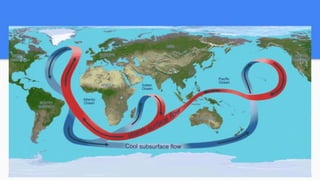
Ocean Circulation
● Circulation of the Ocean refers to the motion of water throughout the
Earth's oceans.
● It is driven by a combination of factors, including wind, temperature,
salinity, and the rotation of the Earth.
● The circulation of the ocean plays a crucial role in regulating the
Earth's climate and distributing nutrients and heat around the globe.
Ocean Circulation
● Ocean circulation is driven by a combination of factors, including wind,
temperature, and salinity.
● The circulation patterns of the ocean have a significant impact on
climate and weather patterns, as well as on the distribution of marine
life.
● Understanding these patterns is crucial to predicting future climate
change and managing marine resources.
Global Ocean Currents
● There are two types of ocean currents:
○ surface currents and
○ deep currents.
● Surface currents are driven by the wind, while deep currents are driven by
density differences caused by differences in temperature and salinity.
● The most well-known surface current is the Gulf Stream, which brings
warm water from the Gulf of Mexico to the North Atlantic.
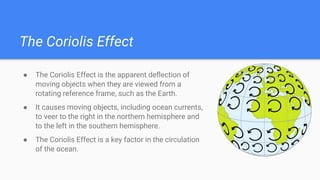
The Coriolis Effect
● The Coriolis Effect is the apparent deflection of
moving objects when they are viewed from a
rotating reference frame, such as the Earth.
● It causes moving objects, including ocean currents,
to veer to the right in the northern hemisphere and
to the left in the southern hemisphere.
● The Coriolis Effect is a key factor in the circulation
of the ocean.
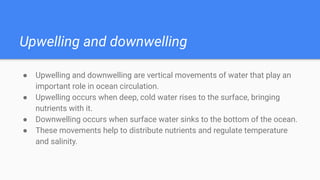
Upwelling and downwelling
● Upwelling and downwelling are vertical movements of water that play an
important role in ocean circulation.
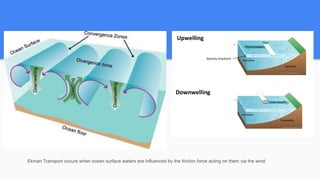
● Upwelling occurs when deep, cold water rises to the surface, bringing
nutrients with it.
● Downwelling occurs when surface water sinks to the bottom of the ocean.
● These movements help to distribute nutrients and regulate temperature
and salinity.
Ekman Transport occurs when ocean surface waters are influenced by the friction force acting on them via the wind.
El Niño and La Niña
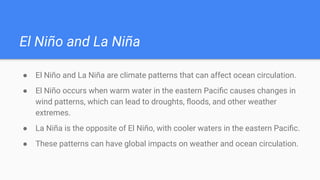
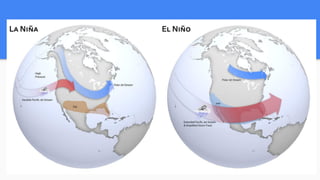
● El Niño and La Niña are climate patterns that can affect ocean circulation.
● El Niño occurs when warm water in the eastern Pacific causes changes in
wind patterns, which can lead to droughts, floods, and other weather
extremes.
● La Niña is the opposite of El Niño, with cooler waters in the eastern Pacific.
● These patterns can have global impacts on weather and ocean circulation.
Waves and Tides
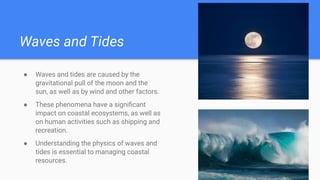
● Waves and tides are caused by the
gravitational pull of the moon and the
sun, as well as by wind and other factors.
● These phenomena have a significant
impact on coastal ecosystems, as well as
on human activities such as shipping and
recreation.
● Understanding the physics of waves and
tides is essential to managing coastal
resources.
Chemical Oceanography
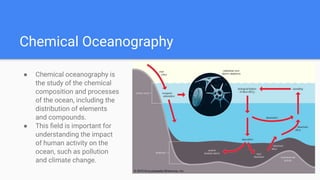
● Chemical oceanography is
the study of the chemical
composition and processes
of the ocean, including the
distribution of elements
and compounds.
● This field is important for
understanding the impact
of human activity on the
ocean, such as pollution
and climate change.
Chemical Composition of the Ocean
● The chemical composition of the ocean is influenced by a variety of
factors, including the
○ weathering of rocks,
○ volcanic activity, and
○ human activities such as pollution.
● Understanding the chemical cycles of the ocean is crucial to managing
marine resources and predicting the impact of climate change on the
ocean.
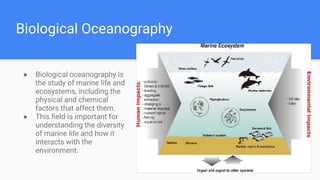
Biological Oceanography
● Biological oceanography is
the study of marine life and
ecosystems, including the
physical and chemical
factors that affect them.
● This field is important for
understanding the diversity
of marine life and how it
interacts with the
environment.
Biological Oceanography
● Biological Oceanography studies the interactions between marine
organisms and their environment.
● This field combines aspects of biology, oceanography, and geology to
understand the diversity of life in the ocean.
● By investigating marine ecosystems, we can better comprehend the
impacts of climate change and human activity on the ocean.
Marine Ecosystems
● Marine ecosystems are complex and diverse, ranging from the shallowest
coral reefs to the deepest ocean trenches.
● They are influenced by physical, chemical, and biological factors, including
light, temperature, nutrients, and predation.
● The study of marine ecosystems helps us understand the relationships
between different organisms and their environment.
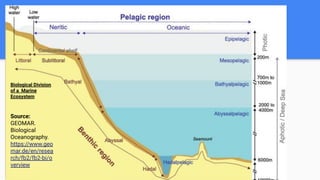
Biological Division
of a Marine
Ecosystem
Source:
GEOMAR.
Biological
Oceanography.
https://www.geo
mar.de/en/resea
rch/fb2/fb2-bi/o
verview
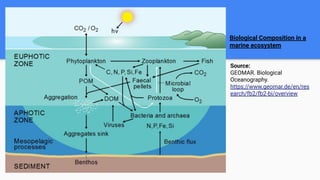
Source:
GEOMAR. Biological
Oceanography.
https://www.geomar.de/en/res
earch/fb2/fb2-bi/overview
Biological Composition in a
marine ecosystem
Marine Biodiversity
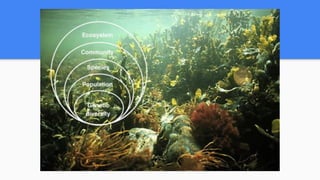
● Marine biodiversity refers to the variety of species and ecosystems in the
ocean.
● It is essential for the functioning of marine ecosystems and for the
provision of goods and services to humans.
● Biological Oceanography investigates the factors that influence marine
biodiversity and the consequences of its loss.
Biogeochemical Cycles
● Biogeochemical cycles are the processes by which nutrients and other
chemicals are cycled through the ocean's ecosystem.
● These cycles are essential to the growth and survival of marine life, as well
as to the health of the ocean itself.
● Understanding these cycles is crucial to managing marine resources and
predicting the impact of climate change on the ocean.
Biogeochemical Cycles
● Biological Oceanography investigates the biogeochemical cycles of elements such as:
○ carbon,
○ nitrogen, and
○ phosphorus in the ocean.
● These cycles are essential for the growth and survival of marine organisms, and have
important implications for the global climate.
● Understanding these cycles can help us predict the effects of climate change on the
ocean.
Human Impacts
● Human activities such as overfishing, pollution, and climate change are
having significant impacts on the ocean and its ecosystems.
● Biological Oceanography investigates the effects of these impacts on
marine organisms and ecosystems, and develops strategies for their
mitigation and management.
Ocean Exploration
● Ocean exploration involves the use of technology to study the ocean and
its features, such as:
○ the seafloor,
○ underwater volcanoes, and
○ deep-sea trenches.
● This field is important for discovering new species and understanding the
geology of the ocean floor.
Estuaries
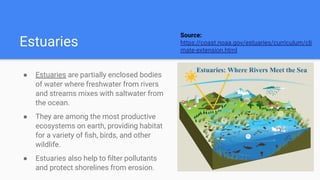
● Estuaries are partially enclosed bodies
of water where freshwater from rivers
and streams mixes with saltwater from
the ocean.
● They are among the most productive
ecosystems on earth, providing habitat
for a variety of fish, birds, and other
wildlife.
● Estuaries also help to filter pollutants
and protect shorelines from erosion.
Source:
https://coast.noaa.gov/estuaries/curriculum/cli
mate-extension.html
Estuaries
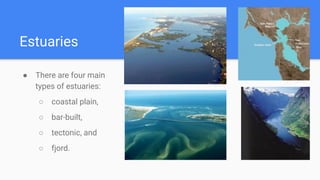
● There are four main
types of estuaries:
○ coastal plain,
○ bar-built,
○ tectonic, and
○ fjord.
Estuaries
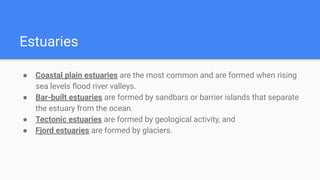
● Coastal plain estuaries are the most common and are formed when rising
sea levels flood river valleys.
● Bar-built estuaries are formed by sandbars or barrier islands that separate
the estuary from the ocean.
● Tectonic estuaries are formed by geological activity, and
● Fjord estuaries are formed by glaciers.
Importance of Estuaries
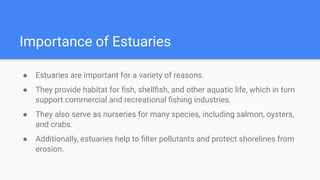
● Estuaries are important for a variety of reasons.
● They provide habitat for fish, shellfish, and other aquatic life, which in turn
support commercial and recreational fishing industries.
● They also serve as nurseries for many species, including salmon, oysters,
and crabs.
● Additionally, estuaries help to filter pollutants and protect shorelines from
erosion.
Threats to Estuaries
● Estuaries are threatened by a variety of human activities, including
development, pollution, and overfishing.
● Pollution from agricultural runoff, sewage, and industrial waste can harm
estuarine ecosystems and the wildlife that depend on them.
● Development can also lead to habitat loss, while overfishing can deplete
populations of important species.
Conservation of Estuaries
● There are several strategies for conserving estuaries, including habitat
restoration, pollution reduction, and sustainable fishing practices.
● Habitat restoration can involve re-establishing wetlands or removing dams
that block fish migration.
● Pollution reduction can be achieved by improving wastewater treatment or
reducing agricultural runoff.
● Sustainable fishing practices can help to ensure that fish populations are
not overexploited.
Atmospheric Influence to Oceans
Ocean Currents
● The atmosphere plays a crucial role in driving ocean currents around the
world.
● Wind patterns, temperature, and pressure gradients affect the movement
of water.
● Some currents, like the Gulf Stream, have a significant impact on regional
climates.
Temperature
● The atmosphere can affect ocean temperature through heat transfer.
● The sun heats the surface of the ocean, and the atmosphere helps
distribute that heat.
● Changes in atmospheric temperature can lead to changes in ocean
temperature, which can have significant impacts on marine life.
Salinity
● The atmosphere can also affect ocean salinity through precipitation and
evaporation.
● Rainfall can dilute saltwater, while evaporation can increase its salinity.
● These changes in salinity can impact marine ecosystems and even affect
global climate.
Climate Change
● As atmospheric conditions change due to human activities, the ocean is
also affected.
● Rising temperatures, melting ice caps, and changes in wind patterns all
have significant impacts on ocean currents, temperatures, and chemistry.
● Understanding these interactions is crucial for predicting and mitigating
the effects of climate change.
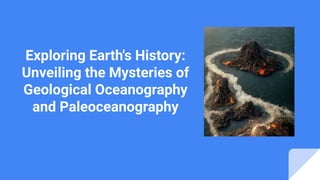
Exploring Earth's History:
Unveiling the Mysteries of
Geological Oceanography
and Paleoceanography
Geological Oceanography & Paleoceanography
● Geological Oceanography and Paleoceanography are two fields of study
that aid in understanding Earth's history.
● Geological Oceanography deals with geological processes that occur in
the ocean, while
● Paleoceanography focuses on the history of the ocean and its inhabitants.
● By studying these fields, we can gain insight into past climate change and
geological events that have shaped our planet.
Plate Tectonics
● Plate tectonics is a crucial component to understanding Earth's history. It
explains the movement of Earth's lithosphere, which is divided into several
plates.
● These plates move and interact with each other, leading to events like
earthquakes and volcanic eruptions.
● Plate tectonics also has a significant impact on the ocean, influencing
ocean currents, seafloor spreading, and the formation of underwater
mountains.
Sea level change
● The ocean plays a vital role in regulating the Earth's climate.
● Over the course of Earth's history, there have been several instances of
significant sea level change.
● During the Ice Age, sea level was about 120 meters lower than it is today.
● Understanding these changes is crucial for predicting future climate
change and its impact on our planet.
Fossils
● Fossils found in rocks and sediments provide valuable information about
the history of life on Earth.
● By studying fossils, we can determine the age of rock formations and
uncover the evolution of species over time.
● Fossils found in ocean sediments also provide insights into past ocean
conditions and the impact of climate change on marine life.
Deep Sea Drilling
● Deep-sea drilling is a technique used to collect sediment and rock samples
from the ocean floor.
● These samples provide valuable information about Earth's history and the
processes that have shaped our planet.
● By analyzing these samples, we can gain insight into everything from past
climate change to the formation of underwater mountains.
Deep Sea Drilling
● Deep-sea drilling is a technique used to collect sediment and rock samples
from the ocean floor.
● These samples provide valuable information about Earth's history and the
processes that have shaped our planet.
● By analyzing these samples, we can gain insight into everything from past
climate change to the formation of underwater mountains.
-End of Presentation-

Oceanography.pdf

  • 1.
  • 2.
    Introduction ● Oceanography isthe scientific study of the ocean and its phenomena. ● It covers a wide range of topics, including: ○ ocean currents, ○ marine life, and ○ the physical and chemical properties of seawater. ● This field is crucial to our understanding of the Earth's climate and weather patterns.
  • 3.
    Physical Oceanography ● Physicaloceanography is one of special fields in oceanography ● It is the study of the physical properties and dynamics of the ocean, including: ○ temperature, ○ salinity, and ○ currents. ● This field helps us understand how the ocean interacts with the atmosphere, and how heat and energy are exchanged between the two.
  • 4.
    Ocean Circulation ● Circulationof the Ocean refers to the motion of water throughout the Earth's oceans. ● It is driven by a combination of factors, including wind, temperature, salinity, and the rotation of the Earth. ● The circulation of the ocean plays a crucial role in regulating the Earth's climate and distributing nutrients and heat around the globe.
  • 6.
    Ocean Circulation ● Oceancirculation is driven by a combination of factors, including wind, temperature, and salinity. ● The circulation patterns of the ocean have a significant impact on climate and weather patterns, as well as on the distribution of marine life. ● Understanding these patterns is crucial to predicting future climate change and managing marine resources.
  • 7.
    Global Ocean Currents ●There are two types of ocean currents: ○ surface currents and ○ deep currents. ● Surface currents are driven by the wind, while deep currents are driven by density differences caused by differences in temperature and salinity. ● The most well-known surface current is the Gulf Stream, which brings warm water from the Gulf of Mexico to the North Atlantic.
  • 8.
    The Coriolis Effect ●The Coriolis Effect is the apparent deflection of moving objects when they are viewed from a rotating reference frame, such as the Earth. ● It causes moving objects, including ocean currents, to veer to the right in the northern hemisphere and to the left in the southern hemisphere. ● The Coriolis Effect is a key factor in the circulation of the ocean.
  • 9.
    Upwelling and downwelling ●Upwelling and downwelling are vertical movements of water that play an important role in ocean circulation. ● Upwelling occurs when deep, cold water rises to the surface, bringing nutrients with it. ● Downwelling occurs when surface water sinks to the bottom of the ocean. ● These movements help to distribute nutrients and regulate temperature and salinity.
  • 10.
    Ekman Transport occurswhen ocean surface waters are influenced by the friction force acting on them via the wind.
  • 11.
    El Niño andLa Niña ● El Niño and La Niña are climate patterns that can affect ocean circulation. ● El Niño occurs when warm water in the eastern Pacific causes changes in wind patterns, which can lead to droughts, floods, and other weather extremes. ● La Niña is the opposite of El Niño, with cooler waters in the eastern Pacific. ● These patterns can have global impacts on weather and ocean circulation.
  • 13.
    Waves and Tides ●Waves and tides are caused by the gravitational pull of the moon and the sun, as well as by wind and other factors. ● These phenomena have a significant impact on coastal ecosystems, as well as on human activities such as shipping and recreation. ● Understanding the physics of waves and tides is essential to managing coastal resources.
  • 14.
    Chemical Oceanography ● Chemicaloceanography is the study of the chemical composition and processes of the ocean, including the distribution of elements and compounds. ● This field is important for understanding the impact of human activity on the ocean, such as pollution and climate change.
  • 15.
    Chemical Composition ofthe Ocean ● The chemical composition of the ocean is influenced by a variety of factors, including the ○ weathering of rocks, ○ volcanic activity, and ○ human activities such as pollution. ● Understanding the chemical cycles of the ocean is crucial to managing marine resources and predicting the impact of climate change on the ocean.
  • 16.
    Biological Oceanography ● Biologicaloceanography is the study of marine life and ecosystems, including the physical and chemical factors that affect them. ● This field is important for understanding the diversity of marine life and how it interacts with the environment.
  • 17.
    Biological Oceanography ● BiologicalOceanography studies the interactions between marine organisms and their environment. ● This field combines aspects of biology, oceanography, and geology to understand the diversity of life in the ocean. ● By investigating marine ecosystems, we can better comprehend the impacts of climate change and human activity on the ocean.
  • 18.
    Marine Ecosystems ● Marineecosystems are complex and diverse, ranging from the shallowest coral reefs to the deepest ocean trenches. ● They are influenced by physical, chemical, and biological factors, including light, temperature, nutrients, and predation. ● The study of marine ecosystems helps us understand the relationships between different organisms and their environment.
  • 19.
    Biological Division of aMarine Ecosystem Source: GEOMAR. Biological Oceanography. https://www.geo mar.de/en/resea rch/fb2/fb2-bi/o verview
  • 20.
  • 21.
    Marine Biodiversity ● Marinebiodiversity refers to the variety of species and ecosystems in the ocean. ● It is essential for the functioning of marine ecosystems and for the provision of goods and services to humans. ● Biological Oceanography investigates the factors that influence marine biodiversity and the consequences of its loss.
  • 23.
    Biogeochemical Cycles ● Biogeochemicalcycles are the processes by which nutrients and other chemicals are cycled through the ocean's ecosystem. ● These cycles are essential to the growth and survival of marine life, as well as to the health of the ocean itself. ● Understanding these cycles is crucial to managing marine resources and predicting the impact of climate change on the ocean.
  • 24.
    Biogeochemical Cycles ● BiologicalOceanography investigates the biogeochemical cycles of elements such as: ○ carbon, ○ nitrogen, and ○ phosphorus in the ocean. ● These cycles are essential for the growth and survival of marine organisms, and have important implications for the global climate. ● Understanding these cycles can help us predict the effects of climate change on the ocean.
  • 25.
    Human Impacts ● Humanactivities such as overfishing, pollution, and climate change are having significant impacts on the ocean and its ecosystems. ● Biological Oceanography investigates the effects of these impacts on marine organisms and ecosystems, and develops strategies for their mitigation and management.
  • 26.
    Ocean Exploration ● Oceanexploration involves the use of technology to study the ocean and its features, such as: ○ the seafloor, ○ underwater volcanoes, and ○ deep-sea trenches. ● This field is important for discovering new species and understanding the geology of the ocean floor.
  • 27.
    Estuaries ● Estuaries arepartially enclosed bodies of water where freshwater from rivers and streams mixes with saltwater from the ocean. ● They are among the most productive ecosystems on earth, providing habitat for a variety of fish, birds, and other wildlife. ● Estuaries also help to filter pollutants and protect shorelines from erosion. Source: https://coast.noaa.gov/estuaries/curriculum/cli mate-extension.html
  • 28.
    Estuaries ● There arefour main types of estuaries: ○ coastal plain, ○ bar-built, ○ tectonic, and ○ fjord.
  • 29.
    Estuaries ● Coastal plainestuaries are the most common and are formed when rising sea levels flood river valleys. ● Bar-built estuaries are formed by sandbars or barrier islands that separate the estuary from the ocean. ● Tectonic estuaries are formed by geological activity, and ● Fjord estuaries are formed by glaciers.
  • 30.
    Importance of Estuaries ●Estuaries are important for a variety of reasons. ● They provide habitat for fish, shellfish, and other aquatic life, which in turn support commercial and recreational fishing industries. ● They also serve as nurseries for many species, including salmon, oysters, and crabs. ● Additionally, estuaries help to filter pollutants and protect shorelines from erosion.
  • 31.
    Threats to Estuaries ●Estuaries are threatened by a variety of human activities, including development, pollution, and overfishing. ● Pollution from agricultural runoff, sewage, and industrial waste can harm estuarine ecosystems and the wildlife that depend on them. ● Development can also lead to habitat loss, while overfishing can deplete populations of important species.
  • 32.
    Conservation of Estuaries ●There are several strategies for conserving estuaries, including habitat restoration, pollution reduction, and sustainable fishing practices. ● Habitat restoration can involve re-establishing wetlands or removing dams that block fish migration. ● Pollution reduction can be achieved by improving wastewater treatment or reducing agricultural runoff. ● Sustainable fishing practices can help to ensure that fish populations are not overexploited.
  • 33.
  • 34.
    Ocean Currents ● Theatmosphere plays a crucial role in driving ocean currents around the world. ● Wind patterns, temperature, and pressure gradients affect the movement of water. ● Some currents, like the Gulf Stream, have a significant impact on regional climates.
  • 35.
    Temperature ● The atmospherecan affect ocean temperature through heat transfer. ● The sun heats the surface of the ocean, and the atmosphere helps distribute that heat. ● Changes in atmospheric temperature can lead to changes in ocean temperature, which can have significant impacts on marine life.
  • 36.
    Salinity ● The atmospherecan also affect ocean salinity through precipitation and evaporation. ● Rainfall can dilute saltwater, while evaporation can increase its salinity. ● These changes in salinity can impact marine ecosystems and even affect global climate.
  • 37.
    Climate Change ● Asatmospheric conditions change due to human activities, the ocean is also affected. ● Rising temperatures, melting ice caps, and changes in wind patterns all have significant impacts on ocean currents, temperatures, and chemistry. ● Understanding these interactions is crucial for predicting and mitigating the effects of climate change.
  • 38.
    Exploring Earth's History: Unveilingthe Mysteries of Geological Oceanography and Paleoceanography
  • 39.
    Geological Oceanography &Paleoceanography ● Geological Oceanography and Paleoceanography are two fields of study that aid in understanding Earth's history. ● Geological Oceanography deals with geological processes that occur in the ocean, while ● Paleoceanography focuses on the history of the ocean and its inhabitants. ● By studying these fields, we can gain insight into past climate change and geological events that have shaped our planet.
  • 40.
    Plate Tectonics ● Platetectonics is a crucial component to understanding Earth's history. It explains the movement of Earth's lithosphere, which is divided into several plates. ● These plates move and interact with each other, leading to events like earthquakes and volcanic eruptions. ● Plate tectonics also has a significant impact on the ocean, influencing ocean currents, seafloor spreading, and the formation of underwater mountains.
  • 41.
    Sea level change ●The ocean plays a vital role in regulating the Earth's climate. ● Over the course of Earth's history, there have been several instances of significant sea level change. ● During the Ice Age, sea level was about 120 meters lower than it is today. ● Understanding these changes is crucial for predicting future climate change and its impact on our planet.
  • 42.
    Fossils ● Fossils foundin rocks and sediments provide valuable information about the history of life on Earth. ● By studying fossils, we can determine the age of rock formations and uncover the evolution of species over time. ● Fossils found in ocean sediments also provide insights into past ocean conditions and the impact of climate change on marine life.
  • 43.
    Deep Sea Drilling ●Deep-sea drilling is a technique used to collect sediment and rock samples from the ocean floor. ● These samples provide valuable information about Earth's history and the processes that have shaped our planet. ● By analyzing these samples, we can gain insight into everything from past climate change to the formation of underwater mountains.
  • 44.
    Deep Sea Drilling ●Deep-sea drilling is a technique used to collect sediment and rock samples from the ocean floor. ● These samples provide valuable information about Earth's history and the processes that have shaped our planet. ● By analyzing these samples, we can gain insight into everything from past climate change to the formation of underwater mountains.
  • 45.