PHP

BY :Mohammed Mushtaq Ahmed
Contents
•
•
•
•
•

HTML
JavaScript
PHP
MySQL
WAMP
HTML
•
•
•
•

Hyper Text Markup Language
Developed by Tim Berners lee in 1990.
Easy to use ,Easy to learn
Markup tags tell the browser how to display
the page.
• A HTML file must have an extension .htm
or.html.
Cont…..
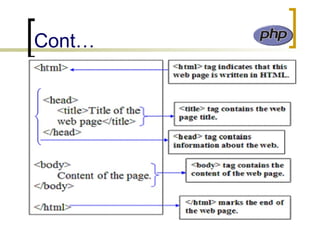
• HTML tags are surrounded by “<“ and “>”
(angular brackets).
• Tags normally come in pairs like <H1> and
</H1>.
• Tags are not case sensitive i.e. <p> is same
as <P>.
• The first tag in a pair is the start tag, the
second tag is the end tag and so on ……,.
Cont…
JavaScript
•
•
•
•

JavaScript ≠ Java
Developed by Netscape
Purpose: to Create Dynamic websites
Starts with < script type=“text/java script”>
and ends with < /script>.
• Easy to learn , easy to use.
• More powerful,loosely typed
Cont…
•
•
•
•
•

Conversion automatically
Used to customize web pages.
Make pages more dynamic.
To validate CGI forms.
It’s limited (can not develpe standalone
aplli.)
• Widely Used
About PHP
•
•
•
•
•

PHP (Hypertext Preprocessor),
Dynamic web pages.
It’s like ASP.
PHP scripts are executed on the server .
PHP files have a file extension of ".php",
".php3", or ".phtml".
Why PHP
• PHP runs on different platforms (Windows,
Linux, Unix, etc.)
• PHP is compatible with almost all servers
used today (Apache, IIS, etc.)
• PHP is FREE to download from the official
PHP resource: www.php.net
• PHP is easy to learn and runs efficiently on
the server side
Cont…
• A PHP scripting block always starts with
<?php and ends with ?>.
• Can be placed any where within a
document.
• We can start a scripting block with <? and
end with ?> on servers that provide
shorthand support.
• It is advised to use standard tags for best
outputs.
Features of PHP…
• Speed
• Full database Support
• Open source and free to download and
use.
• Cross platform
• Easy for newcomer and advance features
Cont…
• Used to create dynamic web pages.
• Freedom to choose any operating system and a web
server.
• Not constrained to output only HTML. PHP's abilities
include outputting images, PDF files etc.
• Support for a wide range of databases. Eg: dBase,
MySQL, Oracle etc.
Working of PHP…

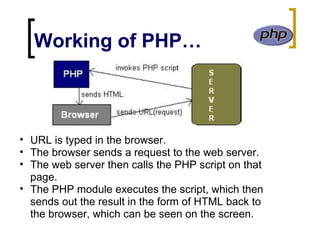
• URL is typed in the browser.
• The browser sends a request to the web server.
• The web server then calls the PHP script on that
page.
• The PHP module executes the script, which then
sends out the result in the form of HTML back to
the browser, which can be seen on the screen.
PHP BASICS…
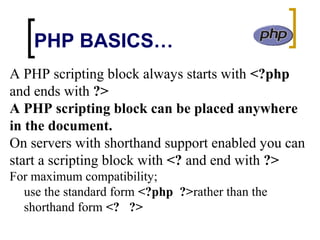
A PHP scripting block always starts with <?php
and ends with ?>
A PHP scripting block can be placed anywhere
in the document.
On servers with shorthand support enabled you can
start a scripting block with <? and end with ?>
For maximum compatibility;
use the standard form <?php ?>rather than the
shorthand form <? ?>
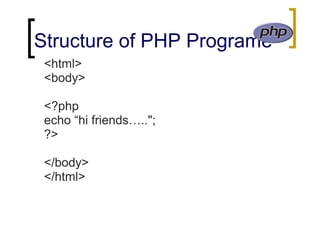
Structure of PHP Programe
<html>
<body>
<?php
echo “hi friends…..";
?>
</body>
</html>
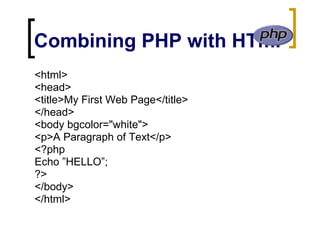
Combining PHP with HTml
<html>
<head>
<title>My First Web Page</title>
</head>
<body bgcolor="white">
<p>A Paragraph of Text</p>
<?php
Echo ”HELLO”;
?>
</body>
</html>
Comments in PHP
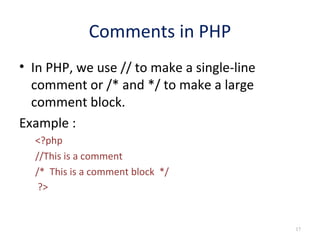
• In PHP, we use // to make a single-line
comment or /* and */ to make a large
comment block.
Example :
<?php
//This is a comment
/* This is a comment block */
?>

17
PHP Variables
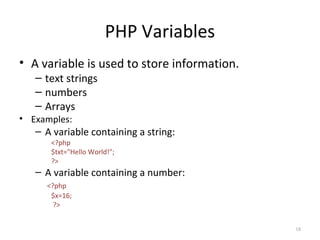
• A variable is used to store information.
– text strings
– numbers
– Arrays

• Examples:

– A variable containing a string:
<?php
$txt="Hello World!";
?>

– A variable containing a number:
<?php
$x=16;
?>
18
Naming Rules for Variables
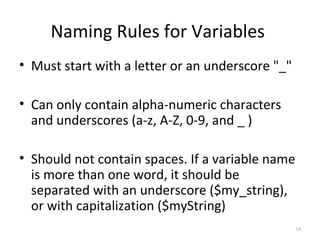
• Must start with a letter or an underscore "_"
• Can only contain alpha-numeric characters
and underscores (a-z, A-Z, 0-9, and _ )
• Should not contain spaces. If a variable name
is more than one word, it should be
separated with an underscore ($my_string),
or with capitalization ($myString)
19
PHP String Variables
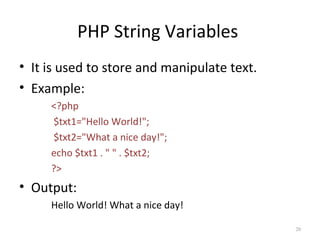
• It is used to store and manipulate text.
• Example:
<?php
$txt1="Hello World!";
$txt2="What a nice day!";
echo $txt1 . " " . $txt2;
?>

• Output:
Hello World! What a nice day!
20
The strlen() function
• The strlen() function is used to return the
length of a string.
• Example:
<?php
echo strlen("Hello world!");
?>

• Output:
12

21
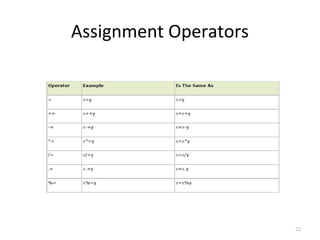
Assignment Operators

22
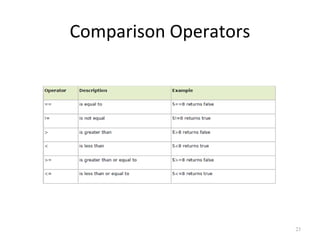
Comparison Operators

23
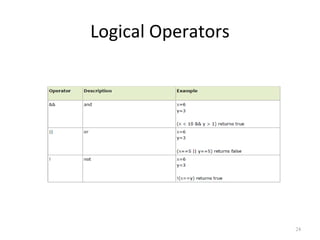
Logical Operators

24
Conditional Statements

25
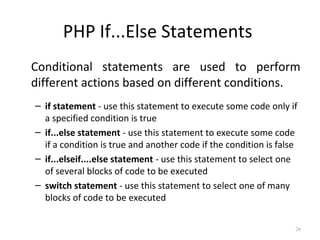
PHP If...Else Statements
Conditional statements are used to perform
different actions based on different conditions.
– if statement - use this statement to execute some code only if
a specified condition is true
– if...else statement - use this statement to execute some code
if a condition is true and another code if the condition is false
– if...elseif....else statement - use this statement to select one
of several blocks of code to be executed
– switch statement - use this statement to select one of many
blocks of code to be executed
26
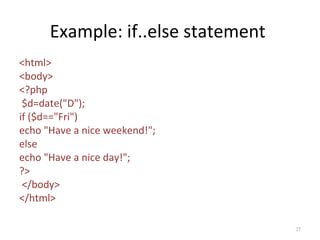
Example: if..else statement
<html>
<body>
<?php
$d=date("D");
if ($d=="Fri")
echo "Have a nice weekend!";
else
echo "Have a nice day!";
?>
</body>
</html>
27
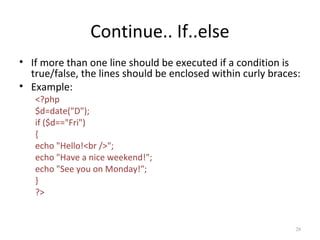
Continue.. If..else
• If more than one line should be executed if a condition is
true/false, the lines should be enclosed within curly braces:
• Example:
<?php
$d=date("D");
if ($d=="Fri")
{
echo "Hello!<br />";
echo "Have a nice weekend!";
echo "See you on Monday!";
}
?>

28
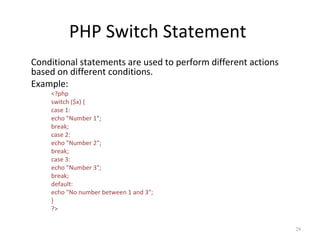
PHP Switch Statement
Conditional statements are used to perform different actions
based on different conditions.
Example:
<?php
switch ($x) {
case 1:
echo "Number 1";
break;
case 2:
echo "Number 2";
break;
case 3:
echo "Number 3";
break;
default:
echo "No number between 1 and 3";
}
?>

29
PHP (Advanced Topics)
Arrays, Loops, Functions, Forms,
Database Handling

30
Arrays

31
Arrays
There are three different kind of arrays:
• Numeric array - An array with a numeric ID key
• Associative array - An array where each ID key is
associated with a value
• Multidimensional array - An array containing one or
more arrays

32
Numeric Array
Example 1
In this example the ID key (index) is
automatically assigned:
$names = array("Peter", "Quagmire", "Joe");

33
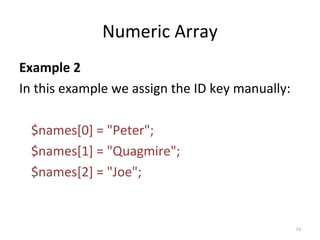
Numeric Array
Example 2
In this example we assign the ID key manually:
$names[0] = "Peter";
$names[1] = "Quagmire";
$names[2] = "Joe";

34
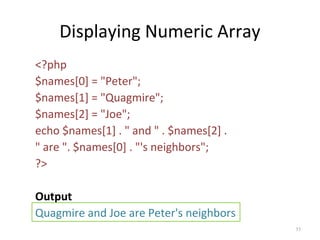
Displaying Numeric Array
<?php
$names[0] = "Peter";
$names[1] = "Quagmire";
$names[2] = "Joe";
echo $names[1] . " and " . $names[2] .
" are ". $names[0] . "'s neighbors";
?>
Output
Quagmire and Joe are Peter's neighbors
35
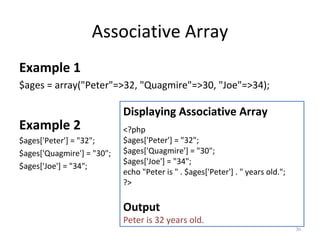
Associative Array
Example 1
$ages = array("Peter"=>32, "Quagmire"=>30, "Joe"=>34);

Example 2
$ages['Peter'] = "32";
$ages['Quagmire'] = "30";
$ages['Joe'] = "34";

Displaying Associative Array
<?php
$ages['Peter'] = "32";
$ages['Quagmire'] = "30";
$ages['Joe'] = "34";
echo "Peter is " . $ages['Peter'] . " years old.";
?>

Output

Peter is 32 years old.
36
Loops

37
Loops
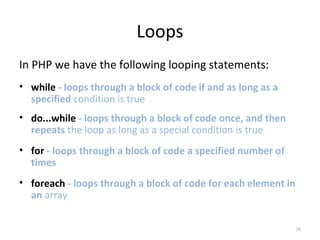
In PHP we have the following looping statements:
• while - loops through a block of code if and as long as a
specified condition is true
• do...while - loops through a block of code once, and then
repeats the loop as long as a special condition is true
• for - loops through a block of code a specified number of
times
• foreach - loops through a block of code for each element in
an array
38
while & do while Loops
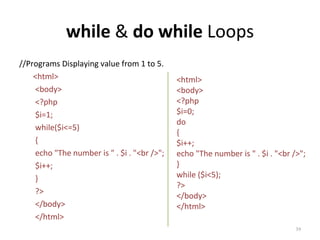
//Programs Displaying value from 1 to 5.
<html>
<body>
<?php
$i=1;
while($i<=5)
{
echo "The number is " . $i . "<br />";
$i++;
}
?>
</body>
</html>

<html>
<body>
<?php
$i=0;
do
{
$i++;
echo "The number is " . $i . "<br />";
}
while ($i<5);
?>
</body>
</html>
39
for and foreach Loops
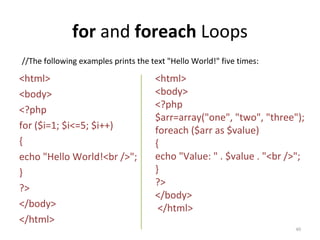
//The following examples prints the text "Hello World!" five times:

<html>
<body>
<?php
for ($i=1; $i<=5; $i++)
{
echo "Hello World!<br />";
}
?>
</body>
</html>

<html>
<body>
<?php
$arr=array("one", "two", "three");
foreach ($arr as $value)
{
echo "Value: " . $value . "<br />";
}
?>
</body>
</html>
40
Functions

41
Functions
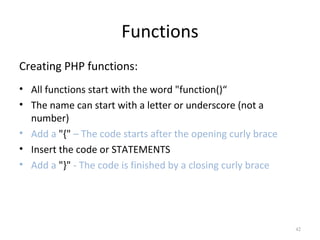
Creating PHP functions:
• All functions start with the word "function()“
• The name can start with a letter or underscore (not a
number)
• Add a "{" – The code starts after the opening curly brace
• Insert the code or STATEMENTS
• Add a "}" - The code is finished by a closing curly brace

42
Functions
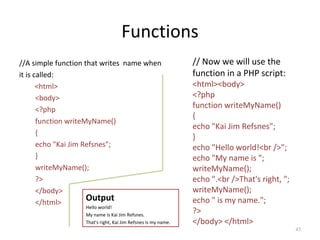
//A simple function that writes name when
it is called:
<html>
<body>
<?php
function writeMyName()
{
echo "Kai Jim Refsnes";
}
writeMyName();
?>
</body>
Output
</html>

Hello world!
My name is Kai Jim Refsnes.
That's right, Kai Jim Refsnes is my name.

// Now we will use the
function in a PHP script:

<html><body>
<?php
function writeMyName()
{
echo "Kai Jim Refsnes";
}
echo "Hello world!<br />";
echo "My name is ";
writeMyName();
echo ".<br />That's right, ";
writeMyName();
echo " is my name.";
?>
</body> </html>

43
Functions with Parameters
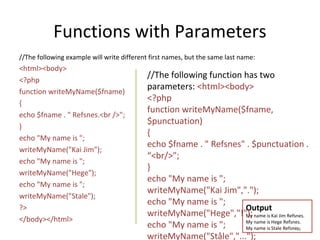
//The following example will write different first names, but the same last name:

<html><body>
<?php
function writeMyName($fname)
{
echo $fname . " Refsnes.<br />";
}
echo "My name is ";
writeMyName("Kai Jim");
echo "My name is ";
writeMyName("Hege");
echo "My name is ";
writeMyName("Stale");
?>
</body></html>

//The following function has two
parameters: <html><body>
<?php
function writeMyName($fname,
$punctuation)
{
echo $fname . " Refsnes" . $punctuation .
“<br/>";
}
echo "My name is ";
writeMyName("Kai Jim",".");
echo "My name is ";
Output
writeMyName("Hege","!"); name is Kai Jim Refsnes.
My
My name is Hege Refsnes.
echo "My name is ";
My name is Stale Refsnes.
44
writeMyName("Ståle","...");
Functions: Return Values
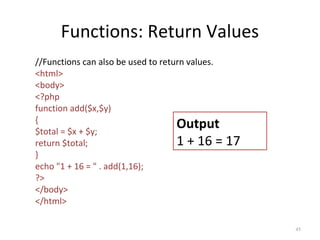
//Functions can also be used to return values.
<html>
<body>
<?php
function add($x,$y)
{
Output
$total = $x + $y;
1 + 16 =
return $total;
}
echo "1 + 16 = " . add(1,16);
?>
</body>
</html>

17

45
Form (User Input)

46
PHP Form
The PHP $_GET and $_POST variables are used to
retrieve information from forms, like user input.
PHP Form Handling
The most important thing to notice when dealing
with HTML forms and PHP is that any form element
in an HTML page will automatically be available to
your PHP scripts.

47
PHP Forms ($_POST)
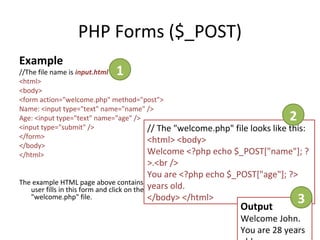
Example

1

//The file name is input.html
<html>
<body>
<form action="welcome.php" method="post">
Name: <input type="text" name="name" />
Age: <input type="text" name="age" />
<input type="submit" />
// The "welcome.php" file looks like this:
</form>
<html> <body>
</body>
Welcome <?php echo $_POST["name"]; ?
</html>

2

>.<br />
You are <?php echo $_POST["age"]; ?>
The example HTML page above contains two input fields and a submit button. When the
years old.
user fills in this form and click on the submit button, the form data is sent to the
"welcome.php" file.
</body> </html>
3

Output

Welcome John.
48
You are 28 years
$_POST, $_GET, and $_REQUEST
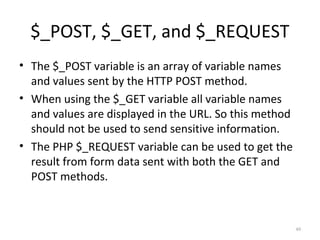
• The $_POST variable is an array of variable names
and values sent by the HTTP POST method.
• When using the $_GET variable all variable names
and values are displayed in the URL. So this method
should not be used to send sensitive information.
• The PHP $_REQUEST variable can be used to get the
result from form data sent with both the GET and
POST methods.

49
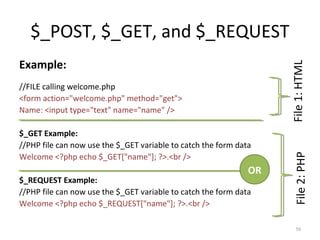
$_POST, $_GET, and $_REQUEST
//FILE calling welcome.php
<form action="welcome.php" method="get">
Name: <input type="text" name="name" />
$_GET Example:
//PHP file can now use the $_GET variable to catch the form data
Welcome <?php echo $_GET["name"]; ?>.<br />

OR

$_REQUEST Example:
//PHP file can now use the $_GET variable to catch the form data
Welcome <?php echo $_REQUEST["name"]; ?>.<br />

File 2: PHP

File 1: HTML

Example:

50
Database Handling
PHP and MySQL

51
MySQL
• MySQL is a database.
• The data in MySQL is stored in database
objects called tables.
• The data in MySQL is stored in database
objects called tables.
• A database most often contains one or more
tables. Each table is identified by a name (e.g.
"Customers" or "Orders").
52
MySQL
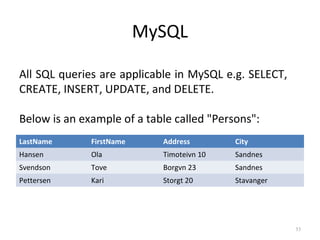
All SQL queries are applicable in MySQL e.g. SELECT,
CREATE, INSERT, UPDATE, and DELETE.
Below is an example of a table called "Persons":
LastName

FirstName

Address

City

Hansen

Ola

Timoteivn 10

Sandnes

Svendson

Tove

Borgvn 23

Sandnes

Pettersen

Kari

Storgt 20

Stavanger

53
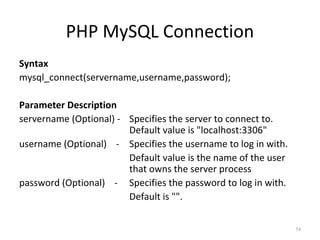
PHP MySQL Connection
Syntax
mysql_connect(servername,username,password);
Parameter Description
servername (Optional) - Specifies the server to connect to.
Default value is "localhost:3306"
username (Optional) - Specifies the username to log in with.
Default value is the name of the user
that owns the server process
password (Optional) - Specifies the password to log in with.
Default is "".
54
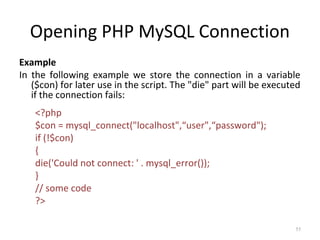
Opening PHP MySQL Connection
Example
In the following example we store the connection in a variable
($con) for later use in the script. The "die" part will be executed
if the connection fails:
<?php
$con = mysql_connect("localhost",“user",“password");
if (!$con)
{
die('Could not connect: ' . mysql_error());
}
// some code
?>
55
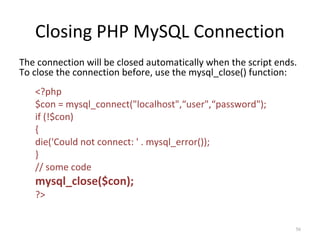
Closing PHP MySQL Connection
The connection will be closed automatically when the script ends.
To close the connection before, use the mysql_close() function:
<?php
$con = mysql_connect("localhost",“user",“password");
if (!$con)
{
die('Could not connect: ' . mysql_error());
}
// some code

mysql_close($con);
?>

56
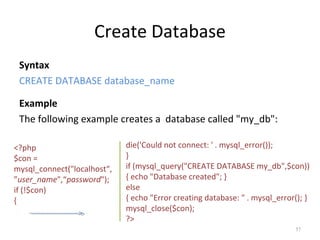
Create Database
Syntax
CREATE DATABASE database_name
Example
The following example creates a database called "my_db":
<?php
$con =
mysql_connect("localhost“,
”user_name",“password");
if (!$con)
{

die('Could not connect: ' . mysql_error());
}
if (mysql_query("CREATE DATABASE my_db",$con))
{ echo "Database created"; }
else
{ echo "Error creating database: " . mysql_error(); }
mysql_close($con);
?>
57
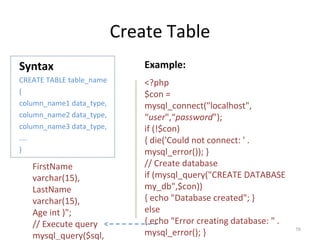
Create Table
Syntax

Example:

CREATE TABLE table_name
(
column_name1 data_type,
column_name2 data_type,
column_name3 data_type,
....
)

<?php
$con =
mysql_connect("localhost",
“user",“password");
if (!$con)
{ die('Could not connect: ' .
mysql_error()); }
// Create database
if (mysql_query("CREATE DATABASE
my_db",$con))
{ echo "Database created"; }
else
{ echo "Error creating database: " .
mysql_error(); }

FirstName
varchar(15),
LastName
varchar(15),
Age int )";
// Execute query
mysql_query($sql,

58
Create Table
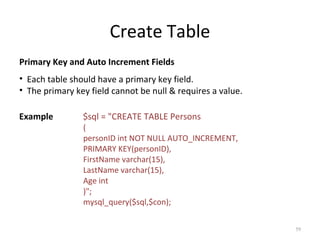
Primary Key and Auto Increment Fields
• Each table should have a primary key field.
• The primary key field cannot be null & requires a value.
Example

$sql = "CREATE TABLE Persons

(
personID int NOT NULL AUTO_INCREMENT,
PRIMARY KEY(personID),
FirstName varchar(15),
LastName varchar(15),
Age int
)";
mysql_query($sql,$con);
59
Insert Data
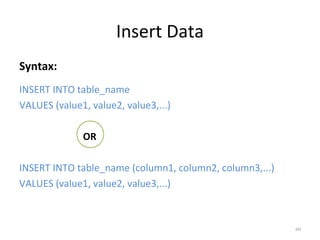
Syntax:
INSERT INTO table_name
VALUES (value1, value2, value3,...)
OR
INSERT INTO table_name (column1, column2, column3,...)
VALUES (value1, value2, value3,...)

60
Insert Data
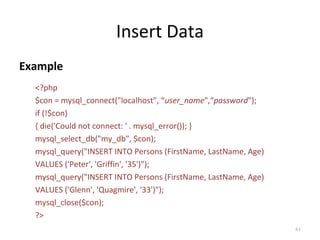
Example
<?php
$con = mysql_connect("localhost", “user_name",“password");
if (!$con)
{ die('Could not connect: ' . mysql_error()); }
mysql_select_db("my_db", $con);
mysql_query("INSERT INTO Persons (FirstName, LastName, Age)
VALUES ('Peter', 'Griffin', '35')");
mysql_query("INSERT INTO Persons (FirstName, LastName, Age)
VALUES ('Glenn', 'Quagmire', '33')");
mysql_close($con);
?>
61
Insert Data (HTML FORM to DB)
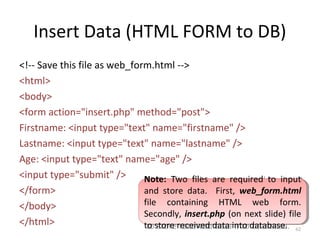
<!-- Save this file as web_form.html -->
<html>
<body>
<form action="insert.php" method="post">
Firstname: <input type="text" name="firstname" />
Lastname: <input type="text" name="lastname" />
Age: <input type="text" name="age" />
<input type="submit" />
Note: Two files are required to input
and store data. First, web_form.html
</form>
and store data. First, web_form.html
file containing HTML web form.
</body>
Secondly, insert.php (on next slide) file
</html>
to store received data into database.
62
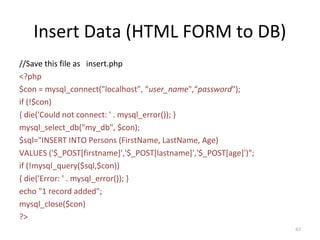
Insert Data (HTML FORM to DB)
//Save this file as insert.php
<?php
$con = mysql_connect("localhost", “user_name",“password");
if (!$con)
{ die('Could not connect: ' . mysql_error()); }
mysql_select_db("my_db", $con);
$sql="INSERT INTO Persons (FirstName, LastName, Age)
VALUES ('$_POST[firstname]','$_POST[lastname]','$_POST[age]')";
if (!mysql_query($sql,$con))
{ die('Error: ' . mysql_error()); }
echo "1 record added";
mysql_close($con)
?>
63
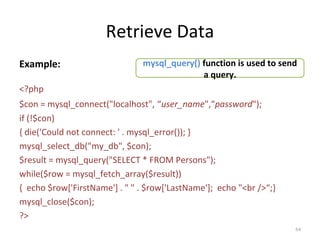
Retrieve Data
Example:

mysql_query() function is used to send
a query.

<?php
$con = mysql_connect("localhost", “user_name",“password");
if (!$con)
{ die('Could not connect: ' . mysql_error()); }
mysql_select_db("my_db", $con);
$result = mysql_query("SELECT * FROM Persons");
while($row = mysql_fetch_array($result))
{ echo $row['FirstName'] . " " . $row['LastName']; echo "<br />“;}
mysql_close($con);
?>
64
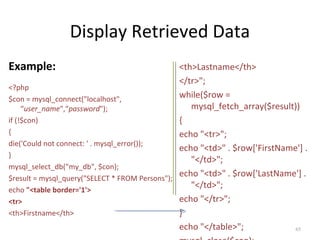
Display Retrieved Data
Example:

<th>Lastname</th>
</tr>";
<?php
while($row =
$con = mysql_connect("localhost",
mysql_fetch_array($result))
“user_name",“password");
if (!$con)
{
{
echo "<tr>";
die('Could not connect: ' . mysql_error());
echo "<td>" . $row['FirstName'] .
}
"</td>";
mysql_select_db("my_db", $con);
echo "<td>" . $row['LastName'] .
$result = mysql_query("SELECT * FROM Persons");
"</td>";
echo "<table border='1'>
echo "</tr>";
<tr>
<th>Firstname</th>
}
echo "</table>";
65
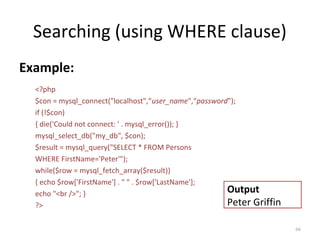
Searching (using WHERE clause)
Example:
<?php
$con = mysql_connect("localhost",“user_name",“password");
if (!$con)
{ die('Could not connect: ' . mysql_error()); }
mysql_select_db("my_db", $con);
$result = mysql_query("SELECT * FROM Persons
WHERE FirstName='Peter'");
while($row = mysql_fetch_array($result))
{ echo $row['FirstName'] . " " . $row['LastName'];
Output
echo "<br />"; }
Peter Griffin
?>
66
Update
Example
<?php
$con = mysql_connect("localhost",“user_name",”password");
if (!$con)
{
die('Could not connect: ' . mysql_error());
}
mysql_select_db("my_db", $con);
mysql_query("UPDATE Persons SET Age = '36'
WHERE FirstName = 'Peter' AND LastName = 'Griffin'");
mysql_close($con);
?>
Peter Griffin’s age was 35

Now age changed into 36
67
Delete
Example:
<?php
$con = mysql_connect("localhost",“user_name",“password");
if (!$con)
{
die('Could not connect: ' . mysql_error());
}
mysql_select_db("my_db", $con);
mysql_query("DELETE FROM Persons WHERE LastName='Griffin'");
mysql_close($con);
?>

68
WAMP Server
(Apache, PHP, and
MySQL)
Installation
69
Installation
What do you need?
Most people would prefer to install all-in-one
solution:
– WampServer -> for Windows platform Includes:
• Apache 2.2.11 - MySQL 5.1.36 - PHP 5.3.0
• Download from http://www.wampserver.com/en/

– http://lamphowto.com/ -> for Linux platform
70
Software to be used
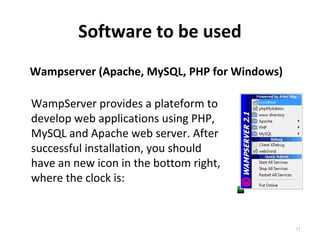
Wampserver (Apache, MySQL, PHP for Windows)
WampServer provides a plateform to
develop web applications using PHP,
MySQL and Apache web server. After
successful installation, you should
have an new icon in the bottom right,
where the clock is:

71
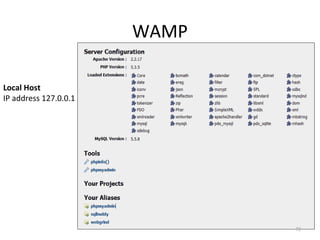
WAMP
Local Host
IP address 127.0.0.1

72
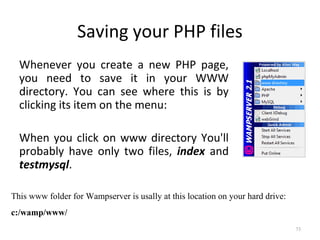
Saving your PHP files
Whenever you create a new PHP page,
you need to save it in your WWW
directory. You can see where this is by
clicking its item on the menu:
When you click on www directory You'll
probably have only two files, index and
testmysql.
This www folder for Wampserver is usally at this location on your hard drive:
c:/wamp/www/
73
Thank You.