Penetration Testing
Introduction and Techniques
: csivvn
: csi_vvn
: csi_vvn
Topics Covered
 Introduction of Penetration Testing
 Need of Penetration Testing
 How is Penetration Testing Beneficial?
 Security Audits Vs Vulnerability Assessment Vs Pen Test
 Types of Penetration testing
 Phases of Penetration Testing
 Steps of Penetration Testing Method
 Security Testing Methodology
: csivvn
: csi_vvn
: csi_vvn
Penetration Testing - Introduction
 Penetration testing is a type of security testing that is used to test the
insecurity of an application. It is conducted to find the security risk which
might be present in the system.
 If a system is not secured, then any attacker can disrupt or take authorized
access to that system. Security risk is normally an accidental error that occurs
while developing and implementing the software. For example, configuration
errors, design errors, and software bugs, etc.
: csivvn
: csi_vvn
: csi_vvn
Need of Penetration Testing
 Penetration testing normally evaluates a system’s ability to protect its
networks, applications, endpoints and users from external or internal threats.
It also attempts to protect the security controls and ensures only authorized
access.
 Penetration testing is essential because : −
 It identifies a simulation environment i.e., how an intruder may attack the
system through white hat attack.
 It helps to find weak areas where an intruder can attack to gain access to the
computer’s features and data.
 It supports to avoid black hat attack and protects the original data.
 It estimates the magnitude of the attack on potential business.
 It provides evidence to suggest, why it is important to increase investments in
security aspect of technology
: csivvn
: csi_vvn
: csi_vvn
How is Penetration Testing Beneficial?
 Enhancement of the Management System − It provides detailed information
about the security threats. In addition to this, it also categorizes the degree of
vulnerabilities and suggests you, which one is more vulnerable and which one is
less. So, you can easily and accurately manage your security system by allocating
the security resources accordingly.
 Avoid Fines − Penetration testing keeps your organization’s major activities
updated and complies with the auditing system. So, penetration testing protects
you from giving fines.
 Protection from Financial Damage − A simple breach of security system may
cause millions of dollars of damage. Penetration testing can protect your
organization from such damages.
 Customer Protection − Breach of even a single customer’s data may cause big
financial damage as well as reputation damage. It protects the organizations who
deal with the customers and keep their data intact.
 Penetration testing is a combination of techniques that considers various issues of
the systems and tests, analyzes, and gives solutions. It is based on a structured
procedure that performs penetration testing step-by-step.
: csivvn
: csi_vvn
: csi_vvn
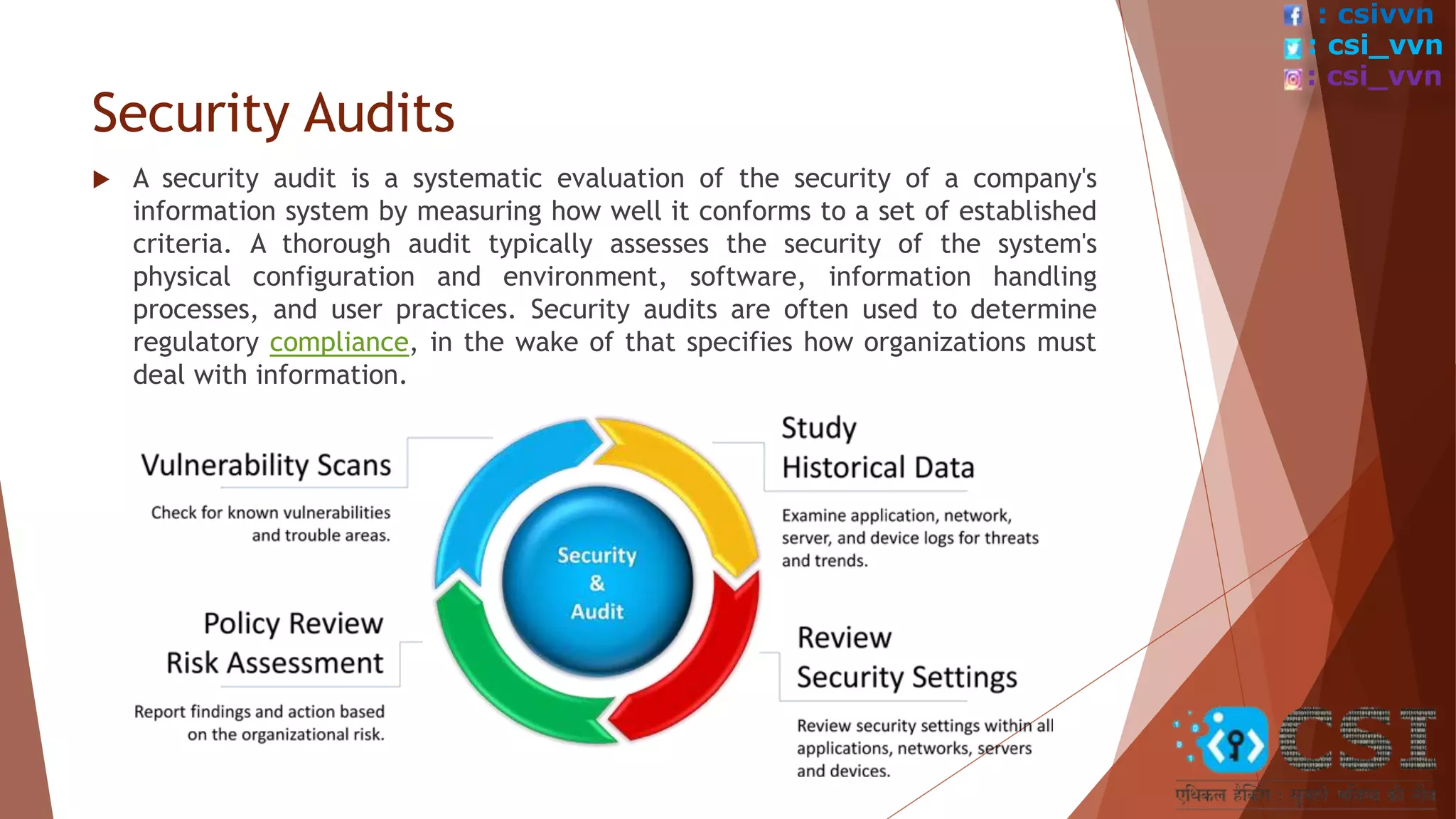
Security Audits
 A security audit is a systematic evaluation of the security of a company's
information system by measuring how well it conforms to a set of established
criteria. A thorough audit typically assesses the security of the system's
physical configuration and environment, software, information handling
processes, and user practices. Security audits are often used to determine
regulatory compliance, in the wake of that specifies how organizations must
deal with information.
: csivvn
: csi_vvn
: csi_vvn
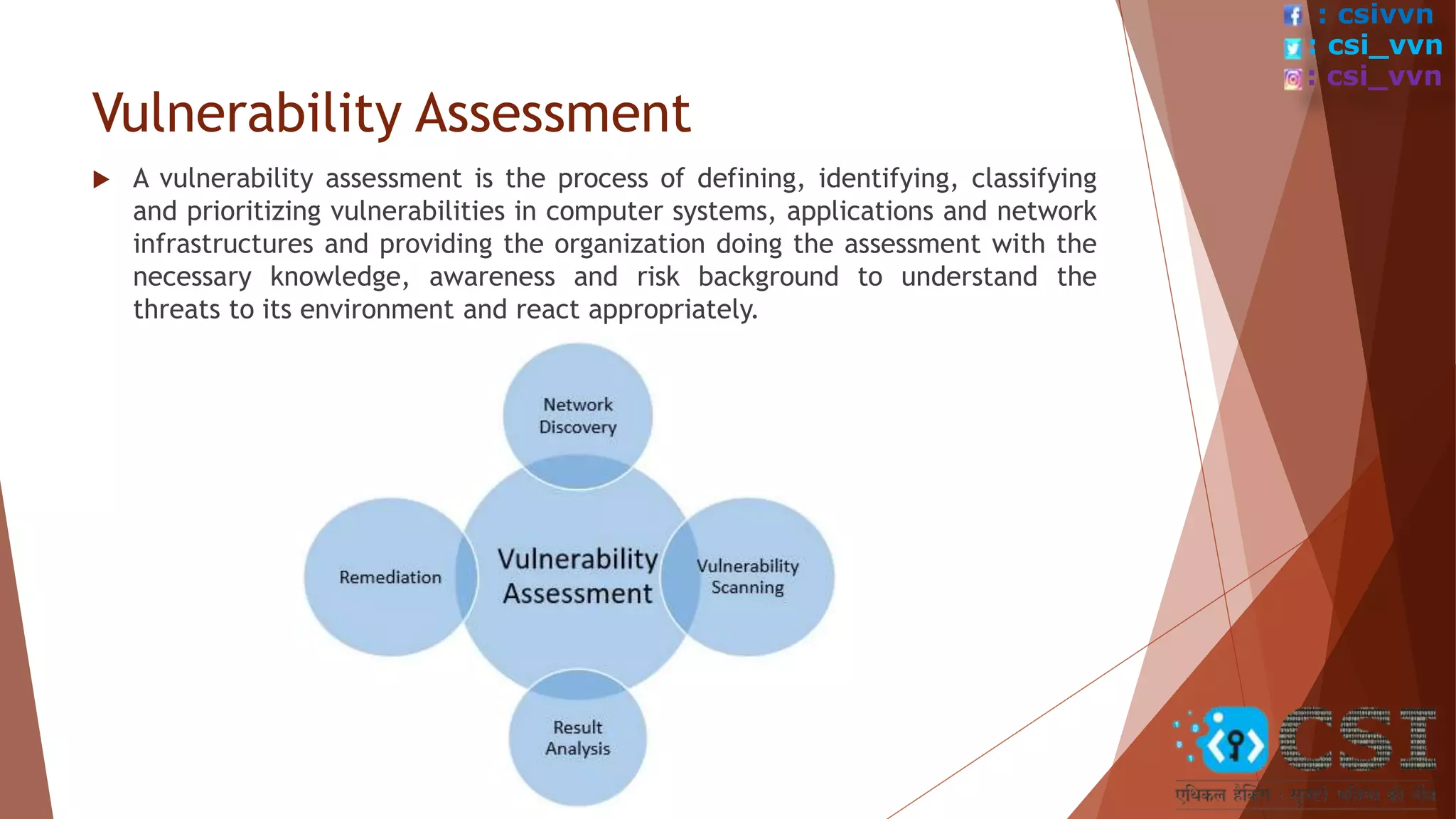
Vulnerability Assessment
 A vulnerability assessment is the process of defining, identifying, classifying
and prioritizing vulnerabilities in computer systems, applications and network
infrastructures and providing the organization doing the assessment with the
necessary knowledge, awareness and risk background to understand the
threats to its environment and react appropriately.
: csivvn
: csi_vvn
: csi_vvn
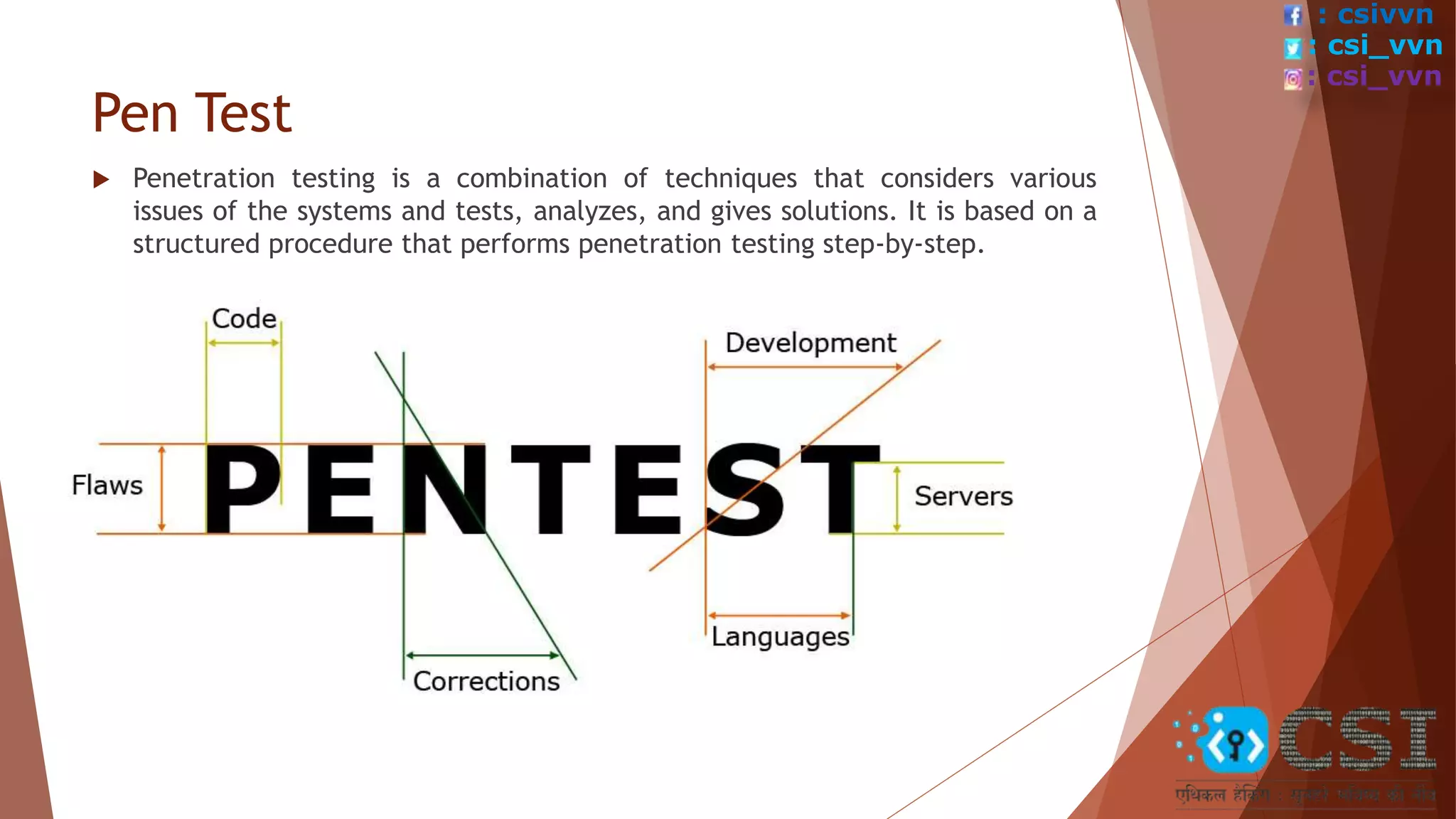
Pen Test
 Penetration testing is a combination of techniques that considers various
issues of the systems and tests, analyzes, and gives solutions. It is based on a
structured procedure that performs penetration testing step-by-step.
: csivvn
: csi_vvn
: csi_vvn
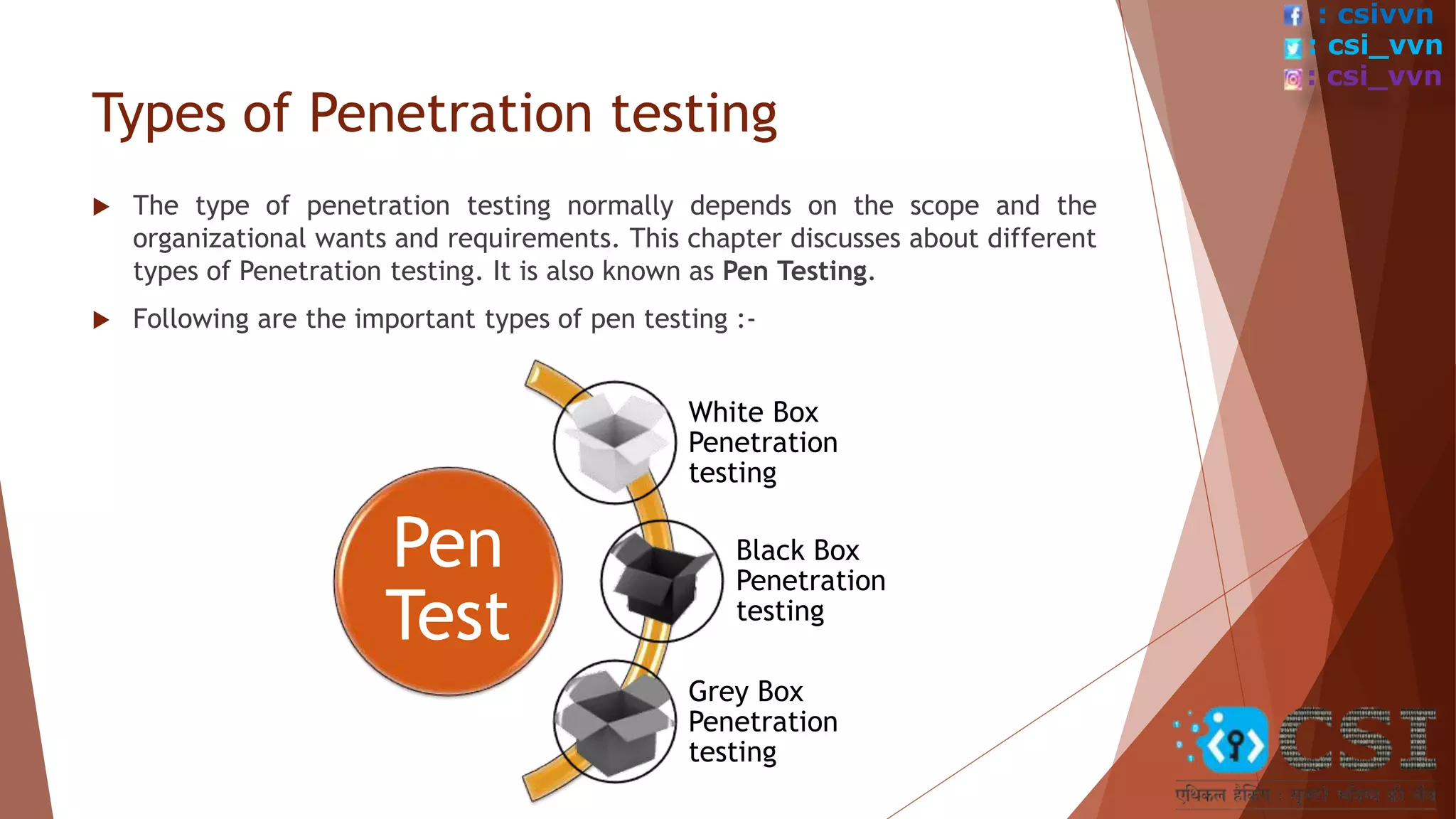
Types of Penetration testing
 The type of penetration testing normally depends on the scope and the
organizational wants and requirements. This chapter discusses about different
types of Penetration testing. It is also known as Pen Testing.
 Following are the important types of pen testing :-
Pen
Test
White Box
Penetration
testing
Black Box
Penetration
testing
Grey Box
Penetration
testing
: csivvn
: csi_vvn
: csi_vvn
White Box Penetration testing
 This is a comprehensive testing, as tester has been provided with whole range
of information about the systems and/or network such as Schema, Source
code, OS details, IP address, etc. It is normally considered as a simulation of
an attack by an internal source. It is also known as structural, glass box, clear
box, and open box testing.
 White box penetration testing examines the code coverage and does data
flow testing, path testing, loop testing, etc.
 Advantages of White Box Penetration Testing
 It ensures that all independent paths of a module have been exercised.
 It ensures that all logical decisions have been verified along with their true
and false value.
 It discovers the typographical errors and does syntax checking.
 It finds the design errors that may have occurred because of the difference
between logical flow of the program and the actual execution.
: csivvn
: csi_vvn
: csi_vvn
Black Box Penetration testing
 In black box penetration testing, tester has no idea about the systems that he
is going to test. He is interested to gather information about the target
network or system. For example, in this testing, a tester only knows what
should be the expected outcome and he does not know how the outcomes
arrives. He does not examine any programming codes.
 Advantages of Black Box
Penetration Testing
 Tester need not necessarily be an
expert, as it does not demand
specific language knowledge
 Tester verifies contradictions in
the actual system and the
specifications
 Test is generally conducted with
the perspective of a user, not the
designer
 Disadvantages of Black Box
Penetration Testing
 Particularly, these kinds of test
cases are difficult to design.
 Possibly, it is not worth, incase
designer has already conducted a
test case.
 It does not conduct everything.
: csivvn
: csi_vvn
: csi_vvn
Grey Box Penetration testing
 In this type of testing, a tester usually provides partial or limited information
about the internal details of the program of a system. It can be considered as
an attack by an external hacker who had gained illegitimate access to an
organization's network infrastructure documents.
 Advantages of Grey Box Penetration Testing
 As the tester does not require the access of source code, it is non-intrusive
and unbiased
 As there is clear difference between a developer and a tester, so there is
least risk of personal conflict
 You don’t need to provide the internal information about the program
functions and other operations
: csivvn
: csi_vvn
: csi_vvn
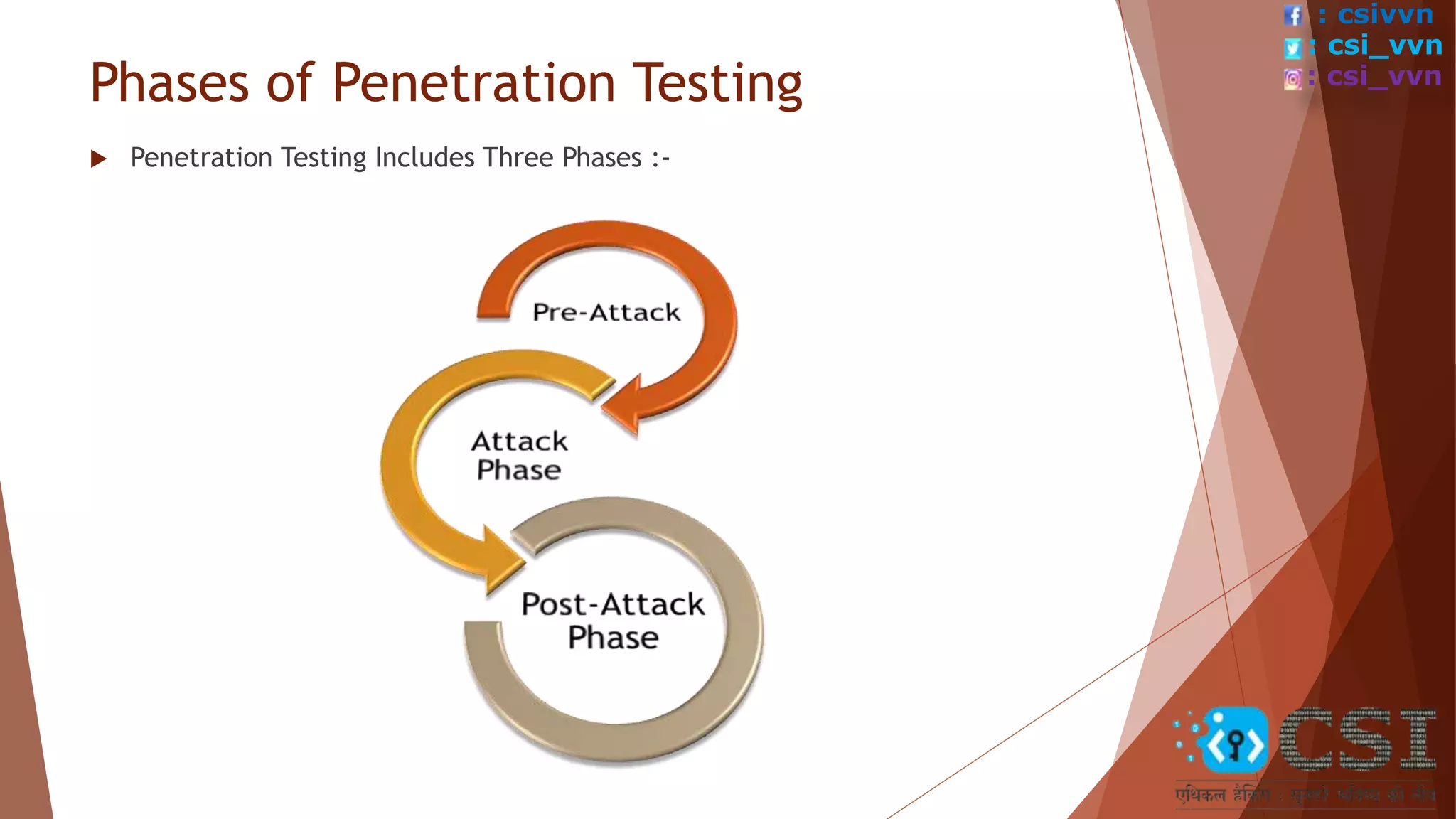
Phases of Penetration Testing
 Penetration Testing Includes Three Phases :-
: csivvn
: csi_vvn
: csi_vvn
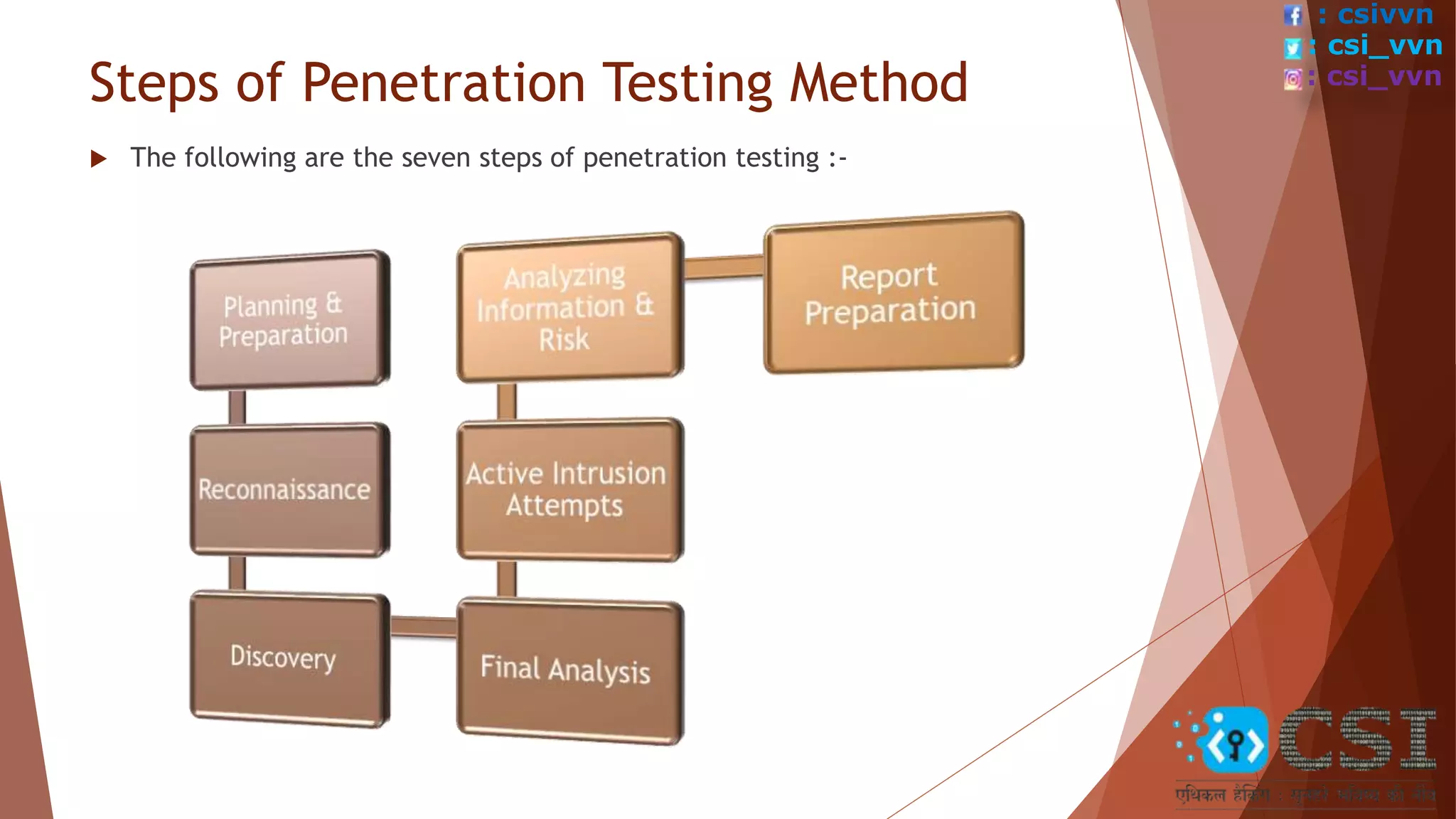
Steps of Penetration Testing Method
 The following are the seven steps of penetration testing :-
: csivvn
: csi_vvn
: csi_vvn
Planning & Preparation
 Planning and preparation starts with defining the goals and objectives
of the penetration testing.
 The client and the tester jointly define the goals so that both the
parties have the same objectives and understanding. The common
objectives of penetration testing are :−
 To identify the vulnerability and improve the security of the technical
systems.
 Have IT security confirmed by an external third party.
 Increase the security of the organizational/personnel infrastructure.
: csivvn
: csi_vvn
: csi_vvn
Reconnaissance
 Reconnaissance includes an analysis of the preliminary information.
 Many times, a tester doesn’t have much information other than the
preliminary information, i.e., an IP address or IP address block.
 The tester starts by analyzing the available information and, if required,
requests for more information such as system descriptions, network plans,
etc. from the client.
 This step is the passive penetration test, a sort of. The sole objective is to
obtain a complete and detailed information of the systems.
: csivvn
: csi_vvn
: csi_vvn
Discovery
 In this step, a penetration tester will most likely use the automated tools to
scan target assets for discovering vulnerabilities. These tools normally have
their own databases giving the details of the latest vulnerabilities. However,
tester discover
 Network Discovery − Such as discovery of additional systems, servers, and
other devices.
 Host Discovery − It determines open ports on these devices.
 Service Interrogation − It interrogates ports to discover actual services which
are running on them.
: csivvn
: csi_vvn
: csi_vvn
Analyzing Information and Risks
 In this step, tester analyzes and assesses the information gathered
before the test steps for dynamically penetrating the system. Because
of larger number of systems and size of infrastructure, it is extremely
time consuming. While analyzing, the tester considers the following
elements :−
 The defined goals of the penetration test.
 The potential risks to the system.
 The estimated time required for evaluating potential security flaws
for the subsequent active penetration testing.
 However, from the list of identified systems, the tester may choose to
test only those which contain potential vulnerabilities.
: csivvn
: csi_vvn
: csi_vvn
Active Intrusion Attempts
 This is the most important step that has to be performed with due care.
 This step entails the extent to which the potential vulnerabilities that was
identified in the discovery step which possess the actual risks.
 This step must be performed when a verification of potential vulnerabilities is
needed. For those systems having very high integrity requirements, the
potential vulnerability and risk needs to be carefully considered before
conducting critical clean up procedures.
: csivvn
: csi_vvn
: csi_vvn
Final Analysis
 This step primarily considers all the steps conducted (discussed above) till
that time and an evaluation of the vulnerabilities present in the form of
potential risks.
 Further, the tester recommends to eliminate the vulnerabilities and risks.
Above all, the tester must assure the transparency of the tests and the
vulnerabilities that it disclosed.
: csivvn
: csi_vvn
: csi_vvn
Report Preparation
 Report preparation must start with overall testing procedures, followed by an
analysis of vulnerabilities and risks. The high risks and critical vulnerabilities
must have priorities and then followed by the lower order.
 However, while documenting the final report, the following points needs to be
considered −
 Overall summary of penetration testing.
 Details of each step and the information gathered during the pen testing.
 Details of all the vulnerabilities and risks discovered.
 Details of cleaning and fixing the systems.
 Suggestions for future security.
: csivvn
: csi_vvn
: csi_vvn
Security Testing Methodology
 Lets surf Online…
: csivvn
: csi_vvn
: csi_vvn
Thanks to All
Any Query?
Call : +91.9099082532
: csivvn
: csi_vvn
: csi_vvn
Like/Follow for Notification of Latest Cyber
Security & Technology's Update.

Introduction to Penetration Testing - By Cyber Expert Amish Patel - 8690029004

  • 1.
    Penetration Testing Introduction andTechniques : csivvn : csi_vvn : csi_vvn
  • 2.
    Topics Covered  Introductionof Penetration Testing  Need of Penetration Testing  How is Penetration Testing Beneficial?  Security Audits Vs Vulnerability Assessment Vs Pen Test  Types of Penetration testing  Phases of Penetration Testing  Steps of Penetration Testing Method  Security Testing Methodology : csivvn : csi_vvn : csi_vvn
  • 3.
    Penetration Testing -Introduction  Penetration testing is a type of security testing that is used to test the insecurity of an application. It is conducted to find the security risk which might be present in the system.  If a system is not secured, then any attacker can disrupt or take authorized access to that system. Security risk is normally an accidental error that occurs while developing and implementing the software. For example, configuration errors, design errors, and software bugs, etc. : csivvn : csi_vvn : csi_vvn
  • 4.
    Need of PenetrationTesting  Penetration testing normally evaluates a system’s ability to protect its networks, applications, endpoints and users from external or internal threats. It also attempts to protect the security controls and ensures only authorized access.  Penetration testing is essential because : −  It identifies a simulation environment i.e., how an intruder may attack the system through white hat attack.  It helps to find weak areas where an intruder can attack to gain access to the computer’s features and data.  It supports to avoid black hat attack and protects the original data.  It estimates the magnitude of the attack on potential business.  It provides evidence to suggest, why it is important to increase investments in security aspect of technology : csivvn : csi_vvn : csi_vvn
  • 5.
    How is PenetrationTesting Beneficial?  Enhancement of the Management System − It provides detailed information about the security threats. In addition to this, it also categorizes the degree of vulnerabilities and suggests you, which one is more vulnerable and which one is less. So, you can easily and accurately manage your security system by allocating the security resources accordingly.  Avoid Fines − Penetration testing keeps your organization’s major activities updated and complies with the auditing system. So, penetration testing protects you from giving fines.  Protection from Financial Damage − A simple breach of security system may cause millions of dollars of damage. Penetration testing can protect your organization from such damages.  Customer Protection − Breach of even a single customer’s data may cause big financial damage as well as reputation damage. It protects the organizations who deal with the customers and keep their data intact.  Penetration testing is a combination of techniques that considers various issues of the systems and tests, analyzes, and gives solutions. It is based on a structured procedure that performs penetration testing step-by-step. : csivvn : csi_vvn : csi_vvn
  • 6.
    Security Audits  Asecurity audit is a systematic evaluation of the security of a company's information system by measuring how well it conforms to a set of established criteria. A thorough audit typically assesses the security of the system's physical configuration and environment, software, information handling processes, and user practices. Security audits are often used to determine regulatory compliance, in the wake of that specifies how organizations must deal with information. : csivvn : csi_vvn : csi_vvn
  • 7.
    Vulnerability Assessment  Avulnerability assessment is the process of defining, identifying, classifying and prioritizing vulnerabilities in computer systems, applications and network infrastructures and providing the organization doing the assessment with the necessary knowledge, awareness and risk background to understand the threats to its environment and react appropriately. : csivvn : csi_vvn : csi_vvn
  • 8.
    Pen Test  Penetrationtesting is a combination of techniques that considers various issues of the systems and tests, analyzes, and gives solutions. It is based on a structured procedure that performs penetration testing step-by-step. : csivvn : csi_vvn : csi_vvn
  • 9.
    Types of Penetrationtesting  The type of penetration testing normally depends on the scope and the organizational wants and requirements. This chapter discusses about different types of Penetration testing. It is also known as Pen Testing.  Following are the important types of pen testing :- Pen Test White Box Penetration testing Black Box Penetration testing Grey Box Penetration testing : csivvn : csi_vvn : csi_vvn
  • 10.
    White Box Penetrationtesting  This is a comprehensive testing, as tester has been provided with whole range of information about the systems and/or network such as Schema, Source code, OS details, IP address, etc. It is normally considered as a simulation of an attack by an internal source. It is also known as structural, glass box, clear box, and open box testing.  White box penetration testing examines the code coverage and does data flow testing, path testing, loop testing, etc.  Advantages of White Box Penetration Testing  It ensures that all independent paths of a module have been exercised.  It ensures that all logical decisions have been verified along with their true and false value.  It discovers the typographical errors and does syntax checking.  It finds the design errors that may have occurred because of the difference between logical flow of the program and the actual execution. : csivvn : csi_vvn : csi_vvn
  • 11.
    Black Box Penetrationtesting  In black box penetration testing, tester has no idea about the systems that he is going to test. He is interested to gather information about the target network or system. For example, in this testing, a tester only knows what should be the expected outcome and he does not know how the outcomes arrives. He does not examine any programming codes.  Advantages of Black Box Penetration Testing  Tester need not necessarily be an expert, as it does not demand specific language knowledge  Tester verifies contradictions in the actual system and the specifications  Test is generally conducted with the perspective of a user, not the designer  Disadvantages of Black Box Penetration Testing  Particularly, these kinds of test cases are difficult to design.  Possibly, it is not worth, incase designer has already conducted a test case.  It does not conduct everything. : csivvn : csi_vvn : csi_vvn
  • 12.
    Grey Box Penetrationtesting  In this type of testing, a tester usually provides partial or limited information about the internal details of the program of a system. It can be considered as an attack by an external hacker who had gained illegitimate access to an organization's network infrastructure documents.  Advantages of Grey Box Penetration Testing  As the tester does not require the access of source code, it is non-intrusive and unbiased  As there is clear difference between a developer and a tester, so there is least risk of personal conflict  You don’t need to provide the internal information about the program functions and other operations : csivvn : csi_vvn : csi_vvn
  • 13.
    Phases of PenetrationTesting  Penetration Testing Includes Three Phases :- : csivvn : csi_vvn : csi_vvn
  • 14.
    Steps of PenetrationTesting Method  The following are the seven steps of penetration testing :- : csivvn : csi_vvn : csi_vvn
  • 15.
    Planning & Preparation Planning and preparation starts with defining the goals and objectives of the penetration testing.  The client and the tester jointly define the goals so that both the parties have the same objectives and understanding. The common objectives of penetration testing are :−  To identify the vulnerability and improve the security of the technical systems.  Have IT security confirmed by an external third party.  Increase the security of the organizational/personnel infrastructure. : csivvn : csi_vvn : csi_vvn
  • 16.
    Reconnaissance  Reconnaissance includesan analysis of the preliminary information.  Many times, a tester doesn’t have much information other than the preliminary information, i.e., an IP address or IP address block.  The tester starts by analyzing the available information and, if required, requests for more information such as system descriptions, network plans, etc. from the client.  This step is the passive penetration test, a sort of. The sole objective is to obtain a complete and detailed information of the systems. : csivvn : csi_vvn : csi_vvn
  • 17.
    Discovery  In thisstep, a penetration tester will most likely use the automated tools to scan target assets for discovering vulnerabilities. These tools normally have their own databases giving the details of the latest vulnerabilities. However, tester discover  Network Discovery − Such as discovery of additional systems, servers, and other devices.  Host Discovery − It determines open ports on these devices.  Service Interrogation − It interrogates ports to discover actual services which are running on them. : csivvn : csi_vvn : csi_vvn
  • 18.
    Analyzing Information andRisks  In this step, tester analyzes and assesses the information gathered before the test steps for dynamically penetrating the system. Because of larger number of systems and size of infrastructure, it is extremely time consuming. While analyzing, the tester considers the following elements :−  The defined goals of the penetration test.  The potential risks to the system.  The estimated time required for evaluating potential security flaws for the subsequent active penetration testing.  However, from the list of identified systems, the tester may choose to test only those which contain potential vulnerabilities. : csivvn : csi_vvn : csi_vvn
  • 19.
    Active Intrusion Attempts This is the most important step that has to be performed with due care.  This step entails the extent to which the potential vulnerabilities that was identified in the discovery step which possess the actual risks.  This step must be performed when a verification of potential vulnerabilities is needed. For those systems having very high integrity requirements, the potential vulnerability and risk needs to be carefully considered before conducting critical clean up procedures. : csivvn : csi_vvn : csi_vvn
  • 20.
    Final Analysis  Thisstep primarily considers all the steps conducted (discussed above) till that time and an evaluation of the vulnerabilities present in the form of potential risks.  Further, the tester recommends to eliminate the vulnerabilities and risks. Above all, the tester must assure the transparency of the tests and the vulnerabilities that it disclosed. : csivvn : csi_vvn : csi_vvn
  • 21.
    Report Preparation  Reportpreparation must start with overall testing procedures, followed by an analysis of vulnerabilities and risks. The high risks and critical vulnerabilities must have priorities and then followed by the lower order.  However, while documenting the final report, the following points needs to be considered −  Overall summary of penetration testing.  Details of each step and the information gathered during the pen testing.  Details of all the vulnerabilities and risks discovered.  Details of cleaning and fixing the systems.  Suggestions for future security. : csivvn : csi_vvn : csi_vvn
  • 22.
    Security Testing Methodology Lets surf Online… : csivvn : csi_vvn : csi_vvn
  • 23.
    Thanks to All AnyQuery? Call : +91.9099082532 : csivvn : csi_vvn : csi_vvn Like/Follow for Notification of Latest Cyber Security & Technology's Update.