Paul Batty,  Pathway to Zero Waste
What is PTZW? A partnership – three founding partners Other partners Government ( DEFRA and GOSE) Improvement and Efficiency South East (IESE) National Industrial Symbiosis Programme (NISP) South East Centre for the Built Environment (SECBE) EnviroBusiness Re Made SE Environment Centre
Our aim To improve South East England’s economic and environmental performance and relieve pressure on its shrinking landfill capacity by:    reducing the amount of surplus and waste material    generated by commercial and industrial activities    increasing the amount that is reused, recycled or    converted to energy instead of being sent to landfill. This will be achieved by driving a mindset change from:
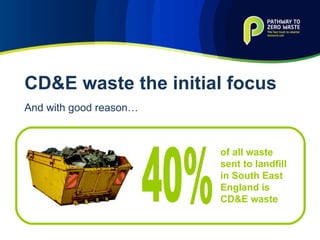
CD&E waste the initial focus And with good reason… 40% of all waste sent to landfill in South East England is CD&E waste
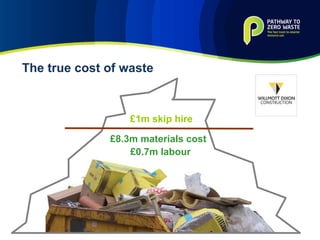
The true cost of waste £1m skip hire £8.3m materials cost £0.7m labour
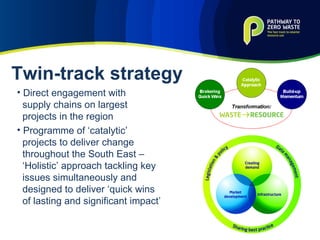
Direct engagement with supply chains on largest projects in the region Programme of ‘catalytic’  projects to deliver change throughout the South East –  ‘ Holistic’ approach tackling key issues simultaneously and designed to deliver ‘quick wins of lasting and significant impact’ Twin-track strategy
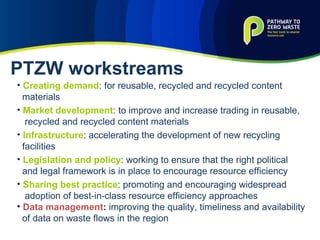
Creating demand : for reusable, recycled and recycled content materials Market development : to improve and increase trading in reusable, recycled and recycled content materials Infrastructure : accelerating the development of new recycling facilities Legislation and policy : working to ensure that the right political and legal framework is in place to encourage resource efficiency Sharing best practice : promoting and encouraging widespread adoption of best-in-class resource efficiency approaches Data management :  improving the quality, timeliness and availability of data on waste flows in the region PTZW workstreams
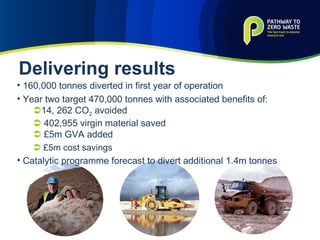
160,000 tonnes diverted in first year of operation Year two target 470,000 tonnes with associated benefits of:  14, 262 CO 2  avoided    402,955 virgin material saved    £5m GVA added    £5m cost savings Catalytic programme forecast to divert additional 1.4m tonnes Delivering results
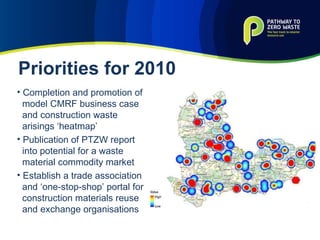
Completion and promotion of model CMRF business case and construction waste arisings ‘heatmap’ Publication of PTZW report into potential for a waste material commodity market Establish a trade association and ‘one-stop-shop’ portal for construction materials reuse and exchange organisations Priorities for 2010
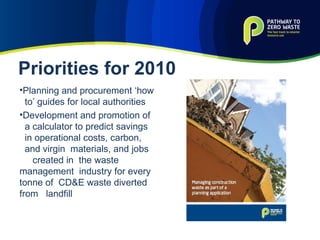
Planning and procurement ‘how to’ guides for local authorities Development and promotion of a calculator to predict savings in operational costs, carbon,  and virgin  materials, and jobs  created in  the waste  management  industry for every tonne of  CD&E waste diverted from  landfill Priorities for 2010
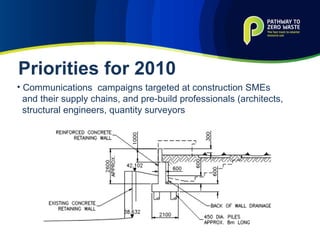
Communications  campaigns targeted at construction SMEs and their supply chains, and pre-build professionals (architects, structural engineers, quantity surveyors Priorities for 2010
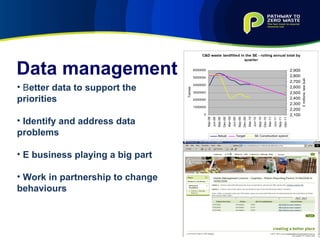
Data management B etter data to support the priorities Identify and address data problems  E business playing a big part Work in partnership to change behaviours
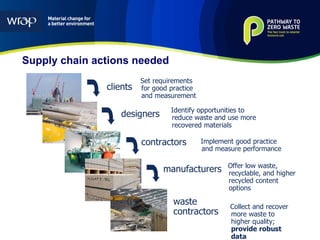
Supply chain actions needed
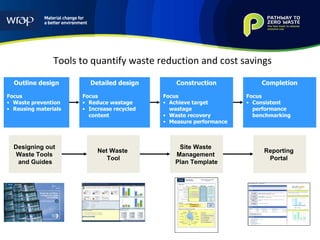
Tools to quantify waste reduction and cost savings Outline design Focus Waste prevention Reusing materials Detailed design Focus Reduce wastage Increase recycled  content Construction Focus Achieve target  wastage Waste recovery Measure performance Completion Focus Consistent performance benchmarking Designing out  Waste Tools  and Guides Net Waste  Tool Site Waste  Management  Plan Template Reporting  Portal
 

Introduction to Pathway to Zero Waste

  • 1.
    Paul Batty, Pathway to Zero Waste
  • 2.
    What is PTZW?A partnership – three founding partners Other partners Government ( DEFRA and GOSE) Improvement and Efficiency South East (IESE) National Industrial Symbiosis Programme (NISP) South East Centre for the Built Environment (SECBE) EnviroBusiness Re Made SE Environment Centre
  • 3.
    Our aim Toimprove South East England’s economic and environmental performance and relieve pressure on its shrinking landfill capacity by:  reducing the amount of surplus and waste material generated by commercial and industrial activities  increasing the amount that is reused, recycled or converted to energy instead of being sent to landfill. This will be achieved by driving a mindset change from:
  • 4.
    CD&E waste theinitial focus And with good reason… 40% of all waste sent to landfill in South East England is CD&E waste
  • 5.
    The true costof waste £1m skip hire £8.3m materials cost £0.7m labour
  • 6.
    Direct engagement withsupply chains on largest projects in the region Programme of ‘catalytic’ projects to deliver change throughout the South East – ‘ Holistic’ approach tackling key issues simultaneously and designed to deliver ‘quick wins of lasting and significant impact’ Twin-track strategy
  • 7.
    Creating demand :for reusable, recycled and recycled content materials Market development : to improve and increase trading in reusable, recycled and recycled content materials Infrastructure : accelerating the development of new recycling facilities Legislation and policy : working to ensure that the right political and legal framework is in place to encourage resource efficiency Sharing best practice : promoting and encouraging widespread adoption of best-in-class resource efficiency approaches Data management : improving the quality, timeliness and availability of data on waste flows in the region PTZW workstreams
  • 8.
    160,000 tonnes divertedin first year of operation Year two target 470,000 tonnes with associated benefits of:  14, 262 CO 2 avoided  402,955 virgin material saved  £5m GVA added  £5m cost savings Catalytic programme forecast to divert additional 1.4m tonnes Delivering results
  • 9.
    Completion and promotionof model CMRF business case and construction waste arisings ‘heatmap’ Publication of PTZW report into potential for a waste material commodity market Establish a trade association and ‘one-stop-shop’ portal for construction materials reuse and exchange organisations Priorities for 2010
  • 10.
    Planning and procurement‘how to’ guides for local authorities Development and promotion of a calculator to predict savings in operational costs, carbon, and virgin materials, and jobs created in the waste management industry for every tonne of CD&E waste diverted from landfill Priorities for 2010
  • 11.
    Communications campaignstargeted at construction SMEs and their supply chains, and pre-build professionals (architects, structural engineers, quantity surveyors Priorities for 2010
  • 12.
    Data management Better data to support the priorities Identify and address data problems E business playing a big part Work in partnership to change behaviours
  • 13.
  • 14.
    Tools to quantifywaste reduction and cost savings Outline design Focus Waste prevention Reusing materials Detailed design Focus Reduce wastage Increase recycled content Construction Focus Achieve target wastage Waste recovery Measure performance Completion Focus Consistent performance benchmarking Designing out Waste Tools and Guides Net Waste Tool Site Waste Management Plan Template Reporting Portal
  • 15.

Editor's Notes

  • #2 Good morning I will talk to you a bit about PTZW to put Waste Data Management into context of PTZW Xx from the EA and xx from willm then drill down into some of the waste data issues The aim being that we all appreciate how important waste data is and collectively work to improve it
  • #3 Firstly- What is PTZW? A partnership programme Founding partners EA, WRAP and SEEDA Other partners too Not least Env Centre Partnership launched in April 2008 as a 3 year programme until March 2011 In December 2009 the programme received £1m ERDF giving a total 3 year budget of £3m
  • #9 .