SISCo project closing conference  Workshop session 2a Comparing sustainability policy  in spatial planning in the UK and Holland University of Southampton 24th November 2011
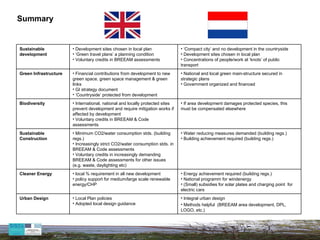
Summary Sustainable development Development sites chosen in local plan ‘ Green travel plans’ a planning condition Voluntary credits in BREEAM assessments ‘ Compact city’ and no development in the countryside Development sites chosen in local plan Concentrations of people/work at ‘knots’ of public transport Green Infrastructure Financial contributions from development to new green space, green space management & green links GI strategy document ‘ Countryside’ protected from development National and local green main-structure secured in strategic plans Government organized and financed Biodiversity International, national and locally protected sites prevent development and require mitigation works if affected by development Voluntary credits in BREEAM & Code assessments If area development damages protected species, this must be compensated elsewhere Sustainable Construction Minimum CO2/water consumption stds. (building regs.) Increasingly strict CO2/water consumption stds. in BREEAM & Code assessments  Voluntary credits in increasingly demanding BREEAM & Code assessments for other issues (e.g. waste, daylighting etc) Water reducing measures demanded (building regs.) Building achievement required (building regs.) Cleaner Energy local % requirement in all new development policy support for medium/large scale renewable energy/CHP Energy achievement required (building regs.) National programm for windenergy (Small) subsidies for solar plates and charging point  for electric cars  Urban Design Local Plan policies Adopted local design guidance Integral urban design Methods helpful  (BREEAM area development, DPL, LOGO, etc.)
Tools for sustainable development What is the one most effective tool for attaining sustainable development? What has been tried and doesn’t work?  
What can or should the government do? How important is the national government’s role in achieving local sustainable development?  How far can local planning systems go it alone?  
What can or should the government do? How important is the national government’s role in achieving local sustainable development?  How far can local planning systems go it alone? How will citizens become enthusiastic for sustainable development? How can developers be triggered to build more sustainably? In Holland developers have decreasing influence at the expense of owners (investors, housing companies and individual builders/customers) whose influence is growing. Thus costs for maintenance and governance are taken into account more than in the recent past). In the UK most homes are still built by large house builders but also many by housing associations who do have an interest in the long term.  
What is common? Can we come up with some conclusions, supported by the British, Belgian and Dutch planning practice?
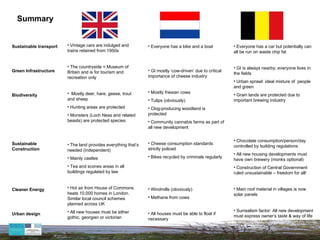
Summary Sustainable transport Green Infrastructure Biodiversity Sustainable Construction Cleaner Energy Urban design Vintage cars are indulged and trains retained from 1950s The countryside = Museum of Britain and is for tourism and recreation only Mostly deer, hare, geese, trout and sheep Hunting areas are protected Monsters (Loch Ness and related beasts) are protected species The land provides everything that’s needed (independent) Mainly castles Tea and scones areas in all buildings regulated by law Hot air from House of Commons heats 10,000 homes in London. Similar local council schemes planned across UK All new houses must be either gothic, georgian or victorian Everyone has a bike and a boat GI mostly ‘cow-driven’ due to critical importance of cheese industry Mostly friesian cows Tulips (obviously)  Clog-producing woodland is protected Community cannabis farms as part of all new development Cheese consumption standards strictly policed Bikes recycled by criminals regularly Windmills (obviously) Methane from cows All houses must be able to float if necessary Everyone has a car but potentially can all be run on waste chip fat GI is always nearby; everyone lives in the fields Urban sprawl: ideal mixture of  people and green Grain lands are protected due to important brewing industry Chocolate consumption/person/day controlled by building regulations All new housing developments must have own brewery (monks optional) Construction of Central Government ruled unsustainable – freedom for all! Main roof material in villages is now solar panels Surrealism factor: All new development must express owner’s taste & way of life
Points to discuss:   If we hold on to ”old” and “authentic” values, we don’t need new rules to be sustainable Economically driven development is sustainable. Or do we need something “extra” to become sustainable? “ Compact city” is as sustainable as “urban sprawl” Can we define differences and  similarities between the British, Belgian and Dutch environmental, urban and sustainable development approach? One thing is for certain: beer is our binding factor

Workshop: Holland vs UK planning

  • 1.
    SISCo project closingconference Workshop session 2a Comparing sustainability policy in spatial planning in the UK and Holland University of Southampton 24th November 2011
  • 2.
    Summary Sustainable developmentDevelopment sites chosen in local plan ‘ Green travel plans’ a planning condition Voluntary credits in BREEAM assessments ‘ Compact city’ and no development in the countryside Development sites chosen in local plan Concentrations of people/work at ‘knots’ of public transport Green Infrastructure Financial contributions from development to new green space, green space management & green links GI strategy document ‘ Countryside’ protected from development National and local green main-structure secured in strategic plans Government organized and financed Biodiversity International, national and locally protected sites prevent development and require mitigation works if affected by development Voluntary credits in BREEAM & Code assessments If area development damages protected species, this must be compensated elsewhere Sustainable Construction Minimum CO2/water consumption stds. (building regs.) Increasingly strict CO2/water consumption stds. in BREEAM & Code assessments Voluntary credits in increasingly demanding BREEAM & Code assessments for other issues (e.g. waste, daylighting etc) Water reducing measures demanded (building regs.) Building achievement required (building regs.) Cleaner Energy local % requirement in all new development policy support for medium/large scale renewable energy/CHP Energy achievement required (building regs.) National programm for windenergy (Small) subsidies for solar plates and charging point for electric cars Urban Design Local Plan policies Adopted local design guidance Integral urban design Methods helpful (BREEAM area development, DPL, LOGO, etc.)
  • 3.
    Tools for sustainabledevelopment What is the one most effective tool for attaining sustainable development? What has been tried and doesn’t work?  
  • 4.
    What can orshould the government do? How important is the national government’s role in achieving local sustainable development? How far can local planning systems go it alone?  
  • 5.
    What can orshould the government do? How important is the national government’s role in achieving local sustainable development? How far can local planning systems go it alone? How will citizens become enthusiastic for sustainable development? How can developers be triggered to build more sustainably? In Holland developers have decreasing influence at the expense of owners (investors, housing companies and individual builders/customers) whose influence is growing. Thus costs for maintenance and governance are taken into account more than in the recent past). In the UK most homes are still built by large house builders but also many by housing associations who do have an interest in the long term.  
  • 6.
    What is common?Can we come up with some conclusions, supported by the British, Belgian and Dutch planning practice?
  • 7.
    Summary Sustainable transportGreen Infrastructure Biodiversity Sustainable Construction Cleaner Energy Urban design Vintage cars are indulged and trains retained from 1950s The countryside = Museum of Britain and is for tourism and recreation only Mostly deer, hare, geese, trout and sheep Hunting areas are protected Monsters (Loch Ness and related beasts) are protected species The land provides everything that’s needed (independent) Mainly castles Tea and scones areas in all buildings regulated by law Hot air from House of Commons heats 10,000 homes in London. Similar local council schemes planned across UK All new houses must be either gothic, georgian or victorian Everyone has a bike and a boat GI mostly ‘cow-driven’ due to critical importance of cheese industry Mostly friesian cows Tulips (obviously) Clog-producing woodland is protected Community cannabis farms as part of all new development Cheese consumption standards strictly policed Bikes recycled by criminals regularly Windmills (obviously) Methane from cows All houses must be able to float if necessary Everyone has a car but potentially can all be run on waste chip fat GI is always nearby; everyone lives in the fields Urban sprawl: ideal mixture of people and green Grain lands are protected due to important brewing industry Chocolate consumption/person/day controlled by building regulations All new housing developments must have own brewery (monks optional) Construction of Central Government ruled unsustainable – freedom for all! Main roof material in villages is now solar panels Surrealism factor: All new development must express owner’s taste & way of life
  • 8.
    Points to discuss:  If we hold on to ”old” and “authentic” values, we don’t need new rules to be sustainable Economically driven development is sustainable. Or do we need something “extra” to become sustainable? “ Compact city” is as sustainable as “urban sprawl” Can we define differences and similarities between the British, Belgian and Dutch environmental, urban and sustainable development approach? One thing is for certain: beer is our binding factor