
11
Buildings as Material Banks (BAMB)
Gilli Hobbs
BRE
22
Developing Buildings as Material
Banks, eliminating waste and
establishing symbiosis in supply
industries
Horizon 2020 – WASTE 1 2014 –
Moving towards a circular economy
through industrial symbiosis
September 2015, for 3.5 years
16 partners from 8 EU countries
3
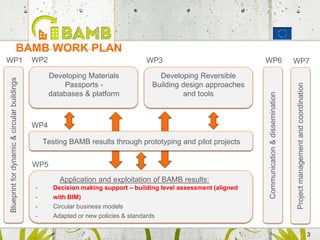
BAMB WORK PLAN
Developing Materials
Passports -
databases & platform
Developing Reversible
Building design approaches
and tools
Testing BAMB results through prototyping and pilot projects
Application and exploitation of BAMB results:
- Decision making support – building level assessment (aligned
- with BIM)
- Circular business models
- Adapted or new policies & standards
Blueprintfordynamic&circularbuildings
Communication&dissemination
Projectmanagementandcoordination
WP2 WP3
WP4
WP5
WP1 WP6 WP7
44
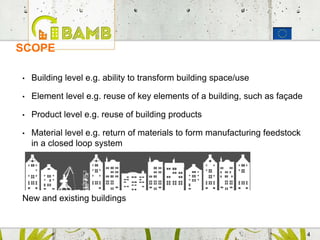
• Building level e.g. ability to transform building space/use
• Element level e.g. reuse of key elements of a building, such as façade
• Product level e.g. reuse of building products
• Material level e.g. return of materials to form manufacturing feedstock
in a closed loop system
New and existing buildings
SCOPE
5
MAINTAIN
REFURBISH
TRANSFORM
From linear to a circular and dynamic built environment
DECISION MAKING SUPPORT- OUTPUTS
REUSE
MAINTAIN
REFURBISH
UPCYCLE / RECYCLE
1. Environmental and economic assessment methodology
2. Application of this methodology via Building Information Modelling (BIM) /
Asset Information Modelling (AIM)
66
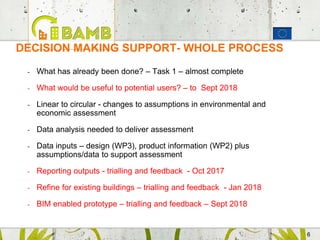
- What has already been done? – Task 1 – almost complete
- What would be useful to potential users? – to Sept 2018
- Linear to circular - changes to assumptions in environmental and
economic assessment
- Data analysis needed to deliver assessment
- Data inputs – design (WP3), product information (WP2) plus
assumptions/data to support assessment
- Reporting outputs - trialling and feedback - Oct 2017
- Refine for existing buildings – trialling and feedback - Jan 2018
- BIM enabled prototype – trialling and feedback – Sept 2018
DECISION MAKING SUPPORT- WHOLE PROCESS
77
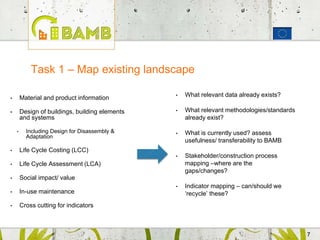
• Material and product information
• Design of buildings, building elements
and systems
• Including Design for Disassembly &
Adaptation
• Life Cycle Costing (LCC)
• Life Cycle Assessment (LCA)
• Social impact/ value
• In-use maintenance
• Cross cutting for indicators
Task 1 – Map existing landscape
• What relevant data already exists?
• What relevant methodologies/standards
already exist?
• What is currently used? assess
usefulness/ transferability to BAMB
• Stakeholder/construction process
mapping –where are the
gaps/changes?
• Indicator mapping – can/should we
‘recycle’ these?
8
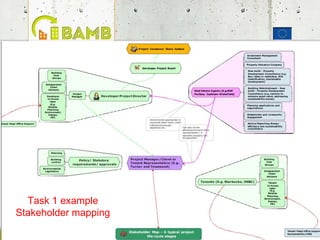
Task 1 example
Stakeholder mapping
9
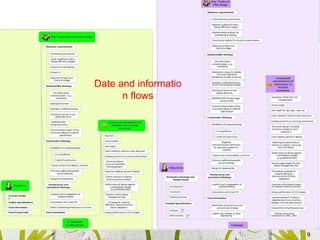
Date and informatio
n flows
1010
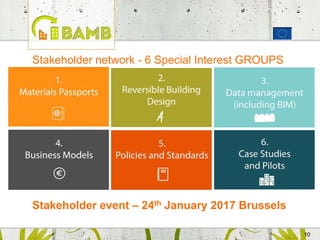
Stakeholder network - 6 Special Interest GROUPS
Stakeholder event – 24th January 2017 Brussels
1111
www.bamb2020.eu
Twitter - @bamb2020
Facebook – bamb2020
bamb@bre.co.uk
1212
• FISSAC – already discussed
• REBUS
• HISER
Other EU projects
13
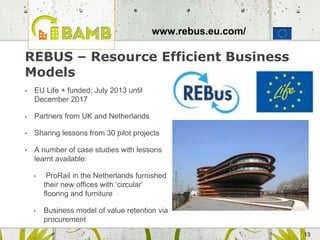
REBUS – Resource Efficient Business
Models
• EU Life + funded; July 2013 until
December 2017
• Partners from UK and Netherlands
• Sharing lessons from 30 pilot projects
• A number of case studies with lessons
learnt available:
• ProRail in the Netherlands furnished
their new offices with ‘circular’
flooring and furniture
• Business model of value retention via
procurement
www.rebus.eu.com/
14
HISER: Holistic Innovative Solutions for an
Efficient Recycling and Recovery of Valuable
Raw Materials from C&DW
• February 2015 to January 2019
• Develop and demonstrate solutions (technological and non-
technological) for a higher recovery of raw materials from ever
more complex C&DW by considering circular economy approaches
• Solutions close to be ready; Demonstrations (mainly) during 2017
• Economic + environmental assessment; Business models /
Exploitation strategies; Policies and standards recommendations
• Conference June 2017 (jointly with BAMB); Delft 20-23 June 2017;
abstracts end January 2017
www.hiserproject.com
1515
Author 1, Author 2 | R&D Institution

Buildings as Material Banks (BAMB)#cethinking

  • 1.
    11 Buildings as MaterialBanks (BAMB) Gilli Hobbs BRE
  • 2.
    22 Developing Buildings asMaterial Banks, eliminating waste and establishing symbiosis in supply industries Horizon 2020 – WASTE 1 2014 – Moving towards a circular economy through industrial symbiosis September 2015, for 3.5 years 16 partners from 8 EU countries
  • 3.
    3 BAMB WORK PLAN DevelopingMaterials Passports - databases & platform Developing Reversible Building design approaches and tools Testing BAMB results through prototyping and pilot projects Application and exploitation of BAMB results: - Decision making support – building level assessment (aligned - with BIM) - Circular business models - Adapted or new policies & standards Blueprintfordynamic&circularbuildings Communication&dissemination Projectmanagementandcoordination WP2 WP3 WP4 WP5 WP1 WP6 WP7
  • 4.
    44 • Building levele.g. ability to transform building space/use • Element level e.g. reuse of key elements of a building, such as façade • Product level e.g. reuse of building products • Material level e.g. return of materials to form manufacturing feedstock in a closed loop system New and existing buildings SCOPE
  • 5.
    5 MAINTAIN REFURBISH TRANSFORM From linear toa circular and dynamic built environment DECISION MAKING SUPPORT- OUTPUTS REUSE MAINTAIN REFURBISH UPCYCLE / RECYCLE 1. Environmental and economic assessment methodology 2. Application of this methodology via Building Information Modelling (BIM) / Asset Information Modelling (AIM)
  • 6.
    66 - What hasalready been done? – Task 1 – almost complete - What would be useful to potential users? – to Sept 2018 - Linear to circular - changes to assumptions in environmental and economic assessment - Data analysis needed to deliver assessment - Data inputs – design (WP3), product information (WP2) plus assumptions/data to support assessment - Reporting outputs - trialling and feedback - Oct 2017 - Refine for existing buildings – trialling and feedback - Jan 2018 - BIM enabled prototype – trialling and feedback – Sept 2018 DECISION MAKING SUPPORT- WHOLE PROCESS
  • 7.
    77 • Material andproduct information • Design of buildings, building elements and systems • Including Design for Disassembly & Adaptation • Life Cycle Costing (LCC) • Life Cycle Assessment (LCA) • Social impact/ value • In-use maintenance • Cross cutting for indicators Task 1 – Map existing landscape • What relevant data already exists? • What relevant methodologies/standards already exist? • What is currently used? assess usefulness/ transferability to BAMB • Stakeholder/construction process mapping –where are the gaps/changes? • Indicator mapping – can/should we ‘recycle’ these?
  • 8.
  • 9.
  • 10.
    1010 Stakeholder network -6 Special Interest GROUPS Stakeholder event – 24th January 2017 Brussels
  • 11.
  • 12.
    1212 • FISSAC –already discussed • REBUS • HISER Other EU projects
  • 13.
    13 REBUS – ResourceEfficient Business Models • EU Life + funded; July 2013 until December 2017 • Partners from UK and Netherlands • Sharing lessons from 30 pilot projects • A number of case studies with lessons learnt available: • ProRail in the Netherlands furnished their new offices with ‘circular’ flooring and furniture • Business model of value retention via procurement www.rebus.eu.com/
  • 14.
    14 HISER: Holistic InnovativeSolutions for an Efficient Recycling and Recovery of Valuable Raw Materials from C&DW • February 2015 to January 2019 • Develop and demonstrate solutions (technological and non- technological) for a higher recovery of raw materials from ever more complex C&DW by considering circular economy approaches • Solutions close to be ready; Demonstrations (mainly) during 2017 • Economic + environmental assessment; Business models / Exploitation strategies; Policies and standards recommendations • Conference June 2017 (jointly with BAMB); Delft 20-23 June 2017; abstracts end January 2017 www.hiserproject.com
  • 15.
    1515 Author 1, Author2 | R&D Institution

Editor's Notes

  • #5 BRE is leading WP5 which is to develop applications for these developed concepts. As such, it is critical that we have better understanding of how to best develop applications that can be used by the construction sector and its clients.