www.cdp.net | @CDP 
CDP Progress 
& Challenges for Cities 
6th ICARB Edinburgh 
5th September 2014 
Amanda Haworth Wiklund
Agenda 
 What is CDP? 
 Summary of corporate trends on climate change 
 Brief points re work w governments & policy-makers 
 Summary of CDP Cities 
 Key outputs & results from 2014 
 Questions / discussion
About CDP 
 Launched in 2000 at 10 Downing Street 
CDP is an international, not-for-profit organisation providing the only global system 
for companies and cities to measure, disclose, manage and share vital 
environmental information. 
 Largest database of corporate climate change, water and forest data in the 
world 
 Data collected from over 4,500 companies including 81% of Global 500 companies 
Global focus 
Mission: To transform the global economic system to prevent dangerous climate 
change and value our natural resources by putting relevant information at the heart 
of business, investment and policy decisions. 
www.cdp.net | @CDP 
Page 3
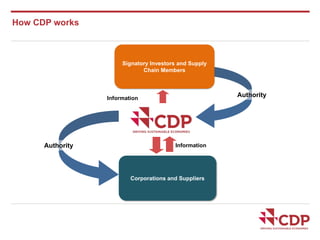
How CDP works 
Corporations and Suppliers 
Authority 
Information 
Authority 
Signatory Investors and Supply 
Chain Members 
Information
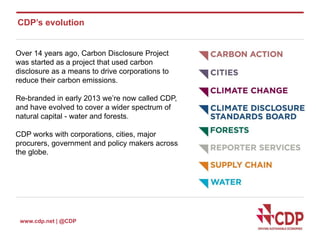
CDP’s evolution 
Over 14 years ago, Carbon Disclosure Project 
was started as a project that used carbon 
disclosure as a means to drive corporations to 
reduce their carbon emissions. 
Re-branded in early 2013 we’re now called CDP, 
and have evolved to cover a wider spectrum of 
natural capital - water and forests. 
CDP works with corporations, cities, major 
procurers, government and policy makers across 
the globe. 
www.cdp.net | @CDP
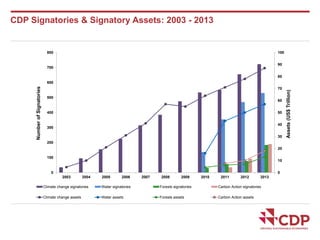
CDP Signatories & Signatory Assets: 2003 - 2013 
100 
90 
80 
70 
60 
50 
40 
30 
20 
10 
0 
800 
700 
600 
500 
400 
300 
200 
100 
0 
2003 2004 2005 2006 2007 2008 2009 2010 2011 2012 2013 
Assets (US$ Trillion) 
Number of Signatories 
Climate change signatories Water signatories Forests signatories Carbon Action signatories 
Climate change assets Water assets Forests assets Carbon Action assets
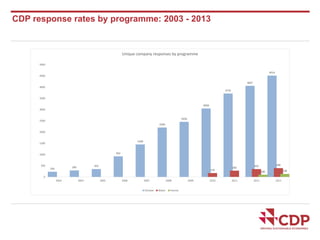
CDP response rates by programme: 2003 - 2013 
235 295 355 
922 
Unique company responses by programme 
1449 
2204 
2456 
3050 
3715 
4057 
4514 
176 
283 
352 396 
100 138 
5000 
4500 
4000 
3500 
3000 
2500 
2000 
1500 
1000 
500 
0 
2003 2004 2005 2006 2007 2008 2009 2010 2011 2012 2013 
Climate Water Forests
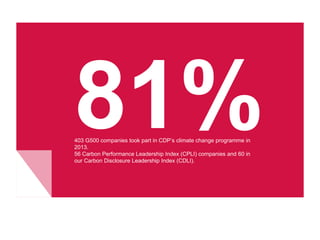
403 G500 companies took part in CDP’s climate change programme in 
2013. 
56 Carbon Performance Leadership Index (CPLI) companies and 60 in 
our Carbon Disclosure Leadership Index (CDLI).
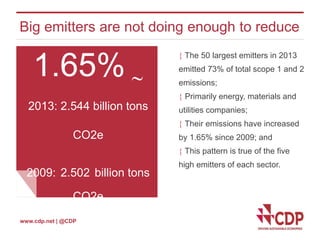
Big emitters are not doing enough to reduce 
1.65%  
2013: 2.544 billion tons 
CO2e 
2009: 2.502 billion tons 
CO2e 
www.cdp.net | @CDP 
 The 50 largest emitters in 2013 
emitted 73% of total scope 1 and 2 
emissions; 
 Primarily energy, materials and 
utilities companies; 
 Their emissions have increased 
by 1.65% since 2009; and 
 This pattern is true of the five 
high emitters of each sector.
There are opportunities for large scale change 
www.cdp.net | @CDP
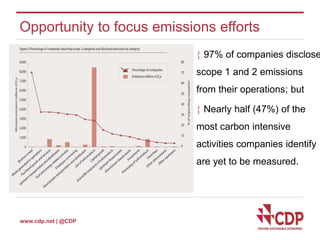
Opportunity to focus emissions efforts 
www.cdp.net | @CDP 
 97% of companies disclose 
scope 1 and 2 emissions 
from their operations; but 
 Nearly half (47%) of the 
most carbon intensive 
activities companies identify 
are yet to be measured.
Financial incentives are powerful tools 
www.cdp.net | @CDP 
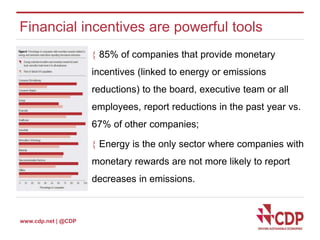
 85% of companies that provide monetary 
incentives (linked to energy or emissions 
reductions) to the board, executive team or all 
employees, report reductions in the past year vs. 
67% of other companies; 
 Energy is the only sector where companies with 
monetary rewards are not more likely to report 
decreases in emissions.
However progress does continue to be made 
www.cdp.net | @CDP
Company reporting continues to improve 
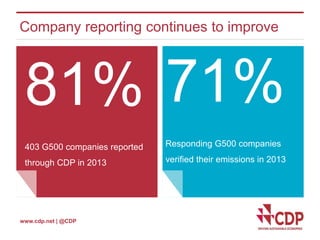
81% 
403 G500 companies reported 
through CDP in 2013 
www.cdp.net | @CDP 
71% 
Responding G500 companies 
verified their emissions in 2013
The quality of information continues to improve 
www.cdp.net | @CDP 
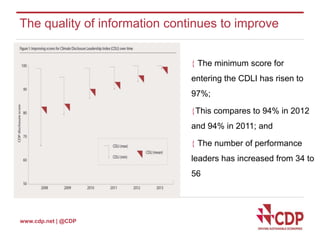
 The minimum score for 
entering the CDLI has risen to 
97%; 
This compares to 94% in 2012 
and 94% in 2011; and 
 The number of performance 
leaders has increased from 34 to 
56
Corporate action on climate change yields benefits 
www.cdp.net | @CDP
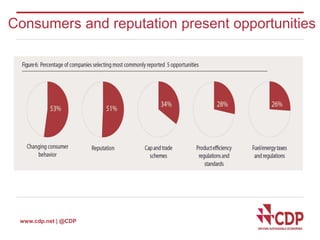
Consumers and reputation present opportunities 
www.cdp.net | @CDP
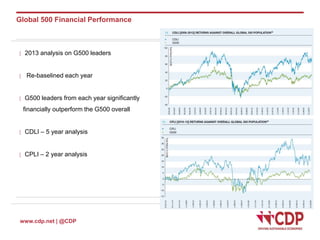
Global 500 Financial Performance 
 2013 analysis on G500 leaders 
 Re-baselined each year 
 G500 leaders from each year significantly 
financially outperform the G500 overall 
 CDLI – 5 year analysis 
 CPLI – 2 year analysis 
www.cdp.net | @CDP
Work with governments and policy-makers 
www.cdp.net | @CDP
Work with governments and policy makers 
CDP is to the future of business what the X-ray was to the then future of medicine— 
without, we would never have seen the insides of a patient’s health. Christiana Figueres 
Executive Secretary of the UN Framework Convention on Climate Change 
 CDP was a force behind landmark UK legislation in 2013 mandating the reporting of 
greenhouse gas emissions in the annual financial reports of listed UK companies. CDP also 
engaged strongly to support European legislation proposed in 2014 requiring listed 
companies to report environmental information to shareholders. 
 Leveraging procurement power 
National governments are now using CDP to leverage their procurement power to drive 
change across their supply chains. 
 Climate Disclosure Standards Board 
CDP provides the secretariat for the Climate Disclosure Standards Board (CDSB). CDSB 
provides a framework to assist companies with the reporting of climate change and other 
environmental information that is of value to investors in mainstream financial reports. 
Find out more, including on how governments and stock exchanges can also incorporate 
this framework, at www.cdsb.net. 
www.cdp.net | @CDP
Introduction to the Cities programme 
www.cdp.net | @CDP Page 21
CDP Cities 
 Why CDP Cities ? What do cities disclose? 
 Who discloses to CDP cities? 
 Key outputs from 2014 
 Open data 
 Partners and Sponsors 
www.cdp.net | @CDP
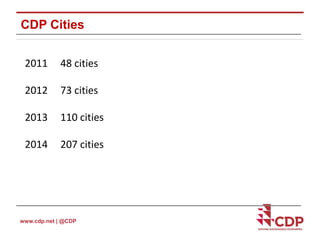
CDP Cities 
2011 48 cities 
2012 73 cities 
2013 110 cities 
2014 207 cities 
www.cdp.net | @CDP
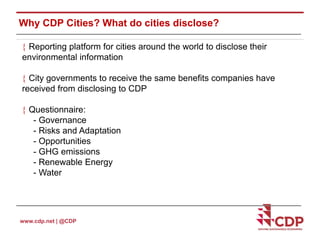
Why CDP Cities? What do cities disclose? 
 Reporting platform for cities around the world to disclose their 
environmental information 
 City governments to receive the same benefits companies have 
received from disclosing to CDP 
 Questionnaire: 
- Governance 
- Risks and Adaptation 
- Opportunities 
- GHG emissions 
- Renewable Energy 
- Water 
www.cdp.net | @CDP
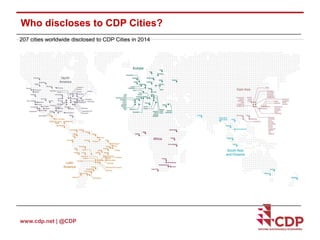
Who discloses to CDP Cities? 
207 cities worldwide disclosed to CDP Cities in 2014 
www.cdp.net | @CDP
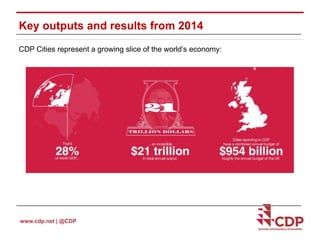
Key outputs and results from 2014 
CDP Cities represent a growing slice of the world’s economy: 
www.cdp.net | @CDP
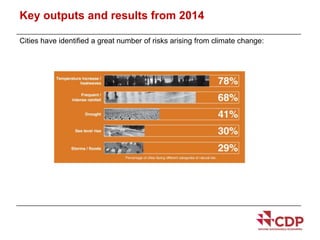
Key outputs and results from 2014 
Cities have identified a great number of risks arising from climate change:
Key outputs and results from 2014 
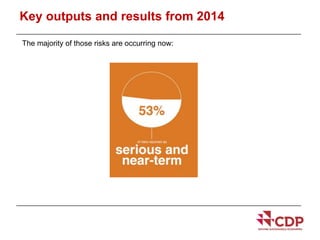
The majority of those risks are occurring now:
Key outputs and results from 2014 
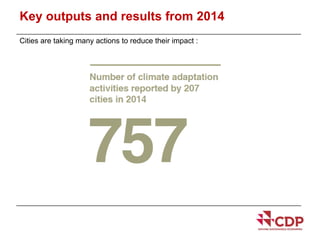
Cities are taking many actions to reduce their impact :
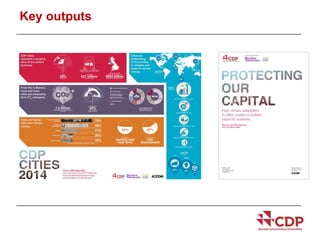
Key outputs
Key outputs 
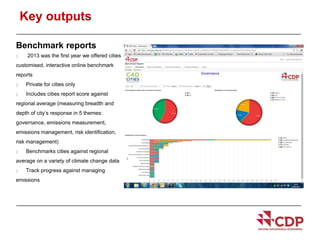
Benchmark reports 
 2013 was the first year we offered cities 
customised, interactive online benchmark 
reports 
 Private for cities only 
 Includes cities report score against 
regional average (measuring breadth and 
depth of city’s response in 5 themes: 
governance, emissions measurement, 
emissions management, risk identification, 
risk management) 
 Benchmarks cities against regional 
average on a variety of climate change data 
 Track progress against managing 
emissions
Open data 
 A large proportion of cities public 
answers from 2014 are available online 
for free. http://opendata.cdp.net/ 
 Over 500 organisations downloaded our 
Open data, including World Bank, WWF, 
CERES, WBCSD the China Carbon 
Emissions Association, as well as 
countless academics and city and 
national governments around the world. 
 Licensed the data via a Creative Commons Attribution Non-Commercial 4.0 
license, allows users to use, adapt, and re-mix the data, as long as CDP is cited as 
the source and the use is non-commercial.
Partners and sponsors 
 To ensure all of those 200+ cities report we work very closely with 
- a group of cities (originally 40) leading in climate change 
 We also work in collaboration with some partners namely: 
Report analysis writer
What people say about CDP 
 “One of the most successful investor engagement programmes of recent years”. The 
Financial Times 
 “Participating in CDP helps drive performance for Diageo. The process ensures the 
business focus on environmental management is maintained. It is an invaluable tool in 
demonstrating progress against our targets and gaining the support of senior 
leadership. It enables us to accelerate the speed with which strategic change can be 
implemented”. Diageo 
 Sustainability experts polled by SustainAbility deem CDP’s sustainability ratings as 
the most credible in the world in its Rate the Raters survey.
Thank you 
amanda.haworth@cdp.net

CDP Progress & Challenges for Cities | Amanda Haworth

  • 1.
    www.cdp.net | @CDP CDP Progress & Challenges for Cities 6th ICARB Edinburgh 5th September 2014 Amanda Haworth Wiklund
  • 2.
    Agenda  Whatis CDP?  Summary of corporate trends on climate change  Brief points re work w governments & policy-makers  Summary of CDP Cities  Key outputs & results from 2014  Questions / discussion
  • 3.
    About CDP Launched in 2000 at 10 Downing Street CDP is an international, not-for-profit organisation providing the only global system for companies and cities to measure, disclose, manage and share vital environmental information.  Largest database of corporate climate change, water and forest data in the world  Data collected from over 4,500 companies including 81% of Global 500 companies Global focus Mission: To transform the global economic system to prevent dangerous climate change and value our natural resources by putting relevant information at the heart of business, investment and policy decisions. www.cdp.net | @CDP Page 3
  • 4.
    How CDP works Corporations and Suppliers Authority Information Authority Signatory Investors and Supply Chain Members Information
  • 5.
    CDP’s evolution Over14 years ago, Carbon Disclosure Project was started as a project that used carbon disclosure as a means to drive corporations to reduce their carbon emissions. Re-branded in early 2013 we’re now called CDP, and have evolved to cover a wider spectrum of natural capital - water and forests. CDP works with corporations, cities, major procurers, government and policy makers across the globe. www.cdp.net | @CDP
  • 6.
    CDP Signatories &Signatory Assets: 2003 - 2013 100 90 80 70 60 50 40 30 20 10 0 800 700 600 500 400 300 200 100 0 2003 2004 2005 2006 2007 2008 2009 2010 2011 2012 2013 Assets (US$ Trillion) Number of Signatories Climate change signatories Water signatories Forests signatories Carbon Action signatories Climate change assets Water assets Forests assets Carbon Action assets
  • 7.
    CDP response ratesby programme: 2003 - 2013 235 295 355 922 Unique company responses by programme 1449 2204 2456 3050 3715 4057 4514 176 283 352 396 100 138 5000 4500 4000 3500 3000 2500 2000 1500 1000 500 0 2003 2004 2005 2006 2007 2008 2009 2010 2011 2012 2013 Climate Water Forests
  • 8.
    403 G500 companiestook part in CDP’s climate change programme in 2013. 56 Carbon Performance Leadership Index (CPLI) companies and 60 in our Carbon Disclosure Leadership Index (CDLI).
  • 9.
    Big emitters arenot doing enough to reduce 1.65%  2013: 2.544 billion tons CO2e 2009: 2.502 billion tons CO2e www.cdp.net | @CDP  The 50 largest emitters in 2013 emitted 73% of total scope 1 and 2 emissions;  Primarily energy, materials and utilities companies;  Their emissions have increased by 1.65% since 2009; and  This pattern is true of the five high emitters of each sector.
  • 10.
    There are opportunitiesfor large scale change www.cdp.net | @CDP
  • 11.
    Opportunity to focusemissions efforts www.cdp.net | @CDP  97% of companies disclose scope 1 and 2 emissions from their operations; but  Nearly half (47%) of the most carbon intensive activities companies identify are yet to be measured.
  • 12.
    Financial incentives arepowerful tools www.cdp.net | @CDP  85% of companies that provide monetary incentives (linked to energy or emissions reductions) to the board, executive team or all employees, report reductions in the past year vs. 67% of other companies;  Energy is the only sector where companies with monetary rewards are not more likely to report decreases in emissions.
  • 13.
    However progress doescontinue to be made www.cdp.net | @CDP
  • 14.
    Company reporting continuesto improve 81% 403 G500 companies reported through CDP in 2013 www.cdp.net | @CDP 71% Responding G500 companies verified their emissions in 2013
  • 15.
    The quality ofinformation continues to improve www.cdp.net | @CDP  The minimum score for entering the CDLI has risen to 97%; This compares to 94% in 2012 and 94% in 2011; and  The number of performance leaders has increased from 34 to 56
  • 16.
    Corporate action onclimate change yields benefits www.cdp.net | @CDP
  • 17.
    Consumers and reputationpresent opportunities www.cdp.net | @CDP
  • 18.
    Global 500 FinancialPerformance  2013 analysis on G500 leaders  Re-baselined each year  G500 leaders from each year significantly financially outperform the G500 overall  CDLI – 5 year analysis  CPLI – 2 year analysis www.cdp.net | @CDP
  • 19.
    Work with governmentsand policy-makers www.cdp.net | @CDP
  • 20.
    Work with governmentsand policy makers CDP is to the future of business what the X-ray was to the then future of medicine— without, we would never have seen the insides of a patient’s health. Christiana Figueres Executive Secretary of the UN Framework Convention on Climate Change  CDP was a force behind landmark UK legislation in 2013 mandating the reporting of greenhouse gas emissions in the annual financial reports of listed UK companies. CDP also engaged strongly to support European legislation proposed in 2014 requiring listed companies to report environmental information to shareholders.  Leveraging procurement power National governments are now using CDP to leverage their procurement power to drive change across their supply chains.  Climate Disclosure Standards Board CDP provides the secretariat for the Climate Disclosure Standards Board (CDSB). CDSB provides a framework to assist companies with the reporting of climate change and other environmental information that is of value to investors in mainstream financial reports. Find out more, including on how governments and stock exchanges can also incorporate this framework, at www.cdsb.net. www.cdp.net | @CDP
  • 21.
    Introduction to theCities programme www.cdp.net | @CDP Page 21
  • 22.
    CDP Cities Why CDP Cities ? What do cities disclose?  Who discloses to CDP cities?  Key outputs from 2014  Open data  Partners and Sponsors www.cdp.net | @CDP
  • 23.
    CDP Cities 201148 cities 2012 73 cities 2013 110 cities 2014 207 cities www.cdp.net | @CDP
  • 24.
    Why CDP Cities?What do cities disclose?  Reporting platform for cities around the world to disclose their environmental information  City governments to receive the same benefits companies have received from disclosing to CDP  Questionnaire: - Governance - Risks and Adaptation - Opportunities - GHG emissions - Renewable Energy - Water www.cdp.net | @CDP
  • 25.
    Who discloses toCDP Cities? 207 cities worldwide disclosed to CDP Cities in 2014 www.cdp.net | @CDP
  • 26.
    Key outputs andresults from 2014 CDP Cities represent a growing slice of the world’s economy: www.cdp.net | @CDP
  • 27.
    Key outputs andresults from 2014 Cities have identified a great number of risks arising from climate change:
  • 28.
    Key outputs andresults from 2014 The majority of those risks are occurring now:
  • 29.
    Key outputs andresults from 2014 Cities are taking many actions to reduce their impact :
  • 30.
  • 31.
    Key outputs Benchmarkreports  2013 was the first year we offered cities customised, interactive online benchmark reports  Private for cities only  Includes cities report score against regional average (measuring breadth and depth of city’s response in 5 themes: governance, emissions measurement, emissions management, risk identification, risk management)  Benchmarks cities against regional average on a variety of climate change data  Track progress against managing emissions
  • 32.
    Open data A large proportion of cities public answers from 2014 are available online for free. http://opendata.cdp.net/  Over 500 organisations downloaded our Open data, including World Bank, WWF, CERES, WBCSD the China Carbon Emissions Association, as well as countless academics and city and national governments around the world.  Licensed the data via a Creative Commons Attribution Non-Commercial 4.0 license, allows users to use, adapt, and re-mix the data, as long as CDP is cited as the source and the use is non-commercial.
  • 33.
    Partners and sponsors  To ensure all of those 200+ cities report we work very closely with - a group of cities (originally 40) leading in climate change  We also work in collaboration with some partners namely: Report analysis writer
  • 34.
    What people sayabout CDP  “One of the most successful investor engagement programmes of recent years”. The Financial Times  “Participating in CDP helps drive performance for Diageo. The process ensures the business focus on environmental management is maintained. It is an invaluable tool in demonstrating progress against our targets and gaining the support of senior leadership. It enables us to accelerate the speed with which strategic change can be implemented”. Diageo  Sustainability experts polled by SustainAbility deem CDP’s sustainability ratings as the most credible in the world in its Rate the Raters survey.
  • 35.

Editor's Notes

  • #2 Thank you for inviting me to speak. Last August Arendalsuka ref local gov’t discomfort w fossil fuel oil wealth, comp w anti-Nazi Germans during Hitler’s time.
  • #3 Inception brilliant formula to present corporations w fiduciary resp. To maintain share value by measuring carbon emissions “What gets measured gets managed” so then able to adapt and/or mitigate.
  • #7 On behalf of 767 investors with US$92 trillion
  • #8 Figures for 2014 not yet publicly available but show a 13% overall increase in company responses, of which 18% represents an increase in climate change responses, 188% in CDP Water.
  • #9 Brief explanation of difference between CPLI & CDLI Companies achieving a position in CDP’s Climate Performance Leadership Index are those who demonstrate the strongest strategies, commitments and actions to reduce carbon emissions and mitigate the risks of climate change.
  • #10 Scope 1 and 2 emissions reported by the Global 500 companies have declined since 2009 but this is in part due to the changing composition of the sample and the declining proportion of companies from high emitting sectors. Companies from energy, utilities and materials sectors now represent 23% of the sample, versus 26% in 2009, and they are responsible for 87% of the scope 1 and 2 emissions this year. Our key message is that the companies responsible for the majority of greenhouse gas emissions are not doing enough. We conducted analysis on 50 companies with high emissions and data going back to 2009. These 50 are responsible for 73% of this year’s scope 1 and 2 emissions, they are mainly from high emitting sectors and their emissions have risen by an average of 1.65% since 2009. This pattern is also true when we looked at the high emitters in each sector. (Note that the analysis was looking at 5 year trends so some high emitters were not included if we did not have emissions every year since 2009. This means that we can not say we identified the 50 biggest emitters of 2013 or the 5 biggest emitters per sector of 2013)
  • #11 (3rd key message followed by proof points)
  • #12 While the high emitters clearly present significant opportunity for change, all companies could re-examine where they focus their emissions reductions efforts. (Refer to stats in bullet points on slide) (Note that companies this year were asked whether scope 3 categories were relevant and then whether they were calculated, the 47% refers to categories identified as relevant but not calculated) Graph shows in particular that companies often focus on relatively insignificant opportunities for reductions: Use of sold products (in centre) is reported by 25% of companies and accounts for 76% of reported scope 3; and Business travel (on left) is reported by 72% of companies and accounts for 0.2% of scope 3.
  • #13 Businesses can use monetary incentives to support action: companies are 18% more likely to achieve absolute emissions reductions when staff are given financial incentives. (Refer to stats in first bullet point on slide noting the specific combination of monetary incentives which are linked to energy or emissions reductions and are applicable to the board, the exec team or to all staff) This trend is true for every sector except Energy.
  • #14 (4th key message with proof points)
  • #15 On a positive note, we are making progress: 81% of the Global 500 uses CDP to manage and disclose their climate change impacts and 71% of those responding companies now disclose verified emissions.
  • #16 And the overall quality and completeness of company responses continues to improve. The score required to achieve a position in the Climate Disclosure Leadership Index (CDLI) is now 97% and the number of companies achieving performance leadership on the CPLI has increased from 34 to 56.
  • #17 (5th key message with proof points)
  • #18 There are commercial benefits if companies lead on climate performance: changing consumer behaviour and / or reputation are reported as presenting the greatest climate change-related opportunities for nearly every sector.
  • #20 (5th key message with proof points)
  • #26 91 small cities 59 medium cities 57 large cities The 207 total covers a worldwide population of 394,360,000