
Tomasz Kozluk, OECD
Global Forum on Environment (and Growth)
25th October 2016
Environmental policies and
economic outcomes:
what can we learn from
firms and industries?
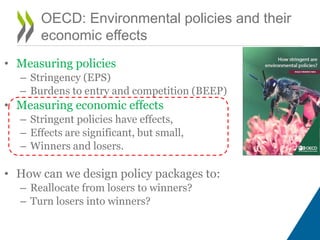
• Measuring policies
– Stringency (EPS)
– Burdens to entry and competition (BEEP)
• Measuring economic effects
– Stringent policies have effects,
– Effects are significant, but small,
– Winners and losers.
• How can we design policy packages to:
– Reallocate from losers to winners?
– Turn losers into winners?
OECD: Environmental policies and their
economic effects
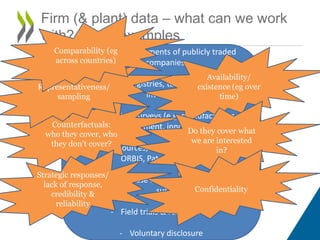
- Financial statements of publicly traded
companies,
- Business registries, tax registries, trade
inventories
- Dedicated surveys (e.g. manufacturing,
investment, innovation),
- Other sources, “privately” collected (eg
ORBIS, Patstat, GIS, GPS),
- Pollution Release Inventories (PRTRs, EU ETS
sub.),
- Field trials & related data
- Voluntary disclosure
Firm (& plant) data – what can we work
with? Some examples
Counterfactuals:
who they cover, who
they don’t cover?
Availability/
existence (eg over
time)
Do they cover what
we are interested
in?
Representativeness/
sampling
Confidentiality
Strategic responses/
lack of response,
credibility &
reliability
Comparability (eg
across countries)
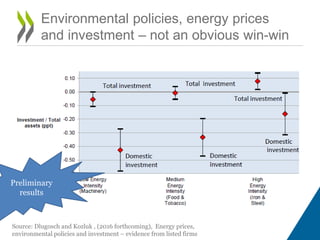
Environmental policies, energy prices
and investment – not an obvious win-win
Preliminary
results
Source: Dlugosch and Kozluk , (2016 forthcoming), Energy prices,
environmental policies and investment – evidence from listed firms
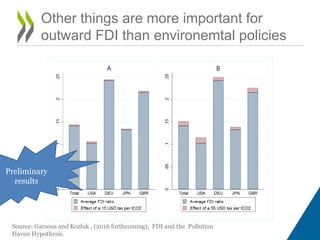
Other things are more important for
outward FDI than environemtal policies
Preliminary
results
Source: Garsous and Kozluk , (2016 forthcoming), FDI and the Pollution
Haven Hypothesis.
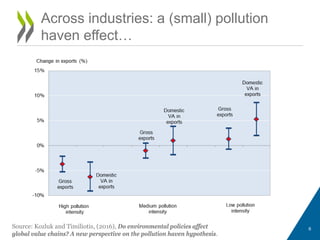
Across industries: a (small) pollution
haven effect…
Source: Kozluk and Timiliotis, (2016), Do environmental policies affect
global value chains? A new perspective on the pollution haven hypothesis.
6
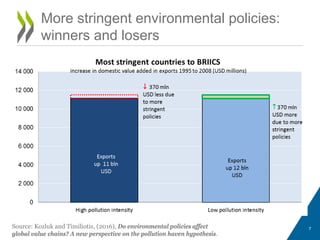
More stringent environmental policies:
winners and losers
Source: Kozluk and Timiliotis, (2016), Do environmental policies affect
global value chains? A new perspective on the pollution haven hypothesis.
7
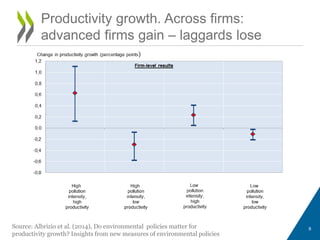
Productivity growth. Across firms:
advanced firms gain – laggards lose
Source: Albrizio et al. (2014), Do environmental policies matter for
productivity growth? Insights from new measures of environmental policies
8
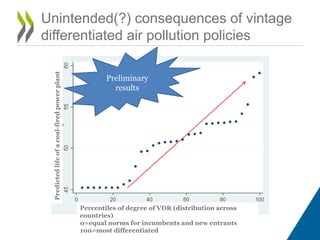
Unintended(?) consequences of vintage
differentiated air pollution policies
Predictedlifeofacoal-firedpowerplant
Percentiles of degree of VDR (distribution across
countries)
0=equal norms for incumbents and new entrants
100=most differentiated
Preliminary
results
Tomasz.Kozluk@oecd.org
http://oe.cd/eps
Thank you!

ENV GLOBAL FORUM OCT 2016 - Session 4 - Tomasz KOZLUK

  • 1.
    Tomasz Kozluk, OECD GlobalForum on Environment (and Growth) 25th October 2016 Environmental policies and economic outcomes: what can we learn from firms and industries?
  • 2.
    • Measuring policies –Stringency (EPS) – Burdens to entry and competition (BEEP) • Measuring economic effects – Stringent policies have effects, – Effects are significant, but small, – Winners and losers. • How can we design policy packages to: – Reallocate from losers to winners? – Turn losers into winners? OECD: Environmental policies and their economic effects
  • 3.
    - Financial statementsof publicly traded companies, - Business registries, tax registries, trade inventories - Dedicated surveys (e.g. manufacturing, investment, innovation), - Other sources, “privately” collected (eg ORBIS, Patstat, GIS, GPS), - Pollution Release Inventories (PRTRs, EU ETS sub.), - Field trials & related data - Voluntary disclosure Firm (& plant) data – what can we work with? Some examples Counterfactuals: who they cover, who they don’t cover? Availability/ existence (eg over time) Do they cover what we are interested in? Representativeness/ sampling Confidentiality Strategic responses/ lack of response, credibility & reliability Comparability (eg across countries)
  • 4.
    Environmental policies, energyprices and investment – not an obvious win-win Preliminary results Source: Dlugosch and Kozluk , (2016 forthcoming), Energy prices, environmental policies and investment – evidence from listed firms
  • 5.
    Other things aremore important for outward FDI than environemtal policies Preliminary results Source: Garsous and Kozluk , (2016 forthcoming), FDI and the Pollution Haven Hypothesis.
  • 6.
    Across industries: a(small) pollution haven effect… Source: Kozluk and Timiliotis, (2016), Do environmental policies affect global value chains? A new perspective on the pollution haven hypothesis. 6
  • 7.
    More stringent environmentalpolicies: winners and losers Source: Kozluk and Timiliotis, (2016), Do environmental policies affect global value chains? A new perspective on the pollution haven hypothesis. 7
  • 8.
    Productivity growth. Acrossfirms: advanced firms gain – laggards lose Source: Albrizio et al. (2014), Do environmental policies matter for productivity growth? Insights from new measures of environmental policies 8
  • 9.
    Unintended(?) consequences ofvintage differentiated air pollution policies Predictedlifeofacoal-firedpowerplant Percentiles of degree of VDR (distribution across countries) 0=equal norms for incumbents and new entrants 100=most differentiated Preliminary results
  • 10.