Introduction to Organizational BehaviorDefinitions,  Fields , and What We Will Study
What IS an Organization?Group of people		Working together				With a common purpose
Which of these would be an organization?United Way (non-profit charity)Scout troopCrowd cheering on home team at a football gameStudent work team in a college classNeighbors doing a one-day park clean upPeople lined up to purchase concert ticketsRoadies setting up the equipment for the concert
Disciplines Contributing to OBPsychologySocial PsychologySociologyAnthropologyEconomics
 OB and Systematic ResearchOB involves using the scientific method to form and test hypotheses aboutHow things are usually done in organizations
How things might be done best Sometimes we read will seem like plain old common sense , but sometimes our gut instincts are dead wrong.  That’s what the scientific research is for.
Some Key Outcomes (dependent variables) Studied in OBProductivityAbsenteeismTurnoverDeviant Behavior  (Workers being bad)Organizational Citizenship (Workers being extra good)Job Satisfaction and Commitment
Things We Think Cause These Outcomes (Independent variables)Individual characteristics (personality, demographics, values, attitudes, abilities, perceptions, motivation, learning, decision-making)Group characteristics (group decision-making, leadership, power and politics, communication, conflict, group structure and norms)Organizational characteristics (culture, structure, design)
Contingency TheoryIs there 1 best way to do most things, or does it usually depend on the situation? Many managers and OB researchers believe that the best way to do things depends on the situation.Contingency theory holds that the right approach is contingent on situational factors.Most OB research is based on the notion that results “depend” on how some complex factors combine.  We’ll look at those contingencies.
Why should YOU study organizational behavior?You’ll understand more about how you and the people around you respond to situationsYou’ll be able to use basic human tendencies to get others to do what you wantResearch shows that EQ is even more important than IQ for success in businessMost managers in executive MBA programs ask for more, more, more OB because getting people to do things is the most critical part of their jobs!
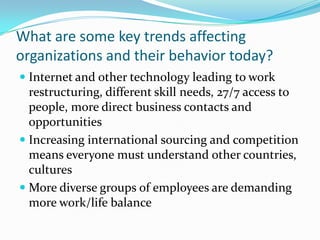
What are some key trends affecting organizations and their behavior today?

Introduction to organizational behavior

  • 1.
    Introduction to OrganizationalBehaviorDefinitions, Fields , and What We Will Study
  • 2.
    What IS anOrganization?Group of people Working together With a common purpose
  • 3.
    Which of thesewould be an organization?United Way (non-profit charity)Scout troopCrowd cheering on home team at a football gameStudent work team in a college classNeighbors doing a one-day park clean upPeople lined up to purchase concert ticketsRoadies setting up the equipment for the concert
  • 4.
    Disciplines Contributing toOBPsychologySocial PsychologySociologyAnthropologyEconomics
  • 5.
    OB andSystematic ResearchOB involves using the scientific method to form and test hypotheses aboutHow things are usually done in organizations
  • 6.
    How things mightbe done best Sometimes we read will seem like plain old common sense , but sometimes our gut instincts are dead wrong. That’s what the scientific research is for.
  • 7.
    Some Key Outcomes(dependent variables) Studied in OBProductivityAbsenteeismTurnoverDeviant Behavior (Workers being bad)Organizational Citizenship (Workers being extra good)Job Satisfaction and Commitment
  • 8.
    Things We ThinkCause These Outcomes (Independent variables)Individual characteristics (personality, demographics, values, attitudes, abilities, perceptions, motivation, learning, decision-making)Group characteristics (group decision-making, leadership, power and politics, communication, conflict, group structure and norms)Organizational characteristics (culture, structure, design)
  • 9.
    Contingency TheoryIs there1 best way to do most things, or does it usually depend on the situation? Many managers and OB researchers believe that the best way to do things depends on the situation.Contingency theory holds that the right approach is contingent on situational factors.Most OB research is based on the notion that results “depend” on how some complex factors combine. We’ll look at those contingencies.
  • 10.
    Why should YOUstudy organizational behavior?You’ll understand more about how you and the people around you respond to situationsYou’ll be able to use basic human tendencies to get others to do what you wantResearch shows that EQ is even more important than IQ for success in businessMost managers in executive MBA programs ask for more, more, more OB because getting people to do things is the most critical part of their jobs!
  • 11.
    What are somekey trends affecting organizations and their behavior today?