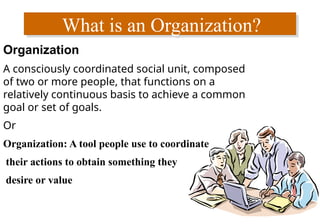
What is anOrganization?
Organization
A consciously coordinated social unit, composed
of two or more people, that functions on a
relatively continuous basis to achieve a common
goal or set of goals.
Or
Organization: A tool people use to coordinate
their actions to obtain something they
desire or value
3.
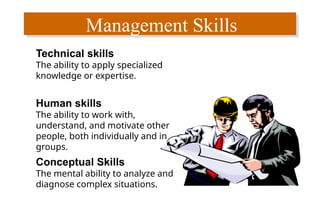
Management Skills
Technical skills
Theability to apply specialized
knowledge or expertise.
Human skills
The ability to work with,
understand, and motivate other
people, both individually and in
groups.
Conceptual Skills
The mental ability to analyze and
diagnose complex situations.
4.
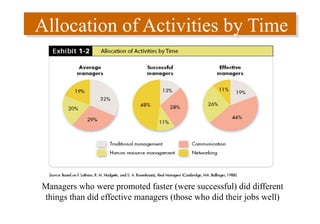
managerial activity andmanagerial
success(Luthans)
1. Traditional management
• Decision making, planning, and controlling
2. Communication
• Exchanging routine information and processing
paperwork
3. Human resource management
• Motivating, disciplining, managing conflict, staffing,
and training
4. Networking
• Socializing, politicking, and interacting with others
5.
Allocation of Activitiesby Time
Managers who were promoted faster (were successful) did different
things than did effective managers (those who did their jobs well)
6.
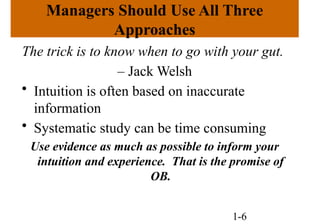
Managers Should UseAll Three
Approaches
The trick is to know when to go with your gut.
– Jack Welsh
• Intuition is often based on inaccurate
information
• Systematic study can be time consuming
Use evidence as much as possible to inform your
intuition and experience. That is the promise of
OB.
1-6
7.
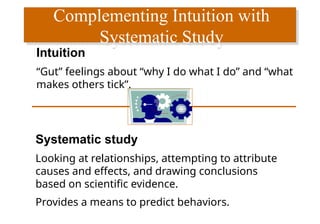
Complementing Intuition with
SystematicStudy
Systematic study
Looking at relationships, attempting to attribute
causes and effects, and drawing conclusions
based on scientific evidence.
Provides a means to predict behaviors.
Intuition
“Gut” feelings about “why I do what I do” and “what
makes others tick”.
8.
8
Now create thelink ….
A strategy is a comprehensive plan that
guides organizations to operate in ways that
allow them to outperform their competitors.
Key managerial responsibilities include
strategy formulation and implementation.
Knowledge of OB is essential to effectively
strategy implementation.
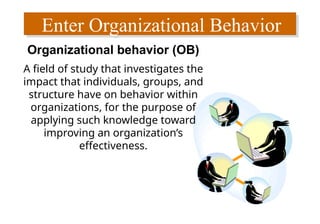
Enter Organizational Behavior
Organizationalbehavior (OB)
A field of study that investigates the
impact that individuals, groups, and
structure have on behavior within
organizations, for the purpose of
applying such knowledge toward
improving an organization’s
effectiveness.
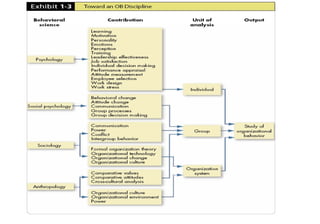
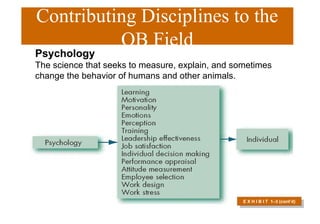
Contributing Disciplines tothe
OB Field
E X H I B I T 1–3 (cont’d)
Psychology
The science that seeks to measure, explain, and sometimes
change the behavior of humans and other animals.
14.
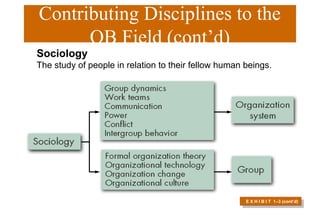
Contributing Disciplines tothe
OB Field (cont’d)
E X H I B I T 1–3 (cont’d)
Sociology
The study of people in relation to their fellow human beings.
15.
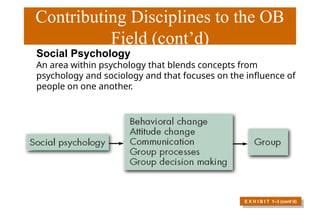
Contributing Disciplines tothe OB
Field (cont’d)
E X H I B I T 1–3 (cont’d)
Social Psychology
An area within psychology that blends concepts from
psychology and sociology and that focuses on the influence of
people on one another.
16.
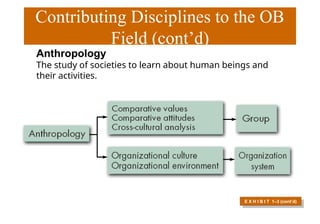
Contributing Disciplines tothe OB
Field (cont’d)
E X H I B I T 1–3 (cont’d)
Anthropology
The study of societies to learn about human beings and
their activities.
17.
SO WHAT ARETHE
CHALLENGES FOR OB….
There are challenges for every discipline…
18.
Challenges and Opportunitiesfor
OB
1. Responding to Globalization
2. Managing Workforce Diversity
3. Responding to Economic Pressures
Further more,
• Improving Quality and Productivity
• Improving Customer Service
• Improving People Skills
• Stimulating Innovation and Change
• Coping with “Temporariness”
• Working in Networked Organizations
• Helping Employees Balance Work-Life Conflicts
• Creating a Positive Work Environment
• Improving Ethical Behavior
1-18
19.
Challenges and Opportunitiesfor
OB
• Responding to Globalization
– Increased foreign assignments
– Working with people from different cultures
– Coping with anti-capitalism backlash
– Overseeing movement of jobs to countries with low-
cost labor
– Managing people during the war on terror.
20.
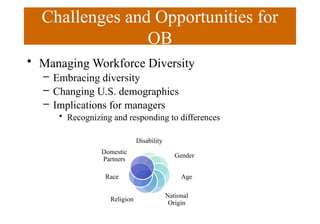
Challenges and Opportunitiesfor
OB
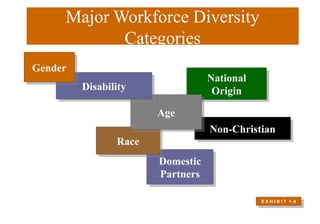
• Managing Workforce Diversity
– Embracing diversity
– Changing U.S. demographics
– Implications for managers
• Recognizing and responding to differences
Disability
Gender
Age
National
Origin
Religion
Race
Domestic
Partners
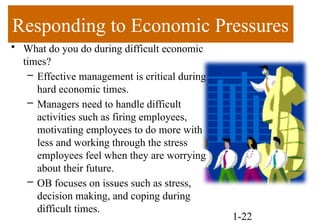
Responding to EconomicPressures
• What do you do during difficult economic
times?
– Effective management is critical during
hard economic times.
– Managers need to handle difficult
activities such as firing employees,
motivating employees to do more with
less and working through the stress
employees feel when they are worrying
about their future.
– OB focuses on issues such as stress,
decision making, and coping during
difficult times.
1-22
23.
Challenges and Opportunitiesfor
OB (cont’d)
• Improving Quality and Productivity
– Quality management (QM)(detail in coming slides)
– Process reengineering
• Responding to the Labor Shortage
– Changing work force demographics
– Fewer skilled laborers
– Early retirements and older workers
• Improving Customer Service
– Increased expectation of service quality
– Customer-responsive cultures
24.
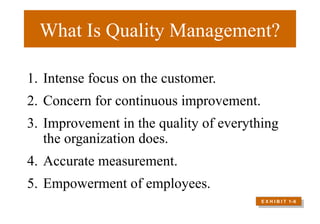
What Is QualityManagement?
1. Intense focus on the customer.
2. Concern for continuous improvement.
3. Improvement in the quality of everything
the organization does.
4. Accurate measurement.
5. Empowerment of employees.
E X H I B I T 1–6
25.
Challenges and Opportunityfor
OB (cont’d)
• Improving People Skills
• Empowering People
• Stimulating Innovation and Change
• Coping with “Temporariness”
• Working in Networked Organizations
• Helping Employees Balance Work/Life
Conflicts
• Improving Ethical Behavior
• Managing People during the War on
Terrorism
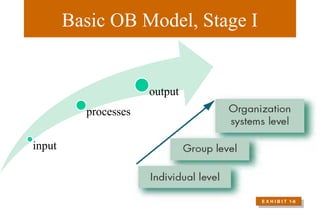
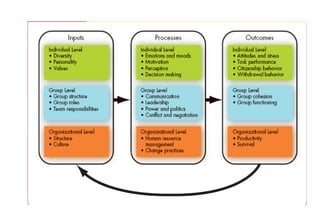
Basic OB Model,Stage I
E X H I B I T 1-6
input
processes
output
30.
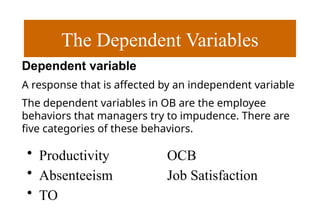
The Dependent Variables
•Productivity OCB
• Absenteeism Job Satisfaction
• TO
Dependent variable
A response that is affected by an independent variable
The dependent variables in OB are the employee
behaviors that managers try to impudence. There are
five categories of these behaviors.
31.
The Dependent Variables(cont’d)
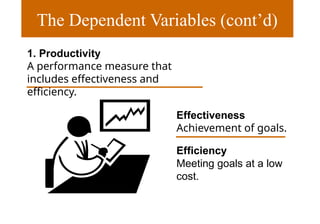
1. Productivity
A performance measure that
includes effectiveness and
efficiency.
Effectiveness
Achievement of goals.
Efficiency
Meeting goals at a low
cost.
32.
The Dependent Variables(cont’d)
2. Absenteeism
The failure to report to work.
Estimated annual cost—over $40 billion for U.S.
organizations; $12 billion for Canadian firms;
more than 60 billion Deutsch Marks (U.S. $35.5
billion) each year in Germany
A one-day absence by a clerical worker can cost
a U.S. employer up to $100 in reduced efficiency
and increased supervisory workload. 3. Turnover
The voluntary and
involuntary permanent
withdrawal from an
organization.
33.
The Dependent Variables(cont’d)
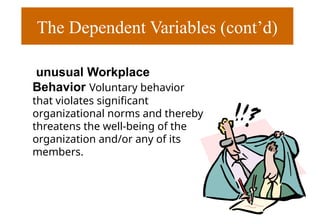
unusual Workplace
Behavior Voluntary behavior
that violates significant
organizational norms and thereby
threatens the well-being of the
organization and/or any of its
members.
34.
The Dependent Variables(cont’d)
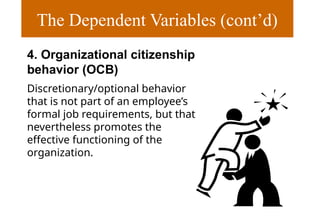
4. Organizational citizenship
behavior (OCB)
Discretionary/optional behavior
that is not part of an employee’s
formal job requirements, but that
nevertheless promotes the
effective functioning of the
organization.
35.
The Dependent Variables(cont’d)
5. Job satisfaction
A general attitude (not a behavior) toward one’s job;
a positive feeling of one's job resulting from an
evaluation of its characteristics.
36.
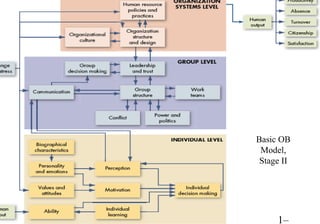
The Independent Variables
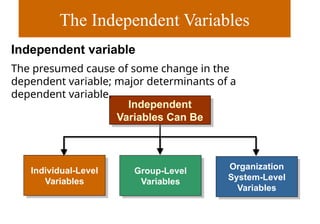
Independent
VariablesCan Be
Individual-Level
Variables
Organization
System-Level
Variables
Group-Level
Variables
Independent variable
The presumed cause of some change in the
dependent variable; major determinants of a
dependent variable.
37.
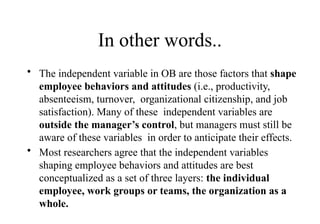
In other words..
•The independent variable in OB are those factors that shape
employee behaviors and attitudes (i.e., productivity,
absenteeism, turnover, organizational citizenship, and job
satisfaction). Many of these independent variables are
outside the manager’s control, but managers must still be
aware of these variables in order to anticipate their effects.
• Most researchers agree that the independent variables
shaping employee behaviors and attitudes are best
conceptualized as a set of three layers: the individual
employee, work groups or teams, the organization as a
whole.
Questions
• “Behavior isgenerally predictable, so there
is no need to formally study OB.” Why is
that statement wrong?
• What are the three levels of analysis in our
OB model? Are they related? If so, how?
#4 A group of researchers, led by Fred Luthans, researched the link between managerial activity and managerial success. They looked at four types of managerial activity. These activities included traditional management, which is made up of decision making, planning, and controlling; Communication consisting of the exchange of information; Human Resource Management that incorporates motivation, discipline, and training; and Networking which utilizes socializing and politicking.
#6 It is important that managers know how to balance the amount of information to gather, their past experiences, and their intuition in the decision-making process. There are negatives associated with all three approaches. It is the manager’s job to make the best decisions possible by accessing as much evidence as possible while remaining efficient.
#18 In the workplace today, there are many challenges and opportunities in the area of Organizational Behavior. Understanding OB has never been more important for managers as organizations are changing at a much more rapid pace than historically seen.
#19 In the workplace today, there are many challenges and opportunities in the area of Organizational Behavior. Understanding OB has never been more important for managers as organizations are changing at a much more rapid pace than historically seen.
#20 In the workplace today, there are many challenges and opportunities in the area of Organizational Behavior. Understanding OB has never been more important for managers as organizations are changing at a much more rapid pace than historically seen.
#22 During economic difficulties, the need for effective managers is heightened. Anyone can manage during good times; it is much tougher to manage through economic struggles. Often when there are economic pressures, managers are forced to make decisions based on resource constraints. These situations may include laying off employees, motivating employees when there are limited resources, and encouraging employees when they are stressed about their futures.



![Polymer [ बहुलक ] Chemistry Notes PDF - Irfanullah Mehar - JJ Sir Chemistry.pdf](https://cdn.slidesharecdn.com/ss_thumbnails/polymerchemistrynotespdf-irfanullahmehar-jjsirchemistry-260210172118-3f9b37f7-thumbnail.jpg?width=640&height=640&fit=bounds)


