Introduction to
Organizational Behavior
What Is Organizational Behavior?
BY: Muhammad Waqas Ashraf
waqasashraf348@gmail.com
03038874422
© 2009 Prentice-Hall Inc. All rights reserved. 1-0
Chapter Learning Objectives
• After studying this chapter you should be able
to:
– Demonstrate the importance of interpersonal
skills in the workplace.
– Describe the manager’s functions, roles, and skills.
– Define organizational behavior (OB).
– Identify the challenges and opportunities
managers have in applying OB concepts.
– Compare the three levels of analysis in this book’s
OB model.
© 2009 Prentice-Hall Inc. All rights reserved. 1-1
The Importance of Interpersonal Skills
• Understanding OB helps determine manager
effectiveness
– Technical and quantitative skills are important
– But leadership and communication skills are
CRITICAL
• Organizational benefits of skilled managers
– Lower turnover of quality employees
– Better financial performance
© 2009 Prentice-Hall Inc. All rights reserved. 1-2
What Managers Do
• They get things done through other people.
• Management Activities:
– Make decisions
– Allocate resources
– Direct activities of others to attain goals
• Work in an organization
– A consciously coordinated social unit composed of
two or more people that functions on a relatively
continuous basis to achieve a common goal or set of
goals.
© 2009 Prentice-Hall Inc. All rights reserved. 1-3
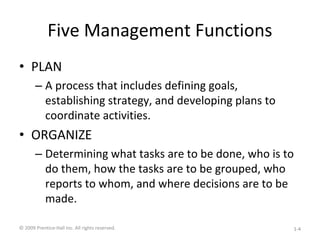
Five Management Functions
• PLAN
– A process that includes defining goals,
establishing strategy, and developing plans to
coordinate activities.
• ORGANIZE
– Determining what tasks are to be done, who is to
do them, how the tasks are to be grouped, who
reports to whom, and where decisions are to be
made.
© 2009 Prentice-Hall Inc. All rights reserved. 1-4
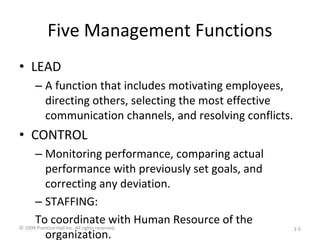
Five Management Functions
• LEAD
– A function that includes motivating employees,
directing others, selecting the most effective
communication channels, and resolving conflicts.
• CONTROL
– Monitoring performance, comparing actual
performance with previously set goals, and
correcting any deviation.
– STAFFING:
To coordinate with Human Resource of the
organization.
© 2009 Prentice-Hall Inc. All rights reserved. 1-5
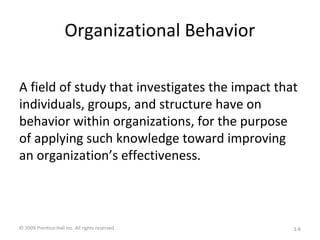
Organizational Behavior
A field of study that investigates the impact that
individuals, groups, and structure have on
behavior within organizations, for the purpose
of applying such knowledge toward improving
an organization’s effectiveness.
© 2009 Prentice-Hall Inc. All rights reserved. 1-6
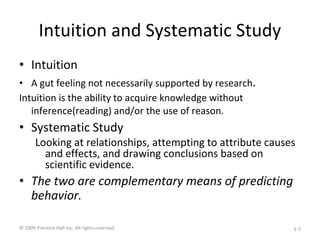
Intuition and Systematic Study
• Intuition
• A gut feeling not necessarily supported by research.
Intuition is the ability to acquire knowledge without
inference(reading) and/or the use of reason.
• Systematic Study
Looking at relationships, attempting to attribute causes
and effects, and drawing conclusions based on
scientific evidence.
• The two are complementary means of predicting
behavior.
© 2009 Prentice-Hall Inc. All rights reserved. 1-7
An Outgrowth of Systematic Study…
Evidence-Based Management (EBM)
– Basing managerial decisions on the best
available scientific evidence.
– Must think like scientists:
• Pose a managerial question
• Search for best available evidence
© 2009 Prentice-Hall Inc. All rights reserved. 1-8
Managers Should Use All Three
Approaches
The trick is to know when to go with your gut.
– Jack Welsh
• Intuition is often based on inaccurate information
• Systematic study can be time-consuming
Use evidence as much as possible to inform your
intuition and experience. That is the promise of
OB.
© 2009 Prentice-Hall Inc. All rights reserved. 1-9
Four Contributing Disciplines
• Psychology
The science that seeks to measure, explain, and
sometimes change the behavior of humans and
other animals.
– Unit of Analysis:
• Individual
– Contributions to OB:
• Learning, motivation, personality, emotions, perception
• Training, leadership effectiveness, job satisfaction
• Individual decision making, performance appraisal, attitude
measurement
• Employee selection, work design, and work stress
© 2009 Prentice-Hall Inc. All rights reserved. 1-10
Four Contributing Disciplines
• Social Psychology
An area within psychology that blends concepts
from psychology and sociology and that focuses
on the influence of people on one another.
– Unit of Analysis:
• Group
– Contributions to OB:
• Behavioral change
• Attitude change
• Communication
• Group decision making
© 2009 Prentice-Hall Inc. All rights reserved. 1-11
Four Contributing Disciplines
– Unit of Analysis:
– Organizational System
– Contributions to OB:
– Work teams
– Communication
– Power
– Conflict
– Intergroup behavior
– Group
– Formal organization theory
– Organizational technology
– Organizational change
– Organizational culture
• Sociology
The study of people in relation to their fellow
human beings.
© 2009 Prentice-Hall Inc. All rights reserved. 1-12
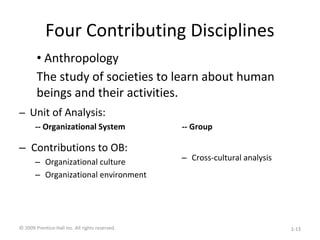
Four Contributing Disciplines
– Unit of Analysis:
-- Organizational System
– Contributions to OB:
– Organizational culture
– Organizational environment
-- Group
– Cross-cultural analysis
• Anthropology
The study of societies to learn about human
beings and their activities.
© 2009 Prentice-Hall Inc. All rights reserved. 1-13
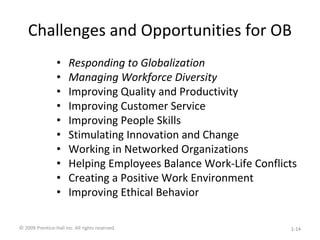
Challenges and Opportunities for OB
• Responding to Globalization
• Managing Workforce Diversity
• Improving Quality and Productivity
• Improving Customer Service
• Improving People Skills
• Stimulating Innovation and Change
• Working in Networked Organizations
• Helping Employees Balance Work-Life Conflicts
• Creating a Positive Work Environment
• Improving Ethical Behavior
© 2009 Prentice-Hall Inc. All rights reserved. 1-14
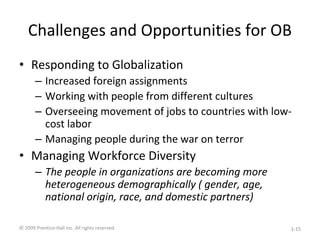
Challenges and Opportunities for OB
• Responding to Globalization
– Increased foreign assignments
– Working with people from different cultures
– Overseeing movement of jobs to countries with low-
cost labor
– Managing people during the war on terror
• Managing Workforce Diversity
– The people in organizations are becoming more
heterogeneous demographically ( gender, age,
national origin, race, and domestic partners)
© 2009 Prentice-Hall Inc. All rights reserved. 1-15
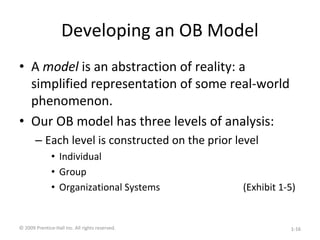
Developing an OB Model
• A model is an abstraction of reality: a
simplified representation of some real-world
phenomenon.
• Our OB model has three levels of analysis:
– Each level is constructed on the prior level
• Individual
• Group
• Organizational Systems (Exhibit 1-5)
© 2009 Prentice-Hall Inc. All rights reserved. 1-16
Types of Study Variables
Independent (X)
– The presumed cause of the
change in the dependent
variable (Y).
– This is the variable that OB
researchers manipulate to
observe the changes in Y.
Dependent (Y)
– This is the response to X (the
independent variable).
– It is what the OB researchers
want to predict or explain.
– The interesting variable!
X → Y → Predictive Ability
© 2009 Prentice-Hall Inc. All rights reserved. 1-17
Interesting OB Dependent Variables
• Productivity
– Transforming inputs to outputs at lowest cost. Includes the
concepts of effectiveness (achievement of goals) and efficiency
(meeting goals at a low cost).
• Absenteeism
– Failure to report to work – a huge cost to employers.
• Turnover
– Voluntary and involuntary permanent withdrawal from an
organization.
• Deviant Workplace Behavior
– Voluntary behavior that violates significant organizational
norms and thereby threatens the well-being of the organization
and/or any of its members.
© 2009 Prentice-Hall Inc. All rights reserved. 1-18
More Interesting OB Dependent
Variables
• Organizational Citizenship Behavior (OCB)
– Discretionary behavior that is not part of an
employee’s formal job requirements, but that
nevertheless promotes the effective functioning
of the organization.
• Job Satisfaction
– A general attitude (not a behavior) toward one’s
job; a positive feeling about one's job resulting
from an evaluation of its characteristics.
© 2009 Prentice-Hall Inc. All rights reserved. 1-19
The Independent Variables
The independent variable (X) can be at any of these three
levels in this model:
•Individual
– Biographical characteristics, personality and emotions, values
and attitudes, ability, perception, motivation, individual learning
and individual decision making.
•Group
– Communication, group decision making, leadership and trust,
group structure, conflict, power and politics, and work teams.
•Organization System
– Organizational culture, human resource policies and practices,
and organizational structure and design.
© 2009 Prentice-Hall Inc. All rights reserved. 1-20
Summary and Managerial Implications
• Managers need to develop their interpersonal
skills to be effective.
• OB focuses on how to improve factors that
make organizations more effective.
• The best predictions of behavior are made
from a combination of systematic study and
intuition.
• There are many OB challenges and
opportunities for managers today.
© 2009 Prentice-Hall Inc. All rights reserved. 1-21

Introduction to ob slides

  • 1.
    Introduction to Organizational Behavior WhatIs Organizational Behavior? BY: Muhammad Waqas Ashraf waqasashraf348@gmail.com 03038874422 © 2009 Prentice-Hall Inc. All rights reserved. 1-0
  • 2.
    Chapter Learning Objectives •After studying this chapter you should be able to: – Demonstrate the importance of interpersonal skills in the workplace. – Describe the manager’s functions, roles, and skills. – Define organizational behavior (OB). – Identify the challenges and opportunities managers have in applying OB concepts. – Compare the three levels of analysis in this book’s OB model. © 2009 Prentice-Hall Inc. All rights reserved. 1-1
  • 3.
    The Importance ofInterpersonal Skills • Understanding OB helps determine manager effectiveness – Technical and quantitative skills are important – But leadership and communication skills are CRITICAL • Organizational benefits of skilled managers – Lower turnover of quality employees – Better financial performance © 2009 Prentice-Hall Inc. All rights reserved. 1-2
  • 4.
    What Managers Do •They get things done through other people. • Management Activities: – Make decisions – Allocate resources – Direct activities of others to attain goals • Work in an organization – A consciously coordinated social unit composed of two or more people that functions on a relatively continuous basis to achieve a common goal or set of goals. © 2009 Prentice-Hall Inc. All rights reserved. 1-3
  • 5.
    Five Management Functions •PLAN – A process that includes defining goals, establishing strategy, and developing plans to coordinate activities. • ORGANIZE – Determining what tasks are to be done, who is to do them, how the tasks are to be grouped, who reports to whom, and where decisions are to be made. © 2009 Prentice-Hall Inc. All rights reserved. 1-4
  • 6.
    Five Management Functions •LEAD – A function that includes motivating employees, directing others, selecting the most effective communication channels, and resolving conflicts. • CONTROL – Monitoring performance, comparing actual performance with previously set goals, and correcting any deviation. – STAFFING: To coordinate with Human Resource of the organization. © 2009 Prentice-Hall Inc. All rights reserved. 1-5
  • 7.
    Organizational Behavior A fieldof study that investigates the impact that individuals, groups, and structure have on behavior within organizations, for the purpose of applying such knowledge toward improving an organization’s effectiveness. © 2009 Prentice-Hall Inc. All rights reserved. 1-6
  • 8.
    Intuition and SystematicStudy • Intuition • A gut feeling not necessarily supported by research. Intuition is the ability to acquire knowledge without inference(reading) and/or the use of reason. • Systematic Study Looking at relationships, attempting to attribute causes and effects, and drawing conclusions based on scientific evidence. • The two are complementary means of predicting behavior. © 2009 Prentice-Hall Inc. All rights reserved. 1-7
  • 9.
    An Outgrowth ofSystematic Study… Evidence-Based Management (EBM) – Basing managerial decisions on the best available scientific evidence. – Must think like scientists: • Pose a managerial question • Search for best available evidence © 2009 Prentice-Hall Inc. All rights reserved. 1-8
  • 10.
    Managers Should UseAll Three Approaches The trick is to know when to go with your gut. – Jack Welsh • Intuition is often based on inaccurate information • Systematic study can be time-consuming Use evidence as much as possible to inform your intuition and experience. That is the promise of OB. © 2009 Prentice-Hall Inc. All rights reserved. 1-9
  • 11.
    Four Contributing Disciplines •Psychology The science that seeks to measure, explain, and sometimes change the behavior of humans and other animals. – Unit of Analysis: • Individual – Contributions to OB: • Learning, motivation, personality, emotions, perception • Training, leadership effectiveness, job satisfaction • Individual decision making, performance appraisal, attitude measurement • Employee selection, work design, and work stress © 2009 Prentice-Hall Inc. All rights reserved. 1-10
  • 12.
    Four Contributing Disciplines •Social Psychology An area within psychology that blends concepts from psychology and sociology and that focuses on the influence of people on one another. – Unit of Analysis: • Group – Contributions to OB: • Behavioral change • Attitude change • Communication • Group decision making © 2009 Prentice-Hall Inc. All rights reserved. 1-11
  • 13.
    Four Contributing Disciplines –Unit of Analysis: – Organizational System – Contributions to OB: – Work teams – Communication – Power – Conflict – Intergroup behavior – Group – Formal organization theory – Organizational technology – Organizational change – Organizational culture • Sociology The study of people in relation to their fellow human beings. © 2009 Prentice-Hall Inc. All rights reserved. 1-12
  • 14.
    Four Contributing Disciplines –Unit of Analysis: -- Organizational System – Contributions to OB: – Organizational culture – Organizational environment -- Group – Cross-cultural analysis • Anthropology The study of societies to learn about human beings and their activities. © 2009 Prentice-Hall Inc. All rights reserved. 1-13
  • 15.
    Challenges and Opportunitiesfor OB • Responding to Globalization • Managing Workforce Diversity • Improving Quality and Productivity • Improving Customer Service • Improving People Skills • Stimulating Innovation and Change • Working in Networked Organizations • Helping Employees Balance Work-Life Conflicts • Creating a Positive Work Environment • Improving Ethical Behavior © 2009 Prentice-Hall Inc. All rights reserved. 1-14
  • 16.
    Challenges and Opportunitiesfor OB • Responding to Globalization – Increased foreign assignments – Working with people from different cultures – Overseeing movement of jobs to countries with low- cost labor – Managing people during the war on terror • Managing Workforce Diversity – The people in organizations are becoming more heterogeneous demographically ( gender, age, national origin, race, and domestic partners) © 2009 Prentice-Hall Inc. All rights reserved. 1-15
  • 17.
    Developing an OBModel • A model is an abstraction of reality: a simplified representation of some real-world phenomenon. • Our OB model has three levels of analysis: – Each level is constructed on the prior level • Individual • Group • Organizational Systems (Exhibit 1-5) © 2009 Prentice-Hall Inc. All rights reserved. 1-16
  • 18.
    Types of StudyVariables Independent (X) – The presumed cause of the change in the dependent variable (Y). – This is the variable that OB researchers manipulate to observe the changes in Y. Dependent (Y) – This is the response to X (the independent variable). – It is what the OB researchers want to predict or explain. – The interesting variable! X → Y → Predictive Ability © 2009 Prentice-Hall Inc. All rights reserved. 1-17
  • 19.
    Interesting OB DependentVariables • Productivity – Transforming inputs to outputs at lowest cost. Includes the concepts of effectiveness (achievement of goals) and efficiency (meeting goals at a low cost). • Absenteeism – Failure to report to work – a huge cost to employers. • Turnover – Voluntary and involuntary permanent withdrawal from an organization. • Deviant Workplace Behavior – Voluntary behavior that violates significant organizational norms and thereby threatens the well-being of the organization and/or any of its members. © 2009 Prentice-Hall Inc. All rights reserved. 1-18
  • 20.
    More Interesting OBDependent Variables • Organizational Citizenship Behavior (OCB) – Discretionary behavior that is not part of an employee’s formal job requirements, but that nevertheless promotes the effective functioning of the organization. • Job Satisfaction – A general attitude (not a behavior) toward one’s job; a positive feeling about one's job resulting from an evaluation of its characteristics. © 2009 Prentice-Hall Inc. All rights reserved. 1-19
  • 21.
    The Independent Variables Theindependent variable (X) can be at any of these three levels in this model: •Individual – Biographical characteristics, personality and emotions, values and attitudes, ability, perception, motivation, individual learning and individual decision making. •Group – Communication, group decision making, leadership and trust, group structure, conflict, power and politics, and work teams. •Organization System – Organizational culture, human resource policies and practices, and organizational structure and design. © 2009 Prentice-Hall Inc. All rights reserved. 1-20
  • 22.
    Summary and ManagerialImplications • Managers need to develop their interpersonal skills to be effective. • OB focuses on how to improve factors that make organizations more effective. • The best predictions of behavior are made from a combination of systematic study and intuition. • There are many OB challenges and opportunities for managers today. © 2009 Prentice-Hall Inc. All rights reserved. 1-21