Introduction to
Operations Research
Prepared by:
Jessica E. Laran
Hello!
I am Jess 
2
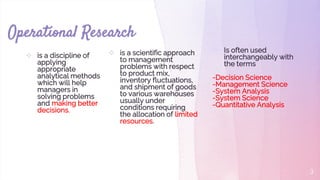
Operational Research
 is a discipline of
applying
appropriate
analytical methods
which will help
managers in
solving problems
and making better
decisions.
 is a scientific approach
to management
problems with respect
to product mix,
inventory fluctuations,
and shipment of goods
to various warehouses
usually under
conditions requiring
the allocation of limited
resources.
 Is often used
interchangeably with
the terms
-Decision Science
-Management Science
-System Analysis
-System Science
-Quantitative Analysis
3
“ The science of better
4
Historical
Background
OPERATIONS RESEARCH
5
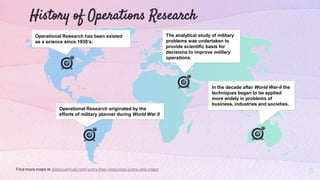
History of Operations Research
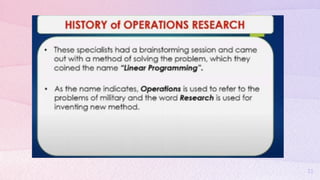
Operational Research originated by the
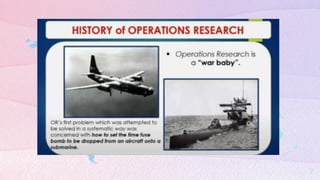
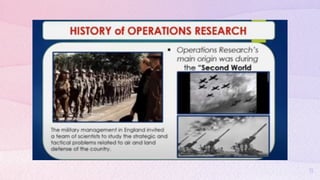
efforts of military planner during World War II
6
Find more maps at slidescarnival.com/extra-free-resources-icons-and-maps
The analytical study of military
problems was undertaken to
provide scientific basis for
decisions to improve military
operations.
In the decade after World War-II the
techniques began to be applied
more widely in problems of
business, industries and societies.
Operational Research has been existed
as a science since 1930‘s.
7
8
9
10
11
Scope of
OPERATIONS RESEARCH
12
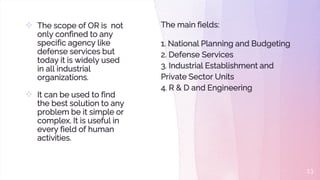
 The scope of OR is not
only confined to any
specific agency like
defense services but
today it is widely used
in all industrial
organizations.
 It can be used to find
the best solution to any
problem be it simple or
complex. It is useful in
every field of human
activities.
13
The main fields:
1. National Planning and Budgeting
2. Defense Services
3. Industrial Establishment and
Private Sector Units
4. R & D and Engineering
Features of
OPERATIONS RESEARCH
14
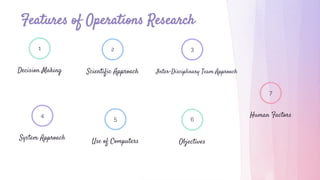
Features of Operations Research
1
Decision Making Scientific Approach
2
Inter-Disciplinary Team Approach
3
Human Factors
7
6
Objectives
Use of Computers
5
System Approach
4
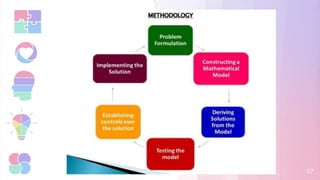
Methodology of
OPERATIONS RESEARCH
16
17
Phases of
OPERATIONS RESEARCH
18
Judgment
Phase
Determination of
the problem
Establishment of
the objectives
and values
Determination of
suitable
measures of
effectiveness
19
1
Observation and data
collection
Formulation of
hypothesis and models
Observation and
experimentation to test
the hypothesis
Prediction of various
results, generalizations,
consideration of
alternative method
20
2
Research
Phase
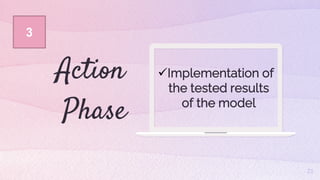
Implementation of
the tested results
of the model
21
3
Action
Phase
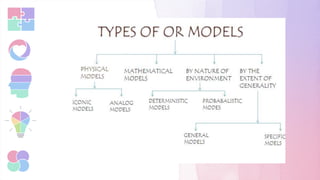
Types of
OPERATIONS RESEARCH
MODEL
22
Technique & Tools
OPERATIONS RESEARCH
24
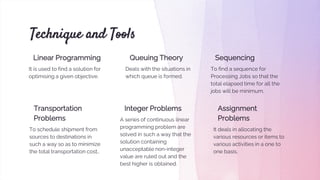
Technique and Tools
Linear Programming
It is used to find a solution for
optimising a given objective.
Queuing Theory
Deals with the situations in
which queue is formed.
Sequencing
To find a sequence for
Processing Jobs so that the
total elapsed time for all the
jobs will be minimum.
Transportation
Problems
To schedule shipment from
sources to destinations in
such a way so as to minimize
the total transportation cost..
Integer Problems
A series of continuous linear
programming problem are
solved in such a way that the
solution containing
unacceptable non-integer
value are ruled out and the
best higher is obtained.
Assignment
Problems
It deals in allocating the
various resources or items to
various activities in a one to
one basis.
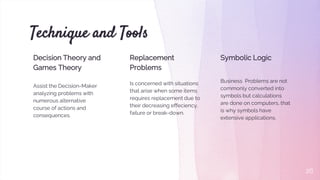
Technique and Tools
Decision Theory and
Games Theory
Assist the Decision-Maker
analyzing problems with
numerous alternative
course of actions and
consequences.
Replacement
Problems
Is concerned with situations
that arise when some items
requires replacement due to
their decreasing effeciency,
failure or break-down.
Symbolic Logic
Business Problems are not
commonly converted into
symbols but calculations
are done on computers, that
is why symbols have
extensive applications.
26
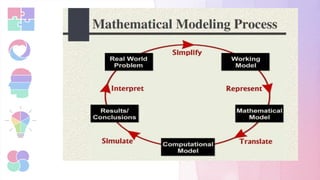
Structure of
Mathematical Model
27
Advantages/Limitations
Operations Research
29
30
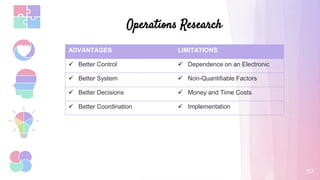
ADVANTAGES LIMITATIONS
 Better Control  Dependence on an Electronic
 Better System  Non-Quantifiable Factors
 Better Decisions  Money and Time Costs
 Better Coordination  Implementation
Operations Research
“If you don't actively attack the risks,
they will actively attack you.
- Tom Gilb
31
Thank You!
32

Introduction to operations research

  • 1.
  • 2.
  • 3.
    Operational Research  isa discipline of applying appropriate analytical methods which will help managers in solving problems and making better decisions.  is a scientific approach to management problems with respect to product mix, inventory fluctuations, and shipment of goods to various warehouses usually under conditions requiring the allocation of limited resources.  Is often used interchangeably with the terms -Decision Science -Management Science -System Analysis -System Science -Quantitative Analysis 3
  • 4.
    “ The scienceof better 4
  • 5.
  • 6.
    History of OperationsResearch Operational Research originated by the efforts of military planner during World War II 6 Find more maps at slidescarnival.com/extra-free-resources-icons-and-maps The analytical study of military problems was undertaken to provide scientific basis for decisions to improve military operations. In the decade after World War-II the techniques began to be applied more widely in problems of business, industries and societies. Operational Research has been existed as a science since 1930‘s.
  • 7.
  • 8.
  • 9.
  • 10.
  • 11.
  • 12.
  • 13.
     The scopeof OR is not only confined to any specific agency like defense services but today it is widely used in all industrial organizations.  It can be used to find the best solution to any problem be it simple or complex. It is useful in every field of human activities. 13 The main fields: 1. National Planning and Budgeting 2. Defense Services 3. Industrial Establishment and Private Sector Units 4. R & D and Engineering
  • 14.
  • 15.
    Features of OperationsResearch 1 Decision Making Scientific Approach 2 Inter-Disciplinary Team Approach 3 Human Factors 7 6 Objectives Use of Computers 5 System Approach 4
  • 16.
  • 17.
  • 18.
  • 19.
    Judgment Phase Determination of the problem Establishmentof the objectives and values Determination of suitable measures of effectiveness 19 1
  • 20.
    Observation and data collection Formulationof hypothesis and models Observation and experimentation to test the hypothesis Prediction of various results, generalizations, consideration of alternative method 20 2 Research Phase
  • 21.
    Implementation of the testedresults of the model 21 3 Action Phase
  • 22.
  • 24.
  • 25.
    Technique and Tools LinearProgramming It is used to find a solution for optimising a given objective. Queuing Theory Deals with the situations in which queue is formed. Sequencing To find a sequence for Processing Jobs so that the total elapsed time for all the jobs will be minimum. Transportation Problems To schedule shipment from sources to destinations in such a way so as to minimize the total transportation cost.. Integer Problems A series of continuous linear programming problem are solved in such a way that the solution containing unacceptable non-integer value are ruled out and the best higher is obtained. Assignment Problems It deals in allocating the various resources or items to various activities in a one to one basis.
  • 26.
    Technique and Tools DecisionTheory and Games Theory Assist the Decision-Maker analyzing problems with numerous alternative course of actions and consequences. Replacement Problems Is concerned with situations that arise when some items requires replacement due to their decreasing effeciency, failure or break-down. Symbolic Logic Business Problems are not commonly converted into symbols but calculations are done on computers, that is why symbols have extensive applications. 26
  • 27.
  • 29.
  • 30.
    30 ADVANTAGES LIMITATIONS  BetterControl  Dependence on an Electronic  Better System  Non-Quantifiable Factors  Better Decisions  Money and Time Costs  Better Coordination  Implementation Operations Research
  • 31.
    “If you don'tactively attack the risks, they will actively attack you. - Tom Gilb 31
  • 32.

Editor's Notes

  • #5 Better decisions, better control, better coordination, better systems