Robbins & Judge
Organizational Behavior
13th Edition
Chapter 1: What Is Organizational
Behavior?
Student Study Slideshow
Bob Stretch
Southwestern College
© 2009 Prentice-Hall Inc. All rights reserved. 1-1
Chapter Learning Objectives
• After studying this chapter you should be able to:
– Demonstrate the importance of interpersonal skills in
the workplace.
– Describe the manager’s functions, roles, and skills.
– Define organizational behavior (OB).
– Show the value to OB of systematic study.
– Identify the major behavioral science disciplines that
contribute to OB.
– Identify the challenges and opportunities managers
have in applying OB concepts.
© 2009 Prentice-Hall Inc. All rights reserved. 1-2
© 2009 Prentice-Hall Inc. All rights reserved. 1-3
• Behaviour is the way in which one acts or
conducts oneself, especially towards others.
• the way in which a person behaves in
response to a particular situation.
© 2009 Prentice-Hall Inc. All rights reserved. 1-4
The Importance of Interpersonal Skills
• Understanding OB helps determine manager
effectiveness
– Technical and quantitative skills important
– But leadership and communication skills are
CRITICAL
• Organizational benefits of skilled managers
– Lower turnover of quality employees
– Apply Higher quality for recruitment
– Better financial performance
© 2009 Prentice-Hall Inc. All rights reserved. 1-5
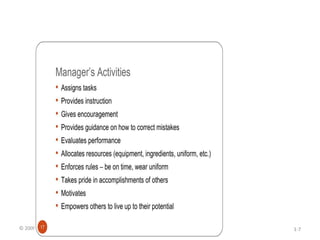
What Managers Do
• They get things done through other people.
• Management Activities:
– Make decisions
– Allocate resources
– Direct activities of others to attain goals
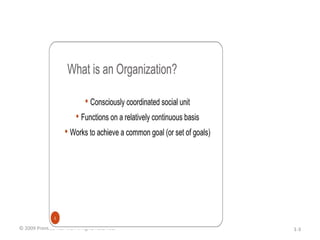
• Work in an organization
– A consciously coordinated social unit composed of
two or more people that functions on a relatively
continuous basis to achieve a common goal or set of
goals.
© 2009 Prentice-Hall Inc. All rights reserved. 1-6
© 2009 Prentice-Hall Inc. All rights reserved. 1-7
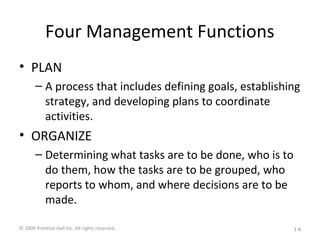
Four Management Functions
• PLAN
– A process that includes defining goals, establishing
strategy, and developing plans to coordinate
activities.
• ORGANIZE
– Determining what tasks are to be done, who is to
do them, how the tasks are to be grouped, who
reports to whom, and where decisions are to be
made.
© 2009 Prentice-Hall Inc. All rights reserved. 1-8
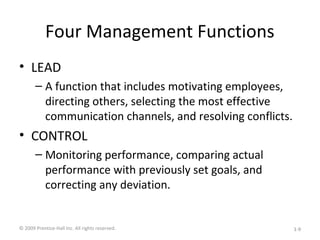
Four Management Functions
• LEAD
– A function that includes motivating employees,
directing others, selecting the most effective
communication channels, and resolving conflicts.
• CONTROL
– Monitoring performance, comparing actual
performance with previously set goals, and
correcting any deviation.
© 2009 Prentice-Hall Inc. All rights reserved. 1-9
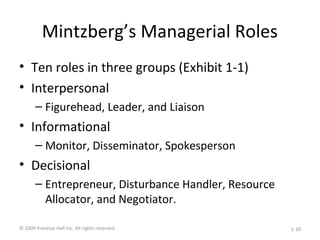
Mintzberg’s Managerial Roles
• Ten roles in three groups (Exhibit 1-1)
• Interpersonal
– Figurehead, Leader, and Liaison
• Informational
– Monitor, Disseminator, Spokesperson
• Decisional
– Entrepreneur, Disturbance Handler, Resource
Allocator, and Negotiator.
© 2009 Prentice-Hall Inc. All rights reserved. 1-10
© 2009 Prentice-Hall Inc. All rights reserved. 1-11
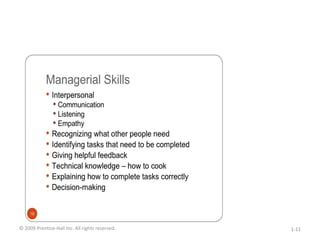
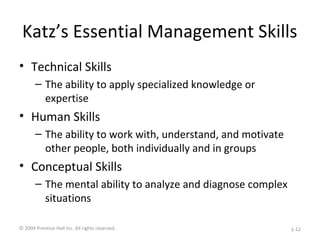
Katz’s Essential Management Skills
• Technical Skills
– The ability to apply specialized knowledge or
expertise
• Human Skills
– The ability to work with, understand, and motivate
other people, both individually and in groups
• Conceptual Skills
– The mental ability to analyze and diagnose complex
situations
© 2009 Prentice-Hall Inc. All rights reserved. 1-12
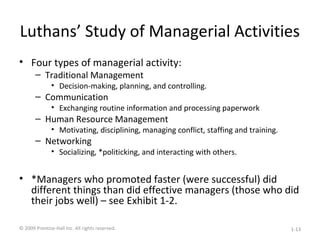
Luthans’ Study of Managerial Activities
• Four types of managerial activity:
– Traditional Management
• Decision-making, planning, and controlling.
– Communication
• Exchanging routine information and processing paperwork
– Human Resource Management
• Motivating, disciplining, managing conflict, staffing and training.
– Networking
• Socializing, *politicking, and interacting with others.
• *Managers who promoted faster (were successful) did
different things than did effective managers (those who did
their jobs well) – see Exhibit 1-2.
© 2009 Prentice-Hall Inc. All rights reserved. 1-13
Organizational Behavior
A field of study that investigates the impact that
individuals, groups, and structure have on
behavior within organizations, for the purpose
of applying such knowledge toward improving
an organization’s effectiveness.
© 2009 Prentice-Hall Inc. All rights reserved. 1-14
*Intuition and Systematic Study
• Intuition
– Gut feelings
– Individual observation
– Common sense
• Systematic Study
– Looks at relationships
– Scientific evidence
– Predicts behaviors
• The two are complementary means of predicting
behavior.
© 2009 Prentice-Hall Inc. All rights reserved. 1-15
Evidence-Based Management (EBM)
– Basing managerial decisions on the best
available scientific evidence.
– Must think like scientists:
• Pose a managerial question
• Search for best available evidence
• Apply relevant information to case
© 2009 Prentice-Hall Inc. All rights reserved. 1-16
Managers Should Use All Three
Approaches
• Intuition is often based on inaccurate information
• Faddism is prevalent in management
• Systematic study can be time-consuming
Use evidence as much as possible to inform your
intuition and experience. That is the promise of
OB.
© 2009 Prentice-Hall Inc. All rights reserved. 1-17
Four Contributing Disciplines
• Psychology
The science that seeks to measure, explain, and
sometimes change the behavior of humans and
other animals.
– Unit of Analysis:
• Individual
– Contributions to OB:
• Learning, motivation, personality, emotions, perception
• Training, leadership effectiveness, job satisfaction
• Individual decision making, performance appraisal, attitude
measurement
• Employee selection, work design, and work stress
© 2009 Prentice-Hall Inc. All rights reserved. 1-18
Four Contributing Disciplines
• Social Psychology
An area within psychology that blends concepts
from psychology and sociology and that focuses
on the influence of people on one another.
– Unit of Analysis:
• Group
– Contributions to OB:
• Behavioral change
• Attitude change
• Communication
• Group processes
• Group decision making
© 2009 Prentice-Hall Inc. All rights reserved. 1-19
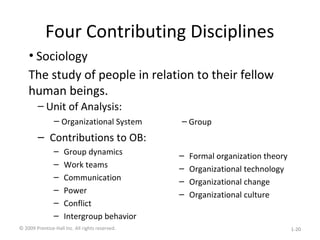
Four Contributing Disciplines
– Unit of Analysis:
– Organizational System
– Contributions to OB:
– Group dynamics
– Work teams
– Communication
– Power
– Conflict
– Intergroup behavior
– Group
– Formal organization theory
– Organizational technology
– Organizational change
– Organizational culture
• Sociology
The study of people in relation to their fellow
human beings.
© 2009 Prentice-Hall Inc. All rights reserved. 1-20
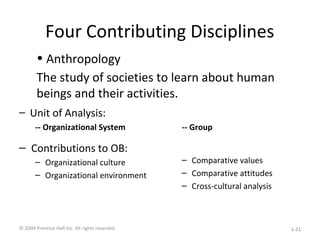
Four Contributing Disciplines
– Unit of Analysis:
-- Organizational System
– Contributions to OB:
– Organizational culture
– Organizational environment
-- Group
– Comparative values
– Comparative attitudes
– Cross-cultural analysis
• Anthropology
The study of societies to learn about human
beings and their activities.
© 2009 Prentice-Hall Inc. All rights reserved. 1-21
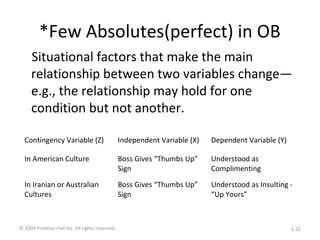
*Few Absolutes(perfect) in OB
Situational factors that make the main
relationship between two variables change—
e.g., the relationship may hold for one
condition but not another.
Contingency Variable (Z) Independent Variable (X) Dependent Variable (Y)
In American Culture Boss Gives “Thumbs Up”
Sign
Understood as
Complimenting
In Iranian or Australian
Cultures
Boss Gives “Thumbs Up”
Sign
Understood as Insulting -
“Up Yours”
© 2009 Prentice-Hall Inc. All rights reserved. 1-22
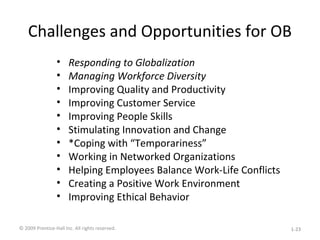
Challenges and Opportunities for OB
• Responding to Globalization
• Managing Workforce Diversity
• Improving Quality and Productivity
• Improving Customer Service
• Improving People Skills
• Stimulating Innovation and Change
• *Coping with “Temporariness”
• Working in Networked Organizations
• Helping Employees Balance Work-Life Conflicts
• Creating a Positive Work Environment
• Improving Ethical Behavior
© 2009 Prentice-Hall Inc. All rights reserved. 1-23
Challenges and Opportunities for OB
• Responding to Globalization
– Increased foreign assignments
– Working with people from different cultures
– Overseeing movement of jobs to countries with low-cost labor
– Managing people during the war on terror
• Managing Workforce Diversity
– The people in organizations are becoming more heterogeneous
demographically (disability, gender, age, national origin, non-
Christian, race, and domestic partners) Exhibit 1-4
– Embracing diversity
– Recognizing and responding to differences
© 2009 Prentice-Hall Inc. All rights reserved. 1-24
Developing an OB Model
• A model is an abstraction of reality: a
simplified representation of some real-world
phenomenon.
• Our OB model has three levels of analysis:
– Each level is constructed on the prior level
• Individual
• Group
• Organizational Systems (Exhibit 1-5)
© 2009 Prentice-Hall Inc. All rights reserved. 1-25
Types of Study Variables
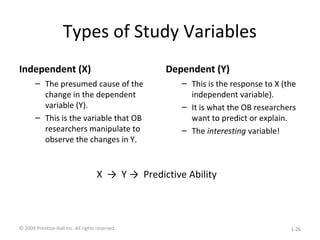
Independent (X)
– The presumed cause of the
change in the dependent
variable (Y).
– This is the variable that OB
researchers manipulate to
observe the changes in Y.
Dependent (Y)
– This is the response to X (the
independent variable).
– It is what the OB researchers
want to predict or explain.
– The interesting variable!
X → Y → Predictive Ability
© 2009 Prentice-Hall Inc. All rights reserved. 1-26
Interesting OB Dependent Variables
• Productivity
– Transforming inputs to outputs at lowest cost. Includes the
concepts of effectiveness (achievement of goals) and efficiency
(meeting goals at a low cost).
• Absenteeism
– Failure to report to work – a huge cost to employers.
• Turnover
– Voluntary and involuntary permanent withdrawal from an
organization.
• Deviant Workplace Behavior
– Voluntary behavior that violates significant organizational
norms and thereby threatens the well-being of the organization
and/or any of its members.
© 2009 Prentice-Hall Inc. All rights reserved. 1-27
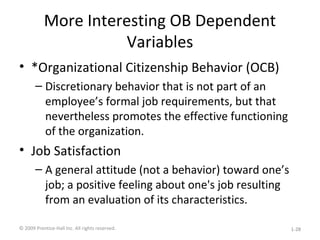
More Interesting OB Dependent
Variables
• *Organizational Citizenship Behavior (OCB)
– Discretionary behavior that is not part of an
employee’s formal job requirements, but that
nevertheless promotes the effective functioning
of the organization.
• Job Satisfaction
– A general attitude (not a behavior) toward one’s
job; a positive feeling about one's job resulting
from an evaluation of its characteristics.
© 2009 Prentice-Hall Inc. All rights reserved. 1-28
The Independent Variables
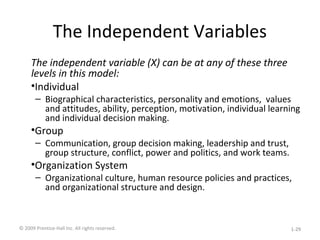
The independent variable (X) can be at any of these three
levels in this model:
•Individual
– Biographical characteristics, personality and emotions, values
and attitudes, ability, perception, motivation, individual learning
and individual decision making.
•Group
– Communication, group decision making, leadership and trust,
group structure, conflict, power and politics, and work teams.
•Organization System
– Organizational culture, human resource policies and practices,
and organizational structure and design.
© 2009 Prentice-Hall Inc. All rights reserved. 1-29
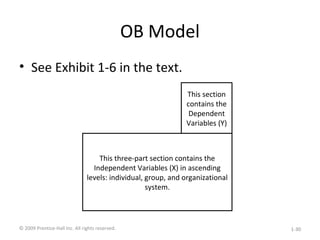
OB Model
• See Exhibit 1-6 in the text.
This three-part section contains the
Independent Variables (X) in ascending
levels: individual, group, and organizational
system.
This section
contains the
Dependent
Variables (Y)
© 2009 Prentice-Hall Inc. All rights reserved. 1-30
Summary and Managerial Implications
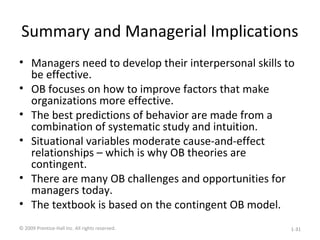
• Managers need to develop their interpersonal skills to
be effective.
• OB focuses on how to improve factors that make
organizations more effective.
• The best predictions of behavior are made from a
combination of systematic study and intuition.
• Situational variables moderate cause-and-effect
relationships – which is why OB theories are
contingent.
• There are many OB challenges and opportunities for
managers today.
• The textbook is based on the contingent OB model.
© 2009 Prentice-Hall Inc. All rights reserved. 1-31
All rights reserved. No part of this publication may be
reproduced, stored in a retrieval system, or transmitted, in
any form or by any means, electronic, mechanical,
photocopying, recording, or otherwise, without the prior
written permission of the publisher. Printed in the United
States of America.
Copyright ©2009 Pearson Education,
Inc. Publishing as Prentice Hall

Organizational Behavior Lectures

  • 1.
    Robbins & Judge OrganizationalBehavior 13th Edition Chapter 1: What Is Organizational Behavior? Student Study Slideshow Bob Stretch Southwestern College © 2009 Prentice-Hall Inc. All rights reserved. 1-1
  • 2.
    Chapter Learning Objectives •After studying this chapter you should be able to: – Demonstrate the importance of interpersonal skills in the workplace. – Describe the manager’s functions, roles, and skills. – Define organizational behavior (OB). – Show the value to OB of systematic study. – Identify the major behavioral science disciplines that contribute to OB. – Identify the challenges and opportunities managers have in applying OB concepts. © 2009 Prentice-Hall Inc. All rights reserved. 1-2
  • 3.
    © 2009 Prentice-HallInc. All rights reserved. 1-3
  • 4.
    • Behaviour isthe way in which one acts or conducts oneself, especially towards others. • the way in which a person behaves in response to a particular situation. © 2009 Prentice-Hall Inc. All rights reserved. 1-4
  • 5.
    The Importance ofInterpersonal Skills • Understanding OB helps determine manager effectiveness – Technical and quantitative skills important – But leadership and communication skills are CRITICAL • Organizational benefits of skilled managers – Lower turnover of quality employees – Apply Higher quality for recruitment – Better financial performance © 2009 Prentice-Hall Inc. All rights reserved. 1-5
  • 6.
    What Managers Do •They get things done through other people. • Management Activities: – Make decisions – Allocate resources – Direct activities of others to attain goals • Work in an organization – A consciously coordinated social unit composed of two or more people that functions on a relatively continuous basis to achieve a common goal or set of goals. © 2009 Prentice-Hall Inc. All rights reserved. 1-6
  • 7.
    © 2009 Prentice-HallInc. All rights reserved. 1-7
  • 8.
    Four Management Functions •PLAN – A process that includes defining goals, establishing strategy, and developing plans to coordinate activities. • ORGANIZE – Determining what tasks are to be done, who is to do them, how the tasks are to be grouped, who reports to whom, and where decisions are to be made. © 2009 Prentice-Hall Inc. All rights reserved. 1-8
  • 9.
    Four Management Functions •LEAD – A function that includes motivating employees, directing others, selecting the most effective communication channels, and resolving conflicts. • CONTROL – Monitoring performance, comparing actual performance with previously set goals, and correcting any deviation. © 2009 Prentice-Hall Inc. All rights reserved. 1-9
  • 10.
    Mintzberg’s Managerial Roles •Ten roles in three groups (Exhibit 1-1) • Interpersonal – Figurehead, Leader, and Liaison • Informational – Monitor, Disseminator, Spokesperson • Decisional – Entrepreneur, Disturbance Handler, Resource Allocator, and Negotiator. © 2009 Prentice-Hall Inc. All rights reserved. 1-10
  • 11.
    © 2009 Prentice-HallInc. All rights reserved. 1-11
  • 12.
    Katz’s Essential ManagementSkills • Technical Skills – The ability to apply specialized knowledge or expertise • Human Skills – The ability to work with, understand, and motivate other people, both individually and in groups • Conceptual Skills – The mental ability to analyze and diagnose complex situations © 2009 Prentice-Hall Inc. All rights reserved. 1-12
  • 13.
    Luthans’ Study ofManagerial Activities • Four types of managerial activity: – Traditional Management • Decision-making, planning, and controlling. – Communication • Exchanging routine information and processing paperwork – Human Resource Management • Motivating, disciplining, managing conflict, staffing and training. – Networking • Socializing, *politicking, and interacting with others. • *Managers who promoted faster (were successful) did different things than did effective managers (those who did their jobs well) – see Exhibit 1-2. © 2009 Prentice-Hall Inc. All rights reserved. 1-13
  • 14.
    Organizational Behavior A fieldof study that investigates the impact that individuals, groups, and structure have on behavior within organizations, for the purpose of applying such knowledge toward improving an organization’s effectiveness. © 2009 Prentice-Hall Inc. All rights reserved. 1-14
  • 15.
    *Intuition and SystematicStudy • Intuition – Gut feelings – Individual observation – Common sense • Systematic Study – Looks at relationships – Scientific evidence – Predicts behaviors • The two are complementary means of predicting behavior. © 2009 Prentice-Hall Inc. All rights reserved. 1-15
  • 16.
    Evidence-Based Management (EBM) –Basing managerial decisions on the best available scientific evidence. – Must think like scientists: • Pose a managerial question • Search for best available evidence • Apply relevant information to case © 2009 Prentice-Hall Inc. All rights reserved. 1-16
  • 17.
    Managers Should UseAll Three Approaches • Intuition is often based on inaccurate information • Faddism is prevalent in management • Systematic study can be time-consuming Use evidence as much as possible to inform your intuition and experience. That is the promise of OB. © 2009 Prentice-Hall Inc. All rights reserved. 1-17
  • 18.
    Four Contributing Disciplines •Psychology The science that seeks to measure, explain, and sometimes change the behavior of humans and other animals. – Unit of Analysis: • Individual – Contributions to OB: • Learning, motivation, personality, emotions, perception • Training, leadership effectiveness, job satisfaction • Individual decision making, performance appraisal, attitude measurement • Employee selection, work design, and work stress © 2009 Prentice-Hall Inc. All rights reserved. 1-18
  • 19.
    Four Contributing Disciplines •Social Psychology An area within psychology that blends concepts from psychology and sociology and that focuses on the influence of people on one another. – Unit of Analysis: • Group – Contributions to OB: • Behavioral change • Attitude change • Communication • Group processes • Group decision making © 2009 Prentice-Hall Inc. All rights reserved. 1-19
  • 20.
    Four Contributing Disciplines –Unit of Analysis: – Organizational System – Contributions to OB: – Group dynamics – Work teams – Communication – Power – Conflict – Intergroup behavior – Group – Formal organization theory – Organizational technology – Organizational change – Organizational culture • Sociology The study of people in relation to their fellow human beings. © 2009 Prentice-Hall Inc. All rights reserved. 1-20
  • 21.
    Four Contributing Disciplines –Unit of Analysis: -- Organizational System – Contributions to OB: – Organizational culture – Organizational environment -- Group – Comparative values – Comparative attitudes – Cross-cultural analysis • Anthropology The study of societies to learn about human beings and their activities. © 2009 Prentice-Hall Inc. All rights reserved. 1-21
  • 22.
    *Few Absolutes(perfect) inOB Situational factors that make the main relationship between two variables change— e.g., the relationship may hold for one condition but not another. Contingency Variable (Z) Independent Variable (X) Dependent Variable (Y) In American Culture Boss Gives “Thumbs Up” Sign Understood as Complimenting In Iranian or Australian Cultures Boss Gives “Thumbs Up” Sign Understood as Insulting - “Up Yours” © 2009 Prentice-Hall Inc. All rights reserved. 1-22
  • 23.
    Challenges and Opportunitiesfor OB • Responding to Globalization • Managing Workforce Diversity • Improving Quality and Productivity • Improving Customer Service • Improving People Skills • Stimulating Innovation and Change • *Coping with “Temporariness” • Working in Networked Organizations • Helping Employees Balance Work-Life Conflicts • Creating a Positive Work Environment • Improving Ethical Behavior © 2009 Prentice-Hall Inc. All rights reserved. 1-23
  • 24.
    Challenges and Opportunitiesfor OB • Responding to Globalization – Increased foreign assignments – Working with people from different cultures – Overseeing movement of jobs to countries with low-cost labor – Managing people during the war on terror • Managing Workforce Diversity – The people in organizations are becoming more heterogeneous demographically (disability, gender, age, national origin, non- Christian, race, and domestic partners) Exhibit 1-4 – Embracing diversity – Recognizing and responding to differences © 2009 Prentice-Hall Inc. All rights reserved. 1-24
  • 25.
    Developing an OBModel • A model is an abstraction of reality: a simplified representation of some real-world phenomenon. • Our OB model has three levels of analysis: – Each level is constructed on the prior level • Individual • Group • Organizational Systems (Exhibit 1-5) © 2009 Prentice-Hall Inc. All rights reserved. 1-25
  • 26.
    Types of StudyVariables Independent (X) – The presumed cause of the change in the dependent variable (Y). – This is the variable that OB researchers manipulate to observe the changes in Y. Dependent (Y) – This is the response to X (the independent variable). – It is what the OB researchers want to predict or explain. – The interesting variable! X → Y → Predictive Ability © 2009 Prentice-Hall Inc. All rights reserved. 1-26
  • 27.
    Interesting OB DependentVariables • Productivity – Transforming inputs to outputs at lowest cost. Includes the concepts of effectiveness (achievement of goals) and efficiency (meeting goals at a low cost). • Absenteeism – Failure to report to work – a huge cost to employers. • Turnover – Voluntary and involuntary permanent withdrawal from an organization. • Deviant Workplace Behavior – Voluntary behavior that violates significant organizational norms and thereby threatens the well-being of the organization and/or any of its members. © 2009 Prentice-Hall Inc. All rights reserved. 1-27
  • 28.
    More Interesting OBDependent Variables • *Organizational Citizenship Behavior (OCB) – Discretionary behavior that is not part of an employee’s formal job requirements, but that nevertheless promotes the effective functioning of the organization. • Job Satisfaction – A general attitude (not a behavior) toward one’s job; a positive feeling about one's job resulting from an evaluation of its characteristics. © 2009 Prentice-Hall Inc. All rights reserved. 1-28
  • 29.
    The Independent Variables Theindependent variable (X) can be at any of these three levels in this model: •Individual – Biographical characteristics, personality and emotions, values and attitudes, ability, perception, motivation, individual learning and individual decision making. •Group – Communication, group decision making, leadership and trust, group structure, conflict, power and politics, and work teams. •Organization System – Organizational culture, human resource policies and practices, and organizational structure and design. © 2009 Prentice-Hall Inc. All rights reserved. 1-29
  • 30.
    OB Model • SeeExhibit 1-6 in the text. This three-part section contains the Independent Variables (X) in ascending levels: individual, group, and organizational system. This section contains the Dependent Variables (Y) © 2009 Prentice-Hall Inc. All rights reserved. 1-30
  • 31.
    Summary and ManagerialImplications • Managers need to develop their interpersonal skills to be effective. • OB focuses on how to improve factors that make organizations more effective. • The best predictions of behavior are made from a combination of systematic study and intuition. • Situational variables moderate cause-and-effect relationships – which is why OB theories are contingent. • There are many OB challenges and opportunities for managers today. • The textbook is based on the contingent OB model. © 2009 Prentice-Hall Inc. All rights reserved. 1-31
  • 32.
    All rights reserved.No part of this publication may be reproduced, stored in a retrieval system, or transmitted, in any form or by any means, electronic, mechanical, photocopying, recording, or otherwise, without the prior written permission of the publisher. Printed in the United States of America. Copyright ©2009 Pearson Education, Inc. Publishing as Prentice Hall