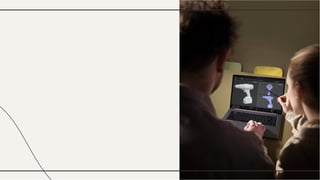
Fundamentals of Modeling and
Simulation: An Introduction
Title: Introduction to Modeling and Simulation
Subtitle: Exploring the Basics, Applications, and Benefits
Sir Najam
Date
21-11-2024
What is Modeling and Simulation (M&S)
?
Key Components
Types of Models
Applications of M&S
Benefits of M&S
Challenges and Limitations
Conclusion
Agenda
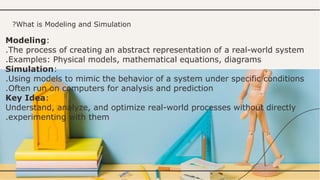
What is Modeling and Simulation
?
Modeling:
The process of creating an abstract representation of a real-world system
.
Examples: Physical models, mathematical equations, diagrams
.
Simulation:
Using models to mimic the behavior of a system under specific conditions
.
Often run on computers for analysis and prediction
.
Key Idea:
Understand, analyze, and optimize real-world processes without directly
experimenting with them
.
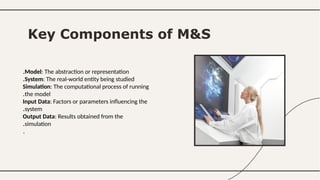
Model: The abstraction or representation
.
System: The real-world entity being studied
.
Simulation: The computational process of running
the model
.
Input Data: Factors or parameters influencing the
system
.
Output Data: Results obtained from the
simulation
.
.
Key Components of M&S
Types of Models
Physical Models
Scale models, prototypes
.
Mathematical Models
Equations, algorithms, and data-driven models
.
Conceptual Models
Flowcharts, system diagrams
.
Discrete vs. Continuous Models
Discrete: Event-driven, specific time steps (e.g., queuing
systems)
.
Continuous: Change over time (e.g., fluid dynamics)
.
Engineering and Design
Product testing, structural analysis
.
Healthcare
Medical imaging, disease modeling
.
Business and Economics
Market analysis, supply chain optimization
.
Military and Defense
War games, tactical planning
.
Environmental Studies
Climate modeling, disaster prediction
.
.
Applications of M&S
Cost-Effective: Reduces the need
for physical testing
.
Risk-Free: Simulate hazardous
scenarios without real-world
consequences
.
Time-Saving: Quickly analyze
multiple scenarios
.
Improved Decision-Making: Data-
driven insights
.
Scalability: Handle complex
systems at large scales
.
Benefits of M&S
Model Accuracy
Simplifications may lead to errors
.
Data Dependency
Requires accurate and extensive data
.
Computational Costs
Complex simulations can be resource-intensive
.
Interpretation of Results
Requires expertise to draw meaningful
conclusions
.
Challenges and Limitations
In summary, modeling and simulation are vital tools for understanding complex
systems. They allow for experimentation and analysis, providing valuable insights
across various industries. Understanding their fundamentals is essential for
effective application
.
Conclusion
Modeling and Simulation are
indispensable tools across various fields
.
They allow for deeper understanding and
optimization of systems
.
While they have challenges,
advancements in technology continue to
improve their accuracy and efficiency
.
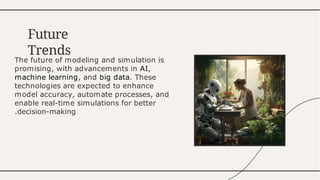
The future of modeling and simulation is
promising, with advancements in AI,
machine learning, and big data. These
technologies are expected to enhance
model accuracy, automate processes, and
enable real-time simulations for better
decision-making
.
Future
Trends
Thank
s
! Do you have any
questions
?
assadchadhar@gmail.com
0312-7522112
Najam

Introduction to modeling and simulation.pptx

  • 1.
    Fundamentals of Modelingand Simulation: An Introduction Title: Introduction to Modeling and Simulation Subtitle: Exploring the Basics, Applications, and Benefits Sir Najam Date 21-11-2024
  • 2.
    What is Modelingand Simulation (M&S) ? Key Components Types of Models Applications of M&S Benefits of M&S Challenges and Limitations Conclusion Agenda
  • 3.
    What is Modelingand Simulation ? Modeling: The process of creating an abstract representation of a real-world system . Examples: Physical models, mathematical equations, diagrams . Simulation: Using models to mimic the behavior of a system under specific conditions . Often run on computers for analysis and prediction . Key Idea: Understand, analyze, and optimize real-world processes without directly experimenting with them .
  • 4.
    Model: The abstractionor representation . System: The real-world entity being studied . Simulation: The computational process of running the model . Input Data: Factors or parameters influencing the system . Output Data: Results obtained from the simulation . . Key Components of M&S
  • 5.
    Types of Models PhysicalModels Scale models, prototypes . Mathematical Models Equations, algorithms, and data-driven models . Conceptual Models Flowcharts, system diagrams . Discrete vs. Continuous Models Discrete: Event-driven, specific time steps (e.g., queuing systems) . Continuous: Change over time (e.g., fluid dynamics) .
  • 6.
    Engineering and Design Producttesting, structural analysis . Healthcare Medical imaging, disease modeling . Business and Economics Market analysis, supply chain optimization . Military and Defense War games, tactical planning . Environmental Studies Climate modeling, disaster prediction . . Applications of M&S
  • 7.
    Cost-Effective: Reduces theneed for physical testing . Risk-Free: Simulate hazardous scenarios without real-world consequences . Time-Saving: Quickly analyze multiple scenarios . Improved Decision-Making: Data- driven insights . Scalability: Handle complex systems at large scales . Benefits of M&S
  • 8.
    Model Accuracy Simplifications maylead to errors . Data Dependency Requires accurate and extensive data . Computational Costs Complex simulations can be resource-intensive . Interpretation of Results Requires expertise to draw meaningful conclusions . Challenges and Limitations
  • 9.
    In summary, modelingand simulation are vital tools for understanding complex systems. They allow for experimentation and analysis, providing valuable insights across various industries. Understanding their fundamentals is essential for effective application .
  • 10.
    Conclusion Modeling and Simulationare indispensable tools across various fields . They allow for deeper understanding and optimization of systems . While they have challenges, advancements in technology continue to improve their accuracy and efficiency .
  • 11.
    The future ofmodeling and simulation is promising, with advancements in AI, machine learning, and big data. These technologies are expected to enhance model accuracy, automate processes, and enable real-time simulations for better decision-making . Future Trends
  • 14.
    Thank s ! Do youhave any questions ? assadchadhar@gmail.com 0312-7522112 Najam