Welcome
INTRODUCTION TO
MATHEMATICAL ANALYSIS
TOPICS
•Brief Overview of Analysis
•Review of Logic
•Introduction to Proof
Overview of Analysis
• Analysis is the study of functions, especially those representing
continuous change in a particular space.
Example
Real coordinate space – Domain of Real Analysis
Complex coordinate space – Domain of Complex Analysis
Arbitrary Vector Space – Domain of Functional Analysis
• We will focus on real-valued functions of a single real variable.
Example
f : R R
Analysis focuses on analytic properties of functions.
Example
Limits, Continuity, Differentiability, Smoothness, Integrability,
Convergence, Analyticity, Measurability.
• Historically, Calculus preceded Analysis. Analysis began as an effort to
establish a strong theoretical foundation for calculus.
• Modern analysis is part of the core theoretical framework for many
fields of Mathematics.
Example
ODEs, PDEs, Probability Theory, Analytic Number Theory, Ergotic
Theory, Optimization Theory, etc.
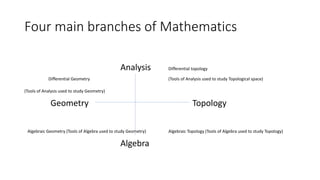
Four main branches of Mathematics
Analysis Differential topology
Differential Geometry (Tools of Analysis used to study Topological space)
(Tools of Analysis used to study Geometry)
Geometry Topology
Algebraic Geometry (Tools of Algebra used to study Geometry) Algebraic Topology (Tools of Algebra used to study Topology)
Algebra
Introduction to Real analysis needs some concepts from Topology such
as open/closed sets and compactness.
Review of Logic
• Definition
A statement is a sentence that is either true or false, but not
both.
Example
a) “Every continuous function is differentiable”
This is a false statement.
b) “The set of integers is countable”
This is a true statement.
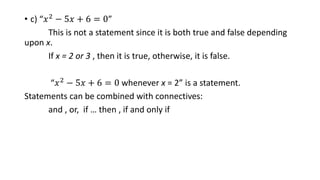
• c) “𝑥2 − 5𝑥 + 6 = 0”
This is not a statement since it is both true and false depending
upon x.
If x = 2 or 3 , then it is true, otherwise, it is false.
“𝑥2 − 5𝑥 + 6 = 0 whenever x = 2” is a statement.
Statements can be combined with connectives:
and , or, if … then , if and only if
Definition
• A statement without a connective is called a prime statement. A
statement with a connective is called a composite statement.
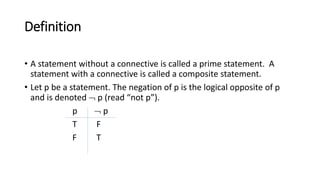
• Let p be a statement. The negation of p is the logical opposite of p
and is denoted  p (read “not p”).
p  p
T F
F T
Example
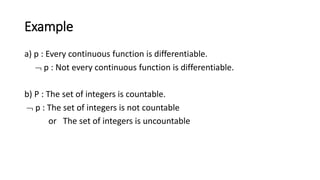
a) p : Every continuous function is differentiable.
 p : Not every continuous function is differentiable.
b) P : The set of integers is countable.
 p : The set of integers is not countable
or The set of integers is uncountable
Definition
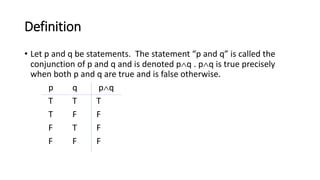
• Let p and q be statements. The statement “p and q” is called the
conjunction of p and q and is denoted pq . pq is true precisely
when both p and q are true and is false otherwise.
p q pq
T T T
T F F
F T F
F F F
Definition
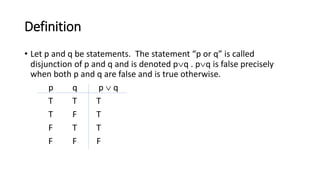
• Let p and q be statements. The statement “p or q” is called
disjunction of p and q and is denoted pq . pq is false precisely
when both p and q are false and is true otherwise.
p q p  q
T T T
T F T
F T T
F F F
Definition
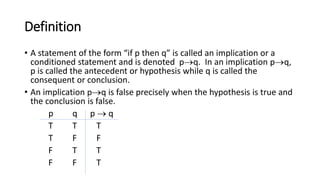
• A statement of the form “if p then q” is called an implication or a
conditioned statement and is denoted pq. In an implication pq,
p is called the antecedent or hypothesis while q is called the
consequent or conclusion.
• An implication pq is false precisely when the hypothesis is true and
the conclusion is false.
p q p  q
T T T
T F F
F T T
F F T
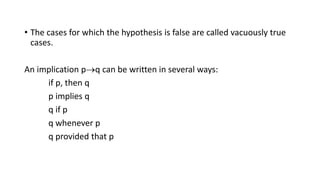
• The cases for which the hypothesis is false are called vacuously true
cases.
An implication pq can be written in several ways:
if p, then q
p implies q
q if p
q whenever p
q provided that p
Definition
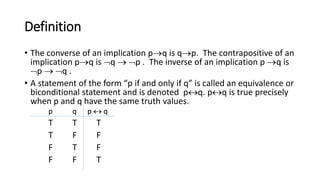
• The converse of an implication pq is qp. The contrapositive of an
implication pq is q  p . The inverse of an implication p q is
p  q .
• A statement of the form “p if and only if q” is called an equivalence or
biconditional statement and is denoted pq. pq is true precisely
when p and q have the same truth values.
p q p  q
T T T
T F F
F T F
F F T
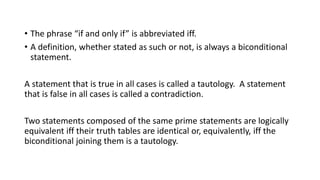
• The phrase “if and only if” is abbreviated iff.
• A definition, whether stated as such or not, is always a biconditional
statement.
A statement that is true in all cases is called a tautology. A statement
that is false in all cases is called a contradiction.
Two statements composed of the same prime statements are logically
equivalent iff their truth tables are identical or, equivalently, iff the
biconditional joining them is a tautology.
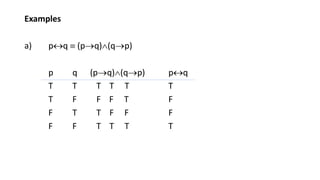
Examples
a) pq  (pq)(qp)
p q (pq)(qp) pq
T T T T T T
T F F F T F
F T T F F F
F F T T T T
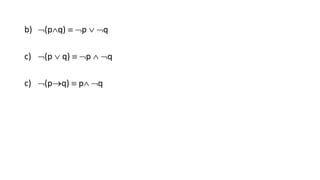
b) (pq)  p  q
c) (p  q)  p  q
c) (pq)  p q
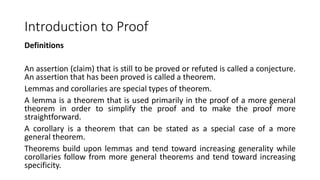
Introduction to Proof
Definitions
An assertion (claim) that is still to be proved or refuted is called a conjecture.
An assertion that has been proved is called a theorem.
Lemmas and corollaries are special types of theorem.
A lemma is a theorem that is used primarily in the proof of a more general
theorem in order to simplify the proof and to make the proof more
straightforward.
A corollary is a theorem that can be stated as a special case of a more
general theorem.
Theorems build upon lemmas and tend toward increasing generality while
corollaries follow from more general theorems and tend toward increasing
specificity.
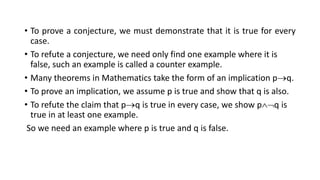
• To prove a conjecture, we must demonstrate that it is true for every
case.
• To refute a conjecture, we need only find one example where it is
false, such an example is called a counter example.
• Many theorems in Mathematics take the form of an implication pq.
• To prove an implication, we assume p is true and show that q is also.
• To refute the claim that pq is true in every case, we show pq is
true in at least one example.
So we need an example where p is true and q is false.
Thank you

Introduction to mathematical analysis

  • 1.
  • 2.
  • 3.
    TOPICS •Brief Overview ofAnalysis •Review of Logic •Introduction to Proof
  • 4.
    Overview of Analysis •Analysis is the study of functions, especially those representing continuous change in a particular space. Example Real coordinate space – Domain of Real Analysis Complex coordinate space – Domain of Complex Analysis Arbitrary Vector Space – Domain of Functional Analysis
  • 5.
    • We willfocus on real-valued functions of a single real variable. Example f : R R Analysis focuses on analytic properties of functions. Example Limits, Continuity, Differentiability, Smoothness, Integrability, Convergence, Analyticity, Measurability.
  • 6.
    • Historically, Calculuspreceded Analysis. Analysis began as an effort to establish a strong theoretical foundation for calculus. • Modern analysis is part of the core theoretical framework for many fields of Mathematics. Example ODEs, PDEs, Probability Theory, Analytic Number Theory, Ergotic Theory, Optimization Theory, etc.
  • 7.
    Four main branchesof Mathematics Analysis Differential topology Differential Geometry (Tools of Analysis used to study Topological space) (Tools of Analysis used to study Geometry) Geometry Topology Algebraic Geometry (Tools of Algebra used to study Geometry) Algebraic Topology (Tools of Algebra used to study Topology) Algebra
  • 8.
    Introduction to Realanalysis needs some concepts from Topology such as open/closed sets and compactness.
  • 9.
    Review of Logic •Definition A statement is a sentence that is either true or false, but not both. Example a) “Every continuous function is differentiable” This is a false statement. b) “The set of integers is countable” This is a true statement.
  • 10.
    • c) “𝑥2− 5𝑥 + 6 = 0” This is not a statement since it is both true and false depending upon x. If x = 2 or 3 , then it is true, otherwise, it is false. “𝑥2 − 5𝑥 + 6 = 0 whenever x = 2” is a statement. Statements can be combined with connectives: and , or, if … then , if and only if
  • 11.
    Definition • A statementwithout a connective is called a prime statement. A statement with a connective is called a composite statement. • Let p be a statement. The negation of p is the logical opposite of p and is denoted  p (read “not p”). p  p T F F T
  • 12.
    Example a) p :Every continuous function is differentiable.  p : Not every continuous function is differentiable. b) P : The set of integers is countable.  p : The set of integers is not countable or The set of integers is uncountable
  • 13.
    Definition • Let pand q be statements. The statement “p and q” is called the conjunction of p and q and is denoted pq . pq is true precisely when both p and q are true and is false otherwise. p q pq T T T T F F F T F F F F
  • 14.
    Definition • Let pand q be statements. The statement “p or q” is called disjunction of p and q and is denoted pq . pq is false precisely when both p and q are false and is true otherwise. p q p  q T T T T F T F T T F F F
  • 15.
    Definition • A statementof the form “if p then q” is called an implication or a conditioned statement and is denoted pq. In an implication pq, p is called the antecedent or hypothesis while q is called the consequent or conclusion. • An implication pq is false precisely when the hypothesis is true and the conclusion is false. p q p  q T T T T F F F T T F F T
  • 16.
    • The casesfor which the hypothesis is false are called vacuously true cases. An implication pq can be written in several ways: if p, then q p implies q q if p q whenever p q provided that p
  • 17.
    Definition • The converseof an implication pq is qp. The contrapositive of an implication pq is q  p . The inverse of an implication p q is p  q . • A statement of the form “p if and only if q” is called an equivalence or biconditional statement and is denoted pq. pq is true precisely when p and q have the same truth values. p q p  q T T T T F F F T F F F T
  • 18.
    • The phrase“if and only if” is abbreviated iff. • A definition, whether stated as such or not, is always a biconditional statement. A statement that is true in all cases is called a tautology. A statement that is false in all cases is called a contradiction. Two statements composed of the same prime statements are logically equivalent iff their truth tables are identical or, equivalently, iff the biconditional joining them is a tautology.
  • 19.
    Examples a) pq (pq)(qp) p q (pq)(qp) pq T T T T T T T F F F T F F T T F F F F F T T T T
  • 20.
    b) (pq) p  q c) (p  q)  p  q c) (pq)  p q
  • 21.
    Introduction to Proof Definitions Anassertion (claim) that is still to be proved or refuted is called a conjecture. An assertion that has been proved is called a theorem. Lemmas and corollaries are special types of theorem. A lemma is a theorem that is used primarily in the proof of a more general theorem in order to simplify the proof and to make the proof more straightforward. A corollary is a theorem that can be stated as a special case of a more general theorem. Theorems build upon lemmas and tend toward increasing generality while corollaries follow from more general theorems and tend toward increasing specificity.
  • 22.
    • To provea conjecture, we must demonstrate that it is true for every case. • To refute a conjecture, we need only find one example where it is false, such an example is called a counter example. • Many theorems in Mathematics take the form of an implication pq. • To prove an implication, we assume p is true and show that q is also. • To refute the claim that pq is true in every case, we show pq is true in at least one example. So we need an example where p is true and q is false.
  • 23.