 Management is essential in all organized
effort, be it business activity or any other
activity.
 Management is the dynamic life giving
element in every organization. It is
management element that co-ordinate
current organizational activities & plan
future ones.
 Mary Parker Follet stated,
“Management is an art
of getting things done
through people.”
 Harold Koontz wrote,
“Management is an art of getting
things done through and with
people in formally
organized groups.”
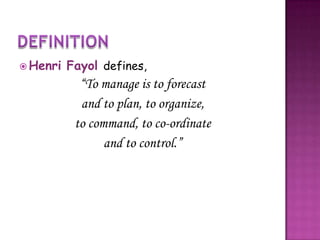
 Henri Fayol defines,
“To manage is to forecast
and to plan, to organize,
to command, to co-ordinate
and to control.”
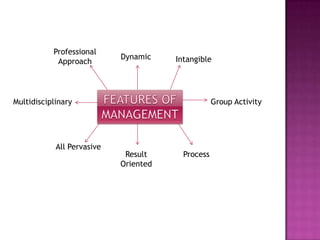
Group Activity
ProcessResult
Oriented
All Pervasive
Multidisciplinary
Professional
Approach
Dynamic Intangible
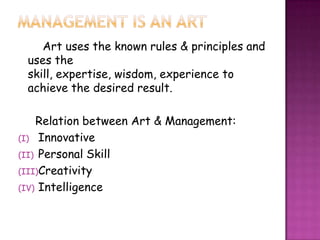
Art uses the known rules & principles and
uses the
skill, expertise, wisdom, experience to
achieve the desired result.
Relation between Art & Management:
(I) Innovative
(II) Personal Skill
(III)Creativity
(IV) Intelligence
Science is a collection of systematic
knowledge, collection of truths and
conclusion after continuous study and
experiments.
Relation between Science & Management:
(I) Universally Accepted
(II) Cause-Effect Relationship
(III)Systematic Decision Making
Management has two faces like a coin; on one
side it is art and on the other it is science.
Management has got scientific principles which
constitute the elements of Science and Skills
and talent which are attributes of Art.
 Levels of management are the convenient
platforms created managing the activities of
business.
 Normally, there are three levels,
(A) Top Level Management
(B) Middle Level Management
(C) Lower Level Management
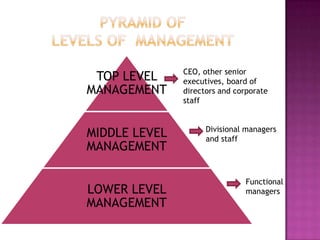
TOP LEVEL
MANAGEMENT
MIDDLE LEVEL
MANAGEMENT
LOWER LEVEL
MANAGEMENT
CEO, other senior
executives, board of
directors and corporate
staff
Divisional managers
and staff
Functional
managers
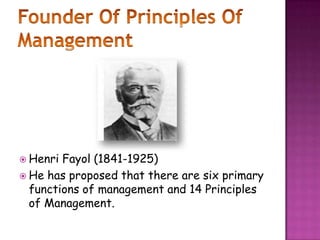
 Henri Fayol (1841-1925)
 He has proposed that there are six primary
functions of management and 14 Principles
of Management.
1. Division of labour
Work of all kinds must be divided & allotted
to various persons according to their expertise
in a particular area.
2. Authority & Responsibility
Authority refers to the right of superiors
to get exactness from their sub-ordinates.
Responsibility means obligation for the
performance of the job assigned.
3. Unity of Command
A sub-ordinate should receive orders and be
accountable to one and only one boss at a time.
4. Unity of Direction
People engaged in the same kind of business
or same kind of activities must have the same
objectives in a single plan.
5. Equity
The employees should be treated with
kindness & equity if devotion is expected of
them.
6. Order
This principle is concerned with proper &
systematic arrangement of things and people.
7. Discipline
Discipline means
sincerity, obedience, respect of authority &
observance of rules & regulations of the
enterprise. Subordinate should respect their
superiors and obey their order.
8. Initiative
Management should provide opportunity to
its employees to suggest ideas, experiences &
new method of work.
9. Remuneration
Remuneration to be paid to the workers
should be fair, reasonable, satisfactory &
rewarding to the efforts.
10. Stability of Tenure
The period of service in a job should be
fixed.
11. Scalar Chain
Scalar chain is the chain of superiors
ranging from the ultimate authority to the
lowest. Communications should follow this
chain.
12. Sub-ordination of Interest
An organization is much bigger than the
individual it constitutes therefore interest of
the interest undertaking should prevail in all
circumstances.
 13. Espirit De’ Corps
It refers to team spirit i.e. harmony in the
work groups and mutual understanding among
the members.
 14. Centralization
Centralization refers to the degree to
which subordinates are involved in decision
making. Whether decision making is centralized
(to management) or decentralized (to
subordinates) is a question of proper
proportion.
Introduction to management

Introduction to management

  • 2.
     Management isessential in all organized effort, be it business activity or any other activity.  Management is the dynamic life giving element in every organization. It is management element that co-ordinate current organizational activities & plan future ones.
  • 3.
     Mary ParkerFollet stated, “Management is an art of getting things done through people.”  Harold Koontz wrote, “Management is an art of getting things done through and with people in formally organized groups.”
  • 4.
     Henri Fayoldefines, “To manage is to forecast and to plan, to organize, to command, to co-ordinate and to control.”
  • 5.
  • 7.
    Art uses theknown rules & principles and uses the skill, expertise, wisdom, experience to achieve the desired result. Relation between Art & Management: (I) Innovative (II) Personal Skill (III)Creativity (IV) Intelligence
  • 8.
    Science is acollection of systematic knowledge, collection of truths and conclusion after continuous study and experiments. Relation between Science & Management: (I) Universally Accepted (II) Cause-Effect Relationship (III)Systematic Decision Making
  • 9.
    Management has twofaces like a coin; on one side it is art and on the other it is science. Management has got scientific principles which constitute the elements of Science and Skills and talent which are attributes of Art.
  • 10.
     Levels ofmanagement are the convenient platforms created managing the activities of business.  Normally, there are three levels, (A) Top Level Management (B) Middle Level Management (C) Lower Level Management
  • 11.
    TOP LEVEL MANAGEMENT MIDDLE LEVEL MANAGEMENT LOWERLEVEL MANAGEMENT CEO, other senior executives, board of directors and corporate staff Divisional managers and staff Functional managers
  • 13.
     Henri Fayol(1841-1925)  He has proposed that there are six primary functions of management and 14 Principles of Management.
  • 14.
    1. Division oflabour Work of all kinds must be divided & allotted to various persons according to their expertise in a particular area. 2. Authority & Responsibility Authority refers to the right of superiors to get exactness from their sub-ordinates. Responsibility means obligation for the performance of the job assigned. 3. Unity of Command A sub-ordinate should receive orders and be accountable to one and only one boss at a time.
  • 15.
    4. Unity ofDirection People engaged in the same kind of business or same kind of activities must have the same objectives in a single plan. 5. Equity The employees should be treated with kindness & equity if devotion is expected of them. 6. Order This principle is concerned with proper & systematic arrangement of things and people.
  • 16.
    7. Discipline Discipline means sincerity,obedience, respect of authority & observance of rules & regulations of the enterprise. Subordinate should respect their superiors and obey their order. 8. Initiative Management should provide opportunity to its employees to suggest ideas, experiences & new method of work. 9. Remuneration Remuneration to be paid to the workers should be fair, reasonable, satisfactory & rewarding to the efforts.
  • 17.
    10. Stability ofTenure The period of service in a job should be fixed. 11. Scalar Chain Scalar chain is the chain of superiors ranging from the ultimate authority to the lowest. Communications should follow this chain. 12. Sub-ordination of Interest An organization is much bigger than the individual it constitutes therefore interest of the interest undertaking should prevail in all circumstances.
  • 18.
     13. EspiritDe’ Corps It refers to team spirit i.e. harmony in the work groups and mutual understanding among the members.  14. Centralization Centralization refers to the degree to which subordinates are involved in decision making. Whether decision making is centralized (to management) or decentralized (to subordinates) is a question of proper proportion.