Yasser A. Hamed M.DYasser A. Hamed M.D
Al-Azhar universityAl-Azhar university
Research Associate Minneapolis University Minnesota USAResearch Associate Minneapolis University Minnesota USA
lasercairo@yahoo.comlasercairo@yahoo.com
Principles of CoherentPrinciples of Coherent
andand
Non-Coherent light therapy.Non-Coherent light therapy.
Yasser A. Hamed M.DYasser A. Hamed M.D
Al-Azhar universityAl-Azhar university
Research Associate Minneapolis University Minnesota USAResearch Associate Minneapolis University Minnesota USA
lasercairo@yahoo.comlasercairo@yahoo.com
Principles of laser photo-Principles of laser photo-
rejuvenation and scar treatment.rejuvenation and scar treatment.
Intense Pulsed LightIntense Pulsed Light
(IPL)(IPL)
Is it the future ?Is it the future ?
YYasserasser A.A. HHamedamed M.DM.D
Al-Azhar university Cairo – Egypt.Al-Azhar university Cairo – Egypt.
Research Associate Minneapolis Minnesota USAResearch Associate Minneapolis Minnesota USA
lasercairo@yahoo.comlasercairo@yahoo.com
Yasser A. Hamed M.DYasser A. Hamed M.D
Al-Azhar universityAl-Azhar university
Research Associate Minneapolis University Minnesota USAResearch Associate Minneapolis University Minnesota USA
lasercairo@yahoo.comlasercairo@yahoo.com
Principles of CoherentPrinciples of Coherent
andand
Non-Coherent light therapy.Non-Coherent light therapy.
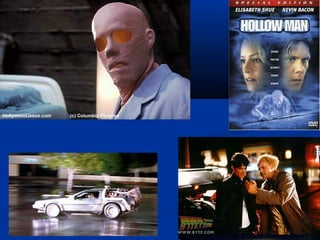
LASER historyLASER history
&&
Science fictionScience fiction
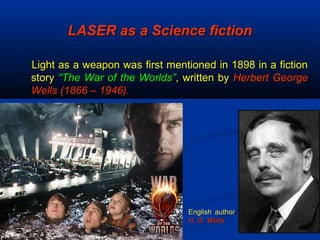
LASER as a Science fictionLASER as a Science fiction
Light as a weapon was first mentioned in 1898 in a fictionLight as a weapon was first mentioned in 1898 in a fiction
storystory “The War of the Worlds”“The War of the Worlds”, written by, written by Herbert GeorgeHerbert George
Wells (1866 – 1946).Wells (1866 – 1946).
English authorEnglish author
H. G. WellsH. G. Wells
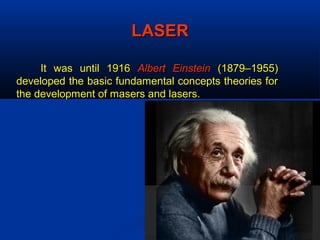
LASERLASER
It was until 1916It was until 1916 Albert EinsteinAlbert Einstein (1879–1955)(1879–1955)
developed the basic fundamental concepts theories fordeveloped the basic fundamental concepts theories for
the development of masers and lasers.the development of masers and lasers.
What is LASER ?What is LASER ?
LASERLASER
Laser is an acronymLaser is an acronym
LL LightLight
AA AmplificationAmplification
SS StimulatedStimulated
EE EmissionEmission
RR RadiationRadiation
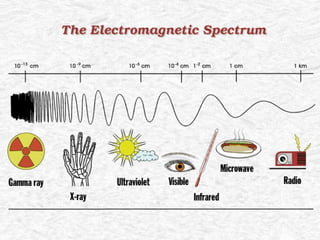
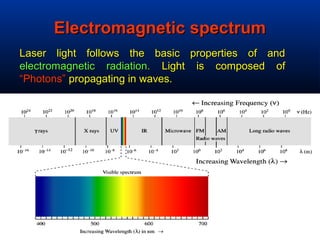
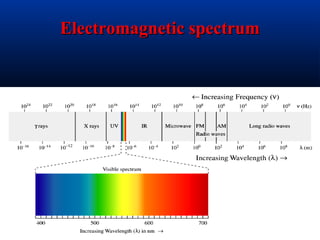
Electromagnetic spectrumElectromagnetic spectrum
Laser light follows the basic properties of andLaser light follows the basic properties of and
electromagnetic radiation.electromagnetic radiation. Light is composed ofLight is composed of
“Photons”“Photons” propagating in waves.propagating in waves.
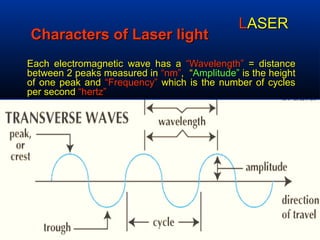
Characters of Laser lightCharacters of Laser light
Each electromagnetic wave has aEach electromagnetic wave has a “Wavelength”“Wavelength” = distance= distance
between 2 peaks measured inbetween 2 peaks measured in “nm”“nm”, “, “Amplitude”Amplitude” is the heightis the height
of one peak andof one peak and “Frequency”“Frequency” which is the number of cycleswhich is the number of cycles
per secondper second “hertz”“hertz”
LLASERASER
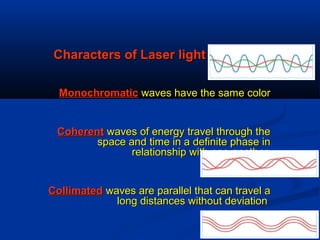
Characters of Laser lightCharacters of Laser light
MonochromaticMonochromatic waves have the same colorwaves have the same color
CoherentCoherent waves of energy travel through thewaves of energy travel through the
space and time in a definite phase inspace and time in a definite phase in
relationship with one another.relationship with one another.
CollimatedCollimated waves are parallel that can travel awaves are parallel that can travel a
long distances without deviationlong distances without deviation
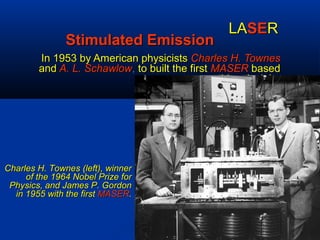
Stimulated EmissionStimulated Emission
In 1953 by American physicistsIn 1953 by American physicists Charles H. TownesCharles H. Townes
andand A. L. SchawlowA. L. Schawlow,, to built the firstto built the first MASERMASER basedbased
on this principle.on this principle.
LALASESERR
Charles H. Townes (left), winnerCharles H. Townes (left), winner
of the 1964 Nobel Prize forof the 1964 Nobel Prize for
Physics, and James P. GordonPhysics, and James P. Gordon
in 1955 with the firstin 1955 with the first MASERMASER..
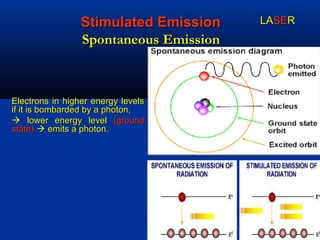
Stimulated EmissionStimulated Emission
Spontaneous EmissionSpontaneous Emission
Electrons in higher energy levelsElectrons in higher energy levels
if it is bombarded by a photon,if it is bombarded by a photon,
 lower energy levellower energy level (ground(ground
state)state)  emits a photon.emits a photon.
LALASESERR
Stimulated EmissionStimulated Emission
Spontaneous EmissionSpontaneous Emission
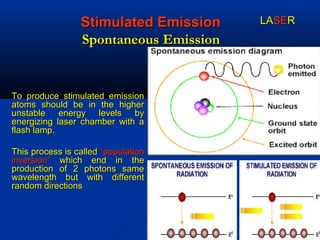
To produce stimulated emissionTo produce stimulated emission
atoms should be in the higheratoms should be in the higher
unstable energy levels byunstable energy levels by
energizing laser chamber with aenergizing laser chamber with a
flash lamp.flash lamp.
This process is calledThis process is called “population“population
inversion”inversion” which end in thewhich end in the
production of 2 photons sameproduction of 2 photons same
wavelength but with differentwavelength but with different
random directionsrandom directions
LALASESERR
AmplificationAmplification
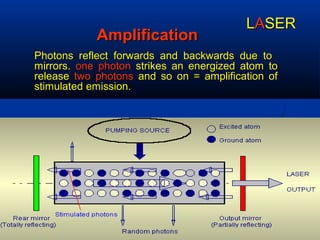
Photons reflect forwards and backwards due toPhotons reflect forwards and backwards due to
mirrors.mirrors. one photonone photon strikes an energized atom tostrikes an energized atom to
releaserelease two photonstwo photons and so on = amplification ofand so on = amplification of
stimulated emission.stimulated emission.
LLAASERSER
RadiationRadiation
Laser is different thanLaser is different than X-ray, cosmic rays, orX-ray, cosmic rays, or
gamma raysgamma rays == ionizing radiationionizing radiation affect theaffect the
molecular structure = cancer, while the laser lightmolecular structure = cancer, while the laser light
isis aa non-ionizing radiationnon-ionizing radiation..
LASELASERR
Laser componentsLaser components
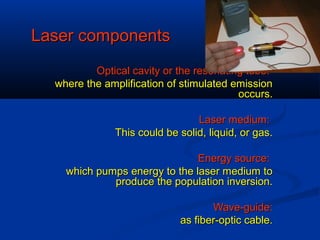
Optical cavity or the resonating tube:Optical cavity or the resonating tube:
where the amplification of stimulated emissionwhere the amplification of stimulated emission
occurs.occurs.
Laser medium:Laser medium:
This could be solid, liquid, or gas.This could be solid, liquid, or gas.
Energy source:Energy source:
which pumps energy to the laser medium towhich pumps energy to the laser medium to
produce the population inversion.produce the population inversion.
Wave-guide:Wave-guide:
as fiber-optic cable.as fiber-optic cable.
LASER tissue interactionLASER tissue interaction
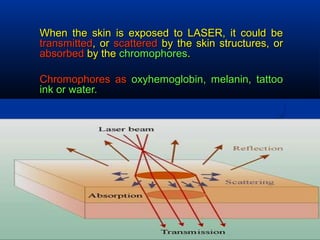
When the skin is exposed to LASER, it could beWhen the skin is exposed to LASER, it could be
transmittedtransmitted, or, or scatteredscattered by the skin structures, orby the skin structures, or
absorbedabsorbed by theby the chromophoreschromophores..
Chromophores asChromophores as oxyhemoglobin, melanin, tattoooxyhemoglobin, melanin, tattoo
ink or water.ink or water.
Grothus-Draper photobiology lawGrothus-Draper photobiology law
Light should be absorbed to have a tissue effectLight should be absorbed to have a tissue effect
if there is no light absorption there will be noif there is no light absorption there will be no
effect.effect.
Absorption is controlled byAbsorption is controlled by wavelengthwavelength of laserof laser
and theand the chromophore.chromophore.
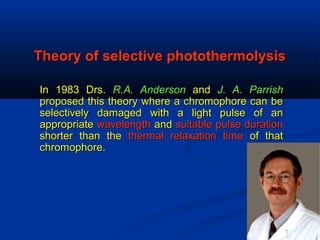
Theory of selective photothermolysisTheory of selective photothermolysis
In 1983 Drs.In 1983 Drs. R.A. AndersonR.A. Anderson andand J. A. ParrishJ. A. Parrish
proposed this theory where a chromophore can beproposed this theory where a chromophore can be
selectively damaged with a light pulse of anselectively damaged with a light pulse of an
appropriateappropriate wavelengthwavelength andand suitable pulse durationsuitable pulse duration
shorter than theshorter than the thermal relaxation timethermal relaxation time of thatof that
chromophore.chromophore.
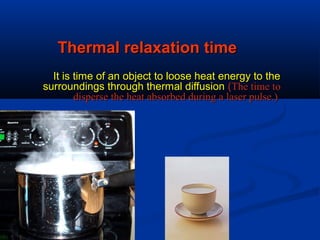
Thermal relaxation timeThermal relaxation time
It is time of an object to loose heat energy to theIt is time of an object to loose heat energy to the
surroundings through thermal diffusionsurroundings through thermal diffusion ((The time toThe time to
disperse the heat absorbed during a laser pulse.)disperse the heat absorbed during a laser pulse.)
Thermal relaxation timeThermal relaxation time
If aIf a chromophorechromophore is exposed to a laser for a timeis exposed to a laser for a time
longerlonger than its thermal relaxation time it will resultthan its thermal relaxation time it will result
in collateralin collateral thermal damagethermal damage andand increased risk ofincreased risk of
complications.complications.
Pulse durationPulse duration
It is the time the laser is in contact with the targetIt is the time the laser is in contact with the target
cell (cell (ChromophoreChromophore).).
Types of LasersTypes of Lasers
GasGas Argon , CO2, Excimer laserArgon , CO2, Excimer laser
DyeDye Pulsed dye laserPulsed dye laser
SolidSolid Ruby, Nd YAG and Er YagRuby, Nd YAG and Er Yag
SemiconductorSemiconductor Diode laserDiode laser
Laser light can be delivered inLaser light can be delivered in pulsespulses,, continuouscontinuous wave, orwave, or
pseudo-continuouspseudo-continuous wave forms.wave forms.
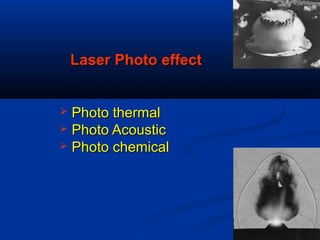
Laser Photo effectLaser Photo effect
 Photo thermalPhoto thermal
 Photo AcousticPhoto Acoustic
 Photo chemicalPhoto chemical
Laser parametersLaser parameters
Energy fluence (Energy density)Energy fluence (Energy density) Joules/cmJoules/cm22
= energy delivered to a given unit area for each= energy delivered to a given unit area for each
single pulse.single pulse.
Irradiance (Power density)Irradiance (Power density) (Watt/cm(Watt/cm22
))
= rate of energy delivery = intensity of the energy= rate of energy delivery = intensity of the energy
delivered.delivered.
Efficacy of laser depends upon:Efficacy of laser depends upon:
 The target chromophoreThe target chromophore
 WavelengthWavelength
 Pulse durationPulse duration
 Energy densityEnergy density
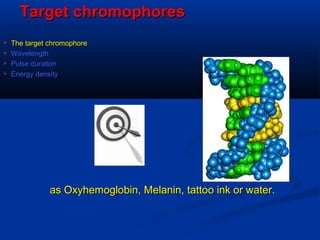
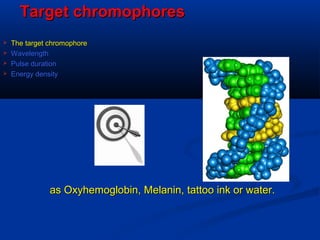
Target chromophoresTarget chromophores
as Oxyhemoglobin, Melanin, tattoo ink or water.as Oxyhemoglobin, Melanin, tattoo ink or water.
 The target chromophoreThe target chromophore
 WavelengthWavelength
 Pulse durationPulse duration
 Energy densityEnergy density
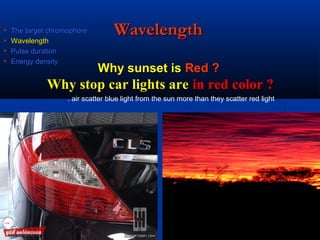
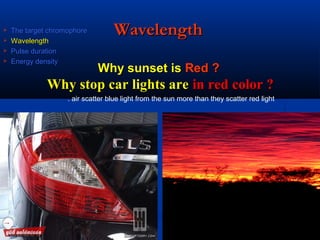
WavelengthWavelength
Why sunset isWhy sunset is Red ?Red ?
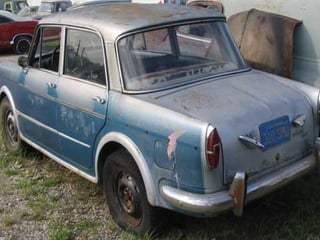
Why stop car lights areWhy stop car lights are in red color ?in red color ?
air scatter blue light from the sun more than they scatter red light.
 The target chromophoreThe target chromophore
 WavelengthWavelength
 Pulse durationPulse duration
 Energy densityEnergy density
Electromagnetic spectrumElectromagnetic spectrum
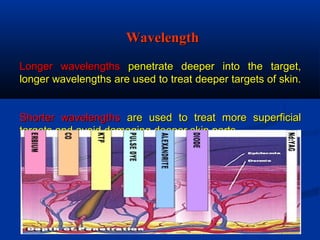
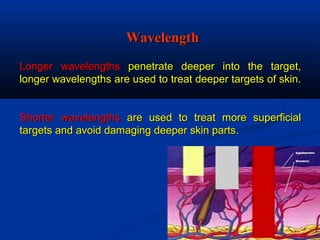
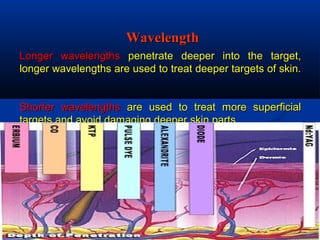
Longer wavelengthsLonger wavelengths penetrate deeper into the target,penetrate deeper into the target,
longer wavelengths are used to treat deeper targets of skin.longer wavelengths are used to treat deeper targets of skin.
Shorter wavelengthsShorter wavelengths are used to treat more superficialare used to treat more superficial
targets and avoid damaging deeper skin partstargets and avoid damaging deeper skin parts..
WavelengthWavelength
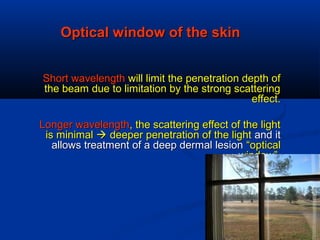
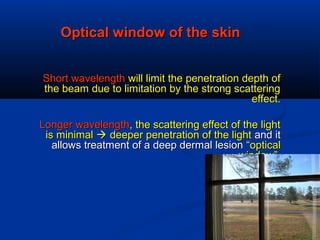
Optical window of the skinOptical window of the skin
Short wavelengthShort wavelength will limit the penetration depth ofwill limit the penetration depth of
the beam due to limitation by the strong scatteringthe beam due to limitation by the strong scattering
effect.effect.
Longer wavelengthLonger wavelength, the scattering effect of the light, the scattering effect of the light
is minimalis minimal  deeper penetration of the lightdeeper penetration of the light and itand it
allows treatment of a deep dermal lesionallows treatment of a deep dermal lesion “optical“optical
window”window”
Pulse durationPulse duration
It is the time the laser is in contact with the targetIt is the time the laser is in contact with the target
cell (cell (ChromophoreChromophore).).
ShortShort exposure timeexposure time  minimal heating of theminimal heating of the
targettarget  no effectno effect..
LongLong exposure timeexposure time  transfer of the heattransfer of the heat
produced by conduction to adjacent tissuesproduced by conduction to adjacent tissues 
complicationscomplications as scarring, atrophy, or pigmentationas scarring, atrophy, or pigmentation
 The target chromophoreThe target chromophore
 WavelengthWavelength
 Pulse durationPulse duration
 Energy densityEnergy density
Energy density (Energy fluence)Energy density (Energy fluence)
As the energy increases the amount of the clinicalAs the energy increases the amount of the clinical
effect / complications is also increased and viceeffect / complications is also increased and vice
versa.versa.
 The target chromophoreThe target chromophore
 WavelengthWavelength
 Pulse durationPulse duration
 Energy densityEnergy density
Anaesthesia with laserAnaesthesia with laser
 Without anaesthesia “Rubber sting”Without anaesthesia “Rubber sting”
 LocalLocal EMLA cream produce a significant reductionEMLA cream produce a significant reduction
in laser-induced pain.in laser-induced pain.
Excessive Use of Topical Anesthetics Can BeExcessive Use of Topical Anesthetics Can Be
FatalFatal (FDA warning Feb 2007)(FDA warning Feb 2007)
 GeneralGeneral
 Cold air currentCold air current
 Chill gelChill gel
 DCDDCD
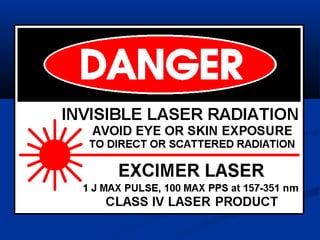
Laser hazard classification schemeLaser hazard classification scheme
Class I:Class I: No hazardNo hazard
Class II:Class II: < 1mW Human aversion is normally< 1mW Human aversion is normally
sufficient protection (as looking away).sufficient protection (as looking away).
Class III A:Class III A: 1-5 mW Hazardous only if someone1-5 mW Hazardous only if someone
looks directly at the laser beam.looks directly at the laser beam.
Class III B:Class III B: 5-500 mW Diffuse scattering beams are5-500 mW Diffuse scattering beams are
dangerous Generally is not a fire hazard.dangerous Generally is not a fire hazard.
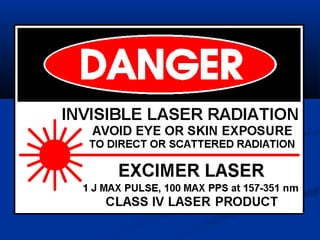
Class IV:Class IV: high power: Even diffuse scattering ishigh power: Even diffuse scattering is
dangerous to the eyes.dangerous to the eyes.
Potential fire hazard.Potential fire hazard.
Potential skin hazard.Potential skin hazard.
Laser hazards and safetyLaser hazards and safety
1. Eye hazards1. Eye hazards
2. Inhalation hazards2. Inhalation hazards
3. Electrical hazards3. Electrical hazards
4.4. Dye safetyDye safety
5.5. Skin safetySkin safety
6. Fire hazard6. Fire hazard
Does laser inactivate botulinum toxin?Does laser inactivate botulinum toxin?
 Patients may be treated with several nonablativePatients may be treated with several nonablative
lasers and IPL or RF devices immediately afterlasers and IPL or RF devices immediately after
botulinum toxin injection without loss of efficacy orbotulinum toxin injection without loss of efficacy or
other apparent adverseother apparent adverse effect.effect.
Dermatol Surg. 2005 Apr;31(4):399-404Dermatol Surg. 2005 Apr;31(4):399-404.
Does laser affect Fillers?Does laser affect Fillers?
??????????????????
How is laser performedHow is laser performed??
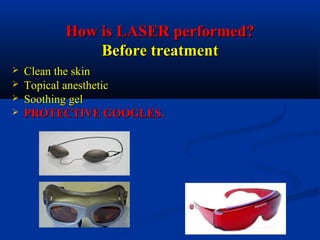
How is LASER performed?How is LASER performed?
Before treatmentBefore treatment
 Clean the skinClean the skin
 Topical anestheticTopical anesthetic
 Soothing gelSoothing gel
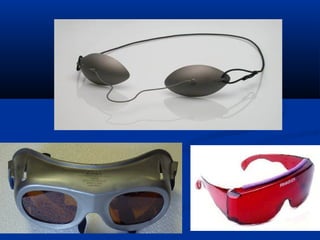
 PROTECTIVE GOOGLES.PROTECTIVE GOOGLES.
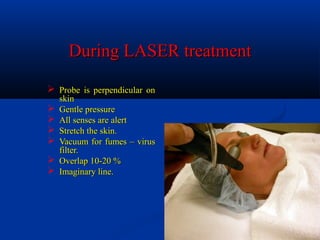
During LASER treatmentDuring LASER treatment
 Probe is perpendicular onProbe is perpendicular on
skinskin
 Gentle pressureGentle pressure
 All senses are alertAll senses are alert
 Stretch the skin.Stretch the skin.
 Vacuum for fumes – virusVacuum for fumes – virus
filter.filter.
 Overlap 10-20 %Overlap 10-20 %
 Imaginary line.Imaginary line.
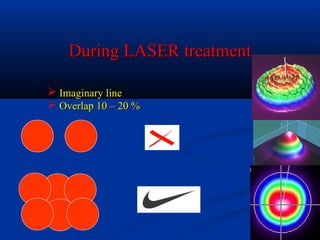
During LASER treatmentDuring LASER treatment
 Imaginary lineImaginary line
 Overlap 10 – 20 %Overlap 10 – 20 %
After LASER treatmentAfter LASER treatment
Cold or ice packs.Cold or ice packs.
Local steroid + antibiotic.Local steroid + antibiotic.
Topical non-steroid soothing cream.Topical non-steroid soothing cream.
Avoid direct sun or heat exposure.Avoid direct sun or heat exposure.
Physical and chemical sun screen.Physical and chemical sun screen.
Side effects.Side effects.
Side effectsSide effects..
BurnBurn
Post inflammatory hyper – hypoPost inflammatory hyper – hypo
pigmentation.pigmentation.
Scar formation.Scar formation.
Principles of laser photo-Principles of laser photo-
rejuvenation and scar treatment.rejuvenation and scar treatment.
What is Photo rejuvenation ?What is Photo rejuvenation ?
This approach is based on the concept that gentleThis approach is based on the concept that gentle
application of a variety of wavelengths in the visible andapplication of a variety of wavelengths in the visible and
infrared spectra stimulates new collagen and perhapsinfrared spectra stimulates new collagen and perhaps
produces new elastic fiber that rejuvenates photoagedproduces new elastic fiber that rejuvenates photoaged
skin.skin.
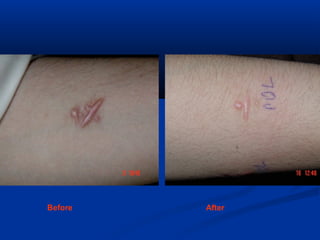
Laser treatment for hypertrophicLaser treatment for hypertrophic
scars, keloids, and striaescars, keloids, and striae
CW lasersCW lasers COCO22 , Er YAG no advantage over scalpel, Er YAG no advantage over scalpel
excision.excision.
high rates of recurrence and other side effects includinghigh rates of recurrence and other side effects including
pain, atrophy, and dyspigmentationpain, atrophy, and dyspigmentation
Flash Lamp Pulsed Dye LaserFlash Lamp Pulsed Dye Laser
Significant improvement in scar surface texture,Significant improvement in scar surface texture,
erythema, height, and flexibility.erythema, height, and flexibility.
Before After
After
Before
Before After
Longer wavelengthsLonger wavelengths penetrate deeper into the target,penetrate deeper into the target,
longer wavelengths are used to treat deeper targets of skin.longer wavelengths are used to treat deeper targets of skin.
Shorter wavelengthsShorter wavelengths are used to treat more superficialare used to treat more superficial
targets and avoid damaging deeper skin partstargets and avoid damaging deeper skin parts..
WavelengthWavelength
Ablative laser systemsAblative laser systems
(working(working hardhard or working smart)or working smart)
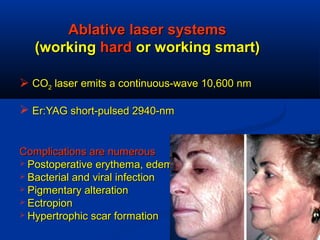
 COCO22 laserlaser emits a continuous-wave 10,600 nmemits a continuous-wave 10,600 nm
 Er:YAG short-pulsed 2940-nmEr:YAG short-pulsed 2940-nm
Complications are numerousComplications are numerous
 Postoperative erythema, edemaPostoperative erythema, edema
 Bacterial and viral infectionBacterial and viral infection
 Pigmentary alterationPigmentary alteration
 EctropionEctropion
 Hypertrophic scar formationHypertrophic scar formation
Non-ablative laser systemsNon-ablative laser systems
(working(working smartsmart or working hardor working hard Titan-CTitan-C))
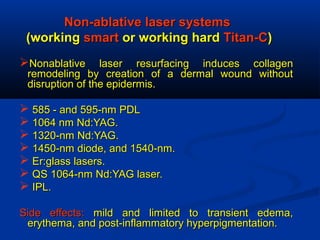
Nonablative laser resurfacing induces collagenNonablative laser resurfacing induces collagen
remodeling by creation of a dermal wound withoutremodeling by creation of a dermal wound without
disruption of the epidermis.disruption of the epidermis.
 585 - and 595-nm PDL585 - and 595-nm PDL
 1064 nm Nd:YAG.1064 nm Nd:YAG.
 1320-nm Nd:YAG.1320-nm Nd:YAG.
 1450-nm diode, and 1540-nm.1450-nm diode, and 1540-nm.
 Er:glass lasers.Er:glass lasers.
 QS 1064-nm Nd:YAG laser.QS 1064-nm Nd:YAG laser.
 IPL.IPL.
Side effects:Side effects: mild and limited to transient edema,mild and limited to transient edema,
erythema, and post-inflammatory hyperpigmentation.erythema, and post-inflammatory hyperpigmentation.
Non-ablative laser systemsNon-ablative laser systems
Radio FrequencyRadio Frequency ((RFRF))
 RF treatment was very satisfactory for skin tighteningRF treatment was very satisfactory for skin tightening
Lasers Surg Med. 2005.Lasers Surg Med. 2005.
 The technique was found to produce gradual tightening in most patients,The technique was found to produce gradual tightening in most patients,
and there were no adverse effectsand there were no adverse effects
J CosmetJ Cosmet Laser Ther. 2005Laser Ther. 2005
 Nonsurgical tightening of skin laxity: a new radiofrequency approach.Nonsurgical tightening of skin laxity: a new radiofrequency approach.
J Drugs Dermatol. 2007 Apr;6(4):381-6.J Drugs Dermatol. 2007 Apr;6(4):381-6.
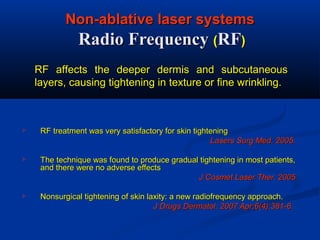
RF affects the deeper dermis and subcutaneousRF affects the deeper dermis and subcutaneous
layers, causing tightening in texture or fine wrinkling.layers, causing tightening in texture or fine wrinkling.
Non-ablative laser systemsNon-ablative laser systems
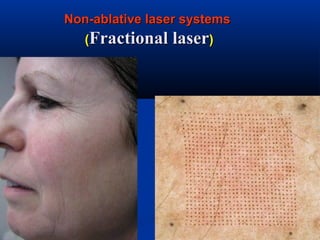
((Fractional laserFractional laser))
Fractional laser 1,550nm Erbium glass fiber laser -------Fractional laser 1,550nm Erbium glass fiber laser -------
microthermal zonesmicrothermal zones (MTZs)(MTZs) of tissue coagulationof tissue coagulation
------- collagen remodeling and new collagen------- collagen remodeling and new collagen
formation.formation.
 Pain.Pain.
 Cooling.Cooling.
• Fractional Laser treatment for pigmentation and texture improvement.
Skin Therapy Lett. 2006 Nov;11(9):7-11.
• Fractional photothermolysis: treatment of facial and nonfacial
cutaneous photodamage with a 1,550-nm erbium-doped fiber laser.
Dermatol Surg. 2007 Jan;33(1):23-8.
• Fractional photothermolysis : A new option for treating melasma?
•Hautarzt. 2008 Feb;59(2):92-100.
Fractional LaserFractional Laser
Non-ablative laser systemsNon-ablative laser systems
((Fractional laserFractional laser))
Non-ablative laser systemsNon-ablative laser systems
((Fractional laserFractional laser))
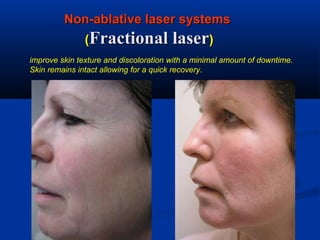
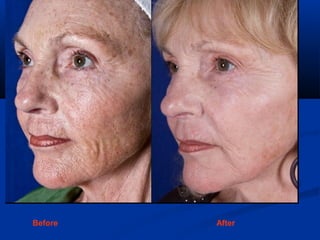
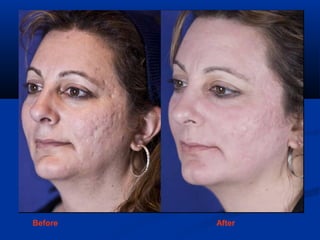
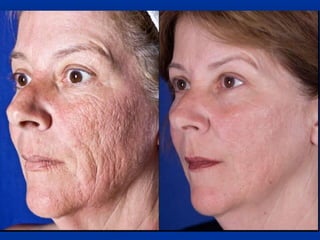
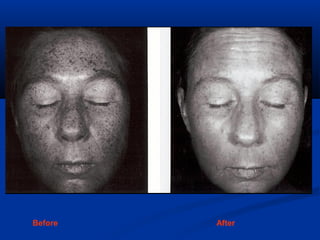
improve skin texture and discoloration with a minimal amount of downtime.
Skin remains intact allowing for a quick recovery.
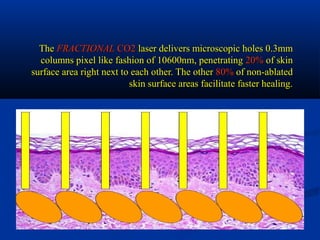
TheThe FRACTIONALFRACTIONAL CO2CO2 laser delivers microscopic holes 0.3mmlaser delivers microscopic holes 0.3mm
columns pixel like fashion of 10600nm, penetratingcolumns pixel like fashion of 10600nm, penetrating 20%20% of skinof skin
surface area right next to each other. The othersurface area right next to each other. The other 80%80% of non-ablatedof non-ablated
skin surface areas facilitate faster healing.skin surface areas facilitate faster healing.
Before After
Before After
Before After
Before After
Advantage of FractionalAdvantage of Fractional
LaserLaser
 Relatively short downtime, typically 4-6 daysRelatively short downtime, typically 4-6 days
 Minimal discomfort as only topical anesthetics neededMinimal discomfort as only topical anesthetics needed
 Safe and effective for virtually all skin surface areasSafe and effective for virtually all skin surface areas
including face, neck, chest, back, arms and handsincluding face, neck, chest, back, arms and hands
 Cosmetic appearance continues to improve withCosmetic appearance continues to improve with
stimulation of collagen production up to 6 months afterstimulation of collagen production up to 6 months after
procedureprocedure
Thank youThank you
Intense Pulsed LightIntense Pulsed Light
(IPL)(IPL)
Is it the future ?Is it the future ?
YYasserasser A.A. HHamedamed M.DM.D
Al-Azhar university Cairo – Egypt.Al-Azhar university Cairo – Egypt.
Research Associate Minneapolis Minnesota USAResearch Associate Minneapolis Minnesota USA
lasercairo@yahoo.comlasercairo@yahoo.com
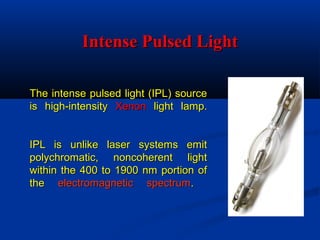
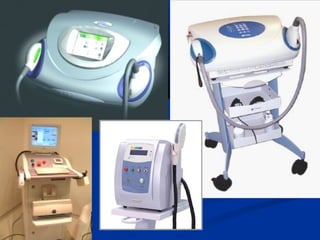
The intense pulsed light (IPL) sourceThe intense pulsed light (IPL) source
is high-intensityis high-intensity XenonXenon light lamp.light lamp.
IPL is unlike laser systems emitIPL is unlike laser systems emit
polychromatic, noncoherent lightpolychromatic, noncoherent light
within the 400 to 1900 nm portion ofwithin the 400 to 1900 nm portion of
thethe electromagnetic spectrumelectromagnetic spectrum..
Intense Pulsed LightIntense Pulsed Light
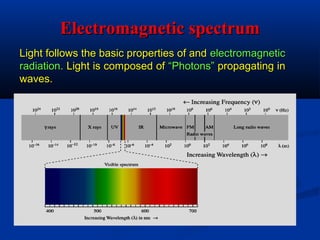
Electromagnetic spectrumElectromagnetic spectrum
Light follows the basic properties of andLight follows the basic properties of and electromagneticelectromagnetic
radiation.radiation. Light is composed ofLight is composed of “Photons”“Photons” propagating inpropagating in
waves.waves.
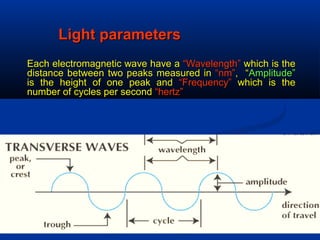
Light parametersLight parameters
Each electromagnetic wave have aEach electromagnetic wave have a “Wavelength”“Wavelength” which is thewhich is the
distance between two peaks measured indistance between two peaks measured in “nm”“nm”, “, “Amplitude”Amplitude”
is the height of one peak andis the height of one peak and “Frequency”“Frequency” which is thewhich is the
number of cycles per secondnumber of cycles per second “hertz”“hertz”
Light tissue interactionLight tissue interaction
When the skin is exposed to light, it could beWhen the skin is exposed to light, it could be
transmittedtransmitted, or, or scatteredscattered by the skin structures, orby the skin structures, or
absorbedabsorbed by theby the chromophoreschromophores..
Chromophores asChromophores as oxyhemoglobin, melanin, tattoooxyhemoglobin, melanin, tattoo
ink or water.ink or water.
Grothus-Draper photobiology lawGrothus-Draper photobiology law
Light should be absorbed to have a tissue effectLight should be absorbed to have a tissue effect
if there is no light absorption there will be noif there is no light absorption there will be no
effect.effect.
Absorption is controlled byAbsorption is controlled by wavelengthwavelength of laserof laser
and theand the chromophore.chromophore.
Light parametersLight parameters
Energy fluence (Energy density)Energy fluence (Energy density) Joules/cmJoules/cm22
is the amount of energy delivered to a given unitis the amount of energy delivered to a given unit
area of tissue for each single pulse.area of tissue for each single pulse.
Irradiance (Power density)Irradiance (Power density) (Watt/cm(Watt/cm22
))
is the rate of energy delivery to an object, itis the rate of energy delivery to an object, it
describes the intensity of the energy delivered.describes the intensity of the energy delivered.
Theory of selective photothermolysisTheory of selective photothermolysis
In 1983 Drs.In 1983 Drs. R.A. AndersonR.A. Anderson andand J. A. ParrishJ. A. Parrish
proposed the theory of selective photothermolysisproposed the theory of selective photothermolysis
which states that a chromophore can be selectivelywhich states that a chromophore can be selectively
damaged with a light pulse of an appropriatedamaged with a light pulse of an appropriate
wavelengthwavelength andand suitable pulse durationsuitable pulse duration shortershorter
than thethan the thermal relaxation timethermal relaxation time of thatof that
chromophore.chromophore.
Thermal relaxation timeThermal relaxation time
It is time of an object to loose heat energy to theIt is time of an object to loose heat energy to the
surroundings through thermal diffusion.surroundings through thermal diffusion.
((The time to disperse the heat absorbed after lightThe time to disperse the heat absorbed after light
exposure)exposure)
If aIf a chromophorechromophore is exposed to a Pulse duration ofis exposed to a Pulse duration of
laser or light timelaser or light time longerlonger than its thermal relaxationthan its thermal relaxation
time it will result in collateraltime it will result in collateral thermal damagethermal damage andand
increased risk of complications.increased risk of complications.
Pulse durationPulse duration
It is the time the light is in contact with the targetIt is the time the light is in contact with the target
cell (cell (ChromophoreChromophore).).
Efficacy of light depends upon:Efficacy of light depends upon:
 The target chromophoreThe target chromophore
 WavelengthWavelength
 Pulse durationPulse duration
 Energy densityEnergy density
Target chromophoresTarget chromophores
as Oxyhemoglobin, Melanin, tattoo ink or water.as Oxyhemoglobin, Melanin, tattoo ink or water.
 The target chromophoreThe target chromophore
 WavelengthWavelength
 Pulse durationPulse duration
 Energy densityEnergy density
WavelengthWavelength
Why sunset isWhy sunset is Red ?Red ?
Why stop car lights areWhy stop car lights are in red color ?in red color ?
air scatter blue light from the sun more than they scatter red light.
 The target chromophoreThe target chromophore
 WavelengthWavelength
 Pulse durationPulse duration
 Energy densityEnergy density
Longer wavelengthsLonger wavelengths penetrate deeper into the target,penetrate deeper into the target,
longer wavelengths are used to treat deeper targets of skin.longer wavelengths are used to treat deeper targets of skin.
Shorter wavelengthsShorter wavelengths are used to treat more superficialare used to treat more superficial
targets and avoid damaging deeper skin partstargets and avoid damaging deeper skin parts..
WavelengthWavelength
Optical window of the skinOptical window of the skin
Short wavelengthShort wavelength will limit the penetration depth ofwill limit the penetration depth of
the beam due to limitation by the strong scatteringthe beam due to limitation by the strong scattering
effect.effect.
Longer wavelengthLonger wavelength, the scattering effect of the light, the scattering effect of the light
is minimalis minimal  deeper penetration of the lightdeeper penetration of the light and itand it
allows treatment of a deep dermal lesionallows treatment of a deep dermal lesion “optical“optical
window”window”
Pulse durationPulse duration
It is the time the laser is in contact with the targetIt is the time the laser is in contact with the target
cell (cell (ChromophoreChromophore).).
ShortShort exposure timeexposure time  minimal heating of theminimal heating of the
targettarget  no effectno effect..
LongLong exposure timeexposure time  transfer of the heattransfer of the heat
produced by conduction to adjacent tissuesproduced by conduction to adjacent tissues 
complicationscomplications as scarring, atrophy, or pigmentationas scarring, atrophy, or pigmentation
 The target chromophoreThe target chromophore
 WavelengthWavelength
 Pulse durationPulse duration
 Energy densityEnergy density
Energy density (Energy fluence)Energy density (Energy fluence)
As the energy increases the amount of the clinicalAs the energy increases the amount of the clinical
effect / complications is also increased and viceeffect / complications is also increased and vice
versa.versa.
 The target chromophoreThe target chromophore
 WavelengthWavelength
 Pulse durationPulse duration
 Energy densityEnergy density
IPL systems work on the same principle as lasersIPL systems work on the same principle as lasers
Light is absorbed by the chromophores in the skin.Light is absorbed by the chromophores in the skin.
Light energyLight energy  heat energyheat energy  thermal damagethermal damage to theto the
specific targetspecific target chromophoreschromophores..
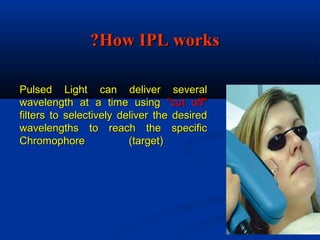
How IPL worksHow IPL works??
Pulsed Light can deliver severalPulsed Light can deliver several
wavelength at a time usingwavelength at a time using "cut off""cut off"
filters to selectively deliver the desiredfilters to selectively deliver the desired
wavelengths to reach the specificwavelengths to reach the specific
Chromophore (target)Chromophore (target)
How IPL worksHow IPL works??
IPL emits wavelengths of light from 400 to 1200 -1900IPL emits wavelengths of light from 400 to 1200 -1900
nm.nm.
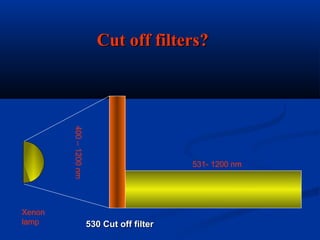
Cut off filtersCut off filters block light shorter than the wavelength ofblock light shorter than the wavelength of
the cut off filter.the cut off filter.
For example:For example: a 550 nm cut off filter blocks light froma 550 nm cut off filter blocks light from
550 nm, and only allows wavelengths from 551 to 1200550 nm, and only allows wavelengths from 551 to 1200
nm.nm.
How IPL worksHow IPL works??
Cut off filtersCut off filters??
Xenon
lamp 530 Cut off filter530 Cut off filter
400–1200nm
531- 1200 nm
When can Intense Pulsed Light beWhen can Intense Pulsed Light be
performedperformed??
There is no definite age regardingThere is no definite age regarding
IPL therapy.IPL therapy.
Does Intense Pulsed Light hurtDoes Intense Pulsed Light hurt??
 Sensation of warmth sting or as a rubberSensation of warmth sting or as a rubber
band snap - individual variation – site.band snap - individual variation – site.
 EMLA cream.EMLA cream.
 Chill gel .Chill gel .
Anaesthesia with IPL treatmentAnaesthesia with IPL treatment
 LocalLocal EMLA cream produce a significant reductionEMLA cream produce a significant reduction
to pain.to pain.
Excessive Use of Topical Anesthetics Can BeExcessive Use of Topical Anesthetics Can Be
FatalFatal (FDA warning Feb 2007)(FDA warning Feb 2007)
 Cold air currentCold air current
 Chill gelChill gel
Simpler to operate than laserSimpler to operate than laser
It interacts to tissue similarly to laserIt interacts to tissue similarly to laser
It has a bigger spot size than any laser, largerIt has a bigger spot size than any laser, larger
areas could be treated very quicklyareas could be treated very quickly
Can treat a wider range of skin type, hair type.Can treat a wider range of skin type, hair type.
Not as powerful as most lasers and mayNot as powerful as most lasers and may
possibly need more treatments to obtain samepossibly need more treatments to obtain same
results.results.
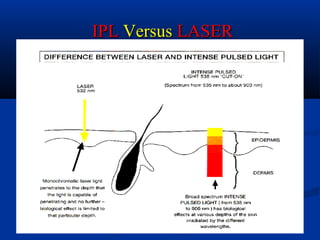
IPLIPL VersusVersus LASERLASER
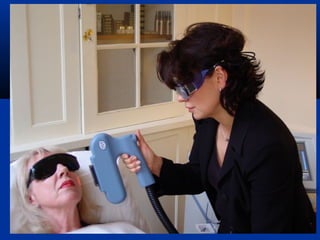
How is IPL performedHow is IPL performed??
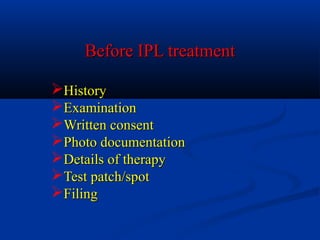
Before IPL treatmentBefore IPL treatment
HistoryHistory
ExaminationExamination
Written consentWritten consent
Photo documentationPhoto documentation
Details of therapyDetails of therapy
Test patch/spotTest patch/spot
FilingFiling
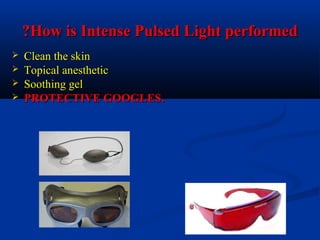
How is Intense Pulsed Light performedHow is Intense Pulsed Light performed??
 Clean the skinClean the skin
 Topical anestheticTopical anesthetic
 Soothing gelSoothing gel
 PROTECTIVE GOOGLES.PROTECTIVE GOOGLES.
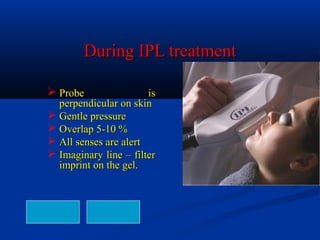
During IPL treatmentDuring IPL treatment
 Probe isProbe is
perpendicular on skinperpendicular on skin
 Gentle pressureGentle pressure
 Overlap 5-10 %Overlap 5-10 %
 All senses are alertAll senses are alert
 Imaginary line – filterImaginary line – filter
imprint on the gel.imprint on the gel.
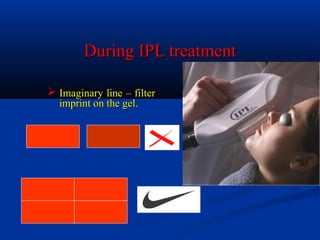
During IPL treatmentDuring IPL treatment
 Imaginary line – filterImaginary line – filter
imprint on the gel.imprint on the gel.
Hazard classification schemeHazard classification scheme
Class I:Class I: No hazardNo hazard
Class II:Class II: < 1mW Human aversion is normally< 1mW Human aversion is normally
sufficient protection (as looking away).sufficient protection (as looking away).
Class III A:Class III A: 1-5 mW Hazardous only if someone1-5 mW Hazardous only if someone
looks directly at the laser beam.looks directly at the laser beam.
Class III B:Class III B: 5-500 mW Diffuse scattering beams are5-500 mW Diffuse scattering beams are
dangerous Generally is not a fire hazard.dangerous Generally is not a fire hazard.
Class IV:Class IV: high power: Even diffuse scattering ishigh power: Even diffuse scattering is
dangerous to the eyes.dangerous to the eyes.
Potential fire hazard.Potential fire hazard.
Potential skin hazard.Potential skin hazard.
IPL hazards and safetyIPL hazards and safety
1. Eye hazards1. Eye hazards
2. Inhalation hazards2. Inhalation hazards
3. Electrical hazards3. Electrical hazards
4.4. Skin safetySkin safety
5. Fire hazard5. Fire hazard
Precautions to be considered withPrecautions to be considered with
laser and IPL ttt.laser and IPL ttt.
 Dark skin typeDark skin type
 Cooling ……. Epidermal protection.Cooling ……. Epidermal protection.
 Wavelength (appropriate cut off filter).Wavelength (appropriate cut off filter).
 Pulse duration.Pulse duration.
 Energy density.Energy density.
 Sun light …….. Heat exposure after ttt…. SunSun light …….. Heat exposure after ttt…. Sun
block ….. Local steroid & antibioticblock ….. Local steroid & antibiotic
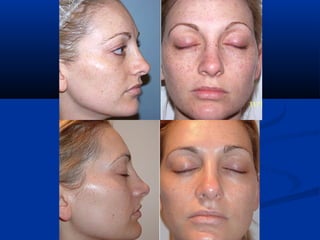
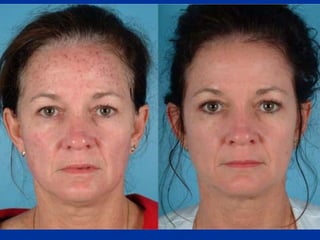
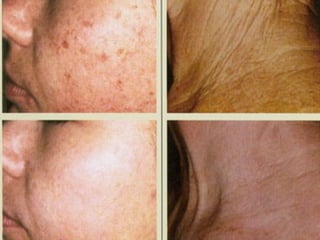
WHAT CAN IPL TREATWHAT CAN IPL TREAT??
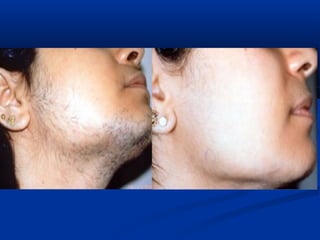
 Hair epilation - (except for white hair)Hair epilation - (except for white hair)
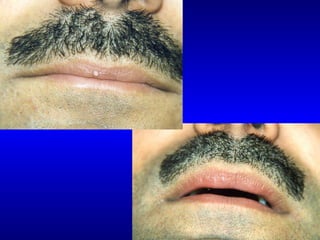
 Psudofolliculitis barbaePsudofolliculitis barbae
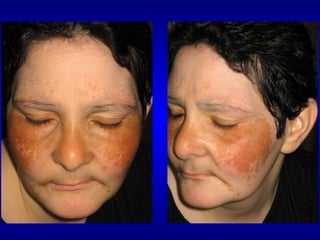
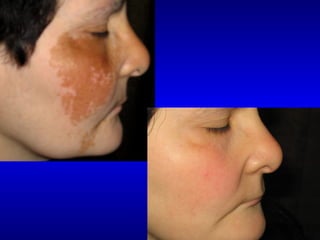
 Rosacea Facial Blood Vessels including PWSRosacea Facial Blood Vessels including PWS
& Hemangiomas& Hemangiomas
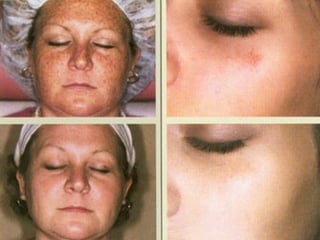
 Pyogenic granulomaPyogenic granuloma Freckles - Sun DamageFreckles - Sun Damage
- Wrinkles- Wrinkles (Non Ablative Resurfacing)(Non Ablative Resurfacing)
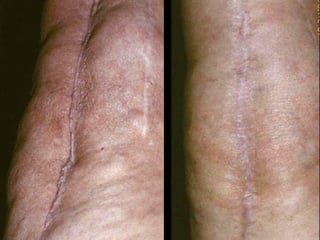
 Scars – atrophic – hypertrophic- keloidScars – atrophic – hypertrophic- keloid
 CelluliteCellulite
 AcneAcne
 Acne and PDTAcne and PDT
 TattoosTattoos
Non-ablative ResurfacingNon-ablative Resurfacing
Nonablative resurfacing induces collagen remodeling byNonablative resurfacing induces collagen remodeling by
creation of a dermal wound without disruption of thecreation of a dermal wound without disruption of the
epidermis.epidermis.
 585- and 595-nm PDL585- and 595-nm PDL
 1064-nm Nd:YAG,1064-nm Nd:YAG,
 1320-nm Nd:YAG,1320-nm Nd:YAG,
 1450-nm diode, and 1540-nm1450-nm diode, and 1540-nm
 Er:glass lasers.Er:glass lasers.
 QS 1064-nm Nd:YAG laserQS 1064-nm Nd:YAG laser
 IPLIPL
Side effects mild and limited to transient edema, erythema,Side effects mild and limited to transient edema, erythema,
and postinflammatory hyperpigmentation.and postinflammatory hyperpigmentation.
Side effects.Side effects.
Side effectsSide effects..
Dark Skin typeDark Skin type
Over doseOver dose
Pulse durationPulse duration
Cooling of the skinCooling of the skin
Solar or heat exposureSolar or heat exposure
Test patch/spotTest patch/spot
Patient selectionPatient selection
DrugsDrugs
Thank youThank you
Yasser A. Hamed M.DYasser A. Hamed M.D
Al-Azhar universityAl-Azhar university
Research Associate Minneapolis University Minnesota USAResearch Associate Minneapolis University Minnesota USA
lasercairo@yahoo.comlasercairo@yahoo.com
Other and new LASEROther and new LASER
indicationsindications
Laser and Photodynamic therapyLaser and Photodynamic therapy
(PDT) ?(PDT) ?
Laser and Photodynamic therapyLaser and Photodynamic therapy
(PDT)?(PDT)?
PDT uses laser, or other light sources, combinedPDT uses laser, or other light sources, combined
with a light-sensitive drug (sometimes called awith a light-sensitive drug (sometimes called a
photosensitising agent).photosensitising agent).
A photosensitising agent is a drug that makes cellsA photosensitising agent is a drug that makes cells
more sensitive to light.more sensitive to light.
Laser and Photodynamic therapyLaser and Photodynamic therapy
(PDT)?(PDT)?
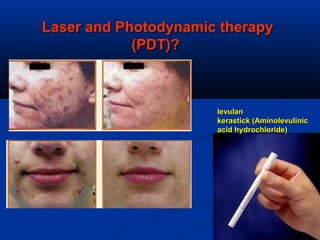
levulanlevulan
kerastick (Aminolevulinickerastick (Aminolevulinic
acid hydrochloride)acid hydrochloride)
Laser and PDT?Laser and PDT?
 NonablativeNonablative skin resurfacingskin resurfacing: the role of PDT.: the role of PDT.
J Drugs Dermatol. 2006J Drugs Dermatol. 2006
 PDT in the treatment ofPDT in the treatment of photodamagedphotodamaged facial skin.facial skin.
skin.Lasers Surg Med. 2007skin.Lasers Surg Med. 2007
 intense pulsed light with PDT for the treatment of facialintense pulsed light with PDT for the treatment of facial acneacne
Lasers Surg Med. 2007Lasers Surg Med. 2007
 PDT treatment ofPDT treatment of Bowen'sBowen's disease.disease.
Br J Dermatol. 2005Br J Dermatol. 2005
 PDT Actinic keratoses, basal cell carcinoma, andPDT Actinic keratoses, basal cell carcinoma, and SCCSCC uncommon treatments.uncommon treatments.
Clin Dermatol. 2005Clin Dermatol. 2005
 Topical 5-aminolevulinic acid therapy of superficialTopical 5-aminolevulinic acid therapy of superficial BCCBCC..
Acta Derm Venereol. 2006Acta Derm Venereol. 2006
 PDT ofPDT of nodular basal cell carcinomanodular basal cell carcinoma..
J Environ Pathol Toxicol Oncol. 2006J Environ Pathol Toxicol Oncol. 2006
 PDT to treat AIDS-relatedPDT to treat AIDS-related Kaposi'sKaposi's sarcoma.sarcoma.
Photomed Laser Surg. 2006Photomed Laser Surg. 2006..
 PDT with systemic photosensitizer forPDT with systemic photosensitizer for nonmelanomanonmelanoma skin cancers .skin cancers .
Dermatol Surg. 2007Dermatol Surg. 2007
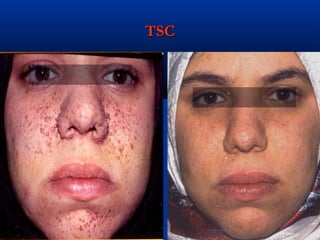
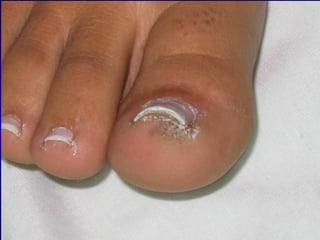
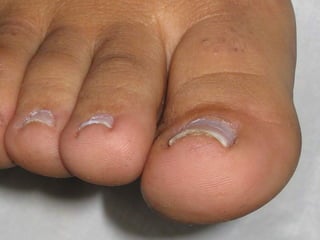
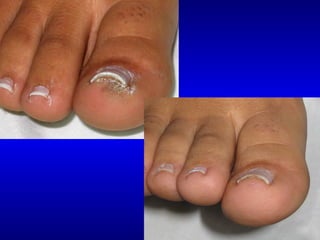
TSCTSC
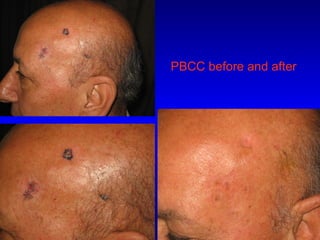
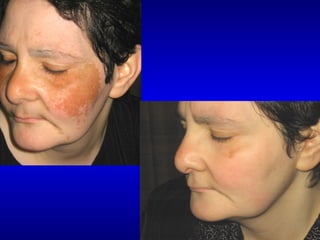
PBCC before and after
Laser phototherapyLaser phototherapy
 UV phototherapyUV phototherapy
 PUVAPUVA
 KUVAKUVA
 Narrow band UVB 311 nmNarrow band UVB 311 nm
 Recently 308-nm xenon chloride excimer laserRecently 308-nm xenon chloride excimer laser

Introduction to laser dermatology 1

  • 2.
    Yasser A. HamedM.DYasser A. Hamed M.D Al-Azhar universityAl-Azhar university Research Associate Minneapolis University Minnesota USAResearch Associate Minneapolis University Minnesota USA lasercairo@yahoo.comlasercairo@yahoo.com Principles of CoherentPrinciples of Coherent andand Non-Coherent light therapy.Non-Coherent light therapy.
  • 3.
    Yasser A. HamedM.DYasser A. Hamed M.D Al-Azhar universityAl-Azhar university Research Associate Minneapolis University Minnesota USAResearch Associate Minneapolis University Minnesota USA lasercairo@yahoo.comlasercairo@yahoo.com Principles of laser photo-Principles of laser photo- rejuvenation and scar treatment.rejuvenation and scar treatment.
  • 4.
    Intense Pulsed LightIntensePulsed Light (IPL)(IPL) Is it the future ?Is it the future ? YYasserasser A.A. HHamedamed M.DM.D Al-Azhar university Cairo – Egypt.Al-Azhar university Cairo – Egypt. Research Associate Minneapolis Minnesota USAResearch Associate Minneapolis Minnesota USA lasercairo@yahoo.comlasercairo@yahoo.com
  • 5.
    Yasser A. HamedM.DYasser A. Hamed M.D Al-Azhar universityAl-Azhar university Research Associate Minneapolis University Minnesota USAResearch Associate Minneapolis University Minnesota USA lasercairo@yahoo.comlasercairo@yahoo.com Principles of CoherentPrinciples of Coherent andand Non-Coherent light therapy.Non-Coherent light therapy.
  • 6.
  • 8.
    LASER as aScience fictionLASER as a Science fiction Light as a weapon was first mentioned in 1898 in a fictionLight as a weapon was first mentioned in 1898 in a fiction storystory “The War of the Worlds”“The War of the Worlds”, written by, written by Herbert GeorgeHerbert George Wells (1866 – 1946).Wells (1866 – 1946). English authorEnglish author H. G. WellsH. G. Wells
  • 9.
    LASERLASER It was until1916It was until 1916 Albert EinsteinAlbert Einstein (1879–1955)(1879–1955) developed the basic fundamental concepts theories fordeveloped the basic fundamental concepts theories for the development of masers and lasers.the development of masers and lasers.
  • 10.
    What is LASER?What is LASER ?
  • 11.
    LASERLASER Laser is anacronymLaser is an acronym LL LightLight AA AmplificationAmplification SS StimulatedStimulated EE EmissionEmission RR RadiationRadiation
  • 13.
    Electromagnetic spectrumElectromagnetic spectrum Laserlight follows the basic properties of andLaser light follows the basic properties of and electromagnetic radiation.electromagnetic radiation. Light is composed ofLight is composed of “Photons”“Photons” propagating in waves.propagating in waves.
  • 14.
    Characters of LaserlightCharacters of Laser light Each electromagnetic wave has aEach electromagnetic wave has a “Wavelength”“Wavelength” = distance= distance between 2 peaks measured inbetween 2 peaks measured in “nm”“nm”, “, “Amplitude”Amplitude” is the heightis the height of one peak andof one peak and “Frequency”“Frequency” which is the number of cycleswhich is the number of cycles per secondper second “hertz”“hertz” LLASERASER
  • 15.
    Characters of LaserlightCharacters of Laser light MonochromaticMonochromatic waves have the same colorwaves have the same color CoherentCoherent waves of energy travel through thewaves of energy travel through the space and time in a definite phase inspace and time in a definite phase in relationship with one another.relationship with one another. CollimatedCollimated waves are parallel that can travel awaves are parallel that can travel a long distances without deviationlong distances without deviation
  • 16.
    Stimulated EmissionStimulated Emission In1953 by American physicistsIn 1953 by American physicists Charles H. TownesCharles H. Townes andand A. L. SchawlowA. L. Schawlow,, to built the firstto built the first MASERMASER basedbased on this principle.on this principle. LALASESERR Charles H. Townes (left), winnerCharles H. Townes (left), winner of the 1964 Nobel Prize forof the 1964 Nobel Prize for Physics, and James P. GordonPhysics, and James P. Gordon in 1955 with the firstin 1955 with the first MASERMASER..
  • 17.
    Stimulated EmissionStimulated Emission SpontaneousEmissionSpontaneous Emission Electrons in higher energy levelsElectrons in higher energy levels if it is bombarded by a photon,if it is bombarded by a photon,  lower energy levellower energy level (ground(ground state)state)  emits a photon.emits a photon. LALASESERR
  • 18.
    Stimulated EmissionStimulated Emission SpontaneousEmissionSpontaneous Emission To produce stimulated emissionTo produce stimulated emission atoms should be in the higheratoms should be in the higher unstable energy levels byunstable energy levels by energizing laser chamber with aenergizing laser chamber with a flash lamp.flash lamp. This process is calledThis process is called “population“population inversion”inversion” which end in thewhich end in the production of 2 photons sameproduction of 2 photons same wavelength but with differentwavelength but with different random directionsrandom directions LALASESERR
  • 19.
    AmplificationAmplification Photons reflect forwardsand backwards due toPhotons reflect forwards and backwards due to mirrors.mirrors. one photonone photon strikes an energized atom tostrikes an energized atom to releaserelease two photonstwo photons and so on = amplification ofand so on = amplification of stimulated emission.stimulated emission. LLAASERSER
  • 20.
    RadiationRadiation Laser is differentthanLaser is different than X-ray, cosmic rays, orX-ray, cosmic rays, or gamma raysgamma rays == ionizing radiationionizing radiation affect theaffect the molecular structure = cancer, while the laser lightmolecular structure = cancer, while the laser light isis aa non-ionizing radiationnon-ionizing radiation.. LASELASERR
  • 21.
    Laser componentsLaser components Opticalcavity or the resonating tube:Optical cavity or the resonating tube: where the amplification of stimulated emissionwhere the amplification of stimulated emission occurs.occurs. Laser medium:Laser medium: This could be solid, liquid, or gas.This could be solid, liquid, or gas. Energy source:Energy source: which pumps energy to the laser medium towhich pumps energy to the laser medium to produce the population inversion.produce the population inversion. Wave-guide:Wave-guide: as fiber-optic cable.as fiber-optic cable.
  • 22.
  • 23.
    When the skinis exposed to LASER, it could beWhen the skin is exposed to LASER, it could be transmittedtransmitted, or, or scatteredscattered by the skin structures, orby the skin structures, or absorbedabsorbed by theby the chromophoreschromophores.. Chromophores asChromophores as oxyhemoglobin, melanin, tattoooxyhemoglobin, melanin, tattoo ink or water.ink or water.
  • 24.
    Grothus-Draper photobiology lawGrothus-Draperphotobiology law Light should be absorbed to have a tissue effectLight should be absorbed to have a tissue effect if there is no light absorption there will be noif there is no light absorption there will be no effect.effect. Absorption is controlled byAbsorption is controlled by wavelengthwavelength of laserof laser and theand the chromophore.chromophore.
  • 26.
    Theory of selectivephotothermolysisTheory of selective photothermolysis In 1983 Drs.In 1983 Drs. R.A. AndersonR.A. Anderson andand J. A. ParrishJ. A. Parrish proposed this theory where a chromophore can beproposed this theory where a chromophore can be selectively damaged with a light pulse of anselectively damaged with a light pulse of an appropriateappropriate wavelengthwavelength andand suitable pulse durationsuitable pulse duration shorter than theshorter than the thermal relaxation timethermal relaxation time of thatof that chromophore.chromophore.
  • 27.
    Thermal relaxation timeThermalrelaxation time It is time of an object to loose heat energy to theIt is time of an object to loose heat energy to the surroundings through thermal diffusionsurroundings through thermal diffusion ((The time toThe time to disperse the heat absorbed during a laser pulse.)disperse the heat absorbed during a laser pulse.)
  • 28.
    Thermal relaxation timeThermalrelaxation time If aIf a chromophorechromophore is exposed to a laser for a timeis exposed to a laser for a time longerlonger than its thermal relaxation time it will resultthan its thermal relaxation time it will result in collateralin collateral thermal damagethermal damage andand increased risk ofincreased risk of complications.complications.
  • 29.
    Pulse durationPulse duration Itis the time the laser is in contact with the targetIt is the time the laser is in contact with the target cell (cell (ChromophoreChromophore).).
  • 30.
    Types of LasersTypesof Lasers GasGas Argon , CO2, Excimer laserArgon , CO2, Excimer laser DyeDye Pulsed dye laserPulsed dye laser SolidSolid Ruby, Nd YAG and Er YagRuby, Nd YAG and Er Yag SemiconductorSemiconductor Diode laserDiode laser Laser light can be delivered inLaser light can be delivered in pulsespulses,, continuouscontinuous wave, orwave, or pseudo-continuouspseudo-continuous wave forms.wave forms.
  • 31.
    Laser Photo effectLaserPhoto effect  Photo thermalPhoto thermal  Photo AcousticPhoto Acoustic  Photo chemicalPhoto chemical
  • 32.
    Laser parametersLaser parameters Energyfluence (Energy density)Energy fluence (Energy density) Joules/cmJoules/cm22 = energy delivered to a given unit area for each= energy delivered to a given unit area for each single pulse.single pulse. Irradiance (Power density)Irradiance (Power density) (Watt/cm(Watt/cm22 )) = rate of energy delivery = intensity of the energy= rate of energy delivery = intensity of the energy delivered.delivered.
  • 33.
    Efficacy of laserdepends upon:Efficacy of laser depends upon:  The target chromophoreThe target chromophore  WavelengthWavelength  Pulse durationPulse duration  Energy densityEnergy density
  • 34.
    Target chromophoresTarget chromophores asOxyhemoglobin, Melanin, tattoo ink or water.as Oxyhemoglobin, Melanin, tattoo ink or water.  The target chromophoreThe target chromophore  WavelengthWavelength  Pulse durationPulse duration  Energy densityEnergy density
  • 35.
    WavelengthWavelength Why sunset isWhysunset is Red ?Red ? Why stop car lights areWhy stop car lights are in red color ?in red color ? air scatter blue light from the sun more than they scatter red light.  The target chromophoreThe target chromophore  WavelengthWavelength  Pulse durationPulse duration  Energy densityEnergy density
  • 36.
  • 37.
    Longer wavelengthsLonger wavelengthspenetrate deeper into the target,penetrate deeper into the target, longer wavelengths are used to treat deeper targets of skin.longer wavelengths are used to treat deeper targets of skin. Shorter wavelengthsShorter wavelengths are used to treat more superficialare used to treat more superficial targets and avoid damaging deeper skin partstargets and avoid damaging deeper skin parts.. WavelengthWavelength
  • 38.
    Optical window ofthe skinOptical window of the skin Short wavelengthShort wavelength will limit the penetration depth ofwill limit the penetration depth of the beam due to limitation by the strong scatteringthe beam due to limitation by the strong scattering effect.effect. Longer wavelengthLonger wavelength, the scattering effect of the light, the scattering effect of the light is minimalis minimal  deeper penetration of the lightdeeper penetration of the light and itand it allows treatment of a deep dermal lesionallows treatment of a deep dermal lesion “optical“optical window”window”
  • 39.
    Pulse durationPulse duration Itis the time the laser is in contact with the targetIt is the time the laser is in contact with the target cell (cell (ChromophoreChromophore).). ShortShort exposure timeexposure time  minimal heating of theminimal heating of the targettarget  no effectno effect.. LongLong exposure timeexposure time  transfer of the heattransfer of the heat produced by conduction to adjacent tissuesproduced by conduction to adjacent tissues  complicationscomplications as scarring, atrophy, or pigmentationas scarring, atrophy, or pigmentation  The target chromophoreThe target chromophore  WavelengthWavelength  Pulse durationPulse duration  Energy densityEnergy density
  • 40.
    Energy density (Energyfluence)Energy density (Energy fluence) As the energy increases the amount of the clinicalAs the energy increases the amount of the clinical effect / complications is also increased and viceeffect / complications is also increased and vice versa.versa.  The target chromophoreThe target chromophore  WavelengthWavelength  Pulse durationPulse duration  Energy densityEnergy density
  • 41.
    Anaesthesia with laserAnaesthesiawith laser  Without anaesthesia “Rubber sting”Without anaesthesia “Rubber sting”  LocalLocal EMLA cream produce a significant reductionEMLA cream produce a significant reduction in laser-induced pain.in laser-induced pain. Excessive Use of Topical Anesthetics Can BeExcessive Use of Topical Anesthetics Can Be FatalFatal (FDA warning Feb 2007)(FDA warning Feb 2007)  GeneralGeneral  Cold air currentCold air current  Chill gelChill gel  DCDDCD
  • 42.
    Laser hazard classificationschemeLaser hazard classification scheme Class I:Class I: No hazardNo hazard Class II:Class II: < 1mW Human aversion is normally< 1mW Human aversion is normally sufficient protection (as looking away).sufficient protection (as looking away). Class III A:Class III A: 1-5 mW Hazardous only if someone1-5 mW Hazardous only if someone looks directly at the laser beam.looks directly at the laser beam. Class III B:Class III B: 5-500 mW Diffuse scattering beams are5-500 mW Diffuse scattering beams are dangerous Generally is not a fire hazard.dangerous Generally is not a fire hazard. Class IV:Class IV: high power: Even diffuse scattering ishigh power: Even diffuse scattering is dangerous to the eyes.dangerous to the eyes. Potential fire hazard.Potential fire hazard. Potential skin hazard.Potential skin hazard.
  • 44.
    Laser hazards andsafetyLaser hazards and safety 1. Eye hazards1. Eye hazards 2. Inhalation hazards2. Inhalation hazards 3. Electrical hazards3. Electrical hazards 4.4. Dye safetyDye safety 5.5. Skin safetySkin safety 6. Fire hazard6. Fire hazard
  • 47.
    Does laser inactivatebotulinum toxin?Does laser inactivate botulinum toxin?  Patients may be treated with several nonablativePatients may be treated with several nonablative lasers and IPL or RF devices immediately afterlasers and IPL or RF devices immediately after botulinum toxin injection without loss of efficacy orbotulinum toxin injection without loss of efficacy or other apparent adverseother apparent adverse effect.effect. Dermatol Surg. 2005 Apr;31(4):399-404Dermatol Surg. 2005 Apr;31(4):399-404.
  • 48.
    Does laser affectFillers?Does laser affect Fillers? ??????????????????
  • 49.
    How is laserperformedHow is laser performed??
  • 50.
    How is LASERperformed?How is LASER performed? Before treatmentBefore treatment  Clean the skinClean the skin  Topical anestheticTopical anesthetic  Soothing gelSoothing gel  PROTECTIVE GOOGLES.PROTECTIVE GOOGLES.
  • 51.
    During LASER treatmentDuringLASER treatment  Probe is perpendicular onProbe is perpendicular on skinskin  Gentle pressureGentle pressure  All senses are alertAll senses are alert  Stretch the skin.Stretch the skin.  Vacuum for fumes – virusVacuum for fumes – virus filter.filter.  Overlap 10-20 %Overlap 10-20 %  Imaginary line.Imaginary line.
  • 52.
    During LASER treatmentDuringLASER treatment  Imaginary lineImaginary line  Overlap 10 – 20 %Overlap 10 – 20 %
  • 53.
    After LASER treatmentAfterLASER treatment Cold or ice packs.Cold or ice packs. Local steroid + antibiotic.Local steroid + antibiotic. Topical non-steroid soothing cream.Topical non-steroid soothing cream. Avoid direct sun or heat exposure.Avoid direct sun or heat exposure. Physical and chemical sun screen.Physical and chemical sun screen.
  • 58.
  • 59.
    Side effectsSide effects.. BurnBurn Postinflammatory hyper – hypoPost inflammatory hyper – hypo pigmentation.pigmentation. Scar formation.Scar formation.
  • 60.
    Principles of laserphoto-Principles of laser photo- rejuvenation and scar treatment.rejuvenation and scar treatment.
  • 62.
    What is Photorejuvenation ?What is Photo rejuvenation ? This approach is based on the concept that gentleThis approach is based on the concept that gentle application of a variety of wavelengths in the visible andapplication of a variety of wavelengths in the visible and infrared spectra stimulates new collagen and perhapsinfrared spectra stimulates new collagen and perhaps produces new elastic fiber that rejuvenates photoagedproduces new elastic fiber that rejuvenates photoaged skin.skin.
  • 64.
    Laser treatment forhypertrophicLaser treatment for hypertrophic scars, keloids, and striaescars, keloids, and striae CW lasersCW lasers COCO22 , Er YAG no advantage over scalpel, Er YAG no advantage over scalpel excision.excision. high rates of recurrence and other side effects includinghigh rates of recurrence and other side effects including pain, atrophy, and dyspigmentationpain, atrophy, and dyspigmentation Flash Lamp Pulsed Dye LaserFlash Lamp Pulsed Dye Laser Significant improvement in scar surface texture,Significant improvement in scar surface texture, erythema, height, and flexibility.erythema, height, and flexibility.
  • 65.
  • 68.
  • 69.
  • 71.
    Longer wavelengthsLonger wavelengthspenetrate deeper into the target,penetrate deeper into the target, longer wavelengths are used to treat deeper targets of skin.longer wavelengths are used to treat deeper targets of skin. Shorter wavelengthsShorter wavelengths are used to treat more superficialare used to treat more superficial targets and avoid damaging deeper skin partstargets and avoid damaging deeper skin parts.. WavelengthWavelength
  • 72.
    Ablative laser systemsAblativelaser systems (working(working hardhard or working smart)or working smart)  COCO22 laserlaser emits a continuous-wave 10,600 nmemits a continuous-wave 10,600 nm  Er:YAG short-pulsed 2940-nmEr:YAG short-pulsed 2940-nm Complications are numerousComplications are numerous  Postoperative erythema, edemaPostoperative erythema, edema  Bacterial and viral infectionBacterial and viral infection  Pigmentary alterationPigmentary alteration  EctropionEctropion  Hypertrophic scar formationHypertrophic scar formation
  • 73.
    Non-ablative laser systemsNon-ablativelaser systems (working(working smartsmart or working hardor working hard Titan-CTitan-C)) Nonablative laser resurfacing induces collagenNonablative laser resurfacing induces collagen remodeling by creation of a dermal wound withoutremodeling by creation of a dermal wound without disruption of the epidermis.disruption of the epidermis.  585 - and 595-nm PDL585 - and 595-nm PDL  1064 nm Nd:YAG.1064 nm Nd:YAG.  1320-nm Nd:YAG.1320-nm Nd:YAG.  1450-nm diode, and 1540-nm.1450-nm diode, and 1540-nm.  Er:glass lasers.Er:glass lasers.  QS 1064-nm Nd:YAG laser.QS 1064-nm Nd:YAG laser.  IPL.IPL. Side effects:Side effects: mild and limited to transient edema,mild and limited to transient edema, erythema, and post-inflammatory hyperpigmentation.erythema, and post-inflammatory hyperpigmentation.
  • 74.
    Non-ablative laser systemsNon-ablativelaser systems Radio FrequencyRadio Frequency ((RFRF))  RF treatment was very satisfactory for skin tighteningRF treatment was very satisfactory for skin tightening Lasers Surg Med. 2005.Lasers Surg Med. 2005.  The technique was found to produce gradual tightening in most patients,The technique was found to produce gradual tightening in most patients, and there were no adverse effectsand there were no adverse effects J CosmetJ Cosmet Laser Ther. 2005Laser Ther. 2005  Nonsurgical tightening of skin laxity: a new radiofrequency approach.Nonsurgical tightening of skin laxity: a new radiofrequency approach. J Drugs Dermatol. 2007 Apr;6(4):381-6.J Drugs Dermatol. 2007 Apr;6(4):381-6. RF affects the deeper dermis and subcutaneousRF affects the deeper dermis and subcutaneous layers, causing tightening in texture or fine wrinkling.layers, causing tightening in texture or fine wrinkling.
  • 75.
    Non-ablative laser systemsNon-ablativelaser systems ((Fractional laserFractional laser)) Fractional laser 1,550nm Erbium glass fiber laser -------Fractional laser 1,550nm Erbium glass fiber laser ------- microthermal zonesmicrothermal zones (MTZs)(MTZs) of tissue coagulationof tissue coagulation ------- collagen remodeling and new collagen------- collagen remodeling and new collagen formation.formation.  Pain.Pain.  Cooling.Cooling. • Fractional Laser treatment for pigmentation and texture improvement. Skin Therapy Lett. 2006 Nov;11(9):7-11. • Fractional photothermolysis: treatment of facial and nonfacial cutaneous photodamage with a 1,550-nm erbium-doped fiber laser. Dermatol Surg. 2007 Jan;33(1):23-8. • Fractional photothermolysis : A new option for treating melasma? •Hautarzt. 2008 Feb;59(2):92-100.
  • 76.
  • 77.
    Non-ablative laser systemsNon-ablativelaser systems ((Fractional laserFractional laser))
  • 78.
    Non-ablative laser systemsNon-ablativelaser systems ((Fractional laserFractional laser)) improve skin texture and discoloration with a minimal amount of downtime. Skin remains intact allowing for a quick recovery.
  • 80.
    TheThe FRACTIONALFRACTIONAL CO2CO2laser delivers microscopic holes 0.3mmlaser delivers microscopic holes 0.3mm columns pixel like fashion of 10600nm, penetratingcolumns pixel like fashion of 10600nm, penetrating 20%20% of skinof skin surface area right next to each other. The othersurface area right next to each other. The other 80%80% of non-ablatedof non-ablated skin surface areas facilitate faster healing.skin surface areas facilitate faster healing.
  • 81.
  • 82.
  • 83.
  • 84.
  • 85.
    Advantage of FractionalAdvantageof Fractional LaserLaser
  • 86.
     Relatively shortdowntime, typically 4-6 daysRelatively short downtime, typically 4-6 days  Minimal discomfort as only topical anesthetics neededMinimal discomfort as only topical anesthetics needed  Safe and effective for virtually all skin surface areasSafe and effective for virtually all skin surface areas including face, neck, chest, back, arms and handsincluding face, neck, chest, back, arms and hands  Cosmetic appearance continues to improve withCosmetic appearance continues to improve with stimulation of collagen production up to 6 months afterstimulation of collagen production up to 6 months after procedureprocedure
  • 88.
  • 90.
    Intense Pulsed LightIntensePulsed Light (IPL)(IPL) Is it the future ?Is it the future ? YYasserasser A.A. HHamedamed M.DM.D Al-Azhar university Cairo – Egypt.Al-Azhar university Cairo – Egypt. Research Associate Minneapolis Minnesota USAResearch Associate Minneapolis Minnesota USA lasercairo@yahoo.comlasercairo@yahoo.com
  • 91.
    The intense pulsedlight (IPL) sourceThe intense pulsed light (IPL) source is high-intensityis high-intensity XenonXenon light lamp.light lamp. IPL is unlike laser systems emitIPL is unlike laser systems emit polychromatic, noncoherent lightpolychromatic, noncoherent light within the 400 to 1900 nm portion ofwithin the 400 to 1900 nm portion of thethe electromagnetic spectrumelectromagnetic spectrum.. Intense Pulsed LightIntense Pulsed Light
  • 92.
    Electromagnetic spectrumElectromagnetic spectrum Lightfollows the basic properties of andLight follows the basic properties of and electromagneticelectromagnetic radiation.radiation. Light is composed ofLight is composed of “Photons”“Photons” propagating inpropagating in waves.waves.
  • 93.
    Light parametersLight parameters Eachelectromagnetic wave have aEach electromagnetic wave have a “Wavelength”“Wavelength” which is thewhich is the distance between two peaks measured indistance between two peaks measured in “nm”“nm”, “, “Amplitude”Amplitude” is the height of one peak andis the height of one peak and “Frequency”“Frequency” which is thewhich is the number of cycles per secondnumber of cycles per second “hertz”“hertz”
  • 94.
    Light tissue interactionLighttissue interaction When the skin is exposed to light, it could beWhen the skin is exposed to light, it could be transmittedtransmitted, or, or scatteredscattered by the skin structures, orby the skin structures, or absorbedabsorbed by theby the chromophoreschromophores.. Chromophores asChromophores as oxyhemoglobin, melanin, tattoooxyhemoglobin, melanin, tattoo ink or water.ink or water.
  • 95.
    Grothus-Draper photobiology lawGrothus-Draperphotobiology law Light should be absorbed to have a tissue effectLight should be absorbed to have a tissue effect if there is no light absorption there will be noif there is no light absorption there will be no effect.effect. Absorption is controlled byAbsorption is controlled by wavelengthwavelength of laserof laser and theand the chromophore.chromophore.
  • 96.
    Light parametersLight parameters Energyfluence (Energy density)Energy fluence (Energy density) Joules/cmJoules/cm22 is the amount of energy delivered to a given unitis the amount of energy delivered to a given unit area of tissue for each single pulse.area of tissue for each single pulse. Irradiance (Power density)Irradiance (Power density) (Watt/cm(Watt/cm22 )) is the rate of energy delivery to an object, itis the rate of energy delivery to an object, it describes the intensity of the energy delivered.describes the intensity of the energy delivered.
  • 97.
    Theory of selectivephotothermolysisTheory of selective photothermolysis In 1983 Drs.In 1983 Drs. R.A. AndersonR.A. Anderson andand J. A. ParrishJ. A. Parrish proposed the theory of selective photothermolysisproposed the theory of selective photothermolysis which states that a chromophore can be selectivelywhich states that a chromophore can be selectively damaged with a light pulse of an appropriatedamaged with a light pulse of an appropriate wavelengthwavelength andand suitable pulse durationsuitable pulse duration shortershorter than thethan the thermal relaxation timethermal relaxation time of thatof that chromophore.chromophore.
  • 98.
    Thermal relaxation timeThermalrelaxation time It is time of an object to loose heat energy to theIt is time of an object to loose heat energy to the surroundings through thermal diffusion.surroundings through thermal diffusion. ((The time to disperse the heat absorbed after lightThe time to disperse the heat absorbed after light exposure)exposure) If aIf a chromophorechromophore is exposed to a Pulse duration ofis exposed to a Pulse duration of laser or light timelaser or light time longerlonger than its thermal relaxationthan its thermal relaxation time it will result in collateraltime it will result in collateral thermal damagethermal damage andand increased risk of complications.increased risk of complications.
  • 99.
    Pulse durationPulse duration Itis the time the light is in contact with the targetIt is the time the light is in contact with the target cell (cell (ChromophoreChromophore).).
  • 100.
    Efficacy of lightdepends upon:Efficacy of light depends upon:  The target chromophoreThe target chromophore  WavelengthWavelength  Pulse durationPulse duration  Energy densityEnergy density
  • 101.
    Target chromophoresTarget chromophores asOxyhemoglobin, Melanin, tattoo ink or water.as Oxyhemoglobin, Melanin, tattoo ink or water.  The target chromophoreThe target chromophore  WavelengthWavelength  Pulse durationPulse duration  Energy densityEnergy density
  • 102.
    WavelengthWavelength Why sunset isWhysunset is Red ?Red ? Why stop car lights areWhy stop car lights are in red color ?in red color ? air scatter blue light from the sun more than they scatter red light.  The target chromophoreThe target chromophore  WavelengthWavelength  Pulse durationPulse duration  Energy densityEnergy density
  • 103.
    Longer wavelengthsLonger wavelengthspenetrate deeper into the target,penetrate deeper into the target, longer wavelengths are used to treat deeper targets of skin.longer wavelengths are used to treat deeper targets of skin. Shorter wavelengthsShorter wavelengths are used to treat more superficialare used to treat more superficial targets and avoid damaging deeper skin partstargets and avoid damaging deeper skin parts.. WavelengthWavelength
  • 104.
    Optical window ofthe skinOptical window of the skin Short wavelengthShort wavelength will limit the penetration depth ofwill limit the penetration depth of the beam due to limitation by the strong scatteringthe beam due to limitation by the strong scattering effect.effect. Longer wavelengthLonger wavelength, the scattering effect of the light, the scattering effect of the light is minimalis minimal  deeper penetration of the lightdeeper penetration of the light and itand it allows treatment of a deep dermal lesionallows treatment of a deep dermal lesion “optical“optical window”window”
  • 105.
    Pulse durationPulse duration Itis the time the laser is in contact with the targetIt is the time the laser is in contact with the target cell (cell (ChromophoreChromophore).). ShortShort exposure timeexposure time  minimal heating of theminimal heating of the targettarget  no effectno effect.. LongLong exposure timeexposure time  transfer of the heattransfer of the heat produced by conduction to adjacent tissuesproduced by conduction to adjacent tissues  complicationscomplications as scarring, atrophy, or pigmentationas scarring, atrophy, or pigmentation  The target chromophoreThe target chromophore  WavelengthWavelength  Pulse durationPulse duration  Energy densityEnergy density
  • 106.
    Energy density (Energyfluence)Energy density (Energy fluence) As the energy increases the amount of the clinicalAs the energy increases the amount of the clinical effect / complications is also increased and viceeffect / complications is also increased and vice versa.versa.  The target chromophoreThe target chromophore  WavelengthWavelength  Pulse durationPulse duration  Energy densityEnergy density
  • 107.
    IPL systems workon the same principle as lasersIPL systems work on the same principle as lasers Light is absorbed by the chromophores in the skin.Light is absorbed by the chromophores in the skin. Light energyLight energy  heat energyheat energy  thermal damagethermal damage to theto the specific targetspecific target chromophoreschromophores.. How IPL worksHow IPL works??
  • 108.
    Pulsed Light candeliver severalPulsed Light can deliver several wavelength at a time usingwavelength at a time using "cut off""cut off" filters to selectively deliver the desiredfilters to selectively deliver the desired wavelengths to reach the specificwavelengths to reach the specific Chromophore (target)Chromophore (target) How IPL worksHow IPL works??
  • 109.
    IPL emits wavelengthsof light from 400 to 1200 -1900IPL emits wavelengths of light from 400 to 1200 -1900 nm.nm. Cut off filtersCut off filters block light shorter than the wavelength ofblock light shorter than the wavelength of the cut off filter.the cut off filter. For example:For example: a 550 nm cut off filter blocks light froma 550 nm cut off filter blocks light from 550 nm, and only allows wavelengths from 551 to 1200550 nm, and only allows wavelengths from 551 to 1200 nm.nm. How IPL worksHow IPL works??
  • 110.
    Cut off filtersCutoff filters?? Xenon lamp 530 Cut off filter530 Cut off filter 400–1200nm 531- 1200 nm
  • 111.
    When can IntensePulsed Light beWhen can Intense Pulsed Light be performedperformed??
  • 112.
    There is nodefinite age regardingThere is no definite age regarding IPL therapy.IPL therapy.
  • 113.
    Does Intense PulsedLight hurtDoes Intense Pulsed Light hurt??  Sensation of warmth sting or as a rubberSensation of warmth sting or as a rubber band snap - individual variation – site.band snap - individual variation – site.  EMLA cream.EMLA cream.  Chill gel .Chill gel .
  • 114.
    Anaesthesia with IPLtreatmentAnaesthesia with IPL treatment  LocalLocal EMLA cream produce a significant reductionEMLA cream produce a significant reduction to pain.to pain. Excessive Use of Topical Anesthetics Can BeExcessive Use of Topical Anesthetics Can Be FatalFatal (FDA warning Feb 2007)(FDA warning Feb 2007)  Cold air currentCold air current  Chill gelChill gel
  • 115.
    Simpler to operatethan laserSimpler to operate than laser It interacts to tissue similarly to laserIt interacts to tissue similarly to laser It has a bigger spot size than any laser, largerIt has a bigger spot size than any laser, larger areas could be treated very quicklyareas could be treated very quickly Can treat a wider range of skin type, hair type.Can treat a wider range of skin type, hair type. Not as powerful as most lasers and mayNot as powerful as most lasers and may possibly need more treatments to obtain samepossibly need more treatments to obtain same results.results. IPLIPL VersusVersus LASERLASER
  • 116.
  • 117.
    How is IPLperformedHow is IPL performed??
  • 119.
    Before IPL treatmentBeforeIPL treatment HistoryHistory ExaminationExamination Written consentWritten consent Photo documentationPhoto documentation Details of therapyDetails of therapy Test patch/spotTest patch/spot FilingFiling
  • 120.
    How is IntensePulsed Light performedHow is Intense Pulsed Light performed??  Clean the skinClean the skin  Topical anestheticTopical anesthetic  Soothing gelSoothing gel  PROTECTIVE GOOGLES.PROTECTIVE GOOGLES.
  • 121.
    During IPL treatmentDuringIPL treatment  Probe isProbe is perpendicular on skinperpendicular on skin  Gentle pressureGentle pressure  Overlap 5-10 %Overlap 5-10 %  All senses are alertAll senses are alert  Imaginary line – filterImaginary line – filter imprint on the gel.imprint on the gel.
  • 122.
    During IPL treatmentDuringIPL treatment  Imaginary line – filterImaginary line – filter imprint on the gel.imprint on the gel.
  • 123.
    Hazard classification schemeHazardclassification scheme Class I:Class I: No hazardNo hazard Class II:Class II: < 1mW Human aversion is normally< 1mW Human aversion is normally sufficient protection (as looking away).sufficient protection (as looking away). Class III A:Class III A: 1-5 mW Hazardous only if someone1-5 mW Hazardous only if someone looks directly at the laser beam.looks directly at the laser beam. Class III B:Class III B: 5-500 mW Diffuse scattering beams are5-500 mW Diffuse scattering beams are dangerous Generally is not a fire hazard.dangerous Generally is not a fire hazard. Class IV:Class IV: high power: Even diffuse scattering ishigh power: Even diffuse scattering is dangerous to the eyes.dangerous to the eyes. Potential fire hazard.Potential fire hazard. Potential skin hazard.Potential skin hazard.
  • 125.
    IPL hazards andsafetyIPL hazards and safety 1. Eye hazards1. Eye hazards 2. Inhalation hazards2. Inhalation hazards 3. Electrical hazards3. Electrical hazards 4.4. Skin safetySkin safety 5. Fire hazard5. Fire hazard
  • 126.
    Precautions to beconsidered withPrecautions to be considered with laser and IPL ttt.laser and IPL ttt.  Dark skin typeDark skin type  Cooling ……. Epidermal protection.Cooling ……. Epidermal protection.  Wavelength (appropriate cut off filter).Wavelength (appropriate cut off filter).  Pulse duration.Pulse duration.  Energy density.Energy density.  Sun light …….. Heat exposure after ttt…. SunSun light …….. Heat exposure after ttt…. Sun block ….. Local steroid & antibioticblock ….. Local steroid & antibiotic
  • 128.
    WHAT CAN IPLTREATWHAT CAN IPL TREAT??  Hair epilation - (except for white hair)Hair epilation - (except for white hair)  Psudofolliculitis barbaePsudofolliculitis barbae  Rosacea Facial Blood Vessels including PWSRosacea Facial Blood Vessels including PWS & Hemangiomas& Hemangiomas  Pyogenic granulomaPyogenic granuloma Freckles - Sun DamageFreckles - Sun Damage - Wrinkles- Wrinkles (Non Ablative Resurfacing)(Non Ablative Resurfacing)  Scars – atrophic – hypertrophic- keloidScars – atrophic – hypertrophic- keloid  CelluliteCellulite  AcneAcne  Acne and PDTAcne and PDT  TattoosTattoos
  • 129.
    Non-ablative ResurfacingNon-ablative Resurfacing Nonablativeresurfacing induces collagen remodeling byNonablative resurfacing induces collagen remodeling by creation of a dermal wound without disruption of thecreation of a dermal wound without disruption of the epidermis.epidermis.  585- and 595-nm PDL585- and 595-nm PDL  1064-nm Nd:YAG,1064-nm Nd:YAG,  1320-nm Nd:YAG,1320-nm Nd:YAG,  1450-nm diode, and 1540-nm1450-nm diode, and 1540-nm  Er:glass lasers.Er:glass lasers.  QS 1064-nm Nd:YAG laserQS 1064-nm Nd:YAG laser  IPLIPL Side effects mild and limited to transient edema, erythema,Side effects mild and limited to transient edema, erythema, and postinflammatory hyperpigmentation.and postinflammatory hyperpigmentation.
  • 140.
  • 141.
    Side effectsSide effects.. DarkSkin typeDark Skin type Over doseOver dose Pulse durationPulse duration Cooling of the skinCooling of the skin Solar or heat exposureSolar or heat exposure Test patch/spotTest patch/spot Patient selectionPatient selection DrugsDrugs
  • 144.
  • 146.
    Yasser A. HamedM.DYasser A. Hamed M.D Al-Azhar universityAl-Azhar university Research Associate Minneapolis University Minnesota USAResearch Associate Minneapolis University Minnesota USA lasercairo@yahoo.comlasercairo@yahoo.com Other and new LASEROther and new LASER indicationsindications
  • 147.
    Laser and PhotodynamictherapyLaser and Photodynamic therapy (PDT) ?(PDT) ?
  • 148.
    Laser and PhotodynamictherapyLaser and Photodynamic therapy (PDT)?(PDT)? PDT uses laser, or other light sources, combinedPDT uses laser, or other light sources, combined with a light-sensitive drug (sometimes called awith a light-sensitive drug (sometimes called a photosensitising agent).photosensitising agent). A photosensitising agent is a drug that makes cellsA photosensitising agent is a drug that makes cells more sensitive to light.more sensitive to light.
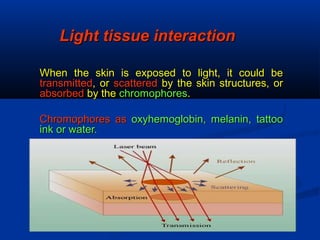
  • 149.
    Laser and PhotodynamictherapyLaser and Photodynamic therapy (PDT)?(PDT)? levulanlevulan kerastick (Aminolevulinickerastick (Aminolevulinic acid hydrochloride)acid hydrochloride)
  • 150.
    Laser and PDT?Laserand PDT?  NonablativeNonablative skin resurfacingskin resurfacing: the role of PDT.: the role of PDT. J Drugs Dermatol. 2006J Drugs Dermatol. 2006  PDT in the treatment ofPDT in the treatment of photodamagedphotodamaged facial skin.facial skin. skin.Lasers Surg Med. 2007skin.Lasers Surg Med. 2007  intense pulsed light with PDT for the treatment of facialintense pulsed light with PDT for the treatment of facial acneacne Lasers Surg Med. 2007Lasers Surg Med. 2007  PDT treatment ofPDT treatment of Bowen'sBowen's disease.disease. Br J Dermatol. 2005Br J Dermatol. 2005  PDT Actinic keratoses, basal cell carcinoma, andPDT Actinic keratoses, basal cell carcinoma, and SCCSCC uncommon treatments.uncommon treatments. Clin Dermatol. 2005Clin Dermatol. 2005  Topical 5-aminolevulinic acid therapy of superficialTopical 5-aminolevulinic acid therapy of superficial BCCBCC.. Acta Derm Venereol. 2006Acta Derm Venereol. 2006  PDT ofPDT of nodular basal cell carcinomanodular basal cell carcinoma.. J Environ Pathol Toxicol Oncol. 2006J Environ Pathol Toxicol Oncol. 2006  PDT to treat AIDS-relatedPDT to treat AIDS-related Kaposi'sKaposi's sarcoma.sarcoma. Photomed Laser Surg. 2006Photomed Laser Surg. 2006..  PDT with systemic photosensitizer forPDT with systemic photosensitizer for nonmelanomanonmelanoma skin cancers .skin cancers . Dermatol Surg. 2007Dermatol Surg. 2007
  • 151.
  • 160.
  • 164.
    Laser phototherapyLaser phototherapy UV phototherapyUV phototherapy  PUVAPUVA  KUVAKUVA  Narrow band UVB 311 nmNarrow band UVB 311 nm  Recently 308-nm xenon chloride excimer laserRecently 308-nm xenon chloride excimer laser

Editor's Notes