Case study of any one type of ownership pattern
of Indian media organisations
•What is Mass Media?
Mass Media is a medium to communicate the large masses whether oral, written
or through broadcast to a larger audience. There was a time when people use to
switch on the radio for listening bulletin information or pick up the newspaper for
reading daily headlines and information to know what is going on in the world all-
around with a cup of tea in their hand. But with time, technology has changed
and there are other media introduced to convey information to masses such as:
• Books and Magazines
• Televisions
• Internet videos
• Films and
• Documentaries
TYPES OF MASS MEDIA
1.Traditional Media
People have developed different ways of
communication depending upon their local
language and culture. Traditional media is
one of the oldest types of mass media to
transfer traditions and culture over
generations. The tools of communication
have been developed from beliefs,
customs, rituals, and practices of society.
Traditional media imparts indigenous ways
of communication for ages.
Forms of Traditional Media
Folk Dances , Folk Songs and Music
,Theatre, Drama, and Folktales
Painting, Sculptures, Inscriptions, Statues,
and Stupas
Motifs and Symbols
Nagada , Shadow Puppetry and String
Puppetry
Storytelling , Nautanki
2.Print Media
In simple words, print media is all about
the printed form of information and news.
Before the invention of the printing press,
printed materials had to be hand-written
that made mass distribution almost
impossible. Print media is one of the basic
types of mass media tools making it very
popular and convenient to reach a wider
audience.
Forms of Print Media
Newspapers (broadsheet and tabloid)
Periodicals, Newsletters, and Magazines
(general or specific interest)
Brochures, Leaflets and Pamphlets
Journals
Books, Novels and Comics
3;Electronic Broadcasting Media
Broadcasting is simply a distribution of audio and video content to a dispersed audience using
the electronic broadcasting medium. Originally the term ‘broadcasting’ referred to the sowing of
seeds on farms by scattering them over the large field. Broadcast media allows ease of news
dissemination to even an illiterate person because it appeals to both the auditory and visual
senses making it one of the most lucrative types of mass media.
Forms of Broadcasting Media
Television , Radio (AM, FM, Pirate Radio, Terrestrial Radio, and Satellite) , Traditional Telephone ,
Film/Movie/Motion Picture , Video Games , Audio Recording and Reproduction
4.New Media or Digital Media
Since the invention of the World Wide Web by English scientist Tim Berners-Lee in 1989, the Internet has
drastically taken over all the types of mass media because of faster dissemination speed and higher
digital technology. New Media is an interactive two-way communication with users being the active
producers of content and information.
New Media is normally a re-conceptualization of the existing media. This is a rapidly growing mass media
with the ease of accessibility with a computer and an Internet connection (broadband or WiFi). From story
writing and graphic designing to multimedia and animation, pursuing a career in this field can be highly
advantageous.
Forms of Digital Media
Websites , Emails ,Social Media and Social Networking Sites (SNS) , Webcast and Podcast , Blogging and
Vlogging ,
MEDIA CONGLOMERATE
A media conglomerate, media group, or media institution is
a company that owns numerous companies involved in mass
media enterprises, such as television, radio, publishing, motion
pictures, theme parks, or the Internet.
According to the magazine The Nation, "Media conglomerates strive for
policies that facilitate their control of the markets around the world."
ADVANTAGES OF
CONGLOMERATES
INCREASED
REVENUES
REDUCED
INVESTMENET
RISK
BENEFIT FROM
INTERNAL
CAPITAL
MARKETS
INCREASED REVENUE
 This is the most obvious benefit of going the conglomerate way.
 As the parent company, there is no denying that you get a share of the subsidiaries coming
your way.
 Depending on the size of your stake in the subsidiary, the extra income could be big enough
to jump-start a dying company
REDUCED INVESTMENT RISK
 The bigger it grows, you are risking a big fall. Risks are written all over the walls of your business.
 One way of minimizing the risk is by diversifying. It is the wisdom which comes from the saying that
you should never put all your eggs in one basket.
DISADVANTAGES OF CONGLOMERATE
• Decrease in Conglomerate Stock Value
• As the overall business grows, its stock value
decreases. This is because of the nature of the
business model employed by conglomerates. The
stock value of the individual companies adds up
to a value that is higher compared to what the
parent company‘s stock value is.
• This is the result of how the management of the
conglomerate handle financial matters. As a
business, there are values which are usually
withheld from the public. This is to avoid a
situation where the competitor has insight about
the workings of the subsidiaries At the same
time, investors who want to diversify their own
portfolio prefer a direct approach rather than
arrangement.
• Potential Difficulty and Inefficiency in
Management
This becomes a bigger problem when the
management is not well familiar with the
industry the subsidiary operates in.
This makes it difficult for the management to
make good decisions to guide the subsidiaries.
They largely have to depend on
the management skills and industry
knowledge of the subsidiary manager.
This makes the job of the top managers very
difficult.
To minimize this, the top managers can
undergo training on the new industry being
represented in the network.
HOW DOES A COMPANY BECOME A CONGLOMERATE?
Every big company starts small. It is through sustained growth that the size increases.
If you are looking to own a multinational company, do not be set back by the challenges.
You should also not be discouraged by the small beginnings.
Companies become conglomerates when they start acquiring other companies. It may
start as a way of boosting their sales outside their immediate industry
It may also be a way of expanding to other industries to cushion themselves from the
risks involved in operating in a single industry. This is what is called diversification.
MEDIA CONGLOMERATES IN INDIA
The sheer number of media organisations and outlets often conceals the fact there is dominance over
specific markets and market segments by a few players – in other words, the markets are often
oligopolistic in character.
The absence of restrictions on cross-media ownership implies that particular companies or groups or
conglomerates dominate markets both vertically and horizontally
The promoters and controllers of media groups have traditionally held interests in many other business
interests and continue to do so, often using their media outlets to further these.There are a few instances
of promoters who have used the profits from their media operations to diversify into other (unrelated)
businesses.
Evil of “paid news”
This closeness between the media and corporate India leads to a deplorable confusion
of priorities. Instead of media houses relying on advertisers to fund quality journalism,
the relationship becomes insidiously reversed. Advertisers and corporate units begin to
rely on news outlets to further their interests.
In 2003, Bennett Coleman Company Limited (publishers of the Times of India and the
Economic Times, among other publications) started a “paid content” service, which
enabled them to charge advertisers for coverage of product launches or celebrity-
related events. In the run-up to the 2009 Lok Sabha elections, the more clearly illegal
practice of “paid news” emerged and became widespread.
CONSOLIDATION
• In the last few years there has been a growing consolidation of media organisations across
the globe. In the political economy of the media the world over there is clearly an alarming
absence of not-for-profit media organisations.
• The Indian media market differs from those of developed countries in several ways. For one,
India is a developing country and all segments of the media industry (including print and
radio) are still growing unlike in developed countries. The media market in India remains
highly fragmented, due to the large number of languages and the sheer size of the country.
• In India’s unique “mediascape”, it is often contended that the proliferation of publications,
radio stations, television channels, and internet websites is a sure-fire guarantor for
plurality, diversity, and consumer choice.
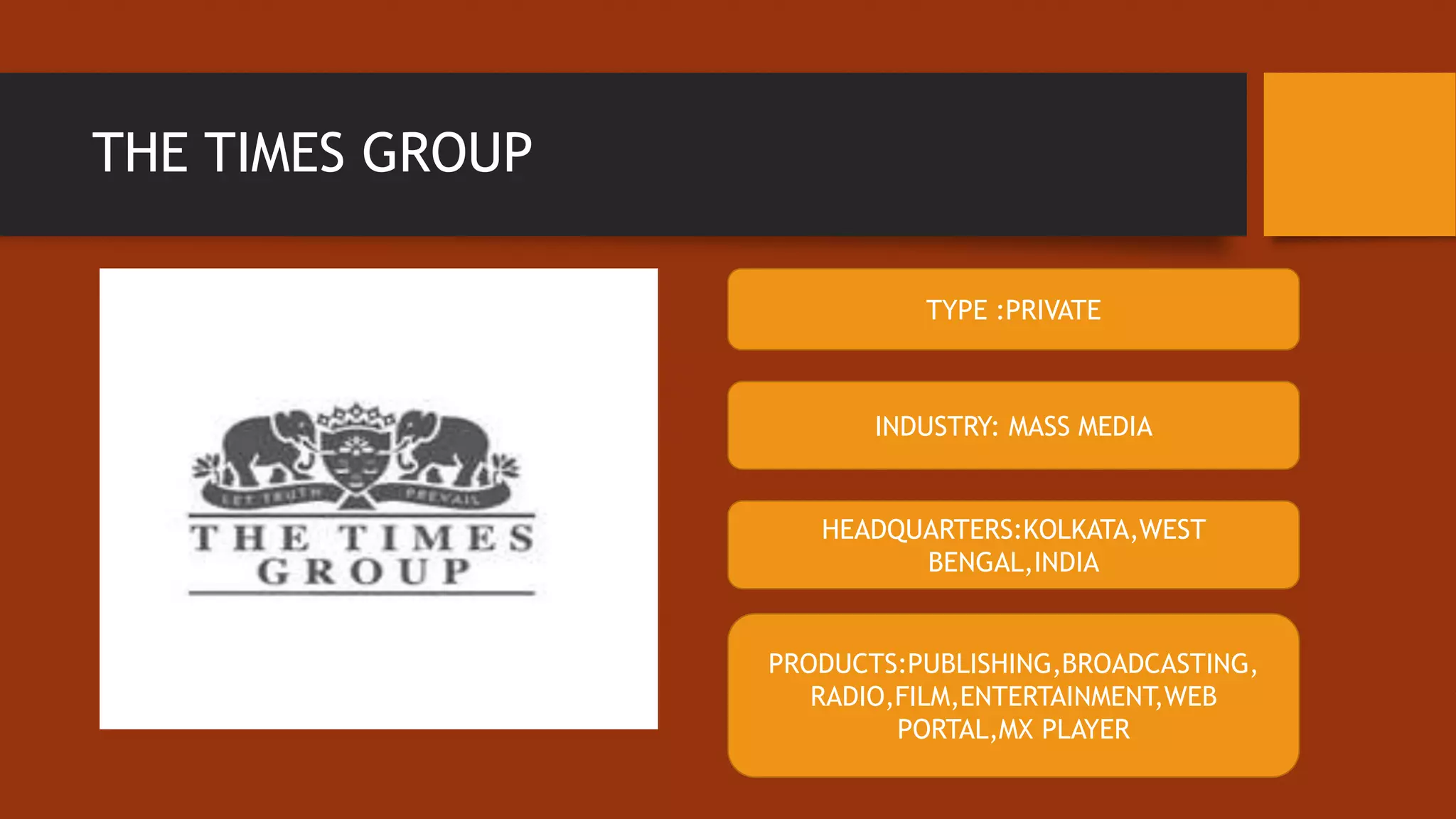
THE TIMES GROUP
TYPE :PRIVATE
INDUSTRY: MASS MEDIA
HEADQUARTERS:KOLKATA,WEST
BENGAL,INDIA
PRODUCTS:PUBLISHING,BROADCASTING,
RADIO,FILM,ENTERTAINMENT,WEB
PORTAL,MX PLAYER
Bennett, Coleman and Company
Limited commonly known as The Times
Group, is India’s largest media
conglomerate.
• The company remains a family-owned business as the
descendants of Sahu Jain own a majority stake in The Times
Group. The Times Group has over 11,000 employees and
revenue exceeding $1.5 billion.
ABOUT THE TIMES GROUP
 Bennett & Coleman Ltd (BCCL), the largest
media conglomerate prides itself in being a
powerhouse of successful Brands. Built on a
strong foundation, 175+ years ago, BCCL
started as a single publication. Today, its
flagship brand, The Times of India, is the largest
English daily, The Economic Times is the second
largest business daily and Mumbai Mirror is the
largest English tabloid amongst other brands.
Publicationsof
theTimesgroup
 THE TIME OF INDIA
 THE ECONOMIC TIMES
 MUMBAI MIRROR
 ET CHANDIGARH
 FEMINA (INDIA)
 FILMFARE
 DELHI TIMES
 The Illustrated Weekly of India ,etc
 ET NOW
 MIRROR NOW
 MOVIES NOW
 MN+
 ROMEDY NOW
 TIMES NOW
 ZOOM (INDIAN TV CHANNEL)
AUDIO INDUSTRY
• RADIO MIRCHI
Radio Mirchi is a nationwide network of private FM radio stations in India. It
is owned by the EntertainmentNetwork India Ltd (ENIL), which is one of the
subsidiaries of The Times Group. mirchi is Hindi for Red Chilli. The tagline of
Radio Mirchi is "Mirchi Sunnewaale Always Khush!"
Times Internet
• CricBuzz
• Gaana.com
• MX player
• ZIGWHEELS
• MAGICBRICKS
MOVIE PRODUCTION
• MIRCHI MOVIES LIMITED
• JUNGLEE PICTURES LIMITED
WORLD WIDE MEDIA
 FILMFARE
Filmfare is an English-language, tabloid-sized magazine about Hindi-
language cinema, popularly known as Bollywood. Established in 1952, the
magazine is published by Worldwide Media, a subsidiary of The Times
Group, India's largest media services conglomerate.
GRAZIA
Grazia India is the Indian edition of the Italian women’s
fashion and celebrity gossip magazine Grazia. It is the 10th international
edition of Grazia. The monthly magazine covers fashion, health, and current
events, and is targeted at affluent urban women.
• TIMES OF INDIA FILM AWARDS
• FEMINA MISS INDIA
• FEMINA (MAGAZINE):
Femina is an Indian magazine owned by Worldwide
Media, a wholly owned subsidiary of the Times
Group. Femina, the oldest women's English magazine in
the country, has been published for almost six decades.
It has evolved to cover a broad spectrum of topics,
including relationships, career, fashion, beauty, and
women achievers who have left a mark in their chosen
field.
HTTPS://OPENCORPORATES.COM/CORPORATE_GROUPINGS/THE%20TIMES%20
GROUP
HTTPS://WWW.CLEVERISM.COM/WHATS-A-CONGLOMERATE-CASE-STUDIES/
HTTPS://EN.WIKIPEDIA.ORG/WIKI/CATEGORY:THE_TIMES_GROUP

Media conglomerate type of ownership pattern

  • 1.
    Case study ofany one type of ownership pattern of Indian media organisations
  • 2.
    •What is MassMedia? Mass Media is a medium to communicate the large masses whether oral, written or through broadcast to a larger audience. There was a time when people use to switch on the radio for listening bulletin information or pick up the newspaper for reading daily headlines and information to know what is going on in the world all- around with a cup of tea in their hand. But with time, technology has changed and there are other media introduced to convey information to masses such as: • Books and Magazines • Televisions • Internet videos • Films and • Documentaries
  • 3.
    TYPES OF MASSMEDIA 1.Traditional Media People have developed different ways of communication depending upon their local language and culture. Traditional media is one of the oldest types of mass media to transfer traditions and culture over generations. The tools of communication have been developed from beliefs, customs, rituals, and practices of society. Traditional media imparts indigenous ways of communication for ages. Forms of Traditional Media Folk Dances , Folk Songs and Music ,Theatre, Drama, and Folktales Painting, Sculptures, Inscriptions, Statues, and Stupas Motifs and Symbols Nagada , Shadow Puppetry and String Puppetry Storytelling , Nautanki 2.Print Media In simple words, print media is all about the printed form of information and news. Before the invention of the printing press, printed materials had to be hand-written that made mass distribution almost impossible. Print media is one of the basic types of mass media tools making it very popular and convenient to reach a wider audience. Forms of Print Media Newspapers (broadsheet and tabloid) Periodicals, Newsletters, and Magazines (general or specific interest) Brochures, Leaflets and Pamphlets Journals Books, Novels and Comics
  • 4.
    3;Electronic Broadcasting Media Broadcastingis simply a distribution of audio and video content to a dispersed audience using the electronic broadcasting medium. Originally the term ‘broadcasting’ referred to the sowing of seeds on farms by scattering them over the large field. Broadcast media allows ease of news dissemination to even an illiterate person because it appeals to both the auditory and visual senses making it one of the most lucrative types of mass media. Forms of Broadcasting Media Television , Radio (AM, FM, Pirate Radio, Terrestrial Radio, and Satellite) , Traditional Telephone , Film/Movie/Motion Picture , Video Games , Audio Recording and Reproduction 4.New Media or Digital Media Since the invention of the World Wide Web by English scientist Tim Berners-Lee in 1989, the Internet has drastically taken over all the types of mass media because of faster dissemination speed and higher digital technology. New Media is an interactive two-way communication with users being the active producers of content and information. New Media is normally a re-conceptualization of the existing media. This is a rapidly growing mass media with the ease of accessibility with a computer and an Internet connection (broadband or WiFi). From story writing and graphic designing to multimedia and animation, pursuing a career in this field can be highly advantageous. Forms of Digital Media Websites , Emails ,Social Media and Social Networking Sites (SNS) , Webcast and Podcast , Blogging and Vlogging ,
  • 5.
    MEDIA CONGLOMERATE A mediaconglomerate, media group, or media institution is a company that owns numerous companies involved in mass media enterprises, such as television, radio, publishing, motion pictures, theme parks, or the Internet. According to the magazine The Nation, "Media conglomerates strive for policies that facilitate their control of the markets around the world."
  • 6.
  • 7.
    INCREASED REVENUE  Thisis the most obvious benefit of going the conglomerate way.  As the parent company, there is no denying that you get a share of the subsidiaries coming your way.  Depending on the size of your stake in the subsidiary, the extra income could be big enough to jump-start a dying company REDUCED INVESTMENT RISK  The bigger it grows, you are risking a big fall. Risks are written all over the walls of your business.  One way of minimizing the risk is by diversifying. It is the wisdom which comes from the saying that you should never put all your eggs in one basket.
  • 8.
    DISADVANTAGES OF CONGLOMERATE •Decrease in Conglomerate Stock Value • As the overall business grows, its stock value decreases. This is because of the nature of the business model employed by conglomerates. The stock value of the individual companies adds up to a value that is higher compared to what the parent company‘s stock value is. • This is the result of how the management of the conglomerate handle financial matters. As a business, there are values which are usually withheld from the public. This is to avoid a situation where the competitor has insight about the workings of the subsidiaries At the same time, investors who want to diversify their own portfolio prefer a direct approach rather than arrangement. • Potential Difficulty and Inefficiency in Management This becomes a bigger problem when the management is not well familiar with the industry the subsidiary operates in. This makes it difficult for the management to make good decisions to guide the subsidiaries. They largely have to depend on the management skills and industry knowledge of the subsidiary manager. This makes the job of the top managers very difficult. To minimize this, the top managers can undergo training on the new industry being represented in the network.
  • 9.
    HOW DOES ACOMPANY BECOME A CONGLOMERATE? Every big company starts small. It is through sustained growth that the size increases. If you are looking to own a multinational company, do not be set back by the challenges. You should also not be discouraged by the small beginnings. Companies become conglomerates when they start acquiring other companies. It may start as a way of boosting their sales outside their immediate industry It may also be a way of expanding to other industries to cushion themselves from the risks involved in operating in a single industry. This is what is called diversification.
  • 10.
    MEDIA CONGLOMERATES ININDIA The sheer number of media organisations and outlets often conceals the fact there is dominance over specific markets and market segments by a few players – in other words, the markets are often oligopolistic in character. The absence of restrictions on cross-media ownership implies that particular companies or groups or conglomerates dominate markets both vertically and horizontally The promoters and controllers of media groups have traditionally held interests in many other business interests and continue to do so, often using their media outlets to further these.There are a few instances of promoters who have used the profits from their media operations to diversify into other (unrelated) businesses.
  • 11.
    Evil of “paidnews” This closeness between the media and corporate India leads to a deplorable confusion of priorities. Instead of media houses relying on advertisers to fund quality journalism, the relationship becomes insidiously reversed. Advertisers and corporate units begin to rely on news outlets to further their interests. In 2003, Bennett Coleman Company Limited (publishers of the Times of India and the Economic Times, among other publications) started a “paid content” service, which enabled them to charge advertisers for coverage of product launches or celebrity- related events. In the run-up to the 2009 Lok Sabha elections, the more clearly illegal practice of “paid news” emerged and became widespread.
  • 12.
    CONSOLIDATION • In thelast few years there has been a growing consolidation of media organisations across the globe. In the political economy of the media the world over there is clearly an alarming absence of not-for-profit media organisations. • The Indian media market differs from those of developed countries in several ways. For one, India is a developing country and all segments of the media industry (including print and radio) are still growing unlike in developed countries. The media market in India remains highly fragmented, due to the large number of languages and the sheer size of the country. • In India’s unique “mediascape”, it is often contended that the proliferation of publications, radio stations, television channels, and internet websites is a sure-fire guarantor for plurality, diversity, and consumer choice.
  • 13.
    THE TIMES GROUP TYPE:PRIVATE INDUSTRY: MASS MEDIA HEADQUARTERS:KOLKATA,WEST BENGAL,INDIA PRODUCTS:PUBLISHING,BROADCASTING, RADIO,FILM,ENTERTAINMENT,WEB PORTAL,MX PLAYER
  • 14.
    Bennett, Coleman andCompany Limited commonly known as The Times Group, is India’s largest media conglomerate. • The company remains a family-owned business as the descendants of Sahu Jain own a majority stake in The Times Group. The Times Group has over 11,000 employees and revenue exceeding $1.5 billion.
  • 15.
    ABOUT THE TIMESGROUP  Bennett & Coleman Ltd (BCCL), the largest media conglomerate prides itself in being a powerhouse of successful Brands. Built on a strong foundation, 175+ years ago, BCCL started as a single publication. Today, its flagship brand, The Times of India, is the largest English daily, The Economic Times is the second largest business daily and Mumbai Mirror is the largest English tabloid amongst other brands.
  • 16.
    Publicationsof theTimesgroup  THE TIMEOF INDIA  THE ECONOMIC TIMES  MUMBAI MIRROR  ET CHANDIGARH  FEMINA (INDIA)  FILMFARE  DELHI TIMES  The Illustrated Weekly of India ,etc
  • 17.
     ET NOW MIRROR NOW  MOVIES NOW  MN+  ROMEDY NOW  TIMES NOW  ZOOM (INDIAN TV CHANNEL)
  • 18.
    AUDIO INDUSTRY • RADIOMIRCHI Radio Mirchi is a nationwide network of private FM radio stations in India. It is owned by the EntertainmentNetwork India Ltd (ENIL), which is one of the subsidiaries of The Times Group. mirchi is Hindi for Red Chilli. The tagline of Radio Mirchi is "Mirchi Sunnewaale Always Khush!"
  • 19.
    Times Internet • CricBuzz •Gaana.com • MX player • ZIGWHEELS • MAGICBRICKS
  • 20.
    MOVIE PRODUCTION • MIRCHIMOVIES LIMITED • JUNGLEE PICTURES LIMITED
  • 21.
    WORLD WIDE MEDIA FILMFARE Filmfare is an English-language, tabloid-sized magazine about Hindi- language cinema, popularly known as Bollywood. Established in 1952, the magazine is published by Worldwide Media, a subsidiary of The Times Group, India's largest media services conglomerate. GRAZIA Grazia India is the Indian edition of the Italian women’s fashion and celebrity gossip magazine Grazia. It is the 10th international edition of Grazia. The monthly magazine covers fashion, health, and current events, and is targeted at affluent urban women.
  • 22.
    • TIMES OFINDIA FILM AWARDS • FEMINA MISS INDIA • FEMINA (MAGAZINE): Femina is an Indian magazine owned by Worldwide Media, a wholly owned subsidiary of the Times Group. Femina, the oldest women's English magazine in the country, has been published for almost six decades. It has evolved to cover a broad spectrum of topics, including relationships, career, fashion, beauty, and women achievers who have left a mark in their chosen field.
  • 23.