Introduction To Java
Mrs.Sonali S.Patil
Assistant Professor, CSE Department,sharad institute of technology
college of engineering yadrav
Introduction To Java
• JAVA was developed by James Gosling at Sun Microsystems Inc in the
year 1995, later acquired by Oracle Corporation.
• Java is a programming language and a platform. Java is a high level,
robust, object-oriented and secure programming language.
Application of JAVA:
• Desktop Applications such as acrobat reader, media player, antivirus,
etc.
• Web Applications such as irctc.co.in, javatpoint.com, etc.
• Enterprise Applications such as banking applications.
• Mobile
• Embedded System
• Smart Card
• Robotics
• Games, etc.
Features of JAVA:
1)Simple:
• Java is very simple & easy to learn.
• We can write java programs very easily.
• To learn java no prior knowledge is required.
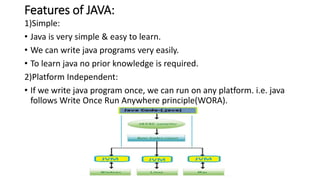
2)Platform Independent:
• If we write java program once, we can run on any platform. i.e. java
follows Write Once Run Anywhere principle(WORA).
Features of JAVA:
3)Architecture Neutral:
• Java programs never communicates with the platform directly. Changes &
upgrades in Operating Systems, processors and system resources will not
force any changes of java programs.
4)Portable:
• We can carry the java byte code to any platform without making any
changes.
• Mobile number portability in India from Airtel to Jio, for that no need to
change number, same byte code (class file) can run on any platform.
5)Secure:
• Java program never communicates directly with the machine. First
converted into byte code and then converted into machine code by the
jvm.
6)Object Oriented Programming Language:
• Java is object oriented programming languages like C++, most of the times
in java, we have to handle everything in terms of object.
7)Multithreaded:
• In the case of multithreading, multiple threads can run simultaneously and
can perform specified task simultaneously, so that performance of the
application will be improved.
8)Robust:
• Java is strongly typed language.
• It provides garbage collector for automatic memory management.
• Java provides inbuilt Exception Handling.
• Java is platform independent and it can run on any platform.
• Because of all these facilities, the chance of failing the program at runtime
is very less and hence, java is Robust.
Features of JAVA:
Features of JAVA:
9)Distributed:
• If the application is distributed across multiple machines(JVMs) such
type of application is called Distributed application.
• Java provides inbuilt support for distributed programming with RMI
(Remote method Invocation).
10)Compiled & interpreted:
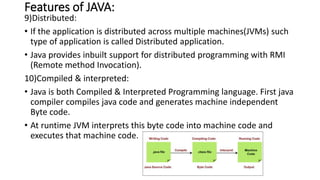
• Java is both Compiled & Interpreted Programming language. First java
compiler compiles java code and generates machine independent
Byte code.
• At runtime JVM interprets this byte code into machine code and
executes that machine code.
Features of JAVA:
11)High Performance:
• Java is relatively faster than traditional interpreted languages, since
the byte code is close to native code.
• It provides high performance due to JIT compiler. Because it has more
information available.
12) Dynamic:
• In the case of java programs, all .class files won’t be loaded at the
beginning. At runtime if JVM required any class then only the
corresponding .class file will be loaded (Dynamic loading).
• The main advantage is program will always get latest version of .class
file and memory utilization will be improved.

Introduction To Java history, application, features.pptx

  • 1.
    Introduction To Java Mrs.SonaliS.Patil Assistant Professor, CSE Department,sharad institute of technology college of engineering yadrav
  • 2.
    Introduction To Java •JAVA was developed by James Gosling at Sun Microsystems Inc in the year 1995, later acquired by Oracle Corporation. • Java is a programming language and a platform. Java is a high level, robust, object-oriented and secure programming language.
  • 3.
    Application of JAVA: •Desktop Applications such as acrobat reader, media player, antivirus, etc. • Web Applications such as irctc.co.in, javatpoint.com, etc. • Enterprise Applications such as banking applications. • Mobile • Embedded System • Smart Card • Robotics • Games, etc.
  • 4.
    Features of JAVA: 1)Simple: •Java is very simple & easy to learn. • We can write java programs very easily. • To learn java no prior knowledge is required. 2)Platform Independent: • If we write java program once, we can run on any platform. i.e. java follows Write Once Run Anywhere principle(WORA).
  • 5.
    Features of JAVA: 3)ArchitectureNeutral: • Java programs never communicates with the platform directly. Changes & upgrades in Operating Systems, processors and system resources will not force any changes of java programs. 4)Portable: • We can carry the java byte code to any platform without making any changes. • Mobile number portability in India from Airtel to Jio, for that no need to change number, same byte code (class file) can run on any platform. 5)Secure: • Java program never communicates directly with the machine. First converted into byte code and then converted into machine code by the jvm.
  • 6.
    6)Object Oriented ProgrammingLanguage: • Java is object oriented programming languages like C++, most of the times in java, we have to handle everything in terms of object. 7)Multithreaded: • In the case of multithreading, multiple threads can run simultaneously and can perform specified task simultaneously, so that performance of the application will be improved. 8)Robust: • Java is strongly typed language. • It provides garbage collector for automatic memory management. • Java provides inbuilt Exception Handling. • Java is platform independent and it can run on any platform. • Because of all these facilities, the chance of failing the program at runtime is very less and hence, java is Robust. Features of JAVA:
  • 7.
    Features of JAVA: 9)Distributed: •If the application is distributed across multiple machines(JVMs) such type of application is called Distributed application. • Java provides inbuilt support for distributed programming with RMI (Remote method Invocation). 10)Compiled & interpreted: • Java is both Compiled & Interpreted Programming language. First java compiler compiles java code and generates machine independent Byte code. • At runtime JVM interprets this byte code into machine code and executes that machine code.
  • 8.
    Features of JAVA: 11)HighPerformance: • Java is relatively faster than traditional interpreted languages, since the byte code is close to native code. • It provides high performance due to JIT compiler. Because it has more information available. 12) Dynamic: • In the case of java programs, all .class files won’t be loaded at the beginning. At runtime if JVM required any class then only the corresponding .class file will be loaded (Dynamic loading). • The main advantage is program will always get latest version of .class file and memory utilization will be improved.