Evolution
Contents
• History
• JDK Versions
• JDK Edition
• Why JAVA?
• Features/Characteristics of Java
Father of JAVA
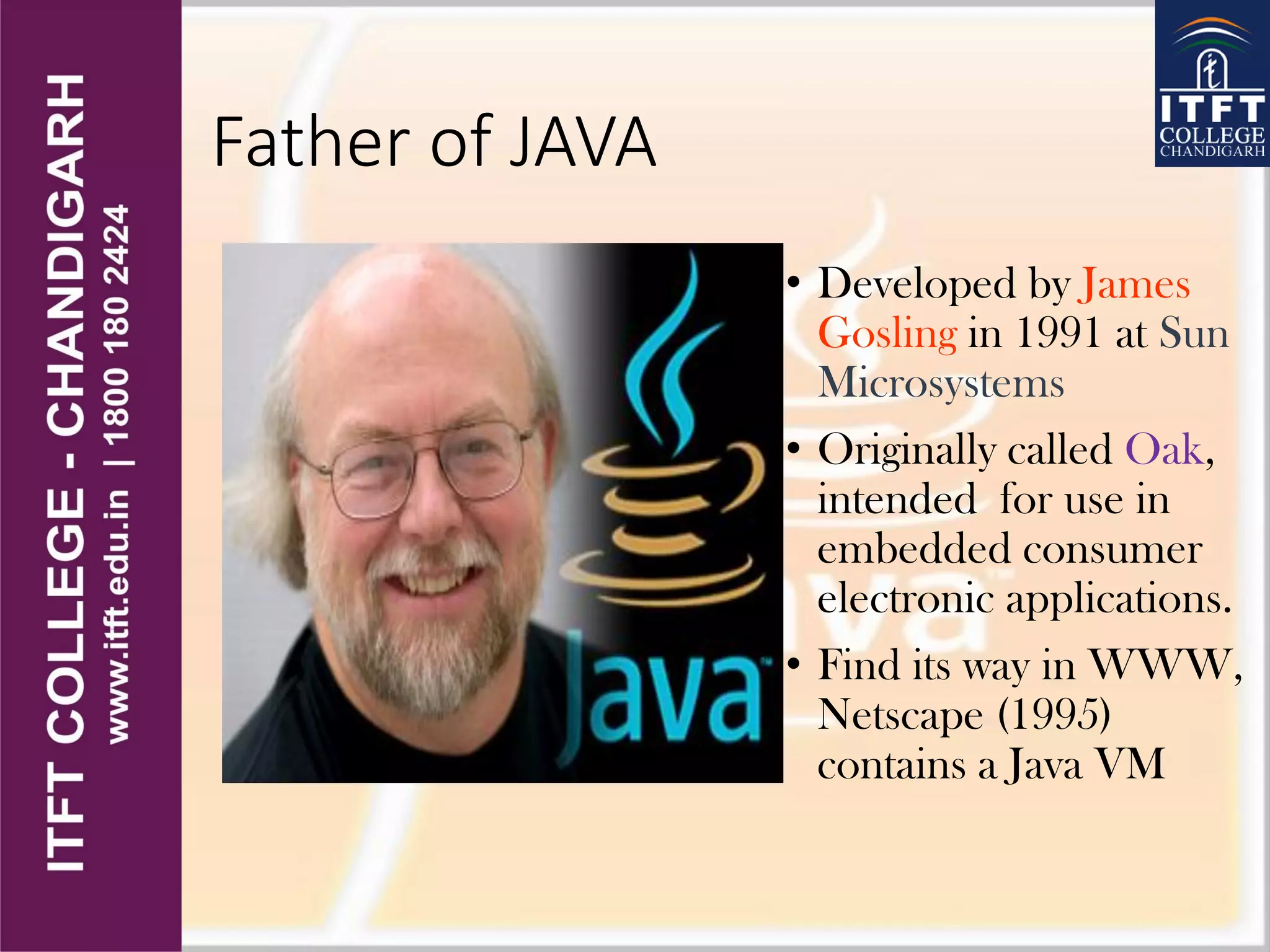
• Developed by James
Gosling in 1991 at Sun
Microsystems
• Originally called Oak,
intended for use in
embedded consumer
electronic applications.
• Find its way in WWW,
Netscape (1995)
contains a Java VM
History
• HotJava
• The first Java-enabled Web browser
• On January 27, 2010, Sun Microsystems was
acquired by Oracle Corporation
JDK Versions
• JDK 1.02 (1995)
• JDK 1.1 (1996)
• Java 2 SDK v 1.2 (a.k.a JDK 1.2, 1998)
• Java 2 SDK v 1.3 (a.k.a JDK 1.3, 2000)
• Java 2 SDK v 1.4 (a.k.a JDK 1.4, 2002)
• JDK 1.5 (2004) a. k. a. JDK 5 or Java 5
• JDK 1.6 (2006) a. k. a. JDK 6 or Java 6
• JDK 7 or Java 7 (July 2011)
• Java 8 expected to be released in 2014
• Java 9 in pipeline
5
JDK Editions
• Java Standard Edition (J2SE)
• J2SE can be used to develop client-side
standalone applications or applets.
• Java Enterprise Edition (J2EE)
• J2EE can be used to develop server-side
applications such as Java servlets and Java
ServerPages.
• Java Micro Edition (J2ME).
• J2ME can be used to develop applications for
mobile devices such as cell phones.
6
Why Java?
7
The answer is that Java enables users to develop
and deploy applications on the Internet for
servers, desktop computers, and small hand-
held devices. The future of computing is being
profoundly influenced by the Internet, and Java
promises to remain a big part of that future. Java
is the Internet programming language.
FJava is a general purpose programming
language.
FJava is the Internet programming language.
Java, Web, and Beyond
• Java can be used to develop Web
applications.
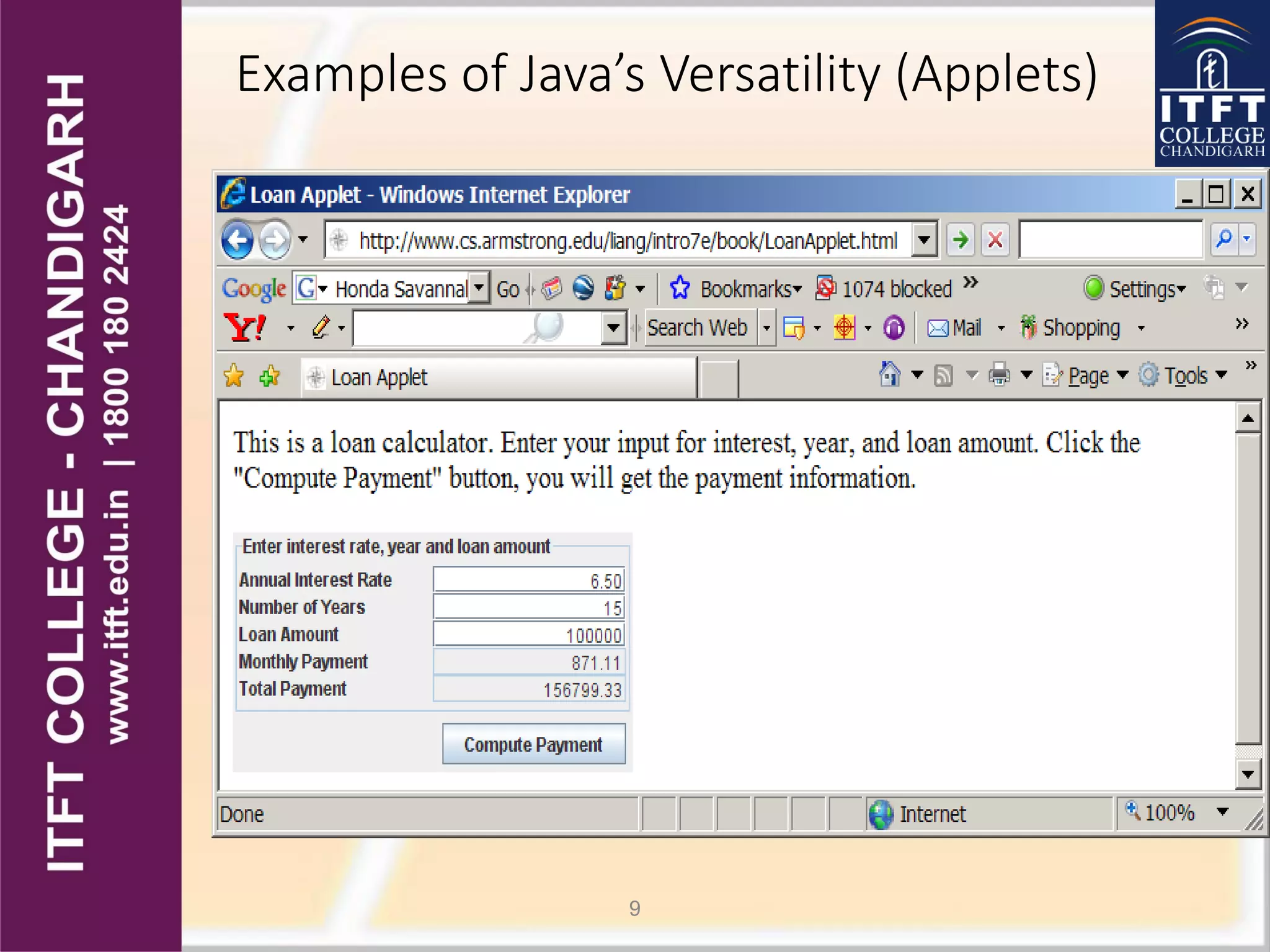
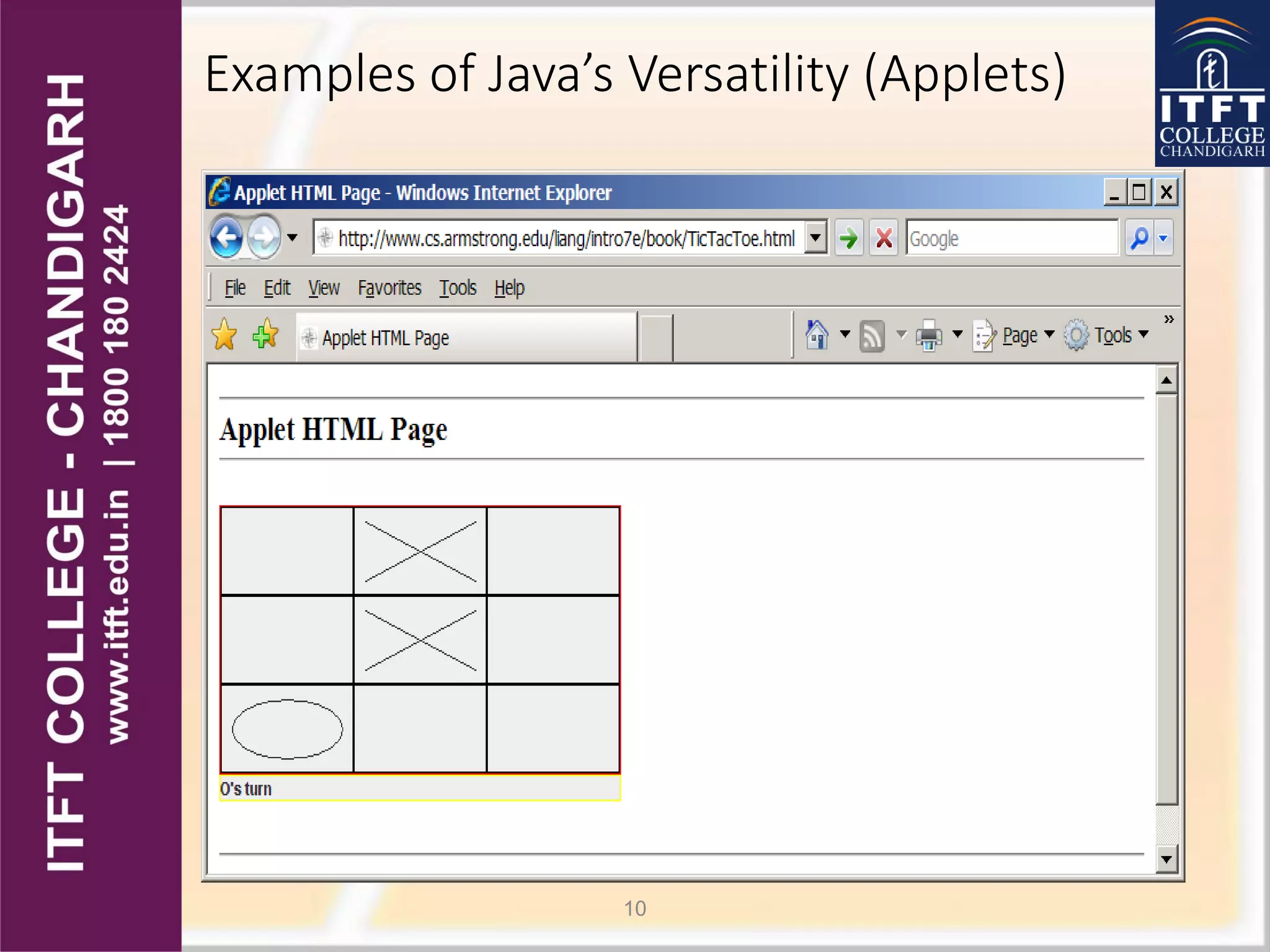
• Java Applets
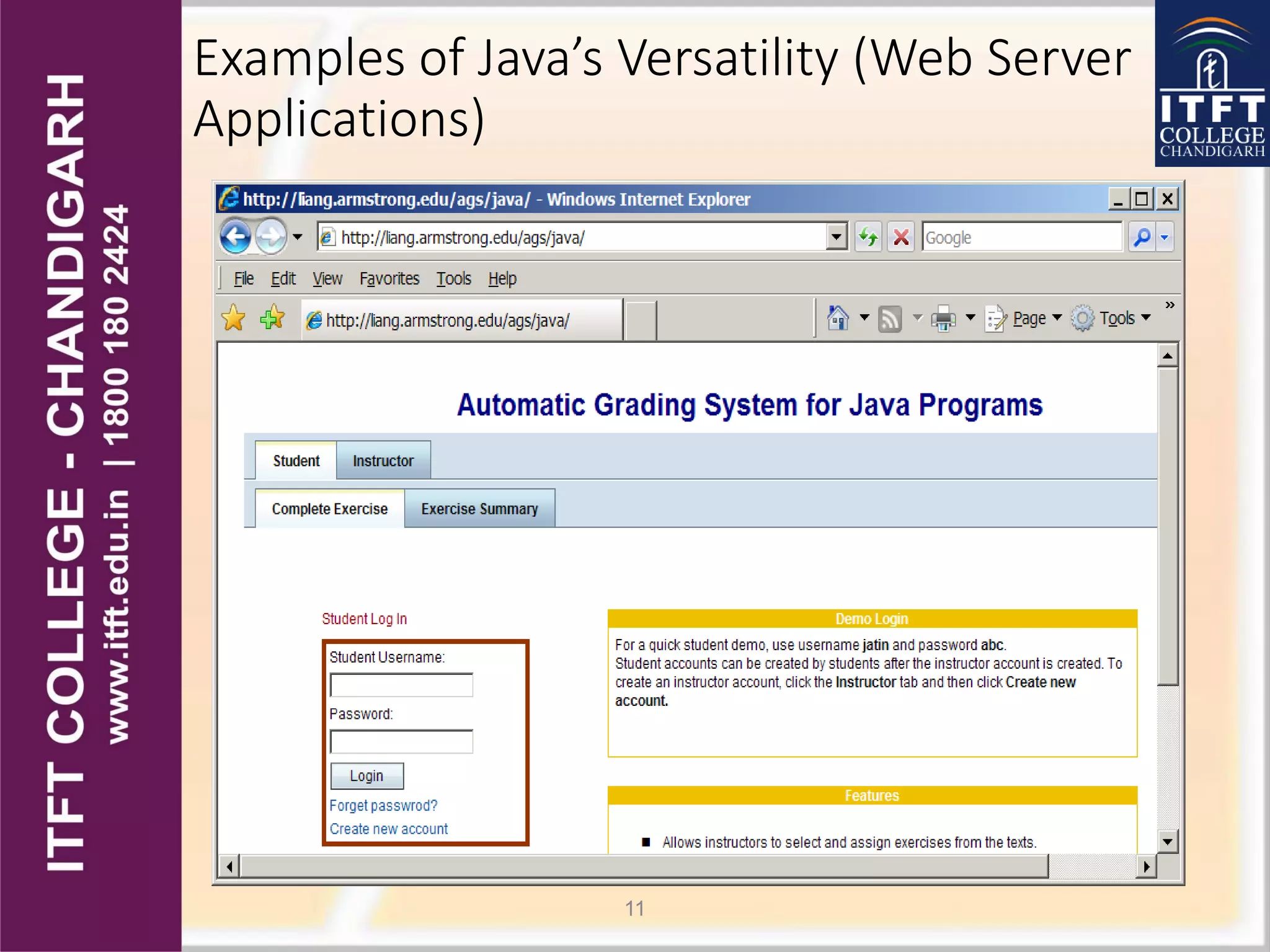
• Java Web Applications
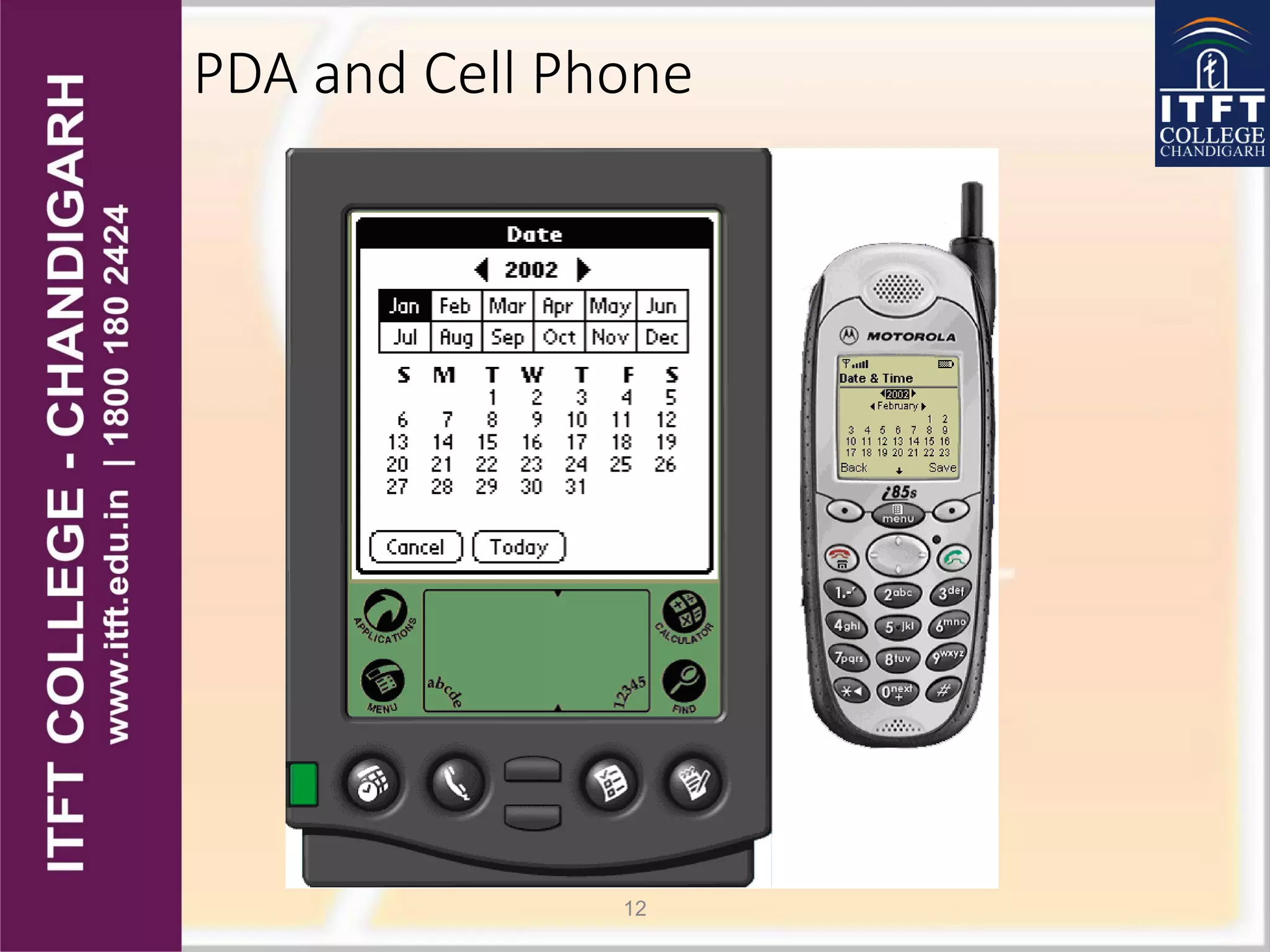
• Java can also be used to develop
applications for hand-held devices
such as Palm and cell phones
8
Examples of Java’s Versatility (Applets)
9
Examples of Java’s Versatility (Applets)
10
Examples of Java’s Versatility (Web Server
Applications)
11
PDA and Cell Phone
12
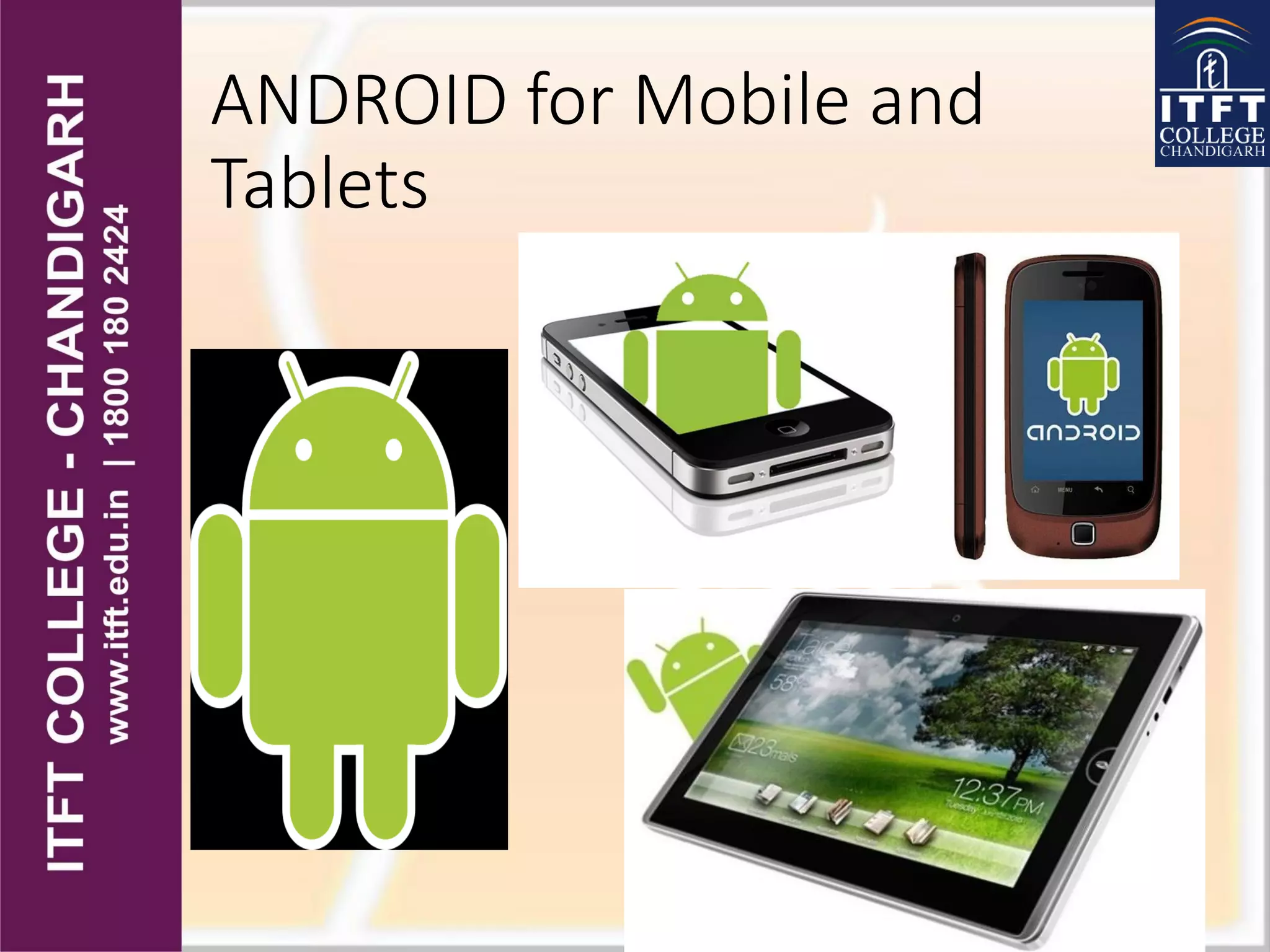
ANDROID for Mobile and
Tablets
Features/Characteristics of Java
• Java Is Simple
• Java Is Object-Oriented
• Java Is Distributed
• Java Is Interpreted
• Java Is Robust
• Java Is Secure
• Java Is Architecture-Neutral
• Java Is Portable
• Java's Performance
• Java Is Multithreaded
• Java Is Dynamic
14
Features/Characteristics of Java
• Java Is Simple
• Java Is Object-Oriented
• Java Is Distributed
• Java Is Interpreted
• Java Is Robust
• Java Is Secure
• Java Is Architecture-
Neutral
• Java Is Portable
• Java's Performance
• Java Is Multithreaded
• Java Is Dynamic
15
Java is partially modeled on C++, but
greatly simplified and improved. Some
people refer to Java as "C++--"
because it is like C++ but with more
functionality and fewer negative
aspects.
No pointers
No manual memory allocation
No Manual garbage collection
Features/Characteristics of Java
• Java Is Simple
• Java Is Object-
Oriented
• Java Is Distributed
• Java Is Interpreted
• Java Is Robust
• Java Is Secure
• Java Is Architecture-
Neutral
• Java Is Portable
• Java's Performance
• Java Is
Multithreaded
• Java Is Dynamic
16
Java is inherently object-oriented.
Although many object-oriented languages
began strictly as procedural languages,
Java was designed from the start to be
object-oriented. Object-oriented
programming (OOP) is a popular
programming approach that is replacing
traditional procedural programming
techniques.
One of the central issues in software
development is how to reuse code.
Object-oriented programming provides
great flexibility, modularity, clarity, and
reusability through encapsulation,
inheritance, and polymorphism.
Features/Characteristics of Java
• Java Is Simple
• Java Is Object-
Oriented
• Java Is Distributed
• Java Is Interpreted
• Java Is Robust
• Java Is Secure
• Java Is Architecture-
Neutral
• Java Is Portable
• Java's Performance
• Java Is Multithreaded
• Java Is Dynamic
17
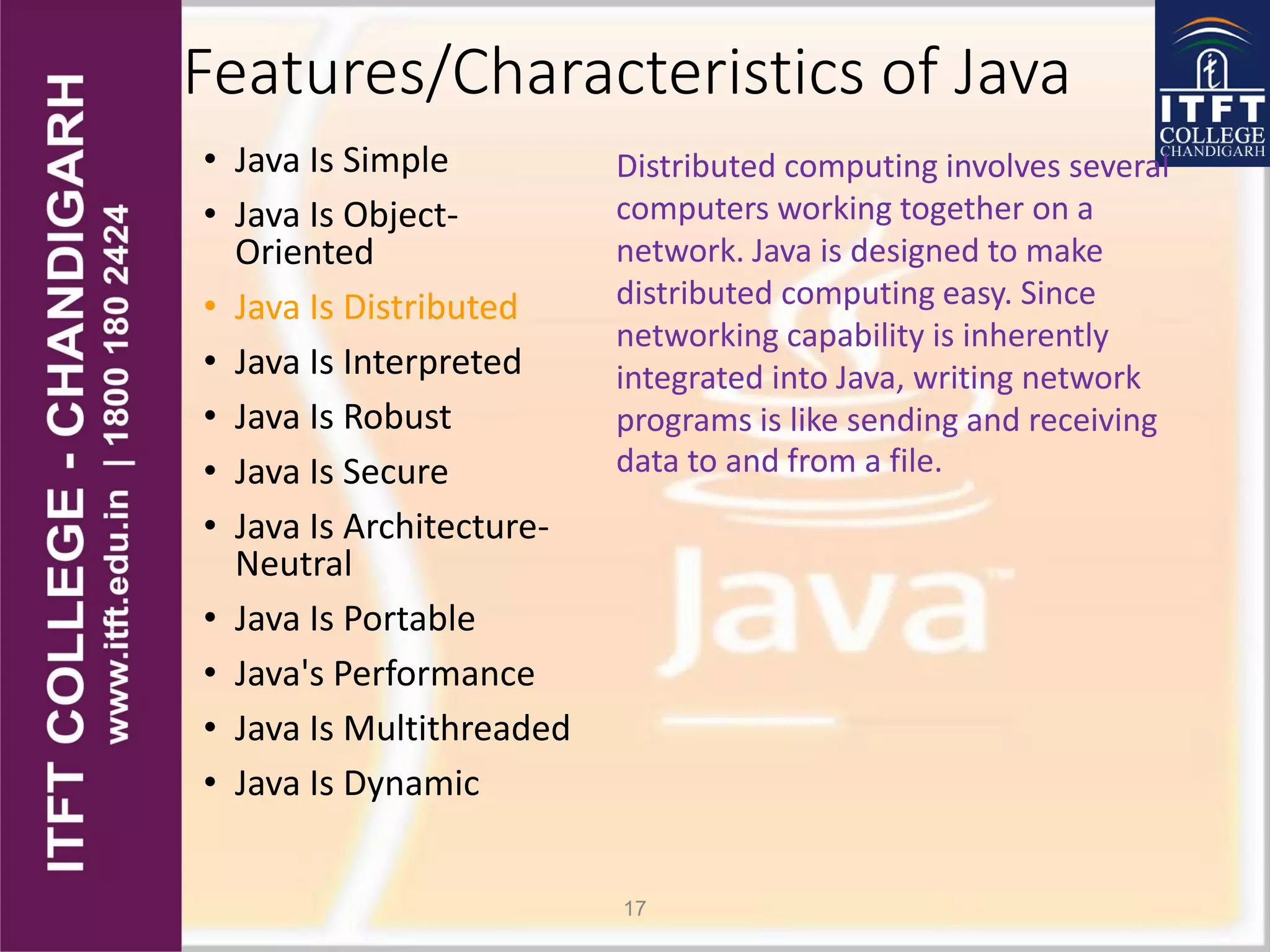
Distributed computing involves several
computers working together on a
network. Java is designed to make
distributed computing easy. Since
networking capability is inherently
integrated into Java, writing network
programs is like sending and receiving
data to and from a file.
Features/Characteristics of Java
• Java Is Simple
• Java Is Object-Oriented
• Java Is Distributed
• Java Is Interpreted
• Java Is Robust
• Java Is Secure
• Java Is Architecture-
Neutral
• Java Is Portable
• Java's Performance
• Java Is Multithreaded
• Java Is Dynamic
18
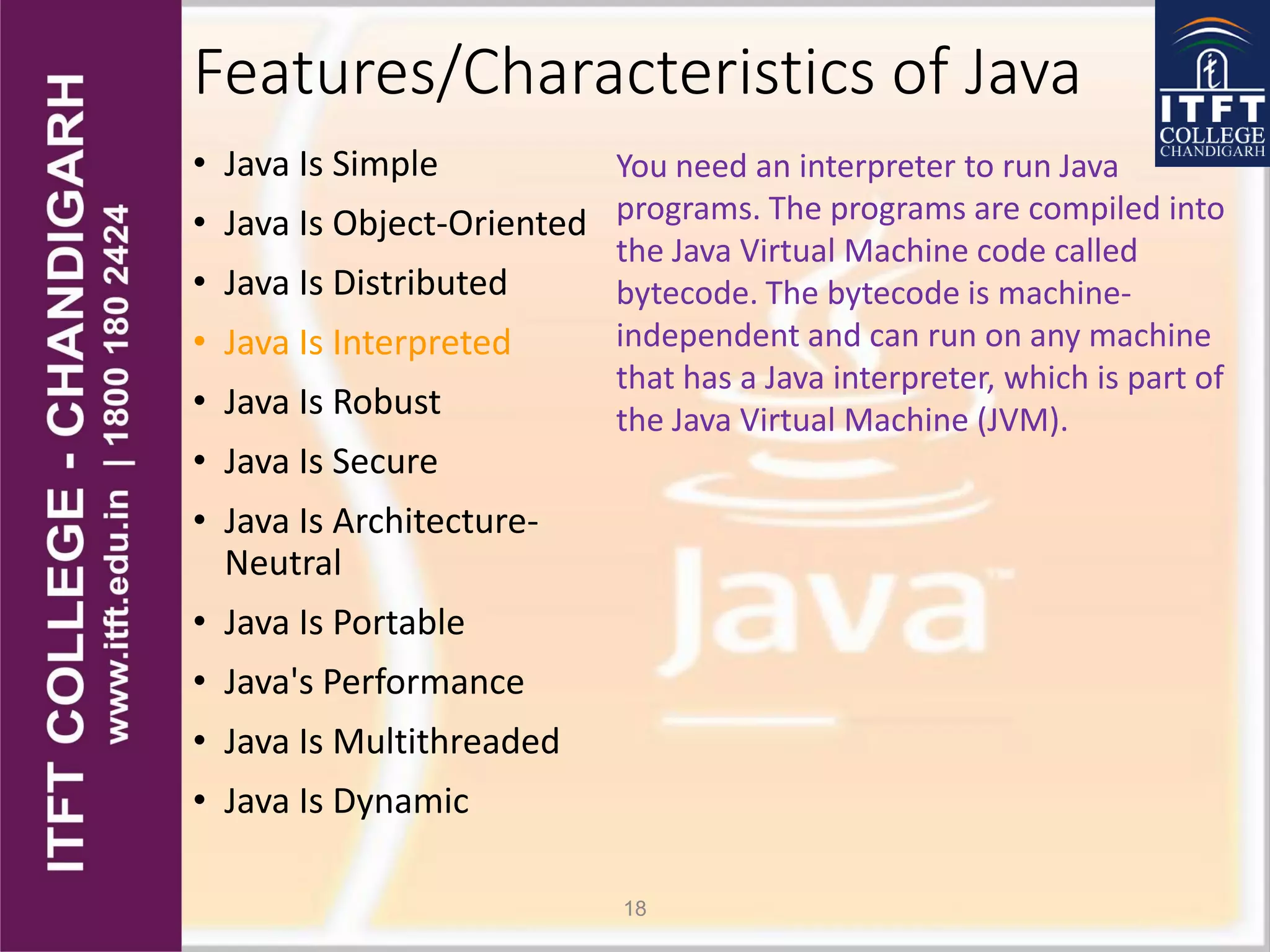
You need an interpreter to run Java
programs. The programs are compiled into
the Java Virtual Machine code called
bytecode. The bytecode is machine-
independent and can run on any machine
that has a Java interpreter, which is part of
the Java Virtual Machine (JVM).
Features/Characteristics of Java
• Java Is Simple
• Java Is Object-Oriented
• Java Is Distributed
• Java Is Interpreted
• Java Is Robust
• Java Is Secure
• Java Is Architecture-
Neutral
• Java Is Portable
• Java's Performance
• Java Is Multithreaded
• Java Is Dynamic
19
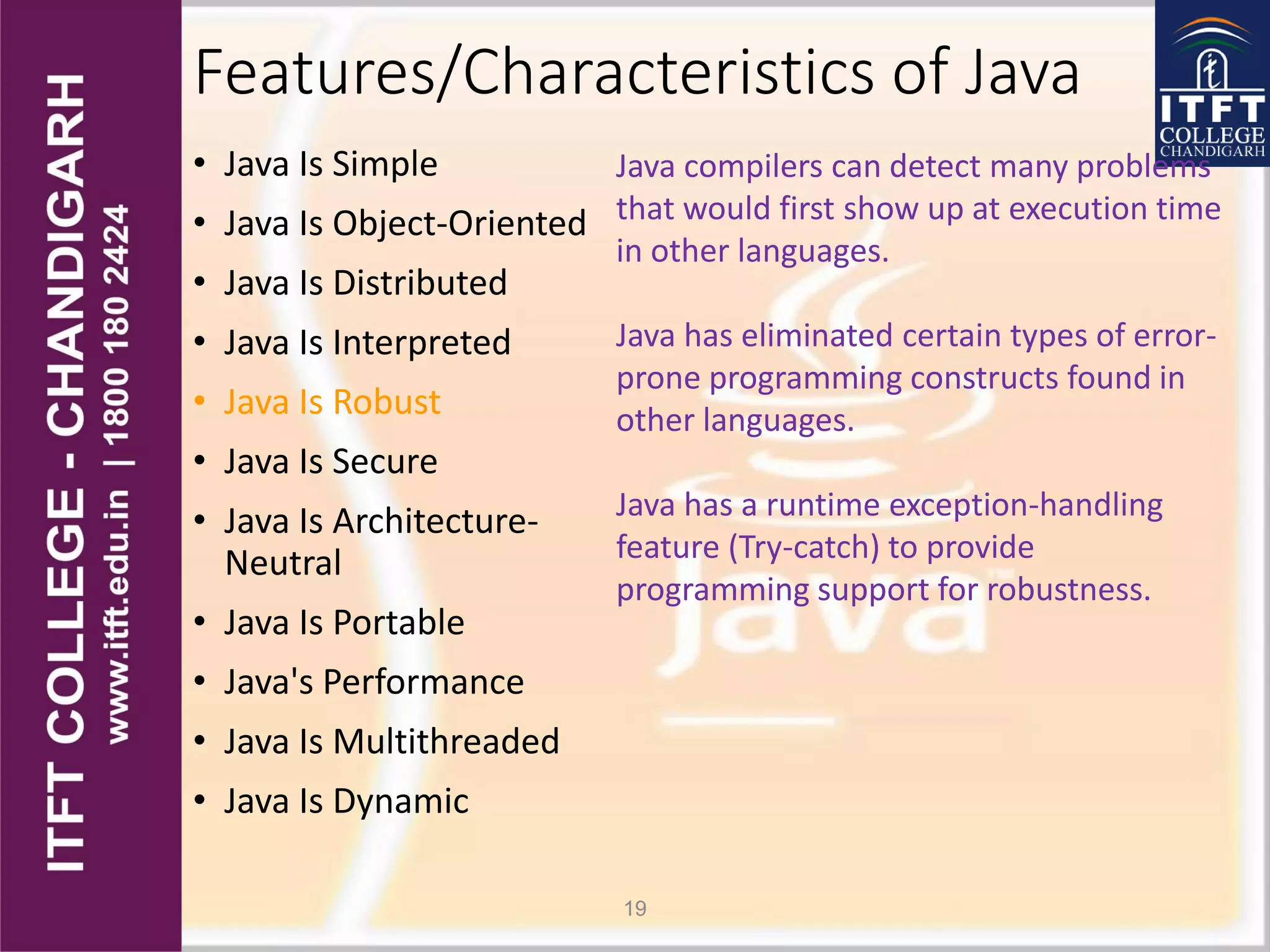
Java compilers can detect many problems
that would first show up at execution time
in other languages.
Java has eliminated certain types of error-
prone programming constructs found in
other languages.
Java has a runtime exception-handling
feature (Try-catch) to provide
programming support for robustness.
Features/Characteristics of Java
• Java Is Simple
• Java Is Object-Oriented
• Java Is Distributed
• Java Is Interpreted
• Java Is Robust
• Java Is Secure
• Java Is Architecture-Neutral
• Java Is Portable
• Java's Performance
• Java Is Multithreaded
• Java Is Dynamic
20
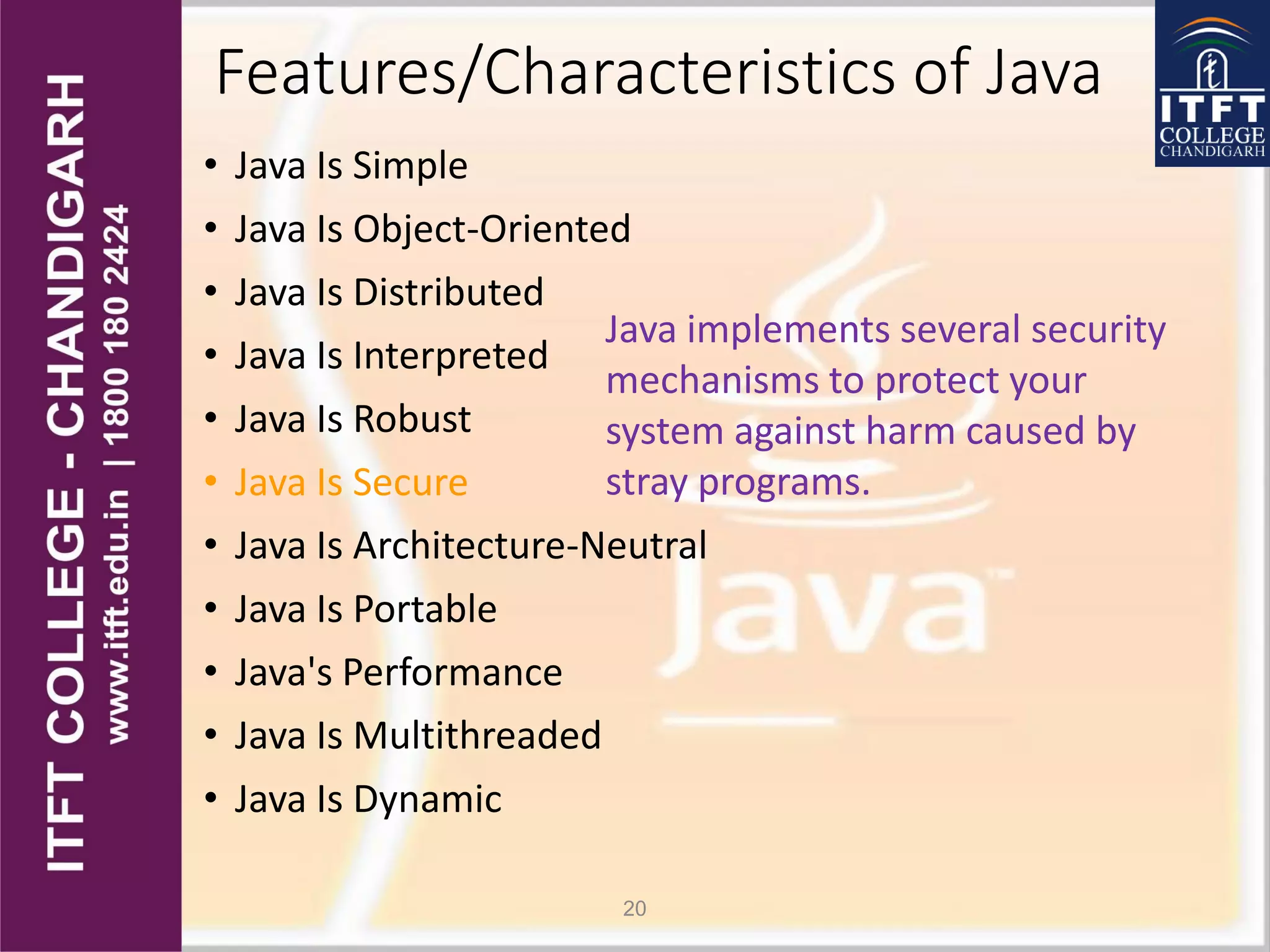
Java implements several security
mechanisms to protect your
system against harm caused by
stray programs.
Features/Characteristics of Java
• Java Is Simple
• Java Is Object-Oriented
• Java Is Distributed
• Java Is Interpreted
• Java Is Robust
• Java Is Secure
• Java Is Architecture-
Neutral
• Java Is Portable
• Java's Performance
• Java Is Multithreaded
• Java Is Dynamic
21
Write once, run anywhere
With a Java Virtual Machine
(JVM), you can write one
program that will run on any
platform.
Features/Characteristics of Java
• Java Is Simple
• Java Is Object-Oriented
• Java Is Distributed
• Java Is Interpreted
• Java Is Robust
• Java Is Secure
• Java Is Architecture-Neutral
• Java Is Portable
• Java's Performance
• Java Is Multithreaded
• Java Is Dynamic
22
Because Java is architecture
neutral, Java programs are
portable. They can be run on
any platform without being
recompiled.
Features/Characteristics of Java
• Java Is Simple
• Java Is Object-Oriented
• Java Is Distributed
• Java Is Interpreted
• Java Is Robust
• Java Is Secure
• Java Is Architecture-
Neutral
• Java Is Portable
• Java's Performance
• Java Is Multithreaded
• Java Is Dynamic
23
Earlier java programs are slow
Now compilers are fast and
processor speed increases
many folds.
So performance of java
programs is not that bad.
Features/Characteristics of Java
• Java Is Simple
• Java Is Object-Oriented
• Java Is Distributed
• Java Is Interpreted
• Java Is Robust
• Java Is Secure
• Java Is Architecture-
Neutral
• Java Is Portable
• Java's Performance
• Java Is Multithreaded
• Java Is Dynamic
24
Multithread programming is
smoothly integrated in Java,
whereas in other languages
you have to call procedures
specific to the operating
system to enable
multithreading.
Features/Characteristics of Java
• Java Is Simple
• Java Is Object-Oriented
• Java Is Distributed
• Java Is Interpreted
• Java Is Robust
• Java Is Secure
• Java Is Architecture-
Neutral
• Java Is Portable
• Java's Performance
• Java Is Multithreaded
• Java Is Dynamic
25
Java was designed to adapt to
an evolving environment.
New code can be loaded on
the fly without recompilation.
There is no need for
developers to create, and for
users to install, major new
software versions. New
features can be incorporated
transparently as needed.
Recommended text
• Java Complete Reference- Tata Mcgraw Hill
• Programming with JAVA by Balagurusamy
• Internet & JAVA PROGRAMMING by Tanveer
Alam
• Internet-Just google “java tutorials”
itft-Java evolution

itft-Java evolution

  • 1.
  • 2.
    Contents • History • JDKVersions • JDK Edition • Why JAVA? • Features/Characteristics of Java
  • 3.
    Father of JAVA •Developed by James Gosling in 1991 at Sun Microsystems • Originally called Oak, intended for use in embedded consumer electronic applications. • Find its way in WWW, Netscape (1995) contains a Java VM
  • 4.
    History • HotJava • Thefirst Java-enabled Web browser • On January 27, 2010, Sun Microsystems was acquired by Oracle Corporation
  • 5.
    JDK Versions • JDK1.02 (1995) • JDK 1.1 (1996) • Java 2 SDK v 1.2 (a.k.a JDK 1.2, 1998) • Java 2 SDK v 1.3 (a.k.a JDK 1.3, 2000) • Java 2 SDK v 1.4 (a.k.a JDK 1.4, 2002) • JDK 1.5 (2004) a. k. a. JDK 5 or Java 5 • JDK 1.6 (2006) a. k. a. JDK 6 or Java 6 • JDK 7 or Java 7 (July 2011) • Java 8 expected to be released in 2014 • Java 9 in pipeline 5
  • 6.
    JDK Editions • JavaStandard Edition (J2SE) • J2SE can be used to develop client-side standalone applications or applets. • Java Enterprise Edition (J2EE) • J2EE can be used to develop server-side applications such as Java servlets and Java ServerPages. • Java Micro Edition (J2ME). • J2ME can be used to develop applications for mobile devices such as cell phones. 6
  • 7.
    Why Java? 7 The answeris that Java enables users to develop and deploy applications on the Internet for servers, desktop computers, and small hand- held devices. The future of computing is being profoundly influenced by the Internet, and Java promises to remain a big part of that future. Java is the Internet programming language. FJava is a general purpose programming language. FJava is the Internet programming language.
  • 8.
    Java, Web, andBeyond • Java can be used to develop Web applications. • Java Applets • Java Web Applications • Java can also be used to develop applications for hand-held devices such as Palm and cell phones 8
  • 9.
    Examples of Java’sVersatility (Applets) 9
  • 10.
    Examples of Java’sVersatility (Applets) 10
  • 11.
    Examples of Java’sVersatility (Web Server Applications) 11
  • 12.
    PDA and CellPhone 12
  • 13.
    ANDROID for Mobileand Tablets
  • 14.
    Features/Characteristics of Java •Java Is Simple • Java Is Object-Oriented • Java Is Distributed • Java Is Interpreted • Java Is Robust • Java Is Secure • Java Is Architecture-Neutral • Java Is Portable • Java's Performance • Java Is Multithreaded • Java Is Dynamic 14
  • 15.
    Features/Characteristics of Java •Java Is Simple • Java Is Object-Oriented • Java Is Distributed • Java Is Interpreted • Java Is Robust • Java Is Secure • Java Is Architecture- Neutral • Java Is Portable • Java's Performance • Java Is Multithreaded • Java Is Dynamic 15 Java is partially modeled on C++, but greatly simplified and improved. Some people refer to Java as "C++--" because it is like C++ but with more functionality and fewer negative aspects. No pointers No manual memory allocation No Manual garbage collection
  • 16.
    Features/Characteristics of Java •Java Is Simple • Java Is Object- Oriented • Java Is Distributed • Java Is Interpreted • Java Is Robust • Java Is Secure • Java Is Architecture- Neutral • Java Is Portable • Java's Performance • Java Is Multithreaded • Java Is Dynamic 16 Java is inherently object-oriented. Although many object-oriented languages began strictly as procedural languages, Java was designed from the start to be object-oriented. Object-oriented programming (OOP) is a popular programming approach that is replacing traditional procedural programming techniques. One of the central issues in software development is how to reuse code. Object-oriented programming provides great flexibility, modularity, clarity, and reusability through encapsulation, inheritance, and polymorphism.
  • 17.
    Features/Characteristics of Java •Java Is Simple • Java Is Object- Oriented • Java Is Distributed • Java Is Interpreted • Java Is Robust • Java Is Secure • Java Is Architecture- Neutral • Java Is Portable • Java's Performance • Java Is Multithreaded • Java Is Dynamic 17 Distributed computing involves several computers working together on a network. Java is designed to make distributed computing easy. Since networking capability is inherently integrated into Java, writing network programs is like sending and receiving data to and from a file.
  • 18.
    Features/Characteristics of Java •Java Is Simple • Java Is Object-Oriented • Java Is Distributed • Java Is Interpreted • Java Is Robust • Java Is Secure • Java Is Architecture- Neutral • Java Is Portable • Java's Performance • Java Is Multithreaded • Java Is Dynamic 18 You need an interpreter to run Java programs. The programs are compiled into the Java Virtual Machine code called bytecode. The bytecode is machine- independent and can run on any machine that has a Java interpreter, which is part of the Java Virtual Machine (JVM).
  • 19.
    Features/Characteristics of Java •Java Is Simple • Java Is Object-Oriented • Java Is Distributed • Java Is Interpreted • Java Is Robust • Java Is Secure • Java Is Architecture- Neutral • Java Is Portable • Java's Performance • Java Is Multithreaded • Java Is Dynamic 19 Java compilers can detect many problems that would first show up at execution time in other languages. Java has eliminated certain types of error- prone programming constructs found in other languages. Java has a runtime exception-handling feature (Try-catch) to provide programming support for robustness.
  • 20.
    Features/Characteristics of Java •Java Is Simple • Java Is Object-Oriented • Java Is Distributed • Java Is Interpreted • Java Is Robust • Java Is Secure • Java Is Architecture-Neutral • Java Is Portable • Java's Performance • Java Is Multithreaded • Java Is Dynamic 20 Java implements several security mechanisms to protect your system against harm caused by stray programs.
  • 21.
    Features/Characteristics of Java •Java Is Simple • Java Is Object-Oriented • Java Is Distributed • Java Is Interpreted • Java Is Robust • Java Is Secure • Java Is Architecture- Neutral • Java Is Portable • Java's Performance • Java Is Multithreaded • Java Is Dynamic 21 Write once, run anywhere With a Java Virtual Machine (JVM), you can write one program that will run on any platform.
  • 22.
    Features/Characteristics of Java •Java Is Simple • Java Is Object-Oriented • Java Is Distributed • Java Is Interpreted • Java Is Robust • Java Is Secure • Java Is Architecture-Neutral • Java Is Portable • Java's Performance • Java Is Multithreaded • Java Is Dynamic 22 Because Java is architecture neutral, Java programs are portable. They can be run on any platform without being recompiled.
  • 23.
    Features/Characteristics of Java •Java Is Simple • Java Is Object-Oriented • Java Is Distributed • Java Is Interpreted • Java Is Robust • Java Is Secure • Java Is Architecture- Neutral • Java Is Portable • Java's Performance • Java Is Multithreaded • Java Is Dynamic 23 Earlier java programs are slow Now compilers are fast and processor speed increases many folds. So performance of java programs is not that bad.
  • 24.
    Features/Characteristics of Java •Java Is Simple • Java Is Object-Oriented • Java Is Distributed • Java Is Interpreted • Java Is Robust • Java Is Secure • Java Is Architecture- Neutral • Java Is Portable • Java's Performance • Java Is Multithreaded • Java Is Dynamic 24 Multithread programming is smoothly integrated in Java, whereas in other languages you have to call procedures specific to the operating system to enable multithreading.
  • 25.
    Features/Characteristics of Java •Java Is Simple • Java Is Object-Oriented • Java Is Distributed • Java Is Interpreted • Java Is Robust • Java Is Secure • Java Is Architecture- Neutral • Java Is Portable • Java's Performance • Java Is Multithreaded • Java Is Dynamic 25 Java was designed to adapt to an evolving environment. New code can be loaded on the fly without recompilation. There is no need for developers to create, and for users to install, major new software versions. New features can be incorporated transparently as needed.
  • 26.
    Recommended text • JavaComplete Reference- Tata Mcgraw Hill • Programming with JAVA by Balagurusamy • Internet & JAVA PROGRAMMING by Tanveer Alam • Internet-Just google “java tutorials”