Introduction to IT Project
Management
N. Selviandro
IT Project Management. School of Computing. Telkom University. 2015.
• Understand the growing need for better project
management, especially for information technology projects
• Explain what a project is, provide examples of information
technology projects, list various attributes of projects, and
describe the triple constraint of projects
• Describe project management and discuss key elements of the
project management framework, including project
stakeholders, the project management knowledge areas,
common tools and techniques, and project success
Learning Objectives
2
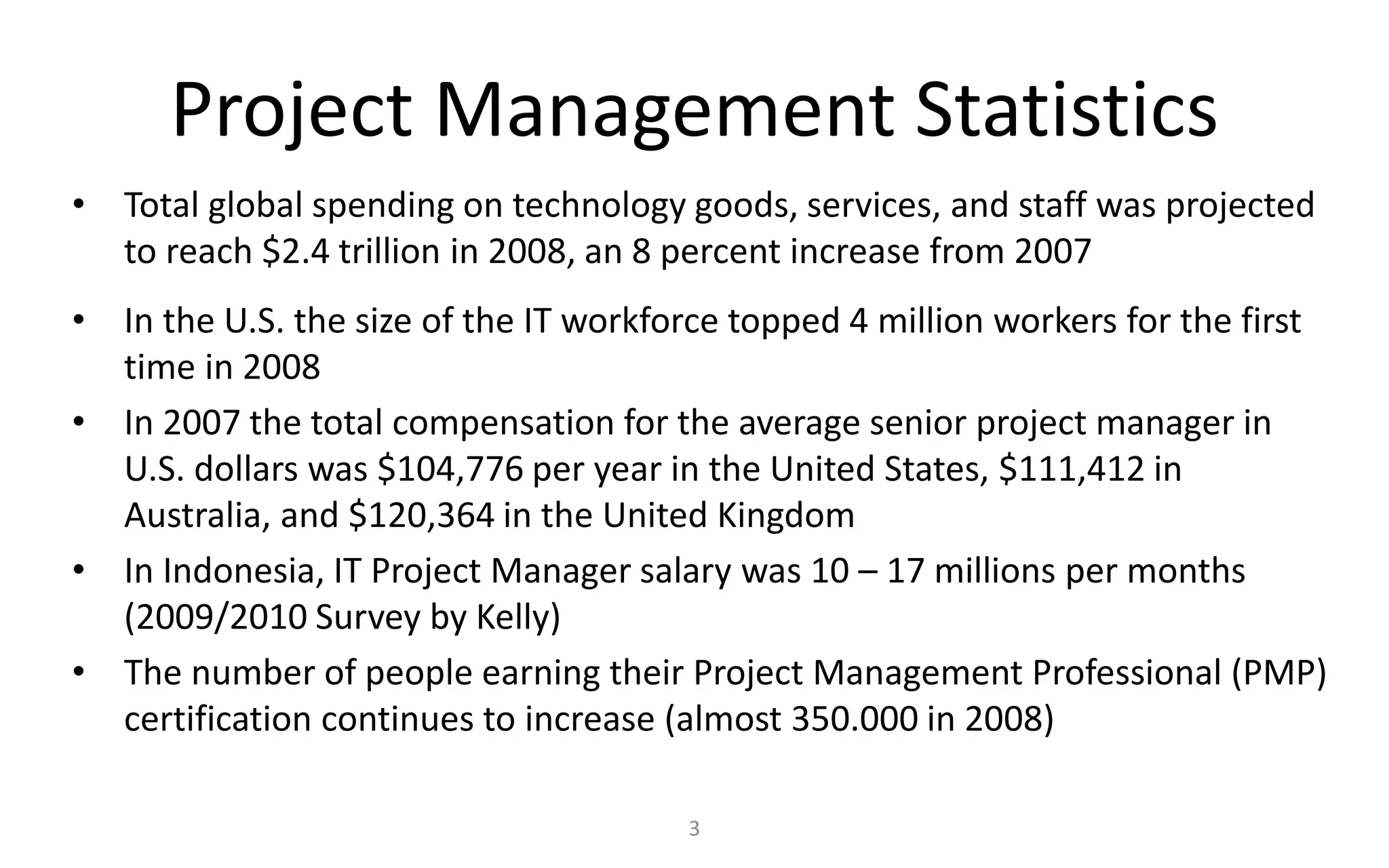
• Total global spending on technology goods, services, and staff was projected
to reach $2.4 trillion in 2008, an 8 percent increase from 2007
• In the U.S. the size of the IT workforce topped 4 million workers for the first
time in 2008
• In 2007 the total compensation for the average senior project manager in
U.S. dollars was $104,776 per year in the United States, $111,412 in
Australia, and $120,364 in the United Kingdom
• In Indonesia, IT Project Manager salary was 10 – 17 millions per months
(2009/2010 Survey by Kelly)
• The number of people earning their Project Management Professional (PMP)
certification continues to increase (almost 350.000 in 2008)
Project Management Statistics
3
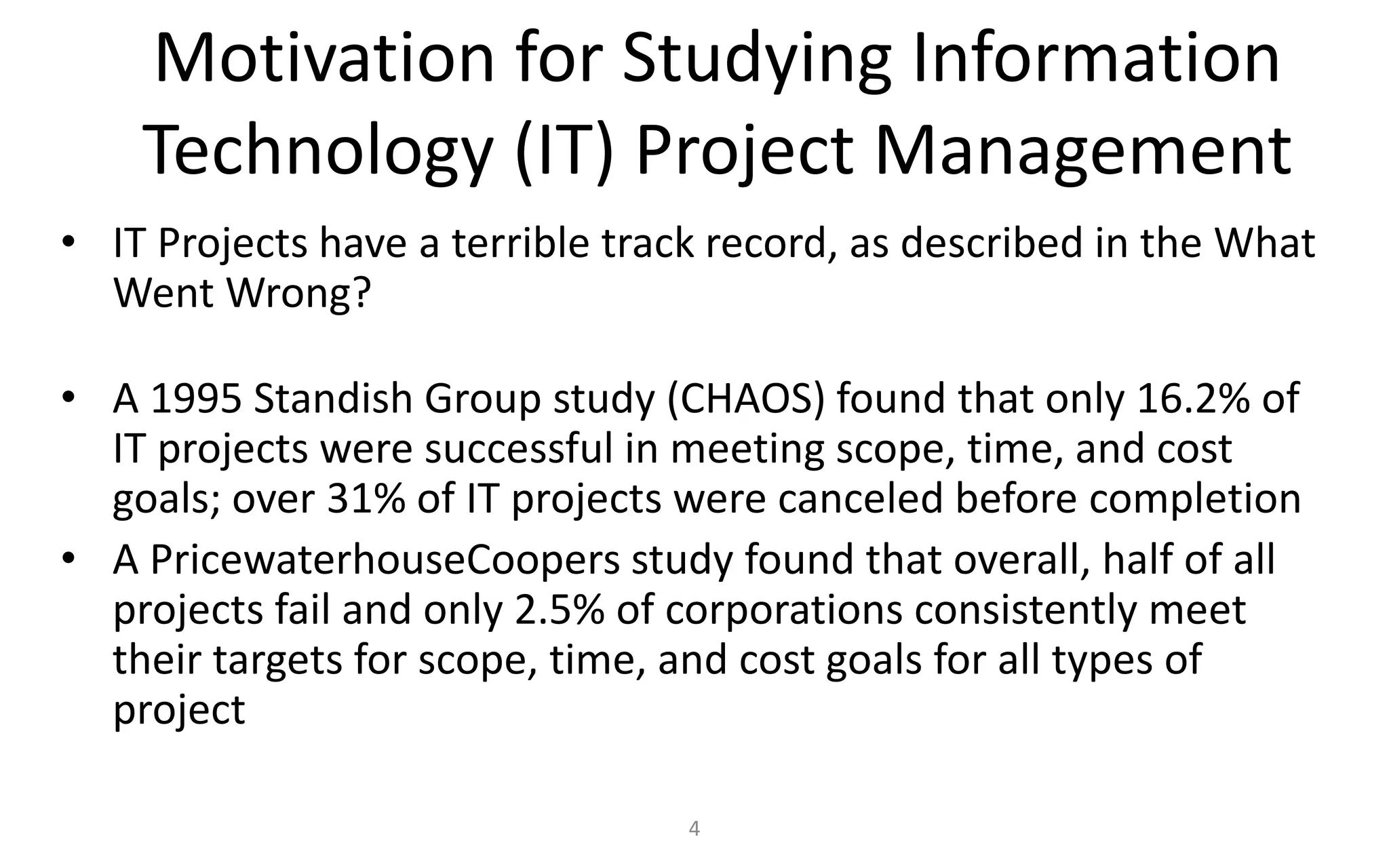
• IT Projects have a terrible track record, as described in the What
Went Wrong?
• A 1995 Standish Group study (CHAOS) found that only 16.2% of
IT projects were successful in meeting scope, time, and cost
goals; over 31% of IT projects were canceled before completion
• A PricewaterhouseCoopers study found that overall, half of all
projects fail and only 2.5% of corporations consistently meet
their targets for scope, time, and cost goals for all types of
project
Motivation for Studying Information
Technology (IT) Project Management
4
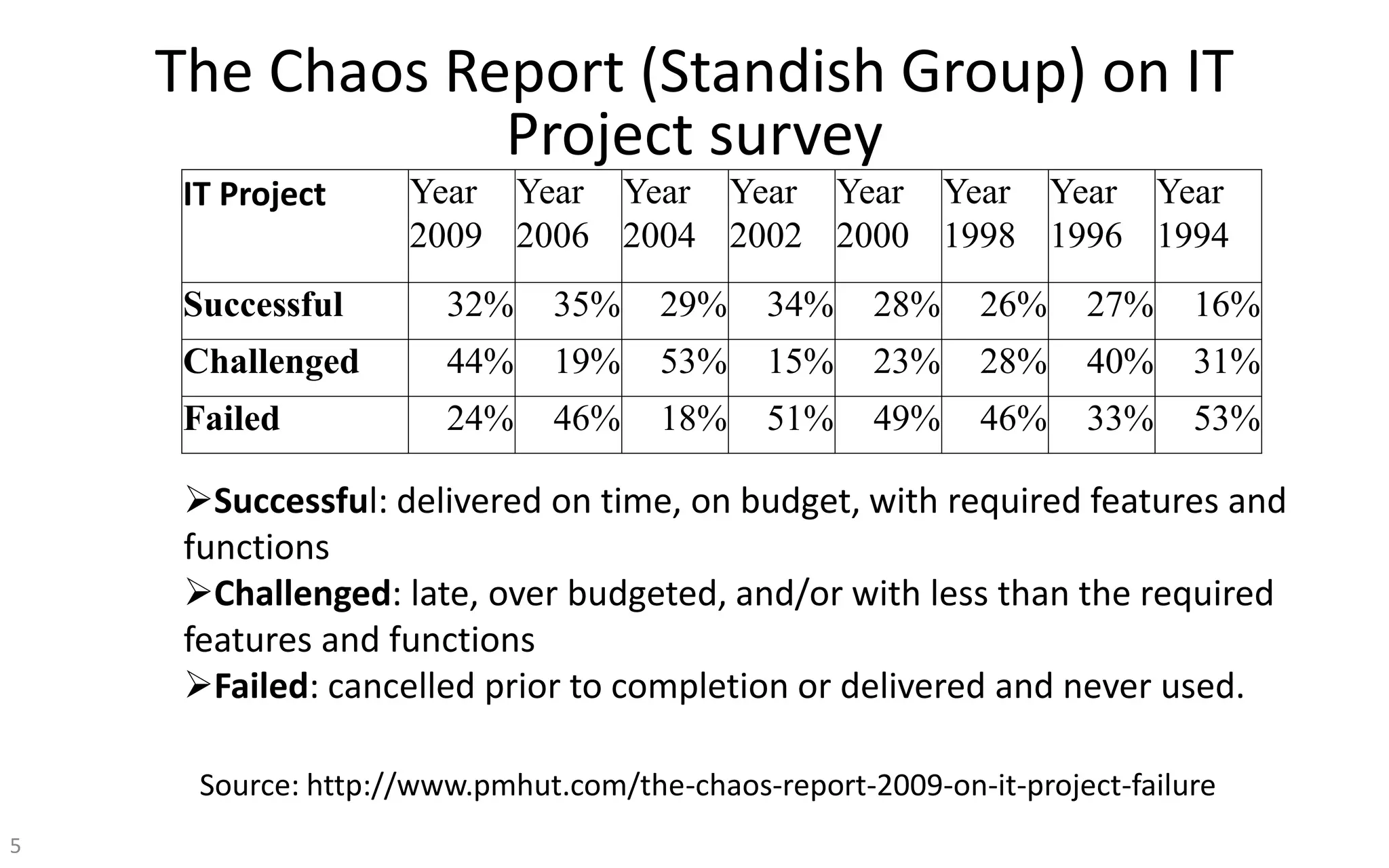
The Chaos Report (Standish Group) on IT
Project survey
5
IT Project Year
2009
Year
2006
Year
2004
Year
2002
Year
2000
Year
1998
Year
1996
Year
1994
Successful 32% 35% 29% 34% 28% 26% 27% 16%
Challenged 44% 19% 53% 15% 23% 28% 40% 31%
Failed 24% 46% 18% 51% 49% 46% 33% 53%
Successful: delivered on time, on budget, with required features and
functions
Challenged: late, over budgeted, and/or with less than the required
features and functions
Failed: cancelled prior to completion or delivered and never used.
Source: http://www.pmhut.com/the-chaos-report-2009-on-it-project-failure
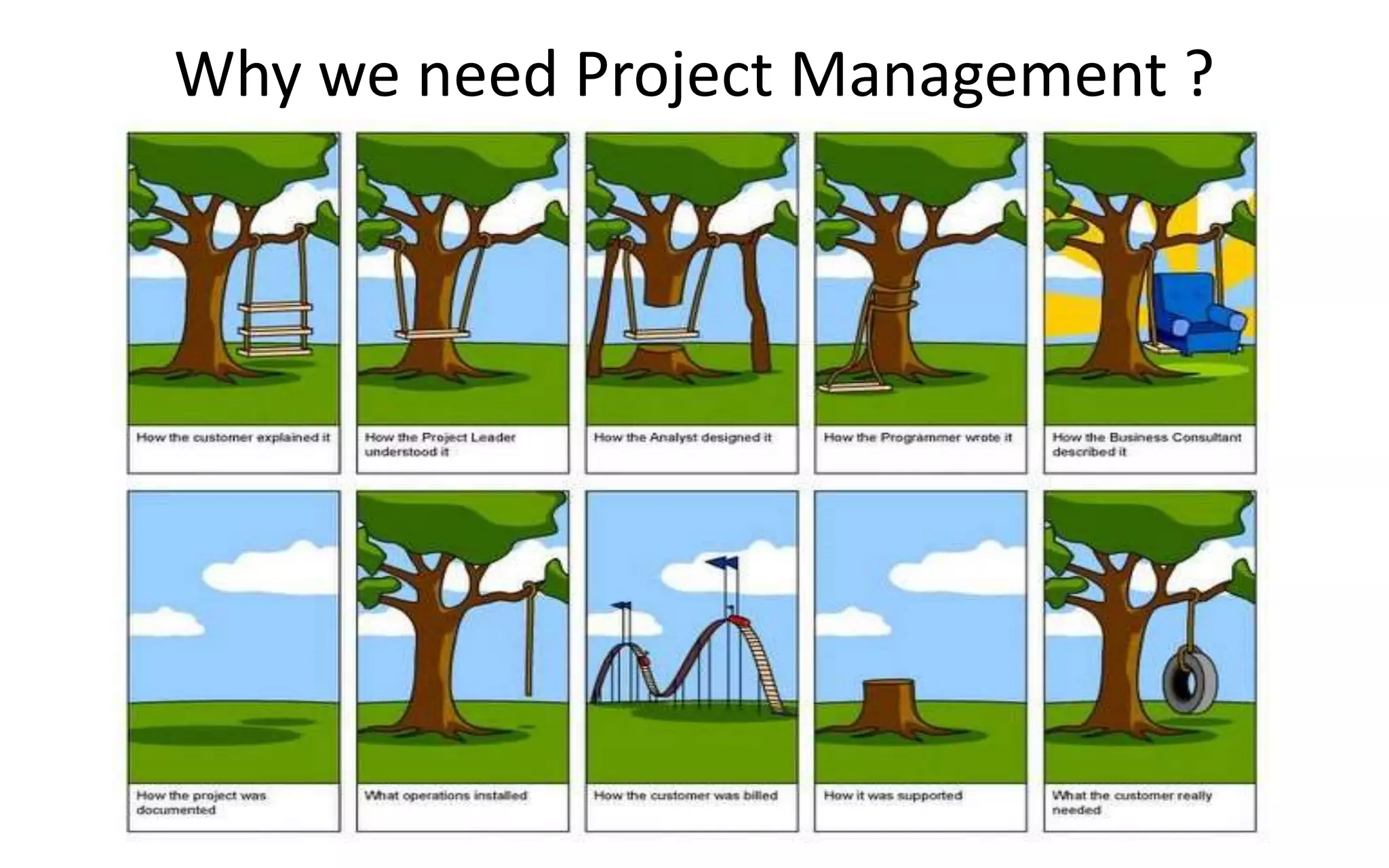
Why we need Project Management ?
6
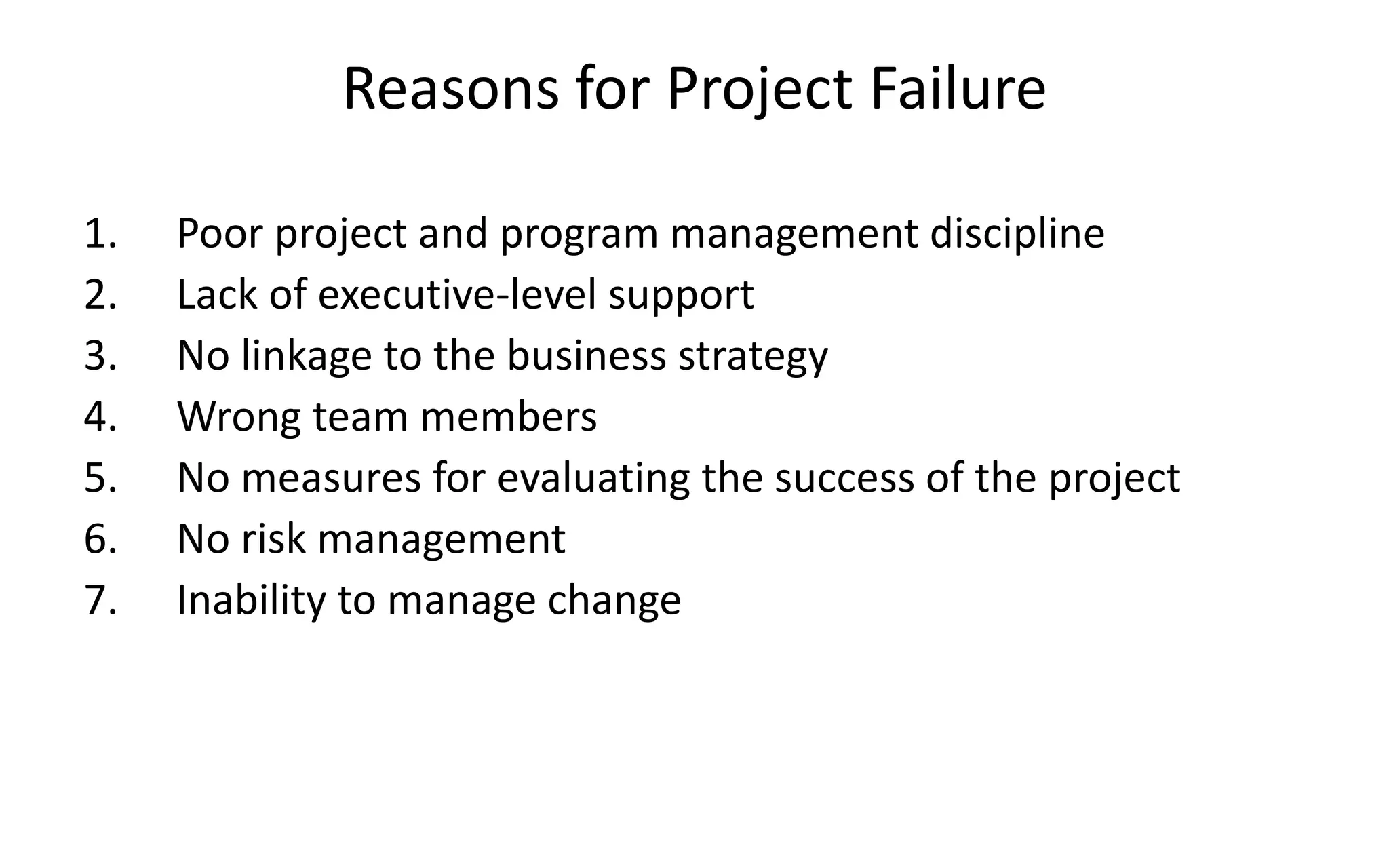
Reasons for Project Failure
1. Poor project and program management discipline
2. Lack of executive-level support
3. No linkage to the business strategy
4. Wrong team members
5. No measures for evaluating the success of the project
6. No risk management
7. Inability to manage change
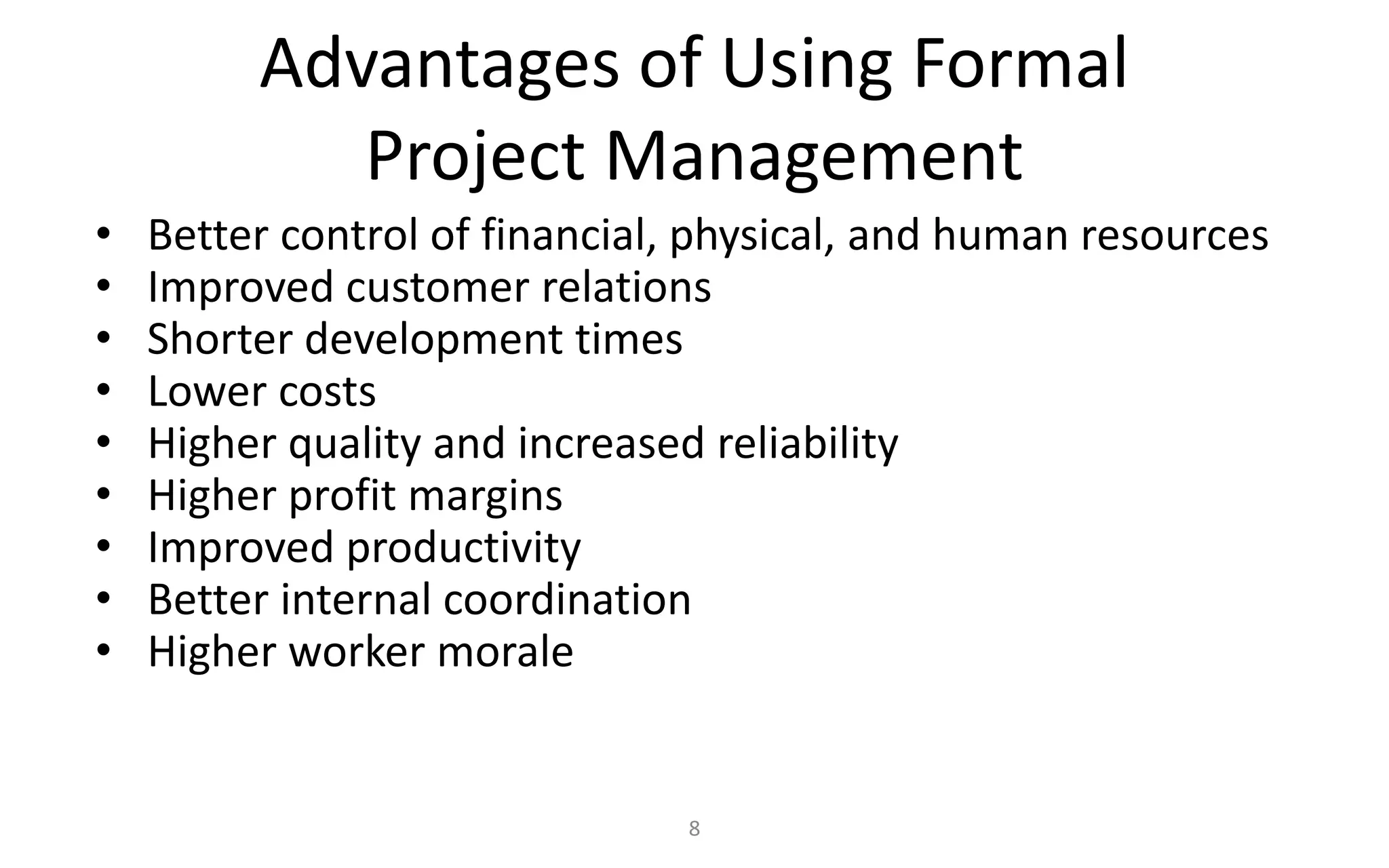
• Better control of financial, physical, and human resources
• Improved customer relations
• Shorter development times
• Lower costs
• Higher quality and increased reliability
• Higher profit margins
• Improved productivity
• Better internal coordination
• Higher worker morale
Advantages of Using Formal
Project Management
8
• A project is “a temporary endeavor undertaken to create a unique
product, service, or result” (PMBOK® Guide, Fourth Edition, 2008, p. 5)
• A project is a temporary endeavor with a defined beginning and end
(usually time-constrained, and often constrained by funding or
deliverables) (wikipedia)
• An individual or collaborative enterprise that is carefully planned to
achieve a particular aim (oxford dictionary)
– Operations is work done to sustain the business
– Projects end when their objectives have been reached or the project has
been terminated
– Projects can be large or small and take a short or long time to complete
What Is a Project?
9
• A project:
– Has a unique purpose
– Is temporary
– Is developed using progressive elaboration
– Requires resources, often from various areas
– Should have a primary customer or sponsor
• The project sponsor usually provides the direction and
funding for the project
– Involves uncertainty
Project Attributes
10
• A technician replaces ten laptops for a small department
• A small software development team adds a new feature to an
internal software application for the finance department
• A college campus upgrades its technology infrastructure to
provide wireless Internet access across the whole campus
• A cross-functional task force in a company decides what Voice-
over-Internet-Protocol (VoIP) system to purchase and how it
will be implemented
Examples of IT Projects
11
• Project managers work with project sponsors, the
project team, and other people involved in a project to
meet project goals
• Program: group of related projects managed in a
coordinated way to obtain benefits and control not
available from managing them individually (PMBOK®
Guide, Fourth Edition, 2008, p. 9)
• Program managers oversee programs; often act as
bosses for project managers
Project and Program Managers
12
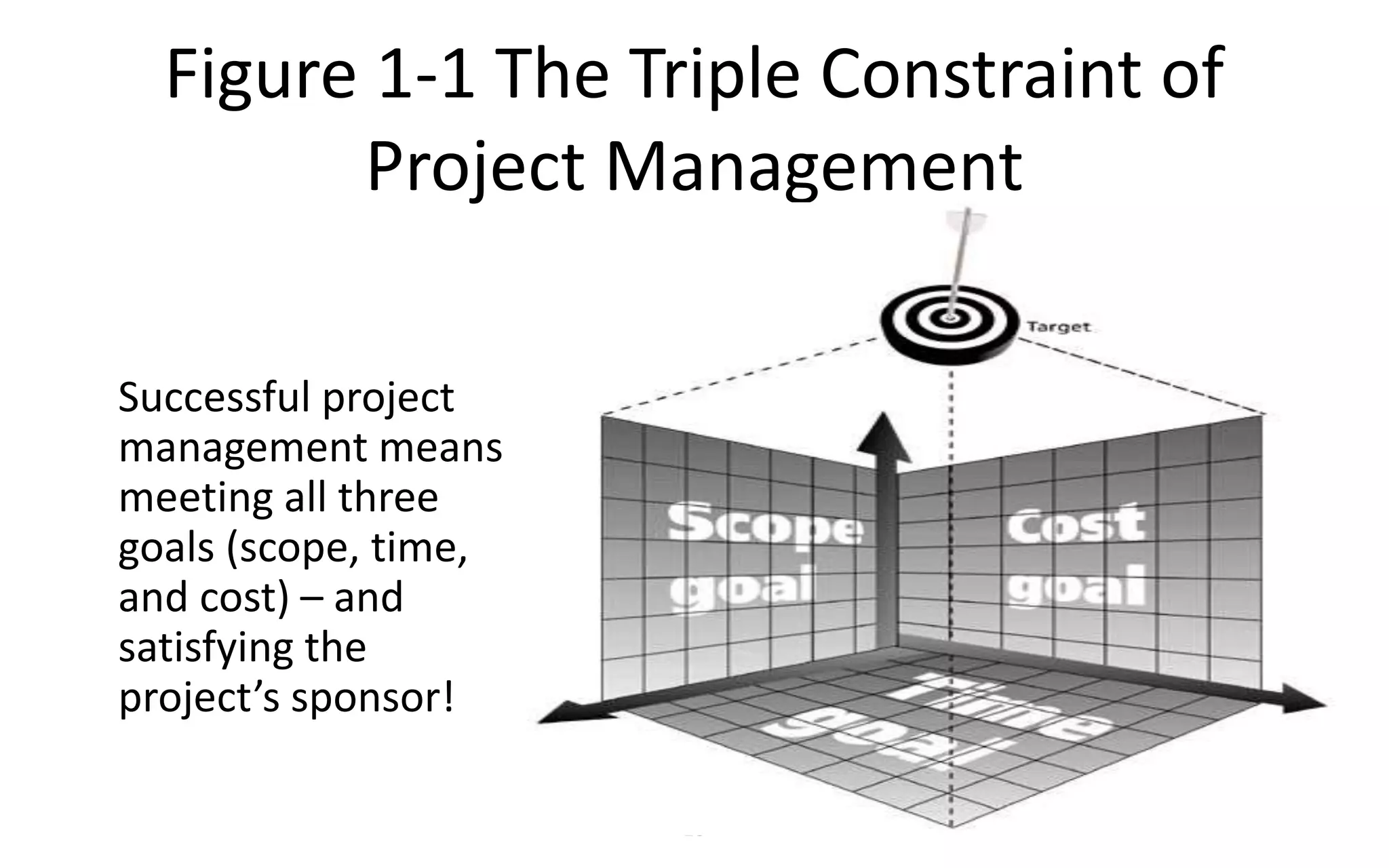
Figure 1-1 The Triple Constraint of
Project Management
13
Successful project
management means
meeting all three
goals (scope, time,
and cost) – and
satisfying the
project’s sponsor!
• Project management is “the application of knowledge, skills, tools and
techniques to project activities to meet project requirements” (PMBOK®
Guide, Fourth Edition, 2008, p. 6)
• Project management is the discipline of planning, organizing, securing,
managing, leading, and controlling resources to achieve specific goals
(wikipedia)
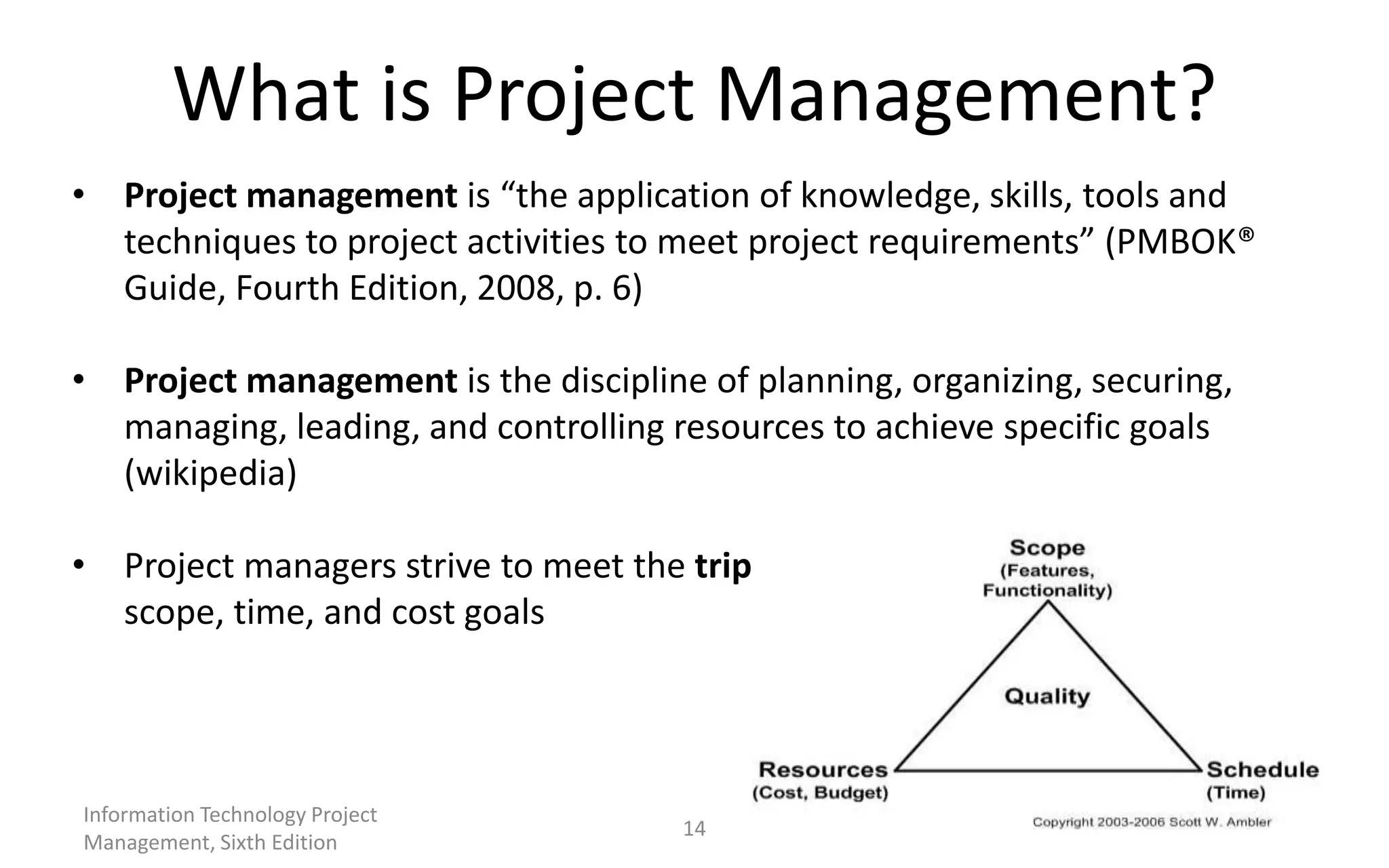
• Project managers strive to meet the triple constraint by balancing project
scope, time, and cost goals
What is Project Management?
Information Technology Project
Management, Sixth Edition
14
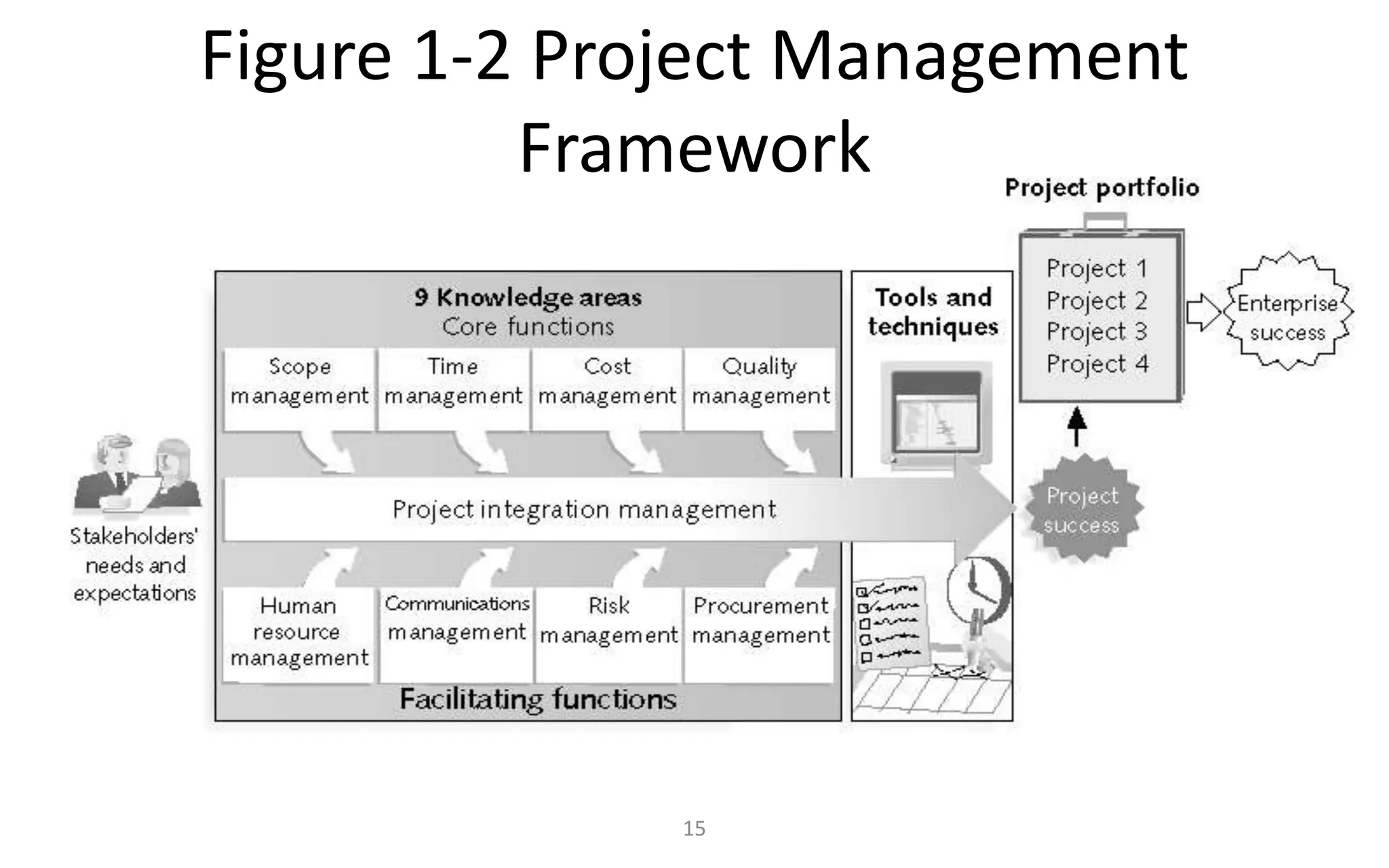
Figure 1-2 Project Management
Framework
15
• Stakeholders are the people involved in or affected by
project activities
• Stakeholders include:
– The project sponsor
– The project manager
– The project team
– Support staff
– Customers
– Users
– Suppliers
– Opponents to the project
Project Stakeholders
16
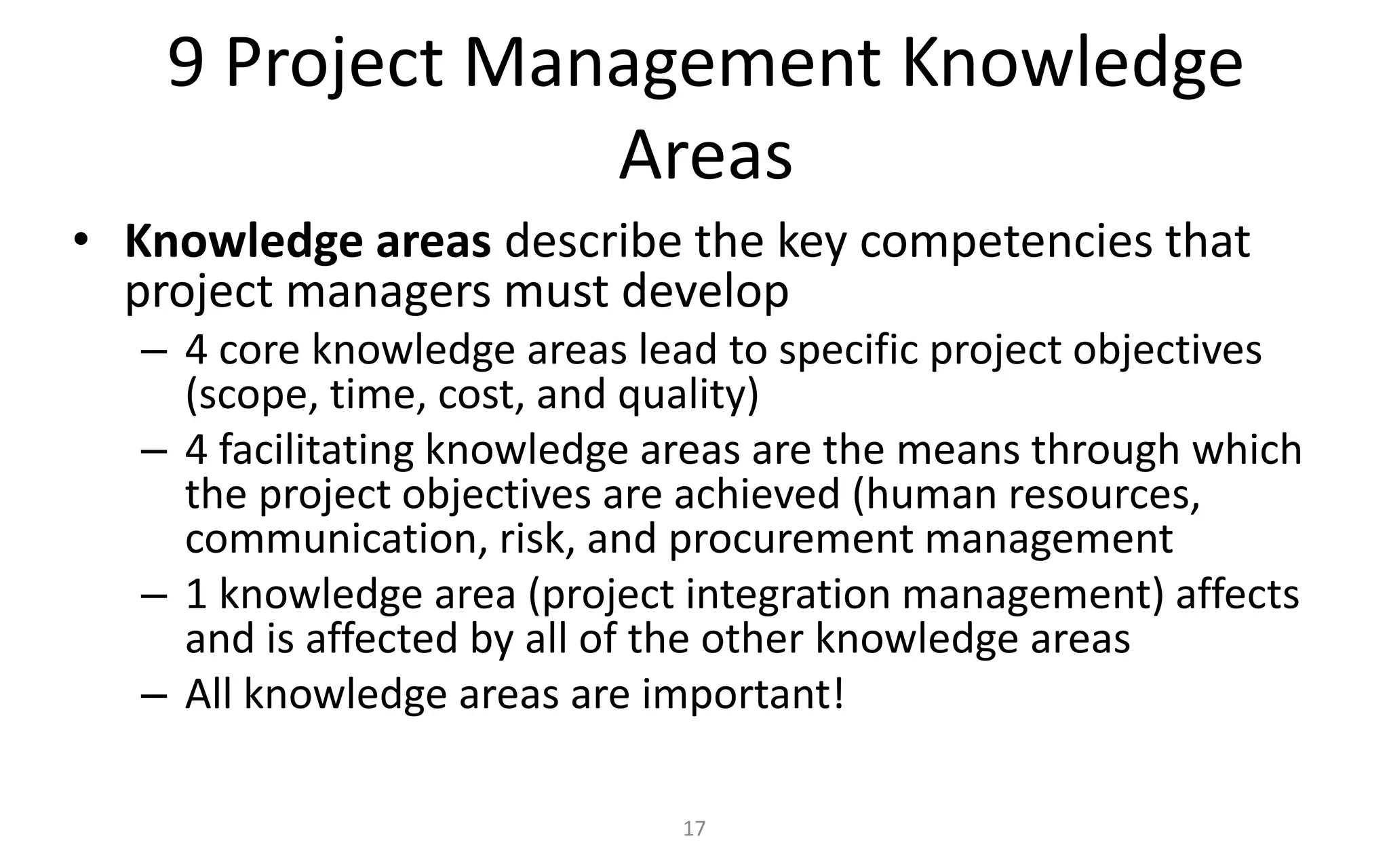
• Knowledge areas describe the key competencies that
project managers must develop
– 4 core knowledge areas lead to specific project objectives
(scope, time, cost, and quality)
– 4 facilitating knowledge areas are the means through which
the project objectives are achieved (human resources,
communication, risk, and procurement management
– 1 knowledge area (project integration management) affects
and is affected by all of the other knowledge areas
– All knowledge areas are important!
9 Project Management Knowledge
Areas
17
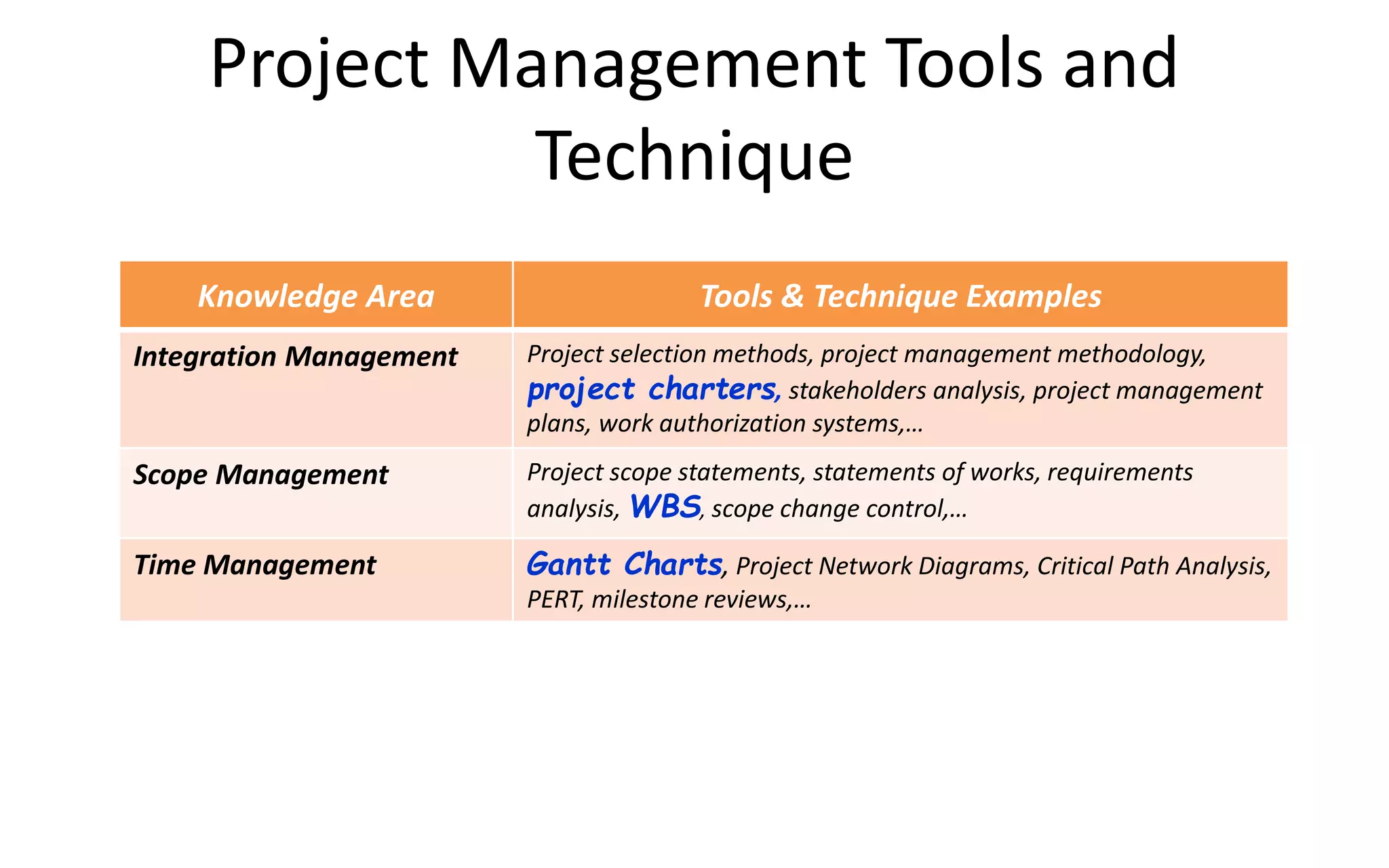
Project Management Tools and
Technique
Knowledge Area Tools & Technique Examples
Integration Management Project selection methods, project management methodology,
project charters, stakeholders analysis, project management
plans, work authorization systems,…
Scope Management Project scope statements, statements of works, requirements
analysis, WBS, scope change control,…
Time Management Gantt Charts, Project Network Diagrams, Critical Path Analysis,
PERT, milestone reviews,…
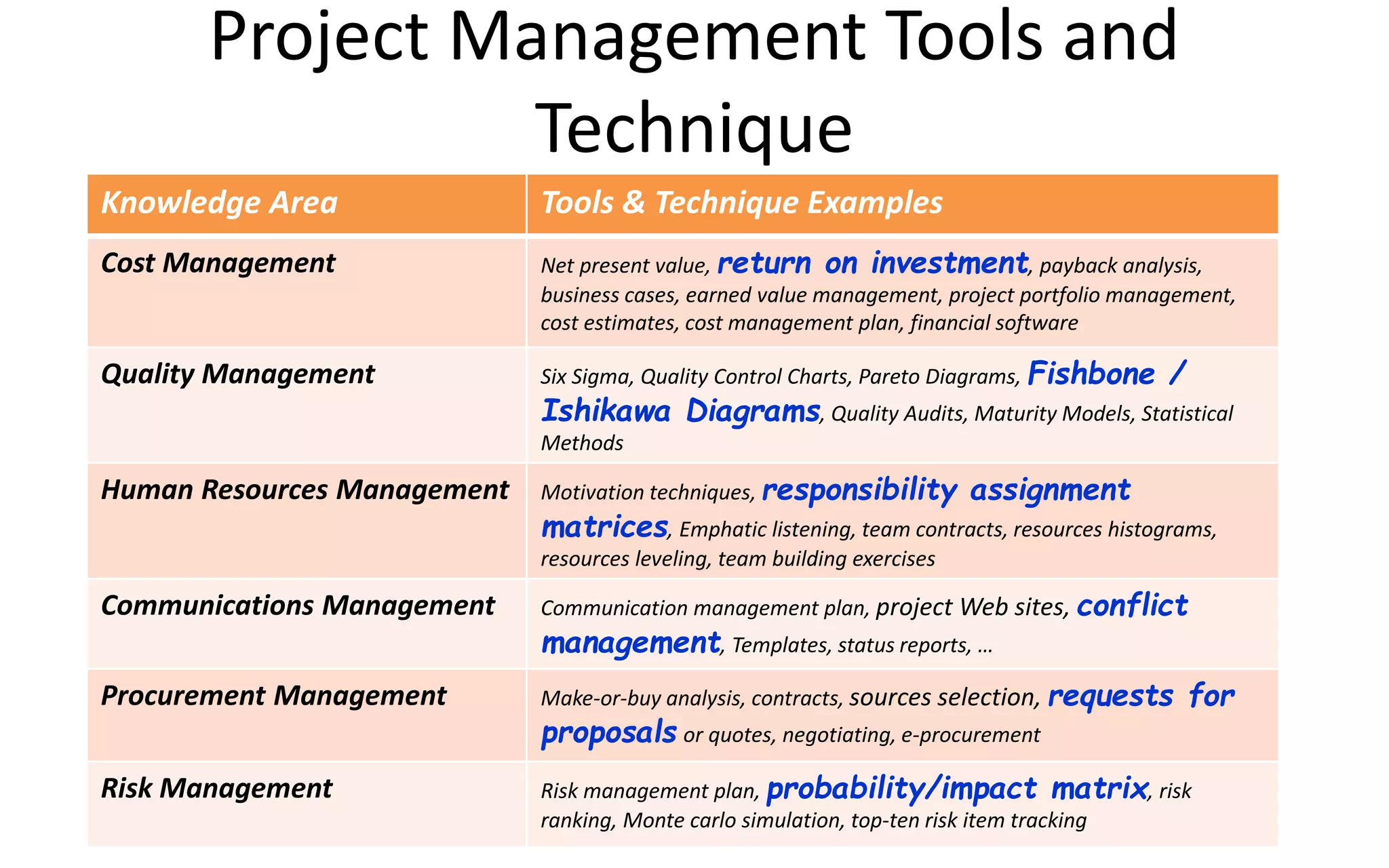
Knowledge Area Tools & Technique Examples
Cost Management Net present value, return on investment, payback analysis,
business cases, earned value management, project portfolio management,
cost estimates, cost management plan, financial software
Quality Management Six Sigma, Quality Control Charts, Pareto Diagrams, Fishbone /
Ishikawa Diagrams, Quality Audits, Maturity Models, Statistical
Methods
Human Resources Management Motivation techniques, responsibility assignment
matrices, Emphatic listening, team contracts, resources histograms,
resources leveling, team building exercises
Communications Management Communication management plan, project Web sites, conflict
management, Templates, status reports, …
Procurement Management Make-or-buy analysis, contracts, sources selection, requests for
proposals or quotes, negotiating, e-procurement
Risk Management Risk management plan, probability/impact matrix, risk
ranking, Monte carlo simulation, top-ten risk item tracking
Project Management Tools and
Technique
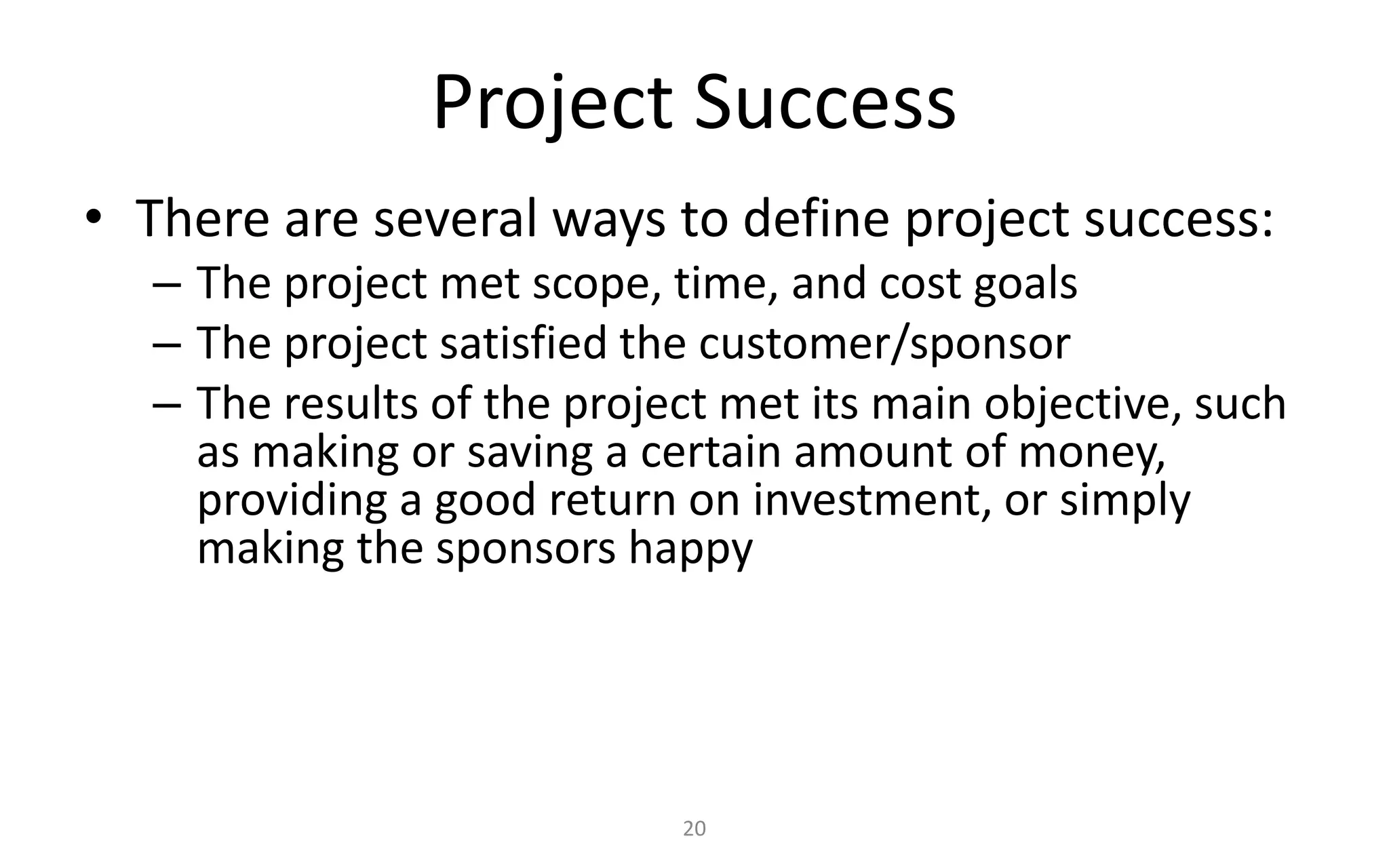
• There are several ways to define project success:
– The project met scope, time, and cost goals
– The project satisfied the customer/sponsor
– The results of the project met its main objective, such
as making or saving a certain amount of money,
providing a good return on investment, or simply
making the sponsors happy
Project Success
20
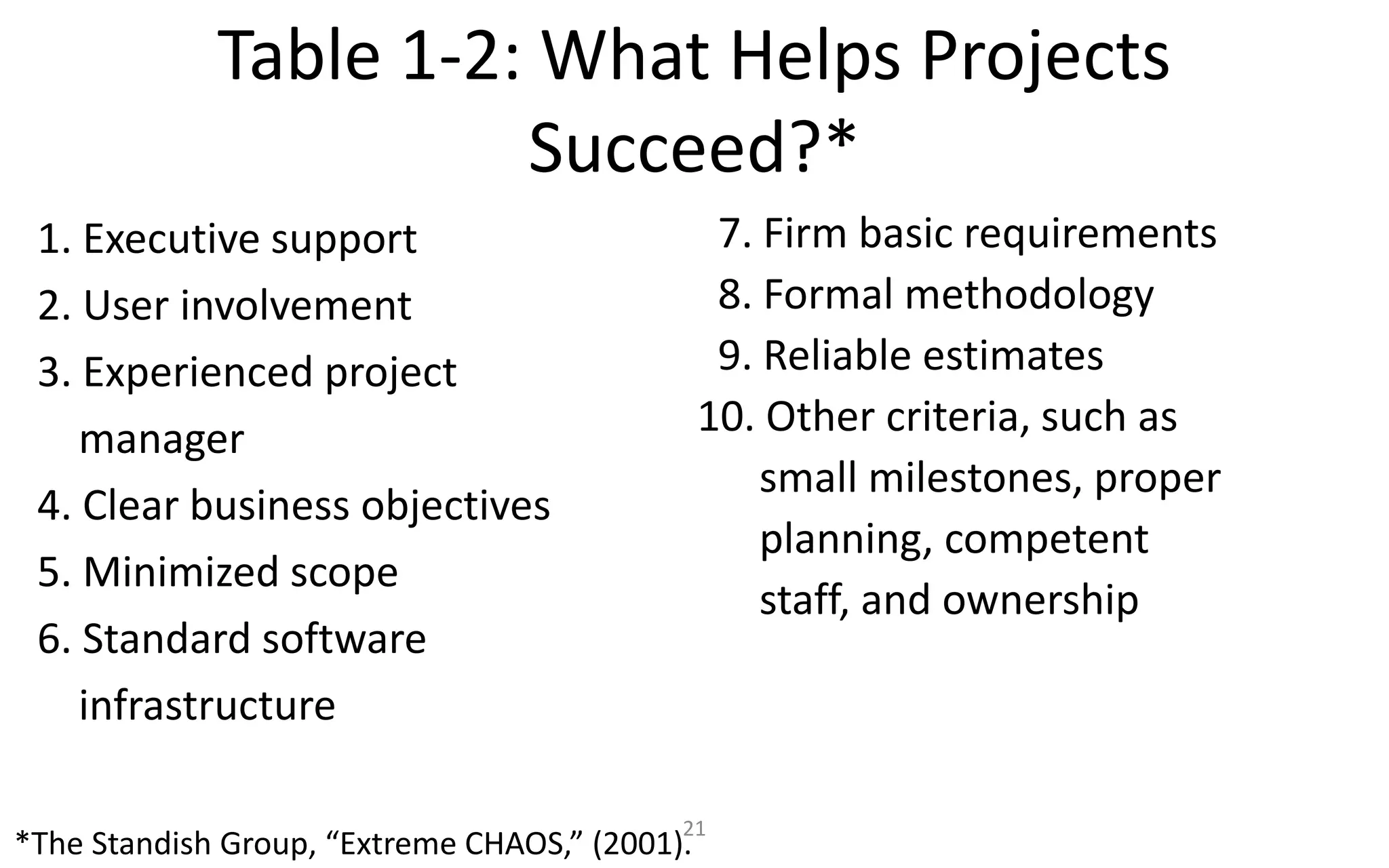
1. Executive support
2. User involvement
3. Experienced project
manager
4. Clear business objectives
5. Minimized scope
6. Standard software
infrastructure
Table 1-2: What Helps Projects
Succeed?*
21
7. Firm basic requirements
8. Formal methodology
9. Reliable estimates
10. Other criteria, such as
small milestones, proper
planning, competent
staff, and ownership
*The Standish Group, “Extreme CHAOS,” (2001).
Q&A
So, what do you say, is IT Project Management
important?

Introduction to ict project management

  • 1.
    Introduction to ITProject Management N. Selviandro IT Project Management. School of Computing. Telkom University. 2015.
  • 2.
    • Understand thegrowing need for better project management, especially for information technology projects • Explain what a project is, provide examples of information technology projects, list various attributes of projects, and describe the triple constraint of projects • Describe project management and discuss key elements of the project management framework, including project stakeholders, the project management knowledge areas, common tools and techniques, and project success Learning Objectives 2
  • 3.
    • Total globalspending on technology goods, services, and staff was projected to reach $2.4 trillion in 2008, an 8 percent increase from 2007 • In the U.S. the size of the IT workforce topped 4 million workers for the first time in 2008 • In 2007 the total compensation for the average senior project manager in U.S. dollars was $104,776 per year in the United States, $111,412 in Australia, and $120,364 in the United Kingdom • In Indonesia, IT Project Manager salary was 10 – 17 millions per months (2009/2010 Survey by Kelly) • The number of people earning their Project Management Professional (PMP) certification continues to increase (almost 350.000 in 2008) Project Management Statistics 3
  • 4.
    • IT Projectshave a terrible track record, as described in the What Went Wrong? • A 1995 Standish Group study (CHAOS) found that only 16.2% of IT projects were successful in meeting scope, time, and cost goals; over 31% of IT projects were canceled before completion • A PricewaterhouseCoopers study found that overall, half of all projects fail and only 2.5% of corporations consistently meet their targets for scope, time, and cost goals for all types of project Motivation for Studying Information Technology (IT) Project Management 4
  • 5.
    The Chaos Report(Standish Group) on IT Project survey 5 IT Project Year 2009 Year 2006 Year 2004 Year 2002 Year 2000 Year 1998 Year 1996 Year 1994 Successful 32% 35% 29% 34% 28% 26% 27% 16% Challenged 44% 19% 53% 15% 23% 28% 40% 31% Failed 24% 46% 18% 51% 49% 46% 33% 53% Successful: delivered on time, on budget, with required features and functions Challenged: late, over budgeted, and/or with less than the required features and functions Failed: cancelled prior to completion or delivered and never used. Source: http://www.pmhut.com/the-chaos-report-2009-on-it-project-failure
  • 6.
    Why we needProject Management ? 6
  • 7.
    Reasons for ProjectFailure 1. Poor project and program management discipline 2. Lack of executive-level support 3. No linkage to the business strategy 4. Wrong team members 5. No measures for evaluating the success of the project 6. No risk management 7. Inability to manage change
  • 8.
    • Better controlof financial, physical, and human resources • Improved customer relations • Shorter development times • Lower costs • Higher quality and increased reliability • Higher profit margins • Improved productivity • Better internal coordination • Higher worker morale Advantages of Using Formal Project Management 8
  • 9.
    • A projectis “a temporary endeavor undertaken to create a unique product, service, or result” (PMBOK® Guide, Fourth Edition, 2008, p. 5) • A project is a temporary endeavor with a defined beginning and end (usually time-constrained, and often constrained by funding or deliverables) (wikipedia) • An individual or collaborative enterprise that is carefully planned to achieve a particular aim (oxford dictionary) – Operations is work done to sustain the business – Projects end when their objectives have been reached or the project has been terminated – Projects can be large or small and take a short or long time to complete What Is a Project? 9
  • 10.
    • A project: –Has a unique purpose – Is temporary – Is developed using progressive elaboration – Requires resources, often from various areas – Should have a primary customer or sponsor • The project sponsor usually provides the direction and funding for the project – Involves uncertainty Project Attributes 10
  • 11.
    • A technicianreplaces ten laptops for a small department • A small software development team adds a new feature to an internal software application for the finance department • A college campus upgrades its technology infrastructure to provide wireless Internet access across the whole campus • A cross-functional task force in a company decides what Voice- over-Internet-Protocol (VoIP) system to purchase and how it will be implemented Examples of IT Projects 11
  • 12.
    • Project managerswork with project sponsors, the project team, and other people involved in a project to meet project goals • Program: group of related projects managed in a coordinated way to obtain benefits and control not available from managing them individually (PMBOK® Guide, Fourth Edition, 2008, p. 9) • Program managers oversee programs; often act as bosses for project managers Project and Program Managers 12
  • 13.
    Figure 1-1 TheTriple Constraint of Project Management 13 Successful project management means meeting all three goals (scope, time, and cost) – and satisfying the project’s sponsor!
  • 14.
    • Project managementis “the application of knowledge, skills, tools and techniques to project activities to meet project requirements” (PMBOK® Guide, Fourth Edition, 2008, p. 6) • Project management is the discipline of planning, organizing, securing, managing, leading, and controlling resources to achieve specific goals (wikipedia) • Project managers strive to meet the triple constraint by balancing project scope, time, and cost goals What is Project Management? Information Technology Project Management, Sixth Edition 14
  • 15.
    Figure 1-2 ProjectManagement Framework 15
  • 16.
    • Stakeholders arethe people involved in or affected by project activities • Stakeholders include: – The project sponsor – The project manager – The project team – Support staff – Customers – Users – Suppliers – Opponents to the project Project Stakeholders 16
  • 17.
    • Knowledge areasdescribe the key competencies that project managers must develop – 4 core knowledge areas lead to specific project objectives (scope, time, cost, and quality) – 4 facilitating knowledge areas are the means through which the project objectives are achieved (human resources, communication, risk, and procurement management – 1 knowledge area (project integration management) affects and is affected by all of the other knowledge areas – All knowledge areas are important! 9 Project Management Knowledge Areas 17
  • 18.
    Project Management Toolsand Technique Knowledge Area Tools & Technique Examples Integration Management Project selection methods, project management methodology, project charters, stakeholders analysis, project management plans, work authorization systems,… Scope Management Project scope statements, statements of works, requirements analysis, WBS, scope change control,… Time Management Gantt Charts, Project Network Diagrams, Critical Path Analysis, PERT, milestone reviews,…
  • 19.
    Knowledge Area Tools& Technique Examples Cost Management Net present value, return on investment, payback analysis, business cases, earned value management, project portfolio management, cost estimates, cost management plan, financial software Quality Management Six Sigma, Quality Control Charts, Pareto Diagrams, Fishbone / Ishikawa Diagrams, Quality Audits, Maturity Models, Statistical Methods Human Resources Management Motivation techniques, responsibility assignment matrices, Emphatic listening, team contracts, resources histograms, resources leveling, team building exercises Communications Management Communication management plan, project Web sites, conflict management, Templates, status reports, … Procurement Management Make-or-buy analysis, contracts, sources selection, requests for proposals or quotes, negotiating, e-procurement Risk Management Risk management plan, probability/impact matrix, risk ranking, Monte carlo simulation, top-ten risk item tracking Project Management Tools and Technique
  • 20.
    • There areseveral ways to define project success: – The project met scope, time, and cost goals – The project satisfied the customer/sponsor – The results of the project met its main objective, such as making or saving a certain amount of money, providing a good return on investment, or simply making the sponsors happy Project Success 20
  • 21.
    1. Executive support 2.User involvement 3. Experienced project manager 4. Clear business objectives 5. Minimized scope 6. Standard software infrastructure Table 1-2: What Helps Projects Succeed?* 21 7. Firm basic requirements 8. Formal methodology 9. Reliable estimates 10. Other criteria, such as small milestones, proper planning, competent staff, and ownership *The Standish Group, “Extreme CHAOS,” (2001).
  • 22.
    Q&A So, what doyou say, is IT Project Management important?