MANAGING
HUMAN RESOURCE
MANAGEMENT
M-1
Dr. Jerry John
Human
Resource
Management
Most Valuable and unique
asset of an organization.
Effort cannot be replaced
with machines
How people are managed
by organization?
Traditional usage was
LABOUR.
Dr. Jerry John@KCM
Personnel
Management
• Personnel management is defined as an
administrative specialization that
focuses on hiring and developing
employees to become more valuable to
the company.
• It is sometimes considered to be a sub-
category of human resources that only
focuses on administration.
• According to Flippo, “Personnel
management is the planning,
organizing, compensation, integration
and maintenance of people for the
purpose of contributing to
organizational, individual and societal
goals.”
Dr. Jerry John@KCM
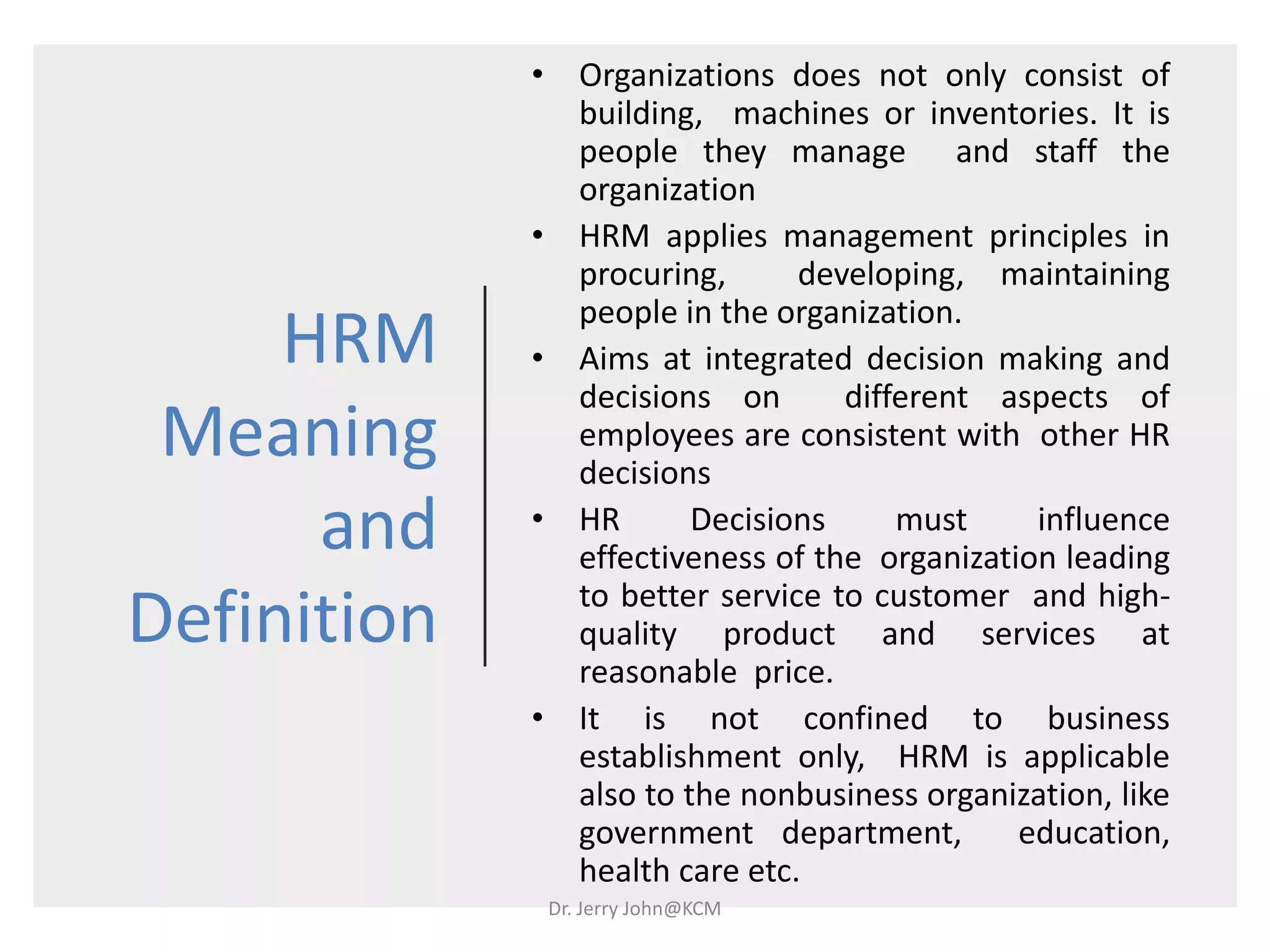
HRM Meaning and Definition
Human Resource
Management is also a
function of management,
concerned with hiring,
motivating and maintaining
people in an organization.
It focuses on people in the
organization.
Dr. Jerry John@KCM
HRM
Meaning
and
Definition
• Organizations does not only consist of
building, machines or inventories. It is
people they manage and staff the
organization
• HRM applies management principles in
procuring, developing, maintaining
people in the organization.
• Aims at integrated decision making and
decisions on different aspects of
employees are consistent with other HR
decisions
• HR Decisions must influence
effectiveness of the organization leading
to better service to customer and high-
quality product and services at
reasonable price.
• It is not confined to business
establishment only, HRM is applicable
also to the nonbusiness organization, like
government department, education,
health care etc.
Dr. Jerry John@KCM
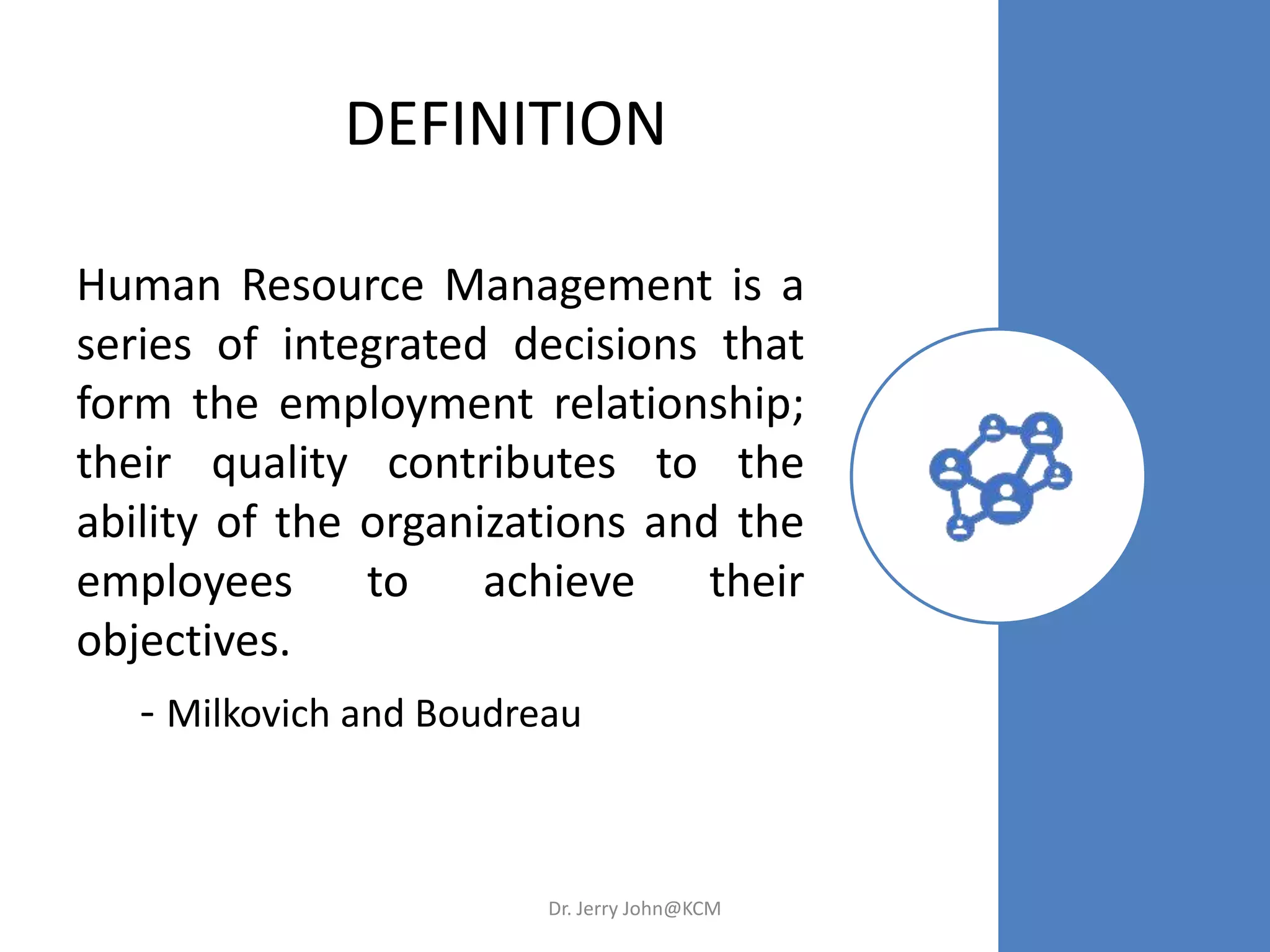
DEFINITION
Human Resource Management is a
series of integrated decisions that
form the employment relationship;
their quality contributes to the
ability of the organizations and the
employees to achieve their
objectives.
- Milkovich and Boudreau
Dr. Jerry John@KCM
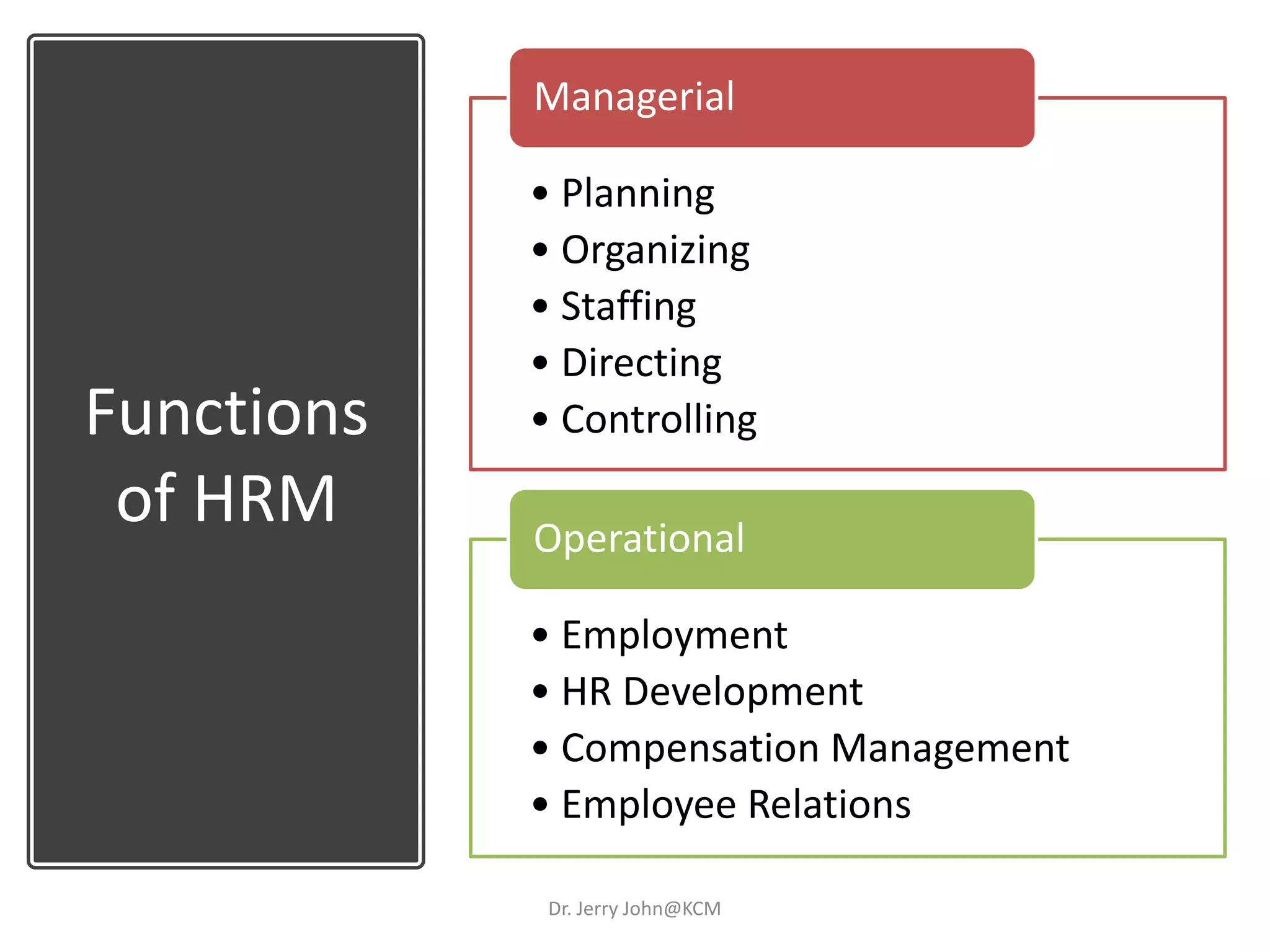
Functions
of HRM
• Planning
• Organizing
• Staffing
• Directing
• Controlling
Managerial
• Employment
• HR Development
• Compensation Management
• Employee Relations
Operational
Dr. Jerry John@KCM
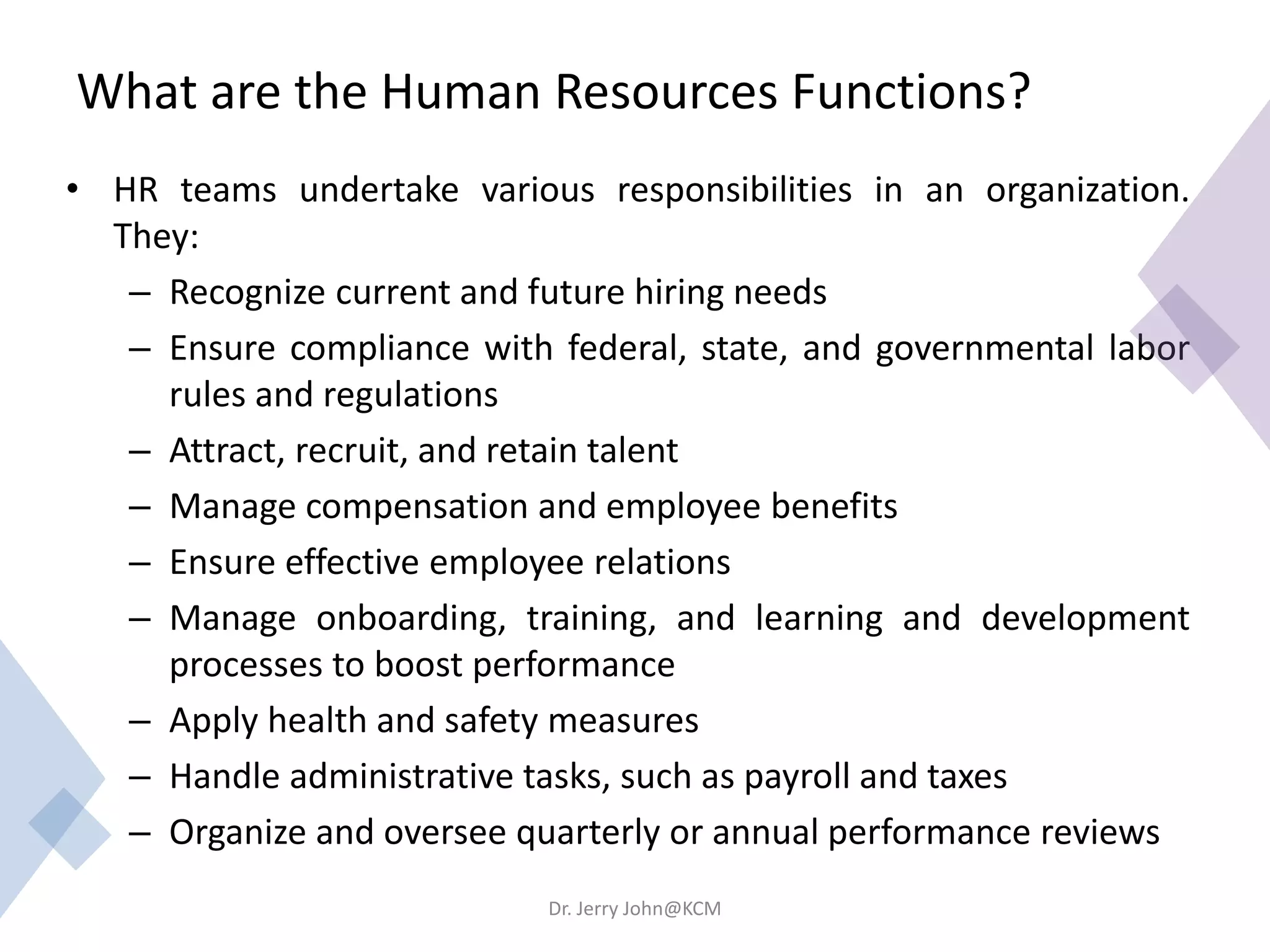
What are the Human Resources Functions?
• HR teams undertake various responsibilities in an organization.
They:
– Recognize current and future hiring needs
– Ensure compliance with federal, state, and governmental labor
rules and regulations
– Attract, recruit, and retain talent
– Manage compensation and employee benefits
– Ensure effective employee relations
– Manage onboarding, training, and learning and development
processes to boost performance
– Apply health and safety measures
– Handle administrative tasks, such as payroll and taxes
– Organize and oversee quarterly or annual performance reviews
Dr. Jerry John@KCM
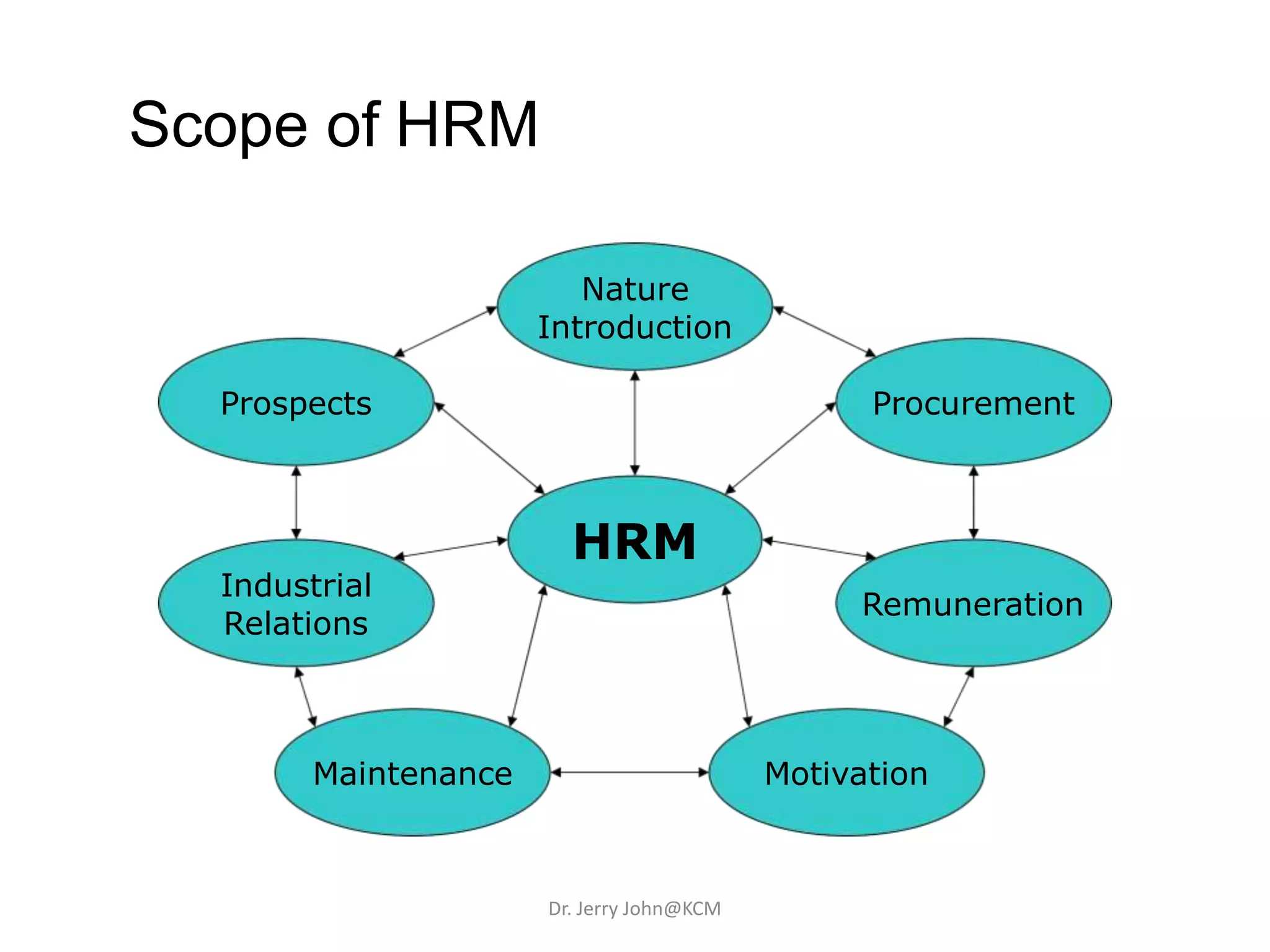
Scope of HRM
HRM
Nature
Introduction
ProcurementProspects
Industrial
Relations
Remuneration
MotivationMaintenance
Dr. Jerry John@KCM
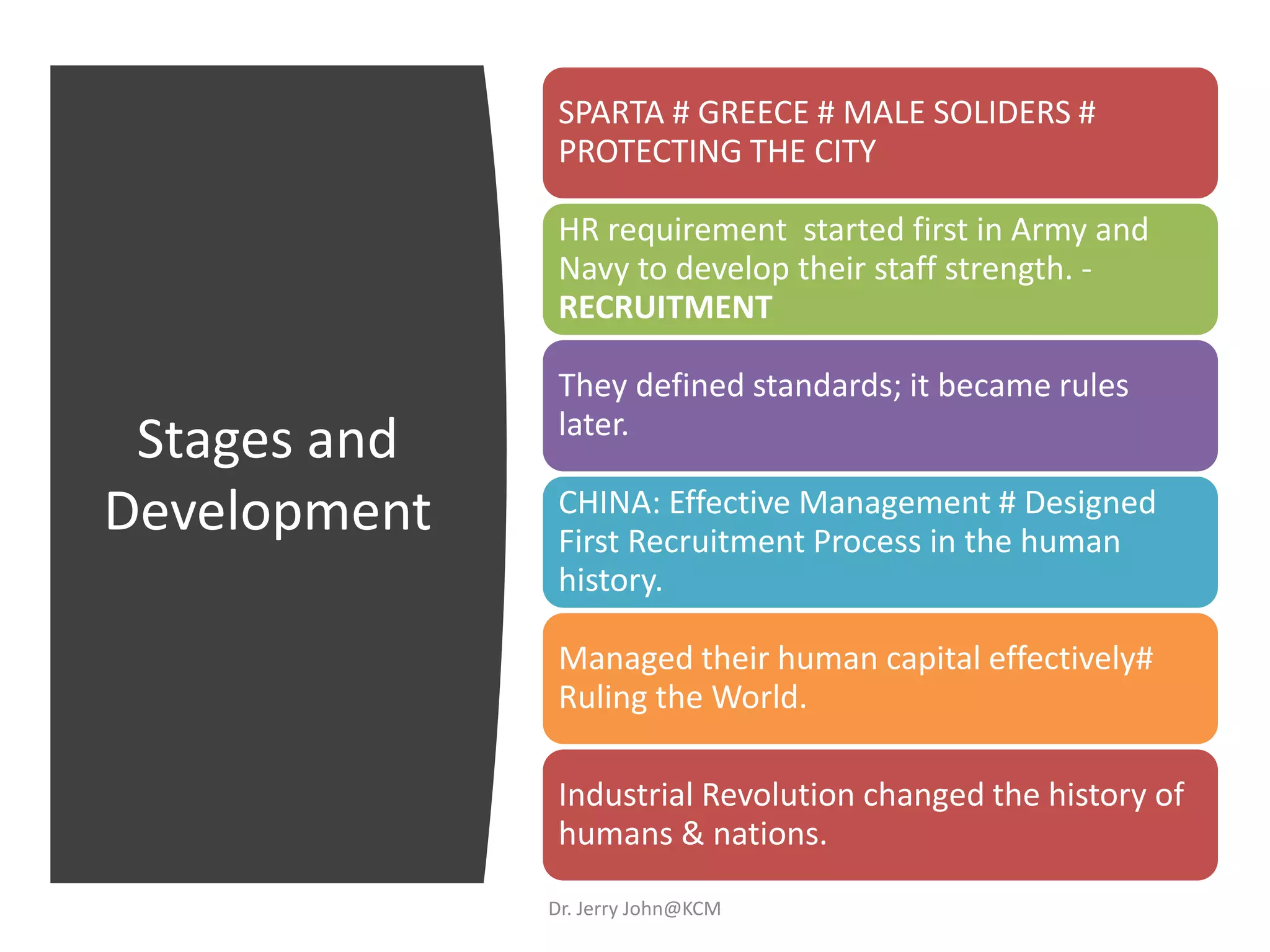
Stages and
Development
SPARTA # GREECE # MALE SOLIDERS #
PROTECTING THE CITY
HR requirement started first in Army and
Navy to develop their staff strength. -
RECRUITMENT
They defined standards; it became rules
later.
CHINA: Effective Management # Designed
First Recruitment Process in the human
history.
Managed their human capital effectively#
Ruling the World.
Industrial Revolution changed the history of
humans & nations.
Dr. Jerry John@KCM
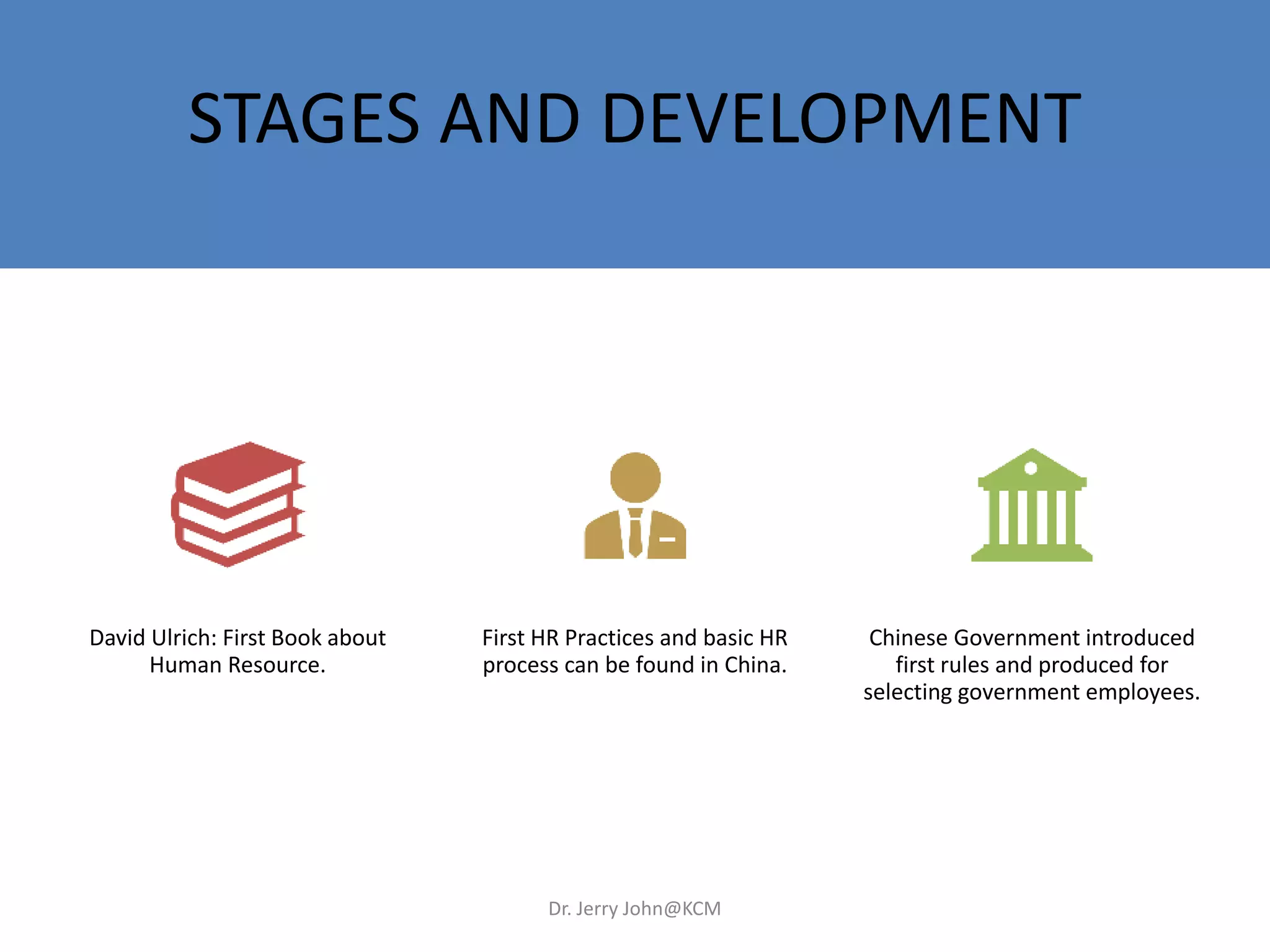
David Ulrich: First Book about
Human Resource.
First HR Practices and basic HR
process can be found in China.
Chinese Government introduced
first rules and produced for
selecting government employees.
STAGES AND DEVELOPMENT
Dr. Jerry John@KCM
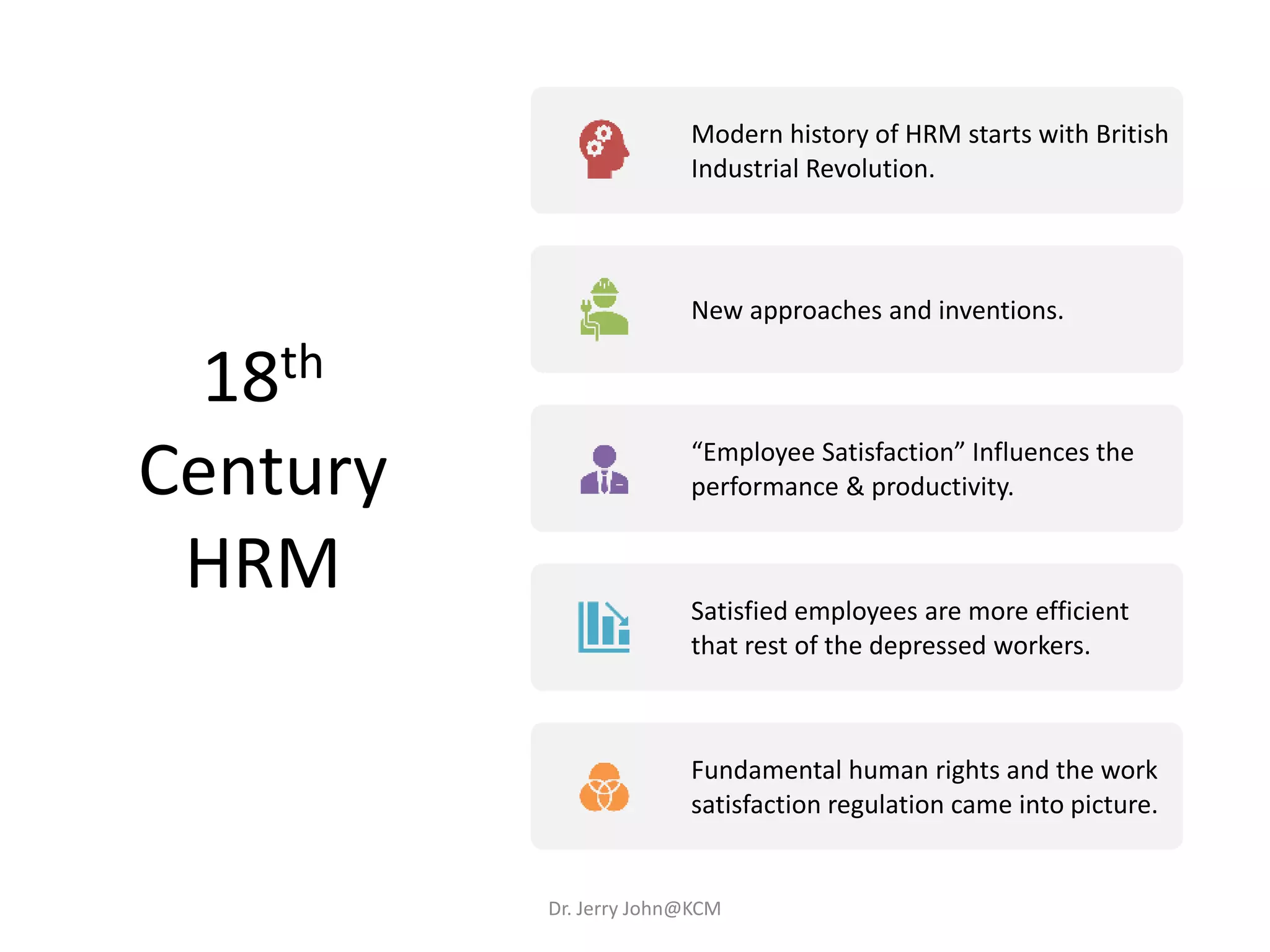
18th
Century
HRM
Modern history of HRM starts with British
Industrial Revolution.
New approaches and inventions.
“Employee Satisfaction” Influences the
performance & productivity.
Satisfied employees are more efficient
that rest of the depressed workers.
Fundamental human rights and the work
satisfaction regulation came into picture.
Dr. Jerry John@KCM
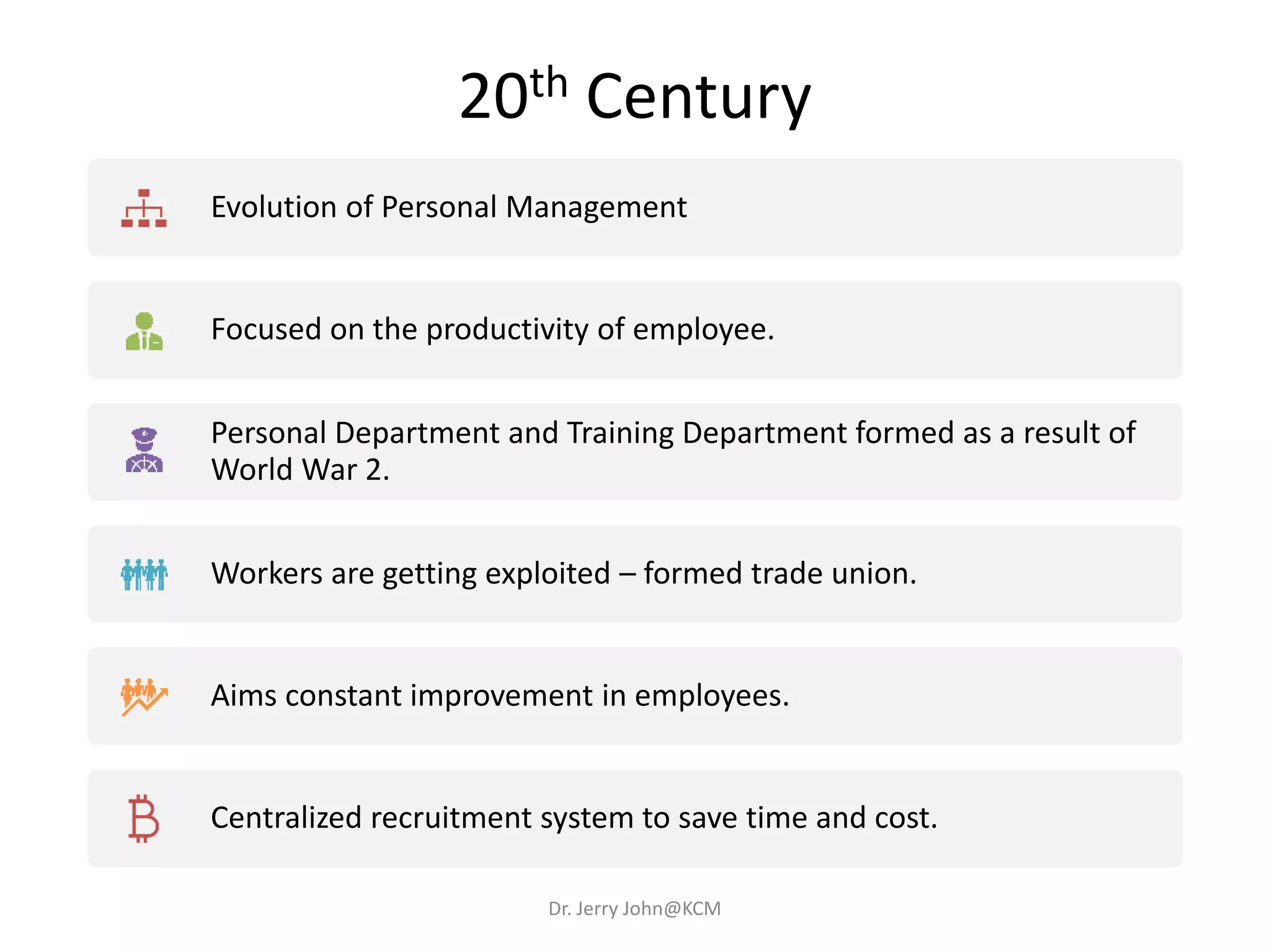
20th Century
Evolution of Personal Management
Focused on the productivity of employee.
Personal Department and Training Department formed as a result of
World War 2.
Workers are getting exploited – formed trade union.
Aims constant improvement in employees.
Centralized recruitment system to save time and cost.
Dr. Jerry John@KCM
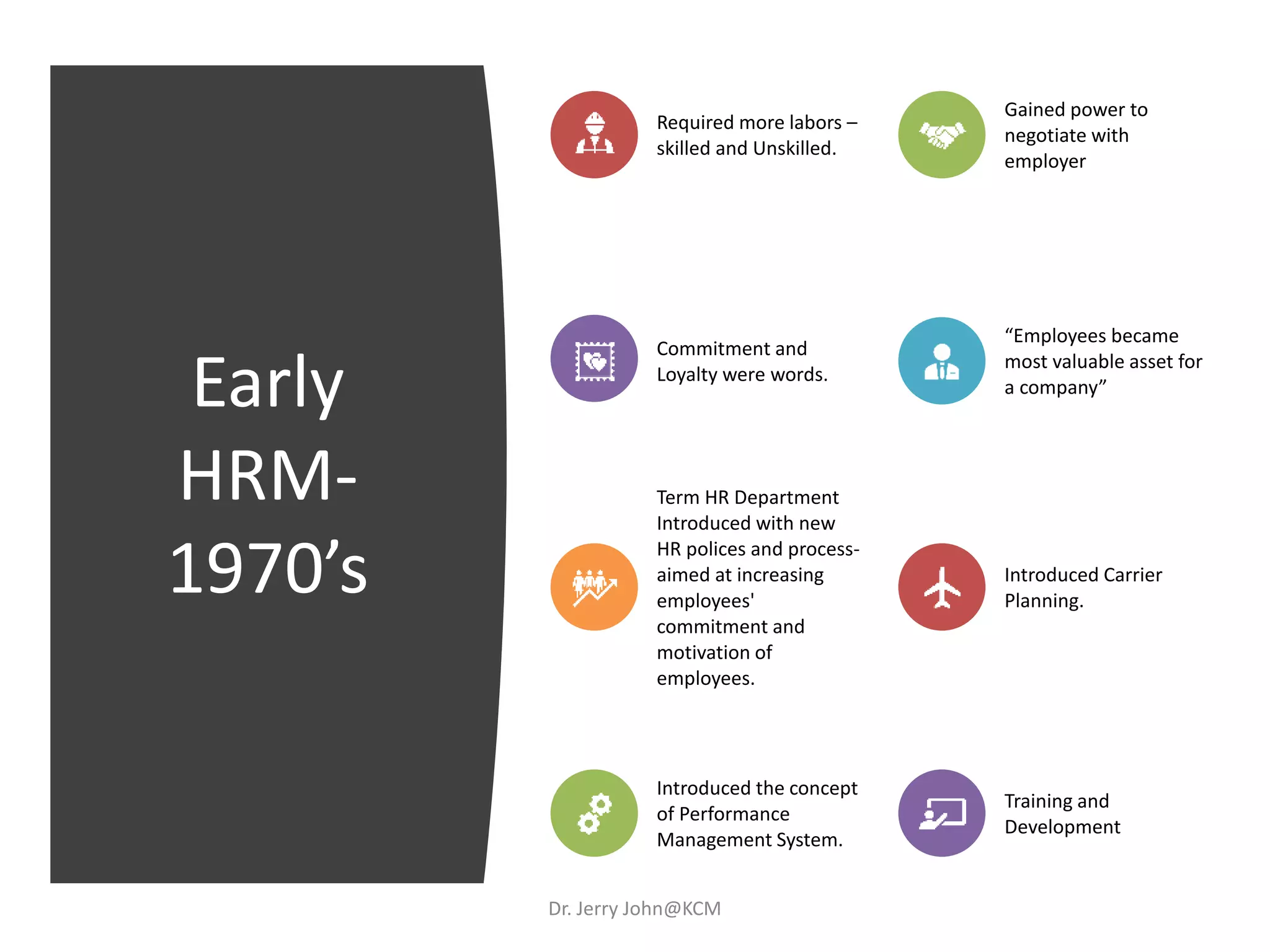
Early
HRM-
1970’s
Required more labors –
skilled and Unskilled.
Gained power to
negotiate with
employer
Commitment and
Loyalty were words.
“Employees became
most valuable asset for
a company”
Term HR Department
Introduced with new
HR polices and process-
aimed at increasing
employees'
commitment and
motivation of
employees.
Introduced Carrier
Planning.
Introduced the concept
of Performance
Management System.
Training and
Development
Dr. Jerry John@KCM
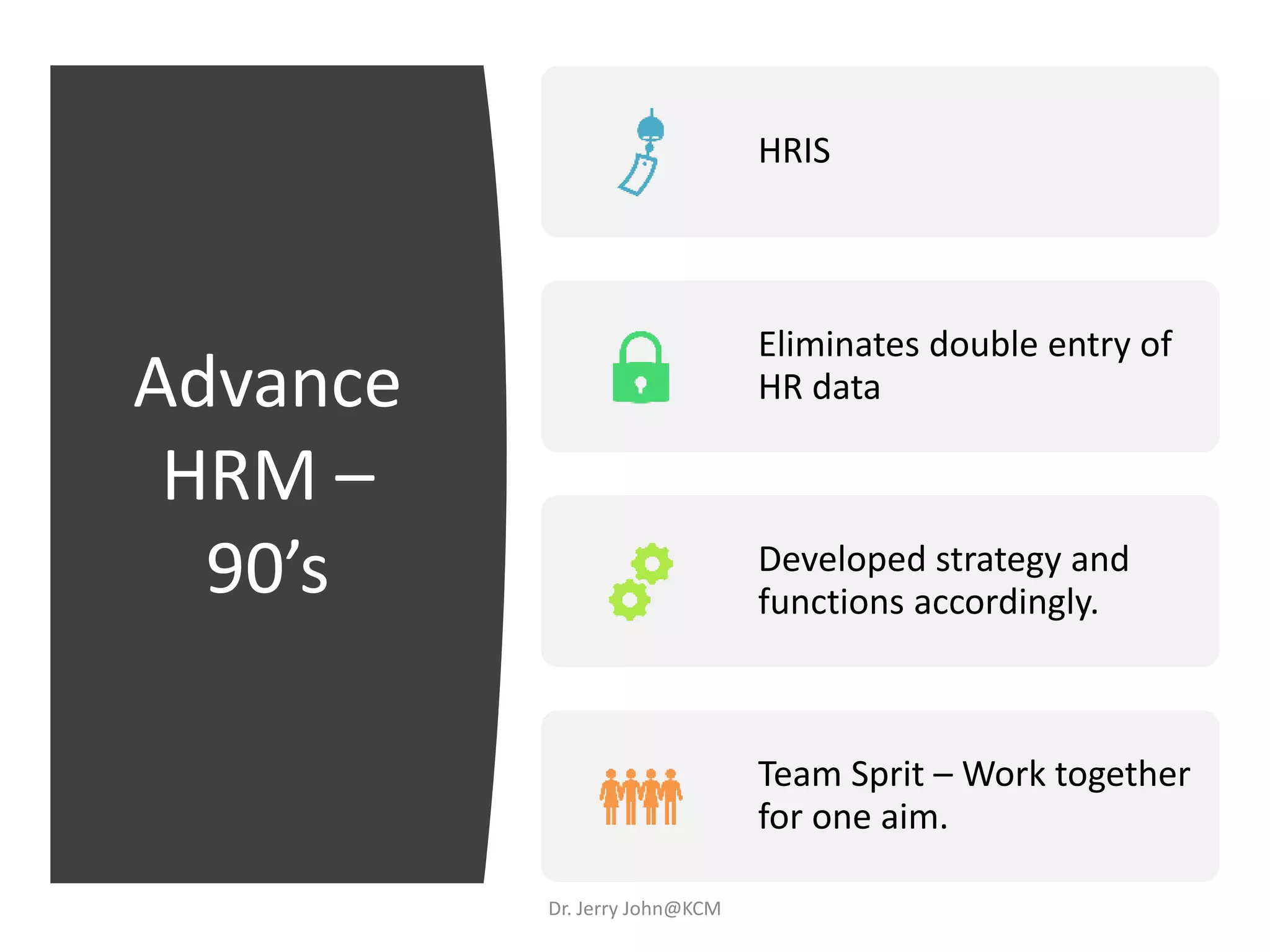
Advance
HRM –
90’s
HRIS
Eliminates double entry of
HR data
Developed strategy and
functions accordingly.
Team Sprit – Work together
for one aim.
Dr. Jerry John@KCM
RESPONSIBILITY,
AUTHORITY &
ACCOUNTABILITY
• Responsibility:
– It is the obligation of a
manager to carry out the
duties assigned to him.
• Authority:
– It refers to the right to give
orders and the power to exact
obedience from others in the
process of discharging
responsibility.
• Accountability:
– The employee's answerability
on using the authority in
discharging the responsibility
is termed accountability.
Dr. Jerry John@KCM
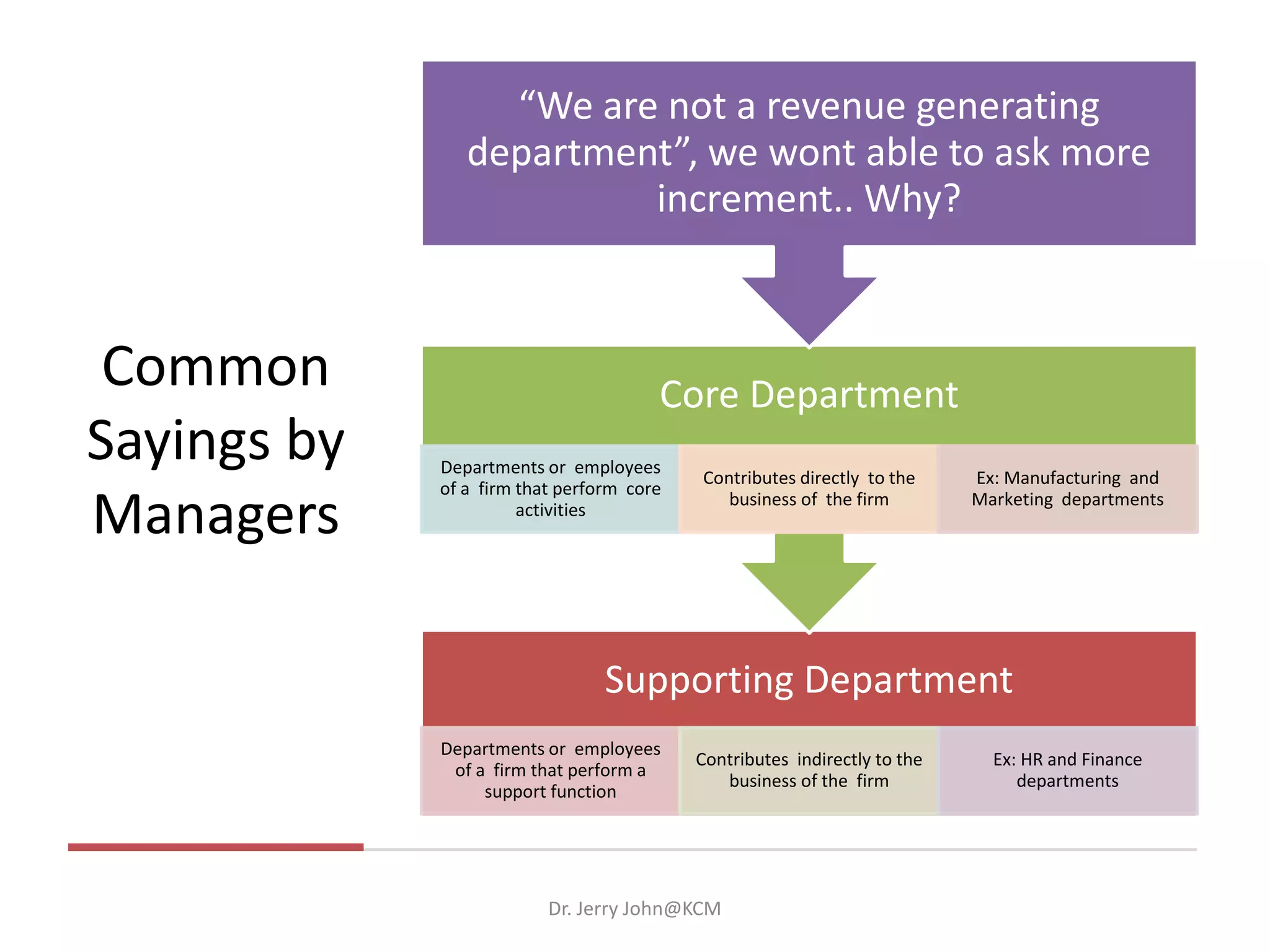
Common
Sayings by
Managers
Supporting Department
Departments or employees
of a firm that perform a
support function
Contributes indirectly to the
business of the firm
Ex: HR and Finance
departments
Core Department
Departments or employees
of a firm that perform core
activities
Contributes directly to the
business of the firm
Ex: Manufacturing and
Marketing departments
“We are not a revenue generating
department”, we wont able to ask more
increment.. Why?
Dr. Jerry John@KCM
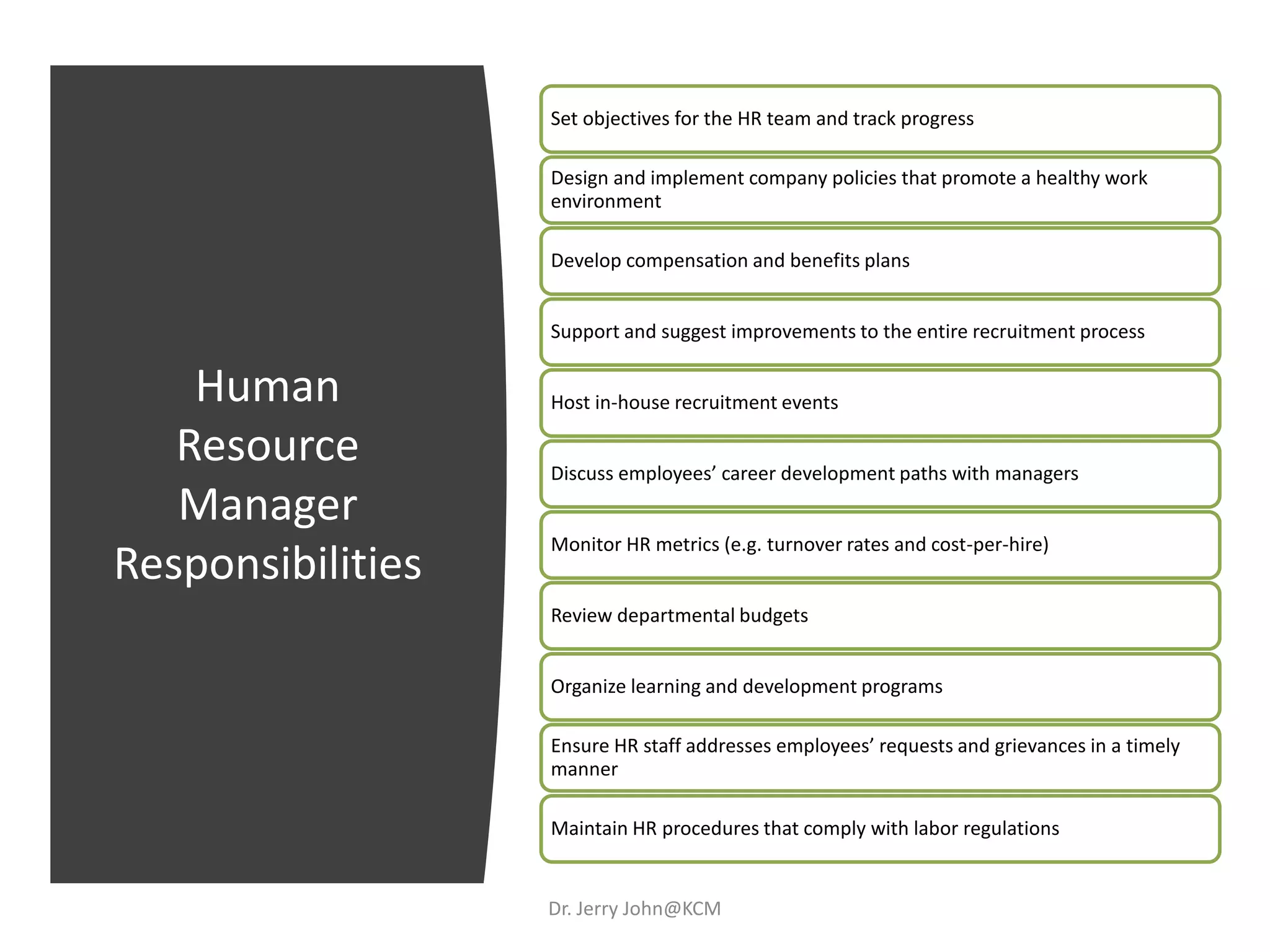
Human
Resource
Manager
Responsibilities
Set objectives for the HR team and track progress
Design and implement company policies that promote a healthy work
environment
Develop compensation and benefits plans
Support and suggest improvements to the entire recruitment process
Host in-house recruitment events
Discuss employees’ career development paths with managers
Monitor HR metrics (e.g. turnover rates and cost-per-hire)
Review departmental budgets
Organize learning and development programs
Ensure HR staff addresses employees’ requests and grievances in a timely
manner
Maintain HR procedures that comply with labor regulations
Dr. Jerry John@KCM
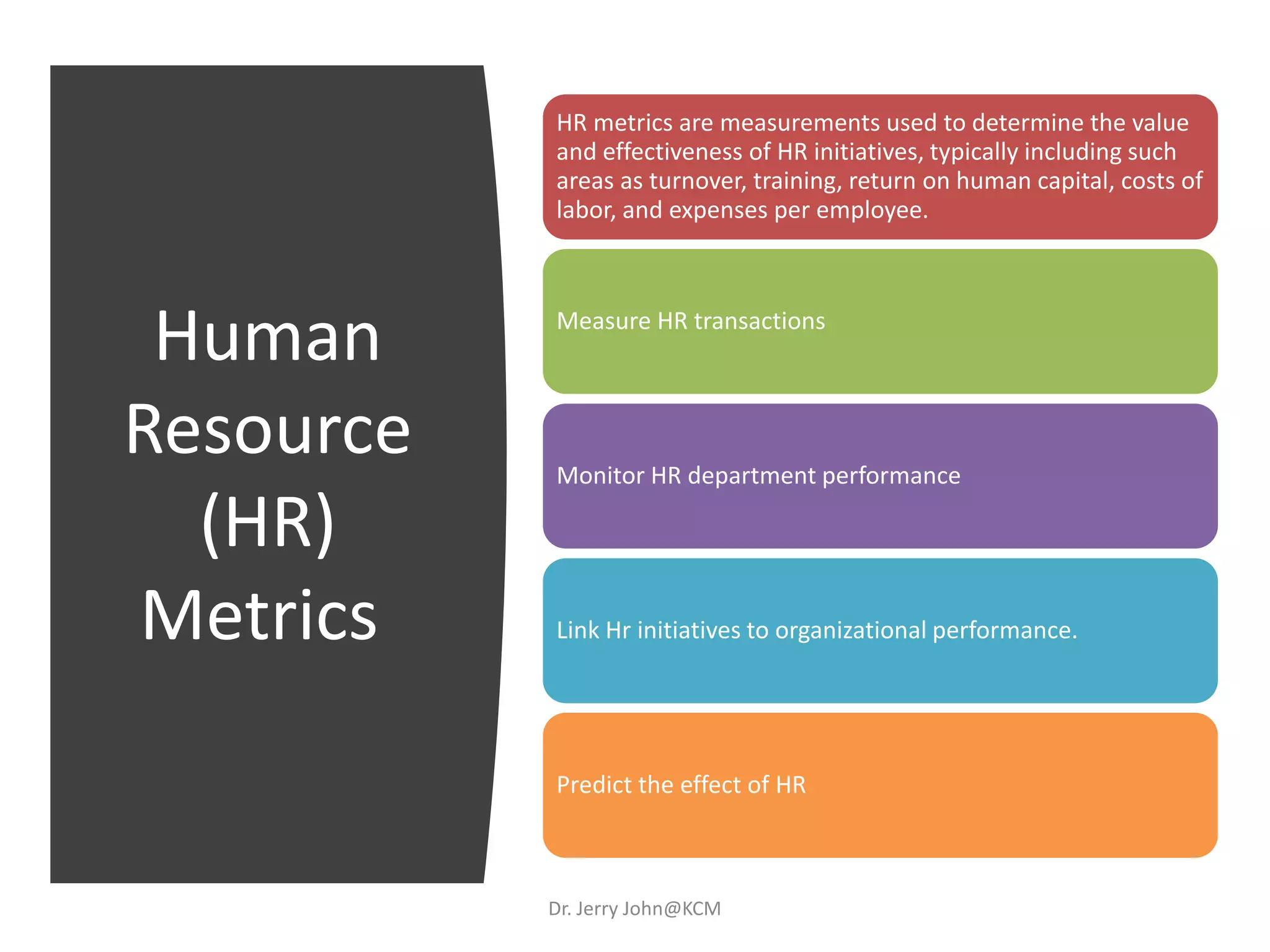
Human
Resource
(HR)
Metrics
HR metrics are measurements used to determine the value
and effectiveness of HR initiatives, typically including such
areas as turnover, training, return on human capital, costs of
labor, and expenses per employee.
Measure HR transactions
Monitor HR department performance
Link Hr initiatives to organizational performance.
Predict the effect of HR
Dr. Jerry John@KCM
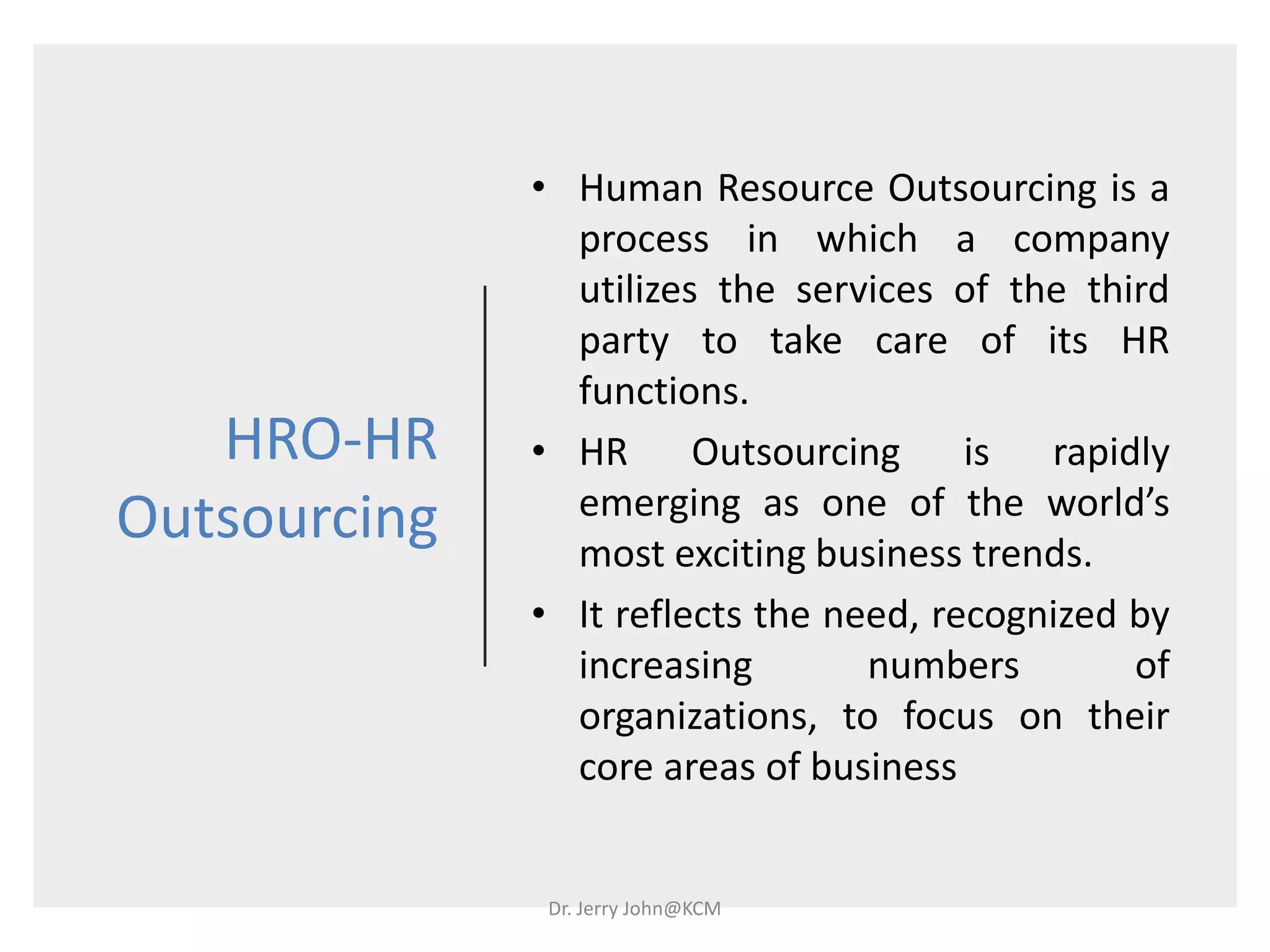
HRO-HR
Outsourcing
• Human Resource Outsourcing is a
process in which a company
utilizes the services of the third
party to take care of its HR
functions.
• HR Outsourcing is rapidly
emerging as one of the world’s
most exciting business trends.
• It reflects the need, recognized by
increasing numbers of
organizations, to focus on their
core areas of business
Dr. Jerry John@KCM
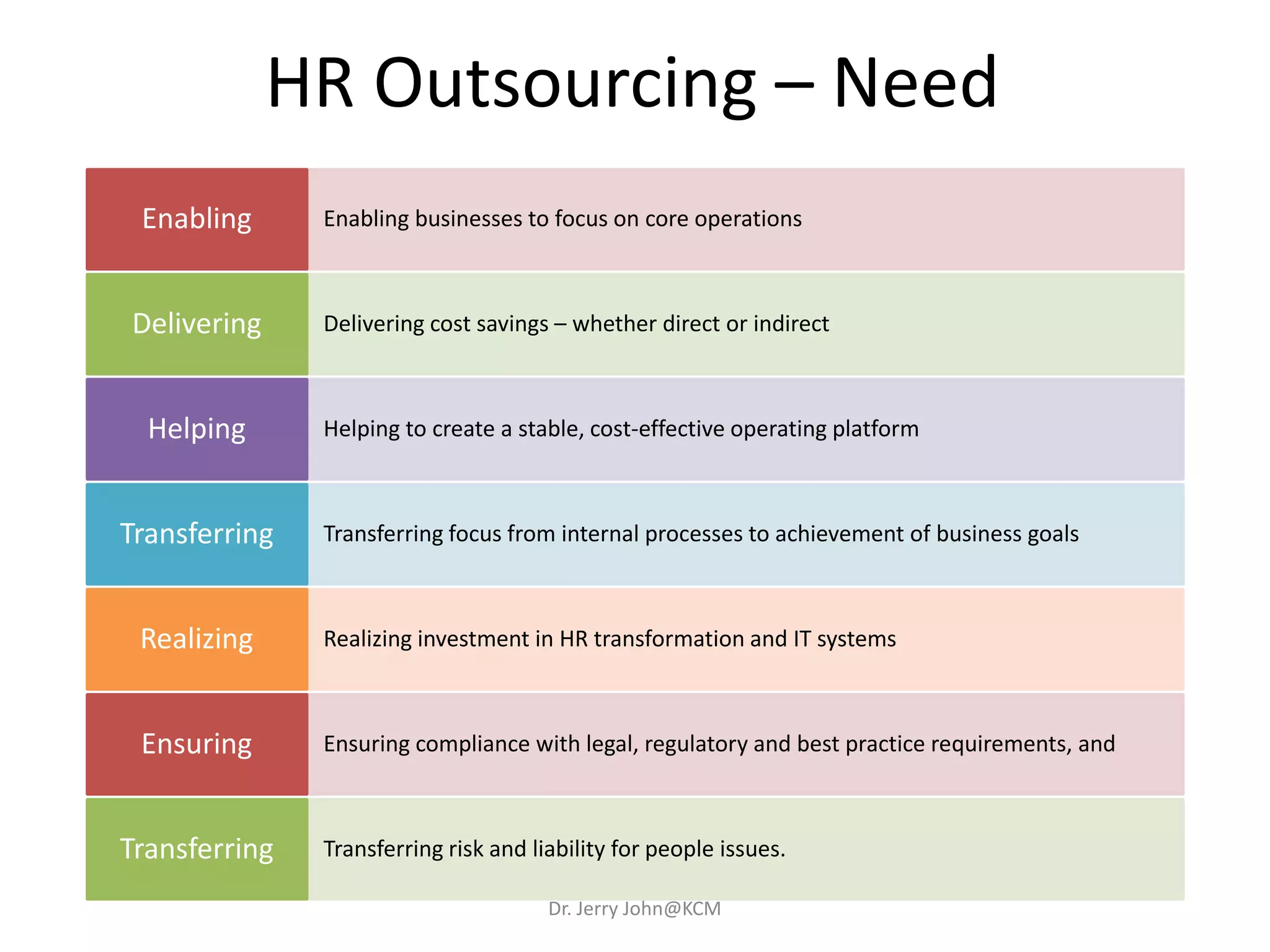
HR Outsourcing – Need
Enabling businesses to focus on core operationsEnabling
Delivering cost savings – whether direct or indirectDelivering
Helping to create a stable, cost-effective operating platformHelping
Transferring focus from internal processes to achievement of business goalsTransferring
Realizing investment in HR transformation and IT systemsRealizing
Ensuring compliance with legal, regulatory and best practice requirements, andEnsuring
Transferring risk and liability for people issues.Transferring
Dr. Jerry John@KCM
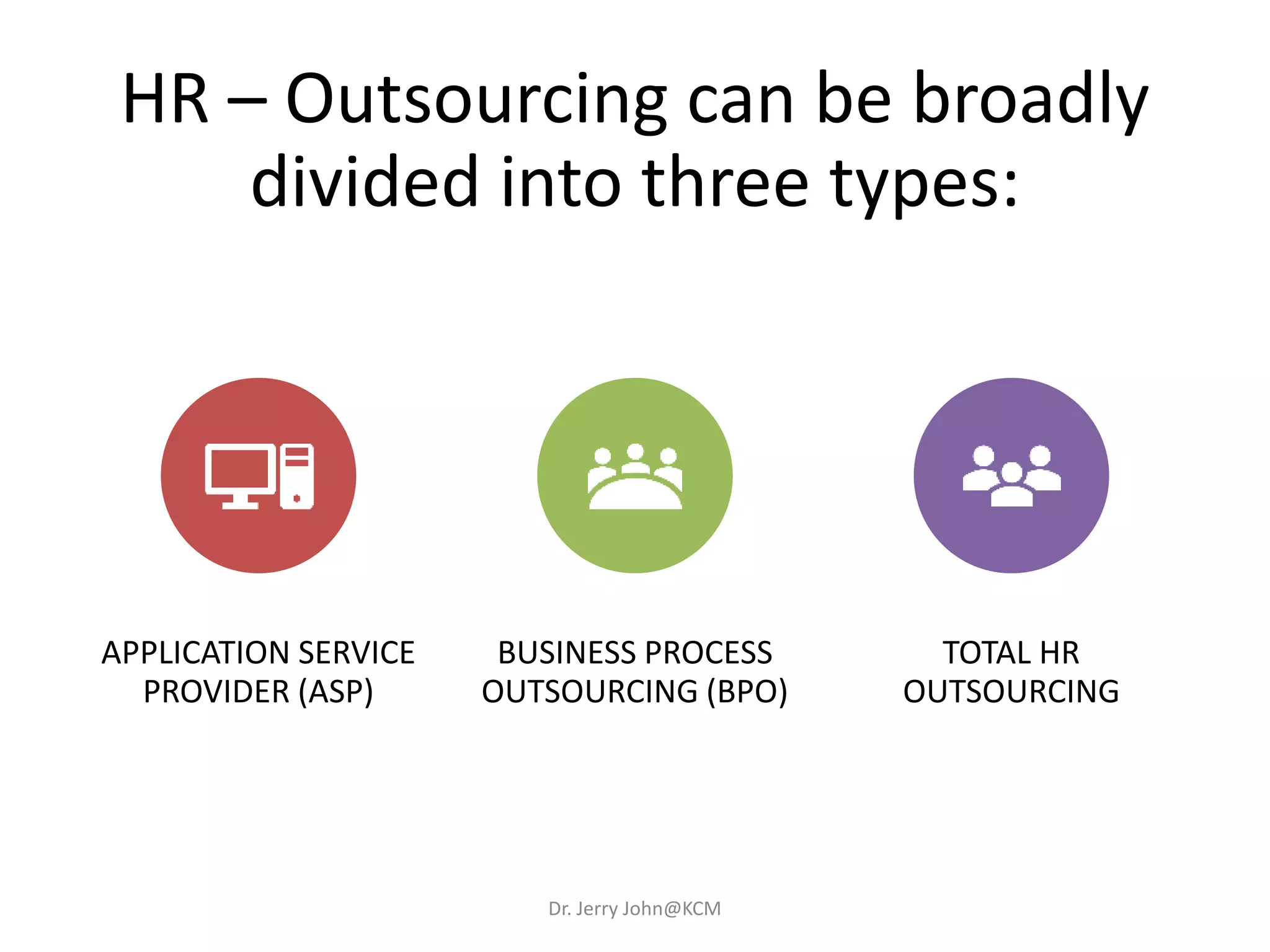
HR – Outsourcing can be broadly
divided into three types:
APPLICATION SERVICE
PROVIDER (ASP)
BUSINESS PROCESS
OUTSOURCING (BPO)
TOTAL HR
OUTSOURCING
Dr. Jerry John@KCM
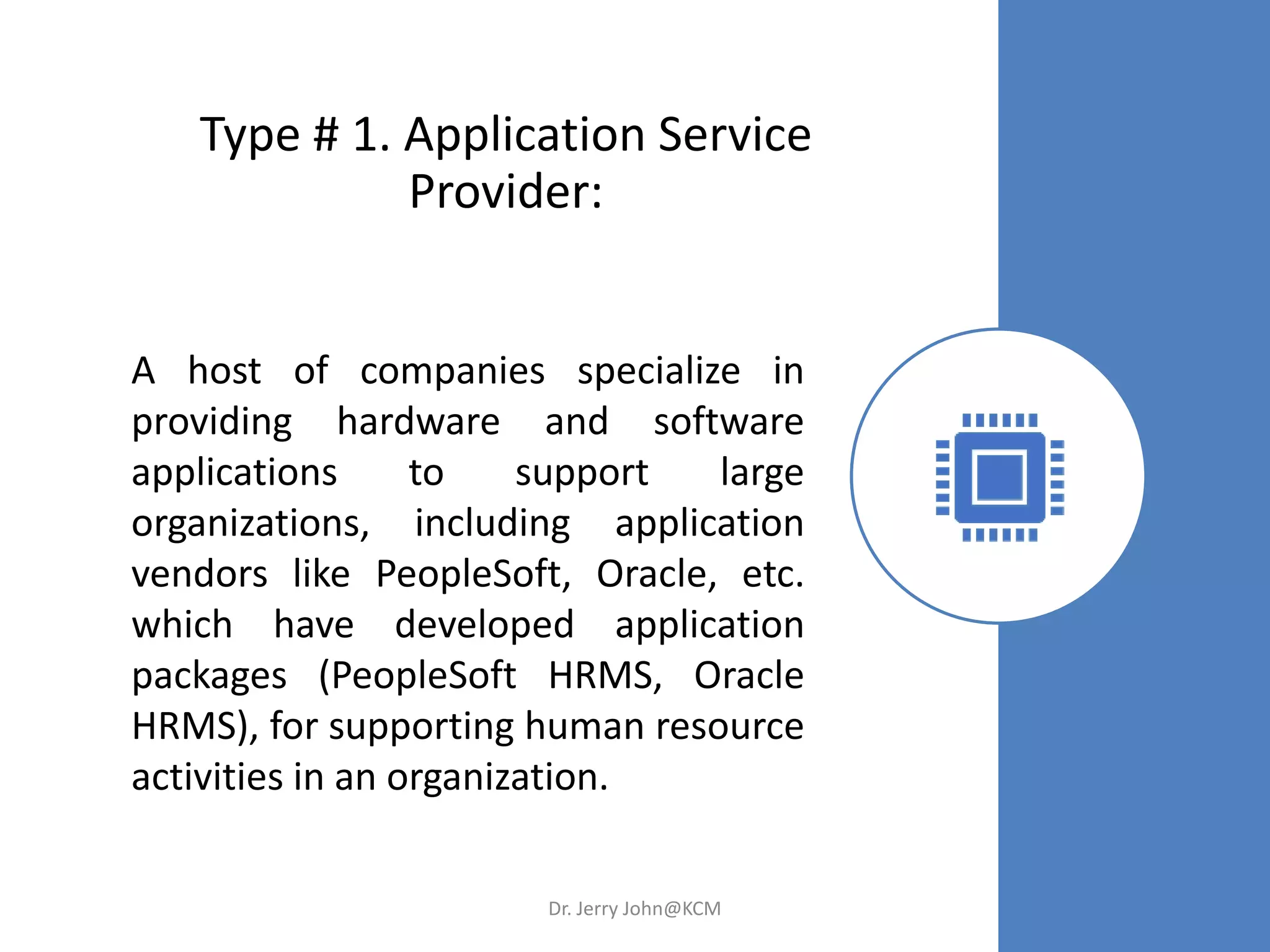
Type # 1. Application Service
Provider:
A host of companies specialize in
providing hardware and software
applications to support large
organizations, including application
vendors like PeopleSoft, Oracle, etc.
which have developed application
packages (PeopleSoft HRMS, Oracle
HRMS), for supporting human resource
activities in an organization.
Dr. Jerry John@KCM
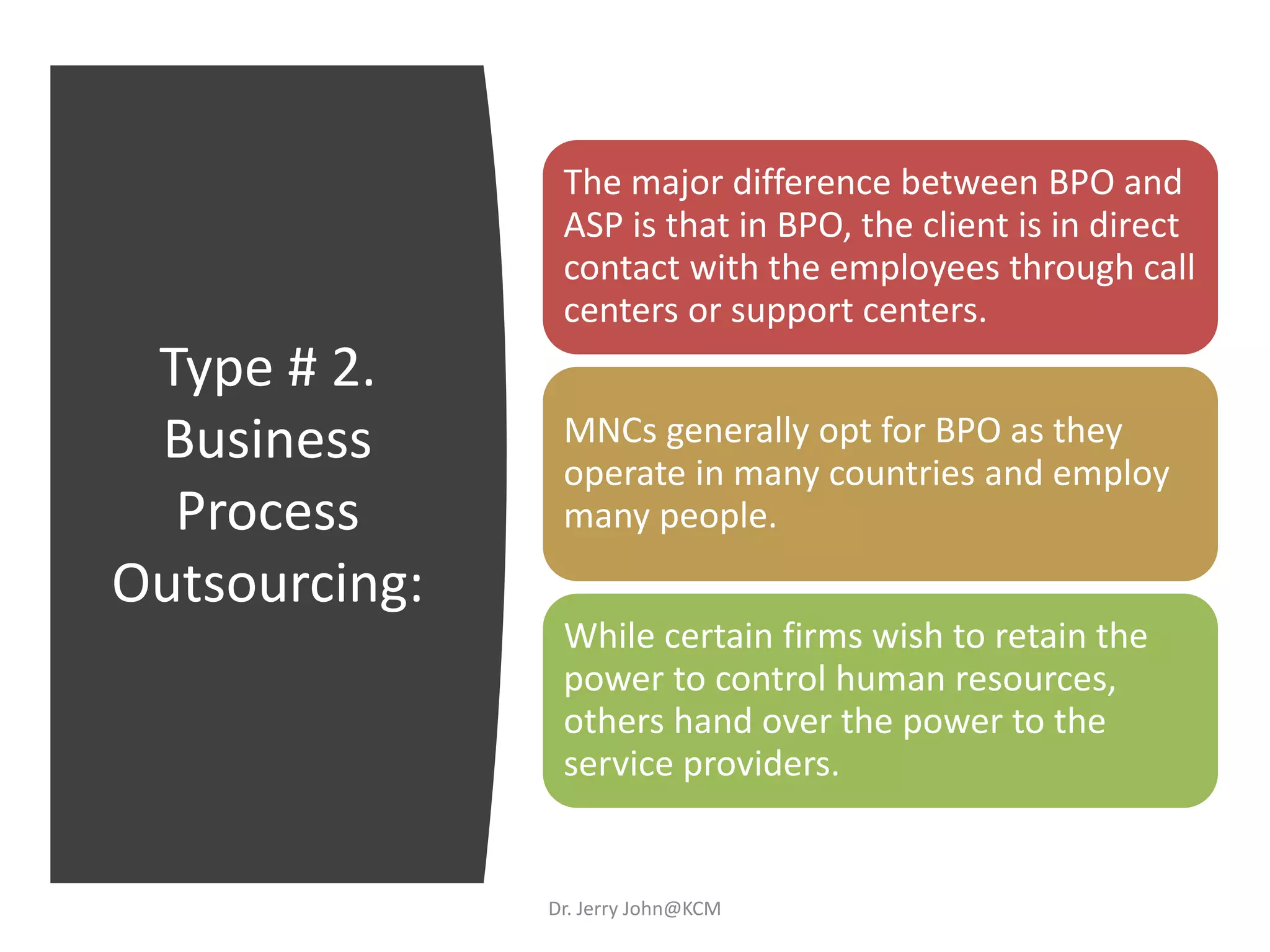
Type # 2.
Business
Process
Outsourcing:
The major difference between BPO and
ASP is that in BPO, the client is in direct
contact with the employees through call
centers or support centers.
MNCs generally opt for BPO as they
operate in many countries and employ
many people.
While certain firms wish to retain the
power to control human resources,
others hand over the power to the
service providers.
Dr. Jerry John@KCM
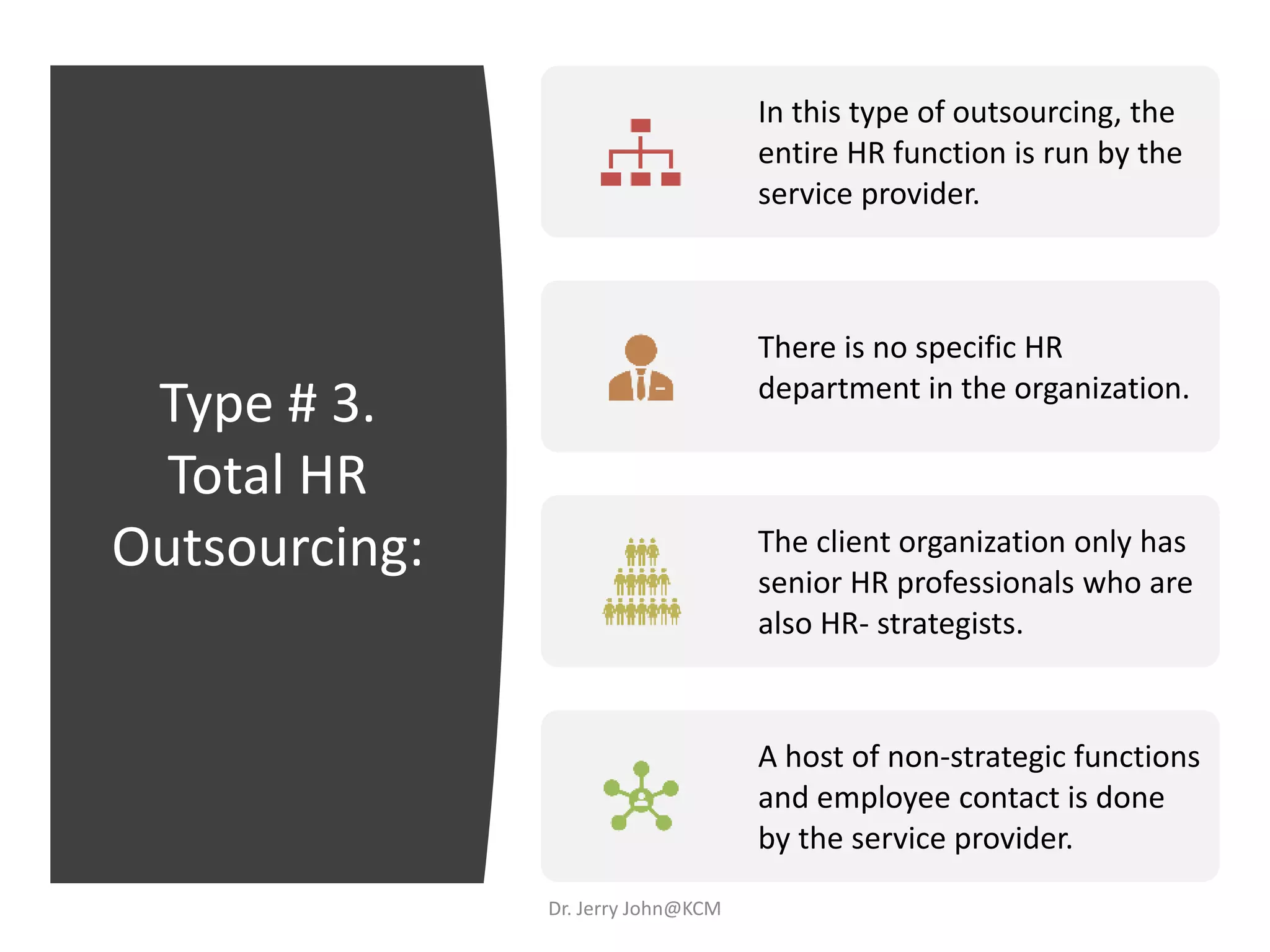
Type # 3.
Total HR
Outsourcing:
In this type of outsourcing, the
entire HR function is run by the
service provider.
There is no specific HR
department in the organization.
The client organization only has
senior HR professionals who are
also HR- strategists.
A host of non-strategic functions
and employee contact is done
by the service provider.
Dr. Jerry John@KCM
HR - Audit
• An effective human resources
(HR) audit investigates every
discipline of the human resources
function.
• HR disciplines include recruitment
and selection, workplace safety
and risk management, training
and development, employee
relations, and compensation and
benefits.
• The purpose of an HR audit is to
determine if your organization’s
policies are current and if they
comply with federal and state
laws governing the workplace.
Dr. Jerry John@KCM
HR – Audit
Why Are
They
Important?
• Internal Services:
– Employers should regularly audit the
services that are provided to their
employees, including payroll, benefits
administration, and conflict resolution.
– The quality of these services directly
affect employee satisfaction, which is
key in employee retention.
– Employee satisfaction with these
services typically leads to increased
company morale and engagement.
– An audit of these services should seek
to ensure that they are meeting the
needs of employees.
Dr. Jerry John@KCM
HR – Audit Why Are They Important?
• Legal Compliance:
– Employers must adhere to employment and
labor laws, which are constantly changing and
evolving.
– Performing an HR audit is especially
important because it mitigates the risk of
being liable for what are deemed “unfair
employment practices”.
– Legal issues and conflicts can be extremely
costly, and HR audits are a proactive way to
minimize the costs associated with such
compliance issues.
– The audit should assess the recruitment and
selection process for employees to ensure
fairness.
– It should also assess the procedures for
layoffs and terminations, and the
effectiveness of measures taken to maintain
workplace safety.
Dr. Jerry John@KCM
HR – Audit Why Are They Important?
• Performance Management:
– HR audits usually involve reviewing
employee files to ensure that
supervisors and managers are
continuously providing feedback and
properly documenting it.
– An audit can help to pinpoint lapses in
leadership and management and
identify opportunities for training or
performance management
improvement.
– These areas are common focuses in HR
audits, but HR audits can be as broad
or narrow as the company wants.
– While audits are a great tool to uncover
deficiencies, organizations should be
committed to acting on the
recommended improvements.
Dr. Jerry John@KCM
Human Resources Information System -
HRIS
• HRIS is a form of human
resources (HR) software that combines
several systems and processes to
ensure the easy management of
human resources, business processes
and data.
• Human resources software is used by
businesses to combine several
necessary HR functions, such as
storing employee data, managing
payrolls, recruitment processes,
benefits administration, and keeping
track of attendance records.
• ERP - Enterprise Resource PlanningDr. Jerry John@KCM
HRIS
• The trend of automating
payroll and workforce
management processes began
during the 1970s.
• The first enterprise resource
planning (ERP) system that
integrated human resources
functions was SAP R/2 (later to be
replaced by R/3 and S/4hana),
introduced in 1979.
• The first completely HR-centered
client-server system for the
enterprise market was PeopleSoft,
released in 1987 and later bought
by Oracle in 2005
Dr. Jerry John@KCM
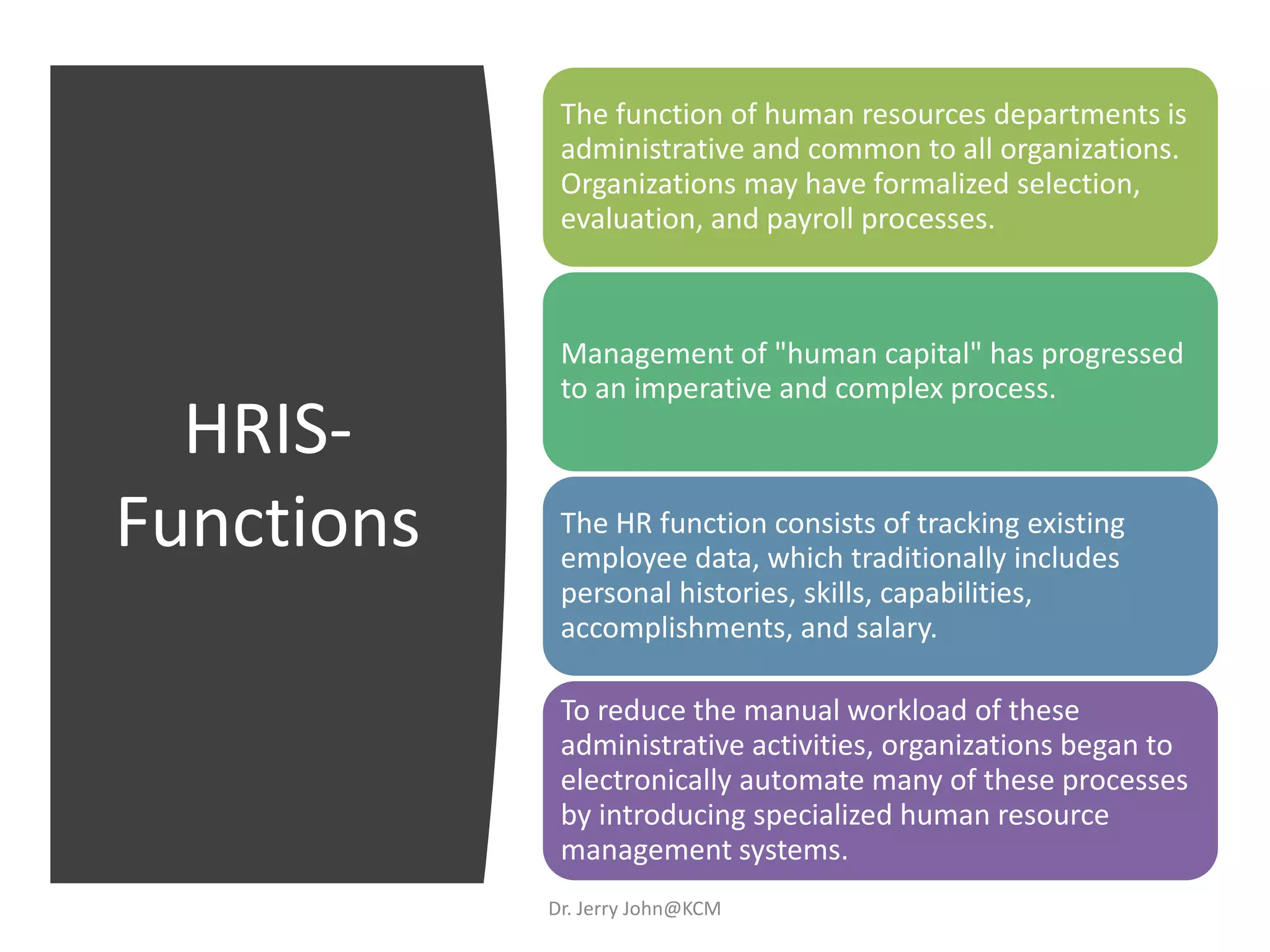
HRIS-
Functions
The function of human resources departments is
administrative and common to all organizations.
Organizations may have formalized selection,
evaluation, and payroll processes.
Management of "human capital" has progressed
to an imperative and complex process.
The HR function consists of tracking existing
employee data, which traditionally includes
personal histories, skills, capabilities,
accomplishments, and salary.
To reduce the manual workload of these
administrative activities, organizations began to
electronically automate many of these processes
by introducing specialized human resource
management systems.
Dr. Jerry John@KCM
HRIS
• Applicant tracking system
• On boarding and off-boarding
• Training tracking
• Advanced reporting
• Tailored workflows and approvals
• Custom access levels and email
alerts
• Company branding
• Custom tabs
• Audit trail
• Phone support
Dr. Jerry John@KCM
Human
Resource
Planning
• Human resource planning
(HRP) is the continuous
process of systematic
planning ahead to achieve
optimum use of an
organization's most valuable
asset—quality employees.
• Human resources planning
ensures the best fit between
employees and jobs while
avoiding manpower
shortages or surpluses.
Dr. Jerry John@KCM
Human
Resource
Planning
• Human resource planning is what a
strategy used by a company to
company maintain a steady stream of
skilled employees while avoiding
employee shortages or surpluses.
• Having a good HRP strategy in place can
mean productivity and profitability for a
company.
• There are four general steps in the HRP
process: identifying the current supply
of employees, determining the future
of the workforce, balancing between
the supply and demand, and how to
implement the plans.
Dr. Jerry John@KCM
Understanding Human Resource Planning
• Human resources planning allows
companies to plan so they can maintain a
steady supply of skilled employees.
• That's why it is also referred to as
workforce planning.
• The process is also used to help
companies evaluate their needs and to
plan ahead to meet those needs.
• Human resource planning needs to be
flexible enough to meet short-term
staffing challenges while adapting to
changing conditions in the business
environment over the longer term.
• HRP starts by assessing and auditing the
current capacity of human resources.
Dr. Jerry John@KCM
HRP
According to Reilly P, “ Human
Resource Planning is the process
in which an organization attempts
to estimate the demand for
labour and evaluate the size,
nature and sources of supply
which will be required to meet
the demand”.
Dr. Jerry John@KCM
Methods
of HR
Planning
• Approaches to forecasting:
– Qualitative:
• Expert opinions
• Delphi technique
• “Bottom-up” approach
– Quantitative
• Regression analysis /
Trend analysis
Dr. Jerry John@KCM
What is
Job
Design?
• Job analysis, contains a simple
term called "analysis", which
means detailed study or
examination of something (job) in
order to understand more about it
(job).
• Therefore job analysis is to
understand more about a specific
job in order to optimize it.
• Job analysis is a systematic process
of collecting complete information
pertaining to a job.
• Job analysis is done by job analyst
who is an officer have been trained
for it.
Dr. Jerry John@KCM
Job Design
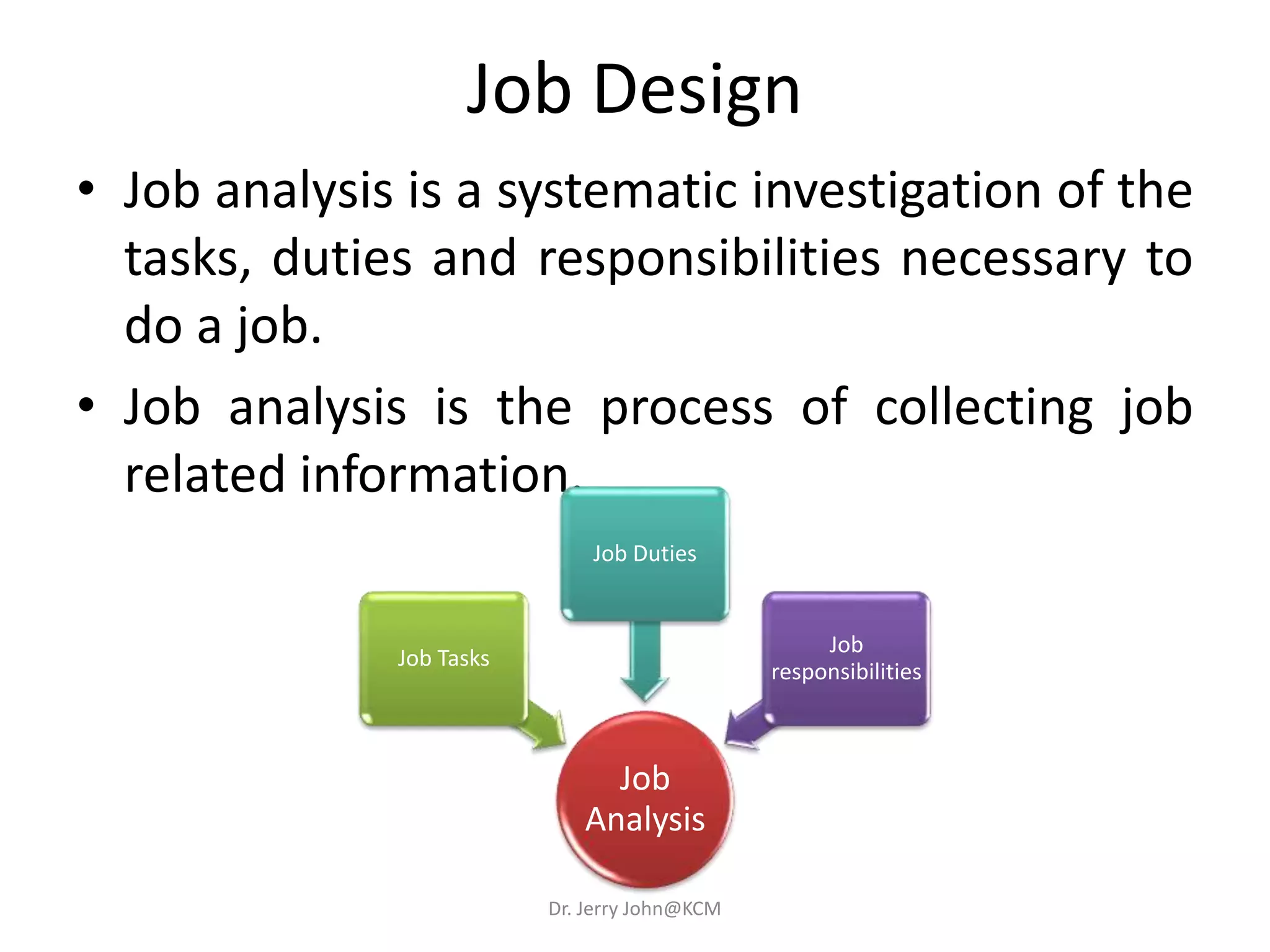
• Job analysis is a systematic investigation of the
tasks, duties and responsibilities necessary to
do a job.
• Job analysis is the process of collecting job
related information.
Job
Analysis
Job Tasks
Job Duties
Job
responsibilities
Dr. Jerry John@KCM
Job analysis
is a detailed
examination
of:
1. Tasks that make up a job
(employee role),
2. conditions under which an
employee performing his/her
job, and
3. what exactly a job requires in
terms of aptitudes (potential for
achievement), attitudes
(behavior characteristics),
knowledge, skills, educational
qualifications and the physical
working condition of the
employee.
Dr. Jerry John@KCM
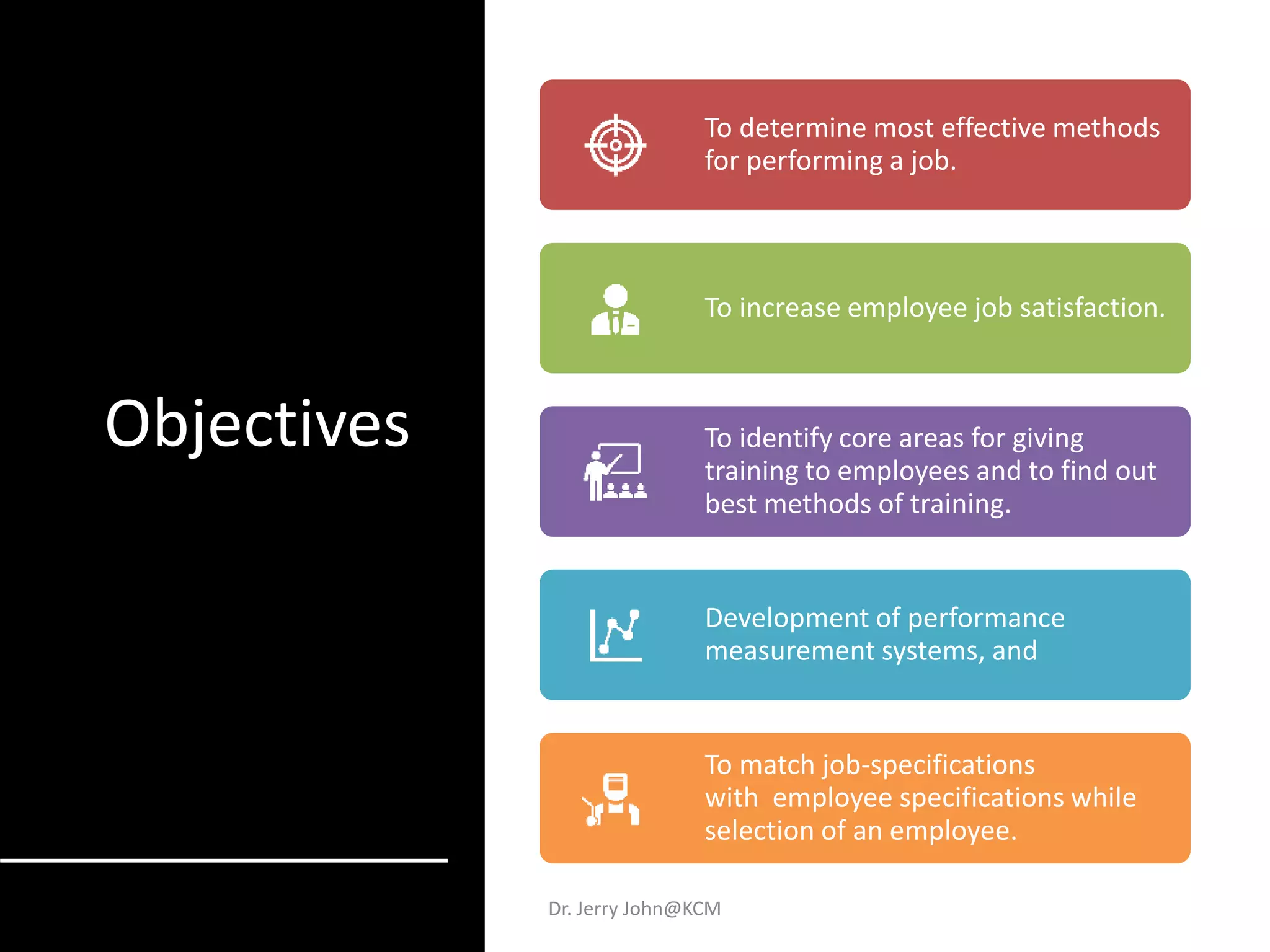
Objectives
To determine most effective methods
for performing a job.
To increase employee job satisfaction.
To identify core areas for giving
training to employees and to find out
best methods of training.
Development of performance
measurement systems, and
To match job-specifications
with employee specifications while
selection of an employee.
Dr. Jerry John@KCM
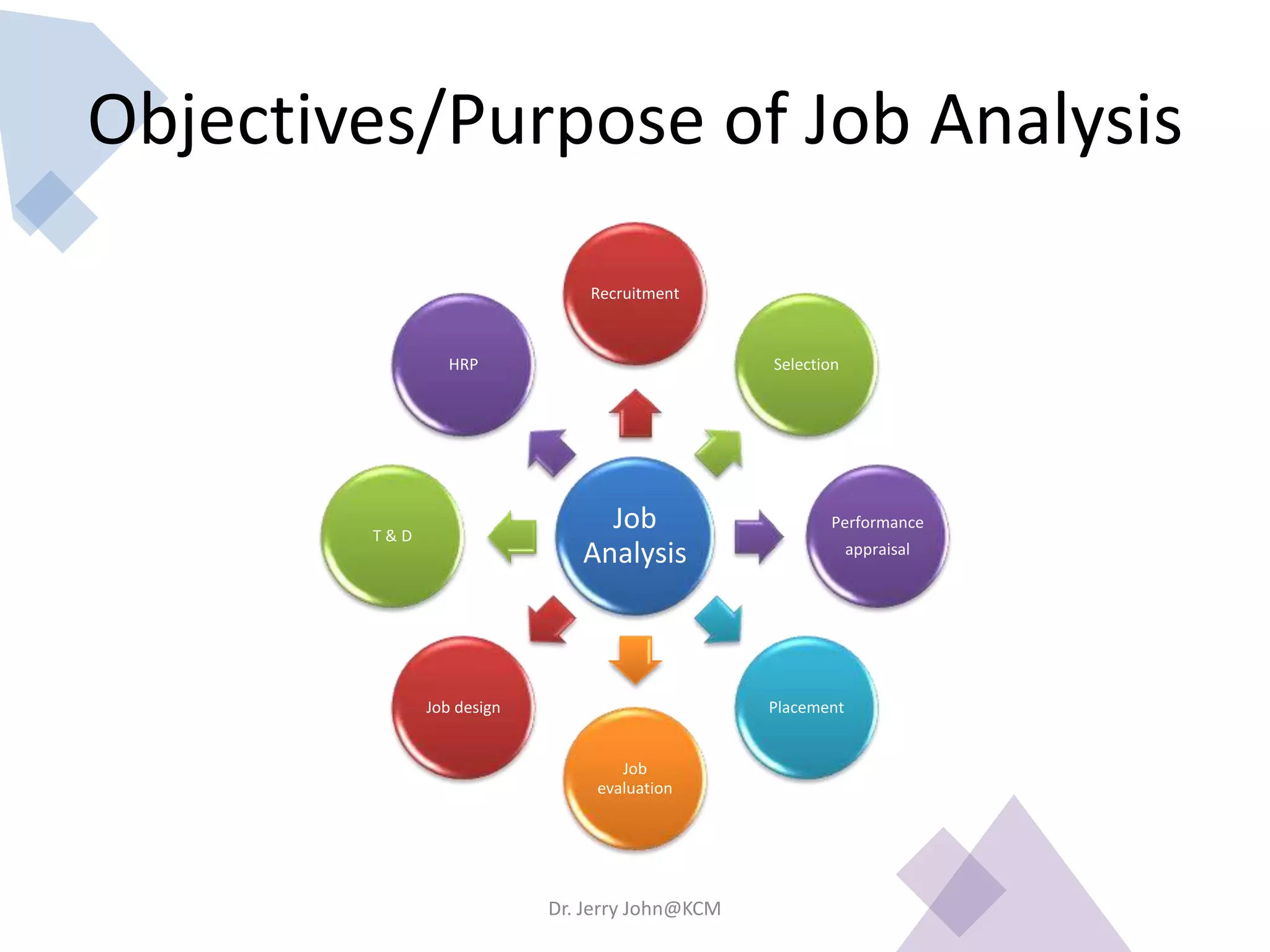
Objectives/Purpose of Job Analysis
Job
Analysis
Recruitment
Selection
Performance
appraisal
Placement
Job
evaluation
Job design
T & D
HRP
Dr. Jerry John@KCM
Definitions
of Job
Analysis
• Edwin B. Flippo, "Job analysis
is the process of studying and
collecting information relating
to the operations and
responsibilities of a specific
job ”.
• Dale Yoder. "A Job is a
collection of duties, tasks and
responsibilities which are
assigned to an individual and
which is different from other
assignment"
Dr. Jerry John@KCM
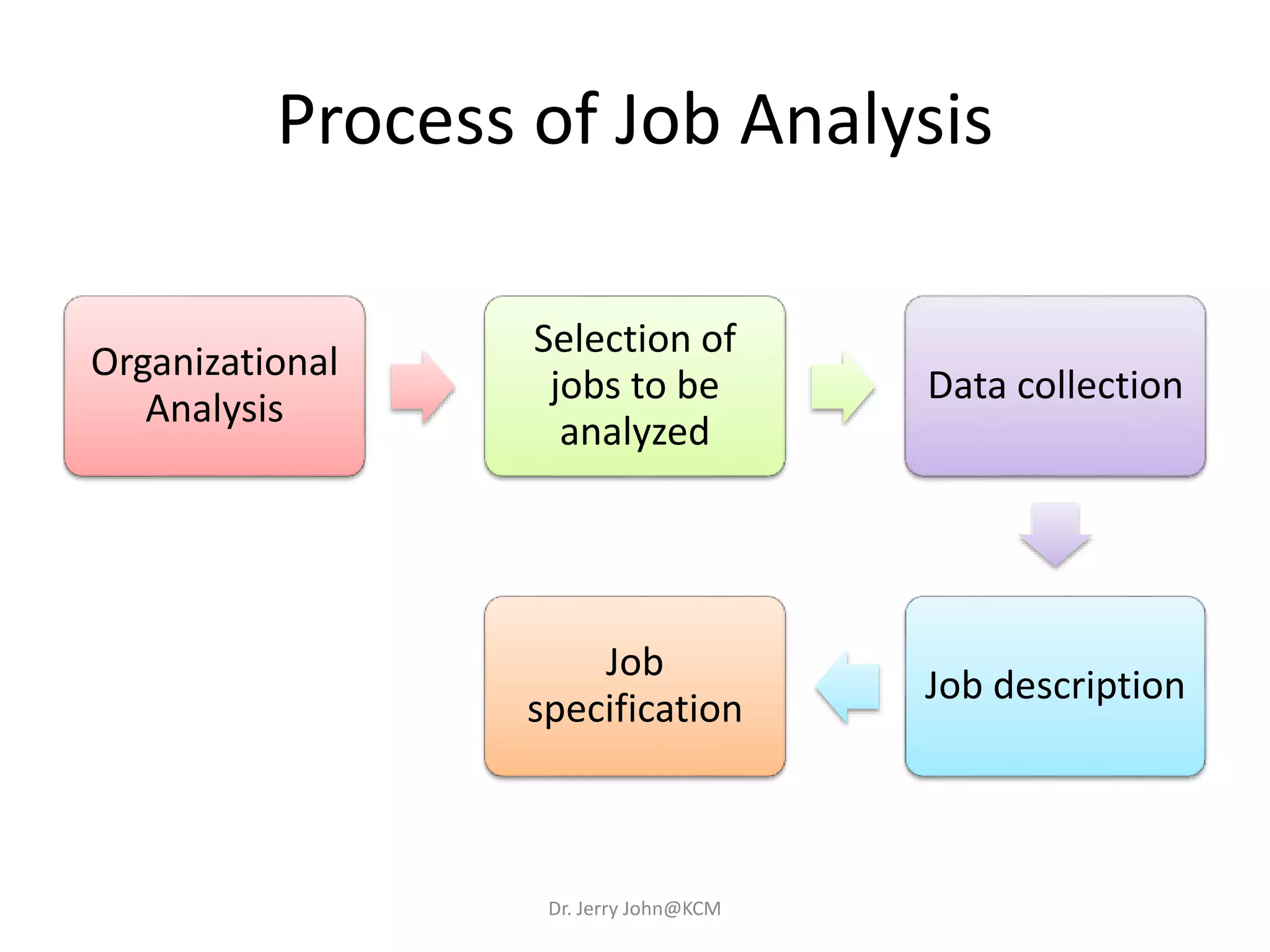
Process of Job Analysis
Organizational
Analysis
Selection of
jobs to be
analyzed
Data collection
Job description
Job
specification
Dr. Jerry John@KCM
Approaches
to Job
Design
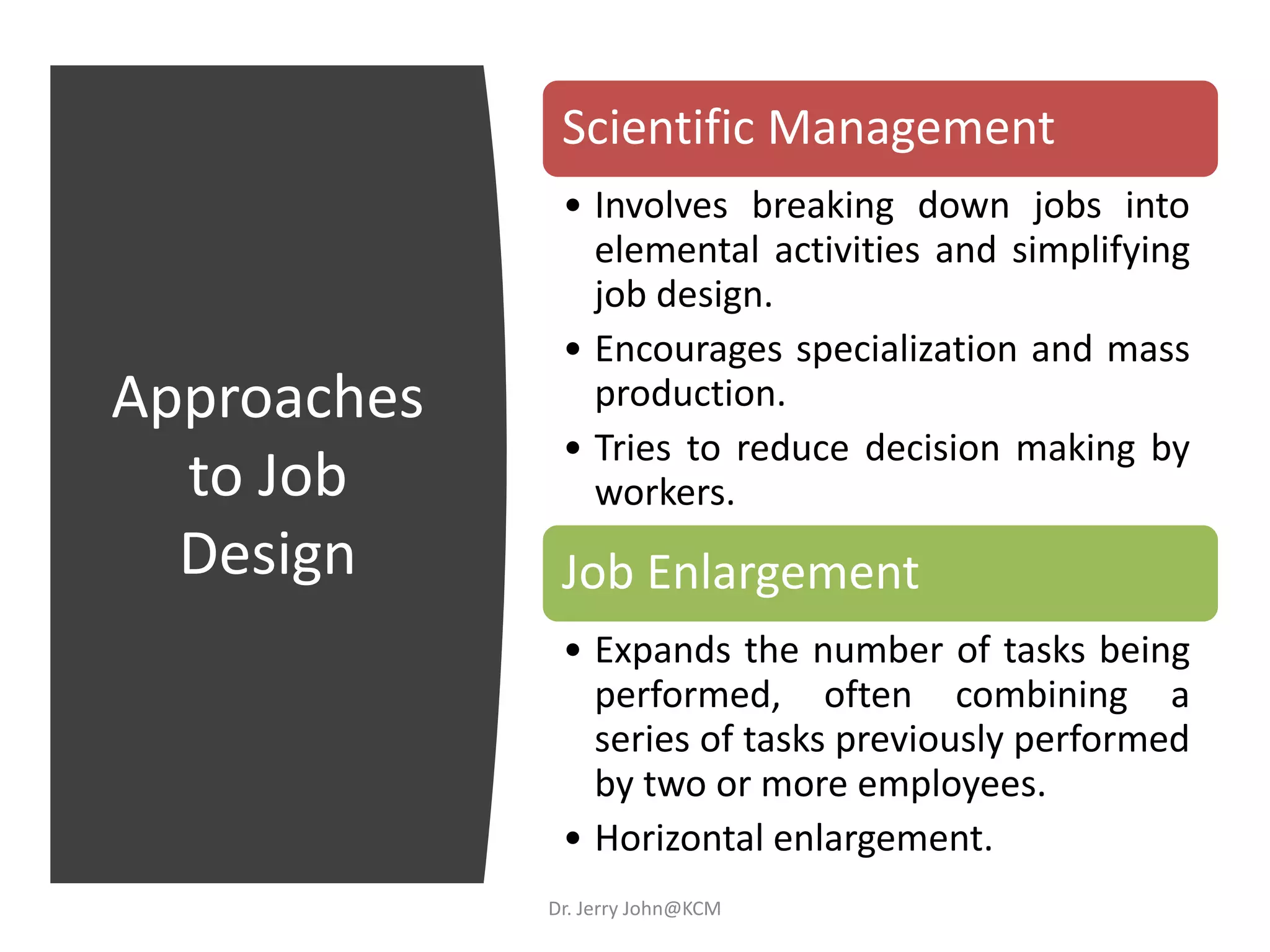
Scientific Management
• Involves breaking down jobs into
elemental activities and simplifying
job design.
• Encourages specialization and mass
production.
• Tries to reduce decision making by
workers.
Job Enlargement
• Expands the number of tasks being
performed, often combining a
series of tasks previously performed
by two or more employees.
• Horizontal enlargement.
Dr. Jerry John@KCM
Approaches
to Job
Design
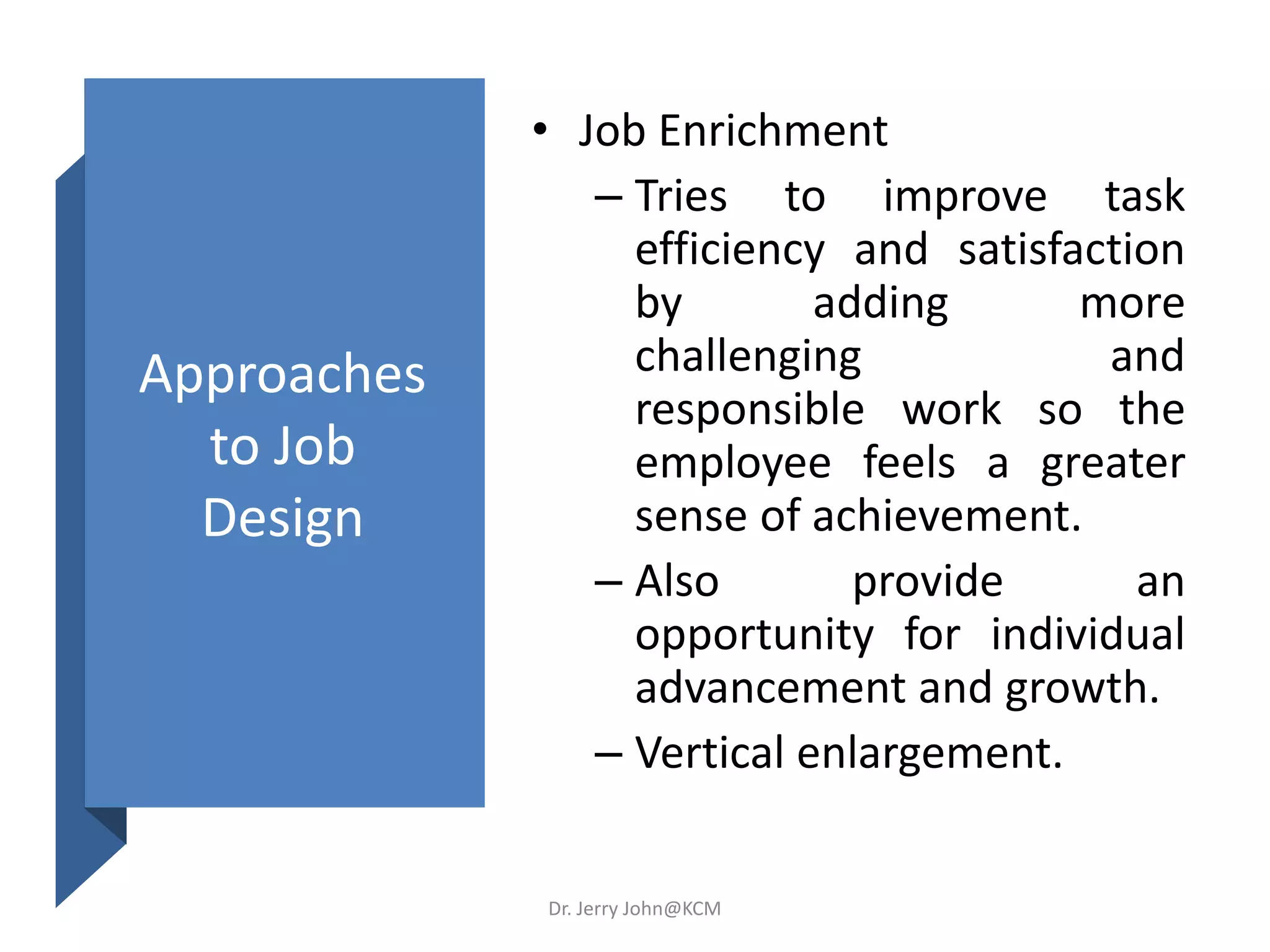
• Job Enrichment
– Tries to improve task
efficiency and satisfaction
by adding more
challenging and
responsible work so the
employee feels a greater
sense of achievement.
– Also provide an
opportunity for individual
advancement and growth.
– Vertical enlargement.
Dr. Jerry John@KCM
Approaches
to Job
Design
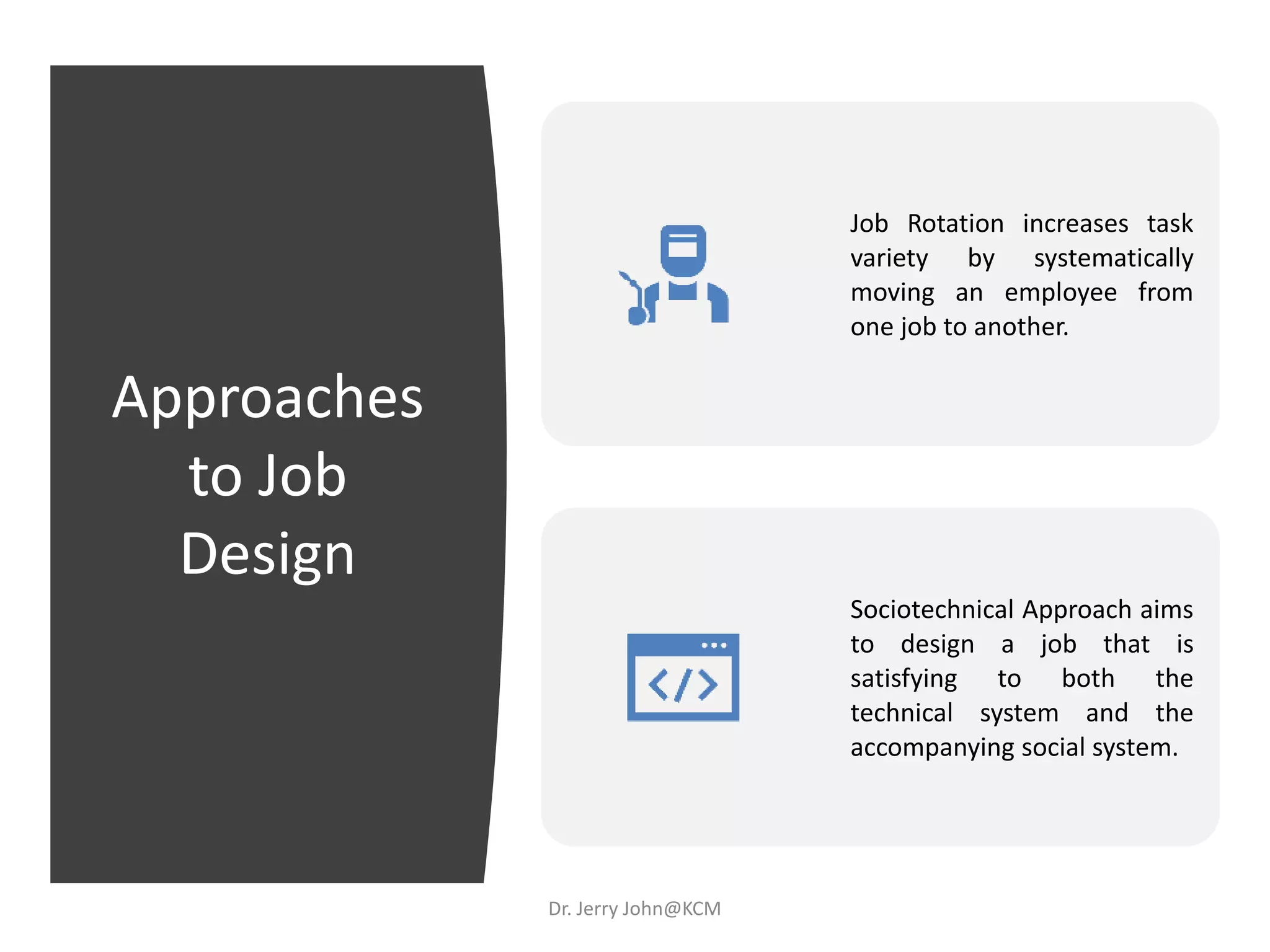
Job Rotation increases task
variety by systematically
moving an employee from
one job to another.
Sociotechnical Approach aims
to design a job that is
satisfying to both the
technical system and the
accompanying social system.
Dr. Jerry John@KCM
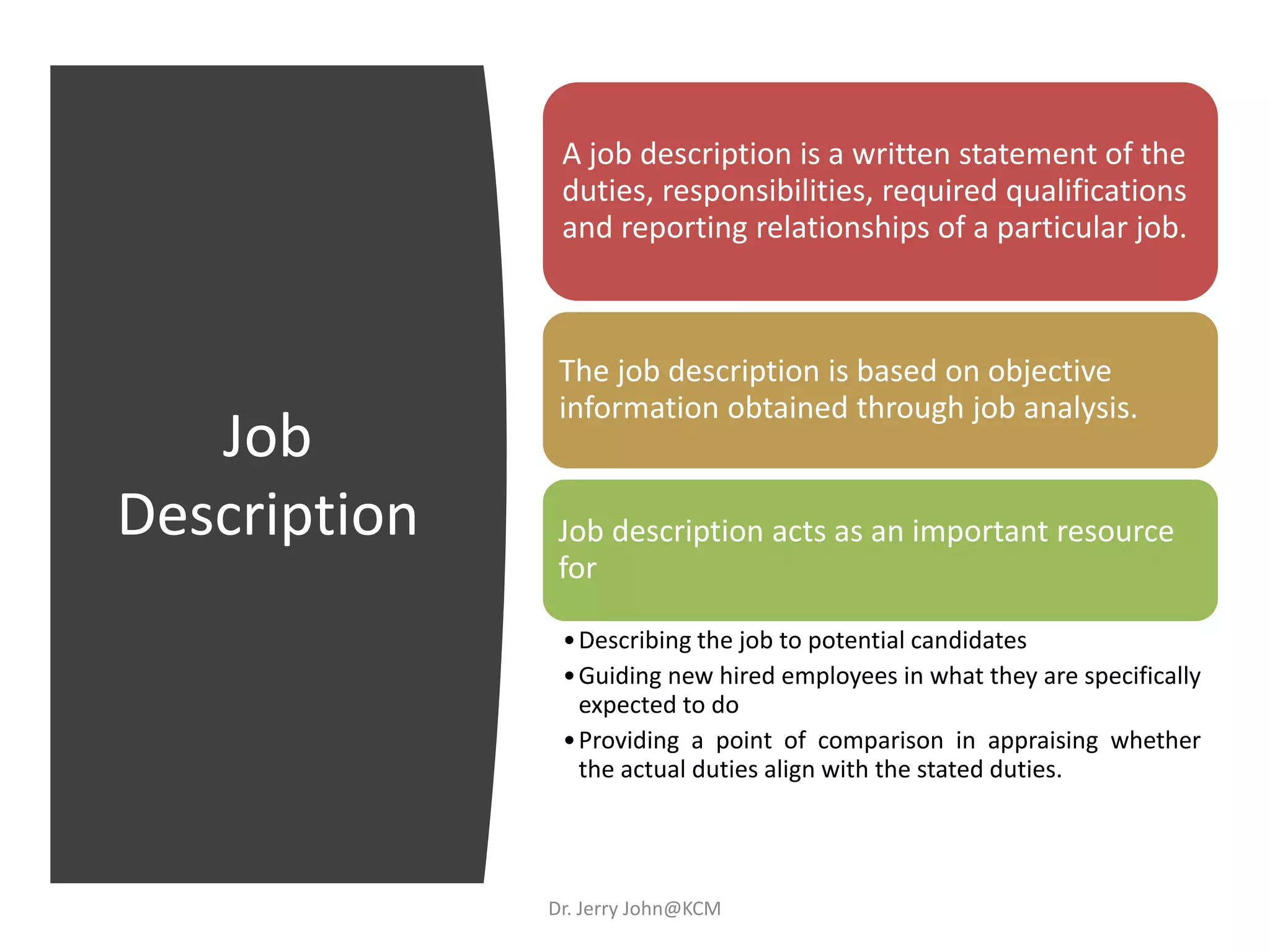
Job
Description
A job description is a written statement of the
duties, responsibilities, required qualifications
and reporting relationships of a particular job.
The job description is based on objective
information obtained through job analysis.
Job description acts as an important resource
for
•Describing the job to potential candidates
•Guiding new hired employees in what they are specifically
expected to do
•Providing a point of comparison in appraising whether
the actual duties align with the stated duties.
Dr. Jerry John@KCM
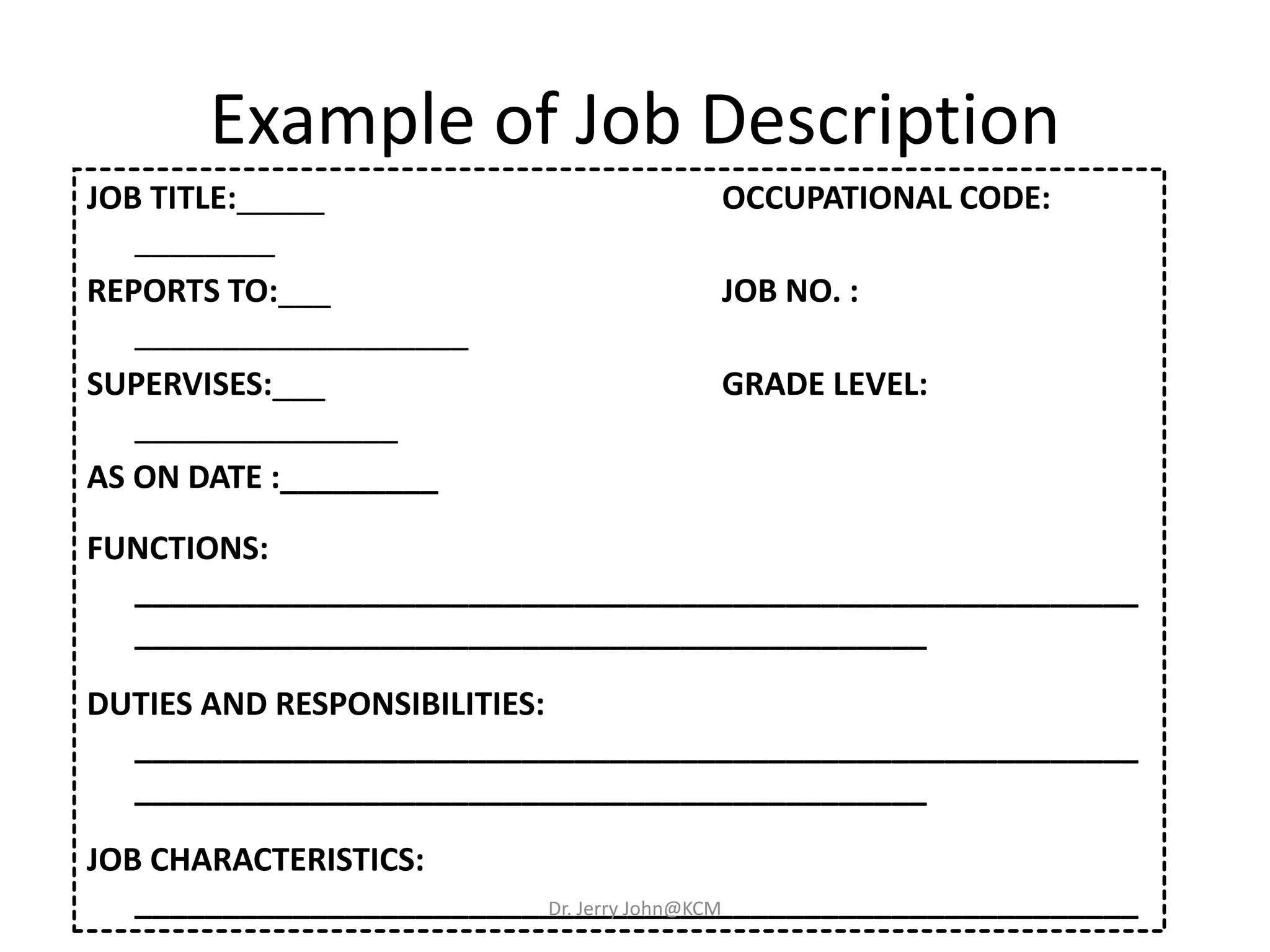
Example of Job Description
JOB TITLE:_____ OCCUPATIONAL CODE:
________
REPORTS TO:___ JOB NO. :
___________________
SUPERVISES:___ GRADE LEVEL:
_______________
AS ON DATE :_________
FUNCTIONS:
_________________________________________________________
_____________________________________________
DUTIES AND RESPONSIBILITIES:
_________________________________________________________
_____________________________________________
JOB CHARACTERISTICS:
_________________________________________________________Dr. Jerry John@KCM
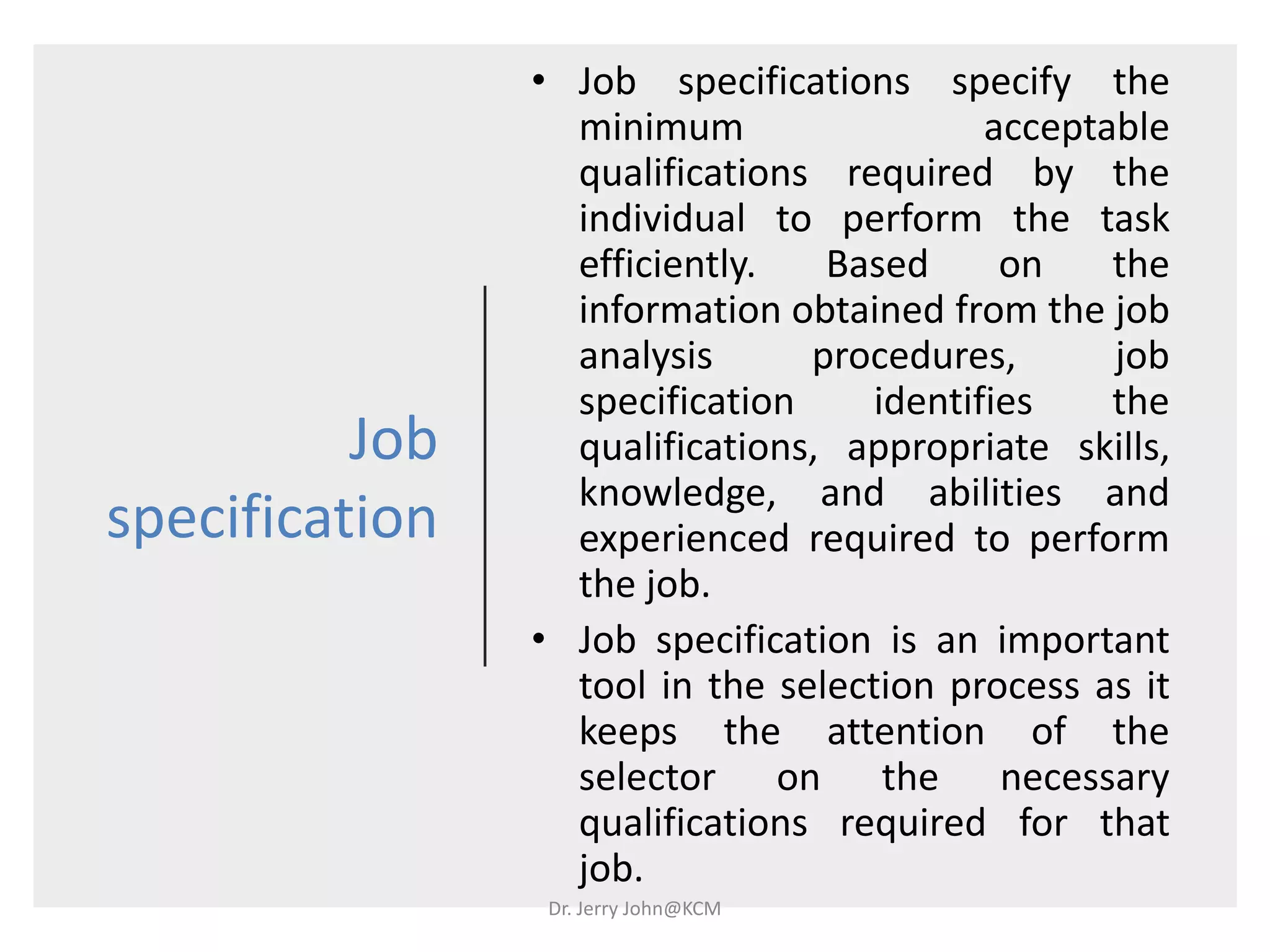
Job
specification
• Job specifications specify the
minimum acceptable
qualifications required by the
individual to perform the task
efficiently. Based on the
information obtained from the job
analysis procedures, job
specification identifies the
qualifications, appropriate skills,
knowledge, and abilities and
experienced required to perform
the job.
• Job specification is an important
tool in the selection process as it
keeps the attention of the
selector on the necessary
qualifications required for that
job.
Dr. Jerry John@KCM
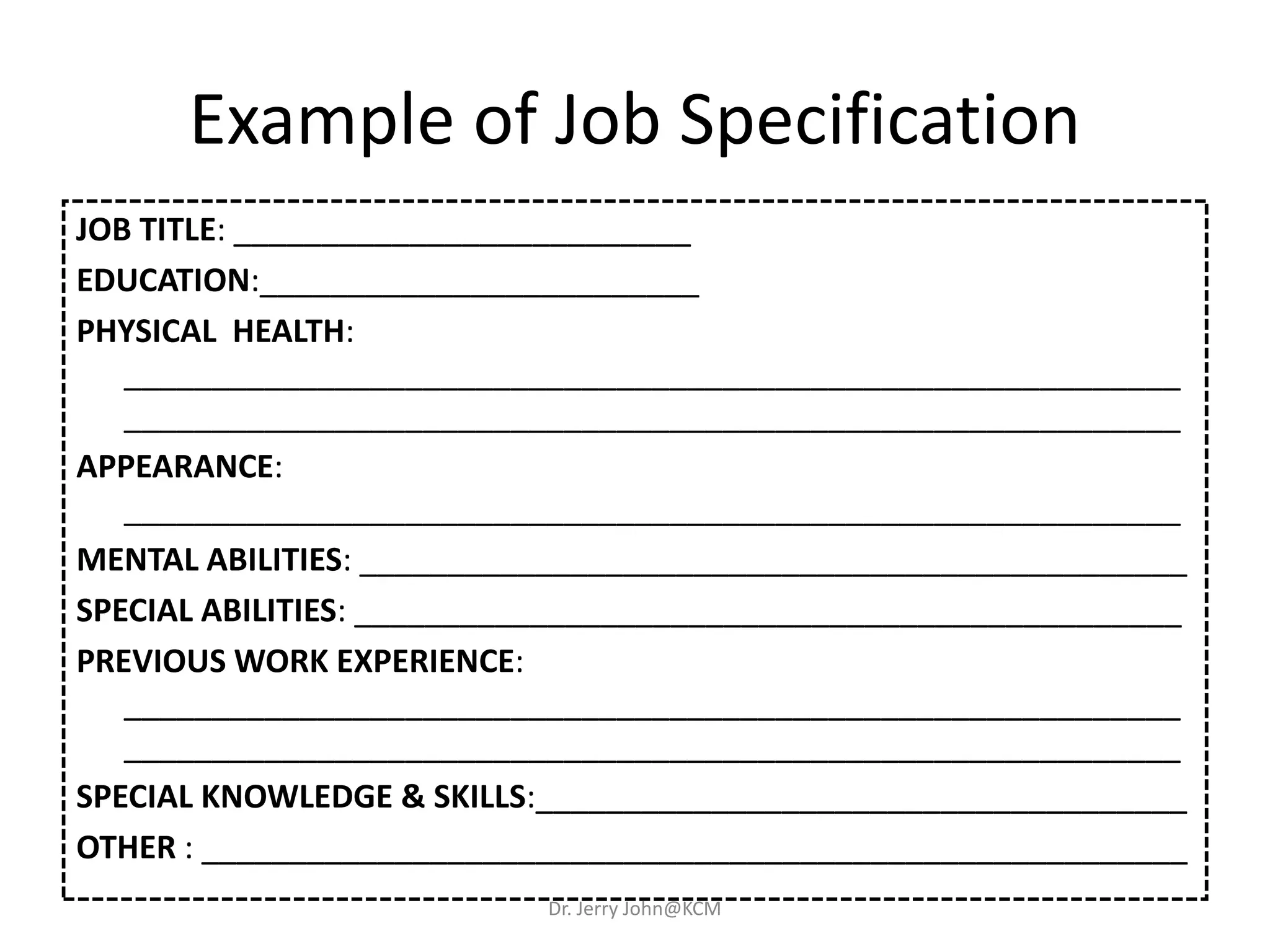
Example of Job Specification
JOB TITLE: __________________________
EDUCATION:_________________________
PHYSICAL HEALTH:
____________________________________________________________
____________________________________________________________
APPEARANCE:
____________________________________________________________
MENTAL ABILITIES: _______________________________________________
SPECIAL ABILITIES: _______________________________________________
PREVIOUS WORK EXPERIENCE:
____________________________________________________________
____________________________________________________________
SPECIAL KNOWLEDGE & SKILLS:_____________________________________
OTHER : ________________________________________________________
Dr. Jerry John@KCM
Job
Evaluation
• Job evaluation provides the
relative value of each job in
the organization. It is an
important tool to determine
compensation
administration.
• If an organization is to have
an equitable compensation
program, jobs that have
similar demands on terms of
skills, education and other
characteristics should be
placed in the common
compensation groups
Dr. Jerry John@KCM
Methods
of
Collecting
Job
Analysis
Data
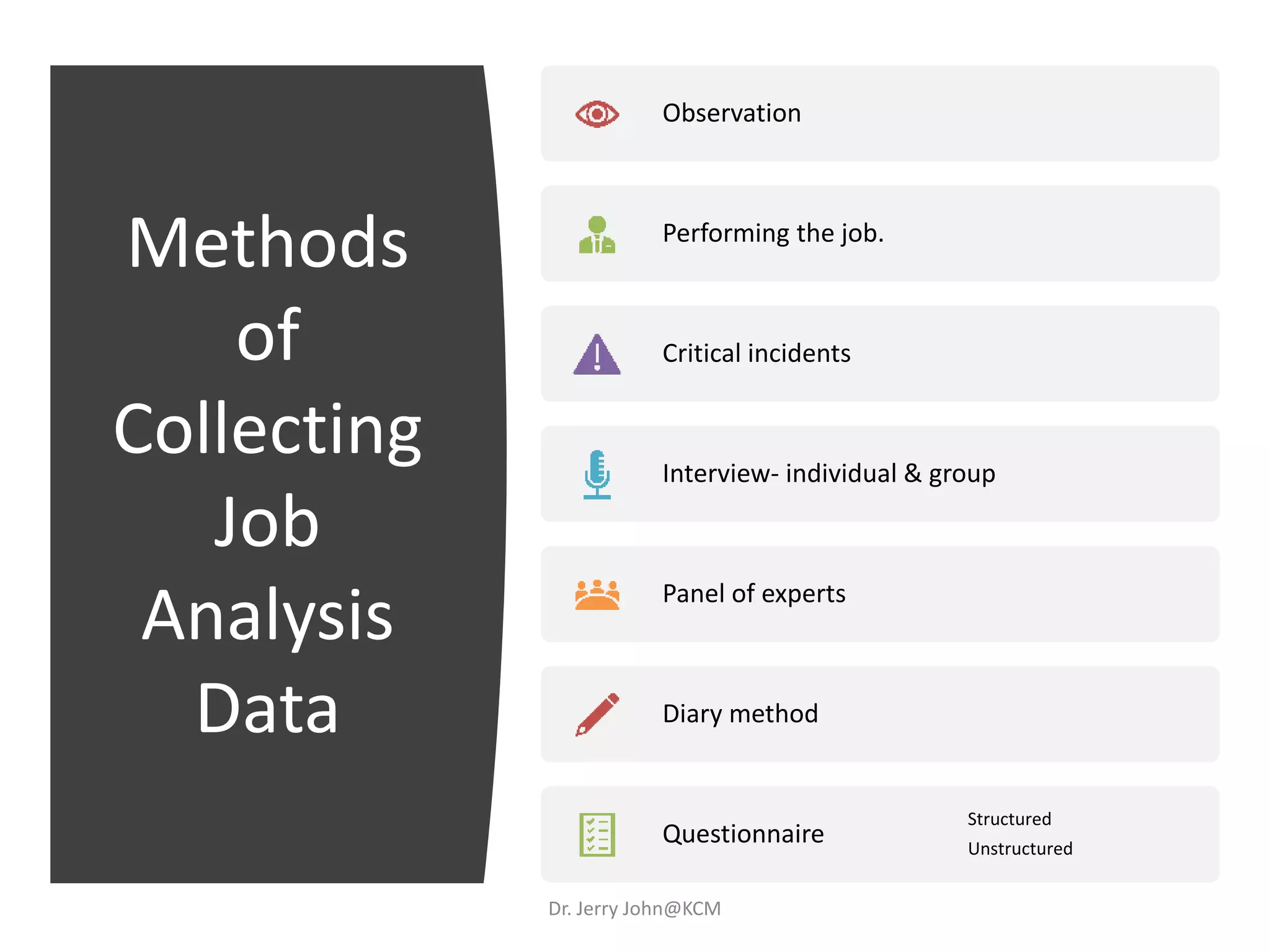
Observation
Performing the job.
Critical incidents
Interview- individual & group
Panel of experts
Diary method
Questionnaire
Structured
Unstructured
Dr. Jerry John@KCM
We Discussed
Dr. Jerry John@KCM
WHAT IS HR? EVOLUTION IMPORTANCE HR-
OUTSOURCING
HR-AUDIT HRIS HRP JOB ANALYSIS

Introduction to Human Resource Management

  • 1.
  • 2.
    Human Resource Management Most Valuable andunique asset of an organization. Effort cannot be replaced with machines How people are managed by organization? Traditional usage was LABOUR. Dr. Jerry John@KCM
  • 3.
    Personnel Management • Personnel managementis defined as an administrative specialization that focuses on hiring and developing employees to become more valuable to the company. • It is sometimes considered to be a sub- category of human resources that only focuses on administration. • According to Flippo, “Personnel management is the planning, organizing, compensation, integration and maintenance of people for the purpose of contributing to organizational, individual and societal goals.” Dr. Jerry John@KCM
  • 4.
    HRM Meaning andDefinition Human Resource Management is also a function of management, concerned with hiring, motivating and maintaining people in an organization. It focuses on people in the organization. Dr. Jerry John@KCM
  • 5.
    HRM Meaning and Definition • Organizations doesnot only consist of building, machines or inventories. It is people they manage and staff the organization • HRM applies management principles in procuring, developing, maintaining people in the organization. • Aims at integrated decision making and decisions on different aspects of employees are consistent with other HR decisions • HR Decisions must influence effectiveness of the organization leading to better service to customer and high- quality product and services at reasonable price. • It is not confined to business establishment only, HRM is applicable also to the nonbusiness organization, like government department, education, health care etc. Dr. Jerry John@KCM
  • 6.
    DEFINITION Human Resource Managementis a series of integrated decisions that form the employment relationship; their quality contributes to the ability of the organizations and the employees to achieve their objectives. - Milkovich and Boudreau Dr. Jerry John@KCM
  • 7.
    Functions of HRM • Planning •Organizing • Staffing • Directing • Controlling Managerial • Employment • HR Development • Compensation Management • Employee Relations Operational Dr. Jerry John@KCM
  • 8.
    What are theHuman Resources Functions? • HR teams undertake various responsibilities in an organization. They: – Recognize current and future hiring needs – Ensure compliance with federal, state, and governmental labor rules and regulations – Attract, recruit, and retain talent – Manage compensation and employee benefits – Ensure effective employee relations – Manage onboarding, training, and learning and development processes to boost performance – Apply health and safety measures – Handle administrative tasks, such as payroll and taxes – Organize and oversee quarterly or annual performance reviews Dr. Jerry John@KCM
  • 9.
  • 10.
    Stages and Development SPARTA #GREECE # MALE SOLIDERS # PROTECTING THE CITY HR requirement started first in Army and Navy to develop their staff strength. - RECRUITMENT They defined standards; it became rules later. CHINA: Effective Management # Designed First Recruitment Process in the human history. Managed their human capital effectively# Ruling the World. Industrial Revolution changed the history of humans & nations. Dr. Jerry John@KCM
  • 11.
    David Ulrich: FirstBook about Human Resource. First HR Practices and basic HR process can be found in China. Chinese Government introduced first rules and produced for selecting government employees. STAGES AND DEVELOPMENT Dr. Jerry John@KCM
  • 12.
    18th Century HRM Modern history ofHRM starts with British Industrial Revolution. New approaches and inventions. “Employee Satisfaction” Influences the performance & productivity. Satisfied employees are more efficient that rest of the depressed workers. Fundamental human rights and the work satisfaction regulation came into picture. Dr. Jerry John@KCM
  • 13.
    20th Century Evolution ofPersonal Management Focused on the productivity of employee. Personal Department and Training Department formed as a result of World War 2. Workers are getting exploited – formed trade union. Aims constant improvement in employees. Centralized recruitment system to save time and cost. Dr. Jerry John@KCM
  • 14.
    Early HRM- 1970’s Required more labors– skilled and Unskilled. Gained power to negotiate with employer Commitment and Loyalty were words. “Employees became most valuable asset for a company” Term HR Department Introduced with new HR polices and process- aimed at increasing employees' commitment and motivation of employees. Introduced Carrier Planning. Introduced the concept of Performance Management System. Training and Development Dr. Jerry John@KCM
  • 15.
    Advance HRM – 90’s HRIS Eliminates doubleentry of HR data Developed strategy and functions accordingly. Team Sprit – Work together for one aim. Dr. Jerry John@KCM
  • 16.
    RESPONSIBILITY, AUTHORITY & ACCOUNTABILITY • Responsibility: –It is the obligation of a manager to carry out the duties assigned to him. • Authority: – It refers to the right to give orders and the power to exact obedience from others in the process of discharging responsibility. • Accountability: – The employee's answerability on using the authority in discharging the responsibility is termed accountability. Dr. Jerry John@KCM
  • 17.
    Common Sayings by Managers Supporting Department Departmentsor employees of a firm that perform a support function Contributes indirectly to the business of the firm Ex: HR and Finance departments Core Department Departments or employees of a firm that perform core activities Contributes directly to the business of the firm Ex: Manufacturing and Marketing departments “We are not a revenue generating department”, we wont able to ask more increment.. Why? Dr. Jerry John@KCM
  • 18.
    Human Resource Manager Responsibilities Set objectives forthe HR team and track progress Design and implement company policies that promote a healthy work environment Develop compensation and benefits plans Support and suggest improvements to the entire recruitment process Host in-house recruitment events Discuss employees’ career development paths with managers Monitor HR metrics (e.g. turnover rates and cost-per-hire) Review departmental budgets Organize learning and development programs Ensure HR staff addresses employees’ requests and grievances in a timely manner Maintain HR procedures that comply with labor regulations Dr. Jerry John@KCM
  • 19.
    Human Resource (HR) Metrics HR metrics aremeasurements used to determine the value and effectiveness of HR initiatives, typically including such areas as turnover, training, return on human capital, costs of labor, and expenses per employee. Measure HR transactions Monitor HR department performance Link Hr initiatives to organizational performance. Predict the effect of HR Dr. Jerry John@KCM
  • 20.
    HRO-HR Outsourcing • Human ResourceOutsourcing is a process in which a company utilizes the services of the third party to take care of its HR functions. • HR Outsourcing is rapidly emerging as one of the world’s most exciting business trends. • It reflects the need, recognized by increasing numbers of organizations, to focus on their core areas of business Dr. Jerry John@KCM
  • 21.
    HR Outsourcing –Need Enabling businesses to focus on core operationsEnabling Delivering cost savings – whether direct or indirectDelivering Helping to create a stable, cost-effective operating platformHelping Transferring focus from internal processes to achievement of business goalsTransferring Realizing investment in HR transformation and IT systemsRealizing Ensuring compliance with legal, regulatory and best practice requirements, andEnsuring Transferring risk and liability for people issues.Transferring Dr. Jerry John@KCM
  • 22.
    HR – Outsourcingcan be broadly divided into three types: APPLICATION SERVICE PROVIDER (ASP) BUSINESS PROCESS OUTSOURCING (BPO) TOTAL HR OUTSOURCING Dr. Jerry John@KCM
  • 23.
    Type # 1.Application Service Provider: A host of companies specialize in providing hardware and software applications to support large organizations, including application vendors like PeopleSoft, Oracle, etc. which have developed application packages (PeopleSoft HRMS, Oracle HRMS), for supporting human resource activities in an organization. Dr. Jerry John@KCM
  • 24.
    Type # 2. Business Process Outsourcing: Themajor difference between BPO and ASP is that in BPO, the client is in direct contact with the employees through call centers or support centers. MNCs generally opt for BPO as they operate in many countries and employ many people. While certain firms wish to retain the power to control human resources, others hand over the power to the service providers. Dr. Jerry John@KCM
  • 25.
    Type # 3. TotalHR Outsourcing: In this type of outsourcing, the entire HR function is run by the service provider. There is no specific HR department in the organization. The client organization only has senior HR professionals who are also HR- strategists. A host of non-strategic functions and employee contact is done by the service provider. Dr. Jerry John@KCM
  • 26.
    HR - Audit •An effective human resources (HR) audit investigates every discipline of the human resources function. • HR disciplines include recruitment and selection, workplace safety and risk management, training and development, employee relations, and compensation and benefits. • The purpose of an HR audit is to determine if your organization’s policies are current and if they comply with federal and state laws governing the workplace. Dr. Jerry John@KCM
  • 27.
    HR – Audit WhyAre They Important? • Internal Services: – Employers should regularly audit the services that are provided to their employees, including payroll, benefits administration, and conflict resolution. – The quality of these services directly affect employee satisfaction, which is key in employee retention. – Employee satisfaction with these services typically leads to increased company morale and engagement. – An audit of these services should seek to ensure that they are meeting the needs of employees. Dr. Jerry John@KCM
  • 28.
    HR – AuditWhy Are They Important? • Legal Compliance: – Employers must adhere to employment and labor laws, which are constantly changing and evolving. – Performing an HR audit is especially important because it mitigates the risk of being liable for what are deemed “unfair employment practices”. – Legal issues and conflicts can be extremely costly, and HR audits are a proactive way to minimize the costs associated with such compliance issues. – The audit should assess the recruitment and selection process for employees to ensure fairness. – It should also assess the procedures for layoffs and terminations, and the effectiveness of measures taken to maintain workplace safety. Dr. Jerry John@KCM
  • 29.
    HR – AuditWhy Are They Important? • Performance Management: – HR audits usually involve reviewing employee files to ensure that supervisors and managers are continuously providing feedback and properly documenting it. – An audit can help to pinpoint lapses in leadership and management and identify opportunities for training or performance management improvement. – These areas are common focuses in HR audits, but HR audits can be as broad or narrow as the company wants. – While audits are a great tool to uncover deficiencies, organizations should be committed to acting on the recommended improvements. Dr. Jerry John@KCM
  • 30.
    Human Resources InformationSystem - HRIS • HRIS is a form of human resources (HR) software that combines several systems and processes to ensure the easy management of human resources, business processes and data. • Human resources software is used by businesses to combine several necessary HR functions, such as storing employee data, managing payrolls, recruitment processes, benefits administration, and keeping track of attendance records. • ERP - Enterprise Resource PlanningDr. Jerry John@KCM
  • 31.
    HRIS • The trendof automating payroll and workforce management processes began during the 1970s. • The first enterprise resource planning (ERP) system that integrated human resources functions was SAP R/2 (later to be replaced by R/3 and S/4hana), introduced in 1979. • The first completely HR-centered client-server system for the enterprise market was PeopleSoft, released in 1987 and later bought by Oracle in 2005 Dr. Jerry John@KCM
  • 32.
    HRIS- Functions The function ofhuman resources departments is administrative and common to all organizations. Organizations may have formalized selection, evaluation, and payroll processes. Management of "human capital" has progressed to an imperative and complex process. The HR function consists of tracking existing employee data, which traditionally includes personal histories, skills, capabilities, accomplishments, and salary. To reduce the manual workload of these administrative activities, organizations began to electronically automate many of these processes by introducing specialized human resource management systems. Dr. Jerry John@KCM
  • 33.
    HRIS • Applicant trackingsystem • On boarding and off-boarding • Training tracking • Advanced reporting • Tailored workflows and approvals • Custom access levels and email alerts • Company branding • Custom tabs • Audit trail • Phone support Dr. Jerry John@KCM
  • 34.
    Human Resource Planning • Human resourceplanning (HRP) is the continuous process of systematic planning ahead to achieve optimum use of an organization's most valuable asset—quality employees. • Human resources planning ensures the best fit between employees and jobs while avoiding manpower shortages or surpluses. Dr. Jerry John@KCM
  • 35.
    Human Resource Planning • Human resourceplanning is what a strategy used by a company to company maintain a steady stream of skilled employees while avoiding employee shortages or surpluses. • Having a good HRP strategy in place can mean productivity and profitability for a company. • There are four general steps in the HRP process: identifying the current supply of employees, determining the future of the workforce, balancing between the supply and demand, and how to implement the plans. Dr. Jerry John@KCM
  • 36.
    Understanding Human ResourcePlanning • Human resources planning allows companies to plan so they can maintain a steady supply of skilled employees. • That's why it is also referred to as workforce planning. • The process is also used to help companies evaluate their needs and to plan ahead to meet those needs. • Human resource planning needs to be flexible enough to meet short-term staffing challenges while adapting to changing conditions in the business environment over the longer term. • HRP starts by assessing and auditing the current capacity of human resources. Dr. Jerry John@KCM
  • 37.
    HRP According to ReillyP, “ Human Resource Planning is the process in which an organization attempts to estimate the demand for labour and evaluate the size, nature and sources of supply which will be required to meet the demand”. Dr. Jerry John@KCM
  • 38.
    Methods of HR Planning • Approachesto forecasting: – Qualitative: • Expert opinions • Delphi technique • “Bottom-up” approach – Quantitative • Regression analysis / Trend analysis Dr. Jerry John@KCM
  • 39.
    What is Job Design? • Jobanalysis, contains a simple term called "analysis", which means detailed study or examination of something (job) in order to understand more about it (job). • Therefore job analysis is to understand more about a specific job in order to optimize it. • Job analysis is a systematic process of collecting complete information pertaining to a job. • Job analysis is done by job analyst who is an officer have been trained for it. Dr. Jerry John@KCM
  • 40.
    Job Design • Jobanalysis is a systematic investigation of the tasks, duties and responsibilities necessary to do a job. • Job analysis is the process of collecting job related information. Job Analysis Job Tasks Job Duties Job responsibilities Dr. Jerry John@KCM
  • 41.
    Job analysis is adetailed examination of: 1. Tasks that make up a job (employee role), 2. conditions under which an employee performing his/her job, and 3. what exactly a job requires in terms of aptitudes (potential for achievement), attitudes (behavior characteristics), knowledge, skills, educational qualifications and the physical working condition of the employee. Dr. Jerry John@KCM
  • 42.
    Objectives To determine mosteffective methods for performing a job. To increase employee job satisfaction. To identify core areas for giving training to employees and to find out best methods of training. Development of performance measurement systems, and To match job-specifications with employee specifications while selection of an employee. Dr. Jerry John@KCM
  • 43.
    Objectives/Purpose of JobAnalysis Job Analysis Recruitment Selection Performance appraisal Placement Job evaluation Job design T & D HRP Dr. Jerry John@KCM
  • 44.
    Definitions of Job Analysis • EdwinB. Flippo, "Job analysis is the process of studying and collecting information relating to the operations and responsibilities of a specific job ”. • Dale Yoder. "A Job is a collection of duties, tasks and responsibilities which are assigned to an individual and which is different from other assignment" Dr. Jerry John@KCM
  • 45.
    Process of JobAnalysis Organizational Analysis Selection of jobs to be analyzed Data collection Job description Job specification Dr. Jerry John@KCM
  • 46.
    Approaches to Job Design Scientific Management •Involves breaking down jobs into elemental activities and simplifying job design. • Encourages specialization and mass production. • Tries to reduce decision making by workers. Job Enlargement • Expands the number of tasks being performed, often combining a series of tasks previously performed by two or more employees. • Horizontal enlargement. Dr. Jerry John@KCM
  • 47.
    Approaches to Job Design • JobEnrichment – Tries to improve task efficiency and satisfaction by adding more challenging and responsible work so the employee feels a greater sense of achievement. – Also provide an opportunity for individual advancement and growth. – Vertical enlargement. Dr. Jerry John@KCM
  • 48.
    Approaches to Job Design Job Rotationincreases task variety by systematically moving an employee from one job to another. Sociotechnical Approach aims to design a job that is satisfying to both the technical system and the accompanying social system. Dr. Jerry John@KCM
  • 49.
    Job Description A job descriptionis a written statement of the duties, responsibilities, required qualifications and reporting relationships of a particular job. The job description is based on objective information obtained through job analysis. Job description acts as an important resource for •Describing the job to potential candidates •Guiding new hired employees in what they are specifically expected to do •Providing a point of comparison in appraising whether the actual duties align with the stated duties. Dr. Jerry John@KCM
  • 50.
    Example of JobDescription JOB TITLE:_____ OCCUPATIONAL CODE: ________ REPORTS TO:___ JOB NO. : ___________________ SUPERVISES:___ GRADE LEVEL: _______________ AS ON DATE :_________ FUNCTIONS: _________________________________________________________ _____________________________________________ DUTIES AND RESPONSIBILITIES: _________________________________________________________ _____________________________________________ JOB CHARACTERISTICS: _________________________________________________________Dr. Jerry John@KCM
  • 51.
    Job specification • Job specificationsspecify the minimum acceptable qualifications required by the individual to perform the task efficiently. Based on the information obtained from the job analysis procedures, job specification identifies the qualifications, appropriate skills, knowledge, and abilities and experienced required to perform the job. • Job specification is an important tool in the selection process as it keeps the attention of the selector on the necessary qualifications required for that job. Dr. Jerry John@KCM
  • 52.
    Example of JobSpecification JOB TITLE: __________________________ EDUCATION:_________________________ PHYSICAL HEALTH: ____________________________________________________________ ____________________________________________________________ APPEARANCE: ____________________________________________________________ MENTAL ABILITIES: _______________________________________________ SPECIAL ABILITIES: _______________________________________________ PREVIOUS WORK EXPERIENCE: ____________________________________________________________ ____________________________________________________________ SPECIAL KNOWLEDGE & SKILLS:_____________________________________ OTHER : ________________________________________________________ Dr. Jerry John@KCM
  • 53.
    Job Evaluation • Job evaluationprovides the relative value of each job in the organization. It is an important tool to determine compensation administration. • If an organization is to have an equitable compensation program, jobs that have similar demands on terms of skills, education and other characteristics should be placed in the common compensation groups Dr. Jerry John@KCM
  • 54.
    Methods of Collecting Job Analysis Data Observation Performing the job. Criticalincidents Interview- individual & group Panel of experts Diary method Questionnaire Structured Unstructured Dr. Jerry John@KCM
  • 55.
    We Discussed Dr. JerryJohn@KCM WHAT IS HR? EVOLUTION IMPORTANCE HR- OUTSOURCING HR-AUDIT HRIS HRP JOB ANALYSIS