
Dr. Prachi Murkute
Unit No Title Learning Outcomes
1. Human Resource
Management
Understand the scope of HRM and its
relationship to other social sciences
2/16/2018Dr. Prachi Murkute 2
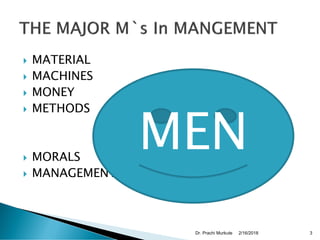
 MATERIAL
 MACHINES
 MONEY
 METHODS
 MORALS
 MANAGEMENT
MEN
2/16/2018Dr. Prachi Murkute 3
 Human : The Individuals
 Resource :encompasses the deployment of
any resource .
i.e. human resources, financial resources,
technical recourses or natural recourses
2/16/2018Dr. Prachi Murkute 4
 Human resources may be defined as
“The total knowledge, skills, creative abilities,
talents and aptitudes of an organization's
workforce,
as well as
the values, attitudes, approaches and beliefs
of the individuals involved in the affairs of the
organization”
2/16/2018Dr. Prachi Murkute 5
 HRM is primarily concerned with how people are
managed within organizations, focusing on policies and
systems
 Human resource management (HRM, or simply HR) is
a function in organizations designed to maximize
employee performance in service of their employer's
strategic objectives.
 It is concerned with the management of people from
recruitment to retirement
 To select the right person at the right place for the right
job at the right time.
2/16/2018Dr. Prachi Murkute 6
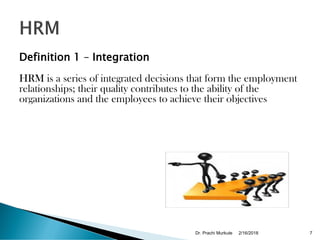
Definition 1 – Integration
HRM is a series of integrated decisions that form the employment
relationships; their quality contributes to the ability of the
organizations and the employees to achieve their objectives
2/16/2018Dr. Prachi Murkute 7
Definition 2- Influencing
 HRM is concerned with the people dimensions
management. Since every organization is made up of
people ,acquiring their services, developing their skills ,
motivating them to higher levels of performance and
ensuring that they continue to maintain their
commitment to the organization are essential to
achieving organizational objectives.
2/16/2018Dr. Prachi Murkute 8
Definition 3 - Applicability
• HRM is planning, organizing directing and controlling of the
procurement , development, compensation , integration,
maintenance, and separation of human resources to the end
that individual, organizational and social objectives are
accomplished.
Core Elements of HRM
Organizations ------People ------ Management
2/16/2018Dr. Prachi Murkute 9
 People possess skills, abilities and aptitudes that offer
competitive advantage to any firm
 No computer can substitute human brain, no
machines can run without human intervention & no
organization can exist if it cannot serve people’s needs.
 HRM is a study about the people in the organization-
how they are hired, trained, compensated, motivated
& maintained
2/16/2018Dr. Prachi Murkute 10
 Human Resource Management has come to be recognized as
an inherent part of management, which is concerned with
the human resources of an organization.
 Its objective is the maintenance of better human relations in
the organization by the development, application and
evaluation of policies, procedures and programmes relating
to human resources to optimize their contribution towards the
realization of organizational objectives
 Societal
 Organizational
 Functional
 Personal
2/16/2018Dr. Prachi Murkute 11
 HRM must see that the legal, ethical, and social
environmental issues are properly attended to.
 Equal opportunity and equal pay for equal work are the
legal issues not to be violated.
 To help the society through generating employment
opportunity, creating schools and dispensaries, helping
women empowerment are the social responsibility issues.
 For Ex: To take care of farmers (whose land has been
acquired for the factory) and tribal’s (who are displaced by
industries and mining companies) are the ethical issues.
2/16/2018Dr. Prachi Murkute 12
 Legal Compliance
 Benefits
 Union Management Relations
 etc
2/16/2018Dr. Prachi Murkute 13
 HRM is a means to achieve efficiency and effectiveness.
It serves other functional areas, so as to help them to
attain efficiency in their operations and attainment of
goals to attain efficiency.
 Acquiring right man for the right job at right time in right
quantity, developing through right kind of training,
utilizing the selected workforce, and maintaining the
workforce are the organizational objectives of HRM.
 Succession planning is to be taken up as a
contemporary organizational objective.
2/16/2018Dr. Prachi Murkute 14
 HRP
 Employee Relations
 Selection
 Training and Development
 Appraisal
 Placement
 Assessment
 Etc
2/16/2018Dr. Prachi Murkute 15
 HRM performs so many functions for other
departments. However, it must see that the
facilitation should not cost more than the
benefit rendered.
2/16/2018Dr. Prachi Murkute 16
 Appraisal
 Placement
 Assessment
 Etc
2/16/2018Dr. Prachi Murkute 17
 In today’s world there is shortage of requisite
talent. Employees are encouraged by
competitive firms to change the jobs. HRM
has the responsibility to acquire, develop,
utilize, and maintain employees.
2/16/2018Dr. Prachi Murkute 18
 Training and Development
 Appraisal, Placement, Compensation
 etc
2/16/2018Dr. Prachi Murkute 19
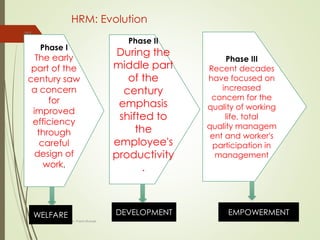
HRM: Evolution
2/16/2018Dr. Prachi Murkute
20
Phase I
The early
part of the
century saw
a concern
for
improved
efficiency
through
careful
design of
work.
Phase II
During the
middle part
of the
century
emphasis
shifted to
the
employee's
productivity
.
Phase III
Recent decades
have focused on
increased
concern for the
quality of working
life, total
quality managem
ent and worker's
participation in
management
WELFARE DEVELOPMENT EMPOWERMENT
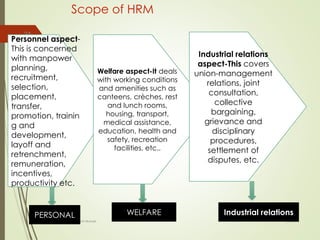
Scope of HRM
2/16/2018Dr. Prachi Murkute
21
Personnel aspect-
This is concerned
with manpower
planning,
recruitment,
selection,
placement,
transfer,
promotion, trainin
g and
development,
layoff and
retrenchment,
remuneration,
incentives,
productivity etc.
Welfare aspect-It deals
with working conditions
and amenities such as
canteens, crèches, rest
and lunch rooms,
housing, transport,
medical assistance,
education, health and
safety, recreation
facilities, etc..
Industrial relations
aspect-This covers
union-management
relations, joint
consultation,
collective
bargaining,
grievance and
disciplinary
procedures,
settlement of
disputes, etc.
PERSONAL WELFARE Industrial relations
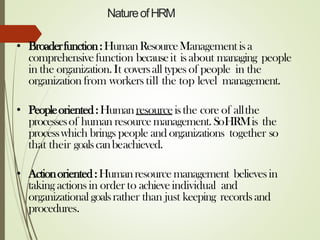
NatureofHRM
• Broaderfunction:HumanResourceManagement isa
comprehensivefunction becauseit isabout managing people
in the organization.It coversall types of people in the
organization from workers till the top level management.
• Peopleoriented:Humanresourceisthe core of allthe
processesof human resourcemanagement. SoHRMis the
processwhich brings people and organizations together so
that their goalscanbeachieved.
• Actionoriented:Humanresourcemanagement believesin
taking actions in order to achieveindividual and
organizational goalsrather than just keeping recordsand
procedures.
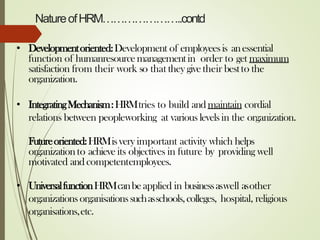
NatureofHRM…………………..contd
• Developmentoriented:Development of employeesis anessential
function of humanresourcemanagementin order to get maximum
satisfaction from their work so that they givetheir bestto the
organization.
• IntegratingMechanism:HRMtries to build andmaintain cordial
relations between peopleworking at various levels in the organization.
Futureoriented:HRMisvery important activity which helps
organizationto achieve its objectives in future by providing well
motivated andcompetentemployees.
• UniversalfunctionHRMcanbeapplied in businessaswell asother
organizationsorganisationssuchasschools,colleges, hospital, religious
organisations,etc.
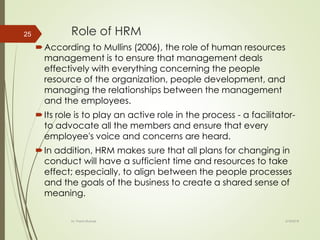
Role of HRM
According to Mullins (2006), the role of human resources
management is to ensure that management deals
effectively with everything concerning the people
resource of the organization, people development, and
managing the relationships between the management
and the employees.
Its role is to play an active role in the process - a facilitator-
to advocate all the members and ensure that every
employee's voice and concerns are heard.
In addition, HRM makes sure that all plans for changing in
conduct will have a sufficient time and resources to take
effect; especially, to align between the people processes
and the goals of the business to create a shared sense of
meaning.
2/16/2018Dr. Prachi Murkute
25
2/16/2018Dr. Prachi Murkute
26
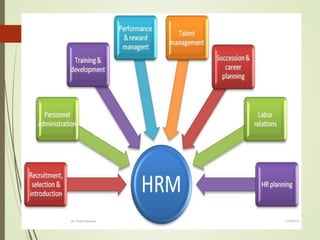
Functions of Human Resource
Management Includes:
Managerial Functions
Operative Functions
2/16/2018Dr. Prachi Murkute
27
Managerial Functions include
 1. Planning
One of the primary function where number & type of employees needed to
accomplish organizational goals are determined. Research forms core
HRM planning which also helps management to collect, analyze and
identify current plus future needs within the organization.
 2. Organizing
Organization of the task is another important step. Task is allocated to every
member as per their skills and activities are integrated towards a common
goal.
 3. Directing
This includes activating employees at different levels and making them
contribute maximum towards organizational goal. Tapping maximum
potentialities of an employee via constant motivation and command is a
prime focus.
 4. Controlling
Post planning, organizing and directing, performance of an employee is
checked, verified and compared with goals. If actual performance is
found deviated from the plan, control measures are taken.
2/16/2018Dr. Prachi Murkute
28
Operative Functions
 `
 Hiring is a process which brings pool of prospective candidates who can help
organization achieve their goals and allows managements to select right
candidates from the given pool.
 2. Job Analysis & Design
 Describing nature of the job like qualification, skill, work experience required
for specific job position is another important operative task. Whereas, job
design includes outlining tasks, duties and responsibilities into a single work unit
to achieve certain goal.
 3. Performance Appraisal
 Checking and analyzing employee performance is another important
function that human resource management has to perform.
 4. Training & Development
 This function allows employees to acquire new skills and knowledge to perform
their job effectively. Training and development also prepares employees for
higher level responsibilities.
 5. Salary Administration
 Human Resource Department also determines pays for different job types and
includes compensations, incentives, bonus, benefits etc. related with a job
function.
2/16/2018Dr. Prachi Murkute
29
Operative Functions…..contd..
 6. Employee Welfare
 This function takes care of numerous services, benefits and facilities provided to
an employee for their well-being.
 7. Maintenance
 Minimizing employee turnover and sustaining best performing employees within
the organization is the key. Minimizing ROI within HR department is also a key goal
for Human resource management team.
 8. Labor Relations
 Labor relation is regards to the workforce who work within a trade union.
Employees in such domain form a union/group to voice their decisions affectively
to the higher management.
 9. Personal Research
 Research is a vital part of human resource management. It is performed to keep
a check on employee opinion about wages, promotions, work condition, welfare
activities, leadership, employee satisfaction and other key issues.
 10. Personal Record
 This function involves recording, maintaining and retrieving employee related
information including employment history, work hours, earning history etc.
2/16/2018Dr. Prachi Murkute
30
HR and Other Social Science
 Its all about Behavioral Science and Social Science
First: HR practices, policies, and programs should be designed to reflect our
best understanding of human psychology.
Second: HR practices, like all business programs, should be tested and
validated.
Third : Information sharing and organizational commitment:
Forth: Performance-based awards and organizational commitment
Fifth : Job security and organizational commitment:
2/16/2018Dr. Prachi Murkute
32
Thank You
2/16/2018Dr. Prachi Murkute
33

INTRODUCTION TO HRM -Dr. Prachi Murkute

  • 1.
  • 2.
    Unit No TitleLearning Outcomes 1. Human Resource Management Understand the scope of HRM and its relationship to other social sciences 2/16/2018Dr. Prachi Murkute 2
  • 3.
     MATERIAL  MACHINES MONEY  METHODS  MORALS  MANAGEMENT MEN 2/16/2018Dr. Prachi Murkute 3
  • 4.
     Human :The Individuals  Resource :encompasses the deployment of any resource . i.e. human resources, financial resources, technical recourses or natural recourses 2/16/2018Dr. Prachi Murkute 4
  • 5.
     Human resourcesmay be defined as “The total knowledge, skills, creative abilities, talents and aptitudes of an organization's workforce, as well as the values, attitudes, approaches and beliefs of the individuals involved in the affairs of the organization” 2/16/2018Dr. Prachi Murkute 5
  • 6.
     HRM isprimarily concerned with how people are managed within organizations, focusing on policies and systems  Human resource management (HRM, or simply HR) is a function in organizations designed to maximize employee performance in service of their employer's strategic objectives.  It is concerned with the management of people from recruitment to retirement  To select the right person at the right place for the right job at the right time. 2/16/2018Dr. Prachi Murkute 6
  • 7.
    Definition 1 –Integration HRM is a series of integrated decisions that form the employment relationships; their quality contributes to the ability of the organizations and the employees to achieve their objectives 2/16/2018Dr. Prachi Murkute 7
  • 8.
    Definition 2- Influencing HRM is concerned with the people dimensions management. Since every organization is made up of people ,acquiring their services, developing their skills , motivating them to higher levels of performance and ensuring that they continue to maintain their commitment to the organization are essential to achieving organizational objectives. 2/16/2018Dr. Prachi Murkute 8
  • 9.
    Definition 3 -Applicability • HRM is planning, organizing directing and controlling of the procurement , development, compensation , integration, maintenance, and separation of human resources to the end that individual, organizational and social objectives are accomplished. Core Elements of HRM Organizations ------People ------ Management 2/16/2018Dr. Prachi Murkute 9
  • 10.
     People possessskills, abilities and aptitudes that offer competitive advantage to any firm  No computer can substitute human brain, no machines can run without human intervention & no organization can exist if it cannot serve people’s needs.  HRM is a study about the people in the organization- how they are hired, trained, compensated, motivated & maintained 2/16/2018Dr. Prachi Murkute 10
  • 11.
     Human ResourceManagement has come to be recognized as an inherent part of management, which is concerned with the human resources of an organization.  Its objective is the maintenance of better human relations in the organization by the development, application and evaluation of policies, procedures and programmes relating to human resources to optimize their contribution towards the realization of organizational objectives  Societal  Organizational  Functional  Personal 2/16/2018Dr. Prachi Murkute 11
  • 12.
     HRM mustsee that the legal, ethical, and social environmental issues are properly attended to.  Equal opportunity and equal pay for equal work are the legal issues not to be violated.  To help the society through generating employment opportunity, creating schools and dispensaries, helping women empowerment are the social responsibility issues.  For Ex: To take care of farmers (whose land has been acquired for the factory) and tribal’s (who are displaced by industries and mining companies) are the ethical issues. 2/16/2018Dr. Prachi Murkute 12
  • 13.
     Legal Compliance Benefits  Union Management Relations  etc 2/16/2018Dr. Prachi Murkute 13
  • 14.
     HRM isa means to achieve efficiency and effectiveness. It serves other functional areas, so as to help them to attain efficiency in their operations and attainment of goals to attain efficiency.  Acquiring right man for the right job at right time in right quantity, developing through right kind of training, utilizing the selected workforce, and maintaining the workforce are the organizational objectives of HRM.  Succession planning is to be taken up as a contemporary organizational objective. 2/16/2018Dr. Prachi Murkute 14
  • 15.
     HRP  EmployeeRelations  Selection  Training and Development  Appraisal  Placement  Assessment  Etc 2/16/2018Dr. Prachi Murkute 15
  • 16.
     HRM performsso many functions for other departments. However, it must see that the facilitation should not cost more than the benefit rendered. 2/16/2018Dr. Prachi Murkute 16
  • 17.
     Appraisal  Placement Assessment  Etc 2/16/2018Dr. Prachi Murkute 17
  • 18.
     In today’sworld there is shortage of requisite talent. Employees are encouraged by competitive firms to change the jobs. HRM has the responsibility to acquire, develop, utilize, and maintain employees. 2/16/2018Dr. Prachi Murkute 18
  • 19.
     Training andDevelopment  Appraisal, Placement, Compensation  etc 2/16/2018Dr. Prachi Murkute 19
  • 20.
    HRM: Evolution 2/16/2018Dr. PrachiMurkute 20 Phase I The early part of the century saw a concern for improved efficiency through careful design of work. Phase II During the middle part of the century emphasis shifted to the employee's productivity . Phase III Recent decades have focused on increased concern for the quality of working life, total quality managem ent and worker's participation in management WELFARE DEVELOPMENT EMPOWERMENT
  • 21.
    Scope of HRM 2/16/2018Dr.Prachi Murkute 21 Personnel aspect- This is concerned with manpower planning, recruitment, selection, placement, transfer, promotion, trainin g and development, layoff and retrenchment, remuneration, incentives, productivity etc. Welfare aspect-It deals with working conditions and amenities such as canteens, crèches, rest and lunch rooms, housing, transport, medical assistance, education, health and safety, recreation facilities, etc.. Industrial relations aspect-This covers union-management relations, joint consultation, collective bargaining, grievance and disciplinary procedures, settlement of disputes, etc. PERSONAL WELFARE Industrial relations
  • 22.
    NatureofHRM • Broaderfunction:HumanResourceManagement isa comprehensivefunctionbecauseit isabout managing people in the organization.It coversall types of people in the organization from workers till the top level management. • Peopleoriented:Humanresourceisthe core of allthe processesof human resourcemanagement. SoHRMis the processwhich brings people and organizations together so that their goalscanbeachieved. • Actionoriented:Humanresourcemanagement believesin taking actions in order to achieveindividual and organizational goalsrather than just keeping recordsand procedures.
  • 23.
    NatureofHRM…………………..contd • Developmentoriented:Development ofemployeesis anessential function of humanresourcemanagementin order to get maximum satisfaction from their work so that they givetheir bestto the organization. • IntegratingMechanism:HRMtries to build andmaintain cordial relations between peopleworking at various levels in the organization. Futureoriented:HRMisvery important activity which helps organizationto achieve its objectives in future by providing well motivated andcompetentemployees. • UniversalfunctionHRMcanbeapplied in businessaswell asother organizationsorganisationssuchasschools,colleges, hospital, religious organisations,etc.
  • 24.
    Role of HRM Accordingto Mullins (2006), the role of human resources management is to ensure that management deals effectively with everything concerning the people resource of the organization, people development, and managing the relationships between the management and the employees. Its role is to play an active role in the process - a facilitator- to advocate all the members and ensure that every employee's voice and concerns are heard. In addition, HRM makes sure that all plans for changing in conduct will have a sufficient time and resources to take effect; especially, to align between the people processes and the goals of the business to create a shared sense of meaning. 2/16/2018Dr. Prachi Murkute 25
  • 25.
  • 26.
    Functions of HumanResource Management Includes: Managerial Functions Operative Functions 2/16/2018Dr. Prachi Murkute 27
  • 27.
    Managerial Functions include 1. Planning One of the primary function where number & type of employees needed to accomplish organizational goals are determined. Research forms core HRM planning which also helps management to collect, analyze and identify current plus future needs within the organization.  2. Organizing Organization of the task is another important step. Task is allocated to every member as per their skills and activities are integrated towards a common goal.  3. Directing This includes activating employees at different levels and making them contribute maximum towards organizational goal. Tapping maximum potentialities of an employee via constant motivation and command is a prime focus.  4. Controlling Post planning, organizing and directing, performance of an employee is checked, verified and compared with goals. If actual performance is found deviated from the plan, control measures are taken. 2/16/2018Dr. Prachi Murkute 28
  • 28.
    Operative Functions  ` Hiring is a process which brings pool of prospective candidates who can help organization achieve their goals and allows managements to select right candidates from the given pool.  2. Job Analysis & Design  Describing nature of the job like qualification, skill, work experience required for specific job position is another important operative task. Whereas, job design includes outlining tasks, duties and responsibilities into a single work unit to achieve certain goal.  3. Performance Appraisal  Checking and analyzing employee performance is another important function that human resource management has to perform.  4. Training & Development  This function allows employees to acquire new skills and knowledge to perform their job effectively. Training and development also prepares employees for higher level responsibilities.  5. Salary Administration  Human Resource Department also determines pays for different job types and includes compensations, incentives, bonus, benefits etc. related with a job function. 2/16/2018Dr. Prachi Murkute 29
  • 29.
    Operative Functions…..contd..  6.Employee Welfare  This function takes care of numerous services, benefits and facilities provided to an employee for their well-being.  7. Maintenance  Minimizing employee turnover and sustaining best performing employees within the organization is the key. Minimizing ROI within HR department is also a key goal for Human resource management team.  8. Labor Relations  Labor relation is regards to the workforce who work within a trade union. Employees in such domain form a union/group to voice their decisions affectively to the higher management.  9. Personal Research  Research is a vital part of human resource management. It is performed to keep a check on employee opinion about wages, promotions, work condition, welfare activities, leadership, employee satisfaction and other key issues.  10. Personal Record  This function involves recording, maintaining and retrieving employee related information including employment history, work hours, earning history etc. 2/16/2018Dr. Prachi Murkute 30
  • 30.
    HR and OtherSocial Science  Its all about Behavioral Science and Social Science First: HR practices, policies, and programs should be designed to reflect our best understanding of human psychology. Second: HR practices, like all business programs, should be tested and validated. Third : Information sharing and organizational commitment: Forth: Performance-based awards and organizational commitment Fifth : Job security and organizational commitment: 2/16/2018Dr. Prachi Murkute 32
  • 31.