


Subject Code: 210
Subject Name: QUALITATIVE RESEARCH METHODS
Semester: II
Chapter No: 1
Title: QUALITATIVE RESEARCH
Specialization: GENERAL
Course : MBA
As per Savitribai Phule Pune University Revised Syllabus (2019)
DR. PRACHI AJIT
PHD, MMS, PGDBM,
B.COM
Content - Qualitative Research:
1. Nature,
2. Relevance,
3. Need,
4. Characteristics and Limitations of Qualitative Research,
5. Ethics in Qualitative Research,
6. Interrelationship of Qualitative and Quantitative Research,
7. Linking Qualitative and Quantitative Research in One Design,
8. Combining Qualitative and Quantitative Data,
9. Combining Qualitative and Quantitative Methods,
10. Linking Qualitative and Quantitative Results,
11. Triangulation.
DR. PRACHI AJIT
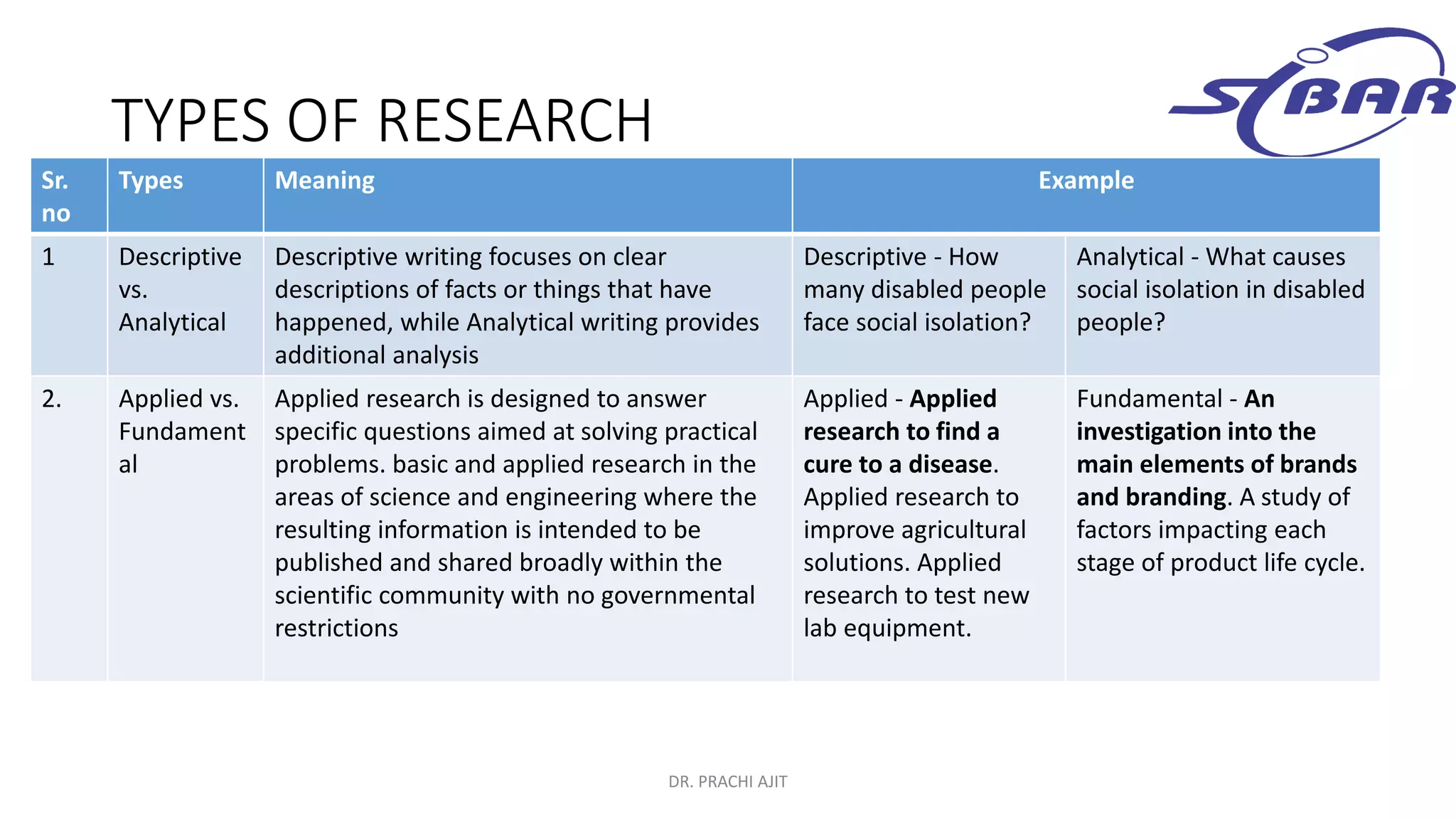
TYPES OF RESEARCH
DR. PRACHI AJIT
Sr.
no
Types Meaning Example
1 Descriptive
vs.
Analytical
Descriptive writing focuses on clear
descriptions of facts or things that have
happened, while Analytical writing provides
additional analysis
Descriptive - How
many disabled people
face social isolation?
Analytical - What causes
social isolation in disabled
people?
2. Applied vs.
Fundament
al
Applied research is designed to answer
specific questions aimed at solving practical
problems. basic and applied research in the
areas of science and engineering where the
resulting information is intended to be
published and shared broadly within the
scientific community with no governmental
restrictions
Applied - Applied
research to find a
cure to a disease.
Applied research to
improve agricultural
solutions. Applied
research to test new
lab equipment.
Fundamental - An
investigation into the
main elements of brands
and branding. A study of
factors impacting each
stage of product life cycle.
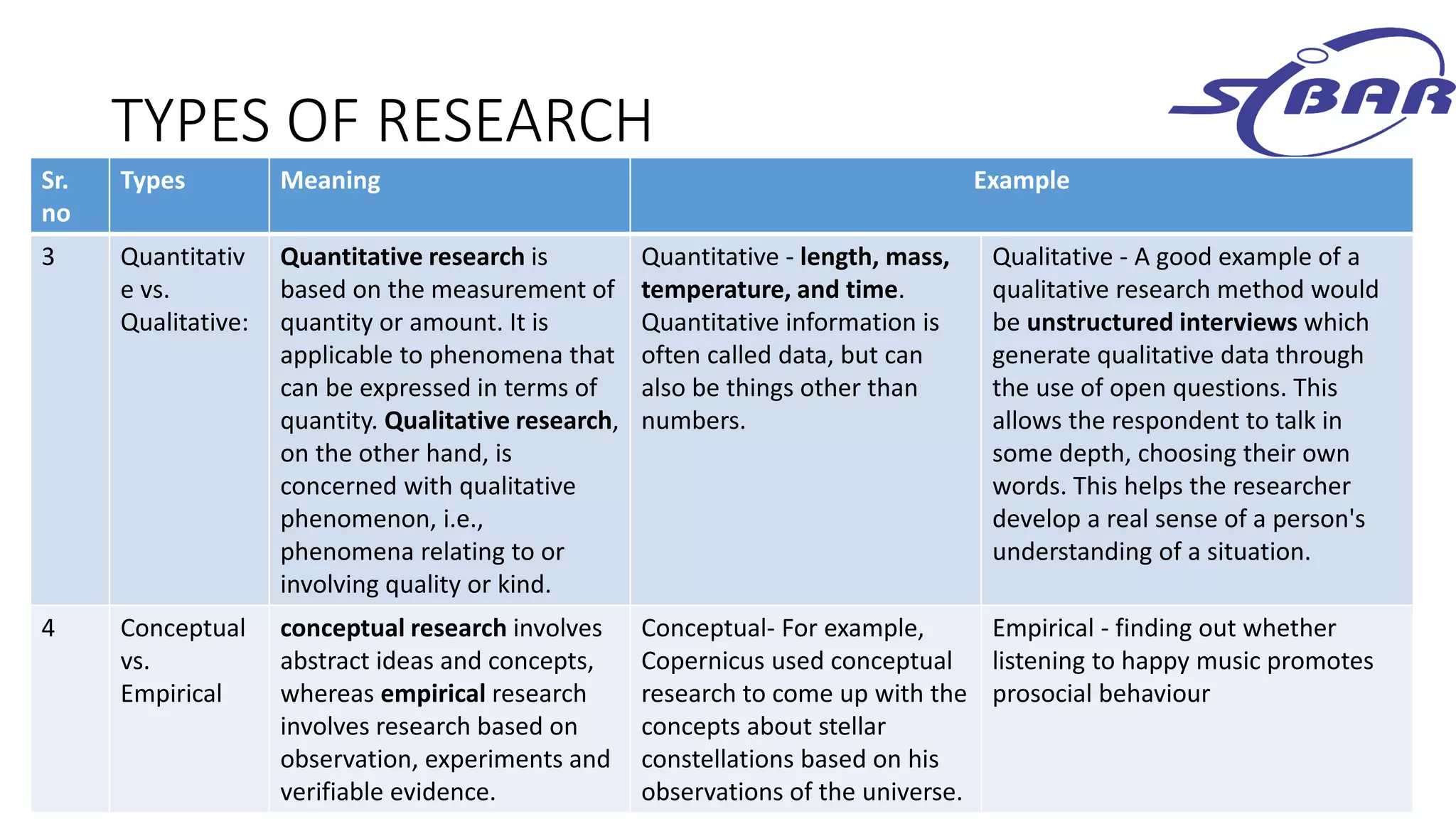
TYPES OF RESEARCH
DR. PRACHI AJIT
Sr.
no
Types Meaning Example
3 Quantitativ
e vs.
Qualitative:
Quantitative research is
based on the measurement of
quantity or amount. It is
applicable to phenomena that
can be expressed in terms of
quantity. Qualitative research,
on the other hand, is
concerned with qualitative
phenomenon, i.e.,
phenomena relating to or
involving quality or kind.
Quantitative - length, mass,
temperature, and time.
Quantitative information is
often called data, but can
also be things other than
numbers.
Qualitative - A good example of a
qualitative research method would
be unstructured interviews which
generate qualitative data through
the use of open questions. This
allows the respondent to talk in
some depth, choosing their own
words. This helps the researcher
develop a real sense of a person's
understanding of a situation.
4 Conceptual
vs.
Empirical
conceptual research involves
abstract ideas and concepts,
whereas empirical research
involves research based on
observation, experiments and
verifiable evidence.
Conceptual- For example,
Copernicus used conceptual
research to come up with the
concepts about stellar
constellations based on his
observations of the universe.
Empirical - finding out whether
listening to happy music promotes
prosocial behaviour
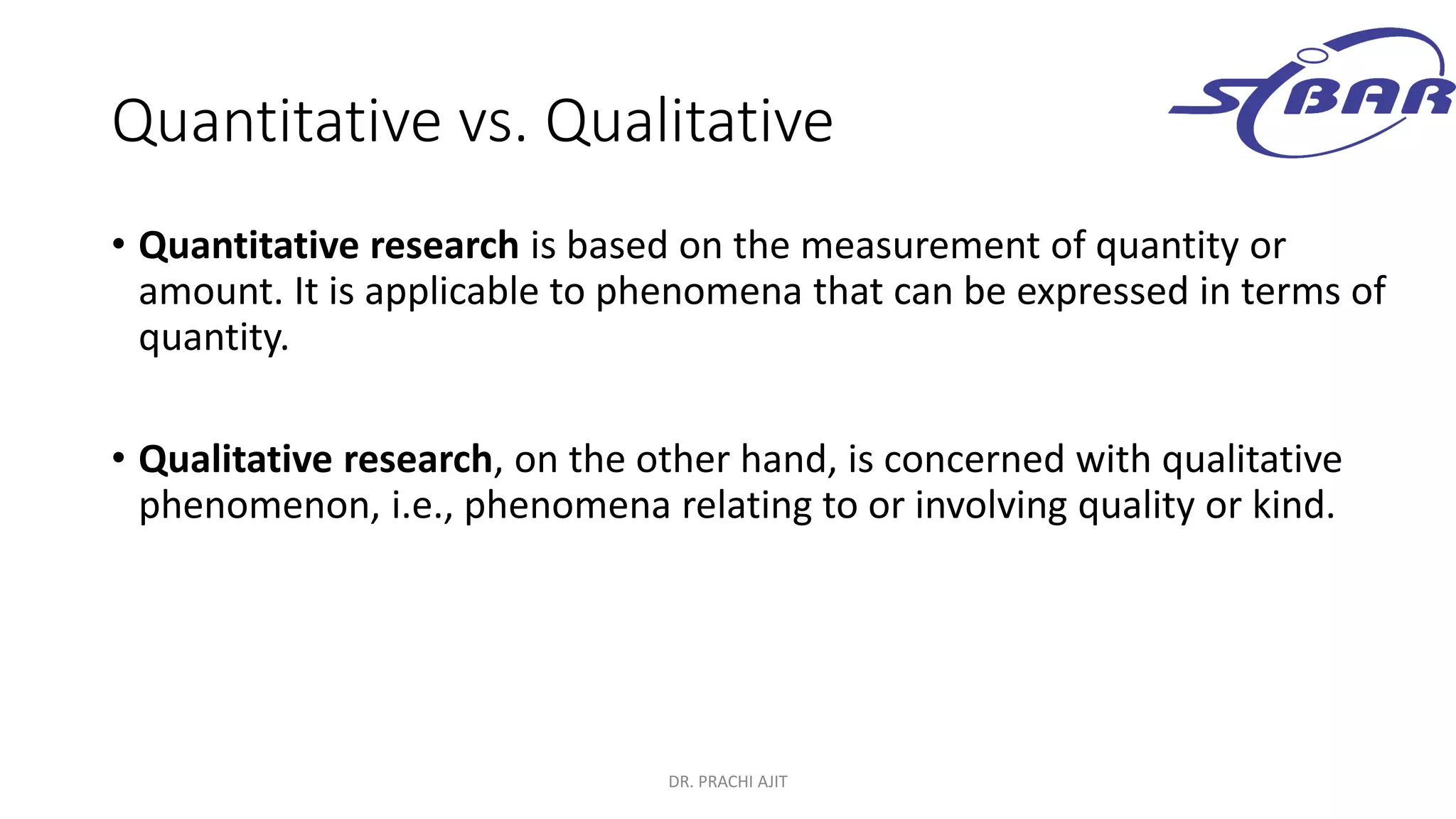
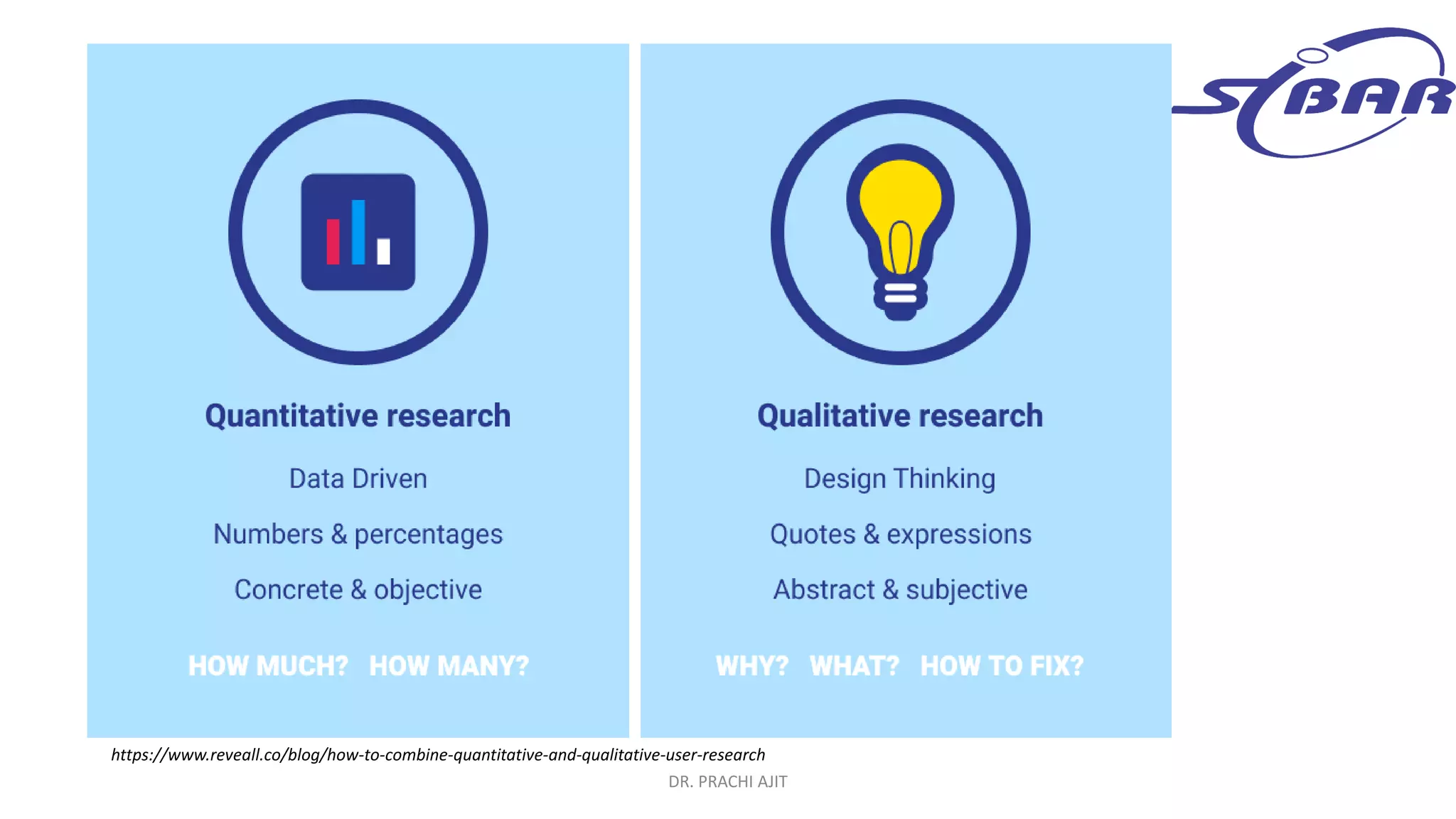
Quantitative vs. Qualitative
• Quantitative research is based on the measurement of quantity or
amount. It is applicable to phenomena that can be expressed in terms of
quantity.
• Qualitative research, on the other hand, is concerned with qualitative
phenomenon, i.e., phenomena relating to or involving quality or kind.
DR. PRACHI AJIT
DR. PRACHI AJIT
https://www.reveall.co/blog/how-to-combine-quantitative-and-qualitative-user-research
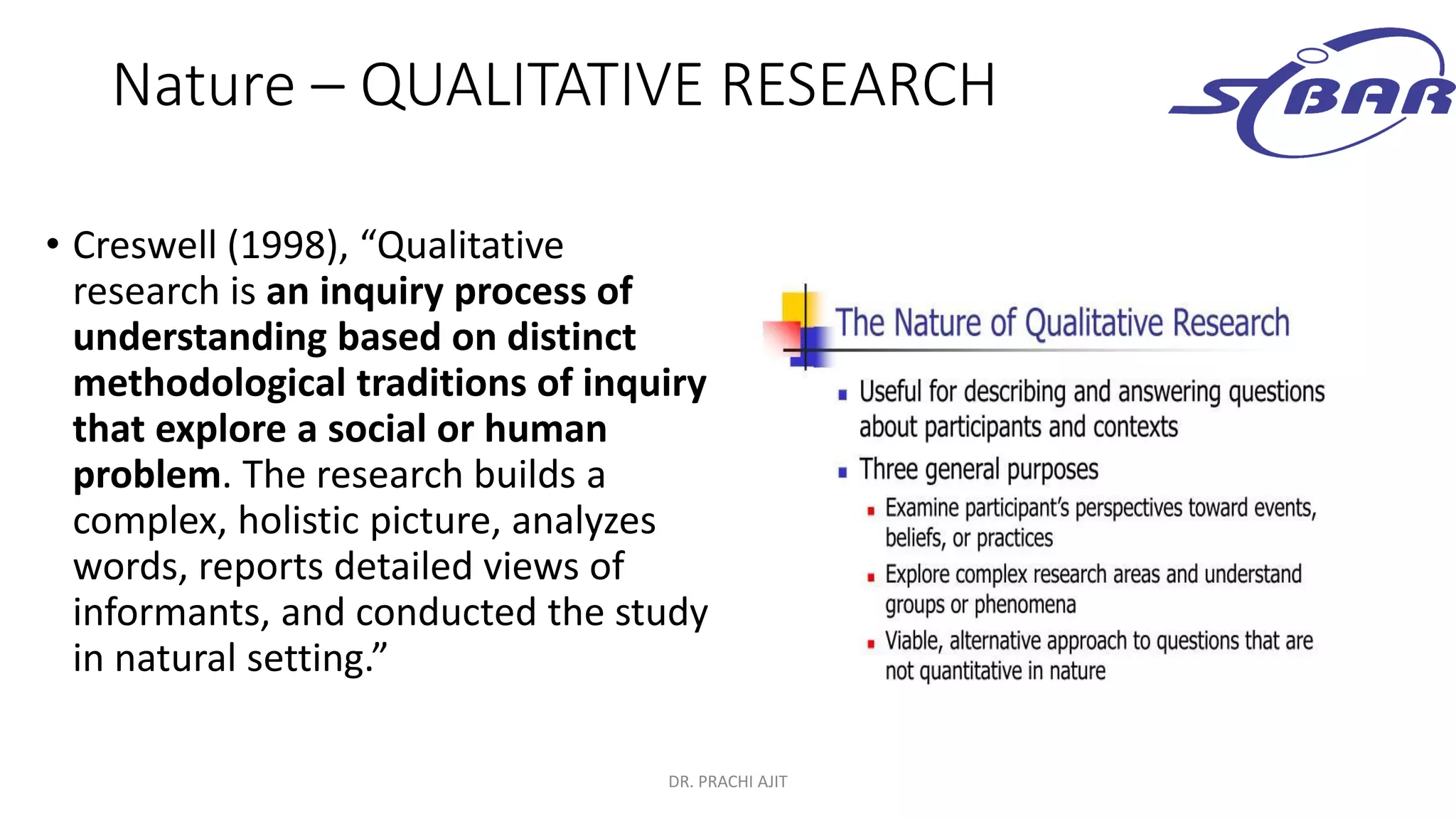
Nature – QUALITATIVE RESEARCH
• Creswell (1998), “Qualitative
research is an inquiry process of
understanding based on distinct
methodological traditions of inquiry
that explore a social or human
problem. The research builds a
complex, holistic picture, analyzes
words, reports detailed views of
informants, and conducted the study
in natural setting.”
DR. PRACHI AJIT
Relevance
• Qualitative research is very important in educational research as it
addresses the “how” and “why” research questions and enables
deeper understanding of experiences, phenomena, and context.
• Qualitative research allows you to ask questions that cannot be easily
put into numbers to understand human experience.
DR. PRACHI AJIT
Need
• Qualitative research enables us to make sense of reality, to describe
and explain the social world and to develop explanatory models and
theories.
• It is the primary means by which the theoretical foundations of social
sciences may be constructed or re-examined.
DR. PRACHI AJIT
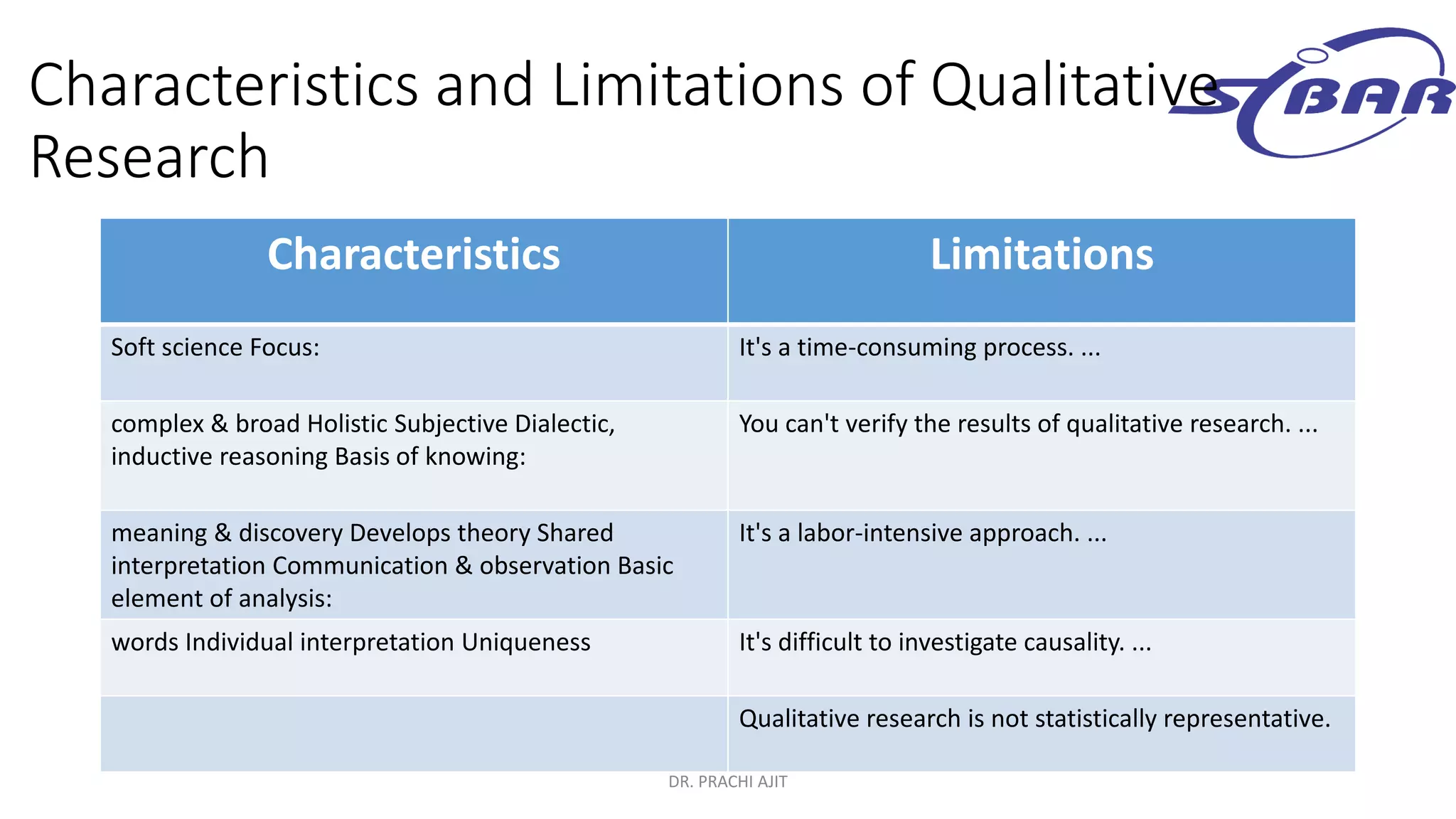
Characteristics and Limitations of Qualitative
Research
Characteristics Limitations
Soft science Focus: It's a time-consuming process. ...
complex & broad Holistic Subjective Dialectic,
inductive reasoning Basis of knowing:
You can't verify the results of qualitative research. ...
meaning & discovery Develops theory Shared
interpretation Communication & observation Basic
element of analysis:
It's a labor-intensive approach. ...
words Individual interpretation Uniqueness It's difficult to investigate causality. ...
Qualitative research is not statistically representative.
DR. PRACHI AJIT
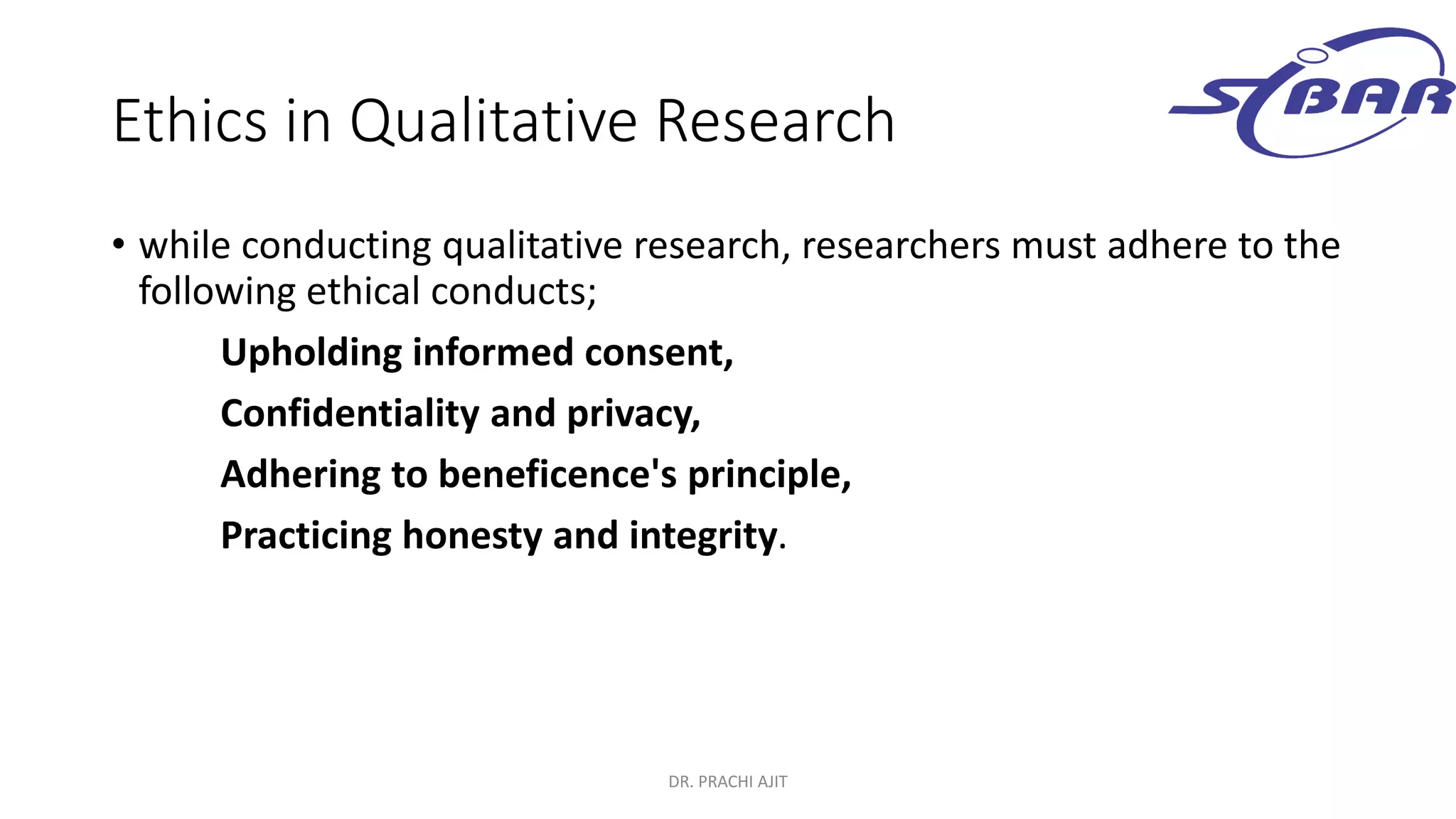
Ethics in Qualitative Research
• while conducting qualitative research, researchers must adhere to the
following ethical conducts;
Upholding informed consent,
Confidentiality and privacy,
Adhering to beneficence's principle,
Practicing honesty and integrity.
DR. PRACHI AJIT
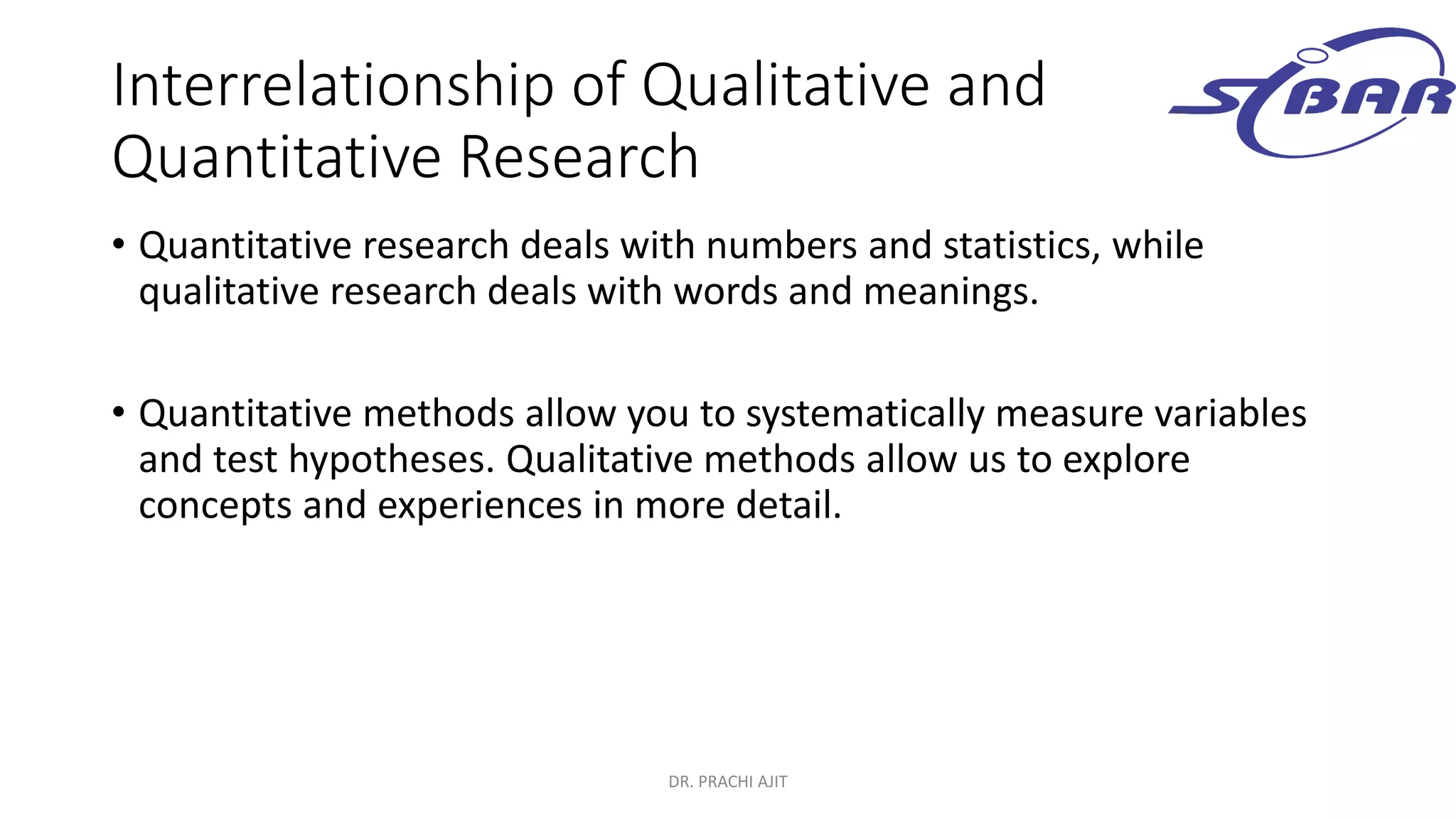
Interrelationship of Qualitative and
Quantitative Research
• Quantitative research deals with numbers and statistics, while
qualitative research deals with words and meanings.
• Quantitative methods allow you to systematically measure variables
and test hypotheses. Qualitative methods allow us to explore
concepts and experiences in more detail.
DR. PRACHI AJIT
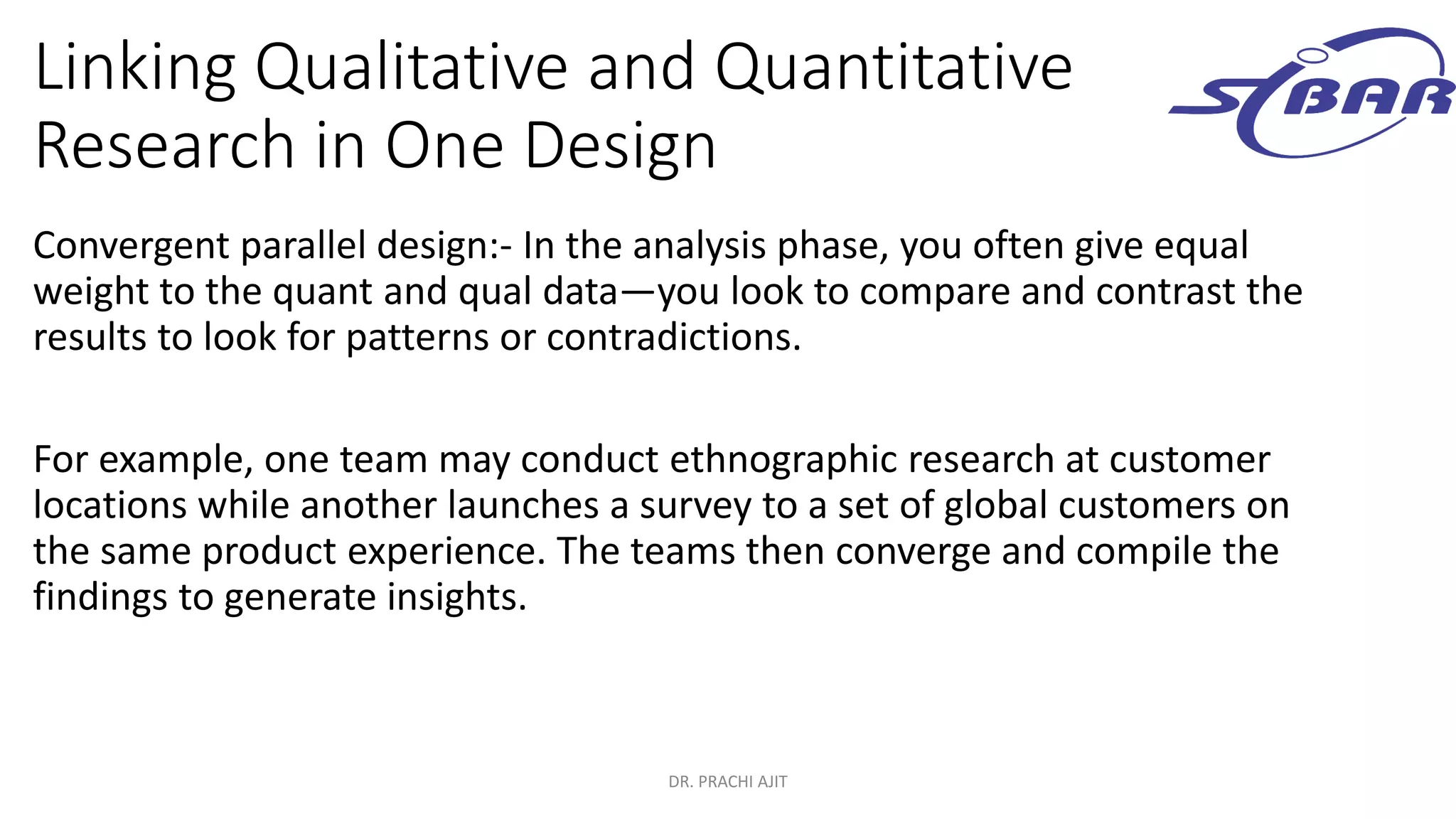
Linking Qualitative and Quantitative
Research in One Design
Convergent parallel design:- In the analysis phase, you often give equal
weight to the quant and qual data—you look to compare and contrast the
results to look for patterns or contradictions.
For example, one team may conduct ethnographic research at customer
locations while another launches a survey to a set of global customers on
the same product experience. The teams then converge and compile the
findings to generate insights.
DR. PRACHI AJIT
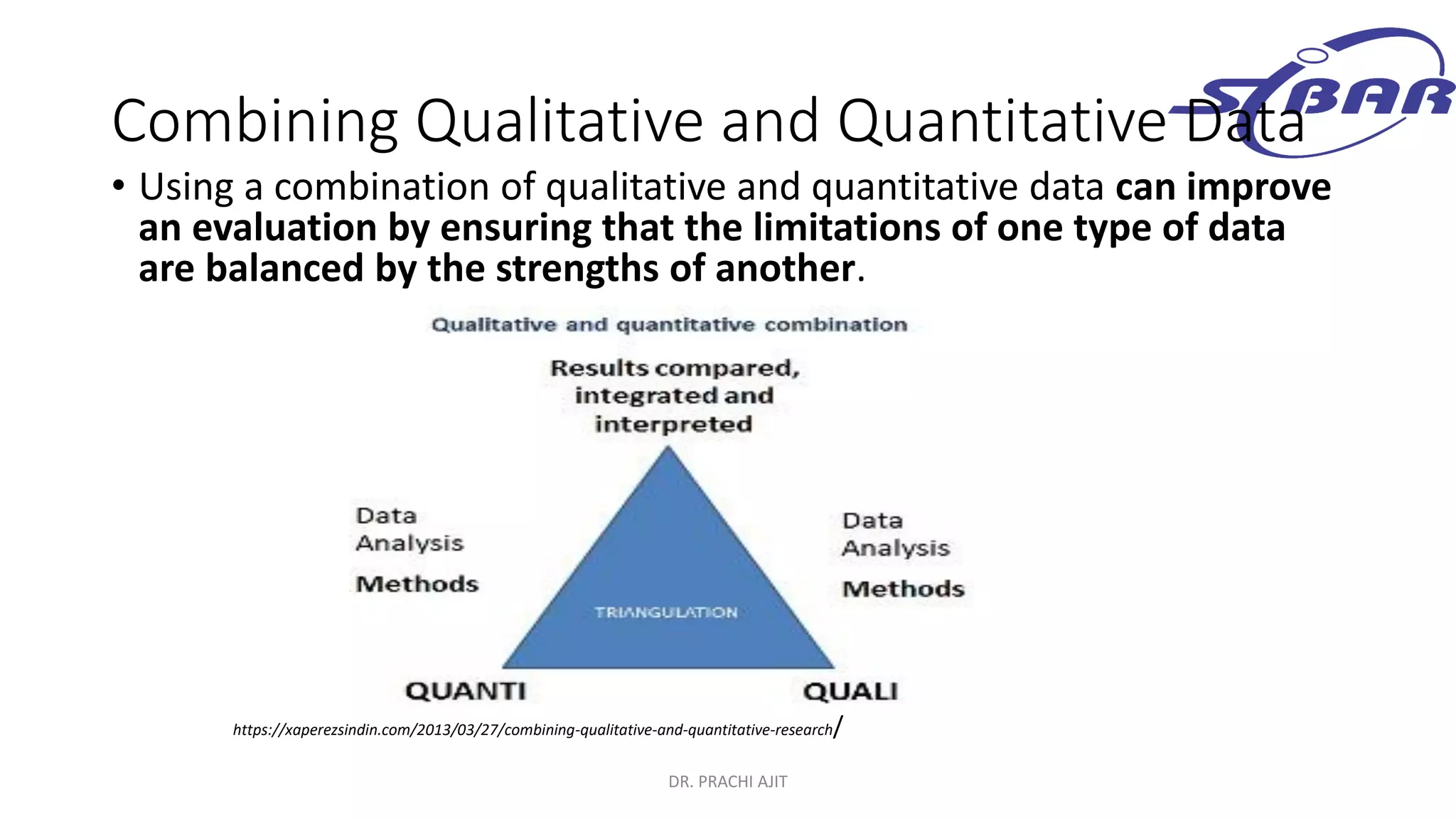
Combining Qualitative and Quantitative Data
• Using a combination of qualitative and quantitative data can improve
an evaluation by ensuring that the limitations of one type of data
are balanced by the strengths of another.
DR. PRACHI AJIT
https://xaperezsindin.com/2013/03/27/combining-qualitative-and-quantitative-research/
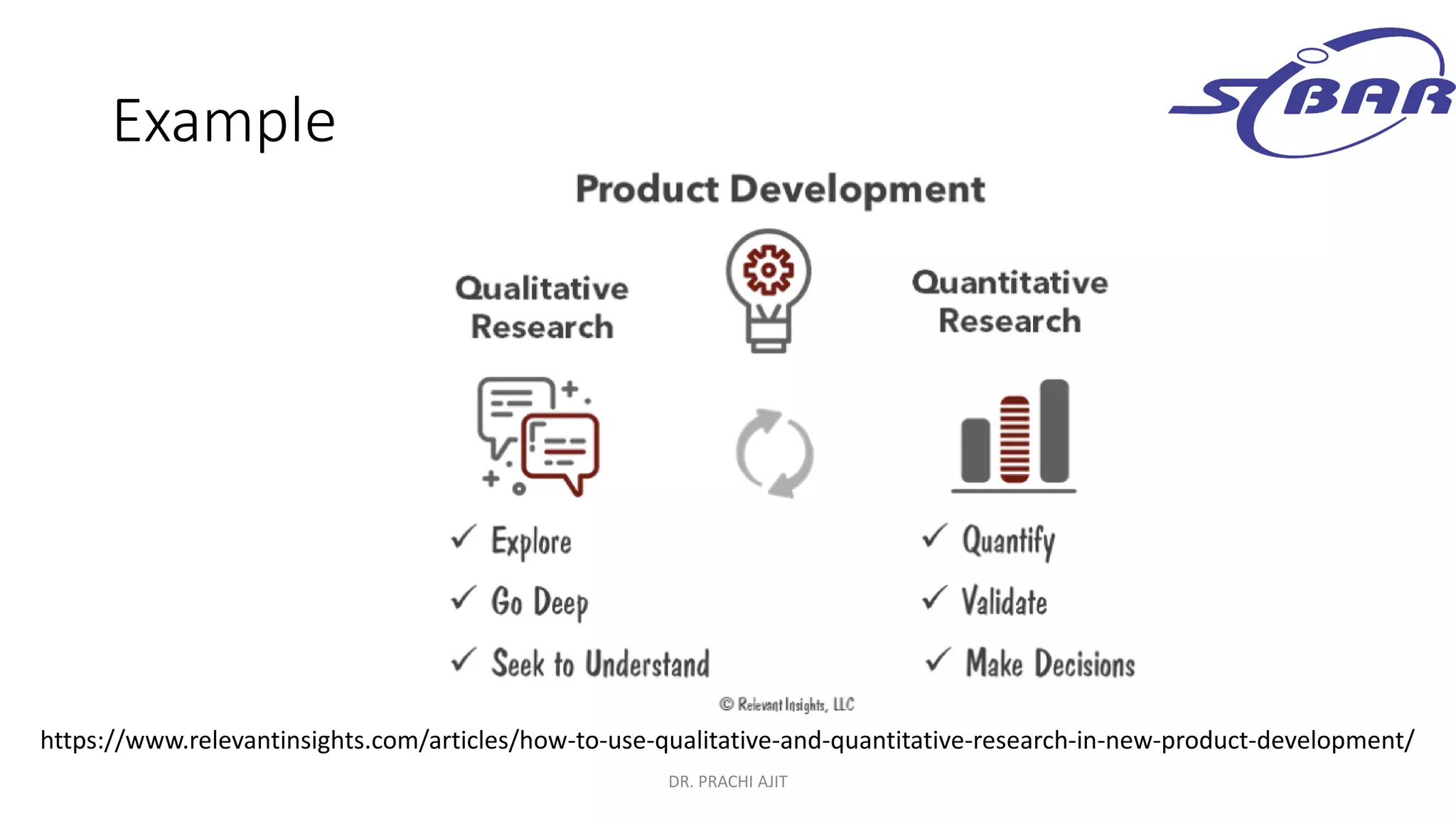
Example
DR. PRACHI AJIT
https://www.relevantinsights.com/articles/how-to-use-qualitative-and-quantitative-research-in-new-product-development/
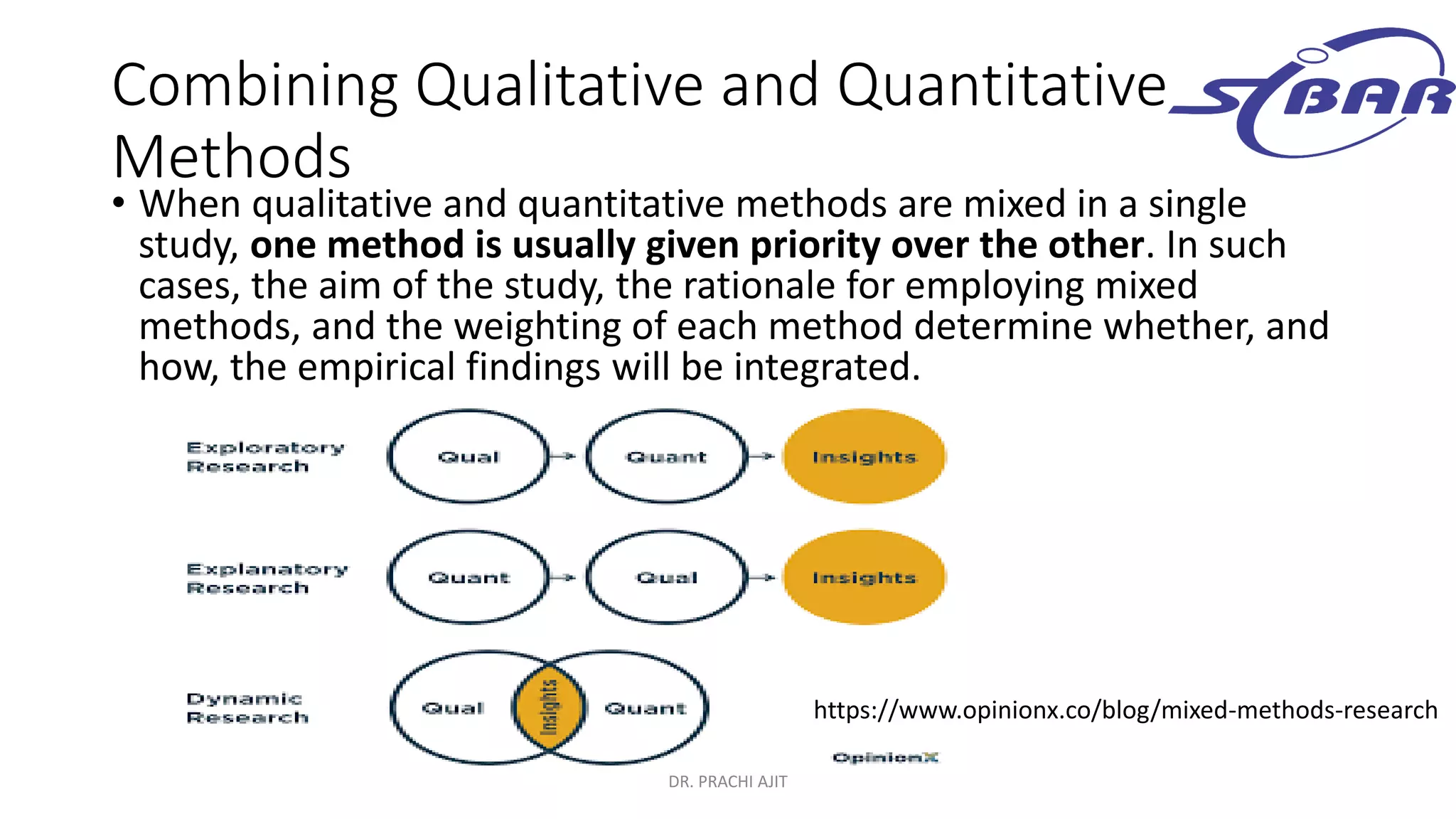
Combining Qualitative and Quantitative
Methods
• When qualitative and quantitative methods are mixed in a single
study, one method is usually given priority over the other. In such
cases, the aim of the study, the rationale for employing mixed
methods, and the weighting of each method determine whether, and
how, the empirical findings will be integrated.
DR. PRACHI AJIT
https://www.opinionx.co/blog/mixed-methods-research
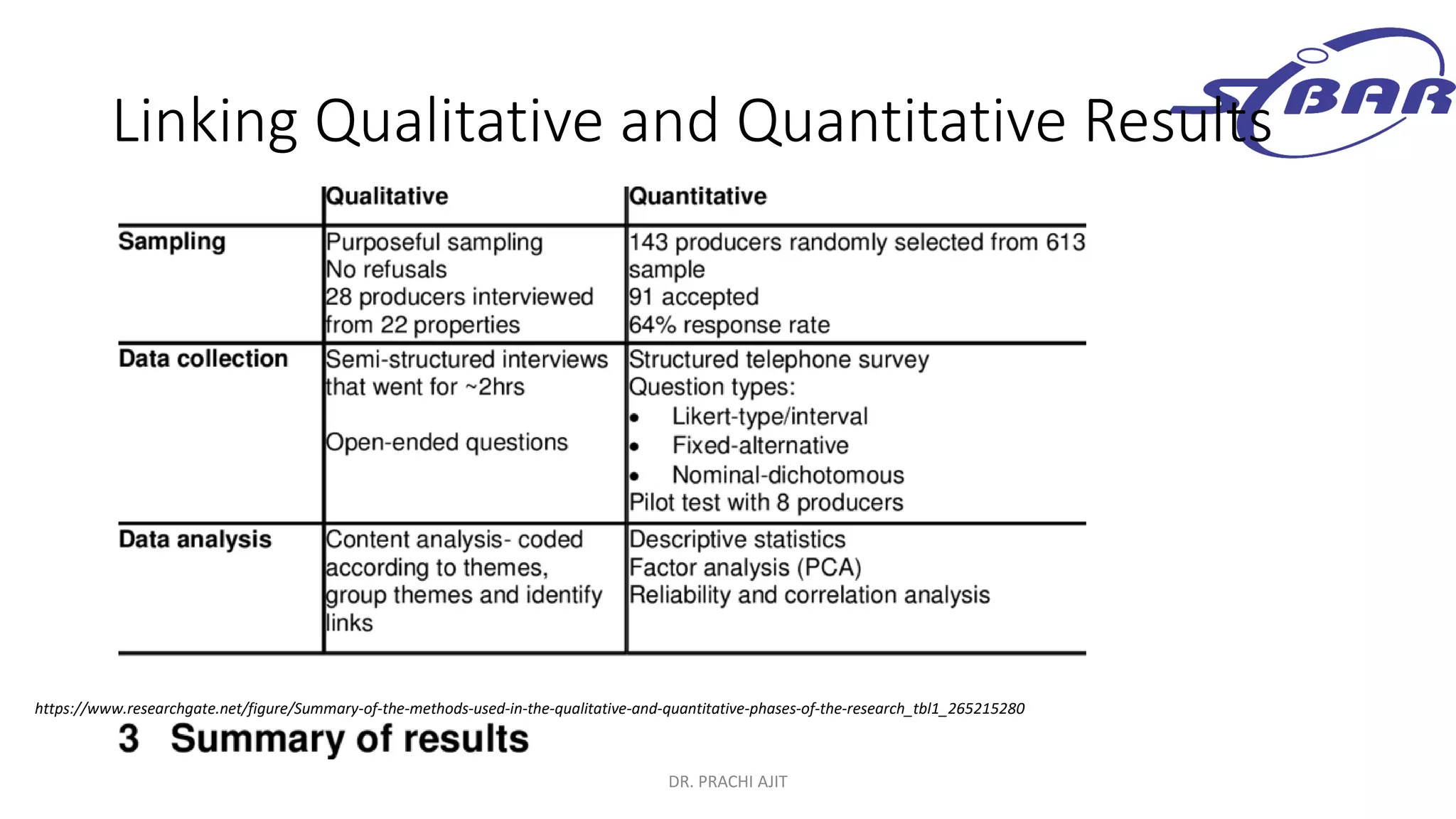
Linking Qualitative and Quantitative Results
DR. PRACHI AJIT
https://www.researchgate.net/figure/Summary-of-the-methods-used-in-the-qualitative-and-quantitative-phases-of-the-research_tbl1_265215280
Triangulation
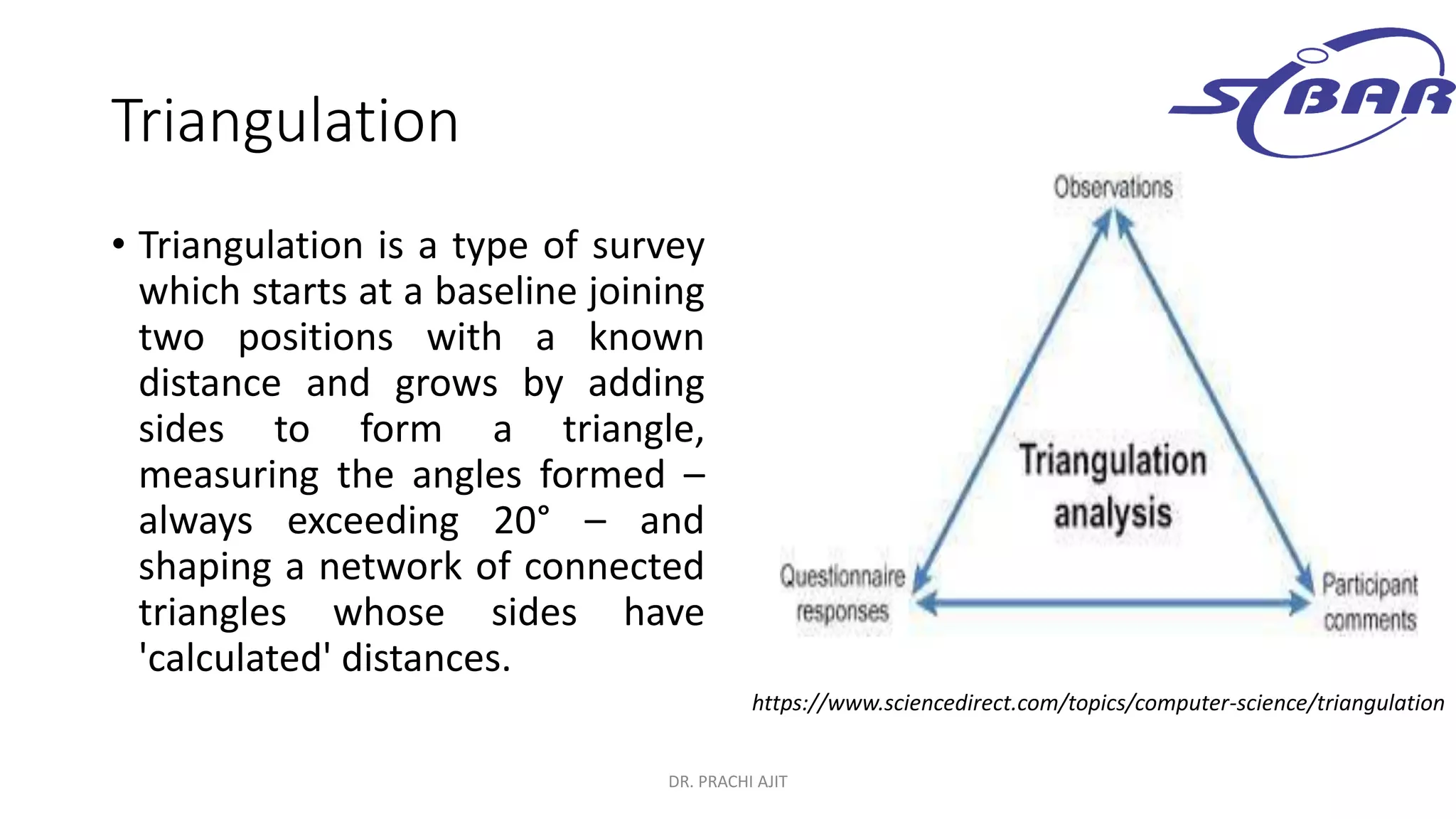
• Triangulation is a type of survey
which starts at a baseline joining
two positions with a known
distance and grows by adding
sides to form a triangle,
measuring the angles formed –
always exceeding 20° – and
shaping a network of connected
triangles whose sides have
'calculated' distances.
DR. PRACHI AJIT
https://www.sciencedirect.com/topics/computer-science/triangulation
Links for further Reference
• https://www.investopedia.com/terms/q/qualitativeanalysis.asp
• https://www.youtube.com/watch?v=F05dE-PpiHA
DR. PRACHI AJIT
THANK YOU
DR. PRACHI AJIT

QUALITATIVE RESEARCH.pdf

  • 1.
    Subject Code: 210 SubjectName: QUALITATIVE RESEARCH METHODS Semester: II Chapter No: 1 Title: QUALITATIVE RESEARCH Specialization: GENERAL Course : MBA As per Savitribai Phule Pune University Revised Syllabus (2019) DR. PRACHI AJIT PHD, MMS, PGDBM, B.COM
  • 2.
    Content - QualitativeResearch: 1. Nature, 2. Relevance, 3. Need, 4. Characteristics and Limitations of Qualitative Research, 5. Ethics in Qualitative Research, 6. Interrelationship of Qualitative and Quantitative Research, 7. Linking Qualitative and Quantitative Research in One Design, 8. Combining Qualitative and Quantitative Data, 9. Combining Qualitative and Quantitative Methods, 10. Linking Qualitative and Quantitative Results, 11. Triangulation. DR. PRACHI AJIT
  • 3.
    TYPES OF RESEARCH DR.PRACHI AJIT Sr. no Types Meaning Example 1 Descriptive vs. Analytical Descriptive writing focuses on clear descriptions of facts or things that have happened, while Analytical writing provides additional analysis Descriptive - How many disabled people face social isolation? Analytical - What causes social isolation in disabled people? 2. Applied vs. Fundament al Applied research is designed to answer specific questions aimed at solving practical problems. basic and applied research in the areas of science and engineering where the resulting information is intended to be published and shared broadly within the scientific community with no governmental restrictions Applied - Applied research to find a cure to a disease. Applied research to improve agricultural solutions. Applied research to test new lab equipment. Fundamental - An investigation into the main elements of brands and branding. A study of factors impacting each stage of product life cycle.
  • 4.
    TYPES OF RESEARCH DR.PRACHI AJIT Sr. no Types Meaning Example 3 Quantitativ e vs. Qualitative: Quantitative research is based on the measurement of quantity or amount. It is applicable to phenomena that can be expressed in terms of quantity. Qualitative research, on the other hand, is concerned with qualitative phenomenon, i.e., phenomena relating to or involving quality or kind. Quantitative - length, mass, temperature, and time. Quantitative information is often called data, but can also be things other than numbers. Qualitative - A good example of a qualitative research method would be unstructured interviews which generate qualitative data through the use of open questions. This allows the respondent to talk in some depth, choosing their own words. This helps the researcher develop a real sense of a person's understanding of a situation. 4 Conceptual vs. Empirical conceptual research involves abstract ideas and concepts, whereas empirical research involves research based on observation, experiments and verifiable evidence. Conceptual- For example, Copernicus used conceptual research to come up with the concepts about stellar constellations based on his observations of the universe. Empirical - finding out whether listening to happy music promotes prosocial behaviour
  • 5.
    Quantitative vs. Qualitative •Quantitative research is based on the measurement of quantity or amount. It is applicable to phenomena that can be expressed in terms of quantity. • Qualitative research, on the other hand, is concerned with qualitative phenomenon, i.e., phenomena relating to or involving quality or kind. DR. PRACHI AJIT
  • 6.
  • 7.
    Nature – QUALITATIVERESEARCH • Creswell (1998), “Qualitative research is an inquiry process of understanding based on distinct methodological traditions of inquiry that explore a social or human problem. The research builds a complex, holistic picture, analyzes words, reports detailed views of informants, and conducted the study in natural setting.” DR. PRACHI AJIT
  • 8.
    Relevance • Qualitative researchis very important in educational research as it addresses the “how” and “why” research questions and enables deeper understanding of experiences, phenomena, and context. • Qualitative research allows you to ask questions that cannot be easily put into numbers to understand human experience. DR. PRACHI AJIT
  • 9.
    Need • Qualitative researchenables us to make sense of reality, to describe and explain the social world and to develop explanatory models and theories. • It is the primary means by which the theoretical foundations of social sciences may be constructed or re-examined. DR. PRACHI AJIT
  • 10.
    Characteristics and Limitationsof Qualitative Research Characteristics Limitations Soft science Focus: It's a time-consuming process. ... complex & broad Holistic Subjective Dialectic, inductive reasoning Basis of knowing: You can't verify the results of qualitative research. ... meaning & discovery Develops theory Shared interpretation Communication & observation Basic element of analysis: It's a labor-intensive approach. ... words Individual interpretation Uniqueness It's difficult to investigate causality. ... Qualitative research is not statistically representative. DR. PRACHI AJIT
  • 11.
    Ethics in QualitativeResearch • while conducting qualitative research, researchers must adhere to the following ethical conducts; Upholding informed consent, Confidentiality and privacy, Adhering to beneficence's principle, Practicing honesty and integrity. DR. PRACHI AJIT
  • 12.
    Interrelationship of Qualitativeand Quantitative Research • Quantitative research deals with numbers and statistics, while qualitative research deals with words and meanings. • Quantitative methods allow you to systematically measure variables and test hypotheses. Qualitative methods allow us to explore concepts and experiences in more detail. DR. PRACHI AJIT
  • 13.
    Linking Qualitative andQuantitative Research in One Design Convergent parallel design:- In the analysis phase, you often give equal weight to the quant and qual data—you look to compare and contrast the results to look for patterns or contradictions. For example, one team may conduct ethnographic research at customer locations while another launches a survey to a set of global customers on the same product experience. The teams then converge and compile the findings to generate insights. DR. PRACHI AJIT
  • 14.
    Combining Qualitative andQuantitative Data • Using a combination of qualitative and quantitative data can improve an evaluation by ensuring that the limitations of one type of data are balanced by the strengths of another. DR. PRACHI AJIT https://xaperezsindin.com/2013/03/27/combining-qualitative-and-quantitative-research/
  • 15.
  • 16.
    Combining Qualitative andQuantitative Methods • When qualitative and quantitative methods are mixed in a single study, one method is usually given priority over the other. In such cases, the aim of the study, the rationale for employing mixed methods, and the weighting of each method determine whether, and how, the empirical findings will be integrated. DR. PRACHI AJIT https://www.opinionx.co/blog/mixed-methods-research
  • 17.
    Linking Qualitative andQuantitative Results DR. PRACHI AJIT https://www.researchgate.net/figure/Summary-of-the-methods-used-in-the-qualitative-and-quantitative-phases-of-the-research_tbl1_265215280
  • 18.
    Triangulation • Triangulation isa type of survey which starts at a baseline joining two positions with a known distance and grows by adding sides to form a triangle, measuring the angles formed – always exceeding 20° – and shaping a network of connected triangles whose sides have 'calculated' distances. DR. PRACHI AJIT https://www.sciencedirect.com/topics/computer-science/triangulation
  • 19.
    Links for furtherReference • https://www.investopedia.com/terms/q/qualitativeanalysis.asp • https://www.youtube.com/watch?v=F05dE-PpiHA • https://www.youtube.com/watch?v=F05dE-PpiHA DR. PRACHI AJIT
  • 20.