Introduction to Graphs
Tecniche di Programmazione – A.A. 2012/2013
Summary
A.A. 2012/2013Tecniche di programmazione2
 Definition: Graph
 Related Definitions
 Applications
Definition: Graph
Introduction to Graphs
Definition: Graph
A.A. 2012/2013Tecniche di programmazione4
 A graph is a collection of points and lines connecting
some (possibly empty) subset of them.
 The points of a graph are most commonly known
as graph vertices, but may also be called “nodes” or
simply “points.”
 The lines connecting the vertices of a graph are most
commonly known as graph edges, but may also be called
“arcs” or “lines.”
http://mathworld.wolfram.com/
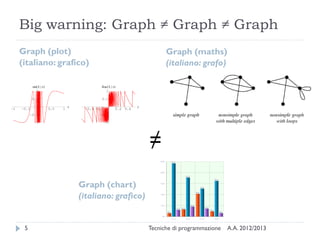
Big warning: Graph ≠ Graph ≠ Graph
Graph (plot)
(italiano: grafico)
Graph (maths)
(italiano: grafo)
A.A. 2012/2013Tecniche di programmazione5
≠
Graph (chart)
(italiano: grafico)
History
A.A. 2012/2013Tecniche di programmazione6
 The study of graphs is known as graph theory, and was
first systematically investigated by D. König in the 1930s
 Euler’s proof about the walk across all seven bridges of
Königsberg (1736), now known as the Königsberg bridge
problem, is a famous precursor to graph theory.
 In fact, the study of various sorts of paths in graphs has
many applications in real-world problems.
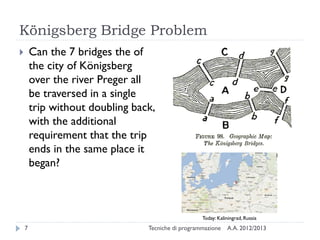
Königsberg Bridge Problem
A.A. 2012/2013Tecniche di programmazione7
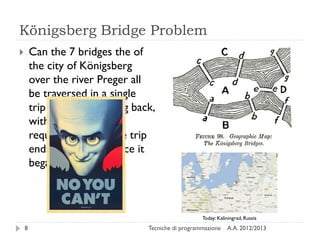
 Can the 7 bridges the of
the city of Königsberg
over the river Preger all
be traversed in a single
trip without doubling back,
with the additional
requirement that the trip
ends in the same place it
began?
Today: Kaliningrad, Russia
Königsberg Bridge Problem
A.A. 2012/2013Tecniche di programmazione8
 Can the 7 bridges the of
the city of Königsberg
over the river Preger all
be traversed in a single
trip without doubling back,
with the additional
requirement that the trip
ends in the same place it
began?
Today: Kaliningrad, Russia
Types of graphs: edge cardinality
A.A. 2012/2013Tecniche di programmazione9
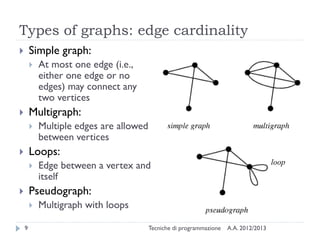
 Simple graph:
 At most one edge (i.e.,
either one edge or no
edges) may connect any
two vertices
 Multigraph:
 Multiple edges are allowed
between vertices
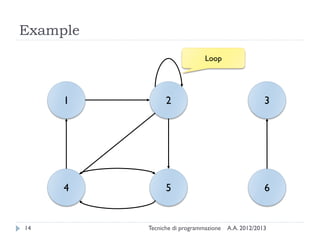
 Loops:
 Edge between a vertex and
itself
 Pseudograph:
 Multigraph with loops
loop
Types of graphs: edge direction
A.A. 2012/2013Tecniche di programmazione10
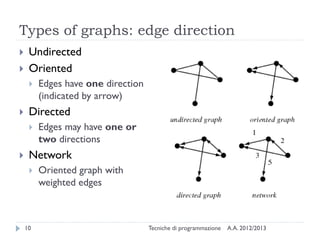
 Undirected
 Oriented
 Edges have one direction
(indicated by arrow)
 Directed
 Edges may have one or
two directions
 Network
 Oriented graph with
weighted edges
Types of graphs: labeling
A.A. 2012/2013Tecniche di programmazione11
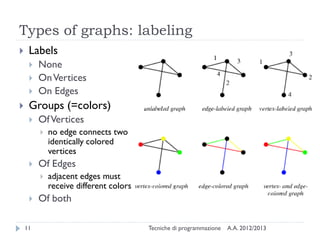
 Labels
 None
 OnVertices
 On Edges
 Groups (=colors)
 OfVertices
 no edge connects two
identically colored
vertices
 Of Edges
 adjacent edges must
receive different colors
 Of both
A.A. 2012/2013Tecniche di programmazione12
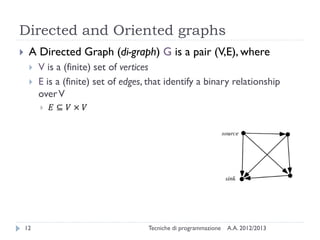
Directed and Oriented graphs
 A Directed Graph (di-graph) G is a pair (V,E), where
 V is a (finite) set of vertices
 E is a (finite) set of edges, that identify a binary relationship
overV
 𝐸 ⊆ 𝑉 × 𝑉
A.A. 2012/2013Tecniche di programmazione13
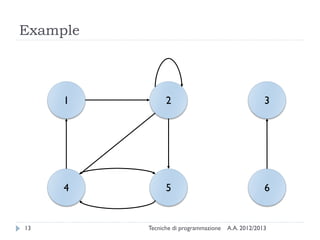
Example
4
1
5 6
2 3
A.A. 2012/2013Tecniche di programmazione14
Example
4
1
5 6
2 3
Loop
A.A. 2012/2013Tecniche di programmazione15
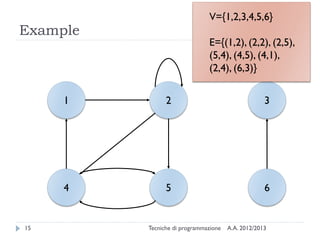
Example
4
1
5 6
2 3
V={1,2,3,4,5,6}
E={(1,2), (2,2), (2,5),
(5,4), (4,5), (4,1),
(2,4), (6,3)}
A.A. 2012/2013Tecniche di programmazione16
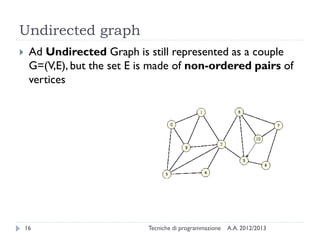
Undirected graph
 Ad Undirected Graph is still represented as a couple
G=(V,E), but the set E is made of non-ordered pairs of
vertices
A.A. 2012/2013Tecniche di programmazione17
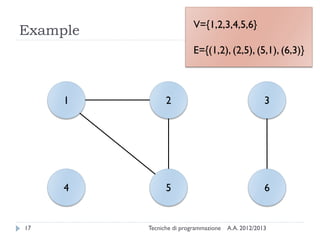
Example
4
1
5 6
2 3
V={1,2,3,4,5,6}
E={(1,2), (2,5), (5,1), (6,3)}
A.A. 2012/2013Tecniche di programmazione18
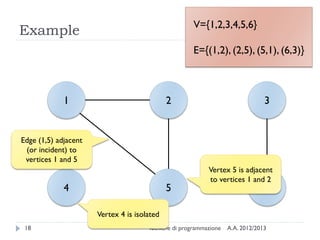
Example
4
1
5 6
2 3
V={1,2,3,4,5,6}
E={(1,2), (2,5), (5,1), (6,3)}
Edge (1,5) adjacent
(or incident) to
vertices 1 and 5
Vertex 5 is adjacent
to vertices 1 and 2
Vertex 4 is isolated
Related Definitions
Introduction to Graphs
A.A. 2012/2013Tecniche di programmazione20
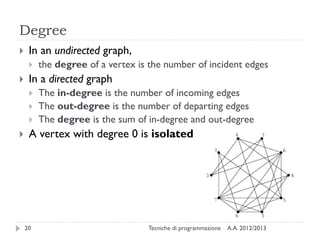
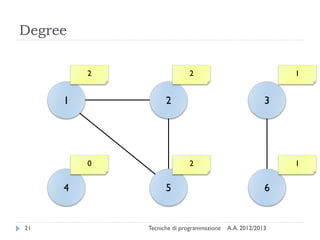
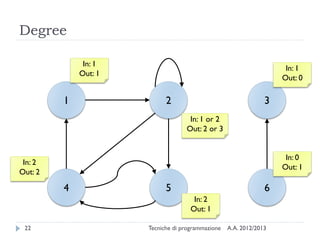
Degree
 In an undirected graph,
 the degree of a vertex is the number of incident edges
 In a directed graph
 The in-degree is the number of incoming edges
 The out-degree is the number of departing edges
 The degree is the sum of in-degree and out-degree
 A vertex with degree 0 is isolated
A.A. 2012/2013Tecniche di programmazione21
Degree
4
1
5 6
2 3
2 2
20 1
1
A.A. 2012/2013Tecniche di programmazione22
Degree
4
1
5 6
2 3
In: 1
Out: 1
In: 2
Out: 2
In: 1 or 2
Out: 2 or 3
In: 2
Out: 1
In: 1
Out: 0
In: 0
Out: 1
Paths
A.A. 2012/2013Tecniche di programmazione23
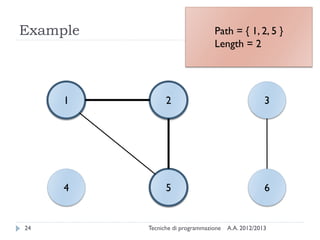
 A path on a graph G=(V,E) also called a trail, is
a sequence {v1, v2, …, vn} such that:
 v1, …, vn are vertices: vi V
 (v1, v2), (v2, v3), ..., (vn-1,vn) are graph edges: (vi-1,vi)  E
 vi are distinct (for “simple” paths).
 The length of a path is the number of edges (n-1)
 If there exist a path between vA and vB we say that vB is
reachable from vA
A.A. 2012/2013Tecniche di programmazione24
Example
4
1
5 6
2 3
Path = { 1, 2, 5 }
Length = 2
A.A. 2012/2013Tecniche di programmazione25
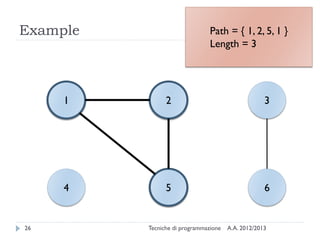
Cycles
 A cycle is a path where v1 = vn
 A graph with no cycles is said acyclic
A.A. 2012/2013Tecniche di programmazione26
Example
4
1
5 6
2 3
Path = { 1, 2, 5, 1 }
Length = 3
A.A. 2012/2013Tecniche di programmazione27
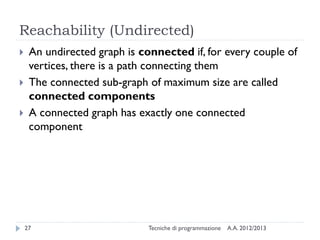
Reachability (Undirected)
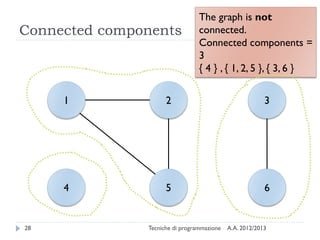
 An undirected graph is connected if, for every couple of
vertices, there is a path connecting them
 The connected sub-graph of maximum size are called
connected components
 A connected graph has exactly one connected
component
A.A. 2012/2013Tecniche di programmazione28
Connected components
4
1
5 6
2 3
The graph is not
connected.
Connected components =
3
{ 4 } , { 1, 2, 5 }, { 3, 6 }
A.A. 2012/2013Tecniche di programmazione29
Reachability (Directed)
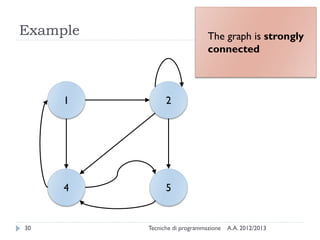
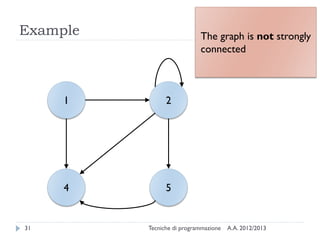
 A directed graph is strongly connected if, for every
ordered pair of vertices (v, v’), there exists at least one
path connecting v to v’
A.A. 2012/2013Tecniche di programmazione30
Example
4
1
5
2
The graph is strongly
connected
A.A. 2012/2013Tecniche di programmazione31
Example
4
1
5
2
The graph is not strongly
connected
Complete graph
A.A. 2012/2013Tecniche di programmazione32
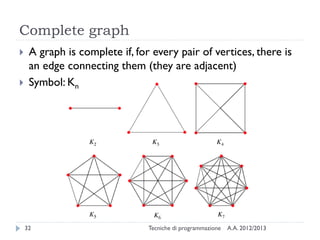
 A graph is complete if, for every pair of vertices, there is
an edge connecting them (they are adjacent)
 Symbol: Kn
A.A. 2012/2013Tecniche di programmazione33
Complete graph: edges
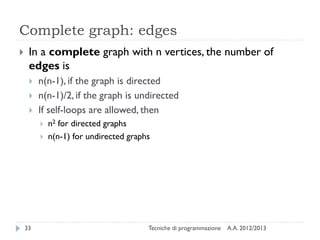
 In a complete graph with n vertices, the number of
edges is
 n(n-1), if the graph is directed
 n(n-1)/2, if the graph is undirected
 If self-loops are allowed, then
 n2 for directed graphs
 n(n-1) for undirected graphs
Density
A.A. 2012/2013Tecniche di programmazione34
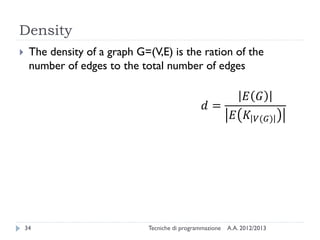
 The density of a graph G=(V,E) is the ration of the
number of edges to the total number of edges
𝑑 =
𝐸 𝐺
𝐸 𝐾 𝑉(𝐺)
A.A. 2012/2013Tecniche di programmazione35
Esempio
4
1
3
2
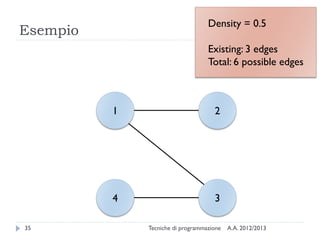
Density = 0.5
Existing: 3 edges
Total: 6 possible edges
A.A. 2012/2013Tecniche di programmazione36
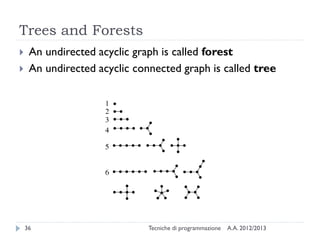
Trees and Forests
 An undirected acyclic graph is called forest
 An undirected acyclic connected graph is called tree
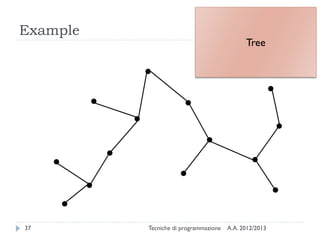
A.A. 2012/2013Tecniche di programmazione37
Example
Tree
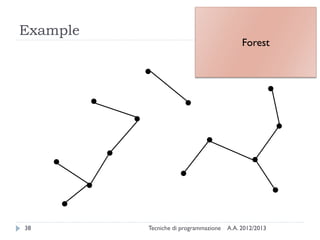
A.A. 2012/2013Tecniche di programmazione38
Example
Forest
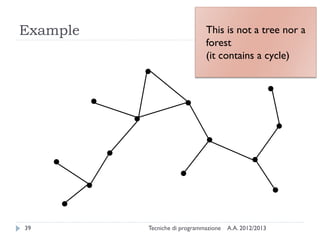
A.A. 2012/2013Tecniche di programmazione39
Example This is not a tree nor a
forest
(it contains a cycle)
Rooted trees
A.A. 2012/2013Tecniche di programmazione40
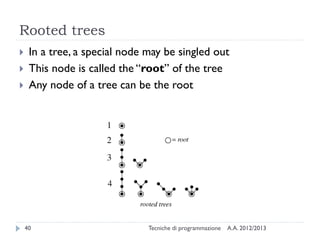
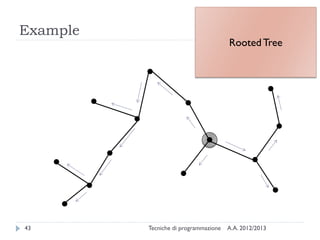
 In a tree, a special node may be singled out
 This node is called the “root” of the tree
 Any node of a tree can be the root
Tree (implicit) ordering
A.A. 2012/2013Tecniche di programmazione41
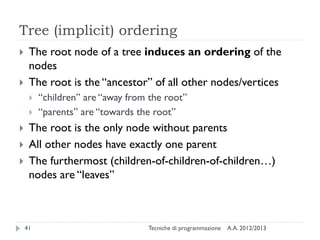
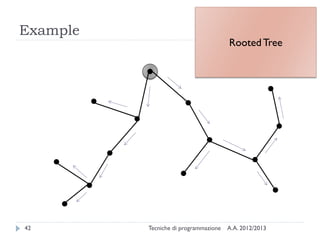
 The root node of a tree induces an ordering of the
nodes
 The root is the “ancestor” of all other nodes/vertices
 “children” are “away from the root”
 “parents” are “towards the root”
 The root is the only node without parents
 All other nodes have exactly one parent
 The furthermost (children-of-children-of-children…)
nodes are “leaves”
A.A. 2012/2013Tecniche di programmazione42
Example
Rooted Tree
A.A. 2012/2013Tecniche di programmazione43
Example
Rooted Tree
A.A. 2012/2013Tecniche di programmazione44
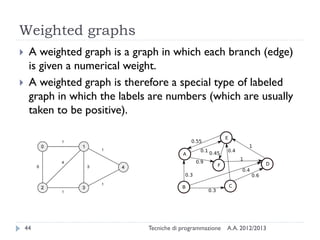
Weighted graphs
 A weighted graph is a graph in which each branch (edge)
is given a numerical weight.
 A weighted graph is therefore a special type of labeled
graph in which the labels are numbers (which are usually
taken to be positive).
Applications
Introduction to Graphs
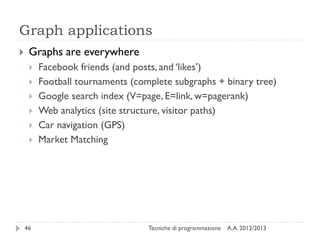
Graph applications
A.A. 2012/2013Tecniche di programmazione46
 Graphs are everywhere
 Facebook friends (and posts, and ‘likes’)
 Football tournaments (complete subgraphs + binary tree)
 Google search index (V=page, E=link, w=pagerank)
 Web analytics (site structure, visitor paths)
 Car navigation (GPS)
 Market Matching
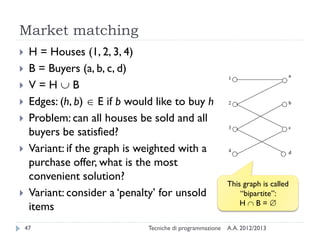
Market matching
A.A. 2012/2013Tecniche di programmazione47
 H = Houses (1, 2, 3, 4)
 B = Buyers (a, b, c, d)
 V = H  B
 Edges: (h, b)  E if b would like to buy h
 Problem: can all houses be sold and all
buyers be satisfied?
 Variant: if the graph is weighted with a
purchase offer, what is the most
convenient solution?
 Variant: consider a ‘penalty’ for unsold
items
This graph is called
“bipartite”:
H  B = 
Connecting cities
A.A. 2012/2013Tecniche di programmazione48
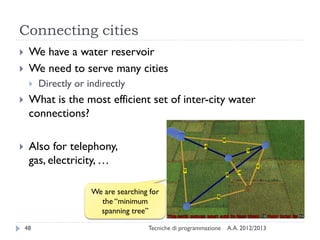
 We have a water reservoir
 We need to serve many cities
 Directly or indirectly
 What is the most efficient set of inter-city water
connections?
 Also for telephony,
gas, electricity, …
We are searching for
the “minimum
spanning tree”
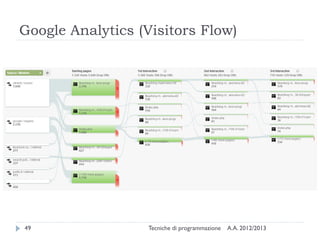
Google Analytics (Visitors Flow)
A.A. 2012/2013Tecniche di programmazione49
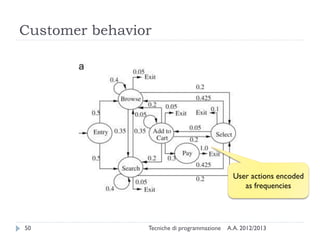
Customer behavior
A.A. 2012/2013Tecniche di programmazione50
User actions encoded
as frequencies
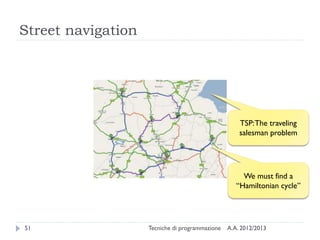
Street navigation
A.A. 2012/2013Tecniche di programmazione51
We must find a
“Hamiltonian cycle”
TSP:The traveling
salesman problem
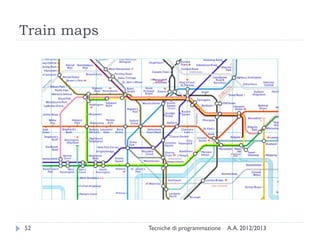
Train maps
A.A. 2012/2013Tecniche di programmazione52
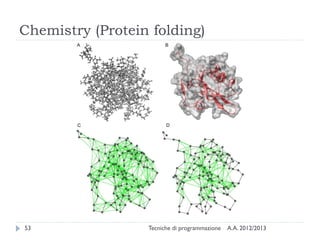
Chemistry (Protein folding)
A.A. 2012/2013Tecniche di programmazione53
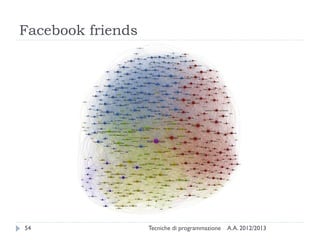
Facebook friends
A.A. 2012/2013Tecniche di programmazione54
A.A. 2012/2013Tecniche di programmazione55
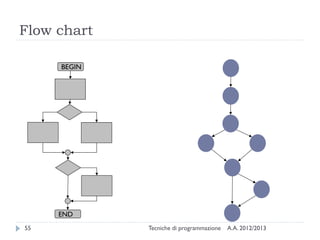
Flow chart
BEGIN
END
Resources
A.A. 2012/2013Tecniche di programmazione56
 Maths Encyclopedia: http://mathworld.wolfram.com/
 Basic GraphTheory with Applications to Economics
http://www.isid.ac.in/~dmishra/mpdoc/lecgraph.pdf
 Application of GraphTheory in real world
http://prezi.com/tseh1wvpves-/application-of-graph-theory-
in-real-world/
 JGraphT Library: http://jgrapht.org/
Licenza d’uso
A.A. 2012/2013Tecniche di programmazione57
 Queste diapositive sono distribuite con licenza Creative Commons
“Attribuzione - Non commerciale - Condividi allo stesso modo (CC
BY-NC-SA)”
 Sei libero:
 di riprodurre, distribuire, comunicare al pubblico, esporre in pubblico,
rappresentare, eseguire e recitare quest'opera
 di modificare quest'opera
 Alle seguenti condizioni:
 Attribuzione — Devi attribuire la paternità dell'opera agli autori
originali e in modo tale da non suggerire che essi avallino te o il modo in
cui tu usi l'opera.
 Non commerciale — Non puoi usare quest'opera per fini
commerciali.
 Condividi allo stesso modo — Se alteri o trasformi quest'opera, o se
la usi per crearne un'altra, puoi distribuire l'opera risultante solo con una
licenza identica o equivalente a questa.
 http://creativecommons.org/licenses/by-nc-sa/3.0/

Introduction to Graphs

  • 1.
    Introduction to Graphs Tecnichedi Programmazione – A.A. 2012/2013
  • 2.
    Summary A.A. 2012/2013Tecniche diprogrammazione2  Definition: Graph  Related Definitions  Applications
  • 3.
  • 4.
    Definition: Graph A.A. 2012/2013Tecnichedi programmazione4  A graph is a collection of points and lines connecting some (possibly empty) subset of them.  The points of a graph are most commonly known as graph vertices, but may also be called “nodes” or simply “points.”  The lines connecting the vertices of a graph are most commonly known as graph edges, but may also be called “arcs” or “lines.” http://mathworld.wolfram.com/
  • 5.
    Big warning: Graph≠ Graph ≠ Graph Graph (plot) (italiano: grafico) Graph (maths) (italiano: grafo) A.A. 2012/2013Tecniche di programmazione5 ≠ Graph (chart) (italiano: grafico)
  • 6.
    History A.A. 2012/2013Tecniche diprogrammazione6  The study of graphs is known as graph theory, and was first systematically investigated by D. König in the 1930s  Euler’s proof about the walk across all seven bridges of Königsberg (1736), now known as the Königsberg bridge problem, is a famous precursor to graph theory.  In fact, the study of various sorts of paths in graphs has many applications in real-world problems.
  • 7.
    Königsberg Bridge Problem A.A.2012/2013Tecniche di programmazione7  Can the 7 bridges the of the city of Königsberg over the river Preger all be traversed in a single trip without doubling back, with the additional requirement that the trip ends in the same place it began? Today: Kaliningrad, Russia
  • 8.
    Königsberg Bridge Problem A.A.2012/2013Tecniche di programmazione8  Can the 7 bridges the of the city of Königsberg over the river Preger all be traversed in a single trip without doubling back, with the additional requirement that the trip ends in the same place it began? Today: Kaliningrad, Russia
  • 9.
    Types of graphs:edge cardinality A.A. 2012/2013Tecniche di programmazione9  Simple graph:  At most one edge (i.e., either one edge or no edges) may connect any two vertices  Multigraph:  Multiple edges are allowed between vertices  Loops:  Edge between a vertex and itself  Pseudograph:  Multigraph with loops loop
  • 10.
    Types of graphs:edge direction A.A. 2012/2013Tecniche di programmazione10  Undirected  Oriented  Edges have one direction (indicated by arrow)  Directed  Edges may have one or two directions  Network  Oriented graph with weighted edges
  • 11.
    Types of graphs:labeling A.A. 2012/2013Tecniche di programmazione11  Labels  None  OnVertices  On Edges  Groups (=colors)  OfVertices  no edge connects two identically colored vertices  Of Edges  adjacent edges must receive different colors  Of both
  • 12.
    A.A. 2012/2013Tecniche diprogrammazione12 Directed and Oriented graphs  A Directed Graph (di-graph) G is a pair (V,E), where  V is a (finite) set of vertices  E is a (finite) set of edges, that identify a binary relationship overV  𝐸 ⊆ 𝑉 × 𝑉
  • 13.
    A.A. 2012/2013Tecniche diprogrammazione13 Example 4 1 5 6 2 3
  • 14.
    A.A. 2012/2013Tecniche diprogrammazione14 Example 4 1 5 6 2 3 Loop
  • 15.
    A.A. 2012/2013Tecniche diprogrammazione15 Example 4 1 5 6 2 3 V={1,2,3,4,5,6} E={(1,2), (2,2), (2,5), (5,4), (4,5), (4,1), (2,4), (6,3)}
  • 16.
    A.A. 2012/2013Tecniche diprogrammazione16 Undirected graph  Ad Undirected Graph is still represented as a couple G=(V,E), but the set E is made of non-ordered pairs of vertices
  • 17.
    A.A. 2012/2013Tecniche diprogrammazione17 Example 4 1 5 6 2 3 V={1,2,3,4,5,6} E={(1,2), (2,5), (5,1), (6,3)}
  • 18.
    A.A. 2012/2013Tecniche diprogrammazione18 Example 4 1 5 6 2 3 V={1,2,3,4,5,6} E={(1,2), (2,5), (5,1), (6,3)} Edge (1,5) adjacent (or incident) to vertices 1 and 5 Vertex 5 is adjacent to vertices 1 and 2 Vertex 4 is isolated
  • 19.
  • 20.
    A.A. 2012/2013Tecniche diprogrammazione20 Degree  In an undirected graph,  the degree of a vertex is the number of incident edges  In a directed graph  The in-degree is the number of incoming edges  The out-degree is the number of departing edges  The degree is the sum of in-degree and out-degree  A vertex with degree 0 is isolated
  • 21.
    A.A. 2012/2013Tecniche diprogrammazione21 Degree 4 1 5 6 2 3 2 2 20 1 1
  • 22.
    A.A. 2012/2013Tecniche diprogrammazione22 Degree 4 1 5 6 2 3 In: 1 Out: 1 In: 2 Out: 2 In: 1 or 2 Out: 2 or 3 In: 2 Out: 1 In: 1 Out: 0 In: 0 Out: 1
  • 23.
    Paths A.A. 2012/2013Tecniche diprogrammazione23  A path on a graph G=(V,E) also called a trail, is a sequence {v1, v2, …, vn} such that:  v1, …, vn are vertices: vi V  (v1, v2), (v2, v3), ..., (vn-1,vn) are graph edges: (vi-1,vi)  E  vi are distinct (for “simple” paths).  The length of a path is the number of edges (n-1)  If there exist a path between vA and vB we say that vB is reachable from vA
  • 24.
    A.A. 2012/2013Tecniche diprogrammazione24 Example 4 1 5 6 2 3 Path = { 1, 2, 5 } Length = 2
  • 25.
    A.A. 2012/2013Tecniche diprogrammazione25 Cycles  A cycle is a path where v1 = vn  A graph with no cycles is said acyclic
  • 26.
    A.A. 2012/2013Tecniche diprogrammazione26 Example 4 1 5 6 2 3 Path = { 1, 2, 5, 1 } Length = 3
  • 27.
    A.A. 2012/2013Tecniche diprogrammazione27 Reachability (Undirected)  An undirected graph is connected if, for every couple of vertices, there is a path connecting them  The connected sub-graph of maximum size are called connected components  A connected graph has exactly one connected component
  • 28.
    A.A. 2012/2013Tecniche diprogrammazione28 Connected components 4 1 5 6 2 3 The graph is not connected. Connected components = 3 { 4 } , { 1, 2, 5 }, { 3, 6 }
  • 29.
    A.A. 2012/2013Tecniche diprogrammazione29 Reachability (Directed)  A directed graph is strongly connected if, for every ordered pair of vertices (v, v’), there exists at least one path connecting v to v’
  • 30.
    A.A. 2012/2013Tecniche diprogrammazione30 Example 4 1 5 2 The graph is strongly connected
  • 31.
    A.A. 2012/2013Tecniche diprogrammazione31 Example 4 1 5 2 The graph is not strongly connected
  • 32.
    Complete graph A.A. 2012/2013Tecnichedi programmazione32  A graph is complete if, for every pair of vertices, there is an edge connecting them (they are adjacent)  Symbol: Kn
  • 33.
    A.A. 2012/2013Tecniche diprogrammazione33 Complete graph: edges  In a complete graph with n vertices, the number of edges is  n(n-1), if the graph is directed  n(n-1)/2, if the graph is undirected  If self-loops are allowed, then  n2 for directed graphs  n(n-1) for undirected graphs
  • 34.
    Density A.A. 2012/2013Tecniche diprogrammazione34  The density of a graph G=(V,E) is the ration of the number of edges to the total number of edges 𝑑 = 𝐸 𝐺 𝐸 𝐾 𝑉(𝐺)
  • 35.
    A.A. 2012/2013Tecniche diprogrammazione35 Esempio 4 1 3 2 Density = 0.5 Existing: 3 edges Total: 6 possible edges
  • 36.
    A.A. 2012/2013Tecniche diprogrammazione36 Trees and Forests  An undirected acyclic graph is called forest  An undirected acyclic connected graph is called tree
  • 37.
    A.A. 2012/2013Tecniche diprogrammazione37 Example Tree
  • 38.
    A.A. 2012/2013Tecniche diprogrammazione38 Example Forest
  • 39.
    A.A. 2012/2013Tecniche diprogrammazione39 Example This is not a tree nor a forest (it contains a cycle)
  • 40.
    Rooted trees A.A. 2012/2013Tecnichedi programmazione40  In a tree, a special node may be singled out  This node is called the “root” of the tree  Any node of a tree can be the root
  • 41.
    Tree (implicit) ordering A.A.2012/2013Tecniche di programmazione41  The root node of a tree induces an ordering of the nodes  The root is the “ancestor” of all other nodes/vertices  “children” are “away from the root”  “parents” are “towards the root”  The root is the only node without parents  All other nodes have exactly one parent  The furthermost (children-of-children-of-children…) nodes are “leaves”
  • 42.
    A.A. 2012/2013Tecniche diprogrammazione42 Example Rooted Tree
  • 43.
    A.A. 2012/2013Tecniche diprogrammazione43 Example Rooted Tree
  • 44.
    A.A. 2012/2013Tecniche diprogrammazione44 Weighted graphs  A weighted graph is a graph in which each branch (edge) is given a numerical weight.  A weighted graph is therefore a special type of labeled graph in which the labels are numbers (which are usually taken to be positive).
  • 45.
  • 46.
    Graph applications A.A. 2012/2013Tecnichedi programmazione46  Graphs are everywhere  Facebook friends (and posts, and ‘likes’)  Football tournaments (complete subgraphs + binary tree)  Google search index (V=page, E=link, w=pagerank)  Web analytics (site structure, visitor paths)  Car navigation (GPS)  Market Matching
  • 47.
    Market matching A.A. 2012/2013Tecnichedi programmazione47  H = Houses (1, 2, 3, 4)  B = Buyers (a, b, c, d)  V = H  B  Edges: (h, b)  E if b would like to buy h  Problem: can all houses be sold and all buyers be satisfied?  Variant: if the graph is weighted with a purchase offer, what is the most convenient solution?  Variant: consider a ‘penalty’ for unsold items This graph is called “bipartite”: H  B = 
  • 48.
    Connecting cities A.A. 2012/2013Tecnichedi programmazione48  We have a water reservoir  We need to serve many cities  Directly or indirectly  What is the most efficient set of inter-city water connections?  Also for telephony, gas, electricity, … We are searching for the “minimum spanning tree”
  • 49.
    Google Analytics (VisitorsFlow) A.A. 2012/2013Tecniche di programmazione49
  • 50.
    Customer behavior A.A. 2012/2013Tecnichedi programmazione50 User actions encoded as frequencies
  • 51.
    Street navigation A.A. 2012/2013Tecnichedi programmazione51 We must find a “Hamiltonian cycle” TSP:The traveling salesman problem
  • 52.
  • 53.
    Chemistry (Protein folding) A.A.2012/2013Tecniche di programmazione53
  • 54.
  • 55.
    A.A. 2012/2013Tecniche diprogrammazione55 Flow chart BEGIN END
  • 56.
    Resources A.A. 2012/2013Tecniche diprogrammazione56  Maths Encyclopedia: http://mathworld.wolfram.com/  Basic GraphTheory with Applications to Economics http://www.isid.ac.in/~dmishra/mpdoc/lecgraph.pdf  Application of GraphTheory in real world http://prezi.com/tseh1wvpves-/application-of-graph-theory- in-real-world/  JGraphT Library: http://jgrapht.org/
  • 57.
    Licenza d’uso A.A. 2012/2013Tecnichedi programmazione57  Queste diapositive sono distribuite con licenza Creative Commons “Attribuzione - Non commerciale - Condividi allo stesso modo (CC BY-NC-SA)”  Sei libero:  di riprodurre, distribuire, comunicare al pubblico, esporre in pubblico, rappresentare, eseguire e recitare quest'opera  di modificare quest'opera  Alle seguenti condizioni:  Attribuzione — Devi attribuire la paternità dell'opera agli autori originali e in modo tale da non suggerire che essi avallino te o il modo in cui tu usi l'opera.  Non commerciale — Non puoi usare quest'opera per fini commerciali.  Condividi allo stesso modo — Se alteri o trasformi quest'opera, o se la usi per crearne un'altra, puoi distribuire l'opera risultante solo con una licenza identica o equivalente a questa.  http://creativecommons.org/licenses/by-nc-sa/3.0/