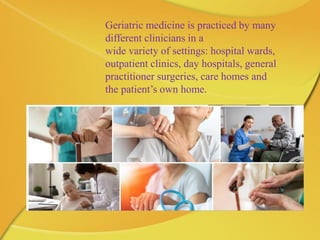
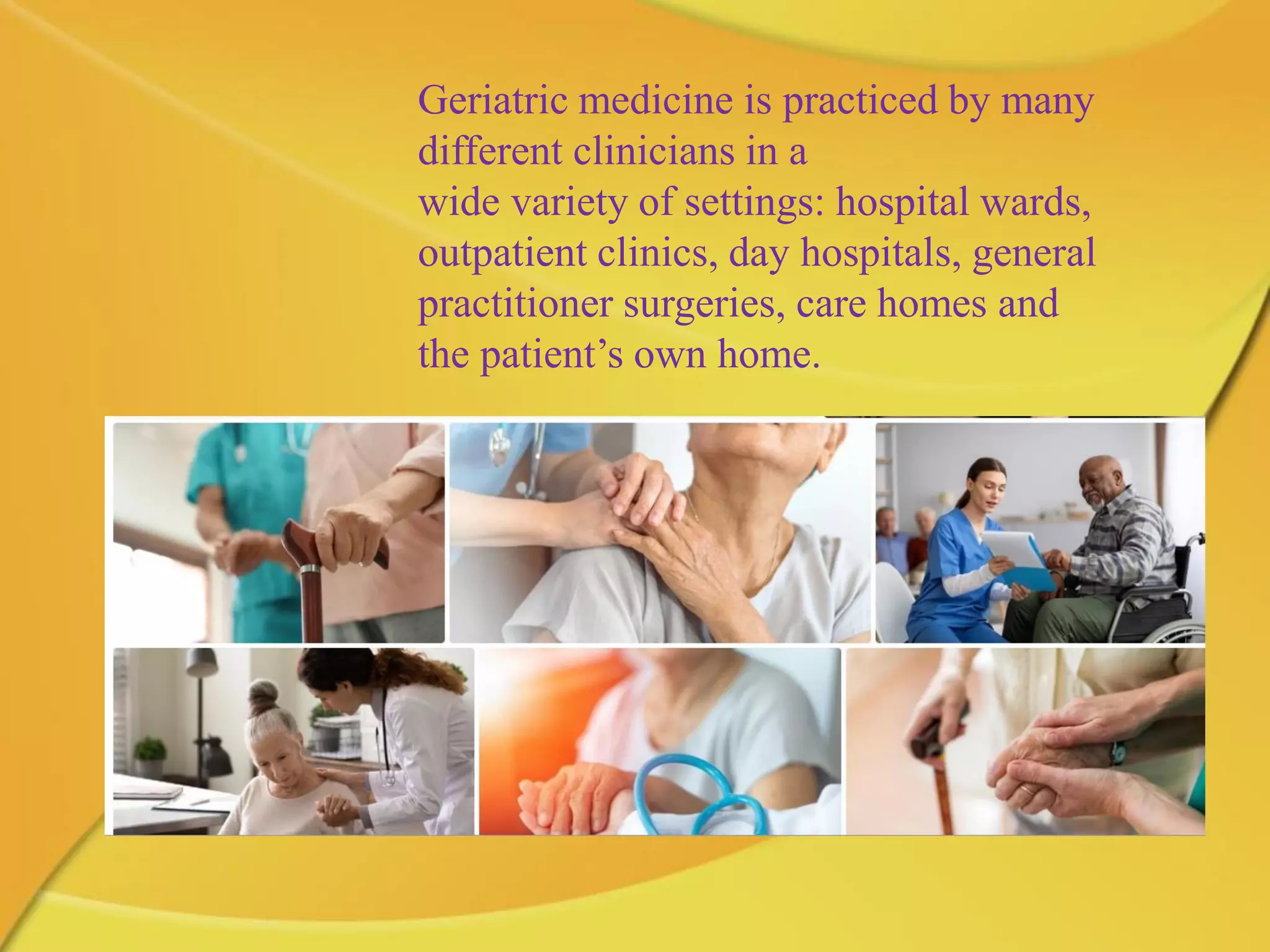
Geriatric medicine is practiced by many
different clinicians in a
wide variety of settings: hospital wards,
outpatient clinics, day hospitals, general
practitioner surgeries, care homes and
the patient’s own home.
Most doctors will spend a large part
of their time dealing with
older patients, which is why
geriatric medicine is important. It is
also a challenge: illness in older
people often presents in atypical
ways; and there is sometimes an
inaccurate perception that little
can be done to help them, or that
their problems are ‘social’ rather
than medical.
Age-related differences
There are important differences in
the physiology and presentation
of older people that every clinician
needs to know about. These in
turn affect assessment
investigations and management
Special features of illness in older
people include the following
Multiple pathology
Older people commonly present with more
than one problem, usually with a number of
causes.
A young person with fever, anemia
a heart murmur and microscopic
hematuria may have endocarditis,
But in an older person this
presentation is more likely to
be due to a urinary tract infection,
aspirin-induced gastritis and
aortic sclerosis. Never stop at a
single unifying diagnosis – always
consider several.
Atypical presentation
Older people commonly present
with ‘general deterioration’ or
functional decline. Acute disease is
often masked but precipitates
Atypical presentation
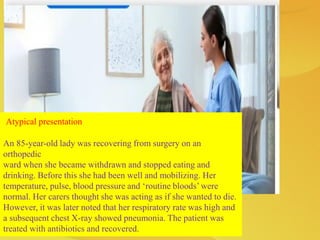
An 85-year-old lady was recovering from surgery on an
orthopedic
ward when she became withdrawn and stopped eating and
drinking. Before this she had been well and mobilizing. Her
temperature, pulse, blood pressure and ‘routine bloods’ were
normal. Her carers thought she was acting as if she wanted to die.
However, it was later noted that her respiratory rate was high and
a subsequent chest X-ray showed pneumonia. The patient was
treated with antibiotics and recovered.
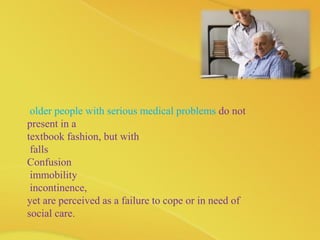
older people with serious medical problems do not
present in a
textbook fashion, but with
falls
Confusion
immobility
incontinence,
yet are perceived as a failure to cope or in need of
social care.
Old age medicine is
complex and a failure to attempt to assess
people’s problems as
medical are unacceptable…Deficiencies in
medical care can lead to
failure to make a diagnosis
improper
and inadequate treatment
Some clinical findings are not
necessarily pathological
Neck stiffness
a positive urine dipstick in women,
mild crackles
at the bases of the lungs
a slightly reduced PaO2 and
reduced skin turgor
may be normal findings in older
people and do not always indicate
disease.
Reduced homeostatic reserve
Ageing is associated with a decline
in organ function with a reduced
ability to compensate. The ability to
increase heart rate and cardiac
output in critical illness is reduced;
renal failure due to medications
or illness is more likely; salt and
water homeostasis is impaired so
electrolyte imbalances are common
in sick older people
impaired immunity
Older people do not necessarily
have a raised white cell count or a
fever with infection.
Hypothermia may occur instead.
A rigid abdomen is uncommon in
older people with peritonitis – they
are more likely to get a generally
tender but soft abdomen.
Measuring the
serum C-reactive protein can be
useful when screening for infection
in an older person who is
nonspecifically unwell.
Some clinical findings are not
necessarily pathological Neck
stiffness, a positive urine dipstick
in women, mild crackles at the
bases of the lungs, a slightly
reduced PaO2 and reduced skin
turgor may be normal findings in
older people and do not always
indicate disease
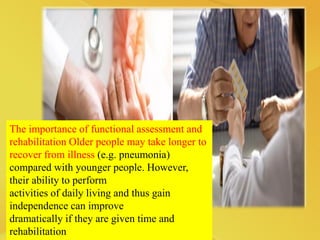
The importance of functional assessment and
rehabilitation Older people may take longer to
recover from illness (e.g. pneumonia)
compared with younger people. However,
their ability to perform
activities of daily living and thus gain
independence can improve
dramatically if they are given time and
rehabilitation
In the 1930s, the very first
geriatricians realized that the
thousands
of patients living in hospitals and
workhouses were not suffering
from ‘old age’ but from diseases that
could be treated: immobility, falls,
incontinence and confusion
called the ‘geriatric giants’
because they are the common
presentations of different illnesses in
older people
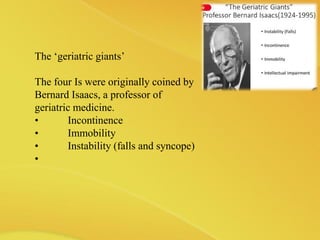
The ‘geriatric giants’
The four Is were originally coined by
Bernard Isaacs, a professor of
geriatric medicine.
• Incontinence
• Immobility
• Instability (falls and syncope)
•
Intellectual impairment (delirium and dementia)
Several different illnesses can present as one of the geriatric
giants. Two common examples also begin with the letter ‘i’
iatrogenic disease (caused by medication), and infection.
The common sources of sepsis in older people are the chest,
urine and
biliary tract.
Simple interventions can make a big difference
Another characteristic of geriatric medicine is that
simple interventions can make a big difference to a
patient’s function and quality of life.
ear syringing, cataract surgery and a
new pair of glasses can dramatically
improve a person’s sense of social
isolation and loneliness
• specially fitted shoes and a properly
measured walking aid can
improve balance, mobility and confidenc
reducing medications can stop a person
from feeling dizzy when
they walk and allow them to go out of
the house again
•.
.
adaptations at home can allow
people to function more easily and
retain their independence
Activities of daily living
• Mobility including aids and
appliances
• Washing and dressing
• Continence
• Eating and drinking
• Shopping, cooking and cleaning
When older people have the benefit
of medical assessment and
treatment for problems which are
often perceived as being due to
old age (e.g. incontinence, falls,
memory problems), they and their
carers can enjoy a better quality of
life
Comprehensive geriatric
assessment is the assessment of a
patient made by a team which
includes a geriatrician, followed by
interventions and goal setting
agreed with the patient and carers.
This can take place in the
community, in assessment areas
linked to the emergency
department, or in hospital.
It covers the following
areas:
medical diagnoses
• review of medicines and
concordance with drug therapy
• social circumstances
• assessment of cognitive function
and mood
;
environment• economic circumstances.
Randomized controlled trials show that
comprehensive geriatric assessment leads to
improved function and quality of life, and
also reduces hospital stay, readmission rates
and institutionalization. There is no evidence
for the effectiveness of a comprehensive
assessment that does not include a doctor
trained in geriatric
medicine.
• functional ability (i.e. ability to
perform activities of daily living
Communication in geriatric medicine
Communication is particularly important in geriatric medicine. A
history from the patient’s relatives or carers is often required and
may differ significantly from that of the patient.
The assessment of older people often requires a
multidisciplinary team and the observations, skills and
opinions of nurses, physiotherapists, occupational
therapists and social workers may shed significant new
light on the patient’s problems. Doctors who work with
older people need to be comfortable with this
multidisciplinary approach, and the often jigsaw puzzle-
like progress in assessment that can some
times occur.
Communicating with older patients may be diffi
cult because of
impaired vision, deafness, dysphasia or dementia.
Healthcare professionals can aid communication by
checking that the patient can
hear what is being said, writing down instructions,
and involving
carers in the consultation and decision-making.
Communicating with older patients
may be difficult because of
impaired vision, deafness,
dysphasia or dementia. Healthcare
professionals can aid
communication by checking that
the patient can
hear what is being said, writing
down instructions, and involving
carers in the consultation and
decision-making.

introduction to geriatric medicine.pdf

  • 1.
    Geriatric medicine ispracticed by many different clinicians in a wide variety of settings: hospital wards, outpatient clinics, day hospitals, general practitioner surgeries, care homes and the patient’s own home.
  • 2.
    Most doctors willspend a large part of their time dealing with older patients, which is why geriatric medicine is important. It is also a challenge: illness in older people often presents in atypical ways; and there is sometimes an inaccurate perception that little can be done to help them, or that their problems are ‘social’ rather than medical.
  • 3.
    Age-related differences There areimportant differences in the physiology and presentation of older people that every clinician needs to know about. These in turn affect assessment investigations and management Special features of illness in older people include the following
  • 4.
    Multiple pathology Older peoplecommonly present with more than one problem, usually with a number of causes. A young person with fever, anemia a heart murmur and microscopic hematuria may have endocarditis, But in an older person this presentation is more likely to be due to a urinary tract infection, aspirin-induced gastritis and aortic sclerosis. Never stop at a single unifying diagnosis – always consider several.
  • 5.
    Atypical presentation Older peoplecommonly present with ‘general deterioration’ or functional decline. Acute disease is often masked but precipitates
  • 6.
    Atypical presentation An 85-year-oldlady was recovering from surgery on an orthopedic ward when she became withdrawn and stopped eating and drinking. Before this she had been well and mobilizing. Her temperature, pulse, blood pressure and ‘routine bloods’ were normal. Her carers thought she was acting as if she wanted to die. However, it was later noted that her respiratory rate was high and a subsequent chest X-ray showed pneumonia. The patient was treated with antibiotics and recovered.
  • 7.
    older people withserious medical problems do not present in a textbook fashion, but with falls Confusion immobility incontinence, yet are perceived as a failure to cope or in need of social care.
  • 8.
    Old age medicineis complex and a failure to attempt to assess people’s problems as medical are unacceptable…Deficiencies in medical care can lead to failure to make a diagnosis improper and inadequate treatment
  • 9.
    Some clinical findingsare not necessarily pathological Neck stiffness a positive urine dipstick in women, mild crackles at the bases of the lungs a slightly reduced PaO2 and reduced skin turgor may be normal findings in older people and do not always indicate disease.
  • 10.
    Reduced homeostatic reserve Ageingis associated with a decline in organ function with a reduced ability to compensate. The ability to increase heart rate and cardiac output in critical illness is reduced; renal failure due to medications or illness is more likely; salt and water homeostasis is impaired so electrolyte imbalances are common in sick older people
  • 11.
    impaired immunity Older peopledo not necessarily have a raised white cell count or a fever with infection. Hypothermia may occur instead. A rigid abdomen is uncommon in older people with peritonitis – they are more likely to get a generally tender but soft abdomen. Measuring the serum C-reactive protein can be useful when screening for infection in an older person who is nonspecifically unwell.
  • 12.
    Some clinical findingsare not necessarily pathological Neck stiffness, a positive urine dipstick in women, mild crackles at the bases of the lungs, a slightly reduced PaO2 and reduced skin turgor may be normal findings in older people and do not always indicate disease
  • 13.
    The importance offunctional assessment and rehabilitation Older people may take longer to recover from illness (e.g. pneumonia) compared with younger people. However, their ability to perform activities of daily living and thus gain independence can improve dramatically if they are given time and rehabilitation
  • 14.
    In the 1930s,the very first geriatricians realized that the thousands of patients living in hospitals and workhouses were not suffering from ‘old age’ but from diseases that could be treated: immobility, falls, incontinence and confusion called the ‘geriatric giants’ because they are the common presentations of different illnesses in older people
  • 15.
    The ‘geriatric giants’ Thefour Is were originally coined by Bernard Isaacs, a professor of geriatric medicine. • Incontinence • Immobility • Instability (falls and syncope) •
  • 16.
    Intellectual impairment (deliriumand dementia) Several different illnesses can present as one of the geriatric giants. Two common examples also begin with the letter ‘i’ iatrogenic disease (caused by medication), and infection. The common sources of sepsis in older people are the chest, urine and biliary tract.
  • 17.
    Simple interventions canmake a big difference Another characteristic of geriatric medicine is that simple interventions can make a big difference to a patient’s function and quality of life.
  • 18.
    ear syringing, cataractsurgery and a new pair of glasses can dramatically improve a person’s sense of social isolation and loneliness • specially fitted shoes and a properly measured walking aid can improve balance, mobility and confidenc
  • 19.
    reducing medications canstop a person from feeling dizzy when they walk and allow them to go out of the house again •. .
  • 20.
    adaptations at homecan allow people to function more easily and retain their independence Activities of daily living • Mobility including aids and appliances • Washing and dressing • Continence • Eating and drinking • Shopping, cooking and cleaning
  • 21.
    When older peoplehave the benefit of medical assessment and treatment for problems which are often perceived as being due to old age (e.g. incontinence, falls, memory problems), they and their carers can enjoy a better quality of life
  • 22.
    Comprehensive geriatric assessment isthe assessment of a patient made by a team which includes a geriatrician, followed by interventions and goal setting agreed with the patient and carers. This can take place in the community, in assessment areas linked to the emergency department, or in hospital.
  • 23.
    It covers thefollowing areas: medical diagnoses • review of medicines and concordance with drug therapy • social circumstances • assessment of cognitive function and mood ;
  • 24.
    environment• economic circumstances. Randomizedcontrolled trials show that comprehensive geriatric assessment leads to improved function and quality of life, and also reduces hospital stay, readmission rates and institutionalization. There is no evidence for the effectiveness of a comprehensive assessment that does not include a doctor trained in geriatric medicine. • functional ability (i.e. ability to perform activities of daily living
  • 25.
    Communication in geriatricmedicine Communication is particularly important in geriatric medicine. A history from the patient’s relatives or carers is often required and may differ significantly from that of the patient.
  • 26.
    The assessment ofolder people often requires a multidisciplinary team and the observations, skills and opinions of nurses, physiotherapists, occupational therapists and social workers may shed significant new light on the patient’s problems. Doctors who work with older people need to be comfortable with this multidisciplinary approach, and the often jigsaw puzzle- like progress in assessment that can some times occur.
  • 27.
    Communicating with olderpatients may be diffi cult because of impaired vision, deafness, dysphasia or dementia. Healthcare professionals can aid communication by checking that the patient can hear what is being said, writing down instructions, and involving carers in the consultation and decision-making.
  • 28.
    Communicating with olderpatients may be difficult because of impaired vision, deafness, dysphasia or dementia. Healthcare professionals can aid communication by checking that the patient can hear what is being said, writing down instructions, and involving carers in the consultation and decision-making.