A derivative is a contract between two or more parties whose
value / payoff is based on an agreed-upon underlying financial
instrument, index or security(underlying Asset).
Common underlying instruments include bonds, commodities,
currencies, interest rates, market indexes and stock.
A derivative's value is based on an asset, but ownership of a
derivative doesn't mean ownership of the asset.
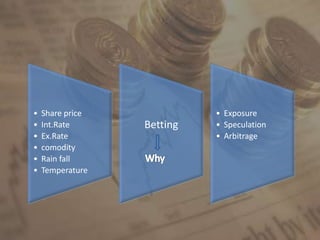
• Share price
• Int.Rate
• Ex.Rate
• comodity
• Rain fall
• Temperature
Betting
• Exposure
• Speculation
• Arbitrage
Derivatives can be used either:
• For Risk management (i.e. to “hedge” by providing offsetting
compensation in case of an undesired event, or
• For speculation (i.e. making a financial "bet"). Enhance
returns
• For Arbitrage: Locking the profit by simultaneously entering
into contacts in multiple markets
Risk Management
Derivatives are used for different type of risk management
purpose. It includes
• Currency Risk
• Interest Rate Risk
• Price Risk i.e stocks, commodities
• Credit Risk
Example : Hedging
Market
Risk
Speculation & Arbitrage
Speculation
Derivatives can be used to acquire risk, rather than to hedge against risk. Thus, some
individuals and institutions will enter into a derivative contract to speculate on the
value of the underlying asset. Speculators look to buy an asset in the future at a low
price according to a derivative contract when the future market price is high, or to sell
an asset in the future at a high price according to a derivative contract when the
future market price is low.
Example
Arbitrage
Locking the profit by simultaneously entering into contacts in multiple markets i.e. buy
instrument in one market and sell in another market. Benefit from the spread in the
markets.
Example
Characteristics of the derivative
• The contract is bilateral
• The contract is settled at a future date.
• The value of the contract is derived (hence the term
"derivative") from the value of the underlying asset
referenced by the contract.
• The transactions in the derivatives are settled by the
offsetting/Squaring transactions in the same derivative.
Characteristics(conti...)
• No limit in no of units transacted in DM because there is no
physical assets to be transacted.
• Usually Screen Based.
• Only Secondary Market Securities are traded & can’t help in
raising funds to a firm.
• Quite Liquid or transactions can be easily effected.
Introduction to derivatives

Introduction to derivatives

  • 1.
    A derivative isa contract between two or more parties whose value / payoff is based on an agreed-upon underlying financial instrument, index or security(underlying Asset). Common underlying instruments include bonds, commodities, currencies, interest rates, market indexes and stock. A derivative's value is based on an asset, but ownership of a derivative doesn't mean ownership of the asset.
  • 3.
    • Share price •Int.Rate • Ex.Rate • comodity • Rain fall • Temperature Betting • Exposure • Speculation • Arbitrage
  • 4.
    Derivatives can beused either: • For Risk management (i.e. to “hedge” by providing offsetting compensation in case of an undesired event, or • For speculation (i.e. making a financial "bet"). Enhance returns • For Arbitrage: Locking the profit by simultaneously entering into contacts in multiple markets
  • 5.
    Risk Management Derivatives areused for different type of risk management purpose. It includes • Currency Risk • Interest Rate Risk • Price Risk i.e stocks, commodities • Credit Risk Example : Hedging Market Risk
  • 6.
    Speculation & Arbitrage Speculation Derivativescan be used to acquire risk, rather than to hedge against risk. Thus, some individuals and institutions will enter into a derivative contract to speculate on the value of the underlying asset. Speculators look to buy an asset in the future at a low price according to a derivative contract when the future market price is high, or to sell an asset in the future at a high price according to a derivative contract when the future market price is low. Example Arbitrage Locking the profit by simultaneously entering into contacts in multiple markets i.e. buy instrument in one market and sell in another market. Benefit from the spread in the markets. Example
  • 7.
    Characteristics of thederivative • The contract is bilateral • The contract is settled at a future date. • The value of the contract is derived (hence the term "derivative") from the value of the underlying asset referenced by the contract. • The transactions in the derivatives are settled by the offsetting/Squaring transactions in the same derivative.
  • 8.
    Characteristics(conti...) • No limitin no of units transacted in DM because there is no physical assets to be transacted. • Usually Screen Based. • Only Secondary Market Securities are traded & can’t help in raising funds to a firm. • Quite Liquid or transactions can be easily effected.