What is a “Derivative”?
 The term ‘Derivative’ stands for a contract whose
price is derived from or is dependent upon an
underlying asset.
 The underlying asset could be a financial asset
such as currency, stock and market index, an
interest bearing security or a physical commodity.
 As Derivatives are merely contracts between two
or more parties, anything like weather data or
amount of rain can be used as underlying assets.
As Per SCRA ACT 1956……..
“Derivative” includes—
 (A) a security derived from a debt instrument,
share, loan, whether secured or unsecured, risk
instrument or contract for differences or any
other form of security;
 (B) a contract which derives its value from the
prices, or index of prices, of underlying
securities;
Examples of Derivative
Contracts
 Farmer locks in a specified price for the commodity,
prices could rise (due to, for instance, reduced supply
because of weather-related events) and the farmer will
end up losing any additional income that could have
been earned. Likewise, prices for the commodity could
drop and the miller will have to pay more for the
commodity than he otherwise would have.
 Over the Counter (OTC) derivatives are those which
are privately traded between two parties and involves
no exchange or intermediary.
 Non-standard products are traded in the so-called
over-the-counter (OTC) derivatives markets.
 The Over the counter derivative market consists of
the investment banks and include clients like hedge
funds, commercial banks, government sponsored
enterprises etc.
What is OTC (Over the counter)??
 A derivatives exchange is a market where
individuals trade standardized contracts that have
been defined by the exchange.
 A derivatives exchange acts as an intermediary
to all related transactions, and takes initial margin
from both sides of the trade to act as a
guarantee.
Exchange Traded Derivatives Market
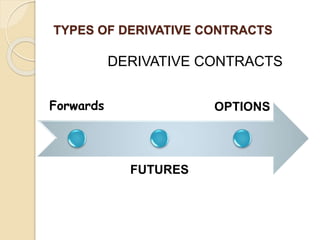
TYPES OF DERIVATIVE CONTRACTS
DERIVATIVE CONTRACTS
Forwards
FUTURES
OPTIONS
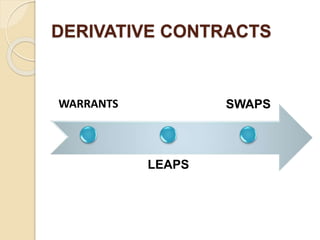
DERIVATIVE CONTRACTS
WARRANTS
LEAPS
SWAPS
DERIVATIVE CONTRACTS
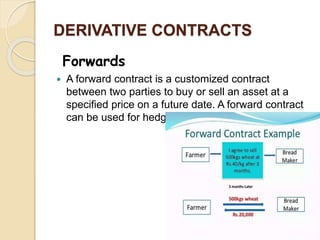
Forwards
 A forward contract is a customized contract
between two parties to buy or sell an asset at a
specified price on a future date. A forward contract
can be used for hedging or speculation
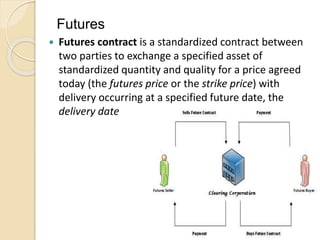
Futures
 Futures contract is a standardized contract between
two parties to exchange a specified asset of
standardized quantity and quality for a price agreed
today (the futures price or the strike price) with
delivery occurring at a specified future date, the
delivery date
 Since the futures price will generally change
daily, the difference in the prior agreed-upon
price and the daily futures price is settled daily
also.
 The exchange will draw money out of one party's
margin account and put it into the other's so that
each party has the appropriate daily loss or
profit.
 Thus on the delivery date, the amount
exchanged is not the specified price on the
contract but the spot value.
Concept of Margin
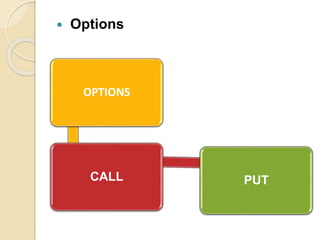
 Options
OPTIONS
CALL PUT
Option
 An option is a derivative financial
instrument that specifies a contract between
two parties for a future transaction on an
asset at a reference price.
 The buyer of the option gains the right, but
not the obligation, to engage in that
transaction, while the seller incurs the
corresponding obligation to fulfill the
transaction.
 Warrants: Options generally have lives of up to
one year, the majority of options traded on
options exchange shaving a maximum maturity
of nine months.
 LEAPS:LEAPS means Long-Term Equity
Anticipation Securities. These are options
having a maturity of upto three years
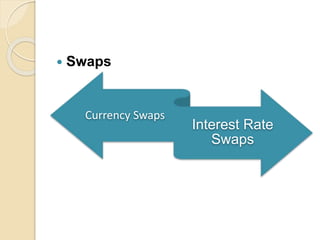
 Swaps
Currency Swaps
Interest Rate
Swaps
CONTIN
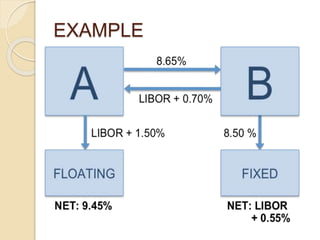
 Interest Rate Swaps: These entails wapping
only the interest related cash flows
between the parties in the same currency.
 Currency swaps: These entails wapping
both principal and interest between the
parties, with the cash flows in one
direction being in a different currency than
those in the opposite direction
EXAMPLE
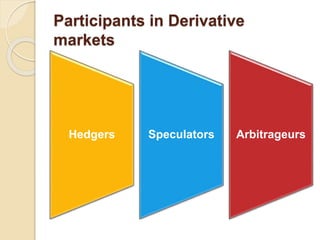
Participants in Derivative
markets
Hedgers Speculators Arbitrageurs
Hedgers
 The process of managing the risk or risk
management is called as hedging. Hedgers
are those individuals or firms who manage
their risk with the help of derivative
products.
 Hedging does not mean maximizing of
return. The main purpose for hedging is to
reduce the volatility of a portfolio by
reducing the risk.
 Speculators
 Speculators do not have any position on which
they enter into futures and options Market i.e.,
they take the positions in the futures market
without having position in the underlying cash
market.
 They only have a particular view about future
price of a commodity, shares, stockindex,
interest rates or currency. They take risk in turn
from high returns. They help in providing the
market the much desired volume and liquidity
 Arbitrageurs
 Arbitrage is the simultaneous purchase
and sale of the same underlying in two
different markets in an attempt to make
profit from price discrepancies between
the two markets.
 Arbitrage involves activity on several
different instruments or assets
simultaneously to take advantage of
price distortions judged to be only
temporary.
 Call Option: Right but not the obligation to
buy
 Put Option: Right but not the obligation to sell
 Option Price: The amount per share that an
option buyer pays to the seller
 Expiration Date: The day on which an option
is no longer valid
 Strike Price: The reference price at which the
underlying may be traded
 Long Position: Buyer of an option assumes
long position
 Short Position: Seller of an option assumes
short position
Some Terminologies
Derivative market

Derivative market

  • 2.
    What is a“Derivative”?  The term ‘Derivative’ stands for a contract whose price is derived from or is dependent upon an underlying asset.  The underlying asset could be a financial asset such as currency, stock and market index, an interest bearing security or a physical commodity.  As Derivatives are merely contracts between two or more parties, anything like weather data or amount of rain can be used as underlying assets.
  • 3.
    As Per SCRAACT 1956…….. “Derivative” includes—  (A) a security derived from a debt instrument, share, loan, whether secured or unsecured, risk instrument or contract for differences or any other form of security;  (B) a contract which derives its value from the prices, or index of prices, of underlying securities;
  • 4.
    Examples of Derivative Contracts Farmer locks in a specified price for the commodity, prices could rise (due to, for instance, reduced supply because of weather-related events) and the farmer will end up losing any additional income that could have been earned. Likewise, prices for the commodity could drop and the miller will have to pay more for the commodity than he otherwise would have.
  • 5.
     Over theCounter (OTC) derivatives are those which are privately traded between two parties and involves no exchange or intermediary.  Non-standard products are traded in the so-called over-the-counter (OTC) derivatives markets.  The Over the counter derivative market consists of the investment banks and include clients like hedge funds, commercial banks, government sponsored enterprises etc. What is OTC (Over the counter)??
  • 6.
     A derivativesexchange is a market where individuals trade standardized contracts that have been defined by the exchange.  A derivatives exchange acts as an intermediary to all related transactions, and takes initial margin from both sides of the trade to act as a guarantee. Exchange Traded Derivatives Market
  • 7.
    TYPES OF DERIVATIVECONTRACTS DERIVATIVE CONTRACTS Forwards FUTURES OPTIONS
  • 8.
  • 9.
    DERIVATIVE CONTRACTS Forwards  Aforward contract is a customized contract between two parties to buy or sell an asset at a specified price on a future date. A forward contract can be used for hedging or speculation
  • 10.
    Futures  Futures contractis a standardized contract between two parties to exchange a specified asset of standardized quantity and quality for a price agreed today (the futures price or the strike price) with delivery occurring at a specified future date, the delivery date
  • 11.
     Since thefutures price will generally change daily, the difference in the prior agreed-upon price and the daily futures price is settled daily also.  The exchange will draw money out of one party's margin account and put it into the other's so that each party has the appropriate daily loss or profit.  Thus on the delivery date, the amount exchanged is not the specified price on the contract but the spot value. Concept of Margin
  • 12.
  • 13.
    Option  An optionis a derivative financial instrument that specifies a contract between two parties for a future transaction on an asset at a reference price.  The buyer of the option gains the right, but not the obligation, to engage in that transaction, while the seller incurs the corresponding obligation to fulfill the transaction.
  • 14.
     Warrants: Optionsgenerally have lives of up to one year, the majority of options traded on options exchange shaving a maximum maturity of nine months.  LEAPS:LEAPS means Long-Term Equity Anticipation Securities. These are options having a maturity of upto three years
  • 15.
  • 16.
    CONTIN  Interest RateSwaps: These entails wapping only the interest related cash flows between the parties in the same currency.  Currency swaps: These entails wapping both principal and interest between the parties, with the cash flows in one direction being in a different currency than those in the opposite direction
  • 17.
  • 18.
  • 19.
    Hedgers  The processof managing the risk or risk management is called as hedging. Hedgers are those individuals or firms who manage their risk with the help of derivative products.  Hedging does not mean maximizing of return. The main purpose for hedging is to reduce the volatility of a portfolio by reducing the risk.
  • 20.
     Speculators  Speculatorsdo not have any position on which they enter into futures and options Market i.e., they take the positions in the futures market without having position in the underlying cash market.  They only have a particular view about future price of a commodity, shares, stockindex, interest rates or currency. They take risk in turn from high returns. They help in providing the market the much desired volume and liquidity
  • 21.
     Arbitrageurs  Arbitrageis the simultaneous purchase and sale of the same underlying in two different markets in an attempt to make profit from price discrepancies between the two markets.  Arbitrage involves activity on several different instruments or assets simultaneously to take advantage of price distortions judged to be only temporary.
  • 22.
     Call Option:Right but not the obligation to buy  Put Option: Right but not the obligation to sell  Option Price: The amount per share that an option buyer pays to the seller  Expiration Date: The day on which an option is no longer valid  Strike Price: The reference price at which the underlying may be traded  Long Position: Buyer of an option assumes long position  Short Position: Seller of an option assumes short position Some Terminologies