DATABASE MANAGEMENT SYSTEM By: Raj Vardhan
INTRODUCTION
A Database Management System (DBMS) is system software used to
manage the organization by storage, access, modify and integrity of
data in structured database. a
A DBMS makes it possible for end users to create, read, update and
delete data in a database systematically. The DBMS essentially
serves as an interface between the database and end users, ensuring
that data is consistently organized and remains easily accessible.
CHARACTERISTICS OF DBMS
It is a digital repository on the server to store and represent the data.
It can provide the clear and logical view of the data.
It contains the Atomicity, Consistency, Isolation and Durability (ACID) property which maintain
data in healthy state in case of failure.
It provides the security to the data.
It can provide different viewpoints as per the requirements
APPLICATION OF DBMS
BANKING For customer information, accounts, payments, deposits, loans and banking transactions.
AIRLINES: For reservations and schedule information. Airlines were among the first to use databases in geographically
a distributed manner. Terminals situated around the world accessed through the central database system.
TELECOMMUNICATION: For keeping records of calls made, generating monthly bills, maintaining balances and storing
information about the communication networks.
FINANCE: For storing information about holdings, sales, and purchases of financial instruments such as stocks and
bonds.
UNIVERSITIES: For student information, course registrations, colleges and grades.
SALES: For storing customer, product & sales information.
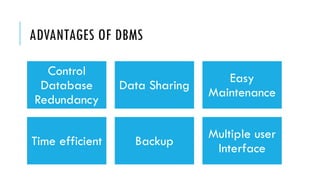
ADVANTAGES OF DBMS
Control
Database
Redundancy
Data Sharing
Easy
Maintenance
Time efficient Backup
Multiple user
Interface
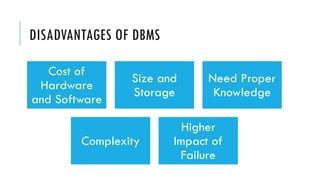
DISADVANTAGES OF DBMS
Cost of
Hardware
and Software
Size and
Storage
Need Proper
Knowledge
Complexity
Higher
Impact of
Failure
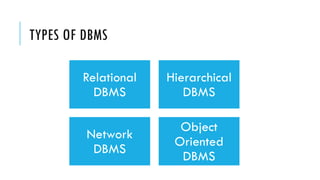
TYPES OF DBMS
Relational
DBMS
Hierarchical
DBMS
Network
DBMS
Object
Oriented
DBMS
RELATIONAL DBMS
Relational DBMS are the most widely used database management systems today. They are
relatively easy to use.
The relational model relies on normalizing data within rows and columns in tables. The data can
be related to other data in the same table or other tables which has to be correctly managed by
joining one or more tables.
Data in this type of model is stored is fixed predefined structures and are usually manipulated
using Structured Query Language (SQL).
Relational database management systems include Oracle, SQL Server, IBM DB2, mySQL & others.
RELATIONAL DBMS
HIERARCHICAL DBMS
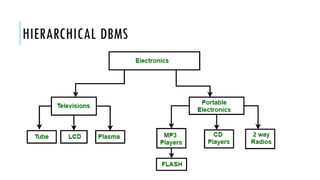
Hierarchical database management systems operates on the parent child tree-like model.
These normally have a 1:N relationship and are good for storing data with items describing
attributes, features and so on.
These could store a book with information on chapters and verses.
They can also be used to store a database of songs, recipes, models of phones and anything
that can be stored in a nested format.
One such example of a Hierarchical database management system is XML document.
α
HIERARCHICAL DBMS
NETWORK DBMS
A Network database management system uses a data model similar to
Hierarchical database management systems.
The major difference here is that the tree structure in the Network
models can have a many parent to many child relational model.
The Network model structure is based on records and sets and most of
these databases use SQL for manipulation of their data.
Network database management systems tend to be very flexible but
are rarely used and were very quite common in the 1960s and 1970s
NETWORK DBMS
OBJECT ORIENTED DBMS
Object-oriented DBMS borrow from the model of the Object-oriented programming paradigm.
In this database model, the Object and its data or attributes are seen as one and accessed through pointers
rather than stored in relational table models.
Object-oriented database models consist of diverse structures and is quite extensible.
This data model was designed to work closely with programs built with Object-oriented programming
languages thereby almost making the data and the program operate as one.
There is little commercial implementation of this database model as it is still developing.
Examples of Object-oriented DBMS include IBM DB4 and DTS/S1.
OBJECT ORIENTED DBMS
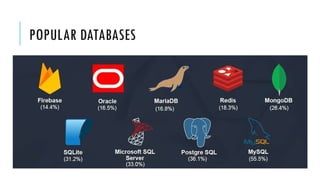
POPULAR DATABASES

Database Management System Introduction to DBMS.pptx

  • 1.
  • 2.
    INTRODUCTION A Database ManagementSystem (DBMS) is system software used to manage the organization by storage, access, modify and integrity of data in structured database. a A DBMS makes it possible for end users to create, read, update and delete data in a database systematically. The DBMS essentially serves as an interface between the database and end users, ensuring that data is consistently organized and remains easily accessible.
  • 3.
    CHARACTERISTICS OF DBMS Itis a digital repository on the server to store and represent the data. It can provide the clear and logical view of the data. It contains the Atomicity, Consistency, Isolation and Durability (ACID) property which maintain data in healthy state in case of failure. It provides the security to the data. It can provide different viewpoints as per the requirements
  • 4.
    APPLICATION OF DBMS BANKINGFor customer information, accounts, payments, deposits, loans and banking transactions. AIRLINES: For reservations and schedule information. Airlines were among the first to use databases in geographically a distributed manner. Terminals situated around the world accessed through the central database system. TELECOMMUNICATION: For keeping records of calls made, generating monthly bills, maintaining balances and storing information about the communication networks. FINANCE: For storing information about holdings, sales, and purchases of financial instruments such as stocks and bonds. UNIVERSITIES: For student information, course registrations, colleges and grades. SALES: For storing customer, product & sales information.
  • 5.
    ADVANTAGES OF DBMS Control Database Redundancy DataSharing Easy Maintenance Time efficient Backup Multiple user Interface
  • 6.
    DISADVANTAGES OF DBMS Costof Hardware and Software Size and Storage Need Proper Knowledge Complexity Higher Impact of Failure
  • 7.
  • 8.
    RELATIONAL DBMS Relational DBMSare the most widely used database management systems today. They are relatively easy to use. The relational model relies on normalizing data within rows and columns in tables. The data can be related to other data in the same table or other tables which has to be correctly managed by joining one or more tables. Data in this type of model is stored is fixed predefined structures and are usually manipulated using Structured Query Language (SQL). Relational database management systems include Oracle, SQL Server, IBM DB2, mySQL & others.
  • 9.
  • 10.
    HIERARCHICAL DBMS Hierarchical databasemanagement systems operates on the parent child tree-like model. These normally have a 1:N relationship and are good for storing data with items describing attributes, features and so on. These could store a book with information on chapters and verses. They can also be used to store a database of songs, recipes, models of phones and anything that can be stored in a nested format. One such example of a Hierarchical database management system is XML document. α
  • 11.
  • 12.
    NETWORK DBMS A Networkdatabase management system uses a data model similar to Hierarchical database management systems. The major difference here is that the tree structure in the Network models can have a many parent to many child relational model. The Network model structure is based on records and sets and most of these databases use SQL for manipulation of their data. Network database management systems tend to be very flexible but are rarely used and were very quite common in the 1960s and 1970s
  • 13.
  • 14.
    OBJECT ORIENTED DBMS Object-orientedDBMS borrow from the model of the Object-oriented programming paradigm. In this database model, the Object and its data or attributes are seen as one and accessed through pointers rather than stored in relational table models. Object-oriented database models consist of diverse structures and is quite extensible. This data model was designed to work closely with programs built with Object-oriented programming languages thereby almost making the data and the program operate as one. There is little commercial implementation of this database model as it is still developing. Examples of Object-oriented DBMS include IBM DB4 and DTS/S1.
  • 15.
  • 16.