

INTRODUCTION TO THE
CIVIL SERVICE
OF GHANA
PRESENTATION BY:
JULIANA AMA KPLORFIA
DEPUTY DIRECTOR, (F&A)
OFFICE OF THE PRESIDENT
JUBILEE HOUSE, ACCRA
PRESENTATION OUTLINE
 Introduction
 History
 Functions
 Mandate
 Classes
 Code of Conduct
 Questions & Answers
INTRODUCTION
 The Ghana Civil Service is an integral part of the
Executive arm of government, and a major
component of the Public Services and Ghana's single
largest employer. The Service is organized along
British lines and constitutes one of the most enduring
legacies of British colonial rule.
 It comes under the supervision of the Public Services
Commission.
INTRODUCTION
 The 1992 constitution provides that the President,
acting in accordance with the advice of the Public
Services Commission, appoints the Head of the Office of
the Civil Service.
 It recruits qualified persons through a system of
competitive examination and rigorous interview
processes and promotes them through a system of merit
based on vacancy.
HISTORY
The history of the Ghana Civil Service is linked with the
establishment of the Colonial Service in the Gold Coast. Under the
British imperial policy, functions of the Service included:
 Maintenance of law and order,
 Imposition and collection of taxes and
 Exploitation of rich minerals and other natural resources
The modern Ghana Civil Service is the development of
the Africanisation Policy. In 1925 – 26, Sir Gordon Guggisburg,
the then Governor of the Gold Coast, put forward the first
organized plan for the development of an indigenous Civil ervice.
This plan was formulated to increase the number of Africans
holding European Appointments, to reduce the high cost of
employing Europeans and create a local machinery for accelerated
development
MISSION
The mission of the Civil Service, as stated in the Civil
Service Law, 1993 PNDCL 327, “is to assist the
Government in the formulation and implementation of
government policies for the development of the
country.”
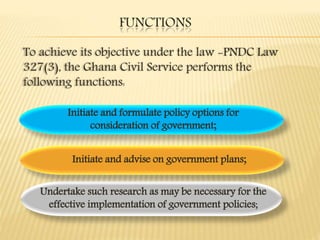
FUNCTIONS
To achieve its objective under the law -PNDC Law
327(3), the Ghana Civil Service performs the
following functions:
Initiate and formulate policy options for
consideration of government;
Undertake such research as may be necessary for the
effective implementation of government policies;
Initiate and advise on government plans;
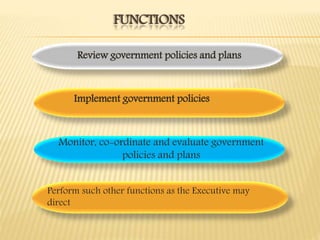
FUNCTIONS
Perform such other functions as the Executive may
direct
Monitor, co-ordinate and evaluate government
policies and plans
Implement government policies
Review government policies and plans
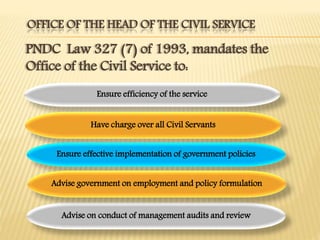
OFFICE OF THE HEAD OF THE CIVIL SERVICE
PNDC Law 327 (7) of 1993, mandates the
Office of the Civil Service to:
Ensure efficiency of the service
Have charge over all Civil Servants
Advise on conduct of management audits and review
Ensure effective implementation of government policies
Advise government on employment and policy formulation
OFFICE OF THE HEAD OF THE CIVIL SERVICE
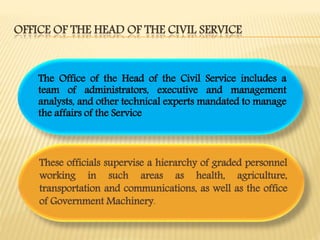
The Office of the Head of the Civil Service includes a
team of administrators, executive and management
analysts, and other technical experts mandated to manage
the affairs of the Service
These officials supervise a hierarchy of graded personnel
working in such areas as health, agriculture,
transportation and communications, as well as the office
of Government Machinery.
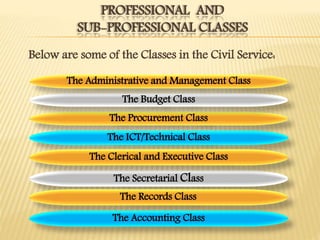
PROFESSIONAL AND
SUB-PROFESSIONAL CLASSES
Below are some of the Classes in the Civil Service:
The Procurement Class
The ICT/Technical Class
The Budget Class
The Secretarial Class
The Records Class
The Accounting Class
The Clerical and Executive Class
The Administrative and Management Class
MINISTRIES AND DEPARTMENTS
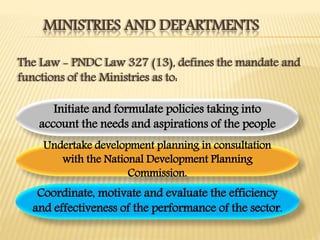
The Law - PNDC Law 327 (13), defines the mandate and
functions of the Ministries as to:
Initiate and formulate policies taking into
account the needs and aspirations of the people
Coordinate, motivate and evaluate the efficiency
and effectiveness of the performance of the sector.
Undertake development planning in consultation
with the National Development Planning
Commission.
MINISTRIES AND DEPARTMENTS
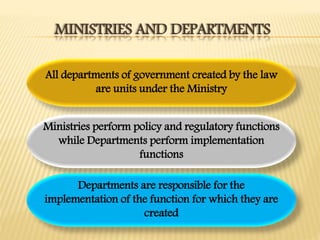
All departments of government created by the law
are units under the Ministry
Ministries perform policy and regulatory functions
while Departments perform implementation
functions
Departments are responsible for the
implementation of the function for which they are
created
CIVIL SERVICE CODE OF CONDUCT
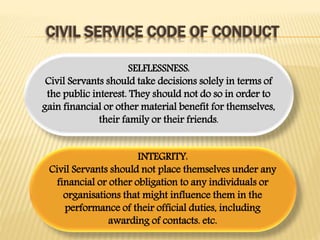
SELFLESSNESS:
Civil Servants should take decisions solely in terms of
the public interest. They should not do so in order to
gain financial or other material benefit for themselves,
their family or their friends.
INTEGRITY:
Civil Servants should not place themselves under any
financial or other obligation to any individuals or
organisations that might influence them in the
performance of their official duties, including
awarding of contacts. etc.
CIVIL SERVICE CODE OF CONDUCT
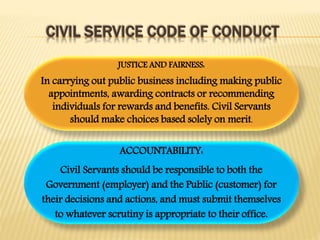
ACCOUNTABILITY:
Civil Servants should be responsible to both the
Government (employer) and the Public (customer) for
their decisions and actions, and must submit themselves
to whatever scrutiny is appropriate to their office.
JUSTICE AND FAIRNESS:
In carrying out public business including making public
appointments, awarding contracts or recommending
individuals for rewards and benefits. Civil Servants
should make choices based solely on merit.
CODE OF CONDUCT
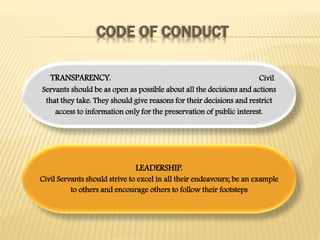
LEADERSHIP:
Civil Servants should strive to excel in all their endeavours; be an example
to others and encourage others to follow their footsteps
TRANSPARENCY: Civil
Servants should be as open as possible about all the decisions and actions
that they take. They should give reasons for their decisions and restrict
access to information only for the preservation of public interest.
PROMOTIONS AND POSTINGS
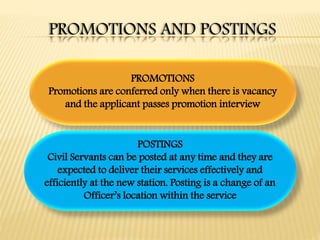
PROMOTIONS
Promotions are conferred only when there is vacancy
and the applicant passes promotion interview
POSTINGS
Civil Servants can be posted at any time and they are
expected to deliver their services effectively and
efficiently at the new station. Posting is a change of an
Officer’s location within the service
REFERENCES
Code of Conduct for the Ghana Civil Service
Ghana Civil Service Rules and Regulations
The Civil Service Act 1993 (PNDCL 327
Head of Civil Service website
Thank you!

Introduction to civil service

  • 1.
    INTRODUCTION TO THE CIVILSERVICE OF GHANA PRESENTATION BY: JULIANA AMA KPLORFIA DEPUTY DIRECTOR, (F&A) OFFICE OF THE PRESIDENT JUBILEE HOUSE, ACCRA
  • 2.
    PRESENTATION OUTLINE  Introduction History  Functions  Mandate  Classes  Code of Conduct  Questions & Answers
  • 3.
    INTRODUCTION  The GhanaCivil Service is an integral part of the Executive arm of government, and a major component of the Public Services and Ghana's single largest employer. The Service is organized along British lines and constitutes one of the most enduring legacies of British colonial rule.  It comes under the supervision of the Public Services Commission.
  • 4.
    INTRODUCTION  The 1992constitution provides that the President, acting in accordance with the advice of the Public Services Commission, appoints the Head of the Office of the Civil Service.  It recruits qualified persons through a system of competitive examination and rigorous interview processes and promotes them through a system of merit based on vacancy.
  • 5.
    HISTORY The history ofthe Ghana Civil Service is linked with the establishment of the Colonial Service in the Gold Coast. Under the British imperial policy, functions of the Service included:  Maintenance of law and order,  Imposition and collection of taxes and  Exploitation of rich minerals and other natural resources The modern Ghana Civil Service is the development of the Africanisation Policy. In 1925 – 26, Sir Gordon Guggisburg, the then Governor of the Gold Coast, put forward the first organized plan for the development of an indigenous Civil ervice. This plan was formulated to increase the number of Africans holding European Appointments, to reduce the high cost of employing Europeans and create a local machinery for accelerated development
  • 6.
    MISSION The mission ofthe Civil Service, as stated in the Civil Service Law, 1993 PNDCL 327, “is to assist the Government in the formulation and implementation of government policies for the development of the country.”
  • 7.
    FUNCTIONS To achieve itsobjective under the law -PNDC Law 327(3), the Ghana Civil Service performs the following functions: Initiate and formulate policy options for consideration of government; Undertake such research as may be necessary for the effective implementation of government policies; Initiate and advise on government plans;
  • 8.
    FUNCTIONS Perform such otherfunctions as the Executive may direct Monitor, co-ordinate and evaluate government policies and plans Implement government policies Review government policies and plans
  • 9.
    OFFICE OF THEHEAD OF THE CIVIL SERVICE PNDC Law 327 (7) of 1993, mandates the Office of the Civil Service to: Ensure efficiency of the service Have charge over all Civil Servants Advise on conduct of management audits and review Ensure effective implementation of government policies Advise government on employment and policy formulation
  • 10.
    OFFICE OF THEHEAD OF THE CIVIL SERVICE The Office of the Head of the Civil Service includes a team of administrators, executive and management analysts, and other technical experts mandated to manage the affairs of the Service These officials supervise a hierarchy of graded personnel working in such areas as health, agriculture, transportation and communications, as well as the office of Government Machinery.
  • 11.
    PROFESSIONAL AND SUB-PROFESSIONAL CLASSES Beloware some of the Classes in the Civil Service: The Procurement Class The ICT/Technical Class The Budget Class The Secretarial Class The Records Class The Accounting Class The Clerical and Executive Class The Administrative and Management Class
  • 12.
    MINISTRIES AND DEPARTMENTS TheLaw - PNDC Law 327 (13), defines the mandate and functions of the Ministries as to: Initiate and formulate policies taking into account the needs and aspirations of the people Coordinate, motivate and evaluate the efficiency and effectiveness of the performance of the sector. Undertake development planning in consultation with the National Development Planning Commission.
  • 13.
    MINISTRIES AND DEPARTMENTS Alldepartments of government created by the law are units under the Ministry Ministries perform policy and regulatory functions while Departments perform implementation functions Departments are responsible for the implementation of the function for which they are created
  • 14.
    CIVIL SERVICE CODEOF CONDUCT SELFLESSNESS: Civil Servants should take decisions solely in terms of the public interest. They should not do so in order to gain financial or other material benefit for themselves, their family or their friends. INTEGRITY: Civil Servants should not place themselves under any financial or other obligation to any individuals or organisations that might influence them in the performance of their official duties, including awarding of contacts. etc.
  • 15.
    CIVIL SERVICE CODEOF CONDUCT ACCOUNTABILITY: Civil Servants should be responsible to both the Government (employer) and the Public (customer) for their decisions and actions, and must submit themselves to whatever scrutiny is appropriate to their office. JUSTICE AND FAIRNESS: In carrying out public business including making public appointments, awarding contracts or recommending individuals for rewards and benefits. Civil Servants should make choices based solely on merit.
  • 16.
    CODE OF CONDUCT LEADERSHIP: CivilServants should strive to excel in all their endeavours; be an example to others and encourage others to follow their footsteps TRANSPARENCY: Civil Servants should be as open as possible about all the decisions and actions that they take. They should give reasons for their decisions and restrict access to information only for the preservation of public interest.
  • 17.
    PROMOTIONS AND POSTINGS PROMOTIONS Promotionsare conferred only when there is vacancy and the applicant passes promotion interview POSTINGS Civil Servants can be posted at any time and they are expected to deliver their services effectively and efficiently at the new station. Posting is a change of an Officer’s location within the service
  • 18.
    REFERENCES Code of Conductfor the Ghana Civil Service Ghana Civil Service Rules and Regulations The Civil Service Act 1993 (PNDCL 327 Head of Civil Service website
  • 19.