
PUBLIC ACCOUNT COMMITTEE
Presented By PRATIK SURATI
Roll No. 16
Subject :- PRIVILEGED CLASS DEVIANCE
LAW
Faculty of Law
Maharaja Sayajirao University, Baroda
INTRODUCTION
 Public Accountability has been regarded as an important
pre-requisite for the proper and effective delivery of
public service by the Governments.
 The Public Accounts Committee (PAC) examines the
report of Accounts of the union government submitted
by the Comptroller and Auditor General of India, to the
President.
 The Public Accounts Committee in India ensures
Parliamentary control over government expenditure.
 It is also responsible for scrutinizing the accounts of
autonomous and semi-autonomous bodies.
MAIN AIM
 For stability of society and compact system of
accountability in country.
 The proper and effective delivery of public service
by the Governments all over the globe.
 The overall progress of country highly to
accountability and transparency.
HISTORICAL BACKGROUND
 The Public Accounts Committee was set up in 1921 under the Montague
Chelmsford Reforms.
 The rules framed under the Government of India Act of 1919 authorised
the Governor-General-in-Council to constitute such committees at the
centre
 Under the India Act of 1935, there was a specific provision that “the
accounts and audit report should be placed before the legislature”.
 So the Rules of Procedure provided for the appointment of Public
Accounts Committee to Scrutinise the Accounts and Audit report.
 After independence, the Constitution of India provides that, the reports of
Comptroller and Auditor General of India regarding the Accounts of the
Union shall be submitted to the President, who shall cause then to be laid
before each house of parliament.
 Then the parliament appoints Public Accounts Committee to scrutinise the
report laid down by the president of India.
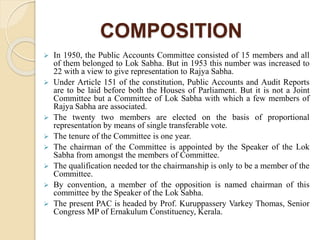
COMPOSITION
 In 1950, the Public Accounts Committee consisted of 15 members and all
of them belonged to Lok Sabha. But in 1953 this number was increased to
22 with a view to give representation to Rajya Sabha.
 Under Article 151 of the constitution, Public Accounts and Audit Reports
are to be laid before both the Houses of Parliament. But it is not a Joint
Committee but a Committee of Lok Sabha with which a few members of
Rajya Sabha are associated.
 The twenty two members are elected on the basis of proportional
representation by means of single transferable vote.
 The tenure of the Committee is one year.
 The chairman of the Committee is appointed by the Speaker of the Lok
Sabha from amongst the members of Committee.
 The qualification needed tor the chairmanship is only to be a member of the
Committee.
 By convention, a member of the opposition is named chairman of this
committee by the Speaker of the Lok Sabha.
 The present PAC is headed by Prof. Kuruppassery Varkey Thomas, Senior
Congress MP of Ernakulum Constituency, Kerala.
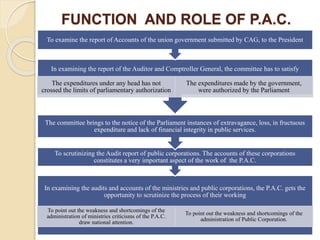
FUNCTION AND ROLE OF P.A.C.
In examining the audits and accounts of the ministries and public corporations, the P.A.C. gets the
opportunity to scrutinize the process of their working
To point out the weakness and shortcomings of the
administration of ministries criticisms of the P.A.C.
draw national attention.
To point out the weakness and shortcomings of the
administration of Public Corporation.
To scrutinizing the Audit report of public corporations. The accounts of these corporations
constitutes a very important aspect of the work of the P.A.C.
The committee brings to the notice of the Parliament instances of extravagance, loss, in fructuous
expenditure and lack of financial integrity in public services.
In examining the report of the Auditor and Comptroller General, the committee has to satisfy
The expenditures under any head has not
crossed the limits of parliamentary authorization
The expenditures made by the government,
were authorized by the Parliament
To examine the report of Accounts of the union government submitted by CAG, to the President
IMPORTANCE
 The Public Accounts Committee examines the accounts of the
Government.
 The Government expenditures are thoroughly examined and
ensured that the Parliamentary limits are not breached.
 The Government and ministers stay alert while making
expenditures because they know that the financial breaches, if
any, will be revealed during the examination by P.A.C.
 The Government has an inbuilt advantage in that, inevitably
the majority of members of the P.A.C. belong to the ruling
party. But the opposition also has an advantage.
 It has now become a convention that the chairman of the
P.A.C. is a member of the opposition.
PROBES BY PAC
2G Spectrum Scam
 In 2011, the Public Accounts Committee probed the 2G spectrum scam which
brought the committee to public attention. The committee, on 4 April 2011,
summoned Ratan Tata, chairman of the Tata group, and Niira Radia, corporate
lobbyist regarding the scam. The PAC asked Congress members to apologise
to Comptroller and Auditor General of India for making allegations against it.
Demonetization of November 8, 2016
 On the eve of November 8, 2016, Prime Minister of Republic of India Shri
Narendra Modi announced "Notes of Rs 500 and Rs 1000 will not remain a
legal tender by midnight". Being an unprecedented step it was much
highlighted in the national and international news with a number of people
criticizing the move and Government acclaiming it as a surgical strike against
black money.
 But P.A.C. headed by Senior Congress leader K.V. Thomas took a serious note
of the move and started probing the move wherein it decided to call RBI
Governor Urjit Patel, Finance Secretary Ashok Lavasa and Economic Affairs
Secretary Shaktikanta Das. and a decision was taken unanimously by all the
members of the committee.
CONCLUSION
 The committee may examine the expenditures, administration,
delegated legislation, public petitions and policies of the
Ministry concerned and its associated public bodies.
 It is only through the Public Accounts Committee that the
objective of Transparency and Accountability is ensured.
 The independent functioning of the PAC enables it to come up
with unbiased reports.
 The panel remains a vital entity that helps the Parliament
exercise its control over the revenues and expenditures of the
government.
 P.A.C. is an instrument of financial control as well an
instrument of administrative control.
THANK YOU

public account committee

  • 1.
    PUBLIC ACCOUNT COMMITTEE PresentedBy PRATIK SURATI Roll No. 16 Subject :- PRIVILEGED CLASS DEVIANCE LAW Faculty of Law Maharaja Sayajirao University, Baroda
  • 2.
    INTRODUCTION  Public Accountabilityhas been regarded as an important pre-requisite for the proper and effective delivery of public service by the Governments.  The Public Accounts Committee (PAC) examines the report of Accounts of the union government submitted by the Comptroller and Auditor General of India, to the President.  The Public Accounts Committee in India ensures Parliamentary control over government expenditure.  It is also responsible for scrutinizing the accounts of autonomous and semi-autonomous bodies.
  • 3.
    MAIN AIM  Forstability of society and compact system of accountability in country.  The proper and effective delivery of public service by the Governments all over the globe.  The overall progress of country highly to accountability and transparency.
  • 4.
    HISTORICAL BACKGROUND  ThePublic Accounts Committee was set up in 1921 under the Montague Chelmsford Reforms.  The rules framed under the Government of India Act of 1919 authorised the Governor-General-in-Council to constitute such committees at the centre  Under the India Act of 1935, there was a specific provision that “the accounts and audit report should be placed before the legislature”.  So the Rules of Procedure provided for the appointment of Public Accounts Committee to Scrutinise the Accounts and Audit report.  After independence, the Constitution of India provides that, the reports of Comptroller and Auditor General of India regarding the Accounts of the Union shall be submitted to the President, who shall cause then to be laid before each house of parliament.  Then the parliament appoints Public Accounts Committee to scrutinise the report laid down by the president of India.
  • 5.
    COMPOSITION  In 1950,the Public Accounts Committee consisted of 15 members and all of them belonged to Lok Sabha. But in 1953 this number was increased to 22 with a view to give representation to Rajya Sabha.  Under Article 151 of the constitution, Public Accounts and Audit Reports are to be laid before both the Houses of Parliament. But it is not a Joint Committee but a Committee of Lok Sabha with which a few members of Rajya Sabha are associated.  The twenty two members are elected on the basis of proportional representation by means of single transferable vote.  The tenure of the Committee is one year.  The chairman of the Committee is appointed by the Speaker of the Lok Sabha from amongst the members of Committee.  The qualification needed tor the chairmanship is only to be a member of the Committee.  By convention, a member of the opposition is named chairman of this committee by the Speaker of the Lok Sabha.  The present PAC is headed by Prof. Kuruppassery Varkey Thomas, Senior Congress MP of Ernakulum Constituency, Kerala.
  • 6.
    FUNCTION AND ROLEOF P.A.C. In examining the audits and accounts of the ministries and public corporations, the P.A.C. gets the opportunity to scrutinize the process of their working To point out the weakness and shortcomings of the administration of ministries criticisms of the P.A.C. draw national attention. To point out the weakness and shortcomings of the administration of Public Corporation. To scrutinizing the Audit report of public corporations. The accounts of these corporations constitutes a very important aspect of the work of the P.A.C. The committee brings to the notice of the Parliament instances of extravagance, loss, in fructuous expenditure and lack of financial integrity in public services. In examining the report of the Auditor and Comptroller General, the committee has to satisfy The expenditures under any head has not crossed the limits of parliamentary authorization The expenditures made by the government, were authorized by the Parliament To examine the report of Accounts of the union government submitted by CAG, to the President
  • 7.
    IMPORTANCE  The PublicAccounts Committee examines the accounts of the Government.  The Government expenditures are thoroughly examined and ensured that the Parliamentary limits are not breached.  The Government and ministers stay alert while making expenditures because they know that the financial breaches, if any, will be revealed during the examination by P.A.C.  The Government has an inbuilt advantage in that, inevitably the majority of members of the P.A.C. belong to the ruling party. But the opposition also has an advantage.  It has now become a convention that the chairman of the P.A.C. is a member of the opposition.
  • 8.
    PROBES BY PAC 2GSpectrum Scam  In 2011, the Public Accounts Committee probed the 2G spectrum scam which brought the committee to public attention. The committee, on 4 April 2011, summoned Ratan Tata, chairman of the Tata group, and Niira Radia, corporate lobbyist regarding the scam. The PAC asked Congress members to apologise to Comptroller and Auditor General of India for making allegations against it. Demonetization of November 8, 2016  On the eve of November 8, 2016, Prime Minister of Republic of India Shri Narendra Modi announced "Notes of Rs 500 and Rs 1000 will not remain a legal tender by midnight". Being an unprecedented step it was much highlighted in the national and international news with a number of people criticizing the move and Government acclaiming it as a surgical strike against black money.  But P.A.C. headed by Senior Congress leader K.V. Thomas took a serious note of the move and started probing the move wherein it decided to call RBI Governor Urjit Patel, Finance Secretary Ashok Lavasa and Economic Affairs Secretary Shaktikanta Das. and a decision was taken unanimously by all the members of the committee.
  • 9.
    CONCLUSION  The committeemay examine the expenditures, administration, delegated legislation, public petitions and policies of the Ministry concerned and its associated public bodies.  It is only through the Public Accounts Committee that the objective of Transparency and Accountability is ensured.  The independent functioning of the PAC enables it to come up with unbiased reports.  The panel remains a vital entity that helps the Parliament exercise its control over the revenues and expenditures of the government.  P.A.C. is an instrument of financial control as well an instrument of administrative control.
  • 10.