Policy Progress 2008  Nick Bennett and Ian Williams Community Housing Governance Conference
Context – 2007  Challenges  NAW election campaign  New WAG New National Assembly Powers CSR  Further HST ballots PR Campaign
National Council Priorities for 07/08  Social Housing Grant £30m extra Social Housing Grant (SHG) Supporting People To increase by £26m by 2010/11 Better Regulation  The Essex Review
Priorities for 2008  Ensuring that we are all equipped for the regulatory review’s outcome –  The need to focus on Governance – so that we are fit to face the future That we build on our improving relationship with local government pre- and post election-  We need to measure our economic and social impact- so we know what difference we are making under a new regulatory regime That we welcome new members and maintain unity as we develop as a movement
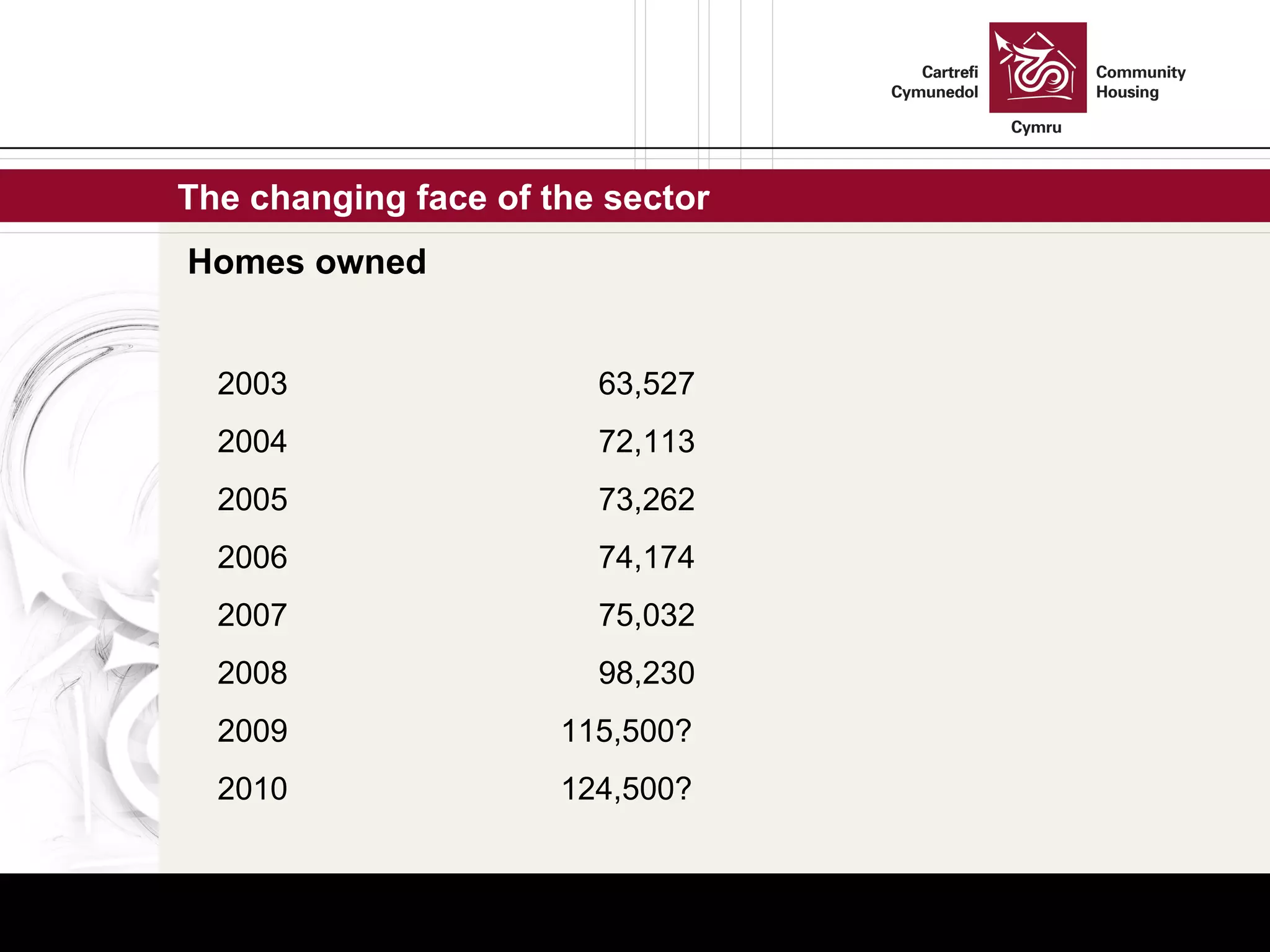
The changing face of the sector  Homes owned 2003 63,527 2004 72,113 2005 73,262 2006 74,174 2007 75,032 2008 98,230 2009   115,500? 2010   124,500?
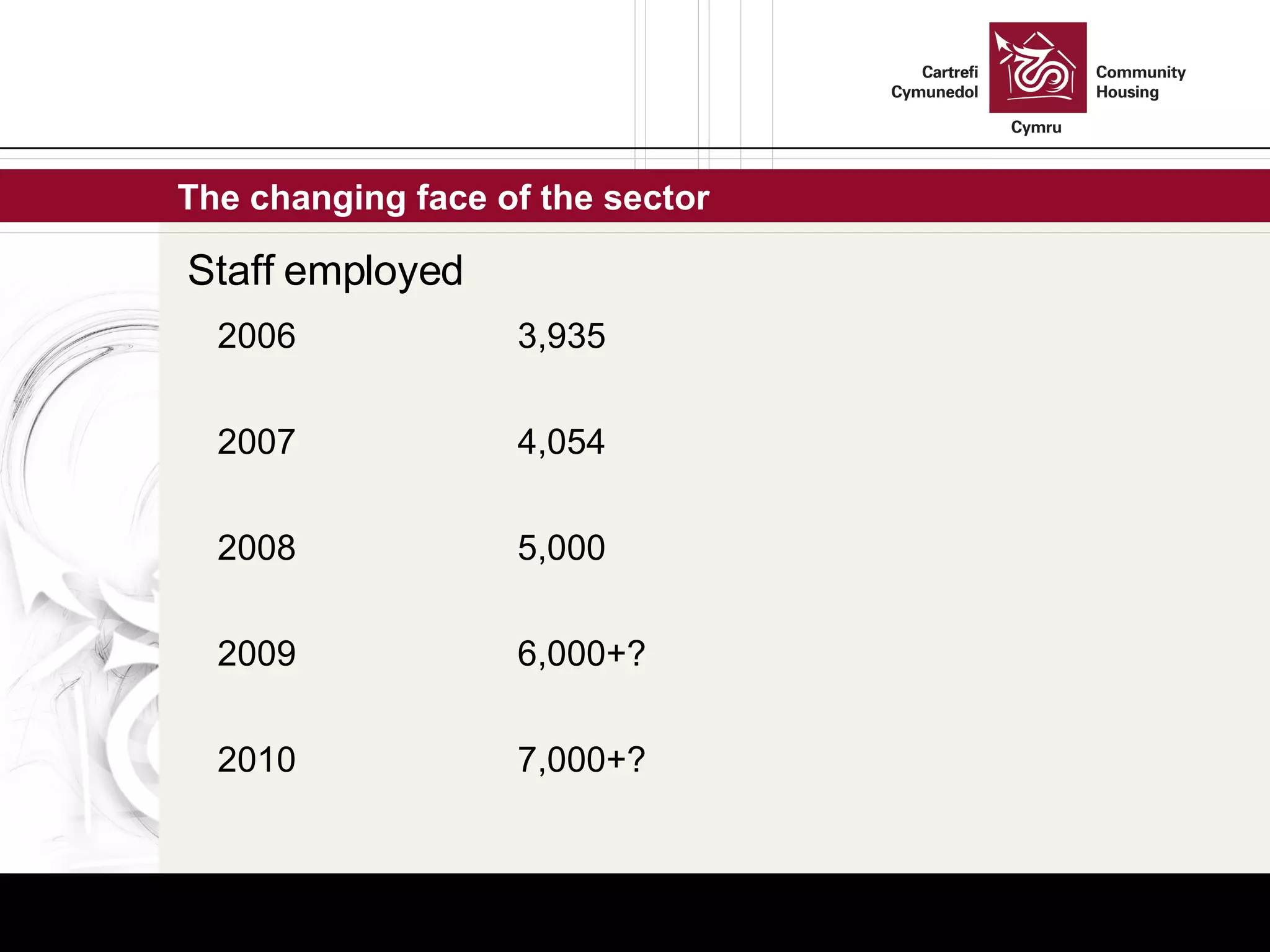
The changing face of the sector Staff employed 7,000+? 2010 6,000+? 2009 5,000 2008 4,054 2007 3,935 2006
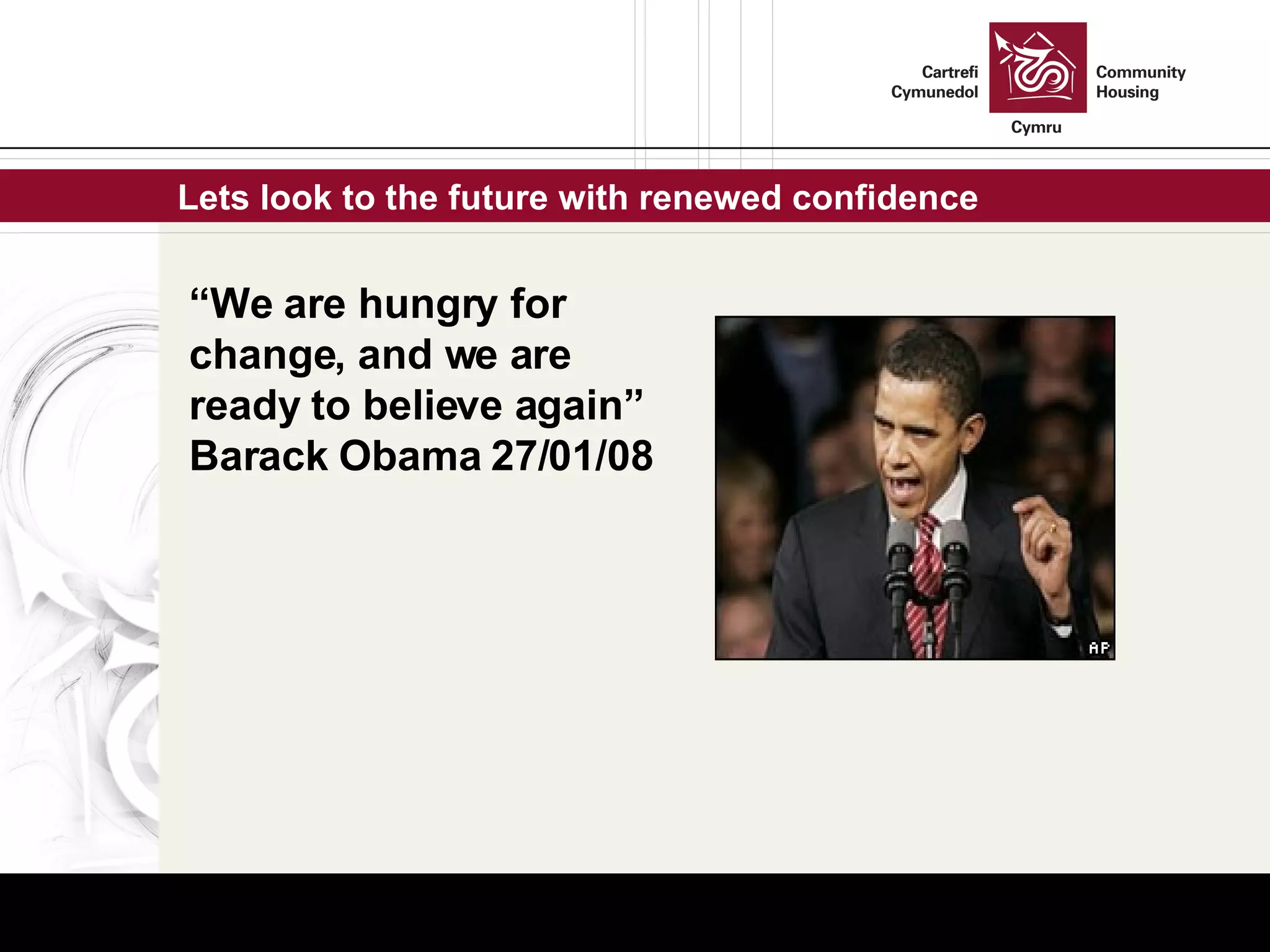
Lets look to the future with renewed confidence  “ We are hungry for change, and we are ready to believe again” Barack Obama 27/01/08
The Review of Regulation Adolygu Rheoleiddio Sue Essex
Review of Governance Adolygiad Llywodraethu Paul Griffiths Public Services Consultant Ymgynghorydd Gwasanaeth Cyhoeddus
Context of Review A higher political priority for affordable housing The case for more focussed external regulation – the Essex Review The need for external confidence in self-regulation
Review Method Short and sharp - 2 months, 30 days A study of 3 Associations Interview of at least one member of most other boards Learning from this Conference
Board Membership Tenant Members Committed and well supported Provide the essential ‘citizen focus’ – housing associations can be the beacon of Welsh public services Need to be rooted in a well supported network of groups and panels Can be recruited where the roots are strong and well nourished – advantage of a community basis?
Board Membership ‘Professional’ Members A reasonable balance of skills and expertise Widespread commitment and motivation Open recruitment is bearing fruit Open recruitment is consistent with pro-active marketing of opportunities  The ‘tap on the shoulder’ and ratification by shareholders is not legitimate!?
Board Membership ‘Partnership’ Members Appointments based on member’s position within local authority or health organisation Can provide valuable links and relationship building with partners Only succeeds on the basis of shared investment in partnership working Personalities matter
Do Boards Make a Difference? Strategic Direction A Clear Diversity of Strategy – community basis, market led, extra care/residential care, special needs, homelessness, working with private landlords, developing home ownership, community regeneration. Whose strategy? – evidence of Boards providing initiative and a brake  Significance of Away- Days
Do Boards Make a Difference? Challenging Performance Regular performance reporting How well is information presented and used? Some evidence of performance monitoring changing practice ‘ Support and Challenge’, ‘Critical Friend’ Is there enough ‘grit in the system’?
Do Boards make a Difference? Financial Management Significance of specialist board members Significance of internal and external auditors to support boards The check of the lenders The importance of the non-specialist The biggest risk to reputations?
Do Boards Make a Difference? Setting the tone, values, culture Boards do not manage staff Boards appoint the chief executive Can boards develop some relationship with staff, sufficient to influence attitudes?
Do Boards Make a Difference? Developing Partnerships Responding to housing needs, meeting care needs, giving confidence and skills to  communities – all require effective partnerships. Are the Board the outward face of the Association – making the external and political relationships? Is partnership what the chief executive does?
A New Model of Self Regulation? WAG sets out clear expectations of Boards on the self-assessment of performance and the evaluation of developments The Boards create procedures and implement them in meeting WAG expectations
A New Model of Self Regulation? The external regulator monitors the process of self regulation and the results External appraisal is ‘risk based’ – focussing on lapses in process and declared gaps in performance External appraisal has a focus on the ‘big picture’ – the synergies and viability of medium and long term development plans
Learning from each other Despite CHC Conferences, Boards are not good at learning from each other? “ We get comparative information from our chief executive” “ Competition gets in the way of shared learning” “ Shared learning takes too much time” What potential for the Steve Cranston web-based conversations? – could you provide another beacon for Welsh public services?
Giving the public confidence The public do not understand what RSL Boards are? Does this matter? It does, if you want to self regulate the use of public money in achieving public goals How can Boards have a more transparent public profile?

Introduction to CHC conference

  • 1.
    Policy Progress 2008 Nick Bennett and Ian Williams Community Housing Governance Conference
  • 2.
    Context – 2007 Challenges NAW election campaign New WAG New National Assembly Powers CSR Further HST ballots PR Campaign
  • 3.
    National Council Prioritiesfor 07/08 Social Housing Grant £30m extra Social Housing Grant (SHG) Supporting People To increase by £26m by 2010/11 Better Regulation The Essex Review
  • 4.
    Priorities for 2008 Ensuring that we are all equipped for the regulatory review’s outcome – The need to focus on Governance – so that we are fit to face the future That we build on our improving relationship with local government pre- and post election- We need to measure our economic and social impact- so we know what difference we are making under a new regulatory regime That we welcome new members and maintain unity as we develop as a movement
  • 5.
    The changing faceof the sector Homes owned 2003 63,527 2004 72,113 2005 73,262 2006 74,174 2007 75,032 2008 98,230 2009 115,500? 2010 124,500?
  • 6.
    The changing faceof the sector Staff employed 7,000+? 2010 6,000+? 2009 5,000 2008 4,054 2007 3,935 2006
  • 7.
    Lets look tothe future with renewed confidence “ We are hungry for change, and we are ready to believe again” Barack Obama 27/01/08
  • 8.
    The Review ofRegulation Adolygu Rheoleiddio Sue Essex
  • 9.
    Review of GovernanceAdolygiad Llywodraethu Paul Griffiths Public Services Consultant Ymgynghorydd Gwasanaeth Cyhoeddus
  • 10.
    Context of ReviewA higher political priority for affordable housing The case for more focussed external regulation – the Essex Review The need for external confidence in self-regulation
  • 11.
    Review Method Shortand sharp - 2 months, 30 days A study of 3 Associations Interview of at least one member of most other boards Learning from this Conference
  • 12.
    Board Membership TenantMembers Committed and well supported Provide the essential ‘citizen focus’ – housing associations can be the beacon of Welsh public services Need to be rooted in a well supported network of groups and panels Can be recruited where the roots are strong and well nourished – advantage of a community basis?
  • 13.
    Board Membership ‘Professional’Members A reasonable balance of skills and expertise Widespread commitment and motivation Open recruitment is bearing fruit Open recruitment is consistent with pro-active marketing of opportunities The ‘tap on the shoulder’ and ratification by shareholders is not legitimate!?
  • 14.
    Board Membership ‘Partnership’Members Appointments based on member’s position within local authority or health organisation Can provide valuable links and relationship building with partners Only succeeds on the basis of shared investment in partnership working Personalities matter
  • 15.
    Do Boards Makea Difference? Strategic Direction A Clear Diversity of Strategy – community basis, market led, extra care/residential care, special needs, homelessness, working with private landlords, developing home ownership, community regeneration. Whose strategy? – evidence of Boards providing initiative and a brake Significance of Away- Days
  • 16.
    Do Boards Makea Difference? Challenging Performance Regular performance reporting How well is information presented and used? Some evidence of performance monitoring changing practice ‘ Support and Challenge’, ‘Critical Friend’ Is there enough ‘grit in the system’?
  • 17.
    Do Boards makea Difference? Financial Management Significance of specialist board members Significance of internal and external auditors to support boards The check of the lenders The importance of the non-specialist The biggest risk to reputations?
  • 18.
    Do Boards Makea Difference? Setting the tone, values, culture Boards do not manage staff Boards appoint the chief executive Can boards develop some relationship with staff, sufficient to influence attitudes?
  • 19.
    Do Boards Makea Difference? Developing Partnerships Responding to housing needs, meeting care needs, giving confidence and skills to communities – all require effective partnerships. Are the Board the outward face of the Association – making the external and political relationships? Is partnership what the chief executive does?
  • 20.
    A New Modelof Self Regulation? WAG sets out clear expectations of Boards on the self-assessment of performance and the evaluation of developments The Boards create procedures and implement them in meeting WAG expectations
  • 21.
    A New Modelof Self Regulation? The external regulator monitors the process of self regulation and the results External appraisal is ‘risk based’ – focussing on lapses in process and declared gaps in performance External appraisal has a focus on the ‘big picture’ – the synergies and viability of medium and long term development plans
  • 22.
    Learning from eachother Despite CHC Conferences, Boards are not good at learning from each other? “ We get comparative information from our chief executive” “ Competition gets in the way of shared learning” “ Shared learning takes too much time” What potential for the Steve Cranston web-based conversations? – could you provide another beacon for Welsh public services?
  • 23.
    Giving the publicconfidence The public do not understand what RSL Boards are? Does this matter? It does, if you want to self regulate the use of public money in achieving public goals How can Boards have a more transparent public profile?