www.edureka.co/big-data-and-hadoop
Introduction to big data and hadoop
Slide 2 www.edureka.co/big-data-and-hadoop
Objectives
At the end of this session , you will understand the:
 Big Data Learning Paths
 Big Data Introduction
 Hadoop and Its Eco-System
 Hadoop Architecture
 Next Step on How to Setup Hadoop
Slide 3 www.edureka.co/big-data-and-hadoop
Big Data Learning Path
• Java / Python / Ruby
• Hadoop Eco-system
• NoSQL DB
• Spark
• Linux Administration
• Cluster Management
• Cluster Performance
• Virtualization
• Statistics Skills
• Machine Learning
• Hadoop Essentials
• Expertise in R
Developer/Testing
Administration
Data Analyst
Big Data and Hadoop
MapReduce
Design Patterns
Apache
Spark & Scala
Apache Cassandra
Linux Administration Hadoop Administration
Data Science
Business Analytics
Using R
Advance Predictive
Modelling in R
Talend for Big Data
Data Visualization
Using Tableau
Slide 4 www.edureka.co/big-data-and-hadoop
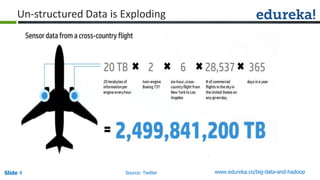
Un-structured Data is Exploding
Source: Twitter
Slide 5 www.edureka.co/big-data-and-hadoop
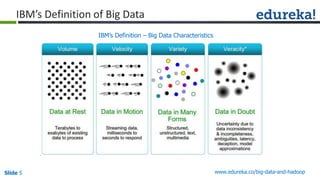
IBM’s Definition – Big Data Characteristics
http://www-01.ibm.com/software/data/bigdata/
IBM’s Definition of Big Data
Slide 6 www.edureka.co/big-data-and-hadoop
Annie’s Introduction
Hello There!!
My name is Annie.
I love quizzes and
puzzles and I am here to
make you guys think and
answer my questions.
Slide 7 www.edureka.co/big-data-and-hadoop
Annie’s Question
Map the following to corresponding data type:
» XML files, e-mail body
» Audio, Video, Images, Archived documents
» Data from Enterprise systems (ERP, CRM etc.)
Slide 8 www.edureka.co/big-data-and-hadoop
Annie’s Answer
Ans. XML files, e-mail body  Semi-structured data
Audio, Video, Image, Files, Archived documents  Unstructured data
Data from Enterprise systems (ERP, CRM etc.)  Structured data
Slide 9 www.edureka.co/big-data-and-hadoop
Further Reading
More on Big Data
http://www.edureka.in/blog/the-hype-behind-big-data/
Why Hadoop?
http://www.edureka.in/blog/why-hadoop/
Opportunities in Hadoop
http://www.edureka.in/blog/jobs-in-hadoop/
Big Data
http://en.wikipedia.org/wiki/Big_Data
IBM’s definition – Big Data Characteristics
http://www-01.ibm.com/software/data/bigdata/
Slide 10Slide 10Slide 10 www.edureka.co/big-data-and-hadoop
Common Big Data Customer Scenarios
 Web and e-tailing
» Recommendation Engines
» Ad Targeting
» Search Quality
» Abuse and Click Fraud Detection
 Telecommunications
» Customer Churn Prevention
» Network Performance Optimization
» Calling Data Record (CDR) Analysis
» Analysing Network to Predict Failure
http://wiki.apache.org/hadoop/PoweredBy
Slide 11Slide 11Slide 11 www.edureka.co/big-data-and-hadoop
 Government
» Fraud Detection and Cyber Security
» Welfare Schemes
» Justice
 Healthcare and Life Sciences
» Health Information Exchange
» Gene Sequencing
» Serialization
» Healthcare Service Quality Improvements
» Drug Safety
http://wiki.apache.org/hadoop/PoweredBy
Common Big Data Customer Scenarios (Contd.)
Slide 12Slide 12Slide 12 www.edureka.co/big-data-and-hadoop
Common Big Data Customer Scenarios (Contd.)
 Banks and Financial services
» Modeling True Risk
» Threat Analysis
» Fraud Detection
» Trade Surveillance
» Credit Scoring and Analysis
 Retail
» Point of Sales Transaction Analysis
» Customer Churn Analysis
» Sentiment Analysis
http://wiki.apache.org/hadoop/PoweredBy
Slide 13Slide 13Slide 13 www.edureka.co/big-data-and-hadoop
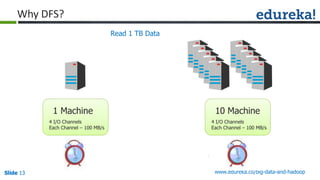
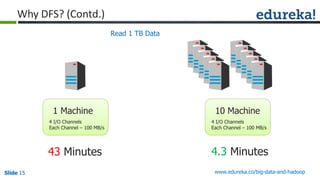
Why DFS?
Read 1 TB Data
4 I/O Channels
Each Channel – 100 MB/s
1 Machine
4 I/O Channels
Each Channel – 100 MB/s
10 Machine
Slide 14Slide 14Slide 14 www.edureka.co/big-data-and-hadoop
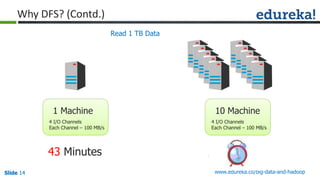
Why DFS? (Contd.)
4 I/O Channels
Each Channel – 100 MB/s
1 Machine
4 I/O Channels
Each Channel – 100 MB/s
10 Machine
43 Minutes
Read 1 TB Data
Slide 15Slide 15Slide 15 www.edureka.co/big-data-and-hadoop
Why DFS? (Contd.)
4 I/O Channels
Each Channel – 100 MB/s
1 Machine
4 I/O Channels
Each Channel – 100 MB/s
10 Machine
4.3 Minutes43 Minutes
Read 1 TB Data
Slide 16Slide 16Slide 16 www.edureka.co/big-data-and-hadoop
Slide 17 www.edureka.co/big-data-and-hadoop
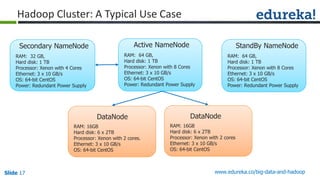
RAM: 16GB
Hard disk: 6 x 2TB
Processor: Xenon with 2 cores
Ethernet: 3 x 10 GB/s
OS: 64-bit CentOS
Hadoop Cluster: A Typical Use Case
RAM: 16GB
Hard disk: 6 x 2TB
Processor: Xenon with 2 cores.
Ethernet: 3 x 10 GB/s
OS: 64-bit CentOS
RAM: 64 GB,
Hard disk: 1 TB
Processor: Xenon with 8 Cores
Ethernet: 3 x 10 GB/s
OS: 64-bit CentOS
Power: Redundant Power Supply
RAM: 32 GB,
Hard disk: 1 TB
Processor: Xenon with 4 Cores
Ethernet: 3 x 10 GB/s
OS: 64-bit CentOS
Power: Redundant Power Supply
Active NameNodeSecondary NameNode
DataNode DataNode
RAM: 64 GB,
Hard disk: 1 TB
Processor: Xenon with 8 Cores
Ethernet: 3 x 10 GB/s
OS: 64-bit CentOS
Power: Redundant Power Supply
StandBy NameNode
Slide 18Slide 18Slide 18 www.edureka.co/big-data-and-hadoop
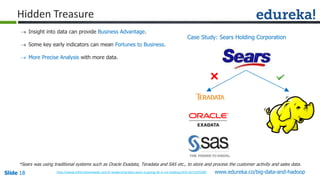
Hidden Treasure
 Insight into data can provide Business Advantage.
 Some key early indicators can mean Fortunes to Business.
 More Precise Analysis with more data.
*Sears was using traditional systems such as Oracle Exadata, Teradata and SAS etc., to store and process the customer activity and sales data.
Case Study: Sears Holding Corporation
http://www.informationweek.com/it-leadership/why-sears-is-going-all-in-on-hadoop/d/d-id/1107038?
Slide 19Slide 19Slide 19 www.edureka.co/big-data-and-hadoop
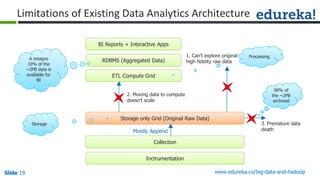
Mostly Append
BI Reports + Interactive Apps
RDBMS (Aggregated Data)
ETL Compute Grid
Storage only Grid (Original Raw Data)
Collection
Inctrumentation
A meagre
10% of the
~2PB data is
available for
BI
Storage
2. Moving data to compute
doesn’t scale
90% of
the ~2PB
archived
Processing
3. Premature data
death
1. Can’t explore original
high fidelity raw data
Limitations of Existing Data Analytics Architecture
Slide 20Slide 20Slide 20 www.edureka.co/big-data-and-hadoop
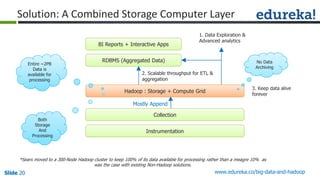
Mostly Append
BI Reports + Interactive Apps
RDBMS (Aggregated Data)
Hadoop : Storage + Compute Grid
Collection
Instrumentation
Both
Storage
And
Processing
Entire ~2PB
Data is
available for
processing
No Data
Archiving
1. Data Exploration &
Advanced analytics
2. Scalable throughput for ETL &
aggregation
3. Keep data alive
forever
*Sears moved to a 300-Node Hadoop cluster to keep 100% of its data available for processing rather than a meagre 10% as
was the case with existing Non-Hadoop solutions.
Solution: A Combined Storage Computer Layer
Slide 21 www.edureka.co/big-data-and-hadoop
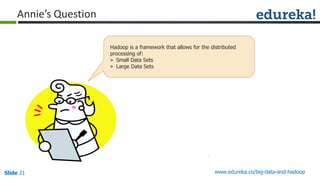
Annie’s Question
Hadoop is a framework that allows for the distributed
processing of:
» Small Data Sets
» Large Data Sets
Slide 22 www.edureka.co/big-data-and-hadoop
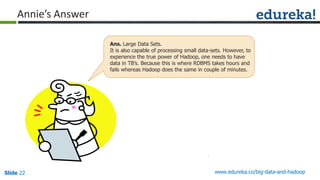
Annie’s Answer
Ans. Large Data Sets.
It is also capable of processing small data-sets. However, to
experience the true power of Hadoop, one needs to have
data in TB’s. Because this is where RDBMS takes hours and
fails whereas Hadoop does the same in couple of minutes.
Slide 23Slide 23Slide 23 www.edureka.co/big-data-and-hadoop
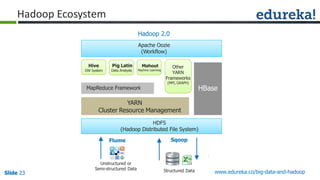
Hadoop Ecosystem
Pig Latin
Data Analysis
Hive
DW System
Other
YARN
Frameworks
(MPI, GRAPH)
HBaseMapReduce Framework
YARN
Cluster Resource Management
Apache Oozie
(Workflow)
HDFS
(Hadoop Distributed File System)
Hadoop 2.0
Sqoop
Unstructured or
Semi-structured Data Structured Data
Flume
Mahout
Machine Learning
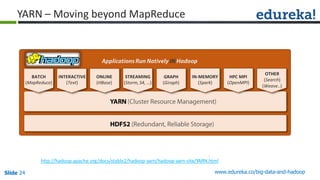
Slide 24 www.edureka.co/big-data-and-hadoop
BATCH
(MapReduce)
INTERACTIVE
(Text)
ONLINE
(HBase)
STREAMING
(Storm, S4, …)
GRAPH
(Giraph)
IN-MEMORY
(Spark)
HPC MPI
(OpenMPI)
OTHER
(Search)
(Weave..)
http://hadoop.apache.org/docs/stable2/hadoop-yarn/hadoop-yarn-site/YARN.html
YARN – Moving beyond MapReduce
Slide 25 www.edureka.co/big-data-and-hadoop
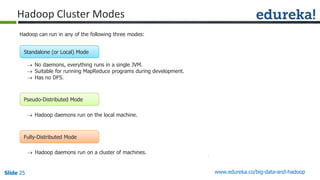
Hadoop can run in any of the following three modes:
Fully-Distributed Mode
Pseudo-Distributed Mode
 No daemons, everything runs in a single JVM.
 Suitable for running MapReduce programs during development.
 Has no DFS.
 Hadoop daemons run on the local machine.
 Hadoop daemons run on a cluster of machines.
Standalone (or Local) Mode
Hadoop Cluster Modes
Slide 26 www.edureka.co/big-data-and-hadoop
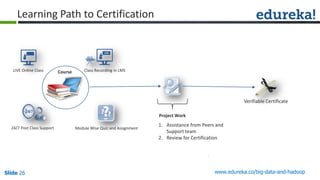
Learning Path to Certification
CourseLIVE Online Class Class Recording in LMS
24/7 Post Class Support Module Wise Quiz and Assignment
Project Work
Verifiable Certificate
1. Assistance from Peers and
Support team
2. Review for Certification
Slide 27Slide 27Slide 27 www.edureka.co/big-data-and-hadoop
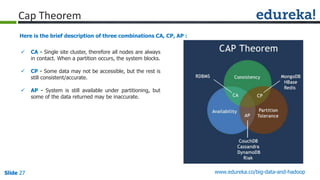
 CA - Single site cluster, therefore all nodes are always
in contact. When a partition occurs, the system blocks.
 CP - Some data may not be accessible, but the rest is
still consistent/accurate.
 AP - System is still available under partitioning, but
some of the data returned may be inaccurate.
Here is the brief description of three combinations CA, CP, AP :
Cap Theorem
Slide 28 www.edureka.co/big-data-and-hadoop
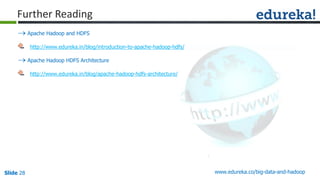
Further Reading
 Apache Hadoop and HDFS
http://www.edureka.in/blog/introduction-to-apache-hadoop-hdfs/
 Apache Hadoop HDFS Architecture
http://www.edureka.in/blog/apache-hadoop-hdfs-architecture/
Slide 29 www.edureka.co/big-data-and-hadoop
Assignment
Referring the documents present in the LMS under assignment solve the below problem.
How many such DataNodes you would need to read 100TB data in 5 minutes in your Hadoop Cluster?
Slide 30
Your feedback is important to us, be it a compliment, a suggestion or a complaint. It helps us to make
the course better!
Please spare few minutes to take the survey after the webinar.
www.edureka.co/big-data-and-hadoop
Survey
Introduction to Big data & Hadoop -I

Introduction to Big data & Hadoop -I

  • 1.
  • 2.
    Slide 2 www.edureka.co/big-data-and-hadoop Objectives Atthe end of this session , you will understand the:  Big Data Learning Paths  Big Data Introduction  Hadoop and Its Eco-System  Hadoop Architecture  Next Step on How to Setup Hadoop
  • 3.
    Slide 3 www.edureka.co/big-data-and-hadoop BigData Learning Path • Java / Python / Ruby • Hadoop Eco-system • NoSQL DB • Spark • Linux Administration • Cluster Management • Cluster Performance • Virtualization • Statistics Skills • Machine Learning • Hadoop Essentials • Expertise in R Developer/Testing Administration Data Analyst Big Data and Hadoop MapReduce Design Patterns Apache Spark & Scala Apache Cassandra Linux Administration Hadoop Administration Data Science Business Analytics Using R Advance Predictive Modelling in R Talend for Big Data Data Visualization Using Tableau
  • 4.
  • 5.
    Slide 5 www.edureka.co/big-data-and-hadoop IBM’sDefinition – Big Data Characteristics http://www-01.ibm.com/software/data/bigdata/ IBM’s Definition of Big Data
  • 6.
    Slide 6 www.edureka.co/big-data-and-hadoop Annie’sIntroduction Hello There!! My name is Annie. I love quizzes and puzzles and I am here to make you guys think and answer my questions.
  • 7.
    Slide 7 www.edureka.co/big-data-and-hadoop Annie’sQuestion Map the following to corresponding data type: » XML files, e-mail body » Audio, Video, Images, Archived documents » Data from Enterprise systems (ERP, CRM etc.)
  • 8.
    Slide 8 www.edureka.co/big-data-and-hadoop Annie’sAnswer Ans. XML files, e-mail body  Semi-structured data Audio, Video, Image, Files, Archived documents  Unstructured data Data from Enterprise systems (ERP, CRM etc.)  Structured data
  • 9.
    Slide 9 www.edureka.co/big-data-and-hadoop FurtherReading More on Big Data http://www.edureka.in/blog/the-hype-behind-big-data/ Why Hadoop? http://www.edureka.in/blog/why-hadoop/ Opportunities in Hadoop http://www.edureka.in/blog/jobs-in-hadoop/ Big Data http://en.wikipedia.org/wiki/Big_Data IBM’s definition – Big Data Characteristics http://www-01.ibm.com/software/data/bigdata/
  • 10.
    Slide 10Slide 10Slide10 www.edureka.co/big-data-and-hadoop Common Big Data Customer Scenarios  Web and e-tailing » Recommendation Engines » Ad Targeting » Search Quality » Abuse and Click Fraud Detection  Telecommunications » Customer Churn Prevention » Network Performance Optimization » Calling Data Record (CDR) Analysis » Analysing Network to Predict Failure http://wiki.apache.org/hadoop/PoweredBy
  • 11.
    Slide 11Slide 11Slide11 www.edureka.co/big-data-and-hadoop  Government » Fraud Detection and Cyber Security » Welfare Schemes » Justice  Healthcare and Life Sciences » Health Information Exchange » Gene Sequencing » Serialization » Healthcare Service Quality Improvements » Drug Safety http://wiki.apache.org/hadoop/PoweredBy Common Big Data Customer Scenarios (Contd.)
  • 12.
    Slide 12Slide 12Slide12 www.edureka.co/big-data-and-hadoop Common Big Data Customer Scenarios (Contd.)  Banks and Financial services » Modeling True Risk » Threat Analysis » Fraud Detection » Trade Surveillance » Credit Scoring and Analysis  Retail » Point of Sales Transaction Analysis » Customer Churn Analysis » Sentiment Analysis http://wiki.apache.org/hadoop/PoweredBy
  • 13.
    Slide 13Slide 13Slide13 www.edureka.co/big-data-and-hadoop Why DFS? Read 1 TB Data 4 I/O Channels Each Channel – 100 MB/s 1 Machine 4 I/O Channels Each Channel – 100 MB/s 10 Machine
  • 14.
    Slide 14Slide 14Slide14 www.edureka.co/big-data-and-hadoop Why DFS? (Contd.) 4 I/O Channels Each Channel – 100 MB/s 1 Machine 4 I/O Channels Each Channel – 100 MB/s 10 Machine 43 Minutes Read 1 TB Data
  • 15.
    Slide 15Slide 15Slide15 www.edureka.co/big-data-and-hadoop Why DFS? (Contd.) 4 I/O Channels Each Channel – 100 MB/s 1 Machine 4 I/O Channels Each Channel – 100 MB/s 10 Machine 4.3 Minutes43 Minutes Read 1 TB Data
  • 16.
    Slide 16Slide 16Slide16 www.edureka.co/big-data-and-hadoop
  • 17.
    Slide 17 www.edureka.co/big-data-and-hadoop RAM:16GB Hard disk: 6 x 2TB Processor: Xenon with 2 cores Ethernet: 3 x 10 GB/s OS: 64-bit CentOS Hadoop Cluster: A Typical Use Case RAM: 16GB Hard disk: 6 x 2TB Processor: Xenon with 2 cores. Ethernet: 3 x 10 GB/s OS: 64-bit CentOS RAM: 64 GB, Hard disk: 1 TB Processor: Xenon with 8 Cores Ethernet: 3 x 10 GB/s OS: 64-bit CentOS Power: Redundant Power Supply RAM: 32 GB, Hard disk: 1 TB Processor: Xenon with 4 Cores Ethernet: 3 x 10 GB/s OS: 64-bit CentOS Power: Redundant Power Supply Active NameNodeSecondary NameNode DataNode DataNode RAM: 64 GB, Hard disk: 1 TB Processor: Xenon with 8 Cores Ethernet: 3 x 10 GB/s OS: 64-bit CentOS Power: Redundant Power Supply StandBy NameNode
  • 18.
    Slide 18Slide 18Slide18 www.edureka.co/big-data-and-hadoop Hidden Treasure  Insight into data can provide Business Advantage.  Some key early indicators can mean Fortunes to Business.  More Precise Analysis with more data. *Sears was using traditional systems such as Oracle Exadata, Teradata and SAS etc., to store and process the customer activity and sales data. Case Study: Sears Holding Corporation http://www.informationweek.com/it-leadership/why-sears-is-going-all-in-on-hadoop/d/d-id/1107038?
  • 19.
    Slide 19Slide 19Slide19 www.edureka.co/big-data-and-hadoop Mostly Append BI Reports + Interactive Apps RDBMS (Aggregated Data) ETL Compute Grid Storage only Grid (Original Raw Data) Collection Inctrumentation A meagre 10% of the ~2PB data is available for BI Storage 2. Moving data to compute doesn’t scale 90% of the ~2PB archived Processing 3. Premature data death 1. Can’t explore original high fidelity raw data Limitations of Existing Data Analytics Architecture
  • 20.
    Slide 20Slide 20Slide20 www.edureka.co/big-data-and-hadoop Mostly Append BI Reports + Interactive Apps RDBMS (Aggregated Data) Hadoop : Storage + Compute Grid Collection Instrumentation Both Storage And Processing Entire ~2PB Data is available for processing No Data Archiving 1. Data Exploration & Advanced analytics 2. Scalable throughput for ETL & aggregation 3. Keep data alive forever *Sears moved to a 300-Node Hadoop cluster to keep 100% of its data available for processing rather than a meagre 10% as was the case with existing Non-Hadoop solutions. Solution: A Combined Storage Computer Layer
  • 21.
    Slide 21 www.edureka.co/big-data-and-hadoop Annie’sQuestion Hadoop is a framework that allows for the distributed processing of: » Small Data Sets » Large Data Sets
  • 22.
    Slide 22 www.edureka.co/big-data-and-hadoop Annie’sAnswer Ans. Large Data Sets. It is also capable of processing small data-sets. However, to experience the true power of Hadoop, one needs to have data in TB’s. Because this is where RDBMS takes hours and fails whereas Hadoop does the same in couple of minutes.
  • 23.
    Slide 23Slide 23Slide23 www.edureka.co/big-data-and-hadoop Hadoop Ecosystem Pig Latin Data Analysis Hive DW System Other YARN Frameworks (MPI, GRAPH) HBaseMapReduce Framework YARN Cluster Resource Management Apache Oozie (Workflow) HDFS (Hadoop Distributed File System) Hadoop 2.0 Sqoop Unstructured or Semi-structured Data Structured Data Flume Mahout Machine Learning
  • 24.
    Slide 24 www.edureka.co/big-data-and-hadoop BATCH (MapReduce) INTERACTIVE (Text) ONLINE (HBase) STREAMING (Storm,S4, …) GRAPH (Giraph) IN-MEMORY (Spark) HPC MPI (OpenMPI) OTHER (Search) (Weave..) http://hadoop.apache.org/docs/stable2/hadoop-yarn/hadoop-yarn-site/YARN.html YARN – Moving beyond MapReduce
  • 25.
    Slide 25 www.edureka.co/big-data-and-hadoop Hadoopcan run in any of the following three modes: Fully-Distributed Mode Pseudo-Distributed Mode  No daemons, everything runs in a single JVM.  Suitable for running MapReduce programs during development.  Has no DFS.  Hadoop daemons run on the local machine.  Hadoop daemons run on a cluster of machines. Standalone (or Local) Mode Hadoop Cluster Modes
  • 26.
    Slide 26 www.edureka.co/big-data-and-hadoop LearningPath to Certification CourseLIVE Online Class Class Recording in LMS 24/7 Post Class Support Module Wise Quiz and Assignment Project Work Verifiable Certificate 1. Assistance from Peers and Support team 2. Review for Certification
  • 27.
    Slide 27Slide 27Slide27 www.edureka.co/big-data-and-hadoop  CA - Single site cluster, therefore all nodes are always in contact. When a partition occurs, the system blocks.  CP - Some data may not be accessible, but the rest is still consistent/accurate.  AP - System is still available under partitioning, but some of the data returned may be inaccurate. Here is the brief description of three combinations CA, CP, AP : Cap Theorem
  • 28.
    Slide 28 www.edureka.co/big-data-and-hadoop FurtherReading  Apache Hadoop and HDFS http://www.edureka.in/blog/introduction-to-apache-hadoop-hdfs/  Apache Hadoop HDFS Architecture http://www.edureka.in/blog/apache-hadoop-hdfs-architecture/
  • 29.
    Slide 29 www.edureka.co/big-data-and-hadoop Assignment Referringthe documents present in the LMS under assignment solve the below problem. How many such DataNodes you would need to read 100TB data in 5 minutes in your Hadoop Cluster?
  • 30.
    Slide 30 Your feedbackis important to us, be it a compliment, a suggestion or a complaint. It helps us to make the course better! Please spare few minutes to take the survey after the webinar. www.edureka.co/big-data-and-hadoop Survey