Introduction to Behavioural
Sciences in Medical Practice
PSY 3015
J. M. Ncheka
1
Outline
• Introduction
• Definitions
• Foundations of behavioural sciences
• Role of behavioural science in medical
practice.
2
Introduction
• It is important to understand one’s own
behaviour and that of a patient.
• Understanding theories and methods of
behavioural sciences .
• Understand a range of behaviours occurring in
health care setting.
• Adopt holistic approach to health care.
3
Behavioral Science
• Behavioral science is any of discipline dealing
with the subject of human actions.
• Science of human behaviour.
• Concerned with study, observation and
explanation of human behaviour either in
single individuals or in a group.
4
• Study of individual differences in relation to
patient’s behaviour.
5
What is the Psychology
6
• Imagine you are seated in a restaurant next to
a stranger. You find out he/she is a
psychologist.
–What comes to your mind?
7
• Comes from two Greek word.
– Psyche (Soul)
– Logos (rational course/study)
• Defined as the study of the mind.
– What is mind?
– How can it be studied?
8
• The description and explanation of state of
consciousness/ science of consciousness
(James, Wundt).
– Excludes the activities of the subconscious and
unconscious mind.
9
• Psychology is a scientific study of behaviour
and mental processes.
• Three key terms:
– Science
– Behaviour
– Mental processes
10
• As a science
– Psychology uses systematic methods to observe,
describe, predict and explain behaviour.
11
• Behaviour
– Actions/reactions of an organism in relation to the
environment.
– Any form of life activity.
– Everything we do that can be directly observed.
– Can be conscious or unconscious
12
• Human behaviour can be influenced by:
– Culture
– Emotions
– Rapport
– Attitudes
13
• Mental processes
– Thoughts, feelings, motives
– Experienced privately
– Cannot be observed directly
– Though they are not observable, they are real and
can affect one’s behaviours.
14
FOUNDATIONS OF BEHAVIOURAL
SCIENCE
15
• 19th
Century
– Modern medicine
• Physical investigation
• Medical examination
16
• 20th
Century
– Challenges to some assumptions of biomedicine
– Increasing role of psychology in health
• Mind and body relationship
17
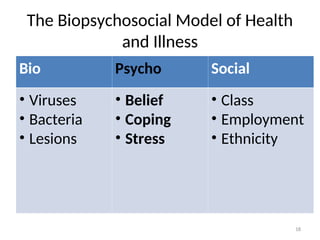
The Biopsychosocial Model of Health
and Illness
Bio Psycho Social
• Viruses
• Bacteria
• Lesions
• Belief
• Coping
• Stress
• Class
• Employment
• Ethnicity
18
ROLE OF BEHAVIOURAL SCIENCES
IN MEDICAL PRACTICE
19
• It helps in understanding:
– Causes of illness (mind body interactions).
– Presentation of illness.
– Delivery of health care
• Planning for health care assessment and
treatment.
20
• Plays a role in patient behaviour and
treatment compliance.
• Psychological tests help in diagnosis.
• Helps in communication.
• Understand uniqueness of individuals.
• Helps in creating a doctor-patient relationship.
21
Summary
22

Introduction to Behavioural Sciences in Medical Practice.ppt

  • 1.
    Introduction to Behavioural Sciencesin Medical Practice PSY 3015 J. M. Ncheka 1
  • 2.
    Outline • Introduction • Definitions •Foundations of behavioural sciences • Role of behavioural science in medical practice. 2
  • 3.
    Introduction • It isimportant to understand one’s own behaviour and that of a patient. • Understanding theories and methods of behavioural sciences . • Understand a range of behaviours occurring in health care setting. • Adopt holistic approach to health care. 3
  • 4.
    Behavioral Science • Behavioralscience is any of discipline dealing with the subject of human actions. • Science of human behaviour. • Concerned with study, observation and explanation of human behaviour either in single individuals or in a group. 4
  • 5.
    • Study ofindividual differences in relation to patient’s behaviour. 5
  • 6.
    What is thePsychology 6
  • 7.
    • Imagine youare seated in a restaurant next to a stranger. You find out he/she is a psychologist. –What comes to your mind? 7
  • 8.
    • Comes fromtwo Greek word. – Psyche (Soul) – Logos (rational course/study) • Defined as the study of the mind. – What is mind? – How can it be studied? 8
  • 9.
    • The descriptionand explanation of state of consciousness/ science of consciousness (James, Wundt). – Excludes the activities of the subconscious and unconscious mind. 9
  • 10.
    • Psychology isa scientific study of behaviour and mental processes. • Three key terms: – Science – Behaviour – Mental processes 10
  • 11.
    • As ascience – Psychology uses systematic methods to observe, describe, predict and explain behaviour. 11
  • 12.
    • Behaviour – Actions/reactionsof an organism in relation to the environment. – Any form of life activity. – Everything we do that can be directly observed. – Can be conscious or unconscious 12
  • 13.
    • Human behaviourcan be influenced by: – Culture – Emotions – Rapport – Attitudes 13
  • 14.
    • Mental processes –Thoughts, feelings, motives – Experienced privately – Cannot be observed directly – Though they are not observable, they are real and can affect one’s behaviours. 14
  • 15.
  • 16.
    • 19th Century – Modernmedicine • Physical investigation • Medical examination 16
  • 17.
    • 20th Century – Challengesto some assumptions of biomedicine – Increasing role of psychology in health • Mind and body relationship 17
  • 18.
    The Biopsychosocial Modelof Health and Illness Bio Psycho Social • Viruses • Bacteria • Lesions • Belief • Coping • Stress • Class • Employment • Ethnicity 18
  • 19.
    ROLE OF BEHAVIOURALSCIENCES IN MEDICAL PRACTICE 19
  • 20.
    • It helpsin understanding: – Causes of illness (mind body interactions). – Presentation of illness. – Delivery of health care • Planning for health care assessment and treatment. 20
  • 21.
    • Plays arole in patient behaviour and treatment compliance. • Psychological tests help in diagnosis. • Helps in communication. • Understand uniqueness of individuals. • Helps in creating a doctor-patient relationship. 21
  • 22.