
SPPU
BE CIVIL ENGINEERNG
Construction Management
© Mr. Shrikant R. Kate 1
Unit-6
Introduction to Artificial Intelligence Technique
Shrikant R. Kate
BE Civil, M Tech Construction Management
Syllabus
Introduction to artificial intelligence technique
Basic terminologies and applications in civil
Engineering.
(a) Artificial neural network
(b) Fuzzi logic
(c) Genetic algorithm.
© Mr. Shrikant R. Kate 2
Artificial Intelligence
AI is combination of - computer science ,
cybernetics, information theory, psychology,
Linguistics and neurophysiology.
AI is branch of science which deals with helping
machines, finds solution to complex problems
in a more human like fashion.
Borrowing characteristics from human
intelligence & applying then as algorithms in
computer friendly way.
© Mr. Shrikant R. Kate 3
Artificial Intelligence
In field of Civil Engineering – many problems like
engineering design, construction management &
program decision-making, were influenced by many
uncertainties which could be solved not only in need
of mathematics, physics and mechanics calculations
but also depend on the experience of practitioners.
Problem solve by :
1.The analysis of natural & artificial agents
2.Formulating & testing hypothesis
3.Designing , building & experimenting with
computational system
© Mr. Shrikant R. Kate 4
Artificial Intelligence
In structure mechanics & construction Materials context,
recent experiments have reported that fuzzy logic (FZ),
artificial neural networks (ANN), genetic algorithm
(GA) & Fuuzy genetic (FG) may offer a promising
alternative.
They are know as AI.
Application Civil Engineering :
1. Construction Management
2. Building Material
3. Hydraulic
4. Optimization
5. Geotechnical & Transportation Engineering
© Mr. Shrikant R. Kate 5
Artificial Intelligence
Various Definition of AI :
“ AI is the study of ideas which enable computers to do
things which make people seem intelligent.”
“Computational techniques for performing tasks that
apparently require intelligence when performed by
humans.”
“Artificial Intelligence is to artificial flowers as natural
intelligence is to natural flowers.”
“The branch of computer science that is concerned with
automation of intelligent behavior.”
“AI is the study of how to make computers do things
which , at the moment, people do better.”
© Mr. Shrikant R. Kate 6
Artificial Neural Network
Introduction:
It is mathematical inventions developed wrt biological
system.
Defined as “Mapping an input space to output space.”
Basic building block of artificial neuron network is
artificial neuron, which simple mathematical meodel.
Model content 3 stages :
1. Multiplication
2. Summation
3. Activation
© Mr. Shrikant R. Kate 7
Artificial Neural Network
Working Principle of Artificial Neuron:
At entrance: Input weighated (By multiplying with individual
weight)
In middle: Sum functions (sum all input & bias)
At exist: Previous sum passing through activation function called
transfer function
This ANN use simple fact that complexity can grow out of merely
few basic and simple rules.
Application : Process control, chemistry, gaming, radar system,
automotive industry, astronomy, banking, fraud detection,
regression analysis, time series prediction, data processing.
© Mr. Shrikant R. Kate 8
Artificial Neural Network
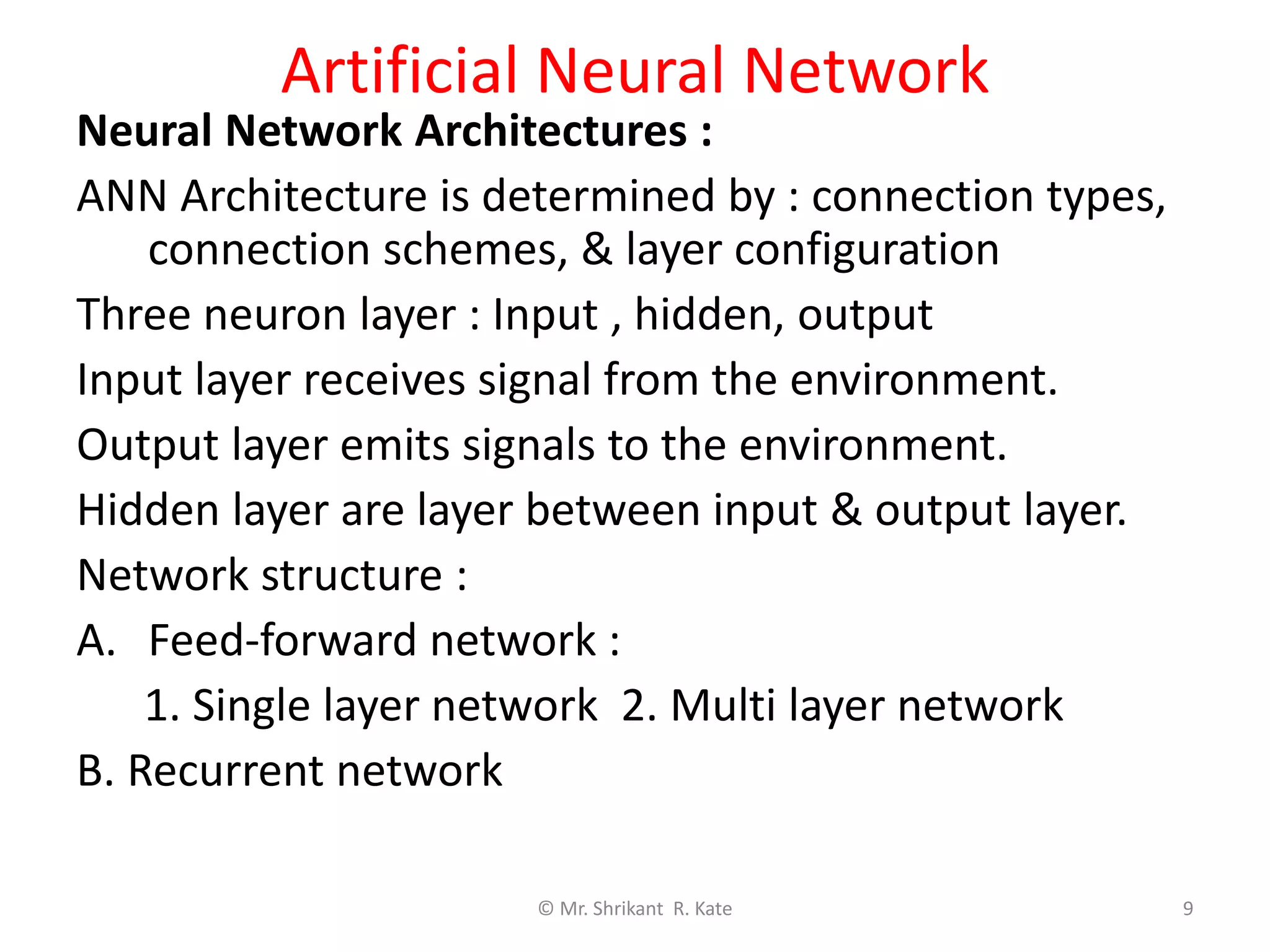
Neural Network Architectures :
ANN Architecture is determined by : connection types,
connection schemes, & layer configuration
Three neuron layer : Input , hidden, output
Input layer receives signal from the environment.
Output layer emits signals to the environment.
Hidden layer are layer between input & output layer.
Network structure :
A. Feed-forward network :
1. Single layer network 2. Multi layer network
B. Recurrent network
© Mr. Shrikant R. Kate 9
Artificial Neural Network
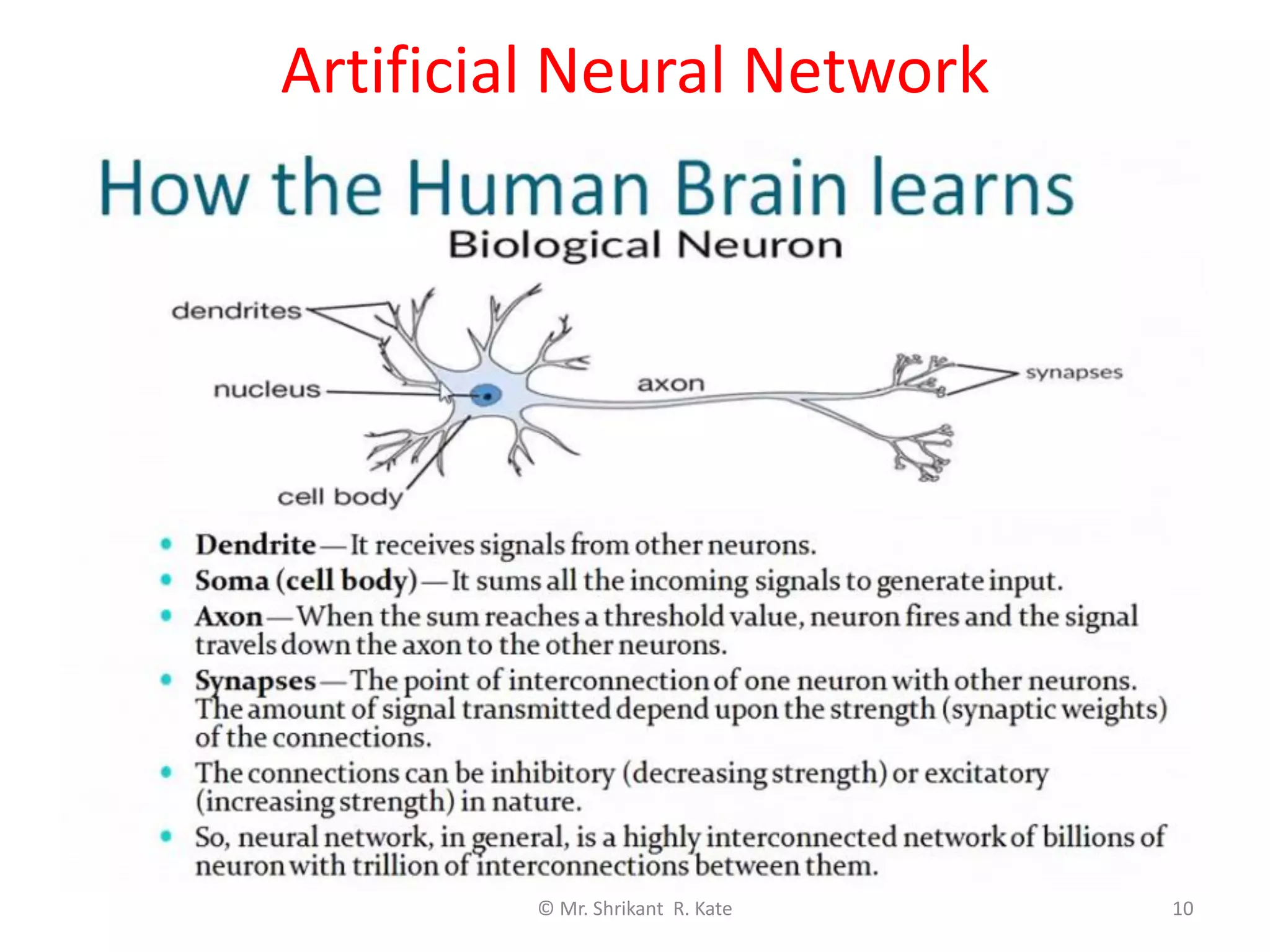
© Mr. Shrikant R. Kate 10
Artificial Neural Network
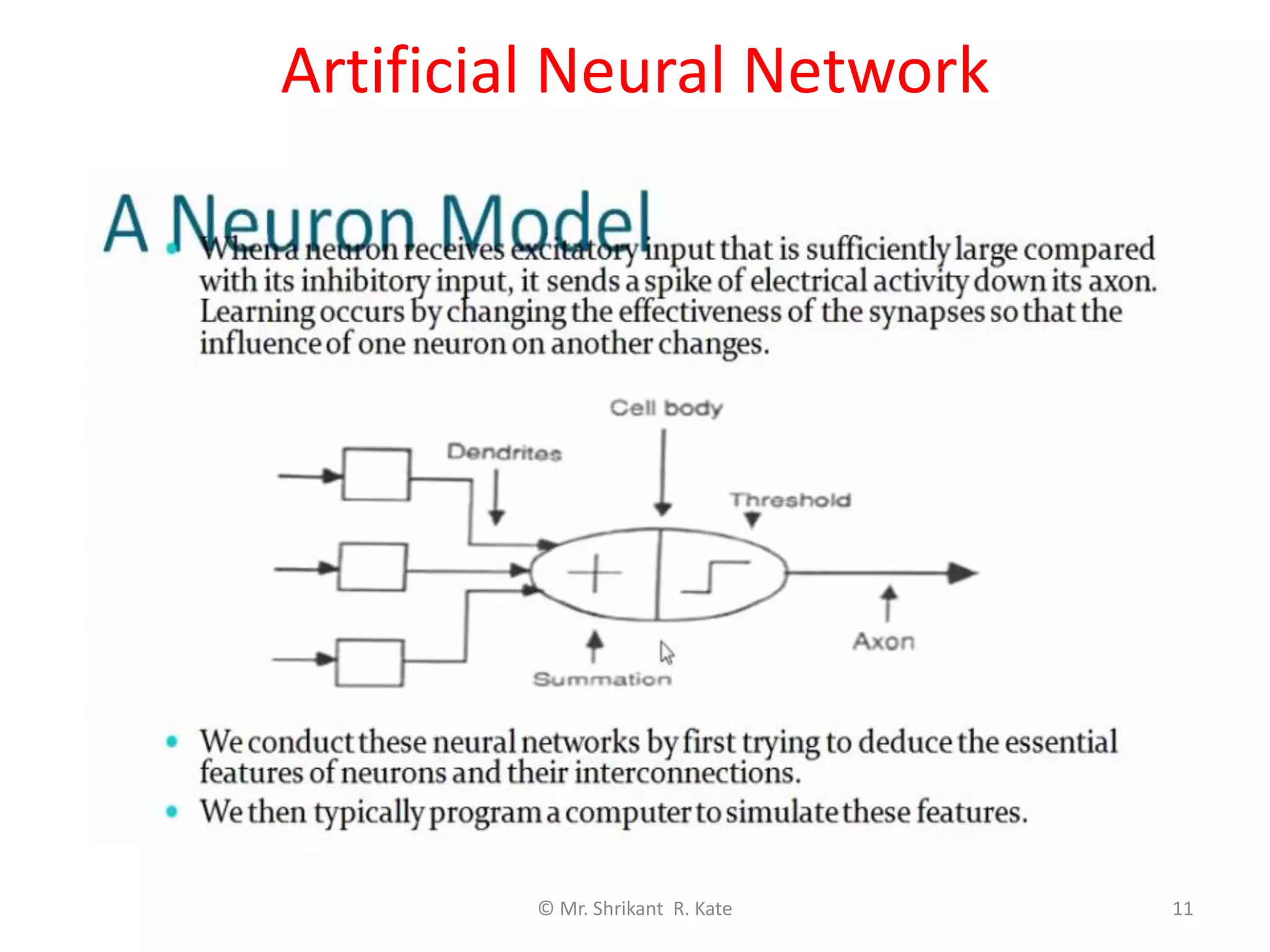
© Mr. Shrikant R. Kate 11
Fuzzy Logic
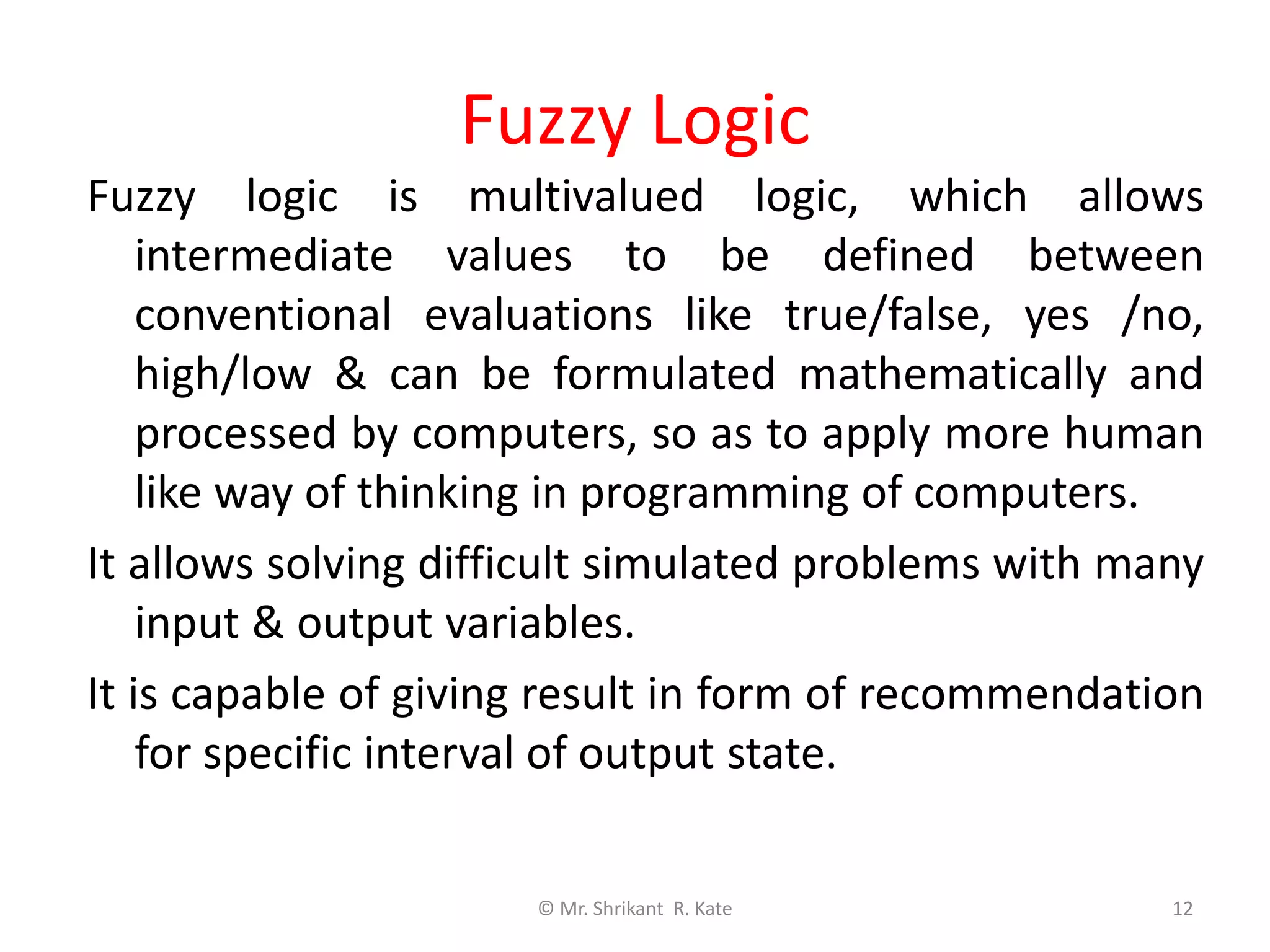
Fuzzy logic is multivalued logic, which allows
intermediate values to be defined between
conventional evaluations like true/false, yes /no,
high/low & can be formulated mathematically and
processed by computers, so as to apply more human
like way of thinking in programming of computers.
It allows solving difficult simulated problems with many
input & output variables.
It is capable of giving result in form of recommendation
for specific interval of output state.
© Mr. Shrikant R. Kate 12
Fuzzy Logic
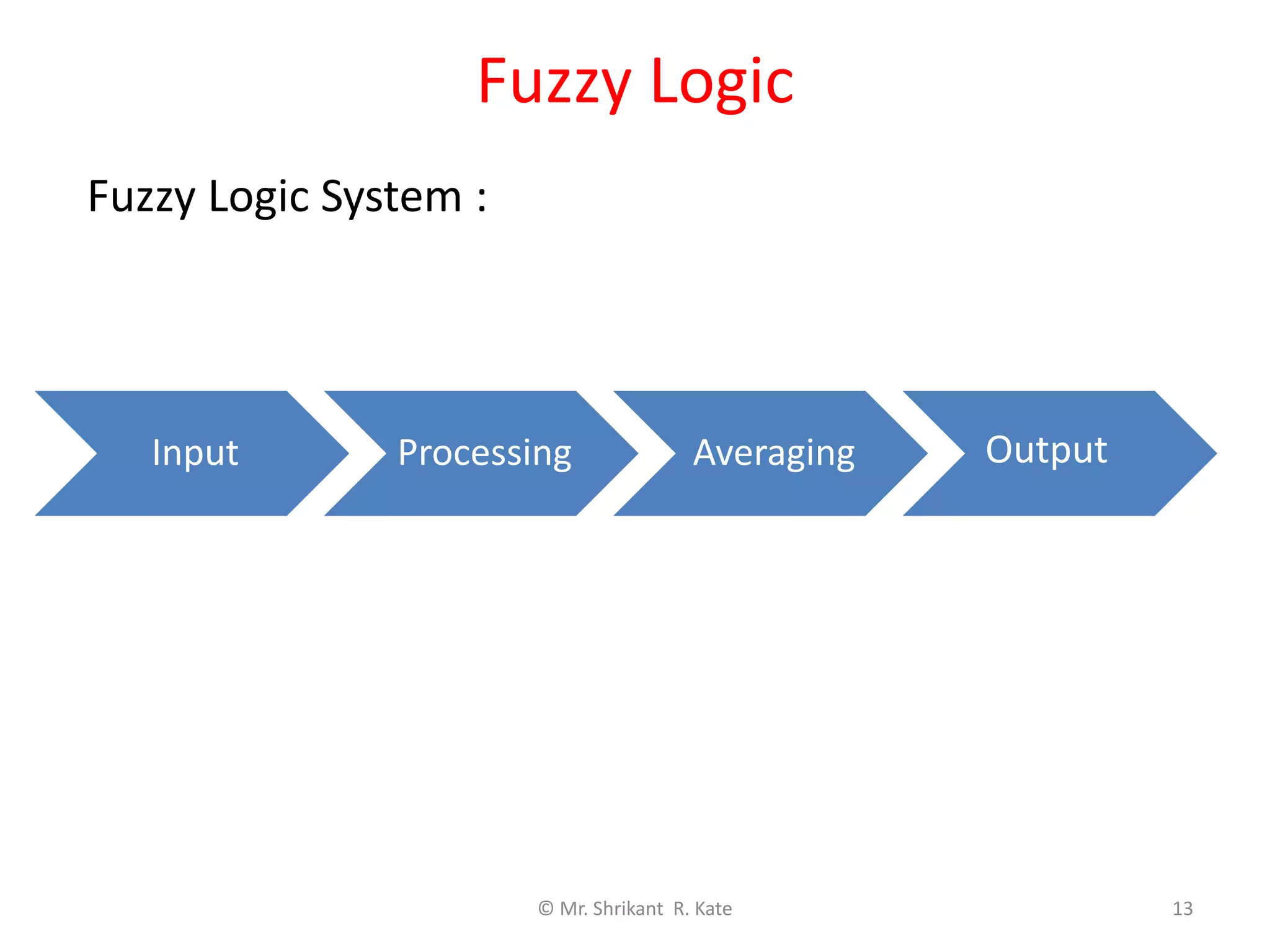
Fuzzy Logic System :
© Mr. Shrikant R. Kate 13
Input Processing Averaging Output
Fuzzy Logic
Fuzzification :
Fuzzification is the first step in fuzzy inference process.
This domain transformation where crisp input are
transformed into fuzzy inputs.
Crisp inputs are exact inputs measured by sensors and
passed into the control system for processing such as
temperature, pressure.
Various membership function :
1. Triangular MF
2. Trapezoidal MF
3. Bell Shaped MF
4. Gaussian MF
5. Sigmoidal MF
© Mr. Shrikant R. Kate 14
Output
Fuzzy Logic
Application of Fuzzy Logic :
1. Aerospace
2. Automotive
3. Business
4. Chemical Industry
5. Defense
6. Electronics
7. Financial
8. Industrial
9. Marine
10. Medical
11. Robotics
© Mr. Shrikant R. Kate 15
Output
Genetic Algorithms
© Mr. Shrikant R. Kate 16
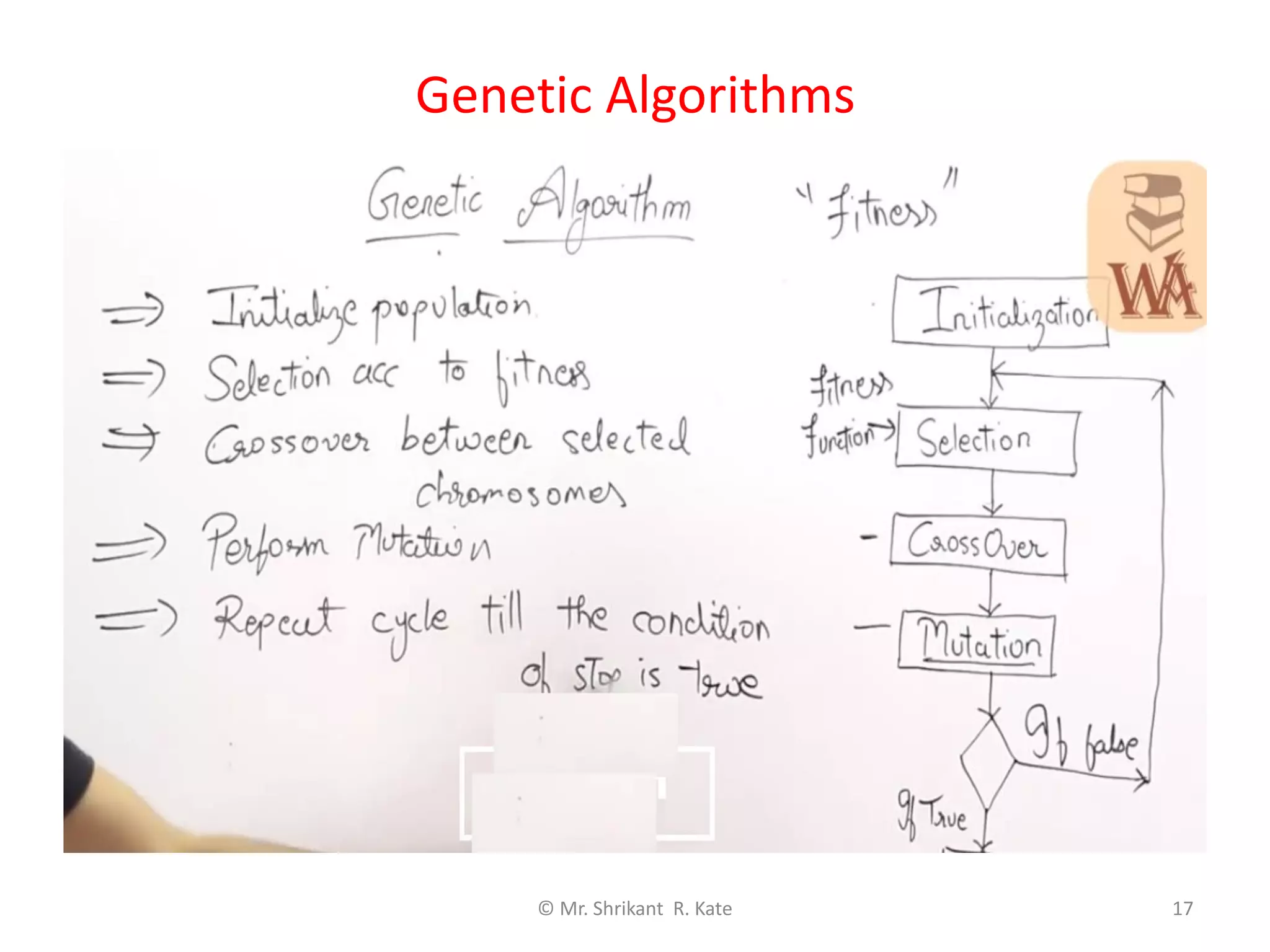
Introduction :
Genetic algorithm carry out directed random searches
through a given set of alternatives with the aim of
finding the best alternatives with respect to given
criteria of goodness.
Criteria express as objective function referred as fitness
function.
Genetic algorithm are intelligent exploitation of
random search used in optimization problems.
Genetic Algorithms
© Mr. Shrikant R. Kate 17
Genetic Algorithms
© Mr. Shrikant R. Kate 18
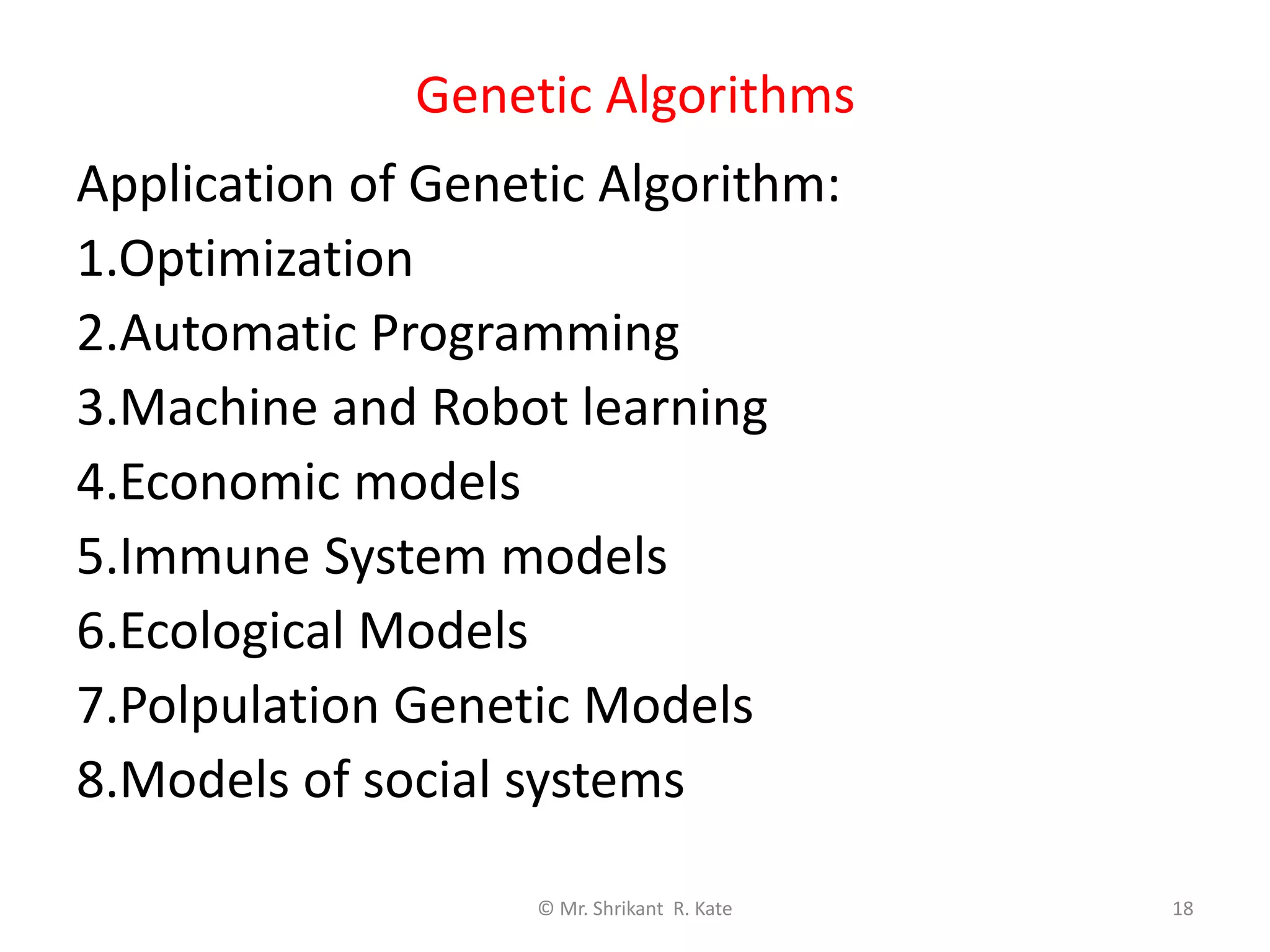
Application of Genetic Algorithm:
1.Optimization
2.Automatic Programming
3.Machine and Robot learning
4.Economic models
5.Immune System models
6.Ecological Models
7.Polpulation Genetic Models
8.Models of social systems
Expert System
© Mr. Shrikant R. Kate 19
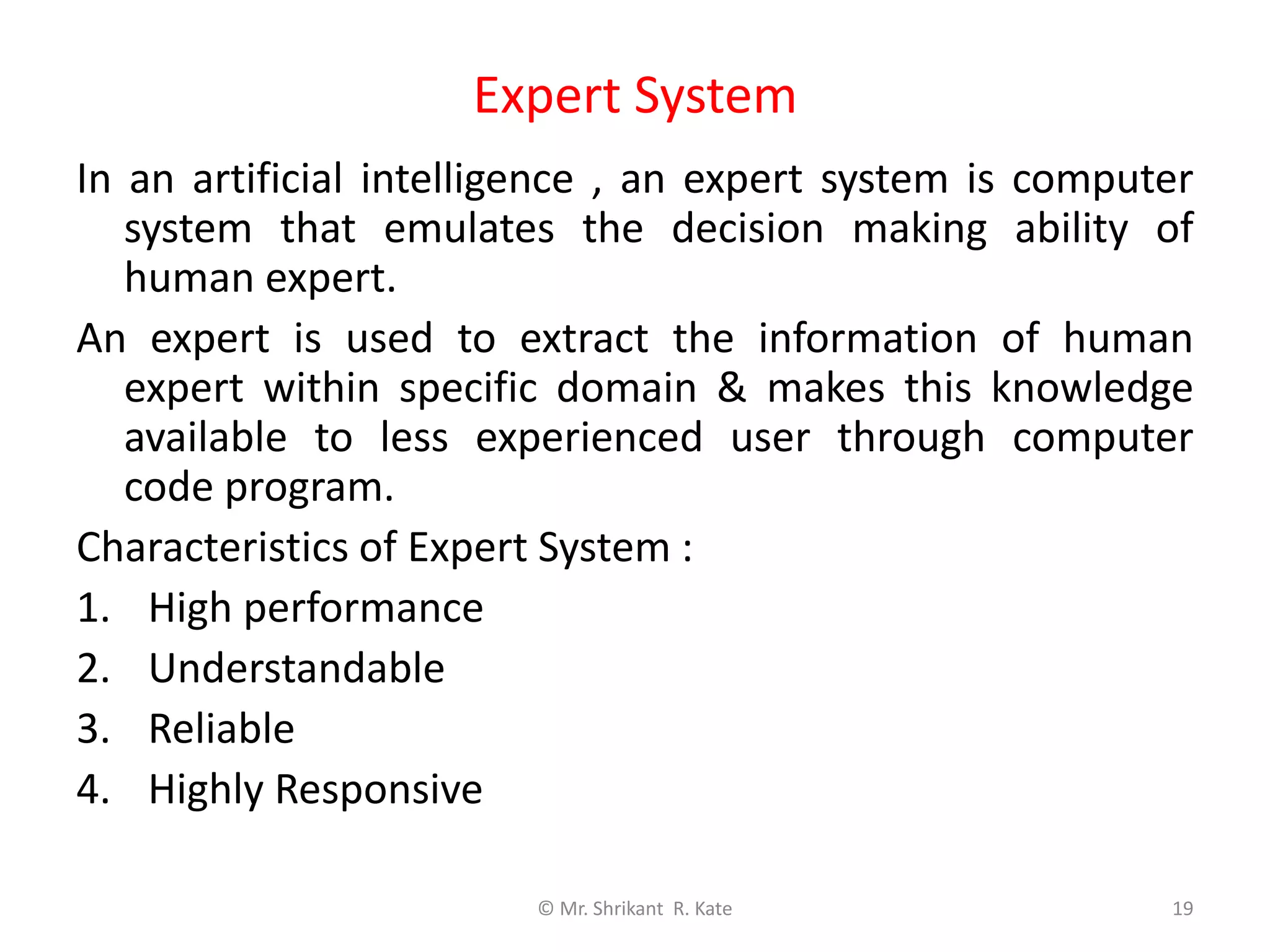
In an artificial intelligence , an expert system is computer
system that emulates the decision making ability of
human expert.
An expert is used to extract the information of human
expert within specific domain & makes this knowledge
available to less experienced user through computer
code program.
Characteristics of Expert System :
1. High performance
2. Understandable
3. Reliable
4. Highly Responsive
Expert System
© Mr. Shrikant R. Kate 20
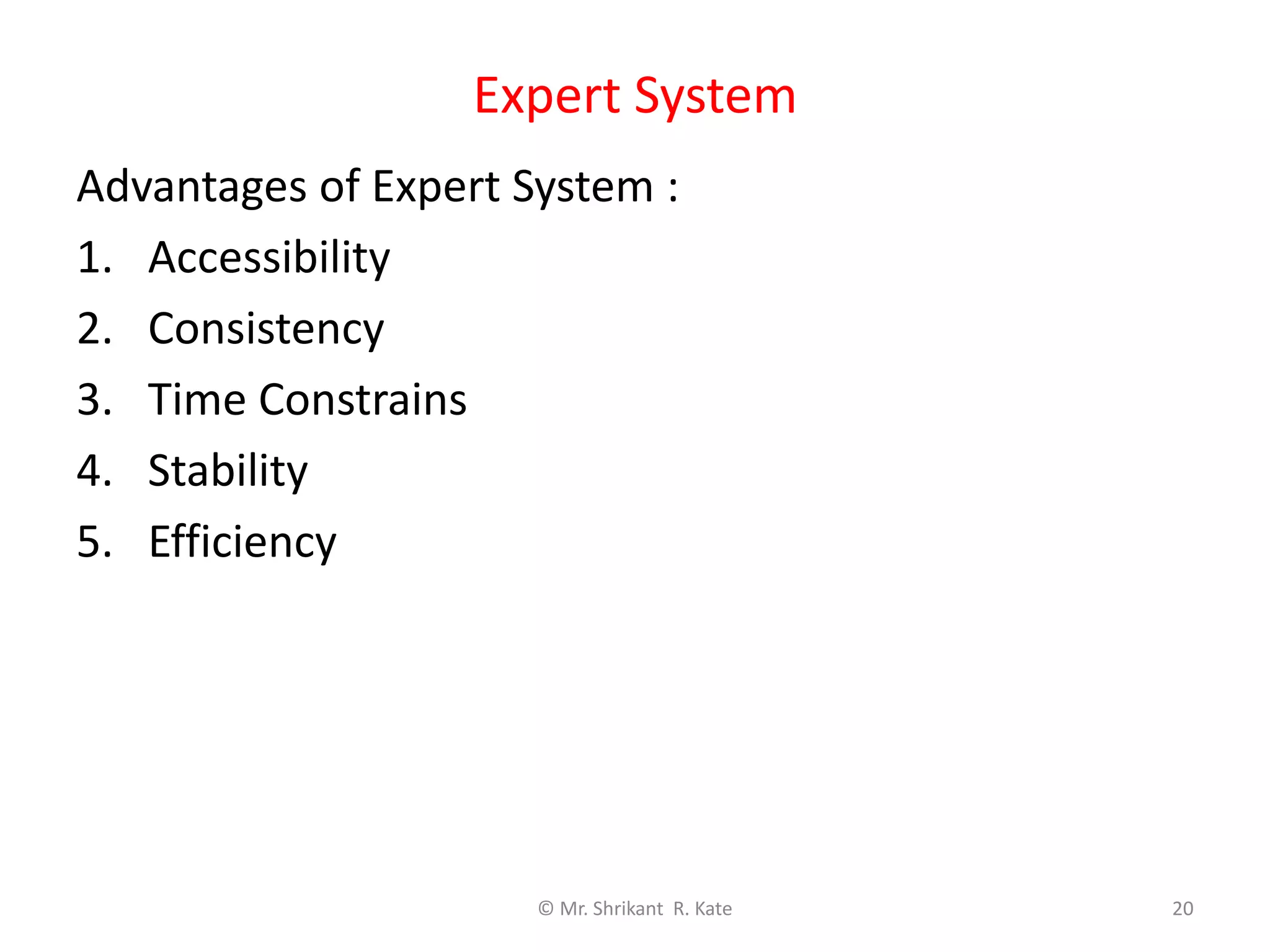
Advantages of Expert System :
1. Accessibility
2. Consistency
3. Time Constrains
4. Stability
5. Efficiency
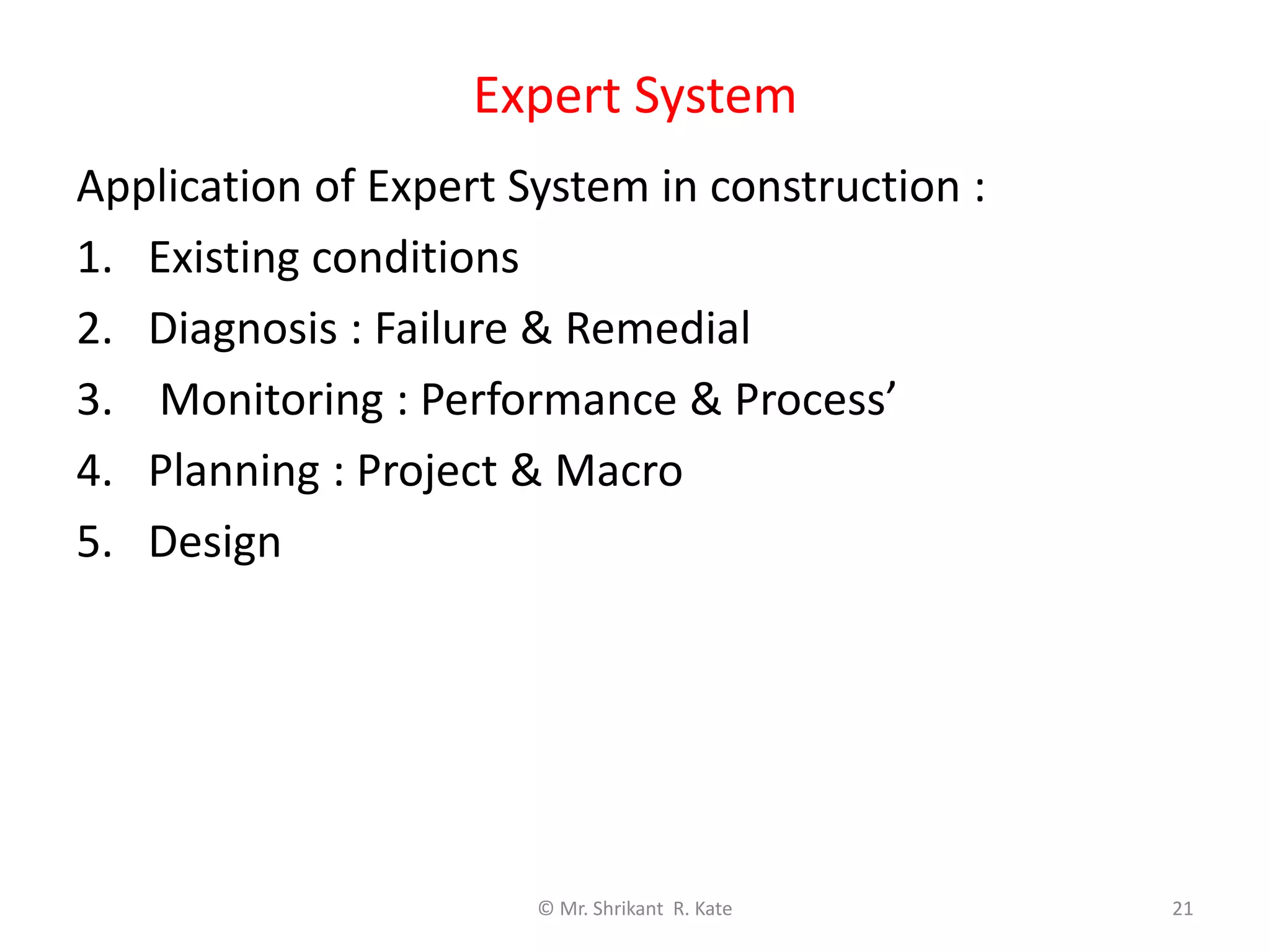
Expert System
© Mr. Shrikant R. Kate 21
Application of Expert System in construction :
1. Existing conditions
2. Diagnosis : Failure & Remedial
3. Monitoring : Performance & Process’
4. Planning : Project & Macro
5. Design
© Mr. Shrikant R. Kate 22

Introduction to Artificial Intelligence Technique for Civil Engineering_ Unit 6 _ Construction Management _ Final Year (BE) _ Department of Civil Engineering _ TAE _ SPPU _ by Shrikant R. Kate

  • 1.
    SPPU BE CIVIL ENGINEERNG ConstructionManagement © Mr. Shrikant R. Kate 1 Unit-6 Introduction to Artificial Intelligence Technique Shrikant R. Kate BE Civil, M Tech Construction Management
  • 2.
    Syllabus Introduction to artificialintelligence technique Basic terminologies and applications in civil Engineering. (a) Artificial neural network (b) Fuzzi logic (c) Genetic algorithm. (c) Genetic algorithm. © Mr. Shrikant R. Kate 2
  • 3.
    Artificial Intelligence AI iscombination of - computer science , cybernetics, information theory, psychology, Linguistics and neurophysiology. AI is branch of science which deals with helping machines, finds solution to complex problems in a more human like fashion. Borrowing characteristics from human intelligence & applying then as algorithms in computer friendly way. © Mr. Shrikant R. Kate 3
  • 4.
    Artificial Intelligence In fieldof Civil Engineering – many problems like engineering design, construction management & program decision-making, were influenced by many uncertainties which could be solved not only in need of mathematics, physics and mechanics calculations but also depend on the experience of practitioners. Problem solve by : 1.The analysis of natural & artificial agents 2.Formulating & testing hypothesis 3.Designing , building & experimenting with computational system © Mr. Shrikant R. Kate 4
  • 5.
    Artificial Intelligence In structuremechanics & construction Materials context, recent experiments have reported that fuzzy logic (FZ), artificial neural networks (ANN), genetic algorithm (GA) & Fuuzy genetic (FG) may offer a promising alternative. They are know as AI. Application Civil Engineering : 1. Construction Management 2. Building Material 3. Hydraulic 4. Optimization 5. Geotechnical & Transportation Engineering © Mr. Shrikant R. Kate 5
  • 6.
    Artificial Intelligence Various Definitionof AI : “ AI is the study of ideas which enable computers to do things which make people seem intelligent.” “Computational techniques for performing tasks that apparently require intelligence when performed by humans.” “Artificial Intelligence is to artificial flowers as natural intelligence is to natural flowers.” “The branch of computer science that is concerned with automation of intelligent behavior.” “AI is the study of how to make computers do things which , at the moment, people do better.” © Mr. Shrikant R. Kate 6
  • 7.
    Artificial Neural Network Introduction: Itis mathematical inventions developed wrt biological system. Defined as “Mapping an input space to output space.” Basic building block of artificial neuron network is artificial neuron, which simple mathematical meodel. Model content 3 stages : 1. Multiplication 2. Summation 3. Activation © Mr. Shrikant R. Kate 7
  • 8.
    Artificial Neural Network WorkingPrinciple of Artificial Neuron: At entrance: Input weighated (By multiplying with individual weight) In middle: Sum functions (sum all input & bias) At exist: Previous sum passing through activation function called transfer function This ANN use simple fact that complexity can grow out of merely few basic and simple rules. Application : Process control, chemistry, gaming, radar system, automotive industry, astronomy, banking, fraud detection, regression analysis, time series prediction, data processing. © Mr. Shrikant R. Kate 8
  • 9.
    Artificial Neural Network NeuralNetwork Architectures : ANN Architecture is determined by : connection types, connection schemes, & layer configuration Three neuron layer : Input , hidden, output Input layer receives signal from the environment. Output layer emits signals to the environment. Hidden layer are layer between input & output layer. Network structure : A. Feed-forward network : 1. Single layer network 2. Multi layer network B. Recurrent network © Mr. Shrikant R. Kate 9
  • 10.
    Artificial Neural Network ©Mr. Shrikant R. Kate 10
  • 11.
    Artificial Neural Network ©Mr. Shrikant R. Kate 11
  • 12.
    Fuzzy Logic Fuzzy logicis multivalued logic, which allows intermediate values to be defined between conventional evaluations like true/false, yes /no, high/low & can be formulated mathematically and processed by computers, so as to apply more human like way of thinking in programming of computers. It allows solving difficult simulated problems with many input & output variables. It is capable of giving result in form of recommendation for specific interval of output state. © Mr. Shrikant R. Kate 12
  • 13.
    Fuzzy Logic Fuzzy LogicSystem : © Mr. Shrikant R. Kate 13 Input Processing Averaging Output
  • 14.
    Fuzzy Logic Fuzzification : Fuzzificationis the first step in fuzzy inference process. This domain transformation where crisp input are transformed into fuzzy inputs. Crisp inputs are exact inputs measured by sensors and passed into the control system for processing such as temperature, pressure. Various membership function : 1. Triangular MF 2. Trapezoidal MF 3. Bell Shaped MF 4. Gaussian MF 5. Sigmoidal MF © Mr. Shrikant R. Kate 14 Output
  • 15.
    Fuzzy Logic Application ofFuzzy Logic : 1. Aerospace 2. Automotive 3. Business 4. Chemical Industry 5. Defense 6. Electronics 7. Financial 8. Industrial 9. Marine 10. Medical 11. Robotics © Mr. Shrikant R. Kate 15 Output
  • 16.
    Genetic Algorithms © Mr.Shrikant R. Kate 16 Introduction : Genetic algorithm carry out directed random searches through a given set of alternatives with the aim of finding the best alternatives with respect to given criteria of goodness. Criteria express as objective function referred as fitness function. Genetic algorithm are intelligent exploitation of random search used in optimization problems.
  • 17.
    Genetic Algorithms © Mr.Shrikant R. Kate 17
  • 18.
    Genetic Algorithms © Mr.Shrikant R. Kate 18 Application of Genetic Algorithm: 1.Optimization 2.Automatic Programming 3.Machine and Robot learning 4.Economic models 5.Immune System models 6.Ecological Models 7.Polpulation Genetic Models 8.Models of social systems
  • 19.
    Expert System © Mr.Shrikant R. Kate 19 In an artificial intelligence , an expert system is computer system that emulates the decision making ability of human expert. An expert is used to extract the information of human expert within specific domain & makes this knowledge available to less experienced user through computer code program. Characteristics of Expert System : 1. High performance 2. Understandable 3. Reliable 4. Highly Responsive
  • 20.
    Expert System © Mr.Shrikant R. Kate 20 Advantages of Expert System : 1. Accessibility 2. Consistency 3. Time Constrains 4. Stability 5. Efficiency
  • 21.
    Expert System © Mr.Shrikant R. Kate 21 Application of Expert System in construction : 1. Existing conditions 2. Diagnosis : Failure & Remedial 3. Monitoring : Performance & Process’ 4. Planning : Project & Macro 5. Design
  • 22.
    © Mr. ShrikantR. Kate 22