GOOD MORNING
BY:
FIROJ PRAKASH KHATRI
B.TECH 3RD YEAR (CIVIL)
SIGNIFICANCE OF AI IN CIVIL
ENGINEERING
•Introduction
•History/Development
•Application of AI in civil engineering
Role of Smart Materials
Role of Artificial Neural Materials
•Conclusion
INTRODUCTION
• System to understand
intelligent entities,
construct them and
make the process of
decision making simple,
quick and efficient.
• Based on computer
science, cybernetics,
information theory,
psychology and
neurophysiology.
• A branch of science,
involved in the research,
HISTORY/DEVELOPMENT
• The term Artificial Intelligence was coined by
John McCarthy attempts to describe the
process of human thinking as a mechanical
manipulation of symbols was started in
1940s
The IBM 702: a computer used by the first generation of
AI researchers.
APPLICATION OF AI IN CIVIL ENGINEERING
• Role of Smart Materials
• Role of Artificial Neural Materials
ROLE OF SMART MATERIALS
• Structural Health Monitoring
• Self-Repair materials
• Structural Engineering
• Waste management
• Concrete mix design
• Estimation
STRUCTURAL HEALTH MONITORING
• Embedding sensors within
structures to monitor stress
and damage can reduce
maintenance costs and
increase the lifespan
• This is already being used in
over forty bridges worldwide
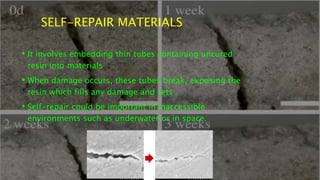
SELF-REPAIR MATERIALS
• It involves embedding thin tubes containing uncured
resin into materials
• When damage occurs, these tubes break, exposing the
resin which fills any damage and sets
• Self-repair could be important in inaccessible
environments such as underwater or in space.
STRUCTURAL ENGINEERING
• They are used to evaluate durability
• they adapt to their surrounding environment such as the ability
to move, vibrate and demonstrate various other responses
• For monitoring the integrity of bridges, dams, offshore oil-
drilling towers where fiber-optic sensors embedded in the
structures are utilized to identify the trouble areas
WASTE MANAGEMENT
• Manual disassembly of the waste is a
challenging, expensive and time
consuming task but the use of smart
materials could help to automate the
process.
• Even it shows a role in food waste
management
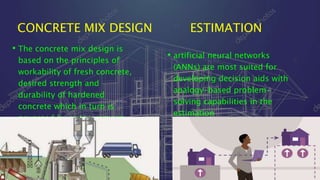
CONCRETE MIX DESIGN ESTIMATION
• The concrete mix design is
based on the principles of
workability of fresh concrete,
desired strength and
durability of hardened
concrete which in turn is
governed by water-cement
ratio law
• artificial neural networks
(ANNs) are most suited for
developing decision aids with
analogy-based problem-
solving capabilities in the
estimation
ROLE OF ARTIFICIAL NEURAL MATERIALS
• Neuro-model -Neural Network System for Modular
Construction Decision Making
• Initial Design Process using Artificial Neural Network
• Planning of Construction Projects
• Construction Robot Fleet Management System Prototype
• Bridge Planning Using GIS and Expert System Approach
• Artificial Neural Network Approach for Pavement Maintenance
• Tidal Forecasting
• Earthquake-Induced Liquefaction
NEURO-MODEL -NEURAL NETWORK
SYSTEM FOR MODULAR
CONSTRUCTION DECISION MAKING
• This model helps to make a
decision whether to use a
conventional "stick-built" method
or to use some degree of
modularization in a particular
project
• project location, environmental and
organizational, labor-related,
project characteristics, and project
risks
INITIAL DESIGN PROCESS USING
ARTIFICIAL NEURAL NETWORK
• The preliminary design model is of
vital importance in the synthesis of a
finally acceptable solution. The
network predicts a good initial design
PLANNING OF CONSTRUCTION
PROJECTS
• AI has its application to generate
plans in all the stages of the
project, descriptions of actions
along with their preconditions
and effects, and selection of new
actions to be inserted into a
project plan
CONSTRUCTION ROBOT FLEET
MANAGEMENT SYSTEM PROTOTYPE
• Implemented on construction job
sites for the efficient management of
time and cost
• Japan has developed their own fleet
of construction robots for future
construction sites.
• Bridge Planning Using GIS and
Expert System Approach
• GIS is a tool which can be
incorporated for the effective data
collection so that in near future, it
can be practiced
• In the planning process of a new
road network, possible locations of
bridges and tunnels
• Artificial Neural Network Approach for
Pavement Maintenance
• The major objective is to assist
decision makers in selecting an
appropriate maintenance and repair
action for a defected pavement
• This is typically performed through
collecting condition data, analyzing
and selecting appropriate
maintenance and repair actions.
TIDAL FORECASTING
• Important factor in determining
constructions or activity in
maritime areas
• Kalman (1960) proposed the
Kalman filtering method to
calculate the harmonic parameters
• Mizumura (1984) also proved
EARTHQUAKE-INDUCED
LIQUEFACTION
• During the occurrence of
earthquakes, numerous civil
structures, such as buildings,
highway embankments and retaining
structures have been damaged .
• helps in the design of structures to
safeguard against the earthquakes.
CONCLUSION
• Various problems are encountered that are very complex and
not well understood
• Most of the mathematical models fail to simulate the complex
behavior of these problems.
• Artificial Intelligence has been successfully applied to many
civil engineering areas like prediction, risk analysis, decision-
making, resources optimization, classification, and selection
etc.
Ai in civil

Ai in civil

  • 1.
    GOOD MORNING BY: FIROJ PRAKASHKHATRI B.TECH 3RD YEAR (CIVIL)
  • 2.
    SIGNIFICANCE OF AIIN CIVIL ENGINEERING •Introduction •History/Development •Application of AI in civil engineering Role of Smart Materials Role of Artificial Neural Materials •Conclusion
  • 3.
    INTRODUCTION • System tounderstand intelligent entities, construct them and make the process of decision making simple, quick and efficient. • Based on computer science, cybernetics, information theory, psychology and neurophysiology. • A branch of science, involved in the research,
  • 4.
    HISTORY/DEVELOPMENT • The termArtificial Intelligence was coined by John McCarthy attempts to describe the process of human thinking as a mechanical manipulation of symbols was started in 1940s The IBM 702: a computer used by the first generation of AI researchers.
  • 5.
    APPLICATION OF AIIN CIVIL ENGINEERING • Role of Smart Materials • Role of Artificial Neural Materials
  • 6.
    ROLE OF SMARTMATERIALS • Structural Health Monitoring • Self-Repair materials • Structural Engineering • Waste management • Concrete mix design • Estimation
  • 7.
    STRUCTURAL HEALTH MONITORING •Embedding sensors within structures to monitor stress and damage can reduce maintenance costs and increase the lifespan • This is already being used in over forty bridges worldwide
  • 8.
    SELF-REPAIR MATERIALS • Itinvolves embedding thin tubes containing uncured resin into materials • When damage occurs, these tubes break, exposing the resin which fills any damage and sets • Self-repair could be important in inaccessible environments such as underwater or in space.
  • 9.
    STRUCTURAL ENGINEERING • Theyare used to evaluate durability • they adapt to their surrounding environment such as the ability to move, vibrate and demonstrate various other responses • For monitoring the integrity of bridges, dams, offshore oil- drilling towers where fiber-optic sensors embedded in the structures are utilized to identify the trouble areas
  • 10.
    WASTE MANAGEMENT • Manualdisassembly of the waste is a challenging, expensive and time consuming task but the use of smart materials could help to automate the process. • Even it shows a role in food waste management
  • 11.
    CONCRETE MIX DESIGNESTIMATION • The concrete mix design is based on the principles of workability of fresh concrete, desired strength and durability of hardened concrete which in turn is governed by water-cement ratio law • artificial neural networks (ANNs) are most suited for developing decision aids with analogy-based problem- solving capabilities in the estimation
  • 12.
    ROLE OF ARTIFICIALNEURAL MATERIALS • Neuro-model -Neural Network System for Modular Construction Decision Making • Initial Design Process using Artificial Neural Network • Planning of Construction Projects • Construction Robot Fleet Management System Prototype • Bridge Planning Using GIS and Expert System Approach • Artificial Neural Network Approach for Pavement Maintenance • Tidal Forecasting • Earthquake-Induced Liquefaction
  • 13.
    NEURO-MODEL -NEURAL NETWORK SYSTEMFOR MODULAR CONSTRUCTION DECISION MAKING • This model helps to make a decision whether to use a conventional "stick-built" method or to use some degree of modularization in a particular project • project location, environmental and organizational, labor-related, project characteristics, and project risks INITIAL DESIGN PROCESS USING ARTIFICIAL NEURAL NETWORK • The preliminary design model is of vital importance in the synthesis of a finally acceptable solution. The network predicts a good initial design
  • 14.
    PLANNING OF CONSTRUCTION PROJECTS •AI has its application to generate plans in all the stages of the project, descriptions of actions along with their preconditions and effects, and selection of new actions to be inserted into a project plan CONSTRUCTION ROBOT FLEET MANAGEMENT SYSTEM PROTOTYPE • Implemented on construction job sites for the efficient management of time and cost • Japan has developed their own fleet of construction robots for future construction sites.
  • 15.
    • Bridge PlanningUsing GIS and Expert System Approach • GIS is a tool which can be incorporated for the effective data collection so that in near future, it can be practiced • In the planning process of a new road network, possible locations of bridges and tunnels • Artificial Neural Network Approach for Pavement Maintenance • The major objective is to assist decision makers in selecting an appropriate maintenance and repair action for a defected pavement • This is typically performed through collecting condition data, analyzing and selecting appropriate maintenance and repair actions.
  • 16.
    TIDAL FORECASTING • Importantfactor in determining constructions or activity in maritime areas • Kalman (1960) proposed the Kalman filtering method to calculate the harmonic parameters • Mizumura (1984) also proved EARTHQUAKE-INDUCED LIQUEFACTION • During the occurrence of earthquakes, numerous civil structures, such as buildings, highway embankments and retaining structures have been damaged . • helps in the design of structures to safeguard against the earthquakes.
  • 17.
    CONCLUSION • Various problemsare encountered that are very complex and not well understood • Most of the mathematical models fail to simulate the complex behavior of these problems. • Artificial Intelligence has been successfully applied to many civil engineering areas like prediction, risk analysis, decision- making, resources optimization, classification, and selection etc.