
ARTIFICIAL INTELLIGENCE
LECTURE 1
Muqaddas Bin Tahir
WHAT IS ARTIFICIAL INTELLIGENCE
 AI is a term that refers to a computer or machine's ability to
accomplish tasks or make decisions, just like humans.
 AI designers aim to reproduce human attributes such as creativity,
logical reasoning, and knowledge acquisition in systems to varying
levels.
 Artificial intelligence is the simulation of human intelligence
processes by machines, especially computer systems.
TYPES OF
ARTIFICIAL
INTELLIGENCE
TYPES OF ARTIFICIAL INTELLIGENCE
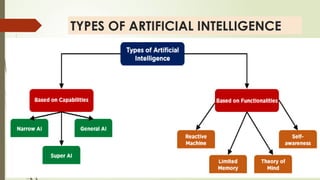
“Based on capabilities" refers to what the AI is capable of doing,
while "based on functionalities" refers to how the AI achieves those
capabilities, encompassing its operation and learning mechanisms.
1. BASED ON CAPABILITIES
2. BASED ON FUNCTIONALITIES
TYPES OF ARTIFICIAL INTELLIGENCE
(Based on Capabilities)
 1. NARROW AI / WEAK AI
 Narrow AI or also expressed as Artificial Narrow Intelligence (ANI) refers to the AI systems that
have been trained to perform only the specific tasks that they have been programmed for.
 They will not be able to perform anything more than what they are designed for and thus,
have a narrow range of competencies.
 Apple Siri is an example of Narrow AI that helps the users/customers with its voice recognition
capabilities and renders relevant answers to their queries.
 The most complex artificial intelligence systems that use machine learning and
deep learning to teach themselves fall under this category of ANI.
TYPES OF ARTIFICIAL INTELLIGENCE (Based
on Capabilities)
 2. GENERAL AI / STRONG AI
 General AI or Artificial General Intelligence (AGI) is the ability of an AI agent
to perceive and understand things just like an actual human does.
 These systems have been programmed to build multiple competencies
independently and form connections across the other domains.
 In a way, this immensely aids in cutting down the time required for training
purposes. Fortunately, this makes the AI systems just as capable as humans by
replicating our multi-functional capabilities in every other way imaginable.
TYPES OF ARTIFICIAL INTELLIGENCE
(Based on Capabilities)
3. Super AI
 Super AI or Artificial Super Intelligence (ASI) has been deemed to become the
pinnacle of AI research.
 In addition to replicating the dynamic intelligence of humans, they will also be
able to emulate tasks, that too with greater memory, faster data analysis and
processing and revamped decision-making capabilities.
 The ASI does not only understand the human sentiments and
customer experiences but also evokes emotions and series of its own. Often,
people have doubted its credibility and tagged it hypothetical to some extent.
TYPES OF ARTIFICIAL INTELLIGENCE
1. Reactive Machines
 These are the oldest forms of AI systems that have extremely limited capability.
 They emulate the human mind’s ability to respond to different kinds of stimuli.
 These machines do not have memory-based functionality. This means such machines cannot use
previously gained experiences to inform their present actions, i.e., these machines do not have the
ability to “learn.”
 These machines could only be used for automatically responding to a limited set or combination of
inputs. They cannot be used to rely on memory to improve their operations based on the same.
 A popular example of a reactive AI machine is IBM’s Deep Blue, a machine that beat chess
Grandmaster Garry Kasparov in 1997.
TYPES OF ARTIFICIAL INTELLIGENCE
2. Limited Memory
 Limited memory machines are machines that, in addition to having the capabilities of purely reactive
machines, are also capable of learning from historical data to make decisions.
 Nearly all existing applications that we know of come under this category of AI. All present-day AI
systems, such as those using deep learning, are trained by large volumes of training data that they
store in their memory to form a reference model for solving future problems.
 For instance, an image recognition AI is trained using thousands of pictures and their labels to teach it
to name objects it scans. When an image is scanned by such an AI, it uses the training images as
references to understand the contents of the image presented to it, and based on its “learning
experience” it labels new images with increasing accuracy.
 Almost all present-day AI applications, from chatbots and virtual assistants to self-driving vehicles are
all driven by limited memory AI.
TYPES OF ARTIFICIAL INTELLIGENCE
3. Theory of Mind
 Previous two types of AI have been and are found in abundance, the next two types of
AI exist, for now, either as a concept or a work in progress.
 Theory of mind AI is the next level of AI systems that researchers are currently engaged in
innovating.
 A theory of mind level AI will be able to better understand the entities it is interacting
with by discerning their needs, emotions, beliefs, and thought processes.
 Artificial emotional intelligence is already a budding industry and an area of interest for
leading AI researchers, achieving Theory of mind level of AI will require development in
other branches of AI as well.
TYPES OF ARTIFICIAL INTELLIGENCE
4. Self-aware
 This is the final stage of AI development which currently exists only hypothetically.
 Self-aware AI, which, self explanatorily, is an AI that has evolved to be so akin to the human brain that it
has developed self-awareness.
 Creating this type of Ai, which is decades, if not centuries away from materializing, is and will always be
the ultimate objective of all AI research.
 This type of AI will not only be able to understand and evoke emotions in those it interacts with, but also
have emotions, needs, beliefs, and potentially desires of its own.
 this is the type of AI that doomsayers of the technology are wary of. Although the development of self-
aware can potentially boost our progress as a civilization by leaps and bounds, it can also potentially
lead to catastrophe.
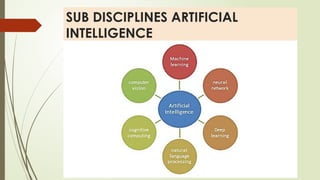
SUB-DISCIPLINES
ARTIFICIAL
INTELLIGENCE
SUB DISCIPLINES ARTIFICIAL
INTELLIGENCE
SUB DISCIPLINES ARTIFICIAL INTELLIGENCE
NEURAL NETWORK
A neural network in artificial intelligence (AI) is a computational model inspired by the
structure and functioning of the human brain's interconnected neurons.
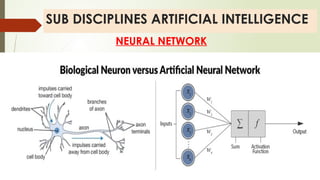
Comprising layers of interconnected nodes or artificial neurons, a neural network processes
information through a series of mathematical transformations. Each connection between
nodes is associated with a weight, representing the strength of the connection. During
training, the network learns to adjust these weights based on input data and desired
output, allowing it to recognize patterns, make predictions, or perform other tasks.
Neural networks excel at tasks such as image and speech recognition, natural language
processing, and complex decision-making, making them a fundamental component in
various AI applications, including machine learning and deep learning. Their ability to
adapt and generalize from data makes neural networks a powerful tool for solving a wide
range of problems across diverse domains.
SUB DISCIPLINES ARTIFICIAL INTELLIGENCE
NEURAL NETWORK
SUB DISCIPLINES ARTIFICIAL INTELLIGENCE
MACHINE LEARNING
Machine Learning (ML) is a subfield of artificial intelligence (AI) that focuses on developing algorithms
and models capable of learning patterns and making predictions or decisions without explicit
programming.
The core principle of machine learning is the ability of systems to iteratively learn from data, identify
patterns, and improve their performance over time.
ML algorithms leverage statistical techniques to enable computers to recognize complex patterns,
adapt to changing environments, and make data-driven decisions.
There are three main types of machine learning: supervised learning, where models are trained on
labeled data to make predictions; unsupervised learning, which involves finding patterns and
structures in unlabeled data; and reinforcement learning, where agents learn to take actions in an
environment to maximize rewards. Machine learning finds applications in a wide range of domains,
including image and speech recognition, natural language processing, recommendation systems,
and predictive analytics, contributing significantly to the advancement of AI technologies.
SUB DISCIPLINES ARTIFICIAL INTELLIGENCE
COMPUTER VISION
Computer vision in AI refers to the interdisciplinary field that enables machines to interpret and understand visual
information from the world, much like humans do with their eyes and brains.
It involves the development of algorithms and systems that allow computers to analyze, process, and make
decisions based on visual data, such as images and videos.
Key tasks within computer vision include image recognition, object detection, facial recognition, and scene
understanding.
By leveraging techniques like machine learning, deep learning, and pattern recognition, computer vision enables
machines to extract meaningful insights, recognize patterns, and derive contextual understanding from visual
input.
Applications of computer vision span a wide range of industries, including healthcare, autonomous vehicles,
surveillance, augmented reality, and various aspects of daily life, contributing to advancements in automation,
safety, and human-computer interaction.
SUB DISCIPLINES ARTIFICIAL INTELLIGENCE
DEEP LEARNING
Deep learning in AI refers to a subset of machine learning techniques that involve neural
networks with multiple layers, known as deep neural networks.
These networks are capable of learning and representing complex patterns and
hierarchical features from data, enabling them to make predictions, classify information,
and perform various tasks without explicit programming.
Deep learning has demonstrated remarkable success in diverse fields such as image and
speech recognition, natural language processing, and even playing strategic games.
The effectiveness of deep learning stems from its ability to automatically learn hierarchical
representations of data, extracting features at different levels of abstraction, and adapting
to the intricacies of various domains.
The training process involves feeding the network large amounts of labeled data, allowing
it to iteratively adjust its parameters to minimize the difference between predicted and
actual outcomes.
SUB DISCIPLINES ARTIFICIAL INTELLIGENCE
NLP (NATURAL LANGUAGE )
Natural Language Processing (NLP) in AI involves the use of computational
models and algorithms to enable machines to understand, interpret, and
generate human language.
It encompasses a wide range of tasks, such as language translation,
sentiment analysis, text summarization, and chatbot interactions.
NLP leverages machine learning techniques, including deep learning, to
process and analyze linguistic data, allowing AI systems to comprehend
and respond to natural language input.
The goal of NLP is to bridge the gap between human communication and
machine understanding, making it possible for AI systems to interact with
users in a more intuitive and context-aware manner.
How different types of AI are used
to solve different problems in at
least three different industries and
sectors
TYPES OF AI USED IN TOP INDUSTRIES
Google, Facebook, and Adobe are three
prominent technology companies that
leverage various types of artificial intelligence
(AI) to solve different problems across diverse
industries.
TYPES OF AI USED IN TOP INDUSTRIES
Google:
 Search and Advertising:
 Natural Language Processing (NLP): Google Search uses NLP algorithms to
understand user queries and provide relevant search results. This helps in delivering
more accurate and contextually relevant information to users.
 Machine Learning in Ad Targeting: Google's advertising platforms, like Google Ads,
utilize machine learning algorithms to analyze user behavior and preferences. This
enables targeted advertising, optimizing ad placements for better engagement and
conversion rates.
 RankBrain: Google's search algorithm employs RankBrain, an AI system that interprets
and processes search queries, learning from user interactions to improve the
relevance of search results over time.
TYPES OF AI USED IN TOP INDUSTRIES
Google:
 Healthcare:
DeepMind in Medical Research: Google's DeepMind, an AI research
lab, has been involved in healthcare initiatives. For instance, DeepMind
has collaborated with healthcare institutions to use AI for analyzing
medical images, predicting patient deterioration, and improving
overall healthcare outcomes.
 Autonomous Vehicles:
Waymo: Google's self-driving car project, now known as Waymo, relies
heavily on AI and machine learning for navigation, object detection,
and decision-making. It demonstrates the application of AI in the
transportation sector to enhance safety and efficiency.
TYPES OF AI USED IN TOP INDUSTRIES
Facebook:
 Social Media and Content Moderation:
Computer Vision: Facebook employs computer vision algorithms for
image recognition and content moderation. AI helps in automatically
identifying and flagging content that violates community standards,
facilitating the removal of inappropriate or harmful material.
Personalized Content Feed: Machine learning is used to analyze user
behavior and preferences, allowing Facebook to personalize users'
content feeds. This enhances user engagement by showing more
relevant content and advertisements.
TYPES OF AI USED IN TOP INDUSTRIES
Facebook:
 Augmented Reality (AR) and Virtual Reality (VR):
 Spark AR: Facebook's AR platform, Spark AR, utilizes AI for creating interactive and
immersive augmented reality experiences. This includes facial recognition for AR filters
and object recognition for AR interactions, contributing to the development of
innovative AR applications.
 Language Translation:
 Natural Language Processing: Facebook employs NLP techniques for language
translation on its platform. This enables users to interact with content in multiple
languages, fostering global communication and collaboration.
TYPES OF AI USED IN TOP INDUSTRIES
Adobe:
Creative Cloud and Design:
Adobe Sensei: Adobe integrates AI through its platform called Adobe
Sensei, which is used in various Creative Cloud applications. For
example, in Adobe Photoshop, AI assists in content-aware fill and
automatic image enhancements, streamlining the creative design
process.
Automated Video Editing: AI is applied in Adobe Premiere Pro to
automate video editing tasks, such as scene analysis, object tracking,
and even suggesting edits based on user preferences.
TYPES OF AI USED IN TOP INDUSTRIES
Adobe:
Marketing and Analytics:
 Predictive Analytics: Adobe Marketing Cloud leverages AI for predictive
analytics. Machine learning algorithms analyze customer behavior and
historical data to predict future trends, enabling businesses to make
informed marketing decisions and personalize customer experiences.
BENEFITS OF
AI
IN INDUSTRIES
BENEFITS OF AI IN INDUSTRIES

AI systems offer a wide range of benefits across various industries, revolutionizing processes,
improving efficiency, and enabling new possibilities. Here are some key benefits in different sectors:
Healthcare:
Diagnosis and Treatment: AI can analyze medical images, identify
patterns, and assist in diagnosing diseases.
Personalized Medicine: AI helps in tailoring treatment plans based on
individual patient data.
Drug Discovery: AI accelerates drug discovery by analyzing large
datasets to identify potential candidates.
BENEFITS OF AI IN INDUSTRIES

Finance:
Fraud Detection: AI systems can detect unusual patterns and
behaviors, helping to identify and prevent fraudulent activities.
Risk Management: AI models analyze market trends and assess
risks, aiding in better decision-making.
Customer Service: Chatbots and virtual assistants powered by
AI enhance customer interactions and support.
BENEFITS OF AI IN INDUSTRIES

Manufacturing:
Predictive Maintenance: AI analyzes equipment data to
predict when machinery is likely to fail, reducing downtime and
maintenance costs.
Quality Control: Computer vision systems can inspect products
for defects more accurately and efficiently than human
inspectors.
Supply Chain Optimization: AI optimizes inventory
management, production schedules, and logistics.
BENEFITS OF AI IN INDUSTRIES
Education:
Adaptive Learning: AI systems personalize learning experiences
based on individual student progress and preferences.
Automated Grading: AI can assist in grading assignments and
exams, saving time for educators.
Language Learning: AI-powered language learning apps
provide real-time feedback and personalized lessons.
BENEFITS OF AI IN INDUSTRIES
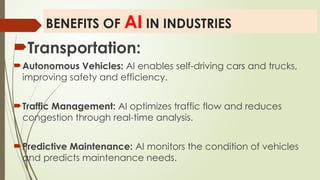
Transportation:
Autonomous Vehicles: AI enables self-driving cars and trucks,
improving safety and efficiency.
Traffic Management: AI optimizes traffic flow and reduces
congestion through real-time analysis.
Predictive Maintenance: AI monitors the condition of vehicles
and predicts maintenance needs.
BENEFITS OF AI IN INDUSTRIES
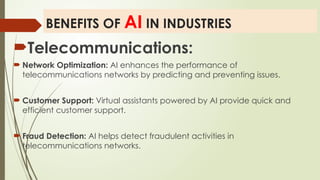
Telecommunications:
 Network Optimization: AI enhances the performance of
telecommunications networks by predicting and preventing issues.
 Customer Support: Virtual assistants powered by AI provide quick and
efficient customer support.
 Fraud Detection: AI helps detect fraudulent activities in
telecommunications networks.
BENEFITS OF AI IN INDUSTRIES
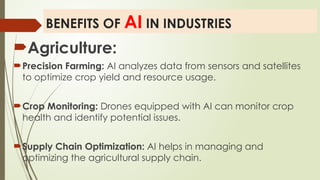
Agriculture:
Precision Farming: AI analyzes data from sensors and satellites
to optimize crop yield and resource usage.
Crop Monitoring: Drones equipped with AI can monitor crop
health and identify potential issues.
Supply Chain Optimization: AI helps in managing and
optimizing the agricultural supply chain.
BENEFITS OF AI IN INDUSTRIES
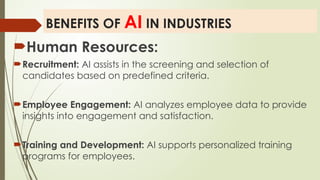
Human Resources:
Recruitment: AI assists in the screening and selection of
candidates based on predefined criteria.
Employee Engagement: AI analyzes employee data to provide
insights into engagement and satisfaction.
Training and Development: AI supports personalized training
programs for employees.
RISKS & DRAWBACKS
ARTIFICIAL INTELLIGENECE
AI (RISKS AND DRAWBACKS)
1. Job Displacement
 One of the most significant disadvantages of AI is job displacement.
 As AI systems become more capable, they increasingly take over tasks traditionally
performed by humans. This shift leads to significant job losses, especially in
manufacturing, customer service, and transportation. For instance, introducing AI in
automotive factories has led to a decrease in manual labor jobs.
 Workers find it challenging to adapt to this change, often requiring new skills they do not
possess. This trend affects individual workers and has broader implications for the
economy and society, such as increased income inequality and social unrest.
AI (RISKS AND DRAWBACKS)
Loss of Privacy
 AI’s ability to process vast amounts of personal data poses a significant threat to privacy.
For example, facial recognition technology powered by AI is used in surveillance systems
worldwide.
 This technology can track individuals without their consent, leading to a loss of
anonymity and personal freedom.
 The widespread use of AI in data analysis also means that personal information is
constantly being collected and analyzed, often without adequate safeguards. This
invasion of privacy is a major concern, as it can lead to misuse of personal data and a
loss of trust in technology.
AI (RISKS AND DRAWBACKS)
Dependence on Technology
 As AI systems become more integrated into daily life, there is an increasing dependence
on technology.
 This dependence can lead to a loss of human skills and judgment. For instance, the
reliance on AI for navigation has led to a decline in map-reading skills.
 In critical sectors like healthcare, over-reliance on AI diagnostics can undermine the
expertise of medical professionals.
 This dependence also raises concerns about what happens when these systems fail or
are unavailable, highlighting the vulnerability of a society overly reliant on AI.
AI (RISKS AND DRAWBACKS)
Ethical and Moral Concerns
 AI raises numerous ethical and moral concerns. For example, the
development of autonomous weapons poses a significant ethical
dilemma. These weapons, capable of making life-or-death decisions
without human intervention, raise questions about moral responsibility and
the value of human judgment in warfare.
 The lack of clarity on who is responsible for the decisions made by AI
systems further complicates these ethical issues.
AI (RISKS AND DRAWBACKS)
Security Risks
 AI systems are vulnerable to security risks, including data breaches and
hacking.
 As AI becomes more prevalent in critical infrastructure, the potential for
catastrophic cyber-attacks increases. For example, AI-powered energy
grids are susceptible to hacking, which could lead to widespread power
outages and endanger public safety.
 The complexity of AI systems makes them difficult to secure, posing a
significant challenge in an increasingly interconnected world.
AI (RISKS AND DRAWBACKS)
High Costs
 Developing and implementing AI technology is often expensive, limiting
its accessibility.
 Small businesses and developing countries may not have the resources to
invest in AI, leading to a digital divide.
 The high cost of AI technology can also lead to monopolies, as only large
corporations can afford to invest in and benefit from these
advancements. This concentration of power and resources can stifle
innovation and competition.
AI (RISKS AND DRAWBACKS)
UNCONTROLLABLE SELF-AWARE AI
 There also comes a worry that AI will progress in intelligence so rapidly that it will become
sentient, and act beyond humans’ control — possibly in a malicious manner.
 Alleged reports of this sentience have already been occurring, with one popular
account being from a former Google engineer who stated the AI chatbot LaMDA
was sentient and speaking to him just as a person would.
 As AI’s next big milestones involve making systems with artificial general intelligence, and
eventually artificial superintelligence, cries to completely stop these developments
continue to rise.

INTRODUCTION TO ARTIFICIAL INTELLIGENCE - Lecture

  • 1.
  • 2.
    WHAT IS ARTIFICIALINTELLIGENCE  AI is a term that refers to a computer or machine's ability to accomplish tasks or make decisions, just like humans.  AI designers aim to reproduce human attributes such as creativity, logical reasoning, and knowledge acquisition in systems to varying levels.  Artificial intelligence is the simulation of human intelligence processes by machines, especially computer systems.
  • 3.
  • 4.
    TYPES OF ARTIFICIALINTELLIGENCE “Based on capabilities" refers to what the AI is capable of doing, while "based on functionalities" refers to how the AI achieves those capabilities, encompassing its operation and learning mechanisms. 1. BASED ON CAPABILITIES 2. BASED ON FUNCTIONALITIES
  • 5.
    TYPES OF ARTIFICIALINTELLIGENCE
  • 6.
    TYPES OF ARTIFICIALINTELLIGENCE (Based on Capabilities)  1. NARROW AI / WEAK AI  Narrow AI or also expressed as Artificial Narrow Intelligence (ANI) refers to the AI systems that have been trained to perform only the specific tasks that they have been programmed for.  They will not be able to perform anything more than what they are designed for and thus, have a narrow range of competencies.  Apple Siri is an example of Narrow AI that helps the users/customers with its voice recognition capabilities and renders relevant answers to their queries.  The most complex artificial intelligence systems that use machine learning and deep learning to teach themselves fall under this category of ANI.
  • 7.
    TYPES OF ARTIFICIALINTELLIGENCE (Based on Capabilities)  2. GENERAL AI / STRONG AI  General AI or Artificial General Intelligence (AGI) is the ability of an AI agent to perceive and understand things just like an actual human does.  These systems have been programmed to build multiple competencies independently and form connections across the other domains.  In a way, this immensely aids in cutting down the time required for training purposes. Fortunately, this makes the AI systems just as capable as humans by replicating our multi-functional capabilities in every other way imaginable.
  • 8.
    TYPES OF ARTIFICIALINTELLIGENCE (Based on Capabilities) 3. Super AI  Super AI or Artificial Super Intelligence (ASI) has been deemed to become the pinnacle of AI research.  In addition to replicating the dynamic intelligence of humans, they will also be able to emulate tasks, that too with greater memory, faster data analysis and processing and revamped decision-making capabilities.  The ASI does not only understand the human sentiments and customer experiences but also evokes emotions and series of its own. Often, people have doubted its credibility and tagged it hypothetical to some extent.
  • 9.
    TYPES OF ARTIFICIALINTELLIGENCE 1. Reactive Machines  These are the oldest forms of AI systems that have extremely limited capability.  They emulate the human mind’s ability to respond to different kinds of stimuli.  These machines do not have memory-based functionality. This means such machines cannot use previously gained experiences to inform their present actions, i.e., these machines do not have the ability to “learn.”  These machines could only be used for automatically responding to a limited set or combination of inputs. They cannot be used to rely on memory to improve their operations based on the same.  A popular example of a reactive AI machine is IBM’s Deep Blue, a machine that beat chess Grandmaster Garry Kasparov in 1997.
  • 10.
    TYPES OF ARTIFICIALINTELLIGENCE 2. Limited Memory  Limited memory machines are machines that, in addition to having the capabilities of purely reactive machines, are also capable of learning from historical data to make decisions.  Nearly all existing applications that we know of come under this category of AI. All present-day AI systems, such as those using deep learning, are trained by large volumes of training data that they store in their memory to form a reference model for solving future problems.  For instance, an image recognition AI is trained using thousands of pictures and their labels to teach it to name objects it scans. When an image is scanned by such an AI, it uses the training images as references to understand the contents of the image presented to it, and based on its “learning experience” it labels new images with increasing accuracy.  Almost all present-day AI applications, from chatbots and virtual assistants to self-driving vehicles are all driven by limited memory AI.
  • 11.
    TYPES OF ARTIFICIALINTELLIGENCE 3. Theory of Mind  Previous two types of AI have been and are found in abundance, the next two types of AI exist, for now, either as a concept or a work in progress.  Theory of mind AI is the next level of AI systems that researchers are currently engaged in innovating.  A theory of mind level AI will be able to better understand the entities it is interacting with by discerning their needs, emotions, beliefs, and thought processes.  Artificial emotional intelligence is already a budding industry and an area of interest for leading AI researchers, achieving Theory of mind level of AI will require development in other branches of AI as well.
  • 12.
    TYPES OF ARTIFICIALINTELLIGENCE 4. Self-aware  This is the final stage of AI development which currently exists only hypothetically.  Self-aware AI, which, self explanatorily, is an AI that has evolved to be so akin to the human brain that it has developed self-awareness.  Creating this type of Ai, which is decades, if not centuries away from materializing, is and will always be the ultimate objective of all AI research.  This type of AI will not only be able to understand and evoke emotions in those it interacts with, but also have emotions, needs, beliefs, and potentially desires of its own.  this is the type of AI that doomsayers of the technology are wary of. Although the development of self- aware can potentially boost our progress as a civilization by leaps and bounds, it can also potentially lead to catastrophe.
  • 13.
  • 14.
  • 15.
    SUB DISCIPLINES ARTIFICIALINTELLIGENCE NEURAL NETWORK A neural network in artificial intelligence (AI) is a computational model inspired by the structure and functioning of the human brain's interconnected neurons. Comprising layers of interconnected nodes or artificial neurons, a neural network processes information through a series of mathematical transformations. Each connection between nodes is associated with a weight, representing the strength of the connection. During training, the network learns to adjust these weights based on input data and desired output, allowing it to recognize patterns, make predictions, or perform other tasks. Neural networks excel at tasks such as image and speech recognition, natural language processing, and complex decision-making, making them a fundamental component in various AI applications, including machine learning and deep learning. Their ability to adapt and generalize from data makes neural networks a powerful tool for solving a wide range of problems across diverse domains.
  • 16.
    SUB DISCIPLINES ARTIFICIALINTELLIGENCE NEURAL NETWORK
  • 17.
    SUB DISCIPLINES ARTIFICIALINTELLIGENCE MACHINE LEARNING Machine Learning (ML) is a subfield of artificial intelligence (AI) that focuses on developing algorithms and models capable of learning patterns and making predictions or decisions without explicit programming. The core principle of machine learning is the ability of systems to iteratively learn from data, identify patterns, and improve their performance over time. ML algorithms leverage statistical techniques to enable computers to recognize complex patterns, adapt to changing environments, and make data-driven decisions. There are three main types of machine learning: supervised learning, where models are trained on labeled data to make predictions; unsupervised learning, which involves finding patterns and structures in unlabeled data; and reinforcement learning, where agents learn to take actions in an environment to maximize rewards. Machine learning finds applications in a wide range of domains, including image and speech recognition, natural language processing, recommendation systems, and predictive analytics, contributing significantly to the advancement of AI technologies.
  • 18.
    SUB DISCIPLINES ARTIFICIALINTELLIGENCE COMPUTER VISION Computer vision in AI refers to the interdisciplinary field that enables machines to interpret and understand visual information from the world, much like humans do with their eyes and brains. It involves the development of algorithms and systems that allow computers to analyze, process, and make decisions based on visual data, such as images and videos. Key tasks within computer vision include image recognition, object detection, facial recognition, and scene understanding. By leveraging techniques like machine learning, deep learning, and pattern recognition, computer vision enables machines to extract meaningful insights, recognize patterns, and derive contextual understanding from visual input. Applications of computer vision span a wide range of industries, including healthcare, autonomous vehicles, surveillance, augmented reality, and various aspects of daily life, contributing to advancements in automation, safety, and human-computer interaction.
  • 19.
    SUB DISCIPLINES ARTIFICIALINTELLIGENCE DEEP LEARNING Deep learning in AI refers to a subset of machine learning techniques that involve neural networks with multiple layers, known as deep neural networks. These networks are capable of learning and representing complex patterns and hierarchical features from data, enabling them to make predictions, classify information, and perform various tasks without explicit programming. Deep learning has demonstrated remarkable success in diverse fields such as image and speech recognition, natural language processing, and even playing strategic games. The effectiveness of deep learning stems from its ability to automatically learn hierarchical representations of data, extracting features at different levels of abstraction, and adapting to the intricacies of various domains. The training process involves feeding the network large amounts of labeled data, allowing it to iteratively adjust its parameters to minimize the difference between predicted and actual outcomes.
  • 20.
    SUB DISCIPLINES ARTIFICIALINTELLIGENCE NLP (NATURAL LANGUAGE ) Natural Language Processing (NLP) in AI involves the use of computational models and algorithms to enable machines to understand, interpret, and generate human language. It encompasses a wide range of tasks, such as language translation, sentiment analysis, text summarization, and chatbot interactions. NLP leverages machine learning techniques, including deep learning, to process and analyze linguistic data, allowing AI systems to comprehend and respond to natural language input. The goal of NLP is to bridge the gap between human communication and machine understanding, making it possible for AI systems to interact with users in a more intuitive and context-aware manner.
  • 21.
    How different typesof AI are used to solve different problems in at least three different industries and sectors
  • 22.
    TYPES OF AIUSED IN TOP INDUSTRIES Google, Facebook, and Adobe are three prominent technology companies that leverage various types of artificial intelligence (AI) to solve different problems across diverse industries.
  • 23.
    TYPES OF AIUSED IN TOP INDUSTRIES Google:  Search and Advertising:  Natural Language Processing (NLP): Google Search uses NLP algorithms to understand user queries and provide relevant search results. This helps in delivering more accurate and contextually relevant information to users.  Machine Learning in Ad Targeting: Google's advertising platforms, like Google Ads, utilize machine learning algorithms to analyze user behavior and preferences. This enables targeted advertising, optimizing ad placements for better engagement and conversion rates.  RankBrain: Google's search algorithm employs RankBrain, an AI system that interprets and processes search queries, learning from user interactions to improve the relevance of search results over time.
  • 24.
    TYPES OF AIUSED IN TOP INDUSTRIES Google:  Healthcare: DeepMind in Medical Research: Google's DeepMind, an AI research lab, has been involved in healthcare initiatives. For instance, DeepMind has collaborated with healthcare institutions to use AI for analyzing medical images, predicting patient deterioration, and improving overall healthcare outcomes.  Autonomous Vehicles: Waymo: Google's self-driving car project, now known as Waymo, relies heavily on AI and machine learning for navigation, object detection, and decision-making. It demonstrates the application of AI in the transportation sector to enhance safety and efficiency.
  • 25.
    TYPES OF AIUSED IN TOP INDUSTRIES Facebook:  Social Media and Content Moderation: Computer Vision: Facebook employs computer vision algorithms for image recognition and content moderation. AI helps in automatically identifying and flagging content that violates community standards, facilitating the removal of inappropriate or harmful material. Personalized Content Feed: Machine learning is used to analyze user behavior and preferences, allowing Facebook to personalize users' content feeds. This enhances user engagement by showing more relevant content and advertisements.
  • 26.
    TYPES OF AIUSED IN TOP INDUSTRIES Facebook:  Augmented Reality (AR) and Virtual Reality (VR):  Spark AR: Facebook's AR platform, Spark AR, utilizes AI for creating interactive and immersive augmented reality experiences. This includes facial recognition for AR filters and object recognition for AR interactions, contributing to the development of innovative AR applications.  Language Translation:  Natural Language Processing: Facebook employs NLP techniques for language translation on its platform. This enables users to interact with content in multiple languages, fostering global communication and collaboration.
  • 27.
    TYPES OF AIUSED IN TOP INDUSTRIES Adobe: Creative Cloud and Design: Adobe Sensei: Adobe integrates AI through its platform called Adobe Sensei, which is used in various Creative Cloud applications. For example, in Adobe Photoshop, AI assists in content-aware fill and automatic image enhancements, streamlining the creative design process. Automated Video Editing: AI is applied in Adobe Premiere Pro to automate video editing tasks, such as scene analysis, object tracking, and even suggesting edits based on user preferences.
  • 28.
    TYPES OF AIUSED IN TOP INDUSTRIES Adobe: Marketing and Analytics:  Predictive Analytics: Adobe Marketing Cloud leverages AI for predictive analytics. Machine learning algorithms analyze customer behavior and historical data to predict future trends, enabling businesses to make informed marketing decisions and personalize customer experiences.
  • 29.
  • 30.
    BENEFITS OF AIIN INDUSTRIES  AI systems offer a wide range of benefits across various industries, revolutionizing processes, improving efficiency, and enabling new possibilities. Here are some key benefits in different sectors: Healthcare: Diagnosis and Treatment: AI can analyze medical images, identify patterns, and assist in diagnosing diseases. Personalized Medicine: AI helps in tailoring treatment plans based on individual patient data. Drug Discovery: AI accelerates drug discovery by analyzing large datasets to identify potential candidates.
  • 31.
    BENEFITS OF AIIN INDUSTRIES  Finance: Fraud Detection: AI systems can detect unusual patterns and behaviors, helping to identify and prevent fraudulent activities. Risk Management: AI models analyze market trends and assess risks, aiding in better decision-making. Customer Service: Chatbots and virtual assistants powered by AI enhance customer interactions and support.
  • 32.
    BENEFITS OF AIIN INDUSTRIES  Manufacturing: Predictive Maintenance: AI analyzes equipment data to predict when machinery is likely to fail, reducing downtime and maintenance costs. Quality Control: Computer vision systems can inspect products for defects more accurately and efficiently than human inspectors. Supply Chain Optimization: AI optimizes inventory management, production schedules, and logistics.
  • 33.
    BENEFITS OF AIIN INDUSTRIES Education: Adaptive Learning: AI systems personalize learning experiences based on individual student progress and preferences. Automated Grading: AI can assist in grading assignments and exams, saving time for educators. Language Learning: AI-powered language learning apps provide real-time feedback and personalized lessons.
  • 34.
    BENEFITS OF AIIN INDUSTRIES Transportation: Autonomous Vehicles: AI enables self-driving cars and trucks, improving safety and efficiency. Traffic Management: AI optimizes traffic flow and reduces congestion through real-time analysis. Predictive Maintenance: AI monitors the condition of vehicles and predicts maintenance needs.
  • 35.
    BENEFITS OF AIIN INDUSTRIES Telecommunications:  Network Optimization: AI enhances the performance of telecommunications networks by predicting and preventing issues.  Customer Support: Virtual assistants powered by AI provide quick and efficient customer support.  Fraud Detection: AI helps detect fraudulent activities in telecommunications networks.
  • 36.
    BENEFITS OF AIIN INDUSTRIES Agriculture: Precision Farming: AI analyzes data from sensors and satellites to optimize crop yield and resource usage. Crop Monitoring: Drones equipped with AI can monitor crop health and identify potential issues. Supply Chain Optimization: AI helps in managing and optimizing the agricultural supply chain.
  • 37.
    BENEFITS OF AIIN INDUSTRIES Human Resources: Recruitment: AI assists in the screening and selection of candidates based on predefined criteria. Employee Engagement: AI analyzes employee data to provide insights into engagement and satisfaction. Training and Development: AI supports personalized training programs for employees.
  • 38.
  • 39.
    AI (RISKS ANDDRAWBACKS) 1. Job Displacement  One of the most significant disadvantages of AI is job displacement.  As AI systems become more capable, they increasingly take over tasks traditionally performed by humans. This shift leads to significant job losses, especially in manufacturing, customer service, and transportation. For instance, introducing AI in automotive factories has led to a decrease in manual labor jobs.  Workers find it challenging to adapt to this change, often requiring new skills they do not possess. This trend affects individual workers and has broader implications for the economy and society, such as increased income inequality and social unrest.
  • 40.
    AI (RISKS ANDDRAWBACKS) Loss of Privacy  AI’s ability to process vast amounts of personal data poses a significant threat to privacy. For example, facial recognition technology powered by AI is used in surveillance systems worldwide.  This technology can track individuals without their consent, leading to a loss of anonymity and personal freedom.  The widespread use of AI in data analysis also means that personal information is constantly being collected and analyzed, often without adequate safeguards. This invasion of privacy is a major concern, as it can lead to misuse of personal data and a loss of trust in technology.
  • 41.
    AI (RISKS ANDDRAWBACKS) Dependence on Technology  As AI systems become more integrated into daily life, there is an increasing dependence on technology.  This dependence can lead to a loss of human skills and judgment. For instance, the reliance on AI for navigation has led to a decline in map-reading skills.  In critical sectors like healthcare, over-reliance on AI diagnostics can undermine the expertise of medical professionals.  This dependence also raises concerns about what happens when these systems fail or are unavailable, highlighting the vulnerability of a society overly reliant on AI.
  • 42.
    AI (RISKS ANDDRAWBACKS) Ethical and Moral Concerns  AI raises numerous ethical and moral concerns. For example, the development of autonomous weapons poses a significant ethical dilemma. These weapons, capable of making life-or-death decisions without human intervention, raise questions about moral responsibility and the value of human judgment in warfare.  The lack of clarity on who is responsible for the decisions made by AI systems further complicates these ethical issues.
  • 43.
    AI (RISKS ANDDRAWBACKS) Security Risks  AI systems are vulnerable to security risks, including data breaches and hacking.  As AI becomes more prevalent in critical infrastructure, the potential for catastrophic cyber-attacks increases. For example, AI-powered energy grids are susceptible to hacking, which could lead to widespread power outages and endanger public safety.  The complexity of AI systems makes them difficult to secure, posing a significant challenge in an increasingly interconnected world.
  • 44.
    AI (RISKS ANDDRAWBACKS) High Costs  Developing and implementing AI technology is often expensive, limiting its accessibility.  Small businesses and developing countries may not have the resources to invest in AI, leading to a digital divide.  The high cost of AI technology can also lead to monopolies, as only large corporations can afford to invest in and benefit from these advancements. This concentration of power and resources can stifle innovation and competition.
  • 45.
    AI (RISKS ANDDRAWBACKS) UNCONTROLLABLE SELF-AWARE AI  There also comes a worry that AI will progress in intelligence so rapidly that it will become sentient, and act beyond humans’ control — possibly in a malicious manner.  Alleged reports of this sentience have already been occurring, with one popular account being from a former Google engineer who stated the AI chatbot LaMDA was sentient and speaking to him just as a person would.  As AI’s next big milestones involve making systems with artificial general intelligence, and eventually artificial superintelligence, cries to completely stop these developments continue to rise.