WHAT IS ARTIFICIAL
INTELLIGENCE?
A I V S M A C H I N E L E A R N I N G V S D E E P L E A R N I N G
Name : Oussama BELAKHDAR
framed by :
Prof. Maria Moise, PhD
01
Table of
Contents
Presentation Outline
Introduction to AI
Machine Learning
Supervised Learning
Unsupervised Learning
Reinforcement Learning
Deep Learning
AI vs Machine Learning
vs Deep Learning
MACHINE LEARNING PRESENTATION
What is AI ?
Introduction to AI
Timeline : History of AI
Types of Artificial Intelligence
Artificiel Intelligence Value Chain Elemnts
Where is AI used ?
AI use cases
AI trend in 2020
Challenges in adoption of Artificial
Intelligence
02
Introduction
to
Artificial
Intelligence
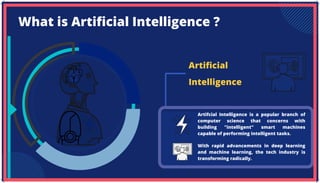
What is Artificial Intelligence ?
Artifcial Intelligence is a popular branch of
computer science that concerns with
building "intelligent" smart machines
capable of performing intelligent tasks.
Artificial
Intelligence
With rapid advancements in deep learning
and machine learning, the tech industry is
transforming radically.
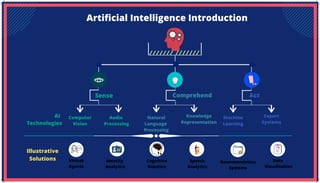
Sense Comprehend Act
Artificial Intelligence Introduction
AI
Technologies
Illustrative
Solutions
Natural
Language
Processing
Knowledge
Representation
Computer
Vision
Audio
Processing
Machine
Learning
Expert
Systems
Virtual
Agents
Identity
Analytics
Cognitive
Robotics
Speech
Analytics
Reommendation
Systems
Data
Visualization
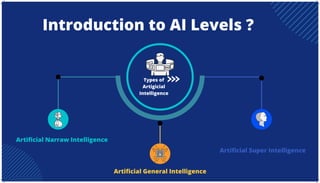
Introduction to AI Levels ?
Artificial Narraw Intelligence
Artificial General Intelligence
Artificial Super Intelligence
Types of
Artigicial
Intelligence
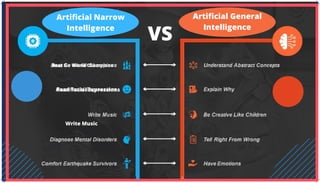
Artificial Narrow
Intelligence
Artificial General
Intelligence
VS
Beat Go World Champions
Read Facial Expressions
Write Music
Artificial Intelligence
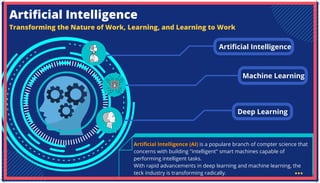
Artificial Intelligence (AI) is a populare branch of compter science that
concerns with building "intelligent" smart machines capable of
performing intelligent tasks.
With rapid advancements in deep learning and machine learning, the
teck industry is transforming radically.
Artificial Intelligence
Transforming the Nature of Work, Learning, and Learning to Work
Machine Learning
Deep Learning
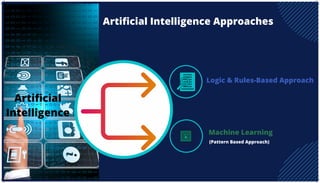
Artificial Intelligence Approaches
Logic & Rules-Based Approach
Machine Learning
(Pattern Based Approach)
Artificial
Intelligence
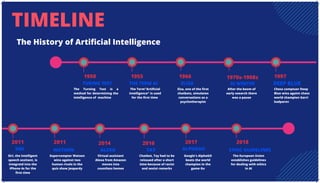
TIMELINE
The History of Artificial Intelligence
TURING TEST THE TERM AI ELIZA AI WINTER DEEP BLUE
SIRI WATSON TAY
ALEXA ALPHAGO ETHIC GUIDELINES
1950 1955 1966 1970s-1908s 1997
2011 2011 2014 2016 2017 2018
The Turning Test is a
method for determining the
intelligence of machine
The Term"Artificial
Intelligence" is used
for the first time
Eiza, one of the first
chatbots, simulates
conversations as a
psychotherapist
After the boom of
early esearch there
was a pause
Chess comptuer Deep
Blue wins againt chess
world champion Garri
kadparov
Siri, the intelligent
speech assitant, is
integratd into the
iPhone 4s for the
first time
Supercompter Watson
wins against two
human rivals in the
quiz show Jeopardy
Virtual assistant
Alexa from Amazon
moves into
countless homes
Chatbot, Tay had to be
reissued after a short
time because of racist
and sexist remarks
Google's AlphaGO
beats the world
champion in the
game Go
The European Union
establishes guidelines
for dealing with ethics
in AI
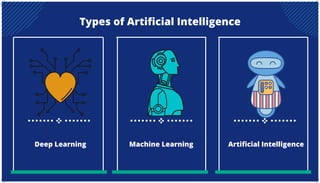
Types of Artificial Intelligence
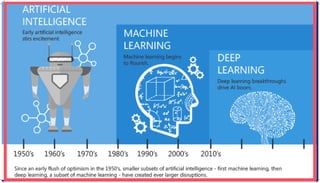
Artificial Intelligence
Deep Learning Machine Learning
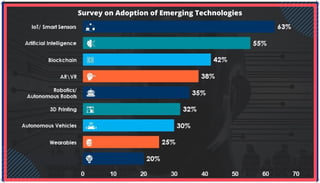
Survey on Adoption of Emerging Technologies
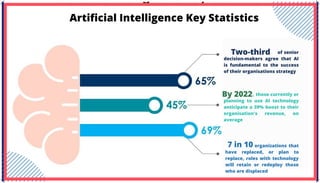
Artificial Intelligence Key Statistics
of senior
decision-makers agree that AI
is fundamental to the success
of their organisations strategy
, those currently or
planning to use AI technology
anticipate a 39% boost to their
organisation's revenue, on
average
organizations that
have replaced, or plan to
replace, roles with technology
will retain or redeploy those
who are displaced
Two-third
By 2022
7 in 10
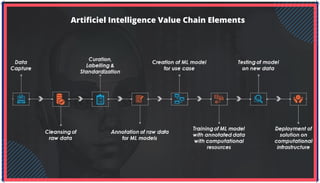
Artificiel Intelligence Value Chain Elements
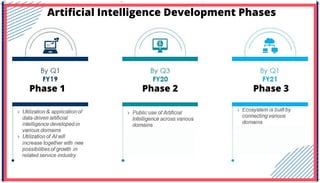
Artificial Intelligence Development Phases
Phase 1 Phase 2 Phase 3
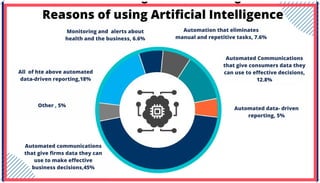
Reasons of using Artificial Intelligence
Monitoring and alerts about
health and the business, 6.6%
Automation that eliminates
manual and repetitive tasks, 7.6%
All of hte above automated
data-driven reporting,18%
Automated Communications
that give consumers data they
can use to effective decisions,
12.8%
Automated data- driven
reporting, 5%
Automated communications
that give firms data they can
use to make effective
business decisions,45%
Other , 5%
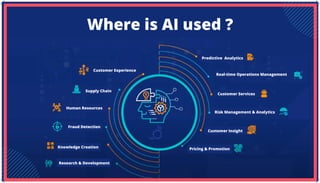
Where is AI used ?
Customer Experience
Supply Chain
Human Resources
Fraud Detection
Knowledge Creation
Research & Development
Predictive Analytics
Real-time Operations Management
Customer Services
Risk Management & Analytics
Customer Insight
Pricing & Promotion
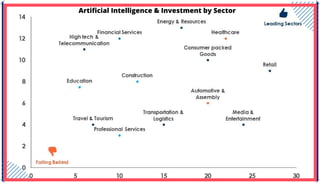
Artificial Intelligence & Investment by Sector
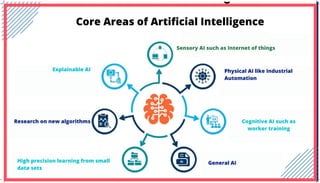
Core Areas of Artificial Intelligence
Explainable AI
Research on new algorithms
High precision learning from small
data sets
Sensory AI such as Internet of things
Physical AI like Industrial
Automation
Cognitive AI such as
worker training
General AI
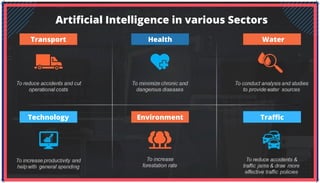
Artificial Intelligence in various Sectors
Transport Health Water
Technology Environment Traffic
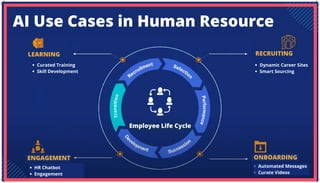
ENGAGEMENT
HR Chatbot
Engagement
Surveys
Dynamic Career Sites
Smart Sourcing
AI Use Cases in Human Resource
LEARNING
Curated Training
Skill Development
RECRUITING
ONBOARDING
Automated Messages
Curate Videos
Employee Life Cycle
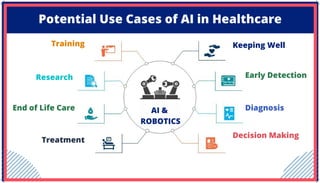
Potential Use Cases of AI in Healthcare
AI &
ROBOTICS
Training
Research
End of Life Care
Treatment
Decision Making
Keeping Well
Early Detection
Diagnosis
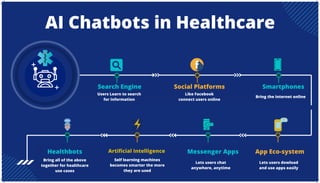
Bring all of the above
together for healthcare
use cases
Social Platforms Smartphones
AI Chatbots in Healthcare
Search Engine
Users Learn to search
for information
Like Facebook
connect users online
Bring the internet online
Healthbots
Self learning machines
becomes smarter the more
they are used
Messenger Apps
Lets users chat
anywhere, anytime
App Eco-system
Lets users dowload
and use apps easily
Artificial Intelligence
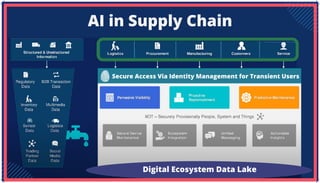
AI in Supply Chain
Digital Ecosystem Data Lake
Secure Access Via Identity Management for Transient Users
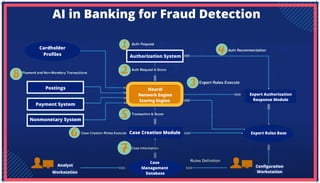
Payment System
Nonmonetary System
Authorization System
AI in Banking for Fraud Detection
Neural
Network Engine
Scoring Engine
Cardholder
Profiles
Postings
Case Creation Module
Case
Management
Database
Expert Rules Base
Expert Authorization
Response Module
Workstation
Configuration
Workstation
Analyst
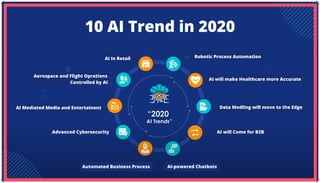
Aerospace and Flight Oprations
Controlled by AI
10 AI Trend in 2020
AI In Retail
AI Mediated Media and Entertainent
Advanced Cybersecurity
Automated Business Process AI-powered Chatbots
AI will Come for B2B
Data Modling will move to the Edge
AI will make Healthcare more Accurate
Robotic Process Automation
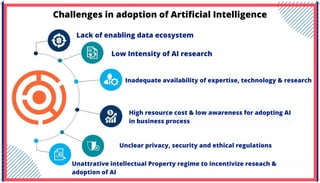
Challenges in adoption of Artificial Intelligence
Lack of enabling data ecosystem
Low Intensity of AI research
Inadequate availability of expertise, technology & research
High resource cost & low awareness for adopting AI
in business process
Unclear privacy, security and ethical regulations
Unattrative intellectual Property regime to incentivize reseach &
adoption of AI
What is Machine Learning?
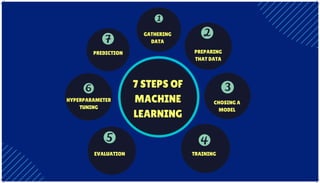
7 Steps of Machine Lrearning
Machine learning vs Traditional Programming
How does machine learning work?
Machine learning use cases
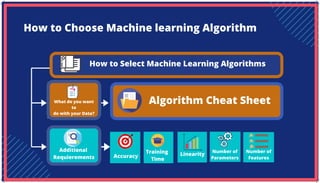
How to choose Machine Learning Algorithm
Why to use decision tree algorithm Learning
Challenges and Limitations of Machine Learning
Application of Machine Learning
Why is machine learning important?
Types of Machine Learning
Machine
Learning
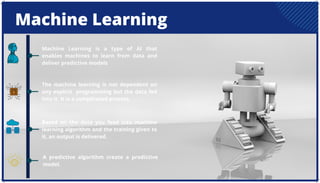
Machine Learning
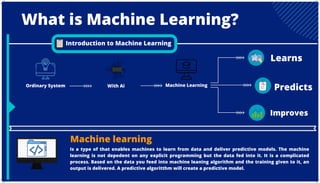
Machine Learning is a type of AI that
enables machines to learn from data and
deliver predictive models
The machine learning is not dependent on
any explicit programming but the data fed
into it. It is a complicated process.
Based on the data you feed into machine
learning algorithm and the training given to
it, an output is delivered.
A predictive algorithm create a predictive
model.
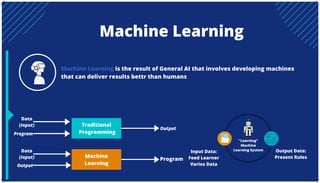
Machine Learning is the result of General AI that involves developing machines
that can deliver results bettr than humans
Machine Learning
Traditional
Programming
Machine
Learning
Data
(Input)
Data
(Input)
Program
Output
Output
Program
Input Data:
Feed Learner
Varios Data
Output Data:
Present Rules
"Learning"
Machine
Learning System
Is a type of that enables machines to learn from data and deliver predictive models. The machine
learning is not depedent on any explicit programming but the data fed into it. It is a complicated
process. Based on the data you feed into machine leaning algorithm and the training given to it, an
output is delivered. A predictive algoritthm will create a predictive model.
Improves
What is Machine Learning?
Machine Learning
Machine learning
Predicts
Introduction to Machine Learning
Learns
Ordinary System With Ai
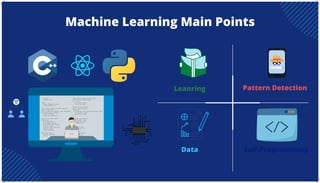
Machine Learning Main Points
Pattern Detection
Self-Programming
Leanring
Data
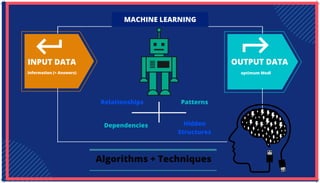
INPUT DATA
information (+ Answers)
OUTPUT DATA
optimum Modl
Algorithms + Techniques
MACHINE LEARNING
Relationships Patterns
Hidden
Structures
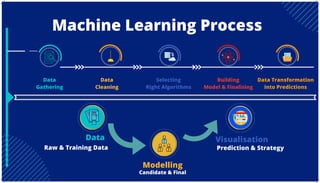
Dependencies
Raw & Training Data
Selecting
Right Algorithms
Modelling
Machine Learning Process
Visualisation
Data
Gathering
Data
Cleaning
Building
Model & Finalising
Data Transformation
into Predictions
Candidate & Final
Prediction & Strategy
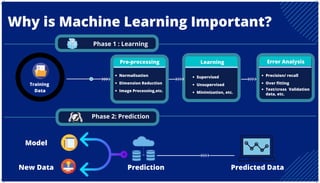
Data
Learning Error Analysis
Phase 2: Prediction
Why is Machine Learning Important?
Pre-processing
Phase 1 : Learning
Model
New Data Prediction Predicted Data
Normalisation
Dimension Reduction
Image Processing,etc.
Supervised
Unsupervised
Minimization, etc.
Precision/ recall
Over fitting
Test/cross Validation
data, etc.
Training
Data
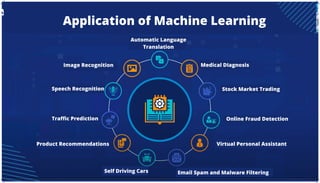
Application of Machine Learning
Image Recognition
Speech Recognition
Traffic Prediction
Product Recommendations
Self Driving Cars Email Spam and Malware Filtering
Virtual Personal Assistant
Online Fraud Detection
Stock Market Trading
Medical DIagnosis
Automatic Language
Translation
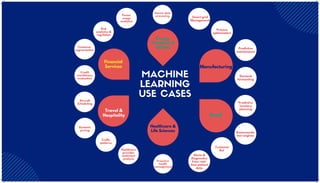
MACHINE
LEARNING
USE CASES
Manufacturing
Financial
Services
Energy,
Feedstock &
Utilities
Seismic data
processing
Retail
Travel &
Hospitality
Healthcare &
Life Sciences
Smart grid
Management
Power
usage
analytics
Alerts &
diagnostics
from real-
time patient
data
Healthcare
provider
sentiment
analysis
Demand
forecasting
Predictive
maintenance
Predictive
invetory
planning
Reommenda
tion engines
Dynamic
pricing
Aircraft
Scheduling
Credit
worthiness
evaluation
Customer
segmentation
Traffic
patterns
Risk
analytics &
regulation
Process
optimization
Customer
Rol
Proactive
health
management
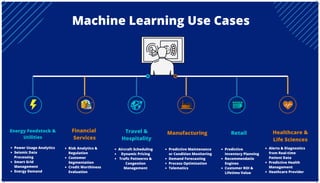
Machine Learning Use Cases
Energy Feedstock &
Utilities
Financial
Services
Travel &
Hospitality
Healthcare &
Life Sciences
Power Usage Analytics
Seismic Data
Processing
Smart Grid
Management
Energy Demand
Risk Analytics &
Regulation
Customer
Segmentation
Credit Worthiness
Evaluation
Aircraft Scheduling
Dynamic Pricing
Trafic Patteerns &
Congestion
Management
Predictive Maintenance
or Condition Monitoring
Demand Forecasting
Process Optimization
Telematics
Predictive
Inventory Planning
Recommendatio
Engines
Customer ROI &
Lifetime Value
Alerts & Diagnostics
from Real-time
Patient Data
Predictive Health
Management
Heathcare Provider
Manufacturing Retail
7 STEPS OF
MACHINE
LEARNING
HYPERPARAMETER
TUNING
GATHERING
DATA
PREPARING
THAT DATA
CHOSING A
MODEL
PREDICTION
EVALUATION TRAINING
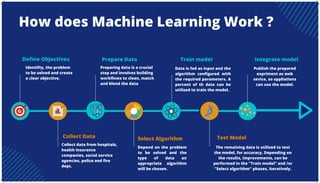
How does Machine Learning Work ?
Define Objectives Prepare Data Train model Integrate model
Collect Data Select Algorithm Test Model
Identifty, the problem
to be solved and create
a clear objective.
Preparing data is a crucial
step and involves building
workflows to clean, match
and blend the data
Data is fed as input and the
algorithm configured with
the required parameters. A
percent of th data can be
utilized to train the model.
Publish the prepared
expriment as web
sevice, so appliations
can use the model.
Collect data from hospitals,
health insurance
companies, social service
agencies, police and fire
dept.
Depend on the problem
to be solved and the
type of data an
appropriate algorithm
will be chosen.
The remaining data is utilized to test
the model, for accuracy, Depending on
the results, improvements, can be
performed in the "Train model" and /or
"Select algorithm" phases, iteratively.
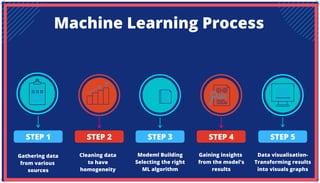
Machine Learning Process
STEP 1 STEP 2 STEP 3 STEP 4 STEP 5
Gathering data
from various
sources
Cleaning data
to have
homogeneity
Modeml Building
Selecting the right
ML algorithm
Gaining insights
from the model's
results
Data visualisation-
Transforming results
into visuals graphs
Additional
Requierements
How to Choose Machine learning Algorithm
How to Select Machine Learning Algorithms
Algorithm Cheat Sheet
What do you want
to
do with your Data?
Accuracy
Training
Time
Linearity
Number of
Parameters
Number of
Features
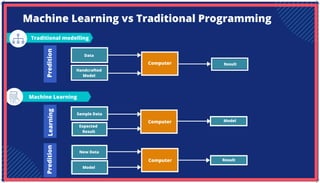
Machine Learning vs Traditional Programming
Computer
Computer
Data
Handcrafted
Model
Result
Sample Data
Expected
Result
Model
New Data
Model
Result
Traditional modelling
Machine Learning
Predition
Learning
Predition
Computer
Use c4.5
Implementation
To Classify
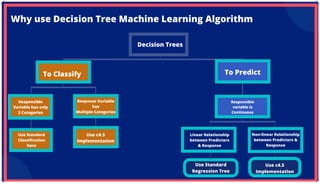
Why use Decision Tree Machine Learning Algorithm
Decision Trees
To Predict
Responsible
Variable has only
2 Categories
Response Variable
has
Multiple Categories
Use Standard
Classification
here
Use c4.5
Implementation
Responsible
variable is
Continuous
Linear Relationship
between Predictors
& Response
Non-linear Relationship
between Predictors &
Response
Use Standard
Regression Tree
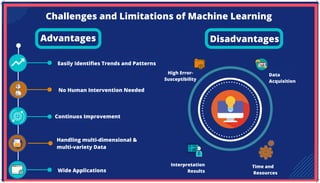
Disadvantages
Challenges and Limitations of Machine Learning
Advantages
Easily Identifies Trends and Patterns
No Human Intervention Needed
Handling multi-dimensional &
multi-variety Data
Interpretation
Results
Continuos Improvement
Wide Applications
High Error-
Susceptibility
Time and
Resources
Data
Acquisition
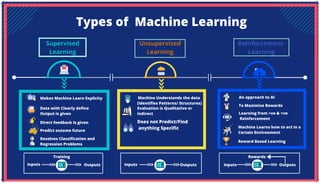
Supervised
Learning
Unsupervised
Learning
Reinforcement
Learning
Machine Understands the data
(identifies Patterns/ Structures)
Evaluation is Qualitative or
indirect
Does not Predict/Find
anything Specific
An approach to AI
Reward Based Learning
Learning from +ve & +ve
Reinforcement
Machine Learns how to act in a
Certain Environment
To Maximise Rewards
Training Rewards
Types of Machine Learning
Data with Clearly define
Output is given
Resolves Classification and
Regression Problems
Makes Machine Learn Explicity
Direct feedback is given
Predict outome future
Inputs Inputs Inputs
Outputs Outputs Outputs
Hidden Markov
Model
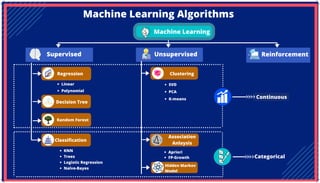
Machine Learning Algorithms
Machine Learning
Supervised Unsupervised Reinforcement
Regression Clustering
Decision Tree
Random Forest
Classification
Association
Anlaysis
Linear
Polynomial
SVD
PCA
K-means
KNN
Trees
Logistic Regression
Naïve-Bayes
Apriori
FP-Growth
Continuous
Categorical
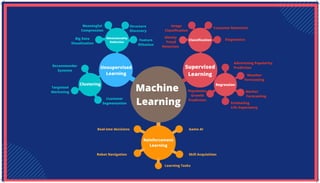
Machine
Learning
Unsupervised
Learning
Supervised
Learning
Clustering
Dimensionality
Reduction
Classification
Regression
Reinforcement
Learning
Recommender
Systems
Targetted
Marketing
Customer
Segmentation
Real-tme decisions
Robot Navigation
Game AI
Skill Acquisition
Learning Tasks
Big Data
Visualisation
Meaningful
Compression
Structure
Discovery
Feature
Eliitation
Image
Classification
Idenity
Fraud
Detection
Customer Retention
Diagnostics
Population
Growth
Prediction
Advertising Popularity
Prediction
Weather
Forecasting
Market
Forecasting
Estimating
Life Expectancy
Types of Machine Learning
What is Supervised Machine Learning?
How Supervised Machine Works?
Types of Supervised Machine Learning Algorithms
Supervised vs Unspervised Machine Learning
Techniques
Advantages of Supervised Learning
Disadvantags of Supervised Learning
Supervised
Machine
Learning
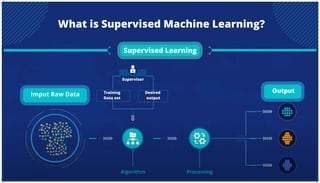
Output
Training
Data set
Desired
output
What is Supervised Machine Learning?
Supervised Learning
Imput Raw Data
Supervisor
Types of Supervised Machine Learning
Algorithms
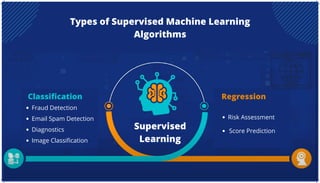
Supervised
Learning
Classification
Fraud Detection
Email Spam Detection
Diagnostics
Image Classification
Regression
Risk Assessment
Score Prediction
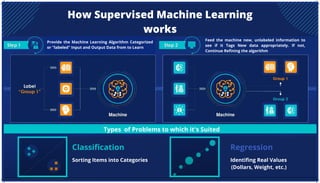
How Supervised Machine Learning
works
Classification
Sorting Items into Categories
Regression
Identifing Real Values
(Dollars, Weight, etc.)
Types of Problems to which it's Suited
Feed the machine new, unlabeled information to
see if it Tags New data appropriately. If not,
Continue Refining the algorithm
Provide the Machine Learning Algorithm Categorized
or "labeled" Input and Output Data from to Learn
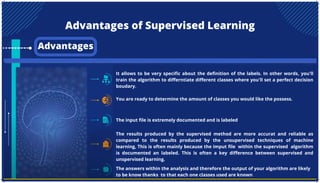
Advantages of Supervised Learning
Advantages
It allows to be very specific about the definition of the labels. In other words, you'll
train the algorithm to differntiate different classes where you'll set a perfect decision
boudary.
You are ready to determine the amount of classes you would like the possess.
The input file is extremely documented and is labeled
The results produced by the supervised method are more accurat and reliable as
compared to the results produced by the unsupervised techniques of machine
learning, This is often mainly because the imput file within the supervised algorithm
is documented an labeled. This is often a key difference between supervised and
unspervised learning.
The answers within the analysis and therefore the output of your algorithm are likely
to be know thanks to that each one classes used are known
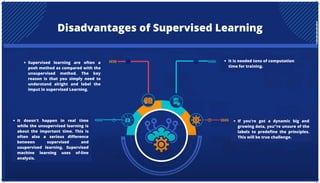
Disadvantages of Supervised Learning
Supervised learning are often a
posh method as compared with the
unsupervised method. The key
reason is that you simply need to
understand alright and label the
imput in supervised Learning.
It is needed tons of computation
time for training.
It doesn't happen in real time
while the unsupervised learning is
about the important time. This is
often also a serious difference
between supervised and
usupervised learning. Supervised
machine learning uses of-line
analysis.
If you're got a dynamic big and
growing data, you"re unsure of the
labels to predefine the principles.
This will be true challenge.
What is Unsupervised Learning?
How Unsupervised Machine Learning Works
Types of Unsupervised Learning
Disadvantages of Unsupervised Learning
Unsupervised
Machine
Learning
Algorithm Output
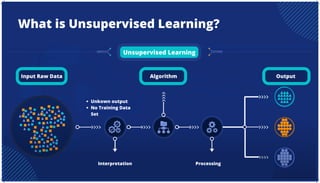
What is Unsupervised Learning?
Unsupervised Learning
Input Raw Data
Unkown output
No Training Data
Set
Interpretation Processing
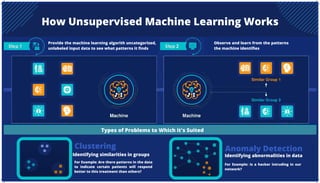
How Unsupervised Machine Learning Works
Provide the machine learning algorith uncategorized,
unlabeled input data to see what patterns it finds
Observe and learn from the patterns
the machine identifies
Types of Problems to Which it's Suited
Clustering
Identifying similarities in groups
For Example: Are there patterns in the data
to indicate certain patients will respond
better to this treatment than others?
Anomaly Detection
Identifying abnormalities in data
For Example: Is a hacker intruding in our
network?
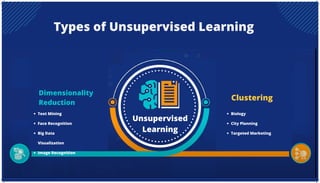
Types of Unsupervised Learning
Unsupervised
Learning
Dimensionality
Reduction
Text Mining
Face Recognition
Big Data
Visualization
Image Recognition
Clustering
Biology
City Planning
Targeted Marketing
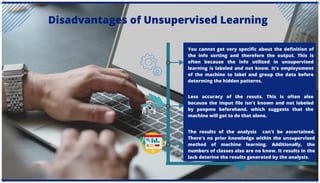
You cannot get very specific about the definition of
the info sorting and therefore the output. This is
often because the info utilized in unsupervised
learning is labeled and not know. It's employement
of the machine to label and group the data before
determing the hidden patterns.
The results of the analysis can't be ascertained.
There's no prior knowledge within the unsupervised
method of machine learning. Additionally, the
numbers of classes also are no know. It results in the
lack deterine the results generated by the analysis.
Less accuracy of the resuts. This is often also
because the imput file isn't known and not labeled
by peopme beforehand. which suggests that the
machine will got to do that alone.
Disadvantages of Unsupervised Learning
Clustering
Associatio
n
Patterns / Structure
Discovery
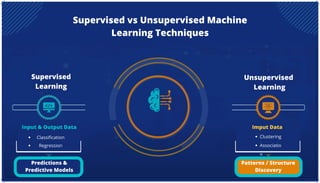
Supervised vs Unsupervised Machine
Learning Techniques
Supervised
Learning
Unsupervised
Learning
Input & Output Data
Classification
Regression
Predictions &
Predictive Models
Imput Data
What is reinforcement learning?
How reinforcement learning works
Types of reinforcement learning
Advantages reinforcement learning
Disadvantage of reinforcement learning
Reinforcement
Learning
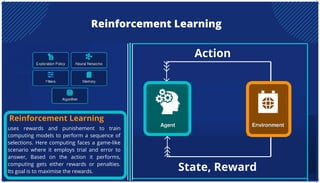
Reinforcement Learning
uses rewards and punishement to train
computing models to perform a sequence of
selections. Here computing faces a game-like
scenario where it employs trial and error to
answer, Based on the action it performs,
computing gets either rewards or penalties.
Its goal is to maximise the rewards.
Reinforcement Learning
Action
State, Reward
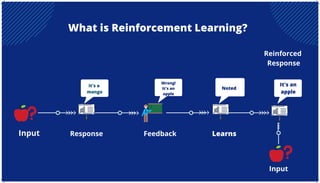
What is Reinforcement Learning?
Input Response Feedback Learns
Input
Reinforced
Response
It's a
mango
Wrong!
It's an
apple
Noted
It's an
apple
Unsupervised
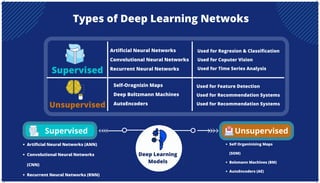
Types of Deep Learning Netwoks
Artificial Neural Networks (ANN)
Convolutional Neural Networks
(CNN)
Recurrent Neural Networks (RNN)
Self Organinizing Maps
(SOM)
Bolzmann Machines (BM)
AutoEncoders (AE)
Artificial Neural Networks
Convolutional Neural Networks
Recurrent Neural Networks
Used for Regresion & Classification
Used for Coputer Vision
Used for Time Series Analysis
Used for Feature Detection
Used for Recommendation Systems
Self-Oragnizin Maps
Deep Boltzmann Machines
AutoEncoders
Supervised
Supervised
Unsupervised
Deep Learning
Models
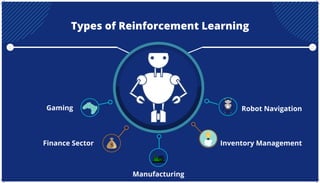
Inventory Management
Types of Reinforcement Learning
Gaming
Finance Sector
Manufacturing
Robot Navigation
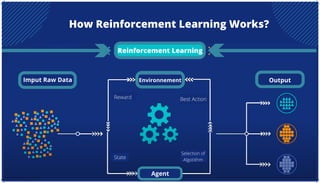
Environnement
Agent
Output
Best Action
Selection of
Algotithm
How Reinforcement Learning Works?
Reinforcement Learning
Imput Raw Data
Reward
State
Disadvantage of Reinforcement Learning
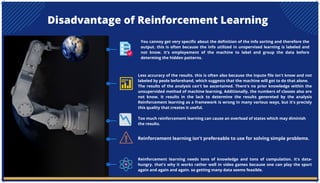
You cannoy get very specific about the definition of the info sorting and therefore the
output. this is often because the info utilized in unspervised learning is labeled and
not know. it's employement of the machine to label and group the data before
determing the hidden patterns.
Less accuracy of the results. this is often also because the inpute file isn't know and not
labeled by peole beforehand, which suggests that the machine will got to do that alone.
The results of the analysis can't be ascertained. There's no prior knowledge within the
unsupervided method of machine learning. Additionally, the numbers of classes also are
not know. It results in the lack to determine the results genereted by the analysis
Reinforcement learning as a framework is wrong in many various ways, but it's precisly
this quality that creates it useful.
Too much reinforcement learning can cause an overload of states which may diminish
the results.
Reinforcement learning isn't prefereable to use for solving simple problems.
Reinforcement learning needs tons of knowledge and tons of compulation. it's data-
hungry. that's why it works rather well in video games because one can play the sport
again and again and again. so getting many data seems feasible.
What is Deep Learning?
Deep Learning Process
Classification of Neural Networks
Types of Deep Learning Networks
Reinfocement leanring
Examples of deep leaning applications
Why is Deep Learning Important ?
Limitations of Deep Learning
Deep Learning
Deep Learning
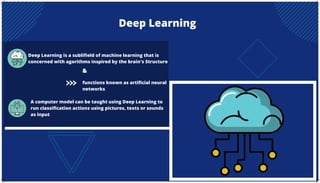
Deep Learning is a sublifield of machine learning that is
concerned with agorithms inspired by the brain's Structure
functions known as artificial neural
networks
A computer model can be taught using Deep Learning to
run classification actions using pictures, texts or sounds
as input
&
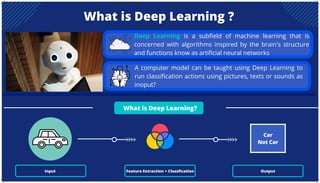
Feature Extraction + Classfication Output
Deep Learning is a subfield of machine learning that is
concerned with algorithms inspired by the brain's structure
and functions know as artificial neural networks
A computer model can be taught using Deep Learning to
run classification actions using pictures, texts or sounds as
inoput?
What is Deep Learning ?
What is Deep Learning?
Car
Not Car
Input
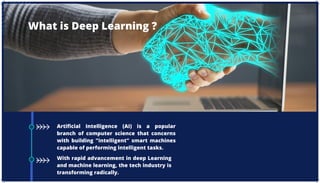
Artificial Intelligence (AI) is a popular
branch of computer science that concerns
with building "intelligent" smart machines
capable of performing intelligent tasks.
With rapid advancement in deep Learning
and machine learning, the tech industry is
transforming radically.
What is Deep Learning ?
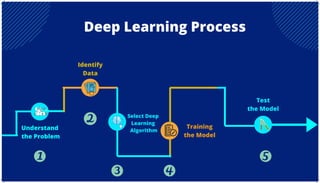
Understand
the Problem
Deep Learning Process
Identify
Data
Select Deep
Learning
Algorithm
Training
the Model
Test
the Model
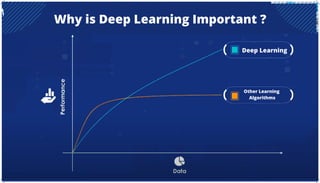
Why is Deep Learning Important ?
Deep Learning
Other Learning
Algorithms
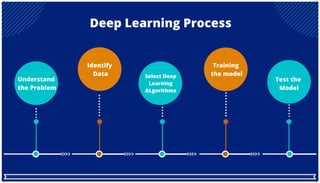
Deep Learning Process
Identify
Data Select Deep
Learning
ALgorithms
Training
the model
Test the
Model
Understand
the Problem
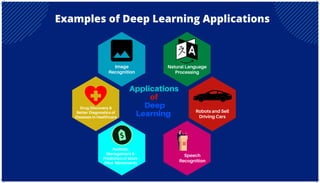
Examples of Deep Learning Applications
Applications
of
Deep
Learning
Drug Discovery &
Better Diagnostics of
Diseases in Healthcare
Image
Recognition
Natural Language
Processing
Robots and Sell
Driving Cars
Speech
Recognition
Portfolio
Management &
Prediction of stock
Price Movements
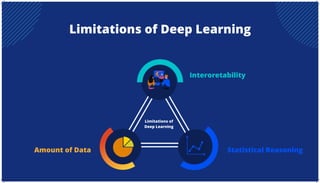
Limitations of Deep Learning
Amount of Data
Interoretability
Statistical Reasoning
Limitations of
Deep Learning
Difference between Machine Learning
and Deep Learning
Which is better to start Artificiel
Intelligence , Machine Learning or Deep
Learning ?
Difference between
Artificial Intelligence
vs Machine Learning
vs Deep Learning
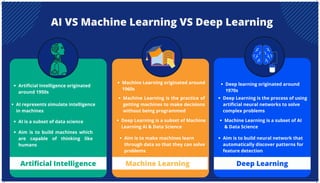
Artificial Intelligence originated
around 1950s
Machine Learning is the practice of
getting machines to make decisions
without being programmed
AI represents simulate intelligence
in machines
AI is a subset of data science Deep Learning is a subset of Machine
Learning Ai & Data Science
AI VS Machine Learning VS Deep Learning
Aim is to build machines which
are capable of thinking like
humans
Machine Learning originated around
1960s
Machine Learning is a subset of AI
& Data Science
Aim is to make machines learn
through data so that they can solve
problems
Deep learning originated around
1970s
Deep Learning is the process of using
artificial neural networks to solve
complex problems
Aim is to build neural network that
automatically discover patterns for
feature detection
Artificial Intelligence Machine Learning Deep Learning
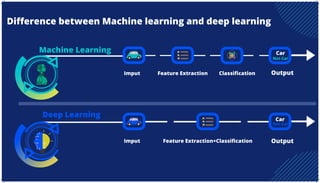
Difference between Machine learning and deep learning
Feature Extraction
Feature Extraction+Classification
Classification
Imput Output
Imput Output
Machine Learning
Deep Learning
Car
Car
Not Car
Not Car
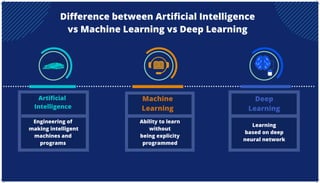
Difference between Artificial Intelligence
vs Machine Learning vs Deep Learning
Machine
Learning
Deep
Learning
Artificial
Intelligence
Engineering of
making intelligent
machines and
programs
Ability to learn
without
being explicity
programmed
Learning
based on deep
neural network
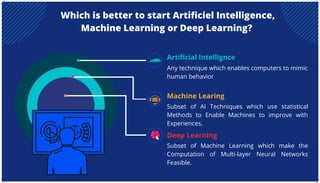
Which is better to start Artificiel Intelligence,
Machine Learning or Deep Learning?
Subset of AI Techniques which use statistical
Methods to Enable Machines to improve with
Experiences.
Subset of Machine Learning which make the
Computation of Multi-layer Neural Networks
Feasible.
Any technique which enables computers to mimic
human behavior
Artificial Intellignce
Machine Learing
Deep Learning
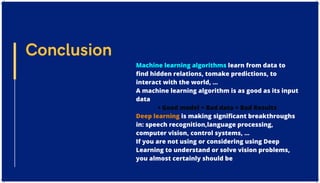
Machine learning algorithms learn from data to
find hidden relations, tomake predictions, to
interact with the world, …
A machine learning algorithm is as good as its input
data
• Good model + Bad data = Bad Results
Deep learning is making significant breakthroughs
in: speech recognition,language processing,
computer vision, control systems, …
If you are not using or considering using Deep
Learning to understand or solve vision problems,
you almost certainly should be
Conclusion
Bibliography
Books
1.
Introduction to Machine LearningThe Wikipedia Guide
Machine Learning for dummies A Willey Brand
MACHINE LEARNING Tom M Mitchell
Understanding Machine Learning: From Theory to
Algorithmsc 2014 by Shai Shalev-Shwartz and Shai Ben-David
2.Journals
Journal of Machine Learning Research www.jmlr.org
Machine Learning
IEEE Transactions on Neural Networks
IEEE Transactions on Pattern Analysis and Machine
Intelligence
Annals of Statistics
Journal of the American Statistical Association
International Conference on Machine Learning (ICML)
European Conference on Machine Learning (ECML)
Neural Information Processing Systems (NIPS)
Computational Learning
International Joint Conference on Artificial Intelligence (IJCAI)
ACM SIGKDD Conference on Knowledge Discovery and Data
Mining (KDD)
IEEE Int. Conf. on Data Mining (ICDM)
3.Conferences
thank you
for
your
time

What is artificial intelligence (IA) ?

  • 1.
    WHAT IS ARTIFICIAL INTELLIGENCE? AI V S M A C H I N E L E A R N I N G V S D E E P L E A R N I N G Name : Oussama BELAKHDAR framed by : Prof. Maria Moise, PhD
  • 2.
    01 Table of Contents Presentation Outline Introductionto AI Machine Learning Supervised Learning Unsupervised Learning Reinforcement Learning Deep Learning AI vs Machine Learning vs Deep Learning MACHINE LEARNING PRESENTATION
  • 3.
    What is AI? Introduction to AI Timeline : History of AI Types of Artificial Intelligence Artificiel Intelligence Value Chain Elemnts Where is AI used ? AI use cases AI trend in 2020 Challenges in adoption of Artificial Intelligence 02 Introduction to Artificial Intelligence
  • 4.
    What is ArtificialIntelligence ? Artifcial Intelligence is a popular branch of computer science that concerns with building "intelligent" smart machines capable of performing intelligent tasks. Artificial Intelligence With rapid advancements in deep learning and machine learning, the tech industry is transforming radically.
  • 5.
    Sense Comprehend Act ArtificialIntelligence Introduction AI Technologies Illustrative Solutions Natural Language Processing Knowledge Representation Computer Vision Audio Processing Machine Learning Expert Systems Virtual Agents Identity Analytics Cognitive Robotics Speech Analytics Reommendation Systems Data Visualization
  • 6.
    Introduction to AILevels ? Artificial Narraw Intelligence Artificial General Intelligence Artificial Super Intelligence Types of Artigicial Intelligence
  • 7.
    Artificial Narrow Intelligence Artificial General Intelligence VS BeatGo World Champions Read Facial Expressions Write Music
  • 8.
    Artificial Intelligence Artificial Intelligence(AI) is a populare branch of compter science that concerns with building "intelligent" smart machines capable of performing intelligent tasks. With rapid advancements in deep learning and machine learning, the teck industry is transforming radically. Artificial Intelligence Transforming the Nature of Work, Learning, and Learning to Work Machine Learning Deep Learning
  • 9.
    Artificial Intelligence Approaches Logic& Rules-Based Approach Machine Learning (Pattern Based Approach) Artificial Intelligence
  • 10.
    TIMELINE The History ofArtificial Intelligence TURING TEST THE TERM AI ELIZA AI WINTER DEEP BLUE SIRI WATSON TAY ALEXA ALPHAGO ETHIC GUIDELINES 1950 1955 1966 1970s-1908s 1997 2011 2011 2014 2016 2017 2018 The Turning Test is a method for determining the intelligence of machine The Term"Artificial Intelligence" is used for the first time Eiza, one of the first chatbots, simulates conversations as a psychotherapist After the boom of early esearch there was a pause Chess comptuer Deep Blue wins againt chess world champion Garri kadparov Siri, the intelligent speech assitant, is integratd into the iPhone 4s for the first time Supercompter Watson wins against two human rivals in the quiz show Jeopardy Virtual assistant Alexa from Amazon moves into countless homes Chatbot, Tay had to be reissued after a short time because of racist and sexist remarks Google's AlphaGO beats the world champion in the game Go The European Union establishes guidelines for dealing with ethics in AI
  • 11.
    Types of ArtificialIntelligence Artificial Intelligence Deep Learning Machine Learning
  • 13.
    Survey on Adoptionof Emerging Technologies
  • 14.
    Artificial Intelligence KeyStatistics of senior decision-makers agree that AI is fundamental to the success of their organisations strategy , those currently or planning to use AI technology anticipate a 39% boost to their organisation's revenue, on average organizations that have replaced, or plan to replace, roles with technology will retain or redeploy those who are displaced Two-third By 2022 7 in 10
  • 15.
  • 16.
    Artificial Intelligence DevelopmentPhases Phase 1 Phase 2 Phase 3
  • 17.
    Reasons of usingArtificial Intelligence Monitoring and alerts about health and the business, 6.6% Automation that eliminates manual and repetitive tasks, 7.6% All of hte above automated data-driven reporting,18% Automated Communications that give consumers data they can use to effective decisions, 12.8% Automated data- driven reporting, 5% Automated communications that give firms data they can use to make effective business decisions,45% Other , 5%
  • 18.
    Where is AIused ? Customer Experience Supply Chain Human Resources Fraud Detection Knowledge Creation Research & Development Predictive Analytics Real-time Operations Management Customer Services Risk Management & Analytics Customer Insight Pricing & Promotion
  • 19.
    Artificial Intelligence &Investment by Sector
  • 20.
    Core Areas ofArtificial Intelligence Explainable AI Research on new algorithms High precision learning from small data sets Sensory AI such as Internet of things Physical AI like Industrial Automation Cognitive AI such as worker training General AI
  • 21.
    Artificial Intelligence invarious Sectors Transport Health Water Technology Environment Traffic
  • 22.
    ENGAGEMENT HR Chatbot Engagement Surveys Dynamic CareerSites Smart Sourcing AI Use Cases in Human Resource LEARNING Curated Training Skill Development RECRUITING ONBOARDING Automated Messages Curate Videos Employee Life Cycle
  • 23.
    Potential Use Casesof AI in Healthcare AI & ROBOTICS Training Research End of Life Care Treatment Decision Making Keeping Well Early Detection Diagnosis
  • 24.
    Bring all ofthe above together for healthcare use cases Social Platforms Smartphones AI Chatbots in Healthcare Search Engine Users Learn to search for information Like Facebook connect users online Bring the internet online Healthbots Self learning machines becomes smarter the more they are used Messenger Apps Lets users chat anywhere, anytime App Eco-system Lets users dowload and use apps easily Artificial Intelligence
  • 25.
    AI in SupplyChain Digital Ecosystem Data Lake Secure Access Via Identity Management for Transient Users
  • 26.
    Payment System Nonmonetary System AuthorizationSystem AI in Banking for Fraud Detection Neural Network Engine Scoring Engine Cardholder Profiles Postings Case Creation Module Case Management Database Expert Rules Base Expert Authorization Response Module Workstation Configuration Workstation Analyst
  • 27.
    Aerospace and FlightOprations Controlled by AI 10 AI Trend in 2020 AI In Retail AI Mediated Media and Entertainent Advanced Cybersecurity Automated Business Process AI-powered Chatbots AI will Come for B2B Data Modling will move to the Edge AI will make Healthcare more Accurate Robotic Process Automation
  • 28.
    Challenges in adoptionof Artificial Intelligence Lack of enabling data ecosystem Low Intensity of AI research Inadequate availability of expertise, technology & research High resource cost & low awareness for adopting AI in business process Unclear privacy, security and ethical regulations Unattrative intellectual Property regime to incentivize reseach & adoption of AI
  • 29.
    What is MachineLearning? 7 Steps of Machine Lrearning Machine learning vs Traditional Programming How does machine learning work? Machine learning use cases How to choose Machine Learning Algorithm Why to use decision tree algorithm Learning Challenges and Limitations of Machine Learning Application of Machine Learning Why is machine learning important? Types of Machine Learning Machine Learning
  • 30.
    Machine Learning Machine Learningis a type of AI that enables machines to learn from data and deliver predictive models The machine learning is not dependent on any explicit programming but the data fed into it. It is a complicated process. Based on the data you feed into machine learning algorithm and the training given to it, an output is delivered. A predictive algorithm create a predictive model.
  • 31.
    Machine Learning isthe result of General AI that involves developing machines that can deliver results bettr than humans Machine Learning Traditional Programming Machine Learning Data (Input) Data (Input) Program Output Output Program Input Data: Feed Learner Varios Data Output Data: Present Rules "Learning" Machine Learning System
  • 32.
    Is a typeof that enables machines to learn from data and deliver predictive models. The machine learning is not depedent on any explicit programming but the data fed into it. It is a complicated process. Based on the data you feed into machine leaning algorithm and the training given to it, an output is delivered. A predictive algoritthm will create a predictive model. Improves What is Machine Learning? Machine Learning Machine learning Predicts Introduction to Machine Learning Learns Ordinary System With Ai
  • 33.
    Machine Learning MainPoints Pattern Detection Self-Programming Leanring Data
  • 34.
    INPUT DATA information (+Answers) OUTPUT DATA optimum Modl Algorithms + Techniques MACHINE LEARNING Relationships Patterns Hidden Structures Dependencies
  • 35.
    Raw & TrainingData Selecting Right Algorithms Modelling Machine Learning Process Visualisation Data Gathering Data Cleaning Building Model & Finalising Data Transformation into Predictions Candidate & Final Prediction & Strategy Data
  • 36.
    Learning Error Analysis Phase2: Prediction Why is Machine Learning Important? Pre-processing Phase 1 : Learning Model New Data Prediction Predicted Data Normalisation Dimension Reduction Image Processing,etc. Supervised Unsupervised Minimization, etc. Precision/ recall Over fitting Test/cross Validation data, etc. Training Data
  • 37.
    Application of MachineLearning Image Recognition Speech Recognition Traffic Prediction Product Recommendations Self Driving Cars Email Spam and Malware Filtering Virtual Personal Assistant Online Fraud Detection Stock Market Trading Medical DIagnosis Automatic Language Translation
  • 38.
    MACHINE LEARNING USE CASES Manufacturing Financial Services Energy, Feedstock & Utilities Seismicdata processing Retail Travel & Hospitality Healthcare & Life Sciences Smart grid Management Power usage analytics Alerts & diagnostics from real- time patient data Healthcare provider sentiment analysis Demand forecasting Predictive maintenance Predictive invetory planning Reommenda tion engines Dynamic pricing Aircraft Scheduling Credit worthiness evaluation Customer segmentation Traffic patterns Risk analytics & regulation Process optimization Customer Rol Proactive health management
  • 39.
    Machine Learning UseCases Energy Feedstock & Utilities Financial Services Travel & Hospitality Healthcare & Life Sciences Power Usage Analytics Seismic Data Processing Smart Grid Management Energy Demand Risk Analytics & Regulation Customer Segmentation Credit Worthiness Evaluation Aircraft Scheduling Dynamic Pricing Trafic Patteerns & Congestion Management Predictive Maintenance or Condition Monitoring Demand Forecasting Process Optimization Telematics Predictive Inventory Planning Recommendatio Engines Customer ROI & Lifetime Value Alerts & Diagnostics from Real-time Patient Data Predictive Health Management Heathcare Provider Manufacturing Retail
  • 40.
  • 41.
    How does MachineLearning Work ? Define Objectives Prepare Data Train model Integrate model Collect Data Select Algorithm Test Model Identifty, the problem to be solved and create a clear objective. Preparing data is a crucial step and involves building workflows to clean, match and blend the data Data is fed as input and the algorithm configured with the required parameters. A percent of th data can be utilized to train the model. Publish the prepared expriment as web sevice, so appliations can use the model. Collect data from hospitals, health insurance companies, social service agencies, police and fire dept. Depend on the problem to be solved and the type of data an appropriate algorithm will be chosen. The remaining data is utilized to test the model, for accuracy, Depending on the results, improvements, can be performed in the "Train model" and /or "Select algorithm" phases, iteratively.
  • 42.
    Machine Learning Process STEP1 STEP 2 STEP 3 STEP 4 STEP 5 Gathering data from various sources Cleaning data to have homogeneity Modeml Building Selecting the right ML algorithm Gaining insights from the model's results Data visualisation- Transforming results into visuals graphs
  • 43.
    Additional Requierements How to ChooseMachine learning Algorithm How to Select Machine Learning Algorithms Algorithm Cheat Sheet What do you want to do with your Data? Accuracy Training Time Linearity Number of Parameters Number of Features
  • 44.
    Machine Learning vsTraditional Programming Computer Computer Data Handcrafted Model Result Sample Data Expected Result Model New Data Model Result Traditional modelling Machine Learning Predition Learning Predition Computer
  • 45.
    Use c4.5 Implementation To Classify Whyuse Decision Tree Machine Learning Algorithm Decision Trees To Predict Responsible Variable has only 2 Categories Response Variable has Multiple Categories Use Standard Classification here Use c4.5 Implementation Responsible variable is Continuous Linear Relationship between Predictors & Response Non-linear Relationship between Predictors & Response Use Standard Regression Tree
  • 46.
    Disadvantages Challenges and Limitationsof Machine Learning Advantages Easily Identifies Trends and Patterns No Human Intervention Needed Handling multi-dimensional & multi-variety Data Interpretation Results Continuos Improvement Wide Applications High Error- Susceptibility Time and Resources Data Acquisition
  • 47.
    Supervised Learning Unsupervised Learning Reinforcement Learning Machine Understands thedata (identifies Patterns/ Structures) Evaluation is Qualitative or indirect Does not Predict/Find anything Specific An approach to AI Reward Based Learning Learning from +ve & +ve Reinforcement Machine Learns how to act in a Certain Environment To Maximise Rewards Training Rewards Types of Machine Learning Data with Clearly define Output is given Resolves Classification and Regression Problems Makes Machine Learn Explicity Direct feedback is given Predict outome future Inputs Inputs Inputs Outputs Outputs Outputs
  • 48.
    Hidden Markov Model Machine LearningAlgorithms Machine Learning Supervised Unsupervised Reinforcement Regression Clustering Decision Tree Random Forest Classification Association Anlaysis Linear Polynomial SVD PCA K-means KNN Trees Logistic Regression Naïve-Bayes Apriori FP-Growth Continuous Categorical
  • 49.
    Machine Learning Unsupervised Learning Supervised Learning Clustering Dimensionality Reduction Classification Regression Reinforcement Learning Recommender Systems Targetted Marketing Customer Segmentation Real-tme decisions Robot Navigation GameAI Skill Acquisition Learning Tasks Big Data Visualisation Meaningful Compression Structure Discovery Feature Eliitation Image Classification Idenity Fraud Detection Customer Retention Diagnostics Population Growth Prediction Advertising Popularity Prediction Weather Forecasting Market Forecasting Estimating Life Expectancy
  • 50.
    Types of MachineLearning What is Supervised Machine Learning? How Supervised Machine Works? Types of Supervised Machine Learning Algorithms Supervised vs Unspervised Machine Learning Techniques Advantages of Supervised Learning Disadvantags of Supervised Learning Supervised Machine Learning
  • 51.
    Output Training Data set Desired output What isSupervised Machine Learning? Supervised Learning Imput Raw Data Supervisor
  • 52.
    Types of SupervisedMachine Learning Algorithms Supervised Learning Classification Fraud Detection Email Spam Detection Diagnostics Image Classification Regression Risk Assessment Score Prediction
  • 53.
    How Supervised MachineLearning works Classification Sorting Items into Categories Regression Identifing Real Values (Dollars, Weight, etc.) Types of Problems to which it's Suited Feed the machine new, unlabeled information to see if it Tags New data appropriately. If not, Continue Refining the algorithm Provide the Machine Learning Algorithm Categorized or "labeled" Input and Output Data from to Learn
  • 54.
    Advantages of SupervisedLearning Advantages It allows to be very specific about the definition of the labels. In other words, you'll train the algorithm to differntiate different classes where you'll set a perfect decision boudary. You are ready to determine the amount of classes you would like the possess. The input file is extremely documented and is labeled The results produced by the supervised method are more accurat and reliable as compared to the results produced by the unsupervised techniques of machine learning, This is often mainly because the imput file within the supervised algorithm is documented an labeled. This is often a key difference between supervised and unspervised learning. The answers within the analysis and therefore the output of your algorithm are likely to be know thanks to that each one classes used are known
  • 55.
    Disadvantages of SupervisedLearning Supervised learning are often a posh method as compared with the unsupervised method. The key reason is that you simply need to understand alright and label the imput in supervised Learning. It is needed tons of computation time for training. It doesn't happen in real time while the unsupervised learning is about the important time. This is often also a serious difference between supervised and usupervised learning. Supervised machine learning uses of-line analysis. If you're got a dynamic big and growing data, you"re unsure of the labels to predefine the principles. This will be true challenge.
  • 56.
    What is UnsupervisedLearning? How Unsupervised Machine Learning Works Types of Unsupervised Learning Disadvantages of Unsupervised Learning Unsupervised Machine Learning
  • 57.
    Algorithm Output What isUnsupervised Learning? Unsupervised Learning Input Raw Data Unkown output No Training Data Set Interpretation Processing
  • 58.
    How Unsupervised MachineLearning Works Provide the machine learning algorith uncategorized, unlabeled input data to see what patterns it finds Observe and learn from the patterns the machine identifies Types of Problems to Which it's Suited Clustering Identifying similarities in groups For Example: Are there patterns in the data to indicate certain patients will respond better to this treatment than others? Anomaly Detection Identifying abnormalities in data For Example: Is a hacker intruding in our network?
  • 59.
    Types of UnsupervisedLearning Unsupervised Learning Dimensionality Reduction Text Mining Face Recognition Big Data Visualization Image Recognition Clustering Biology City Planning Targeted Marketing
  • 60.
    You cannot getvery specific about the definition of the info sorting and therefore the output. This is often because the info utilized in unsupervised learning is labeled and not know. It's employement of the machine to label and group the data before determing the hidden patterns. The results of the analysis can't be ascertained. There's no prior knowledge within the unsupervised method of machine learning. Additionally, the numbers of classes also are no know. It results in the lack deterine the results generated by the analysis. Less accuracy of the resuts. This is often also because the imput file isn't known and not labeled by peopme beforehand. which suggests that the machine will got to do that alone. Disadvantages of Unsupervised Learning
  • 61.
    Clustering Associatio n Patterns / Structure Discovery Supervisedvs Unsupervised Machine Learning Techniques Supervised Learning Unsupervised Learning Input & Output Data Classification Regression Predictions & Predictive Models Imput Data
  • 62.
    What is reinforcementlearning? How reinforcement learning works Types of reinforcement learning Advantages reinforcement learning Disadvantage of reinforcement learning Reinforcement Learning
  • 63.
    Reinforcement Learning uses rewardsand punishement to train computing models to perform a sequence of selections. Here computing faces a game-like scenario where it employs trial and error to answer, Based on the action it performs, computing gets either rewards or penalties. Its goal is to maximise the rewards. Reinforcement Learning Action State, Reward
  • 64.
    What is ReinforcementLearning? Input Response Feedback Learns Input Reinforced Response It's a mango Wrong! It's an apple Noted It's an apple
  • 65.
    Unsupervised Types of DeepLearning Netwoks Artificial Neural Networks (ANN) Convolutional Neural Networks (CNN) Recurrent Neural Networks (RNN) Self Organinizing Maps (SOM) Bolzmann Machines (BM) AutoEncoders (AE) Artificial Neural Networks Convolutional Neural Networks Recurrent Neural Networks Used for Regresion & Classification Used for Coputer Vision Used for Time Series Analysis Used for Feature Detection Used for Recommendation Systems Used for Recommendation Systems Self-Oragnizin Maps Deep Boltzmann Machines AutoEncoders Supervised Supervised Unsupervised Deep Learning Models
  • 66.
    Inventory Management Types ofReinforcement Learning Gaming Finance Sector Manufacturing Robot Navigation
  • 67.
    Environnement Agent Output Best Action Selection of Algotithm HowReinforcement Learning Works? Reinforcement Learning Imput Raw Data Reward State
  • 68.
    Disadvantage of ReinforcementLearning You cannoy get very specific about the definition of the info sorting and therefore the output. this is often because the info utilized in unspervised learning is labeled and not know. it's employement of the machine to label and group the data before determing the hidden patterns. Less accuracy of the results. this is often also because the inpute file isn't know and not labeled by peole beforehand, which suggests that the machine will got to do that alone. The results of the analysis can't be ascertained. There's no prior knowledge within the unsupervided method of machine learning. Additionally, the numbers of classes also are not know. It results in the lack to determine the results genereted by the analysis Reinforcement learning as a framework is wrong in many various ways, but it's precisly this quality that creates it useful. Too much reinforcement learning can cause an overload of states which may diminish the results. Reinforcement learning isn't prefereable to use for solving simple problems. Reinforcement learning needs tons of knowledge and tons of compulation. it's data- hungry. that's why it works rather well in video games because one can play the sport again and again and again. so getting many data seems feasible.
  • 69.
    What is DeepLearning? Deep Learning Process Classification of Neural Networks Types of Deep Learning Networks Reinfocement leanring Examples of deep leaning applications Why is Deep Learning Important ? Limitations of Deep Learning Deep Learning
  • 70.
    Deep Learning Deep Learningis a sublifield of machine learning that is concerned with agorithms inspired by the brain's Structure functions known as artificial neural networks A computer model can be taught using Deep Learning to run classification actions using pictures, texts or sounds as input &
  • 71.
    Feature Extraction +Classfication Output Deep Learning is a subfield of machine learning that is concerned with algorithms inspired by the brain's structure and functions know as artificial neural networks A computer model can be taught using Deep Learning to run classification actions using pictures, texts or sounds as inoput? What is Deep Learning ? What is Deep Learning? Car Not Car Input
  • 72.
    Artificial Intelligence (AI)is a popular branch of computer science that concerns with building "intelligent" smart machines capable of performing intelligent tasks. With rapid advancement in deep Learning and machine learning, the tech industry is transforming radically. What is Deep Learning ?
  • 73.
    Understand the Problem Deep LearningProcess Identify Data Select Deep Learning Algorithm Training the Model Test the Model
  • 74.
    Why is DeepLearning Important ? Deep Learning Other Learning Algorithms
  • 75.
    Deep Learning Process Identify DataSelect Deep Learning ALgorithms Training the model Test the Model Understand the Problem
  • 76.
    Examples of DeepLearning Applications Applications of Deep Learning Drug Discovery & Better Diagnostics of Diseases in Healthcare Image Recognition Natural Language Processing Robots and Sell Driving Cars Speech Recognition Portfolio Management & Prediction of stock Price Movements
  • 77.
    Limitations of DeepLearning Amount of Data Interoretability Statistical Reasoning Limitations of Deep Learning
  • 78.
    Difference between MachineLearning and Deep Learning Which is better to start Artificiel Intelligence , Machine Learning or Deep Learning ? Difference between Artificial Intelligence vs Machine Learning vs Deep Learning
  • 79.
    Artificial Intelligence originated around1950s Machine Learning is the practice of getting machines to make decisions without being programmed AI represents simulate intelligence in machines AI is a subset of data science Deep Learning is a subset of Machine Learning Ai & Data Science AI VS Machine Learning VS Deep Learning Aim is to build machines which are capable of thinking like humans Machine Learning originated around 1960s Machine Learning is a subset of AI & Data Science Aim is to make machines learn through data so that they can solve problems Deep learning originated around 1970s Deep Learning is the process of using artificial neural networks to solve complex problems Aim is to build neural network that automatically discover patterns for feature detection Artificial Intelligence Machine Learning Deep Learning
  • 80.
    Difference between Machinelearning and deep learning Feature Extraction Feature Extraction+Classification Classification Imput Output Imput Output Machine Learning Deep Learning Car Car Not Car Not Car
  • 81.
    Difference between ArtificialIntelligence vs Machine Learning vs Deep Learning Machine Learning Deep Learning Artificial Intelligence Engineering of making intelligent machines and programs Ability to learn without being explicity programmed Learning based on deep neural network
  • 82.
    Which is betterto start Artificiel Intelligence, Machine Learning or Deep Learning? Subset of AI Techniques which use statistical Methods to Enable Machines to improve with Experiences. Subset of Machine Learning which make the Computation of Multi-layer Neural Networks Feasible. Any technique which enables computers to mimic human behavior Artificial Intellignce Machine Learing Deep Learning
  • 83.
    Machine learning algorithmslearn from data to find hidden relations, tomake predictions, to interact with the world, … A machine learning algorithm is as good as its input data • Good model + Bad data = Bad Results Deep learning is making significant breakthroughs in: speech recognition,language processing, computer vision, control systems, … If you are not using or considering using Deep Learning to understand or solve vision problems, you almost certainly should be Conclusion
  • 84.
    Bibliography Books 1. Introduction to MachineLearningThe Wikipedia Guide Machine Learning for dummies A Willey Brand MACHINE LEARNING Tom M Mitchell Understanding Machine Learning: From Theory to Algorithmsc 2014 by Shai Shalev-Shwartz and Shai Ben-David 2.Journals Journal of Machine Learning Research www.jmlr.org Machine Learning IEEE Transactions on Neural Networks IEEE Transactions on Pattern Analysis and Machine Intelligence Annals of Statistics Journal of the American Statistical Association International Conference on Machine Learning (ICML) European Conference on Machine Learning (ECML) Neural Information Processing Systems (NIPS) Computational Learning International Joint Conference on Artificial Intelligence (IJCAI) ACM SIGKDD Conference on Knowledge Discovery and Data Mining (KDD) IEEE Int. Conf. on Data Mining (ICDM) 3.Conferences
  • 85.