Introduction to
Information
and Communication
Technologies
(ICT)
What is ICT?
 ICT stands for Information and Communication
Technology.
 It includes tools and systems to collect, store,
process, and share information.
 Examples: Computers, Internet, Mobile Phones,
Software, Cloud Services.
Components of ICT –
Hardware
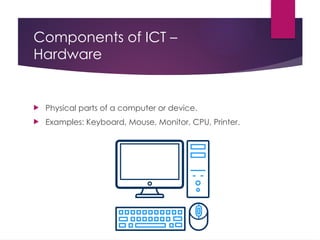
 Physical parts of a computer or device.
 Examples: Keyboard, Mouse, Monitor, CPU, Printer.
Components of ICT – Software
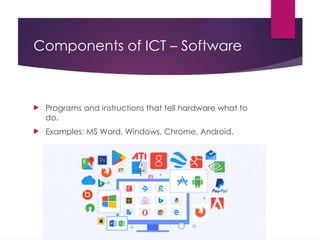
 Programs and instructions that tell hardware what to
do.
 Examples: MS Word, Windows, Chrome, Android.
Components of ICT – ICT
Platforms
 Tools or systems that help people connect and work
together.
 Examples: Google Workspace, Microsoft Teams,
Zoom, Facebook.
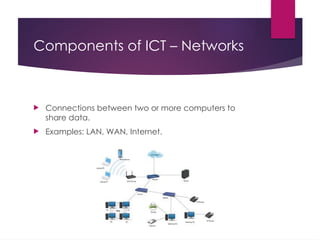
Components of ICT – Networks
 Connections between two or more computers to
share data.
 Examples: LAN, WAN, Internet.
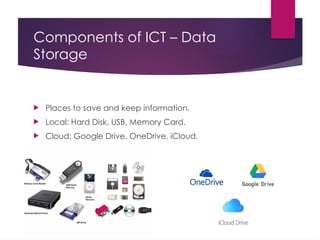
Components of ICT – Data
Storage
 Places to save and keep information.
 Local: Hard Disk, USB, Memory Card.
 Cloud: Google Drive, OneDrive, iCloud.
Scope of ICT – Education
 Used in online classes and smart learning.
 Examples: Google Classroom, YouTube lectures.
Scope of ICT – Business
 Used in online shopping, e-banking, data
management.
 Examples: Amazon, Easypaisa, accounting software.
Scope of ICT – Governance
 E-Government services and digital identity.
 Examples: NADRA, online tax filing.
Scope of ICT – Healthcare
 Digital patient records and telemedicine.
 Examples: Sehat Kahani, hospital management
systems.
Scope of ICT – Digital Media &
Entertainment
 Social media, online games, movies, and music.
 Examples: TikTok, YouTube, Netflix.
Developing Technologies &
Future Trends
 Artificial Intelligence (AI): Machines that learn and
think.
 Internet of Things (IoT): Smart devices connected to
internet.
 Cloud Computing: Data stored and used online.
 5G Networks: Faster internet and communication.
 Blockchain: Secure digital records and transactions.
Summary
 ICT connects the world through technology.
 Used in education, business, governance, and
health.
 Learning ICT means preparing for the digital future.
Introduction to ICT Presentation[1].pptx

  • 1.
  • 2.
    What is ICT? ICT stands for Information and Communication Technology.  It includes tools and systems to collect, store, process, and share information.  Examples: Computers, Internet, Mobile Phones, Software, Cloud Services.
  • 3.
    Components of ICT– Hardware  Physical parts of a computer or device.  Examples: Keyboard, Mouse, Monitor, CPU, Printer.
  • 4.
    Components of ICT– Software  Programs and instructions that tell hardware what to do.  Examples: MS Word, Windows, Chrome, Android.
  • 5.
    Components of ICT– ICT Platforms  Tools or systems that help people connect and work together.  Examples: Google Workspace, Microsoft Teams, Zoom, Facebook.
  • 6.
    Components of ICT– Networks  Connections between two or more computers to share data.  Examples: LAN, WAN, Internet.
  • 7.
    Components of ICT– Data Storage  Places to save and keep information.  Local: Hard Disk, USB, Memory Card.  Cloud: Google Drive, OneDrive, iCloud.
  • 8.
    Scope of ICT– Education  Used in online classes and smart learning.  Examples: Google Classroom, YouTube lectures.
  • 9.
    Scope of ICT– Business  Used in online shopping, e-banking, data management.  Examples: Amazon, Easypaisa, accounting software.
  • 10.
    Scope of ICT– Governance  E-Government services and digital identity.  Examples: NADRA, online tax filing.
  • 11.
    Scope of ICT– Healthcare  Digital patient records and telemedicine.  Examples: Sehat Kahani, hospital management systems.
  • 12.
    Scope of ICT– Digital Media & Entertainment  Social media, online games, movies, and music.  Examples: TikTok, YouTube, Netflix.
  • 13.
    Developing Technologies & FutureTrends  Artificial Intelligence (AI): Machines that learn and think.  Internet of Things (IoT): Smart devices connected to internet.  Cloud Computing: Data stored and used online.  5G Networks: Faster internet and communication.  Blockchain: Secure digital records and transactions.
  • 14.
    Summary  ICT connectsthe world through technology.  Used in education, business, governance, and health.  Learning ICT means preparing for the digital future.