INFORMATION AND COMMUNICATION
TECHNOLOGY
M.AMUDHA
Page 2
INTRODUCTION
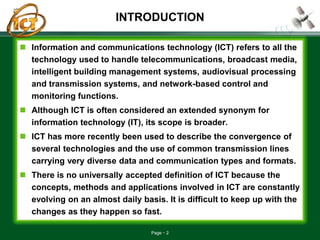
 Information and communications technology (ICT) refers to all the
technology used to handle telecommunications, broadcast media,
intelligent building management systems, audiovisual processing
and transmission systems, and network-based control and
monitoring functions.
 Although ICT is often considered an extended synonym for
information technology (IT), its scope is broader.
 ICT has more recently been used to describe the convergence of
several technologies and the use of common transmission lines
carrying very diverse data and communication types and formats.
 There is no universally accepted definition of ICT because the
concepts, methods and applications involved in ICT are constantly
evolving on an almost daily basis. It is difficult to keep up with the
changes as they happen so fast.
Page 3
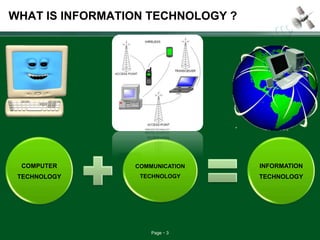
WHAT IS INFORMATION TECHNOLOGY ?
COMPUTER
TECHNOLOGY
COMMUNICATION
TECHNOLOGY
INFORMATION
TECHNOLOGY
Page 4
WHAT IS INFORMATION TECHNOLOGY?
 Fourth generation of human communication.
 The Internet gives us all the opportunity
 to act as a global community;
 advertise and operate across all frontiers; AND
 over borders and beyond the control of any national
government.
 The inherent vulnerability of internet lies in the form of computer
network break-ins, pornography, password sniffing, spoofing,
telecommunication frauds, spamming, advertisement of
unlicensed products, credit card fraud and hacking of computers.
 The internet with all its benefits of reliability, convenience and
anonymity has become an appropriate breeding place for persons
interested in illegal use of IT.
Page 5
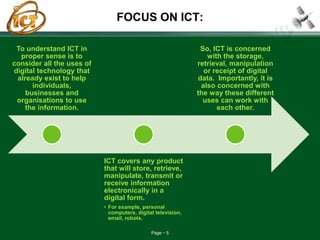
FOCUS ON ICT:
To understand ICT in
proper sense is to
consider all the uses of
digital technology that
already exist to help
individuals,
businesses and
organisations to use
the information.
ICT covers any product
that will store, retrieve,
manipulate, transmit or
receive information
electronically in a
digital form.
• For example, personal
computers, digital television,
email, robots.
So, ICT is concerned
with the storage,
retrieval, manipulation
or receipt of digital
data. Importantly, it is
also concerned with
the way these different
uses can work with
each other.
Page 6
CATEGORIES OF ICT:
 In business, ICT is often categorised into two broad types of
product: -
 The traditional computer-based technologies (things you can
typically do on a personal computer or using computers at home
or at work); and
 The more recent, and fast-growing range of digital communication
technologies (which allow people and organisations to
communicate and share information digitally)
Page 7
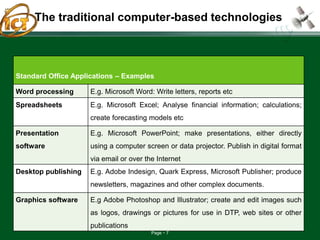
The traditional computer-based technologies
Standard Office Applications – Examples
Word processing E.g. Microsoft Word: Write letters, reports etc
Spreadsheets E.g. Microsoft Excel; Analyse financial information; calculations;
create forecasting models etc
Presentation
software
E.g. Microsoft PowerPoint; make presentations, either directly
using a computer screen or data projector. Publish in digital format
via email or over the Internet
Desktop publishing E.g. Adobe Indesign, Quark Express, Microsoft Publisher; produce
newsletters, magazines and other complex documents.
Graphics software E.g Adobe Photoshop and Illustrator; create and edit images such
as logos, drawings or pictures for use in DTP, web sites or other
publications
Page 8
TYPES OF NETWORKS:
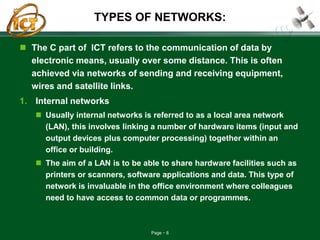
 The C part of ICT refers to the communication of data by
electronic means, usually over some distance. This is often
achieved via networks of sending and receiving equipment,
wires and satellite links.
1. Internal networks
 Usually internal networks is referred to as a local area network
(LAN), this involves linking a number of hardware items (input and
output devices plus computer processing) together within an
office or building.
 The aim of a LAN is to be able to share hardware facilities such as
printers or scanners, software applications and data. This type of
network is invaluable in the office environment where colleagues
need to have access to common data or programmes.
Page 9
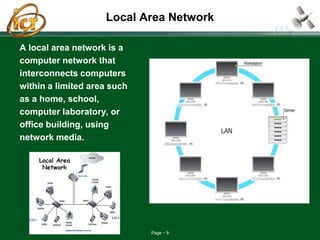
Local Area Network
A local area network is a
computer network that
interconnects computers
within a limited area such
as a home, school,
computer laboratory, or
office building, using
network media.
Page 10
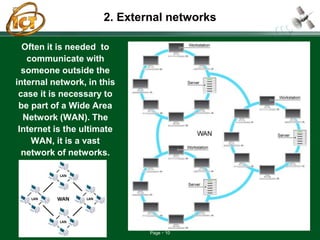
2. External networks
Often it is needed to
communicate with
someone outside the
internal network, in this
case it is necessary to
be part of a Wide Area
Network (WAN). The
Internet is the ultimate
WAN, it is a vast
network of networks.
Page 11
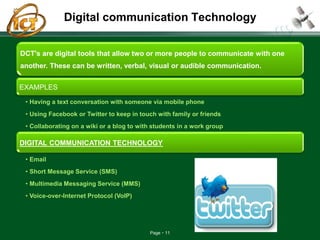
Digital communication Technology
DCT's are digital tools that allow two or more people to communicate with one
another. These can be written, verbal, visual or audible communication.
EXAMPLES
• Having a text conversation with someone via mobile phone
• Using Facebook or Twitter to keep in touch with family or friends
• Collaborating on a wiki or a blog to with students in a work group
DIGITAL COMMUNICATION TECHNOLOGY
• Email
• Short Message Service (SMS)
• Multimedia Messaging Service (MMS)
• Voice-over-Internet Protocol (VoIP)
Page 12
DEVELOPMENT COMMUNICATION:
 Sociologists, psychologists, economists and communication experts are of the opinion that the
proper use of communication can foster the pace and process of development.
 In general terms, communication means interaction between two individuals or within a group or
a community or a nation.
 The foundation of communication is based upon four principal elements communication source,
a message, a channel or medium and a receiver or audience.
 But in development communication it becomes the process of affecting or influencing behaviour
of individuals or groups towards certain desired goals and objectives, necessarily for the benefit
of the entire society. Thus, the receiver is expected to show the behaviour desired by the source
of communication.
 Nora C. Quebral, a leading academic in this field defines Development Communication as the
“art and science of human communication applied to the speedy transformation of a country
and the mass of its people from poverty to a dynamic state of economic growth that makes
possible greater social equality and the larger fulfillment of the human potential
 Development Communication can also be defined as the integration of strategic communication
in development projects. Strategic communication is a powerful tool that can improve the
chances of success of development projects. It strives for behaviour change and not just
information dissemination, education or awareness-raising.
Page 13
ICTs ON SOCIAL CHANGE
 The point of departure for any strategy to combat poverty and promote sustainable
development is to foster positive change and particularly pro-poor change.
 The Millennium Development Goals point to a set of desired first-order changes in the
situation of developing countries fewer people in absolute poverty, fewer women dying in
childbirth, more girls in school, etc. Yet they presume and fundamentally depend upon, a
deeper set of changes, such as higher and broader economic growth in developing
countries, more capable and responsive government institutions, better policies, stronger
voice for the poor etc.
 ICTs, properly adapted to local circumstances, can be a powerful tool to combat poverty
and foster sustainable development. Yet the key to deploying ICTs as an agent of positive
change in a given country is to begin not from measures of what ICTs that country lacks
but from a clear picture of that country‟s key development challenges and a rigorous
analysis of where and how, ICTs could make an impact on those challenges in a
sustainable fashion, of sufficient magnitude to justify investment in ICT by donors or
developing countries or both.
 In other words, one begins not with the question of what ICTs a given country lacks and
what we can do about it but what specific types of change are required to make this
country more sustainably prosperous, in ways that include even the poorest.
 The new technologies and the new forms of economic and social activity they make
possible would transform the way we live.
Page 14
CONCLUSION
 An Information Society without media would be like agriculture
without farmers. Hence, the concept of the Information Society
should be wider than the role of Information and
Communication Technologies and should incorporate issues
related to the mass media such as freedom of expression ,
access to information and the role of journalism.

information and communication technology

  • 1.
  • 2.
    Page 2 INTRODUCTION  Informationand communications technology (ICT) refers to all the technology used to handle telecommunications, broadcast media, intelligent building management systems, audiovisual processing and transmission systems, and network-based control and monitoring functions.  Although ICT is often considered an extended synonym for information technology (IT), its scope is broader.  ICT has more recently been used to describe the convergence of several technologies and the use of common transmission lines carrying very diverse data and communication types and formats.  There is no universally accepted definition of ICT because the concepts, methods and applications involved in ICT are constantly evolving on an almost daily basis. It is difficult to keep up with the changes as they happen so fast.
  • 3.
    Page 3 WHAT ISINFORMATION TECHNOLOGY ? COMPUTER TECHNOLOGY COMMUNICATION TECHNOLOGY INFORMATION TECHNOLOGY
  • 4.
    Page 4 WHAT ISINFORMATION TECHNOLOGY?  Fourth generation of human communication.  The Internet gives us all the opportunity  to act as a global community;  advertise and operate across all frontiers; AND  over borders and beyond the control of any national government.  The inherent vulnerability of internet lies in the form of computer network break-ins, pornography, password sniffing, spoofing, telecommunication frauds, spamming, advertisement of unlicensed products, credit card fraud and hacking of computers.  The internet with all its benefits of reliability, convenience and anonymity has become an appropriate breeding place for persons interested in illegal use of IT.
  • 5.
    Page 5 FOCUS ONICT: To understand ICT in proper sense is to consider all the uses of digital technology that already exist to help individuals, businesses and organisations to use the information. ICT covers any product that will store, retrieve, manipulate, transmit or receive information electronically in a digital form. • For example, personal computers, digital television, email, robots. So, ICT is concerned with the storage, retrieval, manipulation or receipt of digital data. Importantly, it is also concerned with the way these different uses can work with each other.
  • 6.
    Page 6 CATEGORIES OFICT:  In business, ICT is often categorised into two broad types of product: -  The traditional computer-based technologies (things you can typically do on a personal computer or using computers at home or at work); and  The more recent, and fast-growing range of digital communication technologies (which allow people and organisations to communicate and share information digitally)
  • 7.
    Page 7 The traditionalcomputer-based technologies Standard Office Applications – Examples Word processing E.g. Microsoft Word: Write letters, reports etc Spreadsheets E.g. Microsoft Excel; Analyse financial information; calculations; create forecasting models etc Presentation software E.g. Microsoft PowerPoint; make presentations, either directly using a computer screen or data projector. Publish in digital format via email or over the Internet Desktop publishing E.g. Adobe Indesign, Quark Express, Microsoft Publisher; produce newsletters, magazines and other complex documents. Graphics software E.g Adobe Photoshop and Illustrator; create and edit images such as logos, drawings or pictures for use in DTP, web sites or other publications
  • 8.
    Page 8 TYPES OFNETWORKS:  The C part of ICT refers to the communication of data by electronic means, usually over some distance. This is often achieved via networks of sending and receiving equipment, wires and satellite links. 1. Internal networks  Usually internal networks is referred to as a local area network (LAN), this involves linking a number of hardware items (input and output devices plus computer processing) together within an office or building.  The aim of a LAN is to be able to share hardware facilities such as printers or scanners, software applications and data. This type of network is invaluable in the office environment where colleagues need to have access to common data or programmes.
  • 9.
    Page 9 Local AreaNetwork A local area network is a computer network that interconnects computers within a limited area such as a home, school, computer laboratory, or office building, using network media.
  • 10.
    Page 10 2. Externalnetworks Often it is needed to communicate with someone outside the internal network, in this case it is necessary to be part of a Wide Area Network (WAN). The Internet is the ultimate WAN, it is a vast network of networks.
  • 11.
    Page 11 Digital communicationTechnology DCT's are digital tools that allow two or more people to communicate with one another. These can be written, verbal, visual or audible communication. EXAMPLES • Having a text conversation with someone via mobile phone • Using Facebook or Twitter to keep in touch with family or friends • Collaborating on a wiki or a blog to with students in a work group DIGITAL COMMUNICATION TECHNOLOGY • Email • Short Message Service (SMS) • Multimedia Messaging Service (MMS) • Voice-over-Internet Protocol (VoIP)
  • 12.
    Page 12 DEVELOPMENT COMMUNICATION: Sociologists, psychologists, economists and communication experts are of the opinion that the proper use of communication can foster the pace and process of development.  In general terms, communication means interaction between two individuals or within a group or a community or a nation.  The foundation of communication is based upon four principal elements communication source, a message, a channel or medium and a receiver or audience.  But in development communication it becomes the process of affecting or influencing behaviour of individuals or groups towards certain desired goals and objectives, necessarily for the benefit of the entire society. Thus, the receiver is expected to show the behaviour desired by the source of communication.  Nora C. Quebral, a leading academic in this field defines Development Communication as the “art and science of human communication applied to the speedy transformation of a country and the mass of its people from poverty to a dynamic state of economic growth that makes possible greater social equality and the larger fulfillment of the human potential  Development Communication can also be defined as the integration of strategic communication in development projects. Strategic communication is a powerful tool that can improve the chances of success of development projects. It strives for behaviour change and not just information dissemination, education or awareness-raising.
  • 13.
    Page 13 ICTs ONSOCIAL CHANGE  The point of departure for any strategy to combat poverty and promote sustainable development is to foster positive change and particularly pro-poor change.  The Millennium Development Goals point to a set of desired first-order changes in the situation of developing countries fewer people in absolute poverty, fewer women dying in childbirth, more girls in school, etc. Yet they presume and fundamentally depend upon, a deeper set of changes, such as higher and broader economic growth in developing countries, more capable and responsive government institutions, better policies, stronger voice for the poor etc.  ICTs, properly adapted to local circumstances, can be a powerful tool to combat poverty and foster sustainable development. Yet the key to deploying ICTs as an agent of positive change in a given country is to begin not from measures of what ICTs that country lacks but from a clear picture of that country‟s key development challenges and a rigorous analysis of where and how, ICTs could make an impact on those challenges in a sustainable fashion, of sufficient magnitude to justify investment in ICT by donors or developing countries or both.  In other words, one begins not with the question of what ICTs a given country lacks and what we can do about it but what specific types of change are required to make this country more sustainably prosperous, in ways that include even the poorest.  The new technologies and the new forms of economic and social activity they make possible would transform the way we live.
  • 14.
    Page 14 CONCLUSION  AnInformation Society without media would be like agriculture without farmers. Hence, the concept of the Information Society should be wider than the role of Information and Communication Technologies and should incorporate issues related to the mass media such as freedom of expression , access to information and the role of journalism.