INFORMATİON TECHNOLOGY
Information technology (IT), as defined by the information Technology
Association of America (ITAA), is ‘the study , design , development , implementation ,
support , or management of computer-based information systems , particularly
software applications and computer hardware. ‘IT deals with the use of electronic
computers and computer software to convert , store , protect , process , transmit ,
and securely retrieve information.
And also Information technology is a contemporary term that describes the
combination of computer technology (hardware and software) with
telecommunications technology (data, image, and voice networks).
The term is commonly used as a synonym for computers and computer
networks, but it also encompasses other information distribution technologies such as
television and telephones. Several industries are associated with information
technology, including computer hardware, software, electronics, semiconductors,
internet, telecom equipment, e-commerce and computer services.
Humans have been storing, retrieving, manipulating and communicating
information since the Sumerians in Mesopotamia developed writing in about 3000
BC, but the term information technology in its modern sense first appeared in a 1958
article published in the Harvard Business Review; authors Harold J. Leavitt and
Thomas L. Whisler commented that "the new technology does not yet have a single
established name. We shall call it information technology (IT)." Their definition
consists of three categories: techniques for processing, the application of statistical
and mathematical methods to decision-making and the simulation of higher-order
thinking through computer programs.
In some companies, this is referred to as Management Information Services
(or MIS) or simply as Information Services (or IS).
The information technology department of a large company would be
responsible for storing information, protecting information, processing the information,
transmitting the information as necessary, and later retrieving information as
necessary. These innovations enable the processing and storage of enormous
amounts of information, along with rapid distribution of information through
communication networks.
 IT has enabled the globalisation of the economy and competition, and caused
large-scale changes in many industries
 IT is also bringing a major shift in the job market; resulting in a more polarised
occupational structure, consisting of
highly skilled=well paid jobs
lower skilled=low wages
Hardwareand software revolution
• The diminishing cost of personal computers has put computing power
within the reach of even the smallest contractors.
• Rapidly developing hardware performance, coupled with the
development of storage drives with very large volumes, modems,
scanners, and back up devices has made the computer suitable for
storage and distribution of drawings and other data in electronic format.
HISTORY OF INFORMATION TECHNOLOGY
In the 1960s and 1970s, the term information technology (IT) was a little
known phrase that was used by those who worked in places like banks and hospitals
to describe the processes they used to store information. With the paradigm shift to
computing technology and "paperless" workplaces, information technology has come
to be a household phrase. It defines an industry that uses computers, networking,
software programming, and other equipment and processes to store, process,
retrieve, transmit, and protect information.
In the early days of computer development, there was no such thing as a
college degree in IT. Software development and computer programming were best
left to the computer scientists and mathematical engineers, due to their complicated
nature. As time passed and technology advanced, such as with the advent of the
personal computer in the 1980s and its everyday use in the home and the workplace,
the world moved into the information age.
By the early 21st century, nearly every child in the Western world, and many in
other parts of the world, knew how to use a personal computer. Businesses'
information technology departments have gone from using storage tapes created by
a single computer operator to interconnected networks of employee workstations
that store information in a server farm, often somewhere away from the main
business site. Communication has advanced, from physical postal mail, to telephone
fax transmissions, to nearly instantaneous digital communication through electronic
mail (email).
Great technological advances have been made since the days when computers
were huge pieces of equipment that were stored in big, air conditioned rooms,
getting their information from punch cards. The information technology industry has
turned out to be a huge employer of people worldwide, as the focus shifts in some
nations from manufacturing to service industries. It is a field where the barrier to
entry is generally much lower than that of manufacturing, for example. In the current
business environment, being proficient in computers is often a necessity for those
who want to compete in the workplace.
Two different parts of informationtechnology
 Computer Technology
Programmable , multiuse machine that accepts data—raw facts and
figures –and processes , or manipulates , it into information we can use.
 CommunicationTechnology
Also called telecommunications technology , consist of electromagnetic
devices and systems for communicating over long distances
Communication Technology
The new communication technology enables people located in different places
to work together as if they were in the same office. Big multinational companies are
already exploiting this technology to achieve better use of the resources of their
seperate offices. In this way projects can be shared between offices with the
application of the best expertise, and around the clock
Computer Technology
The computer technology program transforms students into technology
leaders in a sustainable global economy. This is achieved by presenting students with
a strong foundation in the concepts, theories, and practices that serve as the basis for
the varying aspects of information technology. This includes the design,
implementation, and adminstration of secured systems and networks. Students have
the opportunity to develope expertise in specialty areas of interest through electives
in higher level technology courses.
Since the purpose of information technology is to facilitate the goals and
objecties of a business or organization, students are required to complete the Minor
in Business Administration. With an understanding of how organizations operate,
students will be able to move effectively design systems and networks that will
support the needs of the business or organization.
To gain real-world experience in today's computer environments, you are also
required to complete an internship.
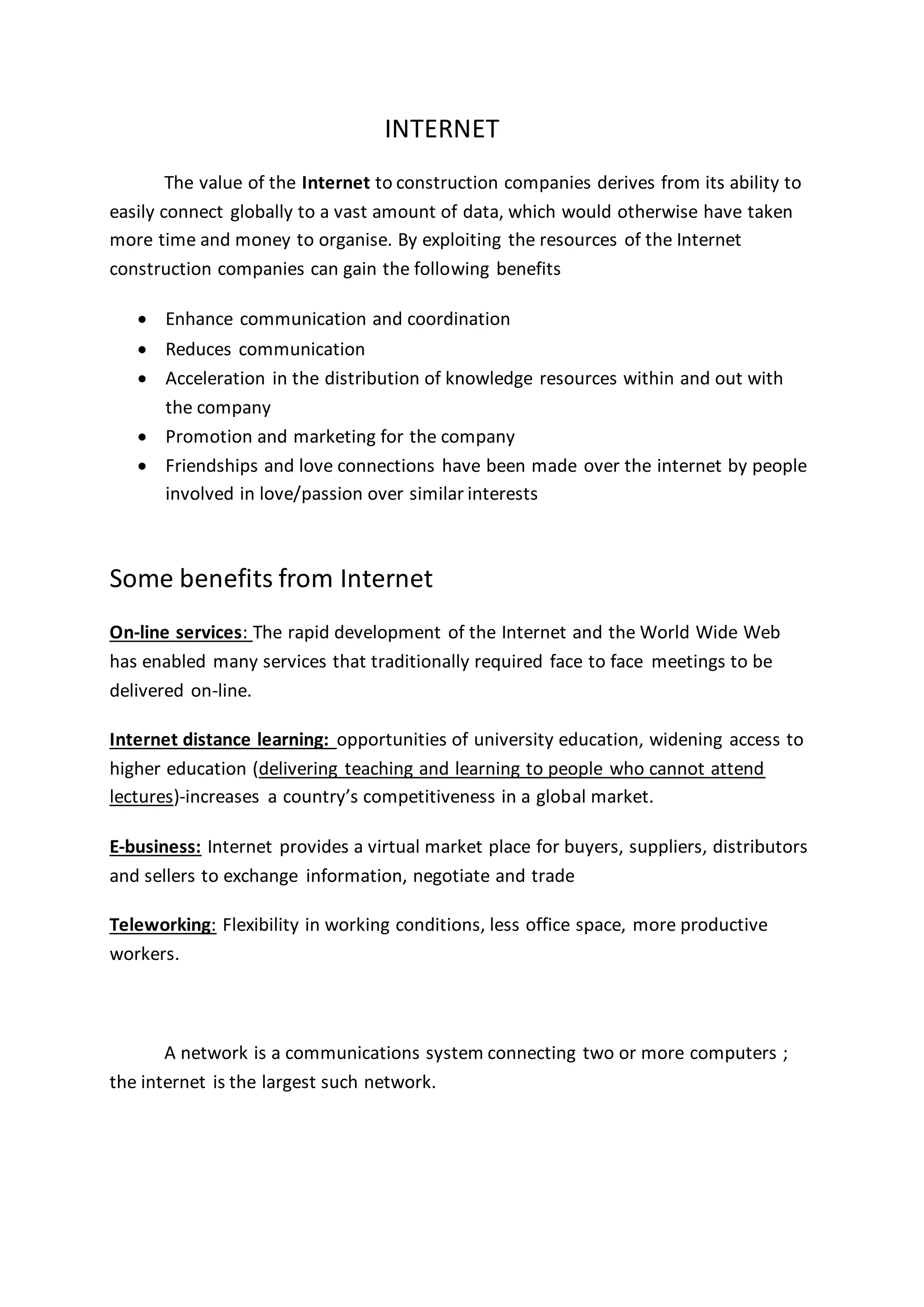
INTERNET
The value of the Internet to construction companies derives from its ability to
easily connect globally to a vast amount of data, which would otherwise have taken
more time and money to organise. By exploiting the resources of the Internet
construction companies can gain the following benefits
 Enhance communication and coordination
 Reduces communication
 Acceleration in the distribution of knowledge resources within and out with
the company
 Promotion and marketing for the company
 Friendships and love connections have been made over the internet by people
involved in love/passion over similar interests
Some benefits from Internet
On-line services: The rapid development of the Internet and the World Wide Web
has enabled many services that traditionally required face to face meetings to be
delivered on-line.
Internet distance learning: opportunities of university education, widening access to
higher education (delivering teaching and learning to people who cannot attend
lectures)-increases a country’s competitiveness in a global market.
E-business: Internet provides a virtual market place for buyers, suppliers, distributors
and sellers to exchange information, negotiate and trade
Teleworking: Flexibility in working conditions, less office space, more productive
workers.
A network is a communications system connecting two or more computers ;
the internet is the largest such network.
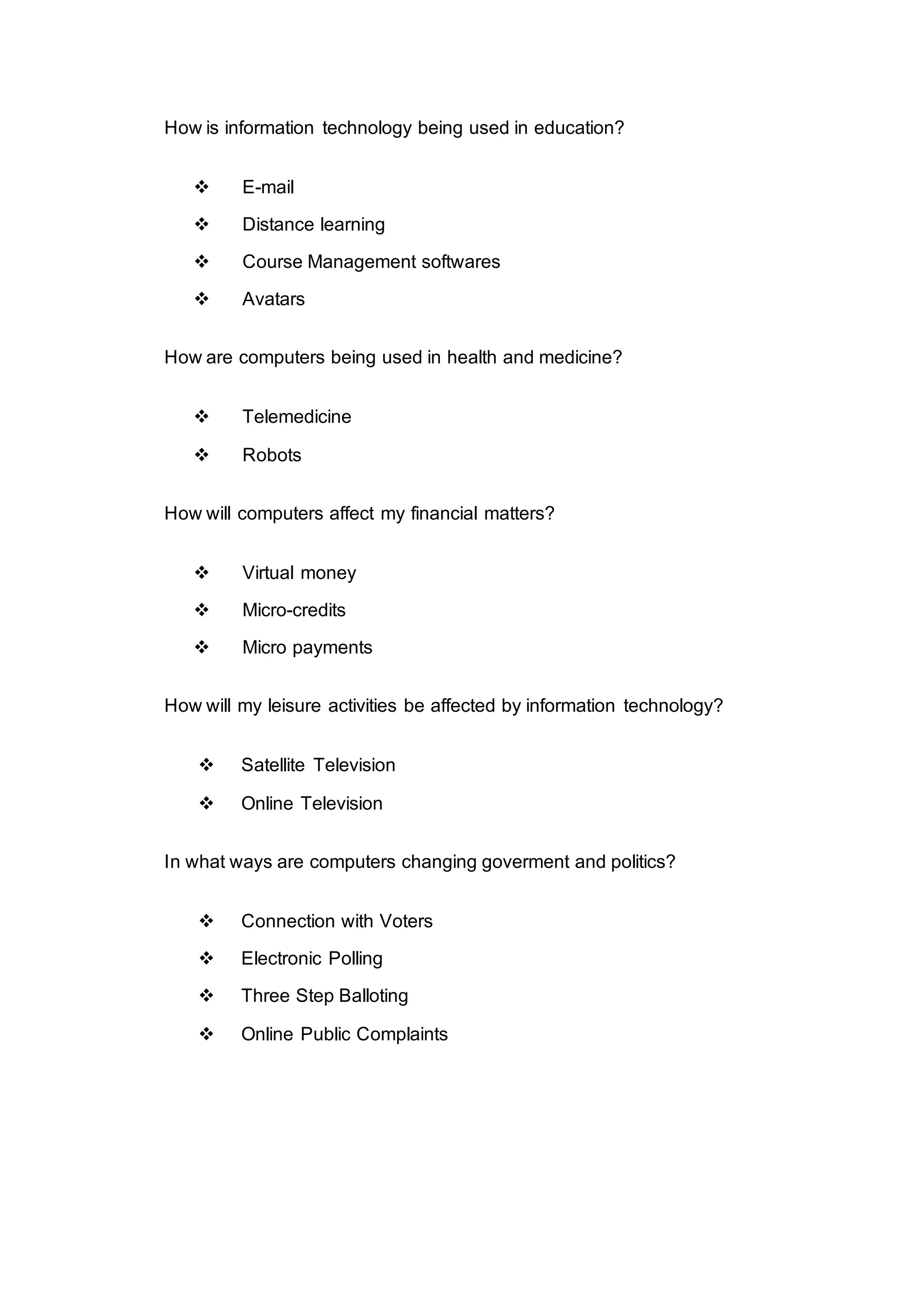
How is information technology being used in education?
 E-mail
 Distance learning
 Course Management softwares
 Avatars
How are computers being used in health and medicine?
 Telemedicine
 Robots
How will computers affect my financial matters?
 Virtual money
 Micro-credits
 Micro payments
How will my leisure activities be affected by information technology?
 Satellite Television
 Online Television
In what ways are computers changing goverment and politics?
 Connection with Voters
 Electronic Polling
 Three Step Balloting
 Online Public Complaints
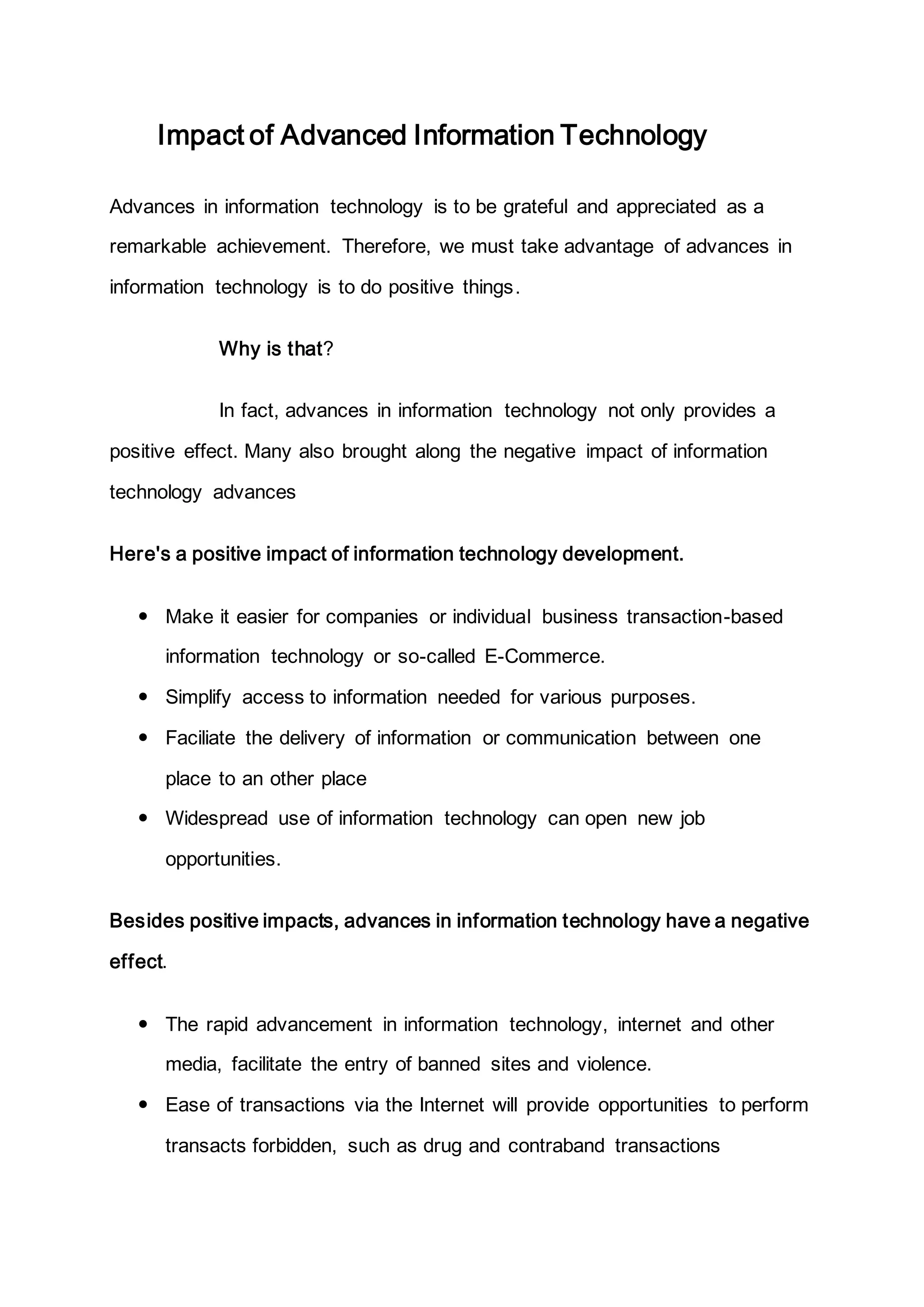
Impact of Advanced Information Technology
Advances in information technology is to be grateful and appreciated as a
remarkable achievement. Therefore, we must take advantage of advances in
information technology is to do positive things.
Why is that?
In fact, advances in information technology not only provides a
positive effect. Many also brought along the negative impact of information
technology advances
Here's a positive impact of information technology development.
 Make it easier for companies or individual business transaction-based
information technology or so-called E-Commerce.
 Simplify access to information needed for various purposes.
 Faciliate the delivery of information or communication between one
place to an other place
 Widespread use of information technology can open new job
opportunities.
Besides positive impacts, advances in information technology have a negative
effect.
 The rapid advancement in information technology, internet and other
media, facilitate the entry of banned sites and violence.
 Ease of transactions via the Internet will provide opportunities to perform
transacts forbidden, such as drug and contraband transactions
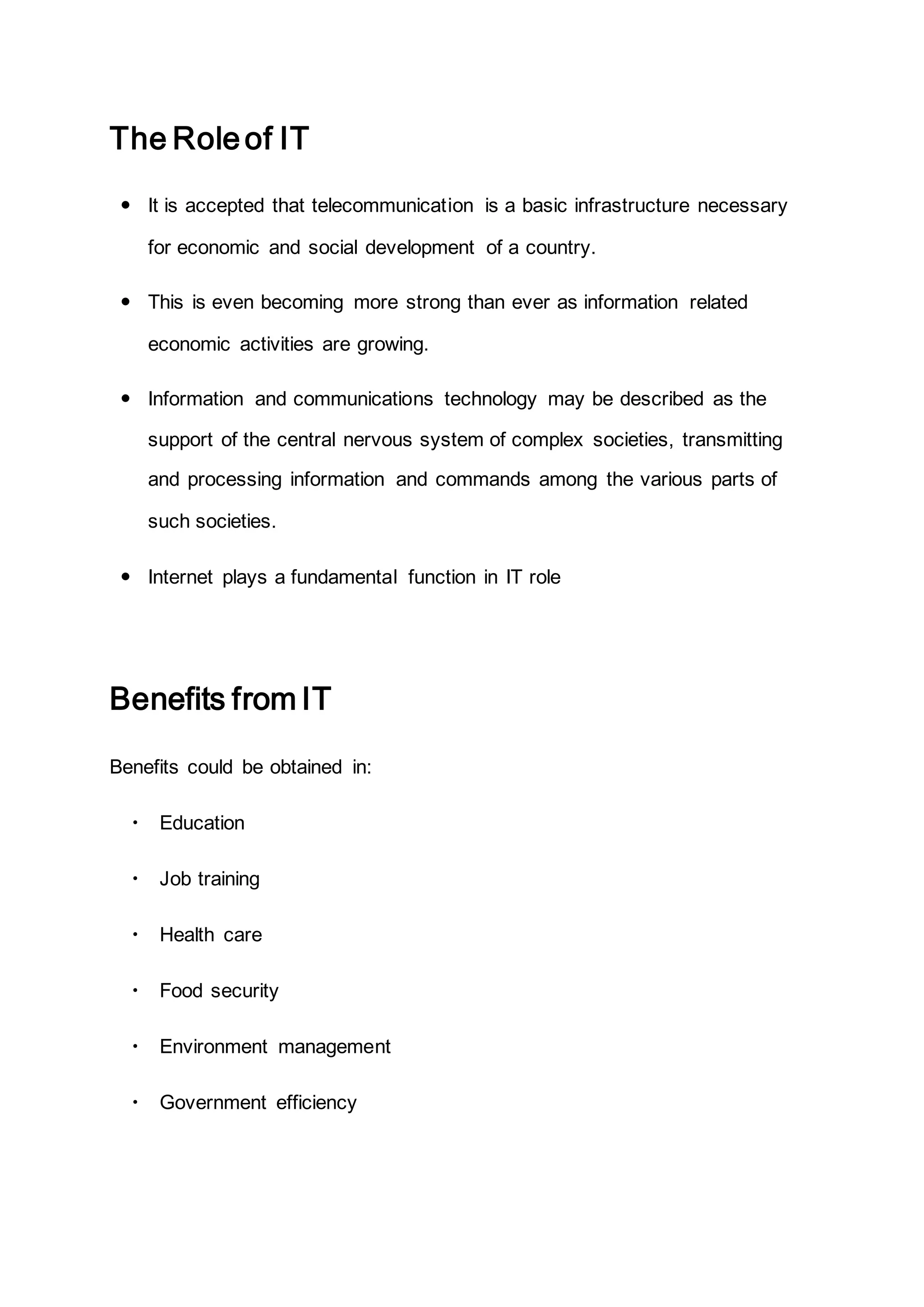
The Roleof IT
 It is accepted that telecommunication is a basic infrastructure necessary
for economic and social development of a country.
 This is even becoming more strong than ever as information related
economic activities are growing.
 Information and communications technology may be described as the
support of the central nervous system of complex societies, transmitting
and processing information and commands among the various parts of
such societies.
 Internet plays a fundamental function in IT role
Benefits from IT
Benefits could be obtained in:
 Education
 Job training
 Health care
 Food security
 Environment management
 Government efficiency

Informati̇on technology 1

  • 1.
    INFORMATİON TECHNOLOGY Information technology(IT), as defined by the information Technology Association of America (ITAA), is ‘the study , design , development , implementation , support , or management of computer-based information systems , particularly software applications and computer hardware. ‘IT deals with the use of electronic computers and computer software to convert , store , protect , process , transmit , and securely retrieve information. And also Information technology is a contemporary term that describes the combination of computer technology (hardware and software) with telecommunications technology (data, image, and voice networks). The term is commonly used as a synonym for computers and computer networks, but it also encompasses other information distribution technologies such as television and telephones. Several industries are associated with information technology, including computer hardware, software, electronics, semiconductors, internet, telecom equipment, e-commerce and computer services. Humans have been storing, retrieving, manipulating and communicating information since the Sumerians in Mesopotamia developed writing in about 3000 BC, but the term information technology in its modern sense first appeared in a 1958 article published in the Harvard Business Review; authors Harold J. Leavitt and Thomas L. Whisler commented that "the new technology does not yet have a single established name. We shall call it information technology (IT)." Their definition consists of three categories: techniques for processing, the application of statistical and mathematical methods to decision-making and the simulation of higher-order thinking through computer programs.
  • 2.
    In some companies,this is referred to as Management Information Services (or MIS) or simply as Information Services (or IS). The information technology department of a large company would be responsible for storing information, protecting information, processing the information, transmitting the information as necessary, and later retrieving information as necessary. These innovations enable the processing and storage of enormous amounts of information, along with rapid distribution of information through communication networks.  IT has enabled the globalisation of the economy and competition, and caused large-scale changes in many industries  IT is also bringing a major shift in the job market; resulting in a more polarised occupational structure, consisting of highly skilled=well paid jobs lower skilled=low wages Hardwareand software revolution • The diminishing cost of personal computers has put computing power within the reach of even the smallest contractors. • Rapidly developing hardware performance, coupled with the development of storage drives with very large volumes, modems, scanners, and back up devices has made the computer suitable for storage and distribution of drawings and other data in electronic format.
  • 3.
    HISTORY OF INFORMATIONTECHNOLOGY In the 1960s and 1970s, the term information technology (IT) was a little known phrase that was used by those who worked in places like banks and hospitals to describe the processes they used to store information. With the paradigm shift to computing technology and "paperless" workplaces, information technology has come to be a household phrase. It defines an industry that uses computers, networking, software programming, and other equipment and processes to store, process, retrieve, transmit, and protect information. In the early days of computer development, there was no such thing as a college degree in IT. Software development and computer programming were best left to the computer scientists and mathematical engineers, due to their complicated nature. As time passed and technology advanced, such as with the advent of the personal computer in the 1980s and its everyday use in the home and the workplace, the world moved into the information age. By the early 21st century, nearly every child in the Western world, and many in other parts of the world, knew how to use a personal computer. Businesses' information technology departments have gone from using storage tapes created by a single computer operator to interconnected networks of employee workstations that store information in a server farm, often somewhere away from the main business site. Communication has advanced, from physical postal mail, to telephone fax transmissions, to nearly instantaneous digital communication through electronic mail (email). Great technological advances have been made since the days when computers were huge pieces of equipment that were stored in big, air conditioned rooms, getting their information from punch cards. The information technology industry has turned out to be a huge employer of people worldwide, as the focus shifts in some nations from manufacturing to service industries. It is a field where the barrier to entry is generally much lower than that of manufacturing, for example. In the current business environment, being proficient in computers is often a necessity for those who want to compete in the workplace.
  • 4.
    Two different partsof informationtechnology  Computer Technology Programmable , multiuse machine that accepts data—raw facts and figures –and processes , or manipulates , it into information we can use.  CommunicationTechnology Also called telecommunications technology , consist of electromagnetic devices and systems for communicating over long distances Communication Technology The new communication technology enables people located in different places to work together as if they were in the same office. Big multinational companies are already exploiting this technology to achieve better use of the resources of their seperate offices. In this way projects can be shared between offices with the application of the best expertise, and around the clock Computer Technology The computer technology program transforms students into technology leaders in a sustainable global economy. This is achieved by presenting students with a strong foundation in the concepts, theories, and practices that serve as the basis for the varying aspects of information technology. This includes the design, implementation, and adminstration of secured systems and networks. Students have the opportunity to develope expertise in specialty areas of interest through electives in higher level technology courses. Since the purpose of information technology is to facilitate the goals and objecties of a business or organization, students are required to complete the Minor in Business Administration. With an understanding of how organizations operate, students will be able to move effectively design systems and networks that will support the needs of the business or organization. To gain real-world experience in today's computer environments, you are also required to complete an internship.
  • 5.
    INTERNET The value ofthe Internet to construction companies derives from its ability to easily connect globally to a vast amount of data, which would otherwise have taken more time and money to organise. By exploiting the resources of the Internet construction companies can gain the following benefits  Enhance communication and coordination  Reduces communication  Acceleration in the distribution of knowledge resources within and out with the company  Promotion and marketing for the company  Friendships and love connections have been made over the internet by people involved in love/passion over similar interests Some benefits from Internet On-line services: The rapid development of the Internet and the World Wide Web has enabled many services that traditionally required face to face meetings to be delivered on-line. Internet distance learning: opportunities of university education, widening access to higher education (delivering teaching and learning to people who cannot attend lectures)-increases a country’s competitiveness in a global market. E-business: Internet provides a virtual market place for buyers, suppliers, distributors and sellers to exchange information, negotiate and trade Teleworking: Flexibility in working conditions, less office space, more productive workers. A network is a communications system connecting two or more computers ; the internet is the largest such network.
  • 6.
    How is informationtechnology being used in education?  E-mail  Distance learning  Course Management softwares  Avatars How are computers being used in health and medicine?  Telemedicine  Robots How will computers affect my financial matters?  Virtual money  Micro-credits  Micro payments How will my leisure activities be affected by information technology?  Satellite Television  Online Television In what ways are computers changing goverment and politics?  Connection with Voters  Electronic Polling  Three Step Balloting  Online Public Complaints
  • 7.
    Impact of AdvancedInformation Technology Advances in information technology is to be grateful and appreciated as a remarkable achievement. Therefore, we must take advantage of advances in information technology is to do positive things. Why is that? In fact, advances in information technology not only provides a positive effect. Many also brought along the negative impact of information technology advances Here's a positive impact of information technology development.  Make it easier for companies or individual business transaction-based information technology or so-called E-Commerce.  Simplify access to information needed for various purposes.  Faciliate the delivery of information or communication between one place to an other place  Widespread use of information technology can open new job opportunities. Besides positive impacts, advances in information technology have a negative effect.  The rapid advancement in information technology, internet and other media, facilitate the entry of banned sites and violence.  Ease of transactions via the Internet will provide opportunities to perform transacts forbidden, such as drug and contraband transactions
  • 8.
    The Roleof IT It is accepted that telecommunication is a basic infrastructure necessary for economic and social development of a country.  This is even becoming more strong than ever as information related economic activities are growing.  Information and communications technology may be described as the support of the central nervous system of complex societies, transmitting and processing information and commands among the various parts of such societies.  Internet plays a fundamental function in IT role Benefits from IT Benefits could be obtained in:  Education  Job training  Health care  Food security  Environment management  Government efficiency