Introduction to Amateur
DMR
Andrew Beard
KC3HPS
February 1st, 2017
Disclaimer
• I am not an expert
• I passed my Technician exam in August 2016
• I purchased by first DMR radio in October 2016
• Everything I say here could be (and probably is)
completely wrong
Basics
• Usually associated with Motorola, but there are
many DMR vendors
• Used on VHF and UHF bands, but more amateur
use on UHF
• Primarily a commercial spec. Make sure your radio
supports amateur frequencies!
• Three types of DMR
• Tier I: Simplex
• Tier II: Repeater
• Tier III: Trunking
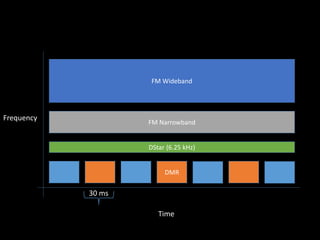
DMR
FM Narrowband
30 ms
FM Wideband
DStar (6.25 kHz)
Time
Frequency
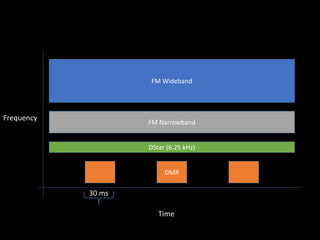
DMR
FM Narrowband
30 ms
FM Wideband
DStar (6.25 kHz)
Time
Frequency
AMBE+2 Codec
• Not part of the DMR spec, but used by all
conventional DMR systems
• Slightly newer version of the codec used for DStar
that includes better forward error correction
• Proprietary codec, and only available in hardware
• Arguments that use of a proprietary codec
constitutes encryption (not encoding)
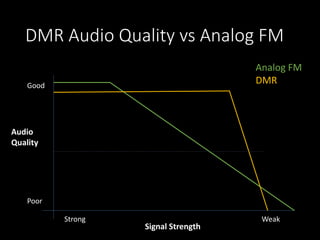
DMR Audio Quality vs Analog FM
Audio
Quality
Signal Strength
Analog FM
DMRGood
Poor
Strong Weak
DMR IDs
• Every user has a unique 7-digit number that
identifies them
• Amateur DMR: Linked to a name and a callsign
• Repeaters use a similar 6-digit convention with the
same regional code
• Every transmission is tagged with a user ID
• List of IDs, callsigns, and locations is public
3 1 4 2 2 5 5
Regional Code Sequential User Number
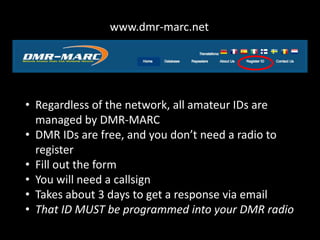
www.dmr-marc.net
• Regardless of the network, all amateur IDs are
managed by DMR-MARC
• DMR IDs are free, and you don’t need a radio to
register
• Fill out the form
• You will need a callsign
• Takes about 3 days to get a response via email
• That ID MUST be programmed into your DMR radio
Repeater Linking
• Analog FM repeater, frequency with offset and
maybe PL tone
• Linked analog repeaters are exceptions, not the
rule
• DMR linking is formalized, occurs via TCP/IP (over
the Internet)
• Step one, separate the conversation from the
repeater
• Core concept of DMR Tier II
Talk Groups
• All client transmissions are coded with a single Talk
Group (TG)
• Repeaters send TGs they’re configured to repeat
• In amateur use, usually organized by area or
language
• Supported talk group can be static (always
connected) or dynamic (PTT)
• Dynamic groups are linked temporarily when a
client transmits a messages coded to that TG
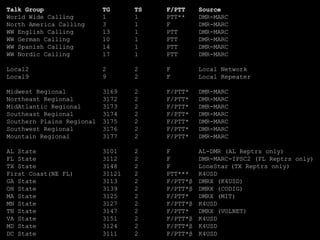
Talk Group TG TS F/PTT Source
World Wide Calling 1 1 PTT** DMR-MARC
North America Calling 3 1 F DMR-MARC
WW English Calling 13 1 PTT DMR-MARC
WW German Calling 10 1 PTT DMR-MARC
WW Spanish Calling 14 1 PTT DMR-MARC
WW Nordic Calling 17 1 PTT DMR-MARC
Local2 2 2 F Local Network
Local9 9 2 F Local Repeater
Midwest Regional 3169 2 F/PTT* DMR-MARC
Northeast Regional 3172 2 F/PTT* DMR-MARC
MidAtlantic Regional 3173 2 F/PTT* DMR-MARC
Southeast Regional 3174 2 F/PTT* DMR-MARC
Southern Plains Regional 3175 2 F/PTT* DMR-MARC
Southwest Regional 3176 2 F/PTT* DMR-MARC
Mountain Regional 3177 2 F/PTT* DMR-MARC
AL State 3101 2 F AL-DMR (AL Reptrs only)
FL State 3112 2 F DMR-MARC-IPSC2 (FL Reptrs only)
TX State 3148 2 F LoneStar (TX Reptrs only)
First Coast(NE FL) 31121 2 PTT*** K4USD
GA State 3113 2 F/PTT*β DMRX (K4USD)
OH State 3139 2 F/PTT*β DMRX (CODIG)
MA State 3125 2 F/PTT* DMRX (MIT)
MN State 3127 2 F/PTT*β K4USD
TN State 3147 2 F/PTT* DMRX (VOLNET)
VA State 3151 2 F/PTT*β K4USD
MD State 3124 2 F/PTT*β K4USD
DC State 3111 2 F/PTT*β K4USD
DMR Channels
• One conversation via one repeater
• Consist of:
• A repeater frequency and offset
• A time slot (1 or 2)
• A talk group
• A color code (like a PL tone)
When you press PTT
• Radio sends a packet to the local repeater with user
ID, destination TG, CC
• Repeater sends a message back to the user saying if
they’re permitted or not (may result in a Talk
Permit or Denied tone)
• If the repeater isn’t current linked to that TG, it will
contact the responsible bridge or peer
• Transmission is distributed to other repeaters who
are listening to the same TG
DMR Networks
• DMR-MARC
• Uses Motorola IP Site Connect (IPSC) for linking
• Contains K4USD network (including K3UCB in Ashton)
• No hotspot support
• DMR-plus
• BrandMeister
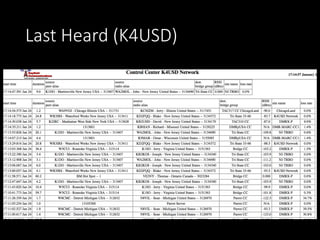
Last Heard (K4USD)
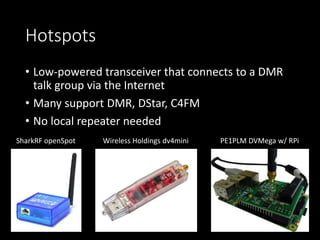
Hotspots
• Low-powered transceiver that connects to a DMR
talk group via the Internet
• Many support DMR, DStar, C4FM
• No local repeater needed
SharkRF openSpot Wireless Holdings dv4mini PE1PLM DVMega w/ RPi
Things To Remember
• Airtime is a resource
• You can’t (usually) just listen to dynamic talk groups
• TDMA is sensitive
• Beware ā€Tier Iā€ or ā€œSlot 1ā€ radios
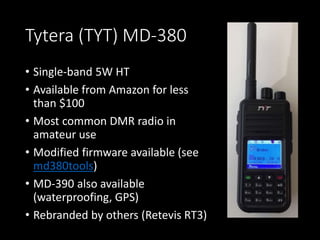
Tytera (TYT) MD-380
• Single-band 5W HT
• Available from Amazon for less
than $100
• Most common DMR radio in
amateur use
• Modified firmware available (see
md380tools)
• MD-390 also available
(waterproofing, GPS)
• Rebranded by others (Retevis RT3)
Other Vendors
• Motorola (MotoTRBO series)
• Connect Systems
• Hytera (PD series)
• Kenwood
• Vertex Standard
• Baofeng
Things That Aren’t DMR
• DStar
• C4FM (Fusion) + WIRES-X
• P.25 (Project 25)
• NXDN
• dPMR
Why DMR?
• Spectral efficiency
• Power efficiency
• Intelligible audio with poor connections
• Repeater and Hotspot linking
• Visibility with Last Heard
• Lower cost than many other digital modes
• Wide compatibility
Questions?
Andrew Beard
kc3hps@gmail.com
@bearda24
Resources
• Amateur Radio Guide to Digital Mobile Radio by
W2XAB
• K4USD Network
• VA3XPR Code of Conduct

Introduction to Amateur DMR

  • 1.
    Introduction to Amateur DMR AndrewBeard KC3HPS February 1st, 2017
  • 2.
    Disclaimer • I amnot an expert • I passed my Technician exam in August 2016 • I purchased by first DMR radio in October 2016 • Everything I say here could be (and probably is) completely wrong
  • 3.
    Basics • Usually associatedwith Motorola, but there are many DMR vendors • Used on VHF and UHF bands, but more amateur use on UHF • Primarily a commercial spec. Make sure your radio supports amateur frequencies! • Three types of DMR • Tier I: Simplex • Tier II: Repeater • Tier III: Trunking
  • 4.
    DMR FM Narrowband 30 ms FMWideband DStar (6.25 kHz) Time Frequency
  • 5.
    DMR FM Narrowband 30 ms FMWideband DStar (6.25 kHz) Time Frequency
  • 6.
    AMBE+2 Codec • Notpart of the DMR spec, but used by all conventional DMR systems • Slightly newer version of the codec used for DStar that includes better forward error correction • Proprietary codec, and only available in hardware • Arguments that use of a proprietary codec constitutes encryption (not encoding)
  • 7.
    DMR Audio Qualityvs Analog FM Audio Quality Signal Strength Analog FM DMRGood Poor Strong Weak
  • 8.
    DMR IDs • Everyuser has a unique 7-digit number that identifies them • Amateur DMR: Linked to a name and a callsign • Repeaters use a similar 6-digit convention with the same regional code • Every transmission is tagged with a user ID • List of IDs, callsigns, and locations is public 3 1 4 2 2 5 5 Regional Code Sequential User Number
  • 9.
    www.dmr-marc.net • Regardless ofthe network, all amateur IDs are managed by DMR-MARC • DMR IDs are free, and you don’t need a radio to register • Fill out the form • You will need a callsign • Takes about 3 days to get a response via email • That ID MUST be programmed into your DMR radio
  • 10.
    Repeater Linking • AnalogFM repeater, frequency with offset and maybe PL tone • Linked analog repeaters are exceptions, not the rule • DMR linking is formalized, occurs via TCP/IP (over the Internet) • Step one, separate the conversation from the repeater • Core concept of DMR Tier II
  • 11.
    Talk Groups • Allclient transmissions are coded with a single Talk Group (TG) • Repeaters send TGs they’re configured to repeat • In amateur use, usually organized by area or language • Supported talk group can be static (always connected) or dynamic (PTT) • Dynamic groups are linked temporarily when a client transmits a messages coded to that TG
  • 12.
    Talk Group TGTS F/PTT Source World Wide Calling 1 1 PTT** DMR-MARC North America Calling 3 1 F DMR-MARC WW English Calling 13 1 PTT DMR-MARC WW German Calling 10 1 PTT DMR-MARC WW Spanish Calling 14 1 PTT DMR-MARC WW Nordic Calling 17 1 PTT DMR-MARC Local2 2 2 F Local Network Local9 9 2 F Local Repeater Midwest Regional 3169 2 F/PTT* DMR-MARC Northeast Regional 3172 2 F/PTT* DMR-MARC MidAtlantic Regional 3173 2 F/PTT* DMR-MARC Southeast Regional 3174 2 F/PTT* DMR-MARC Southern Plains Regional 3175 2 F/PTT* DMR-MARC Southwest Regional 3176 2 F/PTT* DMR-MARC Mountain Regional 3177 2 F/PTT* DMR-MARC AL State 3101 2 F AL-DMR (AL Reptrs only) FL State 3112 2 F DMR-MARC-IPSC2 (FL Reptrs only) TX State 3148 2 F LoneStar (TX Reptrs only) First Coast(NE FL) 31121 2 PTT*** K4USD GA State 3113 2 F/PTT*β DMRX (K4USD) OH State 3139 2 F/PTT*β DMRX (CODIG) MA State 3125 2 F/PTT* DMRX (MIT) MN State 3127 2 F/PTT*β K4USD TN State 3147 2 F/PTT* DMRX (VOLNET) VA State 3151 2 F/PTT*β K4USD MD State 3124 2 F/PTT*β K4USD DC State 3111 2 F/PTT*β K4USD
  • 13.
    DMR Channels • Oneconversation via one repeater • Consist of: • A repeater frequency and offset • A time slot (1 or 2) • A talk group • A color code (like a PL tone)
  • 14.
    When you pressPTT • Radio sends a packet to the local repeater with user ID, destination TG, CC • Repeater sends a message back to the user saying if they’re permitted or not (may result in a Talk Permit or Denied tone) • If the repeater isn’t current linked to that TG, it will contact the responsible bridge or peer • Transmission is distributed to other repeaters who are listening to the same TG
  • 15.
    DMR Networks • DMR-MARC •Uses Motorola IP Site Connect (IPSC) for linking • Contains K4USD network (including K3UCB in Ashton) • No hotspot support • DMR-plus • BrandMeister
  • 16.
  • 17.
    Hotspots • Low-powered transceiverthat connects to a DMR talk group via the Internet • Many support DMR, DStar, C4FM • No local repeater needed SharkRF openSpot Wireless Holdings dv4mini PE1PLM DVMega w/ RPi
  • 18.
    Things To Remember •Airtime is a resource • You can’t (usually) just listen to dynamic talk groups • TDMA is sensitive • Beware ā€Tier Iā€ or ā€œSlot 1ā€ radios
  • 19.
    Tytera (TYT) MD-380 •Single-band 5W HT • Available from Amazon for less than $100 • Most common DMR radio in amateur use • Modified firmware available (see md380tools) • MD-390 also available (waterproofing, GPS) • Rebranded by others (Retevis RT3)
  • 20.
    Other Vendors • Motorola(MotoTRBO series) • Connect Systems • Hytera (PD series) • Kenwood • Vertex Standard • Baofeng
  • 21.
    Things That Aren’tDMR • DStar • C4FM (Fusion) + WIRES-X • P.25 (Project 25) • NXDN • dPMR
  • 22.
    Why DMR? • Spectralefficiency • Power efficiency • Intelligible audio with poor connections • Repeater and Hotspot linking • Visibility with Last Heard • Lower cost than many other digital modes • Wide compatibility
  • 23.
  • 24.
    Resources • Amateur RadioGuide to Digital Mobile Radio by W2XAB • K4USD Network • VA3XPR Code of Conduct

Editor's Notes

  • #2Ā Not going to do a step-by-step of how to get on the air with DMR Hopefully give enough of an introduction to get you interested in DMR, and an idea of what the next couple steps are
  • #4Ā Open standard defined by European Telecommunication Standards Institute (ETSI) Technically supports anything in 66 to 960 MHz Trying not to use the word channel here, since that has a different connotation for DMR (more on this later) Tiers are a simplification
  • #5Ā Spectral efficiency TDMA – Power efficiency Time Division Multiplex Access DMR – 12.5 kHz bandwidth
  • #6Ā Usually tuned in to only one time slot at a time. Power efficiency, duty cycle 50%
  • #7Ā Pronounced like ā€œamberā€ What is a codec? Sounds a little better than DStar. Part new codec with error correction, part because DStar reserves some of channel bandwidth for data. No software implementations. This is why listening to DStar over the internet requires a dongle. Legal argument: France rules DStar not legal in 2010
  • #8Ā Originally taken from Vertex Standard slides, but adjusted Not to any type of scale, FM starts out higher quality than DMR, but a large portion of the time DMR outperforms because it’s so consistent Breaks up to the point of no signal faster, Compromise for commercial use
  • #9Ā Why an ID? DMR wasn’t designed for amateur use. In commercial applications there is no callsign. This is my DMR ID. 3124 is United States, Maryland. Everyone who registers a DMR ID in the state of MD will have an ID that starts with the same 4 digits. I am the 255th person to register a DMR ID in the state of MD. The guy after me will be 256, etc. Can do interesting things with that list.
  • #10Ā If you’re interested in using DMR, sign up ASAP. That last line is REALLY important. At this point, all DMR radios I’m aware of must be programmed with a cable. If someone borrows your radio, they are you until it’s reprogrammed. CAVEAT: md380tools firmware
  • #11Ā Linked analog repeaters implemented on a case-by-case basis KV3B vs WA4TFZ Repeaters do not have to be Internet linked, but most amateur ones are Voice data is already encoded, packetized, and tagged with source/destination. Specific protocols for linking are NOT standardized
  • #12Ā PTT talk groups – Length of time based on repeater configuration. Usually about 10 minutes.
  • #13Ā Just a sampling Will talk about that F/PTT column a bit later
  • #14Ā Color Codes – Must match what the repeater is set to accept. Integer value between 0 and 15. Usually (99% of the time for amateur use) it’s CC 1. Yes, Color Codes aren’t colors (thanks ETSI). Mandatory, unlike tones
  • #15Ā Reasons not permitted: Blacklisted user Unsupported talk group Color code mismatch Bad connection Another user transmitting The radio may emit a talk permitted or denied tone There may be a delay for linking
  • #16Ā Many networks, but three largest for amateur use Dictated by repeater hardware, NOT user radio. Users can join any network. DMR-MARC, Motorola only. Some talk groups area linked across networks. A lot of development, but a lot of it encumbered by patents and NDAs.
  • #17Ā Tell where people are active, who they are. A bit like a DX cluster or spotting network.
  • #18Ā In the 10-20 mW range Do not work for DMR-MARC network, but fine for DMR+ or BrandMeister They don’t decode the audio, no codec chip
  • #19Ā Talk about the always-linked TG problem. From previous list, North America Calling is linked full time to TS1. When I transmit, I transmit on one Talk Group. When I’m listening I get all the TGs on that time slot. The radio decides what I hear. Dynamic talk groups need to be linked. Unless someone has in the past 10 minutes, you can’t hear it. You need to key up Most linear amplifiers don’t work with TDMA
  • #20Ā Reason I mention most common, there is a LOT of community documentation. Codeplugs, etc. Includes charging cradle. USB programming cable, etc md380tools: Add entire database of DMR users, show on demand Hear from any Talk Group without programming it in Change DMR ID from radio Show mic gain while transmitting
  • #21Ā Kenwood does not sell DMR in US Vertex Standard owned by Yaesu
  • #22Ā Dstar, started as a Japanese open standard. Almost entirely driven by ICOM P.25 – Designed for public safety, used for commercial as well NXDN – FDMA, same voice codec. Used a lot by rail industry dPMR - FDMA. European standard. Niche deployments, mostly small ones.
  • #23Ā DMR adoption increasing for a while, recently entering low-cost commoditization phase