Introduction to Advertising
Sushant Dommeti
dcsushant@gmail.com
+91 7710904827
What is Advertising
https://www.youtube.com/watch?v=ZFb01yTR9bA
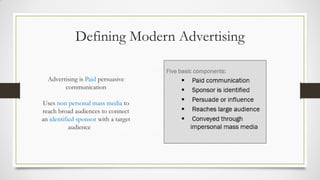
Defining Modern Advertising
Advertising is Paid persuasive
communication
Uses non personal mass media to
reach broad audiences to connect
an identified sponsor with a target
audience
Types of Advertising
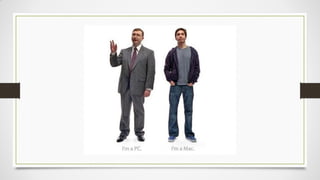
Brand Ad
Brand Ad also known as national consumer focuses on developing a long-term brand identity
and image.
Usually, no retail sales messaging. You can identify a brand name. The ad is driving the brand’s
identity. It is targeted at national consumer.
Types of Advertising
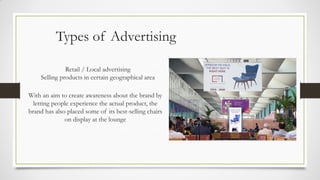
Retail / Local advertising
Selling products in certain geographical area
With an aim to create awareness about the brand by
letting people experience the actual product, the
brand has also placed some of its best-selling chairs
on display at the lounge
Signs of retail ad: Can you see the word sales. % off.
Types of Advertising
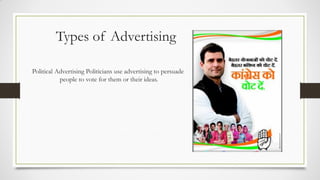
Political Advertising Politicians use advertising to persuade
people to vote for them or their ideas.
Types of Advertising
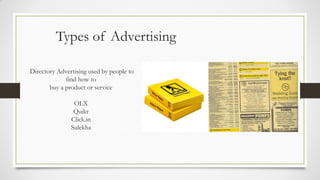
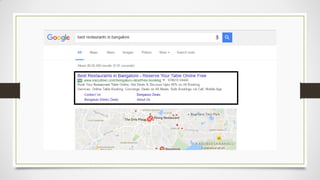
Directory Advertising used by people to
find how to
buy a product or service
OLX
Quikr
Click.in
Sulekha
Types of Advertising
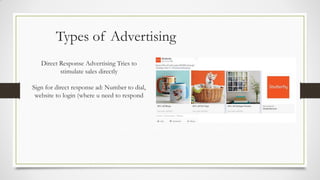
Direct Response Advertising Tries to
stimulate sales directly
Sign for direct response ad: Number to dial,
website to login (where u need to respond
Types of Advertising
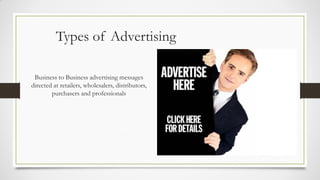
Business to Business advertising messages
directed at retailers, wholesalers, distributors,
purchasers and professionals
Types of Advertising
Institutional Advertising
Corporate advertising used to establish an
identity or influence public opinion
Types of Advertising
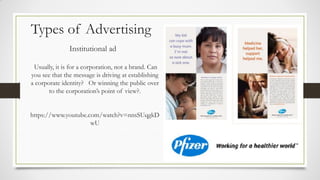
Institutional ad
Usually, it is for a corporation, not a brand. Can
you see that the message is driving at establishing
a corporate identity? Or winning the public over
to the corporation’s point of view?.
https://www.youtube.com/watch?v=nnsSUqgkD
wU
Types of Advertising
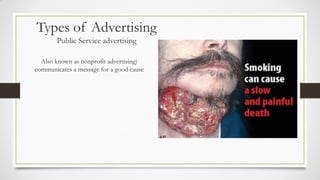
Public Service advertising
Also known as nonprofit advertising)
communicates a message for a good cause
Types of Advertising
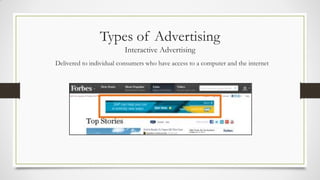
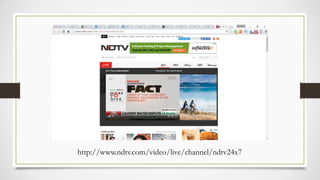
Interactive Advertising
Delivered to individual consumers who have access to a computer and the internet
http://www.ndtv.com/video/live/channel/ndtv24x7
Interactive Banner ads best examples
https://www.youtube.com/watch?v=dSkJoT6RM28
https://www.youtube.com/watch?v=Wd_8okTcyog
https://www.youtube.com/watch?v=1qx2ZGPqVOw
https://www.youtube.com/watch?v=G4t_6pn_CPU
Exercise
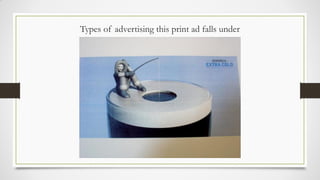
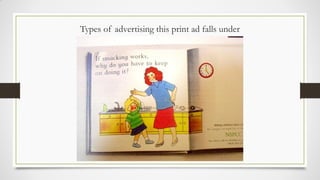
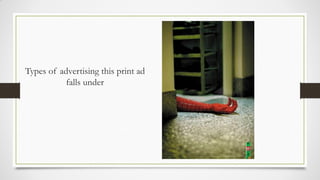
Types of advertising this print ad falls under
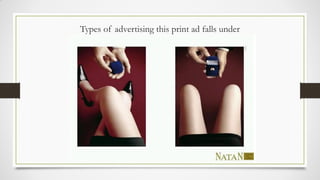
Types of advertising this print ad
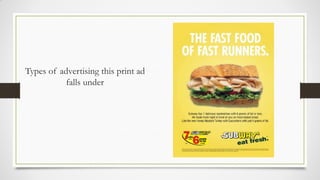
falls under
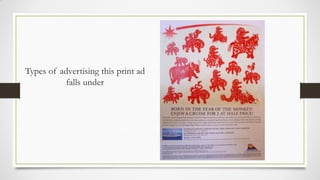
Types of advertising this print ad falls under
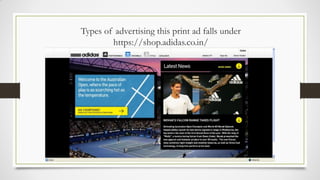
https://shop.adidas.co.in/
Types of advertising this print ad
falls under
Types of advertising this
print ad falls under
Types of advertising this print ad
falls under
Role of Advertising in the perspective of
Marketing
• The process a business uses to satisfy consumer needs by providing goods
and services.
• Carry persuasive messages to actual/potential customers
Role of Advertising in the perspective of
Marketing
(1) advertising is seen as a vehicle for helping consumers assess value, through
price as well as other elements, such as quality, location, and reputation.
May help consumers better assess value.
(2) advertising is seen as so persuasive that it decreases the likelihood that a
consumer will switch to an alternative product regardless of the price charged.
May make consumers less price sensitive.
Role of Advertising in the perspective of
Marketing - Societal
Societal Inform about new products, help consumers compare products, mirror
fashion, influence taste
 Informs consumers about innovations & issues
 Mirrors fashion and design trends
 Teaches consumers about new products
 Helps shape consumer self-image
 Perpetuates self-expression
Role of Advertising in the perspective of
Marketing - Communication
 form of mass communication, connecting buyers and sellers in the
marketplace.
 Transmits market information to match buyers and sellers in the
marketplace. (provides information on product, price & place
Functions of Advertising
 Builds awareness of products and brands.
 Creates a brand image.
 Provides product and brand information (Eg: )
 Persuades people (note: Not bluff, cheap or con)
 Provides incentives to take action (eg: Buy two get 5 free, sure eat durians)
 Provides brand reminder (eg coke, pepsi
 Reinforces past purchases and brand experiences
Key Players in Advertising
 The Media composed of the channels of communication that carry the
message from the advertiser to the audience.
 Example: TV, Newspaper, Buses, Taxis, Billboard, Internet
Key Players in Advertising
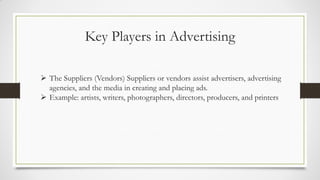
 The Suppliers (Vendors) Suppliers or vendors assist advertisers, advertising
agencies, and the media in creating and placing ads.
 Example: artists, writers, photographers, directors, producers, and printers
Key Players in Advertising
 The Audience customer or prospective custome
Key Players in Advertising
 Example: Bajaj Allianz JFC7 Campaign (link-
 Advertiser: Bajaj Allianz
 Agency: Adjetter Media Pvt Ltd
 Media: – Facebook, Twitter, Instragram, Google Search, Google Display,
Mobile
 Audience:
Why need for effectiveness Advertising
 Today advertising is in a bind
o A down economy
o New technologies that threaten how advertising works eg. Email spam, SMS
ads, Search, social Media
o Increasing clutter
 Advertisers expect specific results that lead to sales
 Advertising must be effective
Why need for effectiveness Advertising
 Consumers (considered effective when)
• View ads for entertainment/curiosity
• May then learn the ad relates to a need
• May receive an incentive to risk change
• May find reinforcement for product decisions (reducing cognitive dissonance)
 Advertisers (considered effective when)
• Ads must gain consumers’ attention
• Ads must hold attention long enough to change consumer purchasing
behavior
Why need for effectiveness Advertising
 Consumers (considered effective when)
• View ads for entertainment/curiosity
• May then learn the ad relates to a need
• May receive an incentive to risk change
• May find reinforcement for product decisions (reducing cognitive dissonance)
 Advertisers (considered effective when)
• Ads must gain consumers’ attention
• Ads must hold attention long enough to change consumer purchasing
behavior
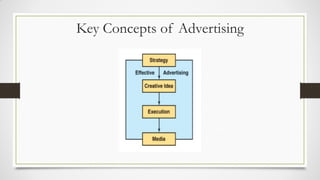
Key Concepts of Advertising
Key Concepts of Advertising- Advertising
Strategy
logic and planning behind the advertisement that gives it direction and focus
Advertisers develop ads to:
 Meet specific objectives
 Target a certain audience
 Speak to that audience’s most important concerns
 Appear in media that will reach the audience most effectively
Key Concepts of Advertising- Creativity
The creative concept is the ad’s central idea
 Grabs your attention
 Sticks in your memory
Creativity drives the entire advertising field
 In planning strategy
 In conducting research
 In buying and placing ad
Key Concepts of Advertising- Creative
Media Use
 How the message is being delivered ?
 Example: television, magazines, or the Internet
 Communication channels that reach a broad audience
 How to deliver the message is just as important coming up with the creative
idea of the message
Key Concepts of Advertising
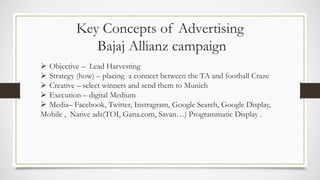
Bajaj Allianz campaign
 Objective – Lead Harvesting
 Strategy (how) – placing a connect between the TA and football Craze
 Creative – select winners and send them to Munich
 Execution – digital Medium
 Media– Facebook, Twitter, Instragram, Google Search, Google Display,
Mobile , Native ads(TOI, Gana.com, Savan…) Programmatic Display .
Exercise
Key Concepts of Advertising
Audi
Objective
Strategy (how)
Creative
Execution
Media
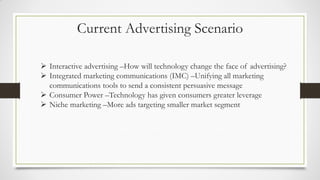
Current Advertising Scenario
 Interactive advertising –How will technology change the face of advertising?
 Integrated marketing communications (IMC) –Unifying all marketing
communications tools to send a consistent persuasive message
 Consumer Power –Technology has given consumers greater leverage
 Niche marketing –More ads targeting smaller market segment
Thank You

Introduction to advertising

  • 1.
    Introduction to Advertising SushantDommeti dcsushant@gmail.com +91 7710904827
  • 2.
  • 3.
    Defining Modern Advertising Advertisingis Paid persuasive communication Uses non personal mass media to reach broad audiences to connect an identified sponsor with a target audience
  • 4.
    Types of Advertising BrandAd Brand Ad also known as national consumer focuses on developing a long-term brand identity and image. Usually, no retail sales messaging. You can identify a brand name. The ad is driving the brand’s identity. It is targeted at national consumer.
  • 8.
    Types of Advertising Retail/ Local advertising Selling products in certain geographical area With an aim to create awareness about the brand by letting people experience the actual product, the brand has also placed some of its best-selling chairs on display at the lounge
  • 9.
    Signs of retailad: Can you see the word sales. % off.
  • 10.
    Types of Advertising PoliticalAdvertising Politicians use advertising to persuade people to vote for them or their ideas.
  • 11.
    Types of Advertising DirectoryAdvertising used by people to find how to buy a product or service OLX Quikr Click.in Sulekha
  • 12.
    Types of Advertising DirectResponse Advertising Tries to stimulate sales directly Sign for direct response ad: Number to dial, website to login (where u need to respond
  • 15.
    Types of Advertising Businessto Business advertising messages directed at retailers, wholesalers, distributors, purchasers and professionals
  • 16.
    Types of Advertising InstitutionalAdvertising Corporate advertising used to establish an identity or influence public opinion
  • 17.
    Types of Advertising Institutionalad Usually, it is for a corporation, not a brand. Can you see that the message is driving at establishing a corporate identity? Or winning the public over to the corporation’s point of view?. https://www.youtube.com/watch?v=nnsSUqgkD wU
  • 18.
    Types of Advertising PublicService advertising Also known as nonprofit advertising) communicates a message for a good cause
  • 19.
    Types of Advertising InteractiveAdvertising Delivered to individual consumers who have access to a computer and the internet
  • 21.
  • 22.
    Interactive Banner adsbest examples https://www.youtube.com/watch?v=dSkJoT6RM28 https://www.youtube.com/watch?v=Wd_8okTcyog https://www.youtube.com/watch?v=1qx2ZGPqVOw https://www.youtube.com/watch?v=G4t_6pn_CPU
  • 23.
  • 24.
    Types of advertisingthis print ad falls under
  • 25.
    Types of advertisingthis print ad falls under
  • 26.
    Types of advertisingthis print ad falls under
  • 27.
    Types of advertisingthis print ad falls under
  • 28.
    Types of advertisingthis print ad falls under https://shop.adidas.co.in/
  • 29.
    Types of advertisingthis print ad falls under
  • 30.
    Types of advertisingthis print ad falls under
  • 31.
    Types of advertisingthis print ad falls under
  • 32.
    Role of Advertisingin the perspective of Marketing • The process a business uses to satisfy consumer needs by providing goods and services. • Carry persuasive messages to actual/potential customers
  • 33.
    Role of Advertisingin the perspective of Marketing (1) advertising is seen as a vehicle for helping consumers assess value, through price as well as other elements, such as quality, location, and reputation. May help consumers better assess value. (2) advertising is seen as so persuasive that it decreases the likelihood that a consumer will switch to an alternative product regardless of the price charged. May make consumers less price sensitive.
  • 34.
    Role of Advertisingin the perspective of Marketing - Societal Societal Inform about new products, help consumers compare products, mirror fashion, influence taste  Informs consumers about innovations & issues  Mirrors fashion and design trends  Teaches consumers about new products  Helps shape consumer self-image  Perpetuates self-expression
  • 35.
    Role of Advertisingin the perspective of Marketing - Communication  form of mass communication, connecting buyers and sellers in the marketplace.  Transmits market information to match buyers and sellers in the marketplace. (provides information on product, price & place
  • 36.
    Functions of Advertising Builds awareness of products and brands.  Creates a brand image.  Provides product and brand information (Eg: )  Persuades people (note: Not bluff, cheap or con)  Provides incentives to take action (eg: Buy two get 5 free, sure eat durians)  Provides brand reminder (eg coke, pepsi  Reinforces past purchases and brand experiences
  • 37.
    Key Players inAdvertising  The Media composed of the channels of communication that carry the message from the advertiser to the audience.  Example: TV, Newspaper, Buses, Taxis, Billboard, Internet
  • 38.
    Key Players inAdvertising  The Suppliers (Vendors) Suppliers or vendors assist advertisers, advertising agencies, and the media in creating and placing ads.  Example: artists, writers, photographers, directors, producers, and printers
  • 39.
    Key Players inAdvertising  The Audience customer or prospective custome
  • 40.
    Key Players inAdvertising  Example: Bajaj Allianz JFC7 Campaign (link-  Advertiser: Bajaj Allianz  Agency: Adjetter Media Pvt Ltd  Media: – Facebook, Twitter, Instragram, Google Search, Google Display, Mobile  Audience:
  • 41.
    Why need foreffectiveness Advertising  Today advertising is in a bind o A down economy o New technologies that threaten how advertising works eg. Email spam, SMS ads, Search, social Media o Increasing clutter  Advertisers expect specific results that lead to sales  Advertising must be effective
  • 42.
    Why need foreffectiveness Advertising  Consumers (considered effective when) • View ads for entertainment/curiosity • May then learn the ad relates to a need • May receive an incentive to risk change • May find reinforcement for product decisions (reducing cognitive dissonance)  Advertisers (considered effective when) • Ads must gain consumers’ attention • Ads must hold attention long enough to change consumer purchasing behavior
  • 43.
    Why need foreffectiveness Advertising  Consumers (considered effective when) • View ads for entertainment/curiosity • May then learn the ad relates to a need • May receive an incentive to risk change • May find reinforcement for product decisions (reducing cognitive dissonance)  Advertisers (considered effective when) • Ads must gain consumers’ attention • Ads must hold attention long enough to change consumer purchasing behavior
  • 44.
    Key Concepts ofAdvertising
  • 45.
    Key Concepts ofAdvertising- Advertising Strategy logic and planning behind the advertisement that gives it direction and focus Advertisers develop ads to:  Meet specific objectives  Target a certain audience  Speak to that audience’s most important concerns  Appear in media that will reach the audience most effectively
  • 46.
    Key Concepts ofAdvertising- Creativity The creative concept is the ad’s central idea  Grabs your attention  Sticks in your memory Creativity drives the entire advertising field  In planning strategy  In conducting research  In buying and placing ad
  • 47.
    Key Concepts ofAdvertising- Creative Media Use  How the message is being delivered ?  Example: television, magazines, or the Internet  Communication channels that reach a broad audience  How to deliver the message is just as important coming up with the creative idea of the message
  • 48.
    Key Concepts ofAdvertising Bajaj Allianz campaign  Objective – Lead Harvesting  Strategy (how) – placing a connect between the TA and football Craze  Creative – select winners and send them to Munich  Execution – digital Medium  Media– Facebook, Twitter, Instragram, Google Search, Google Display, Mobile , Native ads(TOI, Gana.com, Savan…) Programmatic Display .
  • 49.
  • 50.
    Key Concepts ofAdvertising Audi Objective Strategy (how) Creative Execution Media
  • 51.
    Current Advertising Scenario Interactive advertising –How will technology change the face of advertising?  Integrated marketing communications (IMC) –Unifying all marketing communications tools to send a consistent persuasive message  Consumer Power –Technology has given consumers greater leverage  Niche marketing –More ads targeting smaller market segment
  • 52.