ADVERTISING
MANAGEMENT
BY
SALMAN MEHMOOD
Chapter Overview
• Advertising management
• Choosing an advertising agency
• Advertising campaign management
 Research
 Budget
 Media selection
 Creative brief
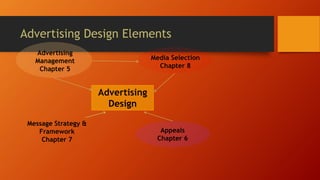
Advertising Design Elements
Advertising
Design
Advertising
Management
Chapter 5
Appeals
Chapter 6
Message Strategy &
Framework
Chapter 7
Media Selection
Chapter 8
Advertising Terms
• Message theme
 Key ideas
• Leverage point
 Connects to value
• Appeal
 Attract attention
• Executional framework
 Delivery
Advertising Management
• Advertising management is a planned managerial process designed to
oversee and control the various advertising activities involved in a
program to communicate with a firm's target market and which is
ultimately designed to influence the consumer's purchase decisions.
• Evaluate role of advertising in IMC program.
• Select in-house or external agency.
• Develop advertising management strategy.
• Develop creative brief.
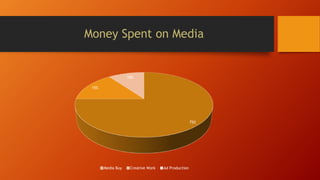
Money Spent on Media
75%
15%
10%
Media Buy Creative Work Ad Production
Advertising fit in IMC
• Advertising still major component
• Role of advertising varies
• Business-to-business sector
• Supporting role
• Consumer sector
• Primary communication vehicle
Oscar Mayer IMC Campaign
In-House or Outside Advertising Agency
Decision Criteria
• The size of the account
• The media budget
• Objectivity
• Product complexity
• Creative ability
In-House versus Outside Agency
In-House
• Lower costs
• Consistent message
• Better understanding of
product and mission
• Faster
• Lower turnover rate in the
creative team
Outside Agency
• Reduce fixed costs
• Greater expertise
• Outsider’s perspective
• Access to top talent
Choosing an Agency
• Screen initial list of agencies
 Reference requests
 Retention rate
 Reason for switching agencies
• Creative pitch
 Shootout
 2 to 3 finalists
 Specific problem/situation
 Expensive for agencies
• Agency selection
Advertising Campaign Management
1. Conduct/review advertising research
2. Establish advertising objectives
3. Review advertising budget
4. Select media
5. Prepare creative brief
Cont..
• DEF: Advertising campaigns are the groups of advertising messages which are
similar in nature. They share same messages and themes placed in different
types of medias at some fixed times. The time frames of advertising
campaigns are fixed and specifically defined.
• Research: first step is to do a market research for the product to be
advertised. One needs to find out the product demand, competitors, etc.
• Know the target audience: one need to know who are going to buy the
product and who should be targeted.
• Deciding a proper theme: the theme for the campaign has to be decided as in
the colors to be used, the graphics should be similar or almost similar in all
ads, the music and the voices to be used, the designing of the ads, the way
the message will be delivered, the language to be used, jingles, etc.
Cont..
• Selection of media: the media or number of Medias selected
should be the one which will reach the target customers.
• Media scheduling: the scheduling has to be done accurately so
that the ad will be visible or be read or be audible to the targeted
customers at the right time.
• Executing the campaign: finally the campaign has to be executed
and then the feedback has to be noted.
Cont.……
• All campaigns do not have fix duration.
• Some campaigns are seasonal and some run all year round.
• All campaigns differ in timings.
• Some advertising campaigns are media based, some are area
based, some are product based, and some are objective based.
• It is seen that generally advertising campaigns run successfully,
but in case if the purpose is not solved in any case, then the
theory is redone, required changes are made using the
experience, and the remaining campaign is carried forward.
Objectives of Advertising Management
Four main Objectives of advertising are:
• 1) Trial
• 2) Continuity
• 3) Brand switch
• 4) Switching back
Let’s take a look on these various types of objectives.
Cont.
• Trial: the companies which are in their introduction stage
generally work for this objective. The trial objective is the one
which involves convincing the customers to buy the new product
introduced in the market. Here, the advertisers use flashy and
attractive ads to make customers take a look on the products and
purchase for trials.
• Continuity: this objective is concerned about keeping the existing
customers to stick on to the product. The advertisers here
generally keep on bringing something new in the product and the
advertisement so that the existing customers keep buying their
products.
Cont.
• Brand switch: this objective is basically for those companies who
want to attract the customers of the competitors. Here, the
advertisers try to convince the customers to switch from the
existing brand they are using to their product.
• Switching back: this objective is for the companies who want
their previous customers back, who have switched to their
competitors. The advertisers use different ways to attract the
customers back like discount sale, new advertise, some reworking
done on packaging, etc.
ANY QUESTIONS?
THANK YOU 

Advertising management

  • 1.
  • 2.
    Chapter Overview • Advertisingmanagement • Choosing an advertising agency • Advertising campaign management  Research  Budget  Media selection  Creative brief
  • 3.
    Advertising Design Elements Advertising Design Advertising Management Chapter5 Appeals Chapter 6 Message Strategy & Framework Chapter 7 Media Selection Chapter 8
  • 4.
    Advertising Terms • Messagetheme  Key ideas • Leverage point  Connects to value • Appeal  Attract attention • Executional framework  Delivery
  • 5.
    Advertising Management • Advertisingmanagement is a planned managerial process designed to oversee and control the various advertising activities involved in a program to communicate with a firm's target market and which is ultimately designed to influence the consumer's purchase decisions. • Evaluate role of advertising in IMC program. • Select in-house or external agency. • Develop advertising management strategy. • Develop creative brief.
  • 6.
    Money Spent onMedia 75% 15% 10% Media Buy Creative Work Ad Production
  • 7.
    Advertising fit inIMC • Advertising still major component • Role of advertising varies • Business-to-business sector • Supporting role • Consumer sector • Primary communication vehicle
  • 8.
  • 9.
    In-House or OutsideAdvertising Agency Decision Criteria • The size of the account • The media budget • Objectivity • Product complexity • Creative ability
  • 10.
    In-House versus OutsideAgency In-House • Lower costs • Consistent message • Better understanding of product and mission • Faster • Lower turnover rate in the creative team Outside Agency • Reduce fixed costs • Greater expertise • Outsider’s perspective • Access to top talent
  • 11.
    Choosing an Agency •Screen initial list of agencies  Reference requests  Retention rate  Reason for switching agencies • Creative pitch  Shootout  2 to 3 finalists  Specific problem/situation  Expensive for agencies • Agency selection
  • 12.
    Advertising Campaign Management 1.Conduct/review advertising research 2. Establish advertising objectives 3. Review advertising budget 4. Select media 5. Prepare creative brief
  • 13.
    Cont.. • DEF: Advertisingcampaigns are the groups of advertising messages which are similar in nature. They share same messages and themes placed in different types of medias at some fixed times. The time frames of advertising campaigns are fixed and specifically defined. • Research: first step is to do a market research for the product to be advertised. One needs to find out the product demand, competitors, etc. • Know the target audience: one need to know who are going to buy the product and who should be targeted. • Deciding a proper theme: the theme for the campaign has to be decided as in the colors to be used, the graphics should be similar or almost similar in all ads, the music and the voices to be used, the designing of the ads, the way the message will be delivered, the language to be used, jingles, etc.
  • 14.
    Cont.. • Selection ofmedia: the media or number of Medias selected should be the one which will reach the target customers. • Media scheduling: the scheduling has to be done accurately so that the ad will be visible or be read or be audible to the targeted customers at the right time. • Executing the campaign: finally the campaign has to be executed and then the feedback has to be noted.
  • 15.
    Cont.…… • All campaignsdo not have fix duration. • Some campaigns are seasonal and some run all year round. • All campaigns differ in timings. • Some advertising campaigns are media based, some are area based, some are product based, and some are objective based. • It is seen that generally advertising campaigns run successfully, but in case if the purpose is not solved in any case, then the theory is redone, required changes are made using the experience, and the remaining campaign is carried forward.
  • 16.
    Objectives of AdvertisingManagement Four main Objectives of advertising are: • 1) Trial • 2) Continuity • 3) Brand switch • 4) Switching back Let’s take a look on these various types of objectives.
  • 17.
    Cont. • Trial: thecompanies which are in their introduction stage generally work for this objective. The trial objective is the one which involves convincing the customers to buy the new product introduced in the market. Here, the advertisers use flashy and attractive ads to make customers take a look on the products and purchase for trials. • Continuity: this objective is concerned about keeping the existing customers to stick on to the product. The advertisers here generally keep on bringing something new in the product and the advertisement so that the existing customers keep buying their products.
  • 18.
    Cont. • Brand switch:this objective is basically for those companies who want to attract the customers of the competitors. Here, the advertisers try to convince the customers to switch from the existing brand they are using to their product. • Switching back: this objective is for the companies who want their previous customers back, who have switched to their competitors. The advertisers use different ways to attract the customers back like discount sale, new advertise, some reworking done on packaging, etc.
  • 19.
  • 20.